



Abstract
Lay abstract
Autistic children often have limited opportunities to participate in leisure activities, which can contribute to a poorer quality of life and challenges during childhood. To address this, strategies are needed that help autistic children increase their participation in leisure activities, including activities that take place in nature. Ocean Heroes is a strengths-based leisure programme in Australia that offers surfing lessons to autistic children. This study looked at the key aspects of the surfing lessons provided by Ocean Heroes, exploring the environment in which the lessons take place, the specific activities involved, the experiences of the children, and how all these factors are connected. Researchers interviewed 17 autistic children, 16 parents and nine coaches, gaining insights on their experiences with the Surf Experience Programme. Findings indicated that factors related to the setting including identification and familiarity with surfing and beach culture, changing weather and locations, sensory benefits, and personal factors set the scene for the development of children's independence, well-being, relationships, and future goals. Within the setting, factors including the way coaches interacted with children, the presence of opportunities for children to socialise with others, the development of perseverance allowing children to overcome setbacks, and the fact that the activity was fun, were instrumental in generating these outcomes. Data analysis revealed that these outcomes were not the result of isolated factors, but rather emerged from the interplay of contextual elements and mechanisms. This underscores the importance of considering the complex interactions between setting, individual strengths, and the actions of participants. Implications are that when designing strategies to increase autistic children's participation in leisure activities it is vital to consider children's personal strengths and interests. Leisure programmes and activities that accommodate strengths and interests are more likely to engage autistic children, enhancing their childhood and increasing their social participation, involvement in the community, and quality of life.
Introduction
From a neurodiversity perspective, autism is a natural variation in human neurodevelopment, regarding processing, communication and sensory experience. It is also defined by the American Psychiatric Association (APA) as part of a broader neurodevelopmental condition characterised by differences in social communication and restricted or repetitive patterns of behaviour, interests, or activities (American Psychiatric Association, 2013). Like other countries around the world, Australia is experiencing an unprecedented rise in the number of people diagnosed with autism (Australian Bureau of Statistics, 2022). In 2022, an Australian national population survey estimated there were 290,900 (1.1%) autistic Australians, a 41.8% increase from 2018 (ABS, 2022). School-aged children represent the largest group of autistic individuals in Australia, making up 73% of the diagnoses and 4.1% of the school-aged population (ABS, 2022).
Autistic children participate less frequently and in fewer community, leisure, and out-of-school activities than their neurotypical peers (Hilton et al., 2008; LaVesser & Berg, 2010). In line with the United Nations’ Convention on the Rights of Persons with Disabilities, reduced opportunities to engage in formal or informal activities, including those in nature, threatens the wellbeing of autistic children and their right to experience childhood (Askari et al., 2015; United Nations, 2013). Ensuring autistic children can fully and effectively participate in activities is important in fulfilling their human rights, and their equality, inclusivity, and personal and societal development (United Nations, 2006, 2015). Programmes focusing on leisure activities have the potential to promote involvement in communities and participation in physical activity for autistic youth (Borgi et al., 2016; DeJesus et al., 2020), with effects optimised when programmes are person-centred, accessible and with informed providers (Dutta & Dey, 2024).
Current Australian guidelines emphasise the importance of programmes being child and family-centred, individualised and strength focused (Autism CRC, 2023). A strengths-based activity is one that aligns with an individual's interests and strengths. In addition to this, it has also been proposed that the design and delivery of these programmes is underpinned by the participant's values, autonomy and requirements (Autism Cooperative Research Centres [Autism CRC], 2023; Jones et al., 2023). These components serve as foundational elements to support meaningful engagement, learning and development. Unlike medically based programs that focus on perceived deficits, strengths-based approaches centre on an individual's abilities and attributes, leveraging these in improving functional outcomes (Department of Education and Early Childhood Development, 2012; Jones et al., 2023). These approaches are in line with international guidelines which call for holistic approaches to health promotion, underlying the importance of considering an individual's context in addition to the mechanisms of a programme (Autism CRC, 2023).
Ocean Heroes is an organisation based in Western Australia offering strengths-based surfing sessions for autistic individuals (Ocean Heroes, 2024). Surfing is an integral part of Australian culture and presents physical challenges and a platform to build connections with communities and individuals (Manero et al., 2024)
Results from previous studies focusing on other leisure programmes emphasise the potential for positive outcomes for participating groups (Bohnert et al., 2019; DeJesus et al., 2020; Lawson et al., 2014). While it is recognised that participating in the Ocean Heroes’ Surf Experience programme promotes positive outcomes in autistic children and youth, the how and why remain unclear. While existing research on strengths-based activities provides valuable insights into the complex connections between their context, mechanisms and outcomes for autistic populations (Jones et al., 2021; Willis et al., 2018), it remains undocumented what effect surfing has on autistic youth, their parents, and coaches. Given that understanding these factors is a necessary step for expanding any service across a community for health promotion (Moore et al., 2015) it is important to investigate the unique perspectives of participants to identify the contexts and mechanisms that produce positive outcomes in Ocean Heroes’ Surf Experience programme.
Aim
This study aimed to identify context features, programme elements, experienced outcomes, and their connections, of the strengths-based surfing lessons offered by Ocean Heroes for autistic school-aged children.
Methods
Design
This qualitative study employed a realist evaluation methodology to explore the Ocean Heroes’ programme for Australian autistic children. This type of evaluation provides a framework for evaluation, identifying what works for whom and why (Pawson & Tilley, 1997). Realist evaluation has been used in previous research examining a strengths-based coding club for autistic adolescents in Australia (Jones et al., 2021), an adaptive physical activity programme for children with disabilities in Norway (Willis et al., 2018), and a specialist peer mentoring programme for autistic university students in Australia (Thompson et al., 2018). The approach has shown utility in understanding the active ingredients of existing programmes aiming to support the participation outcomes of individuals with disabilities.
Participants
The participants in this study were 17 autistic children, 16 parents, and nine coaches, all of whom took part in the surfing sessions provided by Ocean Heroes. Coaches and parents were approached in-person and provided with an information statement outlining the study's aims and procedures. Informed consent was obtained from parents for their own and their child's participation. Children were provided with an adapted Assent Form. There were five fathers, and 11 mothers recruited, all primary caregivers of participating children. Children were included if they were participating in Ocean Heroes’ surfing sessions, were between the ages of eight and 18 years and had an autism diagnosis. Each parent recruited had one or two children participating in the study and one parent dyad was recruited. Sociodemographic and clinical details for participants are presented in Table 1.
Participant Sociodemographic and Clinical Details.

*According to parent reported SRS-2 (Constantino, 2013). The authors acknowledge that the use of a severity scale (mild, moderate, severe) to classify social responsiveness is under much debate. This framework was employed as it ensured consistency in data collection and to aid comparability of results, not to define individuals by their perceived level of function. SD: standard deviation; SRS-2: Social Responsiveness Scale-2.
Description of Programme
Ocean Heroes is a not-for-profit organisation operating with a team of five full-time staff and 15 casual coaches. Programmes span the state of Western Australia and more recently the east coast of Australia. Surfing sessions take place at various beaches across Australia, depending on the season and weather. Ocean Heroes’ Surf Experience programme focuses on promoting physical activity and social interaction through outdoor activities, with most participants being autistic youth. Over 9,000 individuals with autism have surfed with the organisation since 2016, through their different programmes and events. Individualised goals, ranging from donning a wetsuit to catching a wave, are adjusted as needed. During their surf experience sessions, each young person is coached by one to two experienced surf coaches during a one-hour session approximately once a week. A session costs 110 AUD with funding often accessible through government or disability support schemes. While some youths are coached by the same coach, others alternate coaches across sessions, with multiple youth being coached simultaneously. There are opportunities during sessions for participants to interact with other coaches and other participants (if other participants are booked for the same time). Coaches are regularly trained in first aid qualifications, surf rescue certificates and autism awareness.
Data Collection
The first author spent three months with Ocean Heroes, undertaking data collection during weekly surfing lessons from September 2024 to November 2024. Data collection was based on realist evaluation employing a sociodemographic questionnaire completed by parents and coaches, together with ethnographic data collection methods (semi-structured interviews with children, parents and coaches, and observations of surfing sessions). Data collection through ethnographic approaches, such as interviews and observations, can complement realist evaluation by allowing for insider status and insights into how the programme and its participants work in practice (Black et al., 2021).
Interviews
In total, there were 37 completed interviews with 13 children, 16 parents and eight coaches. Interviews were semi-structured, with the interviewer using ‘active listening’ to gauge the most appropriate approach of asking questions (Corbin & Strauss, 2015). With the help of a discussion guide (Appendix 1), information was obtained on children's level of participation, the mechanisms employed in surfing sessions, and programme outcomes. The guide was depicted visually to enhance accessibility (Tang et al., 2019). Participants were given the opportunity to write their responses to the questions, enabling the participation of children preferring to not verbally participate in an interview. All participants were given the choice of engaging in an interview in person, online or via a phone call, with 36 interviews undertaken in person and one interview over the phone. These were recorded using a digital audio recorder, transcribed verbatim, and compared with field notes taken during interview and observation sessions.
Observations
Observations were conducted to help identify patterns in behaviour, informing understanding on the reasons behind observed emotional and behavioural responses. The observations were structured according to the Activities, Environment, Interactions, Objects and Users (AEIOU) observation framework (Wasson, 2000). The first author conducted the participant observations during the surfing sessions, both in and out of the water, with data recorded via field notes. The researcher took care to ensure that their presence did not impact on the achievement of the surfing session's goals, taking on the role of an interested observer. Observations were completed with eight coaches and 16 children with field notes organised and coded similarly to interview data.
Surveys
A sociodemographic questionnaire captured characteristics of participants. The Social Responsiveness Scale – 2 (SRS-2) was administered via parent proxy report indicating the severity of children's autistic traits (Constantino, 2013). Parent and coaches could choose to complete the surveys on paper or online via a tablet or email link.
Data Analysis
Thematic Analysis
This study utilised the reflexive approach to thematic analysis, as described by Braun and Clarke (2012), to explore the data within the context of realist evaluation. A realist evaluation focuses on identifying the contexts, mechanisms and outcomes of a programme. Once identified, these terms can be linked together according to the context-mechanism-outcome (CMO) framework (Pawson & Tilley, 1997). To achieve this, transcripts and field notes were imported into NVivo software (version R14.23.2) (Lumivero, 2023; Zamawe, 2015), with phrases coded as they related to contexts, mechanisms or outcomes. Phrases were coded as context if they described what influenced a situation before the programme and included aspects such as the individual and their prerequisites, available services and the environment. If phrases identified components necessary in enabling certain outcomes they were coded as a mechanism. Data was categorised as an outcome if it related to the effects or outcomes experienced by the participants in this study. Following coding into these predetermined categories, themes were identified. NVivo was used to organise, manage and visualise the data, facilitating the generation of CMO configurations.
Statistics
Data from the sociodemographic surveys and completed SRS-2 forms was entered into IBM SPSS Statistics (version 29.0.0.0) and summarised via descriptive statistics. Age, gender and distance to beach (mean drive in minutes with standard deviation) were analysed. Age was self or parent-reported in completed years and analysed including range (lowest and highest reported ages) and mean (with standard deviation). Gender options other than binary choice (male or female) were provided, however all participants reported themselves or their children as either male or female. Parental role (father or mother) was assumed according to reported parental gender.
Trustworthiness
The trustworthiness of the study was enhanced by ensuring it aligned with the guidelines of Lincoln and Guba (1986). According to the guidelines, research is deemed trustworthy if it is credible, transferable, dependable, and confirmable. The credibility of the study was strengthened by ensuring participant selection was inclusive, involving children, parents, and coaches of varying ages, genders, and experiences (Birt et al., 2016). Transferability was supported by the provision of a detailed description of the programme, participants, and methods (Ahmed, 2024). To ensure dependability, the research team engaged in regular discussions to maintain consistency and account for shifts in perspective (Ahmed, 2024). Confirmability was considered during the process of thematic analysis and the regular evaluation of emerging themes and questions (Ahmed, 2024). Member checking was performed, with participants confirming the main findings (Harvey, 2015).
Ethical Considerations
Participants were provided with information and consent forms, available in several formats ensuring accessibility. Participants had the opportunity to ask questions or raise concerns during surfing sessions. Participants were informed that there would be no effect on their continued surfing experience if they decided not to participate in the study or withdraw their involvement. Information collected was de-identified by assigning each participant an identifier code, ensuring anonymity. This project was approved by Curtin University's Human Research Ethics Committee (HRE2017-0147) and complies with the Australian National Statement on Ethical Conduct in Human Research (2023).
Positionality
The second and last authors are experienced researchers with more than 15 years of experience in autism research. The second author has an educational background while the last author is an occupational therapist with clinical experience. The first author has a medical background and was guided and mentored by the second and last authors in the research design, data collection and analysis process. The third author has extensive experience in delivering strengths-based programmes for autistic adolescents, while the fourth and fifth authors have a background in psychology with experience in the disability and neurodiversity sector. The authors’ varied backgrounds in autism research, education, occupational therapy, psychology, and strengths-based programme delivery influenced the research process, ensuring a holistic and multi-disciplinary approach to understanding the experiences of autistic individuals.
Results
Context
Coding generated 42 codes relating to the context of the programme. Thematic analysis of these codes revealed four overarching themes, all identified by children, parents and coaches. These contexts were: Identity (C1), Environment (C2), Personal factors (C3), and Logistics (C4). See Table 2 for identified themes and subthemes relating to context, and Table 3 for additional supporting quotes.
Overview of Context Themes and Subthemes.

Identified Themes, Subthemes, and Example Quotes Related to Context.

C1. Identity
Identity referred to how the participants of this study viewed themselves, as well as their innate preferences and connection with the environment. Feeling a sense of identity contributed to explaining why children, parents and coaches chose to continue to participate in the Surf Experience programme. The theme of identity was divided into two sub-themes, consisting of Cultural norms (C1.1) and Familiarity (C1.2).
C1.1 Cultural Norms
Children, parents and coaches identified cultural norms relating to surfing and the beach as aligned with their traditions, values and practices. Surfing was described as ‘a big thing in Australia’ (Parent 10) and ‘a massive culture’ (Parent 13). Children identified with surfing culture, thinking of themselves as surfers, ‘I’m like a fish. I love being in the water.’ (Child 12). Some parents also regarded surfing as part of their identity which motivated them to support their children in engaging with the Ocean Heroes’ Surf Experience programme, ‘I’ve been a surfer all my life’ (Parent 9). Even parents who ‘didn't surf’ supported their children's preferences ‘[my son] always loved the water’ (Parent 8), while others identified with their surroundings, ‘[…] we have always been beach people’ (Parent 10). Surfing and spending time in the water transcended simply being a hobby or work, with coaches describing themselves as ‘an ocean lover’ (Coach 1) and ‘the biggest water baby’ (Coach 5).
C1.2 Familiarity
The subtheme of familiarity captures how most children and parents were used to going to the beach, spending time in the water or being familiar with the idea of surfing. Those who identified with their surroundings tended to be familiar with going to the beach, swimming (in pools or the ocean), surfing and other water-based activities, ‘The beach is everybody's happy place’ (Parent 10). Familiarity with impacted motivation for continued engagement, with participants choosing to continue engaging in an activity they knew at a location where they had previous experience.
Familiarity was also impacted by distance. The parents who had their child surfing at the beaches in Perth reported a mean drive of 26.1 min (SD = 16.2) to get to one of the beaches, reflecting how most of those involved in the study lived relatively near the ocean and had geographical opportunity to access the sessions.
C2. Environment
All surfing sessions were held outside and were dependent on favourable weather conditions. The theme of environment included the subthemes of: Weather (C2.1), Location (C2.2) and Sensory aspects (C2.3).
C2.1 Weather
The weather was the primary factor in determining whether surfing sessions were possible and what activities were planned. An onshore wind, no waves, rain, cold, extreme heat and strong currents were described as less favourable conditions for surfing. The weather affected the water and air temperature, impacting participants’ experience and enjoyment, see Table 3. The weather also affected which boards were used, the type of surfing, how long the participants spent in the water and their feelings afterwards. If the conditions were deemed as too challenging, session plans were altered, for example, when the water was flat, ‘they do a lot of beach games’ (Parent 4) or ‘they'll get the boogie boards out and they'll get other stuff out.’ (Parent 13).
C2.2 Location
Changing the location made it possible to provide surfing sessions throughout the year and seasons. The changing of beaches occurred every couple of months. In Perth, surfing sessions occurred at three different beaches, depending on the conditions. Perth beaches were public, sand beaches with low to high energy waves. Before each session, coaches identified the most suitable area for surfing, looking at aspects such as seaweed, sandbanks, currents, other beachgoers and waves. Suitability varied from week to week or even from one hour to the next.
C2.3 Sensory Aspects
There was a pre-existing belief among the parents and coaches that there were beneficial sensory aspects associated with surfing, ‘I like the feeling of saltiness, sea water.’ (Child 1). Water offered ‘that constant nice pressure’ (Coach 6), although the sensation of seaweed was generally disliked. Children enjoyed digging their hands and feet into the wet sand (see Table 3), with parents noting the impact of sensory aspects on their children's ability to regulate both inside and outside of surfing sessions.
C3. Personal Factors
Children and parents came to the Surf Experience programme with personal factors relating to interests, traits and goals. The theme was divided into three subthemes: Parents seeking support (C3.1), Children's characteristics (C3.2) and Coaches’ experiences (C3.3).
C3.1 Parents Seeking Support
While some parents denied having any goals for their children, all parents reported wanting their children to achieve something, whether to ‘do some fun stuff’ (Parent 14), ‘be part of the community’ (Parent 5) or ‘[to] give him confidence’ (Parent 11). Some wanted their child to increase their surfing skills, while others hoped for increased independence, instruction following, and staying safe in the water. Some parents also explicitly sought instructional support from the coaches, having tried to teach their children how to swim or surf, but ultimately concluding ‘there are some things that it's better if the parent is not the teacher’ (Parent 9).
C3.2 Children's Characteristics
Some children experienced difficulties understanding social cues and others struggled with verbal communication and direct instructions. Coaches were informed of preferred forms of communication, stimuli and interaction, either from parents, support workers, the children or by experience. Both coaches and parents noted the social hardships some of the children experienced with friends, at school and at home and how they enjoyed coming to the programme, see Table 3.
Children, parents and coaches shared stories of initial hesitation and refusal among the children due to a lack of familiarity with the activity, an inability to accommodate their preferences, or fear (e.g., of water, sharks, waves), ‘I didn't want to go in [the first time] because it was so busy and you know, huge waves.’ (Child 10a). By contrast, some parents shared that their child had ‘no sense of danger’ (Parent 8) or ‘doesn't have the awareness of his surroundings’ (Parent 13), enjoying the unpredictable ocean and dumping waves, ‘My favourite thing is when a lot of water splashes, like chaos.’ (Child 13b). Overall, children demonstrated determination in the water and were interested in becoming proficient surfers, ‘my goal [is to] enjoy surfing, like get on the big waves’ (Child 1) and ‘One day I would like to surf on a fiberglass board by myself.’ (Child 13a)
C3.3 Coaches’ Experiences
All coaches had surfing experience prior to their involvement in the Surf Experience programme. Some had experience of disability and most started with limited experience supporting autistic individuals.
Lack of experience was not described as an obstacle, with one coach sharing that it is the inherent empathy of the coaches that matters most. Parents expressed appreciation towards the coaches and their knowledge, ‘I mean they all surf. They're just a different type of people, like these guys that come out and take our kids out, I don't know what it is. they're just amazing.’ (Parent 8)
C4. Logistics
This theme referred to the resources and technology required to perform the Surf Experience programme. It was divided into four subthemes, consisting of Booking app (C3.1), Time (C3.2), Equipment (C3.3) and Supporting coaches (C3.4).
C4.1 Booking App
The surfing programme used a mobile application (app) for the booking of sessions. Parents could choose the time depending on school and other obligations, taking into consideration the goals of the session and children's preferences, ‘We choose to come at quiet times so that we don't have to deal with all of that.’ (Parent 5). It was also possible to request a specific coach, which some parents saw as a benefit, ‘You can request a coach and that does make a big difference because it all comes down to relationship and who they connect with.’ (Parent 10)
C4.2 Time
Each surfing session in the Surf Experience programme was scheduled for one hour, which was enough time for most participants, ‘Yeah, I think an hour is pretty much perfect, I think any less, it almost wouldn't be worth it.’ (Coach 1). If there was a need or want to surf for a longer time, children and parents could book more time using the app, ‘I mean, you can go for an hour, but you can also book for two hours, and I reckon that's enough’ (Child 14).
C4.3 Equipment
Ocean Heroes provided varying surfboards, bodyboards, wetsuits, life vests and sunscreen. The equipment was utilised to maximise comfort and safety, matching the skill and confidence levels of the children, ‘even if it's cold, they make sure like they put on the second wet suit’ (Parent 3). Other equipment such as buckets for making sandcastles provided the opportunity to do something else if the weather did not allow for surfing, or if a break was needed.
C4.4 Supporting Coaches
Overview of Mechanism Themes and Subthemes.

Mechanism
For mechanism, there were four major themes identified from 38 separate codes, all relating to the ideas and opportunities the Surf Experience programme brings: Coaches’ approaches (M1), Social (M2), Perseverance (M3) and Fun (M4). See Table 4 for identified themes and subthemes relating to mechanisms, and Table 5 for additional supporting quotes.
Identified Themes, Subthemes, and Example Quotes Related to Mechanisms.

M1. Coaches’ Approaches
This theme captured what the coaches did during each session that made the Surf Experience programme work, leading to the identified outcomes. The approaches of the coaches were divided into two subthemes: Adaptability (M1.1) and Ensuring safety (M1.2).
M1.1 Adaptability
Coaches continuously adapted the sessions and their approaches, understanding that the ‘Surfing Experience’ part of the programme could be many things. Delivering an individualised, person-centred and strengths-based approach, ‘they're able to adapt the session to meet the child where they're at, so in that way, they're noticing what their strengths are.’ (Parent 2). One parent shared, ‘it doesn't have to just be surfing’ (Parent 11), agreeing that a session without using the surfboard could be a perfectly good session.
M1.2 Ensuring Safety
Coaches continuously worked to ensure comfort and safety with the help of equipment, communication, and knowledge of environmental and personal preferences. Knowing when and what equipment to use, using verbal and physical cues when communicating, and listening to the participants and their parents ensured safety.
M2. Social
The Surf Experience programme provided the opportunity to meet people and be social. Two subthemes were identified under the theme Social: Interaction (M2.1) and Communication (M2.2).
M2.1 Interaction
Participants were encouraged to play and interact socially, either with other participants or with the coaches. Playing was described as an important reason for enjoying surfing, ‘What is my favourite thing about surfing? Playing with people.’ (Child 13b). Not all play required verbal communication, suiting participants who preferred to communicate non-verbally, see Table 5. On some occasions, coaches introduced children to each other, coordinating activities to ‘get [the children] doing the same kind of things’ (Parent 8). Party waves (multiple surfers catching the same wave) offered a fun way of incorporating surfing skills with social play, facilitating interaction between children. Even children who played or surfed independently were not completely isolated, ‘even though they're separate, he's fully aware of [the other participant] and the other kids that are around him.’ One-on-one coaching also facilitated interactions between coaches and participants. For the participants who did not prefer verbal communication, coaches maintained a relationship through actions, such as splashing water, high-fiving and applauding.
M2.2 Communication
Verbal communication played a significant role in social interactions between coaches, parents, and children. Coaches and children engaged in conversation during the sessions, including general instructions for surfing and more casual conversations about interests and daily life. Children received ‘comments and feedback on how my last wave was and what I can do to improve’ (Child 14), with verbal cues assisting them in learning to surf, ‘lie down on your tummy’ (Child 13b) and ‘one, two, three, stand up now’ (Child 7).
It was important for the participants to be able to chat with the coaches and make ‘offbeat’ comments, ‘with no pressure and no judgement’ (Parent 9). Children were invited to participate in conversations, with coaches setting examples of different types of communication, ‘The coaches interact with themselves and that models to the children that this is the sort of interaction that the children can have as well’ (Parent 2b). Parents shared that they had noticed children imitating or continuing the coaches’ way of making conversation, by ‘being goofy [and] mucking around’ (Parent 2b). Some participants also spoke with other children, usually with those who had previously been surfing together or with siblings.
M3. Perseverance
Setbacks were encountered by the children, coaches and parents, requiring perseverance in overcoming them. The theme is divided into two subthemes: Dealing with setbacks (M3.1) and Continuity (M3.2).
M3.1 Dealing with Setbacks
Occasionally, children would have a ‘wipe-out’, where they were thrown off their boards, see Table 5. Other types of setbacks included children getting water up their noses and being scared by aquatic animals. These experiences were often initially described as stressful, upsetting and ‘discouraging’ (Coach 3), and for some resulted in a child temporarily refusing to enter the water. Coaches played a key role in encouraging children to return to the water through ‘gentle coaxing’ (Parent 14) and ‘encouragement’ (Coach 3), and by maintaining awareness of their own reactions to setbacks, see Table 5. Coaches also ‘remain[ed] calm in all situations’ (Parent 7) and made sure ‘[my child] is OK’ (Parent 11).
M3.2 Continuity
Time and continuity were other components of dealing with setbacks and overcoming the initial fear experienced by some children, see Table 5. Continuity was also necessary in progressing surfing skills and developing closer relationships. Both parents and coaches acknowledged the benefits of maintaining the same coach across multiple sessions, as it allowed the participants and coaches to get to know each other. By contrast, alternating coaches was also described as beneficial as it allowed participants to find the coach with ‘that personality that [their child] really enjoys’ (Parent 2b).
M4. Fun
Fun was identified as a mechanism of change because it was required for continued involvement in the surfing programme and facilitated all outcomes. Two subthemes were derived from the theme: Playful participation (M4.1) and Atmosphere (M4.2)
M4.1 Playful Participation
Incorporating fun into every aspect was essential. Even dealing with setbacks required a light-heartedness for the children to stay engaged. Children enjoyed surfing because ‘it's fun’ (Child 12) and described the coaches as ‘really fun to be around’ (Child 12).
M4.2 Atmosphere
The surfing programme's ‘inclusive camaraderie’ (Parent 9) was described by parents and coaches as necessary for the children's learning and development. Maintaining a ‘good atmosphere’ (Coach 2) and ‘a good balance of fun and learning’ (Coach 2) involved creating opportunities for everyone to participate in the fun activities and interactions. For the children, Ocean Heroes differed from other programmes, mainly because of its sense of inclusivity, ‘[Child 15] said to me afterwards, she said, ‘do you know what, mum, the difference between the school surfing and this is?’ And I'm like, ‘what's that?’ And she goes ‘Ocean Heroes is the community’.’ (Parent 15).
Outcome
There were four major themes emerging from 30 separate codes capturing the outcomes of the Surf Experience programme: Independence (O1), Wellbeing (O2), Connections (O3) and Aspirations (O4). See Table 6 for identified themes and subthemes relating to outcomes, and Table 7 for additional supporting quotes.
Overview of Outcome Themes and Subthemes.

Identified Themes, Subthemes, and Example Quotes Related to Outcomes.
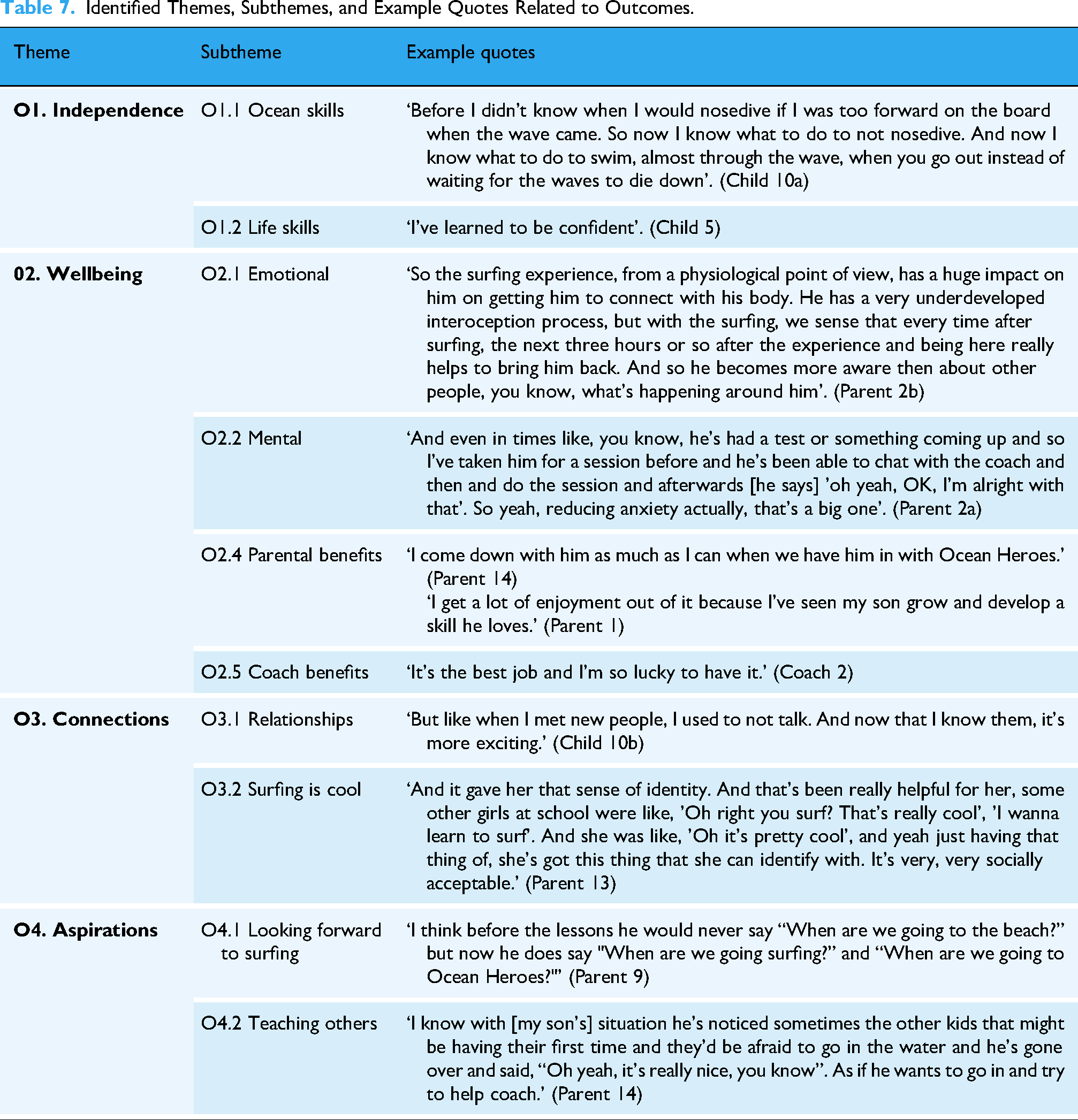
O1. Independence
Parents and coaches described increased independence in different aspects of children's lives because of engaging in the Surf Experience programme. The two subthemes were Ocean skills (O1.1) and Life skills (O1.2)
O1.1 Ocean Skills
Fundamentally, the Surf Experience programme helped participants ‘[get] better at surfing’ (Child 10b). Children described learning the skills required to independently surf; ‘that you have to bend your knees when you’re on the surfboard’ (Child 5), ‘how to stand up’ (Child 13b), and how ‘to turn on the surfboard’ (Child 1). Children were proud of the progress they made across sessions: ‘[I can paddle] on my own now, which I couldn't do at the start’ (Child 10a) and ‘I've learned the push up’ (Child 2). The children also gained water safety skills, improved swimming abilities, and learnt surfing etiquette, ‘he will carry his own board down now’ (Parent 4) and ‘I can now feel comfortable to let him go in [the water] by himself.’ (Parent 11). In addition to becoming surfers, some children also became better surfers, finding confidence in their acquired skills.
O1.2 Life Skills
Surfing and spending time in the ocean lead to increased independence in daily life. Children were described as ‘more willing to have a go at things’ (Parent 11), ‘more responsible’ (Parent 3) and having ‘learned about boundaries and waiting’ (Parent 2a). Some of the children were more comfortable staying home alone and were no longer ‘scared of baths and showers’ (Coach 6). Some children ‘felt very confident’ (Child 1) during sessions, with this sentiment stretching into parts of everyday life.
O2. Wellbeing
The Surfing Experience promoted different forms of wellbeing, with the theme divided into the following subthemes: Emotional (O2.1), Mental (O2.2), Physical (O2.3), Parental benefits (O2.4) and Coach benefits (O2.5).
O2.1 Emotional
Children, parents and coaches identified the participants as ‘happier’ after surfing, a feeling which persisted throughout the day. Some children were better able to ‘self-regulate’ (Parent 2a) after the session, being more in tune with their body, emotions and needs, ‘especially with hunger and thirst’ (Parent 2b). Parents sometimes described having a tough morning, a tough day or even a tough week, ‘but once they've had that one session, it's almost like they're cleansed of all that, their worries and all the things that are consuming them and they'll come out and they're happier.’ (Parent 10).
O2.2 Mental
Participating in the Surf Experience programme led to improved mental health for some of the coaches and children. Coaches attributed this improvement to sharing something they love with the community and feeling like they are doing a ‘good thing’ (Coach 6). For children who sometimes experienced anxiety and had difficulty sharing or expressing their worries, ‘after surfing, he would then be able to talk about what [he's] worried about’ (Parent 2b).
O2.3 Physical
Surfing with Ocean Heroes led to physical benefits for the children, including improved fitness, balance, strength, stamina, endurance and coordination. Feeling tired after a session was a welcomed outcome, leading to a calmer and more regulated child and a ‘peaceful’ rest of the day (Parent 10).
O2.4 Parental Benefits
Parents often enjoyed staying for the duration of sessions, see Table 7. Some parents enjoyed watching their children participate, while others took the opportunity to go for a swim or walk or sit down on the beach. This hour was described by some as the only time when someone else was taking care of their child and could be ‘a nice little break’ (Parent 13) where they got ‘an hour to [themselves]’ (Parent 8).
O2.5 Coach Benefits
The coaches shared their enjoyment in working for Ocean Heroes, expressing that they ‘look forward to coming for work’ (Coach 1) and calling it ‘the best place I could possibly work’ (Coach 2). It was seeing ‘where [the participants] came from and where they are now’ (Coach 5) and having an ‘amazing team’ (Coach 1) that made it enjoyable. Coaches also gained knowledge on autism, feeling more ‘educated’ (Coach 2) on autism and ‘the huge spectrum that there is’ (Coach 3). Understanding ‘what [the children have] had to overcome at school, in their personal lives’ (Coach 5), was humbling for some, reminding them of ‘what's important in life’ (Coach 5).
O3. Connections
The theme of connections was divided into two subthemes: Relationships (O3.1) and Surfing is cool (O3.2).
O3.1 Relationships
Parents shared that one of the most impactful outcomes of joining the Surf Experience programme was their children feeling a sense of belonging. They felt ‘part of a group’ (Parent 6), ‘part of a team’ (Parent 2a) and ‘part of a family’ (Parent 2a). Relationships with the coaches and other participants had helped them find confidence in their social abilities, some feeling like ‘I can talk to anyone’ (Child 1). Some of the parents felt they ‘found their people’ (Parent 13) and others like ‘we’ve joined a community’ (Parent 12).
O3.2 Surfing is Cool
Parents explained that surfing was something ‘cool’ (Parent 11) that the children could talk about in school and share with their friends, ‘I tell all my friends about it and they want to join.’ (Child 10a). It was an activity that others were interested in, which sometimes differed from ‘these sort of autistic special interest topics nobody else is interested in’ (Parent 11). It was something that gave the participants ‘a bit of street cred’ (Parent 13) and the identity of being ‘a surfer’, ‘potentially [making] that connection with other people that surf or go to the beach’ (Parent 6).
O4. Aspirations
Aspirations was divided into two subthemes: Looking forward to surfing (O4.1) and Teaching others (O4.2).
O4.1 Looking Forward to Surfing
After surfing, the children were ‘keen to come back again’ (Parent 11). Children looked forward to the sessions and there was little need to coerce them into participating, see Table 7. This was described as unique, as it was common for the children to resist leaving the house for an activity.
O4.2 Teaching Others
The potential of becoming a surfing coach was motivating to both parents and children, who were excited by the prospect of volunteering or coaching in the future, ‘[Child 13a]'s next goal with Ocean Heroes is to become a coach.’ (Parent 13). Parents encouraged children to speak with programme coordinators about their goals, working with them to progressively increase their responsibilities and independence. Volunteering at events was seen as a good starting point, dealing with tasks such as washing wetsuits and helping inexperienced participants.
Context-Mechanism-Outcome Linkages
Understanding the Surf Experience programme through the lens of a realist evaluation results in themes and subthemes relating to the context, mechanisms and outcomes of the programme. Analysis of the data reveals that these themes are rarely isolated and are required in combination with each other to explain the workings of the programme. Examples of linkages are outlined in Table 8.
Context-Mechanism-Outcome (CMO) Linkages within Sample Quotes.

To clarify the CMO linkages, for example, in the quote from Child 10a ‘And yeah, and when the waves are super bad (C2.1), we just play on the beach with the other kids’ the context is poor surf conditions (C2.1: Weather). Rather than the session being cancelled, the mechanism of adaptability (M1.1) is activated, where coaches and children adjust the session to suit the conditions. Simultaneously, interaction (M2.1) between children is facilitated through shared play. This leads to the outcome of building relationships (O3.1), showing what the programme could lead to even when the planned surfing activity is not possible.
Overall, no singular mechanism led to programme outcomes, but instead the interplay of multiple mechanisms and outcomes within contexts. The traditional linear causality model is therefore replaced with a generative causality model (Figure 1) (Wong et al., 2016), emphasising the different combinations of themes reflecting what works, for whom, in what circumstances, and how.

Generative Causality Model Showing the Linkages between Context, Mechanism and Outcome Themes in the Surf Experience Programme. Instead of a Linear Relationship Represented by an Arrow From Mechanisms to Outcomes, the Current Dumbbell Shape Represents the Tie and Interconnectedness of the Main Mechanisms and Outcomes within the Specified Context.
Discussion
This study aimed to understand what the Surf Experience leads to, and how. The findings suggest that the strengths-based surfing sessions benefited all participants, including autistic youth, their parents, and the coaches. A key finding was that these outcomes did not emerge from isolated factors alone, but from the dynamic interplay between contexts and mechanisms. This highlighted the interconnectedness between contextual features, including environmental conditions and participant characteristics, and mechanisms such as the adaptability demonstrated by both coaches and children. The interaction of these elements facilitated peer engagement and supported the development of social relationships among autistic children. This extends previous research by demonstrating that it is not merely the type of activity that drives change, but how it is delivered through strengths-based practices. The generative causality model reflects how each theme influences and interacts with the others, resulting in a refined programme programme theory to explain the workings of the programme.
A notable aspect of surfing is its dependence on suitable weather and waves (C2.1). Fluctuating weather conditions created both ideal and potentially hazardous situations, requiring constant adaptation. The coaches demonstrated their ability to adjust (M1.1), ensuring safety (M1.2) with their experience (C3.3) and equipment (C4.3). Despite these measures, there were occasions where participants were caught off guard by the conditions, experiencing unexpected setbacks. Coaches’ approach of dealing with setbacks (M3.1), including considering children's personal factors, lead to children re-engaging with the activity. With time and continuity (M3.2), the children's water skills improved (O1.1), both in terms of water safety and surfing ability. What is not unique to surfing is the need to persevere, being resilient in the face of adversity, in the context of support. While the role of perseverance in activities for autistic children remains underexplored, evidence suggests that the ability to recognise and address each participant's challenge is important in building resilience (Ghanouni et al., 2024). Overcoming obstacles, through resilience or perseverance, is important for long-term engagement and preventing adverse outcomes (Ghanouni et al., 2024; Rutberg et al., 2020). While the present study has provided some insight into the role that supported surfing experiences can play in promoting positive outcomes for autistic youth, future studies should further investigate the role of similar programmes in promoting resilience and self-esteem.
The programme resulted in the children becoming surfers, not merely because they learned to catch waves, but because they found belonging in a community. In this study, the children's identity (C1.1) aligned with the coaches being experienced surfers (C3.3), and sharing a self-identified interest created an opportunity to be social (M2). The participants formed relationships (O3.1) within Ocean Heroes, creating a neurodiverse network of friends and role models with shared interests and similar life experiences. It has been suggested that friendships based on shared interests could be highly significant to autistic individuals (Black et al., 2024; Lee et al., 2020), potentially making social interaction more comfortable. This is in line with research based on other strengths-based activities, such as technology clubs, where the importance of including facilitators with activity-specific experience is emphasised (Jones et al., 2021; Lee et al., 2024). Research indicates that facilitators experienced in the interest of autistic youth are better placed than health professionals to leverage the interests of these young people (Jones et al., 2021), and promote their community engagement. This notion aligns with the participants’ aspirations to share their experiences and knowledge with others, by coaching (O4.2), volunteering and telling their friends about surfing (O3.2). These outcomes suggest that participating in a social and leisure activity promotes community involvement for autistic youth. Existing evidence underpinning social and community-based support reflects this (NDIS, 2022), where programmes providing participation opportunities have been found to usually increase the process of feeling and being included, integrated and belonging (DeJesus et al., 2020; Lee et al., 2024; Willis et al., 2018). These findings contribute novel insights by illustrating how strengths-based approaches support the value of social and leisure activities in fostering community involvement among autistic youth, through connections and aspirations. Although these factors enhance quality of life, the long-term impact remains unclear and future research should explore whether the benefits are sustained over time.
Limitations
The findings of this study should be interpreted considering several limitations. The overrepresentation of autistic males and their mothers limits the applicability of findings to other demographics. Transferability is further limited as ethnicity and economic status were not considered in the data analysis. Additionally, it is believed that the physical nature of the sport attracted more physically able participants, not reflecting the general population. Having a single researcher conduct all the interviews and observations encouraged participant openness through familiarity, but introduced potential bias through conversation techniques, body language, or personal interpretations (Zahle, 2025). This challenges the replicability of results as the rapport between other researchers and participants would be different. Finally, researchers may have carried preconceptions into the process of coding and distinguishing themes, resulting in the potential oversimplification of code categorisation. As oversimplification can lead to a loss of depth and richness in data interpretation, the validity of the findings may have been affected (Koro-Ljungberg et al., 2012).
Practical Applications, Recommendations and Conclusion
This study builds on previous research, adding to the understanding of what components are necessary for delivering strengths-based programmes to autistic youth (Jones et al., 2021). The results contributed to a greater understanding of the programme in question, delivering a framework to guide the design and implementation of ongoing and future strengths-based activities. Given the increasing prevalence of autism and the updated recommendations about programmes and their goals, more studies are encouraged to be done together with the autistic community, using participatory approaches that prioritise their experiences (Nicolaidis et al., 2011). To gain evidence on the effects of these types of programmes, future studies could investigate the long-term outcome and the effect of participation on overall quality of life. An important finding of this study is that it is not one context and mechanism that will results in an outcome, but the interplay that makes the outcomes more likely to occur. Armed with this understanding, facilitators of future outdoor leisure activities aimed at autistic children can consider within design factors relating to both context and mechanism, making their intended outcomes a more concrete possibility. In this way, activities and programmes are more likely to be effective at facilitating full active participation, enabling better quality of life outcomes for autistic children and their families.
Supplemental Material
sj-docx-1-ndy-10.1177_27546330251381430 - Supplemental material for ’Oh, Right You Surf! That's Really Cool’: A Realist Evaluation of Surfing as a Strength-Based Activity for Autistic Children
Supplemental material, sj-docx-1-ndy-10.1177_27546330251381430 for ’Oh, Right You Surf! That's Really Cool’: A Realist Evaluation of Surfing as a Strength-Based Activity for Autistic Children by Amelie Nilsson, Elinda Ai Lim Lee, Luke Hallam, Jessica Wheadon, Bahareh Afsharnejad and Sonya Girdler in Neurodiversity
Footnotes
Acknowledgements
The authors thank Claes Hultling for introducing the first author to the value of participating in fun water-based activities, whether it be sailing or surfing, and the importance of making it accessible. They also thank Louis Kelly, other members of Ocean Heroes, and the participants of this study. Lived experience is invaluable. Your kindness and encouragement were greatly appreciated and will be forever treasured.

Ethical Approval
This project was approved by Curtin University's Human Research Ethics Committee (HRE2017-0147).
Informed Consent
All participants provided written informed consent prior to participating.
Funding
The authors received no financial support for the research, authorship, and/or publication of this article.
Declaration of Conflicting Interests
The authors declared no potential conflicts of interest with respect to the research, authorship, and/or publication of this article.
Supplemental Material
Supplemental material for this article is available online.
References
Supplementary Material
Please find the following supplemental material available below.
For Open Access articles published under a Creative Commons License, all supplemental material carries the same license as the article it is associated with.
For non-Open Access articles published, all supplemental material carries a non-exclusive license, and permission requests for re-use of supplemental material or any part of supplemental material shall be sent directly to the copyright owner as specified in the copyright notice associated with the article.
