



Abstract
The current study explores how gender, gender-diversity, and strong interests are associated with camouflaging in autistic adults. Seventy-two autistic adults completed an online survey, including measures characterizing the frequency/intensity of their strong interests and self-reported camouflaging, comprised of assimilation, masking, and compensatory behaviors. Adults self-reported their gender (18 men, 30 women, 24 non-binary) and whether they identified as a gender minority (n = 41). Camouflaging varied as a function of gender identity, gender-diversity, and strong interests: non-binary adults, followed by women, reported the most camouflaging behaviors. Women and non-binary adults reported more masking-related behaviors, and non-binary adults and gender minority individuals were distinguished by heightened assimilation-related behaviors. Greater camouflaging was predicted by more frequent engagement with strong interests and experiencing more distress when disengaging from these interests. Further research is needed to examine any connection between engaging with strong interests and the experience of burnout often associated with intense or lengthy camouflaging. These results add to the growing understanding of the association between camouflaging and gender, and provide a first step to understanding connections between strong interests and camouflaging. Clinical implications for supporting autistic individuals with camouflaging experiences are discussed.
Keywords
Autism spectrum disorder, hereafter autism, is an increasingly common neurodevelopmental condition (Maenner, 2023), characterized by persistent differences in social communication and the presence of repetitive behaviors and specific strong interests (American Psychiatric Association, 2013). Autism is currently diagnosed more frequently in males than females a (Maenner, 2023), however more balanced diagnostic ratios have been observed, particularly in adult samples (Loomes et al., 2017). Reasons for this diagnostic discrepancy often highlight the way that core autism traits in females may differ from the way they are traditionally seen in males (Hull, Petrides, et al., 2020). Some examples of this include the presence of more internalizing rather than externalizing behaviors (e.g., ‘well-behaved’ but greater anxiety; Dillon et al., 2021) and greater initiation of friendships in females, despite difficulties maintaining such friends (Sedgewick et al., 2016). Another area in which autistic females often differentiate from male-centric autism stereotypes is the presence of strong interests that closely align with their same-sex neurotypical peers (e.g., dolls, pop artists, animals, crafts; Bourson & Prevost, 2024; McFayden et al., 2019; Nowell et al., 2019). These differences have the potential to camouflage a girl's autism-related difficulties, leading them to be overlooked for a diagnosis despite often having similar levels of autism traits (Dworzynski et al., 2012). However, to our knowledge, no research has evaluated the relation between camouflaging and interests, especially with regard to gender and gender diversity. The current study measures self-reported camouflaging and strong interests in a gender-diverse sample of autistic adults to evaluate the connections between gender, camouflaging, and interests in autistic adults.
Camouflaging
In recent years, the concept of camouflaging, or “masking”, has emerged as a potential explanation for missed, late, or misdiagnoses in autistic girls and women (Bargiela et al., 2016; Hull et al., 2017; Tierney et al., 2016). Although definitions can vary in this relatively new area of research, here we refer to camouflaging as a phenomenon that encompasses the strategies b or behaviors by which an individual masks or compensates for their autistic traits in predominantly neurotypical social situations (J. Cook et al., 2021; Hull et al., 2017; Lawson, 2020; Livingston & Happé, 2017). Camouflaging is an important construct to study due to its direct connection with quality of life in autistic adults. In a population wherein previous research has already established elevated rates of mental health problems across the lifespan (Lever & Geurts, 2016), camouflaging has been described as “exhausting”, contributing to feelings of anxiety, stress, depression, and even suicidality, which can serve to further exacerbate mental health concerns (Bargiela et al., 2016; Cassidy et al., 2020; Hull et al., 2017; Tierney et al., 2016).
Camouflaging is thought to stem from stigma directed at autism at the individual level (e.g., being bullied for expressing autistic behaviors; A. Cook et al., 2018; Hull et al., 2017; Livingston et al., 2019) or at the population level (e.g., harmful stereotypes, widespread discrimination and marginalization; Pearson & Rose, 2021; Petrolini et al., 2023). Camouflaging may also be the result of efforts to overcome social obstacles while trying to make friends and connect with those in predominantly neurotypical spaces (A. Cook et al., 2018; Hull et al., 2017; Tierney et al., 2016). Pressure to fit in with others is an example of how gender norms and expectations may drive the development of camouflaging techniques. Jedrzejewska and Dewey (2022) reported that autistic teens camouflaged in order to act according to expected gender norms. This extended to camouflaging in social media contexts, but only for girls in the sample, who felt pressure to maintain an online persona similar to those of other girls. Adult women in another study were more likely than men to report camouflaging in professional settings such as work, school, or healthcare environments, suggesting that autistic women may face a greater disparity between their authentic selves and what is expected of them in professional contexts (Cage & Troxell-Whitman, 2019). Several studies have found increased camouflaging in trans and gender-diverse autistic individuals who may feel more awareness and pressure around gender expectations (Hull, Lai, et al., 2020; McQuaid et al., 2022; Perry et al., 2021).
Although the concept of camouflaging emerged from autobiographical works with autistic females (Attwood, 2007; Bargiela et al., 2016; Cridland et al., 2014; Tierney et al., 2016), research suggests autistic people of all genders employ a range of camouflaging behaviors and strategies, which often come at a great cost (J. Cook et al., 2021; Hull et al., 2017; Livingston et al., 2019). Trans and gender-diverse autistic individuals are multiply minoritized, such that they may experience stigma, marginalization, and minority stress (Botha & Frost, 2020) due to both their gender and their neurotype. As such, this population is at risk not only of experiencing heightened pressure to camouflage, but also of experiencing compounded effects of camouflaging on mental health and other aspects of life. Only a handful of previous studies have included a representative number of non-binary participants in their analyses of self-reported camouflaging behavior. One study identified gender identity as a predictor of camouflaging, such that being female or non-binary predicted higher levels of camouflaging (Perry et al., 2021). Hull, Lai, et al., (2020) found significant disparities in camouflaging between men and women, with women scoring higher (more camouflaging) on questions related to overall camouflaging, masking one's autistic traits, and attempting to fit in with others. However, no significant differences were found between the non-binary sample in this study and other gender groups. Other studies have evaluated gender differences based on a binary measure of gender diversity, comparing camouflaging in those who identify as a gender minority and those who do not. These, too, have resulted in mixed findings: Gender minority individuals reported higher levels of camouflaging in domains related to “compensating” for social difficulties, compared to cisgender participants (McQuaid et al., 2022), while another study reported no effect of gender diversity on camouflaging (Hull et al., 2021). In the current study, we seek to clarify the relationship between gender and camouflaging both in terms of non-binary identity and gender diversity.
Strong Interests in Autism
Restricted, special, or intense interests (hereafter “strong interests”) are a component of the diagnostic criteria for autism, living within the “restricted/repetitive behaviors and interests” diagnostic category (American Psychiatric Association, 2013). Although present under the repetitive behaviors umbrella, strong interests can also be considered a social construct: they are the topic of social discourse, the subject of interactive play, and can often be how two people connect over shared interests (Long, 2024). Like camouflaging, strong interests have been evaluated from a sex and gender lens: autistic males present with greater intensity and frequencies of strong interests compared to autistic females (Edwards et al., 2024). Interestingly, the type of interests also may vary according to sex and gender. Previous research suggests males demonstrate greater interests in object-related domains, such as construction, technology, transport, and science, compared to females, whose interests are described as more “social” in nature, comprising psychology, animals, nature and the arts (Duvekot et al., 2017; Edwards et al., 2024; Grove et al., 2018; Hiller et al., 2014; McFayden et al., 2019; Sutherland et al., 2017).
These observed sex differences in emergent interests also have a gendered component, as previous research suggested autistic youth pay more attention to gendered interests during eye tracking (e.g., males pay attention to more traditionally masculine interests such as building toys and game consoles; females pay more attention to traditionally feminine interests such as makeup and dolls; Harrop et al., 2018). Indeed, females’ focused interests are often in subject matters that would not be considered ‘atypical’ in their peer groups (Mandy et al., 2012). Previous literature has suggested that strong interests of a social nature could be a compensatory behavior in themselves as a replacement for other repetitive behaviors that may be more socially stigmatizing (Bishop et al., 2006). Paired with this suggestion, previous research has also suggested that females may employ interest convergence as a potential social strategy, wherein females may be more adept at adopting interests of same-aged peers to become friends (McFayden et al., 2019). Although this is in line with community examples of camouflaging, the relationship between camouflaging and strong interests has, to our knowledge, yet to be examined.
Current Study
The current study merges camouflaging and strong interest literature to explore the relation between interests (nature, intensity, interference) and camouflaging in a gender-diverse sample of autistic adults. Importantly, one of the limitations brought up in previous literature is that many studies only include formally diagnosed individuals, when camouflaging and socialized interests may actually contribute to a missed diagnosis, or below-threshold scores on autism measures (Tsirgiotis et al., 2024). Therefore, it was crucial for the current study to include adults with a reported diagnosis and those who were not yet diagnosed despite seeking a diagnosis. The primary aims of the current study are to (1) explore how gender influences self-reported camouflaging and (2) examine the relationship between camouflaging and strong interests in autism.
Method
Procedure
This study was approved by the Institutional Review Board of the University of North Carolina at Chapel Hill (Protocol #20-2624). Participants were recruited via a local autism registry, an online research participation registry, and social media advertisements. Eligibility criteria included being over the age of 18 years, living in the United States, and reporting either having or actively seeking a clinical autism diagnosis. We chose not to exclude those actively seeking a diagnosis due to the heightened difficulty accessing an accurate and timely diagnosis for cisgender women and gender minority individuals (Langmann et al., 2017; Navot et al., 2017). Eligible participants completed an online survey that consisted of demographic questions as well as specific survey measures described below. All participants provided written consent and were compensated for their participation.
Participants
As part of a demographics survey, participants were asked to select the gender that they felt best described them, selecting from the following options: “man”, “woman”, “non-binary person”, or “other (please describe)”. In order to achieve adequate statistical power for multiple-group analyses, “other” responses (n = 5, e.g., “gender non-conforming”, “genderfluid”, “both female and nonbinary”) were grouped in with “non-binary person” responses upon inspection by the authors. The resulting group, referred to as the “NB” group, therefore encompasses participants are either non-binary or who do not otherwise identify with one binary gender identity. Participants included 72 adults (n = 18 men, 30 women, 24 NB), ranging in age from 18–70 years (M = 31.86, SD = 10.91). Information on participant race, diagnostic information, highest educational level obtained, and household income are detailed in Table 1.
Participant Demographics.

Participants were asked the following question as an indicator of gender-diversity: Have you ever noticed that something was different about your gender, like you felt like a different gender than the one people thought you were? Forty-one participants (n = 4 men, 13 women, 24 NB) responded yes, comprising the gender minority group used in analyses of gender diversity. While we did not record information on participants’ sex assigned at birth for the purpose of this study, many NB participants anecdotally shared in the survey or in correspondence with the study team that they were assigned female at birth and grew up being treated like a girl.
Measures
Camouflaging Autistic Traits Questionnaire (CAT-Q)
The CAT-Q (Hull et al., 2019) is a measure of camouflaging behaviors in adults and comprises 25 questions using a 7-point Likert scale (1 = Strongly Disagree, 7 = Strongly Agree). The 25 questions correspond to one of three domains of camouflaging: Masking, Compensation, and Assimilation (Figure 1). CAT-Q also includes a Total Camouflaging score ranging from 25–175, comprising the three subscale component scores. Higher scores indicate increased levels of camouflaging across domains. The CAT-Q has evidenced acceptable internal consistency (α = 0.94) and test-retest reliability (r = 0.77) in autistic adults, validated through demonstrated convergent validity (Hull et al., 2019).

Types of Camouflaging, as Conceptualized in the CAT-Q (Hull et al., 2021).
Self-Report Interests Scale (SRIS)
The SRIS was adapted from Bodfish's Interests Scale (Bodfish, 2003), which asks caregivers about the strong interests of their child. For the SRIS, the wording is edited to ask the respondent about their own interests. The SRIS is divided into two parts: Part one lists 39 areas of interest topics and asks participants to endorse whether or not each area is a current or former interest of theirs. The current study uses data from the second part of the measure, where participants are asked in a free-response question to write what their primary topic of strong interest is. They are then asked to rate the following on a Likert scale: the (1) degree of interest, (2) frequency of activity related to the interests, (3) interference with other activities, (4) degree of resistance when interrupted, (5) degree of flexibility, (6) adaptability, and (7) amount of accommodation required. Because the strong interests of those who are diagnosed later might be overlooked because they are “social” in nature (e.g., pop stars, book characters, peers), we adapted the measure to add an eighth question regarding whether the interest was related to people: “Regardless of whether the activity is done alone with others, does this interest/activity tend to involve subject material with people or character interaction (like TV shows or books involving people)?” The “degree of interest” question ranges from 1 (mildly important) to 3 (intensely important), while other questions range from 0 to 3. The SRIS yields a score for each element of a particular interest, along with a Total Intensity Rating score ranging from 1–15, with higher numbers indicating stronger interests.
Data Analysis
Aim 1
To examine the effects of gender group (man, woman, NB) on camouflaging, we conducted a one-way ANOVA for each camouflaging domain along with the total camouflaging score. Because of uneven group numbers, we used a non-parametric Games-Howell post-hoc test to examine between-subjects effects. To examine the effects of gender-diversity on camouflaging, we used independent t-tests to compare mean camouflaging scores between those who responded “yes” to the question about experiencing gender-diversity and those who did not.
Aim 2
To evaluate whether elements of personal strong interests were predictors of camouflaging, we used hierarchical linear regression models. For each camouflaging domain along with the Total Camouflaging score, we began with a baseline model including only an intercept. We then sequentially added variables based on theoretical relevance and evaluated improvements in model fit using adjusted R-squared, AIC, and BIC values. Age and gender were added as covariates in the early steps, followed by individual SRIS sub-scores. Predictors that were not significant and did not improve model fit were removed from subsequent models.
Results
Aim 1: Effect of Gender and Gender Diversity on Camouflaging
ANOVA: Differences by Gender
A one-way ANOVA revealed a significant main effect of self-reported gender on all CAT-Q scores (Table 2). Games-Howell tests of multiple comparisons found significant differences between all gender groups for the Total score: NB people reported significantly more overall camouflaging than both women, p = .03, 95% CI = [.93, 26.89], and men, p < .001, 95% CI = [14.57, 44.96], and women reported significantly more overall camouflaging than men, p = .03, 95% CI = [1.04, 30.67]. Despite significant disparities in their total scores, differences between the NB and women groups were only trending towards significance for the Compensation, p = .05, 95% CI = [.00, 11.25], and Assimilation, p = .05, 95% CI = [−.03, 9.98], components and were not statistically significant for the Masking (p = .27) component of the measure.
Between-Subjects Effect of Gender (Men, Women, Non-Binary) on CAT-Q Scores.
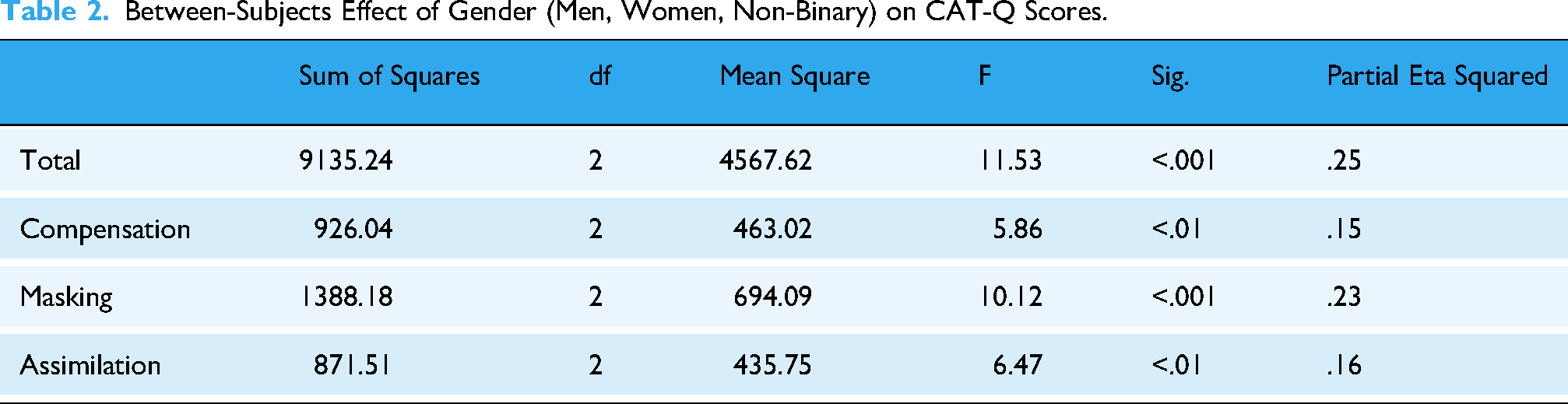
Significant total differences between women and men appeared to be driven by the Masking component, p < .01, 95% CI = [2.21, 14.04], as post hoc tests did not reveal significant differences in the Compensation (p = .42) or Assimilation (p = .22) components. Significant differences between NB adults and men persisted across all components: Compensation, p < .01, 95% CI = [2.12, 16.36], Masking, p < .001, 95% CI = [4.56, 18.30], and Assimilation, p < .01, 95% CI = [2.54, 15.66] (Figure 2).

Mean CAT-Q Scores by Gender Group.
T-Tests: Differences by Gender Diversity
Using independent t-tests, we evaluated differences in CAT-Q scores between participants who had experienced gender diversity (gender minority group; n = 41; 13 women, 4 men, 24 NB) compared to those who did not (cisgender group; n = 31; 17 women, 14 men). The gender minority group reported significantly higher levels of overall camouflaging, t(68.23) = 2.99, p < .01, d = .70; Masking, t(58.12) = 2.73, p < .01, d = .67; and Assimilation, t(52.61) = 3.23, p < .001, d = .80, compared to the cisgender group. There were no significant differences in the Compensation component (p = .24).
Aim 2: Relationship Between Camouflaging and Strong Interests in Autism
Each CAT-Q Score (total, compensation, masking, and assimilation) was regressed on demographic characteristics (gender group with woman as reference group; current age) as well as scores on the SRIS. The indicator of gender diversity as well as the total intensity rating score on the SRIS was omitted from the models due to high collinearity with other predictors. Table 3 reflects the final hierarchical linear regression models.
Final Linear Regression Models of CAT-Q Scores on Gender Group, Age, and SRIS Scores.

+ p < 0.1, *p < 0.05, **p < 0.01, ***p < 0.001
Note: A “- -” indicates that the predictor was included in an earlier model, but was not included in the final model due to model fit.
Compared to women, men reported less total camouflaging (β = -16.49), masking (β = -7.41), and assimilation (β = -5.16), while NB adults reported more assimilation (β = 4.86) behaviors. More frequent engagement with strong interests was predictive of more total camouflaging (β = 9.29), compensation (β = 4.51), and masking (β = 3.47) behaviors. More Masking behaviors were also predicted by greater reported resistance or distress when disengaging with strong interests (β = 4.31). Conversely, more reported flexibility for strong interest engagement predicted fewer masking behaviors (β = -4.34). Increased involvement of other people in activities predicted greater assimilation behaviors (β = 3.51).
Discussion
In this study, we explored self-reported camouflaging of autistic adults in relation to gender identity, gender diversity, and strong interests. We found significant main effects of gender identity (man, woman, NB) and gender-diversity (gender minority or cisgender) on the CAT-Q, a self-reported measure of camouflaging. We also found associations between CAT-Q scores and information on strong interests, suggesting that certain aspects of strong interests may be predictive of camouflaging behavior.
Gender Differences in Camouflaging: Men and Women
Women in this sample reported higher levels of camouflaging compared to men on all domains of the CAT-Q (total, masking, compensation, assimilation). These differences were statistically significant on the CAT-Q total score, as well as in the masking domain of the CAT-Q. In our regression models, being a man was predictive of significantly lower CAT-Q total, masking, and assimilation scores compared to women. These results are consistent with those from Hull, Lai, et al., (2020), who suggested that women may experience more pressure to fit in with others (resulting in more assimilation-related camouflaging) or to monitor and change their natural behaviors (resulting in more masking-related camouflaging). Autistic women in another study were more likely to report camouflaging in professional settings such as work, school, or healthcare environments, suggesting that women may face a greater disparity between their authentic selves and what is expected of them in professional settings (Cage & Troxell-Whitman, 2019). Women in the current study endorsed more camouflaging in the domains that encompass this behavior, thus adding further support to these trends.
Gender Differences in Camouflaging: NB and Gender Minority Groups
NB people reported the highest levels of camouflaging on all CAT-Q scores, with significantly higher camouflaging levels compared to men on the CAT-Q Total score and in all three domains of camouflaging. NB people reported significantly more total camouflaging compared to women: This disparity appears to be driven by differences in camouflaging related to compensation and assimilation, which were trending towards significance (p's = .05). Being NB (compared to being a woman) was also a significant predictor of higher assimilation-related camouflaging.
From the null effects of NB gender (compared to women) on the Masking domain of the CAT-Q, we may conclude that women and NB people in this study experience similar levels of motivation to mask their autistic traits. Both of these groups reported significantly higher masking-related camouflaging than men did. Autistic girls and women in previous studies have described being conditioned to exhibit masking behaviors (e.g., mimicking others, making eye contact, limiting discussion of strong interests, reducing stimming behavior) to satisfy expectations of how girls should behave (Cage & Troxell-Whitman, 2019; Jedrzejewska & Dewey, 2022). NB people in this sample may have grown up with similar expectations.
It is important to note that our analyses by gender group (man, woman, NB) are based on self-reported gender alone, not sex assigned at birth, and that members of the man and woman groups in the sample also indicated in our survey that they experienced gender diversity. As such, we also tested for differences in self-reported camouflaging between these gender minority individuals and the cisgender men and women in the sample. We found that the gender minority group experienced significantly more camouflaging in the total, masking, and assimilation domains. Significantly greater endorsement of masking behaviors by this group lends support to our claim and the narrative in the literature that masking may be reinforced by expectations of gender performance, whether that is by cisgender women or gender minority individuals. Although mean differences between women and NB people in the sample were only trending (p = .05) in the Assimilation domain of the CAT-Q, being NB was a significant predictor of higher assimilation scores compared to women. This, taken with the significant difference based on gender diversity, could be an initial step towards understanding the potential prominence of assimilation-related behaviors among those who are doubly minoritized in society (both autistic and gender-diverse). Assimilation behaviors, such as taking on a “persona” in certain situations, forcing oneself to interact in social situations despite discomfort, not responding in a way that comes naturally to oneself, or avoiding disclosure of one's autistic identity in certain situations, may be adopted to survive in a social climate that not only stigmatizes autism, but also stigmatizes gender expression that strays outside the expected norms (Pearson & Rose, 2021; Perry et al., 2021).
Previous studies of camouflaging in gender-diverse samples have found no effect of gender diversity on CAT-Q scores or have found that only compensation-related camouflaging was more highly endorsed by gender minority groups (Hull et al., 2021; McQuaid et al., 2022). Our contrasting results with a smaller sample size may provide exploratory evidence of the role that the lack of a formal autism diagnosis may play in the type of camouflaging exhibited in these populations. Of the 12 participants in our sample who had not yet received a diagnosis, ten identified as a gender minority. Previous studies have attributed “higher-order” camouflaging behaviors, those that require more cognitive processing and that are more deeply embedded in social relationships than simply “putting on a mask”, as a key reason that many autistic individuals are unable to obtain a formal diagnosis or necessary accommodations (Livingston et al., 2020; Livingston & Happé, 2017). Although our study did not have the statistical power to compare camouflaging based on diagnostic status, our results provide preliminary support for the potential interaction between having a minoritized gender identity and navigating the world without an autism diagnosis.
Strong Interests as Predictors of Camouflaging
Perception of strong interests is known to be impacted by gender, as many strong interests associated with girls (e.g., dolls, animals, pop stars) are often not considered as such because they do not align with stereotypical “high autism interests”, such as trains, sports statistics, or machinery (Antezana et al., 2019; Hiller et al., 2016; Nowell et al., 2019). To our knowledge, no previous study has explored the relationship between strong interests and camouflaging, although participants in previous studies have reported needing to limit engagement with strong interests if they did not align with gender expectations, or struggling to take interest in things they felt were necessary in order to fit in with their peers (Cridland et al., 2014; Hull et al., 2017). We examined whether particular aspects of strong interests, such as the total number of interests or degree of interest, were predictive of camouflaging in this gender-diverse sample. We also added a question to our measure of strong interests, which asked participants to endorse whether engagement with a given interest involved other people, as the “social” element that some interests contain (like playing cooperative games or engaging with other fans of interest) could inherently camouflage something as a strong interest.
In models controlling for gender group and current age, we found that certain aspects of strong interests were indeed significant predictors of certain domains of camouflaging. Higher Frequency scores on the SRIS, indicating more frequent engagement with interest, were predictive of more total camouflaging, as well as more camouflaging in the masking and compensation domains. This significant effect could be due to the fact that high-masking people are often encouraged to engage with a strong interest as part of their recovery from camouflaging to avoid burnout (Raymaker et al., 2020). Therefore, it is possible that more frequent camouflaging would also be associated with frequent interest-related recovery; an area for future research that warrants further inquiry
Higher Resistance scores on the SRIS, meaning that someone feels stronger resistance or experiences severe or intense distress when interest engagement is interrupted, were predictive of higher masking-related camouflaging. Masking was also negatively associated with Flexibility scores on the SRIS, such that greater masking was associated with those who considered themselves to be highly adaptable when it came to their strong interests. Taken together with increased Frequency scores, these relationships lend further support to the narratives of autistic people who describe engaging in certain social settings as expected (e.g., making eye contact, limiting discussion of strong interests, monitoring body language to appear interested), but with the cost of feeling distress and needing to recover using time with strong interests.
Our novel question related to the involvement of people-related strong interests was only significantly associated with Assimilation-related camouflaging, such that more people-centric activities were predictive of more camouflaging strategies aimed at fitting in with others. Although we would expect people-related interest engagement to be tied to more surface-level masking-related behaviors that are more strongly associated with gender performance, the relationship between people and Assimilation scores may illustrate the social context in which some assimilation-related strategies arise. For example, someone might attend an overwhelming social function if it is related to something that they are interested in. It is also possible that some Assimilation-related camouflaging behavior could be a direct result of engagement with people-related strong interests, such as the adoption of a favorite character's mannerisms.
Clinical Implications
Understanding risks for increased levels camouflaging in autistic adults can help enhance diagnostic processes and assessments, as well as treatments. New measures can improve the diagnostic process by capturing self-reported camouflaging as part of the assessment process, such as the Comprehensive Autistic Trait Inventory (CATI; English et al., 2021). Our exploratory and novel findings indicate that gender, gender identity, intensity of interests, and the interest subjects should be taken into consideration in the development of diagnostic tools and treatments. In therapy, identifying the functions of camouflaging behaviors distinguishing between those that cause distress and those that are beneficial can improve mental health (Hull et al., 2021). For autistic women and non-binary people, an intersectional approach can promote discussion of how their identities interact and may cause an increased desire to camouflage.
Limitations and Future Directions
As data for this study was drawn from a study with a strong focus on lived experiences, we did not administer a measure of autism traits, such as the Social Responsiveness Scale – Self Report or the Autism Quotient (Baron-Cohen et al., 2001; Constantino & Gruber, 2012) to our participants. While some participants anecdotally shared that the omission of such a measure decreased the burden of their participation, we were not able to examine the effects of the presence or intensity of autism characteristics on camouflaging, or test for any interactions between autism characteristics and strong interests. Previous studies have found a positive relationship between the intensity of autism traits and reported levels of camouflaging (Belcher et al., 2022; Livingston et al., 2020; Perry et al., 2021), and examining this relationship with regard to gender diversity and strong interests may be a meaningful next step in this line of work. The inclusion of a non-autistic group, or a group with below-threshold endorsement of autism traits, would also be beneficial for future studies. However, as the focus of the current study was on camouflaging, which may in turn be stronger in specific subgroups of individuals (those diagnosed later in life, females or minoritized genders, individuals who self-identify as autistic, and/or those who score sub-threshold for autistic traits) standardized assessments may not fully capture the autism traits of these individuals and could confound potential findings relating camouflaging to autism traits using these types of measures. Participants in the current study were asked to report their gender, but not their assigned sex at birth. As such, it is important to note that comparisons by gender group in our analyses only reflect how our participants experience the world, not necessarily how they were socialized from birth. For example, transgender men were grouped in with cisgender men for these analyses, but may have experienced the heightened pressures to camouflage from a young age due to being assigned female at birth. This limitation is alleviated by our inclusion of a question regarding experiences with gender diversity, where gender-diverse men and women were analyzed in the context of such experiences.
Because our recruitment strategy was solely focused on equitable representation by gender, our resulting sample is not adequately representative of other aspects of individual identity that may affect camouflaging, such as race, ethnicity, or co-occurring disabilities. Understanding how these intersecting identities affect one's lived experience with camouflaging is critical for understanding this phenomenon and should be a prioritized area of research going forward.
Findings must be interpreted with caution as an exploratory study with a relatively small sample size (n = 72) that limits the scope and strength of interpretation of the findings, particularly when multiple comparisons were made without correction in the regression analyses. Including both the CAT-Q total score and subscale score as independent variables in the regression model increases the risk of finding significance by chance. However, effect sizes are provided (using R2 values in Table 3) to permit further evaluation of the strength of differences found, and show strong effects for all CAT-Q scores. We felt it was important to include both the CAT-Q total score and subscales to provide preliminary evidence on how different aspects of camouflaging may be associated with gender, gender identity, and strong interests. Given the limited research investigating the connection between camouflaging and strong interests by gender and gender identity in autistic adults, we hope these initial findings provide a starting point for future research with larger samples.
Conclusion
In this study, we examined the roles that gender, gender-diversity, and strong interests play in the self-reported camouflaging of autistic adults. Our results suggest that gender and gender-diversity play roles in masking- and assimilation-related camouflaging behaviors, which may be reinforced by expectations of gender performance. Camouflaging behaviors were predicted by increased frequency of engagement with strong interests, as well as by heightened distress upon disengaging with strong interests, revealing a relationship between the two that should be explored in future research.
Footnotes
Acknowledgements
We would like to thank the autistic adults who participated in this study. We would also like to thank Catherine Perry for her administrative work on the project, and UNC Autism Research Registry and the Autistic Women and Nonbinary Network for their support in recruitment.

Ethical Considerations
The research protocol for this study was approved by the Institutional Review Board at the University of North Carolina at Chapel Hill (Protocol #20-2624).
Consent to Participate
All participants gave written consent to participate in the study.
Consent for Publication
Not applicable.
Author Contribution Statement (CRediT)
OCP: Conceptualization, Data Curation, Formal Analysis, Investigation, Methodology, Project Administration, Validation, Visualization, Writing – original draft, Writing – review & editing
MS: Conceptualization, Data Curation, Project Administration, Writing – original draft, Writing – review & editing
TCM: Supervision, Validation, Writing – original draft, Writing – review & editing
DC: Conceptualization, Writing – review & editing
CH: Conceptualization, Funding Acquisition, Project Administration, Resources, Supervision, Validation, Writing – review & editing
Funding
The author(s) disclosed receipt of the following financial support for the research, authorship, and/or publication of this article: Recruitment for this project was supported by funding from the National Institute of Child and Health and Human Development (NICHD; P30-HD03110; PI: Piven), from a KL2 Career Development Award through the National Center for Advancing Translational Sciences awarded to CH (UL1TR001111; PI: Buse), and from an NC LEND Trainee Award through the Health Resources and Services Administration Maternal and Child Health Bureau awarded to MS (T73MC00030). Work on this project was also supported by training fellowships from the NICHD (T32 HD040127-21; TCM), the Autism Science Foundation (23-003; OCP), and the National Institute of Deafness and Other Communication Disorders (F31DC021107; OCP).
National Institute of Child Health and Human Development, Maternal and Child Health Bureau, National Institute on Deafness and Other Communication Disorders, Autism Science Foundation, National Center for Advancing Translational Sciences, (grant number P30-HD03110, T32-HD040127-21, T73MC00030, F31-DC021107, 23-003, UL1TR001111).
Declaration of Conflicting Interests
The authors declared no potential conflicts of interest with respect to the research, authorship, and/or publication of this article.
Data Availability Statement
Data and other study materials are available upon request.