



Abstract
Differences in socialising and communicating between autistic and non-autistic people are well documented, but primarily from the perspective of non-autistic researchers assuming an autistic social communicative deficit. However, recent challenges suggest it may be more accurate to talk about an autistic social communication ‘style’. This qualitative study attempts to better characterise this style and to understand how differences between it and a non-autistic communicative style might produce social conflict and communicative misunderstanding. Eight autistic adults (seven women, one nonbinary) took part in an online asynchronous focus group over two weeks. They were asked about their social values, their experiences talking to non-autistic people, positive social interactions, and encouraged to comment and feedback on the contributions of others in the group. Thematic analysis produced five themes: ‘always be truthful’; invisible demands and their impacts; ‘I don’t think neurotypical people do the same for us’; autistic strengths, autistic positives; and the role of the autistic community. These findings highlight the ways in which autistic people's different experiences of (and expectations for) social communication can clash with non-autistic people's, producing disjunctions in understanding, and emphasise the nuance and complexity of participants’ conceptualisations of autism as difference versus deficit versus strength.
Lay Abstract
This study explores how autistic people communicate differently from non-autistic people, and how these differences can lead to misunderstandings. Research has often assumed that autistic people have communication difficulties, but more recent research has emphasised how differences between autistic and non-autistic people might lead to mutual misunderstandings. This study wanted to explore autistic people's experience of these misunderstandings and their perspectives on interacting with autistic and non-autistic people. Eight autistic adults (seven women, one nonbinary) participated in an online discussion over two weeks, sharing their views on and experiences of social interactions and experiences. The researchers identified five main themes from the discussion: the importance of honesty for autistic people; the hidden pressures autistic people face; how non-autistic people may not always understand and accommodate autistic people; the strengths and positives of being autistic; and the complicated role that autistic community plays for autistic people. These findings show that autistic people have different social expectations, which can sometimes lead to confusion or conflict with the expectations of non-autistic people. The study underscores that autistic communication should be seen as its own style of social interaction, with its own strengths and weaknesses, rather than a ‘deficient’ version of non-autistic communication.
Introduction
Autistic people's social communication has traditionally been considered impaired. ‘Persistent deficits in social communication and social interaction’ comprise one of the two primary diagnostic criteria for autism (APA, 2013), and theories of autism generally suggest a specific cognitive deficit in, e.g., theory of mind (Baron-Cohen et al., 1985), social motivation (Chevallier et al., 2012), or empathy (Smith, 2009).
However, new ways of thinking about autism, like the neurodiversity paradigm (Dwyer, 2022; Walker, 2021), have challenged conceptions of autistic behaviour as inherently deficient. For social communication specifically, the double empathy problem has suggested that autistic difficulties are in fact reciprocal challenges arising from a lack of mutual understanding between autistic and non-autistic people (Milton, 2012). This has sparked a range of research into autistic experiences of social communication, especially with other autistic people. These studies have found that autistic people prefer interacting with other autistic people over non-autistic people (Bolis et al., 2020; Chen et al., 2021; Crompton, Hallett et al., 2020; Morrison et al., 2020; Watts et al., 2024); have different friend trait-preferences to non-autistic people (DeBrabander et al., 2019; Dunn et al., 2023); have better rapport with other autistic people vs. non-autistic people (Crompton, Sharp et al., 2020; Jones et al., 2023); and communicate as effectively with other autistic people as non-autistic people do with each other (Crompton, Ropar et al., 2020).
Supporting the idea that autistic–non-autistic interactional difficulties are mutual, studies have also found that non-autistic people struggle to interpret autistic people's gestures and expressions (Casartelli et al., 2020); struggle to interpret their mental states (Heasman & Gillespie, 2018; Sheppard et al., 2016); are likely to form negative first impressions and make unfavourable judgements about them (Alkhaldi et al., 2019; Grossman, 2015; Sasson et al., 2017); are likely to hold negative stereotypes about them (Dickter et al., 2020; John et al., 2018; Morrison et al., 2019); and are likely to overestimate how much they accommodate autistic people during interactions (Heasman & Gillespie, 2019b).
There have been critiques of how the neurodiversity and the double empathy problem have been used in research. Dwyer (2022) and Russel (2020) independently note that some neurodiversity approaches may suffer from the same issues as the social model of disability (Shakespeare & Watson, 2001), acting primarily as a political rather than scientific paradigm, and in some cases rejecting the concept of interventions or treatment for disabilities. For the double empathy problem more specifically, Livingston et al. (2024) highlight a number of issues with the way it has been operationalised in research–primarily, the way in which the concept has been over-extended by researchers attempting to use it as a theory. In its initial form, the double empathy problem highlights that two people with different ‘natural attitudes’ and ‘dispositions’ may struggle to understand and relate to one another due to these differences (Milton, 2012). This distinctly sociological formulation, however, has been taken up by more positivist-oriented researchers as the basis for experimental research, without an associated positivist reformulation of it into a testable theory (Livingston et al., 2024).
Despite these criticisms, the studies mentioned previously demonstrate that, at minimum, there are (1) distinct features of the autistic social communicative experience, that (2) do not impede interaction when they are present in both interlocutors, but (3) conflict in some way with non-autistic social communicative features and/or expectations. This has led to autistic social communicative ‘symptoms’ being reframed by some researchers as instead evidence of an autistic social communicative ‘style’ (Bolis et al., 2020; Davis & Crompton, 2021; Heasman & Gillespie, 2019a; Rifai et al., 2022; Williams et al., 2021).
This reframing of autistic social communication, alongside growing calls to centre autistic lived experience in autism research (Fletcher-Watson et al., 2021; Gillespie-Lynch et al., 2017; Milton, 2014), has uncovered a problem with most current accounts of autistic social-communicative behaviour: they are focused not on autistic social communication per se, but on non-autistic people's experiences of autistic social communication as deficient or confusing.
There is a gap in the literature, then, for descriptive detail of autistic social communication, from the autistic perspective. In this study, we used a focus group and thematic analysis to explore autistic people's experiences of interacting with other autistic people versus non-autistic people. In doing so, we aimed to understand:
How participants understood their own social experiences, expectations, and preferences, How participants felt their social expectations and preferences differed from those of non-autistic people, and How participants felt their social experiences when interacting with other autistic people differed from when they interacted with non-autistic people.
As this was a qualitative study exploring an understudied topic, these aims were guiding interests (O’Reilly, 2011) rather than research questions with specific hypotheses.
Methods
Ethical approval for this study was given by the University of Edinburgh Medical Research Ethics Committee. This paper follows O’Brien et al.'s (2014) standards for reporting qualitative research to improve the clarity, transparency, and openness of reporting.
Qualitative Approach and Research Paradigm
An online, asynchronous focus group was used to compare commonalities between participants’ experiences and accounts. We opted to use a focus group as we wanted the participants to be able to discuss and directly compare their experiences with other participants. The online element was partially a response to the (at the time of data collection) COVID-19 pandemic; but also to increase the accessibility of the study by removing the need to travel to a new place, as well as increasing the amount of processing time available for answering questions.
Reflexive thematic analysis (Braun & Clarke, 2012) was used as it complemented our research paradigm and collective epistemology. For this focus group and its analysis, we took a social constructionist approach to knowledge production, capturing participants’ narratives around and construction of their social realities.
Researcher Positionality and Reflexivity
The first author, who led the focus group and analysis, is an autistic person with autistic friends and family members. She is not an autistic activist or activist academic per se, but she does consider herself a member of the autistic community (though not a community leader or representative). She often talks with other autistic people about autism/being autistic and attends events and spaces for autistic people to meet and talk. The other authors are non-autistic.
The authors’ approach to autism centres on the neurodiversity paradigm (Dwyer, 2022; Walker, 2021) and considers autism one possible human neurodevelopmental pathway among many. This does not imply that we do not consider autism a disability. Rather, as per the weak social model of disability (Barnes, 2019), we emphasise ways in which neurotypical-normed environments disable autistic people and ways in which some aspects of the autistic experience commonly described as impairments (e.g. in the social and communication domains) are the product of relational processes between the autistic person and their environment/interlocutor(s).
Participants
Participants were recruited via social media and the Patrick Wild Centre Participant Database. Interested participants completed an online form, which collected demographic information and confirmed they met the inclusion criteria, which were: (a) being capable of reading the study materials and consenting, (b) being raised in the United Kingdom, to ensure a homogeneity of cultural context, and (c) having a clinical diagnosis of autism.
Ten participants were invited via email to take part in the focus group and to select their own (non-offensive, non-identifying) pseudonyms, as per recommendations by Allen & Wiles (2016). Nine participants agreed to take part, but one (Zippy) had to withdraw prior to contributing for health reasons. The demographic details of the eight remaining participants who took part in the study – River, Anchorite, Jo, Daffodil, Red, Bunny, Sherlock, and Brennan – are detailed in Table 1.
Demographic Details of Participants.

Data available for only five participants.
These are total numbers of participants with each condition, per condition. Some participants may have had more than one additional condition; these have been listed separately, to prevent risk to participant anonymity.
Participants were compensated for their time with a £20 voucher.
Data Collection
Data were collected by the first author via an online focus group, hosted on the GDPR-compliant qualitative research website Collabito (Quallie, 2024). The focus group was asynchronous (i.e. participants could join and leave as they pleased) and ran for two weeks. It was structured like a forum, with a ‘landing page’ that introduced the focus group's aims and rules for participants, and then four other pages – ‘Social Values’, ‘Talking to Non-Autistic People’, ‘Positive Social Interactions’, and ‘Anything Else?’ (allowing participants to raise topics that did not fit elsewhere). Halfway through the focus group, additional ‘probe’ questions were added by a researcher on some topics, and a new topic was added: ‘Other Autistic People's Thoughts: Opinions?’. (See Appendix A for exact question/probe text.)
Participants could leave comments under each topic, and reply to other participants’ comments. The researcher also responded to comments, to elicit further information on a topic. Participants could log into the focus group as they wished, though they were encouraged to log in at three separate time points via prompt emails.
Data Analysis
Data were downloaded from Collabito after the focus group had finished and imported into NVivo for analysis. Data were analysed using reflexive thematic analysis (Braun & Clarke, 2012) by the first author.
During data collection, H.E.A.S. kept notes on emerging commonalities between participant accounts. These notes were used in the initial coding process, which included re-reading the transcripts and coding participants’ comments. Codes were then arranged into five themes, which were comprised of thematically similar codes. All data were then recoded, this time to sort excerpts into their appropriate themes. Each theme drew content from multiple different topics, with contributions from multiple participants.
The contents of each theme were then read back by H.E.A.S. to ascertain whether there was value in developing sub-themes for any of the themes. It was decided that sub-themes were not necessary or appropriate for any of the themes.
Results
Theme 1: ‘Always be Truthful’
Participants had a strict conceptualisation of honesty Figure 1. Using social pleasantries without meaning them was dishonest; white lies were considered malicious; and even being sarcastic or ironic was considered as misleading someone. Being unclear – by ‘talking around’ a sensitive topic or making people ‘read between the lines’ – was also considered deceitful. Importance of truthfulness: Very. I had a terrible experience where I was shopping with a bunch of school friends and they were being sarcastic about horrible clothes. Thing is, I only heard the words, not the sarcasm, and got one of them a jacket a week later for her birthday. Cue being laughed out of the party. Why say you like something when you don't? It leads to misunderstandings and crappy situations. (Bunny) What is even the point of having a conversation if the other person isn't being honest? That's not proper communication. When people tell untruths to smooth out social situations they are just confusing the matter[.] (Red)
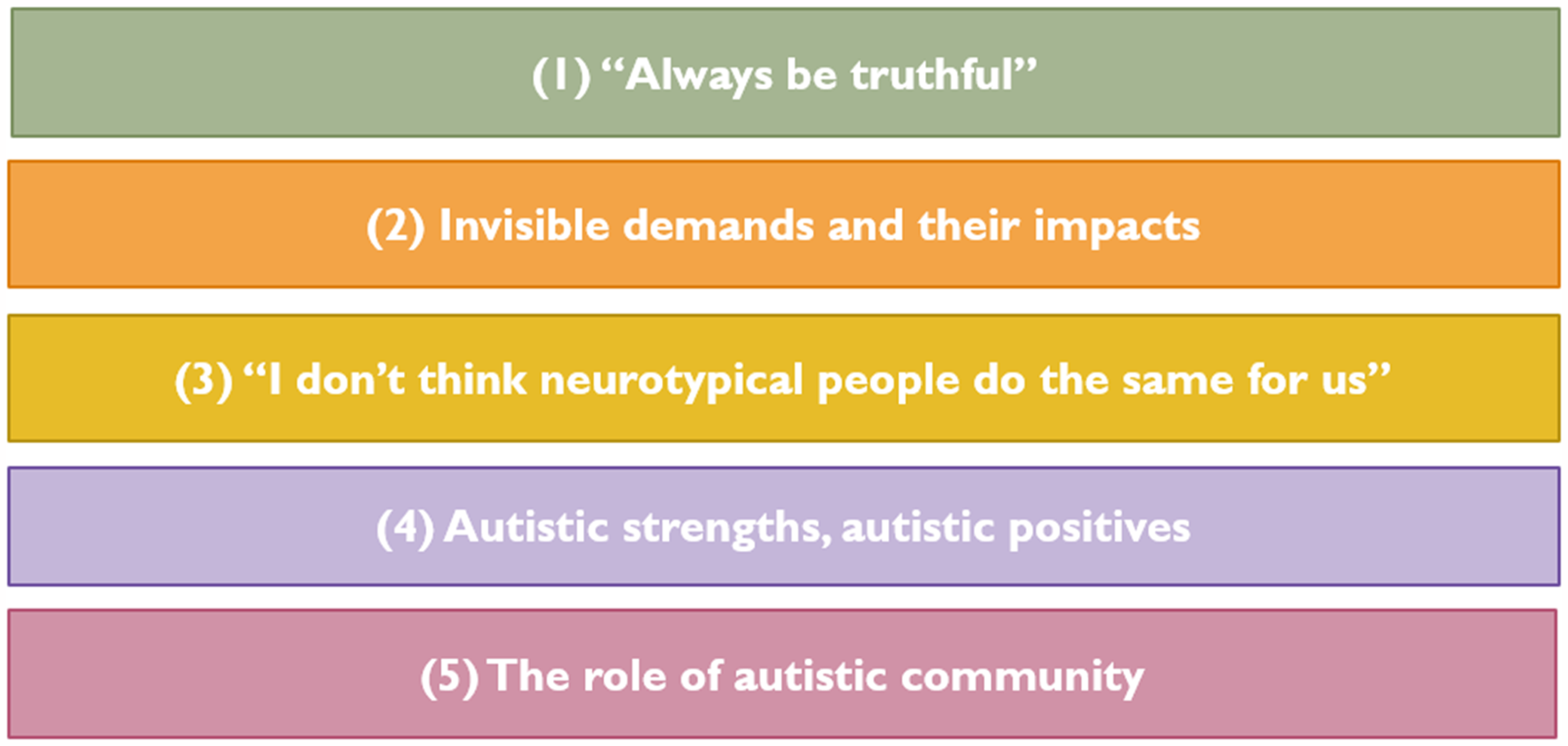
An Overview of the Themes.
All forms of dishonesty were upsetting to participants: ‘Don't worry about hurting my feelings. Don't expect me to read between the lines. Just be open and up front. It's much worse when the truth comes out later and you realise, very hurtful’ (Sherlock). However, participants often worried about honesty with (primarily non-autistic) others. This could lead to the person feeling hurt: ‘[F]riends have always seen the real me, which is truthful (sometimes painfully so apparently!)’ (Sherlock)
This powerful need for honesty was a common autistic trait, according to participants. They felt non-autistic people did not share this trait–and that this difference in perception often led to miscommunications with non-autistic people, or forced autistic people to mask it to fit in. Honesty- it's innate, I've always valued it in communication and have always felt compelled to be honest. […] I've had to try and ‘unlearn’ this, or minimise it in myself, because I've noticed that non-autistic people often do not want to be honest or have honest conversations, they often want to maintain the status quo and prioritise harmony and smooth/easy interactions over authenticity and genuine connection. (Brennan) Yes, the discrepancy between what people are clearly feeling and what they're saying does my head in too. I feel that autistic people naturally operate on this level of reality, whereas NT [neurotypical] people operate on the social layer: [I wish neurotypical people would] read my lips, not my body. (Bunny)
Theme 2: Invisible Demands and Their Impacts
There were additional cognitive, emotional, and social demands that participants felt they had to deal with and non-autistic people did not.
Cognitive demands centred around issues remembering things, and sensory sensitivities. Participants often forgot things they were told, like information from a doctor, or comments at a work meeting. ‘My working memory is awful. It causes so many upsets’. (Sherlock). When participants forgot things, they were made to feel bad by others: [non-autistic] friends and family have been very angry and upset with me before for things that i [sic] can't help, like I can't remember dates or birthdays no matter what strategies I try […] even when I explain why they think i [sic] just don't care or aren't trying hard enough. (Brennan)
Participants also struggled to manage sensory input, especially noise. ‘Busy, noisy places’ (Daffodil) made hearing, and processing speech, very difficult. This impacted participants’ ability to socialise and interact; they couldn’t understand what people were saying, or processed what was being said too slowly to participate. Background noise or excessive sensory input could also make participants anxious. ‘I prefer quiet environments. If there's a lot of movement around me I become anxious and find it difficult to concentrate. If there's background noise I struggle to interpret what people are saying to me[.]’ (Jo).
Emotionally, participants struggled with having the energy for social interactions. ‘Know that I have very few spoons for social engagement. I may not want to see you often. That doesn't mean that I'm no longer friends with you or that I don't think about you’ (Anchorite). They could also struggle with identifying their own and others’ emotions, which could make socialising difficult: ‘I'm worse with emotions than I thought. That's been tricky for me. I don't identify as much with people's emotions or even my own’ (Sherlock).
For many participants, socialising was also a source of anxiety and stress. Participants felt they needed time to recover from socialising, or at minimum ‘transition time’ (Anchorite) between activities or interactions: ‘I find it exhausting to be “on” all the time, and I need tha[t] time (eg [sic] on commutes) to decompress on my own’ (Brennan).
Invisible social demands, however, were the biggest demand on participants’ energy. Dealing with other people's dishonesty (see Theme 1) was a major invisible social demand; as was interpreting other people's (non-)verbal communication, dealing with dis-preferred methods of communication (e.g. verbal, instead of emails or texts), and attempting to get clear information from other (non-autistic) people about, e.g., social plans or work-related tasks. However, the most substantial demand was masking. Masking required participants to deploy elaborate routines to disguise their autistic status. One participant listed their process for managing social interactions: [C]hecking that my body language isn't accidentally defensive or aggressive; that my facial expressions are appropriate […]; I consider if I've eaten anything like garlic recently so I can be aware of not breathing unpleasant smells towards people; I'm constantly checking what my eyes are doing, because depending on the situation I might need to keep focused on watching the speaker's mouth to follow what's being said, but flicking my gaze up near their eyes often enough that they feel I'm listening properly (people I'm talking to don't always know I'm autistic so it's easier just to maintain the pretence); I try to keep track of how much I've been speaking and try to remember not to dominate the conversation, and to ask back to others the social niceties they've asked me; I try not to blurt out and interrupt […], and also keep the volume of my voice appropriate to the situation; I try to ensure I understand that others are following what I'm saying, though this can lead to me over-explaining and repeating things if they aren't clear enough in demonstrating that they know what I mean. Through all of that I also need to try to follow the conversation itself! I can be so focused on engaging “correctly” in the conversation that I can miss the actual conversation itself. It can also completely throw me off if others are working from a different set of rules so don't respond the way I expect them to. (Daffodil)
Theme 3: ‘I Don’t Think Neurotypical People do the Same for Us’
Participants felt that, despite putting a lot of effort into interactions with non-autistic people (see Theme 2), non-autistic people rarely put effort into interacting with them. Participants felt this was an unfair double standard. It feels like we spend so much time trying to derive and memorise rules for how neurotypical people want to be interacted with […] It's exhausting and pretty much thankless. I don't think neurotypical people really do the same for us, or even anything close. (Red)
Participants felt this lack of effort from non-autistic people was in part due to their inability to imagine what being autistic was like, and therefore how badly these accommodations were needed. Even when participants tried to explain their experiences to others, the issues they faced were often downplayed: Sherlock: I think for me the issue is people don't see the exhausting impact a social situation can have, because that happens at home. If I tell an NT [neurotypical person] like my mum or boss that social situations are tiring for me, they contradict me. I think they're trying to be kind and say that I'm good with talking to people, but that ignores the impact it has. Jo, in reply to Sherlock: Yes, this! The impact on me is something almost nobody ever sees. [… I] didn't go anywhere for a couple weeks after I got back home [from a long weekend away] because it had drained me and I needed that time to recover. But people don't see that side of it; they just see the part where I'm out enjoying myself and assume that's what I'm like the whole time. [A badge that I wear] says “please don't touch me”, and I was wearing it last week when I went for my covid booster/flu jag [sic] and ended up having a meltdown, and yet one of the volunteers still reached out and put his hand on my arm while arranging a quiet room for me with another member of staff. I jumped back like I'd been stung but instead of apologising he just looked at me as if I was the one in the wrong. (Daffodil) I've encountered frustrating gaps in understanding when talking to neurotypical people, […] they fail to grasp that my experience of a given situation can be significantly different from their own. I end up having to try to translate my experiences into terms that they find familiar […] This translation - building a bridge to cross the empathy gap - takes effort on my part which often makes interactions with neurotypical people tiring and inherently less rewarding. Because we as ND [neurodivergent] people are in the minority, most of the people we meet outside of our immediate circles are likely to be neurotypical so we tend over time to develop skills to communicate better with them; however, NT [neurotypical] people exist in an NT-dominated world where most of the people they encounter are also NT so they rarely learn the skills to even meet us halfway. It's an uneven balance, tipped in favour of neurotypical minds. (Jo) We don't need to change, we need people to make the effort to understand us and appreciate why certain things might be important to us. […] It's not all about us making the effort. I'm finding that increasingly exhausting […] It makes me want to hole up and stop bothering, except I know that's not the answer. (Sherlock)
Theme 4: Autistic Strengths, Autistic Positives
Participants highlighted strengths and positives associated with being autistic, alongside the negatives and difficulties detailed in previous themes. These are often related to ideas of authenticity, honesty, and clarity. Participants felt that autistic people could be better and more empathetic communicators than non-autistic people. This was because they listened to what people were actually saying, and ignored the stereotypes or social assumptions that often coloured non-autistic people's interpretations: [We] make a big effort to understand individual people, rather than taking the short cuts that NTs [neurotypical people] can take. I have been told my responses are unusual, but equally that I'm a good listener because I don't make assumptions. I think autistic people can be really good communicators. (Sherlock)
Participants felt autistic people treated others as individuals, and communicated honestly. This, in turn, tied into participants’ opinion that being open-minded and accepting was an autistic strength: Sherlock: I also hate people making assumptions. I treat each person as a blank sheet and fill it in with the information they give me. NTs [neurotypical people] seem to take short cuts and I don't like that. I find most autistic people are way more accepting of difference. They mix with lots of genders and ages and abilities and backgrounds. They just see the individual. I value that. Bunny, in reply to Sherlock: I totally get the blank sheet thing. I don't understand how other people bring along judgements when they have never met the person.
There were also things participants enjoyed about being autistic. While these things could cause issues with neurotypical (or even non-autistic neurodivergent) people, around other autistic people they became sources of joy, creativity, and play. ‘The majority of my conversations with autistic friends go off on such random tangents that I can't even figure out how I got from there to here!’ (Jo). A monologue-based conversational style, often about a shared passionate interest, was preferred: ‘The alternating monologue, with times in-between for questions, is definitely my favourite conversational pattern’ (Anchorite).
Many of these experiences were sources of autistic joy, defined here loosely as specific experiences that participants perceived as both quintessentially autistic and deeply enjoyable. Participants discussed playing word/language games and developing their own, dyad-specific communication styles with autistic friends, partners, or children. These were a source of comfort for participants. [I]t's usually complete nonsense to outsiders but makes sense to us. […] A current communication style we are enjoying is based on a meme and adds a sn- [sic] to the start of certain words to denote the snail variant.
1
It's really comforting and makes us laugh together. We also use quite a lot of our own non-verbal communication that has developed over the years and is now quite elaborate and sometimes ridiculous. (Daffodil)
Participants also rejected the idea of autistic social communication deficits in the context of themselves and their autistic family/friends. Autistic social communication in this context was, instead, simply a different style of communication or a way of being: [S]o often we're compared to non-autistic people and judged as being ‘not as good’ at their style of communication, but what if we are better at some things that non-autistic people don't even realise are valuable, or important, or that they don't do? […] I think non-autistic people often see themselves and their own style of communication as the default, and assume that any differences autistic people display must mean that we are ‘lacking’. But I see it more as apples and oranges- if you judge an apple on the criteria of an orange, it won't be orangey enough. But they're just different, apples have features that oranges don't. If a society had never seen an apple before, but were very used to oranges, they might try and make marmalade with it and conclude that apples are no good. But they'd have no idea of the joys to be found in apple crumble, and how you need apples for that and oranges just won't do. (Brennan)
Theme 5: The Role of Autistic Community
Participants had a complex and nuanced view of their relationships with other autistic people. Autistic relationships on a personal basis were important to participants. Other autistic people were generally easier to interact with: ‘I get on better with autistic people in person’ (Red). Many participants mentioned that their partners or closest friends were autistic, and detailed the benefits this brought. Participants could relate to other autistic people's experiences better, had their idiosyncrasies and needs accommodated better, didn’t have to mask so much, could be more relaxed and authentic, and found other autistic people easier to understand.
Autistic–autistic interaction could also be problematic, though. Despite participants rejecting deficit models of autistic social communication as it applied to themselves and their family/friends (Theme 4), this was not the case when they discussed bad experiences with the broader autistic community. Here, participants described social communication deficits – sometimes explicitly using the word ‘deficit’, or deficit-oriented terminology – and ascribed these as the cause of negative experiences. Negatives of interacting with other autistic people included: being interrupted frequently, misunderstanding one another, one person dominating the conversation, people talking too fast, neither person knowing how to start the conversation, or encountering people with fixed ideologies or little tolerance of disagreement.
This latter point caused substantial problems when it came to participants’ interactions in online community spaces. Many participants had been treated badly in these or witnessed others being treated badly. There was, in some online autistic spaces, a perceived intolerance of disagreement, a lack of good-faith assumptions when people phrased things poorly, and an over-eagerness to start fights: I have generally been wary of using the “wrong” terms or somehow saying the wrong thing in autistic spaces. I mentioned that I had Aspergers, but then got accused of being a supremacist - being utterly new to the diagnosis as an adult I had no idea at all about the history behind the term, nor its exclusionary use.
2
(Bunny) [I]n some of the groups there seems to be “One True Way” of thinking and expressing oneself, and anybody who doesn't adhere to the group's ways becomes a target for harassment. I feel that there are parts of the online autistic community that are particularly driven by ideology, and can be hostile to those who don't feel the same way they do about various topics. It's a minefield for anybody new, and gives a horrible first impression of the community. (Jo)
Participants had various ideas about why negative experiences sometimes occurred in online autistic spaces. These ranged from people ‘feeling more free to release these emotions and say things you'd never say in non-autistic company’ (Daffodil), to ‘a sort of collision of autistic communication deficits, together with people projecting their past experiences onto what's happening in the present’ (Anchorite), to long-time members of the community ‘forget[ting] what it's like as an autistic person who is only just coming to terms with being autistic […] forget[ting] that arc of learning that happens, and processing and adjusting’ (Brennan).
A major problem was the difficulty of balancing innate autistic behaviours with ones learnt from existing (and masking) within a neurotypically-normed social environment. This led to difficulties when trying to create (or integrate with) autistic spaces, where community norms were unclear, or being actively negotiated. This was complicated by conflict between community members’ desire to behave in authentically autistic ways versus their learned, non-autistic mask: I think it's a bit like suddenly having to speak Duck and follow Duck customs when all your life you thought you were an Emu, struggling to keep up with the Emu world. Yay, you think, I'm a Duck, I shall go and join My People, but then the Ducks all shout at you for speaking Emu. (Bunny) I described myself somewhere as like someone who was taken from their native land at birth, but still moves to its rhythms. At the same time, I have naturalised a lot of ‘second language’ allistic [non-autistic] behaviours, and can't shuck them off, even though I'd like to. (Anchorite) Although I use the phrase “autistic community” I don't think of it as a single entity: it's a shorthand way to refer to the population of autistic people as a whole. I've been around long enough to see far too much in-fighting and personality conflict to think of all of us as a single community: autistic people are just as prone to disagreement as any other group of people. I keep coming around to the opinion that we're far more similar to non-autistic people than we are different, both the positive and negative aspects. I often find that we focus on the differences - all the ways we are not like non-autistic people - to the point where we lose sight of all the ways in which we're very much alike: all human, warts and all. (Jo)
Discussion
In this study, we aimed to explore three related questions: (1) how autistic people represent and articulate their social experiences, expectations, and preferences, (2) how autistic people feel these differed from non-autistic peoples’, and (3) the differences between interacting with autistic vs. non-autistic people, as an autistic person.
Regarding experiences, expectations, and preferences, the most striking finding was participants’ emphasis on (and distinctive conceptualisation of) honesty and authenticity. Research on lying and autism has focused mostly on autistic people's ability to lie or detect lies and has found autistic people lie less often and less convincingly than non-autistic people (Bagnall et al., 2022; though see Bagnall et al. 2024). That autistic people might have different ideas about what constitutes lying is a novel finding, and may be one of the ‘personal conceptual understandings’ (Milton, 2012) that differ between autistic and non-autistic people according to the double empathy problem.
Other differences identified by participants resemble autistic traits well-established in the literature. These include sensory sensitivities (Boldsen, 2022; Scheerer et al., 2021); executive dysfunction (Freeman et al., 2017; Kleinhans et al., 2005); alexithymia (Poquérusse et al., 2018); difficulties with the energy, motivation, and capacity for socialising (Calder et al., 2013; McNair et al., 2024; Ryan & Räisänen, 2008); and masking (Bernardin et al., 2021; Cage & Troxell-Whitman, 2019; Cook et al., 2021; Hull et al., 2017). Interestingly, some descriptions by participants (primarily elements of Sherlock and Daffodil's quotes in Theme 2) also resembled difficulties with the theory of mind – and therefore a more classical account of autism (Baron-Cohen, 1997, 2000) which the double empathy problem positions itself explicitly in opposition to (Milton et al., 2022). While it is difficult to draw conclusions here due to a sparsity of data, explorations of an autistic social communicative ‘style’ (and specifically, autistic people's descriptions of this style) in the context of the theory of mind-related theories of autism may be of interest for further study.
More novel to this paper, however, is participants’ distinction between some of these differences/traits as inherently making socialising difficult (lower social energy, sensory sensitivities, memory issues), and some making socialising difficult due to lack of understanding/accommodation from non-autistic people (masking, a monologue-orient conversational style, differences in conceptualisations of honesty). This suggests that a dual approach of targeting both environments and stigma might improve autistic people's social experiences.
Participants also reported a range of joyful social and communication experiences – especially when interacting with other autistic people – that are only just beginning to be explored in research (e.g. Haydock et al., 2024). The importance of these experiences to participants’ enjoyment of social interactions, and the extent to which participants viewed these as expressions of self, suggests that this is another area where further research would improve the fullness of our understanding of autistic sociality.
Of particular note is the fact that, while participants primarily emphasised the role of environment (Theme 2) or other people (Theme 3) in negative social communication experiences, reference was also made to autistic social communication deficits (Theme 5). Participants did not explicitly describe their own social communication as deficient. Instead, deficit narratives were deployed to explain instances where other autistic people (primarily in an online context) had acted in a way that made participants feel hurt or misunderstood. Against the backdrop of the broader discussions in the focus group (specifically, autistic people being more understanding, accommodating, and empathetic than non-autistic people), it seems as though this reference to deficits was used as a way to explain these negative social experiences as instances of error, rather than instances of malice.
Regarding how autistic people felt their social communication experiences, expectations, and preferences differed from non-autistic people, it is clear participants felt they were very different to non-autistic people. Most themes covered some aspect of social communication where participants felt they differed from non-autistic people. Autistic definitions of and use of honesty (Theme 1) were significantly different, causing difficulties for the participants (who felt they were often misled by non-autistic people) and the non-autistic people they interacted with (whom participants worried they were being rude to by being honest).
The invisible demands on participants (Theme 2) also drove experiences of disjunction – non-autistic people did not experience these demands, and they appeared to struggle to both understand them and to identify when participants were experiencing them. This meant that non-autistic people failed to adapt their social behaviour to meet autistic people's social communication styles. In contrast, participants felt other autistic people were very good at accommodating others. This was in part because autistic people were used to not being accommodated, and therefore put extra effort in to ensure this was not the case for others.
This finding would seem to support the double empathy problem's emphasis on difficulty empathising/understanding with others (of a different neurotype) as a ‘two-way street’ (Milton, 2012, p. 884) between autistic and nonautistic people – albeit one experienced as more unusual by nonautistic people (who, as the majority group, are not used to encountering those of a different neurotype to themselves) than by autistic people (who, as a minority group, are frequently around those of a different neurotype and therefore frequently experience empathetic disjunctions). This, along with the suggestion from participants that autistic people might be better at accommodating others (especially in the sense of modifying behaviour and/or social expectations to adapt to another person's norms), also aligns with findings that individuals exposed to people from a broad range of backgrounds and societal groups may be better at considering the perspectives of others who are less like them (Crisp & Turner, 2011).
More generally, this finding is especially notable because it conflicts with research suggesting autistic people are less socially motivated (Chevallier et al., 2012; Clements et al., 2018), less socially and cognitively flexible (Hodgson et al., 2017; Leung et al., 2016; Mostert-Kerckhoffs et al., 2015), and less empathetic (Harmsen, 2019) than non-autistic people. The accuracy of this body of research is slowly being challenged (e.g. see Fletcher-Watson & Bird, 2020; Jaswal & Akhtar, 2019; Muskett et al., 2010; Rapaport et al., 2023), which this study's findings contribute to.
Regarding differences between interacting with autistic vs. non-autistic people as an autistic person, it was clear participants felt there was a stark difference. In line with previous research (e.g. Bolis et al., 2020; Chen et al., 2021; Crompton, Hallett et al., 2020; Watts et al., 2024), participants felt that other autistic people were easier to interact with, and preferred interacting with autistic people over non-autistic people. Novel to this study, however, was participants’ accounts of negative experiences with other autistic people (Theme 5) – though these were limited to online contexts. This is not, per se, problematic for the double empathy problem, which in its initial formulation merely suggests that people with closer ‘natural attitudes’ should find understanding and empathising with one another easier (Milton, 2012). Even using the loosely defined ‘theoretical’ formulations of the double empathy problem put forward by positivist researchers, it predicts at most that same-neurotype interactions should generally be easier or better than cross-neurotype interactions (Livingston et al., 2024). Nonetheless, double empathy problem-related research thus far has primarily focused on looking for instances where same-neurotype communication is easy and successful. The findings here suggest that studying the circumstances in which same-neurotype interactions break down (and whether these circumstances differ between autistic and nonautistic same-neurotype interactions) might also be informative.
More broadly, while tensions between the autistic community and the research and autism parent communities have recently begun to be explored (Heraty et al., 2023), tensions within autistic community spaces have not. The experiences discussed here, especially those of being a newly diagnosed autistic person who may not know the ‘right words’, are worth exploring further to better understand the potential risks of online peer/community support for autistic individuals. It should be noted, however, that community infighting is a common feature of activist groups of all kinds (e.g., Basit, 2012; Ghaziani & Fine, 2008; West, 2022), and in an online context is largely driven by social media algorithms that prioritise engagement and therefore conflict (Iandoli et al., 2021). Intra-community conflict can in fact act as a positive force within social movements under some circumstances (Ghaziani & Kretschmer, 2018). It is not clear the extent to which the experiences described by the participants in this study are specifically difficulties with autistic community/activist spaces, versus issues experienced by community/activist spaces more generally.
Limitations
Participants were exclusively raised in the United Kingdom, with English as their first language. They were predominantly women, were all white, and did not include any older (60+) adults. It is therefore unclear to what extent the themes here represent autistic men, older autistic people, or autistic people of colour. Further study of the extent to which these themes apply to children, or to adults with higher support needs, is also needed.
Participants were recruited in part via researchers’ social media networks. Given the researchers’ positionality and research history, these participants are likely to be (a) familiar with and supportive of the neurodiversity paradigm, the double empathy problem, etc., and (b) aware of autistic advocacy spaces online. This means participants will have had specific experiences of being around other autistic people, and will have particular frameworks that they use for understanding those (and other) social experiences. While this is not per se a problem for the analysis (see Braun & Clarke, 2021), it is important to acknowledge as part of reaching trustworthiness criteria for Qualitative research (Nowell et al., 2017).
Conclusion
The themes and findings in this study hint at the origins of the double empathy problem – at key points of miscommunication between autistic and non-autistic people. These include well-established autistic traits and experiences like masking and sensory profiles, alongside the novel finding of an emphasis on honesty.
Supplemental Material
sj-docx-1-ndy-10.1177_27546330251333919 - Supplemental material for ‘Read My Lips, Not My Body’: A Thematic Analysis of Autistic People's Social Communication Preferences, Experiences, and Expectations
Supplemental material, sj-docx-1-ndy-10.1177_27546330251333919 for ‘Read My Lips, Not My Body’: A Thematic Analysis of Autistic People's Social Communication Preferences, Experiences, and Expectations by HEA Sutherland, Catherine J Crompton, Joseph Long and Sue Fletcher-Watson in Neurodiversity
Footnotes
Acknowledgements
We thank the participants for providing us with their time and valuable insights. We also thank the various researchers, autistic community members, and others who have provided valuable feedback on this analysis at various conferences, talks, and other events.

Author Contributions/CRediT
Holly E.A. Sutherland: conceptualisation, methodology, validation, formal analysis, investigation, data curation, writing – original draft, writing – review and editing, visualisation, project administration, funding acquisition. Catherine J. Crompton: conceptualisation, methodology, writing – review and editing, supervision, project administration, funding acquisition. Joseph Long: conceptualisation, methodology, writing – review and editing, supervision, project administration, funding acquisition. Sue Fletcher-Watson: conceptualisation, methodology, writing – review and editing, supervision, project administration, funding acquisition.
Funding
This work was supported by a grant from Medical Research Scotland and Scottish Autism (grant number: PHD-50092-2019) awarded to the authors.
Conflicting Interests
The authors declared no potential conflicts of interest with respect to the research, authorship, and/or publication of this article.
Data Availability
Data and materials are not publicly available for this study due to the risk of identification of participants. We do not have ethical approval or permission from participants to share data from this study with anyone outside of the research team.
Supplemental material
Supplemental material for this article is available online.
Notes
References
Supplementary Material
Please find the following supplemental material available below.
For Open Access articles published under a Creative Commons License, all supplemental material carries the same license as the article it is associated with.
For non-Open Access articles published, all supplemental material carries a non-exclusive license, and permission requests for re-use of supplemental material or any part of supplemental material shall be sent directly to the copyright owner as specified in the copyright notice associated with the article.
