



Abstract
The mental health of autistic university students is a key issue to address, evidenced by increased prevalence of mental health issues within the autistic community and growing numbers of autistic university students. Autistic students experiencing mental health issues have the lowest retention and progression rates of any disability group. This research took a novel approach, with seven co-authors and members of the participatory group (all current/recent students) identifying 10 themes reflecting their mental health experiences at university through reflective discussions, enabling autistic people to lead research and address power imbalances inherent in autism research. They presented these themes at a webinar, attended by over 200 staff from UK universities, providing a platform for autistic students to influence practice. Ten themes identified in line with experiences of the triggers and risk factors for mental health at university were; Routine, living independently, reasonable adjustments, group work, sensory issues, attendance and a range of learning options, disclosing diagnosis, social issues, burnout and seeing the bigger picture. We discussed the support that we found to be useful and developed recommendations for universities to support the positive well-being of autistic students. We outline the need for universities to co-produce services and support with autistic students.
Lay abstract
Autistic people are typically not involved in research and often do not have a say about how mental health services are designed. However, autistic people are more likely to experience mental health difficulties and there are growing numbers of autistic students studying at universities in the UK. Unfortunately, autistic students with mental health issues have also been found to be the group most likely to leave university before finishing their studies. Research has found that services for autistic people are based around what suits neurotypical people so may not fit what autistic people need.
Universities need to listen to autistic people so that they can design services around what works supports their wellbeing. This research was led by seven autistic people who were recent graduates or current students at several universities in the West Midlands and one in North East England and Scotland. We discussed 10 themes which describe our experiences of mental health at university, what made our mental health worse and what support we found to be useful.
The things that affect mental health are different for autistic compared to non-autistic students. This means that support needed is different and should be based on what autistic students say they need rather than what neurotypical people think they need. We hope that this research will help universities to plan the support that they provide for autistic students and make sure that they involve autistic people in planning services, research and policies.
Background
Over the past few years there have been calls for research into the mental health of autistic Higher Education students to take a participatory approach (Accardo et al., 2019; Gunin et al., 2021). Participatory approaches can be usefully applied in both research and within service development (commonly referred to as ‘co-production’) to ensure that services meet the needs of the population that they serve. Such approaches are regarded as best practice or the ‘gold standard’ (Beaumont, 2019) and enable autistic people to use invaluable lived experience to inform and guide research and redress the power imbalance inherent in autistic research. However, despite the benefits in adopting a participatory approach, this has been slower to gain speed within autism research (Den Houting et al., 2021; Fletcher-Watson et al., 2019) and is often tokenistic (Fletcher-Watson et al., 2019). Autism research has been found to be limited to involving autistic people as respondents rather than active participants within the research process (Nicolaidis et al., 2011). This can result in research led by researchers’ priorities which are often different to the priorities of the autistic community (Nicolaidis et al., 2011).
To be meaningful, an important part of the participation process is ensuring that autistic people decide topics to research and that research results in real world changes (Roche et al., 2021) and autistic people have identified physical health, wellbeing and mental health as one of their priority areas (Cage et al., 2024; Roche et al., 2021). The mental health of autistic university students is a crucial issue to address. Not only does data show an increasing number of autistic students within university, (HESA, 2019) but research demonstrates the increased prevalence of mental health issues within the autistic population (Lever & Geurts, 2016). In a meta-analysis, Lai et al. (2019) found the autistic population were significantly more likely to have co-occurring mental health issues, in comparison to the neurotypical population.
Unsurprisingly, autistic students are one of the highest risk groups for experiencing mental health issues at university (Campbell et al., 2022) with comparison studies such as McLeod et al. (2021) finding autistic undergraduate students report poorer physical and mental health, compared to their non-autistic peers. High percentages of autistic students disclose mental health issues; Gurbuz et al.'s (2019) UK study, found 54% of autistic students reported mental health issues compared to 17% of their neurotypical peers (p. 619). Similar rates (57%) have been found in studies in USA (Jackson et al., 2018, p. 6) and Canada (56%) (McMorris et al., 2019, p. 589). Worryingly, 74% of post-secondary students report suicidal behaviours (Jackson et al., 2018, p. 7).
In a systematic literature review investigating the prevalence and impact of mental health issues on autistic university students, Kuder et al. (2021) found that mental health conditions can significantly impact academic and social success. Research shows that autistic students have the highest drop-out rates of any disability group (Gelbar et al., 2014); and autistic students experiencing mental health issues have the lowest retention and progression rates of any disability group in Scotland (87.3% compared to 91.6% for their peers without a disability) (Scottish Government, 2019, p. 6). One study found 56% of autistic students reported thoughts of withdrawing (Gurbuz et al., 2019, p. 34).
Previous research recognises the importance of university support for autistic students to achieve the best outcomes (Cai & Richdale, 2016; Knott & Taylor, 2014; Van Hees et al., 2015; Vincent et al., 2017). However, research suggests that autistic students do not respond to generic approaches and flexible and bespoke support is needed to engage and meet the needs of this heterogenic group which is often wider than the range of support traditionally offered at university (Jackson et al., 2018; Van Hees et al., 2015). Mental health support services have traditionally wielded power over autistic individuals, treating them as problems to be fixed with medication or therapy while granting privileges to neurotypical people (Rauchberg, 2022). Williams and Gilbert (2020), for example, emphasise the intense focus of research on trying to ‘fix’ perceived social deficits in autistic individuals, often overlooking the discrimination they face in society, as highlighted by Milton's (2012) Double Empathy Problem. Rauchberg (2022) argues that research should seek and prioritise the lived experience of neurodivergent people to address these power imbalances.
The support provided to autistic students in UK universities follows a model, with services typically divided into: disability services; wellbeing services; and counselling services (Thorley, 2017). Nevertheless, research suggests that autistic students are not utilising or accessing the full range of support available (Anderson et al., 2018). Autistic students are typically required to have a formal diagnosis to access the full range of disability support services offered. Despite that, research shows a number of undiagnosed people in wider society meeting the criteria for autism (O'Nions et al., 2023) which is likely to be reflected within the university population. In addition to underdiagnosis, evidence suggests that there are significant numbers of autistic students who do not disclose their disability (Fleischer, 2012; Knott & Taylor, 2014; Reed et al., 2016; Van Hees et al., 2015) or delay disclosure (Anderson et al., 2018) which may provide barriers to autistic students accessing needed support.
Research has highlighted the challenges autistic people face in accessing effective wider mental health support. Experiences demonstrate a lack of staff expertise/skills and/or lack of effective approaches tailored to suit the needs of autistic people (Adams & Young, 2021; Camm-Crosbie et al., 2019; Lipinski et al., 2019; Maddox et al., 2020). Understandably, this can negatively impact the wellbeing of autistic people (Camm-Crosbie et al., 2019). Furthermore, autistic students are less likely to access university mental health services (Anderson et al., 2018) and there is limited literature evaluating the effectiveness of university mental health interventions (Toor, 2019). One study aiming to fill this gap found autistic students experienced issues in accessing counselling services and a need for increased autism awareness amongst counsellors to promote better communication skills in interactions with autistic students (Toor, 2019). Additional studies have previously identified a lack of autism awareness amongst university staff (Gurbuz et al., 2019) including counsellors (Van Hees et al., 2015) which may limit the effectiveness of support offered. Another barrier may be the time restricted sessions commonly offered by university counselling and mental health services which one study found to be insufficient for autistic students (Anderberg et al., 2017).
There has been a growing recognition of the importance of mental health support in universities, with many institutions implementing specific mental health strategies. Researchers have highlighted the need for more research into the specific experiences and support found to be effective for autistic Higher Education students (Anderson et al., 2018; Gunin et al., 2021). This research should be co-produced with autistic students to address the unmet needs evidenced.
The process of co-production can be defined as …a way of working where service providers and users work together to reach a collective outcome. The approach is value-driven and built on the principle that those who are affected by a service are best placed to help design it. (Involve, n.d.)
Co-designed services can result in significant transformation such as improved quality, efficiency and effectiveness for services and improved wellbeing and support for service users (Ewert & Evers, 2014; Norton, 2024).
Co-production has the potential to transform services for autistic people as research suggests they are typically designed following neurotypical perceptions of what they need (Rudd & Hwang, 2022). Within the university setting, a lack of co-production is likely to result in approaches to mental health for autistic students based on what works for neurotypical students, despite research suggesting the need for bespoke approaches to address the unique mental health risk and trigger factors for autistic students (Fabri et al., 2022; Jackson et al., 2018; Van Hees et al., 2015).
Working in co-production with autistic students is a way to address the gap between needs and practice and respond to the high prevalence rates of mental health in the autistic population. In addition to increasing wellbeing for autistic students, coproduction would lead to improved quality, efficiency and effectiveness for services and would address the low retention rates.
This paper outlines the results of discussions to identify autistic students experiences of mental health at university, in the lead up to and during a webinar, which took a novel participatory approach.
Method
Positionality
A majority of authors are autistic and two identify as neurodivergent. Authors represent a diverse range of genders and ages and vary in experience of diagnosis with some of us growing up with a diagnosis, whilst others received a diagnosis in adulthood. One author considers themselves to be neurotypical. Most of the authors participating in the reflective discussions have experienced mental health issues at some point during their lives.
The lead author was employed for several years within advocacy and participatory settings in the voluntary sector so has a working knowledge and passion for coproduction. She also worked closely with the autistic community across many settings and was employed as a Specialist Autism Mentor and Mental Health and Wellbeing Practitioner, supporting autistic students through their university journey which motivated her to study this further in her PhD. Two of the authors are mothers of autistic children and have witnessed the stigma and discrimination that their children have faced, resulting in a deep passion and drive to ensure that autistic people live fulfilling lives and are empowered.
Our perspectives have been shaped by the neurodiversity paradigm and the principle of ‘Nothing About Us Without Us.’ We have approached this research with awareness of historical power imbalances in autism research and are committed to participatory research methods that challenge and redress these.
The research undertaken aimed to (a) Identify risk and trigger factors for autistic students’ mental health throughout their university journey in addition to the support they find to be useful; (b) Address the lack of co-production in services and support for autistic students by organising a Webinar to ensure they were able to impart their valuable lived experiences of mental health amongst strategic and support staff within universities and (c) Suggest ways that the university environment can be successfully adapted to positively support autistic students’ mental health.
Participants
A Participatory Action Research (PAR) group of autistic students and recent graduates was established initially to guide and inform the research process of a PhD examining the mental health experiences of autistic university students. They were recruited through various means – some were known to the researcher through previous networks, others contacted the researcher following material was disseminated to promote the wider PhD project. Some members were recruited from an Autism Society which was established in one West Midlands university.
Seven members of the PAR group took part in this research. They studied at undergraduate and postgraduate levels across three universities in the West Midlands and a university in North East England and Scotland. Three were current students at the time of this research and four were recent graduates. All participants are authors of this article.
For demographics of participants, see Appendix Table A1.
Procedures
The PhD researcher (who also identifies as neurodivergent) and seven members of the PAR group discussed organising a webinar as part of the process for disseminating preliminary findings of a separate, ongoing longitudinal survey. The group saw this as an opportunity to impart their lived experiences of mental health, independent of the longitudinal survey, and influence key drivers of change within universities. As such, the group began reflective discussions in the lead up to the webinar around the risk and triggers to mental health. In keeping with the aims of PAR and co-production, the aim was to promote change and action within universities, to lead to better mental health for autistic students.
Prior to the webinar, reflective discussions took place across five meetings hosted on the videoconferencing software ‘Teams’. Each meeting lasted approximately one hour.
Reflective dialogue and analysis
PAR group members discussed themes relevant to their mental health experiences through university and the support they found to be useful, using a reflective dialogue method.
Reflective dialogue involves engaging in group or paired conversations to explore and reflect on thoughts, experiences and insights related to a topic (Rarieya, 2005). Within this research, a novel approach to data collection and interpretation aimed to ensure that autistic voices were at the forefront of the research, driving the process rather than being reinterpreted by neurotypical researchers. PAR group members initially identified themes to embody their experiences of mental health. Participants then populated themes through reflective dialogue. Within the meetings, the PhD researcher took a facilitation role, rather than leading discussions, probing for clarity and detail where necessary. Initially, the PAR group were asked to identify themes representing their mental health experiences at university and the support they found to be useful (Horton et al., 2024). Therefore, discussions were largely unstructured and fluid, with members choosing the direction by proposing themes and opening out discussions with the rest of the group. The researcher clarified themes at the beginning and at several points throughout the meetings. Members were also able to contribute their views over email, should they prefer. Meetings were recorded and transcribed and available to group members to view and edit in a word document. This then formed the basis for a culminating discussion at the webinar. Following the webinar, a Google group was created, and members of the group edited their own transcriptions.
As outlined in our more detailed discussion of this method (Horton et al., 2024), this novel approach turns traditional research processes where the researcher formulates research questions, collects data, then analyses it, on its head, which enabled the participatory group members to hold power. This is an important issue to address, as research involving autistic participants has been found to often be tokenistic (Fletcher-Watson et al., 2019). This approach can be effectively applied within participatory research, allowing traditionally neglected community groups, such as autistic individuals, to be heard, respected, and accurately represented without imposing neurotypical interpretations and meaning on the data (Horton et al., 2024).
The webinar was a free event and details of which were circulated to staff within disability and mental health teams in universities across the UK in addition to being advertised on Linked In. There was an audience of over 200 staff in strategic, teaching and support roles, from universities across the UK. In addition, the webinar was recorded and disseminated to several additional interested staff after the event.
Following the webinar, PAR group members then were sent copies of the transcript of the webinar and all previous discussions to edit and integrate into this article and an additional article outlining the procedures in more depth (Horton et al., 2024). A link to this article on Google docs was circulated to the group members who could then edit or add this journal article, as co-authors, at all stages of development.
Results
Please note: We have chosen to write in first person to acknowledge the irreplaceable value of describing our experiences through an autistic lens.
We identified and presented at the webinar 10 themes which embody our shared experiences of mental health at university. These are; Routine, living independently, reasonable adjustments, group work, sensory issues, attendance and a range of learning options, disclosing diagnosis, social issues, burnout and seeing the bigger picture. Due to the cross over of some of these themes and for ease of discussion, they have been merged. The discussion of themes based on experiences led to identification of risk factors for poor wellbeing. We then outlined the support we find to be useful.
Themes 1 and 2 – Routine and living independently
During the transition to university, we discussed our need for routine and structure and how Freshers fairs or orientation events could be adapted: Freshers fairs… they’re too spontaneous for most autistic people so I’m wondering if more unis should set up more structured times within an induction week for autistic people. (Laura) It's a really stressful time moving away… Obviously you get put in halls… With people you don't know. And it is… extremely loud, especially at night, people having parties and stuff. And so it really can affect your sleep and your general stress levels. And then you've got to go into uni with all of this before you've even had the issues with the lecture theatres. And it's just a cycle that repeats …over and over with very little breaks. So it really affects your ability to work. (Max) There are other things that kind of do get overwhelming and for me that's kind of what affected mental health issues. And that specifically is the … drinking culture at uni and all the parties, I felt quite excluded because I was not into that. I tried it once and I absolutely hated it, [it] was too loud. Too many people. (Dan) There are expectations, especially in university accommodation. If you’re not seen as doing the same as everyone else, or that you don't like something, like going out clubbing and stuff, you're alienated automatically from that group. Especially in freshers, where it's kind of all that partying and you're expected to go to that and then you're seen as the outlier when you're not interested. (Alice) …So that's why I chose [my university], …because I could still go home and be safe for my parents and stay in my home, sleep in my own bed… And in the long run that was a good decision cause I don't like going out to busy places at night, like clubs either, so I was able to avoid the social pressure to do that by staying at home. (Laura) I knew if I did relocate I would find that very stressful and overwhelming… So, by staying at home it's eliminated a lot of the stressors. (Anthony) When I went to uni I didn't have the diagnosis, but because I was old enough, I already kind of … figured out a few things for myself… Living with others was out of the question… because I already knew that I wouldn't be able to do this. So yes, this kind of bigger picture I think, is important to understand that is how autism is placed in our life. (Anita)
Theme 3, 4 and 5 – Reasonable adjustments, group work and disclosing diagnosis
During the early days of university and beyond, we talked about the importance of reasonable adjustments. However, we experienced varying differences in implementation of reasonable adjustments between universities and even between different faculties of the same institution: I think, in general, a lot of educational places need to work on having a set standard across all courses… [Courses] like sociology and SENDIST [Special Educational Needs and Disability Studies] may not have the medical model view of disability, whereas other healthcare topics and subjects could have a medical view. So I think that also varies as that the alignment towards disability and inclusion can influence what support you receive. …They trialled out doing [in class lectures]… so that I managed to be able to do pretty much the whole course online. But, it was a challenge, as well trying to get that in the first place. (Alice) …Having my own separate room now [at uni for exams]… Sensory wise… the environment and the extra time means I can take my time processing what's on the page and … help me a lot. I also experienced quite a lot of anxiety with being autistic as well, and the rest breaks help me to calm my mind down before I can begin and/or have a break at any point. (Beth) When I went to university, I got the DSA set up from the beginning and so it was quite a smooth transition… For exams I had separate rooms, rest breaks, things like that. I had … things like laptops and other lecture recording equipment. That was all provided by DSA, so for me that side of things was a very good experience. There was a lot of support provided. (Anthony) What worked really well is that for my particular degree, …the department, they're really, really flexible. And every lecture is recorded. So if I really wasn't feeling up to it, I could just stay at home and watch [the] lecture online… pretty much every lecturer, …they all provided handouts of the PowerPoints and… pretty much all of them had details … to the point, everything you needed and that was so helpful. (Dan) I … got my diagnosis just before final year during undergraduate. …So I didn't know [about] the DSA support until the end. My issue with group work … is when you … speak to … the course coordinator or the lecturers, they quite often … just see it as a trivial issue having to do group work or … group presentations. And whereas for me, it's a really big thing. And often … I didn't get granted … to not have to participate in the group work. And so that was a really big stressor for me. And it still is and there's… a really big expectation to do presentations and group work and without any adjustments and just having to do it and really keep quiet about it and just get on with the job. (Max) You have this initial, very positive expectation that the diagnosis will just change everything because suddenly you got answers… and then very quickly learn … that having a diagnosis and disclosing it doesn't always result in the kind of positive way that you expect. (Anita) I've always been open about my diagnosis… But that doesn't necessarily mean people will understand you automatically… it doesn't stop people being horrible towards you because they just don't have the training. (Laura) I get told every now and then that I don't look autistic. I’m always a bit flabbergasted by that, because what does autism look like? …And those … experiences come with people suggesting I don’t have any trouble living as an autistic person or I don’t need the extra help I’m given. Which has caused me a few times leaving me to want to validate myself more. …Another variation of “you don’t look autistic” I’ve experienced is ‘oh, you’re a high functioning autistic person’. And … it comes with people assuming I don’t need any support… Their perception of me doesn't mean that … I’m not affected as much, because they don’t see the other times I struggle daily. I was doing alright academically and quite quiet in the class which is why I presume they didn’t recognise I was autistic in the first place. (Beth) It seems that many of the things depend on the individuals rather than just universities, as a whole. That was definitely for me the learning curve. That depending on who the people around me [are] I will disclose or not or because I know how much they potentially understand about autism. …Ideally having lecturers around you and peers who just naturally managed to negotiate things and support each other would be the best. (Anita) I had a meeting with the [project] supervisor… and I had some support…. [the] *mentor I had was with me … and the supervisor said ‘Well, if you're going on to do medicine (which I was thinking of doing at the time), …you can't have all this help and all this assistance. (Anthony)
Theme 6 and 7 – Sensory issues, attendance and a range of learning options
Sensory issues are often misunderstood and we shared our experiences of sensory issues at university: Sensory issues are a big, big one. What is actually happening, and what it is that affects you? Which can be the noise, the light, everything that was just described. So it's a lot of things happening on a sensory level. (Anita) The biggest thing for me was …the lecture theatres… There's always people typing and people talking behind you and just everything else… (Max) “…Potentially we don't even know ourselves what it is, especially if you are not diagnosed or newly diagnosed and it can change during the day. …So something that I can cope with 9:00 in the morning because I've just started, and doesn't mean that I can cope with it at 12 o'clock as well because I'm running out of energy. (Anita) The best thing about COVID was then not having to go to lecture theatres and it all being online. I felt that that was a real benefit and that I performed better… And then the difference between . .. [different universities], they don't record attendance whereas at [another university], they do record attendance. So it's a matter of having to go to lectures, whereas during my undergraduate experience I didn't. And which is a lot less stressful and more beneficial towards me. (Max)
Theme 8 – Social difficulties
Sensory issues can affect our ability to interact. Our discussions around social difficulties led us to talk about the benefits of autism societies at university: “It definitely really helps because … we have a Discord group chat. I was able to see other people have similar experiences to me, I felt much more accepting of myself and I also learnt more about myself since I saw similar traits to me in others that I wasn’t aware of myself yet. There's always people very willing to help, and it's a very supportive group. We run quite a few socials … I ran weekly board games and it was so fun to …have that social structure of playing a game with clear rules and almost to be able to have a facilitator I guess into socialising with others. I've also found that quizzes had been really fun as well, because you got to talk about what you think the answer to the question is … rather than ‘Oh hi? I study this and that,’ and usually not quite sure where to go with small talk at the beginning of university, especially after the transition period is over. …It's just the most amazing feeling when you find someone who's got similar interest to you and you can go full in depth about it with them. (Beth) The society is quite involved in supporting our disability services with their transition program. We … meet some of the freshers, and answer some of their questions. We're setting up a buddy scheme for when they come into university as well, so they’ve got a current student to talk to. (Beth)
Theme 9 – Burnout
Lack of safe social spaces can result in burnout and we discussed differing experiences of burnout at university. For some of us, burnout was less of an issue within the university setting in comparison to at school: I felt it a lot in school because there was just too many demands… They just expect you to act neurotypical all the time. There's just too much going on for me to properly mask [but] with uni… I feel like I'm in a safer environment for autistic people and neurodivergent people, I just feel like there was more understanding of those things at uni. (Laura) I'd say, [I experienced] potentially more [burnout at] university. Cause… especially during lab work you’re expected to be in pretty much 9–5 everyday. And … often times runs over, like a few weeks. I've been finishing at 8:00 PM and then you don't really get any time cause I walk home, which then takes another half an hour. And then obviously, you’ve got to make tea and everything else, so you don't really have any time to just unwind and then you're back into the busy lab. Where it's noisy and you're expected to then talk to however many people. And then on top of that, you potentially got presentations to do. With hardly any break from it. (Max) It was just a case of going to lectures and after doing everything I need to do for a day, just go home and decompress. (Laura)
Theme 10 – Seeing the bigger picture
'Seeing the bigger picture’ brings together all themes and relates to the importance of considering holistic triggers to mental health, across social, academic and independent living domains. We agreed that juggling numerous challenges both within and outside the university environment are overwhelming and stressful for autistic people and affect our ability to work. Beth describes this in terms of energy: The first thing that comes to mind is my energy. As an autistic student, the sensory environment in university spaces really overwhelms me sometimes. For example, it happens often in lectures where it's very overcrowded. And yeah, [it] drains a lot of energy being there, and when it's around three lectures on average a day… it is incredibly exhausting… This year I lived off campus and we had to take the bus to get there and, with the buses not turning up on time, it was always incredibly stressful. And, getting on the bus when it was very packed. I've had really awful experiences on it… (Beth) There's a lot of energy to keep on top of your university studies. While also trying to take care of yourself, especially with the transition to university. Cooking meals for yourself can be exhausting and regular basic sort of day-to-day selfcare. And then that meant that … I wasn't able to go out and do the things that I wanted to do. Like, sport, meet new friends or meet existing friends. I only had enough energy for looking after myself and my degree. But … there were repeated points where I prioritised my degree over basic self-care and my wellbeing. And all of that, it led me to no choice, but having to isolate myself …due to that lack of energy, because I just had nothing else left. And obviously that isolation led to some depression and …it was particularly dark for me at the beginning of university. (Beth)
Mental health support
Having discussed the risks and triggers for mental health at university, we then discussed the support that we found to be helpful: What really helped was that I got access to specialist mentoring and my mentor was able to help [me] think of strategies with me …Also, we talked about social experiences. And it got better bit by bit because we kept checking in on me regularly every week and she was also very nice to talk to. And I'd say out of all the support I've had, I'd pick Specialist Mentoring to be the greatest support I've had in uni. (Beth) …Specialist Mentoring and Academic Tutoring has helped a lot and for the most part I just went to [them] if I had a problem I didn't really talk to the uni because nine times out of ten, the problem was …related to autism, not necessarily because of work.” (Laura) “I had a specialist mentor. Having that individual who you can talk to, when you can't really talk to any other of your peers around you because they don't seem to understand things. The most beneficial part of the support I had for me was having that person that you could talk to and who would be able to understand better. (Anthony)
Discussion
This paper details the valuable lived mental health experiences of a PAR group of autistic university students/graduates through reflective discussions held in the lead up to and during a webinar. These discussions aimed to influence the practice of over 200 strategic and support staff from UK universities in attendance. Co-designed services result in ‘transformative and substantial benefits’ (Norton, 2024, p. 8) for services such as improved quality, efficiency and effectiveness for services as well improved wellbeing and support for service users (Ewert & Evers, 2014; Norton, 2024). Discussions held during the webinar highlighted the gap between needs of autistic students and practice within universities. Therefore, co-producing mental health services and giving autistic students a platform to impart their experiences is important for universities to explore to address this gap.
Through reflective discussions, we identified 10 themes describing our experiences of mental health through university. All these themes are interlinked, highlighting the need to consider these holistically.
Routine
We talked about our need for routine and this is particularly important during transition. Transitioning to university is associated with increased independence in areas such as academic learning and living skills, which can cause autistic students to feel anxious or scared (Cooke et al., 2006; Pancer et al., 2000; Vincent et al., 2017). Unsurprisingly, autistic students report difficulties adjusting to university (Anderson et al., 2018). A positive transition has been found to be associated with better outcomes for autistic students (Cage et al., 2024; Cage & Howes, 2020; Gurbuz et al., 2019; Spiers, 2016) and students report support during transition to be beneficial (Anderson et al., 2018). However, 75% of disabled students have not received transition support (Hector, 2020). Freshers fairs or orientation events can be noisy and stressful for autistic students (Hector, 2020; Lambe et al., 2019) and facilitating a quieter time is beneficial (Hastwell et al., 2013) in addition to running transition events (Accardo et al., 2019). We discussed how adaptations and autism friendly transition events such as a quieter freshers’ fairs support autistic students’ involvement in university life and minimise sensory and unstructured barriers. We described how having a buddy scheme during freshers’ fairs support students in feeling connected. Autistic students may find structured social activities, focused on specific areas of interest or board games and quizzes, to be more accessible during transition and beyond.
Living independently
Living in university accommodation can be challenging and some of us chose to live at home. This helped us to cope in managing all the other demands associated with university life. Those of us living in university accommodation, experienced specific sensory and social challenges, in line with previous research, finding unmet needs and noisy environments to be problematic for disabled students (Hector, 2020). We described how this affects stress levels, mental health and impacted ability to work. This can also result in autistic students feeling excluded and we discussed how the drinking culture at university can lead to feelings of isolation. Universities could work in partnership with autistic students to ensure that accommodation meets their needs and give students a choice to live in quieter halls (Accardo et al., 2019).
Reasonable adjustments, group work, attendance and a range of learning options
Providing reasonable adjustments, such as extra time, rest breaks and a separate room in exams supports wellbeing and enables us to continue in our studies and achieve our potential. We described varying experiences of this, often within different departments of the same universities. We discussed issues with group work and presentations, previously identified as a common problem for autistic students (Anderson et al., 2018; Lambe et al., 2019; Reed et al., 2016). Research outlines the need for universities to find alternative assessment and enrichment approaches for autistic students (Anderson et al., 2018; Lambe et al., 2019; Reed et al., 2016). This has been recently highlighted by the tragic case of a student at Bristol university who took her own life due to the anxiety induced by a presentation (Morris, 2022). Increased understanding and awareness of the impact assessment methods can have on autistic students is needed. Adjustments such as exemption from group work and presentations helped reduce our stress and anxiety. Difficulties with information processing and sensory issues can create barriers to attending lectures in person and access to online or recorded lectures can be very beneficial, although this is not always available. We also discussed the benefits of online lectures, previously found to be useful for disabled students during the Covid-19 lockdown (Office for Students, 2020). However, research reports reluctance of some lecturers in recording their lectures due to issues with intellectual property right and copyright issues (Hector, 2020). Attendance monitoring can be a barrier and cause stress and there is a need for a shift in practice and perceptions to allow flexibility, collaboration and creativity which will enable autistic students to achieve their potential (Anderson et al., 2018).
Disclosing diagnosis and stigma and discrimination
Stigma is a common experience for autistic people (McLeod et al., 2019) and a contributing factor for poor mental health in autistic students (Markoulakis & Kirsh, 2013). Furthermore, fear of stigma or discrimination can lead to autistic students not disclosing their diagnosis at university (Hector, 2020). This is concerning as research suggests that non-disclosure or no diagnosis is common within the autistic student population (Anderson et al., 2018; Fleischer, 2012; Reed et al., 2016; Van Hees et al., 2015). Those of us diagnosed after starting university, reported varying levels of support. Even without an official diagnosis, Dan described a positive experience due to the understanding, flexibility and support implemented by his faculty. Anita described how the team around you can make a difference, often due to individuals rather than university policy. Alice described different perceptions of disability between faculties of the same institution, affecting her experiences. This suggests that support is dependent on individual perceptions of disability, supporting the view that we are disabled by our environment, in line with the social model of disability.
Anita, Beth and Laura described how even a formal diagnosis does not necessarily lead to improved experiences. Misconceptions of autism, stigma and discrimination can result in us feeling invalidated and attitudes and understanding of staff can make a big difference to our university experience (Botha & Frost, 2020). Having a positive experience of disclosure is important and can contribute to us having a positive perception and management of autism diagnosis, which is associated with better wellbeing (Cooper et al., 2017; Flett et al., 2003). The neurodiversity model views autism and other conditions such as dyslexia, ADHD, dyspraxia as part of the continuum of human variation and takes a strength based approach, rather than adopting the medicalised deficit model. Viewing disability through a neurodiversity lens has been found to be associated with positive self-perception (Kapp et al., 2013). Staff can play a part in projecting positive perceptions of autism through their interactions with autistic people.
We described how the ‘you don’t look autistic’ narrative can be invalidating and damaging, and often comes with the assumption that a person does not need support, particularly for those students doing well academically (Baldwin & Costley, 2016).This highlights the need for understanding that even if a student performs well academically, this does not necessarily reflect positive wellbeing. Anthony described a negative experience of being discriminated against for having support from a mentor in a meeting with an academic. Autism therefore, remains hidden and misunderstood in university. A lack of autism awareness has been found to be problematic within universities by a body of literature (Glennon, 2016; Gurbuz et al., 2019; Spiers, 2016; Tipton & Blacher, 2014; Van Hees et al., 2015; Vincent et al., 2017) and related to many of the themes we described. The Double Empathy Problem theory highlights the reciprocal lack of understanding experienced by autistic and neurotypical people (Milton, 2012). This could be addressed through mandatory autism awareness training within universities (Gurbuz et al., 2019) and could promote understanding and perception of autism amongst peers (Gillespie-Lynch et al., 2015) and increase retention figures for autistic students (Cage et al., 2024). Training should take a neuro-affirming approach and could include the themes identified within this paper. The training should be co-produced with autistic students (Gillespie-Lynch et al., 2015) to ensure that it accurately reflects their experiences.
Sensory issues
As autism is a hidden disability, lack of understanding is frequently reported around the extent to which the sensory environment can create barriers for autistic people (Syu et al., 2020) and can cause stress and anxiety. Many autistic students report difficulties within the sensory environment at university (Anderson et al., 2018; Beaumont, 2019; Spiers, 2016), and we discussed the significant impact that sensory issues have on our stress levels (Au-Yeung et al., 2019; Bogdashina, 2016; Fabri et al., 2022; Gaigg et al., 2018). We also described how we are sometimes not aware of the impact of sensory issues ourselves and how they affect us and they can vary from day to day depending on other demands and energy levels. Sensory issues have previously been found to negatively impact students (Anderson et al., 2018) and prevent students from accessing the university environment (Vincent et al., 2017), leading to loneliness and isolation (Quadt et al., 2021). Therefore, increased understanding of the autistic students’ experience of sensory issues within the university environment should be addressed to promote wellbeing (Anderson et al., 2018; Mandy, 2022). This could include, for example, access to a quiet space for decompression, or flexibility around online learning.
Social difficulties
The link between social difficulties and mental health has been well documented (Bishop-Fitzpatrick et al., 2018; Gelbar et al., 2014) and loneliness and social issues are frequently reported within the autistic student population (Anderson et al., 2018; Gurbuz et al., 2019; Jackson et al., 2018; Pinder-Amaker, 2014; Spiers, 2016). We discussed how feeling overwhelmed by the environment or ‘the bigger picture’ drains our energy and makes it difficult for us to engage in social activities, further highlighting the need to consider the bigger picture and look holistically when planning mental health services. Autistic students’ reluctance to engage in university drinking culture can be isolating. Membership of an autism society can facilitate a connection to other like-minded students, who understand the challenges we face. Research has found that autistic students are more likely to choose friends with a similar diagnosis due to high relatability (Chen et al., 2021) and positive group membership can be protective for wellbeing (Mantzalas et al., 2022b) in addition to protecting against suicide (Cassidy et al., 2018).
Burnout
Autistic burnout, caused by an overload of stress and a lack of effective support, is characterised by chronic exhaustion, an increase in autistic behaviour, a loss of skills and reduction in tolerance to stimulus (Raymaker et al., 2020). Autistic burnout is pervasive, long lasting and commonly lasts for a minimum of three months. It can have damaging and serious effects on physical and mental health, and can lead to suicidal behaviour and a reduced capacity for independent living and quality of life (Mantzalas et al., 2022a; Mantzalas et al., 2022b; Raymaker et al., 2020). Autistic burnout commonly leads to a need for social withdrawal (Arnold et al., 2023) and has also been linked to diagnostic overshadowing of mental health issues such as depression, anxiety and personality disorders so it is important that increased awareness is promoted (Arnold et al., 2023). Laura described experiences of frequent burnout at school, but less so at university due to her pursuing her interests and feeling that university is a safer space for neurodivergent people. However, Max described the demands of lab work and sensory issues to trigger increased burnout at university. Having time in a quiet space to decompress is useful in recovering from burnout.
Seeing the bigger picture
Many themes were interlinked and difficult to separate which is reflected in the final theme, ‘Seeing the bigger picture’. Universities should consider the holistic stressors that autistic students encounter in daily life rather than making face value judgements. For example, moving away from home and the social demands associated with university life affected sleep and stress levels which in turn impact academic performance. University life sometimes depletes our energy, impacting our ability to take part in other activities and social interactions which are protective of mental health. Similarly, Van Hees et al. (2015) suggest difficulties in juggling the different living, social and academic aspects of university life, can result in autistic students feeling overwhelmed and contributes to poor mental health. Hence, as a complex interaction of several factors can result in mental health difficulties for autistic students, strategies should take a holistic approach (Fabri et al., 2022; Jackson et al., 2018; Van Hees et al., 2015) previously found to be wider than the support offered within universities (Fabri et al., 2022; Van Hees et al., 2015). Tools such as energy accounting, originally developed by Maja Toudal, or Spoons Theory (Miserandino, 2017) may be useful in supporting autistic students to develop an awareness of the situations and environments which deplete and replenish their energy so that they can take measures to preserve and protect energy levels. For further information on these approaches, please refer to references such as NAS (2020) or Miserandino (2017).
Support
Some of us described the usefulness of DSA funded support which could provide equipment such as laptops or human support such as a Specialist Mentor. However, students without an official diagnosis are unable to access this support leading to stress and anxiety. Research suggests many autistic students either do not disclose their disability or do not have an official diagnosis (Anderson et al., 2018; Fleischer, 2012; Van Hees et al., 2015) sometimes due to stigma (Hector, 2020). This is concerning as students who choose not to disclose have been found to experience difficulties later in their university journey (MacLeod & Green, 2009). The Equality Act (2010) outlines the obligation to provide support if an individual meets the definition of disability. Universities should provide support without an official diagnosis.
Prioritising academic work can result in deterioration of our mental health. This can impact our ability to socialise, which further impacts on wellbeing. Many of us reported the positive influence of Specialist Mentoring. Having a person to talk to regularly, who understands your experiences can address social isolation. Although there are limited studies evaluating Specialist Mentoring, it has been found to be beneficial for autistic students (Irvine, 2023; Lucas & James, 2018). However, only 55% of autistic students have been found to access Specialist Mentoring (Irvine, 2023). Therefore, as discussed above, the provision of mentoring or similar support provided by universities, outside of DSA, would be useful.
Reflective discussions are a useful method in facilitating a participatory approach and addressing the power balances inherent within research with the autistic community. Our unique ‘back to front’ approach with autistic people identifying themes first, rather than these being interpreted by researchers, ensured participation throughout the whole research process and increased validity.
Limitations
These discussions offer a unique insight into the specific experiences of a small group of autistic university students studying across several institutions in the West Midlands (UK) and at one institution in the North East and Scotland and were not intended to be representative of the wider autistic student population. We recognise the heterogeneity of autistic students and the differing experiences across UK institutions, hence the importance of universities working in co-production with autistic students at their institutions. However, research with a larger and wider group of students will ensure a more representative sample. Additionally, members of the PAR group, although representative in terms of gender, were not representative of Black minority groups or Black Asian ethnic minority groups. This is important to address as students with these intersections might have unique or additional challenges.
Implications
Through the identification of themes, we developed the following recommendations for universities to adopt to support the positive well-being of autistic students. Crucially, interventions should be developed in co-production with autistic students to ensure that they are relevant, accessible and meet the needs of the autistic population.
Recommendations
For recommendations for universities to support the positive wellbeing of students, please see Table 1.
Recommendations table.

Conclusion
This paper highlights the urgent need for universities to coproduce mental health support with autistic students to promote the well-being of this community. We (a participatory group of autistic students) were able to embody our experiences of mental health through university using reflective discussions, to present at a webinar attended by strategic, teaching and support staff at universities across the UK. Ten themes were described to symbolise our experiences, along with the support we found to be useful. In line with a body of literature, we experienced a gap between needs and support available within universities to support mental health. Stress and mental health difficulties through university can result in us feeling isolated, overwhelmed, burnt out and unable to engage in our studies. The concerningly high prevalence of mental health issues coupled with low retention and progression rates for autistic students makes this a crucial area to address.
Seeing the bigger picture was connected to all other themes and demonstrated the need for universities to understand that how we present may not reflect how we feel and to consider a range of holistic triggers to our mental health. Co-produced with autistic students, increased staff awareness of autism should take a neuro affirmative approach to address the stigma and discrimination that some of us face. Group work and presentations was an area that some of us found difficult and we report differing experiences of reasonable adjustments depending on staff knowledge. Supportive, flexible individuals who are willing to naturally implement reasonable adjustments, make a difference. As many autistic people may not disclose or have a formal diagnosis, this is crucial. The environment can drain our energy and lead us to not engage in social activities. Sensory adjustments should therefore be considered throughout university spaces. Feeling overwhelmed along with a lack of social activities to suit our interests, can be isolating. Autism societies can help us in connecting to like-minded people and provide valued social outlets. University accommodation can be challenging due to sensory sensitivity and the drinking culture. Accommodation services could help in facilitating access to quieter flats for autistic students, should they prefer this. Transition support can be beneficial to help us feel a sense of connection and belonging in those crucial early days at university. DSA funded equipment and Specialist mentoring was found to be a useful source of support but is only available with a formal diagnosis so should be provided for those without. A one size fits all approach will not work and a range of bespoke, holistic support, wider than the mental health service, will help in addressing these challenges. Coproducing research and service provision will ensure that research is led by autistic students and that services and support meet the needs of this population.
Results of the ongoing and separate longitudinal survey which uses a participatory and mixed methods approach to examine the mental health needs of autistic university students in the UK, will be reported at a later date and will provide further insight into this topic.
Footnotes
Declaration of conflicting interests
The authors declared no potential conflicts of interest with respect to the research, authorship, and/or publication of this article.
Funding
The authors received no financial support for the research, authorship, and/or publication of this article.

Notes
Appendix
Demographics of participants table.
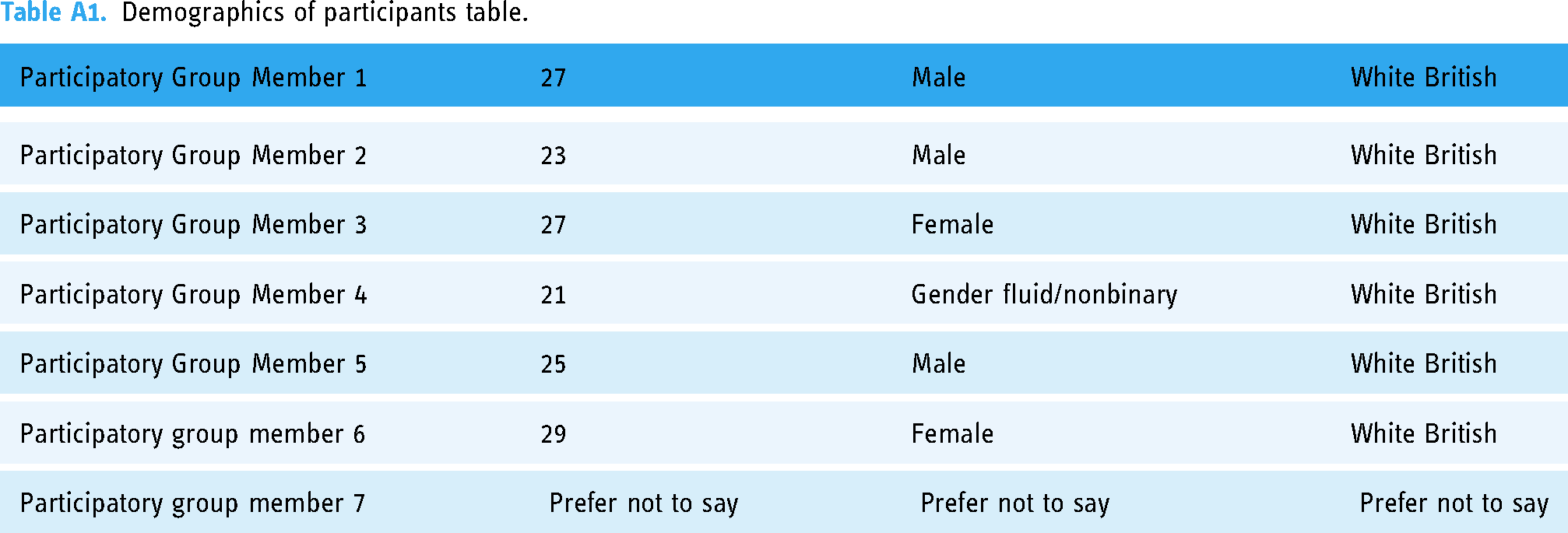
| Participatory Group Member 1 | 27 | Male | White British |
|---|---|---|---|
| Participatory Group Member 2 | 23 | Male | White British |
| Participatory Group Member 3 | 27 | Female | White British |
| Participatory Group Member 4 | 21 | Gender fluid/nonbinary | White British |
| Participatory Group Member 5 | 25 | Male | White British |
| Participatory group member 6 | 29 | Female | White British |
| Participatory group member 7 | Prefer not to say | Prefer not to say | Prefer not to say |