



Abstract
Few studies have explored the mental health of Autistic working parents, despite mental health being a research priority for Autistic people. This scoping review aimed to assess the type and extent of evidence relating to the mental health of Autistic working parents. Utilising the Joanna Briggs Institute's methodology for scoping reviews and the Preferred Reporting Items for Systematic Reviews and Meta-Analyses extension for Scoping Reviews, a total of 9,486 records were screened, with 12 studies included. Data were charted using a data extraction template. Data extracted for each source study included: title, year of publication, author(s), country/region of origin, aim(s), population/sample size, proportion of Autistic working parents in study population, sex and/or gender of Autistic participants, method, mental health measures, and findings. The review identified that more research is needed to establish if the intersection of being Autistic, employed, and a parent (including parenting neurodivergent children) leads to differences in mental health in Autistic working parents compared to other populations and to determine if tailored supports are required for Autistic working parents.
Lay Abstract
Currently, there is limited research that explores the mental health of Autistic working parents, even though Autistic people have identified mental health as a priority area of research and support. The current study is a scoping review on the mental health of Autistic working parents. A scoping review is a method used by researchers to better understand the type and extent of previous research on a particular topic. An initial search found 9,486 potentially relevant research articles, which were screened to determine if they met specific criteria related to the topic. Screening identified 12 relevant research studies that were included in the review. The data in these 12 studies was organised into a table to analyse key characteristics related to the type of study, the study aim(s), the study location, participant details, and key findings. The data obtained from each study included: title, year of publication, author(s), country of origin, aim(s), population/sample size, proportion of Autistic working parents in study population, sex and/or gender of Autistic participants, method, mental health measures, and findings. The review showed that more research is needed in a few main areas. Firstly, whether the mental health of Autistic parents with a job is different than other groups. Secondly, it is also important to include Autistic working parents who are raising neurodivergent children. More research also needs to look into whether Autistic working parents would benefit from customised supports.
Introduction
Autistic 1 people have identified their mental health as one of several research priorities (Pearson et al., 2022; Roche et al., 2020). Prior studies have examined how Autistic experiences related to gender (Sedgewick et al., 2021), employment (Nicholas et al., 2019), and recently, parenting (Pohl et al., 2020), influence mental health. However, most studies have examined parenting and employment separately, with few studies exploring the mental health of Autistic working parents (Gore et al., 2023). The current study aimed to review the literature relevant to the mental health of Autistic working parents to better understand their mental health support needs.
Autistic mental health and employment
Autistic people have higher incidences of mental health conditions compared to non-Autistic people (e.g., DaWalt et al., 2021; Lai et al., 2019; Lever & Geurts, 2016). Gender diverse Autistic people and Autistic women also have higher rates of mental health symptoms, such as anxiety and eating disorder symptoms, than Autistic men (Sedgewick et al., 2021). This discrepancy may be partially explained by men having greater privileges in society (Sedgewick et al., 2021) and a later average age of diagnosis for Autistic women, reducing their access to supports during youth (Beck et al., 2020; Tint et al., 2018).
Autism employment literature reports how work can positively influence mental wellbeing through providing purpose, financial independence, and social benefits (Hayward et al., 2019; Johnson & Joshi, 2016; Nicholas et al., 2019). However, social-communication differences, sensory sensitivities, difficulties seeking adjustments, bullying, and a lack of understanding and acceptance of Autistic people within workplaces can contribute to increased stress in Autistic adults (Hayward et al., 2020; Johnson & Joshi, 2016; Nicholas et al., 2019).
Mental health and parenthood – Autistic and non-Autistic
The transition to parenthood can challenge the mental health of Autistic and non-Autistic parents (Cooklin et al., 2015; Highet, 2022; Pohl et al., 2020). In non-Autistic mothers, factors associated with poor mental health include low socio-economic status, prior mental health diagnoses, being a single parent, and having few supports (Crosier et al., 2007; Ogbo et al., 2018; Schmied et al., 2013). Another factor for non-Autistic mothers is having neurodivergent (e.g. Autistic) children (DePape & Lindsay, 2015). Studies demonstrate higher stress levels, more mental health conditions, and lower quality of life in parents of Autistic children compared to parents of non-Autistic children (DePape & Lindsay, 2015; Giallo et al., 2013; Samsell et al., 2022).
There is a paucity of literature considering Autistic parents (McDonnell & DeLucia, 2021). The few known studies report that Autistic mothers enjoy the parent–child bond (Dugdale et al., 2021; Hwang & Heslop, 2022; Winnard et al., 2021), but report higher incidences of mental health conditions compared to non-Autistic mothers during and after pregnancy (e.g., Hampton 2022a, 2022b, 2022c; Pohl et al., 2020).
Mental health of working parents – non-Autistic and Autistic
In non-Autistic working parents, there is substantial research investigating their mental health and exploration of gender differences in mental health (e.g., Cooklin et al., 2015; Kramer & Pak, 2018; Reich-Stiebert et al., 2023). Studies report that working mothers, compared to working fathers, experience more negative mental health symptoms. This seems to be due, but not limited, to contributing more unpaid domestic work, juggling caregiving and work roles, and other factors such as income inequality, increased likelihood of insecure work, and barriers to career advancement (Cooklin et al., 2016; Craig & Churchill, 2021; Reich-Stiebert et al., 2023).
To the authors’ knowledge, there is no detailed examination of the mental health of Autistic working parents. Recent qualitative research involving 10 Autistic working mothers was one of the first studies to discuss mental health in this population, although the research focus was not specifically on mental health (Gore et al., 2023). The majority of study participants reported having an anxiety disorder and discussed factors which may contribute to participant mental wellbeing (Gore et al., 2023). These factors included employment, associated with positive mental health, and challenges associated with stress and overwhelm including time pressure, financial pressure, and employment-related challenges relating to disclosure, adjustments, and career stagnation (Gore et al., 2023).
Current review objectives
The objectives of this scoping review were to assess the extent and type of evidence concerning the mental health of Autistic working parents, to understand their mental health support needs to optimally manage their quality of life. A search of MEDLINE, the Cochrane Database of Systematic Reviews, and JBI Evidence Synthesis databases indicated no current or underway scoping reviews on the topic. The key research question was ‘What is known from the existing literature about the mental health of Autistic working parents?’
Method
The scoping review was conducted utilising the Joanna Briggs Institute's methodology for scoping reviews (Peters et al., 2020) and the Preferred Reporting Items for Systematic reviews and Meta-Analyses extension for Scoping Reviews (PRISMA-ScR; Tricco et al., 2018) checklist. A protocol was developed in consultation with the co-authors and a La Trobe University librarian. The protocol was not published before conducting the review (available on request from corresponding author).
Information sources and search strategy
The search strategy aimed to find published research and grey literature. Key search concepts were (1) autism, (2) employment, (3) parent or caregiver, and (4) mental health. Prior testing by the first author K.G. found literature when all four concepts were entered together in MEDLINE. An initial list of search terms was developed from reviewing the keywords, index terms, and text words contained in titles and abstracts of relevant articles. This list was refined in consultation with a La Trobe University librarian and all co-authors (see Table 1 for final search terms).
Scoping review search terms by concept.

Initial testing of these search terms identified a large proportion of articles about parents of Autistic children, where participants were not asked whether they were Autistic. This did not improve with additional search restrictions, such as proximity of words relating to ‘autism’ and ‘parent’. Therefore, a full text review of all participants sections was required to isolate sources that included employed Autistic parents.
The main data retrieval occurred in October 2022, with alerts for new articles created for each data base. An additional search was performed in May 2023, identifying further literature, followed by a final search in February 2024 that identified no further relevant literature. Sources included academic databases of peer-reviewed journals and grey literature, as outlined in Table 2. Search terms related to all four concepts of interest were entered for all searches. See Supplemental material for a copy of MEDLINE search string.
Scoping review databases.

Inclusion and exclusion criteria
Study design inclusion criteria included literature reviews, dissertations, and conference proceedings. Where possible, databases were limited to only include studies of adult populations. Due to time and budgetary constraints, only studies published in English were included. There was no historical date limitation, with all studies included up until the end of the data extraction period of 8 February 2024.
Participant inclusion criteria were: (1) aged 18 years and above, (2) self-identified or formally diagnosed Autistic, (3) a caregiver or parent to a child, with no child age limit, (4) employment status as ‘currently working, recently employed, or seeking employment’. The scoping review criteria also included articles where Autistic working parents were a subgroup of study participants and specific findings relevant to this population could be identified and extracted, given the scant existing literature focused only on this population.
Study selection
The results of the systematic search and study selection are presented in Figure 1 (Tricco et al., 2018). All search results were downloaded into EndNote 21 (The EndNote Team, 2013) and then uploaded into Covidence (Veritas Health Innovation, 2022). All duplicate records were removed by Covidence, leaving 8,573 titles screened against the inclusion criteria for eligibility, followed by the abstract. After records passed the initial screening, additional screening of the participants sections occurred to determine if Autistic working parents were identified in the study population. A second reviewer (external to the research team) screened 394 (4.6%) of potential records against the inclusion criteria, with 94.2% agreement. Disagreements between reviewers were resolved by independent blind review by author M.G.

PRISMA-ScR flow diagram of study selection process.
The next phase reviewed the full text of 224 articles. Reasons for excluding sources were noted for reporting. A second reviewer (external to the research team) screened 44 (19.6%) of the full text articles against the inclusion criteria (92.2% agreement). Disagreements between reviewers were resolved by independent blind review by author M.G. The reference lists of all included studies were reviewed and identified five additional studies. A total of 12 studies were identified.
Data extraction and analysis
Data was extracted from each source and charted into a table in Covidence according to fields developed by author K.G. during the scoping review protocol development (see Supplemental material). The following data was charted from each source study: title, year of publication, author(s), country of origin, aim(s), population/sample size, proportion of Autistic working parents in study population, sex/gender of Autistic participants, method, intervention type and detail (if applicable), mental health measures and results.
Community involvement
K.G., who led the study, is an Autistic researcher with lived experience as an Autistic working parent and a psychologist. Members of the supervisory team are also neurodivergent/multiply neurodivergent, including Autistic, and some are working parents.
Results
The 12 identified articles are charted in Table 3.
Summary of scoping review results.
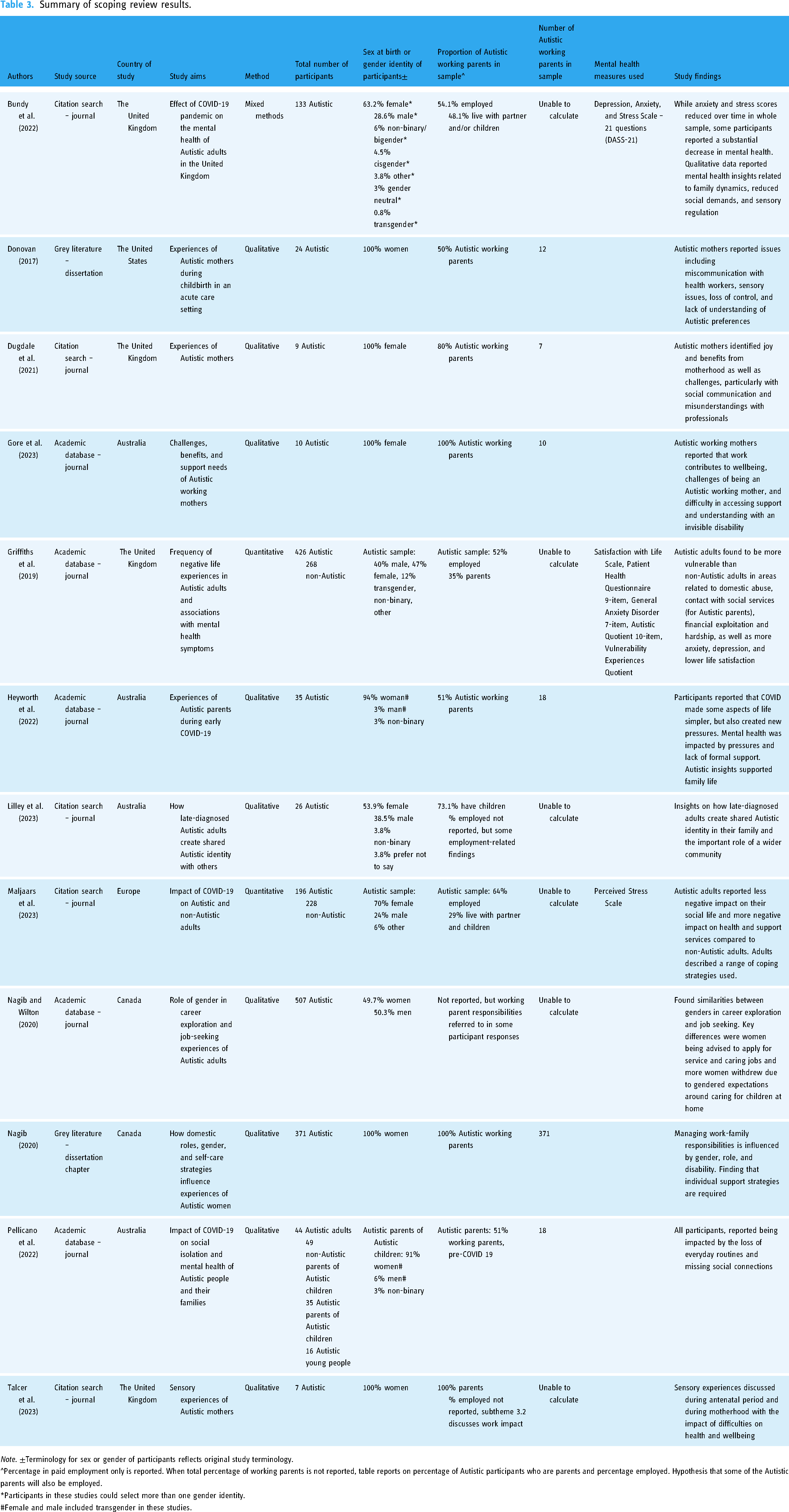
Note. ±Terminology for sex or gender of participants reflects original study terminology.
^Percentage in paid employment only is reported. When total percentage of working parents is not reported, table reports on percentage of Autistic participants who are parents and percentage employed. Hypothesis that some of the Autistic parents will also be employed.
*Participants in these studies could select more than one gender identity.
#Female and male included transgender in these studies.
Study characteristics
Studies were based in the United Kingdom (n = 4, 33.3%), Australia (n = 4, 33.3%), Canada (n = 2, 16.7%), the United States (n = 1, 8.3%) and European countries (n = 1, 8.3%). Study designs included nine qualitative, two quantitative, and one mixed-methods study. Sources were journals from academic databases (n = 10, 83.3%) and dissertations (n = 2, 16.7%). Year of publication ranged from 2017 to 2023. See Supplemental material for further information.
Participant characteristics
All studies (n = 12, 100%) included self-report data from Autistic adults and three studies (25%) included data from a non-Autistic comparison group (Griffiths et al., 2019; Maljaars et al., 2023; Pellicano et al., 2022). Six studies (50%) reported on the number of Autistic working parents in their sample. The number ranged from 50% to 100% of each study's sample, which amounted to 436 Autistic working parents across six studies (Donovan, 2017; Dugdale et al., 2021; Gore et al., 2023; Heyworth et al., 2022; Nagib, 2020; Pellicano et al., 2022). Two (16.7%) of these six studies had a participant sample wholly comprised of Autistic working parents, all women (100%; Gore et al., 2023; Nagib, 2020). Three studies (25%) did not report the proportion of Autistic working parents in their participant sample but had findings regarding this population (Lilley et al., 2023; Nagib & Wilton, 2020; Talcer et al., 2023). Three studies (25%) reported employment and living situation separately, with living situation including ‘with partner and/or child/ren’ (Bundy et al., 2022; Griffiths et al., 2019; Maljaars et al., 2023). These three studies were included on the premise that some participants would have existed in both categories, that is, being employed and living with their children.
Sex/gender
Five studies (41.7%) included only Autistic people who identified as women/female (Donovan, 2017; Dugdale et al., 2021; Gore et al., 2023; Nagib, 2020; Talcer et al., 2023). The proportion of Autistic participants identifying as men/male in the remaining seven studies (58.3%) ranged from 3% to 50.3% (Bundy et al., 2022; Griffiths et al., 2019; Heyworth et al., 2022; Lilley et al., 2023; Maljaars et al., 2023; Nagib & Wilton, 2020; Pellicano et al., 2022). Five studies (41.7%) included Autistic participants who identified with genders other than man or woman – for example, non-binary, gender neutral – with proportions ranging from 3% to 12% (Bundy et al., 2022; Griffiths et al., 2019; Heyworth et al., 2022; Lilley et al., 2023; Pellicano et al., 2022).
Co-occurring mental health conditions
Gore et al. (2023) was the only study to report data on the occurrence of mental health conditions in Autistic working parents. In a sample of 10 Autistic working mothers, nine self-reported having an anxiety disorder and five self-reported depression (Gore et al., 2023). All review studies that reported on mental health measures completed by Autistic people did not extract findings specific to Autistic working parents.
Mental health-related findings specific to Autistic working parents
The studies by Gore et al. (2023) and Nagib (2020) reported specifically on the experiences of Autistic working mothers and included some findings related to their mental health.
When reflecting on their role as a parent, Autistic working mothers outlined the positive bond and loving relationship with their children (Gore et al., 2023; Nagib, 2020). However, they also identified challenges relating to sensory and caring demands. Participants in Nagib's (2020) and Gore et al.'s (2023) studies outlined experiences of sensory challenges at home including difficulty tolerating noise, touch, visual mess and smells from their children. Overstimulation was reported to negatively impact mental health, with descriptions including ‘overload’ and ‘torture’ (Nagib, 2020, p. 115). In respect to caring demands, Autistic working mothers in both studies reported prioritising their children's needs over their own, sometimes leading to negative consequences for their own mental wellbeing through reduced time for self-care (Gore et al., 2023; Nagib, 2020). Parenting a neurodivergent child was also linked to additional demands in supporting the child at home, at school, and in the community in the studies by Gore et al. (2023) and Nagib (2020). These additional demands included social communication challenges in interactions with other parents, teachers, health professionals, support organisations and family members (Gore et al., 2023; Nagib, 2020). Autistic working mothers discussed two-way miscommunication with non-Autistic professionals when advocating for themselves or their child in the aforementioned settings (Gore et al., 2023; Nagib, 2020). Participants reported that miscommunication challenges resulted in them feeling ‘quite depressed’ (Nagib, 2020, p. 111).
When reflecting on their employment, Autistic working mothers in Gore et al. (2023, p. 5) described how employment contributed to their positive self-esteem, creating an identity beyond being ‘someone's mum’. Autistic working mothers in the same study also discussed the importance of the financial independence, due to employment, on their self-esteem (Gore et al., 2023). However, the need to sacrifice income for job flexibility to manage their caring responsibilities was identified as negatively impacting mental health by participants in both Gore et al. (2023) and Nagib (2020). Another key challenge in the workplace identified by Autistic working mothers in Nagib (2020) was interpersonal communication and managing increased sensory input in an open-plan workplace.
Autistic working mothers in both studies identified how access to workplace adjustments can reduce stress. For example, Nagib (2020, p. 121) reported how flexibility with work times and the ability to work from home was ‘key to … survival’ and Gore et al. (2023) reported a lack of workplace understanding of autism can lead to Autistic working mothers feeling unsafe to disclose being Autistic and request adjustments.
Autistic working mothers in Gore et al. (2023) and Nagib (2020) reported challenges specific to being a working parent that appeared to influence mental health. Key challenges included juggling parenting, work, and domestic duties (Gore et al., 2023; Nagib, 2020). Autistic working mothers described that juggling multiple roles resulted in negative mental health symptoms, including stress, overwhelm, fatigue, and Autistic burnout (Gore et al., 2023; Nagib, 2020).
When discussing supports, Autistic working mothers in Gore et al. (2023) and Nagib (2020) mentioned the lack of specialised supports for employed Autistic mothers. In addition, participants in the study by Gore et al. (2023) reported negative experiences in applying for supports or when engaging with professionals who did not understand autism. The latter resulted in participants feeling misunderstood, not receiving support, and, in some cases, giving up on seeking support (Gore et al., 2023).
Discussion
The current scoping review aimed to investigate current literature on the mental health of Autistic working parents. While 12 studies were identified, only two of these studies had study populations wholly comprised of Autistic working parents, all cisgendered women (Gore et al., 2023; Nagib, 2020). In this small sample, the review found that Autistic working mothers experience multiple social communication demands that may negatively influence mental health (Gore et al., 2023; Nagib, 2020), consistent with prior research reporting Autistic social communication challenges in employment (Gemma, 2021; Hayward et al., 2020; Johnson & Joshi, 2016; Nicholas et al., 2019) and in parenting (Hwang & Heslop, 2022; Winnard et al., 2021).
Sensory-related findings relevant to Autistic working mothers included additional sensory stimulation from their child/ren (Gore et al., 2023; Nagib, 2020) and sensory challenges in the workplace (Nagib, 2020). The findings were similar to those described in prior research about Autistic motherhood (Marriott et al., 2021; Winnard et al., 2021) and in the Autistic employment literature (Harmuth et al., 2018; Lindsay et al., 2021; Weber et al., 2022).
When combining employment and parenting, this review found juggling work and caregiving was associated with reports of greater time demands, stress, burnout, and poor mental health (Gore et al., 2023; Nagib, 2020), consistent with prior literature involving non-Autistic working mothers (Baxter & Tai, 2016; Craig & Churchill, 2021; Dugan & Barnes-Farrell, 2020). However, due to a lack of data, it was unclear whether the level of demand and mental health impact differed between Autistic and non-Autistic working parents. Due to a lack of data, we could not determine from the review which support services and coping strategies were most helpful for Autistic working parents.
Research gaps and future directions
This review revealed several gaps in the current literature regarding the mental health of Autistic working parents, which need to be addressed in future research. This includes a lack of robust mental health data, gaps in participant demographic details that made it challenging to disaggregate data from working and non-working parents, a lack of diversity in participant samples, and methodological issues.
First, this review's mental health findings are dominated by insights from qualitative data, with a lack of mental health measurement to quantify the mental health impact. This gap is compounded by no comparative data contrasting the mental health of Autistic working parents with other groups such as non-Autistic working parents or employed Autistic people who are not parents. Therefore, this review cannot determine whether Autistic working parents have poorer mental health compared to other groups and, therefore, whether they require greater or different mental health support to optimise their quality of life. Future research needs to measure the level of mental health issues and other co-occurring conditions in Autistic working parents compared to other populations, to determine whether this group needs greater and/or specialised supports.
Secondly, many papers that may have been suitable for the review were not included because they did not collect adequate demographic details about the employment and parenting status of participants. This made it impossible to identify if participants were working parents. In addition, the lack of gender diversity in participant samples renders it difficult to generalise findings to all Autistic working parents. Only six of the 12 papers included gender diverse Autistic people and reported no mental health findings specific to gender diverse Autistic working parents. Autistic working fathers were also underrepresented in the review papers, with no specific findings related to their mental health.
Thirdly, review studies did not investigate whether factors such as socio-economic status, being a single parent, a same-sex parent and/or co-parenting arrangements were related to mental health issues. This is despite evidence of these factors impacting mental health in non-Autistic populations (Crosier et al., 2007; Ogbo et al., 2018; Schmied et al., 2013). A further issue was a lack of cultural diversity, with no first nations peoples included in the review, and studies only originating in western countries. Even between western nations, there are significant differences in healthcare, welfare, and employment systems that could impact wellbeing (Béland, 2021), further influencing the generalisability of findings. More research is needed with diverse participant samples, and which considers the context of each country's support systems, to better understand which demographic factors for Autistic working parents are related to poorer mental health outcomes so that supports can be targeted appropriately.
Finally, there were several gaps related to study methods. In the six papers (50%; Donovan, 2017; Dugdale et al., 2021; Gore et al., 2023; Heyworth et al., 2022; Nagib, 2020; Pellicano et al., 2022) where it was possible to calculate the proportion of Autistic working parents in the sample, four papers (33.3%; Donovan, 2017; Dugdale et al., 2021; Heyworth et al., 2022; Pellicano et al., 2022) reported 50% to 80% of their total sample identifiable as working parents making it difficult to extract study findings specific to Autistic working parents. While the Nagib (2020) qualitative study included 371 Autistic working mothers (100% of total sample), the study analysed social media posts where they were unable to verify participant demographic details and whether they were Autistic. Furthermore, in eight of the nine qualitative studies, the research aims were broader than mental health (Donovan, 2017; Dugdale et al., 2021; Gore et al., 2023; Heyworth et al., 2022; Lilley et al., 2023; Nagib, 2020; Nagib & Wilton, 2020; Talcer et al., 2023). While data saturation may have been achieved in relation to the original research question, it may not have been achieved in relation to mental health specifically, given this was not part of the research question of these papers. Therefore, there may be additional insights related to the mental health of Autistic working parents that were not identified in these studies.
Strengths and limitations
A key strength of this review is being the first known scoping review investigating current literature regarding the mental health of Autistic working parents. Inclusion of both peer reviewed and grey literature widened the scope of captured data. A methodological limitation is the inclusion of studies in which Autistic working parents were a subset of participants. This may have led to findings from Autistic adults who were not working parents being generalised to Autistic working parents. Subsequent reviews could focus only on Autistic working parents when there is sufficient published literature. Another area relates to study sample diversity. Although this scoping review included parents of all genders, many studies had a high proportion of participants being women and from western countries. Larger samples with greater gender, socio-economic, and ethnic diversity are needed in future research to generalise findings to all Autistic working parents. A final limitation is that the search strategy may have missed some literature where ‘mental health’ or related terms were not a keyword and/or in the abstract; for for example, a reviewer of this article shared a relevant article by Radev et al. (2024) in which Autistic working parents were a subset of participants. This article was not found during our search and was not included to ensure our search strategy was replicable.
Conclusion
This scoping review identified 12 research studies reporting on the mental health of Autistic working parents. The review revealed that more evidence is needed to determine if mental health in Autistic working parents is influenced by factors such as the intersection of being Autistic, employed, and a parent (including parenting neurodivergent children). Future research should investigate whether there are differences in the mental health of Autistic working parents compared to other populations. This will enable better understanding as to whether Autistic working parents require tailored supports.
Supplemental Material
sj-docx-1-ndy-10.1177_27546330241272174 - Supplemental material for Investigating the mental health of Autistic working parents: A scoping review
Supplemental material, sj-docx-1-ndy-10.1177_27546330241272174 for Investigating the mental health of Autistic working parents: A scoping review by Katherine Gore, Melissa Gilbert, Susan M Hayward, Rebecca L Flower and Josephine Barbaro in Neurodiversity
Supplemental Material
sj-pdf-2-ndy-10.1177_27546330241272174 - Supplemental material for Investigating the mental health of Autistic working parents: A scoping review
Supplemental material, sj-pdf-2-ndy-10.1177_27546330241272174 for Investigating the mental health of Autistic working parents: A scoping review by Katherine Gore, Melissa Gilbert, Susan M Hayward, Rebecca L Flower and Josephine Barbaro in Neurodiversity
Footnotes
Declaration of conflicting interests
The authors declared no potential conflicts of interest with respect to the research, authorship, and/or publication of this article.
Funding
The authors disclosed receipt of the following financial support for the research, authorship, and/or publication of this article: Author K.G. received a PhD research scholarship from La Trobe University to support this article's research and authorship. All other authors received no financial support for research, authorship, and/or publication of this article.

Supplemental material
Supplemental material for this article is available online.
Notes
References
Supplementary Material
Please find the following supplemental material available below.
For Open Access articles published under a Creative Commons License, all supplemental material carries the same license as the article it is associated with.
For non-Open Access articles published, all supplemental material carries a non-exclusive license, and permission requests for re-use of supplemental material or any part of supplemental material shall be sent directly to the copyright owner as specified in the copyright notice associated with the article.
