



Abstract
Psychological theory and results from previous empirical studies paradoxically suggest that concealing and revealing one's autism can each result in reduced mental well-being. On one hand, autistic people who reveal their autistic identity experience considerable anti-autism stigma, which can lead to worse mental health outcomes compared to autistic people who conceal their autistic identity. On the other hand, autistic people who conceal their autistic identity are not afforded the benefits of autistic community connectedness, potentially undermining mental health outcomes compared to autistic people who reveal their autistic identity. The present study explores the relationships between autism concealment behaviors, autistic community connectedness, stigma experience, and mental well-being in autistic people. In an analytic sample of 409 autistic people, we found that concealing one's autistic identity was related to worse depressive symptoms, and that this relationship was related to experiencing greater stigma, and not to differences in community connectedness. These findings reinforce the need for combatting stigma against autistic people.
Lay Abstract
Many autistic people try to hide their autistic traits or appear more in line with typical social norms through changing their behavior, even when it is uncomfortable, which is known as camouflaging. Previous studies have shown that autistic people often attribute mental health difficulties, such as anxiety and depression, to concealing their autism through camouflaging. In part, this might be because concealing one's autism is related the loss of a sense of community with other autistic people, which is a protective factor for autistic people's mental health. However, allowing one's autistic identity to be public by forgoing camouflaging can make autistic people more likely to face judgement, stigmatization, and unfair treatment due to society's negative view of autism, which can also lead to poor mental health. Autistic people may thus be in a double bind between engaging in camouflaging but possibly experiencing related mental health difficulties and camouflaging less but encountering more stigmatization.
In this study, we explored what contributes to this seemingly contradictory relationship between autism concealment and depressive symptoms. We collected data from 409 autistic people in an online survey. The results showed that participants who concealed their autism more were more likely to show depressive symptoms. This increase in depression symptoms was explained by experiencing stigma rather than feeling connected to the autistic community. These findings suggest negative effects of camouflaging and stigma on autistic people's mental health and support the call for increased autism acceptance.
For many members of stigmatized groups, concealing their stigmatized identity from those around them represents a practical response to the challenges of being the target of stigmatization, such as prejudice, discrimination, and even violence (Goffman, 1963). However, the decision to conceal important aspects of oneself can have consequences beyond avoiding the effects of stigmatization. For example, for members of the lesbian, gay, bisexual, transgender, queer, and two-spirit (LGBTQ2S+) community, concealing one's stigmatized identity can be related to adverse mental health and well-being outcomes (Pachankis et al., 2020; Meyer, 2003). For members of another marginalized community – the autistic community – the relationship between concealing their stigmatized autistic identity and mental health is less clear. Some studies find that concealing is in fact related to better mental health (Botha & Frost, 2020), perhaps because of how it protects from the stigma autistic people would otherwise face in society. Other studies have found costs of concealing one's autistic identity and have thus called for more research on its impacts (Bargiela et al., 2016). To help reconcile these findings, in the present work, we test two theory-based hypotheses that may explain costs or benefits to mental health as a result of concealing one's autistic identity. Specifically, we test whether the stigma and community connectedness experienced by autistic people who conceal or disclose their autism may exert influences on mental health in opposing directions.
Anti-autism stigma
Undeniably, autistic people are subject to significant stigma and ostracization in society due to the negative attitudes associated with an autism diagnosis (Wood & Freeth, 2016), including people's negative views of behaviors associated with the condition, such as social differences, self-stimulating behaviors, and lack of eye contact (American Psychiatric Association, 2013; Botha et al., 2020; Botha & Frost, 2020).
Anti-autism stigma has wide-ranging effects on autistic people. Neurotypical people (i.e. people who do not have any neurodevelopmental conditions) tend to see autistic people as less socially skilled and report not wishing to engage with them (Sasson et al., 2017). Indeed, autistic people are perceived as being highly disruptive in social interactions (Pachankis et al., 2018a), and stereotypes of them are mostly negative, including a lack of social skills, extreme social withdrawal, and having a difficult personality (Wood & Freeth, 2016). Further, stereotypes of autistic people often deny them traits unique to humans, such as conscientiousness, politeness, and humility (Cage et al., 2019). Media representations of autism tend to be overwhelmingly negative and center on themes such as violence, despair, aggression, and social isolation and ostracization (Holton et al., 2014). As a response to this stigma, autistic people are often subject to the expectation to “fit in” and act “normal”: “they are people with a disability who must deal with the social world as if they were not disabled” (Gray, 2002).
Autism concealment
Autistic people are highly conscious of the stigmatizing and disparaging stereotypes surrounding their condition and of the fact that society largely sees autism as inherently negative (Botha & Frost, 2020). Like members of many other stigmatized groups, autistic people may turn to identity concealment to manage the stigma they face (Quinn & Earnshaw, 2013). In the specific context of stigma management among autistic people, they may conceal their autistic identity through behavioral strategies known as “camouflaging” (Botha & Frost, 2020; Hull et al., 2017). Camouflaging consists of intentionally adopting communication strategies in order to minimize the appearance of one's autistic traits; some commonly cited examples are forcing eye contact, suppressing repetitive and self-stimulating behaviors, and emulating other people's social behaviors (Bargiela et al., 2016; Mandy, in press).
Effects of concealing autism
Concealing one's autistic identity may have complex, positive and negative effects on autistic people's mental well-being. For instance, in cross-sectional studies, camouflaging has been linked to depression and generalized and social anxiety symptoms (Hull et al., 2021). Insights from psychology may help us to understand these outcomes.
Autistic community connectedness
One reason concealment can be related to adverse psychological outcomes is because it denies people the opportunity to experience community connectedness. Community connectedness, a sense of belonging to a shared psychological space (Botha et al., 2022), can buffer the impact of stigma on mental health for people with stigmatized identities (Botha, 2020; Kaniuka et al., 2019). For instance, among LGBTQ + people, when they feel strongly connected to their community, experiencing and perceiving stigma has less of a negative effect on their mental health (Kaniuka et al., 2019).
In the context of the autistic community, autistic community connectedness can be a safeguarding factor against the effects of minority stress and stigmatization on mental health (Botha, 2020). A multidimensional construct consisting of feelings of belonging and social and political connectedness to other autistic people, autistic community connectedness can also lead to improved self-esteem, sense of community and purpose, and reduced internalized stigma (Botha et al., 2022).
The relationship between autistic identity concealment, community connectedness, and well-being is complex. Botha (2020) found that among autistic adults, both concealment and disclosure were found to be minority stressors associated with poor mental health outcomes, but autistic community connectedness served to buffer their adverse effects on psychological well-being such that autistic people who were highly connected to the autistic community experienced better psychological well-being compared to those who experienced similar levels of minority stress but were less connected. This suggests that a sense of belonging to the autistic community may mitigate the adverse effects of concealment on well-being, possibly through positive effects on individual and group identity.
Stigma experience
At the same time as affecting one's relationship with autistic community connectedness, disclosing one's autism can also result in increased experiences of societal stigma, including workplace discrimination, social isolation, and bullying (Botha, 2020; Botha et al., 2020). However, autistic people can still experience stigma even if they do not disclose their disability (Sasson et al., 2017). Across stigmatized groups, the extent of the stigma someone experiences has consistently been found to have a negative effect on their mental health (Mak et al., 2007). As such, the interplay between stigma concealment, stigma experience, and community connectedness (see above; Botha, 2020; Botha & Frost, 2020) might exert complex, possibly opposing, effects on autistic people's psychological well-being.
The present study
The present study aims to explore potential explanations of the complex relationship between concealment and mental health among autistic people. We investigated the role of experiencing stigma and the degree of autistic community connectedness in the mental health of autistic people who camouflage. We thus tested a multiple mediation model wherein stigma concealment both directly predicts mental health and also indirectly predicts mental health through the mediators of autistic community connectedness and stigma experience. Guided by previous findings, we predicted the following patterns:
Autism concealment would negatively predict stigma experience, which would then predict increases in depressive symptoms. Autism concealment would negatively predict autistic community connectedness, which would then predict decreases in depressive symptoms. We expected for autism concealment to overall negatively predict depressive symptoms (i.e. autism concealment should be related to better mental health), a relationship we hypothesized to be mediated by autistic community connectedness and stigma experience.
These predictions (particularly predictions 1 and 2) reflect the conflicting nature of the literature (e.g. Botha, 2020) on the question of whether autism concealment should lead to worse or better mental health. These predictions are summarized in Figure 1 and were pre-registered on the Open Science Framework: https://osf.io/mzver/?view_only=08923a52f3a44839b2f9c515e4d08b02.

Proposed multiple mediation model.
Method
Ethics statement
This study protocol was reviewed and approved by the research ethics board at the lead author's home institution. All participants gave informed consent in order to participate.
Participants
We conducted a power analysis using the R package pwr2ppl (Aberson, 2022) to determine the sample size needed to detect moderate relationships between the variables 1 with 80% power. This procedure yielded a desired sample size of 365 participants. We increased this number by 15% to account for probable exclusions and arrived at a recruitment goal of 420 participants. The sample was recruited on Prolific (prolific.co) such that the study was only shown to those who had identified as autistic in the pre-screening questionnaire administered by Prolific. Participants were compensated with £1.35 for a 10-min study. Ultimately, 431 people started the survey. Consistent with our pre-registered exclusion criteria, 13 participants were excluded from the analytical dataset through listwise deletion due to missing data, and nine were excluded as they had indicated that they were not autistic in the demographics section. No one was excluded from analyses for failing the attention check. Following these exclusions, the final analytic sample consisted of 409 participants. Demographic information can be seen in Table 1.
Demographic details.

Procedure
This study was conducted entirely online. Participants completed the measures in random order. The measures under “Exploratory Measures” were not part of the hypothesized mediation model and hence collected solely for the purposes of exploration, with potential inclusion in future studies. Descriptions of these measures, as well as the raw and cleaned data and the code used for data cleaning and analysis are available on the Open Science Framework: https://osf.io/97hg8/?view_only=63ab5f9e7466471f8069ec373df8d1fd.
Main measures
Exploratory measures
We included three exploratory measures in the survey for use in future studies: the Subjective Identity Concealability Scale (Le Forestier et al., 2020), an alternative measure of Stigma Concealment (Jackson & Mohr, 2016), and the Stigma Consciousness Scale (Pinel, 1999). For brevity, these are reviewed in the online supplement available on the Open Science Framework.
Results
Preliminary analyses
Skew was calculated for all seven measures using the psych package in R (Revelle, 2018). No scale had a skew with an absolute value greater than 1. As such, no transformations were performed. A correlation matrix for the main measures is presented in Table 2, and the full correlation matrix including the exploratory measures can be found in the Supplemental material.
Correlations between the main measures.
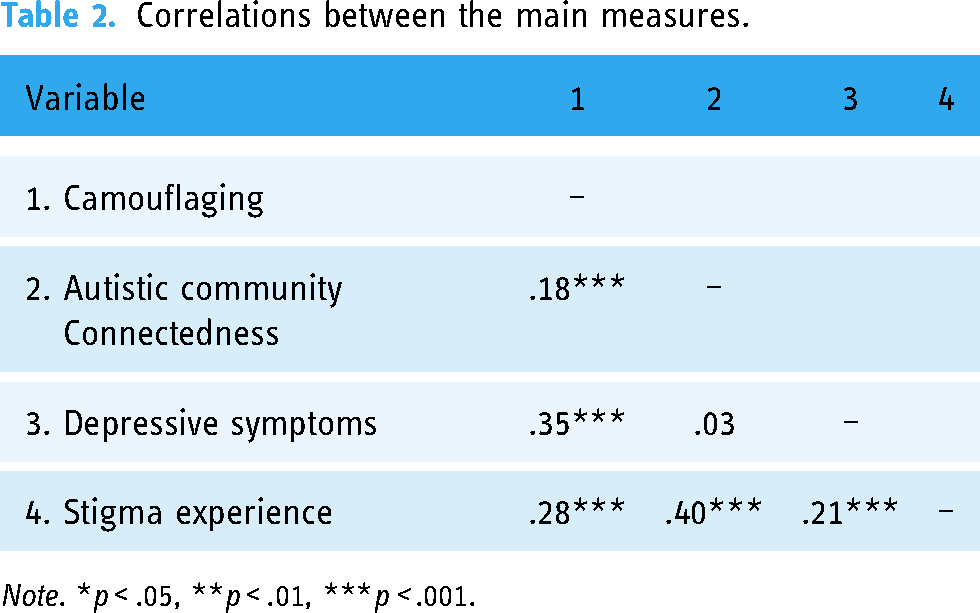
Note. *p < .05, **p < .01, ***p < .001.
Multiple mediation analysis
We tested if the relationship between stigma concealment in the form of camouflaging and depressive symptoms was multiply mediated by autistic community connectedness and stigma experience using path analysis in the lavaan package in R (Rosseel, 2012).
Table 3 presents the results of the resulting multiple mediation analysis. We observed a total effect of camouflaging on depressive symptoms, but in the opposite direction than Prediction 3, with participants who concealed their autism more also reporting more depressive symptoms. This effect was mediated by increases in stigma experience in the opposite direction of what we predicted (Prediction 1), with participants who concealed more experiencing more stigma and depressive symptoms. However, autistic community connectedness was not a significant mediator of the relationship between camouflaging and depressive symptoms, with an insignificant indirect effect contrary to Prediction 2. The results are visualized in Figure 2.

Visualization of the multiple mediation analysis. Note. *p < .05, **p < .01, ***p < .001.
Results of the multiple mediation analysis.

Robustness analyses
To test these results’ robustness to the inclusion of relevant covariates, we repeated this mediation analysis while including age, gender (man, woman, and non-binary/multiple; see Table 1), sexuality (recoded into two levels—heterosexual and non-heterosexual—due to small sample sizes within non-heterosexual groups), and the presence of a formal diagnosis (those who identified as being self-diagnosed were coded as self-diagnosed regardless of whether or not they were seeking a formal diagnosis) as covariates. The model replicated all key effects found in the pre-registered model without covariates. The only result that differed was that the path between autistic community connectedness and depressive symptoms (b1) was now significant, but the indirect effect through autistic community connectedness was still not significant. These results are summarized in detail in the Supplemental material.
We additionally investigated multicollinearity in this model, which yielded no concerning results. This analysis is also detailed in the Supplemental material.
We also ran a robustness analysis using the alternative measure of Stigma Concealment (Jackson & Mohr, 2016) instead of the CAT-Q used in the previous analysis, given the conceptual overlap between the measures. In this robustness test, we also found the same pattern of direct, total, and indirect effects as in the main analysis. The results of the robustness analysis are summarized and visualized in the Supplemental material.
Finally, although we already found that including diagnosis status as a covariate in our main model did not alter our conclusions, we nonetheless wondered whether participants who were formally diagnosed versus self-diagnosed may have differed on our key mechanism—community connectedness. We thus conducted a t-test investigating the relationship between diagnosis status and autistic community connectedness. Mean autistic community connectedness levels did not significantly differ by diagnostic status (t(268.16) = -0.70, p = .482).
Alternative model
Due to the cross-sectional nature of these data, we cannot infer the directionality of the present effects. However, we deemed that it was implausible that concealing one's autistic identity would lead to more stigma. We thus proceeded to test an alternative model regarding the significant relationships we observed regarding camouflaging, stigma experiences, and depressive symptoms. Specifically, we tested whether higher levels of stigma experience would lead to increased concealment through camouflaging, which would in turn lead to more depression symptoms. These tests were exploratory and not pre-registered, but reflect stigma's role as the primary motivation for identity concealment (Goffman, 1963). The results of this exploratory analysis are summarized in Table 4 and visualized in Figure 3. We found that, indeed, increases in stigma experience predicted increases in camouflaging, which, in turn, predicted higher depressive symptoms in this sample.

Visualization of the exploratory mediation analysis. Note. *p < .05, **p < .01, ***p < .001.
Results of the exploratory mediation analysis.

Discussion
This study examined the relationship between stigma concealment and mental health in a sample of autistic adults. We found that stigma concealment behaviors in the form of camouflaging were associated with increased depressive symptoms, contrary to what we had predicted and what had sometimes been observed in previous research (Bargiela et al., 2016; Cage & Troxell-Whitman, 2019), but consistent with what has been observed for other groups who conceal their stigmatized identities (e.g. sexual minorities; Pachankis et al., 2020). Our initial model indicated that this relationship was mediated by increases in experiencing stigma, but not autistic community connectedness. This was likely in part because, contrary to our predictions, camouflaging was associated with experiencing more stigma, not less, which was in turn related to greater depressive symptoms. Furthermore, community connectedness did not seem to mediate the relationship between camouflaging and depressive symptoms.
To probe the finding that concealment in the form of camouflaging was associated with more stigma and not less, we tested an alternative model that positioned stigma experience as the predictor and concealment as the mediator. We found support for this model, consistent with concealment's role in undermining autistic people's mental health, but tracing that effect back to stigma. However, the cross-sectional nature of these data prevents us from truly differentiating this model from alternatives.
There are several potential explanations for these findings. It is possible that engaging in concealment behaviors leads an autistic person to be more aware of the stigma autistic people face in society, as well as attribute perceived discrimination or stigmatization to being autistic rather than other social identities. This awareness, also known as stigma consciousness, may then undermine their mental health, an effect that has been found in other minority groups (Figueroa & Zoccola, 2015). Additionally, as concealment via camouflaging is a response to stigma and our data are cross-sectional, an alternative explanation is that concealment and stigma were positively related because those participants experiencing more stigma to begin with had more cause to conceal, as is reflected in our alternative model. Experiences of stigmatization and concealment behavior may thus together lead to worse mental health, implying that the experience of stigma would be more appropriately considered a precursor to concealment, rather than (or in addition to) a consequence of it. This is partially in line with a longitudinal study by Pachankis et al. (2018b) which found that in sexual minority men, experiencing stigma was more strongly associated with depressive symptoms in masculine (i.e. those whose identity may have been more concealable) than feminine men. However, it is worth noting that the average camouflaging scores in our sample were lower than those in previous research (e.g. Cage & Troxell-Whitman, 2019; Hull et al., 2019), suggesting that our participants may have concealed less than previous autistic samples. In addition, our exploratory analysis was not pre-registered and should be replicated, ideally in longitudinal data.
Community connectedness was noticeably not a protective factor in this study. While the average score per item on the measure of autistic community connectedness in this study was comparable to that in Botha (2020), it is possible that overall, our participants were not particularly connected to the autistic community and thus may not have been able to benefit from autistic community connectedness. Future research should determine whether lower levels of community connectedness might be due to not viewing one's autism as a positive or at least as a value-neutral social identity. Indeed, a study of autistic people's attitudes towards the autistic community found that feelings of belonging to the autistic community are far from universal, with some participants reporting feelings of detachment from it, possibly related to internalized stigma as well as systemic issues such as racism within the community (Botha et al., 2022). In our study, autistic community connectedness was positively related to scores on the Stigma Consciousness Scale (see the Supplemental material) and CAT-Q (see Table 2), suggesting that more connected autistic individuals were more aware of the stigma autistic people face and were more likely to mask their autism. This demonstrates the link between autistic masking, stigma, and negative mental health outcomes, together with the finding that concealment mediated the relationship between stigma experience and depressive symptoms.
Future directions
The specific relationship between concealment and well-being is still not sufficiently understood. Given the high rates of depressive symptoms in autistic adults (Hollocks et al., 2019) which have been linked to camouflaging (Hull et al., 2021), it is imperative to study the mechanisms that might contribute to that relationship. In this study, we considered two plausible, theory-based mechanisms for how camouflaging may result in depressive symptoms but did not find strong evidence supporting either of them. Future work should thus identify and test other models, preferably in longitudinal studies to enable researchers to trace any changes in concealment and well-being over time and hence bring us closer to establishing directionality, especially in autistic people holding other marginalized but arguably concealable identities, such as being LGBTQ2S+ .
As a possible alternative, future studies could examine the relevance of the rejection-identification model to mental well-being in autistic people. According to the rejection-identification model, perceived prejudice may result in a stronger sense of minority group identification, which is conceptually similar to community connectedness, among members of that minority group, which can bolster psychological well-being (Branscombe et al., 1999). Indeed, the particularly strong correlation between autistic community connectedness and stigma experience in our sample (see Table 2) points to a potential relationship. As such, subsequent work should examine the link between group identification and psychological well-being in autistic people and test if the relationship between the two variables, if any, could buffer against the negative effects of experiencing stigma on mental health. In addition, using data from the exploratory measures collected as part of this study could allow us to investigate the relationship between other social psychological factors and well-being in autistic people, including stigma consciousness and subjective stigma concealability as discussed above.
Limitations
This study has several limitations. The sample was overwhelmingly White and Western, which limits our ability to generalize the findings to the rest of the world. This study did not assess the intersectional stigmatization an autistic person may experience if they also hold other marginalized identities, such as being a sexual or gender minority (Khudiakova & Chasteen, 2022), which is particularly relevant given that almost half of our sample was not cisgender and heterosexual. Due to the cross-sectional nature of this study, it is beyond its scope to establish any causal relationships, such as that between stigma experience and concealment. Besides, psychological well-being is a multifaceted construct involving more than presumably low levels of depressive symptoms (see Huppert, 2009), which limits the conclusions we can draw about the relationship between stigma concealment, stigma experience, and psychological well-being.
Conclusion
Autistic people are more likely to experience mental health problems than neurotypical people. In this study, we investigated the role of concealment and stigma experience in autistic people's mental health. We found that autistic people who concealed more experienced more depression symptoms, and that this relationship was related to increases in stigma experience, but not autistic community connectedness. This study highlights the need for autism acceptance and inclusion in the form of reducing the stigma associated with autism in order to tackle the potential negative mental health aspects of concealing.
Supplemental Material
sj-docx-1-ndy-10.1177_27546330241255121 - Supplemental material for To mask or not to mask: The role of concealment behavior, stigma experience, and community connectedness in autistic people's mental health
Supplemental material, sj-docx-1-ndy-10.1177_27546330241255121 for To mask or not to mask: The role of concealment behavior, stigma experience, and community connectedness in autistic people's mental health by Valeria Khudiakova, Joel M. Le Forestier and Alison L. Chasteen in Neurodiversity
Footnotes
Declaration of conflicting interests
The authors declared no potential conflicts of interest with respect to the research, authorship, and/or publication of this article.
Funding
The author(s) disclosed receipt of the following financial support for the research, authorship, and/or publication of this article: Trinity College Experiential Funding awarded to VK and a Social Sciences and Humanities Research Council of Canada Insight Grant awarded to ALC (grant number 435-2020-0160).

Supplemental material
Supplemental material for this article is available online.
Notes
References
Supplementary Material
Please find the following supplemental material available below.
For Open Access articles published under a Creative Commons License, all supplemental material carries the same license as the article it is associated with.
For non-Open Access articles published, all supplemental material carries a non-exclusive license, and permission requests for re-use of supplemental material or any part of supplemental material shall be sent directly to the copyright owner as specified in the copyright notice associated with the article.
