



Abstract
Purpose
A pilot study evaluated the feasibility of a curriculum that overtly teaches computer programming while covertly scaffolding social-communication skills for autistic children aged 8–12 years.
Methods
Participants were taught the Python programming language so they could program their own chatbots to greet a human user and discuss different topics, taking turns during the discussion, as though the chatbot were a human itself. The students were challenged with creating chatbots that pass the ‘Turing Test’, where a human evaluator would not be able to tell whether their chatbots were humans or computer programs. The curriculum included didactic instruction, peer-group discussion, homework and the chatbot project. Six autistic children participated in the six-session program. Feasibility was assessed using questionnaires and qualitative feedback.
Results
The curriculum is deemed feasible and desirable. There was no measurable change in social-communication skills immediately following the six-session program. Participants and their parents were highly interested in similar programs in the future, suggesting promising potential for further development and refinement.
Conclusion
A curriculum of programming a chatbot that also covertly scaffolds social communication is feasible for autistic children who are interested in computer programming.
Keywords
Introduction
Many autistic individuals face social challenges that may increase mental-health difficulties (Lai et al., 2019) and decrease employment outcomes (Wei et al., 2013). Such challenges are not necessarily intrinsic to autistic individuals. Rather, they tend to result from an interplay between the autistic person's cognitive-and-communication styles and the neurotypical-majority environmental contexts and demands (Milton, 2012). These challenges are exacerbated by stigmatisation that many autistic people face (Han et al., 2022; Whelpley & May, 2023). In other words, the fit between autistic individuals and their environment matters greatly to their wellbeing (Lai et al., 2020).
Many existing social-skills-building or scaffolding intervention programs aim to enhance autistic individuals’ social-communication skills. Traditional interventions for autistic children and youth (e.g., PEERS, Social Thinking, etc.) focus on explicitly teaching social skills in a group setting (Afsharnejad et al., 2024). Such explicit social-skills interventions have limitations. Specifically, participants are taught rules for social communication to which they should adhere, making it more difficult to establish authentic and intimate relationships with others. Significant cognitive effort is required to remember these rules during social interactions, which can further hinder social development. Such rules also pressure autistic individuals to conform to neurotypical norms and expectations (Bottema-Beutel et al., 2018). As these interventions overemphasize explicit rules, participants tend to perform well on formal tests of social knowledge through memorization. However these interventions may not support abstraction and application of social skills outside of the intervention settings (Gates et al., 2023; Marro et al., 2019). Furthermore, given their relatively rigid approach to social interactions, these interventions may not equip autistic individuals with sufficiently robust skills to handle more diverse and fluid social interactions in daily life. Social interactions may differ depending on situational context and may not necessarily be topic-focused in nature. That is, how conversations are initiated, and the content of those conversations, will not always follow a rule-based system. However, many explicit intervention programs do not address this (Bottema-Beutel et al., 2018). Instead, performance-based interventions support individuals to better translate social-skills knowledge outside of the classroom setting, and may enable more diverse and robust skills development. Performance-based interventions also enable participants to engage in social interactions on their own terms, making thema promising approachfor new social-communication-skills interventions for autistic individuals (Marro et al., 2019). Activity-based learning is a recommended approach for performance-based interventions, which are preferred by autistic youth over direct social-skills instruction (Bottema-Beutel et al., 2016).
Many autistic people have strengths in thinking logically and extracting patterns. Such individuals tend to excel at computer programming (Costello et al., 2021) and are likely to pursue computer science careers (Wei et al., 2013). Thus, researchers have explored the role of computer-programming instruction in activity-based interventions. Eiselt and Carter (2018) conducted three programming courses with students aged 9–16 years. Each course lasted several months, and integrated practicing communication skills with learning how to computer program. The same students participated in all three courses, learning a different programming language with each new course. An extracurricular program was established based on the design of their curriculum. Begel et al. (2021) created a 13-day, remote, video-game-design course for autistic youth. Six first-year university students were grouped together to learn how to design and program various video games. The participants were highly motivated to attend the classes and complete the game-design project. However, the communication-skills aspect was not explicitly integrated into the program. Thus, participants often completed activities on their own, rather than collaborate for social interaction and social-skills improvement. For future program iterations , the authors recommended more direct integration of communication-skills training, towards increasing collaboration between participants. Finally, Elshahawy et al. (2020) explored integrating programming-related skills (i.e., computational thinking, namely, sequential, conditional and iteration concepts) in a social-communication skill-development program using a serious game. Overall, these studies demonstrated demand for opportunities for autistic individuals to interact with peers and an instructor to complete projects of interest. Such opportunities enable autistic individuals to adopt and practice social-communication skills that are useful in group contexts.
The current, pilot feasibility study integrated the preceding insights. In a group setting, autistic children were taught a newly developed computer-programming curriculum to create a rule-based chatbot that mimics a human in a social-communication situation. Participants determined patterns that make the chatbot sound more ‘human’, which may scaffold their own social-communication-skill development. Thus, this project enables participants to incorporate their learned social skills (including those derived from autistic-peer interactions) in their chatbots. This is unlike other computer-programming curricula, where participants develop these skills only by interacting with other participants. As a feasibility study, we aimed to answer three questions: (a) are parents and their autistic children interested in this intervention? (b) did parents and autistic children recognize any potential benefit of this intervention? and (c) could this intervention be implemented successfully (i.e., is it logistically feasible in line with how Weiner et al. (2017) defined feasibility)?
Methods
Participants
Participants (also referred to as children or students) were recruited over one month through a posting by Autism Ontario, a charitable organisation and leading source of autism information in Ontario, Canada. Parents contacted the researchers to express interest in having their children participate. To improve fit, an initial online meeting between the instructor, a parent and the child, enabled the instructor to answer outstanding questions before starting the study.
The MacArthur Competence Assessment Tool for Clinical Research (MacCAT-CR) was used with students and parents, i.e., substitute-decision makers (SDM), to ensure that they could appropriately act on information presented in the informed-consent form (Appelbaum & Grisso, 2001). If the students received at least 70% on the MacCAT-CR, they gave informed consent; otherwise, the SDM gave consent, and the child gave assent. Ethics approval was obtained through the University of Toronto Research Ethics Board (protocol number 42115).
Seven 8–12-year-old participants initially signed up, but one participant dropped out midway through the second session. This participant's parents felt that their child was not engaged in the sessions. Of the remaining six participants, there were five males and one female (assigned sex at birth). Two participants were siblings (one male, one female). None of the participants had prior computer-programming experience. According to parent reports, all participants were formally diagnosed with autism by a clinician; we did not collect proof of diagnosis, nor did we carry out further diagnostic assessments. Participants were compensated with a 60 Canadian-dollar gift card for their participation.
Curriculum
The curriculum consisted of (a) educational material, (b) homework and (c) the chatbot project.
Educational Material Python is commonly used in industry, so learning it gives students a more practical skill. Python has English-like syntax, making it easier than other languages to read and understand. Python has extensive online resources to supplement and expand students’ knowledge.
While many computer-programming curricula for children use Scratch, a block-based language, Python, a text-based programming language, was selected for several reasons:
The curriculum initially included basic computer-programming topics that are relevant to creating a chatbot. These include: print statements, input statements, string-variable assignment and manipulation, self-defined functions, loops and lists. Session material was shared through Jupyter Notebooks, hosted on the online Datalore platform. Datalore allowed participants and the instructor to program simultaneously in the same notebook and view each other's code. Jupyter notebooks were used, rather than a traditional integrated development environment (IDE), as the notebooks served as a reference for students completing the homework. Notebooks had text-and-image sections, and sections where students wrote and tested their Python programs. Comic-strip images depicted conversation scenes between two children, and participants were encouraged to discuss what appropriate responses and actions might be in the different scenes. These comic strips (Figure 1) were created using the “Storyboard That” platform.
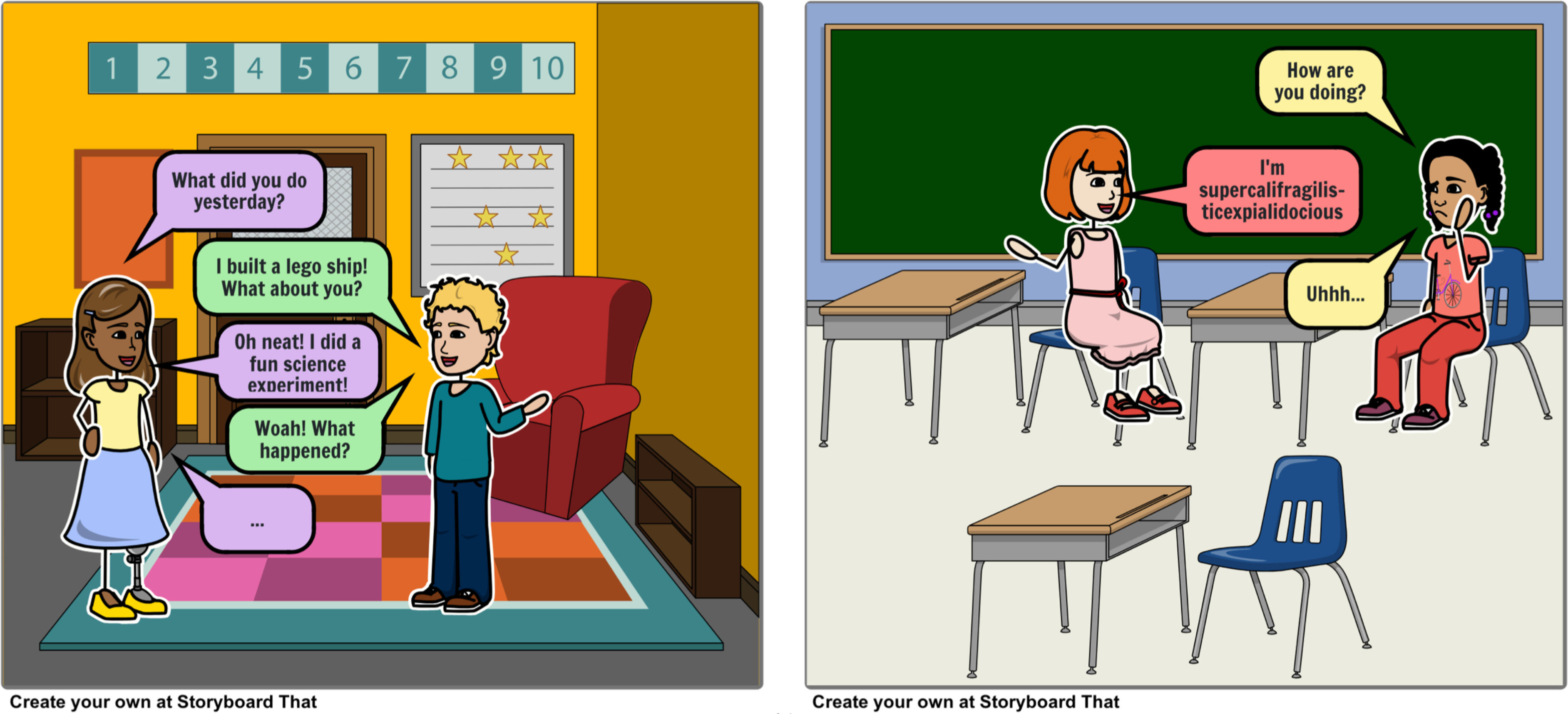
(Left) An example of turn-taking; (right) a prompt used to discuss how to handle misunderstandings. Images created using the “Storyboard That” platform.
Six live sessions, each lasting 1.5 h, were conducted virtually using the Zoom meeting software. Several coding activities were included throughout the sessions so that participants could attempt to program on their own while in-session. All participants were asked to attempt each of the activities.
2. Homework
Homework (in Jupyter Notebook) was distributed through Google Drive. Participants used the Google Colab app to access the notebooks and complete the homework. The instructor had access to students’ homework to monitor their progress and help with troubleshooting.
The homework aimed to solidify concepts introduced in class and was intended to take students a maximum of 30 min. Each week, the homework progressively became more difficult, and introduced applications of concepts outside of programming a chatbot. Homework included simple programming questions, debugging questions, predicting the output of code (and then testing to see if the prediction is correct) and more complex programming questions.
Code-block questions started in fill-in-the-blank style, to prompt participants to think about important concepts before thinking about syntax. For example, a question on conditional statements may begin by asking students to fill in the required operator (e.g., ‘==’). A later question may ask them to specify what the condition is (e.g., to what are they comparing the variable value). Finally, students are asked to write a full conditional statement independently. All homework questions, separated by programming topic, can be found at the following link: https://github.com/shalabieh/JADD_ProgrammingChatbot/tree/main/Homework
3. Chatbot Project How the chatbot would introduce itself and greet the program user – Participants were asked to generate a phrase to initiate a conversation; they could use whichever phrase they liked, but the example phrase given was ‘Hi, how are you?’ Other than the instruction, “You’re trying to get to know the person on the other end”, students were given little situational context. Thus, participants did not have an opportunity to start conversations with ‘tickets’ relevant to situational contexts. Instead, students were encouraged to consider personal characteristics that they assigned their chatbots, such as their age, name, favourite colour, etc., which could facilitate introductions. What topics the chatbot would discuss – Using a topic-oriented approach to conversation, students considered topics they were interested in discussing, and imagined how a conversation about this topic would unfold. Within this context (i.e., getting to know someone), finding topics of mutual interest was an accessible way for the chatbot to have interesting conversations with those around them, irrespective of neurotype. We recognize that not all conversation in real life is topic-oriented. However for the dual purposes of learning to computer program and creating a chatbot, topic-oriented conversation is an effective intial step in integrating social-skills development with computer programming. How the chatbot would take turns during a conversation – At the start of the conversation, the initiation took on an action-sequence format of ‘statement-question-statement-question’. Later in the conversation, the chatbot could also handle ‘statement-statement’ sequences. Participants used conditional statements to consider what the chatbot response should be, depending on how the user responds to them. How to deal with misunderstandings or unanticipated answers from the user – Given that participants had limited programming capabilities, they were asked to consider handling misunderstandings and unanticipated answers with responses like, “Please tell me more about what you said, I didn’t understand”, or “Sorry, I’m still having trouble understanding that – would it be ok if we changed topics?” We believe that having the chatbot ask to change topics to something already programmed was a rudimentary but appropriate way of handling this situation. It was also relatively easy to implement using the programming principles that the students had learned. These generic statements are also effective in real-life situations when misunderstandings occur. How to end the conversation – One outcome of meaningful conversation is a desire to hold a further conversation at another time. Participants were encouraged to consider when a natural end to a conversation would occur. Students next explored how to express that they enjoyed this interaction, and would like to hold another conversation in the future. For example, the chatbot could end (e.g., once they have run out of conversation topics) with, “It's been great talking, but I have to get going. Let's talk again soon!”
Students were asked to program a chatbot that can interact socially to get to know a friend, while convincing the friend that they are talking to a human and not a chatbot. That is, students were challenged to create a chatbot that passes the ‘Turing Test’, where a human evaluator cannot tell whether their chatbot is a human or a computer program. It is important to note that the goal was not to encourage the participants to be inauthentic or deceptive. Rather, as a group, students explored the mechanisms by which they can have meaningful conversations with other people. Next, participants explored how to create a chatbot that implements these mechanisms. Specifically, students focused on:
The communication process was decomposed into three overarching functions: (a) sense/perceive, (b) process and (c) decide and respond. Each programming topic was introduced with respect to one of the three functions. For example, the print statement is a respond function, the input function is a sense/perceive function, and the if statement is a process function.
To design the chatbot, the instructor used the Think, Make and Improve model (Martinez, 2016). In the first session, the instructor introduced the chatbot task and asked participants to think about how they might create their own chatbot. Most activities related back to the chatbot. For example, students first started with printing the chatbot's name. Next, they asked for an input from the user in the form of a greeting. As they progressed to conditional statements, they iteratively improved the chatbot to increase its functionality. Participants were encouraged to discuss, with the instructor and other students, how they might approach some of these social situations. There were no right or wrong ways for the students to create their chatbot – the only time the instructor corrected students was when their code led to errors. Otherwise, participants were encouraged to design their chatbot in whichever way they found fit. We believe this pedagogic stance encourages participants to be authentic in their socialisation and the programmed social abilities of their chatbots.
Measures
We were interested in the feasibility of this curriculum, and how it could be improved (Leaf et al., 2020). Thus, feedback was obtained from parents and students in three ways.
Parents rated statements from an assessment of acceptability, appropriateness and feasibility (Weiner et al., 2017) on a scale of 1 (completely disagree) to 5 (completely agree). Parents and students were asked to complete feedback surveys through QualtricsTM. The feedback questionnaires for parents and students are included in Appendices A and B. Parents were engaged in informal feedback interviews via Zoom. These interviews gave parents the opportunity to delve into more detail about their thoughts on the curriculum. These also allowed the researcher to ask follow-up questions on the parent's responses in the feedback surveys. The interviewer coded parents' comments into (a) what the program did well, and (b) how future program iterations could improve.
To explore potential changes in social-communication skills, both parents and students completed the Social Skills Improvement System (SSiS) (Gresham & Elliott, 2008). Furthermore, the instructor and parents jointly completed the Adaptive Behavior Assessment System, 3rd edition (ABAS-3) School Teacher Form (Harrison & Oakland, 2015) pre- and post-curriculum.
A summary of all materials and measures used in this study is shown in Figure 2.
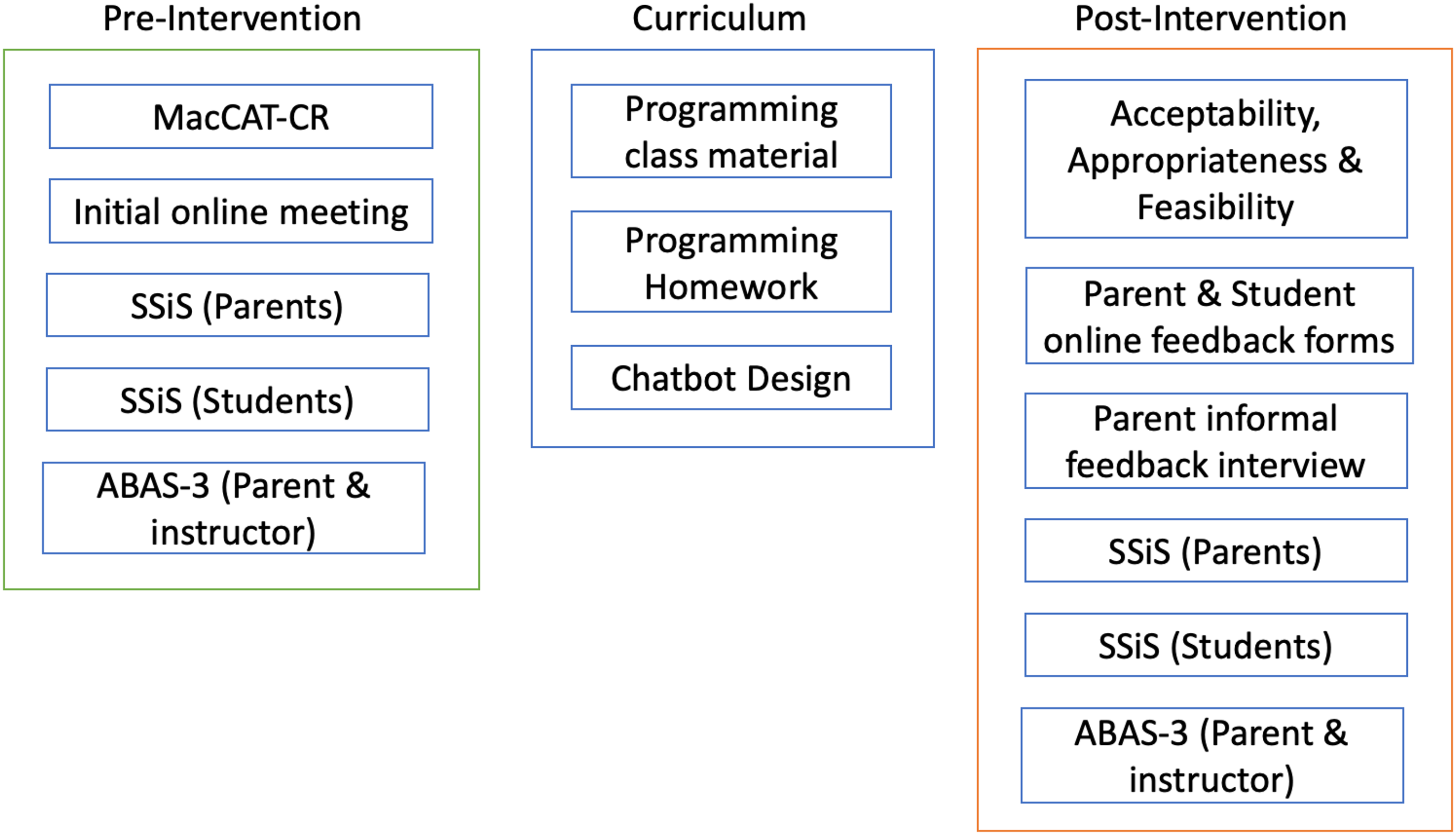
All materials and measures used in this feasibility study.
Results
Curriculum modification and study outcomes
As several students had difficulties with the material from the beginning, the instructor modified the schedule throughout this feasibility study. The final curriculum was streamlined to focus on four topics: (a) the print function, (b) the input function, (c) string-variable assignment, and (d) conditional statements. While other concepts (e.g., self-defined functions, lists, loops) may enhance a chatbot, a complex chatbot can already be created using the four focus topics taught.
Participants achieved varying degrees of understanding of the programming material. Of six participants, two demonstrated excellent knowledge and programmed most of their chatbot independently. Two participants demonstrated intermediate knowledge and required some instructor support. They would need help starting a new aspect of their chatbot, but once they were on track, they could continue independently. Finally, two participants struggled significantly with the material, and worked closely with the instructor to complete their chatbots.
Participant chatbots
Participants were encouraged to explore topics they like to discuss with friends through their chatbots. This led to programmed conversations on the topics of feelings, volleyball, basketball, video games, movies, etc. One student created an ‘all-knowing’ chatbot that could answer questions with factual information. Participants said they were excited by the prospect of personalising their chatbots.
All students created functioning chatbots. Some chatbots could carry a topic back-and-forth about 4–5 times, whereas other chatbots had more rudimentary conversations. Chatbots were programmed to transition to another conversation topic when they could not continue on a topic.
Acceptability, appropriateness and feasibility
Table 1 shows each scale's mean, median and interquartile range (IQR), which combined parent responses of 1 (completely disagree) to 5 (completely agree) to four items per scale.
Parent ratings for program acceptability, appropriateness and feasibility.

Feedback discussions with parents revealed a clear demand for curricula like the current program. Parents stated that their children were looking forward to attending sessions and were engaged with the material. Several parents expressed interest in having their children participate again in a similar program. Both parents and students were excited about computer programming. Parents also felt it was important that their children gain a skill that would enhance their future employment prospects.
Several parents stated that their children prefer implicit, even covert, social-skills programs like the current one, where social skills are learned to accomplish the goal of creating a human-like chatbot. This is in contrast to more traditional, explicit programs, where social-skills training is the sole focus. Their children were more engaged and motivated to attend sessions to learn the overt, explicit skills of computer programming. All parents stated that they would recommend this program to other parents of autistic children.
Change in social-communication skills
Table 2 shows pre- and post-curriculum scores. Paired Wilcoxon signed-rank tests showed no significant difference in students’ social skills. The rank-biserial correlation (rrb) was used to show the direction of an intervention effect, with negative rrb values indicating an increase in rated social-communication skills post-curriculum. While student-reported SSiS and instructor-parent joint-reported ABAS-3 social scores increased, these increases were not statistically significant. Parent-reported SSiS also showed no significant intervention effect.
Pre- and post-intervention social-skills measures of participants.

Discussion
This pilot study demonstrated feasibility and both parents’ and children's preference for a computer-programming curriculum designed to indirectly scaffold social-communication skills. However, further program refinement is required to attain measurable improvement in participant social skills.
Acceptability, appropriateness and feasibility
Some participants were engaged and at ease with the material, while others found learning new concepts stressful. The person-environment fit could be improved for each individual student to reduce the stress of learning new concepts (Lai et al., 2020). In addition, assessing skills critical to computer programming (e.g., pattern recognition) could improve fit, engagement and intervention outcomes. Of note, the current program may better serve those who are uninterested in traditional, overt social-skills interventions. Instead, such individuals may prefer more indirect, yet active, self-driven engagement in learning these skills. Parents and students alike said that six sessions were not enough for them to become comfortable with the programming material. A longer program would be more appropriate and could also include more advanced topics (e.g., self-defined functions, lists and loops). The instructor at times had difficulty managing all six participants, who understood the material to varying degrees. We therefore do not recommend increasing virtual class sizes beyond five or six students. However, in-person class sizes could be increased by grouping students by their level of understanding. We designed the worksheets such that students could progress through them independently. This allows the instructor to support students experiencing more difficulty with the material. Furthermore, students who understand the material and complete the activities more quickly could be asked to help others, creating opportunities to build both social and leadership skills.
Change in social-communication skills
While social-skills training is valuable for autistic people who are motivated to gain them (Fong et al., 2021), no statistically significant changes in social-communication abilities were detected in this feasibility study. Contributing to these null findings are the small sample size, short duration of the curriculum, and use of measures that are possibly insensitive to detect changes following this new intervention.
Parents were asked why they did not see a change in their child's social-communication abilities. Many said that their children were more focused on learning the programming material than applying the social-communication skills in their daily lives. Nonetheless, participants opened up to other participants and the instructor as the sessions progressed. One parent noted that she heard her child, during a later session, make a joke, something he usually struggled to do. Working on the chatbot provided students with opportunities to both proudly show their project, and start conversations about it with friends and family.
The current intervention took an indirect, almost covert, approach to teaching social-communication skills. When asked if their children would be interested in a more explicit, overt social-skills training program, several parents stated that their children would lose interest. While this six-session curriculum did not lead to immediate, significant improvements in overall social-communication skills, a longer program of this kind may be promising. For example, So et al. (2020) devised a social-robot play-drama intervention that ran 135 min/week for each of 9 weeks. They found improvements in joint attention initiations through this indirect intervention, where children interacted spontaneously in dramatic plays with social robots.
We believe that an interaction between multiple mechanisms could lead to social-skills enhancement for participants. Many previous social-skills interventions designed for neurodiverse children, adolescents or adults, rely on multiple componentsto create a helpful program. These components include, interaction with peers, learning new information, applying this information, etc. (McDonald et al., 2022). The current newly developed curriculum also combines several components for students to enhance social skills: interacting with other autistic children in the class, learning about a topic of interest, and applying this topic of interest to a specific use case. Uniquely, rather than teaching social skills explicitly, programming the chatbot applies the social skills acquired through discussion with autistic peers and the instructor on how to make the chatbot more human-like. We believe future work that engages students to apply learned social skills to a problem of interest would strengthen the uptake of these skills.
Limitations and next steps
Conducting an online study
Conducting this program online has both benefits and limitations. Parents appreciated the improved accessibility, especially for those uncomfortable meeting in-person early in the Covid-19 pandemic. However, the instructor could not always gauge participant attentiveness and understanding, especially when participant cameras were off. The online format might have also inhibited participants from asking questions. Several parents checked in with their children during the sessions to ensure they were engaged. Some parents said that their children expressed frustration off-screen during the sessions or while completing homework. Several parents stated that their children would have benefitted from in-person instruction.
Enhancing the curriculum for authentic social development
The current study demonstrates feasibility, but the small number of participants limited our ability to obtain more conclusive evidence. The participants were self-selected by being interested in computer programming. Thus, this curriculum may better fit autistic individuals who already have an interest in computer programming than those who do not have such an interest. More diverse participants may reveal other areas of improvement for the curriculum, as well as which types of participants this intervention would benefit most. Modifications to the curriculum are required to better fit individual learning styles and increase motivation and engagement. Further interaction with autistic children and their parents is required to refine the outcomes and socialisation goals to prioritise (Bottema-Beutel et al., 2016). Such improvements are intended to help participants feel accepted for their authentic selves. They may also reduce learned masking and camouflaging, which are potentially undesirable outcomes of some social-skills intervention programs (Zhuang et al., 2023).
To further support the goal of scaffolding authentic interactions, reference to the Turing Test could be removed in future iterations of this program. The original task assigned to participants was to create a chatbot that passed the Turing Test, that is, a chatbot that convinced a user that it was a human. Reference to the Turing Test may unintentionally encourage participants to be inauthentic in order to deceive others into thinking their chatbot is a human. This may inadvertently hinder their authentic social improvement.
Furthermore, a wide range of real-life social interactions require different techniques to effectively interact with another person (Bottema-Beutel et al., 2018). The current curriculum focused on the context where the chatbot was simply getting to know another person. However, in real life, participants likely encounter social situations that are less formally about getting to know another person. In these situations, there could be other ways of initiating social interactions. For instance, Sacks (1972) posits that individuals could use a situation-specific ‘ticket’ to initiate a conversation, such as “Excuse me, I think you dropped this”. In future work, guiding participants to consider different situational contexts for their chatbot may improve their robustness in responding to a wide array of social situations.
The complexity of the social interactions was also limited by the computer programming topics that were covered in this short curriculum. For instance, dealing with misunderstandings, unanticipated answers and unrelated insertions or expansions on previous statements may require more advanced programming concepts. These concepts include lists, dictionaries and even large language models. The current pilot curriculum is expandable, such that more complex forms of social interactions can be explored and incorporated into the development of the chatbot.
Finally, the current curriculum did not address non-verbal communication skills, with which many autistic individuals struggle. Once participants are comfortable with the basic programming concepts, they could learn to program robots that display non-verbal social signals.
Recruiting neurodiverse peers for participation
Socialization is bi-directional in nature. Thus, future work will explore including neurotypical individuals so that they learn and engage with the communication styles of autistic individuals. The current program aimed to provide an environment where autistic individuals, who are motivated to acquire more social skills, can do so safely. Including neurodiverse peers interested in computer programming in future program iterations would further provide opportunities to build high-quality interaction and collaboration across neurotypes. Such opportunities may reduce the stigmatisation and misunderstanding faced by many autistic individuals (Bottema-Beutel et al., 2016, 2018; Kim et al., 2023).
Conclusion
Overall, both parents and students reported that this new curriculum intervention, and the design and conceptualisation beyond it, are feasible and desirable. More social-communication interventions that align with autistic individuals' motivations and incorporate their interests are required to cater to the diverse cognitive needs of autistic people.
Supplemental Material
sj-docx-1-ndy-10.1177_27546330241245290 - Supplemental material for Computer programming a chatbot to improve social-communication skills in autistic children: A feasibility study
Supplemental material, sj-docx-1-ndy-10.1177_27546330241245290 for Computer programming a chatbot to improve social-communication skills in autistic children: A feasibility study by Sarah Halabieh, Meng-Chuan Lai, Hsiang-Yuan Lin and L. H. Shu in Neurodiversity
Footnotes
Contributorship
All authors contributed to the study’s conception and design. Material preparation, data collection and analyses were performed by Sarah Halabieh. Funding support was acquired by L.H. Shu. The first draft was written by Sarah Halabieh. All authors participated in the revision of the manuscript. All authors read and approved the final manuscript.

Declaration of conflicting interests
The authors declared no potential conflicts of interest with respect to the research, authorship, and/or publication of this article.
Ethical approval
Ethics approval of the study was obtained through the University of Toronto Research Ethics Board (protocol number 42115).
Funding
The authors disclosed receipt of the following financial support for the research, authorship, and/or publication of this article: The authors are grateful to financial support from the Natural Sciences and Engineering Research Council of Canada (NSERC RGPIN-2019-06935) and the Social Sciences and Humanities Research Council of Canada (SSHRC 430-2018-00464). We also acknowledge the support of the University of Toronto Faculty of Applied Science and Engineering Deans Strategic Fund for PsychEng (Collaborative Specialization in Psychology, Psychiatry and Engineering).
Informed consent
The MacArthur Competence Assessment Tool for Clinical Research (MacCAT-CR) was used with student participants and parents, that is, substitute-decision makers (SDM), to ensure that they could respond appropriately to the information presented in the informed-consent form (Appelbaum & Grisso, 2001). If the students received at least 70% on the MacCAT-CR, they gave informed consent; otherwise, the SDM gave consent, and the child gave assent.
Trial registration
Not applicable, because this article does not contain any clinical trials.
Supplemental material
Supplemental material for this article is available online.
References
Supplementary Material
Please find the following supplemental material available below.
For Open Access articles published under a Creative Commons License, all supplemental material carries the same license as the article it is associated with.
For non-Open Access articles published, all supplemental material carries a non-exclusive license, and permission requests for re-use of supplemental material or any part of supplemental material shall be sent directly to the copyright owner as specified in the copyright notice associated with the article.
