



Abstract
Millions of Americans believe Donald Trump's claim that the 2020 U.S. Presidential election was ‘rigged’. This commentary presents evidence of the remarkably diverse acceptance of this claim in the American population. For nearly half a century, ever since Reagan, right-wing operatives have been working to capture and return fire with the most advanced analytical tools of the post-structuralist academic Left. In the last dozen years these strategies have been ruthlessly effective in the complex algorithmic spaces of media and communications that reproduce dynamic hierarchies of the legendary ‘urban systems’ paradigm of linguistics and cybernetics that once dominated urban research. Today these systems are evolving into cognitive infrastructures that accelerate the production and circulation of conspiracy and faith, producing bizarre intersectional configurations of the sort that culminates in the 2025 re-inauguration of a revanchist, eschatological American anti-urbanism nurtured on hatred of transnational cultural evolution.
Not so long ago, the U.S. urban system was regarded as the world's purest expression of industrial development and technological innovation, refined by the cumulative achievements of modernist rational scientific analysis (Berry and Wheeler, 2005). Despite all their disagreements, generations of post-positivist revolutionary social theorists agreed with positivist spatial scientists that U.S. urbanism was the fundamental reference point for understanding the base production relations of political economy as well as the super-structural kaleidascope of social movements for diversified human liberation and environmental consciousness.
That was then
Now, bizarre, irrational contradictions in the U.S. urban system, and strange mutations of anti-urban cultural politics, provide bitter lessons from the 2024 Presidential election for analysts across the political spectrum – from ‘Never Trumper’ Republican veterans of the Bush-era neocon Project for a New American Century (Kristol, 2024) to Black radicals who accused Angela Davis of white supremacy for supporting a centrist like Kamala Harris (Kimberley, 2024). The technologically advanced urban system that achieved the ‘industrialisation of information’ in the second half of the twentieth century (Hall, 1998) has become a remarkably adaptive infrastructure for twenty-first century disinformation and anti-urban political power. That infrastructure has become surprisingly diverse. The MAGA multi-ethnic working-class coalition achieved goals that have eluded centrist, progressive and radical attempts to formulate recombinant successors of Democratic history – the 1930s North/South FDR coalition, the 1960s JFK/LBJ New Frontier/Great Society mobilizations, the 1990s Clinton triangulations, and the 2008 Iowa breakthrough of Obama's ‘post-racialism’ appeal. For urbanists, the most important lessons are the ways Trump's ‘American Carnage’ anti-urbanism (Alberta, 2019) has attained legitimacy in unexpected configurations of diverse, intersectional lived experiences in America's landscape hybrids of material competition and cybernetic, cognitive-capitalist mirror-worlds (Gelertner, 1991; Klein, 2023).
Some of the early evidence from the 2024 exit polls implies a familiar configuration of America's urban/rural divide. Trump lost in cities over 50,000 (37%), but won narrowly in suburbs (50–48%) and decisively in small towns and rural areas (63–36%). Trump won white men (54%) and white women (52%), voters who never attended college or university (63%), those who have ever served in the U.S. military (65%), and white evangelical/born again Christians (82%). And 67% of those who agreed ‘America's best days are in the past’ went for Trump, versus the 58% of those seeing the nation's best in the future who backed Harris.
There's plenty of evidence, in other words, for a familiar Left narrative that Trump's victory is simply the latest and most apocalyptic revelation of an inherent racism, misogyny, xenophobia, and reactionary authoritarianism that constitutes America.
Yet the closer one looks – and even after considering the quirky turnout totals as the vote tabulations continue on the west coast – the results reveal surprising complexity. Trump's vote share among white women was surpassed by the share among Latino men (55%). Among voters who described themselves to pollsters as Native American, 65% voted for Trump. Trump got the support of 39% of Asian voters, and won 52% of the ‘all other ethnic and racial groups’ amalgamation. A New York Times analysis of county-level classifications reads like a macabre MAGA plagiarism of Berry and Smith's (1972) City Classification Handbook. Trump improved over 2020 results in urban counties (+5.2%), suburban counties (+4.3%), and majority non-white counties (+6.9%). Trump achieved small but crucial improvements in Black-majority counties (+2.7%). In the nation's seventeen majority-Indigenous counties, Trump's vote share increased by 10.0%. Majority-Hispanic counties increased Trump support by 13.3%, part of a broad Latina/o shift across parts of Miami, New York, and New Jersey.
A particularly striking shift involved Trump victories in 12 of the 14 Latina/o majority South Texas border counties. The historical parallax view of the electoral ‘Earthquake’ (Goodman et al., 2024) in this Democratic stronghold is especially poignant. It was here where the children of Mexican immigrants in a tiny town taught profound, challenging lessons to a young schoolteacher between September 1928 and May 1929. Decades later that embodied, lived experience was manifest in an address to a joint session of Congress that signified dramatic, nationwide urban changes: ‘My first job after college was as a teacher in Cotulla, Texas, in a small Mexican-American school. Few of them could speak English, and I couldn’t speak Spanish. My students were poor and they often came to class without breakfast and hungry. And they knew even in their youth the pain of prejudice. They never seemed to know why people disliked them, but they knew it was so because I saw it in their eyes. I often walked home late in the afternoon, after the classes were finished, wishing there was more that I could do. But all I knew was to teach them the little that I knew, hoping that it might help them against the hardships that lay ahead. And somehow you never forget what poverty and hatred can do when you see its scars on the hopeful face of a young child. I never thought then, in 1928, that I would be standing here in 1965. It never even occurred to me in my fondest dreams that I might have the chance to help the sons and daughters of those students, and to help people like them all over this country. But now I do have that chance. And I’ll let you in on a secret: I mean to use it’. (Johnson, 1965)
The 2024 results suggest that the hopeful retrospective assessment of 2016 as an historical oddity – antebellum slaveholder gerrymandering of the Electoral College manipulated by testosterone-fuelled red pill Redditors and 4chan trolls sharing Pepe the Frog memes – has evolved into something even more dangerous. Eight years after losing the popular vote by three million, a convicted felon sexual predator who cheered on a coup attempt and loudly proclaims plans to imprison his opponents and deploy military force to deport millions achieved a decisive popular-vote victory. The margin is 3.73 million as of this writing, with 94.3% of votes counted. Mr End-of-History Francis Fukuyama sounds like Bernie Sanders when he warns of an entrenched shift of the working class to Republicans, noting that ‘[f]or Blacks and Hispanics, class was much more important than identity’. The political scientist Herbert Kitschelt portrays Trump's 2024 win as the ‘capstone’ of ‘a new populist radical right in the entire Western Hemisphere’ on par with elections of 1860, 1876, 1896 and 1932 (quoted in Edsall, 2024). Alongside the admirable post hoc attempts to use grand historical parallels to make sense of the results are the micro-aggressions that become macro and mega through a national cybernetic infrastructure that is accelerating changes in language, culture and representation. Thomas Frank, author of a previous generation's warnings that Democrats failed to understand Republicans’ hacking of the source code of industrialised false consciousness (What's the Matter With Kansas?), had a sudden, painful realisation in March of 2024 that Trump might win. Frank happened to visit a display at the Smithsonian. Reading the explanatory text alongside an old painting, Frank noticed that the westward expansion of the United States was now described as ‘settler colonialism’. ‘I read it’, Frank (2024) recalls, ‘and I knew instantly where this nation was going’. It's not that the diagnosis was wrong. Frank's fear was that the discourse was a symptom of a deepening nationwide class and culture divide in the politics of language. ‘Some curator at one of our most exalted institutions of public instruction’, Frank (2024) writes, ‘had decided to use a currently fashionable, morally loaded academic keyword to address a visitor to the museum – say, a family from the Midwest, doing the rounds of national shrines – and teach them a lesson about American wickedness’.
Sadly, the savage eloquence of the cognitive urban elites blamed for Harris’ loss among working-class voters is now aimed at allies in the circular firing squad of American progressivism. ‘Some Democrats are finally waking up and realising woke is broke’, writes Maureen Dowd (2024), lamenting the party's ‘hyper-political correctness, condescension, and cancellation’, its support for ‘diversity statements for job applicants and faculty lounge terminology like “Latinx” and “BIPOC” (Black, Indigenous, People of Color)’. Democrats’ unabashed support for the marginalised is laudable, Dowd argues, but it alienates many of the party's once-reliable constituencies. Survey data reported in the Financial Times, for example, indicates that 75% of white progressives agree with the statement, ‘Racism is built into our society’, compared with 62% of Black and 38% of Hispanic respondents. Conversely, 75% of Hispanic and 58% of Black respondents agreed, ‘America is the greatest country in the world’, compared with only 31% of white progressives.
Of all the historical comparisons, however, some of the most significant lessons of the MAGA rainbow coalition involve the 1980s – when Jesse Jackson used that spectrum metaphor slogan in an attempt to build a diverse, multiracial movement to stem the Democrats’ drift to the centre as Ronald Reagan pulled the nation hard right. Trump's endless reality television and social media presence are the literal embodiment of decades of Hollywood-manufactured false consciousness. Ronnie's ‘Win one for the Gipper’ speech in Knute Rockne: All American (1940), and starring roles in The Santa Fe Trail (1940), Law and Order (1953), and The Cattle Queen of Montana (1954) prepared Americans to be suitably entertained when Reagan used hardball tactics with Congress – like borrowing Clint Eastwood's Sudden Impact line when Dirty Harry points his .44 Magnum hand cannon at the last surviving evil Black robber holding a hostage in a San Francisco diner: ‘Go ahead. Make my day’. One of Reagan's durable legacies was the mobilisation of millions of fundamentalist evangelical Christians who had previously eschewed the sinful arena of electoral politics. Evangelical Protestants had always been radicalised by a nativist, anti-Catholic xenophobia that had persisted ever since JFK's 1960 campaign, which then coalesced with a wild diversity of conspiratorial John Birch Society factions (Glazer and Moynihan, 1963; Hofstadter, 1964). At the same time, the global spread of neoliberal economic doctrines in the 1980s – from Thatcher to Deng to Pinochet and Reagan – infused Friedrich Hayek's theories of informational evolution and market consciousness into the operating systems of capital accumulation and statecraft. A distinctive American paradox involved Reagan's pursuit of Hayek's Social Darwinism survival-of-the-fittest economic policies while consolidating the support of fervent anti-Darwinian Christian creationists. A new entrepreneurial, cybernetic blend of faith, marketing, and paranoia – ‘televangelism’ – came to be detectable as a statistically significant predictor of support for ‘New Christian Right’ political movements (Wilcox, 1989).
Trump's role in the American national consciousness highlights the contradictions of a high-technology urbanised society enriched by scientific achievement that evolves into an infrastructure for the production of anti-urban xenophobia, spectacles of vengeance, unhinged yet entertaining irrationality, distraction and conspiracy. Curiously, the ‘urban systems’ statistical paradigms that once dominated urban research (Berry, 1964) provides quite accurate measures of the relative volumes of human attention consumed by Trumpian spectacles. A few weeks before first primaries of 2016, Trump enjoyed a long, friendly online conversation with the conspiracy entrepreneur Alex Jones, whose InfoWars broadcasts on YouTube alone had by then racked up more than two billion views. The December, 2015 Trump-Jones interview quickly racked up millions of views – and, most importantly, created endless matrices of cognitive correlations in the ‘up next’ recommendations presented to viewers watching seemingly unrelated content. Methods developed by Rieder et al. (2018) allow us to map the evolutionary network of algorithmic recommendations that developed, with first-order connections among 129 videos with a total audience of some 79.17 million views (Figure 1). The complex hierarchies of human attention conformed quite well to the Zipf (1949) rank-size rule that dominated late-twentieth century positivist urban theory: “I call Trump a Marshall McLuhanesque figure,” Bannon told David Brooks (2024) weeks before the Republican National Convention, and right before Bannon reported to serve a few months in prison for defiance of a Congressional subpoena. “McLuhan called it, right? He says this mass thing called media, or what Pierre Teilhard de Chardin said of the noösphere, is going to so overwhelm evolutionary biology that it will be everything. And Trump understands that. That's why he watches TV”.
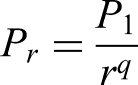
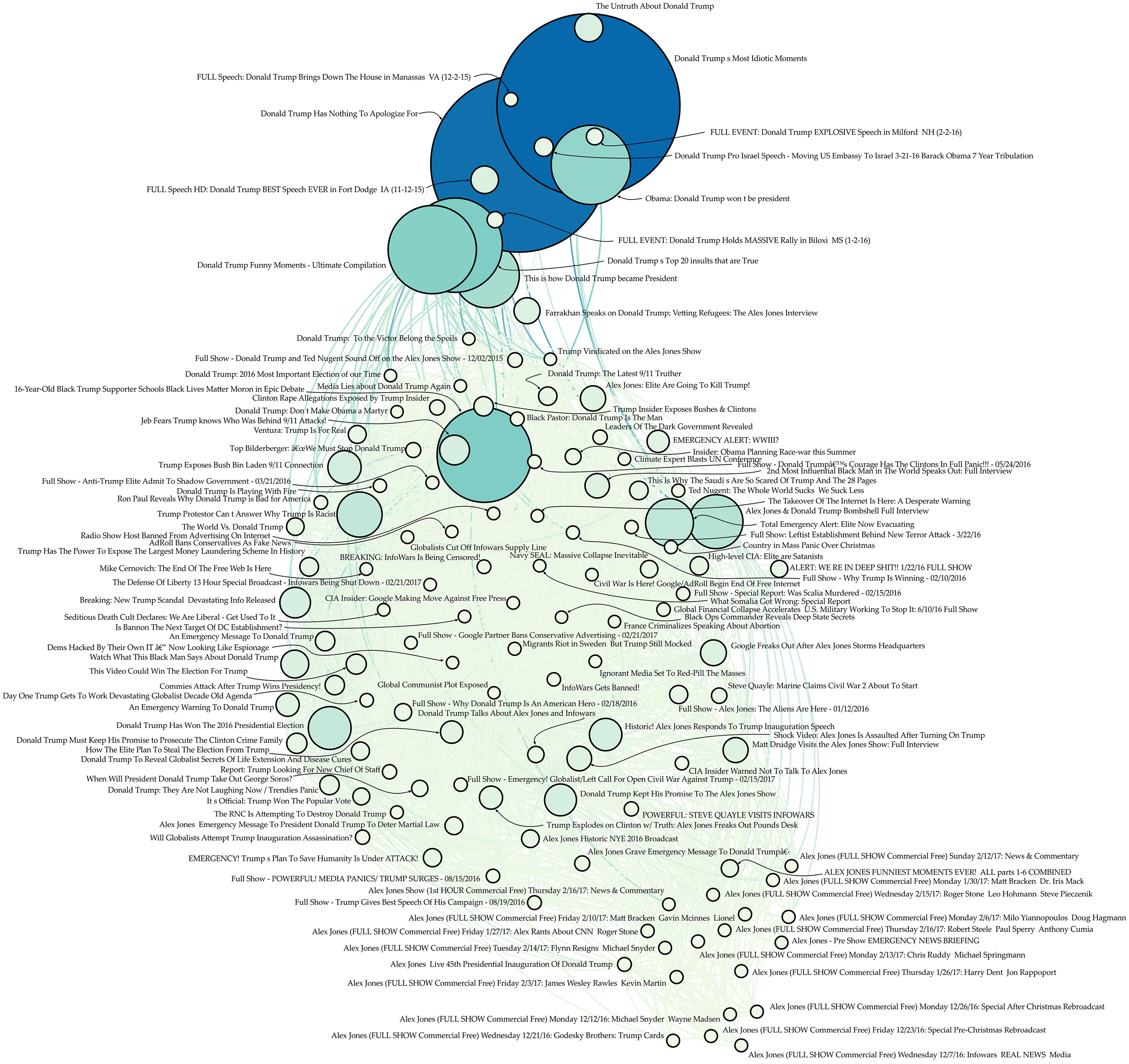
Conspiratorial correlations in the Noösphere. As his candidacy for the Republican nomination began, Donald Trump spent a full 30 minutes on Alex Jones’ ‘InfoWars’ radio show and video broadcast. By this point, Jones was earning upwards of $50 million annually through sales of apocalypse survival supplies and bizarre diet and health products – while manufacturing mind-bendingly detailed lies such as the ‘false flag’ crisis-actor story that unleashed countless death threats against the parents of children killed in the 2012 Sandy Hook school shooting. This map shows the inter-correlations of ‘related videos’ recommended by YouTube’s pattern-recognition algorithms. As of 22 February 2017, the Trump-Jones video (in the darker shade) had been viewed 2,480,598 times. Circle sizes are scaled proportional to total views: maximum 10.13 million (‘Donald Trump’s Most Idiotic Moments’), minimum 3,924 (‘Global Communist Plot Exposed’). To describe this visualisation as a “map” at first seems deceptive, since the circles are positioned according to the statistical similarities of their viewership recommendations – rather than geographic position of physical cities. Yet the noöspheric nature of online worlds like YouTube exhibit striking similarities to the rank-size hierarchies that have been at the heart of positivist scientific urban theory for more than half a century – as expressed most clearly in Brian J.L. Berry’s (1964) ‘Cities as Systems Within Systems of Cities’. As viewers watched Jones and Trump, YouTube’s algorithms watched and tailored the ‘up next’ recommendations, yielding a maze of first-order correlations among 129 videos with a cumulative total audience of 79.17 million views, 805 thousand ‘likes,’ 160 thousand ‘dislikes’, and 487 thousand comments. The rank-size hierarchy is described by a simple equation that explains 96.76% of the variance in the audiences attracted. Source: graphic and calculations by the author, using data extracted using the open-source interface built by Bernhard Rieder at the Digital Methods Initiative at the University of Amsterdam (see Rieder et al., 2018). Unfortunately, YouTube deprecated the ‘relatedToVideoID’ API parameter in early August, 2023, and thus it is no longer possible for researchers to perform audience-formation analyses like this.
It is risky to use rational positivist methods to analyse MAGA postrationalist populism. Nevertheless, it is essential to try. Here we use evidence from the special Social Media Study conducted by researchers with the long-running American National Election Studies (ANES), supported by NSF grants to Stanford and the University of Michigan. Wave 3 of the panel-design survey on cultural politics, news consumption and social media activities among U.S. citizens age 18 and over was implemented between 9 November 2022 and 2 January 2023. One of the survey questions serves as a proxy ‘meta-conspiracy’, a narrative that unites so many other wild stories of the MAGA movement. In November, 2020, Biden won 81.285 million votes to Trump's 74.224 million. In late 2022 and early 2023, survey participants were asked, ‘Donald Trump said, “The election was rigged, it was stolen”. Do you believe this statement is true or false?’ More than a sixth (18.2%) said the claim was ‘mostly true’. More than a tenth (11.2%) said it was ‘completely true’.
Table 1 presents the results of a logistic regression model predicting the likelihood that an individual respondent will judge Trump's assertion mostly or completely true. Tolerance values for all predictors are well above the 0.20 threshold signifying problematic levels of multicollinearity, and there is a very close fit between model predictions and observed outcomes. The survey and model also include details that attempt to adjust for ‘trolling’ behaviours that have become common among respondents in political surveys.
Model of belief in Trump's election lie.

Significant at *P < 0.05; **P < 0.01; ***P < 0.001.
Source: Author's analysis of ANES 2020–2022 Social Media Study.
Results highlight three themes. First, the takeover of the Republican Party since the 2015 ‘Never Trump’ primary fights seems completely woven into America's anti-urban political polarisation. In metropolitan areas, only 26.95% believe Trump's claim, compared with 40.52% in non-metropolitan areas. The metropolitan indicator remains highly statistically significant in iterative model-building, and persists even when considering party affiliation and dozens of other controls. After accounting for all other factors, those living in metropolitan areas are 0.69 times as likely to believe Trump's lie (Table 1). Compared with neutral independents, those who identify strongly with the Republican Party are 4.20 times more likely to believe Trump's claim. Not surprisingly, those with strong Democratic loyalties are only 0.33 times as likely to believe the deception. Trump support, moreover, has become tightly linked with the traditional grand old party (GOP) base commitment on abortion: those celebrating the Dobbs decision overturning Roe v. Wade are 1.45 times more likely to believe the stolen-election lie. So too with a strange reversal of states’-rights conservatism and Second Amendment purity: those who want the federal government to overrule state laws to make guns much easier to buy are 1.98 times more likely to believe Trump's lie.
Second, Trump's rigged-election narrative achieves surprisingly diverse appeal and legitimation. Ubiquitous photos of angry white men at Trump rallies have created deceptive, high-resolution illusions. Compared with heterosexual females, straight men are only 0.55 times as likely to believe the rigged election claim. All other gender/sexuality positionalities are statistically insignificant after controlling for party affiliation and other factors. With regard to ethnoracial variations, compared with the reference category (non-Hispanic ‘others’ such as Asian Americans), non-Hispanic whites are not significantly more likely to believe Trump's claim. Non-Hispanic Black respondents are not significantly less likely to believe. But Latinas and Latinos are 1.61 times more likely to believe, even after considering party loyalty and all other controls in the models. Trump's vote shares among Hispanics increased from 28% to 36% between 2016 and 2020, and nationwide House Republican vote shares among Hispanics jumped from 25% to 39% between 2018 and 2022 (Hartig et al., 2023). Trump's electoral conspiracy has intersectional appeal. The ‘rigged’ claim was believed by 33.8% of straight Latina women, and 36.6% among those who are married. Republicans’ House vote shares among Latina women increased from 23% to 34% between 2018 and 2022 (Hartig et al., 2023). Between Obama's re-election in 2012 and Trump's 2024 win, the net shift of vote shares towards Republicans diversified GOP support by race (R gain of 17 points among Asians, 19 for Blacks and 29 for Hispanics), race and education (R + 13 points for white with no college degree, 21 for non-white with BA+, 37 for non-white, no degree), and age (R + 14 points for voters age 18–29) (Cohn, 2024).
Such trends underscore a blend of cultural and discursive alienation, as diagnosed by Representative Ritchie Torres, first elected in 2020 to represent the South Bronx. On November 6, Torres posted to X, ‘Donald Trump has no greater friend than the far left, which has managed to alienate historic numbers of Latinos, Blacks, Asians and Jews from the Democratic Party with absurdities like ‘Defund the Police’ or ‘From the River to the Sea’ or LatinX. There is more to lose than there is to gain politically from pandering to a far left that is more representative of Twitter, Twitch, and TikTok than it is of the real world. The working class is not buying the ivory-towered nonsense that the far left is selling’. ‘If the goal is to win elections on Twitter, then you should embrace movements like ‘Defund the Police.’ But if the goal is to win elections in the real world, where it matters, then you have to appeal to working-class people of color’,
Online and offline reactions to the kinds of glocal tensions highlighted between Torres and AOC take us to the Holy Land, the Apocalypse, the Second Coming, the Rapture. This is the third set of interrelations manifest in the ANES data. There is evidence of horrific perversions of Teilhard de Chardin's ideas in the Bannon-Trump co-evolution of media polarisation and spiritual divisions. Teilhard de Chardin envisioned technologies bringing peoples together – a literal communications communion towards spiritual unity – but today's MAGA noösphere is a galaxy of separation, segregation and force fields of rage. Respondents who distrust the New York Times are, all else constant, 1.56 times more likely to believe Trump. The ratio jumps to 3.58 for those who hate MSNBC. For religious identification, the reference category is atheists. Note that any expression of religious affiliation pushes the odds ratio over 1.0, signifying a greater likelihood of believing Trump's claim. Those identifying as ‘Just Christian,’ or this in combination with statements that they consider themselves ‘born again,’ are twice as likely to believe Trump's stolen-election lie. Although only marginally significant (P = 0.095), there is also a strong effect (odds ratio 1.93) for religions categorised as ‘Other’: Eastern Orthodox, Hindu, Jewish, Mormon, Muslim and other faiths. Catholics are 2.25 times more likely to believe the lie. The odds ratio shoots up to 3.47 for Catholics who identify as born again, a striking irony given the 1980s history of ‘born again’ as a meme of Protestant, anti-Catholic spiritual politics. And even after accounting for religion, party loyalty, and all other factors in the model, those who use Facebook many times per day are 1.41 times more likely to believe Trump's lie.
Here there are direct connections to the California and Silicon Valley operatives involved in Trump's rise a decade ago. Only a few months after accepting the Hayek Lifetime Achievement Award, Facebook first investor Peter Thiel stepped to the 2016 RNC stage in Cleveland to endorse Trump. ‘I am proud to be gay’, Thiel told the delegates; ‘I am proud to be a Republican. But most of all, I am proud to be an American’. In the same year that Gawker's outing of Thiel led to a rage culminating in his secret bankrolling of Hulk Hogan's sex-tape lawsuit to destroy the digital tabloid, a book was published from a Stanford conference that Thiel had financed to showcase the work of the theologian René Girard. It was Girard's ‘mimesis’ theory of spiritual militant politics that had inspired Thiel to invest in Zuckerberg's experiment. Thiel's chapter in the book portrays post-9/11 America as a twenty-first reincarnation of Leo Strauss's hidden-message theology of military struggles between a secular Athens and a spiritual Jerusalem (Thiel, 2007). Half a century after David Ley (1974) suggested that the urban revolution ‘must be spiritual as well as institutional’ amidst a ‘technetronic’ postindustrial capitalism that was reproducing a ‘privatism that sanctions evil’, Bannon was just one of many operatives around Trump who combined Girardian mimesis, Strauss-inspired conspiracy theories, and McLuhan/Teilhardian medium-message noösphere techniques to locate, quantify and exploit dialectical rage against progressivism. Bannon first understood what is now called the ‘manosphere’ in his stint representing Goldman Sachs’ investment in a start-up online gaming firm in Hong Kong; he's read Foucault and Judith Butler, and he understands the finer points of gender performativity, queer theory and intersectionality (see Wylie, 2019: 60, 61). One field-test operation in the Cambridge Analytica search for unexpected sources of political support, involved using Facebook data to identify women who shopped at organic food stores, but who also attended churches where the faith preached eternal hell and damnation for homosexuals (Wylie, 2019: 72–74).
Millions of Americans believe that God has ordained Donald Trump to save America from the evil represented by Democrats. Millions believe Trump's claim of a rigged 2020 election. Millions believe in various conspiracies, from #pizzagate to the Deep State, replacement theory, 9/11 as an inside job, Bill Gates/Anthony Fauci coronavirus microchip implantation schemes, 5G tower digital eugenics, planetary tentacles of George Soros money, Jewish space lasers, giant extraterrestrial lizards living on adrenochrome, QAnon, and all sorts of other mutations. Figure 1 and Table 1 are imperfect, infinitesimal samples – snapshots of dynamic, endlessly adaptive memetic constellations of attention and anxiety, faith and fear. Despite the infinite combinatorical diversity of meanings, the relative magnitudes of circulating narratives conform to the hierarchical regularities that were the mainstay of twentieth-century urban systems research, cybernetics and neoliberal information theory. Conspirituality seems to be evolving into a self-replicating congitive-capitalist assembly line for the production of false consciousness, alienating urban and rural cultures while further fragmenting the assemblage of difference that constitutes the Democratic coalition. Three decades ago, Harvey (1992: 126) suggested that ‘postmodernism opens a door to radical politics but for the most part has refused to pass through it’. It is now clear, from Reagan through Bush to Trump, that generations of New Right operatives have learned how to hijack postmodernism, intersectionality and performativity to build a resilient infrastructure that harnesses diversity to lend legitimacy to revanchist, anti-urban politics. This infrastructure produces dynamic cognitive central-place networks in which Bannon's ‘flood the zone’ epistemology of disinformation overload produces more confusion, while reconfiguring perceptions of elite/populist hierarchies. The Right has hijacked the analytical tools of the Left to manoeuver in hybrid material and virtual urban worlds where single-dimension binaries between Right and Left are evolving in more complex, multidimensional axes of intersectional identity, politics and faith – from Reagan's Biblical creationist call to 10,000 ‘born again’ Christians in a Dallas, Texas speech in 1980 to Trump's prosperity-gospel cult of Norman Vincent Peale, from Ramaswamy's anti-woke entrepreneurial Hindutva to Thiel's apolyptic transhumanism and Elon Musk's technotheology of humanity as a multi-planetary species. Conspirituality speeds up the cognitive assembly lines of manufactured consent in capitalist factories of fragmentation.
