



Abstract
Somaiyeh Falahat, Libby Porter, Justin Tse, and Ryan Walker have offered eloquent and powerful critiques of an attempt to interpret images and representations of the Vancouver global city-region in the spirit of crime-scene photographs. This response seeks to engage these valuable critiques in relation to Cindi Katz's work on social reproduction and Gayatri Spivak's conceptualisation of planetarity.
Sometime near the beginning of the 21st century of the Western calendar, Cindi Katz and Neil Smith organised a high-profile lecture series at the Centre for Place, Culture, and Politics at the Graduate Centre of CUNY, the City University of New York. Among the most prominent speakers amidst a dazzling lineup was the charismatic, enigmatic post-colonial feminist Marxist literary theorist Gayatri Chakravorty Spivak. Planning for that talk had been stressful for Neil and Cindi, because Spivak – like so many other public intellectuals working their way into the globalising discursive stratosphere – had a reputation for last-minute cancellations. But Spivak arrived, and did not disappoint. She delivered a powerful, wide-ranging talk on the contemporary global neocoloniality of enduring Eurocentric conceptions of human rights and dilemmas in the education of young children in an unequal world. The lecture was a version of what became ‘Human Rights, Human Wrongs’, part of the 2001 Oxford Amnesty Lectures. Subsequently published in South Atlantic Quarterly, Spivak's (2004) analysis offered a breathtaking global analysis of neoliberalisation, the 19th-century Social Darwinist origins of post-World War II human rights discourse and institutions, and what the atheist Spivak grudgingly respected in what she called the ‘licenced lunacy’ of religious fundamentalists who ‘have succeeded best in the teaching of the poor – for the greater glory of God’ (Spivak, 2004: 564). Speaking in Midtown Manhattan, one recurrent question in Spivak's lecture should have been amplified with bullhorns to echo through the concrete canyons of one of the world's core nodes mediating the planetary circulation of capital. ‘If child labour is bad’, Spivak explained to an audience energised by the era's activist consumer boycotts of the sweatshop production practices of Nike and other global sportswear brands, then ‘why is teaching children how to be investors a good thing?’ Spivak lamented the ‘seriousness of training into the general culture’ of neoliberal globalisation as ‘reflected by the fact that Morgan Stanley Dean Witter, Merrill Lynch, and other big investment companies are accessing preschoolers’, with a flood of promotional materials and books teaching kids – Global North kids – how saving and investing can be so much fun. Kids learn responsibility, discipline, and delayed gratification, and, Spivak (2004: 540) noted, ‘children are teaching parents how to manage portfolios’. But in the supposedly postcolonial Global South, Spivak explained, children remain divided by a horrific, durable ‘class apartheid’. Children of the second and third generation of post-colonial, non-European elites enjoy the nurturing, liberating pedagogies of meaning – learning with others how to read and discern the intricate nuances of written and oral communication. Children of the lower classes and castes are relegated to the mindless assembly-line rituals of repetition and rote memorisation.
Spivak's published essay is an extraordinary synthesis of pluralistic theory – from Marx to Rawls, Foucault, Lyotard, Derrida, Giddens, du Bois – along with vivid, intimate ethnographic empirics. Spivak's ethnography narrates an intricate web of class, caste, and gender politics in education learned through a decade of teaching teachers in Manbhum, a rural district of West Bengal. For Spivak, it is a bitter twist of non-linear space-times of post/neocolonial history and geography that even teachers with the best of intentions wind up helping to reinforce the work of police and administrators in the dominant Hindu culture's infrastructure of social control in small villages of Sabars, Dhekaros, and Kheriyas – Indigenous peoples among the two hundred groups officially categorised by the British in the Criminal Tribes Act of 1871. Just a few months before that legislation was passed, a day of sports and boat races on Burrard Inlet had celebrated the colony of British Columbia joining a new ‘Confederation’ called Canada, as part of a deal involving construction of a transcontinental rail line over the mountains. Spivak (2004: 580) warns readers at one point that her entire paper is ‘hopelessly anecdotal’, but that's a deceptive false modesty in a magisterial panorama of global historical mutations of colonialism and capitalism and the practices by which capitalist colonisation is legitimated. Spivak's analysis achieves for a Manhattan – Manbhum transnational, transcontinental ‘wormhole geography’ (Sheppard, 2002) what Katz (2004) revealed in the parallax view from New York City to a small village in the eastern, Arabic-speaking region of Sudan. Circuits of ‘development’ capital – from its Global North, global-city origins to its noblesse oblige Global South rural village structural adjustment destinations – alter the daily material practices of children's lives, social reproduction, and intergenerational norms of ‘what counts as being skilled, what kinds of knowledge are admissible and useful, what work attitudes are acceptable, and by whose authority these are determined’. (Katz, 2004: x). The globalisation of capital, Katz emphasises, is not just about free trade and multinational corporations. It's also a dialectical, embodied spatio-temporal re-scaling of the planetary and the personal. ‘The complexity of investments at a transnational scale’, (Katz, 2004: 157) writes, is often mirrored and sustained by a narrowing of investments, and thus productive activities, in particular “locals”. The struggle for viability in these narrowed landscapes of production and reproduction takes a serious toll on children coming of age: their bodies and their fortunes riddled with, as much as riddles of, global, national, and local effects and processes.
‘Planetarity’ is not just about planetary urbanisation, of course, but invokes the infinite intergenerational accounting of ancestries and futurities, of debts and inheritances across time and space in an accelerationist Anthropocene. For Spivak (2014), this is a reworking of the old Latin sub specie aeternitatis – the ‘species of eternity’ to escape historicism – to highlight mutations in what she diagnoses as ‘species of alterity.’ Planetarity is about the quickening pace of evolution in species of alterity – new combinatorics of hierarchical human difference – and the unknowable destinations of dynamic coevolutionary frontiers of human and non-human processes on an urbanising planet. The speedy, nonlinear reconfiguration of these frontiers – and their embodied intergenerational amortisation in transnational great walls of capital (Ley, 2021) – make it difficult to develop the epistemic tools that Falahat (2024: 1) envisions for ‘co-creating a collective understanding of the “urban”.’ Sadly, the Late Latin subalternis – particularity as defined in opposition to a related universal – has been hijacked by the intersectionally performative poststructuralist spectacles of representational reconciliation in planetary cognitive-capitalist factories of fragmentation and the competitive production of urban difference (Daigle, 2019; Harvey, 1992; Peck, 2015). Hence in the Q and A after a lecture at Jawaharlal Nehru University in early 2024, a heckler identifying himself as the ‘Founding Professor of the Centre for Brahmin Studies’ gets viral-video fame by challenging Spivak's self-presentation as middle class (Lakshman, 2024). The heckler, a 28-year-old Dalit MA student in Sociology, becomes the subject of salacious press coverage when he questions Spivak's street cred as an anti-class/caste privilege thinker by citing du Bois – trolling Spivak, who was annoyed as ‘an old female teacher confronting a male student’, into correcting the student's pronunciation of Du Bois’ name. ‘Responding to the controversy that has erupted since’, The Hindu Online reports, Spivak explained that ‘for some reason’ people in the audience were not speaking Du Bois’ name in the correct, Haitian way. ‘Since Du Bois was himself a Black “Dalit”,’ Spivak told a reporter, ‘I would like to suggest that the correct pronunciation be learned’ (Lakshman, 2024). ‘There is a kind of somewhat frightened reverse casteism among politically correct non-Dalits of which the serious activists do not take advantage’, Spivak told the correspondent, struggling to derive a useful theoretical interpretation from a chaotic cybernetic spectacle that morphed into disputes over the identity and class privilege of her great-grandfather, and how that influenced her interpretation of the French colonisation of Haiti and Du Bois’ apologies for lacking the personal lived experience of slavery.
Sincere apologies for this detour on a journey of intellectual tourism, but such vignettes are important for understanding how the increasingly fine-grained personal, planetary, and performative production of difference remains ‘the logic of late capitalism’ (Tse, 2024: 2). Ignore the symbolic creations conveyed by the author function (Foucault, 1969) scribbling these words in the unforgivably colonial Old English audio frequency modulations that came to be associated with the lexicographic representation signified as ‘word.’ Heed the injunctions of ORCID Unauthenticated (2014) to minimise citational benefit. Instead, read Spivak (2004) and Katz (2004) on the relations between global Lefebvrian secondary-circuit flows of capital and the local lives of children. Read the original sources cited in the reference list (Wyly, 2024). Read the extraordinary revelations of Falahat (2024), Porter (2024), Tse (2024) and Walker (2024) on the spirits and ghosts ‘of ancestors inextricable from place’ that ‘connect us across generations’ (Walker, 2024: 2), on Sontag's spirit helping students in Singapore navigate the happiness and suffering of Indian, Malay, and Chinese racial formations (Tse, 2024: 2), on the imperatives of ‘epistemically shared space[s] of conversation’ of pluriversal urbanism (Falahat, 2024: 1). Then begin reading the latest disclosures about the death of a tiny, emaciated Indigenous boy on the edge of the Vancouver metropolitan region, as documented in an investigative report released just a few weeks after Spivak's ‘Can the Subaltern Speak?’ was thrown in her face as she was accused of demanding ‘syntactical obedience’ in New Delhi conversations over France's colonisation of Haiti and the relative privilege of her dead intellectual and familial ancestors (Charlesworth, 2024). The little boy referred to as R.L.C. in BC court proceedings in 2023 was subsequently given the pseudonym ‘Colby’ in the publicly released investigative report. The Sacred Story investigation reveals that Colby entered this world with the nickname ‘miracle baby’, barely surviving an emergency caesarian with a rare genetic disorder and multiple medical complications. The perilous childbirth killed his twin. Family life was shaped by historical-structural dynamics of intergenerational poverty and traumatic social reproduction, including housing precarity, substance abuse, and repeated instances of serious violence among multiple partners over several years. Colby's consciousness on this planet of planetarity ended in a 9-min beating, all captured on video, while another child was made to watch. Colby was kicked, slapped, and choked as his caregiver placed the entire weight of her body on his emaciated frame. Pursuant to a 2011 Memorandum of Understanding and a 2019 federal Act Respecting First Nations, Inuit and Métis Children and Families, child welfare in this part of the region was a joint responsibility of BC's Ministry of Children and Family Development (MCFD) and the Child and Family Support Department of Colby's First Nation. Ministry protocol required front-line MCFD staff to follow the Nation's lead on foster care placements in order to honour self-determination and to recognise the legacies of systemic, structural, anti-Indigenous racism traced all the way back to Pope Alexander VI's 1493 Papal Bull and the Doctrine of Discovery (Charlesworth, 2024: 10). Thus MCFD staff acquiesced to the placement of Colby into the foster family that killed him, relying on assurances from staff in the Nation's Department that the caregivers were ‘good people’. ‘We’re telling you we have concerns’, one school-based worker later told investigators. ‘I don’t see this kid’ at school for months as the caregivers cut off communication and isolated the child, ‘And you’re telling me that you’re going to put him [in that home] permanently? And he literally died that weekend’ (Charlesworth, 2024: 55). The postmortem investigation revealed that two of the Nation's Department staff members had been fully aware, through family networks, of the caregiver's past abuse of her own child. MCFD social workers ‘might have had concerns but didn’t feel safe to speak up for fear of being labelled racist’ for second-guessing the sovereignty, jurisdiction, and authority of an Indigenous Nation (Charlesworth, 2024: 42).
Settlers asking invasive questions violates the formally institutionalised spectacles of reconciliation, in which the very real material injustices of the colonial past and present co-evolve with an expanding cultural political economy of language, representation, positionality, and performative visibility – creating the cognitive-capitalist assembly line structural functionalism of legal, bureaucratic, and discursive evasions that Spivak (2004) analyzed from Manhattan to Manbhum. Colby lost his life to those evasions. He will never get to read Katz or Spivak. When he died, his body – with multiple fractures, severe injuries to the brain, lungs and abdominal organs, with a malnourished weight of 28.8 kg compared with an average of 48.9 kg for a child of his age – was riddled with, and was a riddle of, the global, national, and local contradictions of one of the most ethnoracially diverse, competitive, and expensive frontiers of planetary urbanisation.
In this part of the world, transnationalisation of people and property co-evolves with vibrant yet uneven, fragmented, yet overwhelmed non-Euclidian spaces of Indigenous resurgence. Vancouver-area homes owned by passport-sales schemes marketed to the P.R.C. via Quebec are worth, at the median, 2.23 times the value of homes of Canada-born owners (Gellatly and Morissette, 2019: 7). The restoration of sovereignty over a tiny parcel of ancestral territories in the region's globally-valued urban land will ‘propel’ an Indigenous nation ‘forward’ on an evolving trajectory away from a ‘colonial past’ towards ‘an increasingly Indigenous future’ (Cyca, 2024) through a Cdn $20 billion matrix of legal partnerships between a First Nation, a non-Indigenous developer with offices in Toronto, Seattle, Taipei, Shanghai, Hong Kong, and Tokyo, the City of Vancouver, and Canada's federal government (Van der Haegen, 2024). A 246-page Services Agreement between the Nation and the surrounding City – which has no zoning authority over the new high-rise development – is for a term of 120 years, a local counterpart to the ‘transversal logics’ of new kinds of ‘property time’ in the production of urban exchange values in a world system of ‘illiberal space-time oddities’ in Global South and East post-colonial and post-socialist states (Kim, 2024). Meanwhile, in the single year of 2023, the number of new international migrants coming to metropolitan Vancouver (140,000) outnumbered by a factor of more than two-to-one the region's total combined population of Indigenous First Nations, Métis, and Inuk/Inuit peoples whose place-based ancestries in this part of the world predate the existence of BC and Canada (estimated in the most recent Census of Canada at 63,340).
One result is a complex mosaic of ancestral, intergenerational, and transnational inequalities in access to traditional signifiers of settler-colonial assimilation, such as homeownership (Table 1). Even after controlling for differences in age, family composition, and housing type, people who identify their ethnic origins as North American Indigenous are much less likely (odds ratio 0.32) to live in a home owned by someone in the household. Conversely, the high odds ratio for British-origin, Canadian-born citizens (1.37) attests to the enduring legacy of the lightning-fast imposition of centuries of England's evolving legal cultures of property in this part of the world just a few human lifetimes ago (Harris, 2004). Yet the odds ratios are highest for people from Asia who immigrated to Canada and became citizens (1.95), and for Canadian-born citizens who trace their ancestries to Asia (2.29). In this part of the world, the moral and material economies of filial piety towards ancestors and planning for the inheritance of descendants that define the ‘property mind’ (Haila, 2017) have been transnationalising for quite a while. Yet at the same time, an October 2024 class-action certification petition in BC Supreme Court over systemic discrimination against generations of off-reserve Indigenous children placed in government care cites chilling data: Indigenous children were 13 times more likely than non-Indigenous youth to be in the child welfare system and foster care in 2011; by 2021 the disparity was nearly 24 times.
Population living in owned homes in the Vancouver metropolitan region.
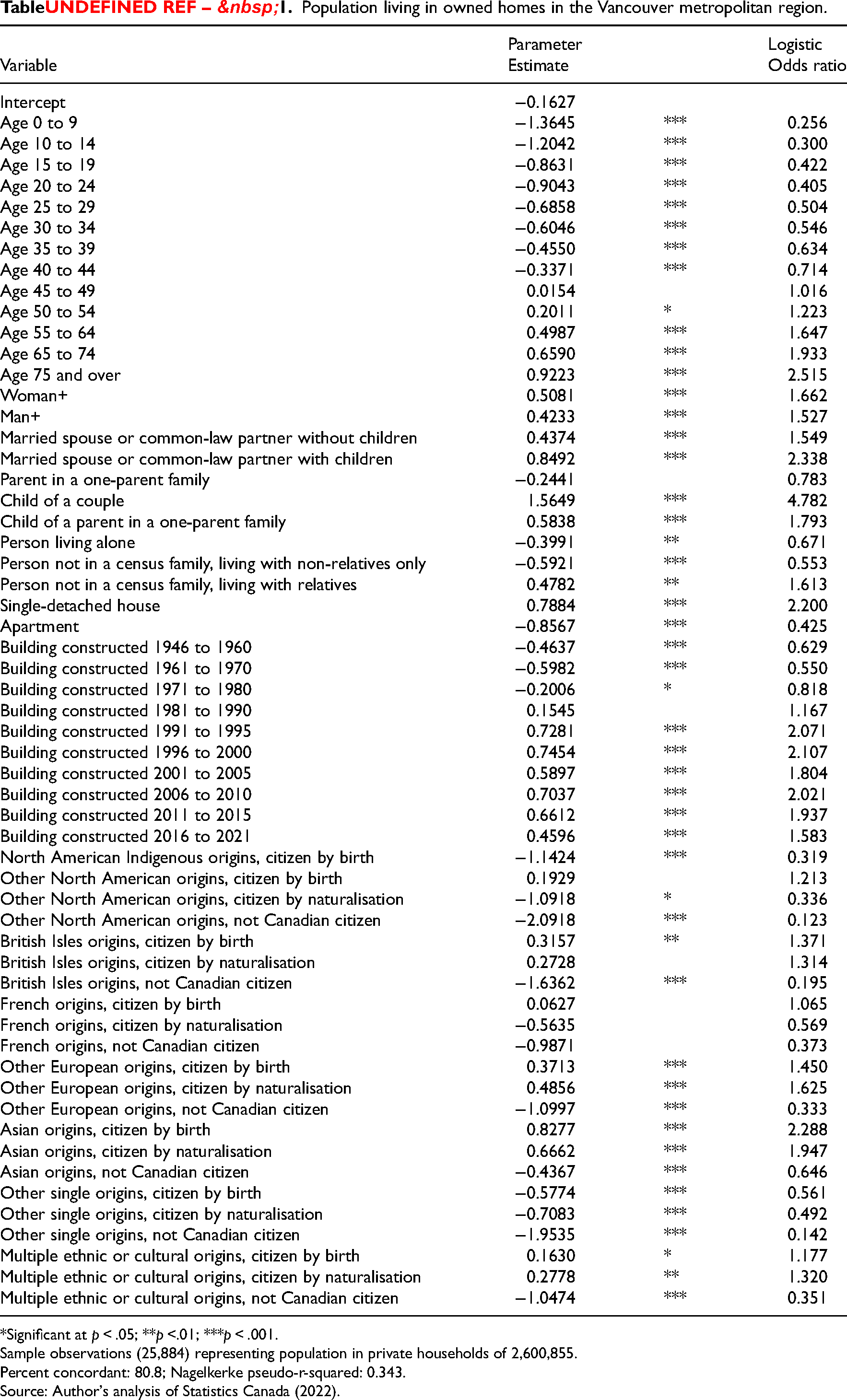
*Significant at p < .05; **p <.01; ***p < .001.
Sample observations (25,884) representing population in private households of 2,600,855.
Percent concordant: 80.8; Nagelkerke pseudo-r-squared: 0.343.
Source: Author's analysis of Statistics Canada (2022).
Porter's (2024) assessment is brilliant Spivakian deconstruction of authorial positionality. Wyly (2024) is intellectual tourism, the weaponisation of erasure, hand-wringing white fragility, a white-witness form of ‘muscular, entitled pontification’. There's a remarkable, metaphysically gripping grace in Porter's (2024) call for responsibility, reciprocity, repatriation, relationality, and resurgence. This makes for a valuable dialogue when read alongside Charlesworth's (2024) investigation, which involved more than 2000 participants, 140 community engagement sessions, 1000 surveys, and reviews of some 5915 documents. The Sacred Story investigation was supervised by Indigenous Cultural Advisors and conducted according to Indigenous research and decolonisation methodologies, including Sacred Teachings of the ‘Six Rs’: relationship, respect, relevance, responsibility, reciprocity, and repair. Core principles included the understanding that every part of humanity and nature – ‘each thing in Creation’ – is special, sacred, and part of our family (Charlesworth, 2024, Appendix I: 2). Read Porter (2024) alongside Tse's (2024) moving account of Sontag helping students grapple with the varied embodied traumas specific to particular global racial formations in Singapore, in conversation with Deloria's (1973) God is Red and the principles of two-eyed seeing in the Sacred Story investigation (Charlesworth, 2024) and Ley's (1974) call for a spiritual revolution to transform urban theory and practice. Porter (2024) and Charlesworth (2024), moreover, are particularly revelatory if read while watching the speech of Grand Chief Stewart Phillip at the July, 2024 press conference announcing the release of the report, titled: Don’t Look Away: How One Boy's Story Has the Power to Shift a System of Care for Children and Youth (see B.C. Representative for Children and Youth, 2024). The three-hour press conference is freely available on YouTube. Grand Chief Phillip speaks from the heart on the dehumanising racism that shaped his youth – but also his decades of experience with First Nations Councils where leaders would avoid intruding into cases of domestic violence. ‘Whoah, that's not really our business, that's the family's business, you know, we shouldn’t interfere’. Grand Chief Phillip also speaks candidly about the decades of resentment, distrust, and suspicion he endured as he struggled to represent BC's diverse Indigenous communities and political traditions in negotiations with successive settler governments. There are at least 204 First Nations in the province, and many of them were angry with Phillip's decisions as he balanced confrontation with compromise to work towards durable agreements. Grand Chief Phillip reminds everyone that children are a ‘universal value’ carried by Indigenous peoples, and indeed all peoples. ‘It takes an entire community to raise a child. And that community is not just the Indigenous community, that is the global community’.
These words were spoken in a room at Vancouver's new billion-dollar global Convention Centre with its LEED® Platinum, six-acre green roof, built the year before Colby was born. The building is on the downtown waterfront, next to the international cruise ship terminal, through which about 1.25 million passengers come through each year. Steps away are tourist shops offering a wide selection of overpriced stereotypical Canadian souvenirs alongside Indigenous art – much of it fake, since Canada does not yet have an Indigenous-specific intellectual property rights law corresponding to the U.S. Indian Arts and Craft Act of 1990. Close by on the Western side of the downtown peninsula, crowdfunded shares of a shell company created to escape property transfer taxes on an old apartment building sold out on WeChat several years ago, driving a property assessed at $Cdn 15.6 million up to $Cdn $60 million in a bidding war that lasted all of two hours. The property was flipped a few weeks later for $Cdn 68 million. On the other side of downtown is the vast tract of 1880s railyards that became the site of intergenerational, trans-Pacific entrepreneurial family succession planning that helped ‘accumulate capital around the world while keeping it all in the family’ (Tse, 2024: 1). So far, the viewcount is a bit over 450 thousand for a YouTube blog segment produced by a Chinese-language immigration and study abroad consultancy; a Shenzhen billionaire invites them in to film a corporate board meeting as she plans a redesign of the Indigenous market inside the giant shopping mall she bought on Tsawwassen First Nation sovereign territory. Amidst such Indigenous-transnational space-time oddities, Grand Chief Phillip's wisdom is a crucial voice in the meeting of multitudes of temporalities of knowledge and memories of those who have been disappeared through centuries of spatially uneven processes of colonisation, development, and capitalisation – part of the long intergenerational commitment that Falahat (2024) advocates for entirely new ‘thinking-feeling structures’ of epistemic, ontological, and economic conversations of pluriversal urbanism. But the asymptotic multidimensionality of positionality means that juxtaposing these spatio-temporal narratives is inescapably risky. Porter (2024) emphasises that writing is dangerous, witnessing sustains colonial mythologising, and even to step back and listen is to engage in intellectual tourism. And, of course, it is a particularly egregious form of epistemological violence to do so in the words in which these thoughts are expressed – in the words and deeds of property and pronunciation reproduced through centuries of layered Anglophone colonisation that requires a comprehensive methodology of stratigraphy (Porter et al. 2024) if there is any hope of excavating to the ‘bedrock of reconciliation’ – ‘restitution for lands and resources taken from Indigenous nations’ (Walker, 2024: 1). To use the written methodologies of millennia of colonial cognition (McLuhan, 1962) to offer admiration and respect for Porter's (2024) critique is nothing short of evil – a ‘masquerade’ of critical urban theory that becomes another of Lefebvre's (1962) ‘Metamorphoses of the Devil.’
Porter (2024) is correct that footnotes can perpetuate colonisation. Primitive attempts to play the role of Modest Witness without being Haraway are irredeemably fraudulent. Yet it is also true that strict-constructionist readings of the quintessential textual colonialism of the Royal Proclamation of 1763 are, ever so slowly, rewriting jurisdictions of place, property, and peoples across Canada. Canada's experience, moreover, is just one frontier of dynamic global contradictions between Eurocentric universalisms and variegated forms of ‘vernacular cosmopolitanism’ (Katz, 2004; Spivak, 2014). Contradictions of language, ethics, and representation seem unavoidable in the ‘epistemic tyrannies’ of the past century of urban theory (Falahat, 2024), precluding collective understanding of the fast-evolving new configurations of space and time in planetary relations of transnationalisation and Indigeneity.
Nevertheless, we cannot look away from the embodied material consequences of these juxtapositions, contradictions, and spectacular confusions of legitimation. ‘No human collectivity, no animate collectivity living on a planet can have planetarity as its self-consolidating other’, Spivak (2014: 5) explains. ‘This should give us pause – the fact that we are going to make ourselves extinct is part of the natural history of the planet. I say it that way because I cannot say it any other way. Everything we do or say, good or bad, thinking or not thinking, is to stay the horror of the randomness of planetarity. We can’t do anything with this. It is in view of this that social democracy must persistently go forward’.
It is this kind of postcolonial, multidimensional metaphysics of Vancouver's position in transnational, non-North Atlantic ‘postmodern recapitulation[s] of the settler temporality of property’ (Kim, 2024: 374) that foreshadowed Porter's (2024) critique of the settler spectacle, Falahat's (2024) call for equitable historical-cultural presence in epistemic spaces of urban theory, and Tse's (2024) analysis of the ontological absence of Asian subjectivities in dramas of globalising capital. The foreshadowing took place in the same year as the release of Roman Polanski's Chinatown, the cinematic simulacra that Tse (2024) deploys in a magnificent analysis of the conflation of transpacific capital with Asian bodies. It's the same year that Newton (1973: 79, 82) cited Proudhon's 1840 quip – ‘Property is theft’ – while expressing a militant consciousness that ‘equated having money with whiteness’ and the indictment that ‘white people were criminals because they plundered the world’. It's the same era when the Tsleil-Waututh leader and actor Chief Dan George was ascending to Hollywood fame in performances with Dustin Hoffman (Little Big Man, 1970) and Clint Eastwood (The Outlaw Josie Wales, 1976), while writing the poetry that would speak across the generations to inspire his grandson's mobilisation against a pipeline megaproject imperiling Burrard Inlet to deliver yet more Alberta oil to global markets (see ‘Words to a Grandchild’, 1974, in George [2023]: 53–57). Writing in the aftermath of the November, 1972 Trail of Broken Treaties to Washington, D.C. and the call for the United States to step to the ‘forefront of civilised nations’ by reopening treaty negotiation processes from the 18th and 19th centuries, Deloria (1974: 2–3) cautioned white settler-savior activists that they had fundamentally misunderstood Red Power militant sovereignty. ‘Imagining … that the coming Indian movement was an offshoot of the development of the sixties’, Deloria (1974: 2–3) reflected, the New Left welcomed Indian activists at its rallies, included Indians in the roll call of the oppressed, and sought Indian endorsement for schemes of fundamental reform. The Indian activists learned the language of social protest, mastered the complicated handshakes used by the revolutionary elect, and began to raise funds for their activities. But the funding sources which were pouring money into the new fad of “self-determination” for minority groups were often astounded to learn that the Indians were not planning to share the continent with their oppressed brothers once the revolution was over. Hell, no. The Indians were planning on taking the continent back and kicking out all the black, Chicano, Anglo, and Asian brothers who had made the whole thing possible.
Every child matters. If child labour is bad, then teaching children how to invest, or how to become responsible homeowners, is its own kind of loss of innocence. Don’t look away from the complexities of Spivak's planetarity. We see its ghostly traces in the hybrid materialisations of atheistic, secular, agnostic, and reverent spiritualities in metropolitan regions shaped by religious diversity, UNDRIP Indigenous reascendence, and transnational, diasporic multicultural mobilities (Dwyer et al., 2016). Its apparitions are manifest when Squamish Chief Ian Campbell explains how the Skwachàys portal at Sen̓áḵw brings you to other spirit realms of existence in the universe. Just a few kilometres south, the busy highway traffic flows under the flight paths of the Vancouver International Airport, through which 24 million souls pass through each year. Along the Highway to Heaven are six Chinese-language churches, three Buddhist temples, a Sikh gurdwara, two Hindu temples, and Jewish and Muslim religious schools. Don’t look away from the complexities and contradictions of evolutionary transnational urbanism. It is here where Walker (2024) helps us learn from and with the increasingly diverse settler publics with ancestral worldviews from around the world that are remaking cities that are fast becoming theirs, where Tse helps us regard the multidimensional Asian subjectivities of consciousness and capital in the era of transpacific neoliberalisation, and where Falahat (2024) helps us look forward towards the intertwined temporalities of cultural traditions and individual geobiographies in new kinds of polycentric urban epistemologies. Isn’t it an overwhelming, confusing, exhilarating time to be alive?
