



Abstract
Cities are real, physical, material concentrations of human activities and built environments, but they are also portals that allow and require unique ways of perceiving relations across space and time. Photography, especially the genre of seductive urban landscape views so often deployed by airlines, realtors, and city boosters, distorts our perceptions of space-time. These distortions are particularly serious in the unique configuration of Indigeneity and transnationalization that constitutes the lands presently known as Canada and British Columbia. Drawing inspiration from Sontag's dark but essential Regarding the Pain of Others, and focusing on the Vancouver global city region, this article seeks to develop critical captions for urban landscape views as what Eugène Atget portrayed as crime-scene evidence.
An ample reservoir of stoicism is needed to get through the great newspaper of record each morning, given the likelihood of seeing photographs that could make you cry. (Susan Sontag, Regarding the Pain of Others, 2003: 13)
The city of the dead antedates the city of the living. In one sense, indeed, the city of the dead is the forerunner, almost the core, of every living city. Urban life spans the historic space between the earliest burial ground … and the final cemetery, the Necropolis, in which one civilization after another has met its end. (Lewis Mumford, The City in History, 1961: 7)
…one of the central teachings according to which I was raised – what some would call a law in my culture – is to always be careful with words because you cannot take them back. This teaching informs choices about what one says, what one does not say, and how one says it. We should use words to inform, encourage, and uplift. This teaching is also an injunction about the responsibility to speak truthfully, especially when it is a truth that is important for the well-being of the collective. Jody Wilson-Raybould, “Indian” in the Cabinet: Speaking Truth to Power, 2021: 300)
Among the many tourist attractions available to visitors arriving in Vancouver, British Columbia, Canada, the 20-min “Vancouver Panorama” flights of Harbour Air offer the most visually tantalizing. Taking flight from the downtown waterfront past a new Cdn $800 million Convention Centre and showcase Olympic Cauldron broadcast around the world during the 2010 Winter Olympic and Paralympic Games, historic de Havilland “Beaver” floatplanes take six passengers on a route of intense ocular contrasts. Rising from the water and banking in a gentle arc over the majestic Lions Gate Bridge built in the Great Depression, windows on the left showcase the massive, 400-hectare Stanley Park—set aside in 1858 as a military reserve to supply timber for ship masts of the Royal Navy. Stanley Park is nudged tightly against a cluster of apartment towers in the city's West End, Canada's largest and oldest LGBTQQIP2SAA + neighborhood, where in 2016 Justin Trudeau became the first sitting Prime Minister to march in the Pride Parade. Just behind the West End glimmer the office towers of the city's central business district. To the right, mansions creep up the slopes of the North Shore Mountains in the separate municipality of West Vancouver, Canada's wealthiest jurisdiction. Home sales here average Cdn $3.6 million these days. A moment later, a glance to the left opens a broad vista across the gentle waves of the Salish Sea, known as Canal del Rosario and then the Strait of Georgia in the colonial era from the 1790s until a recent renaissance of Indigenous toponymic reclamation. Just below on the left is Bowen Island, named for British Rear Admiral James Bowen (1751–1835). To the right, the serpentine engineering achievements of the Sea-to-Sky Highway hug the steep feldspar and quartz crags rising from the shoreline, twisting along a speedy vortex of forest, water, and stone-wall views that provide backdrops for innumerable car commercials and Hollywood North cinema scenes. This region is North America's third largest film production complex after Los Angeles and New York. The plane turns back to the south after passing over the Horseshoe Bay terminal of BC Ferries, by some measures the world's largest water passenger transport fleet. Approaching Stanley Park once again, Beaver pilots bank to the left to fly east across False Creek, a shallow tidal inlet and marsh shoreline that has been filled in over successive generations to produce ever more square feet of some of the world's most attractive real estate (Figure 1).
While home prices look like bargains to global elites considering options from New York to Los Angeles, London, Hong Kong, or Shanghai, when expressed as multiples of local incomes Vancouver prices are routinely ranked as the second or third most expensive in the world. Tourists gazing out the windows are treated to landscape views that seem to be crystallized summaries of a vast literature of celebration in urban studies, planning, architecture, and pop culture. The Vancouver Achievement of Urban Planning and Design (Punter, 2003) and City Making in Paradise (Harcourt et al., 2007) have built a Dream City of Vancouver and the Global Imagination (Berelowitz, 2005) and a playful meme of the City of Glass (Coupland, 2009) that now aspires to an entire urban philosophy of Vancouverism (Beasley, 2019). Photo-packed blogs like Vancouver is Awesome spawn local newspapers and retrospective coffee-table picture-book collections like Vancouver Was Awesome (Russworm, 2014). The Beaver banks to the left over the Second Narrows Crossing that carries the Trans-Canada Highway over the waters of Burrard Inlet. The Second Narrows was renamed the Ironworkers Memorial Bridge in honor of the 20 lives lost in a collapse during the initial construction in June 1958. Burrard Inlet had once been called Canal de Floridablanca by the Spanish, and before that, Sasamat, by the Tsleil-Waututh peoples among the many diverse local communities of the hən̓q̓əmin̓əm̓ regional language ensemble. The plane glides in a slow descent and skips across the waves past the cruise ship terminal at Canada Place to Harbour Air's docks below the new Convention Centre. From takeoff to landing, visitors and spectators—not excluding the “mode of being” of the author function responsible for these words (Foucault, 1969: 382)—click and tap away to capture photographs of the dream city of paradise.
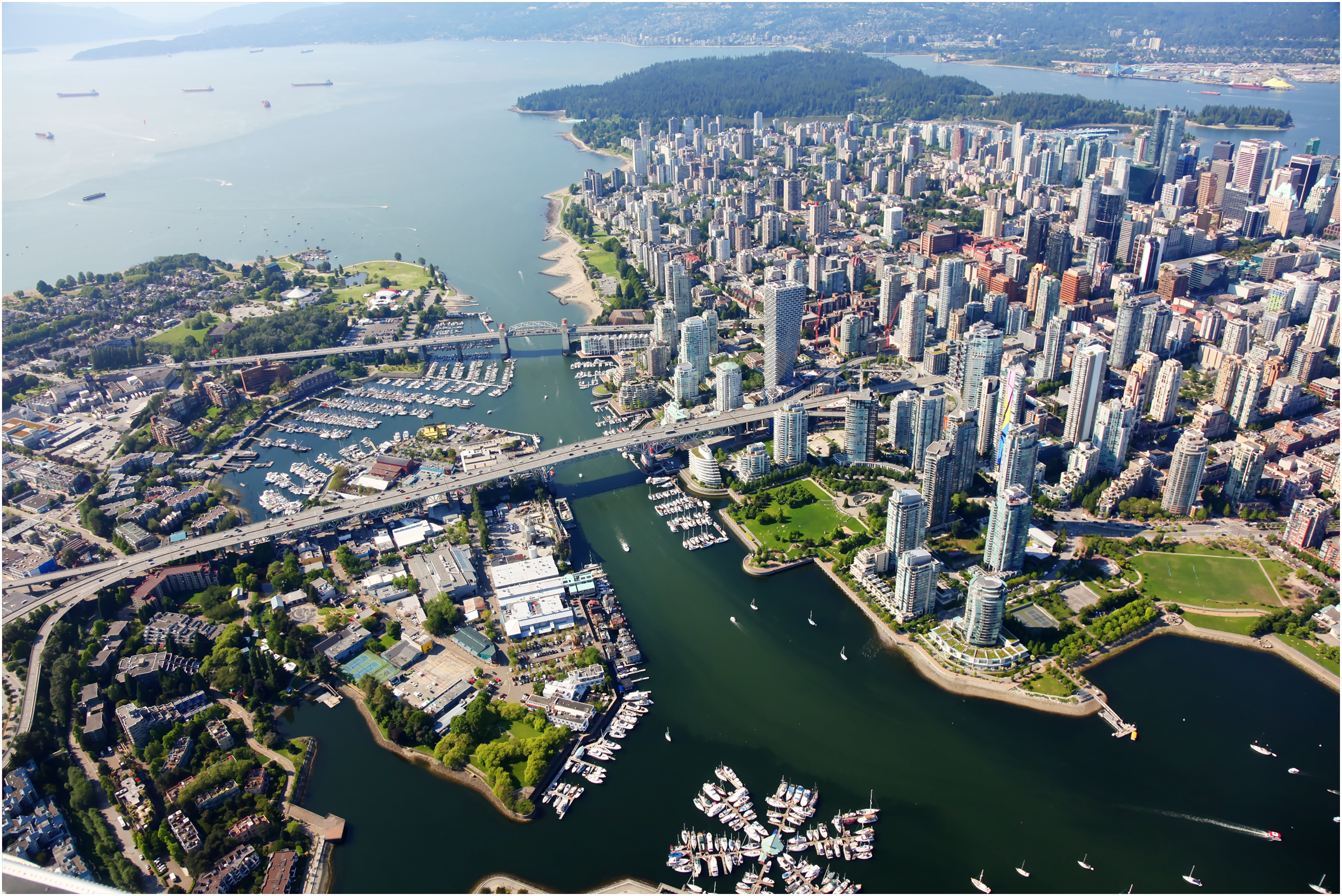
Central Vancouver (photograph by the author).
The Vancouver Panorama flight is just a tiny sample in a vast world system of migration, travel, and tourism, of the “tourist gaze” (Urry, 1990) of transnational cultural hybridities and diasporic mobilities in global space-of-flows mediascapes (Castells, 1996; Rantanen, 2006) in which “[t]ravel becomes a strategy for accumulating photographs” and “converting experience into an image” (Sontag, 1977: 9). Yet photographs are dangerous. Images are deceptive, and the reflected shadows of truth in Plato's cave now circulate as representational memes in Appadurai's global ethnoscape/mediascape/mindscape (Appadurai, 1990; Rantanen, 2006). The “insatiability of the photographing eye” since the first Daguerreotypes of 1839, Susan Sontag warned half a century ago, teaches humanity a “new visual code” that transforms “our notions of what is worth looking at and what we have a right to observe” (Sontag, 1977: 3). Photographs reproduce and circulate as illusions, each image offering itself as an unproblematic positivist reflection of a discrete spatiotemporal slice of reality. Photographs conceal the partiality, selectivity, and contingency of meanings associated with the circumstances of their creation—not just as individual images, but also their position in an ever-expanding correlational universe of multimedia representation. “Photographed images do not seem to be statements about the world,” Sontag (1977: 4) avers in drawing a contrast with the Gutenberg galaxy of print consciousness (McLuhan, 1962), but rather, “pieces of it, miniatures of reality that anyone can make or acquire.” Such visual truth claims are fraudulent yet persuasive. Hence photography creates a disorienting world of moral and ethical presumptions, especially implicating ideas of evidence and accountability. Ever since the Paris police used photographs to track down and execute the Communard revolutionaries of 1871, such images have served as the ubiquitous tactical weapons of state authorities—but also inquisitive journalists and insurgent activists and protesters. Long before the Trumpian “posttruth” era of misinformation, disinformation, and the conspiratorial cybernetic weaponization of Foucault and Said's conceptions of discursive Othering, Sontag warned that photographic evidence is inherently dangerous. To the degree that the last two centuries have intertwined capitalist–colonial urbanization with accelerating technological revolutions in photography, the optimism of modernity—photography as a craft of empathetic interpretation of ordinary landscapes (Meinig, 1979) and the planning of urban environments to make city images meaningful, vivid, and memorable for those who live there (Lynch, 1960)—has been replaced by something dark and disturbing. The landscape iconography of Dream City in Paradise, it turns out, is actually the Lie of the Land (Mitchell, 1996).
At first glance, Figure 1 seems to be nothing more than a tourist snapshot of a popular, smallish city with a certain population, in a Province called British Columbia, in the nation-state of Canada. But to succumb to this interpretation is the “blind field” diagnosed by Lefebvre (1970: 29), the negation of perception of spatiotemporal histories, a vision that “doesn’t see and doesn’t know it is blind.” Let's consider just one example of the lives – and afterlives – concealed by the sunny, distant view so common in landscape images like Figure 1. In the middle distance on the left side of the image is a small park nestled in a curve of the shoreline on the south side of the mouth of False Creek. This is Sen̓áḵw, a small remnant of the traditional, ancestral, and unceded territories of Sḵwx̱wú7mesh Úxwumixw, the Squamish Nation, which in 2023 celebrated the centennial of a majority of its citizens voting to request the Federal Department of Indian Affairs to amalgamate the communities of 26 separate Reserves into a single First Nation. On July 1, Canada Day, Stewart Phillip, Grand Chief of the Union of BC Indian Chiefs and leader of the BC First Nations Leadership Council, walked along a path on the western edge of Sen̓áḵw to speak with a correspondent from APTN News. Launched in 1999 as the Aboriginal Peoples Television Network, APTN is the first national Indigenous broadcaster in the world. “On screen, online, or on location,” the network's website explains, “APTN contributes to greater understanding between Indigenous peoples and the world.” On Canada Day, 2023—a national holiday that has become increasingly polarized with each year since the publication of a massive final report from a National Truth and Reconciliation Commission documenting the goals of more than a century of Canada's Indigenous policies as “best … described as ‘cultural genocide’” (TRC, 2015: 1)—Grand Chief Phillip wanted to speak with APTN News to draw attention to a tragic story of child abuse. It took place in a small community on the eastern edge of the Vancouver metropolitan region (Figure 2). It involved two Indigenous children removed from their mother and placed in foster care by the provincial Ministry of Children and Family Development. Grand Chief Phillip told the reporter, …this particular case is one of, one of the most horrific tragedies involving the death of a child in memory in the Province of British Columbia. It's absolutely horrible. These children were brutally beaten for a number of months, they were starved, and they were forced to eat their own vomit, and there was feces, also. I have never heard of anything…
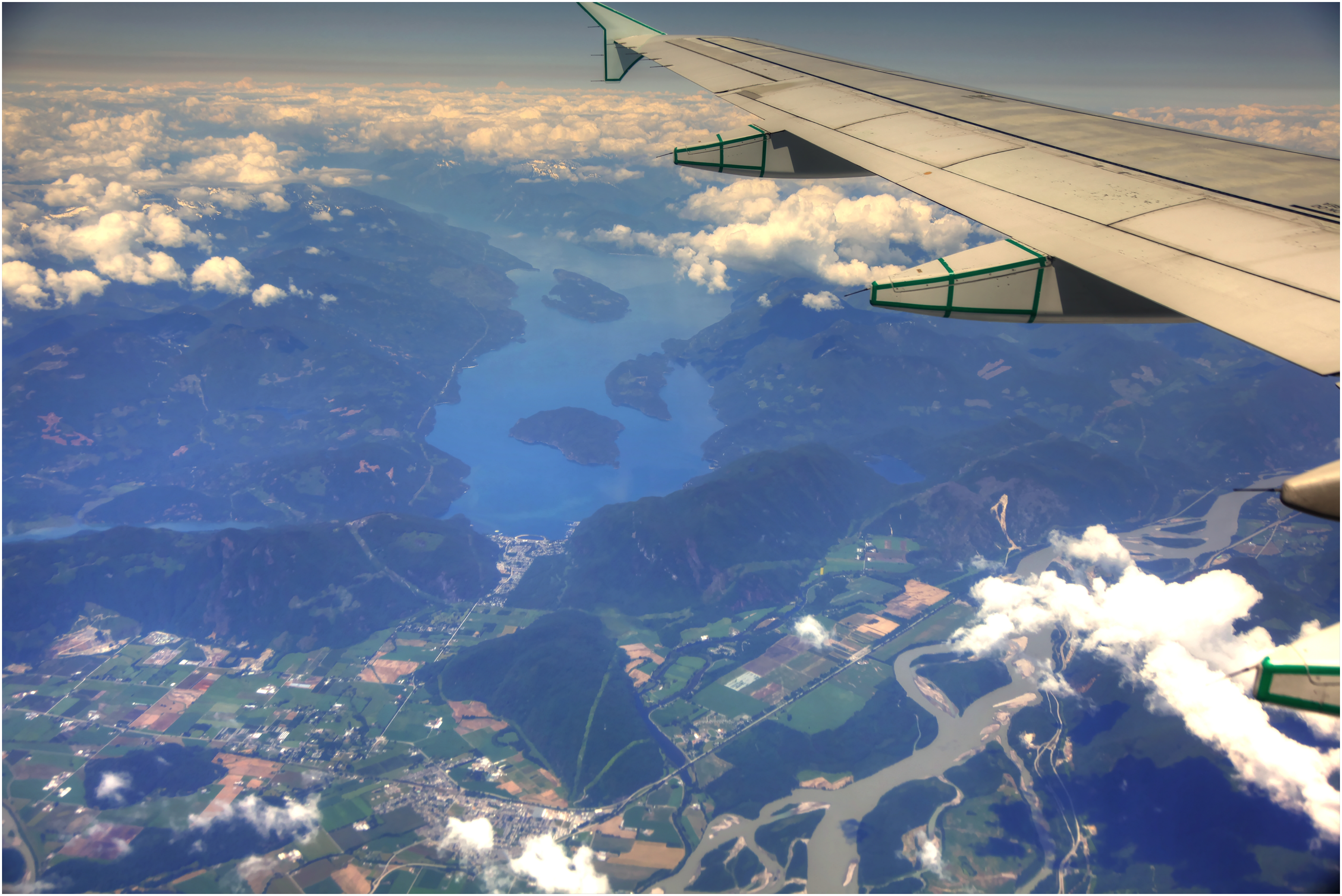
Eastern edge of the Vancouver metropolitan region (photograph by the author).
..you know, it's absolutely horrible, and this particular case, it's outrageous, there was evidently no oversight, no regular checkups, or anything of that nature, which is part of the responsibilities of the Ministry.
In previous weeks the case had finally received news coverage through public proceedings of the Provincial Court. “Now that it's become a public issue,” Chief Phillip remarked, the so-called parents—foster parents—received 10 years in jail. But in my mind it should have been at least—at least—25 years, each, for both of them, yet it wasn’t. So we’re absolutely outraged that there hasn’t been a very severe, decisive response on the part of the Ministry, on the part of government, and certainly on the part of the justice system. It's been a complete, colossal failure of defending the rights of children. Unacceptable.
A few days later, speaking to a local reporter for Canada's national CBC News Network, Phillip emphasized the “brutal and sickening” behavior of the “depraved parents” in the case. This was by no means the first catastrophic failure of the Ministry, although it is certainly the most serious in recent public memory. “Why do you think it keeps happening?” asked the reporter. “Well, quite frankly,” Chief Phillip replied, it's racism. There's an attitude throughout society, throughout its institutions, that Indigenous people are not worthy of proper treatment, proper care, and within society itself, there's racist notions in regard to people of colour, we see that every day, and it's a, you know, it's a cancer within Canadian society, that these notions of white supremacy not only still exist, but are growing. (CBC News, 2023)
Two interrelated facets of Grand Chief Phillip's words merit serious consideration. First, there is the matter of white supremacy in the historical construction and present evolution of the built environment of cities with global aspirations, such as that portrayed in Figure 1. Second, Phillips’ rage at the short sentence given the defendants—and his emphatic recommendation of quarter-century prison sentences—highlights distinctive perspectives at the intersection of Indigeneity, sovereignty and state authority, and principles of justice.
This article is a struggle with these two issues, as part of an effort to write an appropriately critical caption for Figure 1. In 1931, Walter Benjamin observed that the images of the disappearance of old streetscapes in a fast-modernizing Paris captured by Eugène Atget (1857–1927) had been described as crime scene photographs. “But is not every square inch of our cities the scene of a crime?” Benjamin (1931: 256) asked. “Every passer-by a culprit? Is it not the task of the photographer to point out the guilty in his pictures? ‘The illiteracy of the future,’ someone has said, ‘will be ignorance not of reading or writing, but of photography.’ But must not a photographer who cannot read his own pictures be no less accounted an illiterate?.”
Too many of us, it seems, are guilty and illiterate when we gaze at seductive images like that shown in Figure 1. Misinterpretations and distortions are worsened by the competitive representational hierarchies of the “digital hall of mirrors” of cybernetically performative media environments (Leong, 2021; Sontag, 2004; Táíwò, 2022). Things are not what they appear to be. It is not entirely coincidental that Sontag, the quintessential New Yorker, ends Regarding the Pain of Others with a rumination on “Dead Troops Talk,” a staged photo of “a made-up event in a savage war that had been much in the news” (Sontag, 2003: 123) by the postmodern Vancouver photographer Jeff Wall. Wall's images can be read in terms of a “sense of spiritual unease in the midst of (relative) plenty, which is the particular affliction of the audience Wall addresses,” (Seamon, 1994: 253), and the same ennui lurks behind photographs like Figure 1 deployed by travel agencies, realtors, and city boosters. Likewise, 30 years on from architect Trevor Boddy's (1993: 38) reminder that “Cornel West, arguably the most important black intellectual in the U.S., has promoted architectural critic and historian Lewis Mumford as the kind of engaged public intellectual so needed today,” to understand today's selfie-city TikTok postmodern cinematic urbanism, Mumford's concern with the boundaries between life and death cry out for patient, painful reflection. Mumford's fascination with the liminal was, of course, a retrospective view of a few thousand years of global history as refracted through Western eyes, of the Elysian Fields graveyards on the outskirts of European cities; in today's context of cities with diasporas tracing ancestries around the world in space and time, the role of images and spectacles in alternately revealing and obscuring the frontiers between individual life and death present fundamentally collective questions about the meanings of planetary urbanism.
To appreciate the full implications of such seductive visual deception requires that we begin by considering the facts of the case that enraged Grand Chief Phillip.
R.L.C.
Information on the case known legally as Rex v. M.F. and T.T. is limited, pursuant to Sections 486.5 (1) and 486.4 (2.2) of the Criminal Code of Canada. These provisions authorize Bans on Publication designed to prevent the identification of witnesses and underage victims. Some details, however, began to circulate in press accounts of a sentencing hearing. As the prosecutor read the account of the events and injuries, “[t]here were murmurs and gasps in the courtroom,” reported one journalist, “and one person left sobbing” (Welsh, 2023). A detailed Agreed Statement of Facts was negotiated between the Crown and two defendants, M.F. and T.T., as part of guilty pleas. In the publicly available document justifying the final sentence, the judge in the case provided a short summary of the Agreed Facts (La Prairie, 2023). The judge also provided comments based on a review of evidence from a USB drive obtained after police executed a search warrant at the home of M.F. and T.T. The drive includes some 16,000 CCTV video clips from four cameras in the home, with a total running time of approximately 400 hours.
R.L.C. and N. are two Indigenous children who are members of one of BC's 204 First Nations. In October 2019, R.L.C. (age 10), N. (age 7), and an older sister A. (age 13) were removed from the care of their mother and placed in foster care with Ms T. and her partner M.F. R.L.C. had serious, congenital health problems. He required regular medical care and medications for chronic kidney disease, asthma, and anemia. M.F. and T.T. were paid Cdn $1000 per month, plus expenses, to care for the children. They lived along with T.T.'s brother in a four-bedroom duplex home in a small community on the eastern edge of the Vancouver metropolitan region (just off the left side of the image in Figure 2). In September 2020, T.T. removed R.L.C. from school. No attempt was made to connect him to the remote classes provided by the school. Medical appointments were missed. The last contact with a medical professional was by video, on November 2, 2020. The last contact with the Ministry of Children and Family Development was on July 27, 2020. Physical abuse by both M.F. and T.T. began, becoming most severe between early December 2020, and 21 February 2021. R.L.C. and N. were slapped, punched, kicked, whipped, choked, gagged, bound, struck with belts and weapons, and forced to perform extreme, military-style exercise routines for hours—sometimes in diapers, sometimes naked. At one point, T.T. held N. while M.F. hit her with a 2 × 4 piece of wood. Other items used to strike the children at various points were a broom handle, a shoe, kitchen utensils, a bucket, a can of Lysol spray, a cell phone, and the butt end of an axe. The CCTV videos show M.F. and T.T. laughing while the children are abused. R.L.C. and N.—age 10 and seven, respectively – were forced to wear diapers, and were locked in a closet. They were separated from the other children, and punished by the denial of food. When they were fed, it was usually dog food. They were forced to eat their own vomit and urine. They were forced to eat feces from their diapers.
Abuse of R.L.C. intensified in late February 2021. He was zip-tied to his bed, and then forced to do hours of squatting exercises. He was shaken, punched, slapped, kicked, and thrown down. He was hit repeatedly with a 2 × 4 all over his body. T.T. dragged him around, slammed his head onto the floor, stomped on him, and told the other children to hit him with a 2 × 4. At 3:25 in the afternoon of 26 February 2021, T.T. dragged R.L.C. into the kitchen, threw him to the floor, and kicked him. As R.L.C. struggled to put on his shirt while he was on the floor, T.T. kicked him again, then grabbed his wrists to pull him up and slapped his face. R.L.C. was dazed. He lost his balance and fell to the floor. The floor was wood, hard. T.T. picked him up and threw him down again. He hadn’t been able to put on his shirt properly when he had been kicked on the floor just a moment earlier, so his hands were stuck in the neck and arm openings. When he was thrown down again he couldn’t protect himself. His head bounced off the hard wood floor. T.T. kicked him again.
R.L.C. was unresponsive. At 3:37 pm, T.T. carried him to a chair. The next 40 min of the video show her on her cell phone, walking around the house, paying no attention to R.L.C. She called 911 at 4:19 p.m. BC Ambulance paramedics arrived, and given the severity of the injuries, R.L.C. was airlifted to BC Children's Hospital in Vancouver (just off the left side of Figure 1). Doctors diagnosed a severe underweight condition of R.L.C., along with injuries to his brain, lungs, and abdominal organs. On 28 February 2021, doctors declared him neurologically brain dead. A short time later—the precise date is redacted from published court records to prevent anyone cross-referencing death records to ascertain personal identity—R.L.C was taken off life support and died. He was 11 years old. The cause of death was listed as blunt force trauma to the head.
N. survived. Doctors diagnosed numerous bruises and abrasions all over her body, and injuries from zip ties used on her ankles and wrists. She was eight years old.
Due to the severity of R.L.C.'s injuries and inconsistencies in T.T.'s stories when the ambulance crews arrived, the RCMP were notified. A search warrant on the home was executed the same day he was taken off life support. After investigations and legal proceedings, one of the defendants pleaded guilty in August 2022. The other pled guilty three months later. Officials in the Ministry of Children and Family Development learned some of the specifics of the abuse only when the summary of Agreed Facts was read in open court at the sentencing hearing on 15 June 2023.
Regarding
Photographs are in evidence, along with thousands of video fragments. Depending on the frame-per-second rate of the particular CCTV cameras in the home, there are somewhere between 360 and 720 thousand images in evidence, providing a ghastly reincarnation of “new wave” cinematographer Jean-Luc Godard's 1960 quip: “Photography is truth. And cinema is truth twenty-four times a second.” Since the Rex v. M.F. and T.T. images are not publicly available, the circumstances here are subtly distinct from the war-atrocity photographs Sontag struggled with in Regarding the Pain of Others. Yet it is precisely the absence of photographs in juxtaposition with carefully chosen words that amplify the power of regarding, and its witness of the ethics of visual communication of horrors throughout a world urban system from Guernica to Grozny, Kabul to Sarajevo, Jerusalem to Jenin and beyond. So also for anyone who reads La Prairie's (2023) explicit description of videos showing R.L.C.'s abuse and starvation worsening to the point where he is “so emaciated that he looks like a skeleton,” the “appearance of a child from the holocaust” (sic). Moreover, it is important to remember that “to look closely” is just one of the varied definitions of the word derived from the French regarder. Another is “to consider (someone or something) as being a specified thing, possessing specified qualities etc.” When used as a noun the word can mean “esteem,” “attention, heed,” “a conventional expression of kindly feeling,” or “consideration, sympathetic concern” (Cayne, 1990: 838). Sontag—like JWR, Jody Wilson-Raybould, the first Indigenous Minister of Justice and Attorney General (MOJAG) of the nation of Canada—was always very careful in her choice of words.
Sympathetic concern remains problematic, however, and even factual narrative descriptions entail the same kinds of risks of the visual “gaze” that has been a concern of feminist geographers for many years. It has now been three decades since Rose's (1993: 87) comprehensive, devastating attack on the “visuality” of the entire discipline of Geography as a “sophisticated ideological device that enacts systematic erasures.” Rose (1995) uses “phallocentric” as an adjective for, inter alia, the words look, gaze, knowledge, mirror, perspective, scenography, space, visions, visual depth, visual spaces, visuality, visualized space, and voyeurism (see Gould, 1994, 1999: 148). “Ocularcentric” urban research remains controversial (see Vertovec et al., 2024: 18). Ever since McLuhan, however—and with ever-sharpening bioscientific detail on the contrasts between alphabetical and logographic languages in shaping the neuroplasticity of human brains (Baron, 2015; Wolf, 2007)—it has been clear that all forms of mediated communication can be subjected to the feminist critique of visualized knowledge, as well as the fusion of “Greek ocular metaphors” and Cartesian mind–body separations that perpetuate anti-Black epistemologies of Western science (West, 1999: 71).
Regardless of the type of media involved, there is an impossible dilemma. To regard the pain of others—without the situated knowledge and standpoint epistemology shaped by lived experience (Harding, 2005)—is the worst kind of voyeurism and appropriation. But to look away and ignore the evidence of horrific Indigenous suffering is another form of systematic erasure and dehumanization. 1 Looking away is the kind of detached complicity called out by protesters carrying “SILENCE = VIOLENCE” signs at so many marches protesting so many different injustices in cities around the world. The meme has become its very own category in the stock photo industry. You can choose from 5424 “SILENCE = VIOLENCE” protest images on Alamy, 8357 on Shutterstock, and 22,276 on Getty Images. A quick search for “SILENCE = VIOLENCE protest images” on the Death Star of voyeuristic phallocentric knowledge (Google) returns 46.6 million hits.
The dilemma of looking is intensified by the fact that any attention paid to an episode fuels distortion, decontextualization, stereotyping, stigmatization, and the weaponization of empirical events by ideological and political operatives. This, too, has been a core concern of urban sociology and urban geography for many years—particularly the way the “tangle of pathologies” of poverty, crime, and dysfunctional family relations create racialized narratives of a dangerous urban “underclass” in the United States (Slater, 2021; Venkatesh, 2000; Wilson, 1987). Yet to avoid the harsh realities is its own form of cowardly privilege. This is one reason why Loïc Wacquant (2022) dedicates his most recent book, The Invention of the Underclass, “To Bill Wilson, role model extraordinaire of intellectual courage.” Wilson (1987) challenged the then-prevailing Left orthodoxy of ignoring the ever-worsening indicators of crime and family destruction wrought by the structural production of race-and-classified regimes of permanent unemployment. Misunderstood and attacked as a co-opted Black conservative, Wilson confronted the evidence not to blame the victims, but as part of a struggle towards policy changes to address the societal catastrophe of postindustrial urban restructuring. These facets of the dilemma are somewhat distinctive in Canada. Severe, intergenerational Indigenous poverty has traditionally been associated with rural reserves, and the overlapping dimensions of racialization and social marginalization in metropolitan areas are generally less tightly correlated compared with the United States (Smith and Ley, 2008). But persistent urban/rural contrasts coexist with increasingly diverse and unequal experiences of urban Indigeneity among hundreds of distinctive nations and communities. Recent years, moreover, have brought a rapid pivot in Canada's federal governing coalition and key factions of the nation's metropolitan, corporate, and media elites toward what Daigle (2019) identifies as “spectacles” of reconciliation that reproduce “naturalized and fetishized Indigenous suffering and trauma.” Such performative spectacles mask material realities, while also obscuring the extraordinary diversity and complexity of Indigeneity. All this takes place at a moment when Canada's past and present are the subjects of turbulent—some would say (and/or hope) “revolutionary”—contestation (George, 2023). To the degree that regarding the pain of R.L.C. is a form of cultural appropriation that promotes stigmatization, even Indigeneity itself does not exempt a viewer from the quandary identified in Sontag's (2003: 7) discussion of Virginia Woolf's 1938 essay on war photographs: “No ‘we’ should be taken for granted when the subject is looking at other people's pain” Añonuevo et al. (2023: 203), for example, emphasize that “it would be erroneous and perpetuating of epistemological violence to suggest that Indigenous geographers share a common sociopolitical lens,” and this is especially important in understanding contemporary Canadian spatialities and Indigeneity.
In Canada, “Indigenous” is the broadest, most inclusive term for the original inhabitants of the land and their descendants, as well as some of the blended relations of descendants with successive generations of immigrants. “Aboriginal” is a legal and institutional term established through Section 35 of the Constitution Act, 1982, recognizing Indigenous rights and title tracing back to the Royal Proclamation of 1763. Section 35 (2) of the Constitution Act recognizes three groups of Aboriginal peoples: First Nations, Métis, and Inuit. The Assembly of First Nations represents more than 900,000 members of 634 First Nations across Canada, who speak more than 50 distinct languages. First Nations are further divided according to complex, paradoxical, and historically evolving categorizations implemented under the authority of the Indian Act of 1876, as amended. This legislation was designed to eliminate Indigenous societies and assimilate them into the British-dominated modernity that in 1867 consolidated separate North American colonies into the Confederation of Canada. The Indian Act distinguishes between “Status Indians” and “Nonstatus Indians.” Individuals with status are officially listed on the Indian Registry maintained by the federal government. Nonstatus First Nations individuals may be unregistered for a variety of reasons, but most often due to status lost via 20th-century policies designed to achieve assimilation by transforming “Registered Indian” into “Canadian citizen.” Pursuing a university education, serving in the armed forces, leaving a reserve for an extended period, or (for Indigenous women) marrying a non-Indigenous man would automatically entail “enfranchisement” and loss of status under the terms of previous legislation, the Gradual Civilization Act, 1857. Status lost through such provisions has been restored for some Indigenous people due to a long and uneven history of organizing and court challenges. Even today, however, Inuit and Métis peoples are ineligible for the rights and programs—limited and paternalistic though they are—provided to status Indians.
The Indian Act is widely, but not universally, hated. “It is an amazing thing – a shocking thing,” Wilson-Raybould (2021: 142) writes, “to imagine that in Canada the central piece of legislation about Indigenous peoples is still the Indian Act – a segregationist, colonial, and racist law passed in 1876.” As long as the Indian Act remains, JWR concludes, “institutionalized, systemic racism” against Indigenous peoples will persist. “Ultimately, we must be rid of it,” she writes. And yet the Indian Act is so deeply entangled with continental-colonial history that repealing or replacing it will require generations of negotiation, cooperation, conflict, consultation, and communication. The Act is a paradox at the heart of Canada's history and present: it is dehumanizing, paternalistic, and coercive, yet because of its foundational, ur-Constitutional nature it recognizes certain rights that elected governments and courts absolutely must honor. In practice, the first decades of this century have brought numerous revisions to the Indian Act. Collis (2022) analyzes a “statutory upheaval” of 47 amendments passed between 2005 and 2020, in the most active (yet often overlooked) period of changes to the Indian Act in more than a century. The essence of the 1876 legislation remains in force, yet it is being dramatically modified by disaggregated, flexible, and adaptive reconfigurations of Indigenous rights in order to realign the settler-colonial legal order to the dynamic conditions of transnational trade, investment, and capital accumulation. “A new class of hybridized legal spaces is evolving,” Collis (2022: 179–180) concludes, and recent legislation “destabilizes dominant narratives that conflate rights law and the insertion of modern legal standards into Indigenous spaces as reciprocal markers of a virtuous postcolonial future.”
“It is, unfortunately, not as simple as just ripping up the Indian Act,” Jody Wilson-Raybould told delegates at the 37th Assembly of First Nations in July 2016. Wilson-Raybould, also known by her ancestral name Puglaas, is a descendant of the Musgamagw Tsawataineuk and Laich-Kwil-Tach peoples, and a member of the We Wai Kai Nation. The previous autumn she had won election to Canada's federal Parliament to represent the newly created riding of Vancouver-Granville (just off the left side of Figure 1). Serving in Prime Minister Trudeau's cabinet as Minister of Justice and Attorney General, JWR told the AFN delegates that “…simplistic approaches, such as adopting the UNDRIP [United Nations Declaration on the Rights of Indigenous Peoples] as being Canadian law, are unworkable, and, respectfully, a political distraction to undertaking the hard work required to actually implement it” (reprinted in Wilson-Raybould, 2019: 71, 72). Years later—after a fierce fight with Trudeau over a deferred prosecution agreement for a Montreal multinational firm guilty of a decade's worth of bribery of government officials in Libya—JWR was forced out of the Prime Minister's cabinet and eventually left electoral politics. In her detailed memoir of Indigeneity and Canadian politics—“Indian” in the Cabinet—she outlined the long-term, intergenerational, and intricate geographical contextualization processes that will be required for Canada to move beyond the Indian Act. Doing so requires “creating pathways that support nations to determine their own governance models based on their Indigenous legal orders and traditions,” Wilson-Raybould (2021: 142) wrote, “and to move out of the Indian Act on their own terms – at their own pace and without the federal government as a gatekeeper.” This is a reminder that to see Figure 1 as a city known as Vancouver in a country called Canada is a naive and dangerous manifestation of Lefebvre's blind field: instead, Figure 1 is a retrospective Mumford archeology blended with a prospective Mike Davis-style “excavating the future” palimpsest of hundreds of distinct societies, cultures, and nations. Some of those distinct societies are the transnational diasporas sustaining a demography where, Statistics Canada reports, international immigration comprised nearly 98% of all net population growth between July 2022 and July 2023. And for many other distinct societies, the Indian Act remains an undeniable structure of governance, regulation, and control that establishes many of the parameters of daily life. Yet the Indian Act acknowledges and reproduces certain fundamental Indigenous rights, and thus, paradoxically, it enables some of the city political machine dynamics so familiar in conventional settler urban theory. “[W]e have to be mindful of the vested interests in the status quo that are resistant to change,” Wilson-Raybould (2019: 72) told delegates at the Assembly of First Nations, “not to mention the citizens of the Nations who may be afraid of change and more comfortable with the devil they know, than the devil they do not.”
JWR's diagnosis was an eerie premonition of what would happen within the AFN just a few years later, generating torrid national press coverage and high-stakes struggles over images, reputations, and representation. In the same APTN broadcast in which Grand Chief Phillip spoke about the Rex v. M.F. and T.T. case, the lead story reported on a divisive power struggle inside the AFN that led to the removal of National Chief Roseanne Archibald. In the summer of 2021, Archibald had begun an acceptance speech by declaring “the AFN has made her-story today,” after she clinched a fifth round of voting to become the organization's first female National Chief. But by late June 2023, in a special Chiefs-in-Assembly meeting held over Zoom, Regional Chiefs voted 163 to 62 to remove Archibald. Those voting for removal justified the decision as a response to a year-long human resources investigation undertaken by an outside legal firm hired by AFN counsel. The investigation documented employee harassment in a workplace environment described as “highly politicized, divided, and even fractured.” The law firm also found that Archibald disclosed confidential information when she released a statement and circulated emails and memos questioning the motives of the complainant employees. One of the employees was said to suffer “reputational harm” after being accused of suing Archibald for defamation and had to shut down her social media accounts due to a flurry of death threats. Archibald told CBC News that the investigation had been “conducted in a colonial and confrontational manner,” and had previously accused the complainant employees of attempting to “secure over a million dollars in contract payouts.” Archibald and her supporters portrayed the entire investigation and her removal as retribution for her attempt to root out widespread corruption in the organization, and her pursuit of a forensic audit of AFN finances (Stefanovich, 2023). Archibald had narrowly survived a previous coup attempt in a showdown at the 2022 AFN Assembly at the Vancouver Convention Centre (on the right side of the downtown peninsula in Figure 1). In the days before the 2023 Assembly in Halifax, Archibald tried to rally support for reinstatement as she posted videos from her car while visiting North Vancouver (off the right side in Figure 1). Amidst heavy press coverage by APTN and CBC News, two feminist Indigenous scholars attacked the AFN as “intimately tied to the federal government” and corrupted by proximity to “systems of Canadian power.” The coup is “embarrassing,” they wrote. “This is not who we are collectively as Indigenous peoples who are the living legacy of our ancestors” (Sy and Green, 2023). The AFN began in 1969 as the National Indian Brotherhood of Canada, a grassroots resistance movement protesting a federal legislative proposal to unilaterally dismantle the Indian Act without any Indigenous consultation.
Back in May 2010, at the Western Canada Aboriginal Law Forum, Wilson-Raybould delivered a speech entitled “We Truly Have Come a Long Way,” and emphasized that while there is much to be done, “We are now in the driver's seat” (reprinted in Wilson-Raybould, 2019: 19). Indigenous peoples “have to vote for change,” she told the delegates; The twisted reality of our postcolonial transition is that our people have to vote the colonizer out. As you are all aware, this is because the colonizer – in our case, Canada – has a fiduciary relationship to our people and cannot simply legislate the Indian Act away until our people tell them it is okay to do so. Perverse but true. (Wilson-Raybould, 2019: 21)
But every child matters
Anyone who recognizes this phrase, and its circulation in the nationwide social justice movement energized by the 2021 ground-penetrating radar measurements of subsurface anomalies in cemeteries outside several sites of Canada's century of assimilationist Indigenous residential schools, must devote somber reflection to Canada's past and present institutions built on the assumption of hierarchical human inequality and paternalistic-theocratic ideologies. White people have especially serious moral obligations. Anyone whose ancestors helped build or profited from the “totality of the domination of the settler colonial state and its structures” (Smiles, 2018: 148) over hundreds of once-sovereign Indigenous societies must draw inspiration from the historian Noel Ignatiev (1940–2019), author of How the Irish Became White (Ignatiev, 1995) and founder of the journal Race Traitor. For anyone whose mind's eye cannot stop regarding R.L.C.'s head bouncing off that hard wood floor in the kitchen, the journal's motto—“Treason to whiteness is loyalty to humanity”—exacerbates the emotional turbulence of rage, lament, and (for whites) a radical counterpart to the conservative mantra of “personal responsibility.” This is not about the attention-seeking “confessional spaces of white guilt” of a performative reconciliation industry (Daigle, 2019: 723), but rather the invisibility of humility in reading and writing—the “safe distance” between the faces of writers, written words, and readers (Coates, 2017: 161; cf. Foucault, 1969: 391). It's a cancer within Canadian society, Chief Phillip emphasizes, that these notions of white supremacy not only still exist, but are growing. For any whites with even the slightest tinge of moral and ethical commitment to the universality of humanity—especially if they regard themselves anywhere on a continuum of enlightened/liberal/progressive/radical—the appropriate inspiration might involve a bit of remedial reading of Huey P. Newton's (1973) Revolutionary Suicide. Every subtraction of white life—or a placement of a white life in any circumstances with elevated risk of a premature end in service to a revolutionary goal—helps humanity advance toward a post-white world.
Regarding privacy and public hierarchies
Here there's a plot twist. Remember, this is Hollywood North.
This case of racist white supremacy is just a little bit unusual. M.F. and T.T. are not, in fact, white. They are Indigenous. They are members of one of the two of BC's 204 First Nations involved in the foster care case. This is one of the reasons for the Court's publication ban and for the extreme care of journalists and editors reporting on the case. Some news accounts briefly mention the fact—adding just a single word, “Indigenous,” as a modifier to “foster parents” before narrating the court proceedings and details of the abuse—but others do not. Chief Phillip's interview with APTN makes no mention of the issue. The Indo-Canadian Voice (2023) omits the fact in a detailed account of responses by First Nations leaders and public officials, including Minister of Children and Family Development Mitzi Dean's apologies and condolences to “Indigenous peoples across the province who have experienced and continue to experience the trauma of a broken child-welfare system.” The issue is also not mentioned in the BC Aboriginal Child Care Society's (2023) open letter calling for an Indigenous-led investigation “to ensure that Indigenous perspectives, values, and ways of knowing are respected.”
The matter is extremely sensitive. As BC Premier David Eby defended Minister Dean from a growing chorus of First Nations leaders’ demands for her resignation or firing, he cautioned journalists that the particular First Nation where the tragedy took place has requested “that we refrain from further media statements about this” (quoted in Palmer, 2023). Yet Grand Chief Phillip's discussion of the case with APTN News puts Sontag's (1977) dilemma of Plato's Cave into the McLuhan global media village, while also exposing the tensions between Western ideas of instantaneous global-village communications versus Indigenous perspectives on a world of “non-homogeneous pockets of identity that must be thrust into eventual conflict, because they represent different arrangements of emotional energy” (Deloria, 1973: 78). APTN's July 1 broadcast uploaded to YouTube has only reached an audience of a bit more than 3000 thus far, but in the networks of contemporary cognitive capitalism, Alphabet's algorithms are always watching what people are watching when they regard the pain of others (Figure 3). Reider et al.'s (2018) API data mining tools reveal that most of the first-order “next up” recommendations offered to viewers who watched the July 1 broadcast remain within APTN's YouTube channel. Several items, however, link to a much wider assemblage of visual narratives, especially at the second-order level, connecting to some 1002 videos with a total cumulative audience of more than 5.6 billion.
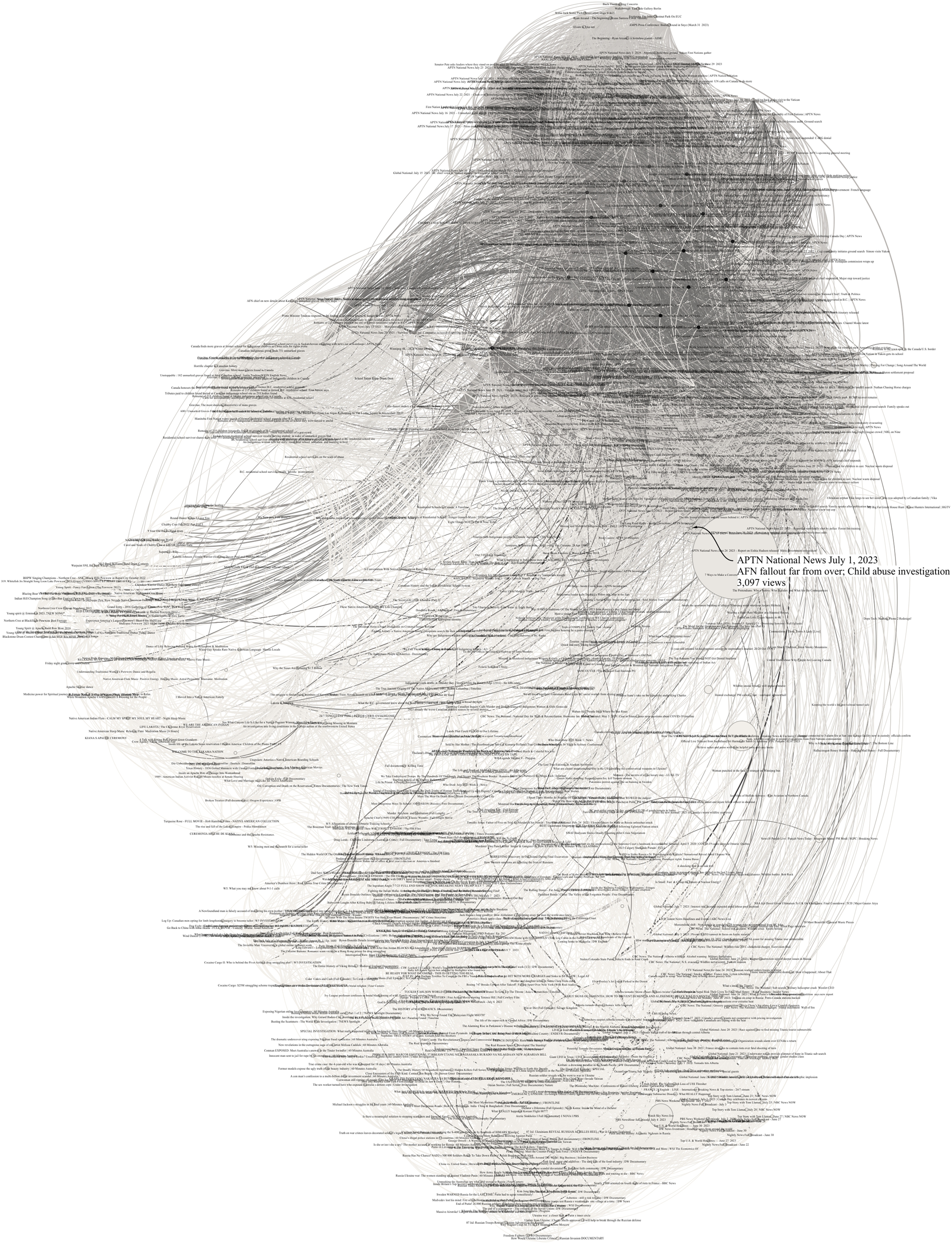
Correlation of online audience formation processes for the 1 July 2023 broadcast of APTN News. First- and second-order “view next” recommendations served by YouTube's algorithms, extracted from the YouTube API using tools developed and made available by Rieder et al. (2018). Graphic produced by the author.
The content of the correlations here need not follow any logic or coherence. The largest destinations for anyone who follows just two recommended clicks or thumb-swipes from Chief Phillip's remarks wind up at the live feed from TV9 Kannada (1.8 billion), which markets itself as “one of India's most watched and credible national news channels worldwide.” Other scenes offered by the algorithm take viewers to livestreams from ARY News out of Pakistan (608 million) and Sky News (475 million), while smaller spectacles take the eyeballs to dispatches from Al Jazeera, National Geographic, the Official Channel of the Rolling Stones, the Wall Street Journal, and Canada's emeritus cranky correspondent Rex Murphy appearing on the alt-right psychologist Jordan Peterson's channel to rant about “The Catastrophe of Canada.” The point here is that once the horrific, intimate details of individual lives are thrust into the klieg lights of an evolutionary infrastructure of multimedia communications and algorithmic political culture, Sontag's ethics of what we have a right to observe become a concern that is simultaneously individualized and personal, but also public and (at least potentially) planetary. The seemingly chaotic connections reflect the market power and business model of surveillance capitalism (Zuboff, 2019), which harvests the different, diverse, random elements of urban social life that Lefebvre (1970) envisioned as “the encounter.” Surveillance capitalism translates these embodied, situated, localized communications into Silicon Valley infrastructures of industrialized commodification and manipulation of human attention via competitive maneuvers for market share—“mindshare”—and advertising.
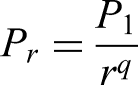
There's another eerie parallel here with Mumford's (1961) millennial vision of civilizational life and death because today's social media ecosystems produce the same precision in rank-size hierarchies that were the basis of a vast swath of 20th-century urban research. One of the implications of Brian J.L. Berry's (1964) influential “cities as systems within systems of cities” theory of urban size hierarchies was that individual cities might decline or even die as abandoned ghost towns. What endures is the collective urbanism of the entire system. The structured relations between a dominant metropolis, many medium-sized cities, and a vast number of small towns and villages endure, reproduced at a larger overall scale with each generation of population growth. Such hierarchies are symptomatic of long-term evolutionary paths of human development and spatial organization. Humanity can be understood as the aggregation of individual lives “embedded in a higher order of complexity,” a “societal organism that displays self-regulating fluctuations around a path of growth” (Berry, 1991). At any given point in time, with just a few basic elements of data, urban hierarchies can be measured and modeled with a high degree of accuracy through a series of simple equations. These equations conform to regularities identified by the linguist George Kingsley Zipf (1949) in his studies of character and word frequencies in, inter alia, Chinese, English, Pennsylwanisch (Pennsylvania Dutch), Hebrew, Plains Cree, and Norwegian. As applied to urban populations, and she was a very crusty lady. She would just pretty much barge into the home and see what was going on rather than just being afraid to go into the home and perhaps phoning or something like that. (quoted in Palmer, 2023)

R.C.L.'s birth mother, M.P., was devastated to learn of all that he had endured. After his death, but before the final sentence was handed down, M.P. herself died. Before her death, she spoke to the probation officer charged with preparing the pre-sentencing report. The officer reported that M.P. found it difficult to express how greatly she has been impacted by the actions of the subject; she is struggling to cope with the gravity of losing her child. She described an increase in her substance misuse as a means of numbing her pain and acknowledged she feels untrusting of child protection services who were unable to keep her child safe. She feels disconnected from her surviving children due to her grief and self-harming behaviors, and notes mental, physical, and spiritual anguish daily. She also reflected on the impact of her Indigenous community members because of the offenses and feels isolated due to the tension the subject's behavior has caused. (La Prairie, 2023: 7)
It is a small and close-knit community grounded in culture, tradition, and teachings. The loss of [R.L.C.] has had a devastating impact upon this community. In particular, the circumstances under which he died have devastated the community … [R.L.C.] was a sweet and kind boy, a gentle boy, he was sunshine. He was a beautiful angel who brought light to the lives of those who came to know him and love him. That light is now gone. … in honour of [R.L.C.], the community is dedicated to ensure that no other child will ever be taken in this way and will work diligently to keep their children safe from harmful individuals.
Now stop and thencean. That's the ancient linguistic origin of the word recognized today as the English word think. Grand Chief Phillip—member and Chief of the Penticton Indian Band, an entirely separate sovereignty among BC's 204 First Nations—comments on the too-lenient sentence involving a case of two different First Nations, and says this is about racist notions in regard to people of color and a worsening cancer of Canadian white supremacy. All people of goodwill should now pray that the operatives at Fox, Breitbart, Newsmax, Rebel News, and all the rest of the dog-whistle, righteous-whiteous right-wing media ecosystem don’t pursue this story. If they do, the career catastrophe that befell Harsha Walia offers one macabre preview of the kinds of things that could happen. A four-word tweet about cases of arson at churches after the news of the possible unmarked graves at residential schools in the summer of 2021 led to Fox News coverage and Walia's firing from the Executive Director position at the BC Civil Liberties Association, along with the torrent of social media death threats that have come to define so much of public life (see Olaniyan, 2021).
Still, it is worth acknowledging at least a little bit of irony in the interpretation. An Indigenous child literally tortured to death by Indigenous cousins on the lands of an Indigenous First Nation, followed by a leader of a separate Indigenous First Nation demanding a Giuliani-style lock’em-up-and-throw-away-the-key punishment for the Indigenous offenders is … a growing cancer of white supremacy within Canadian society. To read La Prairie's (2023) meticulous, clinical distillation of what must be a very large case file, in juxtaposition with the suitably sensitive, delicate, euphemistic press coverage is to contrast Jody Wilson-Raybould's (2021) cultural law with Confucius’ warning abusing metaphor destroys society, since tyranny begins in language (Moser, 2019: 685). In the last published essay of her life, written just weeks after the diagnosis of the final cancer that would kill her, Sontag (2004) chronicled the metaphors deployed to evade accountability for the torture of prisoners by U.S. soldiers at Abu Ghraib prison in Iraq: “Regarding the Torture of Others” Reading La Prairie (2023), one need not have any sympathy for those whom Ta-Nehisi Coates (2015: 7) famously called “these new people who have been brought up hopelessly, tragically, deceitfully, to believe that they are white” to recognize that the spectacular cinematic urbanism (Tarantino, 2022) of performative gestures of Canadian reconciliation might be misunderstood by some audiences.
Regarding reconciliation, reparations, and reproduction
But why not? Pretty much everything can be connected in one way or another to white supremacy, if we take a sufficiently broad view of the violent geographies (Gregory and Pred, 2007) created, reorganized, and reproduced over the past few centuries. Read Mike Davis’ (2001) Late Victorian Holocausts on the planet-spanning environmental catastrophes of white colonialism alongside Michelle Alexander's (2012) New Jim Crow on racialized mass incarceration, and Jason Hackworth's (2019) analysis of how the “pathological inner city” trope enables U.S. conservatives to turbocharge the 21st-century gerrymandering of 19th-century Electoral College white supremacy. Consider the 2018 publication of Zora Neal Hurston's 1927 interviews (Hurston, 2018) with 86-year-old Cudjo Lewis—survivor of the Clotilda, the last slave ship known to have made the transatlantic journey of human plunder and bondage, whose wreckage in the Mobile River was described by researchers in 2021 as offering the possibility of DNA evidence—alongside the vivid quotidian fabric of the urban environments, lives, deaths, and communal afterlives of Eric Garner (Taibbi, 2017), George Floyd (Samuels and Olorunnipa, 2022), and so many others. Read the words of Indigenous survivors whose testimony to Canada's Truth and Reconciliation Commission “stripped white supremacy of its authority and legitimacy,” in the words of Phil Fontaine, then serving as National Chief of the AFN (TRC, 2015: 132). Pretty soon it's hard not to see white supremacy everywhere. So if we accept Chief Phillip's verdict, then the next question is, what is to be done?
Look again at Figure 1. Walter Benjamin teaches us that every square inch of this city is the scene of a crime. This beautiful city view is a mug-shot of colonial white supremacy. If this is CSI White Supremacy, cut to the forensic teams and detectives tracking down suspects in pursuit of justice. Over the past several generations, social movements and legal-institutional processes have created a variegated landscape of Truth and Reconciliation Commissions, formal apologies, and calls for reparations. There are precedents. Rome demanded recompense from Carthage after the Punic Wars of 264–146 BCE. The State of Massachusetts awarded a pension to the slave Belinda Royall in 1783 after her Loyalist owner fled in the U.S. Revolution. Reparations have been made in the cases of post-Apartheid South Africa, the Tuskegee Airmen syphilis medical experimentation case, and the U.S. forced internment of Japanese Americans. On the other hand, an attempt by Chinese, Korean, Russian, and Mongolian victims of Japan's Unit 731 biological warfare atrocities to gain compensation eventually failed in court proceedings in Japan. Germany paid reparations to Israel in the 1950s. Future Prime Minister Menachim Begin led militant resistance to the idea as a transactional form of “conscience laundering.” But the payments were made, resulting in a turbocharged GDP for the young nation as well as intensified dispossession of Palestinians—a palimpsest of moral contradictions that led to great controversy over Coates’ interpretations of that history. That coalesced with an acrimonious social media fray after Cornel West called Coates the “neoliberal face of the black freedom struggle” and accused him of “fetishizing white supremacy” in defending Obama's legacy. The bitter public feud led Coates to delete his account on what was then called Twitter. “Peace, y’all. I’m out. I didn’t get in it for this,” he signed off to his 1.25 million followers (see Coates, 2017: 176–177, 203–206; Lartey, 2017; Schuessler, 2017).
We are in the very last living generation, therefore, when it makes any kind of sense to have contemporary discussions of reparations and historical accountability that invoke the simplistic double-helix binaries of left/right, progressive/reactionary, BIPOC/white, west/rest, colonizer/colonized, Indigenous/settler. All of these dialectics are now coevolving in multidimensional directions, entangled with the cognitive-capitalist “factory of fragmentation” (Harvey, 1992) that simultaneously energizes, divides, and co-opts the passions of the postindustrial, poststructuralist left. Diverse perspectives on the possibilities and implications are exemplified in Coates (2017: 151–161); Michaels and Reed (2022), Táíwò (2022), Haider (2018), and Leong (2021). Reed (2020: 102–103) goes so far as to situate Coates’ widely read article, “The Case for Reparations,” as a revival of the Black cultural nationalism of the late 1960s, the sort of competitive entrepreneurialism that culminated in James Brown's endorsement of Richard Nixon and releasing the song, “I Don’t Want Nobody to Give Me Nothing (Open Up the Door, I’ll Get it Myself” (Reed, 2015). Coates's “calls for reparations and his related embrace of racial ontology,” Reed (2020: 102) writes, are “every bit as conservative and counterproductive” as the mirage of “postracialism” signified by the utopian celebrations of Barack Obama's electoral wins in 2008 and 2012. Viewed through the lens of black historical materialism, movements for reparations risk creating a self-replicating, divisive fragmentation of class consciousness and solidarity by diverting strategic resources into the infinite intersectionality of whom owes what to whom. Appiah (2020) reminds readers that Stuart Hall reminisced that in his childhood in Jamaica, nobody was ever called “black,” but that his grandmother could recognize the differences among no fewer than 15 hues of brown. Today's ADOS movement (African Descendants of Slavery) “wants to establish what it considers a properly ‘cohesive’ notion of Black identity,” Appiah (2020) writes, “fencing out people like Barack Obama and Kamala Harris as ‘New Black’ usurpers of a native lineage of suffering.” Conflicts between fast-changing, performative, networked identities versus historically inscribed palimpsests of ancestries now constitute complex, transnational fields of postcolonial diasporas, claims to territory, and competitive meritocracies and moral claims (Appiah, 2018). Praising Reed's (2020) “must-read” analysis of the corrosive cumulative history of deindustrialization and the destruction of organized labor, Barbara Fields calls reparations “the latest neoliberal market prescription.” Riffing on the contemporary obsession with representational visibility in Hollywood blockbusters and the diversity of a top 1% enriched by half a century of neoliberalization—and the ways some forms of identity transformation are welcomed as emancipation (Caitlyn Jenner) while others are attacked as fraudulent (Rachel Dolezal)—Reed (2015) calls the entire assemblage of media spectacles “The James Brown Theory of Black Liberation.”
In all of this discussion of moral and strategic considerations, however, there has been little direct mention of urban theory. This is particularly important in light of the ways global circuits of economic, political, and cultural relations have woven local lives into complex, multiple-scaled forms of transnational urbanism (Smith, 2001). In some cases, there are tantalizing yet hidden urban dimensions to the politics and strategies. In a brilliant analysis, Táíwò (2022) traces the history of feminist intersectionality and standpoint epistemology as decades of neoliberalization have created a performative, individualized, identitarian mode of “deference politics.” This reinforces a model of seemingly progressive, bottom-up social change that nevertheless channels popular energies “flowing through approved channels and hierarchies” (Táíwò, 2022: 73). In dazzling passages that implicitly translate Berry-esque urban systems theory into the language of intersectionality and postcolonial critical race theory, Táíwò (2022: 73, 74) shows how cognitive-capitalist deference politics funneled and controlled progressive and radical energies in Obama's election—reproducing a form of “racial Reaganomics” that deploys the most advanced forms of Taylorism to manage assembly-line positionalities in “fantasies about the exchange rate between the attention economy and the material economy.” Reparations discourse has become entangled with these processes, and has also been constrained by the litigator's mantra to “go where the money is” in attempts to sue single, high-profile, deep-pocketed companies or public institutions. But if one were really to heed Watergate whistleblower Mark Felt's Deep Throat advice—follow the money!—then it is crucial to remember Sam Stein's (2019: 2) observation that the value of global real estate is 36 times the value of all the gold ever mined in world history. Three-quarters of that accumulated wealth is in housing, where competitive dynamics in urban land markets reproduce Berry's (1964) hierarchies of unaffordability, migration, investment, and debt—as well as the mass consciousness of the morality of property ownership and home “equity.”
Contemporary reparations discourse, then, is undermined by binary thinking that produces ever more zones of contention for adaptive cognitive-capitalist factories of fragmentation—particularly in light of the constraints imposed by the pragmatic need to engage with existing mutations of Westphalian nation-state frameworks of power and legal authority. Perhaps one can envision several hundred distinct, sovereign state authorities to enforce the quarter-century incarceration advocated by a Grand Chief. But in general, transcending the disparate impacts embedded in current state institutions requires and enables a reconsideration of historical and geographical accountability as an inherently long-term, transnational urban process of negotiating intergenerational debts and responsibilities. It means forsaking the zero-sum assumptions of Pareto-optimal efficiency that undergird economic theory, from Berry (1964) all the way to Glaeser's (2020) celebration of deregulated city-building as the triumphant extension of Frederick Jackson Turner's frontier. What is required instead is a renewed pursuit of “a normative theory of spatial or territorial allocation based on principles of social justice” (Harvey, 1973: 97). Harvey (1973: 96–118) reconstructed Berry's (1964) rendition of a positivist spatial science of “urban systems” into “Social Justice and Spatial Systems,” a long-run ethics to unify equity and efficiency, efficiency and distribution. Western Canada, and the unique urban context of the Vancouver metropolitan region, offer a particularly pertinent context in which to consider these issues. The region forces radical reconceptualization of ethnoracial taxonomies and Eurocentric conceptions of nation and territory. Remember: there are more than 634 First Nations in the “nation” of Canada, and 204 just in the Province of British Columbia. Within many of the Nations are tensions between hereditary lines of inherited community leadership as opposed to the band elections system mandated under the Indian Act. The divisions within Indigeneity in BC are so complex that recent disputes over hunting and fishing rights led Grand Chief Phillip and others on the Chiefs Council of the Union of BC Indian Chiefs to unanimously pass a resolution and issue a press release just a few weeks before Phillip's interview on the Rex v. M.F. and T.T. case with APTN. The press release denounced “Métis Colonialism,” comparing the “deeply offensive” rights assertion of several Métis organizations to the “dehumanizing Doctrine of Discovery and terra nullius” principles that were so central to Christian/White/European colonial expansion four centuries ago (UBCIC, 2023). In the contemporary lingua franca of Canadian progressivism, this is a double-shot of Godwin's Law. Chief Phillip's outrage at the justice system, moreover, could be seen as a manifestation of Albert Camarillo's (2015) diagnosis of the Pacific Coast of North America as a “new racial frontier” of dialectics of conflict and collaboration among nonwhites in the aftermath of the 1992 Los Angeles riots/rebellions. That confusing spectacle—cascading from the videotape revelation of the beating of Rodney King as only the most suddenly visible episode of anti-Black policing infrastructures, to the jury-acquittal chaos that fused with long-simmering tensions over Korean–American merchants’ treatment of black customers that led to the burning of Koreatown—had been memorably rendered by Ruth Wilson Gilmore (1993) as “Terror Austerity Race Gender Excess Theater.” With just a slight turn of the kaleidascope, Phillip's demand for quarter-century prison sentences for M.F. and T.T. could be viewed as another glimpse of the long history of the oft-ignored politics of conservatives of color (Forman, 2017; Fortner, 2015). R.L.C.'s grandmother, too, recalling the last time she heard her grandson's voice on a rushed phone call cut short by T.T.'s evasions, told a reporter, “I was horrified that it was only 10 years for monsters that do that to a child” (quoted in Brunoro, 2023).
Further complexity involves the dynamism of transnational diversification. The Vancouver region is one of the most cosmopolitan parts of North America, a vivid expression of the “majority-minority” new racial frontier analyzed by Camarillo (2015). Nationwide, international immigration has comprised a rising share of net population growth: a third in the late 1960s, fluctuating at lower levels in the 1970s and 1980s, rebounding to about one-half in the 1990s, then steadily rising to 93% in 2021/2022. The Vancouver area has been at the leading edge of this trend for many years. Of a total 2021 metropolitan population of 2.61 million, 1.09 million are immigrants to Canada. Almost a third of immigrants have arrived just in the past 10 years. 1.42 million residents of the region (54.5%) identify as visible minorities. The largest visible minority communities in the region are identified as Chinese (512,000), South Asian (369,000), and Filipino (142,000). Other important constellations of diverse origin and identity comprising at least 50,000 residents each include Latin American, Southeast Asian, West Asian (defined in Canadian statistics as roughly equivalent to the Middle East), Korean, and the hybrid category “Multiple visible minorities.” Local journalists delight in profiles of the seemingly infinite creativity of a constant stream of high-achieving new arrivals. A particularly fascinating case is Mackie's (2020) profile of a YouTube star famous in India, who came to Vancouver by way of a lengthy path: born in St John's, Newfoundland, childhood in Bombay, India and Midland Texas, education in Des Moines, Iowa and Chicago, Illinois, work in high finance in Cyprus, Singapore, Belgium, London, Cameroon, and Ghana, then standup comedy and acting classes in Los Angeles. Then she arrived in BC during the COVID-19 pandemic, not long before the 2021 Census enumeration documents that all Indigenous identities combined—First Nations, Métis, Inuk/Inuit, and “Multiple Indigenous identities”—comprise 63,345 residents of metro Vancouver (Statistics Canada, 2023). In the short five years between 2016 and 2021, immigrants to Canada who settled in the Vancouver region (154,820) outnumbered all the region's Indigenous peoples by a factor of almost two to one. The continued social reproduction of a society established on dispossessed Indigenous territories accounts for the harsh assessment of prominent analysts like Kim TallBear, Professor in the Faculty of Native Studies at the University of Alberta. Speaking on the Media Indigena podcast a few weeks after delivering a prestigious Anthropology lecture on the Musqueam Campus of the University of British Columbia—in the very same lecture hall where Jane Jacobs delivered one of the last public speeches of her life—TallBear (2022) critiqued “settler theorizing” that is “designed to obfuscate, … to have us believe that multiculturalism is the new progressive way, which is another way to eliminate us.” More than a decade earlier, the AFN had passed a resolution demanding a freeze on all immigration to Canada until the federal government “addresses, commits, and delivers resources to improve housing conditions, education, health, and employment in First Nations communities.”
In a similar spirit, Glen Coulthard (Yellowknives Dene), who teaches in UBC's First Nations and Indigenous Studies Department, develops a brilliant synthesis of Marxist theories of primitive accumulation and Fanon's critique of colonial misrecognition to challenge Canadian narratives of acknowledgment and reconciliation. In Red Skin, White Masks, Coulthard (2014: 60) draws attention to a fundamental disjuncture in ontologies of geography and history highlighted by the late Lakota lawyer and philosopher Vine Deloria, Jr. In the “Thinking in Time and Space” chapter of God is Red, Deloria (1973: 75–76) writes that when the “domestic ideology” of the United States is divided according to American Indian and Western European immigrant … the fundamental difference is one of great philosophical importance. American Indians hold their lands – places – as having the highest possible meaning, and all their statements are made with this reference point in mind. Immigrants review the movement of their ancestors across the continent as a steady progression of basically good events and experiences, thereby placing history – time – in the best possible light. When one group is concerned with the philosophical problem of space and the other with the philosophical problem of time, then the statements of either group do not make much sense when transferred from one context to the other without a proper consideration of what is happening.
Indigeneity and immigration are all too often regarded as separate, unrelated dimensions of social change and public policy. Considering them simultaneously in relation to Sontag and Mumford's understanding of city imagery as the palimpsest of lives present and past and Deloria's Indigenous ontologies of space-time invites us to see Figure 1 in new—and appropriately disconcerting—ways. This is a real, physical, material concentration of buildings, activities, investments, commitments, and debts of millions of people living and working here today. But it is also a portal that allows and requires that we perceive time and space in unconventional, metaphysical ways. For example, if talk of reparations is “an airing of family secrets, a settling with old ghosts,” a “full acceptance of our collective biography and its consequences” (Coates, 2017: 202) then Figure 1 is not just the core of a metropolitan area with 2.6 million inhabitants. It's urban life spanning the historical-geographical space between present and past, near and far, living and dead. It's a “stark poetry” to think of the 2.6 million who presently live here “as the tips of stems, endlessly twisting themselves down in the realm of times past” and places near and far in the biographies and itineraries of individuals and families (Hägerstrand, 2006: xi).
In the late 1940s, the Swedish geographer Torsten Hägerstrand (1916–2004) developed a simple yet labor-intensive method of visualizing human activity patterns in space and time. After a 1959 visit to the University of Washington in Seattle—just a few hours down the highway from BC—Hägerstrand's ideas influenced a cohort of faculty and doctoral students in Geography, including Brian Berry, whose research came to be known as the Quantitative Revolution. The most memorable elements of Hägerstrand's “time geography” were three-dimensional “aquarium” graphs of individuals’ paths through space during, say, a 24 hour time period. Space was represented in the x-y horizontal coordinate plane, while time was a third z dimension showing vertical paths of individuals moving between home, work, shopping, and other daily activities. Hägerstrand's methodology spawned innumerable extensions and applications across multiple disciplines, from transportation planning to the study of unemployment and occupational segregation, exposure to health risks, and everyday survival strategies of the homeless. Early years of the method required hand-drawn diagrams compiled from individual survey responses, diaries, and/or field observations. In the 1980s the computational advances of Geographical Information Systems enabled dramatic expansion in the size of datasets amenable to study; data collection and coding, however, remained challenging and tedious. By the late 1990s, the civilian availability of the military's Global Positioning Systems began to offer the possibility of near-real-time automated “geosurveillance” of the movement patterns of millions (Kwan, 2004).
Hägerstrand's time geography becomes relevant to our story when the daily time-space paths become life-paths across generations and centuries of migration and urbanization in Mumford's palimpsest of lives and afterlives. This is, in fact, how the idea first came to Hägerstrand, sifting through a century's worth of birth, marriage, and death records of a rural church parish in Sweden. Individuals and families struggle to survive. Some prosper, and many do not. Fortunes are made and lost. The land is dispossessed, bought, and sold. Cities are built and grow, making land and homes ever more valuable. People die. Money and land—or debts—are inherited. Tracing lines of intergenerational accountability has been part of reparations movements for quite some time, most notably in the forensic accounting of the Holocaust that continues in banking, law, and politics today (see Savage, 2023 on the latest on investigations of the Swiss banking behemoth Credit Suisse). Yet ongoing revolutions in the digitization of historical records, the network effects of machine learning in search algorithms, and the rapid popularity of 23andMe genomics are creating entirely new ways of thinking about cities as assemblages of individuals with ancestral paths of movement, money, and moral obligations. Before we give further consideration to these evolving urban perspectives, however, it is necessary to understand how certain kinds of life paths are evaluated in Canada's legal system.
Globalizing Gladue
In deciding sentences for M.F. and T.T., Judge La Prairie was required to consider an extensive array of aggravating and mitigating factors, presentencing reports, psychological assessments, and other documents. Such considerations relate to entrenched policy dilemmas highlighted by Jody Wilson-Raybould (2021: 137–140, 151). For several years, JWR worked as a Crown Prosecutor in Vancouver's Downtown Eastside (off the right side of Figure 1), widely described as the poorest urban neighborhood in all of Canada. That experience led JWR, when she was MOJAG, to set the highest priority on reforming mandatory minimum sentences to reduce Indigenous overrepresentation in the criminal justice system. As mitigating factors, La Prairie (2023) noted that both M.F. and T.T. pled guilty and expressed remorse for their actions. M.F., however, continued deflecting, attempting to place primary responsibility on T.T.
M.F., 39, was raised by a single mother after his parents separated when he was about six. There was a history of violence in his family. His father violently beat his mother. He has a Grade 9 education, and the court-appointed psychologist rated him with severe cognitive limitations, functional illiteracy, and meeting the criteria for intellectual disability. He has three children from a previous relationship, and four children with T.T. M.F.'s father, and his maternal grandmother, attended residential schools, and thus he “has been impacted not only by the intergenerational trauma of colonization, but also by the residential school system” (La Prairie, 2023: 12).
T.T., 35, was raised in an unstable family environment with neglect, physical abuse, and sexual abuse. Her father died before she was born. Her mother suffered from serious physical and mental health problems and alcoholism. Her mother's boyfriends would repeatedly abuse her mother. As a young girl, T.T. witnessed several episodes in which her mother attempted suicide. Eventually, at age 13, T.T. moved to her grandparents’ home, where “Ms. T.'s grandmother raised her in a traditional spiritual manner.” T.T. has a Grade 11 education. She left school when she became pregnant with her first child. She has five children, four with M.F. When T.T. was asked to care for the children of her cousin, M.P., she initially agreed to take them for a short period of time. She recounts the experience as stressful and overwhelming, and asked the Ministry of Children and Family Development for help, but “her request was not met.” The psychological assessment notes possible PTSD with mood, anger, and behavioral dysregulation due to “a history of problems with violence, intimate and nonintimate relationships, employment, and significant traumatic experiences across the lifespan.” T.T.'s maternal grandfather attended residential school, although the experience was never a topic of discussion in the family. An Elder in T.T.'s First Nation stated “that people of his age, including Ms T.'s grandfather, who survived residential school came away with the teachings of how to be cruel, which caused a disconnect in families. He states we lost our culture, our spirituality and had to fight our way back to who we once were as people” (La Prairie, 2023: 14).
These biographical circumstances come from La Prairie's (2023) brief summary of a special report for the Rex v. M.F. and T.T. case. It's almost certainly a very long document, but we can’t know for sure, because this is a tightly guarded, confidential Gladue report. Gladue is a landmark case in Canadian criminal law, with important yet often overlooked implications for the meanings of Canadian urbanism. In the same year that Canada's Parliament recognized Territorial status for Nunavut—a step below full Provincial autonomy according to the provisions of the 1867 Confederation, but still creating the largest negotiated land settlement between a nation-state and an Indigenous population in the world—the Supreme Court handed down the Gladue decision consolidating and reaffirming the legal mandate for all judges to consider the unique individual, community, and historical circumstances of Indigenous people who are convicted of serious criminal offenses. In evaluating an appeal of a manslaughter case in which a 19-year-old woman enraged by suspicions of infidelity killed her husband, the Court clarified and standardized judicial procedure in the application of Section 718.2 (e) of Part XXIII of the Criminal Code of Canada. Section 718.2 (e) mandates that sentencing judges consider all available sanctions other than imprisonment, and also requires judges to pay special attention to the circumstances of Indigenous offenders. “Section 718.2 (e) is not simply a codification of existing jurisprudence,” the Justices wrote. “It is remedial in nature. Its purpose is to ameliorate the serious problem of overrepresentation of aboriginal people in prisons, and to encourage sentencing judges to have recourse to a restorative approach to sentencing” (R. v. Gladue, 1999, para. 93.3). The Justices further specified that (1) sentencing is “an individual process and in each case, the consideration must continue to be what is a fit sentence for this accused for this offence in this community,” (2) the term “community” must be defined broadly “so as to include any network of support and interaction that might be available” to the Indigenous person, and (3) sentencing judges must “undertake the sentencing of aboriginal offenders individually, but also differently, because the circumstances of aboriginal people are unique.” Section 718.2 (e) is not to imply an automatic reduction of penalties for Indigenous offenders, but in some circumstances jail terms may be less than the term imposed on a non-Indigenous offender for the same offense (R. v. Gladue, 1999, paras. 93.5, 93.6, 93.11).
The explicitly urban dimension of the Supreme Court's jurisprudence involved a review of lower court judges’ opinions holding that Section 718.2 (e) did not require special consideration of Indigeneity in this case, because both the offender and the deceased were residing in an urban area, not a reserve governed pursuant to the Indian Act. This issue goes to the heart of widespread myths and stereotypes of Canadian modernity, which falsely portray Indigeneity as past/declining/rural as opposed to a presumed Eurocentricity of future/growing/urban. The Gladue Justices clarified that “Whether the offender resides in a rural area, on a reserve or in an urban centre the sentencing judge must be made aware of alternatives to incarceration that exist whether inside or outside the aboriginal community of the particular offender” (R. v. Gladue, 1999, para. 84). It is worth considering the full extent of an even more strident injunction of the Court: Section 718.2 (e) applies to all aboriginal offenders wherever they reside, whether on- or off-reserve, in a large city or a rural area. Indeed it has been observed that many aboriginals living in urban areas are closely attached to their culture. See the Royal Commission on Aboriginal Peoples, Report of the Royal Commission on Aboriginal Peoples … : ‘Throughout the Commission's hearings, Aboriginal people stressed the fundamental importance of retaining and enhancing their cultural identity while living in urban areas. Aboriginal identity lies at the heart of Aboriginal peoples’ existence; maintaining that identity is an essential and self validating pursuit for Aboriginal people in cities.’ … ‘Cultural identity for urban Aboriginal people is also tied to a land base or ancestral territory. For many, the two concepts are inseparable …. Identification with an ancestral place is important to urban people because of the associated ritual, ceremony and traditions, as well as the people who remain there, the sense of belonging, the bond to an ancestral community, and the accessibility of family, community and elders.’ (R. v. Gladue, 1999, para. 91, internal citations omitted)
People, property, power
Rituals, ceremonies, and a sense of belonging in attachments to culture and territory bring us to a final set of plot twists. Vancouver is not only Hollywood North, but also the longtime home of the “cyberpunk” sci-fi author William Gibson. Gibson's tech-dystopian visions now coevolve with Cherokee Brian Hudson's “Indigenous Cyberpunk Manifesto” and a plurality of multidimensional Indigenous futurities (Lenhardt, 2020). The results highlight apocalyptic optimism in blends of past, present, and future, and competing philosophies of human relations, human nature, and human relations to nonhuman dimensions of nature. From the steps of the old library of the Musqueam campus of the University of British Columbia, there is a surreal parallax view between today's debates over the present, past, and future, and the small statues carved over the building entrance during construction in 1925 as the stonecutters’ playful responses to the Scopes Trial then being broadcast around the world. One statue shows a stern, bible-thumper face over the word FUNDAMENTALIST, while the other shows a monkey face above the label EVOLUTION. A century on, how are cities changing in planetary society at a moment of perilous coevolution of human and nonhuman processes alongside revolutionary transformations of human consciousness and memory itself? Think of the Gladue Justices’ recognition of the ancestral cultural histories of belonging and identity in the land, as Delorian space-time is stretched and contorted by the arrival of newer groups of new people—and money—in one of the world's most expensive city regions. What happens when the “Western European immigrant” divide of Deloria's space–time dialectic evolves in and from new origins and destinations? What are the implications of the ever-shrinking proportion of Global North/Western Eurocentric whiteness as a share of a diverse, majority-urban world?
In an eloquent postcolonial critique of the dispossessions of individualized, Western ontologies of private property, Ananya Roy (2017) draws extensively on Cheryl Harris’s (1993: 1713) legal analysis of U.S. urban history as a story of the “property interest in whiteness.” In the parallax view that shifts from history to the future and beyond the United States, however, 30 years after the publication of Harris’ (1993) article in the Harvard Law Review as “Whiteness as Property,” the converse question appears: Is property a form of whiteness? And, if so, is it subject to the same moral calculus evoked in the phrase “white supremacy”? To pose these sorts of questions is dangerous, offensive, yet absolutely essential. Racism is real, material, and violent. Race is a fiction. Whiteness is a fabrication built to legitimate the evolution of racial capitalism over several centuries, culminating in the early 20th century with a comprehensive pseudo-science of “bio-racism” legitimating myths of European superiority. Even as late as the U.S. Immigration Act of 1924, however, bio-racism blends of Social Darwinism and eugenics relied on intra-European hierarchies of ‘Nordic superiority’ over the “shiftless, ignorant, and worthless” “inferior white races” of “neolithic” cockneys and Irish and Italians, Greeks, Slavs, and all the other Others of a Europe violently divided against itself—even as it struggled to maintain control of a sprawling global colonial lattice (citations in Fields and Fields, 2014: 41–43). As imperial hegemony shifted from Europe to the United States, only by means of popular assent to the myth of an essence that came to be known as “white” could the internal contradictions of Ango-American capitalist consciousness be resolved. This enterprise of “racecraft” has always served to mask and strengthen the reproduction of capitalism. What differs now are new generations of progressive advocates for DNA-based “official sanction for ‘biracial’ and ‘multiracial’ as categories of human beings.” Young BIPOC activists “may not be aware of the malignant history to which they are signing on,” Fields and Fields (2014: 288) caution. “In racial disguise,” Fields and Fields (2014: 268) write, “inequality wears a surface camouflage that makes inequality in its most general form – the form that marks and distorts every aspect of our social and political life – hard to see, harder to discuss, and nearly impossible to tackle.”
The danger of our present moment of cybernetic neoliberal intersectionality that the virtual-reality futurist Jaron Lanier calls “digital Maoism” is that discourses of reparative justice are diverted into militarized Hägerstrandian investigations of individual identity purity-tests of ancestral accountability. Some of these efforts, to be sure, do seem to have become institutional imperatives in light of the entrepreneurial, competitive commodification of positionality. One reason for Kim TallBear's busy interview schedule involves her double-barrel expertise on the horrific historical-anthropological abuses of DNA and genomics, as well as today's cultural politics in the proliferation of “pretendian” false claims of Indigenous identity. A national phenomenon in both the United States and Canada, pretendian spectacles and social media firestorms focused on the Vancouver region in late 2022 regarding a UBC Professor of Law and inaugural Director of the Indian Residential School History and Dialogue Centre, once considered a prospect to be the first Indigenous Justice on Canada's Supreme Court, who is not, in fact, Indigenous (Leo, 2022; TallBear, 2022).
Eventually, however, all forensic ancestry investigations go in unexpected directions. It's not just white celebrities who demand editing out the fact that their ancestors owned slaves like Ben Affleck did after being featured on a turfed episode of Henry Louis Gates, Jr.'s Finding Your Roots. We now have the dubious cinema speculation privilege to be able to read the Wikileaks trove of Skip Gates’ emails from that behind-the-curtain racecraft wizardry thanks to North Korean hackers’ rage at Sony over The Interview—pivotal scenes of which were filmed in a Downtown Vancouver plaza at the center right of Figure 1. Gates himself reminds journalists of an episode he did with Quincy Jones and Oprah Winfrey, where strands of Gates's own DNA trace to Ireland and England: “I am descended from – on my father's side – from a white man who impregnated a black woman, and, on my mother's side, from a white woman who was impregnated by a black man” (quoted in Gross, 2019). Today's asymptotic TikTok-turbocharged pursuit of pure BIPOC authenticity eventually risks assigning blame to Kwame Anthony Appiah for the white privilege of his mother from the English midlands or investigating the lineage of Obama's white mother from Kansas, or even the slave/slavemaster embodiment of Frederick Douglass. It also implies rejecting the Indigenous authenticity of a legendary lawyer and philosopher due to the French heritage of the Des Lauriers fur trapper who was, sometime around 1800, welcomed into the Lakota Sioux and whose descendants came to be known as Deloria. Without that lineage, we wouldn’t have such bittersweet brilliance of the complex, nonlinear histories of “English settlers’ encouragement of an intertribal raid-and-trade slave economy that hurled Indigenous bodies into the world of Atlantic slavery” as slave-owners themselves (Deloria, 2022: 60)—an assemblage of multidimensional toxic intersectionality that continues to surface today in U.S. Supreme Court cases (compare Oklahoma v. Castro-Huerta with McGirt v. Oklahoma) and the Muscogee (Creek) Nation's Court (see Grayson and Kennedy v. Citizenship Board of the Muscogee (Creek) Nation of Oklahoma). 23andMe Hägerstrandian forensics would also mean discounting the achievements, insights, and wisdom of a matrilineal Musgamagw Tsaiwataineuk and Laich-Kwil-Tach society, part of a broader community of the Kwakwa̱ka̱ʼwakw peoples, because of the dilution introduced by the English and German ancestry of JWR's mother (Wilson-Raybould, 2021: 14–15). Considering the “lies that bind” (Appiah, 2018) of identity across the generations shifts the views of even the most seemingly revolutionary visions. “Racism destroyed our family history,” Huey Newton (1973: 9) tells readers in the first pages of Revolutionary Suicide. “My father's father was a white rapist.” Newton wrote these words at the peak of his notoriety and celebrity, right around the time he was invited to Beijing and offered political asylum in a strategic spectacle to showcase Mao's cultural revolution—blissfully ignorant, as were everyone from John Lennon and the Rolling Stones to Sartre, Nixon, Kissinger, and even Foucault—of the lives lost in Mao's “large-scale engineering of human souls and minds” (Mishra, 2021).
The point here is that any political and strategic effort to pursue genuine, lasting reparations, reconciliation, and reconstruction—as opposed to the “gamified social interaction” of individualized, embodied experience and identity as a “weapon to wield in battles over prestige” in the performative discourses of cognitive capitalism (Táíwò, 2022: 121)—will require restructuring the rights and responsibilities of sources of long-term, collective, intergenerational wealth production. This must happen at the same time that voracious, materially intensive and unequal human lives of Western conceptions of wealth are replaced by genuinely sustainable modes of production, distribution, and consumption. It will also be necessary to change vast—and generally invisible, until one is required to hire accountants and attorneys to navigate them—legal and regulatory infrastructures on property rights, family law, capital gains taxation, and inheritance. These challenges are ever more urgent at the present historical moment of increasingly diversified generational successions more than half a century on from Canada's 1967 adoption of a points-based “merit” system for immigration and the 1971 decision to become the world's first nation-state to formally commit to multiculturalism as national policy (Ley, 2010b).
In turn, this requires very sensitive—and inescapably intergenerational—conversations among people of color whose parents and grandparents immigrated to Canada, acquired property and struggled to pay off mortgages, and then passed inheritances built on capital gains achieved through the globalized urbanization of unceded Indigenous territories. The longer these difficult conversations are deferred, the longer the calculations of compound growth create ever wider divides between the wealth of those with commodifiable property and the debts of those whose ancestors were dispossessed.
Connecting reparations discourse to the evocative U.S. Southern segregationist phrase “white supremacy” is great for engagement of enragement in the clicks and lulz attentional economies of cognitive capitalism. At first glance, the prospect of a global Gladue doxxing jubilee to track down the beneficiaries of legalized white-privilege money laundering does look like an interesting new kind of Quantitative Revolution. By all means, reparations must be paid, and all forms of material power, privilege, and hierarchy associated with the Social Darwinist myths of whiteness must be destroyed. But the coalescence of networked bioracism ancestral investigations and digital Maoism unleashes a dangerously divisive phenomenon that Arundhati Roy (2023) calls the “hydra-headed, multilimbed, hawkeyed, forever-awake, ever-vigilant, heresy-hunting machine,” in which “[t]he fine art of taking offense has become a global industry.” There is more than coincidental evolutionary significance in the sisterhood of the entrepreneurial leadership of 23andMe (Anne Wojcicki, founder and CEO) and YouTube (Susan Wojcicki, CEO) as the digitized racecraft viewcounts ratchet up on Gates's Finding Your Roots YouTube channel. Just a few taps away on YouTube are millions of views in the new RCTA movement—“race change to another”—as teenagers watch videos and meditate in the sincere belief that they can change their looks to an “East Asian appearance” or even develop “Korean DNA” (Tran, 2023). Yet the seductive phallocentric visual deceptions of multimedia surveillance capitalism conceal the powerful selection biases of fractal transnational hierarchies of censorship—such that it's a bit harder to trace the influence of the more organized RCTA imposed in the “Han supremacist eugenics” coevolving with jailbait Winnie-the-Pooh memes in today's PRC (Fincher, 2018: 186). It is crucial to avoid chaining today's ideas to a false clarity associated with a previous purity that was, in fact, never pure. Fields and Fields (2014: 3) cite extraordinary ethnological research on this matter. Even at the point when U.S. national consciousness reached its most “pure” illusions of whiteness—the diverse foreign-born share of the U.S. population was at its very lowest level when Newton headed to Beijing—decades of linked records to the 1970 Census indicated that nearly a quarter of Americans listed as “white” almost certainly had African ancestors. More than four-fifths of those listed as “black” had non-African ancestors.
In the futurist project of “figuring out how best to join forces” in a diverse urban world, “we will need each other to get where we’re going,” Táíwò (2022: 121) writes, and there's no doubt that in the next seven generations, “we” will be defined by conversations among transnational urban diversity and glocalized Indigeneity. Truly sustainable forms of reconciliation will require difficult conversations about the cities-within-systems-of-cities hierarchies of property supremacy that reproduce more complex, multidimensional expressions of human supremacy.
Hägerstrandian Vancouverism
The Vancouver metropolitan region has evolved into an unusually competitive and diverse position in the transnational hierarchies of Berry's (1964) urban systems. Here, a Berry–Hägerstrand–Ignatiev–Newton approach to reconciliation, reparations, and accountability would etch out some rather intricate geographies. To be sure, the first and perhaps the largest fortunes to investigate are likely to seem like embodiments of the usual suspects. The foremost local example would be the capital and properties traced to the 4000-acre West Vancouver tract acquired in the early 1930s by British Pacific Properties, the corporate arm of the Guinness Brewing dynasty that built the Lions Gate Bridge. The West Vancouver municipality that encompasses the hillside subdivisions and continued land sales and development projects “has always been shaped by global capital,” the Vancouver data scientist Andy Yan tells the journalist Douglas Todd (2023), “going back to when people from Britain arrived and bought up its real estate.” But today this is a rapidly diversifying global suburb in an intricate network of transnational suburban constellations (Keil, 2013). More than a third of the residents of the jurisdiction with the subdivision still labeled as the “British Properties” now trace their backgrounds to East Asia or the Middle East.
Many other threads of the metropolitan fabric trace out complex lines of property and personhood. While classical accounts of spatial assimilation associate “port of entry” immigration neighborhoods with economic marginality, configurations in this part of the world are more contingent. Measured across more than four thousand dissemination areas of Greater Vancouver and the Fraser Valley, 2021 homeownership rates do have a negative correlation with the neighborhood share of immigrants coming to Canada in the previous five years (−0.425, p = .0001). But the correlations are greatly reduced for the share of those arrived five years earlier (−0.122, p = .0001) and become statistically insignificant for arrivals in the 2001–2010, 1991–2000, and 1980–1990 periods. Homeownership rates are slightly positively correlated (0.157, p = .0001) with the share of immigrants arrived prior to 1980. Numerous studies document an unusually rapid ascent to homeownership for those admitted via Canada's dominant economic categories, and a close correlation between house prices and immigration levels (Ley, 2010a; Mendez et al., 2006). House price trends have been unhinged from local incomes for many years. By contrast, Gordon (2020) draws on new federal housing statistics to calculate a close correlation of 0.846 between nonresident ownership shares and price-to-income ratios for Vancouver area municipalities. Similarly, while there are the expected negative correlations between ownership rates and neighborhood visible minority shares across the region's four thousand dissemination areas, most of the correlations are modest; the most pronounced is −0.383 (p = .0001) for residents identifying as Latin American. From one standpoint, this correlation could be viewed as a measure of Anglo white supremacy over Latinx peoples (Camarillo, 2015), but from another subject position it is just a deeper layer in the planetary palimpsest of diasporas benefiting from what Nick Estes, cofounder of The Red Nation, calls the “structural sin” of the Catholic Doctrine of Discovery (Augustine, 2021). For residents of the Vancouver region identifying as Chinese, the correlation with ownership is slightly positive (0.0995, p = .0001). A scatterplot shows a wide variation of literally thousands of unique relations between neighborhood Chinese share and homeownership rates.
These types of correlations are aggregate—“ecological” in the lingo of social area analysis—since this paper was drafted prior to the release of the micro-level PUMF from the most recent Census of Canada. A customized, special tabulation and cross-linkage of individual-level immigration and housing data by researchers at Statistics Canada, however, provides an exceptionally clear view of how Vancouver transnational urbanism has reconfigured Harris’ (1993) legal history (Gellatly and Morissette, 2019). In the Vancouver metropolitan area as of 2017, the median assessed value of single-family detached homes owned by Canadian-born owners stands at Cdn $1.254 million. For immigrant owners, the corresponding median is Cdn $1.373 million. For immigrants arriving in Canada between 2009 and 2016, the median is Cdn $1.659 million. For recent immigrants admitted through Canada's cash-for-citizenship federal investor immigrant program, the median of Vancouver-area homes is Cdn $2.396 million. In Canada's complex, “evolving system of cooperative federalism and multilevel governance” (Wilson-Raybould, 2019: 74), Quebec maintains significant autonomy over immigration. Thus even after the federal government surrendered to years of scandalous press coverage of the failures of the investor-immigrant program to achieve its purported job-creation goals and closed down applications—prompting a frantic meeting at a hotel in Beijing, documented by an Associated Press photographer as stranded applicants spoke under a giant banner, “INVESTORS TO CANADA UNITE AND DEMAND JUSTICE!”—Quebec was able to continue its own program. 3 Thus once investor immigrants admitted through Quebec's program arrive in Canada, they are entitled to full mobility rights pursuant to the Charter of Rights and Freedoms. Many soon head to Ontario or BC. Investor-immigrants from the P.R.C. admitted to Canada through Quebec's investor-immigrant program who own single-family homes in the Vancouver metropolitan region have median assessed values of Cdn $2.801 million. The median is Cdn $2.379 million for investor-immigrants coming to Vancouver from Iran via Quebec, Cdn $1.412 million from Taiwan, and Cdn $1.537 million from all other countries (Gellatly and Morissette, 2019: 7). Overall, homeownership rates for all immigrants in the Vancouver region exceed those of Canadian-born householders (70.2% to 62.2%), and this gap has persisted since the 1990s.
Historical dialectical thinking and the parallax view are essential here. Recent immigrant owners comprise only 4.95% of the single-family market in Vancouver, and the aggregate assessed value of their properties (Cdn $28.2 billion) is a small fraction of the total for Canadian-born owners (Cdn $248.2 billion). Yet property ownership has been transnationalizing and diversifying for generations, such that the category “Canadian-born owner” becomes with each passing year a more kaleidoscopic expression of diasporic “super-diversity” (Vertovec et al., 2024).
The precision of studies like Gordon (2020), Vertovec et al. (2024), and Gellatly and Morissette (2019), moreover, lends credence to the steady stream of sensational anecdotes in local journalism. Several years ago, what might very well have been “the biggest residential transaction ever conducted in Canada” (Young, 2015) involved the Cdn $51.8 million sale of a Vancouver mansion by Don Mattrick, CEO of the Silicon Valley social media gaming company Zynga. Mattrick had been ranked the second-highest-paid CEO in the San Francisco Bay Area. The buyer of Mattrick's Vancouver mansion was Chen Mailin, a former duck farmer who built a massive hotel and construction empire and represented the City of Nanjing in the P.R.C.'s People's Political Consultative Committee. In a rare interview, the media-shy Chen told CBC News (2015) that he loved Vancouver because “they have the best education for kids.” More recently, a large shopping mall with an assessed value of Cdn $412 million built by a multinational developer was sold to a billionaire entrepreneur who had amassed her fortune in shopping malls in Shenzhen. In the dynamic property “palimpsest … written upon by successive generations” (Appiah, 2018: 133) of the region's diversified diasporas, Liu Weihong's purchase of Tsawwassen Mills acquires the building only, not the land. Tsawwassen Mills was built on former agricultural land owned by the Tsawwassen First Nation (TFN). In 2009, as part of a long negotiation process punctuated by a first-class travel itinerary to Dubai, Hong Kong, and Singapore that convinced the then-serving TFN chief to drop opposition to a port expansion at North America's largest coal export facility, the TFN became only the second of BC's 204 First Nations to proceed through the entire modern treaty process (Wood, 2013). The TFN gained a return of only a small portion of lands regarded as their ancestral territories but achieved legally recognized, enforceable, and marketable sovereignty over some of the most valuable land in the hemisphere. The TFN's negotiated land is on the river floodplain in the suburbs south of Vancouver, close to the airport and with excellent highway access routes, just north of the border with the United States “We kicked the Indian Act off our lands,” explained Kim Baird of her time as Chief negotiating a controversial treaty. Grand Chief Phillip, among others, argued that the TFN could have negotiated a better deal for more lands to set a stronger precedent. Neighboring First Nations, however, are frustrated because they have long had claims to exactly the same territory that is now—thanks to the rigid Cartesian divisions of property imposed upon the complex, nonlinear, overlapping, and competing pre-European mosaics of political and ethical difference (Graeber and Wengrow, 2021: 192–204)—recognized as exclusively TFN, with its own reputational appurtenances like copyright and trademark law (see §4.40 of TFN, 2010). The terms of the mall sale and its ground lease are confidential. But the acquisition enhances Liu Weihong's portfolio with two other recent retail property purchases in the suburbs of Victoria—where settler-legal public data disclose that one is assessed at Cdn $242 million, the other at Cdn $260 million. Some years earlier the CCP's Global Times had praised Liu's aggressive entrepreneurial style when she physically “beat a female reporter” who was asking tough questions at a press conference (Todd, 2022). Liu's success, from Shenzhen to membership in the Provincial Congress of Political Consultation, the Chinese Women's Entrepreneurial Chamber, and the All-China Federation of Industry and Commerce, seems to be a state-sanctified exception to the generalized rules of cisheteropatriarchy that have excluded the planet's largest population of 顺性别/Shùn xìngbié/ cisgender women from “the biggest accumulation of property wealth” in world history (Fincher, 2018: 6). Just a few meters away from the massive parking lot surrounding Tsawwassen Mills, three of the BC growth machine's long-established, non-Indigenous developers are building more than 2400 homes on TFN lands to be sold to Canadian and international buyers. The new sovereignty allowed a select few among the TFN's 490 members to convert quasi-ownership ‘certificates of possession’ governed by the Indian Act to suddenly marketable properties. “Many became millionaires,” Chief Baird explained, “but most members didn’t. So it's been difficult to manage members’ expectations” (quoted in Todd, 2020).
Meanwhile, there's a battle over the last un–re-developed parcel from a giant 1880s rail-yard tract of land along the tidal inlet that stretches through the center of Figure 1. The struggle involves years of transnational litigation between bitter billionaires. In 1990, the Singapore billionaire Oei Hong Leong bought a tiny carve-out from a massive tract on the north shore of False Creek. Old False Creek railyards that had been built as part of British Columbia's negotiation to join a new “Confederation” in 1871 had been cleared for a 1986 World Exposition. The bid to host Expo 86 was designed to attract international attention, travel, migration, and investment. After Expo, the vast cleared lands were sold to a single buyer – the Hong Kong property tycoon Li Ka-Shing – at a discount price that came to be known as the ‘deal of the century.
The sale boldly signaled to a worldwide audience that BC's elite was eager, inclusive, and welcoming of international capital investment. The message was clearly understood across the Asia-Pacific realm, the world's largest source of untapped, ascendant, long-term, “patient” capital (Olds, 1998). The sale of the lands to Li Ka-Shing set the region on the path toward a thoroughly transnational urban master-planned environment shaped by the hierarchies of capital and official planning documents, interacting with the populist legitimation functions of diverse, dispersed, iterative consultation processes expected in Canadian municipal politics. Larry Beasley (2019: 351–352), Co-Chief of Planning for the City of Vancouver in the years when the project was making the city famous for “Vancouverism” describes “The Planning Process” as “Bringing Progressive Coherence Out of Randomness.” Out of, not to. The logic is inductive. Planners work hard, scrambling to keep up with phenomena that may appear random to some eyes—but is not surprising when space-time is viewed through a market lens. Capital can be patient looking toward the next generation, but can move very fast once strategic opportunities appear. Not entirely randomly, Gordon Campbell, the same realtor who negotiated the sale of the old rail lines for the Expo event—who later won the election as a “well-traveled” developer who “epitomized the free-market internationalization of the world city” (Ley et al., 1992: 265), later joined City Council, then was elected Mayor and stewarded the redevelopment plan. The project, the largest master-planned residential development in North America, came to be known as Concord Pacific Place. As the first phases of redevelopment were completed and became wildly successful in market terms as well as progressive circles in planning and architecture, Cambpell rose to the Premier position in the BC Liberal Party, which gained control of the Provincial legislature in 2001. It took several years, but it was Campbell's government that achieved that historic TFN treaty negotiation for Indigenous sovereignty and a transnational port expansion.
As the Expo lands were cleared and prepared for redevelopment, Li sold the small “Plaza of Nations” parcel with a few temporary structures to Oei for Cdn $40 million. Li's son Victor spearheaded the massive development as a way of proving his readiness to return to Hong Kong and assume control over the family's vast conglomerate (Olds, 1998). After Victor returned to Hong Kong, control of the Concord Pacific development company passed to Victor's partner Terry Hui. Eventually, Terry Hui and Oei Hong Leong began negotiating a joint development plan for the Plaza of Nations parcel, finalized as negotiating teams flew from Vancouver to Hong Kong in May 2015 to meet in a hotel suite. There they signed a two-page memorandum of understanding to work together on a “multiyear billion-dollar development.” Almost immediately, however, Hui and Oei's teams began fighting over the details of the agreement and the redevelopment plans, while the broader Vancouver real estate market became a capital-switch destination for yield-hungry low-interest-rate investment from across Canada, the United States, and East Asia. Benchmark single-family home prices in the Vancouver region jumped by 40% in a single year, 2015. By October 4 of that year, Oei's firm served Concord with a claim for Breach of Contract in the High Court of Singapore. Three weeks later, Concord filed suit in BC Supreme Court, alleging that Oei's disagreements constituted a breach of the two-page memorandum signed in Hong Kong as an instrument legally enforceable under Canadian law. Concord lost in repeated BC Court decisions, and faced sanctions over allegations of falsified witness testimony. The litigation dragged on until August 2022 when the Supreme Court of Canada refused to hear Concord's appeal. The parcel is now worth at least Cdn $800 million. Oei Hong Leong tells journalists he's already filed permit applications with the City of Vancouver to proceed with his own redevelopment plans.
All of the competitive legal drama over glocalized, commodifiable property rights focuses on the palimpsest of 1880s Canadian Pacific Railway lines built on the traditional, unceded, ancestral lands of the Musqueam, the Squamish, the Tsleil-Waututh, the Qayaqat, the Cayuse, Umatilla, the Walla Walla, many other peoples of the Hul’qumi’num Treaty Group.
Remembering future urban histories
Every child matters. R.L.C. mattered in his short life, and his life and its end still matter today. R.L.C.'s life certainly matters as much as the lives of the actors recruited in 1991 through a casting call in a Vancouver neighborhood newspaper inviting “Afghani men” and others of “appropriate ethnic and national backgrounds” to play the fake departed in the image that so intrigued Sontag at the end of Regarding—Jeff Wall's “Dead Troops Talk.” R.L.C. could have grown up to be the next Grand Chief Phillip, the next Melanie Mark, or the next J.W.R. He could have become the next Lewis Mumford, or the next Susan Sontag or the next Vine Deloria, Jr. Remembering that lost potential future must galvanize the living, especially all who benefit from the accumulation of wealth and power achieved through a “real estate state” (Stein, 2019) that is now an intricate, adaptive transnational urban system. Remembering traumas such as those endured by R.L.C. is only the beginning of long, intergenerational conversations with their own paradoxes. Near the end of Regarding, Sontag (2003: 115) proposes that we understand remembering as an ethical act. It is, “achingly, the only relation we can have with the dead.” Likewise, in a survey of generational changes in the authors and topics of the discipline called Geography, Trevor Barnes (2008) recalls an eulogy for Hägerstrand in Lund, Sweden, delivered by Allan Pred: “A man dies. A friend is lost. A vacuum is created. And the memories rush in.” A child is lost, a vacuum is created, and the memories of his life and those of his ancestors rush in. But too much remembering of too much history can be overwhelming. It can be dangerous: “…too much remembering (of ancient grievances: Serbs, Irish) embitters,” Sontag (2003: 115) warns. “To make peace is to forget,” she suggests. “To reconcile, it is necessary that memory be faulty and limited.”
To be absolutely clear, this is not any suggestion that Indigenous peoples need to “forget” or “get over” a past that is, of course, not really past. Quite the contrary. The suggestion, instead, is a struggle with how urban memory itself is evolving in a world where injustices—along with opportunities and new possibilities—across many generations have produced cities of millions. Glance at seductive place-promotional imagery like Figure 1, and then imagine the Hägerstrandian life paths of generations of those who have lived, worked, and died in places near and far in the complex geographies that have produced what is visible in today's landscape. Some of those strands reach out across space, across the globe to origins of atrocity from whence Canada has defined its place in the world by welcoming refugees—Czhechoslovakia as the Nazis rose to power, Vietnam and Cambodia as French-American neocolonialism morphed into the Khmer Rouge killing fields, Rwanda, Ukraine, the diverse cultural revolutions that continue to cascade through Beijing and Kabul and Tehran and beyond, industrialized murder and targeted assassinations from various regimes, fearful political environments like those that led Jane Jacobs to move her family from New York City to Toronto, and the list goes on. Other life-path strands reach out across time in the hundreds of societies and cultures that were variously invaded, destroyed, and intermixed in the making of what the philosopher John Ralston Saul (2008) calls the inescapably “Métis Civilization” known as Canada. Ethical questions of memory—what and where to remember, what and how to forget in the pursuit of some kind of shared future for some subset of an interconnected urban community—are now thoroughly transnational urban moral challenges as the tough work begins on the next phases of human and nonhuman evolution.
At first skim, to mention evolution here seems to evoke the familiar Christian Biblical FUNDAMENTALIST and monkey-faced Darwinian EVOLUTION statues etched on the UBC Library during the Scopes Trial. But, once again, things are not quite what they seem. Deloria's distinction between Indigenous and immigrant worldviews on space and time hints at entirely different kinds of evolutionary futures. Thus as we regard a photograph such as Figure 1 through the eyes of Sontag, Benjamin, and Atget—as crime-scene evidence—we are called to remember the overwhelming multiplicities of the past while preparing ourselves for unexpected, nonlinear, multidimensional, and ultimately metaphysical coordinates of time and space, history and future, near and far.
Remember that small park in the middle distance on the left side of Figure 1? That's where Grand Chief Phillip spoke with the APTN reporter about the case of R.L.C. Close by, on both sides of the Burrard Street bridge, is a small Sen̓áḵw parcel left over after a century of dispossessions of the Sḵwx̱wú7mesh Úxwumixw. In 1913, the Squamish living here were forcibly evicted and put on a barge to a separate reserve on the north side of Burrard Inlet. Sen̓áḵw is physically located in the City of Vancouver, but after years of litigation, a court decision shortly after the most recent turn of the century placed the parcel into an entirely new legal space of Squamish authority. Viewed from ground level and looking across the bridge, a portion of Sen̓áḵw appears in Figure 4. 4 At Sen̓áḵw, one of the largest Indigenous real estate ventures in North America, the Sḵwx̱wú7mesh Úxwumixw is building a development of 11 towers with 6000 apartments. The tallest structures in the development will be 56 stories. The 10-acre parcel will have a population of approximately 10,000, and will become the densest population concentration in Canada. The project is a partnership with Westbank, a prominent local, non-Indigenous developer that recently completed Vancouver House. That's on the far side of the bridge, in the middle right of Figure 4: it's the twisting-torso metallic tower, with balconies designed to shimmer like digital pixels in the glare of the summer evening sunsets. The city's first building in the newly created “Super Prime” category of luxury architecture, Vancouver House was marketed with an ethical-capitalist “one-for-one real estate gifting” feature devised by a Hollywood film executive-turned-philanthropist. Each luxury condo unit sold in Vancouver House financed the donation of a home made from a cargo shipping container given to a destitute family living on the edge of a garbage dump in Phnom Penh, Cambodia.
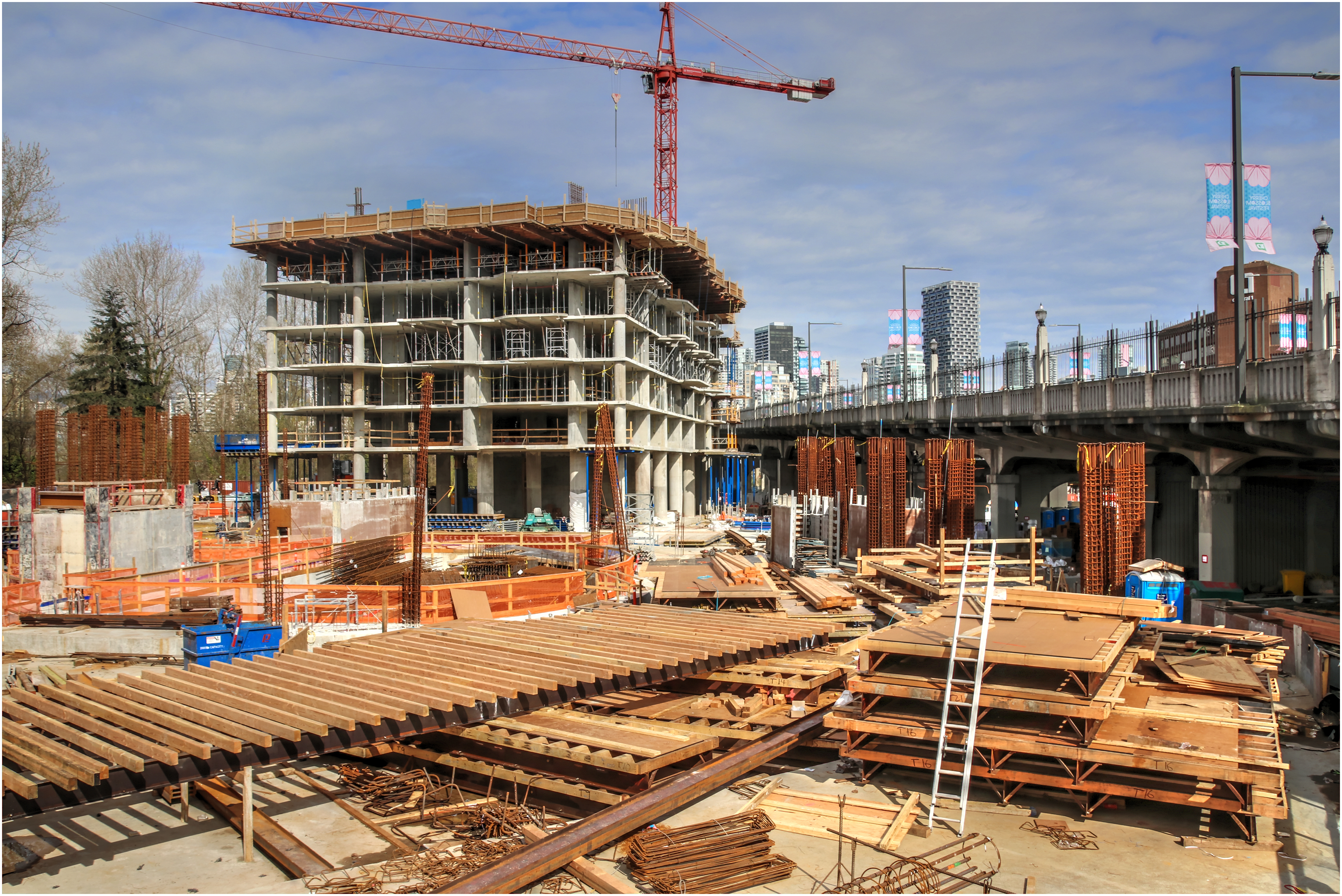
Senáḵw project under construction, looking northeast across the Burrard Street Bridge toward Vancouver House. Photograph by the author.
Speaking about the Sen̓áḵw project “on land that was illegally confiscated from my ancestors,” a Sḵwx̱wú7mesh Úxwumixw spokesperson emphasized that the endeavor—about Cdn $3 billion in construction, projected to yield up to Cdn $20 billion over its lifetime, split between Sḵwx̱wú7mesh Úxwumixw and Westbank—reflects “a fiduciary responsibility to achieve the highest and best use when we do projects” (Alam, 2019; Baker, 2021). Prime Minister Trudeau threw the first shovel of dirt at the groundbreaking in September 2022, along with Sḵwx̱wú7mesh Úxwumixw leaders, the developer, and local political officials. Major construction financing was provided by the largest loan made in the history of the federal Canada Mortgage and Housing Corporation. Two hundred fifty units in Sen̓áḵw are to be set aside to provide affordable housing for Sḵwx̱wú7mesh Úxwumixw citizens, managed by the Nation's nonprofit housing society. The rest of the units will be rented at market rates to generate revenue for seven generations of Sḵwx̱wú7mesh Úxwumixw. “We have to bring back the best value for our members because otherwise they’re being robbed from the potential value that can be created on the land. So we pushed the density to what we think makes sense,” the Sḵwx̱wú7mesh Úxwumixw spokesperson told a Canadian Press reporter (Alam, 2019).
Criticisms of the development and planning process by various non-Indigenous commentators, and NIMBY opposition from some of the residents of the adjacent neighborhood of single-family homes, prompted a response from the Indigenous journalist Michelle Cyca (2024). Cyca (2024) wrote that too many settlers—even self-described progressives—expect the Indigenous reconciliation process to “look like a kind of reversal, rewinding the tape of history to some museum-diorama past.” Instead, Cyca (2024) emphasizes that the restoration of Indigenous sovereignty will “propel us forward,” and “Vancouver's skyline will keep evolving – to look not like its colonial past, but an increasingly Indigenous future.”
A few steps away—look closely and you can discern the red and white tents in the middle distance on the left side of Figure 1—is the site of the popular Bard on the Beach Shakespeare Festival. “Our Festival is located in Sen̓áḵw on the ancestral lands of the Sḵwxwú7mesh (Squamish), xʷməθkʷəyəm (Musqueam) and səlilwətaɁɬ (Tsleil-Waututh) peoples,” the festival website explains in a detailed history of the park (Bard on the Beach, 2019). “One thing I’d like our visitors to appreciate,” explains Squamish Chief Ian Campbell in a video, “is the ancientness of where you are. … this land has history and stories and secrets that have occurred for many thousands of years.” Campbell shares his childhood memory of elders telling him about a man from Sen̓áḵw who harpooned a seal with an elk-twine weapon, but then, the seal swam down to the head of False Creek, and went into the deep hole known as Skwachàys. Skwachàys is also known as a portal. This portal will bring you into other spirit realms of existence throughout the universe. So we believe that there are many stories of change and transformation that have occurred within this area over the history of our Squamish, Musqueam, and Tsleil-Waututh people. (Bard on the Beach, 2019)
Craig Womack (2014) makes a compelling case that Sontag's (1964) perspective on aesthetic sophistication, transgressive collective consciousness, performative creativity, and the cachet of insider standpoint epistemology—all those features that place the marginalized at the leading edge of urban cultural transformation—offer the only way to grasp the full implications of Deloria's (1973, 2003) philosophy of space and time. That's because Deloria positions his dichotomy between Western European immigrant worldviews of time and Indigenous ontologies of space within a comprehensive, unorthodox philosophy of history, archeology, astronomy, and theology. Quite literally, it involves an extrusion from Jupiter that careens throughout the solar system for centuries, chaotically destabilizing the orbits of Earth and other planets before eventually becoming Venus. Deloria relies on Zecharia Sitchin's interpretation of ancient Sumerian carvings in a narrative that the human race—or, at least those who eventually became white European colonial imperialists—began as a lab experiment by ancient alien astronaut genetic engineers, who arrived in a spacecraft that landed in the Persian Gulf. Sitchin and Deloria offer a wild ride. Sumerian polytheism in Mesopotamia comes from a division of labor created by the alien astronauts’ engineering of human slaves to mine gold from South Africa to propel into the atmosphere of a dying distant planet. When the aliens depart about 550 BC, the human slaves have learned enough from their captivity to become European and American imperialists and slave traders. Deloria is playfully ambiguous—on the same page—on whether Indigenous peoples escaped the influences of “these ancient astronaut intrusions,” or divided their societies into “sky and earth subdivisions” as a way of adapting to the “genetic intrusion” (Deloria, 2003: 161).
“A common experience for many readers when encountering God is Red,” Womack (2014: 456) writes, “must be the thought, ‘Did I just read what I think I did?’ Mostly,” Womack (2014: 456) continues, “Native literary studies has answered back largely by not answering at all: ‘No, I did not.’” To bequeath serious, reverent regard to Deloria's all-out critique of both Western Judeo-Christian creationist theology and Western Darwinian evolutionary science, however, is precisely the kind of hallucinogen-free consciousness expansion required to perceive the full panorama of diverse, multicultural views of spiritual realms of existence that Chief Campbell reveals in the False Creek portal. Vast, changing cognitive galaxies of alternative diasporic and Indigenous views of life and death, of humans and nature, of human nature, come together in ongoing urban revolutions. When the first edition of God is Red was published in 1973, it made sense to equate the lineage of Judaism/Catholicism/Protestant Christianity with ‘white Western European colonizer immigrant.’ But by the time the 30th-anniversary edition appeared in 2003, Vancouver was several generations out on the leading edge of a transformation of “Christianity as an Asian religion crossing the Pacific with Chinese diaspora and other Asian immigrants” (Byassee et al., 2023: 6), even as the fading demography of European-descended Christianity led many observers to misunderstand BC as one of the most secular places in the Americas (Todd, 2008). Meanwhile, one of the faith leaders at a multifaith Voices of Peace event organized after the latest Hamas/Israel war in late 2023 is a Hindi-speaking Mormon bishop born in Fiji, who immigrated to Canada, and in the Vancouver suburb of Surrey in 2016 began offering the world's very first Mormon worship services in Hindi and Punjabi. Regarding the pain of Indigenous others is now fully intertwined with a partial but notable reversal of Harvey's (1989) analysis of the time-space compression dynamics of capital. 23andMe DNA science, along with the continued digitization of historical genealogies and archives (e.g., Leo, 2022; TallBear, 2022), interact with the instantaneous personalized-yet-planetary discourses of social media, to propel the uneven time-space expansion of individual and collective memories of ancestors among transnational diasporas and Indigenous peoples.
To look carefully at Figure 1, therefore, is to see the tips of stems of millions of lives and afterlives on an ever-evolving planet. What the concept of “evolution” means here, of course, is contested—but not only in the familiar Genesis/Darwinian binary of the Scopes Trial. In his encyclopedic critique of this “quarrel within the Western belief system,” Deloria (2002: 32) lampoons the “holy script” of Darwinian evolutionists—i.e., Western white settler scientists—by referring to the work of the “much-beloved Pierre Teilhard de Chardin, Roman Catholic priest and advocate of evolution.” Deloria's “campy heterodoxies” (Womack, 2014: 458) are here quite hilarious. The Vatican had repeatedly disciplined the “much beloved” evolutionary paleontologist and ordained Jesuit, exiling him to China and forbidding the publication of his writings until long after his death (Aczel, 2007). Deloria's portrayal of a scientific-theological heretic as a defender of orthodoxy further obscures the enigmatic positionality of a strange, recurrent spectral figure on the fringes of urban research. Teilhard de Chardin died shortly before his scheduled appearance at a landmark planetary environmental symposium convened by Lewis Mumford; Teilhard de Chardin's (1956) lecture was published posthumously. More recently, his philosophies inspired NYU President John Sexton's creation of the “Global Network University” beginning in 2007, and in May 2018 the benediction during the globally televised Harry and Meghan Royal Wedding by the charismatic Episcopal Bishop Michael Curry; it was Curry who later issued a formal Episcopal Church statement on the moral imperatives of holy scripture after Donald Trump's June 2020 crass photo-op holding a bible in front of St John's across from the White House, after a militarized clearing of crowds protesting the murder of George Floyd.
This is no critique of Deloria. As Womack (2014: 458) wisely remarks, “Rather than embarassment, I see much of value in [the] kooky claims” of Deloria's alien genetic engineers. What is crucial to remember here is the significance of heterodox views of human evolution when understood in relation to the long-term meanings of capital—of intergenerational inheritances of wealth and debt—in a world that has only recently become majority-urban, as it has come to be dominated by innumerable nodes of unique but interrelated manifestations of the transnational real estate state (Stein, 2019). A decade before his diagnosis of the revolutionary turmoil of 1968 and a new kind of Marxian analysis of the production of urban space as capital's preferred optimization of sustainability, Lefebvre (1962) saw fit to include a rumination on good, evil, and theology as one of his Preludes to Modernity. “If I had plenty of time at my disposal and enough energy to bring the history of philosophy up to date,” Lefebvre (1962: 56) writes, “I would return to a former project of mine which I have already outlined somewhere or other: I would write a vast, serious, and well-documented opus several volumes long, entitled The Metamorphoses of the Devil.” Lefebvre (1962: 56) fantasizes about rummaging through philosophy, painting, literature, and music, but also “demonology, occultism, witchcraft … spiritual testaments of heretics … arcane tomes on callabalistic magic ….” Lefebvre (1962: 58) dreams of a Marxist dialectical materialist history of good and evil, of the ways every people, every class and culture, “has had its devil, has seen it, conjured it up, made it, lived it, pursued it and immolated it, only to resuscitate it in order to kill it anew.” Lefebvre clearly sees the polygenesis of the varied devils known and unknown by the delegates of the many nations listening to Wilson-Raybould (2019: 72). And then, after commentary on the millennial history of European eschatology, Lefebvre (1962: 63) riffs on the consensus of “establishment theologians” that God is dead but the Devil is alive and decides to “make a little foray into science fiction”: Capable of going faster than the speed of electromagnetic waves by capturing photonic energy and passing into the hyperspatial continuum, the intergalactic spaceship Teilhard de Chardin broke the light barrier
In the end, even when accompanied by the right kind of caption, a city photograph like Figure 1 cannot reveal singular, unambiguous truths. Instead, it poses difficult questions and begins sensitive but essential conversations. How does the planetary urban community cope with the coevolutionary diversification of Indigeneity and transnationalization in the production of multidimensional inequality? A few generations from now, what kinds of urban people do we wish to become? Can we prevent the circumstances that create life paths that place children like R.L.C. into mortal danger? Who are “we,” and how will we live and die together in an urban world?
Footnotes
Acknowledgments
Sincere appreciation is offered to Grace Chen for outstanding research assistance in constructing the database derived from Statistics Canada measures used in parts of this analysis. Thanks also to the anonymous referees for exceptionally careful and detailed comments, criticisms, and recommendations on an earlier version of this article. Gratitude is also due to Daniel Hiebert, David Ley, Mark Davidson, and (again) Grace Chen for wise counsel, guidance, and recommendations. To borrow an aphorism from R.W. Lake, the usual disclaimer that the usual disclaimer applies, applies: none of the aforementioned bears any responsibility for the shortcomings and problematic dimensions of what is presented here.
Funding
The author received no financial support for the research, authorship, and/or publication of this article.
Declaration of conflicting interests
The author declared no potential conflicts of interest with respect to the research, authorship, and/or publication of this article.