



Abstract
I welcome and endorse Loretta Lees' call for a reconstituted critical urban studies tradition predicated upon polyvocal, intersectoral and co-produced research, dialogues and dialoguing and concurrent and compounding critical intelligences. In this short commentary, I make the case for placing scholar policy activism at the heart of such a tradition. I explore how and why critical urban research has come to view executive power as its arch nemesis. I argue that continued estrangement and jousting between the architects of radical praxis and those of policy practice is indefensible. I scope the contours of a new generation of policy engaged critical scholarship. We can no longer in good conscience fire missiles from inside the ivory tower and outside of the governing tent in the hope that better cities will result. If we are to be serious about ‘shaking up the city’, we will need to work with and on sources of power – to immerse ourselves in the epistemic communities which enjoy dominion over policy registers – and recalibrate the urban ‘partition of the sensible’.
Introduction
Critical urban researchers have never really figured how far and in what ways they ought to be active beyond the confines of the academy. Their incertitude has been both self-created (a manifestation of their parochial understanding of what it means to be critical) and self-sabotaging (an impediment to their capacity to achieve transformative outcomes through praxis). Although insisting that ‘the point is to change the world, not just to study it’, they have never properly reckoned with whether and in what ways their activism has made any appreciable difference. Indeed on occasions vainglorious braggadocio has permitted faux, and even perfidious, activism to persist in a state of self-congratulatory self-deception, believing itself to be making a difference when it is not. Whilst radical stratagems for disruptive system change have made it over the tall walls of the ivory tower, in truth their tremors and reverberations have extended only to a limited hinterland. All the while, as if to mock their impotence, Rome has continued to burn to a cinder.
It is in this context that I situate my commentary on Loretta Lees' timely, thoughtful and educative article reflecting upon the meaning and implications of critical urban scholars’ vacillation towards external engagement and dialogue for both the ways in which they practice critical urban research and for the efficacy and probity of their efforts to ‘shake up the city’ (Slater, 2021). Welcoming and endorsing Lees’ call for full spectrum engagement and dialogue and a compounding of critical literacies, in the remainder of this commentary I focus in particular upon the need for critical urban researchers to work in partnership with their erstwhile arch-nemesis, urban public policy makers. My goal is to elaborate further the case for placing scholar policy activism at the heart of a revigorated tradition of engaged critical urban research.
Dialoguing into the future
Loretta Lees (2024) throws down a gauntlet to the editors of Dialogues in Urban Research (DIUR) when she asks, what constitutes engaged dialogue in urban research?
Her hope is that when soliciting and publishing copy, the editors will be mindful of the pantheon of diverse voices implicated in the production, circulation and consumption of urban knowledges and will place front and centre interdisciplinary, international, intersectoral, polyvocal and co-produced research, dialogues and dialoguing. For Lees, not only would such a strategy be good for the journal, it would also be good for critical urban research. The development of critical urban studies has been stunted by dint of the insularity of the bounded academic communities who have enjoyed dominion over its production and legitimation. If critical urbanism is to prosper, these communities will need to cede custody of the dialogical field, commit to ‘engaged pluralism’, valorise the ‘critical competencies’ of other actors and become radically open to co-producing alternate urban critical intelligences. Insofar as it profiles and promulgates dialogue between interlocutors and provocateurs within and beyond the ivory tower, DIUR has a role to play in enabling and guiding a transformation for the better in the theory and practice of critical urban research.
I read Lees’ article as something of a summa-critica of her own prodigious back catalogue of engaged critical research. Self-identifying as an academic ‘insider/outsider’, she has co-produced all sorts of urban knowledges with all sorts of academic and non-academic collaborators for all sorts of users, beneficiaries and audiences, cultivating therein productive nomadism and border crossing and an oeuvre characterised by political acuity, scholarly intensity and translational knowledge exchange. Having more so walked the talk to this point, this is now Lees more so talking the walk.
Lees formally codifies engaged dialogue in urban research as ‘a process of working collaboratively with people, whoever they are, in relation to particular urban issues that affect them and/or us, to understand those issues better’ and elaborates to greater analytical heights than hitherto the repercussions of ‘engaged pluralism’ for ‘the issues we focus on and the approaches we take…our methodologies, our theory-making, and in how we communicate our research’. Engaged dialogue involves dismantling the power held by the academic expert. It constitutes a new way of doing critical urban studies and sanctions a new and more democratic epistemology of the urban. A multiplicity of self-consciously partial and limited intelligences aggregate and compound to yield deeper insights into urban change and conflict and wiser counsel apropos policy and other interventions.
I endorse wholeheartedly Lees’ call for a reconstituted critical urban studies tradition committed to co-producing with a wide spectrum of actors from diverse backgrounds modest and humble understandings and interventions. I wish to amplify a proposition which I think is integral to Lees’ vision but which I wager will go underacknowledged; that critical urban researchers who practice engaged pluralism practice full spectrum engaged pluralism, that is move beyond their zones of comfort and open themselves up to working collaboratively with partners of all sizes, shapes and hues. Lees’ manifesto aspires to the transcendence of all critical geographies which are narrowly sectional. This means that they be open to working not only with adjacent and natural partners such as marginalised communities, charities, activist and advocacy groups and social enterprise but also with less proximate and for some less compatible partners such as state institutions including policy-makers and other institutional actors. It is this catholicity that makes her line of sight new and compelling.
In making her case Lees convenes the idea of the ‘intelligentsia class’; a class comprising not only ‘university educated people who do mental or intellectual labour for their job …… but also journalists, writers, policy makers, and others who have a privileged position and a platform’. In her opening salvo, she takes issue with critical urban scholars who consider policy engagement to be a threat to the fidelity and integrity of their commitment to marginalised and oppressed groups and explicitly underscores the value of scaling cross-border dialogue within the intelligentsia itself. Alert the ‘pervasive realities of hierarchy, division and privilege’ she proceeds to champion a dismantling and rethinking of the power of the intelligentsia and an expansion of dialogue on the basis of equivalence with extra-intelligentsia communities. Because the intelligentsia has in the past adopted a dismissive and even at times hostile attitude towards these non-traditional ‘urban experts’, Lees is especially enthusiastic about bringing ‘indigenous’ intellect, expertise and wisdom to the table. But this is alongside and perhaps even concurrent with, not in lieu of nor indeed in opposition to, dismantling obstacles to dialogue between sectors of the intelligentsia.
Indeed Lees recalls with dismay the advice she was once given by a senior colleague to deprioritise dialoguing with policy-makers because real impact, influence and change came from street protest and direct action. Whilst alert to the virtues of activism from a distance and to the vices of naive policy engagement, she has always refused this dichotomy in her own work (Lees, 2022). Alongside advancing urban geography as a branch of knowledge she herself has (co)scoped, (co)elaborated, (co)evangelised and (co)actioned with policy communities high impact mitigations and remediations apropos anti-social gentrification (Lees et al., 2015). Such refusal to be constrained by arbitrary academic identities I would argue, must become the disciplinary norm if critical urban research is to have a (consequential) future. We must strike a new compact with those in positions of authority who wield power and allocate resources, if we are to be serious about working collaboratively to produce a better future for marginalised and oppressed communities.
Estranged! Why critical urban scholars and policy makers don’t speak
Why has the figure of the critical and policy engaged urban scholar become such a marginal academic subject? Indeed why do some critical urbanists see policy engaged critical urban scholarship as a misnomer? Approaching these questions as a geographer, I cannot help but reflect upon the enduring legacy of academic identities bequeathed by the so-called ‘relevance debates’ which animated the anglophone discipline in the 1970s (Boyle et al., 2020).
In 1972, in a pioneering article in the recently launched Antipode: A Radical Journal of Geography, David Harvey famously scoped the shape of an exciting new tradition of critical urban research (Harvey, 1972). For Harvey, urban research was as much a socio-politico-institutional project as it was an academic-scholarly-intellectual one. Rooted in neoclassical economics, mainstream liberal-humanist urban theory and practice had proven itself to be not only intellectually shallow but also practically inconsequential, at least for marginalised and oppressed groups. A revolution in theory – or more accurately a new generation of revolutionary theory – was required. Analytical categories which manifest as natural and uncontroversial needed to be troubled and provincialised; these categories reified only a particular socio-structural reality and consolidated the status quo. For Harvey that meant building a Marxist geography; for others it involved exploring anarchist, anti-imperialist, feminist, ecological, anti-racist and fourth-worldist thought.
It was urban geographers who staked out the key debating postures. Historiographies of the period often recount barbed exchanges between the revolutionary Harvey and counter-revolutionary Brian Berry which degenerated into a ugly brawl when each reviewed the other's book; Berry (1974a – see also 1972) trashing Harvey's 1973 Social Justice in the City and Harvey (1975) ridiculing Berry's 1973 The Human Experience of Urbanisation. But both picked other fights; Berry (1974b) for example mocking Harold Rose’ (1970) edited book Geography of the Ghetto, Perceptions, Problems and Alternatives and Harvey (1974) taking to task Terry Coppock's (1974) IBG presidential address calling for a policy turn in geography, asking ‘What kind of geography for what kind of public policy?’. Other plaintiffs included David Smith, Bill Bunge, Richard Morrill Ron Horvath, Michael Elliot Hurst, Harold Rose, Richard Peet, Gilbert White, John Frazier, Bart Epstein and Clark Akatiff, all of whom were actively researching dimensions of urban social/spatial (in)justice.
Whilst ultimately an unsustainable over-simplification, there is some merit in the claim that three gravitational poles were elaborated comprising a novel ‘radical’ force-field centred upon dialectical reason, revolutionary scholar-activism and politicised advocacy; a ‘pure’ field predicated upon impartial positivist reason and disinterested theoretical exegesis, and; an ‘applied’ field privileging practical, practitioner-oriented, problem-focussed and policy-facing scholarship and even hired consultancy (Lin et al., 2022). Of course intellectual endeavour meandered unevenly within and between these force fields, aligning and dis-aligning in often surprising ways. But there can be no denying that these three energy centres did envision powerful images of the scholar that have since become constituent of our collective unconscious.
The pure camp affirmed the importance of fundamental science in effective policy intervention; the applied tradition reminded us of the importance of acquiring competencies in the technocracies of evidence based public policy; and the radical camp conscientised us to the reality that we are unlikely to make progress if we simply medicate ourselves on a barely modified status quo. But critiques of pure geography also alerted us to the dangers of becoming too aloof and out of touch (indulgent self-referential theorising in an ivory tower), applied geography of becoming too naïve, intellectually denuded and compromised (practising inferior, uncritical, complicit and incorporated scholarship) and radical geography of becoming too revolutionary and hopelessly utopian and partisan (luring us into an unnecessary stance of ‘principled non-participation’) (Table 1).
Academic identities and stratagems towards policy engagement circa 1970s.
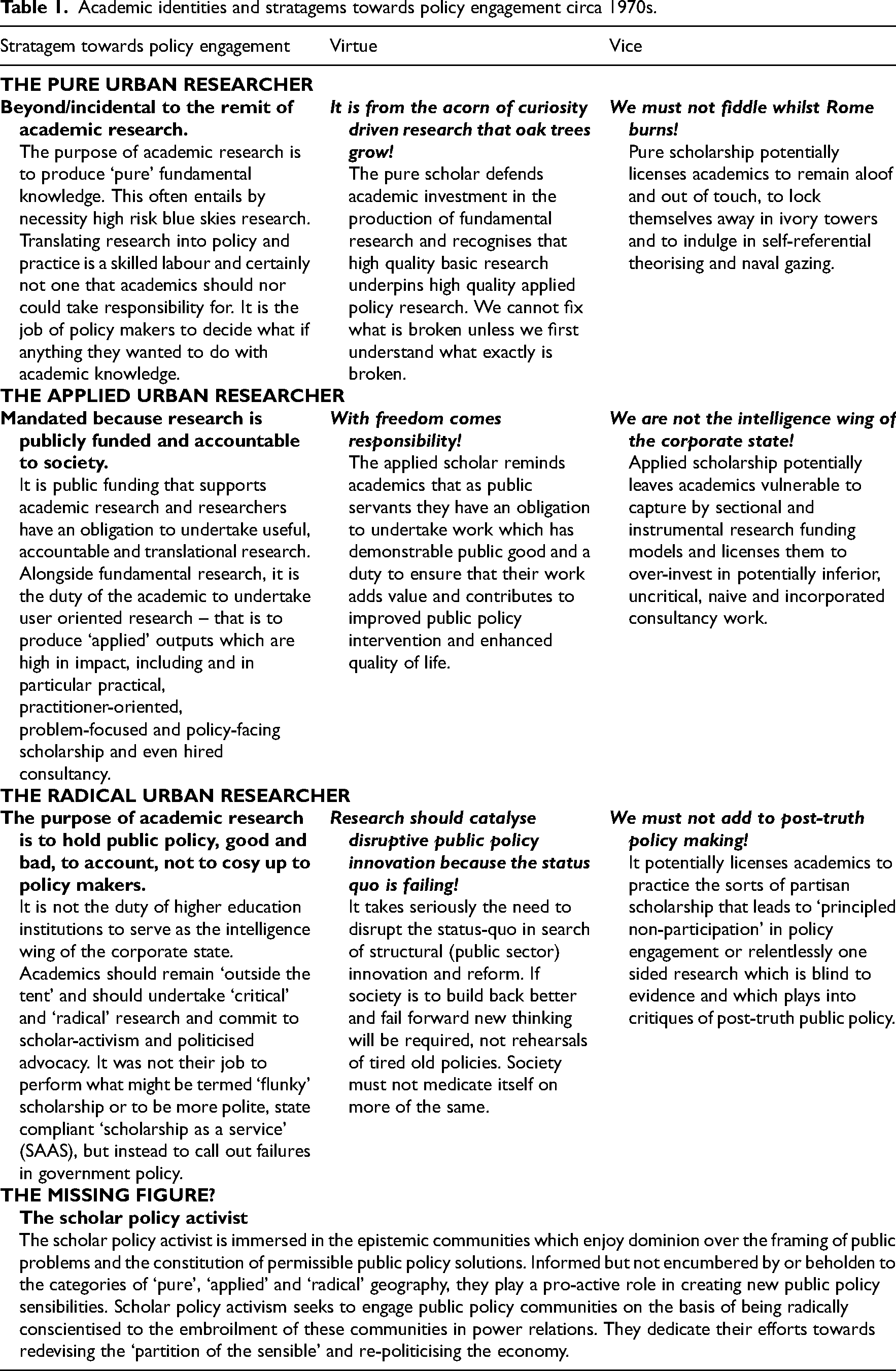
I would argue that the relevance debates spawned and bequeathed a parochial choice architecture and partition of the sensible which has made dialoguing with policy communities difficult to countenance let alone enact. It has lured us into a needless foreclose of options. Labels take on meaning only in history and we would do well to remember that the academic identities denoted by the nomenclature ‘pure’, ‘applied’ and ‘radical’ geography are always in structuration. But to the extent that residues, vestiges and traces of these academic identities continue to overbear on our sense of permissible stratagems towards policy engagement, I would contend that the relevance debates put a sword to the figure of the policy-engaged critical urban scholar or the scholar policy activist.
Enough! Why continued estrangement is indefensible
In 1930 in his first volume of Prison Notebooks, amidst the rising tide of European fascism and following Communist International's 1928 declaration of a ‘Third Period’ and disavowal of actually existing democracy, Antonio Gramsci (1930: 3) famously stated: ‘The crisis consists precisely in the fact that the old is dying and the new cannot be born; in this interregnum a great variety of morbid symptoms appear’. This quote has been dissected many times and debated ad nausea but stripped of clutter it makes a simple compelling point. For Gramsci, the term interregnum signified a historical moment during which the existing hegemonic model loses its social license and capacity to command consent and is unable to rule effectively, but yet when there exists no credible alternative strong enough to replace it. In this vacuum, vulture agendas flourish and ‘morbid symptoms’ (populist, fascist, nationalistic and anti-democratic) become manifest.
We are surely living through a period of interregnum today – indeed it feels like we are at its trough. A perfect storm of seemingly insoluble systemic weaknesses is bringing western (neo)liberal market democracy to the brink of collapse. Whilst in the 1970s the advanced capitalist world was burdened by a crisis which could credibly be written off as a temporary ‘conjunctural disequilibrium’, it is becoming impossible to resist the conclusion that today's polycrises or permacrises are fundamentally ‘organic’ in genesis. Under-performance, risk, fragility and shock are everywhere evident: boom and bust economics, disaster capitalism, a global climate and ecological emergency, widening social and spatial inequalities, a dislocation between representative democracy and popular sovereignty, COVID-19, a crisis in mental health, warring imperial hegemons and even nervous chatter about nuclear war, to name but a few. Morbid symptoms are aplenty including but not limited to twenty first century culture wars, political pusillanimity, revanchist neoconservative eschatology, illiberal liberalism, illiberal populism and post-truth politics.
Everything changes when we locate the relationship between critical urban research and urban public policy thus; what we expect of ourselves, what others expect from us and the costs which attend to failure. Whilst academic subjectivities, political calculi and stratagems forged in the 1970s (on the eve of an interregnum) are certainly not obsolete, shifting contexts and emerging exigencies (in the eye of an interregnum) have degraded their ‘symbolic efficiency’ to the extent that we are now obliged to strike a radically new relationship with them.
Are we to be content with the (impact of) impact agendas we have been pursuing as the world has been hurtling towards collapse? Whilst in the 1970s we worked to scope models of praxis which we believed could be consequential without the benefit of hindsight, mature reflection now enables us to comment more authoritatively on the ethics and the efficacy of such models, and to understand their limitations. The important distinction is that whilst the relevance debates emerged in the 1970s with the express goal of improving and/or changing the world, today we are faced with the troubling reality that the world we live in has significantly degenerated, and that in spite of our best efforts we have been incapable of doing much of consequence to pull it back from the brink.
We are obliged then to take responsibility for what we do next with a choice architecture which might be judged to have fallen short at a historical moment when failure is not an option.
But we must be cognisant too that others are mandating us to demonstrate our usefulness as defined by political registers which are largely foreign to our own. Confronted by growing government directives mandating that universities submit to sectional impact agendas and demonstrate greater enthusiasm for overtly ‘useful’ scholarship as a service (SAAS), scholarly communities are being forced to wrestle anew with questions of mission, accountability and societal value. Already freighted with an alarming degree of coercion, partisan and populist politicians have further layered directives with added menace by issuing chilling and revanchist diktates instructing scholars to prostrate themselves under national priorities……or else. To disengage from or to engage carelessly with state led impact agendas is to risk becoming impoverished and perhaps even for some communities of geographers insolvent; to engage naively and uncritically is to risk becoming diminished to, and incorporated into, the intelligence wing of the corporate state.
We are obliged then to take ownership of this latest imperative to prove our usefulness to society and to be pro-active in our development and defence of models of radical praxis which achieve impact on terms with which we are comfortable.
And then there is the concern that our failure to dialogue with policy communities is creating a vacuum that less progressive sectional interests are only too happy to fill. In fact today we stand accused of having relinquished custody of the ‘truth’ to the extent that we have gifted partisan and vested post-truth politicians a free run on policy capture. Far-right-wing nationalists and populist neo-conservatives for example are playing lose and fast with the truth, claiming authority for wild and dangerous claims about climate change and migration and racism; deglobalisation, economic isolation, and electoral honesty; pandemic origins, vaccine efficacy and gender identification. For regressive actors making power grabs on public policy, any principled non-participation on our behalf is being viewed as a gift, a de facto clearing of the ground for non-principled participation. Hitherto approached as an incorporated, complicit and inferior tradition of scholarly endeavour, arguably there is nothing now more important – and indeed radical – than truly evidence based public policy. After all, nothing is working!
We have an obligation then to challenge the neglect and abuse of ‘truth’ in public life and revalorise radical praxis which is built upon rigorous and impartial evidence based intervention.
Shifting contexts and emerging obligations then I would argue mandate that we rediscover, reimagine and revalorise the figure of the scholar policy activist and place this figure at the centre of twenty first century critical urban research. Otherwise status quo radical geography will continue to undergird and enable status quo public policy and by implication status quo disaster capitalism.
For a turn to critical urban policy activism and compound critical literacies
So consistent and trenchant has David Harvey's critique of neoclassical liberal-humanist geography been that it has come as something of a shock that he has recently defended the importance of geographers working with and on the state and its public policy machinery and lent his weight to the virtues of engaging in ‘reformist’ activism dedicated to reclaiming the social democratic foundations of the economy. Indeed given the period of interregnum through which we are living, it is our duty to support the existing politico-economic model so that it survives (perhaps just survives) for the foreseeable future but in a form that more directly serves the public good. Capitalism Harvey (2019) now argues is: ‘too big to fail… a revolutionary overthrow of this capitalist economic system is not anything that's conceivable at the present time. It will not happen, and it cannot happen, and we have to make sure that it does not happen.’ 'a socialist program, or an anti-capitalist program, of the sort that I would want is one about trying to manage this capitalist system in such a way that we stop it being too monstrous to survive at the same time as we organize the capitalist system so that it becomes less and less dependent upon profitability and becomes more and more organized so that it delivers the use values to the whole of the world's population - so that the world's population can reproduce in peace and tranquility, rather than the way it's going right now.'
However we read this surprising (apparent?) shift in Harvey's politics, it does signal a new preparedness of even (former?) staunch radical geographers to countenance scholar policy activism.
What does it mean to argue for a policy-engaged critical urban geography that which seeks to maximise the production of use values, even if within the confines of social democracy? Perhaps we are after a scholar activist tradition which celebrates the public intellectual who is also deeply engaged in shifting the gestalt within policy communities and contributing to disruptive innovation in urban policy.
Scholar policy activists should be informed but not encumbered by or beholden to the categories of ‘pure’, ‘applied’ and ‘radical’ geography. It is not sufficient for them to simply disseminate translational research to policy audiences after the fact, nor to advise policy wonks or even co-create research which supports policy formation. They should instead be immersed in the epistemic communities which enjoy dominion over the framing of public problems and the constitution of permissible public policy solutions (McGuirk et al., 2022). They should be radically conscientised to the embroilment of public policy in institutional power and should direct their efforts towards the production of alternate public policy logics and sensibilities. Their mission should be to redevise the ‘partition of the sensible’ and re-politicise the economy.
Might there be past and present figures that we can point to as role models for a new policy engaged critical urban studies? The skill sets required are indeed difficult to find in one scholar. Other disciplines have high status ‘influencers’ – here I think of for example Joseph Stiglitz, Kate Raworth, Thomas Piketty, Stephanie Kelton, Mariana Mazzucato, Naomi Klein, Geoff Mulgan and Shoshana Zuboff. Within urban research, Jane Jacobs, Jan Gehl, Oscar Newman and Mindy Fullilove come to mind. Perhaps we are asking for too much – a David Harvey, Brian Berry, Harold Rose and Stan Openshaw rolled into one! Or a Susan Smith, Danny Dorling, Richard Florida and David Smith composite or a creolised Doreen Massey, Edward Ackerman, Dudley Stamp and Gilbert White!
For Lees, the biography of ‘outside-insider’ (in truth hell-raiser) Bill Bunge provides inspiration. Indeed Bunge's Detroit Geographic Expedition and Institute (DGEI) and associated community mapping programme in Fitzgerald Detroit is often cited by radical geographers as the paradigmatic exemplar of good critical urban research. My own view is that the DGEI is indeed instructive but for reasons only tangentially to do with Bunge.
What kind of academic subject was ‘wild’ Bill Bunge? In answering this question we need to resign immediately the figures of the pure, applied and radical geographer. Bunge was all of these and more – a mongrel admixture, unclassifiable.
A self-declared communist, for Bunge pure quantitative spatial science and radical geography could happily co-exist. His innovative and pioneering book Theoretical Geography (Bunge, 1962) was an especially celebrated exposition of the ‘new geography’. Just as important was his founding in 1968 (immediately in the wake of the Detroit race riots and commissioning of the Kerner Report) of the ‘people's geography’ Detroit Geographical Expedition and Institute – in partnership with Fitzgerald resident Gwendolyn Warren – and publication in 1971 of a surprisingly much more maligned book Fitzgerald: Geography of a Revolution (Bunge, 1971). For Bunge, committed social activism through quantitative analytical cartography in community with oppressed groupings and dedicated to social revolution constituted the essential mission for human geography. Bunge had little truck with bookish dogmatic Marxists (whom he described as a ‘pain in the gluteus maximus’) who failed to apply their work beyond the walls of the ivory tower. The point was to change the world but to do so in the name of science, not ideology.
Bunge's spatial analytic infused activism challenging racialised capitalism certainly merits revisiting. It helps us better visualise the sorts of activism which radical geographers were pioneering in the early 1970s. Amidst a Detroit which was deindustrialising and riven with social and spatial injustices it underscores why radical geographers felt obliged to distance themselves from and disrupt status-quo policy making. But it also surfaces the painful reality that in spite of his best efforts, Bunge was unable to temper let alone arrest the decline of Detroit nor Fitzgerald, and improve life chances for racially oppressed black African American communities. It is true that to change the direction of a city it is first necessary to change the minds of its leaders but few minds were changed by Bunge. Indeed who amongst the city leaders who walked Detroit into bankruptcy in 2013 would have heard of Bunge let alone ingested his ideas (Davidson, 2022).
But too few geographers have paid enough attention to what became of Gwendolyn Warren. Fortunately, in 2014 Cindy Katz tracked Warren down and in a public interview encouraged her to speak about her own experience of the DGEI (Warren et al., 2019). What had been reduced to a (his)tory was further layered, complexified and enriched. It transpires that it is from (her)story or perhaps even (their)story that the real lessons are to be learned.
Warren disclosed that Fitzgerald residents found Bunge a strange anomaly. The community reaped no benefits from the community mapping research and was on the precipice of withdrawing from the project. But they were persuaded to stick with the initiative by the offer of research training in applied geography and community-led urban regeneration which was accredited by Michigan State University and provided a pathway to enter other programmes as a Sophomore. This Warren says was truly life changing and seeded a generation of able and disruptive community activist and policy-makers in Detroit and elsewhere. Warren herself went on to study public health and enjoyed a long and distinguished career as an executive policy innovator in various public health, education and social services roles in San Francisco, Atlanta and Miami. By self-admission, her expertise – catalysing and leading public service innovation and change and co-designing with local communities next generation local economic development – was shaped by her experiences with the DGEI. But by self-declaration, the value of this expertise could only be harvested by bringing research praxis into communion with policy-making and public service.
Conclusion
Loretta Lees is on the money in arguing that critical urban studies has been impoverished by the loss of the figure of the engaged critical scholar and that recovery of such a figure has the potential to transform for the better the theory and practice of critical urban research. In this commentary I have argued that the subjectivity of the scholar policy activist ought to be at the heart of any reinvention of engaged critical urban scholarship. For too long radical praxis has placed itself in opposition to or at least at a remove from policy communities. It is time we got real about what our activism has achieved and what it has not. We are mandated to conscientise ourselves to the work intellectual resources inherited from the 1970s continue to do in our discipline and, mindful of shifts in context, to strike a felicitous relationship with this endowment, one which is suitably acclimated to present intellectual and secular conditions. Firing missiles from inside the ivory tower but outside the governing tent now manifests as an indulgent (Global North) luxury. It is time we championed radical outcomes by working with and on sources of power.
Footnotes
Declaration of conflicting interests
The author declared no potential conflicts of interest with respect to the research, authorship and/or publication of this article.
Funding
The author received no financial support for the research, authorship and/or publication of this article.
