



Abstract
Cities are physical, material concentrations of people and structures, but they are also ongoing conversations of intergenerational negotiation, communication, competition, conflict, and cooperation. Recently, Emma Colven, Renee Tapp, Delik Hudalah, Dallas Rogers, and Christopher Silver have offered valuable critical contributions to this dialogue in urban research, evaluating the utility and limitations of a new metaphor, Dracula Urbanism, for understanding the inequalities of today's transnational real-estate growth machines. In this essay, we pursue an extended meditation inspired by some of the most valuable insights offered by Colven, Tapp, Hudalah, Rogers, and Silver. Dracula Urbanism is a fascinating yet fearful story of technologically accelerated reproduction of inequality and urban competition. Uneven yet insistently transnationalizing real estate states rely on, and reproduce, recombinant legitimations of diaspora and nativism, capital and consciousness, property and personhood, ancestry and amortization.
Cities can be understood as deep and complicated conversations. While, on the one hand, cities are physical, material places, they are also sites for ongoing human communications about life, histories and futures, and relations among people, nature, and the multiverses of other worlds beyond human existence and/or comprehension. Dialogues in Urban Research was established to create critical yet constructive conversations with and across differences at a perilous yet fascinating historical-geographical conjuncture. As the world and its urban environments change, David Wilson and I recently offered up a provocation in Dialogues: that this present transformation is understandable through the metaphor of Dracula urbanism. Believing that this kind of metaphor can unearth important insights, our ideas were keenly examined by five interlocutors in the journal. In this essay, building on a previous short response, we offer a more extended meditation on these critics’ wise contributions and implications.
Critics Emma Colven, Renee Tapp, Delik Hudalah, Dallas Rogers, and Christopher Silver have helped nuance our comprehension about Dracula urbanism. We have learned much from them and will continue to be open and malleable as the Dracula concept evolves in ongoing attempts to keep pace with the dramatic changes that constitute contemporary urbanism. Taking each critic separately, Colven develops a situated and suitably provincialized perspective on Bram Stoker's Dracula and its limits for comparative urbanism today, and offers postcolonial and feminist alternatives in the Malay Pontianak and Indonesian Kuntilanak and Rangda female-bodied vampire narratives to highlight the gendered socio-nature dimensions of urban redevelopment and lived experience. Tapp (2023) provides an inspiring call for analysts and activists to reclaim the real estate state for the public interest, and to remember the progressive possibilities of state intervention that have been collectively forgotten after several generations of neoliberal agnotology – the orchestrated production of ignorance in urban theory (Slater, 2021) that is now being updated and automated through the widespread fascination with Big Data, smart cities, artificial intelligence, and the implications of Covid zoomification for urban structure and real estate valorization (Klein, 2023; Krugman, 2023; MacKinnon et al., 2023). Hudalah (2023) develops a magisterial cartography of the spatial evolution of today's mutations of economists’ beloved notion of creative destruction – a mode of destructive creation in which capital produces space by pursuing ‘maximum natural extraction freedom on larger geographical scales’ that alternately dissolve, transcend, and perforate traditional urban/rural dichotomies. Rogers presents a panoramic yet forensic evaluation of the powers of metaphor in urban research, with a wise caution on the dangerous seductions of the ‘academic hunger games’ in today's citation-industrial complex; metaphors can themselves become self-replicating linguistic distractions, empty signifiers ‘dressed up as Frankenstein for a night’, in Rogers’ intoxicating prose. Christopher Silver situates the operation of real-estate states and Dracula urbanism within the ‘longer historical trajectory’ of urban renewal, metropolitan-scale redevelopment, and neoliberal social engineering – while offering essential comparative insights, such as the fact that the share of the ‘truly desperate’ in Jakarta is much lower than the horrific intergenerational landscapes of Flint and other centres of America's deindustrialized urban system of the ‘truly disadvantaged’ (Wilson, 1987; Wacquant, 2022).
We agree with much that these critics have noted in their essays. With Silver's missing pieces of the empirics in Flint and Jakarta and the historical trajectory that situates present trends in relation to Tapp's historical reminder of the high point of Fordist-Keynesian welfare-state public intervention in housing and land markets and Colven's postcolonial provincialization, it becomes clear how our current moment of planetary urbanization produces contradictory, competing visions of history and future. In Rogers’ sublime panorama, Engels’ vampires of feudal and factory ownership are resurrected in today's global urban system of necrotecture and narcotecture, as transnational supply chains, geopolitical competition, and legal arbitrage mediate intensified competition for the spoils of an increasingly automated mode of capitalist production (Harvey, 2023: 310). Developers, investors, and smart-cities techno-utopians promise a clean, efficient escape from what Edward Said called the gravity of history. Urban problems of the past can be resolved for optimized rates of real estate valorization, advocates promise, in an ideology of algorithmic purification that simultaneously perpetuates and ignores the tainted, two-century history of social physics (compare Jefferson, 2020 with Bell, 1962: 395, and Pentland, 2014). Meanwhile, the emancipatory possibilities of the ‘multiscale, noncentered’ constellations of urban, suburban, and rural spaces are thwarted by what Hudalah identifies in the false-consciousness promises of ‘billionaire fantasies’ that produce yet more ‘generational miseries’.
It is crucial to remember that Hudalah's wonderful historical lineage of the complex spatialities of urban-rural megalopoli align well not only with the ‘postmetropolis’ diffuse spatialities envisioned by Ed Soja, Mike Davis, and others in the LA School of Urbanism (Davis, 2001; Dear, 2003), but also with earlier forgotten dreams of urbanism that flourished amidst the welfare-state apex noted by Tapp. The architect and planner Constantinos Doxiadis (1913–1975), for example, was shaped by childhood experiences in a family that helped re-settle Greek refugees between the First and Second World Wars. In a professional career of international consulting in architecture, engineering, and city planning, Doxiadis (1968: 376–378) envisioned a global ‘Ecumenopolis’ – an integrated planetary network of urban, suburban, and rural corridors in which humanity achieves a peaceful, collaborative equilibrium of nature, society, and space. From a different perspective in the crown jewel of Global North industrial modernism in the ‘arsenal of democracy’ of a powerful yet precarious planetary imperialism, the Chinese and Black Power philosophers Grace Lee and Jimmy Boggs had premonitions of the kind of postcolonial, feminist, and queer theory provincialization Colven (2023) helps us see today; Grace and Jimmy saw urbanization as presenting humanity with an epochal, evolutionary choice. The current path is a mechanized and militarized ‘cybernation,’ Jimmy Boggs warned in 1963 (111), in which ‘we are moving towards an automated society’ of technologically accelerated capital accumulation reproducing ever deeper forms of structural unemployment and class and race inequality. Another path was possible – a progressive ‘revolution of evolution’ towards the multiracial, cross-class collective urban project of deciding, as Grace Lee Boggs (1998) put it so eloquently, what kinds of humans we wish to become. We can see parallels, here, of course, with Harvey's (1974) challenge to the way Eurocentric Malthusian Social Darwinist ideology had corrupted the neoclassical urban theory that structured twentieth-century industrial urbanism. The most ambitious antecedent of Tapp's rousing call to ‘reclaim the real estate state for the public interest’ was the Freedom Budget for All proposed by Bayard Rustin, A. Philip Randolph, and Leon Keyserling (Randolph and Rustin, 1967). The Freedom Budget would have completed FDR's unfinished New Deal (Sunstein, 2006) by linking a genuinely inclusive program of urban renewal and ‘decent homes for all’ to a nationwide commitment to full employment, affordable education and medical care, and a universal guarantee of public-sector jobs for all unemployed workers.
There are, of course, many other hopeful examples from the past several generations of urban theory, advocacy, and activism. Unfortunately, the phenomenon we label Dracula Urbanism betrays and destroys these ‘spaces of hope’ (Harvey, 2000).
Dracula Urbanism literally drains the blood of cities in order to sustain the extraction of freedom naturalized by implicit – and sometimes quite open – rationalizations of ‘frontiers’ of city-building as the leading edge of hierarchical human competition and development. Ed Glaeser (2020), for example, gleefully embraces Frederick Jackson Turner's explicitly genocidal frontier thesis of 1893 to showcase an argument for de-regulated city-building as a strategy for unbounded economic growth and upward social mobility. Authored by the world's leading ‘celebrity urbanologist’ (Peck, 2016), the article was published in the early months of the first global pandemic of the age of planetary urbanization, in the house policy journal of the U.S. Department of Housing and Urban Development. In Dracula Urbanism, the embodied, situated human use values of collaboration and Kropotkin-style cooperative evolution necessitated by the spatio-temporal concentration of human lives are leached out in order to maximize the competitive exchange value of dead labour embalmed in the rising ledger entries of property valuation. The pursuit of deadnamed ‘equity’ balances of property ownership is, for most, only obtainable through the dead pledges – the Old French mortgages – of debt commitments that discipline workers, families, communities, and local governments. For all but a fortunate few, the real humanity of daily city life remains subservient to the dead-labor value extraction of capital accumulation and real estate development. Class discipline – in its multidimensional constellations of ancestry, lived experience, and fast-changing relations between present expressions of sexual and gender identities and collective histories of family, faith, nation, and culture – is mortgaged and magnified in ever more divisive, dangerous ‘frontiers of the future’ of capital accumulation (Kallin, 2021; Gieseking, 2020; Tse, 2013).
Sadly, the materialist political economy of proposals like the Freedom Budget has been eviscerated since the 1960s by the evolution of liberal, neoliberal, and even progressive and radical consciousness – as elite responses to ethnic pluralism and culture-of-poverty epistemologies have morphed into dynamic, adaptive forms of intersectional identitarianism (Reed, 2020; Haider, 2018; Táíwò, 2022). For more than half a century now, the urbanization of capital has been legitimated by the urbanization of consciousness in the ‘billionaire fantasies’ diagnosed by Hudalah (cf. Harvey, 1989) – as well as the segmented forms of inclusive essentialism proffered by Western blends of anti-racism, neoliberalism, and cultural nationalism (Reed, 2020: 70–73). It is not entirely coincidental that at the precise moment when David Harvey arrived in Baltimore and found Marx and Engels to be the most reliable guides to the city's horrific tangle of injustices of housing, race, and class, James Brown endorsed Richard Nixon's Presidential run and released ‘I Don’t Want Nobody to Give Me Nothing (Open Up the Door, I’ll Get it Myself)’. Central to such self-help narratives – what Reed (2015: 49) renders as ‘The James Brown Theory of Black Liberation’ that has sustained ‘decades of neoliberal hegemony’ – are the metaphors and meanings of entrepreneurialism, achievement, visibility, and hard-earned success. Competitive challenges enable the diversity of individual and community struggle to be concretized into the material and institutional rights of home, land, and property (Harvey, 2023: 409). Homeownership, already well-established in the ‘Americanism and Fordism’ cognitive assembly lines of Model Ts and psychoanalysis that so fascinated Gramsci, became ever more important in the popular legitimation of urban capital accumulation through constant development and redevelopment.
Silver sagaciously reminds us of the long historical trajectory here, as large metropoli have ‘continuously undertaken transformation’ to remake their built environments – in part as power plays to ‘accomplish various forms of neoliberal social engineering’. What's new – and truly horrifying – is the fusion of materialism, metaphor, and moral discourses of the imperative of growth machine benevolence and capital accumulation. There's also a new, non-Euclidian, post-Cartesian geography of ‘spooky spatialities’ (to steal from Rogers) where Dracula's Transylvania manifests in unexpected, strange settings. Back in 2008, when E. Stanley O’Neal, the first Black CEO of a major Wall Street firm, was hauled before Congress to explain Merrill Lynch's role in the mortgage-backed instruments that were vaporizing in the early stages of a rapidly mutating global crisis, he began by reminding legislators where he came from: ‘My grandfather, James O’Neal, was born into slavery in 1861’ (O’Neal, 2008: 179). O’Neal grew up in a tiny house in Wedowee, Alabama, with no running water or indoor plumbing. When he was thirteen, the family moved to Atlanta so his father could take a job in a General Motors factory. That job allowed the family to afford a downpayment on a small house, where they stayed thirty years and paid off the old-fashioned thirty-year conventional mortgage. O’Neal got himself through college working at the same factory, then got a job at Merrill in 1987. By the time he attained the Merrill presidency in the summer of 2001, America's banking and financial infrastructure was rapidly abandoning the boring, steady profits of conventional thirty-year fixed-rate mortgages held in the portfolios of individual banks – in order to pursue the exciting profit opportunities of ‘risk-based pricing’ with a dizzying array of ‘innovative’ risky credit products integrated into a massive secondary market of mortgage-backed securities and globally traded derivatives. The new ecosystem promised expanded homeownership opportunities for those excluded from previous generations of homeownership, but it also created dangerous, perverse incentives for predatory exploitation. It created new interdependencies between the neighbourhood contours of class and race segmentation of U.S. cities and global networks of debt, investment, and speculation. Fortune dubbed O’Neal a ‘turnaround genius’, as he led Wall Street's biggest brokerage into the lucrative nexus between maxed-out U.S. homeowners and yield-hungry institutional investors around the world. Shareholder return on equity tripled between 2002 and 2006, as the firm's stock price rose by some 346 percent. In this transformation, O’Neal led a true rainbow coalition of cosmopolitan capital: Merrill had an Indian Head of Equities, an Egyptian Vice Chair, a Korean Co-Head of Global Markets, a Turkish Head of Fixed Income, and a Japanese Head of Market Risk. As O’Neal's Merrill team scrambled up the food chain of a ruthless Wall Street ecosystem, innumerable local predators in cities and suburbs across America sought out prey such as Addie Polk – an elderly African American widow in Akron, Ohio, who was pushed into repeated loans with Countrywide Home Loans, eventually landing her into a mortgage for 180 percent of the assessed value of her modest home. After slipping into default and foreclosure after the loan was sold to one of the GSEs (Government Sponsored Enterprises) that was bailed out in 2008, with sheriff's deputies pounding on the door to enforce an eviction order, in quiet desperation in an upstairs bedroom Addie lay on the bed, pointed a handgun at her chest, and pulled the trigger. Addie, 90 years old, survived the gunshot wound but died in the hospital a few months later. Her story was national news for a brief moment when Ohio Representative Dennis Kucinich spoke about the case on the floor of the U.S. House – Fannie Mae quickly wrote off the mortgage – and then she was forgotten amidst the trillion-dollar bailouts of institutions ‘systemically important’ to the circulation of transnational capital. Stan O’Neal was paid US $48 million in 2006, and as Merrill collapsed he took a retirement package of $30 million and $129 million in stock and options.
The key lesson here is the articulation of modes of legitimation of capital in the ongoing urban coevolution of ethnoracial and class relations (Robinson, 2010; Haider, 2018; Reed, 2020; Táíwò, 2022). Forbes joyously ranks Rihanna, Kim Kardashian, and Oprah Winfrey on the list of America's Richest Self-Made Women, while happily honoring a new kind of Chicago School heritage as retired Army Lieutenant Colonel and Hyatt Hotel heirx Jennifer Pritzker becomes the world's first transgender billionaire. Tiny, shiny shards glittering on the postindustrial cognitive assembly lines of capitalist ‘factories of fragmentation’ (Harvey, 1992) help legitimate the urban neoliberalization that has, for several generations, intensified ethnoracial competition while achieving a profound class-based narrowing of ‘the pathways that white ethnics traveled from tenements to middle-class suburbs’ (Reed, 2020: 172) in the short-lived New Deal from the 1930s to the 1950s. There is a troubling continuity in the seductive achievement narratives of neoliberalism, from the way Wall Street's Congressional allies – white Democrats and Republicans alike – offered O’Neal's biography as the ‘classical American success story’ in 2008, versus the way white gentrifiers today reconcile sociocultural progressivism with whiteness as property (Harris, 1993), reproducing yet another generation of ‘settler colonial narratives, like the American Dream and pioneer fantasies’ (Montalva Barba, 2023: 803). Such discourses now legitimate Turneresque triumph-of-the-city ideologies (Glaeser, 2020) far beyond the time-spaces of mid-twentieth-century American urban theory, policy, and politics – which, even at the high point of naive postwar optimistic modernist social science, remained a ‘mysterious’ process of ethnoracial ‘evolution of the American peoples’ that might never have any final, definitive form (Glazer and Moynihan, 1963: 315). To the degree that Chicago School sociology ‘concretized’ the normalized ‘hidden signifiers of white power and privilege’ into Turneresque notions of urban progress and achievement that reproduced distinctively American spatialities of (de)industrialization, segregation, and suburbanization over the past century (Montalva Barba, 2023: 805), such materializations are now being produced and legitimated in even more deceptively sophisticated ways in transnational urban real estate states. Recrudescent old MAGA white supremacy co-evolves with the kaleidascopic diversity of ascendant property capital, as Euro-American whiteness becomes an ever smaller portion of global urbanism.
Our concern here – our fear, because it is a scary story – is that Dracula Urbanism is vitalized by the increasingly sophisticated transnational urban expressions of what Anne Haila theorized as the ‘property mind’. Uneven yet insistently transnationalizing real estate states rely on, and reproduce, recombinant legitimations of diaspora and nativism, capital and consciousness, property and personhood, ancestry and amortization. Generational processes of collective-competitive dialectics of urban capital accumulation take one form as ‘urban villagers’ become rentiers and landlords in the ‘ultra ownership society’ rapidly produced in the planet's largest urban system (Huang, He and Gan, 2021; Sa and Haila, 2023). They surface in different ways in the hyper-exploitation of migrant labour to manufacture nationalist consent stored in luxury cathedrals of greenwashed sustainability – ‘glass refrigerators in the desert’ – in Gulf autocracies (Koch, 2014). They take different forms in the crypto-neocolonial capitalist constellations of planning, property, race, religion, and gender in the caste-based slum eviction frontiers of southern India (Ranganathan, 2022). They recur with terroristic regularity in the ‘American Carnage’ double-helix of rural nativism and white nationalist ethnoracial rage that has – ever since Barry Goldwater in 1964 – maintained antebellum Electoral College power by stigmatizing and stereotyping the people and places of the intricate urban system inscribed by the Great Migration (Hackworth, 2019). Colven (2023) wisely identifies the Orientalism of Bram Stoker's colonial, Victorian geographical imaginations of Eastern and Southern Europe – a human evolutionary palimpsest that would be diagnosed for just one city a few generations later by Glazer and Moynihan (1963). There were at least eighteen distinct languages spoken in the area within walking distance around the southern tip of Manhattan Island back in 1660. ‘There still are’, Glazer and Moynihan (1963: 1) remarked; ‘not necessarily the same languages, but at least as many; nor has the number ever declined in the intervening three centuries’. As we consider the way real estate states constantly prioritize the exchange value of urban property rights over the use values of the diversity of urban lived experience, we are inspired by Colven's wonderful invocation of Pontianak as a challenge to the patriarchy and predation of capital. We fantasize of an emancipatory urbanism beyond the blood and death of capital and Dracula – an urbanism of materialism and metaphor than honours the spirit of Pontianak in conversation with James O’Neal, Addie Polk, Grace Lee, and Jimmy Boggs, as we continue the intergenerational conversations of what kinds of urban humans we wish to become.
Although Dracula Urbanism is most severe in cases of absolute decline at the metropolitan, municipal, or neighbourhood scale, relative decline – the perpetual potential of falling behind – haunts even the most turbocharged urban growth machines. Transnational competition and opportunities alter the meanings of growth, decline, and potential, and thus create surreal extremes of juxtaposition and contradiction. By the time the Indigenous sovereignty scientist and DNA analyst Dr Kim TallBear arrived in September, 2022 to deliver a lecture on the xʷməθkʷəy̓əm (Musqueam)/Vancouver campus of the University of British Columbia – in the same lecture hall where Jane Jacobs made one of the very last public appearances of her life – the twenty-first century reincarnation of Bram Stoker's bloodlines had reconfigured key elements of a real estate state that had produced one of the world's most expensive metropolitan land markets. The work of TallBear, Professor in the Faculty of Native Studies at the University of Alberta, had rocketed to international fame in the aftermath of the same moment of cultural political economy as E. Stanley O’Neal's Congressional defenestration. A progressive veteran of the financial crisis – Elizabeth Warren, a Harvard Law Professor who had presciently warned of the crisis and then served as SIGTARP (Special Inspector General for the Troubled Asset Relief Program) – seemed to have potential for elected office, leading right-wing opposition researchers to seize on a university scholarship form where Warren had claimed partial Native American ancestry. Endless ‘Pocohantas!’ trolling by Donald Trump led Warren's advisors to stage a DNA ancestry analysis in the form of a documentary-style political ad. As a disastrous media spectacle unfolded, journalists sought commentary from TallBear, author of Native American DNA: Tribal Belonging and the False Promise of Genetic Science (2013). TallBear's 2022 lecture at UBC, part of a prestigious Anthropology series, focused on the frontier narratives of colonial white settler science in the search for extraterrestrial life. Her visit, however, took place in the crescendo of several years of escalating protests over Canada's history of assimilationist Indigenous residential schools, a visit and formal apology by Pope Francis for the role of the Catholic Church, a vibrant and insistent ‘LAND BACK’ grassroots social movement, and a nationwide proliferation of high-profile ‘pretendian’ cases of fraudulent Indigenous identity claims (including a UBC Professor of Law who was the inaugural Director of the newly built Indian Residential Schools History and Dialogue Centre). For TallBear (2022), the phenomenon of ‘self-indiginezation’ has become just another of the many eliminatory techniques of colonial genocide, camouflaged by ‘settler theorizing’ of neoliberal choice, diversity in self-expression, and inclusion that is ‘designed to obfuscate, … to have us believe that multiculturalism is the new progressive way, which is also a way to eliminate us’. Yet dialectically counterposed to continua of eliminatory techniques are varied modes of inclusion into the exclusionary structures of capital accumulation. In the Vancouver region, this means access to the high and ever-increasing values of urban space in complex transnational circuits of competition, migration, and investment.
This is where we can see a fascinating response to Tapp's call to reclaim the real estate state for the public interest. In British Columbia, the most notable recent trend has been the culmination of decades-long struggles of Indigenous nations to attain sovereignty and to put public assets to work for the future of the distinct societal publics that pre-date the very existence of Canada. This transformation, however, is unfolding in one of the more expensive parts of the planet. In a widely cited neoliberal think tank ranking of 94 major metropolitan regions around the world, Vancouver regularly jostles with Sydney, Australia as the second or third most expensive market when local home prices are expressed as a ratio to local incomes; the Hong Kong S.A.R. always ranks first (Cox, 2023). Renters are caught in a harsh intergenerational reversal of fortune: in the 1970s, two-fifths of all housing units built in Canada involved some kind of public or tax subsidy, and there was a vibrant social housing construction program. Since the early 1990s, however, nearly all housing construction has been private, with a decisive bias towards ownership. BC now has the nation's highest share of renter households paying more than half of their income for rent and utilities – 18 percent of renter households in the Vancouver region – and average rents surged by almost a third between 2016 and 2021 (Griffiths, 2023). For homeowners, the decades of neoliberalization have inscribed deeper segmentations depending on the conditions of ever-escalating mortgage debt required to gain access to property rights (Walks, 2013). On the western growth periphery of one of the world's highest per-capita rates of net international immigration, the Vancouver metropolitan region has become an ethnoracially diverse new ‘racial frontier’ (Camarillo, 2015) of complex scales of transnational social fields and planetary gentrification (Ley, 2010; Lees et al., 2016). The local growth machine reflects and reproduces sophisticated forms of racial-capitalist legitimation. The entire metropolitan real estate market is built on land that – in contrast to most of the rest of Canada and North America – was never formally ceded through colonial treaty. Over the past half-century – beginning with a series of shifts that roughly correspond with the 1970s collapse of Fordist-Keynesian industrial urbanism that Harvey (1989: 173) identifies as beginning the radical restructuring of ‘productive forces and social relations’ in postmodernism – two broad transformations have remade British Columbia's real estate state. First, a painful recession prompted a frantic scramble by city and provincial elites to move aggressively to integrate BC's real-estate-reliant political economy to changes in Canada's national immigration policies as a way of tapping into the ascendant wealth of the Asia-Pacific. Second, Indigenous mobilization in the courts, electoral politics, and direct action social movements have affirmed the unique status of collective rights among the hundreds of local societies and cultures predating the Confederation of Canada in 1867. Organization and protest succeeded in the codification of Indigenous rights and title in the Canadian Constitution of 1982 and the Charter of Rights and Freedoms, while subsequent hard-fought court cases have recognized present land rights under juridical authorities traced back to the Royal Proclamation of 1763, issued in London by King George III.
The result is an intricate, non-linear transformation of past and present, as intense transnational land-market competition co-evolves with the harsh biopolitics of intergenerational poverty and fast-shifting cultural discourses of moral and ethical claims to property. Canada's poorest urban neighbourhood, the Downtown Eastside (DTES), is nestled closed to a CBD core and 1880s-era rail-industrial district that was, a century later, cleared for a World Exposition staged to attract national and global attention, migration, and investment (Figure 1). The vast Expo site was subsequently sold in what came to be known as the ‘deal of the century’ in a single transaction to Li Ka-Shing, Hong Kong's wealthiest property tycoon, and redeveloped into one of North America's largest master-planned ‘mega-projects’, Concord Pacific Place (Olds, 2001). The nearby DTES, integrated into Canada's national urban-rural hierarchies of exclusion and marginalization, continues to struggle with poverty, homelessness, chronic mental health episodes, and a deadly fentanyl-driven overdose crisis; the community also serves as a destination for the dispossessed from the region's suburbs, rural BC, and many cities, towns, and rural areas across Canada. Indigenous people account for 39 percent of the 2095 identified in Metro Vancouver's latest homelessness field survey, while comprising little more than two percent of the region's total population of 2.6 million (Mauboules, 2020: 28). And yet such statistics of disparity have become part of a ‘naturalized and fetishized Indigenous suffering and trauma’ in what Michelle Daigle (2019: 703) diagnoses as the ‘spectacle of reconciliation’: acknowledgment, much of it now backed by government mandates at the federal, provincial, and municipal levels after an historic National Truth and Reconcilation Commission released its final report in 2015, sustains ‘hollow performances of recognition and remorse’ and ‘confessional spaces of white guilt’. Rapidly mainstreamed from radical activists to scholars and now capitalist elites, spectacles of poverty statistics and Indigenous trauma – much like the whispers about ‘poverty pimps’ who built careers by studying racialized ‘underclass’ dynamics in U.S. cities in the 1980s and 1990s – ignore the very real sense of community among residents and activists in the DTES, who have for half a century fought against stigmatization and displacement by upscale redevelopment that now completely surrounds the neighbourhood (Boyd, MacPherson and Osborn, 2009). Trauma spectacles also distort the true diversity and complexity of Indigeneity, as ‘the unified Indian subject [becomes] reified as Indigenous political and legal pluralities [are] quickly overlooked in settlers’ rush to reconcile’ (Daigle, 2019: 704). There are 204 distinct First Nations in British Columbia, and 11 just in the lands now known as Metro Vancouver, part of a complex ‘post nation-state’ with an ‘evolving ecosystem of cooperative federalism and multilevel governance’ (Wilson-Raybould, 2019: 74). The widespread stereotype that associates Indigineity with a rural past, moreover, is now dangerously obsolete: ‘With 50% of Indigenous People in Canada now living in cities’, the eminent planner Leonie Sandercock (2023: 243) emphasizes, the very essence of today's urban moment is ‘the ‘new frontier’ of contestation for the recognition of Indigenous rights and title, the reclaiming of Indigenous spaces, and the reconciliation of Indigenous and non-Indigenous lifeways and desires’.
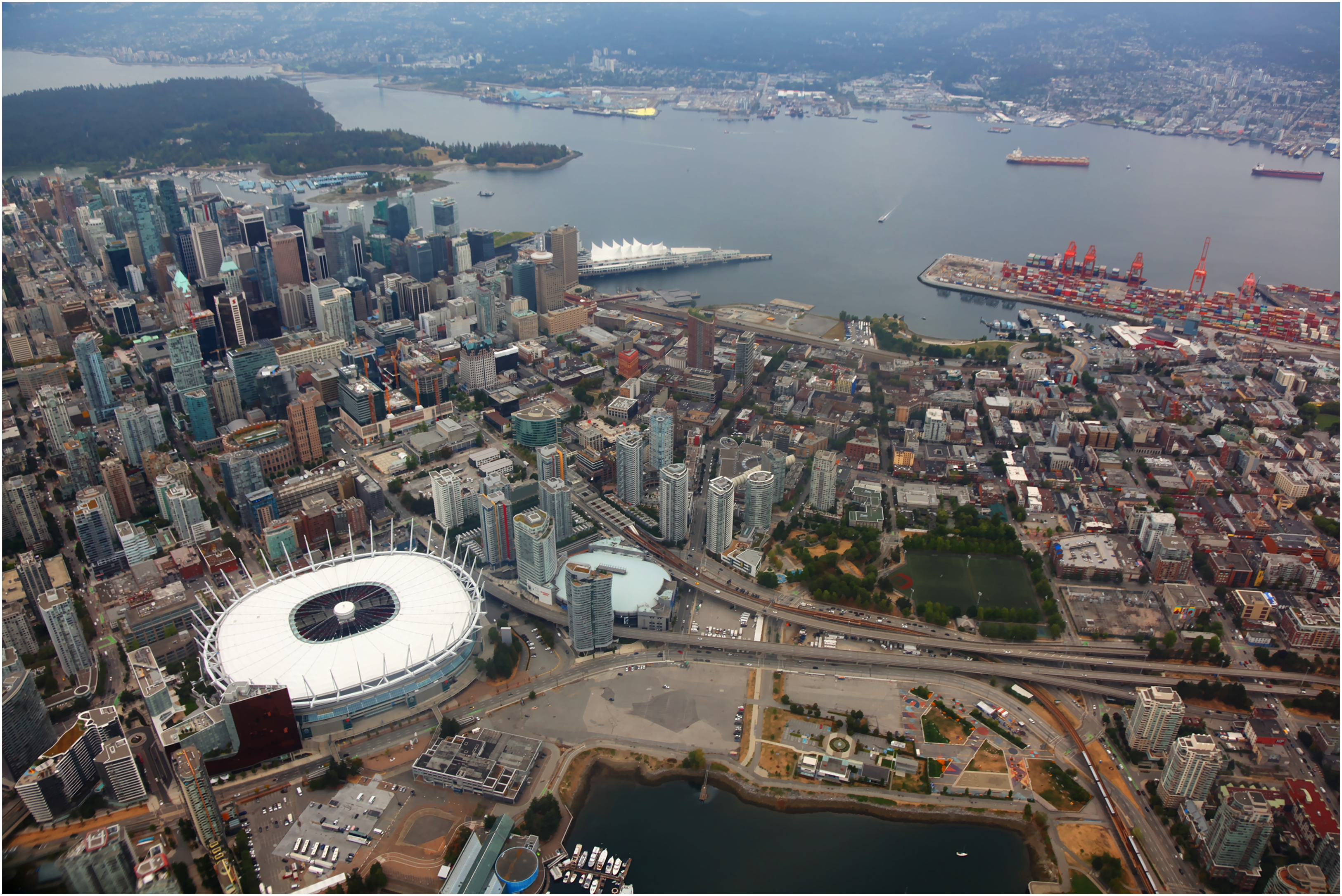
Central Vancouver, British Columbia, looking north. To the left is the Central Business District, including the city's Trump Tower, and the white ‘sails’ of Canada Place (a cruise ship terminal and convention centre complex). At centre right are Chinatown and the Downtown Eastside, Canada's poorest urban neighbourhood. The pair of highway road segments are the first and only completed portions of a vast urban renewal and freeway plan begun in the late 1950s. The plan was stopped by the largest mass mobilization City Hall had ever faced, culminating in direct action and strategic community organization in 1967 to save Chinatown. The lands in the near foreground are the last, un-redeveloped remnants of 1880s-era railyards cleared to host a 1986 World Exposition. The parcel at right includes a sales centre used to market the varied offerings of the developer Concord Pacific, parking lots used for various festivals as well as staging grounds for cross-continental truck fleets that carry equipment for concerts held at either of the two nearby stadia, and a small, temporary park. The temporary park was built atop the parking lot to avoid disturbing the subsurface toxic railyard soil deposited during the redevelopment of the other Expo sites to the west. The temporary park was built in 2019 after protests by condo owners in the towers at right, angry at the long delays in a permanent park for the entire northeast portion of the Expo Lands (promised in 1989). At the bottom left is a small parcel that became the subject of a bitter lawsuit between a local billionaire and a Singapore billionaire over a short partnership agreement signed in a hotel in Hong Kong. Everything in the image is traditional, ancestral, unceded lands of several of BC's 204 Indigenous First Nations.
Recognition, reclamation, and reconciliation are now intertwined with complex ancestries of capital in an intensely competitive real estate state. Some of the most expensive per-square-foot properties in the hemisphere are valorized by intergenerational waves of globally selective migration of entrepreneurialism and investment. Vancouver's Trump Tower (ironically renamed in early 2022 under a customized new brand called ‘Paradox Hotels’) was developed by the young son of one of Malaysia's wealthiest developers, who proudly shook hands with The Donald at the groundbreaking back in 2013. One of the undeveloped remnants of the Expo site was recently the subject of a bitter lawsuit between a local Chinese-Canadian billionaire and a Singaporean billionaire over the terms of a short partnership memorandum signed in a hotel room in Hong Kong; the tiny un-re-developed parcel in the centre of the vast Concord Pacific lands that were once a World Expo global showcase – and, before that, rail yards built in the rapid colonial settlement and dispossession of the 1860s and 1870s – is now worth an estimated Cdn $800 million. Meanwhile, just a kilometre to the west (Figure 2), Vancouver's first building designated in the new luxury architectural classification known as ‘super-prime’, offered a new twist on real estate marketing devised by a Hollywood film executive-turned-philanthropist: for each condo sold in the shiny metallic ‘Vancouver House’ twisting-torso tower, the developer paid for a home made out of a shipping container donated to a poor family living on the edge of a garbage dump in Phnom Penh, Cambodia. Just a few hundred metres away, Westbank, the developer of Vancouver House, is partnering with the Sḵwx̱wú7mesh (Squamish) Nation on Sen̓áḵw, a massive development planned for a tiny portion of vast regional territories reclaimed through some 20 years of litigation (Figures 3 and 4). Sen̓áḵw is located within the boundaries of what is today called the City of Vancouver, but it is now legally classified as Reserve land, and thus exempt from municipal zoning and land-use regulations; it is the largest First Nations economic development project in Canadian history, one of several partnerships between Indigenous nations obtaining or strengthening territorial land rights and long-established, non-Indigenous developers cultivating legitimacy at a moment when the spectacle of reconciliation has become a mandate for continued capital accumulation (Hyde, 2022). The Sen̓áḵw project, with plans for 6080 units in 11 towers between 32 and 59 stories, will generate an estimated $20 billion over the next few generations, split between Sḵwx̱wú7mesh and Westbank; Prime Minister Justin Trudeau attended the groundbreaking, with the announcement of a Cdn $1.4 billion bridge loan for the construction, the largest loan ever made by the Canada Mortgage and Housing Corporation (CMHC) in Canadian history. Sen̓áḵw will be all rental, and most of the units will rent at market rates. 1200 units will be designated as affordable pursuant to CMHC definitions. Of the 6080 units, 250 will be set aside for Sḵwx̱wú7mesh Nation members, managed by Hiyam Housing, a nonprofit arm of the Sḵwx̱wú7mesh Nation. The high-rise scale of the Sen̓áḵw project has unleashed a rather predictable NIMBY dynamic of opposition from mostly white, European-descended owners of nearby single-family homes (most of them in the Cdn $2–$5 million range), while the project is celebrated by Glaeseresque YIMBY neoliberal urbanists by virtue of its pure, ‘highest and best use’ freedom from pesky municipal regulations and the contentious public hearings required for rezonings anywhere else in the city.
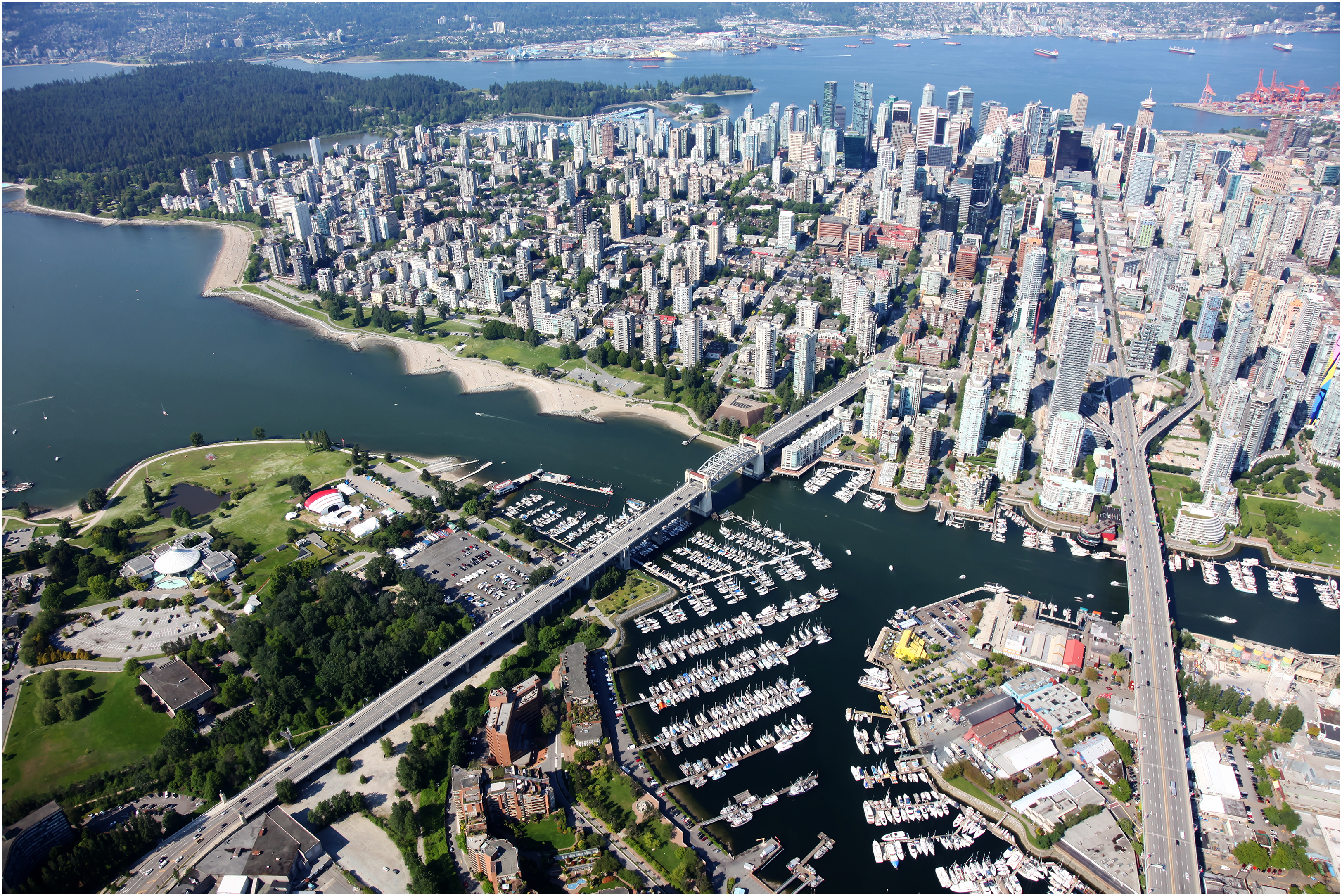
Looking north across downtown Vancouver, from just west of the view shown in Figure 1. At right, just east of the Granville Street Bridge on the north side of False Creek, is the edge of Concord Pacific Place, the largest master-planned community when it was built on the old Expo Lands in the 1990s. Nestled along the western cloverleaf of the Granville Street Bridge is Vancouver House, the city's first entry into the new ‘Superprime’ architectural category of luxury properties. In 2015, Vancouver House was marketed with a ‘one for one real estate gifting model’ devised by a Hollywood film executive-turned-philanthropist: for each condo sold here, a home made out of a shipping container was donated to a family living on the edge of a garbage dump in Phnom Penh, Cambodia. Just across the water, in the left foreground, are triangular parcels of land on both sides of the Burrard Street Bridge that were finally returned to Sḵwx̱wú7mesh Úxwumixw, the Squamish Nation, after decades of litigation. In 2023, the Squamish Nation celebrated the centennial of a majority of its citizens voting to request the Federal Department of Indian Affairs to amalgamate the communities of twenty-six separate Reserves into a single First Nation. In 1913 the Squamish had been forced from this small portion of their traditional territories, known as Sen̓áḵw, moved by barge to a Reserve in North Vancouver (near the top left of the image). Sen̓áḵw, a joint venture of the developer who built Vancouver House and the Squamish Nation, is the largest First Nations economic development project in Canadian history. Canada's Prime Minister attended the groundbreaking in September, 2022, announcing bridge financing in the largest loan ever made by the Canada Mortgage and Housing Corporation.
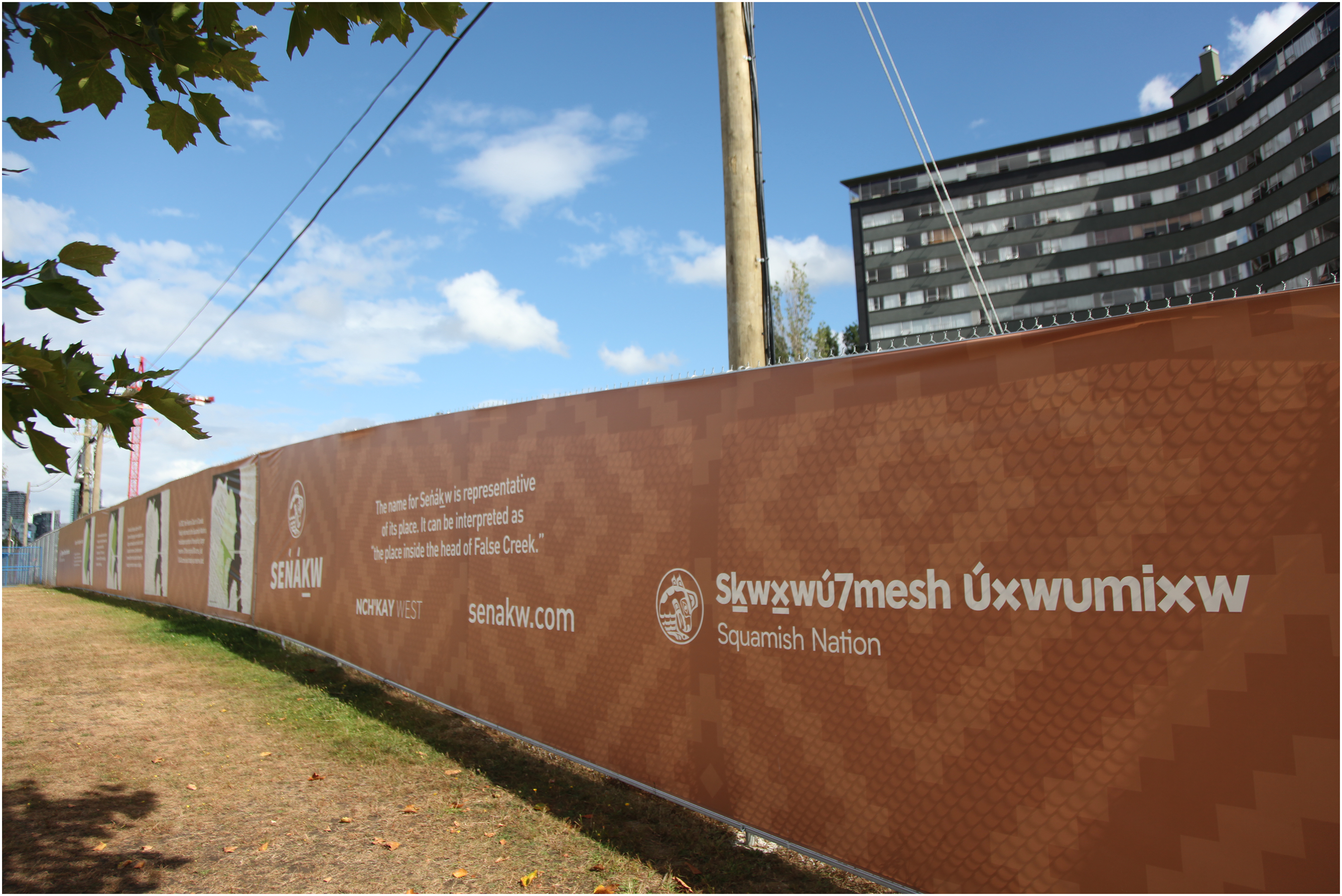
Sen̓áḵw development site, summer 2023.
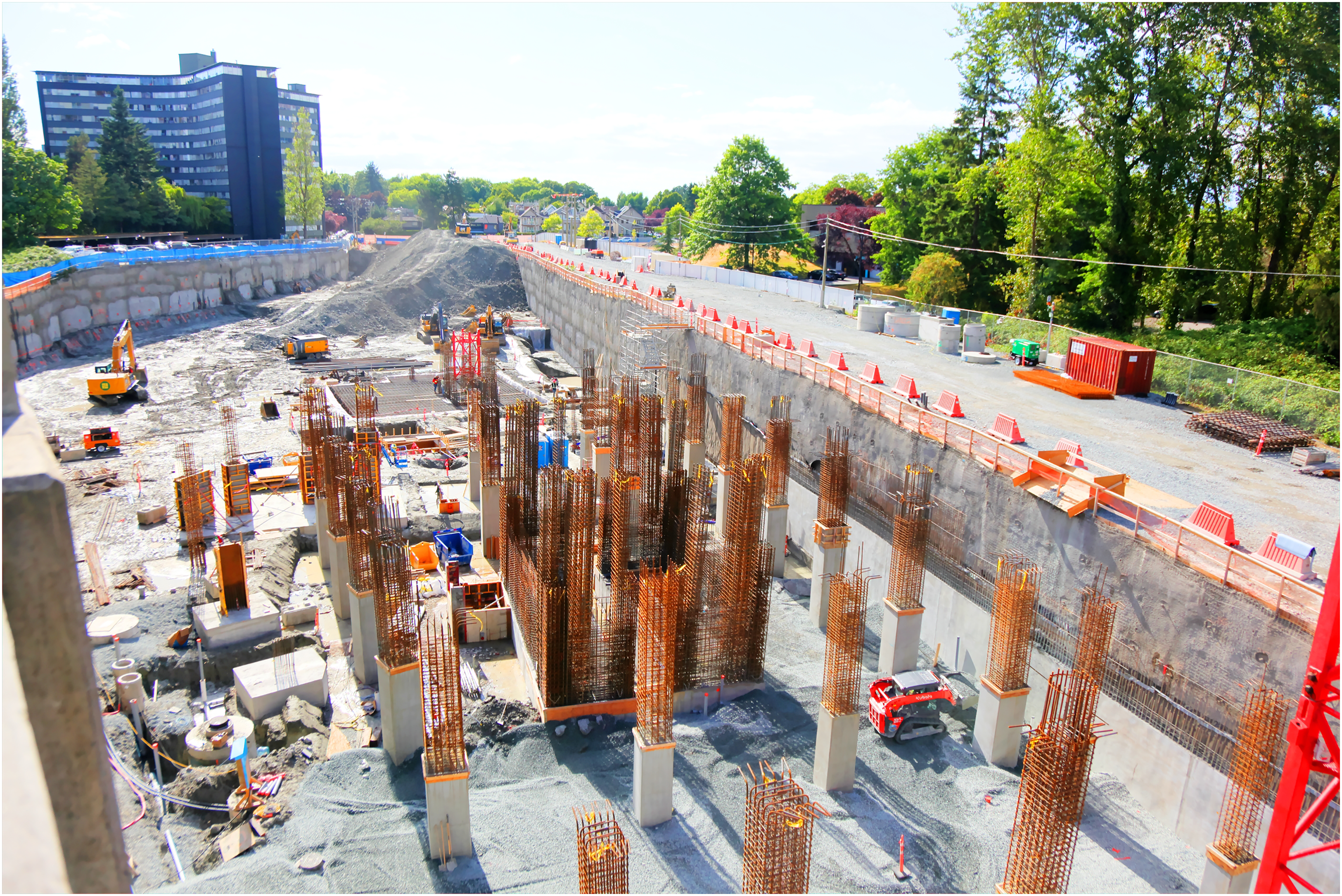
Sen̓áḵw construction progress, summer 2023. With plans for more than 6000 units in 11 towers between 32 and 59 stories, the project will generate an estimated Cdn $20 billion over its lifetime, split between Sḵwx̱wú7mesh Úxwumixw and the developer Westbank.
British Columbia's ‘Expo’ era of the 1980s and 1990s brought a Euro-whiteness backlash of xenophobia in response to the sudden migration of wealthy and middle-class ethnic Chinese immigrants from Hong Kong – who saw Canada as a safe refuge with reliable rights for property owners, given the uncertainty around the colony's impending return to the P.R.C. In the 2000s and the 2010s, discourses became more complex, multidimensional, and intersectional with larger investment flows from the Mainland – even as growth machine elites quickly learned that the most effective way to discredit local opposition was to equate even the slightest objection to unrestrained development and investment with Canada's history of xenophobia, racism, and genocide. At one point, when benchmark home prices rose 40 percent in a single year, local white developers and Vancouver's mayor – memorably described by one journalist as ‘profoundly Caucasian’ – used the racism charge in an attempt to discredit detailed evidence on foreign ownership and a worsening housing affordability crisis in a study released by Andy Yan – an urban planner, data scientist, and fourth-generation Chinese-Canadian whose great-grandfather had been admitted to Canada only after being forced to pay the notoriously racist head tax designed to exclude Chinese immigrants (Cheung, 2019; Glavin, 2018). Strident industry denials of the links between real estate prices, immigration, and transnational investment were finally, definitively addressed with new housing data from Statistics Canada in 2017. Among those born in Canada who managed to afford to buy single-family detached homes in the Vancouver region, median values stand at Cdn $1.25 million. Canada's globally selective immigration policies boost median values among owners who are recent immigrants (Cdn $1.66 million), especially those admitted under the federal government's cash-for-citizenship investor-immigrant program (Cdn $2.40 million). The Pacific metropolis is valorized by Lefebvrian spatial-fix dynamics that blend economics with culture, ancestry, and family – Li Ka-Shing's Concord Pacific project was a more functional version of Succession, a chance for his son Victor to prove his readiness to take over the family business back in Hong Kong – and refracted through Canada's uniquely precarious ‘post nation-state’ structure (Wilson-Raybould, 2019). For immigrant investors from China who own single-family detached homes in the Vancouver region but who were admitted to Canada through Quebec's separate investor-immigrant program, median values are Cdn $2.80 million (Gellatly and Morisette, 2019: 7), well over twice the median-value of so-called ‘Canadian’ homeowners.
We are inspired by Rogers’ (2023) wise warnings on the ‘perniciousness’ of the attention economy, and the abuse of metaphors in the ‘citation-producing machine’ of contemporary academic knowledge production. To the degree that urban research remained marginal in the positivist abstractions of neoclassical and neoliberal economics in the days of Harvey's (1973) Social Justice and the City, the approach of planetary urbanism early in the twenty-first century brought a linguistic Cambrian explosion – what Taylor and Lang (2004) surveyed as no fewer than one hundred new phrases introduced in attempts to capture the ‘shock of the new’ in urban change. The value of a nineteenth-century monster metaphor of blood, aristocracy, and ancestry is precisely in what Silver (2023) notes on the seeming incommensurability of cities like Flint and Jakarta, because Dracula – and Pontianak – live at the shifting boundary between metaphor, materialism, and metaphysics of embodied, situated lived experience and the afterlives of capital and dead labour as concretized into the exchange value of today's increasingly competitive urban markets. The question of whether the property mind is good or evil is now a global urban question – at the precise moment when attempts to conceptualize ‘totality’ are seen as unfashionable, unrealistic, or offensive (Goonewardena, 2018; Harvey, 2023). The empirical incommensurability of urban regions – in all the full complexity of their unique, multiscalar contexts of politics and power interacting with glocal strands of Hägerstrandian life-paths, migration, and diaspora – reproduces, for each generation, what Lefebvre (1970: 29) diagnosed as the confusing ‘blind field’ distorted by the sedimented cognitive categories of materially centralized industrialism. Pontianak, Lefebvre, Tapp, Colven, Rogers, Hudalah, Silver, Grace Lee, and Jimmy Boggs help us imagine emancipatory, genuinely inclusive alternatives to the harsh and bloodly Dracula revanchism of a world of capital.
Footnotes
Declaration of conflicting interests
The authors declared no potential conflicts of interest with respect to the research, authorship, and/or publication of this article.
Funding
The authors received no financial support for the research, authorship, and/or publication of this article.