



Abstract
This paper poses the question of what the proliferation of urban research centres across the world means for urban studies as a field of research, what this tells us about the (uneven) geographies of urban knowledge production and circulation, and who are the key institutions and researchers involved. In other words: what, where and who is urban studies? Building on a minor tradition of bibliometric research in urban studies and related disciplines, the paper assesses the Scopus-registered 2011–2021 publication output of the more than 1000 researchers affiliated to 30 urban studies centres across the world. The analysis points to four main observations. First, urban studies output is published in an extraordinarily wide range of journals, representing work from research communities across the social sciences and humanities, engineering, natural sciences and medical sciences. Second, clear global hierarchies exist in knowledge production, but co-authorship relations are also shaped by geographical proximity and the multidisciplinary profile of each individual research centre. Third, English is the dominant language of academic publications, but other languages play important roles for individual centres at the level of co-authorship relations and journals. Fourth, the article provides evidence of a diverse and globally distributed landscape of mid-sized urban studies centres that contribute substantially to the top urban studies journals. Each observation is linked to a reflection on the potential role for research centres in creating a more equal playing field for urban studies.
Introduction
Everyone who has strived to define a coherent research program in urban studies has been struck by how obscure the boundaries of the field seem to be at the present time and by the degree to which a compelling theoretical model seems to be lacking. (Gutman, 1963: 12)
The fact is that urban studies, like any emerging endeavour, is subject to powerful forces of differentiation and specialization. […] I believe that we may have passed the day when we seriously can think of a single and unified field of urbanology, urbanistics, metropology, or urbiculture. (Popenoe, 1971: 11)
Clearly the golden period of urban research has ended in France and perhaps, generally, speaking, in all comparable industrial countries. […] it is probably fair to talk about a crisis which, in my view, can be said to manifest itself on three levels. The object of urban research is fading away, its institutions are being worn down and its ideas are running dry. (Topalov, 1989: 625)
These three quotes from papers published, respectively, more than 60, 50 and 20 years ago on the state of urban studies are enlightening in many ways. At the very least, the quotes put into perspective more contemporary claims about the end of urban studies as a coherent field of research, be it Neil Brenner's reference to ‘the field formerly known as urban studies’ in his 2011 inaugural lecture at Harvard University, the critique of ‘methodological cityism’ (Angelo and Wachsmuth, 2015) or the global urbanism concern with introducing new knowledge and theories into the heart of urban studies, whether post-colonial theory, feminist and queer geographies, or research on racial capitalism, as one way of revitalizing a field of study deemed increasingly irrelevant in engaging with our urban world today (Roy, 2021). Urban studies scholars, if anything, seem to have always diagnosed their own discipline as operating in crisis mode.
There is one major difference, however, between these older reflections and current debates on the state of urban studies. The earlier papers were written at a time of major growth of higher education across North America and Europe and an expanding post-World War II economy (with the 1989 paper by Topalov acting as a kind of swan song, reflecting on this period and the subsequent ‘post-industrial’ decline of the 1980s). Especially in the United States, this national prosperity was juxtaposed with severe social unrest in cities, with extreme poverty and segregation, police brutality, racial unrest and social activism ensuring American cities were on the map of politicians and governments across the country. City-based universities were positioned as playing a major role in addressing these urban problems, and it is in this context that urban studies emerged as a distinct field of research in the United States (Bowen et al., 2010). Many of the journal articles, book chapters, books and reports published during these decades combined a substantive interest in the ‘what’ of urban studies (what are the core concepts shaping this field? Which traditional disciplines are involved?) with concrete institutional and organizational ‘how’ questions: how to set up and organize an urban studies centre. How to connect an urban studies centre to its wider university institution. How to achieve community outreach and to ensure the research conducted is of direct relevance to these communities. Fast forward to the 21st century and we find ourselves in the midst of a pervasive ‘urban age’ discourse that puts cities centre stage in economic development strategies and that often sees cities and urban life as the solution to all social ills and challenges. This has translated into substantive support for urban research, ranging from basic and applied research funding from agencies at different levels, the emergence and institutionalization of policy, governmental and research networks connecting cities and countries, to the UN's Sustainable Development Goals explicitly addressing urban questions. We can also observe a proliferation of (mostly university-based) multi-disciplinary urban studies centres across the world. However, in contrast to the literature of the 1960s and 1970s, contemporary papers on the state of urban studies are characterized by, at most, only reflections in the margins on institutional and organizational concerns, focusing primarily on theoretical and epistemological questions. As Zeiderman (2018) has highlighted, we need to move beyond the enclave of urban theory and start to address (again) the ‘how’ questions related to organization and research practice.
In this paper, I do so by posing the question of what this proliferation of urban studies centres across the world means for urban studies as a field of research, what this tells us about the (uneven) geographies of urban knowledge production and circulation, and who are the key institutions and researchers involved. In other words: what, where and who is urban studies? For both substantive and pragmatic reasons, I focus on urban studies centres. First, the position of each urban studies centre in relation to the supporting university institution is important. Transcending the simple spatiality of Global South versus Global North, the relative importance of specific scientific disciplines to the field understood as ‘urban studies’ differs substantially across these institutions and has a major impact on the actual profile, politics and intellectual priorities of each urban studies centre. Put differently, by choosing to focus on the way in which these centres and their affiliated researchers ‘self-identify’ as belonging to the field of urban studies, we gain a grounded sense of how urban research is practiced by the more than one thousand researchers affiliated to these centres, rather than how it is imagined by the handful of authors writing on the state of urban studies today. Second, urban studies centres act as strategic intermediaries – not only between university researchers and city actors, but also between the university and trans-local networks and funding opportunities mentioned above. This suggests that studying urban studies centres will allow us to also gain insights into the wider dynamics that transcend the centre as such, specifically concerning the ways in which uneven geographies of knowledge production and circulation are produced and reproduced. Third, this paper was developed in the context of the Urban Agency network, a scientific research network funded by the Research Foundation Flanders (FWO) that brings together urban studies centres across Europe and beyond, and that specifically focuses on the relationship between the institutional embedding of urban studies and the nature of the research conducted. 1 We know very little about the similarities and differences between urban studies centres, and this paper offers a first mapping of the institutional landscape of urban studies through the lens of its publication output.
The contribution of this paper is that it adds empirical information about the organization, practices and geographies of urban studies centres to a debate on global urban studies that has remained primarily theoretical and epistemological. Building on a minor tradition of bibliometric research in urban studies and related disciplines (Kamalski and Kirby, 2012; van Meeteren et al., 2016; Kanai et al., 2018; Kong and Qian, 2019; Sgambati et al., 2022), I rely on bibliometric data on the publication output of urban studies centres across the world to gain deeper insights into the what, where and who of urban studies. After the introduction, in the second section of the paper I discuss the adopted methodology and the dataset compiled and used. This is followed by three substantive descriptive-analytical sections. First, a ‘what’ section, in which I describe the main disciplines contributing to the various urban studies centres, the most important journals for the researchers affiliated to the various centres and the similarities/differences between centres. This section is largely about providing insights into the general profile of my sample of urban studies centres, but it already helps us to gain more detailed insights into the observed diversification of urban research beyond its ‘core’ fields of planning, human geography, sociology and other social science disciplines, to disciplines more commonly based within engineering, medical sciences and the environmental sciences. Second, a ‘where’ section, in which I tackle head-on the oft-repeated claim that urban studies has largely developed based on cases in the Global North, and that there is a clear hierarchy of knowledge production with institutions and researchers in Western Europe and North America dominating the discussion. Drawing on country and institutional affiliation data for all the publications in our dataset, I can unpack this claim and identify a multi-layered geography of macro-regional inequalities and connections shaping the investigated urban studies centres. Third, a ‘who’ section, which drills down to the individual level by mapping the most cited publications in the dataset, contributing to insights into the multi-disciplinary character of urban studies and the role played by specific authors in shaping the uneven landscape of the field. Among other things, this section shows the extent to which authors associated with post-colonial and comparative urbanism have become among the most-cited in contemporary urban studies, but that this has very little effect on existing hierarchies of knowledge production. I conclude with a summary of the main observations and offer four propositions concerning the possible role for multi-disciplinary urban studies centres in creating a more equal landscape for urban research.
Methodology and basic data
I generated the dataset based on the Scopus database. Other databases such as Web of Science or Google Scholar are available, but Scopus provides a wider coverage (especially for the social sciences and humanities), is more open to different publication types beyond the journal article format and scores better than competitors for the inclusion of publications from all geographical regions and in languages other than English. I adopted an institutional bottom-up approach and made no a priori assumptions as to relevant disciplines; this is the opposite of approaches in bibliometric research that start from subject areas identified by Scopus to map disciplinary trends. My approach, in other words, can also identify urban research in research fields not commonly associated with urban studies, such as medicine, computer science, or agricultural and biological sciences. To operationalize this bottom-up approach, I created a sample of key urban studies centres across the world, based on my existing knowledge of the landscape of urban studies, the membership base of the Urban Agency research network, peer feedback from colleagues and additional online searches. As one of my interests is to describe and analyse the proliferation of multi-disciplinary urban studies centres, in my screening I only included centres that have a university-wide membership base and/or remit, or that at least cover multiple disciplines. Following this selection criterion, most centres are easy to identify, but ‘in-between’ cases exist. One example would be a centre for urban studies that is firmly embedded within a department of urban planning, but with a university-wide remit and strong multi-disciplinary profile. Another example concerns centres only indirectly linked to the university system (or not linked to it), but with strong involvement in multi-disciplinary urban research. My aim was not to be exhaustive, but to create a dataset based on a reasonable distribution of centres across the world. Table 1 provides an overview of the 30 centres on which my dataset is based, categorized using the United Nations (UN) Geoscheme classification. I was able to identify urban studies centres for most sub-regions, although not all of them. This already reflects the uneven geographies of academic knowledge production: either I did not find any centres in these regions, or these centres had (next to) no publications registered in Scopus.
Selected urban studies centres.
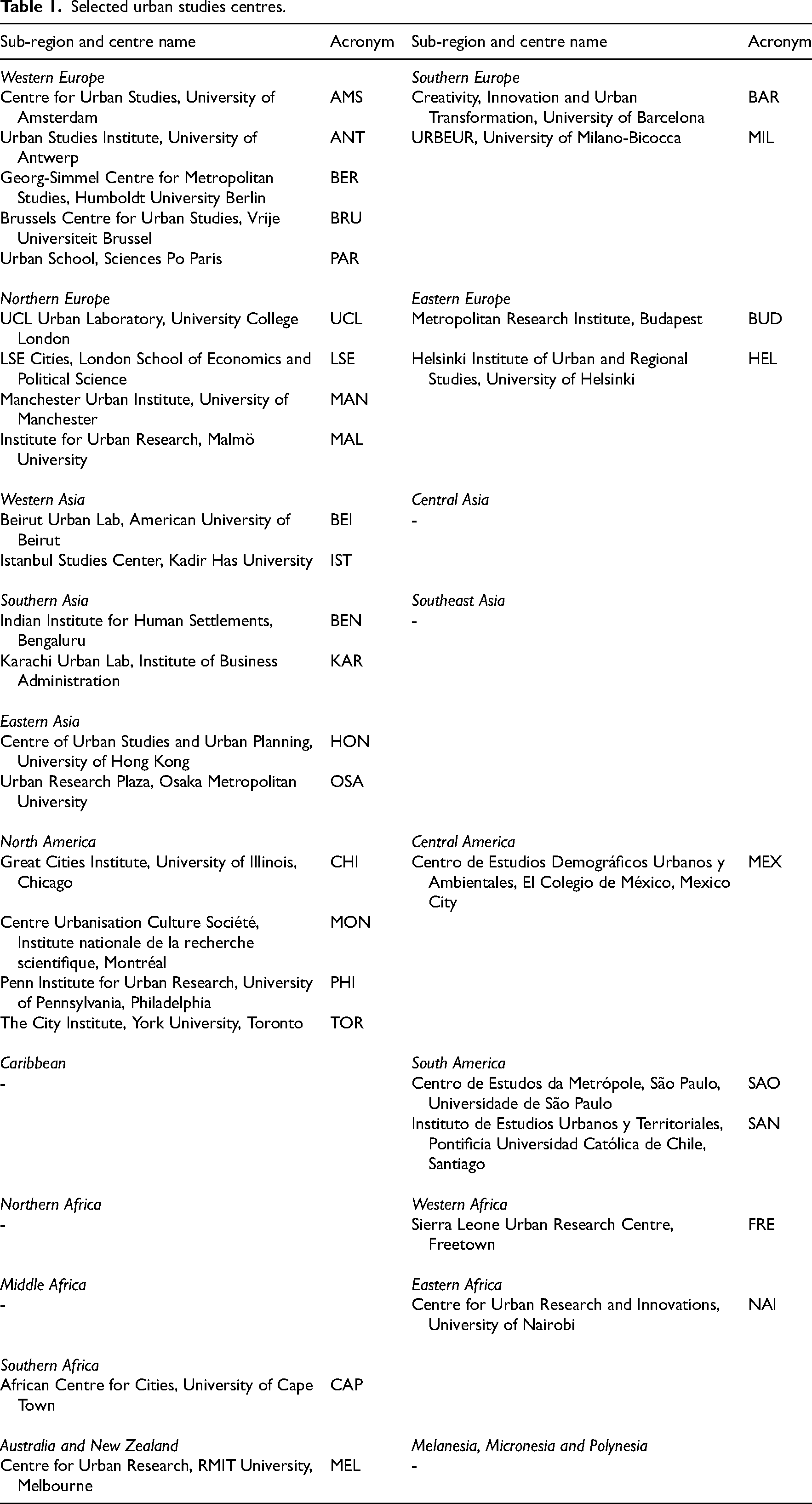
I can only emphasize that this selection strategy is inclusive in some ways (by offering a global scan and acknowledging the disciplinary diversity of urban studies centres), but exclusive in other ways: not only do I exclude strong centres for urban research that do not use the ‘urban’ label (e.g. planning schools or geography, sociology or public policy departments), I also exclude centres that do not explicitly have a university-wide or at least multi-disciplinary remit. Finally, in trying to create a sample that includes centres from across the world, I ‘de-emphasized’ centres from Western Europe and Northern America where we can find an enormous concentration of urban research in all sizes and shapes. Obviously, this exercise shows the impossibility of ever compiling a ‘complete’ dataset due to the shifting definitions and institutional operationalizations of what constitutes urban research. That said, I am confident that my ‘incomplete’ dataset still offers relevant insights into the institutional, disciplinary and geographical dynamics shaping global urban studies today: we might observe specific local articulations in centres that are not part of our sample, but there is no obvious reason to assume that the general trends I identify in this article are fundamentally questioned.
Following the identification of the urban studies centres, I scraped all the centre websites to compile a list of all affiliated researchers (n = 1005; the data was collected between 27 April and 19 May 2022). Using strings of the unique Scopus Author ID values for authors per urban studies centre, 2 I downloaded all their publications (n = 17,753) present in Scopus. I selected the period from 2011 to 2021 for my analysis. This approach has its limitations. As I adopted a bottom-up data collection strategy, the composition of the list of researchers depends on institutional/centre choices about who to list on their website in the first place. It is possible that ‘urban’ researchers working at the same institution and perhaps even active in the day-to-day activities of the urban studies centre are not listed, but it is equally possible that some of those listed are not actively involved in shaping the profile and identity of the centre. I recognize this limitation, but consider it is outweighed by the advantage of being able to carry out a global analysis of self-identifying urban studies centres.
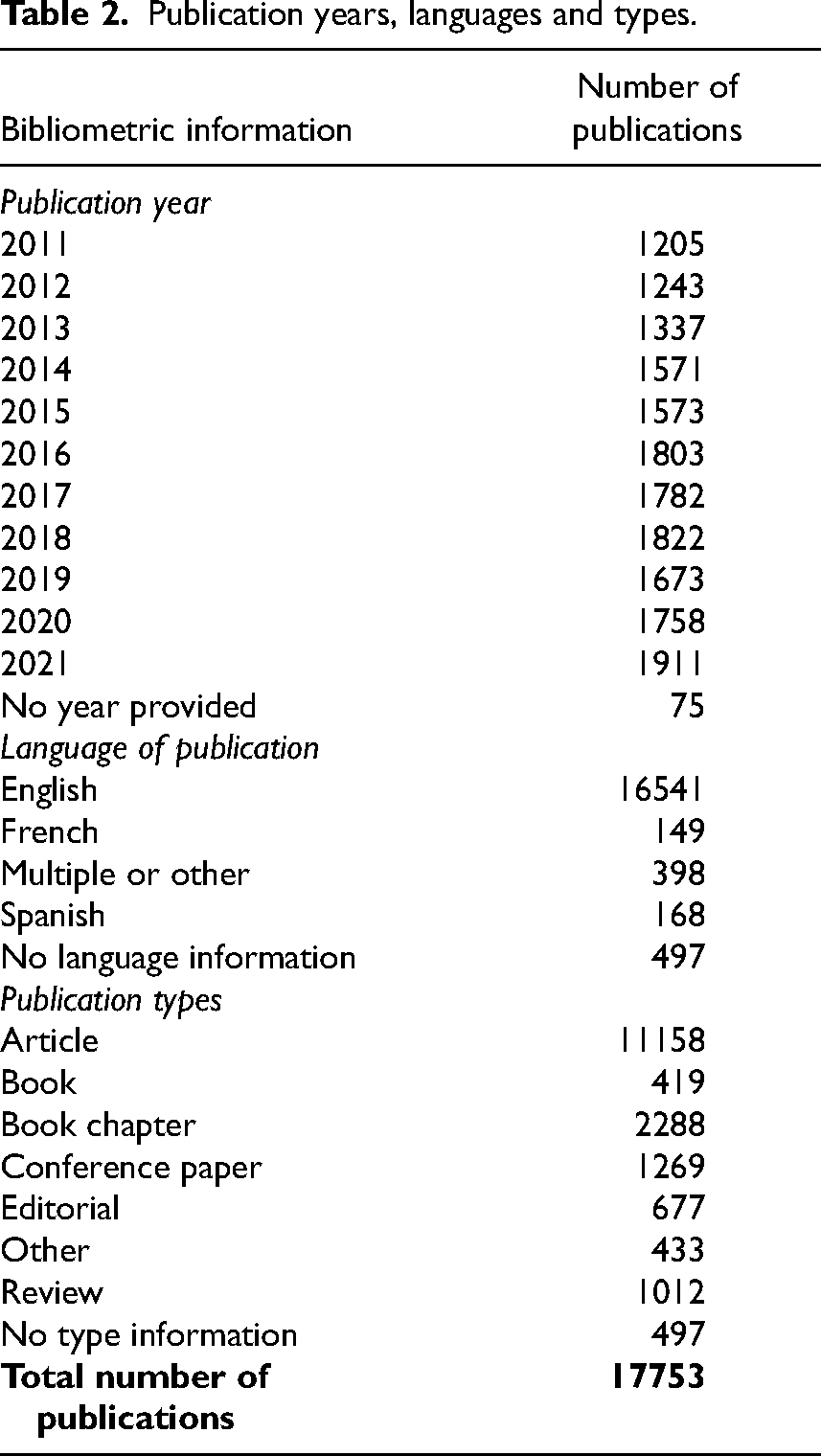
The downloaded publication data (see Table 2) shows a steadily upward trend in publication output from 1205 publications in 2011 to 1911 in 2021. Most are in English (16,541 of 17,752, or no less than 93 %), but publications in Spanish and French also have some visibility in the dataset. The publications are mainly in the form of articles (11,158 of 17,752, or 63%), but book chapters, conference papers and reviews are also reasonably important as output.
Publication years, languages and types.
Plotted on a world map, Figure 1 shows the total number of publications per urban studies centre (visualized by the size of the circles) and the country ‘hosting’ one or more urban studies centres in our dataset (the 0-5202 scale). Data on the map is skewed, in the sense that it only shows countries in which an urban studies centre from the dataset is located. Nevertheless, assuming my selection includes a reasonable distribution of urban studies centres across the world, this map clearly shows the uneven geography of urban studies today, as many countries and world regions literally disappear from the map. The following sections will confirm this overall trend, as well as introduce some important nuances and contradicting observations.
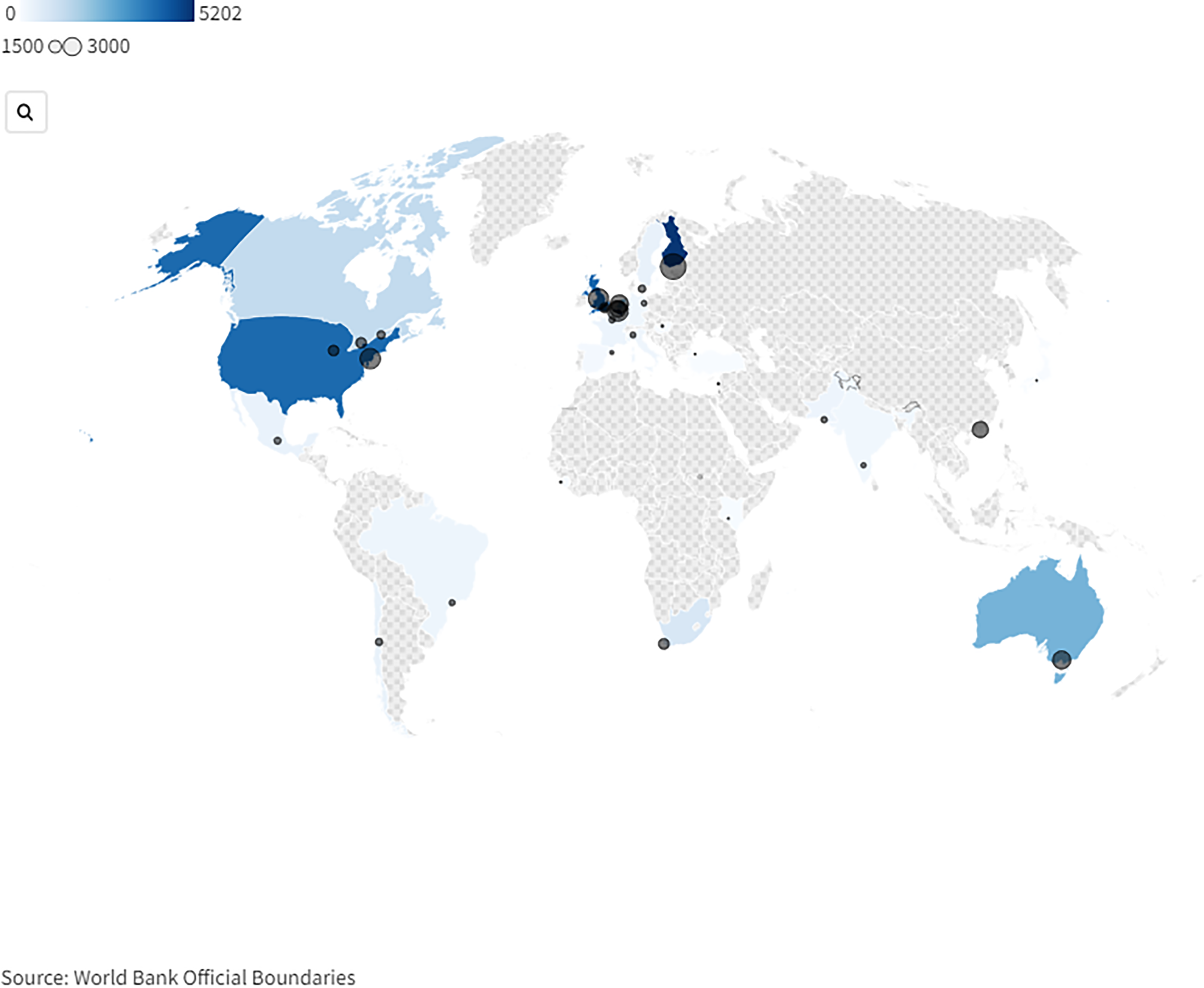
Total number of publications per urban studies centre, country and World Bank region. Created with Flourish.
What is urban studies?
The three quotes at the beginning of this article already highlight that the ‘what is urban studies’ question has been a matter of concern from the very beginning, with scholars arguing that the field's boundaries are ‘obscure’, that it is ‘subject to powerful forces of differentiation and specialization’, or even that the ‘object of urban research’ is disappearing. In some ways, current scholarly-literary preferences continue this line of thought by embracing the unbound nature of urban studies (Leitner et al., 2020) or the planetary explosion of spaces (Brenner, 2013), and in its eclectic and almost anti-definitional theorizing of ‘the urban’. I also sidestep these definitional questions, but do so in a different, primarily empirical way by identifying and describing the research currently conducted within urban studies centres across the world, using the Scopus dataset of publications. Urban studies is what urban studies does, in other words. As Figure 2 shows, most publications from researchers affiliated with an urban studies centre in our dataset are published in journals outside of the social sciences. With 33%, ‘social sciences’ is clearly the largest subject area, but there are also many publications in environmental sciences (12%), engineering (9%), arts and humanities (7%), and medicine (6%), as well as earth and planetary sciences (4%), business, management and accounting (4%), economics, econometrics and finance (4%), agricultural and biological science (3%), and energy (2%). The ‘other’ category (11%) contains subject areas as diverse as psychology, nursing, mathematics, chemical engineering, physics and astronomy, or material science.
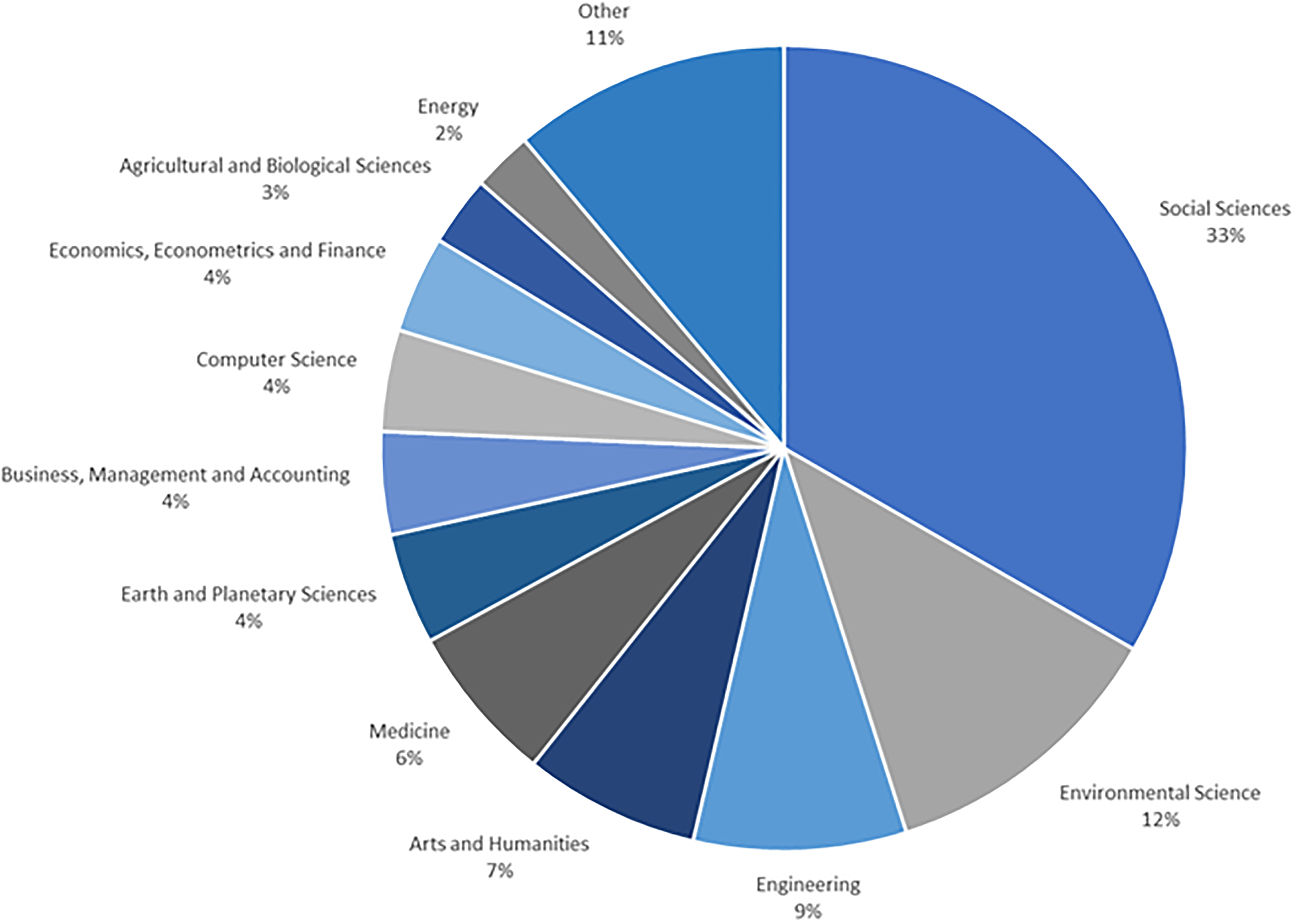
Most important ‘urban studies’ subject areas in our sample.
One caveat is that journals in Scopus are often linked to multiple subject areas, meaning that publications linked to, for example, the subject area ‘medicine’ or ‘engineering’ can also be linked to the subject area ‘social sciences’. Nevertheless, a scan of the most important journals shows that the overlap is largely situated between the subject areas ‘social sciences’ and ‘environmental science’, with core journals such as Urban Studies, Environment and Planning A-D or Journal of Transport Geography being linked to both. This seems to suggest that urban studies as a field of publication activity is characterized by a relatively wide range of discrete research communities, largely disconnected from each other but all carrying out research on urban issues. This impression is also confirmed when looking at the ranking of the most important journals (see Figure 3); that is, the journals that have published most articles from researchers linked to the sampled urban studies centres.
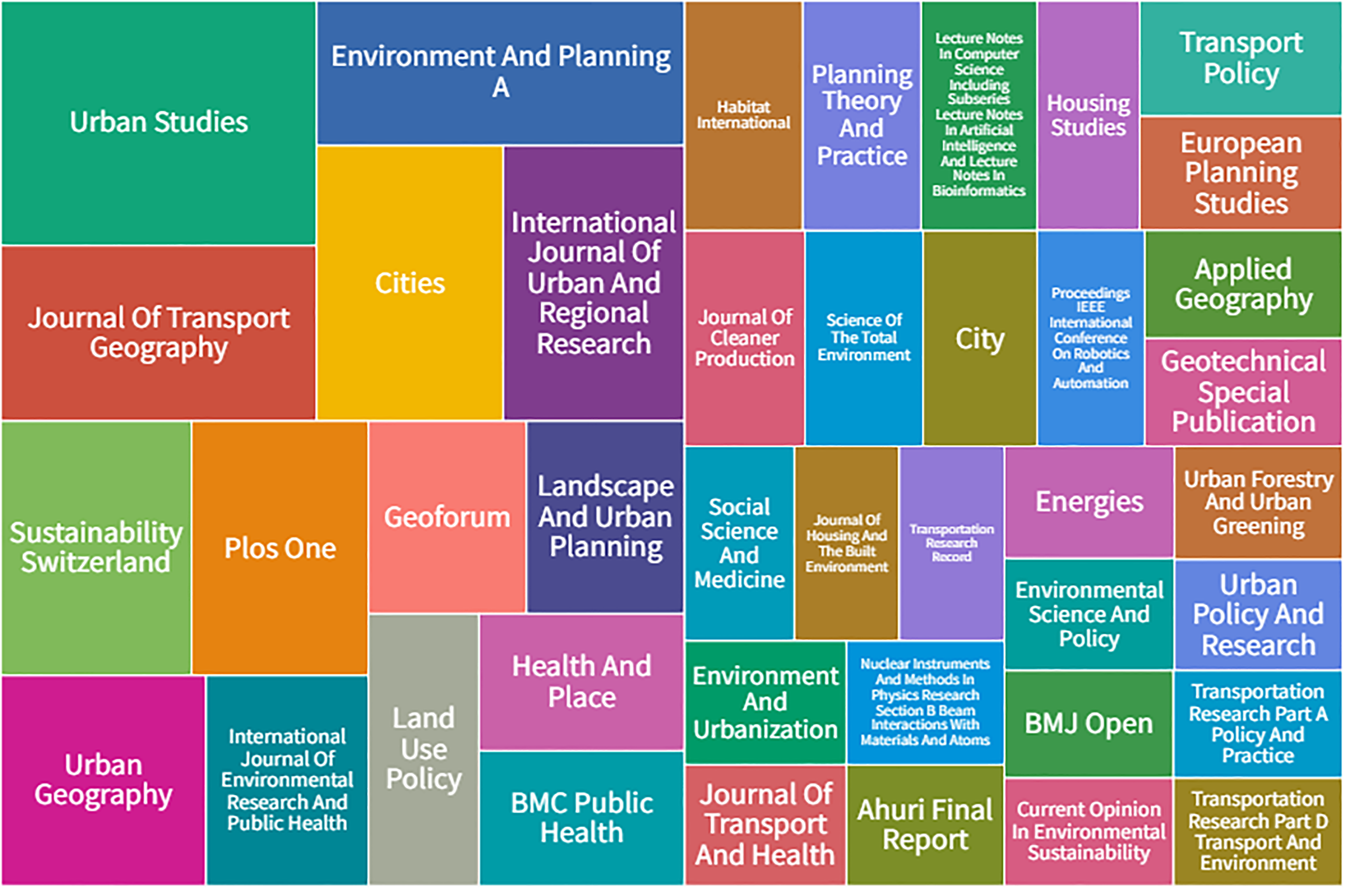
Most important journals (> 24 publications in the period 2011–2021) for the urban studies centres in our sample. Created with Flourish.
In many ways, this will be a familiar list to most readers of this article, as many of the listed journals will be immediately recognized as belonging to the ‘canon’ of urban studies: Urban Studies, Cities, International Journal of Urban and Regional Research and City, but also journals in closely related fields, such as planning and geography (European Planning Studies, Landscape and Urban Planning, Planning Theory and Practice, Environment and Planning A, Geoforum, Applied Geography and Journal of Transport Geography). At the same time, we can observe substantial output in domains only partially linked to dedicated urban studies debates. This applies to transport research, housing studies, public health and environmental studies. The list also contains more ‘exotic’ journals in the fields of computer science, mathematics and engineering, though to a large extent, these seem to be so prominent in the list due to different publication cultures, with researchers in the more technical disciplines on average having a higher publication output than researchers in the social sciences.
Both the overview of the most important subject areas (Figure 2) and of the most important journals (Figure 3) are further proof of the multi-disciplinary character of urban studies that has been observed by scholars from its very early days (see the Gutman, 1963 quote at the beginning of this article) to current diagnoses (Wolman et al., 2022). The data also points to a research domain that combines both basic and applied research – in fact creating a ‘mixed forum, taking ideas and borrowing methods from theory, practice and critique’ (Bowen et al., 2010: 204). A more expansive mapping of research output would surely uncover an even wider range of applied research contributions, ranging from policy-oriented reports to design work, but this is not captured in the Scopus dataset.
The multi-disciplinary nature of urban studies, and its mixture of both basic and applied research, does raise questions about the extent to which the social sciences are still an important platform for debate on the nature of urban studies and ‘the urban’. Alex Schafran (Schafran, 2014: 326) has provocatively argued that the embeddedness of ‘critical urban studies’ within the social sciences is part of the problem, as it remains stuck in 20th-century social science approaches to theory and methods, in which ‘architecture and engineering increasingly have their own conversations, both critical and as handmaidens for the global growth machine’. In their reflections on organizing the Summer Institute in Urban Studies, Ward and Bunnell (2021) reach similar conclusions, showing that the institute's conception of urban studies is derived from academic practices in the social sciences that operate at some distance from the clearly also ‘urban’ work of architects, designers and planners. More fundamentally, Brendan Gleeson (2013) points to the marginalization of social scientific approaches to the study of cities and urbanization, because of the increasing visibility and influence of a popular ‘urban age’ discourse and ‘neo-positivist’ physical sciences that lack a substantive social analysis. Further, according to Clive Barnett, we can observe a shift away from urban social sciences to ‘urban thought’, as ‘a much more diffuse set of academic fields of expertise that span the natural and environmental sciences, engineering and design, arts and humanities, and medical sciences’ (Barnett, 2020: 444). Based on my dataset and analysis, diagnoses suggesting a marginalization of the social sciences need to be considered exaggerations, but the ways in which urban studies centres aim to combine urban expertise from across a university raise difficult questions on the position of urban research that adopts a substantive and complex understanding of social relations.
Drilling down to the level of individual research centres and the similarities or differences between them, this general description of the characteristics of urban studies becomes even richer and more differentiated. Table 3 lists the subject area percentages per centre.
Subject area distribution for each urban studies centre.
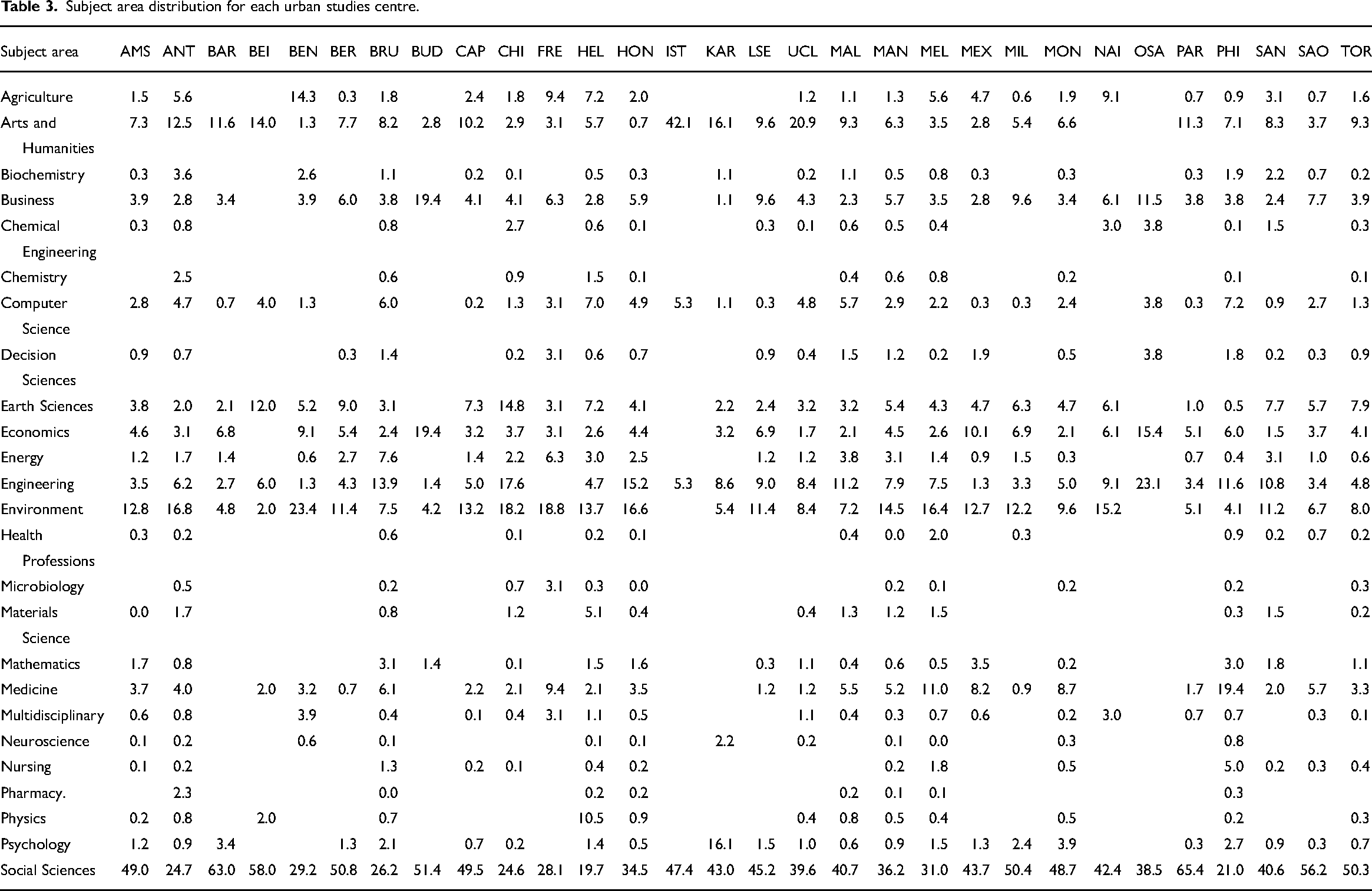
With the social sciences being the largest subject area in the overall dataset, at 33%, when looking more closely at each centre we can observe a total of 8 centres below this percentage and 22 above it. Explaining the former (centres with <33% of their total publications being in the social sciences) are the relatively high percentages of publications in the subject areas of environmental science (overall average 12%), engineering (9%) and/or medicine (6%). This is clearly the case for Philadelphia, which only has 21% of its publications in the social sciences but no <19% in medicine and 12% in engineering. Other examples are Antwerp (25% social sciences and 17% environmental science), Chicago (25% social sciences, 18% environmental science and 18% engineering) and Helsinki (20% social sciences, 14% environmental science and – exceptionally – 11% in physics and astronomy). These centres are often among the largest ones in my dataset, but the size is to a substantial extent related to the relative centrality of engineers, environmental scientists and medical scientists, and the relative marginalization of social scientists within these centres (at least in terms of the quantity of publication output). Smaller urban studies centres tend to be those with more limited urban research being carried out within engineering, environmental science and medicine, and in turn with a relatively higher percentage of publication output by social scientists. This applies most clearly to Paris, with no less than 65 % of its publications in the social sciences, compared with only 5% in environmental science, 3% in engineering and 2% in medicine. Similar observations can be made for Barcelona (63% social sciences, 5% environmental science, 3% engineering and 0% medicine) or Beirut (58% social sciences, 2% environmental science, 6% engineering and 2% medicine). Across the full sample, relatively high percentages of publications in the arts and humanities tend to be related to a less pronounced dominance of the environmental-medical-engineering triad in the total publication output of a centre. A North-South dichotomy in this analysis primarily emerges through the sheer force of numbers. As already discussed in the methodology section, the geography of urban studies research is highly uneven, with English-speaking countries and/or countries with strong connections to Anglo-American academic publication cultures dominating the debate. In addition, as this section shows, the major powerhouses when it comes to the quantity of output are the centres with research expertise in environmental science, engineering and/or medicine. These centres are all based in the Global North (Amsterdam, Antwerp, Brussels, Chicago, Helsinki, Manchester, Melbourne and Philadelphia), except for the ones in Cape Town and Hong Kong. These centres also outperform most others with regard to the quantity of output in other subject areas, ranging from agricultural and biological sciences to arts and humanities, computer science and other areas of research.
A closer look at the journals in which the different centres publish is also enlightening. For one thing, it shows the extreme spread of journals in which scholars affiliated with urban studies centres publish. We counted no fewer than 5472 distinct source titles for a total of 17,753 publications, which would mean an average of 3.1 publications per source title – and considering the investigated 2011–2021 period, only one publication per source title every 3 to 4 years. This suggests a very rich and diverse publication ecosystem, but also a very fragmented one with no cohesive identity for urban studies as a whole. The dataset-wide journal trends discussed above are also reflected to some extent at the level of individual centres, but the wide spread of publication output even affects the top publishing outlets. Only Urban Studies and International Journal for Urban and Regional Research are used as outlets for publications by at least four out of five urban studies centres. There is a second tier of journals that are used as publishing outlets for roughly two-thirds of all centres: Cities, Sustainability, Urban Geography, Journal of Transport Geography, Environment and Planning A, Geoforum and Journal of Urban Affairs. Then there is a long list of journals that roughly manage to reach between one third and half of all urban studies centres, followed by an even longer list that are the outlet for only a handful of centres.
It also becomes clear that some urban studies centres in the sample become much less visible due to having no or almost no publications, even in a relatively long list of the top 150 journals. This applies to Beirut, Budapest, Freetown, Istanbul, Karachi, Nairobi and Osaka. Many of these centres revolve around the publication activity of a small number of authors who realize the large majority of the Scopus-registered output. Accordingly, these centres tend to have a relatively narrow publication focus, deriving from the research expertise of one, two or three senior researchers, and are perhaps not best understood as urban studies centres in the strong multi-disciplinary and interdepartmental sense of the word. Unsurprisingly, given the clear inequalities in resources and institutional capacity, all these centres are located in the Global South or Global East. Though this observation supports the oft-repeated claim that there is a clear hierarchy of knowledge production, the situation is not that clear cut. As discussed above, the North–South hierarchy in urban studies emerges above all due to a select number of centres in the Global North with strong output in environmental science, engineering and/or medicine skewing the overall dataset. Some of these centres (or, more precisely, groups within a centre) are highly specialized in domains that seem only marginally connected to urban concerns. For example, Philadelphia shows clear specialization in robotics (Proceedings – IEEE International Conference on Robotics and Automation and Springer Tracts in Advanced Robotics), public health and medicine (American Journal of Public Health and American Journal of Preventive Medicine) and housing (Housing Policy Debate), with its researchers responsible for most publications in the mentioned outlets that are part of our dataset. However, beyond this, we can also observe a quite diverse and geographically distributed landscape of mid-sized urban studies centres that substantially contribute to the top 150 urban studies journals: Barcelona, Bengaluru, Berlin, Mexico City, Milan, Paris and Sao Paulo. Slightly larger still are Cape Town, Chicago, London LSE, London UCL, Malmö, Montreal, Santiago and Toronto. This shows that urban studies centres outside of Western Europe, North America and Australia have gained a substantial presence within urban studies over the last decade by producing output in Scopus-registered journals that are not only within one specific niche but that cover multiple strands of urban research.
Where is urban studies?
The above discussion on the ‘what’ of urban studies, seen through the lens of disciplines and journals, already starts to address the question concerning the ‘where’. In this second empirical section of our paper, I unpack this geographical dimension in more detail by looking both at the country and institutional affiliations of all the authors identified in our dataset. As a reminder, my dataset contains all 2011–2021 Scopus-registered publications linked to at least one centre-affiliated author. As many publications are co-authored, this means that the full sample also contains the names, and in turn, country and institutional affiliations of these co-authors, some of whom will be based in the same institution or country, although many will not.
A first observation is that urban studies, despite having substantially internationalized and partially globalized in recent decades, remains a strongly ‘locally’ rooted research affair: on average, 56% of all institutional affiliations in the dataset (median 58%) are linked to the ‘home country’ of the respective centre. A caveat is that this percentage needs to be understood in relational terms: absolute comparisons between centres are thus not very useful. The percentage is nevertheless still an indication of the relative internationalization of each centre: the higher the percentage of publications with international co-authorship, the lower will be the ‘home country’ percentage. 3 We can note strong divergences between the centres in the dataset, but these divergences cannot immediately be linked to and explained by a Global North versus Global South dichotomy: The centres in Freetown and Karachi are strongly internationalized, but so is Helsinki; the centres in Beirut, Istanbul, Osaka and Sao Paolo are predominantly locally/nationally oriented, although this also applies to Barcelona, Milan, Montreal, Chicago, Philadelphia and Toronto.
An analysis dealing with the regional and sub-regional level is already more insightful, and here we clearly see well-known hierarchies of knowledge production. Figure 4 presents a synthetic overview of the main co-authorship relations per centre (i.e. of the publications produced by authors linked to a centre) at the regional level (sub-regional and country-level information is available, but not shown in this table).
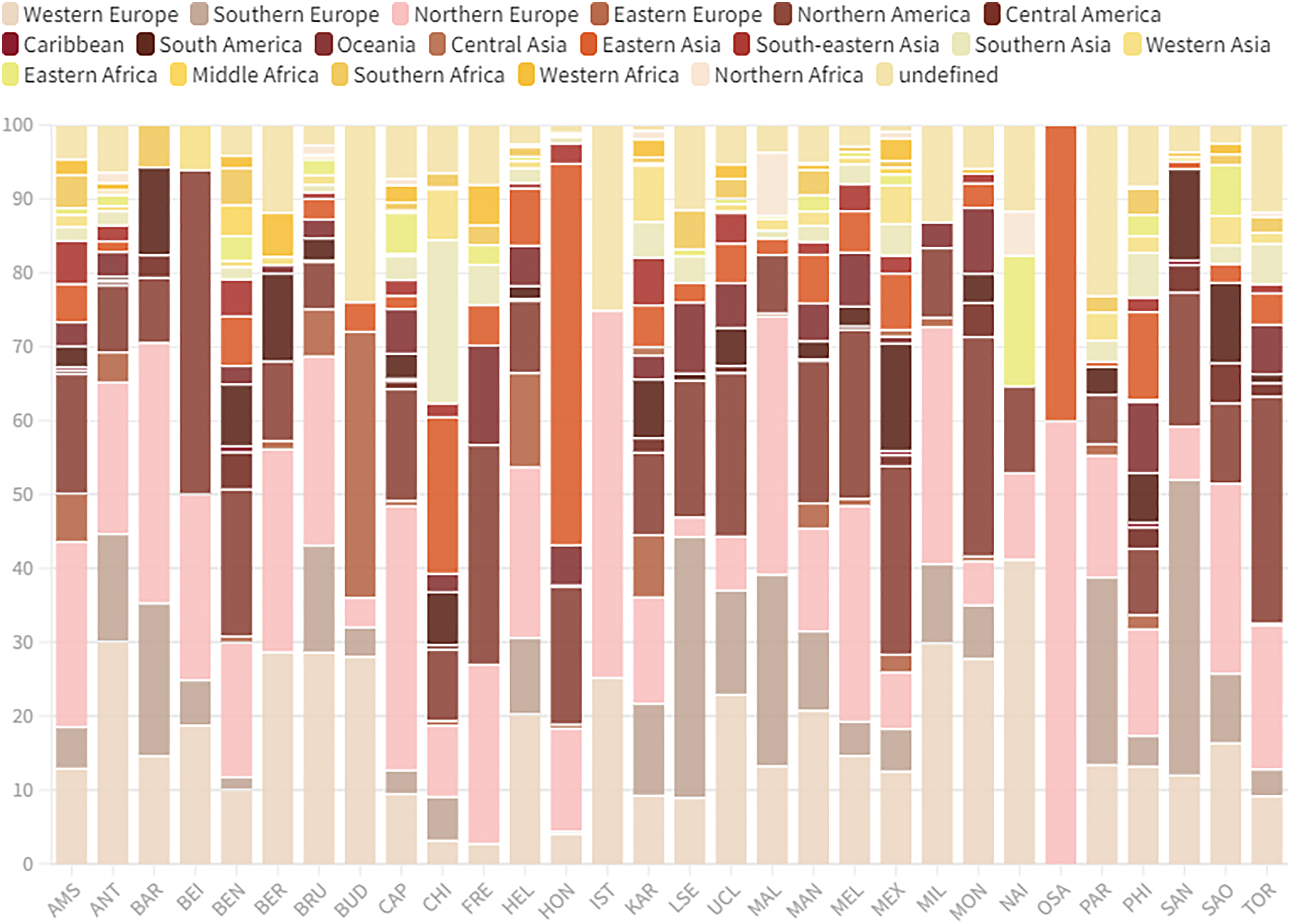
Regional co-authorship affiliations of the centres in our dataset. Chart created with Flourish.
The general overview is one in which Northern Europe, Western Europe and Northern America dominate the discussion – or to be more precise, in which authors based in these countries are centrally positioned in co-authorship networks of authors affiliated with urban studies centres in our dataset. At the level of regions, we see median figures of 19.7% for Europe, 8.3% for the Americas, 4.1% for Asia, 1.9% for Africa and 1.4% for Oceania. At the sub-regional level, distinctions become even clearer with high median percentages only for Northern Europe (7.9%), Northern America (7.3%) and Western Europe (6.0%), and to a lesser extent Southern Europe (2.1%), Eastern Asia (1.6%) and South America (1.2%). Sub-regions such as the Caribbean, Central Asia and Northern, Middle and Western Africa literally disappear from the map, with percentages close to zero. To an only slightly lesser extent, this also applies to Eastern Europe and Central America, as well as large parts of Asia (South-Eastern Asia, Southern Asia and Western Asia) and Africa (Eastern Africa and Southern Africa). Country-level exceptions to this regional–sub-regional rule exist, but remain exceptions and will be partially an effect of my selection of urban studies centres: for example, within invisible Southern Africa, South Africa is visible when looking at international co-authored publications, but part of my dataset is a relatively large urban studies centre in Cape Town. Also, within highly productive sub-regions, we can observe individual countries with very limited visibility. The high percentages for Northern Europe, for example, can be largely explained by high levels of output co-written between authors from the sampled centres and those based in the United Kingdom, whereas other Northern European countries show visible but much more modest levels of co-authored output.
Approaching this same table from the perspective of individual centres offers some additional insights into the regional geographies of urban studies. First of all, and in line with the above analysis, co-authorship relationships of the different centres tend to be primarily focused on a select set of countries, all of which are based in the Global North. Focusing on countries with which centres co-author at least 2% of their total output – which does not seem much, but in most countries it is lower, and often (close to) zero per cent – we see that only the United Kingdom (23 out of 30 centres in our sample) and the United States (22) operate as major hubs for co-authorships, seemingly acting as obligatory points of passage for authors across the world. A second tier of countries follows: Germany (13), the Netherlands (10) and Canada (10). A second observation is that there is a tendency to co-author between neighbouring countries. Thus, the centres in Belgium (Antwerp and Brussels) show strong co-authorship relations with authors in the United Kingdom and the United States, but also with the Netherlands, France and Germany. The centre in Milan co-authors substantially with authors in France and Spain. The centre in Cape Town (together with Bengaluru, Freetown and Nairobi) also has comparatively high percentages of co-authorship relations with authors based on the African continent, even though the percentages for individual African countries remain very low and are outnumbered by the density of connections to the United Kingdom and the United States. Third – and even though English operates as the dominant lingua franca across the academic world – we can observe a tendency to co-author with people sharing the same language (which in itself is often connected to a history of imperial and colonial relations). São Paulo, for example, has a reasonable proportion of co-authored publications with researchers based in Portugal. Santiago co-authors relatively high levels of output with Spain and various Central and South American countries. Unsurprisingly, French-speaking Montréal also has strong connections to France.
When looking at institutional affiliations instead of country affiliations, we are able to pin down the ‘where’ of urban studies even more precisely. Figure 5 ranks institutions on the basis of the number of times each is mentioned as the affiliation of an author. The higher the number, the more central this institution becomes in the overall geography of urban studies publication output.
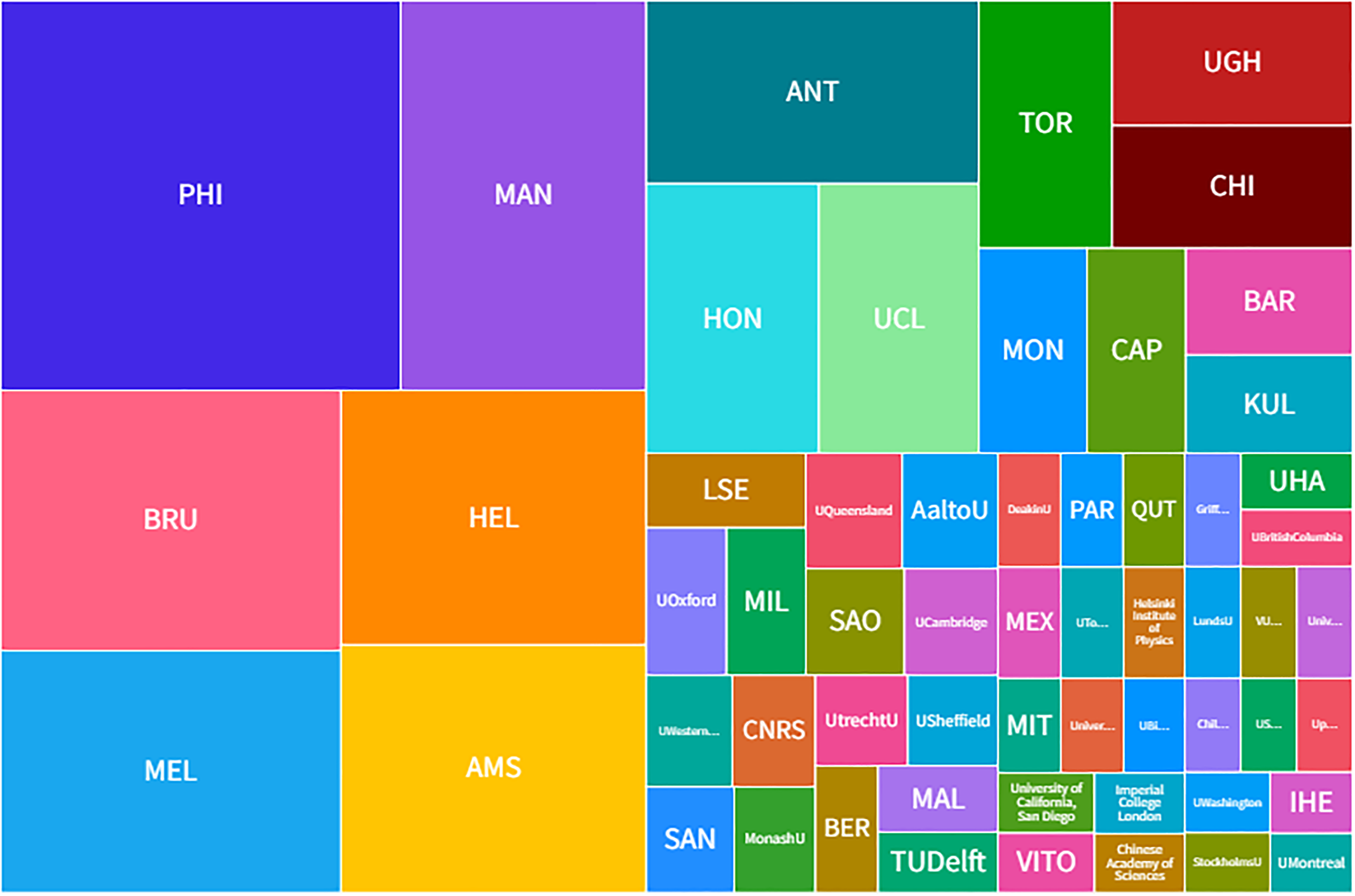
Institutional co-authorship affiliations of the centres in our dataset (>70 times mentioned). Created with Flourish.
This institutional ranking needs to be treated with caution, since the overview is shaped by the original selection of urban studies centres for my dataset: many of the institutions listed here host the urban studies centres included in my selection (I use the acronyms adopted in Table 1 to highlight this). This does not mean that these institutions would not rank highly otherwise – there is a reason why I selected these centres in the first place: because these are recognized and important centres for urban research activity – but their position would be less pronounced. Keeping this in mind, one interpretation of the data is that productive (in terms of publication output) urban studies centres tend to be part of a national environment of universities that is dense and involves high levels of co-authorship and collaborations between researchers across universities. This partially seems to explain the high ranking of institutions in Belgium (Ghent University, KU Leuven, Hasselt University and VITO), the United Kingdom (University of Oxford, University of Cambridge, University of Sheffield, University of Leeds and University of Birmingham), the Netherlands (Utrecht University, Delft University of Technology and VU Amsterdam), Australia (University of Melbourne, University of Queensland, University of Western Australia, Monash University, Deakin University, Queensland University of Technology and Griffith University), Canada (University of Toronto and University of British Colombia) and the United States (MIT and University of California).
The list of institutional affiliations thus shows a clear and unsurprising bias towards Europe, North America and Australia, but there are important exceptions. First, various institutions in Africa, Asia and Central and South America that host the urban studies centres underlying our dataset rank highly as important institutions for co-authoring: University of Cape Town, University of Hong Kong, Universidade de São Paulo, Pontificia Universidad Católica de Chile and El Colegio de Mexico, AC. As already mentioned, this is (at least also) the result of my original selection bias. Second, though not among the top 50, an important Chinese cluster of research activity emerges: Chinese Academy of Sciences, City University of Hong Kong, Hong Kong Polytechnic University, Hong Kong University of Science and Technology, Tsinghua University, Tongji University, Peking University, Chinese University of Hong Kong, Ministry of Education China and Sun Yat-Sen University. Third, and further down the ranking, we can observe a diversification of institutions, with an increasing number of institutions across Europe (though still largely in Northwest Europe) as well as other regions of the world: examples would be institutions in Russia (Ural Federal University), Singapore (Nanyang Technological University and National University of Singapore), South Africa (University of the Witwatersrand) and New Zealand (The University of Auckland).
Who is urban studies?
Having analysed the ‘what’ and ‘where’ of urban studies, in this last empirical section I focus on the ‘who’. My interest here is both about the ways in which different centres contribute to similar/different circuits of knowledge, and about the impact and visibility of individual authors in my dataset within their respective research domains.
To tackle the first dimension, I look at the journals in which each centre publishes – irrespective of whether it belongs to the top urban studies journals list that I discussed in the ‘what is urban studies?’ section. This exercise is insightful, since it allows me to describe in greater detail the centre-specific publication foci. To an important extent, the individual centres follow the trends discussed in the previous paragraphs, but in addition we can observe two things. First, multiple centres publish in social science journals that do not appear in the top 150. These seem to be primarily journals ‘drowned out’ by the sheer mass of publications in environmental sciences, engineering and public health. A few of these are dedicated urban journals, such as Urban Research and Practice, sub\urban and Journal of Urban Technology, but many more are from sociology (Social Inclusion, Sociologica), migration studies (International Migration, Journal of International Migration and Integration and Journal of Refugee Studies), development studies (International Development Planning Review), geography (Singapore Journal of Tropical Geography, ACME, Documents d'Anàlisi Geogràfica and Geographica Helvetica) or housing studies (Critical Housing Analysis). This confirms that urban studies continue to be a hybrid platform for debate, borrowing methods and theories from other disciplines (Bowen et al., 2010). Second, we can identify journals that are important publishing outlets for only one urban studies centre. This includes dedicated urban journals, such as the trilingual Brussels Studies (important for the centre in Brussels), Urban Forum with its focus on African cities (Cape Town), the Italian-language Sociologia Urbana e Rurale (Milan), Urban Affairs Review (Chicago), Journal of Urban Economics (Philadelphia), Canadian Journal of Urban Research (Toronto and Montreal), and the Spanish-language Estudios Demograficos y Urbanos (Mexico City) and Revista Latinoamericana de Estudios Urbanos Regionales (Santiago). The same situation also applies to disciplines that are traditionally closely related to urban studies, such as geography, with Canadian Geographer (Toronto and Montreal), Australian Geographer (Melbourne), Revista de Geografia Norte Grande (Santiago) and Cahiers de Géographie du Québec (Montreal), spatial planning, with Australian Planner (Melbourne) and demography, with Demographic Research and Canadian Studies in Population (Montreal) and Papeles de Población (Mexico City). Strikingly, though perhaps not surprising considering the dominance of the English language in contemporary academia, none of the Spanish, Italian, French or other-language journals in the sample are important publishing outlets for multiple urban studies centres, reflecting the local and national orientation of these journals.
A second way of unpacking the ‘who’ of urban studies is to drill down to the individual level by identifying the most-cited publications within our dataset. Strictly speaking, I do not focus on the research content of the investigated journal articles, as I restrict myself to relationships between articles (and by inference, their authors). Looking at all the most-cited publications would produce a list in which the top ones are far removed from what is usefully considered urban research, including various publications in the domains of robotics, computer science, geoscience, radiology and public health. This reflects the main weakness of my dataset – as already discussed in previous sections – which is that because I rely on the ‘self-identification’ of urban studies centres (I consider all researchers listed as affiliated with an urban studies centre to be urban researchers), my dataset also includes all publications of those authors who might only partially identify as urban researchers. To avoid this problem, in Table 4 I show a list of the most-cited publications that contain the keywords ‘urban’, ‘city’ or ‘cities’ in the publication title or abstract.
Most-cited publications of centre-affiliated authors.

This list of the most-cited publications shows a number of clusters of urban research activity with high levels of citation. Among some of the most cited works, we can observe various publications in planning, urban economics, urban political economy, sustainability and transition studies, housing, and post-colonial and comparative urbanism. The latter is well-represented among the top most-cited publications, suggesting that at least at the level of academic discourse and citation trends, a stronger global orientation towards urban studies has become mainstream in the last decade – publications from authors such as Jennifer Robinson, Susan Parnell, Vanessa Watson, Ananya Roy and Mary Lawhon are among the most cited in this list. We also see authors such as Neil Brenner, Jamie Peck and Nik Theodore on high positions in the list, representing a cluster of urban political economy often put in opposition to the global urbanism debate. Related, although slightly more pluralistic in its theoretical orientations, is research straddling the boundaries between urban political economy, planning and critical urban theory more widely, such as research on policy mobilities (Eugene McCann, Kevin Ward) or the creative and tourist city (Claire Colomb, Johannes Novy). Reflecting to an important extent the nexus between environmental studies and urban studies, various publications in this list address the society-environment interface, ranging from publications on resilience (Simin Davoudi, Maria Kaika), ecosystem services and nature-based solutions (Henrik Ernstson, Dagmar Haase, Francesc Baró, Niki Frantzeskaki), urban agriculture (Nathan McClintock) and urban living labs (James Evans, Andrew Karvonen, Bas van Heur), to more technical research on remote sensing, urban heat islands or air pollution. Lastly, we can identify a cluster of research concerning urban health (Billie Gilles-Corti) and a strand focusing on transport and urban economics (Gilles Duranton), as well as transport and mobility issues more widely (Karen Lucas).
The field of urban studies, in other words, is characterized by substantial thematic diversity. This diversity is nevertheless barely, if at all, reflected in the actual location and co-authorship relations of researchers, with the vast majority of output published by authors based in the Global North. A scan of the affiliations mentioned in the top 150 most-cited publications shows that no fewer than 136 publications have at least one author based in North America, Northwest Europe (and the majority of those are in the United Kingdom), Australia or New Zealand. Of the remaining 14 publications, the authors are based in South Africa, China and/or Hong Kong. Authors affiliated to other Global South institutions do appear in this list, but their most-cited publications are always co-authored with others based in the Global North. Through this strategy, it is particularly researchers based in Brazil, India, Singapore, Poland, the Czech Republic, Spain and Italy who manage to gain visibility. Almost no other countries appear in the top 150. Considering this situation, one is left with the impression that this diverse field of urban studies – including the post-colonial urbanism literature – is dominated by Anglophone scholars from countries of the former British Empire, in conversation with one another. 4
Concluding summary and four propositions
In this paper I have adopted a radically open and rich, multi-disciplinary understanding of urban studies. To a large extent, I have done so by remaining resolutely empirically focused in my analytical approach. My focus is not on what some of the most prominent authors claim urban studies is about (or should be about). Instead, I pay close attention to what urban researchers actually do: What do they publish? In which journals do they publish? Where are they institutionally based? With whom do they co-author publications? In addition, whereas most bibliometric papers rely on the categories used by databases such as Web of Science or Scopus to construct their sample of relevant publications (e.g. Kong and Qian, 2019), I adopt a pragmatist understanding of science, in that I accept the self-descriptions of the actors involved; selecting research centres that identify as centres for urban studies, I consider all members of these centres as members of the broad church of urban studies. The advantage of this approach is that I can cast a much wider net than is usually possible, but also that I can do justice to the organizational and disciplinary specificity of each research centre within my sample. One of the contributions of this paper is thus that it adds empirical information about the organization, practices and geographies of urban studies to the debate on a topic that has previously been primarily theoretical and epistemological. Post-colonial and comparative urbanists are surely correct in arguing that we ‘need to reshape the circuits through which social-science knowledge [and, we would add, other scientific knowledges] moves’ (Robinson, 2011: 16), in order to contest and ultimately transform our current hierarchies of knowledge production. However, even after more than two decades of discussion, we know frustratingly little about what these actual circuits of knowledge look like.
The bibliometric analysis that I present in this paper offers one possible way of tracing these circuits with more precision than has previously been undertaken. Specifically, I do so by mapping and analysing the publication output of different urban studies centres and scholars across the world in order to better understand the ways in which their positionality is related to particular disciplinary debates and language communities, as well as local and national concerns (also see Ferenčuhová, 2016; Zeiderman, 2018; van Heur, 2020). The paper offers various empirical insights in this respect, but I want to conclude with four propositions on (i) what this analysis can mean for thinking through modes of global urban studies research that actively aim to dismantle existing hierarchies of knowledge production and (ii) what the role can be for multidisciplinary urban studies centres in creating this more equal playing field.
Footnotes
Acknowledgements
The author wishes to thank the three reviewers for their careful and engaged reading of an earlier version of this manuscript. The research conducted for this article took place in the context of the ‘Urban Agency III’ Scientific Research Network funded by the Research Foundation – Flanders (FWO), which brings together urban studies centres from across the world to examine the relationship between the institutional embedding of urban studies and the orientation, nature and performativity of the research involved. Discussions within this network, and specifically with Bert De Munck, Guy Baeten, Lena Imeraj, Maria Kaika, Stijn Oosterlynck and Kate Reilly, have contributed to improving the overall analysis and quality of this article. Many thanks also to Hans Jonker who helped gather and process the data, and carried out the data visualizations.
Declaration of conflicting interests
The author declared no potential conflicts of interest with respect to the research, authorship, and/or publication of this article.
Funding
The author received no financial support for the research, authorship, and/or publication of this article.
