



Abstract
In this forum paper, I revisit the rich and coherent literature on inequality from the 1990s, immersed in radical urban studies and Marxist political economy, and apply it to recent transitions in city fabrics, that is the built environment and the social worlds around it. Some city fabrics reflect powerful interests, while others are more everyday and mundane. Recently, there has been the sense that powerful fabrics have increasingly encroached upon or erased everyday ones. I use urban vignettes to visualize the shift from the corrugated city, where there was a rough balance between powerful and everyday fabrics, and the lopsided city, where powerful fabrics seek to displace and dominate. This transition requires a more robustly class-driven analysis than what is currently used in urban studies, itself fragmented. In response, I articulate a focused yet balanced analysis of the lopsided city in conversation with certain key legacies of the 1990s literature on inequality: studying the extremes, building theory on empirical richness, paying attention to the city fabric, a concern for social justice, the importance of formal mechanisms in the city (e.g. the state and developers), and balancing fragmented and totalizing views of the city. However, certain aspects of the 1990s literature have aged less well, such as the obsession with the dystopic, the narrow focus on global cities of the Global North, and the ‘all-or-nothing’ (universalistic) notions that class should dominate urban analysis.
Introduction
Let me begin with a provocation that doubles as a plea. While discrimination around gender, race, sexuality, and disability remains deeply embedded in Global North society, its more blatant manifestations have arguably been robustly challenged over the past 50 years. It is far more difficult now to be outwardly racist, misogynistic, homophobic, transphobic and so forth, at least in academia, polite company and especially in the wake of #MeToo and Black Lives Matter. And yet during this same period, class-based inequality has flourished, moving in the opposite direction, especially in more neoliberalized contexts such as the United Kingdom and the United States. These trends are especially pronounced in urban areas, which condense, concentrate, and accelerate larger societal trends around class stratification and stunted social mobility.
Into this contradictory context, I want to revisit earlier literature from the 1990s on inequality to better frame certain aspects of current (and rising) economic inequality in cities. In an earlier piece of work (DeVerteuil, 2009), I argued that inequality was about societal distributions that were mathematically unequal in a way that was seen as morally unfair, in that certain social groupings received less than their fair share. Income and wealth inequality crosscut almost every society and every city in the world, and thus demonstrate how class is a near-universal commonality (Blomley, 2008; Dorling, 2014; Smith, 1994). In this regard, Chakravorty (2006: 2) insisted that ‘the idea of income inequality is easily understood, relatively easily measured, universal in its manifestation, and tangible, at some level, to everyone with social awareness’. While the urban manifestations of class-based inequality can be quite different, its underpinnings are essentially endemic and inherent to capitalism (Harvey, 1973; Massey, 1996), reflecting the enduring division between the working class and capitalist class interests. For some, inequality is a good thing – talent and hard work are unequally distributed, and as a result so is society. For others, the negative spillover effects of inequality are the central plank of city life. This plank was explored in depth by a slew of important works in radical urban studies and Marxist political economy in the 1990s: Davis (1990), Sassen (1991), Mollenkopf and Castells (1991), Zukin (1992), Fainstein et al. (1992), Sorkin (1992), Smith (1994), Merrifield and Sywngedouw (1996), Smith (1996), Massey (1996) and Wacquant (1999). But the 1990s was not just a decade of enormous conceptual progress and innovation – the urban world itself was also transitioning to a more entrenched version of inequality set within a context of ascendant neoliberalism that persists to this day.
The prominence given to these matters in urban studies has gradually waned over the past 20 years, to the point where class-based inequality is no longer as central as it was in the 1990s. Rather, class-based inequality has become secondary, one of many concerns within the field. This is not to say that issues of class inequality have disappeared altogether from urban studies – they have certainly not, and remain a ‘meta-trope’ that is highly legible in the city. Class-based inequality continues to animate discussions of racial capitalism (Melamed, 2015), gentrification and displacement (Lees et al., 2016), the settler colonial city (Simpson and Hugill, 2022), and informality (Roy, 2009; Thieme et al., 2017). However, these literatures do not occupy the same prominence in urban studies as class-based inequality did in the 1990s, nor are they primarily driven by class-based inequalities. Rather, they compensate with a greater (and long-overdue) interest in other axes of difference in the city – gender, ‘race’, sexuality, disability and so forth, following a largely post-structuralist approach.
This trend against class reductionism was recognized over 30 years ago by Sayer (1992: 344): ‘[this] has been highlighted in the feminist and post-Marxist literature, namely Marxism's neglect or demotion of non-class sources of power and division such as patriarchy, racism, violence, nationalism, homophobia, and so on’. This post-structural critique has effectively undermined some of the key beliefs around radical urban studies. Class became but one axis of inequality, and no longer the dominant one. The greater attention played to ‘race’ and gender in particular also bled into more intersectional studies, of how the city was complicit in these inequalities (e.g. Bondi and Domosh, 1992; Kobayashi and Peake, 2000). There was also greater attunement to the banal, the mundane, the affective, the everyday and the messy (Thrift and Amin, 2002). While I do not propose a return to an unreconstructed class-driven approach that ignores these subsequent criticisms, I do propose that for certain trends in the twenty-first century city, a balanced and focused revisit of the 1990s ‘heyday’ of inequality research is entirely appropriate. But what is the value (and perils) of such a revisit, what can we learn as students of the city? After all, real-world inequality is still ‘big’, to borrow from a famous movie quote in Sunset Boulevard (1950), but perhaps the field of urban studies has become ‘small’, lacking the desire to ask big questions about certain pressing issues, or simply too fragmented to present a common front.
In this forum article, I revisit the 1990s heyday to articulate a focused yet balanced analysis of certain current trends in inequality in the city, with the analysis driven primarily by class. This revisiting would proceed alongside lessons learned since the 1990s around other axes of (social) inequality, such as race, gender, sexuality, disability and so forth. More specifically, I want to apply a revisited notion of class-based inequality to a particularly pressing transition facing cities in the twenty-first century. This pressing transition is the sense that especially since the 2008 global recession, the built environments of certain cities have moved from corrugated to lopsided. Built environments can be understood in a wider sense by the notion of the city fabric, which captures ‘…the social and material world that lives and landscapes are made from’ (Knowles and Harper, 2009: 10). A ‘corrugated’ city fabric indicates a certain regular braiding, a linear ridged pattern. When applied to inequality in the city, corrugated suggests a roughly equal balance between the polarized ‘high’ and ‘low’ elements of urban society, set within an undulating pattern where neither side dominates. A ‘lopsided’ city fabric initially indicates, as does inequality, a condition (if not a consolidation) of unevenness. But it adds the sense of being disproportionately heavy to one side.
The remainder of the paper is organized as follows. I first detail, using a series of urban vignettes, the transition from corrugated to lopsided cities, with the former incorporating insights from the post-colonial critique of urban studies, particularly around informality and fragmentation. The novelty of the lopsided city means that it has not been sufficiently empirically investigated or theorized – in the second and third sections, I review the 1990s work on inequality and then apply its key legacies to the currently lopsided city. Finally, in the conclusions, I propose a middle ground with which to see emerging inequality in cities in the twenty-first century.
From the corrugated city to the lopsided city
I want to illustrate the transition from the corrugated city to the lopsided city using six urban vignettes, using my own personal images. Urban vignettes were used in Urban Constellations (Gandy, 2011: 5) as a way to ‘explore specific facets of city life where even small observations are woven into a sophisticated cultural and political critique’. I harness several theoretical approaches (e.g. political economy and post-colonial) with visual analysis of the (changing) city fabric (DeVerteuil, 2022). In this way, I parallel what Knowles and Harper (2009: 19) said about how ‘the camera lens picks out the particular and issues an invitation to establish connection with the bigger landscape on which it sits’. An economically unequal city will necessarily produce unequal material environments (Harvey, 2003) that can be visualized, based on the sense that an underlying material order is required to sustain a certain social order (Edensor, 2005).
Two very different city fabrics characterize the economically unequal city – the powerful and the everyday, building on Zukin's (1992) landscapes of power and vernacular. Powerful city fabrics embody a variety of characteristics: centrality, protected, mainstream, placeless yet place-making, and purposefully iconic. They are vertical, out of touch with the vernacular, exclusionary, exuding the power of the ‘blank slate’, the tyranny of the straight line, seeing the city as a totality, people-less. They are a form of extroverted and foreclosed urbanism in which no other alternatives are possible, securitized and domesticated, ordered and with high imageability yet sterile. They embody Lefebvre's abstract space, A quantified space that is simultaneously commodified and bureaucratized, where use value is dominated by exchange value, where differences and diverse pasts are being erased, and whose extension and imposition is bound up with the disintegration of the city and the colonization of everyday life (Pinder, 2005: 139).
Conversely, everyday fabrics are the forces shaped by and arrayed against, beyond, or alongside powerful city fabrics. These fabrics are more hopeful and enable rather than foreclose opportunities within the city. The characteristics embodied in everyday fabrics include informality, the mundane and banal, low-lying, unexceptional, peopled, marginal, peripheral, peopled, provisional, and precarious. They capture the quiet moments of the city, the vernacular spaces that seem downright place-bound when compared to the cosmopolitan airs of the powerful. They are spaces of use value, social reproduction, introverted and even an optimistic, hard-won urbanism. As Kim (2015: 8) relates in a powerful rebuke of the dystopian, ‘critical theory might disparage the relative optimism of everyday urbanism and its focus on what might alternatively be interpreted as coping mechanisms by those disenfranchised by the global circuits of capital’. Everyday city fabrics relate to Lefebvre's ‘differential space’: ‘the urban as a place of encounter, assembly, partnership, innovation and simultaneity, as well as plurality, complexity, co-existence and tolerance’ (Walks, 2013: 1475).
Underlining the extremes of the city fabric via the powerful and everyday might seem excessive in this age of relationality and real-world urban fragmentation. Yet by focusing on the extremes, I am tapping into a longstanding interest, particularly among urban sociologists, of approaching the social world through its edges, making ‘…sharply visible what might otherwise remain confusingly vague’ (Sassen, 2014: 1). Douglas Massey (1996) spoke of an ‘era of extremes’, of seeing the (unequal) city through this lens. Similarly, Stuart (2016: 26) chose the extremes as a way to throw everything in ‘sharp relief’, in that ‘successful case studies look at extremes, unusual circumstances, and analytically clear examples, all of which are important not because they are representative but because they show a process or problem in particularly clear relief’. Urban geographers have also used the same approach to see widening inequalities in the city fabric, stretching from isolated ghettos to private master-planned communities, high-tech corridors, mixed-use developments, ‘festival’ settings, gentrified neighbourhoods, preserved historic buildings and neighbourhoods, and postmodern architecture (Knox, 1991). Along these lines, Derickson (2015) proposed two kinds of city fabric – Urb1 and Urb2. The first is framed by planetary urbanization and power, while the second is messier, plural, and constitutes those places ignored but in rough co-existence with Urb1. Yet these extremes do relate to each other in various ways, ranging from one dominating the other to side-by-side existence, overlaps and juxtapositions.
In the corrugated city, the extremes of the city fabric relate to each other in a rough balance. This co-patterning of powerful and everyday fabrics is very much a feature of Global South cities, whose intra-urban geographies are gaining increased attention via the post-colonial critique of urban studies. In effect, this critique opens up a much larger range of cities for study and a wider array of points of reference from which to generate urban theory. In this regard, Roy (2009) would talk about an ‘implosion’ of established urban theory and an ‘explosion’ of new theoretical perspectives (see also Leitner et al., 2019). This is the process of ‘provincializing’ urban theory from the Global North theory that pretends to be cosmopolitan when it is actually provincial (Sheppard et al., 2013). Theory always comes from somewhere, it is always idiosyncratic, and the post-colonial aims to make urban theory more cosmopolitan, and more open to influences beyond Anglo-America. This is further based on Robinson's (2002) critique of global city theory, and her push for a recognition of cities that are more ‘ordinary’ in the aim of theory production, on the need to bring in a wider array of cities into the fold of urban studies, crucial in building a ‘convincing urban theory’ (McNeill, 2017: 57).
The post-colonial approach is well-versed on issues of inequality in the Global South city, framed by (1) informality and (2) fragmentation. For the former, Sheppard et al. (2020: 395) emphasized everyday informality as more tactical and makeshift, and less about purposeful market-driven, world-class strategies: ‘informality…functions as a survival strategy whereby the monetarily poor can compensate for their lack of income through communing’. Informality brings up the issue of the everyday, of not seeing bare-bones survival in the city as something negative and dystopic but rather more prosaic, makeshift and provisional (Vasudevan, 2015), an appreciation of Lefebvre's (1991) ‘spatial practices’ and ‘spatial representations’ rather than imposed ‘spaces of representation’.
Like informality, fragmentation becomes a way of urbanism; the urban world is fragmented, part of ‘a geography of shards and fragments’ (Roy, 2009: 819). Roy (2016: 816) further states that ‘the ontology of the city could not be understood as a spatial or social whole’. In other words, elevating the ‘parts’ of the city over the ‘whole’, which directly runs against the more totalizing perspectives of previous Marxist-inspired work that focused on a particular city, whether Los Angeles (Davis, 1990), Paris (Harvey, 2003), Moscow (Schlögel, 2012) or Vienna (Schorske, 1980). For instance, Caldeira's (2000: 298) case study of São Paulo very much valorizes the parts over the whole, and focuses on the coming apart of the city, the creation of a ‘city of walls’ in which the city fabric is ‘not a neutral stage for the unfolding of social relations’. In effect, the partitioning and enclavism of São Paulo created a corrugated pattern that epitomized inequality and compromised civility and publicness. This focus on unequal and fragmented materiality is certainly not distinct to the Global South, but it is where theorizations have emerged most strongly, and largely from a post-structural and post-colonial stance (Caldeira, 2017, 2000; McFarlane, 2016; Roy, 2016; Simone, 2004).
Informality and fragmentation in the city can be visualized via juxtapositions. For instance, the first image was taken from an aeroplane window and gets at the heart of the informal and fragmentary nature of the twenty-first-century corrugated city in the Global South. The image shows Cairo's jagged edges, between the mass-produced and planned, and the self-constructed and unplanned (Figure 1). In effect, informality generated at the grassroots or state level in the city fabric leads to spatial fragmentation. A similar relationship exists between Mumbai Airport and its surrounding informal settlements located to the east, north and south (Figure 2).
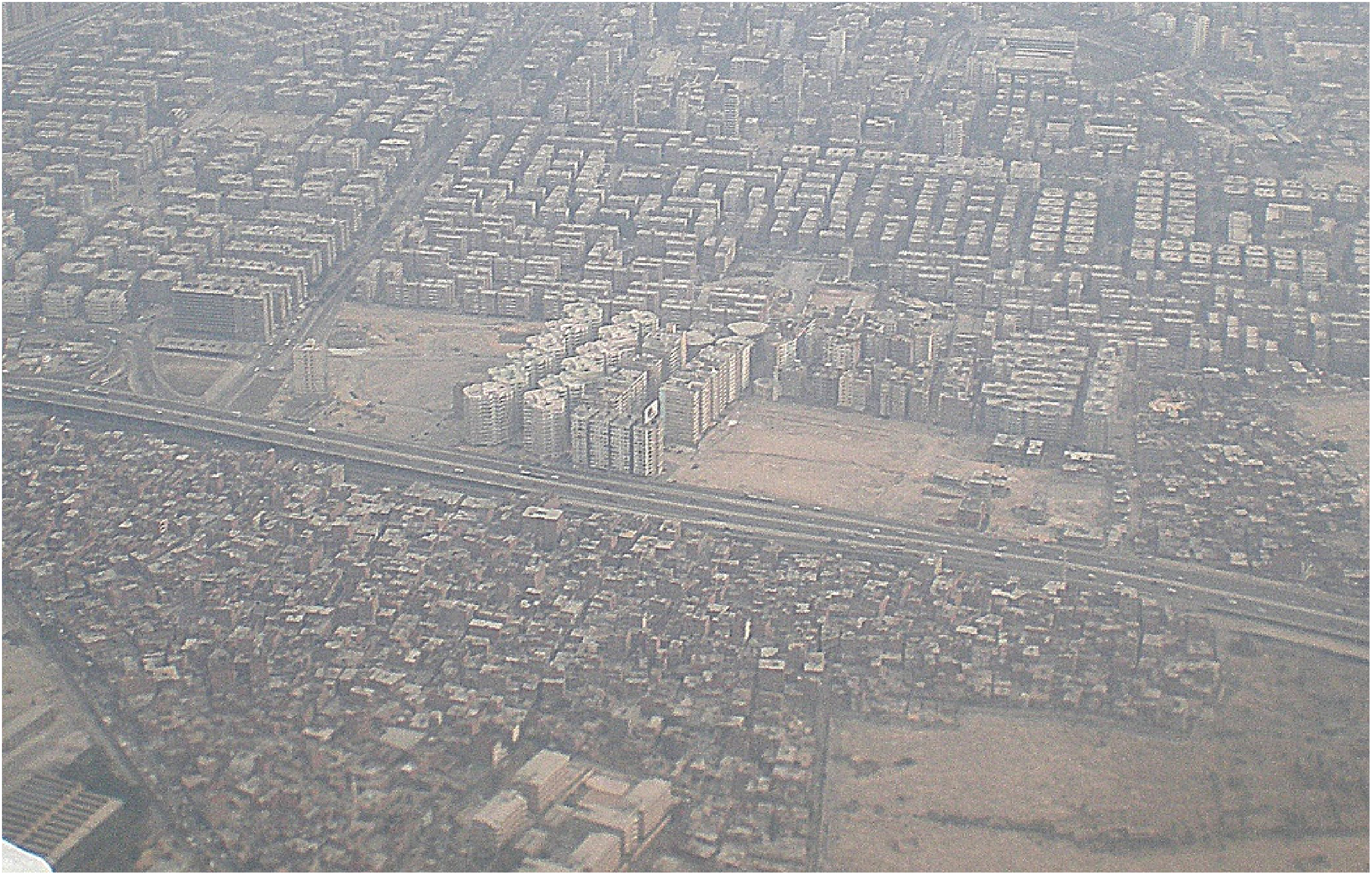
Cairo, 2008.
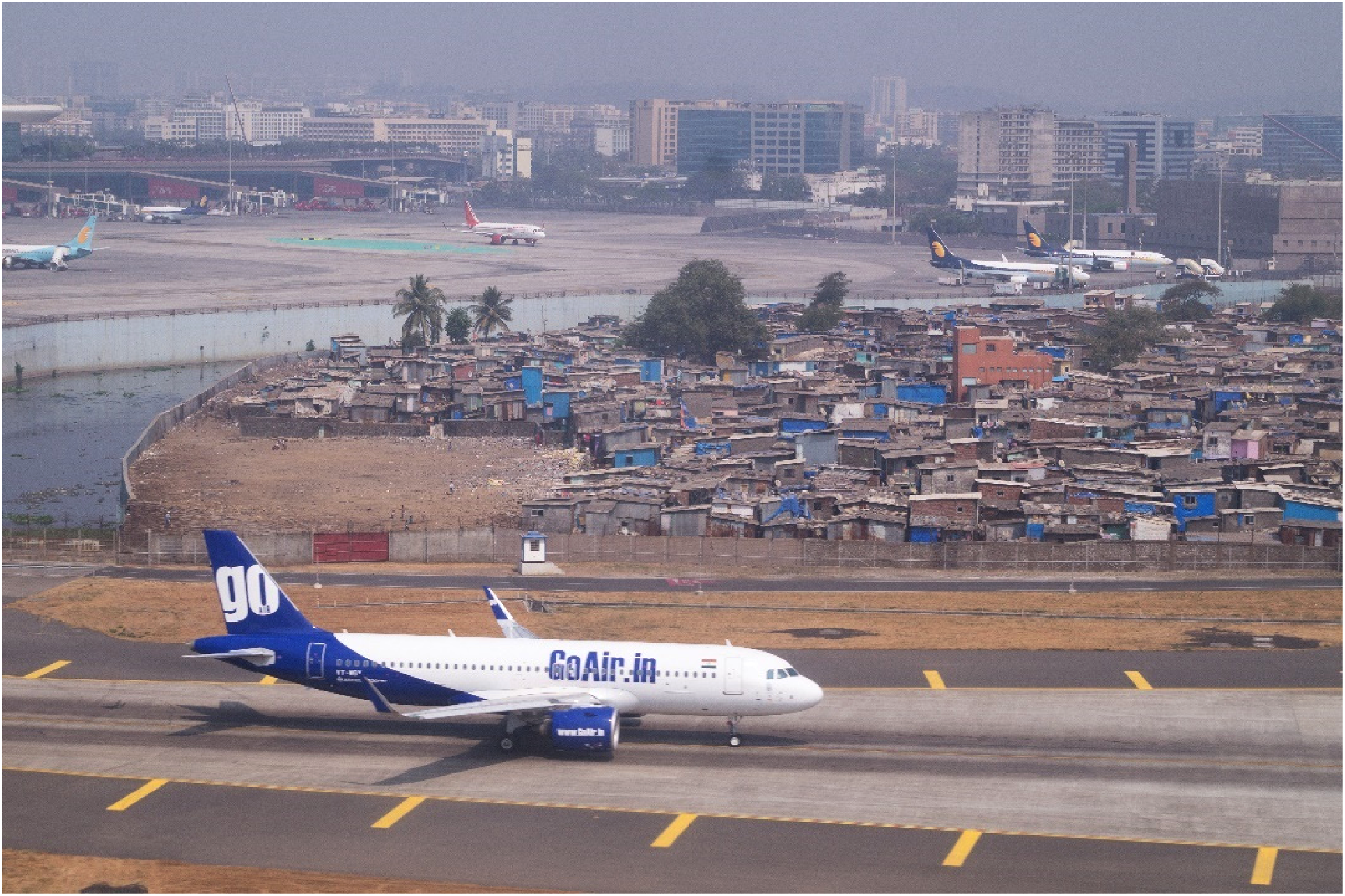
Mumbai Airport, 2019.
Two worlds present themselves in this image of Mumbai Airport – bare-bones survival in the everyday fabrics of do-it-yourself (DIY) urbanism, and a dynamic, globally connected version of hyper-mobility via a mimicking of Global North (or East) infrastructure. Jagged and unfair as they are, the inequalities in city fabrics betray a complicated relationship. While the airport itself would surely want to raze the informal settlements that hem it in, the reality is more muddled. First, airport workers also live in the surrounding informal settlements, which dull the sharpness of the two fabrics. Second, the everyday fabrics have stood their ground for decades, their persistence the product of sheer size and loyal voting. This case of ‘occupancy urbanism’ (Benjamin, 2008) has enabled a roughly balanced pattern of corrugation.
The final vignette of the corrugated city comes from the emergence of a new global edge city (World Trade Center, São Paulo; Figure 3) and, in its shadows, a long-established favela (Jardim Edithe), ‘in themselves seen as potentially interruptive parallel environments, peripheries whose messy horizontality rivals the obsessively sleek verticality of the global centre’ (Jordan and Lindner, 2016: 6).
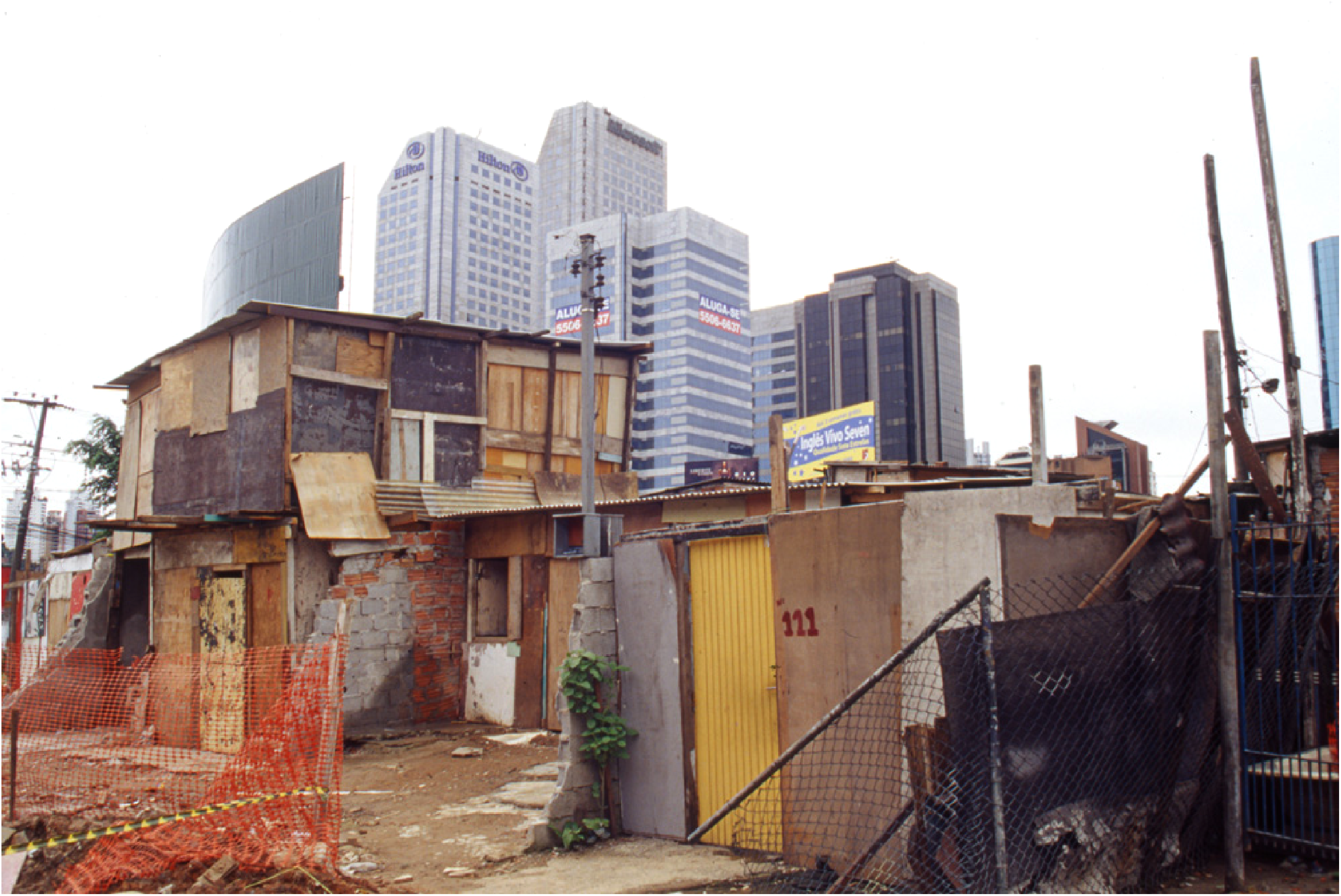
São Paulo, 2006.
The World Trade Center has grown since the 1990s, emulating Global North fabrics, particularly the production of expressly global and privatized edge city business districts to house internationally oriented businesses, part of an emerging, polycentric corporate geography within global city regions. There is no middle ground between the two fabrics. But as a coda, the favela was demolished in the 2010s to make way for the originally planned transportation corridor – all that is left now are the powerful city fabrics.
I can use this last vignette of the corrugated city to segue into the lopsided city, which also can be visualized, particularly where the powerful are encroaching upon the everyday in very specific (and detrimental) ways. The lopsided city is where the powerful few hold increasingly disproportionate power over the majority of the urban population, an extreme version of inequality and unevenness that suggests one side is winning (but has not won entirely yet). This contrasts with corrugation, which suggested that the middle is losing out equally to the extremes at the top and bottom. The next vignette is the most blatant in favour of the lopsided city: the emergence of so-called ‘pencil towers’ in places such as Hong Kong and New York, their very materiality a direct manifestation of the demands made by the super-rich on city space, of their desire to vertically secede from the rest of society. A phenomenon of the 2010s, these pencil towers (or toothpick buildings in Hong Kong) are built to the maximum height rather than a footprint. But further height is added by buying up air rights from neighbouring buildings, a more intense financialization of space and an extreme verticalism (McNeill, 2020: 816), part of an Expanded universe of ‘virtual’ rights to space, including…subterranean land ownership rights, transferable and distributed space ownership rights, which are reconfiguring conventional property development valuation and practice, and which require enhanced skills in interpreting the valuations and metrics that constitute city development.
In the concatenation below (Figure 4), the intervening 11 years show how the Midtown Manhattan skyline had been transformed by a bumper crop of pencil towers. Airspace has been traded and colonized in a way that is completely out of scale with surrounding city fabrics. More elevator shafts than buildings, these pencil towers exaggerate the powerful city fabrics to an almost satirical degree, constituting among the tallest buildings in the world. A product of excess airspace, capital, super-rich buyers and financial secrecy, these conspicuous developments reflect too much wealth and too much power, lop-siding the city further in favour of the powerful.
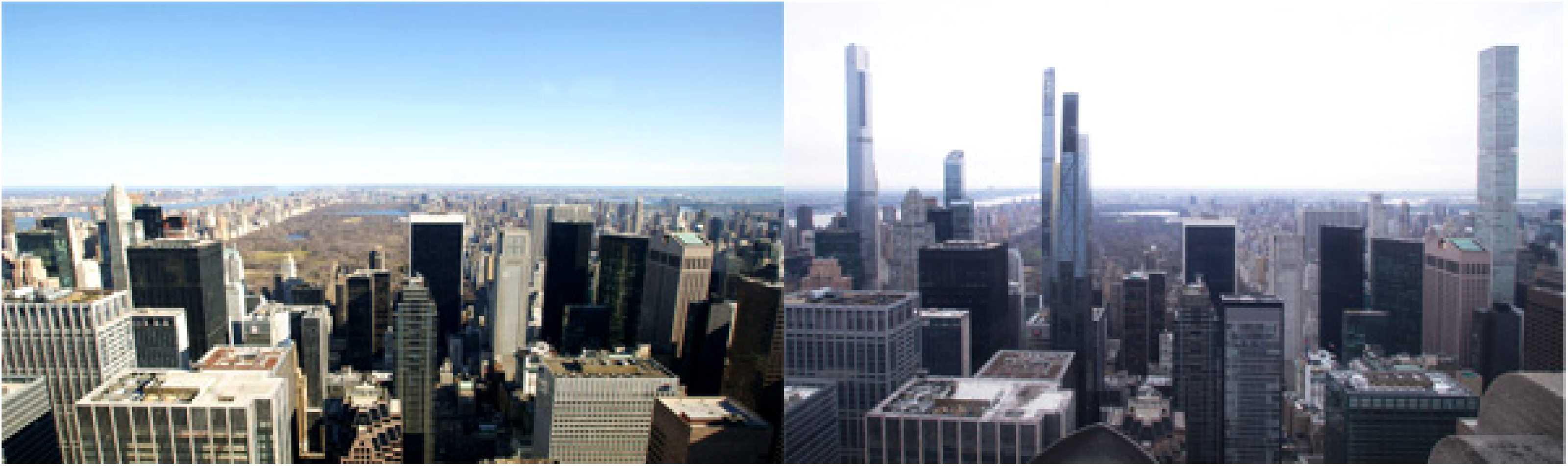
View north from Rockefeller Center, 2012 and 2023.
The next vignette captures the radical speed, scale, specialization and scope of redevelopment in the Global East – particularly but not exclusively in urban China – which has led urban studies to take seriously the materiality inherent in this massive, unprecedented state-supported densification of the city fabric. A variety of authors (Kim, 2015; Lees et al., 2016; Shin 2016; Wu and Keil, 2020) have underlined what Ong (2011) called ‘hyperbuilding’, which is maximizing redevelopment, but also inter-referenced by spectacular structures designed for world recognition. For Roy and Ong (2011: xv), ‘Asia is a geographic location, a space of urban innovations, as well as an emergent symbol for urban renovations that have global applicability’. Here I was inspired by Sze Tsung Leong's work on the jarring juxtapositions produced by headlong hyper-development in Chinese cities, with Shanghai as the most acute (Figure 5). Arriving in September 2017, I found visual evidence of older and less vertically built environments – especially the shikummen in central areas such as Laoximen – being rapidly demolished to accommodate dramatic densification.
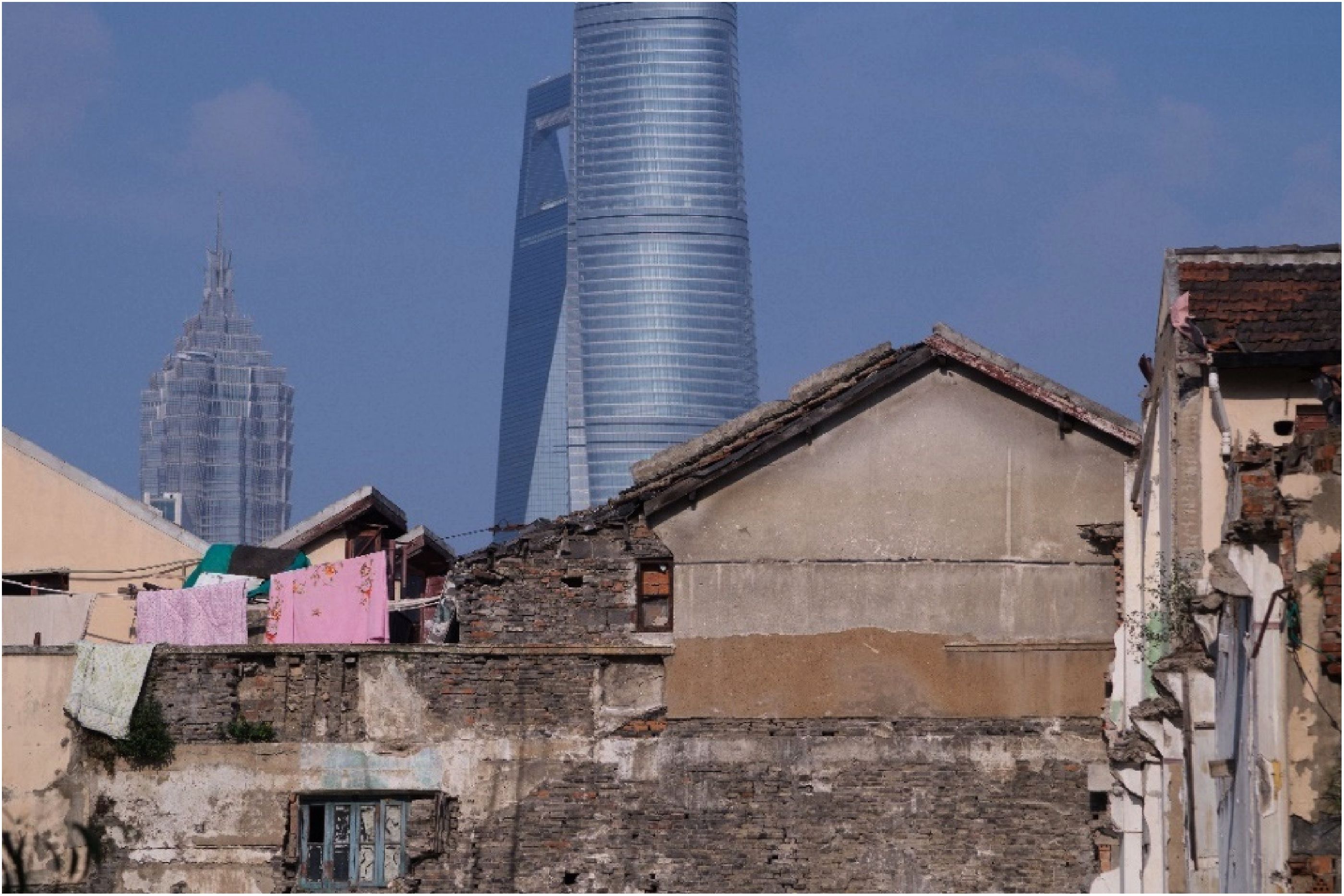
Shanghai, 2017.
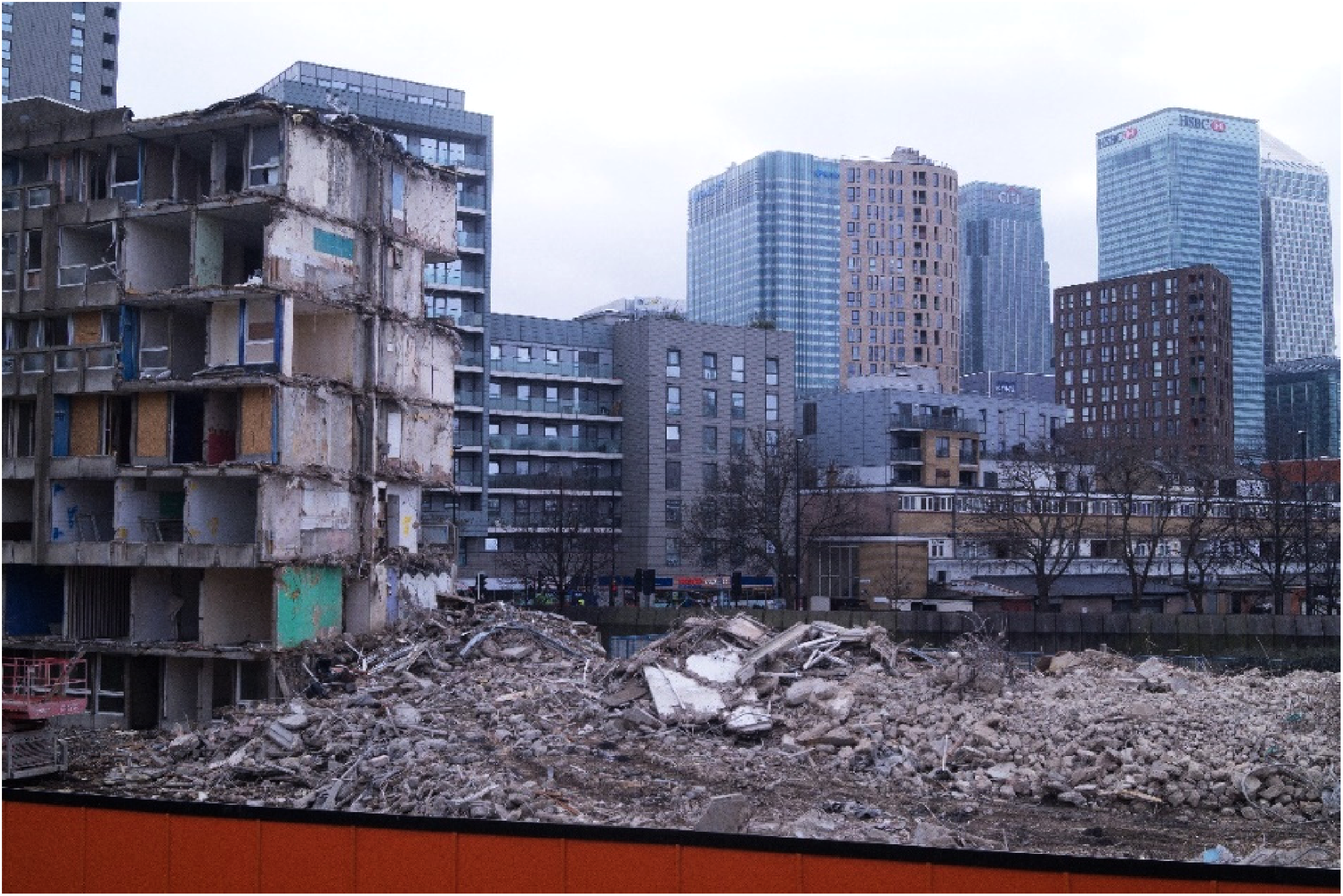
Demolished Robin Hood Estates, East London, 2018.
With their low-rise structures, humane scale and intimate courtyards, these everyday city fabrics contrast sharply with the taller, denser and cookie-cutter towers sprouting all around. The social geography of the city thus changes from horizontal to vertical, from intimate to sterile and disconnected. The balance of power tilts in favour of powerful city fabrics where the older fabrics become at best residual. In effect, this ‘mega-urbanization’ engenders massive displacement on a scale even larger than the immediate postwar regeneration of Global North cities, akin to Robert Moses ‘on steroids’. This is invariably accompanied by very rapid redevelopment that allows little sentimentality for the older city fabric (see Knowles and Harper, 2009 for Hong Kong), involving significant densification and verticalization.
The final vignette illustrates how powerful city fabrics are again erasing everyday ones. Specifically, this vignette juxtaposes the ‘high and dry’ nature of residual social housing and the increasingly dynamic and powerful city fabrics that threaten to overtake it. Large-scale, mid-twentieth-century social housing in the Global North is the epitome of the everyday and the logic of inclusion, but its continued existence is far from guaranteed. This is particularly the case in highly dynamic cities where these developments are seen as standing ‘in the way’ of a more modern city aesthetic (Lees et al., 2016), putting those social housing projects at risk while the lopsided city becomes even more blatantly expansionist. The cases of London and New York both convincingly capture the expanding lopsided city where social housing is demoted to make way for a newer, higher-density and altogether different fabrics. In London, strategically located social housing such as the Heygate Estate in Elephant and Castle and the Robin Hood Estate near Canary Wharf were demolished in 2013 and 2018 (Figure 6), respectively, to make way for a ‘social mix’.
In New York, social housing has largely remained untouched but has increasingly been overtaken by neighbouring infill developments for much wealthier residents, such as One Manhattan Square on the Lower East Side (Figure 7).
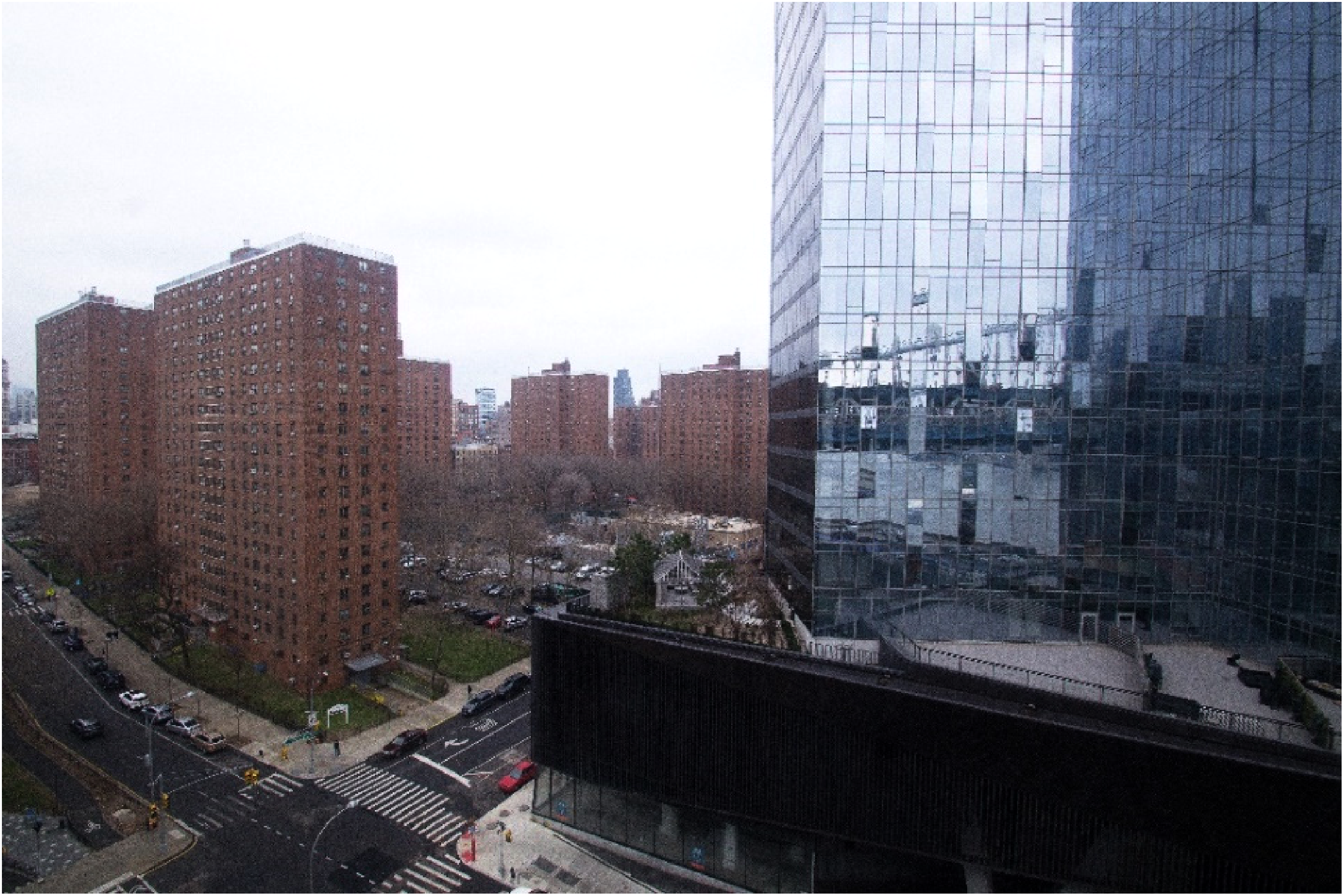
Rutgers Housing Project (left) and One Manhattan Square (right), 2023.
A clear set of winners are making increasing demands on city space, upsetting the rough balance in which the rich and poor were equal in their claims, as Zukin (1992) underlined 30 years ago between power and vernacular. This divergence became especially acute in the wake of the 2008 global economic crisis, when the 1% became more energetic in their colonization of city space, abetted by a pliable state and the globalization and financialization of pied-à-terre real estate (DeVerteuil and Manley, 2017), itself turbo-charged by sustained low-interest rates and successive tech booms. These trends are reinforced by the larger shift from capital investment in commodity production to real estate. And so cities are moving beyond separate and self-perpetuating trajectories for the best and worst areas (Wacquant, 1999) – a sort of corrugation, even with in the cities of the Global North – and towards reconfiguration by the former over the latter through encroachment or erasure.
Revisiting class-driven and class-based inequality from the 1990s
Radical urban studies and Marxist political economy have long held the view that cities are more unequal than society as a whole. This distinguishes urbanity from other social realities, in that the city is both related to but also independent of capitalism and the state (Walker, 2015). The city becomes, in Peck's (2015: 168) words, a ‘conjunctural alloy’ of large-scale processes and structures. Unpacking this statement, I emphasize the notion of uneven spatial development championed by the Marxist political economy of Henri Lefebvre, David Harvey and Neil Smith, and the various ways to manage the capitalist city, drawing on work by Jamie Peck, Nik Theodore, Neil Brenner and others, but also extending to incorporate the global/local relationality championed by Doreen Massey. Yap and McFarlane (2020: 262) framed these points of reference in terms of inequality, especially the relationships between economic processes – production, exchange and capital flows – and the political and social forces shaping [for instance] poverty. Here, urbanization plays vital roles in driving the global economy, absorbing surplus wealth, and unequally distributing resources and provisions across the city. Harvey, for example, has brilliantly elucidated the spatial and social destruction caused by capitalist urbanization, while Lefebvre's examination of the production of urban space has exposed the close interplays of ideology, labour processes, socio-spatial polarization, the built form and everyday life.
The lopsided city presents a distinct challenge to current understandings of inequality in and of the city. More specifically, the informal and fragmented perspectives that developed from, and worked so well with the corrugated city, seem ill-suited to capture the largely formal and monolithically class-driven nature of the lopsided city. In response, can a revival of previous insights generated during the last explosion of inequality in the city – the 1990s – give some insight into current conditions? A positive answer demands that I revisit the 1990s heyday of studying inequality in urban studies, not only to develop my own arguments around reviving its insights, but also because it coincided with the high-water mark of the radical/critical political economy approach. I want to focus on the 1990s as a crucial transitional decade; it is high time we re-position the coherent, forward-looking insights on the fundamental shifts in the scale and scope of inequality as they urbanized. This decade was also crucial to my own development as a student of the city, in terms of going beyond stating the causes of the unequal city and towards an understanding of its consequences, directions and intensity. While frequently treating inequality as a meta-narrative, this period did allow a capacious entrée into then-current urban conditions, bolstering claims that the city is inherently unequal in its manifestations, more so than society as a whole.
The tight coupling between political economy and the study of inequality in cities in the 1990s featured a series of foundational texts that positioned inequality at the very centre of debates around the nature of urbanism: Davis’ (1990) fortification thesis, Sassen's (1991) polarization thesis, the ‘dual city’ (Mollenkopf and Castells, 1991), Zukin's (1992) power/vernacular, divided cities (Fainstein et al., 1992), social justice (Smith, 1994), the urbanization of inequality (Merrifield and Sywngedouw, 1996), Douglas Massey's ‘age of extremes’ (1996), the revanchist city (Smith, 1996), the ghetto/enclave/citadel model (Marcuse, 1997), and the coming of advanced marginality (Wacquant, 1999). All of these works captured the increasing concentration of wealth and poverty amplified and reinforced by a ‘powerful process of geographic concentration’ (Massey, 1996: 395). This underlined how the affluent had become more spatially concentrated by the 1990s, with the rise of exurban gated communities, the gentrification of amenity-rich neighbourhoods in older cities, and the erection of fortified downtown and edge city developments.
Let me consider the key lessons for each of these works as they were presented in the 1990s, rather than burden them with various amendments, critiques and codicils from the ensuing decades. I begin with Sassen's (1991) foundational work into the especially unequal, if not polarized, nature of the global city across London, New York and Tokyo. There she stated that the globalization and bifurcation of the urban labour market and the demise of Fordism had led to growing wealth and (working) poverty at the expense of the middle class. Her polarized global city thesis became the starting point for ensuing debates around the relationship between globalization and inequality in the Global North. She contended that large, global metropolitan regions inevitably created rising spatial and socioeconomic polarization. Incomes were polarizing because unprecedented increases in the numbers of high-level professionals working in transnational industries (their very growth spurred by globalization) coincided with the downgrading of well-paying manufacturing jobs and the increasing informalization and casualization of basic economic activities. This contrasted sharply with the growth of the middle class under Fordism, ‘based on an industrial complex that leads not to the expansion of a middle class but to increasing dispersion in the income structure and in the bidding power of firms and households’ (Sassen, 1991: 361). Global cities were seen to be at the extremes of this class polarization, particularly as they were increasingly dominated by immigrants from the Global South. Sassen's focus on the local consequences of inequality and globalization attracted substantial attention and criticism, including its dubious applicability to non-American cities where racial and immigrant divisions were not as pronounced, where the middle class was not shrinking, and where the welfare state was more proactive in countering gross inequalities (e.g. Hamnett, 2003; May et al., 2007).
Inspired by Sassen's (1991: 343) insights that ‘a new class alignment is being shaped, and global cities have emerged as one of the main arenas for this development…they contain both the most vigorous economic sectors and the sharpest income polarization’, a variety of work on the promise and perils of an emerging ‘dual’ or ‘divided’ city became commonplace as the decade proceeded (Fainstein et al. 1992; Merrifield and Sywngedouw, 1996; Mollenkopf and Castells, 1991; Zukin, 1992). Fainstein et al. (1992) focused on New York and London as hypothetically ‘divided cities’, building on Sassen's work but also on uneven development and the underclass thesis from Wilson (1987). The authors were careful not to buy into a total polarization scenario, but to ground tendencies towards ‘social duality’ manifesting itself spatially via intense class-based segregation and stunted social mobility. To wit, the capitalist city by its very nature creates social inequality and then sustains it via a complexly polarized material-built environment and intra-urban forms. Globalization and economic restructuring during the 1980s had intensified older social divisions (especially racial) but had also created new fault lines, adding complexity to the ‘dual city’ hypothesis explored by Mollenkopf and Castells (1991). Those authors concluded that New York was divided between a coherent core of highly paid professionals and a ‘disorganized periphery fragmented by race, ethnicity, gender, occupational and industrial location, and the spaces they occupy’ (p. 402). While Fainstein et al. (1992) noted the uncritical use of this (more complex) dual city outcome, they remain convinced that of the three main class groupings in New York and London, power had shifted to the top group (however defined) while the bottom group has expanded, leaving an eroded middle.
With more focus on the city fabric itself, Davis’ City of Quartz (1990) presented a totalizing reading of a single city largely through the lens of inequality. In Chapter Four (‘Fortress LA’), Davis outlined a distinctly material perspective of class-based inequality as it metastasized into a jagged built environment. Davis advanced the idea that the built environment followed deepening social inequality through fortification, gating and surveillance (see also Caldeira, 2000 for a Global South equivalent). Building on Davis, Zukin (1992: 197) saw inequality increasingly entrenched in the built environment of places such as New York and London: Cities always struggle between images that express a landscape of power and those that form the local vernacular. While power in modern times is best abstracted in the skyscraper outline of a city's financial wealth, the vernacular is most intimately experienced in low-lying residential neighborhoods…outside the commercial center. Urban form has been especially vulnerable in recent years to an asymmetry of power favouring the private sector. Since the 1970s, because of the withdrawal of federal funding and the aftermath of local ‘fiscal crisis’, city government have become more dependent on pleasing private investors… (1992: 210).
Up to this point, the injustices associated with inequality had been perhaps implicit. But in the preface of his book, Smith (1994: 1) noted the intimate link between inequality and the need for social justice to better urban conditions: There is much talk about gaps these days. There are gaps between the ‘haves’ and ‘have-nots’ in our own society, and in others….how we respond to these situations, for examples whether or not we see those better-off as deserving their advantage, involves considerations of social justice. But there is more to inequality than the possibility of injustice. Gaps can be dangerous, threatening personal safety, social order and stability. Minding the gaps may be as much a matter of prudence as of morality.
This segues to the early 2000s work influenced by the Regulation School, which produced a certain rebalancing from the gloomy, perhaps even dystopic, representations of supposedly congenitally unequal cities. In a highly influential Antipode special issue (2002), the city was shown to be both highly unequal as a consequence of neoliberalism, and also the arena of resistance against (and practices beyond) neoliberalism (Peck and Tickell, 2002). As spatial fixes for capital, cities were presented as always on the knife edge between destiny and demise, always unequal and unfair, but also always full of opportunity and dissidence. This notion was simultaneously developed by Smith's (2001) concept of urbanization from below that challenged dominant understandings of globalization and transnationalism as uniquely top-down processes. Rather, there was a concomitant urbanism from below that served to ‘indigenizing the “global”’ (2001: 1), unintentionally presaging post-colonial perspectives on the city (Robinson, 2002).
While lively class-driven debates within radical urban studies around inequality in and of the city petered out by the 2000s (see May et al., 2007 as a bookend of sorts), the polarization thesis remained potent in at least one sub-field of urban studies, that of gentrification studies. For its proponents, gentrification acts as a way to downscale the more abstract notions of inequality onto specific processes of real estate re-investment, landscape change and class displacement by incoming gentrifiers. Indeed, Smith's (1996, 2002) revanchist city thesis could be taken as an early example of the lop-siding city. Lees et al. (2016: 6) framed these dynamics as follows: ‘we are concerned with uneven spatial development in cities and the modes of regulation that manage capitalism in cities, especially in its current phase’. And while gentrification studies have become a massive literature in their own right, absorbing a considerable array of processes beyond incumbent neighbourhood upgrading, including urban regeneration and governance, it has not developed theories of inequality per se but instead apply previous ones (especially around uneven development) to local outcomes. If gentrification were a camera lens, it would be a zoom rather than a wide-angle, capturing a particular facet rather than the whole. Inequality in the city exceeds what can be captured by gentrification – this can include other kinds of class struggle beyond capitalist accumulation in the built environment and subsequent displacement, including labour market precarity, macro-trends in immigration, suburbanization, but also the sheer scale of regeneration in cities recognized by a Global East perspective.
Application to the lopsided city
The current surge in inequality towards the lopsided city is reminiscent of the 1990s, a decade during which urban inequality deepened and became entrenched. But unlike the 1990s, the field of urban studies is currently far more imploded and fragmented, and less obviously driven by class analysis. It would seem appropriate now to strategically intervene by applying the revisited legacies from the 1990s to the current transition to the lopsided city. I will accomplish this by applying (and thereby salvaging) seven key legacies from the 1990s heyday: an unadulterated class-driven analysis; an empirically rich approach; attention to the top-down, state-imposed nature of the city fabric; an attunement to the built environment; a focus on totality over the fragments; an abiding concern for social justice; and an enduring fascination with the extremes.
The single-minded focus on class-based inequality featured in the 1990s can certainly be applied to the current lopsided city in 2023, including persistent labour market bifurcation, class polarization and social duality. This longstanding ‘Manhattanization’ of cities, where the poor and rich live side-by-side while the middle classes wilt, continues to resonate 30 years after Sassen, Fainstein, Mollenkopf, Castells and Zukin provided their insights across various (global) cities. These insights, however, are now exceeded by several trends in the lopsided city. The first and most obvious is the blatant interventions by the powerful to encroach upon and erase everyday city fabrics, whether through pencil towers, state-sponsored densification or the erosion of social housing. In these ways, we are witnessing the vertical mansionization of cities, a pied-à-terre urbanism (DeVerteuil and Manley, 2017) taken to its extremes. The shrinking middle ground of the ‘dual city’ has now been superseded by shrinking everyday city fabrics, a fate feared by Zukin in 1992 and Neil Smith in 1996.
The second legacy of the 1990s heyday was its empirically rich set of single and comparative case studies, focusing on global cities such as London, New York and Tokyo. This empirical-based approach can be equally useful when applied to the lopsided city, the processes and outcomes of which are still relatively understudied. Of course, since the 1990s, the realm of comparative urbanism has greatly expanded (Robinson, 2022), moving well beyond Global North cities (and global cities) to encompass a much greater range of empirical case studies and sites of theory building. Any understanding of the lopsided city must therefore incorporate a more open approach to the world of cities, one that retains a focus on global cities of the Global North (and the Global East) – given their symbolic weight in urban theory but also their real-world influence in policy terms – while substantially growing the number and types of other ways of urbanism, building on the post-colonial insights into the corrugated city.
The third legacy of the 1990s heyday was its insistence on the formality of the city fabric, of how developers and the state were beginning to collude on more aggressive forays into everyday city fabrics on behalf of powerful interests. So rather than a fragmented view of the informal and formal vying for power over the city fabric, as in corrugated cities of the Global South (e.g. Caldeira, 2017; Roy, 2009), top-down impositions are far more evident in lop-siding cities of the Global North. For instance, the encroachment and erasure of social housing in cities such as London and New York epitomize this public–private alliance that aims to reconfigure marginal everyday fabrics located in highly valued locations (Lees et al., 2016). The same goes for a certain kind of Global East urbanism, where massive state-sponsored redevelopment is the foremost way in which cities are reconfigured, ranging from Shanghai to Seoul and Singapore.
The fourth legacy of the 1990s heyday was the important attention paid to the city fabric itself, via Zukin, the LA School, and Marcuse. The built environment matters in manifesting but also consolidating polarization. A polarized social order in the city will yield a polarized city fabric – this was well-documented in the 1990s, particularly by Davis (1990) and Zukin (1992). But it has taken another 30 years to see that the city fabric had begun to lop-side blatantly in favour of the powerful. This is most obvious at the cutting edge of the lopsided city – the pencil towers, the erasure of social housing, and the drastic densification in cities of the Global East. However, and as a point I will return to later, I want to avoid any sort of dystopic reading of these shifts, in that so far the lopsided city remains very much incomplete.
The fifth legacy of the 1990s heyday was the tendency to universalize the urban experience around class-based inequality, but also taking a totalizing approach to the case study cities. This certainly involved a certain ‘bigness’ that no longer pervades an increasingly fragmented urban studies. But such a universalistic approach to cities adopted by radical urban studies and Marxist political economy was long ago rejected in favour of a far more variegated and multi-scalar approach. I acknowledge and appreciate these other strands of knowing cities, even though I argue in this forum for the strategic importance of a class-driven analysis for trends such as lop-siding. I also argue that there is some benefit in partially seeing cities across their totality, rather than solely fragmented as the post-colonial critique would have it. Here I can connect to Harvey’s (2003: 17) approach to transitions in nineteenth-century Paris, where he brought up the difficulty of balancing the totality of the city with its attendant parts, of ‘convey(ing) some sense of the totality of what the city was about through a variety of perspectives on material life, on cultural activities, on patterns of thought within the city. The most interesting urban writing is often of a fragmentary and perspectival sort. The difficulty then is to see the totality as well as the parts…’. As Peck (2015: 169) further argued, conceptual abstraction is not always ‘totalizing essentialism’. Striving to see the whole remains important, to situate what may seem like small-scale changes to the city fabric – pencil towers, the encroachment of social housing, and radical densification – within a larger narrative of lop-siding cities, of balancing totality with the fragmented.
The sixth legacy of the 1990s heyday was its insistence on social justice to frame class-based inequality, especially evident in Smith's (1994) work. Interest in social justice in the city has only exploded since the 1990s, with a flurry of research that extends well beyond class-based injustices informed by post-structuralist and capabilities approaches (Fainstein, 2010; Soja, 2010). The lopsided city reinforces well-established kinds of inequalities, especially around access to urban space and the right to the city. But new inequalities could also emerge when the city becomes reserved for only one group, implicating a host of issues around housing, employment and poverty management (Evans and DeVerteuil, 2018). Allied with this, the final legacy of the 1990s heyday was its emphasis on studying the extremes, a foresight that has only grown in importance. A lopsided city becomes knowable only if the extremes of the powerful and everyday fabrics are taken seriously, rather than the (shrinking) middle ground, and moving well beyond what a corrugated approach could show us.
My application has salvaged certain legacies of the 1990s heyday, but its utility also inevitably brings up certain shortcomings, some of which have already been signposted. Beyond the fact that the academics working in the 1990s could not anticipate a more aggressive lop-siding of the city, several other obvious critiques can be levelled. A focus on the extremes may seem altogether suited to studying the lopsided city, but it also invites dystopic readings. A dystopic reading of the city is necessarily a narrow one, allowing little room for better alternatives and futures. Davis (1990), like much of the self-professed (and much-maligned) LA School, was entranced by the spectacle of surreal inequalities, in turn inadvertently glorifying them, drawn in by the seductive dystopia of the Blade Runner scenario writ large. I must resist the temptation to frame the lopsided city in dystopic terms, given it remains emergent and uneven, such that the relationship between powerful and everyday fabrics continues to be ambiguous. The 1990s heyday was also largely limited to a focus on global cities of the Global North, essentially ignoring large swathes of cities in the Global East and especially the Global South, ordinary or otherwise. And as previously acknowledged, a single-minded focus on class-driven inequalities presents a universalistic optic that misses at least as much as it captures. In the conclusions below, I attempt to respond to some of these limitations by making space for a middle-ground approach.
Learning from the 1990s: Occupying a middle ground
In this forum article, I revisited the 1990s focus on class-driven inequality, salvaging certain key legacies as they apply to the current lopsided city. In the conclusions, I wish to carve a middle ground for the study of the lopsided city, one that acknowledges the limitations of the 1990s heyday but also shows that we lose something by diluting the incisiveness of class-based inequality in favour of a more decaffeinated approach. Such a decaffeinated approach is not primarily driven by class concerns, and thereby departs from a critical political economy of the city, a case perhaps of throwing the baby out with the bath water. Certainly, some aspects can be dispensed with – the dystopic, the narrow focus on global cities of the Global North, the ‘all-or-nothing’ (universalistic) notions that class should dominate urban analysis. Yet others can be retained – the focus on the extremes, empirical richness, paying attention to the city fabric, a concern for social justice, and the importance of formal mechanisms in the city (e.g. the state and developers). Such a revisited, balanced approach can be articulated as a middle ground between high-altitude totalization and low-level, empiricist and fragmented fragments.
Empirically, this retention must be set within a greater range of cities that extends well beyond the Global North (or global cities). In an age of relational (and sometimes transnational) urban studies, this extension can further articulate the relationship among cities of the Global North, East and South. This was implicitly signposted in the polarization debates of the 1990s, in which immigrants – mostly from the Global South – were moving to cities of the Global North and driving the growth of the working poor, while at the same time effectively changing the social order of the global city (Smith, 2001). Conversely, the corrugated nature of the Global South could slowly dissipate as the state imposes more of its will upon the city fabric, as it does in the Global East currently (Lees et al., 2016).
Theoretically, however, I am in no way interested in uniting urban studies and rescuing it from its fragmentation and increasingly muscle-bound conceptualizations. There is certainly no desire to return radical urban studies and Marxist political economy to its dominant status in the 1990s. Rather, I argue that for certain urban trends, such as the lop-siding of the city fabric, a balanced yet class-driven focus on inequality make the most sense. Academic debates come and go, based on waxing and waning interest in certain empirical exigencies and conceptual bandwagons, from structuration theory to the creative city, but this forum rejects this tendency to toss out and bury older, less trendy concepts. Moreover, the lopsided nature of cities is not irreversible. On this note, now is the time to make a simple observation – something that is too lopsided will inevitably fall over. This I knew as a child playing Lego and Jenga, and I believe it might also apply to the future lopsided city. Entropy and failure are always built-in, and cracks in the lopsided city were already apparent during the pandemic that suggested a certain middle ground. Inequality was belatedly re-discovered with great fanfare during the pandemic itself, as it was in the aftermath of the 2008 global economic crisis. While the pandemic further concentrated wealth and income to a smallish clique of people who work from home via technology and hidden subsidies, it also saw a radical growth spurt across many welfare states, as formal mechanisms were (re)introduced to support the newly unemployed and those at risk of eviction. These responses may not be easy to visualize in terms of the city fabric, but they do point to the multiple trajectories that the emerging lopsided city might take in the 2020s.
Footnotes
Declaration of conflicting interests
The authors declared no potential conflicts of interest with respect to the research, authorship, and/or publication of this article.
Funding
The author received no financial support for the research, authorship, and/or publication of this article.