




Abstract
Ecology research has continuously expanded over the last several decades, and is recently experiencing rapid development at the macroscale. Both the number and scope of macro-ecological studies have increased significantly since the beginning of the 21st century. There is a need to reveal the recent hotspotsand challenges of macroscale ecology research, and the macro-ecology and macrosystems ecology were proposed as a way to do this, with global and regional sustainability recognized. Through scientometric analyses, we highlighted common research frontiers and challenges: (1) increased research on ecological functions and processes; (2) taking developmental issues as the core at the macroscale; and (3) continually refined data, scaling methods and models. It is time to solve these existing and possible future problems with multidisciplinary integration to materialize a strong base for ecological sciences to achieve goals of regional and global sustainable development.
Keywords
Introduction
In addition to the basic life guarantee and improvements to the social economy, biotic and environmental protection are important components of United Nations Sustainable Development Goals (SDGs). That is, protecting the biodiversity of life both below water and on land (14th–15th goals), reducing land degradation, and achieving a land degradation-neutral world by 2030. Additionally, combatting climate change and its impacts (13th goal), including public health, food and water security, migration and security, all continue to be major concerns. For all of these goals, ecological research has not developed at full scale in disciplinary participation. As the scope of human activities continues to expand, its influences will affect a wider space (i.e., regional, national, continental, and global levels). More complex processes (from patterns to functions) and hierarchical structures (e.g., trophic levels) are usually the research focus in contemporary ecology at a large scale. Macro-ecology and macrosystems ecology, therefore, were gradually incorporated to discuss these ecological problems.
Macro-ecology was first used directly by Brown and Maurer (1989), and the definition of the term was discussed and defined in the following years. Macro-ecology, beyond describing and explaining large-scale species distributions compared to biogeography, is concerned with the search for general laws, theories, and principles relating to the processes that underlie observed large-scale ecological spatial patterns and temporal changes (Kent, 2007). It is a way of studying relationships between organisms and their environment, such as species-energy relationships (Evans et al., 2005), macro-evolution of species at risk (Davies, 2019), and climate reshuffles competitors (Alexander et al., 2016). However, these research areas have not yet been covered humans as an important interacting component in hierarchically organized systems. Macrosystems ecology involving human activities was thus proposed in 2014, but has not been widely used (Soranno and Schimel, 2014). It can be seen as a “macroscale ecology” that expands ecological research from landscape to global extents with longer timescales and includes biological, geophysical and socio-economic components and their interactions across scales under a dynamic and systematic perspective. This concept transcends the traditional disciplinary boundaries of ecology, considering the complex socio-economic system, intersecting geography, politics, social culture and other disciplines (Heffernan et al., 2014). It provides a new opportunity to understand ecological interactions, patterns and processes on different spatial and temporal scales and has the potential to address important social and ecological challenges in pursuing sustainable development (Rose et al., 2017), that is humans as components (Heffernan et al., 2014), such as in the demand and supply of cultural services.
This paper investigates the research progress and current status of the two fields from 2000 to 2020 using scientometric analysis and information visualization, to understand the development differences and trends of macro-ecology and macrosystems ecology, respectively. Guided by the need to research sustainable development, critical issues for the further advancement of macro-ecology and macrosystems ecology as integrated macroscale ecology are discussed.
Methods
Data sources and processing
According to the above distinction between the two concepts, we searched articles on “macro-ecology” and “macrosystems ecology” using the Web of Science (WoS) Core Collection database with topic searches (TS) (TS = “macroecolog*” OR “macro-ecolog*”) and (TS = “landscape ecolog*” OR “national ecolog*” OR “regional ecolog*” OR “global ecolog*” OR “macro-scale ecolog*” OR “macrosystems ecolog*”), respectively. For the searches, the time span was specified as 2000–2020, and the results were refined by including only articles, reviews, proceedings papers, data papers and meeting abstracts. A total of 2472 and 6255 records were downloaded as text files for bibliometric coupling analysis using “bibliometrix” package in the R 4.0.2 (Aria and Cuccurullo, 2017; Nettle and Frankenhuis, 2019).
We separately analyzed the volume of published articles, word clouds, keyword co-occurrence networks and thematic evolution. Word clouds are a simple and clear way to show the popularity of a theme with different sizes for different frequencies of keywords summarized by authors. The top 50 keywords of high-frequency occurrence were drawn in the word clouds. A keyword co-occurrence network could be generated to determine the keyword that was the most useful in the course of knowledge exchange and produce clusters for similar topics (Zhu and Guan, 2013). To describe the temporal evolution of “thematic evolution”, one cutting point (2010) was inserted in the whole period.
Results
Research trends of the two fields
The number of publications in macrosystems ecology is several times greater than that in macro-ecology, and a gradual increase in the number of publications can be seen over 20 years in both fields. The number of publications in 2020 was ten times that in 2000 for macro-ecology and four times that in 2000 for macrosystems ecology. This illustrates that both fields received increased attention during the early 21st century. According to the word clouds, in addition to the traditional research issues (biodiversity, species richness, and body size) of biogeography, climate change has become a hot topic in recent years. Geographic information system (GIS) and remote sensing are evenly developed and applied in large-scale ecological research, which indicates that new technology promotes the development of ecology at large spatiotemporal scales. Distinctions are evident in that macro-ecology is largely dominated by classic issues of ecology from the species level to ecosystems and from structural characteristics to functional traits at large spatial scales (Figure 1b). Macrosystems ecology tends to be more complex with habitat and landscape as key objects of investigation and application oriented toward conservation, planning, and sustainable development (Figure 1d).
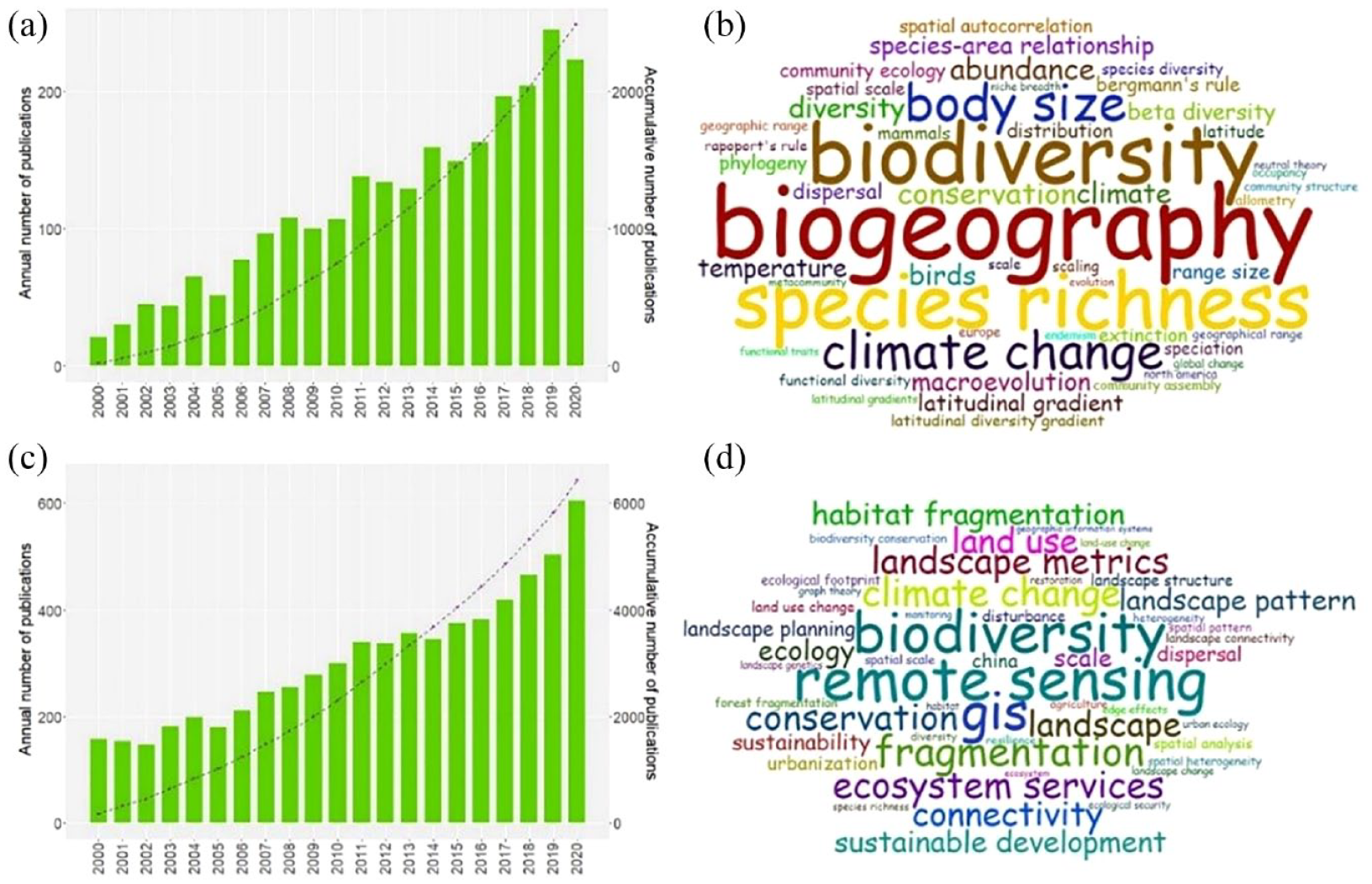
Number of publications (left – a, c) and word clouds (right – b, d) in macroecology (top – a, b) and macrosystems ecology (bottom – c, d) from 2000 to 2020.
Clustering of research hotspots
Keyword co-occurrence networks generalize clusters for similar topics. As shown in Figure 2, four clusters were identified in macro-ecology, with “patterns”, “biodiversity”, “body size” and “climate change” as cores. However, only two clusters were identified in macroscale ecology; one is based on “biodiversity”, “conservation”, and “landscape studies”, which is much stronger. The other is “ecosystem services”, which is a new research theme at its ‘adolescent’ stage. It can also be seen that macro-ecology is oriented to basic scientific research, while macrosystems ecology is oriented mainly to ecological conservation, management, and social demands.
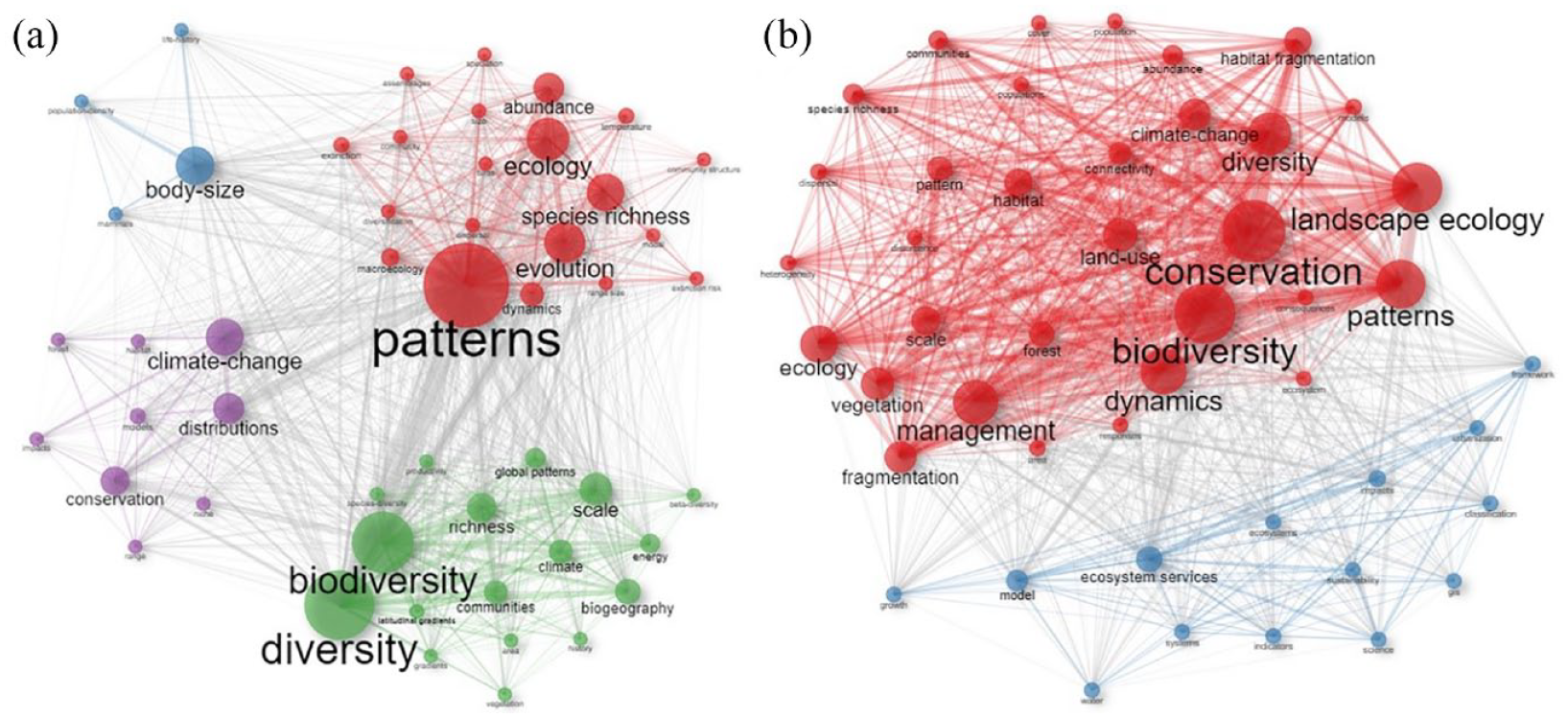
Keywords co-occurrence network of macro-ecology (a) and macrosystems ecology (b) from 2000 to 2020.
Evolution and frontiers
A time-line view of the theme words produced represents the chronological evolution of macroscale ecological research (Figure 3), which reflects the evolutionary relationship among the major themes during two intervals, 2000–2010 and 2010–2020. Obviously, the research direction of macro-ecology has changed from diversity to simplicity (Figure 3a) and from theory and model into two dominant directions (species richness and scaling). Conversely, macrosystems ecology has become more diverse (Figure 3b), and GIS as the technical core has turned into demand-oriented theory and application in ecological research. Additionally, research focused on ecosystem services and sustainable development has received increasing attention. Although they have opposite trends in the number of thematic keywords, the common point is that they are focusing on sustainable research for ecological or social development. For example, from “functional diversity” or “community structure” to “species richness”, which focuses on the problem of ever-decreasing biodiversity. Similarly, there has been a shift in theory or technology toward these problems, such as from a “neutral model” or “metabolic theory” to “species richness” and from “GIS” to “sustainable development” or “ecosystem services”.
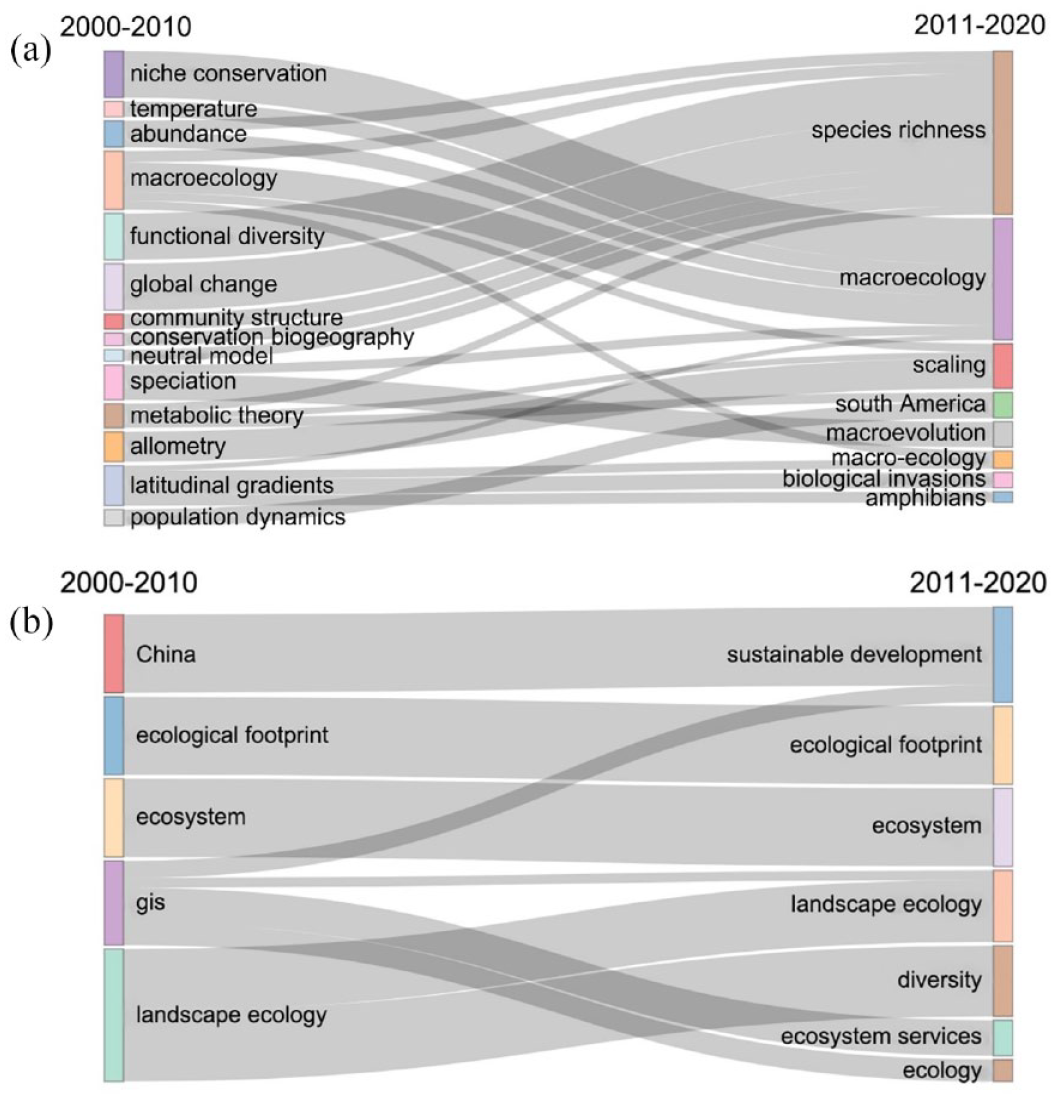
Thematic evolution of macro-ecology (a) and macrosystems ecology (b) during 2000–2020.
Research hotspots and challenges
According to the above results, hotspots are identified through clustering and thematic evolution during the first two decades of the 21st century: (1) increased research on ecological functions and processes and (2) taking developmental issues as the core at the macroscale. These factors put higher demands on data, scaling methods and models. Consequently, possible challenges and perspectives for future ecological research at macro-spatiotemporal scales could also be found.
Increased research on ecological functions and processes
Whether it is the study of single species in biogeography to biodiversity in macro-ecology or the study of ecosystem services in macroscale ecology, this all reflects that researchers are more aware of the multiple functions and processes provided by interactional natural systems and their contributions to human society.
For macro-ecology, in addition to species richness, patterns and diversity, biological conservation to combat climate change is an important emerging topic. According to the 6th Assessment Report of the Intergovernmental Panel on Climate Change (IPCC, 2022), 3%–14% of species in terrestrial ecosystems will face a high risk of extinction when the world warms by 1.5°C. Numerous studies have shown that global warming can cause significant changes in the morphology of individual plants, the composition of species in communities and the carbon cycle of ecosystems (An et al., 2005; Hudson et al., 2011; Niu et al., 2010; Rollinson and Kaye, 2012; Sherry et al., 2007; Wolkovich et al., 2012). Changes in the amounts and frequencies of rainstorms and droughts have also produced profound impacts on the growth of plants, and the structure and functions of ecosystems at regional and even global scales. How these changes affect ecological processes is thus another important research topic. These processes occur at multiple scales from small to large, which is also the main reason why macro-ecology has been proposed and studied.
Other topics in macroscale ecology, such as ecological functions (centered on ecosystem services), have been highlighted recently. The Millennium Ecosystem Assessment (MA, 2005) reveals that human activities have significantly altered almost all ecosystems and functions provided, including support, provisioning, regulation and cultural services. The assessment result is that 60% of ecosystems services are already in a state of degradation or unsustainable use. Studies on ecosystem functions have moved from basic quantitative assessments to flow modeling, including issues related to socio-economic or human well-being (e.g., cultural services). That is also the main content of macrosystems ecology recently proposed, for example, Wu et al. (2020) assessed the evolution of social-ecological systems over millennia.
Taking developmental issues as the core at the macroscale
At a broad scale, ecosystems include not only natural but also social systems. Human activities and demands play a decisive role in developing this system. As shown by the reported SDGs, global environmental problems are deteriorating with the increase in population and human activities, urbanization and economic growth. Ecologists and social scientists increasingly recognize the ecological importance and global prevalence of human influence. The global human population has been projected to increase to approximately 9 billion in 2050 and 11 billion in 2100 (Klein and Anderegg, 2021). Along with this fundamental change, urbanization at a large scale can be elevated and two-thirds of the global human population will live in cities or towns in 2050 (Balk et al., 2021). The growing human population and accompanying living standards demand much more food, water, and other natural resources. Large-scale urbanization can also bring about negative ecological outcomes such as threats to water quality, demographic stability, cultural identity, and exacerbated climate warming (Thapa et al., 2021; Ouyang et al., 2022). Climate change is another great challenge that can increase temperature or precipitation extremes or enlarge dryland areas driven by large-scale warming and drying climates, which will further undermine the ecological and environmental bases for supporting the growing human population on our planet (Spinoni et al., 2021; Tuholske et al., 2021). The interactions of climate change, land use, industrialization, population increase and urbanization make the world full of large challenges in safeguarding resource availability and ecological and environmental security. Research also indicates that four of the seven defined planet boundaries have already reached the status of increasing risk or even high risk globally (Steffen et al., 2015). Therefore, making developmental issues as the core of macroscale research has become increasingly important. As a series of indicators for aggregately gauging human environmental performance at the global scale, anthropogenic impacts can be exacerbated to squeeze the safe operating space toward sustainable development by earth system interactions (Lade et al., 2020). The main demands of ecology and sustainability research at the macroscale will be how to scientifically analyze the mechanism of human-nature interactions and their dynamics, how to develop ways to maintain positive interactions between the components to transform sustainable development from theories into actions, and how to reach SDGs. Ecological benefits and positive interactions can also be created by humans through ecological conservation and restoration approaches facilitating synergetic improvements in ecosystem services and human well-being (Terrado et al., 2016; Huang et al., 2019; Bardgett et al., 2021).
Challenges of data, scaling, and models
The obvious challenge of macro-ecology is the need for more information at multiple scales both ecologically and socio-economically, which means more data, appropriate methods, and accurate models. Macro-ecological data are characterized by large amounts, high dynamics, incompleteness and uncertainty (Benedetti-Cecchi et al., 2018; Wueest et al., 2020). These features pose great challenges for data collection, processing, preservation, and sharing. The rapid developments of field observations, experiments, remote sensing and simulations have strongly promoted the processing technology and methods for the analysis of ecological data (Luo et al., 2011). To provide theoretical guidance for ecosystem management and decision making, it is necessary to timely and effectively integrate observed and experimental data among different sites and regions, time series, and ecological processes that are relevant to multiple factors to reveal the multi-scale responses of ecological systems to environmental and socio-economic changes (Stadler et al., 2006). It is worth noting how to integrate human-related social-ecological data, including income, education, the supply and demand of resources, which is closely related to ecological protection and development. The transformation brought about by the era of big data may provide a cornerstone for forming new ideas, theories, and methods in the field of macroscale ecology (Zhang, 2017).
Scaling methods are critical for advancing both macro-ecology and macrosystems, including large spatial and temporal scales. Ecologists increasingly recognize the significance of history in research on the structures and processes of communities, which will deepen our understanding of the underlying causes of contemporary patterns. Three types of historical information, paleontology and archeological data, phylogenetic correlation of taxa, and historical biogeography, can be integrated into macro-ecological research (Beck et al., 2012). In addition, the horizontal and vertical differences in ecosystems have always been the focus of ecology. Macro-ecology mainly focuses on spatial relationships in the horizontal direction, while research in the vertical direction has generally received attention from critical zone science (from vegetation canopy to rock) (Lü et al., 2019). The integration of horizontal and vertical research is one of the important aspects that should be considered when evaluating ecological processes and the multifunctionality of ecosystems across spatiotemporal scales in the future (Luo et al., 2019). In the horizontal direction, both the biotic and abiotic characteristics of ecosystems exhibit gradient and scale differences to some extent, leading to the regional differentiation of biological behaviors, physical migration, and ecological processes. Scale dependence makes it difficult to obtain consistent conclusions. When a large-scale rule meets a specific local feature, scaling up and down with more algorithms and parameters under special laws is also necessary. Therefore, the identification of scaling rules is essential for understanding potential nonlinearities in system-wide interactions and feedbacks (Harte et al., 2009; Locey and Lennon, 2016; Peters et al., 2007). Macro-ecological researchers often consider ecosystems as a whole and explore how the processes respond to impacts from finer (e.g., individual) or broader (e.g., continental) scales (Evans et al., 2012; Peters et al., 2007). It is extremely difficult and even impossible to conduct controlled experiments in the field at landscape or larger spatial extents. Consequently, modeling is a suitable way to identify the influence from different parameters in a system to determine and compare the responses under different conditions. Rose et al. (2017) discussed how human behaviors affect ecological processes and interactions through four predictions, i.e., “expansion”, “shrinking”, “speeding up” and “slowing down”. Such theoretical generalizations and related methodological development are badly in need of advancing their modeling tools for ecological investigations at macroscales (Cabral et al., 2017).
Models are cost-effective tools supporting macroscale ecological research. In recent years, some mechanical and process-based models have been developed to discuss the complexity of biodiversity and ecosystem dynamics at different scales (Gotelli et al., 2009; Harfoot et al., 2014; Purves et al., 2013). Predictive biological models provide a means for scientists to project changes in species and ecosystem responses to disturbances such as climate change (Urban et al., 2016), which has always been the core of macro-ecology and even ecology. The values of large amounts of ecological data depend on how the data can be integrated into an ecological model to predict future changes. The combination of observed, experimental and remote sensing data in mechanical and process-based models is effective for evaluating model performance, optimizing model parameters, reducing model uncertainty and improving prediction accuracy (Niu et al., 2014). Meanwhile, the use of multisource input data increases model uncertainty, which will have significant impacts on model predictions and their applications in the field of ecological planning and management (Dormann et al., 2008; Cabral et al., 2017).
Macroscale ecology necessitates disciplinary integration toward sustainable development solutions
Ecology has evolved into a very broad branch of science that spans from molecular and genetic levels to the level of the whole biosphere (Anderson et al., 2021). It is still expanding bidirectionally to both micro-scale studies and macroscale ones (McCallen et al., 2019), even classical ecological research themes at organization levels below ecosystem have dominated the published literature (Carmel et al., 2013). Macroscale ecology, no matter if it uses the field of macro-ecology or macrosystems ecology, can be considered one of the more recent advancements of ecology toward large spatial scales. Therefore, overwhelming complexity is unavoidable for carrying out studies in this comparatively new branch of macroscale ecology. To address this complexity, disciplinary integrations within the relevant subdisciplines of the whole ecological science arena are necessary to lay strong theoretical and methodological bases for macroscale ecology, which makes this branch of macroscale ecology interdisciplinary. On the other hand, macroscale ecology usually faces problems concerning the natural ecosystems and their interactions with human societies. Accordingly, political, economic, and cultural issues can also be involved, this calls for the participation of relevant socio-economic sciences, which makes macroscale ecology transdisciplinary (Castillo et al., 2020). In addition to disciplinary integration within and beyond the realm of ecology, ground-based monitoring and observation networks, remote sensing, and methodological development of eco-informatics and systematic ecological modeling are also required to strengthen the advancement of this macroscale ecology (Holzer et al., 2018; Michener and Jones, 2012). Functionally, macroscale ecology needs to attach more importance on application oriented systematic studies of ecological restoration, conservation, climate change adaptation, and decision support for best practices of ecosystem management and land uses at large spatial scales. These can facilitate sustainable development solutions for the coupled human and natural systems in the Anthropocene epoch of our planet.
Conclusions
Macroscale ecology research in the first two decades of the 21st century has had a good start, including research directions, methods and disciplines, but there is still a long way to go. Research on ecosystem processes, ecological functions and socio-economic sustainability as well as data and models need continuous improvement at the macro-spatiotemporal scale.
The more prominent the emerging regional and global problems are (increasing populations, stressed resources, developing economies and degraded environments), the more the discipline needs, including meteorology, geography, environmental science, economics and sociology. It should be the foundation for integrating and advancing sustainability-oriented multidisciplinary and even transdisciplinary macroscale ecological research that will call for theoretical and methodological innovations. Accordingly, the task of maintaining a resilient and sustainable world becomes very complex, which highlights the importance of advancing a big ecology paradigm.
Footnotes
Declaration of conflicting interests
The author(s) declared no potential conflicts of interest with respect to the research, authorship, and/or publication of this article.
Funding
The author(s) disclosed receipt of the following financial support for the research, authorship, and/or publication of this article: This work was supported by National Nature Science Foundation of Sciences (Project NO. 42101110), and Shaanxi Provincial Department of Science and Technology (Project NO. 2022KRM090).