



Abstract
In recent years, shrinking cities have proliferated across China, with the three northeastern provinces experiencing the most significant population declines. These regions are struggling with structural deterioration and urgently need to transition their development models to strengthen innovation capacities. Innovation networks, as key carriers of knowledge, technology, and resources, play a crucial role in supporting urban transformation. This study, based on panel data from prefecture-level cities and patent application and publication flow data spanning from 2008 to 2023, investigates the relationship between shrinking cities and innovation networks. The findings reveal that: (1) innovation network density in the three proviences of China has increased, with expanding external nodes and strong connections to regions east of the “Hu Huanyong Line,” while links to the west remain sparse; (2) within the three provinces, non-shrinking cities experience faster innovation network centrality growth compared to shrinking cities; (3) urban population size is positively correlated with innovation network centrality in both shrinking and non-shrinking cities. However, in shrinking cities, population size does not significantly contribute to innovation network centrality enhancement. The study concludes that innovation networks in shrinking cities can still thrive, suggesting the need for adjusted innovation policies and enhanced cooperation to promote urban revitalization.
Introduction
Since the mid-20th century, developed countries have experienced significant population loss due to factors such as deindustrialization, suburbanization, demographic shifts, and economic globalization (Oswalt, 2005). Between 1950 and 2000, Oswalt’s research found that 450 cities worldwide experienced varying degrees of population shrinkage, a phenomenon known as shrinking cities (Oswalt and Rieniets, 2006). In Europe, one in every four cities with populations exceeding 100,000 faces population shrinkage (Oswalt, 2005). As a global phenomenon, urban shrinkage has attracted significant academic attention.
After experiencing rapid urbanization, China is now facing large-scale urban population shrinkage, commonly referred to as “shrinking cities.” According to data from the Sixth and Seventh National Population Censuses, between 2010 and 2020, 266 cities in China experienced varying degrees of shrinkage, comprising 52% of all cities nationwide. This represents an increase of 86 cities compared to the period from 2000 to 2010 (Meng and Long, 2022). Shrinking cities in China are predominantly concentrated in the northeastern and central regions, exhibiting a regional clustering pattern. By 2020, the total population of the three northeastern provinces had decreased by nearly 11 million compared to 2010, resulting in a regional development imbalance and socio-economic decline.
To revitalize Northeast China, the national government introduced the “14th Five-Year Plan for Comprehensive Revitalization of Northeast China,” which advocates for the acceleration of new productivity formation through technological innovation. In the era of the knowledge economy, innovation has become a core driver of regional socio-economic development and an essential indicator of a region’s future growth potential (Cooke, 2016). In the context of globalization, innovation networks formed by the movement of technology, knowledge, and talent between cities have greatly facilitated the sharing of innovation resources, promoting the agglomeration and spillover effects of innovation, thereby enhancing urban innovation capacity (Huggins and Prokop, 2017). This connectivity has gradually shifted from “physical territories” to “spaces of flows” (Knox and Castells, 1995). Since Castells proposed the theory of flow spaces, an increasing number of scholars have applied flow data to analyze the spatiotemporal characteristics (Taylor, 2010), evolution processes (Cao et al., 2018), causes, and innovation effects of cooperation networks (Choi et al., 2006). However, existing studies have mostly focused on growing cities in developed capitalist countries, with limited attention given to how innovation network characteristics change in the context of population shrinkage and the links between innovation networks and shrinking cities. Additionally, research on shrinking cities has primarily concentrated on the causes of shrinkage (Reckien and Martinez-Fernandez, 2011) and the external effects of population decline in individual cities (Mallach et al., 2017), with insufficient exploration of urban networks and the relationship between external connections and shrinking cities.
This study focuses on 34 prefecture-level cities in the three northeastern provinces of China (due to data availability, the Yanbian Korean Autonomous Prefecture and Daxing’anling District were excluded). The study examines the spatiotemporal characteristics of innovation networks in shrinking cities of developing countries, aiming to analyze whether urban shrinkage affects innovation networks.
Literature review
Definition and causes of shrinking cities
The concept of shrinking cities has been the subject of considerable debate in the academic community, with two main perspectives: narrow and broad. From a narrow perspective, shrinking cities refer to urban areas that experience sustained population loss, typically characterized by permanent decline, which represents the core meaning of urban shrinkage (Hollander et al., 2009). However, there remains controversy regarding the specific criteria for measuring population loss. The International Shrinking Cities Research Network defines shrinking cities as those with populations exceeding 10,000 that have experienced population decline for more than two years and are undergoing some form of structural crisis (Hollander and Németh, 2011). German scholars Oswalt and Rieniets conducted a quantitative analysis of urban shrinkage, defining it as a city that has temporarily or permanently lost a substantial portion of its population, with the loss accounting for at least 10% of the total population or an annual decline greater than 1% (Oswalt and Rieniets, 2006). American scholar Schilling defined shrinking cities as those that have lost more than 25% of their population over the past 40 years, accompanied by vacant buildings and abandoned property (Schilling and Logan, 2008).
From a broader perspective, shrinking cities encompass the overall decline of economic, social, cultural, and demographic aspects in spatial terms, representing a broader definition of urban shrinkage. For instance, Fernandez argues that urban shrinkage involves multiple dimensions, including economic, geographic, demographic, social, and spatial aspects (Martinez-Fernandez et al., 2012).
Urban shrinkage and urban growth represent two divergent processes of regional urbanization, dynamically transitioning with the evolution of urbanization stages. Numerous studies indicate that the formation of shrinking cities is influenced by globalization, institutional change, deindustrialization, suburbanization, and demographic shifts (Wiechmann and Pallagst, 2012). While the causes of shrinking cities are complex, it must be acknowledged that urban shrinkage is not limited to individual cities but is widely associated with the global system, reflecting a “global-localization” nature. It is rooted in the process of globalization and influenced by local policies (Martinez-Fernandez et al., 2016), and it manifests as regional development imbalances (Ma et al., 2020). On the one hand, economic globalization and regional integration have accelerated the flow of factors between regions, reinforcing the siphoning effect of regional central cities. This, in turn, accelerates the outflow of resources from cities with weaker factor aggregation capacities, thus triggering or exacerbating urban shrinkage (Pallagst et al., 2013). Existing research has shown that the opening of high-speed rail in population-shrinking regions has intensified the development gap between backbone cities and other cities (Yang et al., 2024).
On the other hand, in the age of information and networking, urban interconnections have become increasingly tight, and urban development is more significantly influenced by urban network externalities. Urban network externalities refer to the advantages cities gain by participating in networks, manifested in the utilization of complementary relationships and synergies in cross-regional cooperation, generating economies of scale, and expanding cities’ ability to acquire external resources (Meeteren et al., 2016). Cities positioned at the margins or with poorly embedded in the urban network may experience a decline in their aggregation capacity and lack of competitiveness, leading to shrinkage. For instance, Wu Kang and others found that a decrease in investment network centrality leads to a worsening of population shrinkage in shrinking cities (Wu and Yao, 2021). This is particularly true for resource-dependent cities reliant on traditional industries, which, if trapped in a closed development model with weak connections to other cities, may fall into a negative feedback loop, resulting in path dependence (Martinez-Fernandez and Wu, 2007).
For the empirical region of the three northeastern provinces of China in this study, the shrinkage mechanism follows the “global-localization” characteristic but also presents heterogeneity compared to developed countries. The development of Northeast China is characterized by a paradigm deeply embedded in Chinese institutional frameworks and national policies. Key factors contributing to shrinkage include institutional dependence formed by the planned economy in traditional industrial cities and the deprivation of development factors in underdeveloped regions due to policy bias, which are critical drivers of urban shrinkage (Freeman, 1991). This also weakens the region’s external connections, trapping cities in a negative development cycle.
The relationship between innovation networks and urban shrinkage
The concept of innovation networks was first introduced by Freeman, who defined them as a summary of all formal and informal cooperation relationships emerging from the series of innovation activities centered around enterprises (Freeman, 1991). In the current knowledge economy, innovation networks play an even more crucial role and actively engaging in global technological innovation trends has become a vital means of addressing the transformation challenges of shrinking cities. This provides a new perspective on the revitalization of shrinking cities. On the one hand, existing research has found that urban network externalities affect urban population changes, and economic performance, and promote multidimensional connections between cities, utilizing the spillover effects of large cities to foster urban development (Huang et al., 2020; Zhou et al., 2023). For innovation networks, their external effects significantly impact a city’s innovation capability. Cities positioned as nodes within the network can leverage knowledge spillovers to acquire more innovative resources, thus driving industrial transformation and upgrading (Capello and Lenzi, 2019). On the other hand, studies have proposed the concept of “structural advantages” in urban networks, which suggests that cities occupying strategic positions or possessing strong centrality in the flow of network elements have enhanced capabilities to establish external connections that foster economic expansion and social development (Neal, 2011). In recent years, scholars have increasingly recognized the interactive role between innovation networks and urban scale, finding that the activity of cities in innovation networks is influenced by factors such as city size, human capital, and scientific and technological expenditure, with innovation resources often concentrated in economically developed large cities (Caragliu et al., 2016; Lee, 2015). However, existing studies largely focus on growing cities, with insufficient exploration of the mechanisms and effects of the relationship between shrinking cities and innovation networks. There is a tendency to focus on economic networks, with less attention paid to innovation networks such as patent collaboration and knowledge flow. Moreover, most studies focus on developed Western countries, neglecting the unique mechanisms of institutional transformation in developing countries.
Interaction model between shrinking cities and innovation networks in the three northeastern provinces of China
Existing studies on shrinking cities predominantly examine causation through globalization impacts (Wiechmann, 2007), deindustrialization effects (Schilling and Logan, 2008), or institutional path dependence (Martinez-Fernandez, 2016), overlooking network externalities. Recent innovation network research reveals the critical role of interurban knowledge flows and resource sharing in regional development (Sá et al., 2023). Cities including shrinking cities function both as innovation containers and key knowledge network nodes. This establishes our theoretical “Shrinking City-Innovation Network” framework for examining their interactions.
Urban shrinkage as a complex structural process triggers reduced economic efficiency, fiscal austerity and brain drain (Martinez-Fernandez et al., 2012). This simultaneously weakens local innovation foundations and relational capacities, impairing network embeddedness and structural positions within innovation systems (Bokányi et al., 2022). Specifically, population loss diminishes human capital supply and firm and research institution relocation reduces R&D density. Fiscal constraints limit governmental support for technological investment and industrial upgrading. These collectively degrade structural metrics like centrality within regional/national innovation networks (Bonaventura et al., 2021).
Conversely, innovation network engagement offers revitalization pathways: collaborative linkages with universities, research institutes or enterprises enable access to advanced knowledge/technologies for industrial upgrading (Asheim and Isaksen, 2002); high-centrality nodes exhibit greater resource mobilization capacity and policy bargaining power, attracting investment, policy incentives, and talent repatriation (Wang et al., 2020). Thus maintaining or enhancing network embeddedness constitutes a critical transformative pathway.
Institutional frameworks and urban endogenous capacities mediate this interaction. In the three northeastern provinces of China, national policies including the Old Industrial Base Revitalization Strategy, regional coordination strategies and partner assistance provide institutional safeguards and resource channels (Zhang et al., 2024). Urban-level factors like talent pools, industrial structure, innovation capability and governance capacity determine resource absorption, translation, and utilization effectiveness (Li and Ma, 2022)
In summary, this study constructs a theoretical model elucidating the interaction between shrinking cities and innovation networks. It emphasizes examining their reciprocal relationship through the logical trajectory of “Shrinkage Drivers-Network Embeddedness-Interactive Effects”. This model not only expands the theoretical perspective of shrinking cities research but also provides theoretical underpinnings and analytical tools for understanding network strategies and pathway selection during innovation-driven transitions in China’s old industrial base cities.
Based on these points, this study proposes the following research objectives:
(1) To analyze the network structure and spatiotemporal characteristics of innovation networks in shrinking cities.
(2) To explore whether there is a correlation between urban shrinkage and innovation network centrality.
(3) To verify whether the population size in shrinking cities impacts innovation network centrality.
Methodology and data
Social Network Analysis
This study employs Social Network Analysis (SNA) to explore the spatial structure evolution of the innovation network in the three northeastern provinces of China, and the relationship between urban shrinkage and innovation networks at the urban social network level. The study constructs an urban innovation network relationship model using UCINET and conducts a quantitative analysis of the relationships between urban nodes using ArcGIS. Through the analysis of network density, out-degree, in-degree, and urban centrality indicators of the innovation space network in various prefecture-level cities in the three northeastern provinces, this research investigates the spatial characteristics of urban innovation networks. Here, out-degree represents the number of connections actively initiated by each urban node to other nodes; in-degree denotes connections actively established by other urban nodes toward the focal city. Innovation network centrality is calculated through integrated analysis of out-degree and in-degree data.
(1) The innovation network density is calculated by the ratio of the actual number of connections between nodes to the theoretical total number of possible connections, which measures the intensity of connections between spatial nodes in the innovation network. A higher network density indicates a tighter connection between cities (Newman, 2003).

Where: D represents innovation network density; n denotes the number of urban nodes,
(2) The study primarily analyzes the centrality of urban nodes to examine the evolutionary characteristics of the innovation network hierarchy. In network analysis, the position and role of urban nodes can be reflected through various types of centrality, such as degree centrality, betweenness centrality, and closeness centrality. This study focuses mainly on degree centrality because other centrality measures cannot fully reflect the network characteristics in a city network constructed based on enterprise and knowledge flow data. Therefore, in this study, the innovation network centrality of a city is defined as urban centrality (hereafter referred to as urban centrality), and out-degree and in-degree are used as measurement indicators (Borgatti and Halgin, 2011).

Where
Panel data regression model
The spatial structure of urban innovation networks is influenced by multiple variables, including population, economy, transportation, and industrial development, all of which simultaneously reflect the urban shrinkage trend (Acemoglu et al., 2016). This paper introduces a panel data regression model, using urban centrality as the dependent variable and urban population change, per capita GDP, science and technology expenditure, fixed asset investment, and other data as independent variables. The regression analysis aims to explore whether there are differences in the impact of various variables on innovation networks, as well as the relationship between urban shrinkage and urban innovation networks.

Where
The above model can be estimated using multiple linear regression. Panel data typically employs methods such as mixed data models, random effects models, and fixed effects models for regression. Based on relevant research, a two-step procedure combining the F-test and Hausman test is commonly used to select the appropriate regression model. In the first step, the F-test is used to determine whether individual effects exist in the data. If the null hypothesis cannot be rejected, indicating the absence of individual effects, a mixed data model should be used. Conversely, a fixed or random effects model should be selected. In the second step, the Hausman test is employed to decide whether to use a fixed effects model or a random effects model. If the null hypothesis cannot be rejected, indicating that individual effects are random, a random effects model should be used. Otherwise, a fixed effects model should be employed (Wooldridge, 2010).
Data sources
The data for this study’s joint publication is sourced from China National Knowledge Infrastructure (CNKI); the joint patent publication data is sourced from the National Patent Database (http://epub.cnipa.gov.cn/index); population, economic, and social data are obtained from local statistical yearbooks and the city’s national economic and social development statistical bulletins.
Results
Identification of shrinking cities in the three northeastern provinces of China
This research adopts the narrow conceptualization of urban shrinkage, defining it specifically as persistent population decline in urban areas characterized by permanent demographic loss. Consequently, the identification of shrinking cities centers exclusively on the core variable of population quantity, explicitly excluding broader socio-economic contraction features. Shrinking cities are defined as densely populated urban areas with a population of 10,000 or more residents, which have experienced population decline in the past two years and are undergoing some form of structural crisis. Taking into account both the definitions used by the International Shrinking Cities Research Network and the actual conditions in the three northeastern provinces of China, this study employs the following criteria for a comprehensive assessment of urban shrinkage: (1) a resident population of over 10,000, (2) a reduction in population size during the observation period, and (3) a sustained population loss lasting for more than two years. The data source for this assessment is the “urban population at the end of the year” from the official statistical yearbooks of each city during the study period.
By calculating the changes in urban population size from 2008 to 2023, this study identifies urban shrinkage. A shrinkage index less than 1 indicates urban shrinkage, while a value greater than 1 suggests that no shrinkage has occurred (Hollander and Németh, 2011). The expression is as follows:

Where
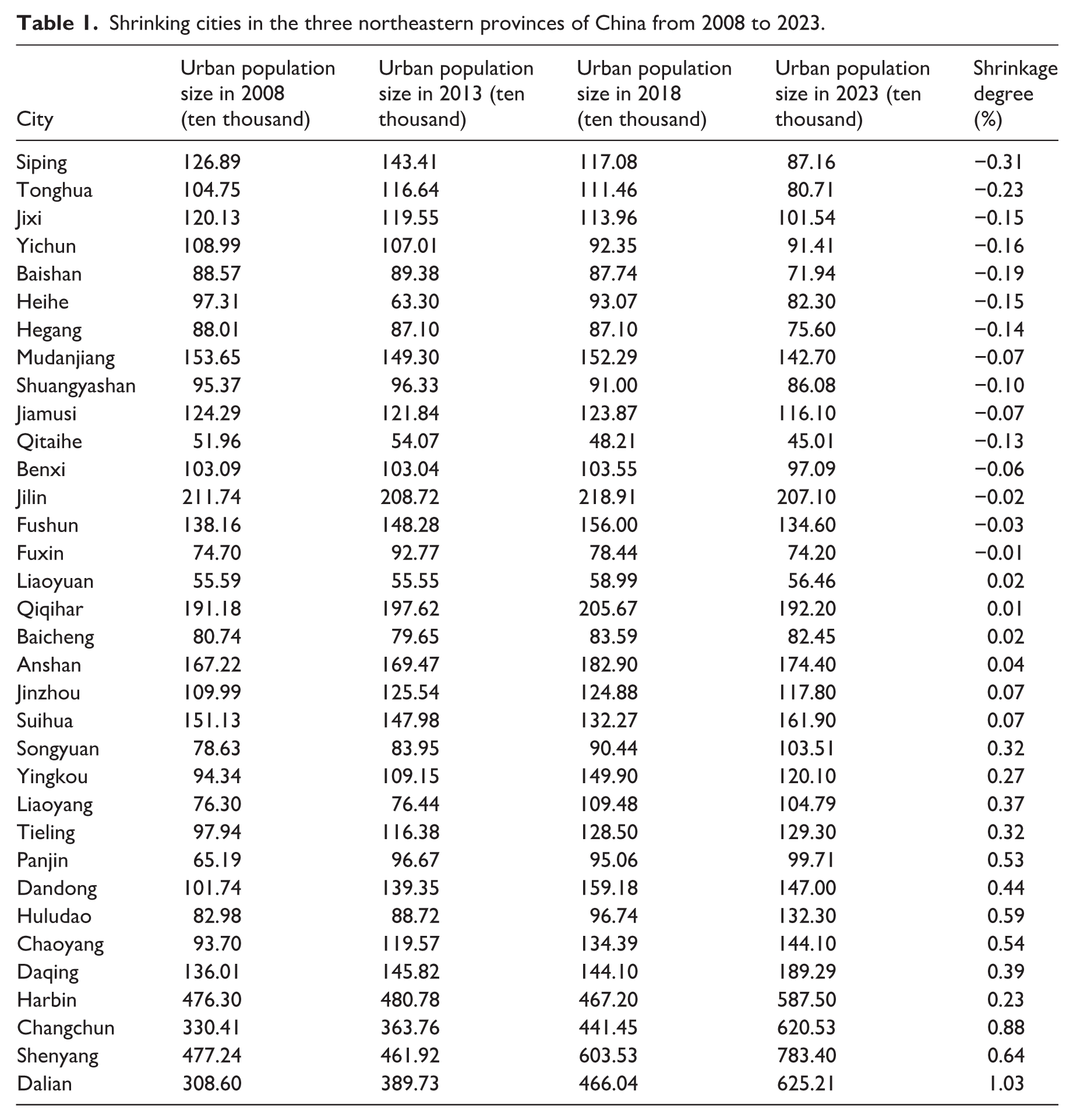
Based on the calculated shrinkage index, from 2008 to 2023, the phenomenon of population shrinkage in the three northeastern provinces is relatively severe. A total of 15 prefecture-level cities experienced population decline, including Siping, Tonghua, Jixi, Yichun, Baishan, Heihe, Hegang, Mudanjiang, Shuangyashan, Jiamusi, Qitaihe, Benxi, Jilin, Fushun, and Fuxin. In contrast, Tonghua, Jilin, Fushun, and Fuxin witnessed minor population increases during 2008–2018 followed by substantial subsequent declines; 19 prefecture-level cities saw population growth, with Dalian, Shenyang, and Changchun exhibiting the highest population growth rates; Liaoyuan, Qiqihar, Anshan, and Jinzhou exhibited initial metropolitan population growth followed by decline during 2008–2023. Baicheng, Suihua, Liaoyang, Panjin, Dandong, Daqing, Harbin, and Shenyang demonstrated fluctuating demographic patterns across the same period. Songyuan, Tieling, Huludao, Chaoyang, Changchun, and Dalian maintained steady population growth. Based on these patterns, this study focuses on cities experiencing net population reduction from 2008 to 2023 with 2023 metropolitan populations less than 2008 baselines (Table 1).
Shrinking cities in the three northeastern provinces of China from 2008 to 2023.
Evolution characteristics of innovation networks
Evolution characteristics of innovation network structure
Regarding network density, continuous growth has been observed in the innovation network, with the number of nodes increasing by 193 and the number of edges by 706, resulting in a rapid scale expansion. Network density values for 2008, 2013, 2018, and 2023 were 3.93, 6.70, and 10.64, respectively, with growth rates of 70.5% between 2008 and 2013, and 58.7% between 2013 and 2018. Regarding the network pattern, a structure centered on the provincial capitals of the three northeastern provinces and surrounding cities such as Dalian gradually formed, radiating outward to Beijing, Tianjin, Shanghai, and Nanjing. From 2008 to 2023, interregional intercity spatial links were significantly strengthened, with a marked increase in external nodes participating in the innovation network. The spatial structure indicates that cooperation between the three northeastern provinces and regions east of the “Hu Huanyong Line” is relatively close, while links with areas to the west of the line are more scattered and sparse. The Beijing-Tianjin-Hebei urban agglomeration, as the most important external node, maintains the closest innovation link with the northeastern provinces (Figure 1).
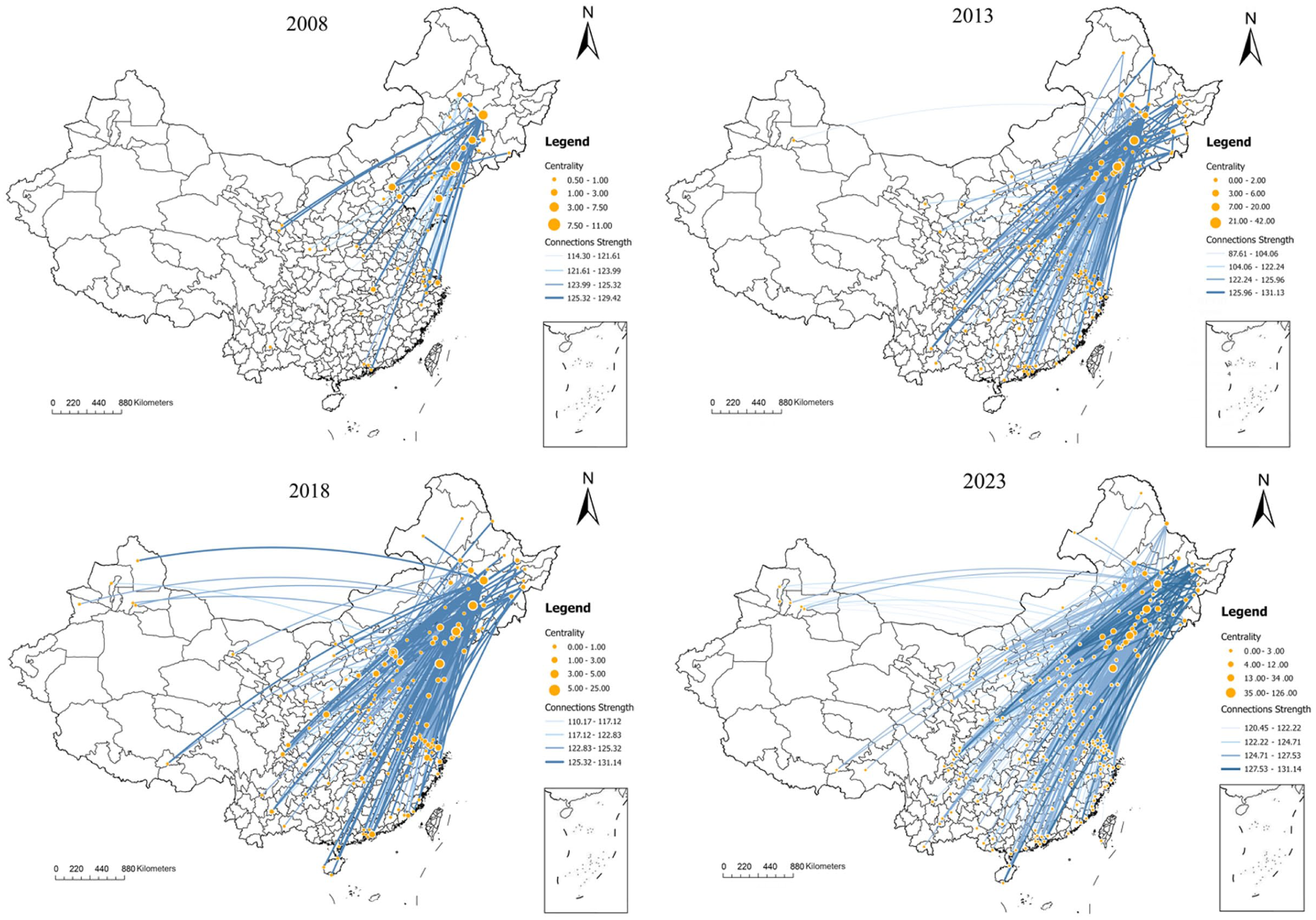
Innovation network patterns in 2008, 2013, 2018, and 2023 (the map is sourced from the China Standard Map, with the approval number GS (2020) 4619).
Evolution characteristics of innovation network nodes
Within the northeastern provinces, the cities of Harbin, Changchun, Shenyang, and Dalian have gradually gained prominence and now occupy dominant positions in the innovation network, displaying a clear “core-periphery” structure. Externally, Beijing has consistently been the most important partner for innovation cooperation, with connections to cities such as Nanjing and Tianjin being further strengthened in subsequent years. The main external nodes display a tendency to cluster toward the eastern coastal areas (Figure 1).
Comparative analysis of innovation network centrality dynamics in shrinking and non-shrinking cities
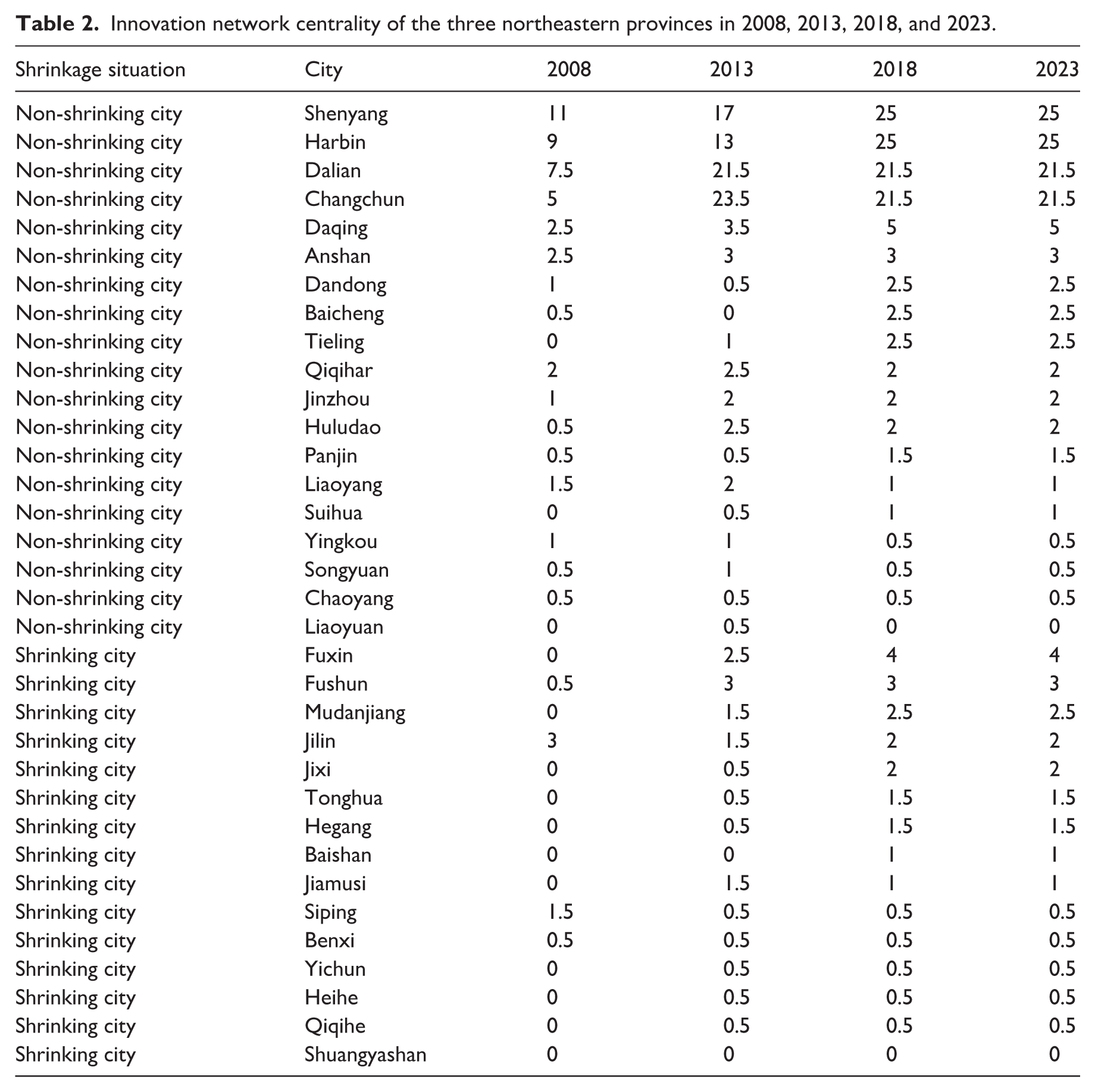
A correlation analysis between urban population shrinkage and urban centrality values reveals a relatively consistent development trend. The centrality of shrinking cities within the innovation network is generally low, with an average value of 2.25 over the four years and a slow growth rate, averaging 1.85%. Most cities, such as Jilin and Siping, show negative growth in centrality. In contrast, non-shrinking cities exhibit significantly higher innovation network centrality compared to shrinking cities, with an average value of 8.45 over four years and a growth rate averaging 1.61% (Figure 2).
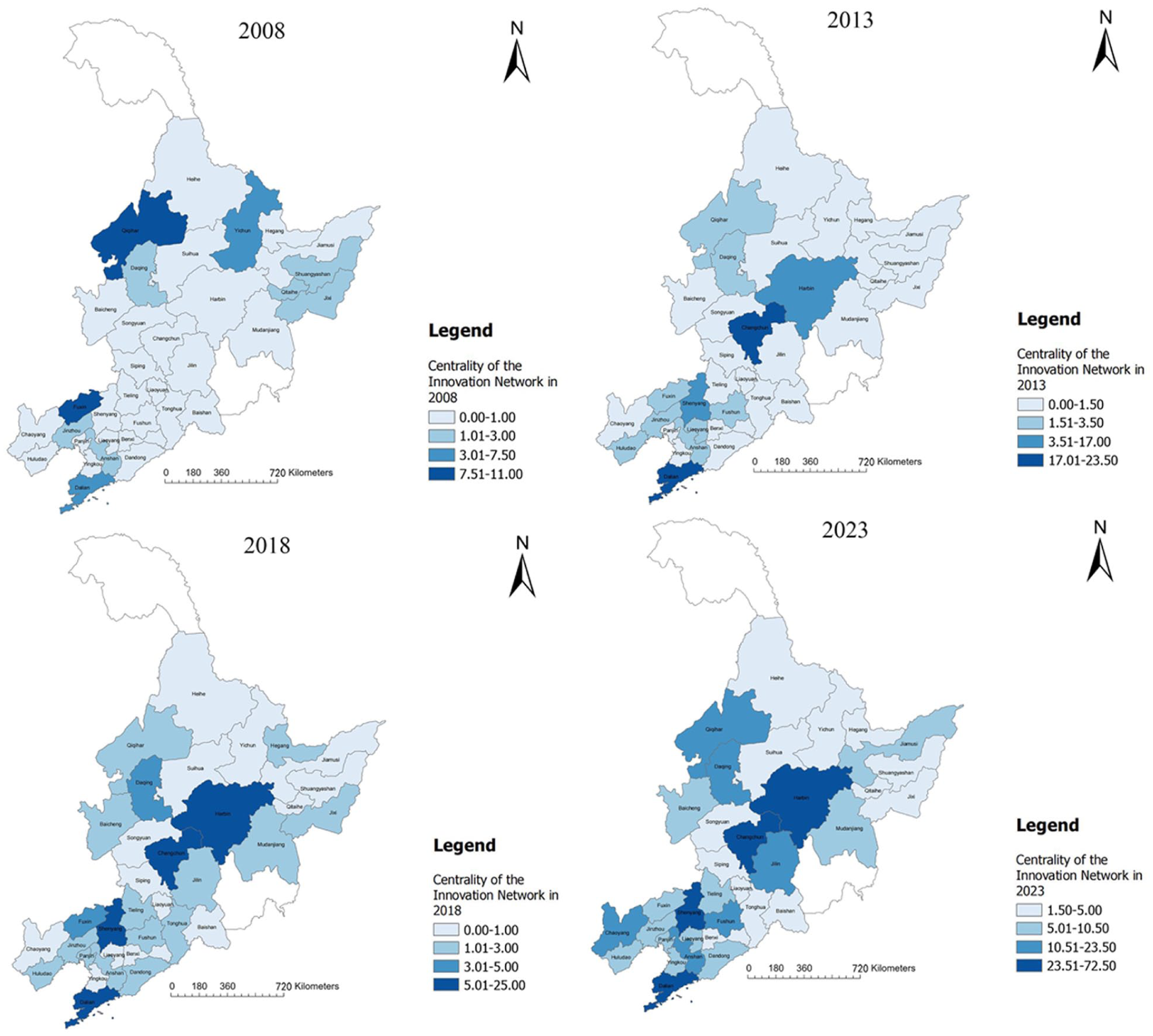
Innovation network centrality of the three northeastern provinces in 2008, 2013, 2018, and 2023 (the map is sourced from the China Standard Map, with the approval number GS (2020) 4619).
In 2008, the primary nodes of the innovation network were Harbin and Shenyang, with secondary nodes being Changchun and Dalian. Secondary nodes included provincial capitals and coastal cities, which, due to their geographical advantages, exhibited higher urban centrality, with strong out-degree and in-degree. Five tertiary nodes and twenty-five fourth-level nodes were identified. All shrinking cities were categorized as tertiary or fourth-level nodes, with 70% classified as fourth-level and 30% as tertiary nodes. The average centrality of shrinking cities was 0.37, while that of non-shrinking cities was 2.45, showing clear polarization in urban centrality development.
In 2013, the centrality of Changchun and Dalian grew rapidly, and the number of tertiary nodes increased. All shrinking cities remained as tertiary or fourth-level nodes, with 75% categorized as fourth-level and 25% as tertiary nodes. The urban centrality of shrinking cities averaged 0.93, while that of non-shrinking cities averaged 5.05.
In 2018, the primary nodes in the innovation network included Harbin, Changchun, Shenyang, and Dalian, with Shenyang having the highest centrality. The number of tertiary nodes increased by six, and these nodes were spatially distributed around the first and second-tier nodes. The innovation networks of provincial capitals developed well, positively influencing surrounding cities. The average urban centrality of shrinking cities increased to 1.4, while that of non-shrinking cities was 6.28.
In 2023, the centrality of the four primary nodes—Harbin, Changchun, Shenyang, and Dalian—had steadily increased, with 9 second-level nodes, 19 third-level nodes, and 2 fourth-level nodes. The centrality of cities as a whole increased significantly, with the average urban centrality of shrinking cities rising to 6.3, while the average centrality of non-shrinking cities reached 20.02. The gap between shrinking and non-shrinking cities narrowed, and the development of the innovation network showed a tendency toward greater balance (Table 2).
Innovation network centrality of the three northeastern provinces in 2008, 2013, 2018, and 2023.
Correlation between innovation network centrality and population size
A correlation analysis was conducted between the population size of prefecture-level cities in the three northeastern provinces of China and the centrality of innovation network spatial nodes. The results of the analysis are presented in Table 3. Overall, the correlation coefficient is 0.859, with a significance level of 1%, indicating a strong positive correlation between the centrality of innovation network cities and urban population size. Larger cities tend to exhibit higher centrality within the innovation network.
Correlation analysis of innovation network centrality and urban population size.

Note: ***, ** and * denote statistical significance at the 1%, 5%, and 10% level (indicating that the variable exerts a highly statistically significant effect on the dependent variable), no marker indicates statistically insignificant correlation.
For non-shrinking cities, the correlation coefficient with population size is 0.85, also significant at the 1% level, suggesting a very strong positive relationship. These cities consistently maintain higher centrality. In contrast, for shrinking cities, the correlation coefficient is 0.302, significant at the 5% level. This indicates a weaker, though statistically significant, positive relationship between population size and innovation network centrality.
These findings suggest that both shrinking and non-shrinking cities exhibit a positive correlation between innovation network centrality and urban population size. However, the strength of this correlation is much stronger in non-shrinking cities, where larger populations are more closely associated with higher centrality in the innovation network.
Impact relationship between innovation network centrality and population size
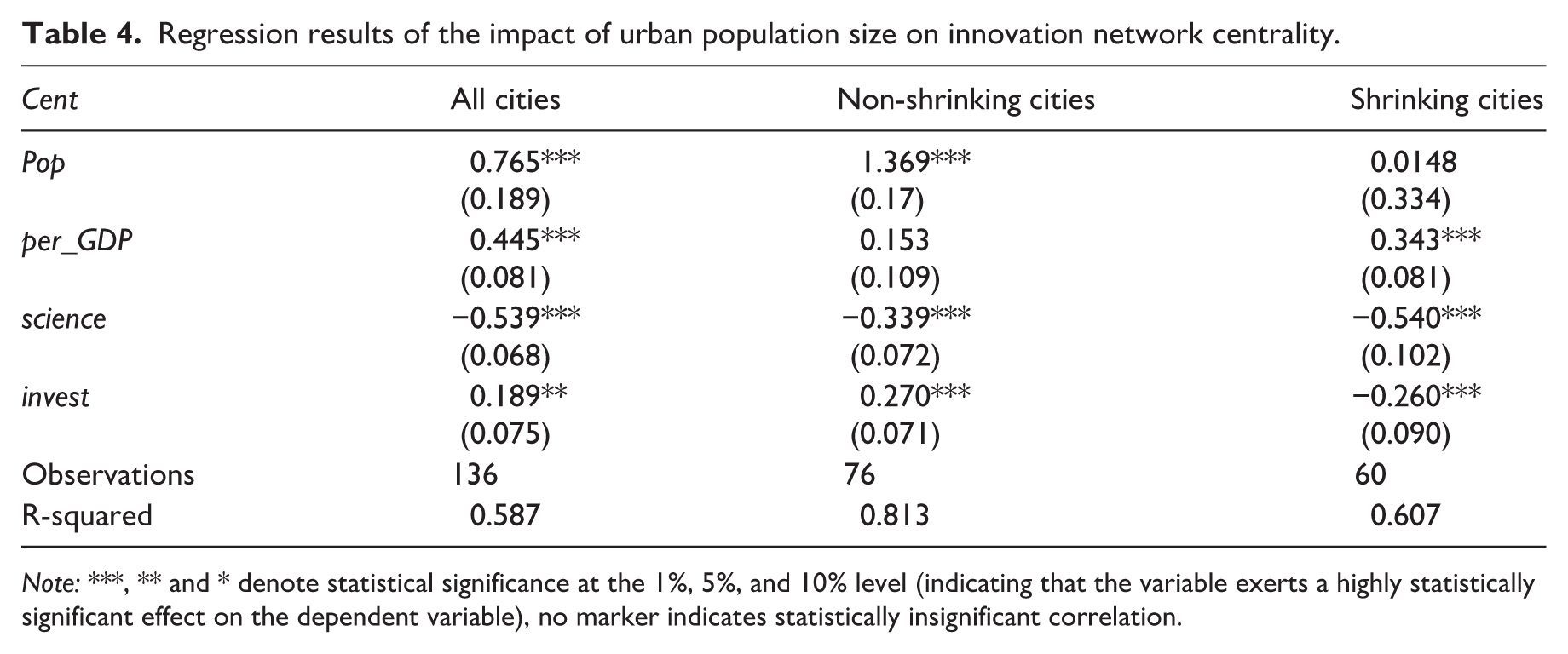
To explore the impact of urban population size on innovation network centrality, regression analysis was conducted using the model established earlier. The results, based on the Hausman test and F-test, indicated that a fixed-effects model should be applied to all prefecture-level cities in the three northeastern provinces of China. The regression results, shown in Table 4, reveal that the coefficient of the key variable, urban population size, is significant at the 1% level, indicating a strong positive relationship between urban population size and innovation network centrality. Specifically, an increase in urban population size promotes an increase in innovation network centrality. Other variables, such as per capita GDP and total fixed asset investment, also positively influence innovation network centrality, while scientific and technological expenditures have a negative impact (Table 4). This aligns with existing research emphasizing the role of urban size, human capital, and government investment in driving innovation activities (Caragliu et al., 2016; Lee, 2015).
Regression results of the impact of urban population size on innovation network centrality.
Note: ***, ** and * denote statistical significance at the 1%, 5%, and 10% level (indicating that the variable exerts a highly statistically significant effect on the dependent variable), no marker indicates statistically insignificant correlation.
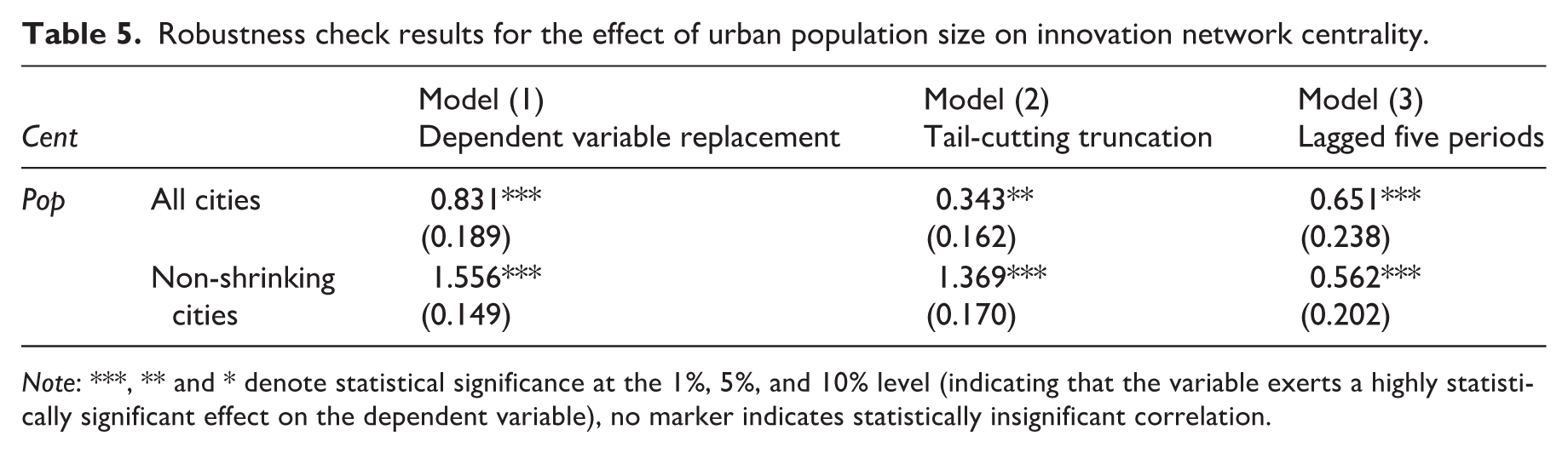
To ensure the robustness of these findings, three methods were employed for robustness checks: substituting the dependent variable, addressing endogeneity, and removing outliers. For heteroscedasticity, weighted least squares (WLS) regression was used. For the dependent variable substitution, the number of innovation network connections was used as a proxy for innovation network centrality. To address endogeneity, both the explanatory variables and control variables were lagged by five periods, with the lagged explanatory variable serving as an instrumental variable. Additionally, outliers were dealt with using a tail-trimming method for the 2% and 98% extremes (Wooldridge, 2010). Table 5 shows that the conclusion that urban population size positively impacts innovation network centrality in prefecture-level cities in Northeast China remains robust after these tests.
Robustness check results for the effect of urban population size on innovation network centrality.
Note: ***, ** and * denote statistical significance at the 1%, 5%, and 10% level (indicating that the variable exerts a highly statistically significant effect on the dependent variable), no marker indicates statistically insignificant correlation.
Next, a heterogeneity regression analysis was conducted to explore the relationship between population size and innovation networks in shrinking cities. Based on the Hausman test and F-test, fixed-effects models were applied to both shrinking and non-shrinking cities. The regression results reveal that, in non-shrinking cities, urban population size significantly impacts innovation network centrality at the 1% confidence level. This positive relationship persists even after robustness checks, suggesting that cities like Shenyang, Dalian, Harbin, and Changchun maintain high levels of innovation cooperation by continuously attracting human capital, particularly through strong connections with national central cities such as Beijing and Shanghai.
However, in shrinking cities, no significant relationship was found between urban population size and innovation network centrality. Given the fixed-effects model, which accounts for both individual and time dimensions, this suggests that urban population decline in shrinking cities does not affect their innovation cooperation with other cities. In these cities, factors such as per capita GDP, scientific and technological expenditures, and total fixed asset investments significantly influence innovation network centrality.
This finding can be explained by three interrelated mechanisms. (1) Shrinking cities in the three northeastern provinces of China are already on the periphery of the innovation network, exhibiting lower centrality. Innovation activities are primarily concentrated around a few key nodes, such as research institutions and R&D enterprises. National and local policies, such as the revitalization of Northeast China and development zones, provide strong support for technology-driven enterprises, allowing local institutions to operate steadily and maintain their roles as key nodes in the innovation network. According to “scale-free network theory,” a few key nodes dominate the innovation network, even if population decline occurs (Barabasi and Albert, 1999). As long as these key nodes remain intact, the overall structure and centrality of the innovation network can be maintained. (2) Innovation links are highly dependent on specific knowledge groups. The population loss in shrinking cities primarily involves low-skilled labor, while the core innovation groups exhibit low mobility due to institutional and familial factors. Research indicates that for knowledge workers, career opportunities tend to outweigh environmental factors when choosing a settlement (Darchen and Tremblay, 2010). (3) As an old industrial base, Northeast China exhibits significant structural rigidity and institutional stickiness. Long-standing institutional dependencies may “lock in” the innovation paths of cities or industries, with innovation activities often shaped by persistent institutional structures and path dependence (Cooke and Piccaluga, 2006). Even with population loss, state-owned enterprises in these cities can continue to drive innovation activities through established institutional resources. For instance, in Songyuan City, Jilin Province, institutions applying for patents are primarily from the State Grid Corporation of China.
The foregoing analysis reveals that innovation networks in China’s shrinking cities exhibit strong policy-driven orientations, contrasting sharply with the market-led adjustment approaches prevalent in Western urban shrinkage governance. Taking the three northeastern provinces of China as an example, state-directed initiatives—including the Northeast Revitalization Strategy, old industrial base restructuring, and sci-tech innovation zone development—have continuously channeled resources and policy advantages. Consequently, even amid persistent urban population decline, key nodes within innovation networks maintain stable operations and structural positions. This state-local government dominated pathway, shaping innovation capacity through fiscal subsidies, project support, and talent recruitment programs, demonstrates pronounced institutional path dependence and continuity.
In contrast, innovation network evolution in Western shrinking cities—such as Detroit, USA and Germany’s Ruhr region—relies predominantly on market mechanisms and corporate-led adaptation. Detroit, for instance, has transitioned from traditional manufacturing toward a knowledge economy by promoting creative industries, small business incubation, and social capital engagement amidst deindustrialization (Berglund, 2020); the Ruhr region has fostered innovation through university collaborations and market-driven industrial restructuring, establishing a regional self-organization model (Hospers, 2004). While local governments provide policy guidance, innovation resource allocation occurs primarily through market mechanisms, with centrality fluctuations responding acutely to demographic shifts, industrial transitions, and capital mobility.
From a comparative perspective, Chinese shrinking cities emphasize policy steering within a “nation-local” governance framework, creating administratively embedded hub nodes whose stability and influence derive substantially from continuous policy resource infusion. Western counterparts rely more on endogenous mechanisms such as market forces, talent mobility, and knowledge diffusion, which drive structural network evolution from the bottom up. This reflects a clear contrast between top-down and bottom-up pathways in network development.
Therefore, centrality maintenance within China’s shrinking city innovation networks cannot be simplistically equated with Western experiences, requiring instead full consideration of national governance capacity, policy implementation efficiency, and the structural role of institutional environments. This divergence further suggests that future innovation network optimization necessitates more effective synergy between institutional advantages and market vitality.
Conclusion and discussion
This study uses the three northeastern provinces of China as an empirical case to analyze the structural characteristics of their innovation networks and explore the relationship between urban shrinkage and innovation networks. The main conclusions are summarized as follows. (1) The innovation network density in the three northeastern provinces of China shows an increasing trend, with the scale of external nodes gradually expanding. In terms of spatial structure, a close connection exists with the region east of the “Hu Huanyong Line,” while the connection with the western regions remains sparse and dispersed. (2) Within the three northeastern provinces, the internal nodes exhibit a clear “core-periphery” structure, with cities like Harbin, Changchun, Shenyang, and Dalian serving as the core. The growth rate of urban centrality in non-shrinking cities is faster, whereas, in shrinking cities, it is slower. Additionally, the innovation network centrality of non-shrinking cities is significantly higher than that of shrinking cities. (3) In terms of the causal relationship between urban population size and innovation network centrality, the increase in urban population size in non-shrinking cities can promote the enhancement of innovation network centrality. However, in shrinking cities, this relationship is not significant. Overall, the analysis indicates that, in shrinking cities, there is a positive correlation between urban population size and innovation network centrality, though the former is not the key factor influencing the latter.
The conclusions demonstrate that shrinking cities challenge the traditional “growth-oriented” perspective, which assumes a linear relationship between urban size and innovation capacity. Population size does not serve as the core driver of innovation network centrality. Shrinking cities can still gain developmental momentum by embedding themselves in innovation networks. This is also in line with current policy directions, which should move away from traditional thinking based on “scale expansion” and shift towards a new type of urbanization focused on “downsizing and strengthening.” Emphasis should be placed on cultivating innovation growth models that prioritize knowledge flow overpopulation concentration. For the three northeastern provinces of China, priority should center on enhancing central cities’ leadership and cultivating externally-oriented nodes. Leveraging national strategic corridors such as the Harbin-Changchun Metropolitan Cluster and Central-Southern Liaoning Urban Agglomeration, deeper integration into national-level urban networks like Beijing-Tianjin-Hebei and the Bohai Rim should be advanced. Developing gateway cities and hub nodes with strong external connectivity requires strengthening multimodal linkages (high-speed rail, aviation, logistics) between Shenyang, Changchun, Harbin, and key cities including Beijing, Tianjin, Shanghai, and Qingdao, thereby elevating regional positioning within national networks. Secondly, optimizing urban functional specialization and spatial configuration necessitates supporting large cities in consolidating core functions while empowering small-medium cities to develop specialized competencies, establishing a rational urban hierarchy. Focus should target secondary node cities (e.g., Anshan, Mudanjiang, Tonghua, Siping), amplifying their roles as regional transportation, industrial, and service centers. Amid guided population mobility, shrinking cities must leverage existing resources to build specialized innovation nodes, preventing hollowing-out of innovation assets and counteracting innovation actor deficits caused by demographic decline. Increased R&D investment, optimized scientific services, and regional collaboration can break path dependency while enhancing intra-network connectivity and vitality. Third, augmenting shrinking cities’ endogenous innovation capacity and network resilience requires establishing local fiscal guidance funds, introducing industrial technology institutes, and implementing researcher mobility programs to boost technological supply. Concurrently, support traditional industries (metallurgy, chemicals, energy) in transitioning toward digital twins, smart manufacturing, and green upgrading within old industrial bases.
In conclusion, this study aims to contribute to the following areas of research: First, existing studies have seldom focused on the development of innovation networks in the context of population shrinkage and the relationship between urban shrinkage and innovation networks. Through empirical research, this study reveals the evolutionary characteristics of innovation networks in shrinking cities in the three northeastern provinces and evaluates the correlation between population size and their innovation connections. These findings differ from the patterns observed in growing cities but, to some extent, support theories such as “knowledge density” and “scale-free network theory,” providing evidence from a unique perspective. Second, urban shrinkage has become a global phenomenon, but most existing research focuses on developed countries, with limited attention paid to developing countries. This study, within the context of China’s development, contributes to enriching research perspectives on shrinking cities and broadens the application of urban network research.
Finally, future research should address the following limitations: first, longer-term panel data could be used to analyze lag effects further, exploring whether changes in urban population size in shrinking cities have a longer-term impact on innovation networks. Second, this study focuses only on domestic innovation links; future research may extend to global scope and assess the relationship between shrinking cities and global innovation connections. Third, this study insufficiently explores the potential causal mechanisms through which innovation network centrality changes influence population mobility and shrinkage. Urban embeddedness within innovation networks may exert feedback effects on population agglomeration or outflow by modulating employment opportunities, resource flows, and urban perception. Future research should therefore adopt a bidirectional causality perspective to systematically analyze how innovation network structural evolution reciprocally affects demographic changes, particularly examining potential heterogeneous effects across different types of shrinking cities.
Footnotes
Acknowledgements
I would like to thank the editors and anonymous reviewers for their valuable comments and suggestions, which significantly enhanced the quality of this manuscript.

Ethical approval
This study did not involve human participants or animals, and therefore ethical approval was not required.
Informed consent statements
This study did not involve human participants or animals, and therefore informed consent was not required.
Author contributions
Shuai Yu: writing—review and editing, writing—original draft, project administration, methodology, conceptualization. Wantong Zhao: writing—original draft, visualization, validation, methodology, data curation, conceptualization. Xiaoxiang Yi: writing—review and editing, conceptualization, project administration.
Funding
The authors disclosed receipt of the following financial support for the research, authorship, and/or publication of this article: This work was supported by the Key R&D Program Project of Heilongjiang Province (grant number JD2023SJ17).
Declaration of conflicting interests
The authors declared no potential conflicts of interest with respect to the research, authorship, and/or publication of this article.
Data availability statement
Data available on request.