




Abstract
The average salt intake of Chinese residents far exceeds the recommended standard. As food delivery becomes increasingly popular among the Chinese public, salt reduction for takeaways is important to reduce salt intake of Chinese residents. However, studies related to salt reduction of takeaways are still very few; especially, no study has explored consumers’ attitudes towards salt level in takeaway meals. The purpose of the study was to objectively measure consumers’ request for reduced-salt options when ordering meals online, from real takeaway orders. Consumer messages from 718 restaurants on a meal delivery app called ELEME in China were collected between July and December 2020. Reduced-salt messages from all consumer messages placed by consumers when ordering meals were extracted to determine the extent of customized salt reduction requests and to analyze the content of those requests. Feature words from messages identified through AI machine learning (Term Frequency and Term Frequency-Inverse Document Frequency method) were extracted and analyzed. Out of 25,982 consumer messages, 10,549 (40.6%) were reduced-salt messages. Consumers, in general, had the demand to customize dishes with less salt – “less salt” was the most frequently mentioned word for taste preference. Populations with special health and nutritional needs may have a higher demand for reduced-salt meals according to these messages. The study showed definite patterns of demand in a sizable minority of orders and identified the feature words and concepts that could feed into future efforts to create an effective choice architecture in online meal delivery platforms.
Introduction
China is among the ‘saltiest’ nations around the world (Chen et al., 2020). People in China consume, on average, 9.3 grams of salt from home cooking, well over the amount of 5 grams of salt per day recommended by the World Health Organization (WHO) and the Chinese Dietary Guidelines (Bureau of Disease Prevention and Control, National Health Commission of the People’s Republic of China, 2021; World Health Organization, 2023). Excessive salt or sodium intake is associated with increased blood pressure and contributes to the development of hypertension (Chinese Center for Disease Control and Prevention, Chinese Center for Disease Control and Prevention of Chronic Noncommunicable Diseases, 2021; Lin et al., 2020; Lu et al., 2017; Xu et al., 2020). Reducing salt intake to the recommended amount not only helps to reduce the incidence of high blood pressure, but also reduces the risk of cardiovascular diseases, including strokes and heart attacks (Aburto et al., 2013; Huang et al., 2020; World Health Organization, 2020). A large number of people in China suffer from the above diseases, for example, as of 2018, more than one-quarter of Chinese adults had hypertension (National Center for Chronic and Noncommunicable Disease Control and Prevention, Chinese Center for Disease Control and Prevention, Chinese Center for Disease Control and Prevention of Chronic Noncommunicable Diseases, 2021). Thus Chinese residents will benefit from reducing salt intake to the recommended amount.
In China, people’s food sources become increasingly abundant, salt reduction policies should be comprehensive and tackle the emerging trends. In recent years, online meal delivery services are becoming increasingly popular, especially among young people (Partridge et al., 2020). In China, between 2020 and 2022, the number of online meal delivery users increased by 419 million to 521 million, accounting for almost half of the Chinese internet users (China Internet Network Information Center, 2023). With rapid market expansion, recent studies have begun to examine the dietary quality of takeaway meals. Evidence from many countries demonstrated that takeaway meals are often unhealthy with salt content exceeded the dietary recommendations (Hanning et al., 2019; Partridge et al., 2020; Ren et al., 2020; Saunders et al., 2015). In addition, it was evident that, when compared with homemade meals, restaurant meals or takeaway meals often contained more salt content (Lee et al., 2016). Therefore, salt reduction of takeaway meals is important in China, but the research on this area remains new with a still few relevant studies at present(Ren et al 2020; Song et al,2023).
To effectively implement a healthier online takeaway food environment, it is crucial to investigate consumer demands on salt reduction. In China, chefs are willing to meet the customers’ salt reduction demand and reduce the salt content when provided with appropriate low-salt cooking training (Ma et al, 2018; Ma et al, 2014; Song et al, 2023). Local evidence showed that consumers were interested in lowering their salt intake (Chen et al, 2020) with an observable decline in salt consumption over the past three decades (Du et al, 2020). Despite the high consumer interest in salt reduction in China, the translation of action to demanding reduced-salt meals when ordering online takeaways remains scarcely studied, particularly on the objective measure of these demands. While most of the consumer research on the attitude of salt reduction is often based on self-reported surveys (Grimes et al, 2023; Chen et al, 2020; Kim et al, 2012), subjective measures are prone to bias with inconsistency between responses and actual behavior. Consumers would continue to be passively exposed to a high-salt takeaway food environment, if without making a customized request during the order. Therefore, understanding the extent of salt reduction demand by consumers when ordering online takeaway foods, in an objective measure would seize opportunities to implement tailored salt reduction interventions, bringing a mutual benefit to promote healthy diets and meet consumers’ needs with repeatable sales.
This study aims to objectively measure consumers’ real demand for reduced-salt meals through analyzing the customized messages left when ordering takeaway meals on a popular meal delivery app (MDA) in China. On MDAs, consumer messages can be added before placing their meal order, where the message often indicates their taste preferences (e.g., less sweet, hot or cold, spicy or not), including requests about salt reduction. Given the proliferation of takeaway food and the preponderance of food ordered on MDAs in China, understanding consumers’ salt reduction demands from the real orders on MDAs is an objective way. Analyzing the real orders’ data from the real market environment can avoid the bias of the survey method. The contribution of this study is to reveal the scale of salt reduction requests, and to understand how these requests were expressed, from the real market orders. The most important significance of this study is to show whether consumers have demands for salt reduction in takeaway foods. If so, the results will play a role in attracting the attention of public health agencies, MDAs, and restaurants to improve their service. What’s more, by analyzing consumers’ demands for salt reduction, this study provides references for the design of salt reduction policies based on MDAs, such as what kind of taste options should be provided when they order on MDAs to promote more convenient selection of salt reduction dishes, and what kind of population should be targeted to provide salt reduction options.
Methods
Overview of analysis methods
Messages placed during food ordering on ELEME, a popular MDA platform in China, were analyzed to assess consumers’ demand for reduced-salt meals. Salt reduction keywords or phrases were extracted from consumer messages, based on which the scale and wording of reduced-salt messages were analyzed. To prove that a large number of people had strong demands for salt reduction dishes provided by the MDA, and to understand how these requests were expressed, the analysis was made by calculating the frequency of salt reduction related comments. The methodology of this research is summarized in Figure 1.
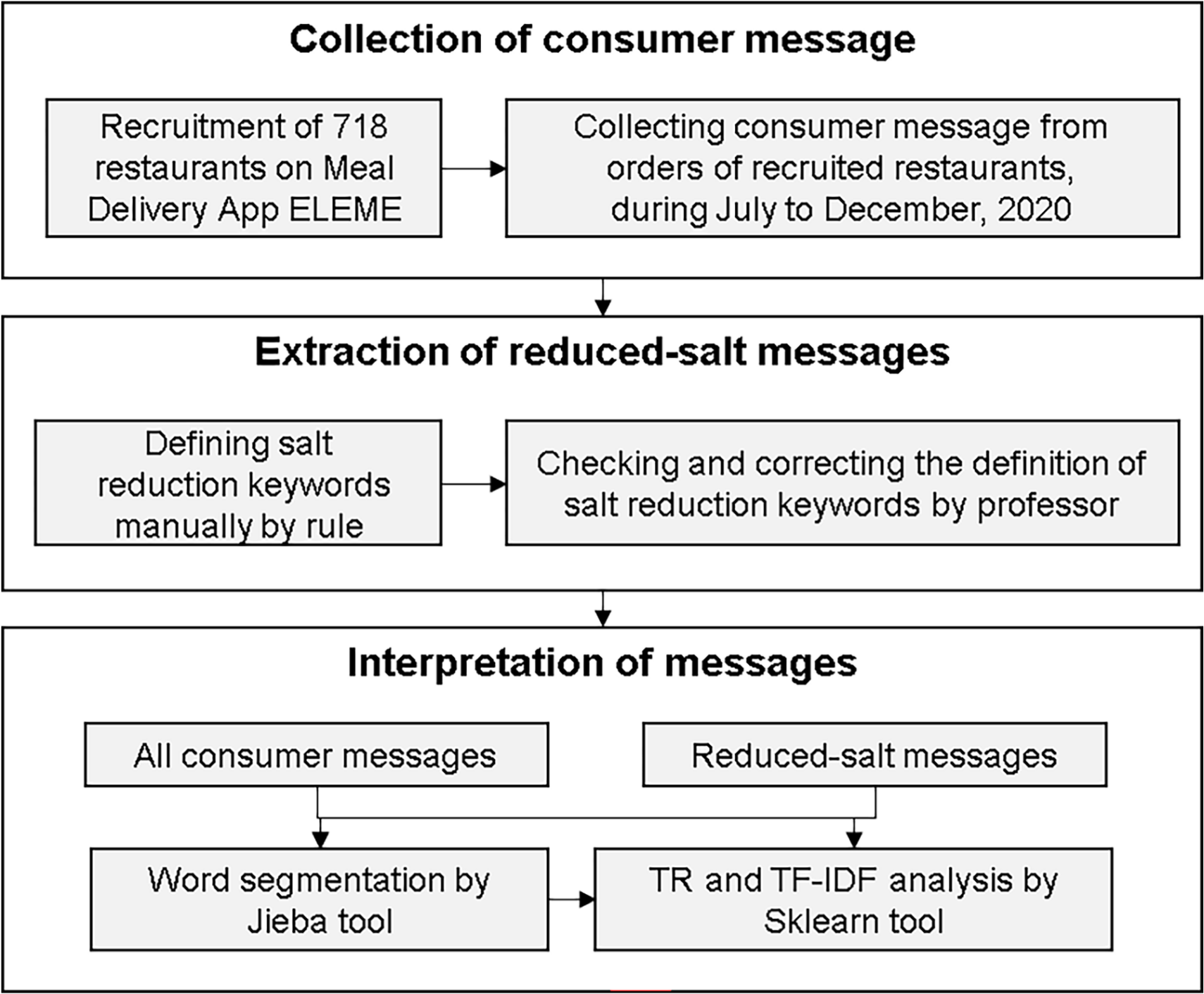
Flowchart of the methodology.
Collection of consumer messages
A total of 2,430 restaurants providing services on ELEME, one of the largest MDAs in China, voluntarily signed up for this salt reduction study, among which 718 provided their operational data from July to December 2020 to the study team. We collected all consumer messages from the available operational data for our analysis. The 718 restaurants were mainly located in four cities across different geographical regions in China, including Beijing in the north, Taizhou in the southeast, Shenyang in the northeast, and Chengdu in the southwest. A restaurant chain with branches in tier-one and tier-two cities was also part of the 718 restaurants. Such geographic distribution represented the diverse dietary habits, e.g., salt use, well across China.
Identification of reduced-salt messages for AI machine learning extraction
Reduced-salt messages refer to consumer messages with keywords or phrases related to reducing the amount of salt contained in the food orders. For all the orders with consumer messages, the authors defined the messages with reduced-salt meaning by the following processes. Firstly, the first author manually screened the consumer messages in sequence to identify salt reduction keywords and phrases often used for categorization until no new keywords or phrases appeared. The identified keywords and phrases included “less salt”, “less sauce”, “not too salty”, and “lighter taste” (see Supplemental Material for the full list). Secondly, the second author, a Chinese expert in nutrition and health research who works in a national-level public health institution, further reviewed the extractions for accuracy; any differences were resolved by discussions between the two researchers.
Interpretation of messages by AI machine learning method
Natural Language Processing (NLP) is a discipline of AI machine learning method that utilizes computer technology to analyze, understand, and process natural language with a focus on language. To interpret the reduced-salt messages, tools based on NLP methods were applied to process Chinese language content.
The first step is to divide the sentences in consumer messages into segmented words. A segmentation tool for Chinese text named Jieba in Python was used to divide the consumer messages in this step. The Jieba tool divides sentences based on its word dictionary. However, some words may not be included in the Jieba dictionary, which can cause the word segmentation results inconsistent with the actual meaning. So the segmentation results were checked and corrected by adding custom dictionaries for specific phrases that were unrecognizable.
The second step is to preliminarily interpret what the consumer messages mean by extracting and ranking the top 10 “feature words” from the messages. These segmented phrases, defined as “feature words” in this study, were then extracted for frequency analysis through the values assessed by Term Frequency (TF) and Term Frequency–Inverse Document Frequency (TF-IDF) algorithms by Sklearn tool in Python. Specifically, TF refers to the number of times a word appears in the text, while TF-IDF measures the importance of a word in a collection of documents (Sammut and Webb, 2011). The higher the TF-IDF value is, according to the algorithm, the higher the importance of a word to the document collection. If a word has high TF but low TF-IDF, such as “is” and “that”, it means that the word frequently appears in a document but is less meaningful. The 10 feature words with the highest TF or TF-IDF values and sample messages were identified to assist in message interpretation.
The above analyses were carried out on all consumer messages and selected reduced salt user message respectively. Analyses of all user comments were used to understand the occurrence frequency of salt reduction keywords, and to compare the salt reduction related requests with others. While analyses of salt reduction user comments were used to understand how users express salt reduction comments.
Results
Consumer and reduced-salt messages
From July to December 2020, the 718 restaurants sold 3,630,798 takeaway orders in total through ELEME, as shown in Table 1. Among all the orders, 0.7% or 25,982 included messages from consumers; 10,549 of these included salt reduction keywords or phrases, known as “reduced-salt messages”, which accounted for 40.6% of the total number of consumer messages included in orders.
The scale of takeaway orders, consumer messages, and reduced-salt messages.
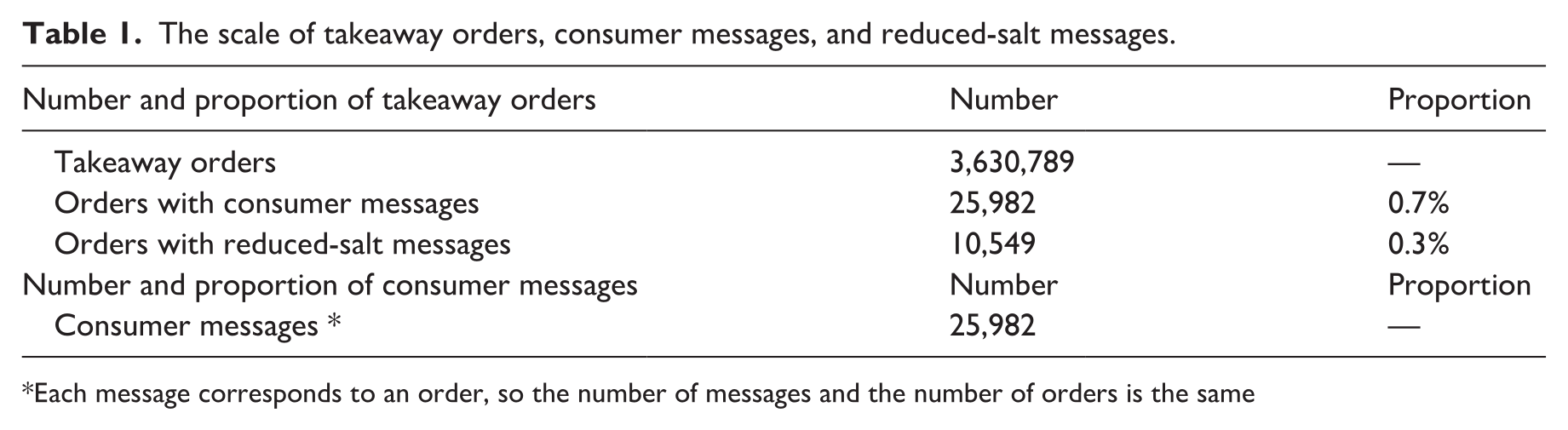
Each message corresponds to an order, so the number of messages and the number of orders is the same
Feature words by TF and TF-IDF
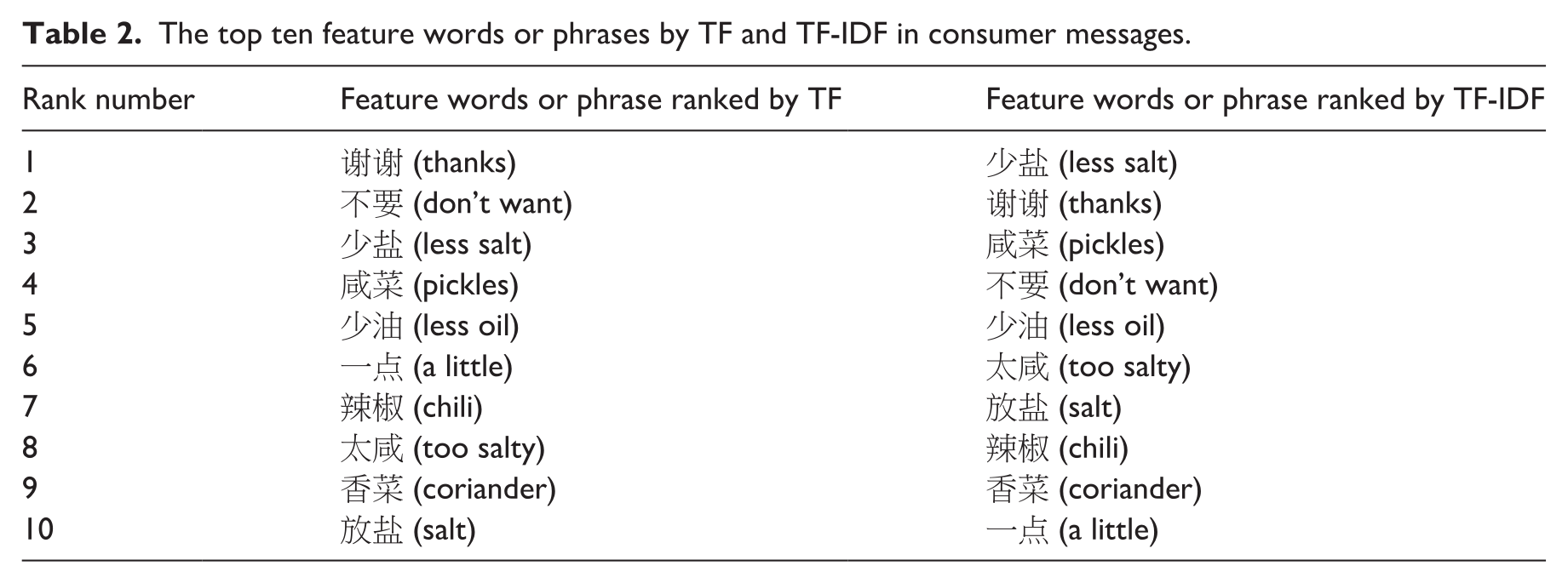
For the wording of all consumer messages, the 10 feature words or phrases with the highest TF or TF-IDF value in consumer messages are presented in Table 2. The two ranking lists covered the same feature words or phrases but in different orders. Seven out of the ten feature words represented a taste preference, namely, “less salt”, “pickles”, “less oil”, “chili”, “too salty”, “coriander”, and “salt”, with four of them being salt-related (“less salt”, “pickles”, “too salty”, and “salt”). “Less salt” was among the top three feature words or phrases when ranked by TF and was the most frequently appearing word or phrase among those linked with taste. The two feature words or phrases with the highest TF value were non-taste-related (“thanks” and “don’t want”). In those ranked by TF-IDF, “less salt” ranked the highest among all the identified words or phrases; the other three salt-related feature words or phrases (“pickles”, “too salty”, and “salt”) also moved to a higher place in this list compared with the TF ranking.
The top ten feature words or phrases by TF and TF-IDF in consumer messages.
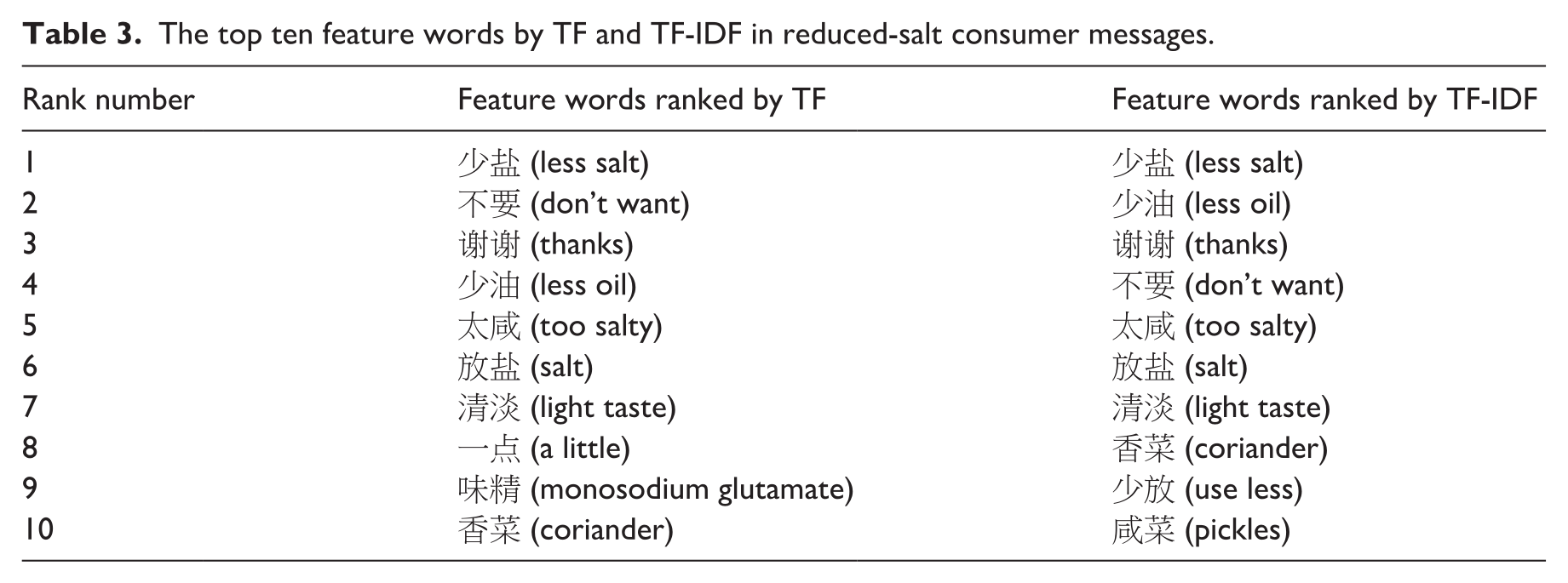
For the wording of reduced-salt messages, Table 3 shows the top 10 feature words or phrases by TF and TF-IDF in reduced-salt messages. In both lists, most (7/10) feature words or phrases were linked with taste preference, with “less salt” ranked at the top. Five feature words or phrases were considered salt-related in each ranking, including “less salt”, “too salty”, “salt”, “light taste”, and “monosodium glutamate” (ranked by TF) or “pickles” (ranked by TF-IDF), which indicated various expressions by consumers for salt requests. Feature words or phrases indicating taste preference other than salt-related, e.g., “less oil” and “coriander”, also often appeared in reduced-salt messages; non-taste-related feature words or phrases included “don’t want”, “thanks”, and “a little”.
The top ten feature words by TF and TF-IDF in reduced-salt consumer messages.
Compared with other salt-related feature words or phrases, e.g., “less salt”, “too salty” and “salt”, “light taste” is a more general word or phrase that can also refer to taste preference for fewer other condiments or ingredients. In consumer messages with the keyword or phrase “light taste”, the most frequently appearing taste-related words or phrases by TF (top 20) were “less oil”, “less salt”, “chili”, “too salty”, “too oily”, “monosodium glutamate”, and “coriander”. Some specific examples included the following:
“Light taste, minimum spicy, less salt, thank you.” “Less oil, less salt, light taste.” “I am sick. Please make the dishes taste light and don’t add chili, spring onion and garlic. Thank you.” “Please add less oil in the two stir-fries! I prefer light taste! Thank you for your cooperation!” “Light taste, not too salty.”
Demographic information in reduced-salt messages
Although they did not appear in the top ten feature words or phrases in Table 2 and Table 3, keywords containing demographic information, e.g., “pregnant woman”, “elderly”, “sick person”, and “kid”, were also found in the reduced-salt messages. The word “pregnant woman” appeared in messages containing the feature word “less salt” 84 times, followed by the words “kid” (56 times), “elderly” (51 times), and “sick person” (20 times). Specific examples included the following:
“Please make the soup with less oil and less salt. It is for a pregnant woman.” “The meal is for a pregnant woman. Please do not add monosodium glutamate and make it less salty and spicy.” “It is for children. Not spicy and low salt, thank you! Please do make sure the food is not spicy.” “I am your regular customer. Please make the order with less oil and less salt. It is for the elderly who had their gall bladder removed, so they cannot eat greasy food. Thank you.” “Please do not add chili and make it less salty. There are sick people in the house. Thank you.”
Conclusion and discussion
To our knowledge, this study was the first qualitative analysis of consumer demand for reduced-salt meals as expressed through MDA messages in China. It is found that a sizable minority of consumers in China do have a demand for reduced-salt meals. Among consumers interested in customizing taste preference (e.g., less salt, sweet, spicy) when ordering online food takeaways, they often expressed a demand for less salt – about two fifths of consumer messages were about salt reduction, and “less salt” was the most often mentioned word for taste preference. In some cases, consumers would also like to request “less salt” along with less chili or less oil for an overall lighter taste. Populations with special health and nutrition needs, e.g., pregnant women, elderly, children, and sick people, may have a higher demand for reduced-salt meals. Having “less salt” frequently shown in the messages reflected an unmet demand for salt reduction options among consumers. Data has shown that the total number of takeaways ordered through Chinese MDAs in 2021 was 20.3 billion, which represented 55.7 million orders per day on average (LeadLeo, 2022). Assuming 0.3% of daily orders contain reduced-salt messages as this research demonstrated, the MDAs across China could be producing 167,100 reduced-salt orders per day even using the more cumbersome ‘comment box’ interface.
The results that user messages of takeaway orders are calling for salt reduction are expected in the context of existing research confirming the high salt content in takeaways and increasing Chinese consumer demand for salt reduction (Chen et al., 2020; Du et al., 2020; Lee et al., 2016; Song et al, 2023). However, although consumers have become more and more health-conscious in recent years, ordering food on delivery platforms has made healthy choices difficult. Traditionally, in restaurants, Chinese consumers generally put forward taste requirements to waiters when ordering food, and restaurants always meet such requirements. However, for consumers, when ordering food on the MDAs, the most direct and simple way to express taste needs is cut off, resulting in consumers passively eating salty food. Despite the fact that requests for salt reduction accounted for two-fifth of all consumer messages, the number of orders that contained consumer messages was low (0.7%). This could be due to the inconvenience posed to consumers in leaving a message, or the lack of awareness that such a request could be fulfilled. After consumers select dishes on the ordering page, they are directed to the next page with an order overview with their address, delivery time, etc. To leave a message, it requires consumers to scroll down this final page to find the “Notes” caption, click on it, and only then they are directed to a field in which consumers can enter a message with special requirements, if any. Consumers can place their order without scrolling down the overview page, which makes the comment box a “hidden” setting that is easily overlooked by consumers. For consumers who may have an intention to make special requests, the extra steps needed and unclear instruction may become a barrier to requesting healthier options. On the other hand, for those who took the extra steps to place a message for salt-related requests, it was found that various expressions were used. This may become another challenge to restaurants trying to understand and respond to these requests.
For policy implications, we think it is significant to explore policies that request to make changes to the user interface on MDAs, that can provide standardized and simplified channels for reduced-salt demand, and better support consumers in customizing takeaway meals, as well as communicating with restaurants for healthier meal selections. Studies have shown that if restaurants were presented with salt reduction demands on MDAs, the restaurants would also actively meet the consumers’ needs (Song et al, 2023), which also indicates the opportunity to approach MDAs as major platforms for promoting salt reduction. In fact, possible solutions are already available and can be easily applied to salt reduction. On the leading MDAs in China, including ELEME and MEITUAN, the use of submenu has been widely adopted to provide options related to portion size, the amount of chili, and the amount of sugar, among others. If a dish includes such a submenu on the ordering page, consumers are required to select among the available options or stay with the default before the dish can be ordered. Submenu as a technical function is almost effortless for restaurants to set up if they are up to it and for consumers to make choices. However, this use of a submenu has not been widely adopted for salt level. Given the relative number of consumer messages about salt among all consumer messages, this is a missed opportunity for MDAs and restaurants. Advocating that restaurants add salt reduction options to the submenu set on the delivery platform will make the salt reduction choice easier for consumers, not only conducive to providing personalized services for consumers with special taste needs, but also conducive to further strengthening the health awareness of salt reduction.
In addition, from the perspective of public health, the disease burden of excessive salt intake can further highlight the need to address consumers’ salt reduction demand in takeaway meals. Although salt reduction has long been an effort by public health agencies in China, home cooking and public education have been the main focus, for example, campaigns to promote the use of salt reduction spoons and salt consumption monitoring systems at the household level, as well as education programs targeting school children and the general public (Chen et al., 2020; He et al., 2019, 2022; Huang and Zeng, 2021; Nakadate et al., 2018; Xian et al., 2020). With online ordering increasingly becoming a main source of daily meals for Chinese people, relying on traditional campaigns targeting household cooking behavior to promote salt reduction is no longer sufficient, and the work should be extended to broader settings, e.g., MDAs, and focused on the changing food environment.
Several limitations in this study should also be acknowledged. First, due to the nature of the tools for text segmentation and TF/TF-IDF analysis, only the TF and TF-IDF values of feature words or phrases were broken down from the whole consumer message, some words or phrases may share the total number of times they appeared without considering the similar meaning. For example, more than one feature word or phrase meant “less salt” in Chinese when broken down, but instead of combining them into one, they were treated as individual words or phrases in this ranking analysis. Second, on ELEME, a submenu with options for taste preferences could be provided by restaurants for some dishes, but the salt reduction option is usually not included. If a consumer has already selected their taste preference of, e.g., the amount of chili or sugar level through the set submenu, they would be less likely to make similar requirements through consumer messages or scroll down the order overview page to leave a message for taste preference, which may result in an underestimation of consumers’ other taste demands in our analysis, compared with salt reduction demand. Finally, we obtained data from restaurants in four cities and a restaurant chain across different regions in China; this difference was not reflected in our analysis, as the main purpose of this study was to gain an overview of the scale of salt reduction requests and how these requests were featured. Further study is needed to explore consumers’ demand for salt reduction across different geographical regions and demographic groups, and therefore to better support MDAs and restaurants that tailor the interface setup for consumers.
This study also has some implications for future research. As this study is the first on the salt reduction needs of consumers on delivery platforms, we call for expanding the MDAs and sample size of restaurants in the future to further strengthen the credibility and influence of the research findings that consumers need reduced-salt takeaways. In addition, we believe that we can recruit restaurants to set salt reduction sub-menus and verify whether salt reduction sub-menus can improve consumers’ choice rate of salt reduction dishes. In addition, because restaurants are free to add menu options to the MDAs, according to the policy implication of the study, a more important research direction in the future is to verify whether setting a salt reduction submenu on the delivery platform page really improves the salt reduction choice rate of consumers. Finally, we believe that it is of great significance to further analyze the individual characteristics of consumers who have salt reduction demands, and explore how to target the potential salt reduction consumers and only provide the salt reduction sub-menus on MDAs appropriately to them.
Supplemental Material
sj-doc-1-tus-10.1177_27541231241298191 – Supplemental material for Analysis of consumer requests for reduced-salt meals on a Chinese meal delivery app*
Supplemental material, sj-doc-1-tus-10.1177_27541231241298191 for Analysis of consumer requests for reduced-salt meals on a Chinese meal delivery app* by Wenyue Li, Chao Song, Ying Cui, Beisi Li, Zhongdan Chen, Paige Snider, Yue Ma, Ailing Liu, Ying Long and Gauden Galea in Transactions in Urban Data, Science, and Technology
Footnotes
Acknowledgements
The authors would like to thank all team members in this project, including following individuals from ELEME for their invaluable services to implement the project on their platform: Shuhan Zhang, Hong Miao, and Xiyan Tian. The views expressed in this study are those of the authors alone and do not necessarily reflect the policies or views of the World Health Organization.
Authors’ contributions
W.L.: conceptualization, data curation, formal analysis, methodology, software, original draft, review and editing. CIS.: conceptualization, data curation, formal analysis, review and editing. Y.C., B.L., ZAC., P.S., and G.G.: conceptualization, supervision, review and editing. Y.M.: review and editing. A.L. and Y.L.: resources, supervision, review and editing. All authors have read and approved the final manuscript.
Declaration of conflicting interests
The author(s) declared no potential conflicts of interest with respect to the research, authorship, and/or publication of this article.
Funding
The author(s) disclosed receipt of the following financial support for the research, authorship, and/or publication of this article: This work was supported by the Resolve to Save Lives through their grant to the World Health Organization Representative Office in China to support efforts that aim to reduce salt intake among the Chinese population. The funder had no role in the study design, data analysis, or writing of this article.
Availability of data and materials
The data of consumer messages on the MDA are not publicly available.
Disclaimer
The views expressed in this article are those of the authors alone and do not necessarily reflect the policies or views of the World Health Organization.
Ethical statement
The study was reviewed and approved by Ethics Committee of the National Institute for Nutrition and Health of Chinese Center for Disease Control and Prevention (No. 2021-019), and WHO Western Pacific Regional Office Ethics Review Committee, with a trial registration number of ChiCTR2100047729. The study was done in line with ELEME user policies and regulatory policies around user privacy.
†
Contributed equally
Supplemental material
Supplemental material for this article is available online.
Author biographies
 .
.
References
Supplementary Material
Please find the following supplemental material available below.
For Open Access articles published under a Creative Commons License, all supplemental material carries the same license as the article it is associated with.
For non-Open Access articles published, all supplemental material carries a non-exclusive license, and permission requests for re-use of supplemental material or any part of supplemental material shall be sent directly to the copyright owner as specified in the copyright notice associated with the article.
