



Abstract
This paper examines the condition of partial development in which infrastructural provision in second-tier cities has become increasingly selective, creating new geographies of inequality for lower-middle-class migrants. The resulting precarity is not a by-product of growth but is state-engineered through a governing logic of infrastructural selectivity. The paper analyses the mechanisms that produce this condition. Findings reveal a bifurcated system where state investment in transport and subsidised housing is channelled towards prioritised New Town Initiatives (NTIs) at the expense of bottom-up self-urbanised peripheral entities. This institutionalised selectivity compels migrants into a range of everyday improvisations, navigating informal housing and transport markets to secure their livelihoods. By centring these bottom-up practices, the study offers a critical account of how partial development is governed and lived, contributing to debates on state entrepreneurialism, infrastructural governance and urban justice in China.
Introduction
In the spring of 2023, Meina, a 26-year-old human resources officer, left her rented flat in a gated community in downtown Xi’an and began an hour-long bus commute to a small state-owned enterprise in Gaoling, a peripheral urban district of Xi’an. Her roommate, who works a similar distance away in the state-prioritised Chanba International Port area, arrived in just 20 minutes by metro. When asked why she does not move closer to her job, Meina was dismissive: That place is so ‘cun’ (rural/underdeveloped). . . I can’t even find a discount store. . .the only option [for healthcare] is the old oilfield hospital.
Meina’s predicament is not static. While Xi’an opened Metro Line 10 in September 2024 to connect the city with Gaoling, the new line exemplifies the logic of selective development: it bypasses existing settlements and industrial plants, including Meina’s workplace, to serve newly-constructed regions.
The municipal choice to build infrastructure for a speculative future rather than for the present population crystallises an overlooked geography of inequality. Meina’s experience highlights a crucial shift in Chinese urbanism, where the era of totalising, rapid expansion is giving way to partial development. Infrastructural provision is increasingly selective as investment is channelled towards politically favoured flagship projects like New Town Initiatives (NTIs). In contrast, organically developed ‘peripheral towns’ like Gaoling are left behind, creating a tiered system of infrastructural citizenship and a pronounced ‘spatial mismatch’ between work and residence (Ran et al., 2020). While identified in the literature (Zhou et al., 2018), the governance logics that produce it and the lived experiences of those who must endure it remain underexplored.
This article argues that the precarity experienced by migrants in Xi’an’s periphery is state-engineered, constituting a defining feature of partial development. Through a case study of Gaoling, it demonstrates that infrastructural selectivity functions as the principal governing logic producing this vulnerability. This logic operates through two mechanisms: (i) the political tiering of urban space, which systematically divests essential mobility infrastructures from peripheral, bottom-up self-urbanised regions while channelling investment into flagship NTIs, and (ii) the strategic repurposing of social welfare, where subsidised housing is deployed as a tool for talent recruitment rather than poverty alleviation. Consequently, spatial mismatch emerges as a durable spatial expression of this governance. In the resulting state-engineered voids, residents are forced to secure their livelihoods through everyday improvisation in informal and semi-formal infrastructures. Tracing these practices, this paper offers a bottom-up account of how partial development is delivered and experienced. The following sections develop this theoretical framework and operationalise it through mobile ethnographic evidence from Xi’an’s periphery.
Theorising partial development: Logic, expression and response
This paper theorises partial development as a state-led pattern in which territorial incorporation and urban expansion proceed through highly selective and sequenced investments that leave some spaces and populations in a prolonged condition of infrastructural and welfare incompleteness despite formal incorporation into municipal territory. This differs from classic accounts of uneven development that emphasise market-driven agglomeration and inter-urban competition (Smith, 2008). Partial development, as used in this paper, emphasises how state entrepreneurialism and its administrative and planning arrangements structure when and where provision arrives within a single city.
A key mechanism through which this condition is produced is infrastructural selectivity. Since the 2010s, ‘new-type urbanisation’ (Chen et al., 2018) and hukou reform (Qin et al., 2022) have accelerated the building of multi-functional NTIs at metropolitan edges, producing concentrated investment in selective nodes while provision elsewhere is deferred or thinned out (Shen and Wu, 2017). Whereas uneven development literature has often centred regional core-periphery relations or hierarchies between cities (Brenner, 2004; Smith, 2008), partial development draws attention to the active production of delayed build-out and incomplete connectivity within a single municipal territory. Under the logic of state entrepreneurialism, policy instruments and fiscal capacity are channelled selectively into flagship projects and zones, while organically developed peripheral towns, former counties and older industrial districts experience systematic under-investment.
This dynamic echoes, yet departs from, accounts of splintering and patchwork urbanism. ‘Splintering urbanism’ traces how liberalised infrastructure networks are selectively unbundled to favour premium users and spaces (Graham and Marvin, 2002). Work on the ‘patchwork city’ in the Global South foregrounds how fragmented, people-centred infrastructures are assembled in the absence of universal provision (de Coss-Corzo, 2021; McFarlane, 2008). In China, however, the bypassing and patchiness of infrastructural provision are not primarily outcomes of market liberalisation but are state-engineered through administrative hierarchies and extra-territorial governing arrangements. The preferential channelling of administrative authority, fiscal capacity and policy tools to NTI authorities leaves other settlements with incomplete networks and pared-back public services. Empirical studies have documented spatial-temporal misalignment between industry, housing and services (Zhang et al., 2019) and the intensification of occupational stratification, residential segregation, and commuting burdens under performance-oriented development (Hsing, 2010; Wang et al., 2010).
Within this broader pattern, spatial mismatch provides a framework for analysing how urban structure shapes everyday spatial practice. Originally developed to explain labour market disadvantages in US cities when low-income and minority workers were spatially isolated from employment opportunities (Gobillon et al., 2007), the concept is adapted in China to reveal how institutional and territorial divisions under the party-state system shape inequality (Shen, 2017). Quantitative studies link mismatch to city size and industrial restructuring via job decentralisation and rising inner-city housing costs (Ran et al., 2020) yet often neglect how specific governance mechanisms actively institutionalise mismatch beyond statistical correlations. I argue that in second-tier metropolitan peripheries, spatial mismatch should be reconceptualised as a spatial expression of infrastructural selectivity. The uneven sequencing of infrastructure, housing and services constrains households’ ability to overcome internal urban boundaries through residential moves, job changes or mobility, thereby reproducing unemployment risks, low incomes and high commuting costs (Xiao et al., 2023).
This state-engineered mismatch generates particularly acute instability in the intertwined housing and labour markets of the lower-middle-class and young white-collar migrants. Distinct from the high-end ‘talent’ targeted by entrepreneurial strategies (Trémon et al., 2024) and from the classic nongmingong figure (Fan, 2008), these non-locally born residents occupy an under-recognised position between institutional protection and market thresholds (Pun and Chan, 2013). Despite wages often exceeding those in traditional manufacturing and construction, this mobile class remains structurally unstable. Lacking employer-provided housing or collective dormitories (see Li and Duda, 2010), they face high costs in commercial rental markets and the twin risks of substandard quality and legal vulnerability. Even in second-tier cities where absolute costs are lower, the relative burden of housing remains prohibitive for new labour market entrants, exacerbating their vulnerability (Liu et al., 2020). The collapse of long-term rental chains has produced collective displacement (Li et al., 2023), while grey-zone arrangements such as the proliferation of sublessors (erfangdong) (Arkaraprasertkul, 2018; Ling, 2022) and group-rental housing (qunzufang) (Zhang, 2019) have further exposed the absence of tenancy safeguards. With thin local social networks, non-locally born residents are thus more prone to instability in the dual markets of jobs and housing.
In the voids created by selective provision and intensified by market pressures, residents are compelled to engage in migrant improvisation, defined as the everyday practices that render life workable under partial development. Patchwork arrangements arise in thinly served spaces, where heterogeneous actors from paratransit operators to urban village landlords and agents collaborate, often tacitly, to restore minimum connectivity and shelter (Simone, 2004). This resonates with the ‘patchwork city’ debates discussed earlier (de Coss-Corzo, 2021; McFarlane, 2008). In China’s urban peripheries, such relational infrastructures are visible in transport through the use of paratransit (Qian, 2018) and illegal ride-hailing (Zhang, 2014), and in housing, where low-income groups rely on urban villages and qunzufang (Lin et al., 2011; Zhang, 2019). These arrangements allow residents to patch together fragmented infrastructures and to compensate for formal deficits in situ, instead of exiting peripheral locations altogether. However, unlike grassroots resilience, these solutions are reactive improvisations to state-engineered precarity, where they are precarious, often vulnerable to state crackdown and shift significant time and money costs downwards onto households (de Coss-Corzo, 2021). Migrant improvisation thus stabilises the micro-level consequences of partial development, allowing urban labour markets and flagship projects to function without the state extending robust, universalised infrastructures to all incorporated territories.
On this basis, I propose a dialectical framework to organise the empirical analysis. Partial development serves as the overarching lens for understanding patterned incompleteness at the peri-urban interface. This condition is produced by infrastructural selectivity, the governing logic that strategically allocates and withholds investment, administrative capacity and welfare entitlements. Spatial mismatch emerges as the spatial outcome of this logic, creating a durable misalignment between housing, jobs and services. In turn, these constraints compel migrant improvisation, the everyday response of stitching together fragmented urban functions via informal and semi-formal infrastructures. The following sections operationalise this framework in Xi’an by asking, domain by domain, who gains access, through which channels and at what cost.
Methods and study context
This study adopts a qualitative, practice-centred methodology to examine how migrants make infrastructures work under conditions of partial development. Unlike quantitative models that simulate abstract flows (for example, McNally, 2007), this approach captures the situated improvisations through which mobility and service access are negotiated in everyday life (Rasouli and Timmermans, 2014). Following calls for qualitative and mobile ethnographies in transport studies (Røe, 2000), the design combines go-along interviews, participant observation and key-informant interviews to foreground practice.
The research is situated in Xi’an, a second-tier provincial capital in northwestern China where rapid population growth parallels uneven patterns of metropolitan expansion. Contrasting with dominant east- and southward migration patterns, Xi’an’s permanent resident population grew by over 4.4 million between 2013 and 2023 (Xi’an Municipal Bureau of Statistics, 2014, 2024). This paper focuses on Gaoling District, a ‘peripheral town’ within Xi’an’s municipal territory. For the purposes of this study, peripheral towns are defined as bottom-up, organic urbanised settlements on the metropolitan edge, often former counties incorporated into the city. These entities lie outside the geographic scope of preferential policies and resource allocation largely directed towards state-led NTIs. Despite its marginal position in municipal planning, Gaoling has experienced significant population growth following 2016 hukou reforms (see Figure 1). This demographic expansion has unfolded alongside a fragmented governance structure. The imposition of municipally-controlled NTIs within the district’s territory has administratively hollowed out the local district government, producing a bifurcated system where resources are channelled into new developments while social provision in the original towns remains underfunded.
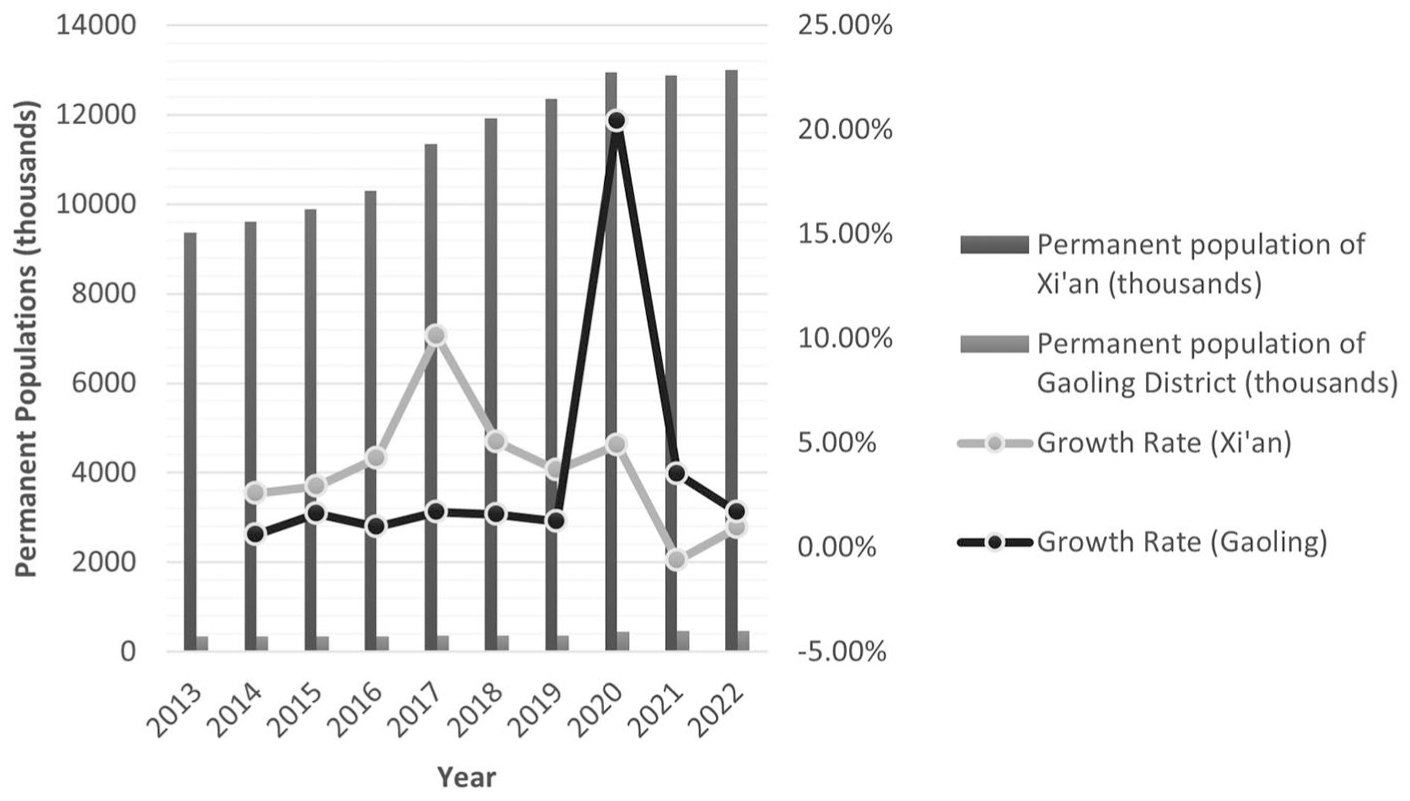
Permanent population and annual growth rate of Xi’an and Gaoling district, 2013–2022 (compiled from Xi’an Statistical Yearbook).
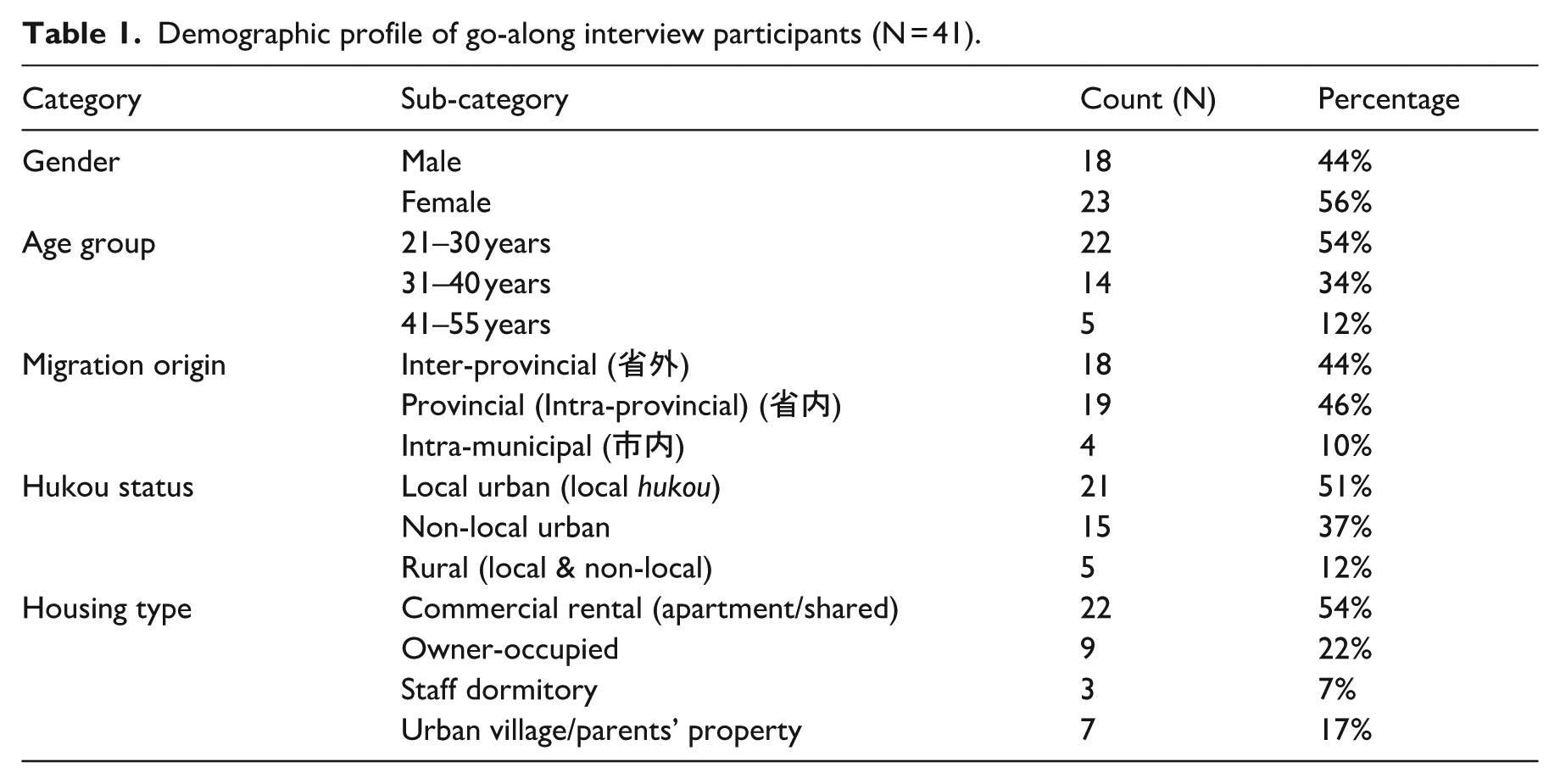
Fieldwork was conducted between February and October 2023 in Gaoling District and along principal commuting corridors to the municipal core. The core dataset comprises 41 in-depth go-along interviews with migrants (see Table 1 for a demographic summary). ‘Migrants’ refers here to non-locally born individuals who, regardless of formal hukou status, lack local social networks, positioning them between the traditional nongmingong and local categories. Using a purposive sampling strategy combined with snowballing, recruitment targeted high-density nodes (e.g., bus stops, canteens, and factory dormitory areas) in the old county seat, Jingwei and Jinghe industrial parks, and the peri-urban interface approaching Gaoling, to capture diverse commuters. The sample includes 18 men and 23 women, aged 21–55, a demographic exposed to labour and housing market volatility. Participants work in both state-owned and private organisations across manufacturing, transport, retail, food service and hospitality, education, healthcare and junior office-based roles, reflecting the mix of blue-collar and lower-middle-class and young white-collar employment in Gaoling. Their diverse hukou status (local urban, local rural, non-local urban and non-local rural) and migration trajectories (from intra-municipal transfers to intra-provincial and inter-provincial moves) allow for comparison across the ‘floating population’.
Demographic profile of go-along interview participants (N = 41).
Go-along interviews lasted 40 to 90 minutes, conducted while participants navigated daily routes to observe the frictions and fixes of everyday infrastructure. Supplementing this, short residential stints in local guesthouses and budget hotels facilitated the systematic retracing of commuting routes at peak and off-peak times, allowing for direct observation of how access to amenities, healthcare and schooling was negotiated in practice.
Elite interviews and focus groups were conducted to contextualise the practice-level findings. This included seven semi-structured interviews with urban planners and a further four interviews and two focus groups with municipal and district-level officials. This dataset clarifies the policy intent, administrative logics and governance fragmentation underpinning the infrastructural conditions experienced by residents.
Analysis was conducted iteratively using an inductive, thematic approach. Field notes and interview transcripts were coded to identify repertoires of migrant improvisation across mobility, housing, schooling and healthcare. Coding began with open, descriptive labels generated close to participants’ own terms and advanced through constant comparison to analytical categories linking specific tactics to infrastructural configurations. As an indication of thematic saturation, recruitment and analysis ran in parallel, and interviews continued until no substantively new patterns emerged across occupational and hukou groups. Comparative analysis traced how these improvisational repertoires varied by infrastructural context, focusing on lower-middle-class and young white-collar migrants.
Intra-urban travel and settlement dynamics under the core-periphery structure
The state-engineered precarity materialises in the administrative landscape of Xi’an’s urban periphery, where municipally-prioritised NTIs coexist with marginalised peripheral towns. The institutional linchpin of this process is the preferential designation and build-out of zoning and NTIs in Chinese metropolitan governance (cf. Jiang and Waley, 2023). As a cross-scalar arrangement under a state-entrepreneurial structure, higher-level authorities constitute and empower new non-administrative governance bodies, such as development-zone or new-town management committees, recentralising and reallocating administrative powers that previously belonged to lower-level governments (Cartier, 2011). These bodies are authorised to exercise planning, construction and fiscal powers over tracts of economic value or development potential located within the lower tier’s statutory territory.
One consequence is a critical supply-side shortfall in public infrastructure. On the one hand, management committees oriented to performance and growth targets prioritise their own development agendas and have no statutory mandate, nor practical inclination, to provide services such as transport or subsidised housing to the peripheral towns from which their territories have been carved. On the other hand, the original territorial governments, having lost their most valuable land together with associated tax and land-lease revenues, see their fiscal capacity eroded and are unable to finance large-scale infrastructure for their remaining populations. Here, I characterise this as institutionalised selective provision, a mechanism where the vertical administrative system of the state directly produces the local scarcity of public goods.
Producing immobility: Selective governance and the politics of commuting
The public transportation network is an important tool providing mobility for lower-income populations (Zhao, 2015). However, disparities in economic conditions and urbanisation trajectories have led to inequalities in the development and effectiveness of public transit systems across different spatial entities (Hou et al., 2023). In Xi’an, where rapid growth has been managed through a fragmented governance landscape, deficiencies in public service provision persist, particularly in peripheral areas where the restructuring process has failed to fully integrate transport services (Wu et al., 2014; Xi’an Municipal Bureau of Statistics, 2024).
Transport deficiencies in Gaoling are a manifestation of the tension between municipal authority and local capacity. In principle, the 2015 county-to-district restructuring might be expected to fold local services into the municipal network, alongside the upward centralisation of fiscal power. Instead, the municipal government institutionalised a bifurcated system by establishing ‘Xi-Gao Company’, a joint venture that ring-fences operating responsibilities and finances. While holding a monopoly over Gaoling to Xi’an bus services, it limits integration by terminating routes at the old county seat and the industrial parks, leaving outlying residential areas across the district underserved.
This situation stands in contrast to other restructured districts like Chang’an, which during its county era had a similar model to Gaoling, with public transport heavily reliant on private, unlicensed operators. However, Chang’an received preferential treatment because its newly planned University Town was deemed a ‘core strategic area’ for the municipality’s expansion. The introduction of an integrated municipal bus route was pushed through despite fierce resistance from local transport operators. As planner Jiashu recalled, this resistance included collective action by local bus drivers: City Transit buses going to the university town in Chang’an were once forced to stop by local drivers, who pulled out stop signs and prevented passengers from boarding the buses because it interfered with their routes.
This conflict illustrates the selective nature of municipal decision-making in Xi’an. The absence of a comparable high-priority project in Gaoling meant the municipal government lacked the political incentive to overcome local frictions (Ma, 2024). This local selectivity is underpinned by the broader logic of China’s fragmented authoritarianism, where transport connectivity is defined less by technocratic planning than by inter-governmental territorial struggles. Following county-to-district restructuring, the centralisation of power and resources has systematically transferred vital fiscal rights to prioritised NTI committees (Cartier, 2011; Tsui, 2011), leaving peripheral-town governments like Gaoling, stripped of authority and left with an eroded fiscal base, disempowered and ill-equipped to tackle their own transport challenges.
This logic of prioritising political utility over local necessity is epitomised by the planning of major infrastructure projects. As Jiashu pointed out, political imperatives shaped investment in specific lines and destinations: Many suburban metro lines were built to support projects like the Western China Science and Technology Innovation Harbour, the Asian Cup bid, and the National Games. These lines were initially designed to improve transport conditions for areas like Xixian New Area and the Xi’an International Trade and Logistics Park. . .but without these central government-backed projects, approval would have been difficult, as they don’t address the city’s most urgent needs but serve political goals at both the higher and municipal levels.
The practice of using infrastructure as a bargaining chip for political and economic goals is also evidenced by the recently opened Metro Line 10 to Gaoling. Like other subway projects in China (Li and Liu, 2024; Pan et al., 2011), this selectively routed line was designed less around existing dense settlements than around newly built districts and tracts of vacant land, in order to serve the development ambitions of industrial parks governed by a powerful NTI committee and to anchor a corridor of transit-oriented development, while selectively neglecting the immediate mobility needs of local residents.
The inadequacies of the formal transport system have given rise to a thriving informal market that patches up transport infrastructures (cf. de Coss-Corzo, 2021). Along the Gaoling-city corridor, numerous unlicensed private car drivers offer rides to passengers facing long waits for buses at high-traffic stops and key transfer locations. Yehan, a migrant working at a grocery company in Gaoling, frequently uses these illicit services for her commute: The bus from home to work has irregular schedules and takes a long time, plus I have to transfer. It takes over two hours each way. Although these illegal cars wait until they have three passengers, they can leave quickly during peak times, and it only takes 20 minutes. . .. It’s also cheaper when we split the fare.
Yehan’s calculation is a conscious choice to accept higher uncertainty for lower time costs. This reliance on social connections to stabilise a grey-zone market echoes the theoretical notion of ‘people as infrastructure’ (Simone, 2004), where residents compensate for formal deficits through relational networks. Knowledge of where to find rides, which drivers are trustworthy and when cars depart circulates through dense everyday social networks among colleagues and neighbours. Unregulated transportation services also involve locally licensed taxi drivers whose livelihoods are squeezed between municipal intervention and platform competition. Chenming, a licensed driver working for the county’s taxi service since 2010, expressed frustration with finding fares: If you don’t go out to find customers, you won’t get many fares. . . Most workers (in large enterprises in the industrial park) take the company shuttles, but a few take the bus to here (Checheng Garden) and switch to city buses. For those in a rush or when the bus isn’t running, they’ll take a cab. . . During the evening rush, I can make three or four long hauls into the city, and I don’t even need to use the meter.
Here, the boundary between the legal and the illegal dissolves as Chenming’s formal status fails to guarantee his livelihood. Echoing the collective resistance of local bus drivers in Chang’an, his resort to off-meter hauls is similarly a defensive response to shrinking livelihood space under municipal mandates (cf. Qian, 2018). These informal services are essentially passive adaptations by local stakeholders to top-down planning and investment choices, stitching together resources and positions to barely fill the voids left by the state’s selective investment.
Even so, the reparative capacity of this informal patchwork is limited and exclusionary. The network is heavily dependent on word-of-mouth and local familiarity (cf. Zhang et al., 2015). For newcomers, women commuting at night or workers with caregiving responsibilities, the threshold for trusting unregulated services is considerably higher (e.g., Qiao et al., 2023). Informal services are also highly vulnerable to policy shifts such as periodic enforcement campaigns and roadside inspections. Thus, while easing frictions, these practices operate through a highly individualised privatisation of risk, reallocating financial, temporal and safety burdens from the public systems onto the very drivers and passengers least able to bear them (Fileborn et al., 2022). These layered constraints generate significant divergence in residents’ access to the city, reflected in the highly differentiated daily activity spaces mapped in Figure 2.
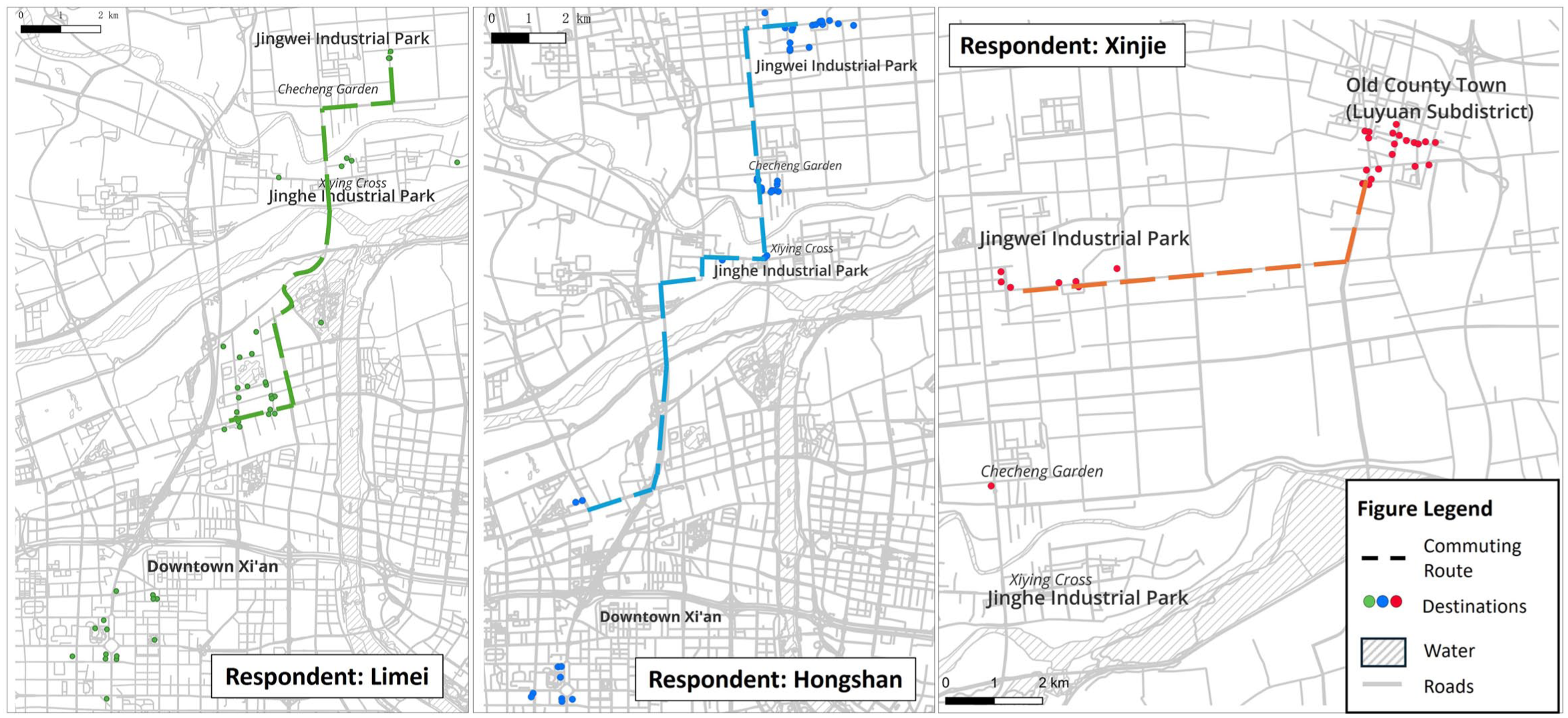
Destinations of respondents’ seven-day activities.
This figure maps the seven-day activity destinations of Limei (downtown-to-NTI commuter), Hongshan (NTI-to-downtown), and Xinjie (old county seat-to-NTI). Although all earn around RMB 5,000 per month and rent comparable flats, their activity spaces diverge sharply with access to transportation infrastructure. Limei, an executive in an electromechanical company based in Jingwei New Town, rents a two-bedroom apartment in Weiyang District. Effective public transport allows her routines to extend beyond workplace and home into Weiyang’s commercial hinterland south of the Weihe River. Hongshan, a pharmacist at a downtown public hospital, also rents a two-bedroom flat in Jingwei New Town and can similarly access a wider commercial environment via well-connected transit. Even though living services are thin around their residences and workplaces, as well as in the old county seat relying mainly on farmers’ markets and street shops, connectivity to the urban core broadens their practical reach of services. By contrast, Xinjie, a public high school teacher residing in a one-bedroom flat in the county seat, has a much narrower activity space, limited leisure options and a burdensome commute to the city centre.
This sense of separation is mirrored in linguistic practice. Residents of the old county seat refer to the city centre simply as ‘Xi’an’ like outsiders rather than ‘shiqu’ (downtown), while NTI residents avoid identifying with ‘Gaoling’ in favour of ‘Jingkai’ (the Chinese abbreviation of the Xi’an Economic and Technological Development Zone). This terminological discrepancy underscores the entrenched socio-spatial divisions from the city-county period, persisting in city-peripheral (shiqu versus jiaoqu) binary in political discourse and the administrative dichotomy between the ‘six downtown districts’ (chengliuqu) and the ‘suburban counties’ (waixian). Hierarchies of state investment are thus reproduced in both the stratified commuting experience and the narration of mobility.
More broadly, selective transport planning and provision constrain peripheral mobility and deepen segregation between the urban core, NTIs and peripheral towns. Under such intractable constraints, improvisation often shifts from travel optimisation to residential reconfiguration (e.g., Wu, 2006). Aiyuan, a migrant from Sichuan teaching at a school in Jingwei Industrial Park, faces a two-hour commute from her purchased property. Instead of searching for a faster route, she abandons her home during the workweek: If I lived in my own property, it would take me almost two hours to get to work via the metro with two transfers. So, I stay in the school’s dorm. . .The area is inconvenient, with no large malls nearby, and Gaoling’s old town is even more remote – about an hour by bus with limited service. The only thing I want is for the metro to open, so it only takes me an hour to get home.
When the state renders daily mobility unworkable, the most practical adaptive strategy is to reconfigure lives through the housing market. Aiyuan’s strategy thus shows how state-engineered mobility frictions are displaced into the housing domain, providing a direct bridge from the politics of commuting to the politics of housing.
The politics of housing: State diversion and migrant improvisation
Unlike the state-monopolised transit system, housing in urban China is a complex domain shaped by an interplay of policies, capital and various socio-economic forces. However, for the lower-middle class, the formal market for affordable, state-subsidised housing is itself a site of infrastructural selectivity. While recent hukou reforms have nominally opened pathways to subsidised housing, the reality on the ground is one of institutional scarcity and strategic diversion. In peripheral Xi’an, the housing domain reproduces infrastructural selectivity through diversion of subsidised stock and eligibility filters that privilege strategic places and groups. Confronted with incomplete delivery, migrants assemble market-based fixes like urban-village partial lets and qunzufang that restore use-value but externalise legal, health and security risks.
For low-wage migrants in Xi’an, state-subsidised housing options nominally include capped-price housing (CPH, lianzufang), public-rental housing (PRH, or gongzufang) and subsidised-rental housing (baozufang), designed to alleviate housing poverty by targeting households that meet low-income and housing-deprivation criteria. However, the reality on the ground is one of overwhelming demand and institutional scarcity. Each year, over 150,000 new college graduates remain in Xi’an, yet in 2022 the city built only around 5,693 new PRH units (People’s Government of Xi’an, 2023). PRH allocation operates through a city-wide waiting list that prioritises resident status, stable employment and per capita income, alongside housing thresholds including no prior homeownership and less than 17 m2 per person. Eligibility for the smaller and cheaper CPH is narrower still, largely limited to officially recognised ‘low-income households’ (dibaohu) and other specified groups like families without working capacity. Despite these filters, the imbalance continues to worsen, driven by the post-pandemic economic downturn and the expansion of hukou settlement since 2016. Qinglin, a migrant from Henan, complained that after more than two years on the list, there were still thousands of people on the list ahead of him.
In suburban areas like Gaoling that have recently undergone county-to-district restructuring and remain weakly integrated into municipal systems, housing insecurity is more precarious than in the downtown districts. At ‘Minsheng Community’, a subsidised housing complex in Gaoling (Figure 3), government official Ming expressed the severity of the housing shortage: Due to limited supply, this was initially a mixed community of capped-price and public rental housing. Even if all units were allocated to truly low-income local families, it still wouldn’t be enough. For those who qualify (for CPH) but can’t get a place, the government offers cash to rent privately. This cash is meant for basic needs, but often, it is used for essentials rather than rental costs.
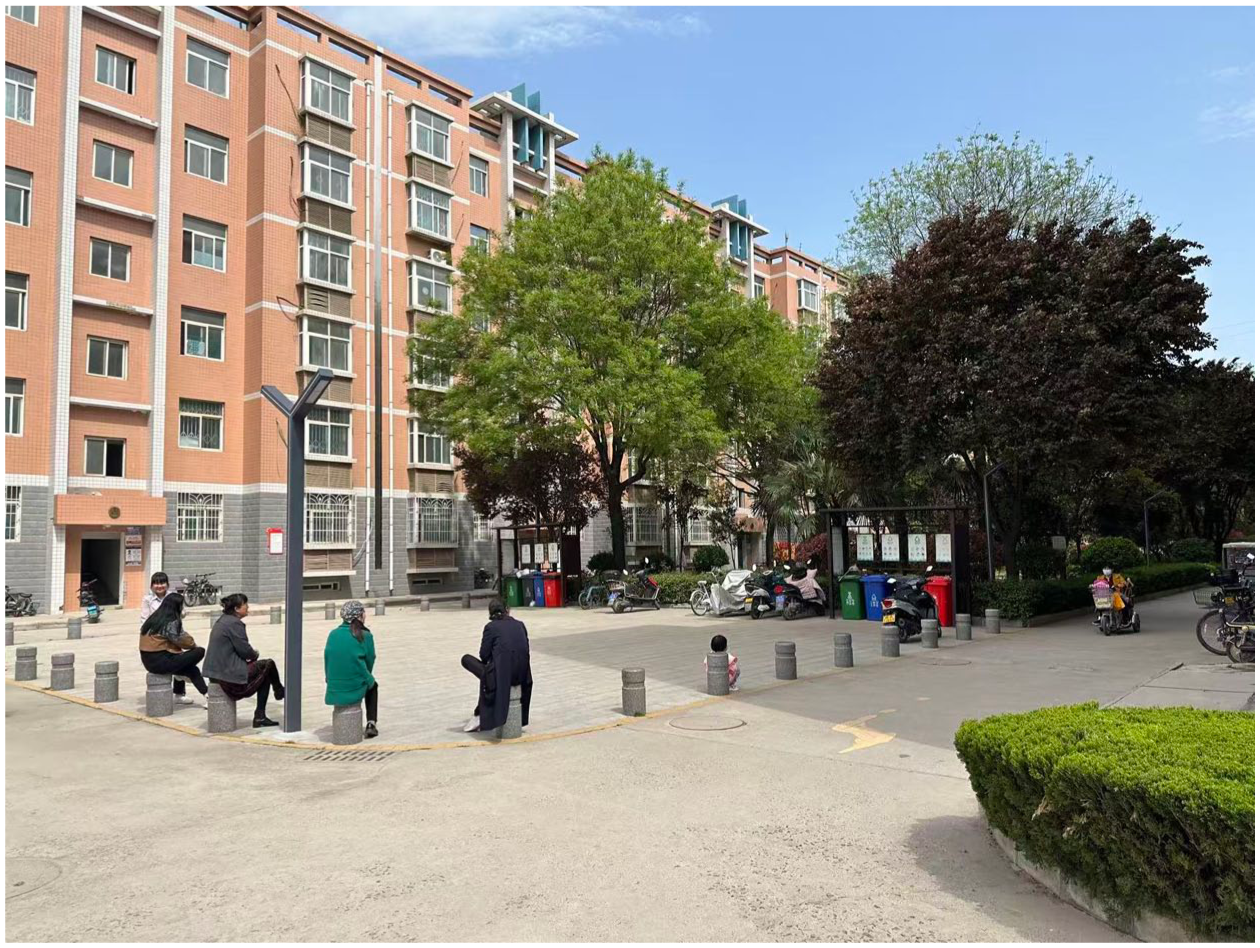
Live view of the Minsheng Community, Gaoling District (photo by the author).
For PRH applicants, often there is no recourse but to wait. Yet, even standing in line offers no guarantee, as the state manages scarcity through mechanisms of selective allocation. A notable portion of limited PRH stocks is strategically diverted to qualified ‘talents’, skilled degree holders and government-selected cadres from elite universities (xuandiaosheng), granting them preferential access while bypassing ordinary applicants like Qinglin. This practice repurposes a welfare instrument intended for poverty alleviation into a device for attracting preferred residents (Pun et al., 2018). This selectivity is also territorial: municipally-favoured NTIs like Jingkai control over 3,989 units, yet these resources are deployed to attract investment and skilled workers, reserved primarily for internal enterprise employees rather than the broader public. In contrast, peripheral towns struggle to meet basic needs: Gaoling’s local government manages only 425 PRH units. As Ming noted, local PRH under construction in 2023 was still catching up with targets set for 2018–19, amid persistent funding shortfalls, underscoring how peripheral-town administrations remain fiscally and institutionally ill-equipped to bridge this structural gap.
For lower-middle-class migrants expelled from the formal subsidised housing system, the only option is to seek cost-effective alternatives in sparsely regulated grey zones, notably individually or collectively owned properties in urban villages and qunzufang. Mirroring the logic of informal transport, these housing improvisations also involve calculated trade-offs between affordability, location and security. Tongxin, a contract worker who has relocated four times in seven years in pursuit of affordable housing, now rents a single room in a self-built village house: Of course, I know I can’t even get a residence permit to live in this kind of house, but affordability is my priority. I rented this single room for only 100 yuan a month – cheaper than public rental housing, probably only one-tenth of the market price. . . . If you live far away, the transport costs are high, and a normal house nearby is too expensive. . . . But don’t think about settling down or even getting married or having children. The construction team only paid part of the social insurance for me.
Tongxin’s experience shows how urban villages sustain the industrial workforce through a tight calculus of low wages, incomplete social insurance and proximity to work. By accepting substandard conditions, migrants effectively lower the reproduction cost of labour for the nearby NTI, rendering the ‘underdeveloped’ village and the ‘modern’ industrial park functionally integrated within the fragmented urban regime. This arrangement forces migrants to prioritise immediate survival over long-term stability, deferring life goals such as marriage and family in exchange for a foothold in the city. Such trade-offs between enduring long commutes and accepting substandard housing are representative of many workers employed in the main commuting and commercial centre of Jingwei Industrial Park between the old county seat and Checheng Garden.
Gaoling’s urban villages defy the stereotypical image of overcrowded, unauthorised rental housing. The village where Tongxin resides retains the physical layout of a traditional village with a cluster of low-rise self-built houses and narrow laneways. Unlike the dense, multi-story ‘handshake buildings’ (woshoulou) seen in Pearl River Delta urban villages, which are often purpose-built to maximise rental units (Lin et al., 2011), the properties here are two-story, single-family homes originally designed for owner-occupation. As villagers like Tongxin’s landlord have transitioned away from farming, many families retain surplus rooms as a ready, informal housing supply for factory workers. The emerging rental market is therefore one of opportunism, where left-behind family members typically occupy one floor while letting out a few vacant rooms on another to generate supplementary income (Figure 4). As Tongxin indicates, this co-living arrangement offers distinct advantages: The landlord’s family occupies the ground floor, and all four vacant rooms on the first floor are let out. This is the norm in nearly every house; there are no properties solely inhabited by tenants. Moreover, with a police station, health centre, and a variety of small eateries at the village entrance, the area is both secure and convenient.
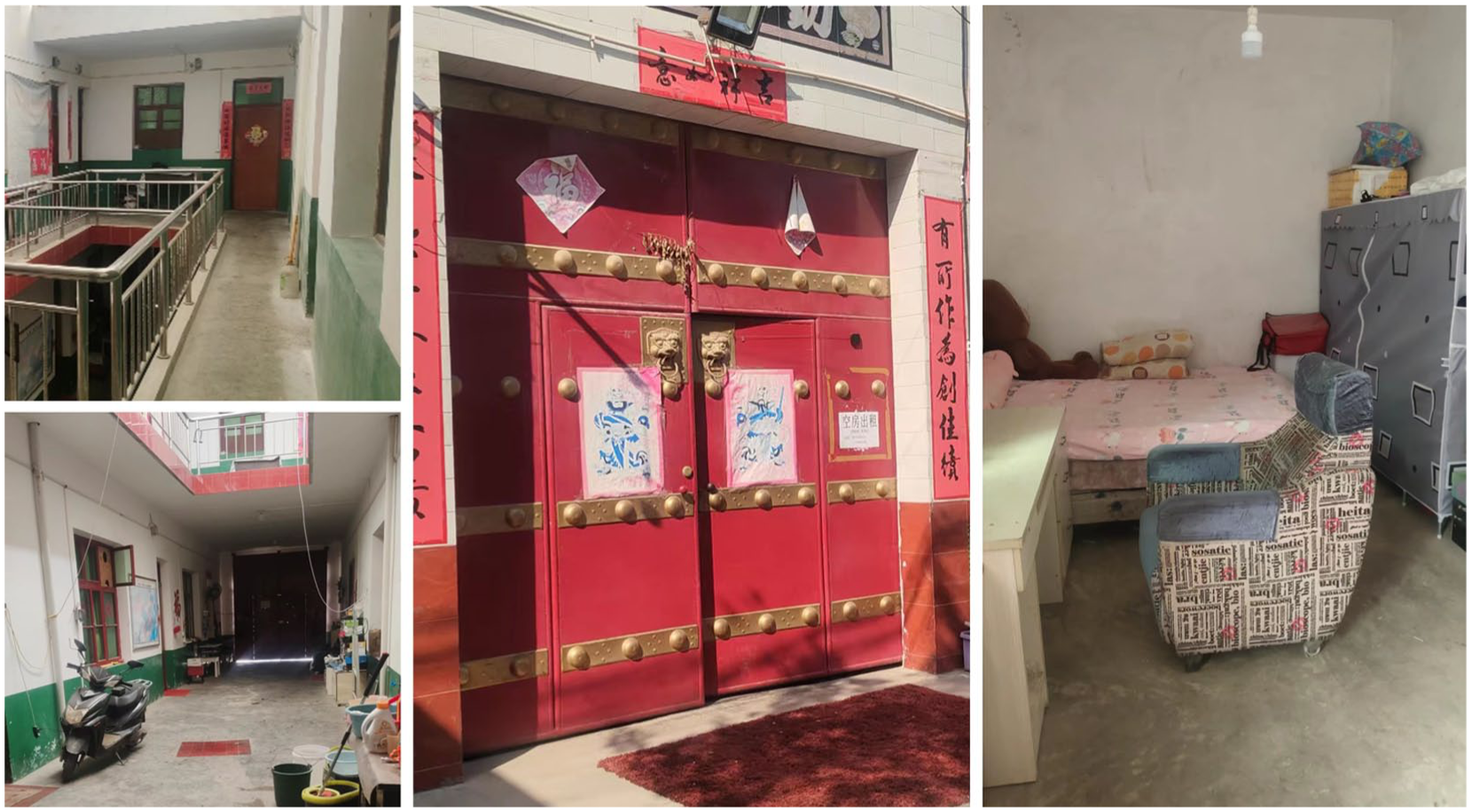
Rental housing in family-built property, Gaoling (Photo by the author).
The physical co-presence of the landlord’s family provides a layer of informal surveillance that generates the security he values. Yet this improvisation rests on a fragile and asymmetrical symbiosis: Essential amenities are secured through personal negotiation rather than enforceable rights, effectively privatising the risks of social reproduction within the formal city.
In addition to urban villages, qunzufang has also gained popularity among younger migrants. This practice involves the unauthorised subdivision of standard family apartments into multiple, smaller tenancies, allowing individuals to access gated communities without the prohibitive cost of a whole-let unit. As Weidong, a letting agent working in Gaoling, described: . . . [This flat] was originally a three-bedroom, two-reception layout, but it’s been reconfigured into four self-contained studio rooms, each with a private kitchen and bathroom. We’ve re-done the plumbing and wiring for the whole flat so that every room can be en-suite. The kitchen doesn’t have a gas line, but you can use an electric hob, and we’ve installed an extractor hood. Every door is a keypad security door.
Such subdivision reflects the commodification of precarity. By refitting ordinary flats into quasi-studios, agents sell the appearance of independence at a fraction of the cost of commercial rentals while obscuring the legal and safety risks embedded in such ad-hoc renovations. What remains unsaid is that such units, termed ‘chuanchuanfang’ (‘skewered rooms’, units strung along a corridor) often pose serious hazards, including irritant air from fresh refurbishment, heightened fire risk linked to low-quality particleboard furniture, and thin partitions that offer almost no sound insulation (see CCTV News, 2024).
The reason these properties remain in high demand is that they enable low-income groups to exit the poorer conditions of traditional urban villages while gaining entry to newly built gated communities, challenging the assumption that high rents exclude them from well-built estates (Wu, 2006). As Huyue recalled of her experience renting for the first time after graduating in 2020: A lot of the so-called ‘whole lets’ you see online are these subdivided rooms in modern blocks. (You) open the main door, and it’s just a narrow corridor. . .the main advantages are the low rent and the residential-rate utilities, cheaper than in a commercial flat. In a good compound, the neighbours will be more polite, and the amenities are better.
Choosing a ‘skewered room’ is therefore a negotiation of social status. Migrants tolerate severe spatial confinement in exchange for the symbolic capital and safety of living in a middle-class gated community. This trade-off supports an external performance of urban respectability while silently bearing hazardous living conditions and the ever-present threat of displacement inherent to their informal tenure. Adding to this precarity is the inconsistent legality of such arrangements. First-tier cities like Shanghai cap the number of residence permits/households permitted per unit size, while many second-tier cities including Xi’an have yet to establish comparable frameworks.
As improvisations, renting in village housing or qunzufang represents an individual tactic for survival in the voids of the urban periphery. Confronted with selective provision, lower-middle-class migrants assemble their own repairs to cope with spatial mismatch. These informal infrastructures function as necessary complements that keep a model of partial development running by patching gaps in the formal grid, but this patchwork also externalises legal, health and time costs onto migrants themselves.
Discussion: Governing through selectivity and improvisation
Synthesising the mobility and housing analyses, the Gaoling case shows that infrastructural incompleteness at the metropolitan edge is neither accidental nor temporary. The co-existence of well-serviced NTIs and thinly provisioned peripheral towns, routine reliance on informal repairs in transport and housing, and repeated deferral of promised improvements together indicate a settled way of governing the urban periphery. These patterns are best read as an overarching condition of partial development, generated through a logic of infrastructural selectivity, expressed spatially as mismatch, and negotiated through migrant improvisation. In this sense, the experience of residents in peripheral Xi’an speaks to debates on actually existing neoliberal and entrepreneurial urbanisation, where inequality is actively produced and managed rather than treated as an unintended side-effect of growth (Wu, 2020).
First, the findings show partial development as a durable governing condition rather than a transitional stage on the road to urban completeness. Planning narratives often treat peripheral deficits as frictions that will be resolved as cities ‘catch up’ to a linear trajectory of modernisation. Peripheral urbanisation scholarship has long noted that such ‘temporary’ deficits can endure for decades, as in São Paulo’s self-built outskirts where municipal authorities continue to draw political and fiscal value from under-serviced areas (Caldeira, 2017). What remains less developed is how provisionality becomes stabilised as an ordinary horizon. In Gaoling, peripheral towns are formally incorporated and mobilised within growth strategies, but their infrastructural and welfare build-out is held in a protracted state of ‘not yet’. The case adds institutional specificity by tracing how administrative restructuring and budgetary practices sediment incompleteness within a single municipality.
Second, my analysis identifies infrastructural selectivity as the governing logic that produces and sustains this condition. Selectivity is not a diffuse tendency but is organised through concrete instruments in Xi’an. The selective establishment and construction of NTIs and other politically-prioritised entities serves to unbundle the city territory. Planning authority, fiscal capacity and welfare entitlements are recentralised in NTI management committees, while district governments retain residual responsibilities with diminished revenues. The result is a variegated regime of infrastructural citizenship. NTI residents access dense transport networks and sizeable subsidised housing stock geared towards recruiting ‘talent’, while adjacent towns contend with truncated bus routes, bypassed metro lines and near-symbolic subsidised housing provision. This foregrounds an exclusionary corollary of state entrepreneurialism (Wu, 2020), where the ability to assemble premium infrastructures in strategic nodes is coupled with an institutional capacity to defer, dilute or withdraw provision in non-priority territories. Partial development names the resulting condition in which expansion and incompleteness are structurally intertwined.
Third, the findings clarify spatial mismatch as a key spatial expression of infrastructural selectivity. Beyond simple correlations between city size, employment distribution and commuting burdens (Ran et al., 2020), I have shown how mismatch is actively manufactured and stabilised through selective planning and investment decisions. The trajectory of Metro Line 10, designed to serve industrial parks and speculative districts while skirting around existing settlements, demonstrates how infrastructure aligns with project-led growth rather than residential and labour geographies. In this configuration, mismatch functions as a filter stratifying access to the city. As long, fragmented and costly commuting chains pull migrants into areas that are administratively urban yet infrastructurally thin, access to transport and subsidised housing resembles what Hirsch (1976) termed positional goods, whose value derives from relative advantage exclusively. Mismatch is thus both a spatial outcome and a mechanism through which differentiated rights to the city are reproduced.
Finally, migrant improvisation helps explain how life is sustained under these conditions without romanticising ‘resilience’. The Gaoling case reveals how migrants assemble a patchwork of informal and semi-formal arrangements that restore minimum connectivity and shelter where the formal grid falls short. Informal carpools, off-meter taxi runs and strategic use of company shuttles keep commuting chains just about workable. Village rooms and subdivided ‘skewered rooms’ in gated communities provide footholds near work for those excluded from subsidised housing. These practices resonate with accounts of ‘people as infrastructure’ and improvisational urbanism in cities such as Johannesburg or Mexico City, where social relations and practical knowledge compensate for unreliable networks (de Coss-Corzo, 2021; Simone, 2004). The Xi’an case, however, highlights how such improvisations are tightly entangled with state projects. By accepting substandard housing and monetising their own risk in informal markets, migrants subsidise the formal economy and lower the costs of labour reproduction for NTIs and firms that depend on them. Informal fixes also render omissions in formal planning politically bearable, without requiring a reorientation of investment priorities. Migrant improvisation is thus a reactive form of agency that keeps partial development operational, redistributing temporal, financial and embodied costs of infrastructural selectivity onto those least able to absorb them.
Taken together, these arguments show how the four elements of the framework operate in concert in Xi’an’s periphery. Partial development describes the overarching condition within which expansion and incompleteness coexist. Infrastructural selectivity names the governing logic that produces this condition through patterned allocations of authority, finance and welfare. Spatial mismatch is one of its most visible spatial expressions, stratifying access to the city. Migrant improvisation is the everyday response through which residents render life possible within these constraints. Situating Gaoling within this architecture allows the paper to speak to broader debates on uneven development, splintering urbanism and migrant precarity, while foregrounding China’s second-tier urban peripheries as critical sites where contemporary urbanisation is governed and lived.
Conclusion
This paper has argued that state-engineered precarity is a constitutive feature of partial development in urban China. Through Gaoling, it has shown that the infrastructural bifurcation between well-serviced NTIs and neglected peripheral towns is produced by a governing logic of infrastructural selectivity. The state strategically channels investment into flagship zones while maintaining adjacent territories in a protracted state of incompleteness. In this context, spatial mismatch functions as a durable filter for social stratification, compelling residents into a landscape of migrant improvisation where informal markets must fill the voids left by the state.
These findings offer a grounded critique of ‘actually existing state entrepreneurialism’ (Sun et al., 2024; Wu, 2020). By centring the lived experiences and adaptive strategies of migrants, this study reveals that the state’s pursuit of competitive growth is structurally coupled with the disinvestment in social reproduction for its peripheral workforce. Infrastructural uncertainty thus becomes an instrument of governance, a form of statecraft that disciplines populations and manages development.
The implications of this study extend to fundamental questions of urban justice. The analysis reveals a significant form of infrastructural inequality that is often masked in official narratives of integration. The misallocation of affordable housing, repurposing it as a tool for talent recruitment rather than poverty alleviation, represents a profound failure of the state to guarantee essential services for its most vulnerable groups. The landscape of migrant improvisation is thus the inverse image of its selective and powerful presence. Realising a more inclusive urban future in China requires moving beyond the spectacle of flagship projects to confront the mundane precarity produced in their shadows and to rebalance power and resources to support the grassroots communities bearing the hidden costs of partial development.
Footnotes

Ethical approval
Ethical approval for this study was obtained from Xi’an Jiaotong-Liverpool University.
Informed consent statements
All participants provided informed consent prior to their participation in interviews and go-along activities. All identifying details have been removed and pseudonyms are used throughout the manuscript to ensure participant confidentiality.
Funding
The author received no financial support for the research, authorship, and/or publication of this article.
Declaration of conflicting interests
The author declared no potential conflicts of interest with respect to the research, authorship, and/or publication of this article.
Data availability statement
The data that supports the findings of this study are not publicly available due to the sensitive nature of the interviews and to protect participant privacy but may be made available from the corresponding author upon reasonable request.