



Abstract
As a key infrastructure of platform urbanism, smart urban platforms integrate diverse information and communications technologies (ICT), such as video analytics, sensor networks, and big data-driven forecasting. Yet the development and governance of these platforms in China encounter profound challenges tied to the tensions inherent in platform urbanism, particularly the decentralization of traditionally hierarchical state controls. Drawing on an in-depth case study of Guangzhou, this paper investigates the political drivers underpinning the rise of smart platforms in China. While local governments leverage platformization to alleviate fiscal pressures, address information asymmetries, and navigate interjurisdictional competition, they simultaneously face critical capacity gaps in technological oversight. This governance deficit constrains the state’s ability to regulate technology providers effectively. In response, local authorities adopt hybrid strategies, relying on political contracting, profit-sharing arrangements, and investment-binding mechanisms, to assert partial control over platform operations. The findings reveal how state entrepreneurialism manifests in China’s smart city practices, balancing between market dependence and efforts to retain public authority in an increasingly data-driven governance landscape.
Introduction
Since the turn of the millennium, urban landscapes have been profoundly reshaped by processes of assetization, through which land, housing, and various infrastructures are recast as financial, technological, and political assets (Birch and Ward, 2024; Liu and He, 2025). Smart platforms—emerging asset portfolios underpinned by data, technology, and physical amenities—embody a new form of socio-technical infrastructure that integrates seamlessly into the everyday operations of urban life while intertwining with production, consumption, and governance processes. Existing scholarship on urban governance has largely followed capitalist logics, highlighting how urban assets have become integral to financialized accumulation regimes in the post-crisis era, sustaining urban growth through the capitalization of social infrastructures and public goods (He and Cai, 2024; Liu and He, 2025). This paper turns its attention to an extra-economic perspective, introducing the territorial logics of the state (Wu et al., 2024) in governing platform urbanism. It argues that smart platforms are not merely assetized instruments for urban growth, but have evolved into governing mechanisms through which the state extends infrastructural power and regulatory control (Cai and He, 2022). In this process, market actors—particularly technology providers—are enrolled into governance arrangements that anchor platform-based statecraft.
Research on platform urbanism has gained global traction, as scholars examine how digital systems, data flows, and platform-based operations reconfigure urban space under diverse political-economic conditions (Sadowski, 2020b). In Western contexts, platform urbanism has largely unfolded under the dominance of financial capital and institutional investors, who channel investments into digital infrastructures, data ecosystems, and platform-based services as new frontiers of capital accumulation (Moreno, 2014). These investments not only yield rentier profits through the capitalization of data flows and infrastructures but also enable corporate actors to extend their sway over urban governance (Stehlin et al., 2020). Platforms both embed within local infrastructures to monopolize spatial relations and dis-embed through transnational technological diffusion to evade regulatory oversight, thereby serving elite economic and political interests (Graham, 2020; Shelton and Lodato, 2019). In this sense, platform urbanism in Western societies has been identified as a financialized and corporate-led project, transforming cities into arenas of accumulation and technocratic control.
By contrast, the Chinese trajectory of platform urbanism is state-orchestrated in nature, reflecting a distinctive mode of digital governance underpinned by state entrepreneurialism. Although corporate technology giants such as Baidu, Alibaba, and Tencent (abbr. BATs) play indispensable roles as platform constructors and technology providers, the state retains planning centrality and regulatory authority throughout the process of platformization. Rather than ceding control to market forces, multi-scalar state actors actively mobilize public investment, direct procurement, and policy design to integrate smart platforms into the governing apparatus of contemporary urbanism. The governance architecture exemplifies what scholars describe as the “global localism” of platform urbanism (Dameri et al., 2019), in which global technological paradigms are reterritorialized through national institutional frameworks and state-orchestrated development agendas. The Chinese case, therefore, reveals a distinct configuration of state–market relations: while digital enterprises undertake platform construction and management, the state remains its dominant position in governing digital infrastructures, ensuring that the platformization of urban life ultimately reinforces—rather than displaces—state territoriality and regulatory power.
Within this governance framework, China has witnessed the rapid expansion of Information and Communications Technology (ICT) over the past decade, including cloud computing, the Internet of Things (IoT), and other digital technologies. With the rise of major domestic technology firms such as the BATs, digitally enhanced urbanism has become a central tenet of national and local development agendas (Caprotti and Liu, 2019). Under the central government’s endorsement, local authorities—often in collaboration with technology companies—have extended smart city initiatives beyond pilot experimentation into long-term policy practice (Xu et al., 2022). According to data from the Guangdong Provincial Government Procurement Network, Guangdong Province procured 2,575 smart platform projects in 2020. By 2022, this number had risen to 3,420, with public expenditure on smart city services through direct procurement reaching 1.053 billion yuan 1 . Such developments demonstrate how ongoing technological advancements have reshaped public service delivery and government–market interplay, giving rise to a new form of platform urbanism across Chinese cities.
Given the state-centric nature of China’s platform urbanism, this paper investigates the indispensable role of the state in developing and governing platforms, and unpacks the evolving state–market interplay that stabilizes the platformization processes. Existing studies on state entrepreneurialism emphasize state dominance and the instrumental use of markets (Wu, 2018), yet the scenario of “planning centrality, market instruments” needs to be enriched by examining the governance costs and barriers associated with leveraging market forces (Cai and Chen, 2024). In practice, while the hardware systems underpinning smart platforms are often advanced and widely deployed, the platforms themselves are frequently slow to evolve, poorly maintained, and underutilized. Feedback from grassroots bureaucrats regarding platform functionality is seldom addressed promptly by technology providers. On the flip side, government departments demonstrate limited engagement with the platforms, relying primarily on basic features such as video surveillance and work order management. When urgent or unexpected tasks arise, platform responses are typically too slow, prompting officials to revert to traditional methods such as manual call centers and human-led coordination.
Against this backdrop, the paper explores two interrelated research questions. First, how does the state strategically deploy market instruments—such as public–private partnerships, procurement contracts, and investment incentives—to promote platform urbanism within a state-orchestrated governance framework? Second, what structural and technological constraints hinder the effective implementation of state entrepreneurialism, particularly in terms of the coordination between government agencies and technology platforms?
The remainder of the paper is structured as follows. It begins by reviewing the extant literature of platform urbanism and state entrepreneurialism to provide a contextualized explanation of platform urbanism in China. The paper then introduces the research methodology and the case study of Guangzhou to examine the evolving dynamics of smart urban platforms in the era of digitalization. Subsequently, it analyzes how the state instrumentalizes market tools in the development of platform urbanism, including the underlying political motivations and the statecraft employed. Building on this, the paper further explores the practical dilemmas faced by state entrepreneurialism in deploying market instruments, particularly the dual barriers of institutional fragmentation and techno-governance asymmetries. Finally, the paper concludes by summarizing the critical findings and contributions of this study to the scholarship on platform urbanism.
Literature review
From the smart city and platform capitalism to platform urbanism
Platform urbanism, both as a conceptual lens and a practical approach, traces its origins to the rapid multifaceted evolution of smart cities over the past decade (Hollands, 2008). The smart city is typically defined by the integration of big data, digital infrastructures, and network technologies into urban systems (Kitchin, 2014; Townsend, 2013). This vision suggests that cities are increasingly shaped by “everyware”, a condition where ubiquitous computing and digital instrumentation are embedded across physical infrastructures (e.g., telecommunication networks, sensor systems, surveillance grids and building controls), to monitor and regulate urban processes (Greenfield, 2006). Harrison et al. (2010) characterizes the smart city as “instrumented, interconnected, and intelligent”, referring to the use of smart devices for real-time data collection, cross-system integration of information, and data analytics to support more efficient and responsive policy-making in urban governance. This perspective on smart cities primarily emphasizes ICT and its application in urban governance from the standpoint of technocrats and technological advancements. The technology-centered approach, however, tends to treat smart platforms as black boxes, reducing the city to a passive container of digital tools while overlooking the political, institutional, and strategic roles of the state in shaping, deploying, and governing these platforms (Field et al., 2020). Scholars argue that the mere integration of ICT into urban infrastructure does not inherently make a city “smarter”. Rather, smartness depends on the alignment of technology with human capital, social capital, and broader socio-economic policies to drive growth and guide urban development (Caragliu et al., 2011; Hollands, 2008). As a result, existing literature often fails to account for how smart platforms are embedded in broader statecraft and power dynamics that influence urban governance.
A second stream of research on smart platforms draws form the growing literature on platform capitalism, which foregrounds the political economy of platforms and their entwinement with everyday urban governance. As Lefebvre (1991) suggested, platforms now serve as the new areas for capital growth, circulation, and accumulation. Platform capitalism, as articulated by Srnicek (2017), describes an emergent economic model that generates value by extracting, processing, and commodifying data produced through smart platforms. Within this framework, platforms function as socio-technical intermediaries embedded in wider process of capitalization (Langley and Leyshon, 2017; Wagner, 2021). Critically, their importance lies in the capacity to extract rent from data flows and social interactions, which are enclosed as proprietary services and monetized through anticipatory logic of future value (Graham, 2020; Sadowski, 2020a, 2020b). This perspective illuminates how platform companies gain authorities by reorganizing the production, distribution, and consumption of big data, often operating beyond traditional regulatory systems (Vallas and Schor, 2020; van Dijck et al., 2018). However, classical theories of platform capitalism typically presuppose a market realm relatively autonomous from the state, where the core tension stems from the conflict between the logic of capital accumulation and public needs. This paradigm reveals its limitations when interpreting the Chinese context. More broadly, it situates smart platforms within the logics of the platform economy, extending their impact on thinking about the relationship of smart platforms and the city beyond technological innovation to encompass deeper economic, spatial, and cultural transformations (Barns, 2019). The market-oriented perspective, which tend to emphasize speculative and entrepreneurial endeavors in smart platform development, often overlooks the crucial role of municipal states and how these platforms are integrated into wider state-led strategies and urban entrepreneurial agenda.
Building on the foundational insights of smart cities and platform capitalism, platform urbanism has emerged as a distinct mode of urbanization shaped by digital platforms and algorithmic systems (Fields et al., 2020; Pollio, 2021; Rose et al., 2021). The term “platform urbanism” was introduced by Barns (2014) to explore the governance potential of open data platforms, emphasizing how platforms serve as multilateral digital intermediaries to connect governments, technology providers, and citizens. These systems restructure urban flows of people, goods, services, and information by reconfiguring underlying data infrastructures, thereby altering the logics and modalities of urban governance (Barns, 2018, 2020; Hardaker, 2021). Scholars argues that platform urbanism is driven by platform capital’s imperative to datify and monetize urban spaces, therefore, serving the interests of elite actors through value extraction and data commodification (Sadowski, 2020b; Shelton and Lodato, 2019). From the dual perspective of platforms as socio-technical assemblages and intermediations, scholars further conceptualize platform urbanism as a socio-technical condition of urban life characterized by digitally-enabled, socio-technical assemblages that engender new kinds of social, economic and political intermediations (Caprotti et al., 2022). Research on platform urbanism has increasingly focused on the contested dynamics of digital capital’s reshaping of urban spatiality. Shelton and Lodato (2019) argue that the rise of platform urbanism is fundamentally driven by capital accumulation, with platforms primarily structured to serve the interests of a narrow group of economic and political elites. Stehlin et al. (2020) further advance by constructing a typology of platformization trajectories, ranging from data capital’s networked accumulation to community-led commoning, to frame platformization as both a spatial fix for capital accumulation and a symptom of urban governance crises. Their critique reveals how platforms, despite their technological solutionist rhetoric, exacerbate socio-spatial inequalities through data extraction and the reproduction of uneven development. This aligns with Graham’s (2020) theorization of “conjunctural geographies”, which regards platforms’ strategic duality as the entity embedding into local infrastructures to monopolize spatial interactions while dis-embedding through transnational corporate structures to evade accountability.
The theoretical contribution of this paper lies in its introduction of the state entrepreneurialism perspective to reveal the unique logic of Chinese platform urbanism, thereby supplementing and refining existing platform capitalism theories that have overlooked the role of state capacity. The emergence of platform urbanism in China embodies a distinct operational logic, markedly contrasting with the tech-enterprise-dominated global expansion model of platform capitalism discussed earlier. In this context, platform urbanism is not unilaterally driven by market forces but is deeply embedded in the national governance system, presenting a strong state-led governance framework. In contrast to Western contexts where platform capitalism often exacerbates inequalities in public service provision, the core tension in China manifests differently. While the state leverages smart platform development as a key market instrument to achieve its governance objectives, it simultaneously faces severe challenges in its capacity to manage its agents. This highlights the high global localism of platform urbanism, rooted in the interaction between global drivers and local contexts (Dameri et al., 2019). Urban platforms have become a crucial avenue for the Chinese government to enhance digitization and urban governance. Therefore, platform urbanism in China is characterized not only by market-based features but also by the evolving relationships between governments of different scales and the increasingly powerful technology enterprises (Caprotti and Liu, 2019). The advent of platform urbanism in China implies that the platform-centered urban governance model has altered the relationship between the government and enterprises. The government has become the primary force driving the development of smart urban platforms, and the evolution of platform urbanism in China exhibits strong state-led characteristics.
State entrepreneurialism in platform urbanism
By integrating data infrastructure, sensors, and modeling, smart platforms are able to collect and analyze up-to-date data, which supports real-time decision-making across policy domains such as public safety, transportation and disaster management (Batty, 2013). Beyond technical functions, smart platforms also shape institutional arrangements and policy priorities, reflecting broader transformations in the ways of governing urban spaces. The rise of smart platforms indicates a shift toward data-centric and technology-driven urban entrepreneurialism that are deeply intertwined with state and market strategies. As McGuirk et al. (2021) criticized, the boom in smart platforms is a variant of Harvey’s urban entrepreneurialism, offering a technical fix to capital accumulation by attracting investment, building digital economies, and rebranding urban identity. However, this framing aligns with a technocratic and market-centric narrative that treats smart platforms as neutral tools for urban governance. However, such accounts frequently underestimate the indispensable roles of the state in steering these developments, neglecting how smart platforms are embedded within broader state-led strategies of governance and urban entrepreneurialism.
The theory of state entrepreneurialism offers a unique framework for analyzing how governing entities integrate market mechanisms in urban development (Wu, 2018; Wu and Zhang, 2022). Building on Harvey’s (1989) critical analysis of urban entrepreneurialism, this theory places greater emphasis on centralized authority (Ong, 2007) and the proactive role of state sectors (Peck and Zhang, 2013). Wu (2020) defines “state entrepreneurialism” as a governance model where the Chinese government directly intervenes in economic activities through state-owned enterprises and quasi-governmental agencies during the marketization process. Its core lies in the combination of planning centrality and market instruments, through which the state strategically deploys market mechanisms, such as land commodification and public–private partnerships, to achieve the dual goals of economic growth and political stability (Liu and Yau, 2020). State entrepreneurialism also operates within a multi-scalar political structure, wherein the national state ensures territorial coherence and governance capacity by (re)formulating political mandates and deploying diverse planning techniques (Liu and He, 2024). Through institutional innovations like the cadre evaluation system, it ensures local compliance with central strategies, making market instruments serve as vehicles for national objectives (Wu and Zhang, 2022). Besides, state entrepreneurialism often incorporates geopolitical agendas (e.g., technological autonomy) and social stability functions into policymaking frameworks (Grossi and Pianezzi, 2017; Sun et al., 2024; Yan and Zhao, 2024).
The evolution of this theoretical framework engages in critical dialogue with the global trajectory of platform urbanism. Rolf and Schindler (2023) conceptualize the model of state platform capitalism to reveal how geopolitical competition drives the institutional convergence of platform capitalism and state capitalism, in which digital platforms, functioning as technological stacks to interweave data, infrastructure, and governance ends, are reconstructed as extended carriers of state power. Zhu et al. (2024), taking state entrepreneurialism as an entry point, explore how the state embeds platform urbanism into innovation-driven development strategies. Through case studies of Zhangjiang Science City and Nanjing Jiangbei New Area, they demonstrate how the state integrates platformized development, urban spatial production, and national strategic objectives through hybrid tools such as venture capital guidance and spatial scale restructuring.
A review of previous studies reveals that state entrepreneurialism in platform urbanism primarily encompasses three practical pathways. The state plays a pivotal role in enabling platform urbanism by investing heavily in digital infrastructure (e.g., 5G networks, data centers) and offering supportive policy measures (e.g., tax incentives, data openness). A representative example is the Xiong’an New Area in China, where the state actively fosters smart city development through technological innovation like the digital twins system (数字孪生系统) and creative financing mechanisms (Wang et al., 2024). Despite its dominant role, the state achieves resource integration through flexible public–private collaborations, such as partnering with Alibaba to develop the “City Brain” in Hangzhou (Caprotti and Liu, 2022). Such collaboration is not merely market-driven; instead, the state incorporates private sectors into its strategic framework by co-opting technology enterprises, such as setting data sovereignty standards (Wu, 2023). In addition, the state reduces uncertainties in technological application through policy experiments, while incentivizing local officials to engage in innovation via bureaucratic promotion mechanisms (Lin et al., 2022).
State entrepreneurialism provides a critical theoretical lens for understanding China’s platform urbanism. By combining state dominance with market instruments, state entrepreneurialism challenges the Western neoliberal paradigm and offers new perspectives for urban governance studies in the Global South. Existing research has highlighted the central role of state entrepreneurialism in platform urbanism. However, there remains a lack of in-depth discussion on how the state leverages market instruments within this state entrepreneurialism framework and the potential challenges this approach may entail. While existing scholarship illuminates the global-local dynamics of platform urbanism, China’s state-led model demands empirical grounding. The following section examines Guangzhou’s smart urban platforms as a lens to unravel how state entrepreneurialism operationalizes these theoretical tensions.
Research method and the case of Guangzhou
The case for this research is drawn from Guangzhou, a mega-city in southern China. Guangzhou is one of the political, economic, and transportation hubs in South China, with 11 districts under its jurisdiction, an administrative area of approximately 7,500 square kilometers, and a resident population of over 18 million. In 2023, the city’s GDP reached 3.03 trillion yuan, with the value-added from core digital economy industries accounting for 12.8%, reflecting significant progress in information technology development. The high level of economic development and favorable technological industry environment in Guangzhou provide a strong foundation for the development of platform urbanism. Meanwhile, the growing pressure on urban governance is pushing grassroots levels to actively explore new governance methods. As one of the central cities in South China, Guangzhou, with its large geographical scale, substantial population, complex management tasks, and heavy governance pressures, can epitomize the urban governance challenges currently faced by economically developed regions. In addition to this, the urban management department system in Guangzhou is also quite typical. As the central institution for city management, the urban management department is an important scenario for the application of smart platforms. By analyzing the process of applying smart platforms in Guangzhou, we can obtain more enlightening empirical materials and enhance the extrapolatability of our research findings.
Between 2008 and 2015, Guangzhou’s urban management system underwent a series of institutional reforms that culminate in the creation of the Urban Management Smart Platform overseen by the municipal Urban Management Committee (UMC, 城市管理委员会). This platform was designed to resolve fragmented governance by consolidating functions from various urban management departments, including sanitation, construction, and law enforcement, into an integrated and standardized workflow. The development of urban smart platforms includes steps such as information gathering and classification, task assignment, frontline response, feedback submission, and performance evaluation. Tasks generated from grassroots patrols, citizen complaints, media reports, and directives from superiors were uniformly transcribed into this platform. Urban management officers would then respond to assigned work orders on-site, report task completion through the system, and close the loop in task management: If our frontline workers identify an issue during the inspection—something that typically requires intervention—we first log the incident into the platform system. The system then assigns it to relevant officials to solve, after which a response is submitted through the platform to end the task. This process represents the earliest form of operational workflow in the urban management sector. (Interview CGJ230113)
In 2015, Guangzhou consolidated the UMC and the Urban Management Law Enforcement Bureau (UMLEB, 城市管理执法局) to form a new agency named the Urban Management and Comprehensive Law Enforcement Bureau (UMCLEB, 城市管理和综合执法局). This institutional restructuring marked a shift toward advancing smart urban management and promoting intelligent governance in Guangzhou. As part of this transition, the municipal urban management authority established a new Science and Technology Information Department (STID), one of its 22 sub-departments, tasked with overseeing technological innovation and the integration of emerging technologies into urban governance practices. STID’s responsibilities involve spearheading the design and execution of urban governance technology projects and managing the lifecycle of smart urban platforms. Examining Guangzhou’s urban management platforms offers insights into the current state of local smart platform development and the nuanced interactions between government agencies and technology enterprises during the process.
This research employed a mixed-method approach, including participatory observation, in-depth interviews, symposiums, and secondary data analysis. Between 2022 to 2023, the authors directly engaged with a research project commissioned by the UMCLEB, which allowed us to conduct fieldwork and interviews with key actors and to gain in-depth understandings of the operational mechanisms behind smart platforms development. On-site observations of interactions between government actors and other stakeholders enable us to gather a range of empirical materials, including platform operation reports, platform development contracts, and periodic reports, that offered intuitive and dynamic insights into the functioning of smart platforms. These efforts were documented in nearly 50,000 words of field notes, accumulating solid materials for our subsequent analysis.
We also conducted in-depth interviews and panel discussions with a diverse group of stakeholders involved in the construction and operation of the Guangzhou Urban Management Smart Platform. Interviewees included IT directors in government departments, frontline staff at the subdistrict level, and technical lead and project managers from technology firms. Selection of interviewees was guided by consideration of credibility, representativeness, and relevance. From May 2022 to March 2023, we held over 10 interview sessions, engaging nearly 30 individuals across government and enterprise sectors. At the same time, we reviewed a range of secondary textual materials, including internal assessment reports, publicly unavailable archival documents, operation records, promotional texts, and news coverage, which complemented and cross-verified the primary data. The integration of these various data sources enabled a comprehensive and grounded portrayal of smart platform practices within Guangzhou’s urban management system.
Platformizing urban governance: political motivations and contractual mechanisms
Financial pressures constitute a primary driver for adopting smart platforms in urban governance. Under structural financial pressures, governments face the dual challenge of cutting daily expenditures while managing surging project costs. For instance, the Guangzhou City Urban Management Bureau’s basic expenditures fell to the 2011 level (123 million yuan) in 2021, while its project expenditures surged 4.7-fold over the decade to 1.819 billion yuan. Smart platforms help local governments respond to fiscal and administrative pressures in two main ways. Adopting new technologies signals alignment with national policy priorities and the innovation agenda. By replacing manual processes with automated systems, smart platforms offer practical solutions for departments facing tight budgets, as platformization enables local governments to secure one-time project funding while reallocating resources more efficiently.
As the complexity of governance targets continues to increase, local governments in Guangzhou face significant challenges stemming from information asymmetries due to the lack of timely and accurate insights into residents’ needs and behaviors. At the root of this information gap is the increasing atomization of society, which impedes citizens’ understanding of policy information and thus weakens state capacity for social governance. For instance, Guangzhou UMCLEB actively advanced the implementation of waste sorting policies in urban neighborhoods, while door-to-door policy promotion efforts are often rejected by residents. As a set of governance tools that can be quantified, standardized, and widely replicated and evaluated, digital technology significantly enhances state capacity in urban governance. By enabling the precise acquisition and processing of citizen information, public authorities could directly manage dispersed individuals and allocate resources through disintermediated pathways. This potential was further amplified during the COVID-19 pandemic, when individuals and households were effectively embedded within centralized management systems constructed through digital media such as online WeChat groups and health codes, thereby strengthening state penetrative power at the grassroots level. As such, technology has become a crucial tool for the government to address information asymmetries and enhance governance efficiency, with its appeal in the realm of public administration continuing to grow. In addition, the competitive dynamics of bureaucratic performance assessments have become a key driver of smart platform adoption. In the post-GDP era, where standardized performance metrics for evaluating governance capacity of local carders are limited, performance assessment of grassroots officials often relies on impression-based judgments. To gain favorable attention from high-level authorities, local governments tend to prioritize projects with high visibility, such as installing a new smart platform. These technologically advanced initiatives not only resonate with broader digital governance agendas but also generate measurable and politically appealing outcomes that speak directly to the performance expectations placed on local officials.
Driven by multiple political motivations to alleviate fiscal stress, resolve information asymmetries, and outperform rival jurisdictions, local governments have increasingly outsourced the development of smart platforms to technology firms through formal contractual arrangements, resulting in the hybrid governance logic of state entrepreneurialism. As illustrated in Figure 1, the Guangzhou UMCLEB strategically engages technology enterprises in the development of urban smart platforms. Through this arrangement, the local government advances its platformization agenda by assigning technology enterprises key responsibilities for running the platform, i.e., data collection, algorithmic analysis, and operational control, while subjecting them to performance evaluation under its supervision simultaneously. On the one hand, the local governments assigned technology enterprises data collection and algorithmic analysis, which are the most important functions for running smart urban platforms. Taking the Urban Construction and Operation Management Service Platform as an example, according to the Notice on Accelerating the Construction of Urban Operation Management Service Platforms issued by the Ministry of Housing and Urban-Rural Development in December 2021, Guangzhou was required to complete the platform construction within one year, by the end of 2022. Given such a tight timeline, it was virtually impossible for the local government to undertake the construction independently. Therefore, Guangzhou UMCLEB selected Company D, a technology enterprise with advanced technological resources in areas such as smart law enforcement, smart sanitation, smart construction waste management, integration with the “12345” government service hotline, and IoT platforms, as the project contractor.
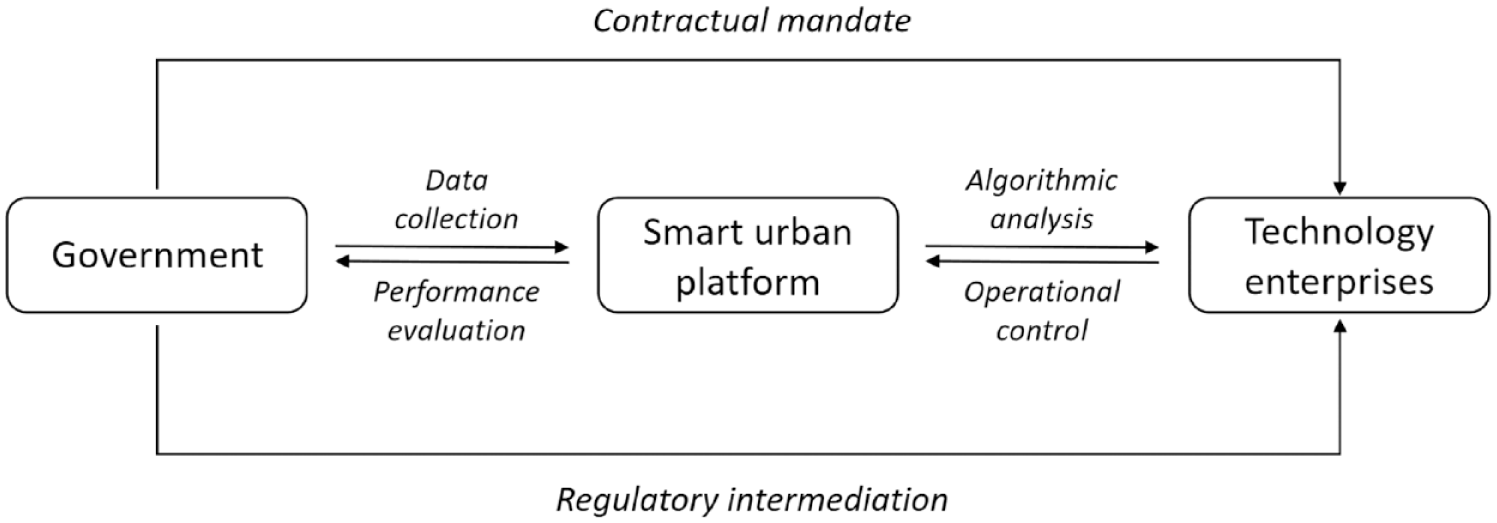
The platformization of urban management systems in Guangzhou.
The Guangzhou UMCLEB has adopted a series of institutional and strategic interventions. A key shift involves curbing the proliferation of new platform projects. Following the rapid expansion of smart governance infrastructure around 2020, the Bureau has moved toward a more restrained approach. For instance, prior to approving new platform initiatives, the Bureau collaborates with the Government Services and Data Management Bureau as well as academic institutions to conduct in-depth needs assessments to strengthen third-party evaluations. This reflects an emergent concern with technocratic redundancy and the risks of overlapping digital systems. For existing platforms, the Bureau has experimented with a triad of governance strategies, including investment binding, profit control, and political contracting, to rebalance the principal-agent relationship between the state and technology enterprises.
First, the Guangzhou UMCLEB leverages asset specificity as a critical regulatory instrument in compliance governance. Smart platform infrastructure exhibits dual forms of embeddedness (i.e., physical embeddedness through site-specific installations and digital embeddedness via backend management platforms). Once enterprises have committed substantial resources to platform construction, government actors exploit these sunk costs to demand the fulfillment of informal and often extra-contractual obligations. More specifically, enterprises make substantial upfront investments in dedicated projects (e.g., village-specific management systems), spatially anchoring operations and significantly constraining mobility. Prolonged platform engagement induces user habituation, entailing substantial switching costs that coerce enterprises to continuously adapt to evolving governmental demands, such as modular functional upgrades. By binding investment with long-term operation, the local government institutionalize profit-driven corporate behavior into governance instruments, in which state entrepreneurialism builds authority and establishes formal control over market actors.
The sustained operation of urban smart platforms depends on a distinct revenue model wherein governments strategically transfer or bundle administrative authorities to create monetization opportunities for partnering enterprises. For instance, in the case of smart platforms deployed in urban villages, the street-level government delegated a part of administrative rights to contracted private firms as a form of quasi-rent, ensuring their continued engagement and compliance. These delegated rights often include exclusive contracts for public sanitation services and parking management service, which provide stable and significant revenue streams. In addition to rent-seeking through delegated functions, platform enterprises also pursue profitability by internalizing previously dispersed urban services, enabled by government authorization. These platforms play a critical role in managing real-time traffic monitoring, area patrols, and the early detection of social tensions. To further reduce operational costs and consolidate service delivery, some platform companies have petitioned to assume responsibility for such functions, including the deployment and maintenance of associated digital infrastructure. This reflects a broader trend of privatized technological governance, in which private actors perform quasi-public roles under the framework of state entrepreneurialism.
Political contracting operates through mandating the involvement of state-owned enterprises (hereafter SOEs) in establishing urban smart platforms. Platform enterprises handle conceptualization and financing, and SOEs dominate core technical operations, and universities provide R&D support. This division of labor legalizes social responsibilities through contractual clauses, ensuring that corporate innovation aligns with bureaucratic agendas. Notably, a staff of the platform enterprise stated: “We provide the ideas, funding, and operational management, while they [SOEs] oversee construction, research and development, and system maintenance” (Interview HLJ220719), offering a tangible illustration of the tripartite responsibility allocation. Besides, platform contracts between the government and enterprise are often signed in ten-year increments, so the decade-long contractual framework allows the Guangzhou UMCLEB to adjust platform functions, serving to reassert bureaucratic authority and realign platform logics with broader state objectives. As noted in the interview: “With a 10-year contract term, whenever the government seeks to expand the platform’s functions during this period, it need only submit requests, and SOEs will remain engaged” (Interview: HLJ220719), demonstrating how institutional design accommodates governance flexibility. Collectively, these strategies reflect the hybrid governance rationality of state entrepreneurialism, which simultaneously instrumentalizes market actors while retaining hierarchical oversight and adaptive control.
These governance strategies demonstrate the state’s strategic capacity to effectively leverage market tools in achieving public governance objectives. However, the interactive effects of these strategies in practice have ultimately led to a significant structural misalignment between platform functionalities and the dynamically evolving demands of urban governance. Taking the outdoor advertising signage smart monitoring platform as an example, while it utilizes sensor technology to automatically monitor safety parameters of elevated billboards and directly pushes risk alerts to corresponding urban management officers, the system has revealed notable functional deficiencies in operation. The platform experiences network instability or even outages once or twice monthly, features cumbersome interfaces with data reset after screen switching, and suffers from design flaws including frequent false alarms and round-the-clock low-risk notifications. Despite repeated feedback from frontline inspectors to the technology provider, the company has merely documented these issues without implementing substantive improvements. This case reveals the inherent tension between administrative oversight capacity and technological governance complexity within the state entrepreneurialism framework. When governments delegate technical operational authority to market entities without establishing corresponding technical supervision capabilities and contractual enforcement mechanisms, such governance models may ultimately undermine the original goal of achieving refined governance. This structural contradiction not only compromises specific governance outcomes but also presents new practical challenges for the theoretical refinement of state entrepreneurialism.
State capacity and governance barriers: Between entrepreneurialism and institutional-technological constraints
During the development of smart urban smart platforms, a principal-agent relationship emerges between local governments and technology enterprises. The local government, as the principal, commissions the platform, while the enterprise acts as the agent responsible for its implementation. The platform itself represents a bundle of incomplete contracts. In most cases, the government retains residual rights of control, particularly over sensitive domains such as citizen data and government information, based on legitimate security concerns, thereby asserting ownership of the platform. However, the contractual arrangements often leave aspects of platform operations unspecified, granting enterprises certain residual control rights. As daily managers, technology enterprises wield significant discretion but lack strong incentives to fulfill public service mandates. As a result, they often seek to minimize operational costs, circumvent routine oversight, and avoid additional responsibilities beyond the contract’s explicit terms.
Helong Street, located in Guangzhou, is a typical urban village area densely populated by migrant workers. It covers an administrative area of approximately 6.17 square kilometers with over 170,000 permanent population. To address longstanding governance challenges, such as alley sanitation, informal construction, and waste classification, the Guangzhou UMCLEB and Helong Street Office jointly launched an urban smart platform in 2021 that integrated multiple functions, including sanitation oversight, street order regulation, and building safety management. More than 1,000 high-definition surveillance cameras were installed as part of the system. Following the platform’s launch, the Guangzhou UMCLEB received new directives from higher-level authorities aimed at strengthening the management of rental housing, requiring surveillance coverage in public areas of rental buildings. The goal was to integrate surveillance footage from the public areas of rental buildings into the urban smart platforms, the public security system, and landlords’ mobile devices (Interview HLJ220719). However, the technology enterprise resisted this requirement by citing algorithmic limitations and increased management costs, arguing that responsibilities for rental housing management fall outside the operational mandate of this smart platform. On these grounds, market actors adopted a strategy of evasion and delay in responding to the demands of municipal and street-level bureaus.
The advancement of China’s platform urbanism hinges on intensive collaboration between technological innovation and bureaucratic coordination. Yet entrenched organizational pathologies, such as organizational silos, hierarchical fragmentation, and interdepartmental chaos, persistently undermine the integration and efficacy of smart urban platforms. These structural flaws reflect the inherent contradictions of state entrepreneurialism in reconciling market-driven technological solutions with centralized administrative control. Within the urban management bureaucracy, urban smart platforms typically fell under the shared purview of both technical and functional departments, leading to fragmented oversight. For instance, the Municipal Construction Waste Intelligent Integrated Management System, formally administered by the Municipal Urban Management Bureau, did not transmit its foundational or output data to the STID. Instead, data were centralized within the Construction Waste Management Division, which retained full authority over the platform’s operational use and decision-making. The STID’s role was limited to hardware construction, system maintenance, and interdepartmental liaison, leaving it with little access to day-to-day platform operations or meaningful input into the platform’s design and functional priorities. This separation highlights the institutional silos that persist within digital governance structures and the challenges of aligning technical infrastructure with administrative practice.
The complexity of smart platform governance was further compounded by a multilayered bureaucratic hierarchy. Most platforms were overseen either by directly affiliated agencies of the urban management departments or by grassroots administrative bodies (such as township, subdistrict, or village-level governments). For instance, the newly established Guangzhou Urban Management Bureau supervised seven affiliated units, including the Municipal Gas Affairs Center and the Municipal Domestic Waste Classification Management Affairs Center. These units operated their own domain-specific subsystems, such as smart gas and smart sanitation platforms, thereby creating a three-tier administrative structure comprising the municipal bureau, affiliated unit, and platform. In this arrangement, both data flow and command transmission had to pass through intermediary organizations (e.g., the Gas Affairs Center), significantly impeding direct access and responsiveness. As a result, the operational capabilities of technical departments were severely constrained, weakening their ability to engage in platform design, real-time coordination, and cross-system integration.
Administrative fragmentation across departments presented significant challenges to effective platform governance. The case of construction waste disposal illustrates the extent of this organizational disarray. The process—from source control and transport to final disposal—involved multiple departments, including housing and urban-rural development, transportation, urban management, and environmental protection. For example, if a construction waste transport vehicle was found operating with an unclean exterior, it could trigger a multi-agency enforcement sequence: traffic police and urban management officers would confiscate the driver’s license and transport permit, followed by the transmission of license plate information to the housing and urban-rural development bureau, which would then dispatch personnel to investigate site-level violations. These fragmented enforcement chains stemmed from overlapping jurisdictions and the absence of unified command. Under the guise of meeting internal operational requirements, departments often developed their own isolated digital systems, such as video surveillance platforms and vehicle tracking tools, which lacked interoperability. This siloed platform construction further undermined coordination, reinforcing institutional boundaries rather than facilitating integrated governance.
State entrepreneurialism presupposes the state’s capacity to strategically deploy market instruments. However, the case of Guangzhou exposes a critical paradox: the state’s techno-governance incapacity undermines its ability to act as a competent entrepreneur. This is manifested in the following three aspects. First, critical technical roles lack expertise. The Guangzhou Urban Management Bureau’s IT division, despite being labeled as the city’s “technical backbone”, mainly employs non-specialists, making it hard to evaluate technical proposals or oversee implementation. As one interviewee noted, “Management experts without technical grounding struggle to assess project feasibility or cost-benefit trade-offs” (Interview: SYL220718). Second, grassroots technical skills are eroding. In S Street’s smart sanitation platform, externally hired operators with only high school diplomas couldn’t even log into the system during an inspection, relying on handwritten passwords, showing a clash between the state’s stable bureaucratic structure and platform governance’s rapid technical needs. Finally, structural barriers hinder technical upgrades. Slow bureaucracy renewal prioritizes seniority over digital skills. According to the 2021 central policy document State Council Opinions on Further Deepening the Reform of Budget Management Systems, local governments are required to strictly control fiscal expenditures and phase out various universal and baseline-based rewards. Fiscal austerity means local governments cannot match private-sector salaries to attract talent. Even when technical talent is recruited, bureaucratic inertia and risk-averse cultures suppress innovation.
In response to its technical capacity gaps, the state delegates platform development to enterprises, a strategic maneuver within the framework of state entrepreneurialism. However, this delegation inadvertently strengthens the position of market actors, producing asymmetric dependencies and three notable forms of governance distortion. First, contractual lock-in arises from vague contractual language that enables firms to evade obligations. In the Helong Street Smart Platform case, ambiguous clauses such as “assist in relevant law enforcement tasks” enabled the contracted enterprise to reject expanded surveillance demands, citing unverifiable R&D costs. Lacking the expertise to dispute these claims, the municipal authority signed a supplementary contract, increasing the budget by 10% without binding guarantees of functional upgrades. Second, functional rigidity results from the adoption of standardized, pre-packaged platforms. During bidding, technology firms offer ready-made systems that are difficult to adopt post-deployment. Due to the ineffective oversight, local governments struggled to impose iterative customization. For instance, the Helong Street waste-monitoring platform proved inflexible when shifting governance priorities required integration with rental housing management, which rendered the system partially obsolete. Third, diminished state authority reflected the structural power asymmetries during the development of platform urbanism. Technology enterprises prioritized profit maximization and may delay necessary upgrades unless further compensated. Governments, lacking credible technical tools (e.g., exit options or technical audits), became increasingly dependent on the enterprises. Furthermore, sunk investments in bespoke infrastructure, including smart poles and backend systems, further constrained governments’ choices, reinforcing long-term entrenchment even in the face of underperformance.
This case underscores the inherent contradictions of state entrepreneurialism in practice. While the state aims to leverage market mechanisms to enhance governance efficiency, its limited technological capacity often results in dependence rather than control. A pronounced techno-epistemic asymmetry separates the state from its enterprise partners. On one side, firms retain exclusive control over platform architecture and data operations, relegating government actors to the role of end-users. For example, when officials requested adaptations for rental housing surveillance, the contracted enterprise dismissed the request as “outside the platform’s scope”, a technical claim the state lacked the capacity to evaluate or refute. On the flip side, under pressure to deliver quick governance outcomes, local governments frequently prioritize expedient fixes over structural oversight. Ad hoc solutions, such as issuing supplementary contracts or allocating additional funds, become routine, further entrenching enterprise dominance. As one municipal official candidly observed, “The platform is hard to command. It is the enterprises calling the shots” (Interview: HLJ220719).
Conclusion
This paper has critically examined the implementation of state entrepreneurialism in China’s platform urbanism, revealing both its strategic innovations and inherent contradictions. By analyzing the Guangzhou smart city platform as a paradigmatic case, the research underscores how the Chinese state deploys market instruments, political contracts, profit control, and investment-binding strategies, to navigate the dual imperatives of economic growth and political stability. However, the interplay between state-led governance and market-driven technological solutions exposes systemic tensions that challenge the efficacy of state entrepreneurialism in the digital age.
This paper contributes to the adaptive development of state entrepreneurialism theory within the context of China’s smart city practices. Diverging from Western neoliberal models of urban entrepreneurship that emphasize market autonomy, yet not fully aligning with Harvey’s (2005) conceptualization of “neoliberalism with Chinese characteristics”, China’s platform urbanism unfolds within a state-led governance framework, where market tools are strategically deployed to advance governance objectives. This hybrid logic that merges centralized planning with market mechanisms transcends simplistic ideological labels by showcasing dynamic state-market-society interactions (Deng, 2023; Wu and Zhang, 2022). Its defining feature lies in the state’s maintenance of control over fundamental technological ecosystem design while strategically leveraging market tools to achieve governance goals. It offers a novel framework for analyzing how China adapts to technological change while maintaining political dominance. Simultaneously, the originality of this framework lies in its revelation of the inherent tensions within state entrepreneurialism. The state’s strategic use of market tools to strengthen control inadvertently deepens its reliance on corporate expertise, calling for a dialectical understanding of state entrepreneurialism. Focusing on the dynamic interplay between governance costs and state capacity, we argue that attention must be paid both to the state’s strategic capacity to maintain political primacy and to the structural constraints it confronts amid technological transformation.
The study highlights the epistemic divides between state and market actors as a critical barrier to effective governance. Wang et al. (2024) observe that even domestic tech giants see their influence curtailed under recentralized governance regimes, where the state reasserts dominance over platform functionalities and decision-making hierarchies. However, in the case of Guangzhou’s smart platforms, the state’s reliance on enterprises for technical expertise, coupled with its own deficiencies in digital literacy and bureaucratic rigidity, leads to contractual lock-ins, functional rigidity, and eroded authority. These asymmetries reveal the limitations of state entrepreneurialism in reconciling technocratic efficiency with hierarchical control. Further compounding these challenges are intra-state dilemmas, such as organizational silos, hierarchical fragmentation, and interdepartmental chaos. These structural flaws reflect the inertia of China’s bureaucratic system, which prioritizes stability over adaptability and stifles the potential of market-driven innovations. China’s platform urbanism demonstrates a distinctive approach to technological modernization. The Guangzhou example reveals that despite employing market mechanisms adaptively, state entrepreneurialism remains constrained by the bureaucratic frameworks it seeks to transform. These initiatives represent complex governance arrangements where the state strategically embraces global technological developments while reinforcing authority over domestic market actors (McGuirk et al., 2021). For this model’s long-term viability, the state must address its knowledge limitations, including technical and regulatory expertise deficits, and reconceptualize governance as a fluid relationship between power, innovation, and social justice.
These findings also hold significant policy and practical implications for platform urbanism in China. To address techno-governance imbalance, the state should strengthen technical capacity within public institutions and promote digital competency throughout administrative levels. Additionally, streamlining data integration vertically while encouraging horizontal cooperation through interdepartmental working groups could reduce institutional fragmentation and improve platform compatibility.
This study focuses on Guangzhou as a representative case of China’s economically developed regions, which may limit generalizability to smaller cities or rural areas where technological infrastructure, administrative capacity, and market dynamics differ significantly. The research emphasizes institutional and technological barriers but leaves room for deeper exploration of social consequences, such as citizen participation and data privacy concerns. The study’s temporal scope also presents limitations, as platform urbanism remains a rapidly evolving phenomenon that requires longitudinal analysis to understand its full trajectory and implications. Future research could explore the following: comparing China’s state entrepreneurialism with platform urbanism in other contexts to identify common patterns and divergent approaches; assessing the long-term socio-political impacts of platform-mediated governance on urban citizenship; investigating how platform urbanism manifests differently across China’s urban hierarchy, from megacities to small towns. Additionally, studies incorporating citizen voices and user experiences would provide crucial insights into the social acceptance and legitimacy of platform urbanism initiatives.
Footnotes
Acknowledgements
The authors would like to express her gratitude to interviewees who work for urban smart platforms in Guangzhou and stimulate insightful discussions with the authors.

Ethical considerations
This study is part of the first author’s National Social Science Foundation of China which approved by National Office for Philosophy and Social Sciences. Ethical guidelines were strictly followed to ensure the protection of all participants involved.
Consent to participate
Informed consent for participation was obtained from interviewees involved in the fieldwork.
Consent for publication
Informed consent for publication was obtained from all participants involved in the study, including their agreement to share anonymized data and findings.
Author contributions
Rong Cai: Writing-original draft, review & editing, Supervision, Conceptualization; Siyan Li: Writing-original draft, Formal analysis; Xianliang Tang: Investigation, Writing-original draft
Funding
The authors disclosed receipt of the following financial support for the research, authorship, and/or publication of this article: The work was supported by the National Social Science Foundation of China [grant number 22CGL058], and the Ministry of Education Social Science Key Research Center Major Project [grant number 22JJD630023].
Declaration of conflicting interests
The authors declared no potential conflicts of interest with respect to the research, authorship, and/or publication of this article.