



Abstract
This research bridges two influential strands of literature on urban China—state entrepreneurialism and homo urbanicus (城市人). By revisiting how China’s post-reform urban transformation has unfolded and connecting it to current development strategies, this research provides a fresh perspective on the country’s urbanization processes and their implications for future governance. The analysis proposes an alternative periodization of three phases: anti-migration urbanism, anti-settlement urbanism, and anti-civitas urbanism. Beyond understanding urbanization as a crisis-driven, state-rescaling phenomenon pivoting around the blending of state and market forces, this research repositions the concept of homo urbanicus, or the urban citizen, as central to understanding the urban question in China’s governance strategies. The study urges scholars to reconsider urbanization not only as a structural transformation but as a transformative redefinition of citizenship critical to understanding China’s ongoing drive to “people-centered urbanzation”.
Keywords
Introduction: A dialogue in the era of people-centered urbanization
The concept of “people-centered urbanization” has increasingly shaped the discourse on urban development in China, with notions such as the “people’s city” gaining significant tractions in recent years (He, 2024; Wang et al., 2024). As China’s urbanization model pivots towards a framework that seeks to balance economic growth with social equity, this evolving focus raises two crucial, yet underexplored, questions. First, should we reconsider the trajectory of China’s post-reform urbanization in light of the contemporary drive towards people-centered urbanization, and if so, how? Second, what lessons can be drawn from the past four decades of urban governance to inform the development of a more inclusive and sustainable urban future?
To address these questions, this paper bridges two distinct yet complementary bodies of literature—state entrepreneurialism and homo urbanicus—to provide fresh insight into China’s urban transformation. State entrepreneurialism, which emphasizes the role of the state as both regulator and entrepreneur, offers a grounded understanding of urban governance in China (Wu, 2023). In contrast, the concept of homo urbanicus, primarily explored in Chinese-language scholarship, offers a normative perspective on the evolving role of the urban citizen, aiming to steer urban development toward greater efficiency and equity (Leung, 2014). Together, these frameworks allow for a more nuanced analysis of China’s urbanization processes.
This paper advances two interconnected arguments. First, the notion of homo urbanicus—defined as “a rational individual seeking opportunities for spatial interactions within a settlement”—complements the framework of state entrepreneurialism by reframing the urban question . It emphasizes the evolving figure of the urban citizen as a central, yet often overlooked, element in post-reform urban governance, particularly in navigating the tensions between “planning centrality” and “market instrument” (Wu, 2018). Second, the unique dynamics of China’s entrepreneurial state reinforces homo urbanicus by demonstrating the interdependence of equality and efficiency while challenging the conventional dichotomy of state-led equality versus market-driven efficiency.
The remainder of this article unfolds as follows: Section 2 explores the evolution of state entrepreneurialism and its implications for state rescaling in China. Section 3 repositions urban question by foregrounding homo urbanicus as a conceptual lens for understanding people-centered urbanization. Sections 4 to 6 apply this dialogic framework to propose an alternative periodization of China’s post-reform urbanization trajectory, offering scale-centric analyses of key urban policies alongside citizen-centered reflections on equality and efficiency. Finally, the conclusion synthesizes the intellectual benefits of this developing dialogue, advocating for a more human-centered approach to urban theory and planning praxis in China.
The urban question as a scale question in post-reform China
Brenner’s (2000) articulation of the “urban question as a scale question” presents a provocative and critical lens through which to examine urbanization in post-reform China. While this conceptualization originates from the urban experiences of post-1980 North Atlantic countries, its distinct focus on the relationship between urbanization and state rescaling inspires a critical understanding of China’s urban transformation dynamic. As Lim (2017: 1851) observes, city-regionalism in China is driven by national-level regulatory adjustments—responding to forces of marketization, liberalization, and globalization—that have redefined the power and importance of previously subordinate regulatory scales, such as municipal and provincial governments.
This scale-centric perspective is complemented by Friedmann (2005: xvi), who emphasizes that China’s urbanization is an endogenous process shaped by internal dynamics rather than external shock. The complex interactions between central and local governments underscore this, with local authorities often exercising considerable autonomy, sometimes even challenging central directives. Chung (2016) encapsulates this dynamic as a “centrifugal empire,” highlighting the constant negotiation between central authority and local autonomy in China’s governance.
State entrepreneurialism, as theorized by (Wu, 2018, 2023), extends the scale-centric perspective by focusing on the strategic actions taken by local states to foster economic growth, stability, and capital accumulation through the creation of market-like environments and engagement with external market actors. Through this lens, the deep connection between local urban development and the global economy is particularly evident in China’s rise as the “world workshop,” where local governments play a pivotal role in attracting foreign capital and establishing globally connected industrial hubs (Wu, 2018). State entrepreneurialism also emphasizes fiscal decentralization and local autonomy in land development, reflecting the complex post-reform central-local relations.
On the other hand, the discourse surrounding state entrepreneurialism diverges from state rescaling in its treatment of the historical inevitability of urban-oriented rescaling. Wu (2008) adopts a neoliberal, “there is no alternative” stance on this inevitability, positing that China’s urbanization does not embody a “strange case” (Harvey, 2006: 34–41) where neoliberal policies are merely merged with authoritarian governance. Rather, he contends that the urban frontier is pivotal for the establishment of a market society capable of navigating the complexities of a market economy. In contrast, Su and Lim (2023) challenge this determinism, invoking Harvey’s (2005) foundational critique of the inherent contradictions between territorial and capitalist logics within capitalism. They assert that China’s urban transition is neither predetermined nor universally applicable. Similarly, Lim (2017) questions the inevitability argument, highlighting that China has maintained a unitary and hierarchical state structure throughout its urban transformation.
The scale question as an urban question: Toward a dialogue
This article challenges the Chinese government’s framing of people-centered urbanization as “inevitable” while arguing that its outcome remains contingent and open to contestation. It does so by examining the trajectory of China’s post-reform urban transition through a new conceptual framework called “the scale question as an urban question.” This framework brings together two perspectives: state entrepreneurialism—focused on crisis-driven state rescaling —and homo urbanicus, which centers urbanization on the rational aspirations of citizens (Leung, 2012).
The inevitability of people-centered urbanization cannot be understood without confronting the role of state entrepreneurialism as a “crisis of crisis management”, displacing existing conditions only to create new crises (Ward and Jonas, 2002). Traditional accounts focus on how entrepreneurial urban policies manage the accumulation of crises through state rescaling, framing these cities as outcomes of regulatory reconfigurations. However, such readings often ignore how entrepreneurial policies also fuel new crises. In practice, cities shaped by these policies increasingly become preconditions and arenas where crises multiply, setting the stage for future disruptions (cf. Brenner, 2000).
Challenging the deterministic push for people-centered urbanization demands the lens of homo urbanicus. This concept conceptualizes urbanization as a rational endeavor, where individuals gravitate toward dense environments to pursue spatial interactions and mutual support, countering the reductive economic framing of urban residents as merely self-interested actors (Leung, 2012). By foregrounding the aspirations of citizens, homo urbanicus revitalizes the “urban question,” treating the urban not just as an analytical scale or a contested space for social struggle. It also avoids the pitfalls of “scale-centrism,” which riskdiluteing urban questions by framing them sorely as reflexive responses to scalar shifts (see Brenner, 2019).
The dialogic framework offers two key methodological implications. First, it prompts us to consider whether evolving urban policies in China resonate with human nature by: (i) enhancing accessibility to production, living, and ecological interactions at a human scale; (ii) improving the quality and quantity of spatial interactions through concentrated living; and (iii) balancing self-preservation with communal living in densely populated environments (Leung, 2019). Additionally, it invites scrutiny of how institutional barriers—such as the hukou system—obstruct the aspirations of urban people. Leung (2014: 41) also notes that modern cultures rooted in English liberalism often misrepresent human rationality, turning moderate self-preservation into subjective selfishness and mutual preservation into impractical altruism.
Second, this framework urges us to see cities not just as battlegrounds of competing interests but as human settlements where mutual preservation can take root. Political-economic analyses overemphasize entrepreneurial governments and sideline urban residents. Migrant workers, for example, are reduced to self-interested actors—mere cogs in the machinery of market transitions—while the city is framed as a compromise between a divided state and society (e.g. Wu, 2018, 2023). In contrast, homo urbanicus emphasizes mutual preservation as a fundamental human trait, advocating for policies that align with natural laws (Leung, 2014, 2020).
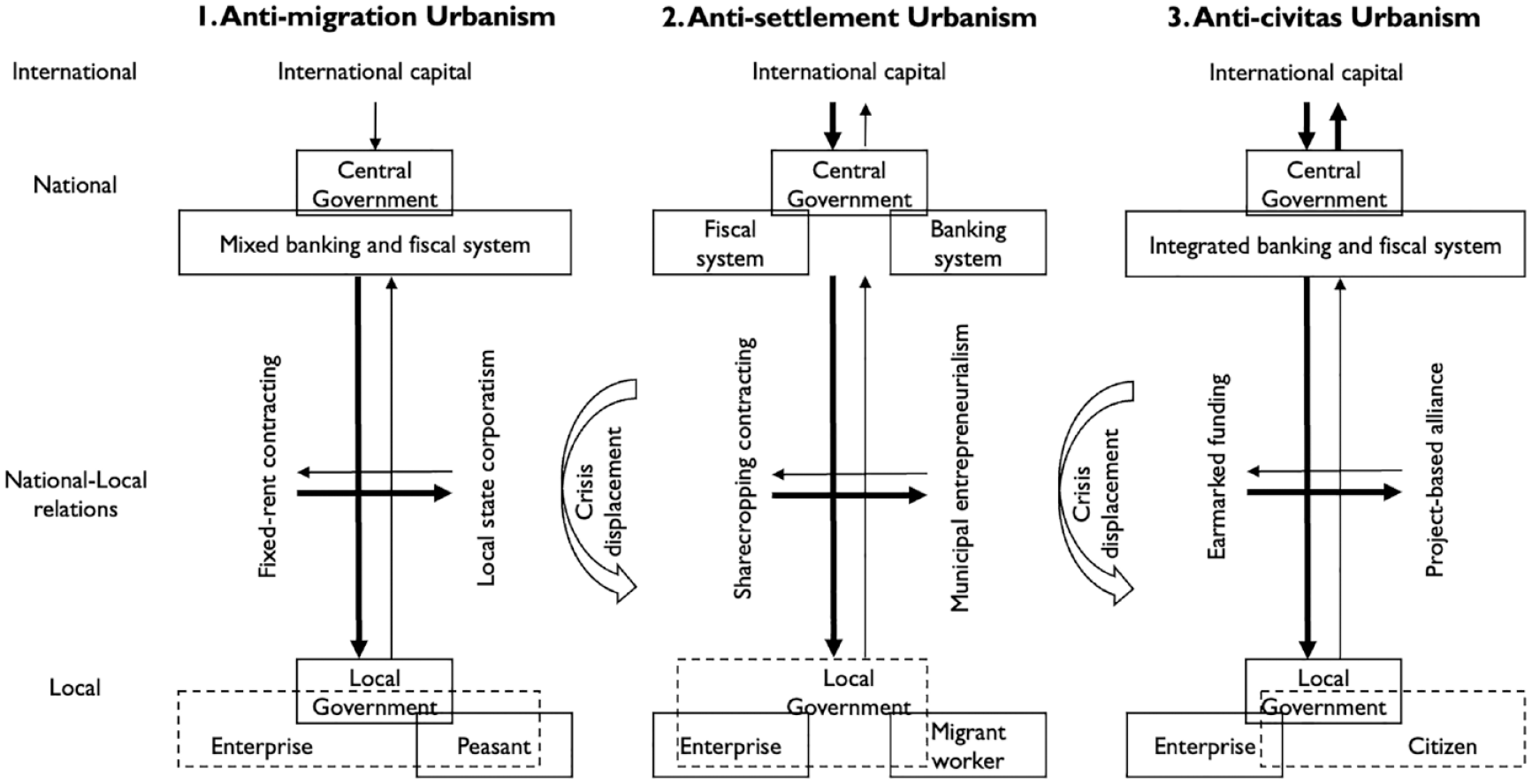
Consequently, this research proposes a new analytical framework for understanding China’s post-reform urbanization, delineated through three stages: anti-migration urbanism, anti-settlement urbanism, and anti-civitas urbanism (Figure 1). These stages represent distinct phases in the evolution of urban policies and their implications for urban life, building on the conceptual framework of state rescaling and urban rationality.
Three waves of anti-urbanism.
The analytical framework also includes three steps to engage with this urbanization transition. The first step (reading it horizontally) involves interpreting urbanization as a scale question, emphasizing how successive waves of state rescaling displace crises of capital accumulation and state legitimacy, unveiling the layers of urbanism that follow. The second step (reading individual waves vertically) reveals how each wave pivots around the fiscal and financial division of labor between central and local states. Together, these steps contextualize the defining features of post-reform Chinese urbanization—namely, the rise of town and village enterprises in the 1980s and early 1990s, the rapid financialization of urban land between the early 1990s and 2000s, and the massive scale of migrant populations since the 2000s (Zhou et al., 2018). The third step (reading the local scale of each wave relationally) marks the bifurcation between scale-centric and people-centric readings of urbanism. On one hand, the scale-centric perspective casts light on the relay-like urbanization of industries, land, and people. On the other hand, the people-centric perspective confronts the historically “incompossible” (Jonas and Jessop, 2010) nature of concurrent and convergent urbanization of these three aspects, critically interrogating the still-skewed definition of urban man concerning the rights to migrate, settle, and circulate.
This dialogic exploration exposes the contradictions in “people-centered urbanization.” It cuts through the facade of human-centered rhetoric to reveal how urbanization continues to fall short of meeting the genuine needs of urban people.
Anti-migration urbanism (1978–1992): Leaving the soil, still tethered to the village
This era (1978–1992) is marked by a striking disjunction between the rapid pace of industrialization—surged by 45%—and the relatively modest rate of urbanization, which grew by 10%. This pattern, labeled as “industrialization-led urbanization” (Zhou et al., 2018) or “under-urbanization” (Zhang and Zhao, 2003), is vividly captured by the colloquial phrase “leaving the soil without leaving the village; entering the factories without entering the city” (litu bu lixiang, jinchang bu jincheng). While alternative terms like “suburban industrialization” (Naughton, 1995) or “townization” (Guldin, 1996) hilight different dimensions of this process, they concur with the parlance that economic pragmatism began to outweigh political ideology in shaping the emerging urban landscape. This transformation was facilitated by a strategic reconfiguration of the Maoist state, involving fiscal decentralization, the establishment of special economic zones, the maintenance of de jure public ownership of means of production, and ruling authority of the Communist Party of China (Shen, 2006).
A defining feature of this period was the unforeseen explosive growth of town and village enterprises (TVEs) in rural China, which significantly outperformed state-owned enterprises (SOEs) in urban areas, driving grassroots industrialization. While SOEs experienced a six-fold increase in industrial production value, TVEs saw an extraordinary 46-fold rise. By the end of 1993, TVEs accounted for 60% of national industrial output (Cai, 1995; Li, 2003), while the private sector contributed 12% of GDP by 1992.
However, urbanization policies disincentivized migration to large cities, directing population growth toward smaller towns. Consequently, the share of small cities (with populations under 500,000) in China’s total urban population rose, while the share of large cities (with populations exceeding 500,000) consistently declinedfrom 62.7% in 1978 to 54.3% in 1990 (Yeh et al., 2006; Zhuang and Zhang, 2002: 240). This anti-migration stance reflected a lingering suspicion of large cities as hubs of urban maladies (Fang, 2014).
The scale question: The urban take-off that didn’t happen
China’s crisis-driven fiscal decentralization since the 1980s has unleashed significant economic vitality across all sub-national levels, empowering individuals and families to drive the de-agriculturalization of the local economy (Chien, 2010; Huang, 1999; Qian and Roland, 1998). The pivotal 1980 policy shift from a centralized fund allocation system to local fiscal autonomy marked a critical juncture. Local governments and state-owned enterprises (SOEs) gained the ability to retain surplus revenue after remitting a fixed amount, a significant change from the previous model in place since the 1950s (Zhang and Li, 1998). This decentralization strategy “astutely” avoided direct confrontations with Beijing while catalyzing local economic initiatives (Harvey, 2005: 121), albeit shifting the national state’s responsibility for addressing social crises like unemployment to individual locales (Yang and Wen, 2010). In essence, decentralization incentivized local governments to maximize fiscal revenues.
This shift redefined local governments, even at the township level, as primary investors in fixed assets, often collaborating with local SOEs (Zhou et al., 2018). The pre-1994 tax system, with its fixed-value-added tax (VAT) on manufacturing, encouraged investments in fixed assets and employment expansion, albeit without ensuring profitability (Sun and Zhou, 2013). While heavy investment alleviated urban unemployment, particularly among the “returned youth,” it did not guarantee sustained profitability for SOEs. Moreover, there was no meaningful separation between the fiscal and banking systems in China, with each playing the left or right pocket of the state. Local governments exploited their newfound autonomy to establish and influence local banking institutions, enhancing their competitive edge in inter-jurisdictional economic contests (Ning, 2018; Zhang, 2006).
Despite shifting attitudes towards cities, economic dynamism increasingly manifested in larger regions beyond pre-existing urban boundaries, spearheaded by TVEs in areas like the Pearl River Delta and the Lower Yangtze Delta (Naughton, 1995). TVEs operated under a hybrid “principal-agent” contract system, publicly owned yet privately managed, granting them a competitive advantage (Cai, 1995; Oi, 1992, 1995). This dual structure meant that TVEs were more influenced by local “guanxi” networks than by formal market contracts (Liu, 1999; Qu, 2015, 2016). Most TVEs, small in scale, relied heavily on debt financing and state-owned bank loans, with limited access to formal equity financing channels. These bank loans, heavily subsidized by the central state, were more cost-effective than informal financing (Li, 2003). This “local state corporatism” (Oi, 1992) underscores both the advantages and limitations of the “administrative region economy” (Chan, 2018), which managed labor movement between rural and urban sectors through local state apparatus, preserving urban interests while shifting systemic risks (e.g. inflation and food security) to the state and rural communities (Yang and Wen, 2010). Consequently, fiscal deficits accumulated by local governments were consistently managed through the central bank’s inflationary monetary policies (Yang and Wen, 2010).
The urban question: Entering the factories without entering the city
There is no denying that the rise of TVEs significantly improved welfare and freedom of rural population, thanks to both state decentralization and market liberalization. Nevertheless, the slow economic revival of traditional urban centers during this period—contrary to the central planners’ hopes for these areas to emerge as export powerhouses (Naughton, 1995: 78)—and the widening gap between industrialization and urbanization cannot be fully understood without acknowledging the unjust anti-migration regime that effectively barred rural-to-urban movement. From the perspective of homo urbanicus, this regime continued to obstruct effective spatial interactions and limit the alignment between people and their settlements through free choice, ultimately preventing a harmonious balance between self-preservation and mutual preservation across the urban-rural spectrum.
The inefficiencies imposed by this migration ban were starkly illustrated by the encroachment of proliferating TVEs and sprawling rural housing developments onto arable land, alongside the self-exploitation of rural labor within their communities (Yang and Wen, 2010). To address these challenges, the Land Management Law was introduced in 1896, aiming to systematically regulate and streamline the conversion of rural land to non-rural uses.
The sustainability of this TVE-driven rural urbanization is questionable, as it perpetuates the dualistic urban-rural system and continues the “pro-industry, anti-urban” philosophy inherited from the socialist era. This ideology idealized cities as centers of production, dominated by manufacturing and the working class, rather than as hubs of leisure and luxury (Kirkby, 2018; Sun, 2015). It justified the curtailing of urban population growth (Ma, 2002; Zhou and Ma, 2000) and the transformation of existing consumption-oriented cities into production-centric but often dysfunctional urban centers (Xue, 2013; Yeh et al., 2006). As a result, urban residents in China constituted less than 20% of the national population until the 1980s. The reinstatement of city planning at the 1980 National City Planning Work Meeting, which had been abolished in 1961 (Li, 2012), marked a departure from past ideologies but did not yet crystallize a new vision for urban life. In practice, city master plans continued to emphasize industrial projects, urban functional zones, and transportation infrastructure (Gu et al., 2015), echoing the state-socialist principles of equitable productivity distribution (Wu, 1983).
Overall, the rampant rural industrial growth during this period, fueled by local fiscal initiatives and the entrepreneurial drive of TVEs, created an economic landscape that blurred the traditional urban-rural boundary. This development heralded the rise of a more geographically extended urban region centered on existing urban cores, reminiscent of the “desakota” phenomenon observed in Southeast Asia (Guldin, 1996). Meanwhile, this growth also highlighted a critical oversight: the lack of a clear urban strategy. While fiscal and economic policies favored industrial expansion and local economic autonomy, they failed to adequately address structural urban issues such as lack of infrastructure, public services, and social welfare. This oversight led to an uneven urbanization process, where economic growth was disconnected from urban planning and social development, contributing to the sluggish economic revival of traditional urban centers.
Anti-settlement urbanism (1993–2012): Entering the city but unable to settle down
The conclusion of food grain rationing in 1992 sparked a migration wave unlike anything China had seen before (Chan, 2009). People from the countryside moved to cities en masse, catching cities off guard, prompting local governments to respond with social welfare fees levied on migrant labor wages and employers’ capital gains (Yang and Wen, 2010). Despite their vital contribution to the urban economy, these migrants were largely excluded from urban social housing, education, and publicly funded medical care, benefits reserved for urban hukou holders. Between 1995 and 2011, the urbanization rate surged from 29% to 51%, predominantly fueled by migration. This gap between industrialization and urbanization narrowed, with the urbanization ratios overtaking industrialization for the first time in 2003 (Li and Wang, 2012). It looked like China was becoming an urban nation, but behind those numbers was a more complicated reality: people lived in cities without ever being allowed to truly settle there. The mass migration underscored another glaring issue: the widening gap between de jure (based on hukou) and de facto (based on residence) urbanization.
Seasonal migration patterns between rural and urban areas further exposed the discord between the physical expansion of urban spaces and the “citizenization” of migrants. This mismatch became particularly pronounced in the early 2000s as urban construction land and built-up areas grew rapidly, outpacing urban population growth (Chen et al., 2010; Fan and Zhao, 2012; Qiao, 2014). Moreover, the expansion of urban land primarily supported industrial development zones and real estate ventures, failing to provide adequate living spaces for migrant workers (Tao and Cao, 2008). Consequently, these workers were often relegated to factory dormitories (Pun, 2005) or makeshift housing in urban villages (Zhang et al., 2003). Meanwhile, rural areas saw an seemingly odd residential land expansion despite a declining rural population, raising alarms for central authorities concerned about the inefficient land use (Li et al., 2010).
This rapid urbanization mirrored China’s ascent as a global manufacturing powerhouse, where surplus rural labor fed into the global capital circuit, especially in export-oriented industries located in various Economic & Industrial Development Zones. These zones cropped up along the coast and later inland, echoing earlier experiments with export-crossing zones in the 1980s (Cartier, 2001; Gallagher, 2011). Often set up on the outskirts of cities, they drew foreign investors with promises of cheap land and favorable planning. This broad socio-spatial transition fostered a sprawling or jump-frog urban landscape where migrant workers resided in dormitories away from city centers, tethered to the job but detached from the benefits of urban life.
The scale question: Unintentional land financialization out of crisis management
At the dawn of the 1990s, China grappled with deep economic crises, including economic stagnation, inflation, and currency devaluation, all intensified by real estate market speculation in the nascent Hainan Special Economic Zone. These economic challenges were compounded by political tensions between the central and local governments over fiscal power, after a decade of fiscal decentralization. Declining shares of government revenue in GDP and central government revenue in total government revenue significantly weakened the central government’s capacity to address regional disparities, raising concerns regarding sovereign unity (Wang, 1997).
In response, Premier Zhu Rongji initiated sweeping reforms. Economically, he implemented a series of “anti-market” measures to stabilize the overheated economy. These included currency reforms, pegging the yuan to the US dollar in 1993, and tightened controls on credit expansion to curb speculative investments, particularly in real estate. Non-performing loans from state-owned banks were transferred to newly formed national asset disposal companies, paving the way for broader economic restructuring (Yang and Wen, 2010).
To address the fragile central-local relations, the tax-sharing reform centralized the collection of Value Added Tax (VAT), thereby reducing local governments’ fiscal autonomy (Zhu, 2011). Simultaneously, banking reforms tightened regulations on local borrowing. Beginning in 1995, the central government promoted the privatization of small state-owned enterprises (SOEs) in non-strategic sectors, leading to millions of layoffs. Equally significant, the accelerated market-oriented housing supply following the 1997 Asian Financial Crisis further deepened the commodification of urban space (Wu et al., 2006). Collectively, these reforms dismantled the reciprocal corporatism between local governments and enterprises, forcing local authorities to compete for foreign direct investment (FDI) and increasingly valuable urban land use quotas.
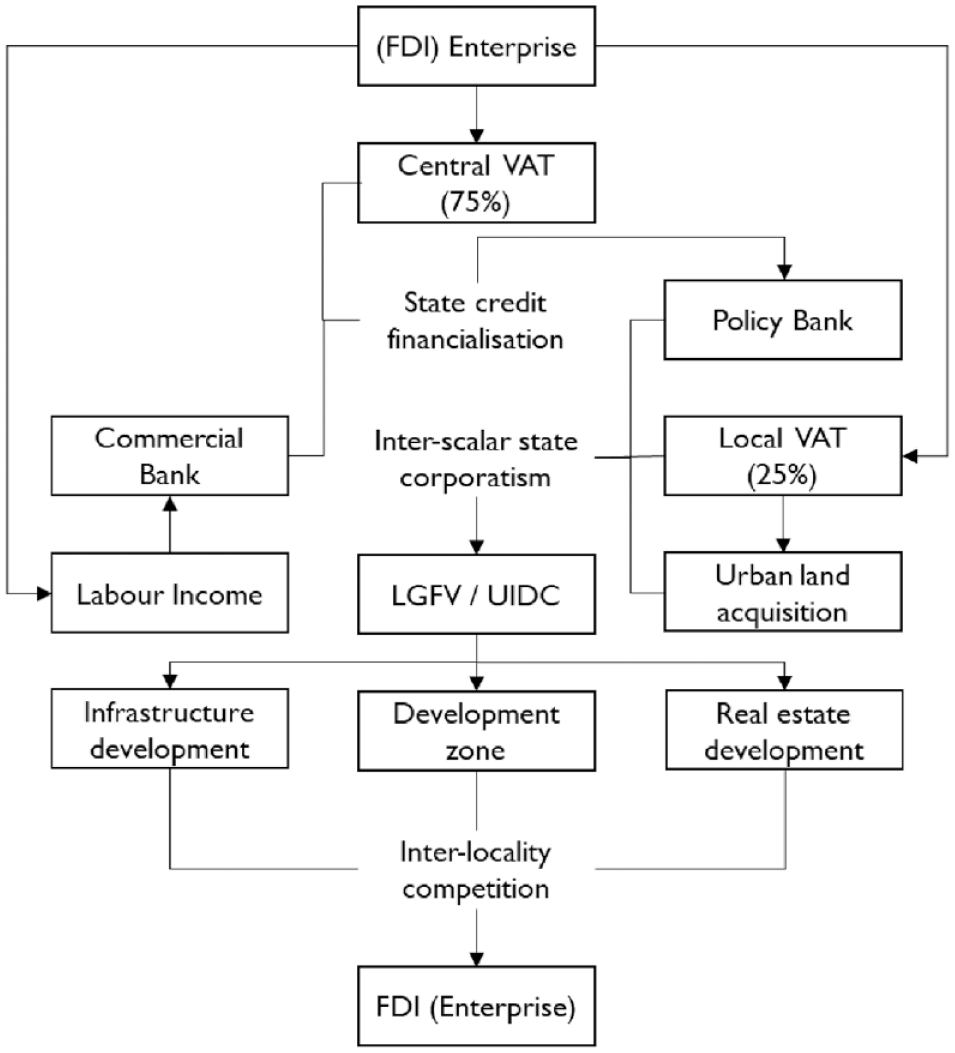
Leveraging their newfound authority over urban land development, local governments utilized urban land conveyance fees—a strategic leeway in the tax-sharing reform—to finance FDI-oriented infrastructure project (Figure 2), despite restrictions on property tax, municipal bonds, and bank borrowing (Wu, 1999b). In this process, urban investment and development corporations (UIDCs) emerged as innovative financing models for large-scale infrastructure projects. These state-owned enterprises, armed with unparalleled financial autonomy, financed local infrastructure through international loans, repaying them with urban land conveyance fees (Jiang and Waley, 2018; Wu, 1999a). This model marked a departure from prior central-local financial relations, emphasizing financial independence and developmental urban planning.
Capital circulation in the wave of anti-settlement urbanism.
As the policy banking system progressed, the China Development Bank (CDB) replaced international lenders to provide UIDCs with long-term financing. This shift resolved existing bottlenecks in funding large-scale and costly projects, significantly accelerating urban infrastructure development (Wu, 2022). In the name of enhancing market discipline in local government borrowing, the CDB collaborated with the latter to establish replicable UIDCs as de facto Local Government Financing Vehicles (LGFVs), allowing local authorities to bypass direct borrowing restrictions (Gao, 2010; Sanderson and Forsythe, 2012). The partnership birthed distinct development models in Wuhu (Zhan, 2014), Tianjin (Guo, 2013; Wang, 2016), and Chongqing (Ren et al., 2005; World Bank, 2009; Zhang, 2011), rapidly advancing the sophistication and momentum of land-centric urban development. By 2006, land financialization was estimated to account for about 60% of China’s infrastructure investment, compared to 10% from fiscal input and 30% from any land conveyance (Jiang et al., 2007).
Post-Global Financial Crisis, LGFVs surged as officially designated strategic actors to diversify local government financing channels and implement the “four trillion” stimulus package. Between 2007 and 2009, the number of LGFVs increased from 360 to 822 entities, particularly in small cities, with corporate bonds surpassing bank loans as the primary funding source (Pan et al., 2017).
In retrospect, China’s rapid ascent as the world factory exposed its domestic economy to periodic global shocks, such as the international financial crises of 1997 and 2008. These events coincided with the proliferation of UIDCs and LGFVs, which emerged as market instruments for crisis management, addressing accumulation crises through further land-centered urban growth. Their rise heralded a new form of municipal corporatism, intertwining the centrally-regulated policy banking system and local state-backed UIDCs, all revolving around increasingly valuable urban land use quotas (Zhu, 2005).
This municipal corporatism produced significant economic and social spin-offs. On the one hand, the tug-of-war between central and local authorities over land management attempted to balance food security with economic development, amid soaring commodity housing prices against lavish industrial land use (Ho, 2001). On the other hand, local “enclosure movement with Chinese characteristics” (Zhang, 2015) led to widespread displacement of landless peasants and migrant workers. These challenges threaten the party state’s stability and necessitate further crisis management.
The urban question: Imaging citizenship upon arrival
The momentum of urbanization was officially acknowledged in the Eighth Five-Year Plan (1991–1995), which continued to shape national strategies in subsequent plans, including the Tenth (2001–2005) and Eleventh (2006–2010) Five-Year Plans. From the perspective of homo urbanicus, the freedom of internal migration and the ability to reside in a different location from one’s registration—including large cities, even if only temporarily—allows individuals to better express their choices regarding spatial interactions. However, inter-city competition for export-oriented economic growth, dictated by rigid land use quotas and the narrowly defined citizenship imposed by the hukou system, which regulates access to localized state welfare, exposes deep-seated injustices. This model distorts the balance between efficiency and fairness, undermining the potential for equitable and sustainable urban development.
The inherent inequity becomes glaringly apparent in the land conflicts between urban and rural areas (Qian and Wong, 2012) and the struggles between state organs and civilians for economic benefits. While the conversion of farmland to non-agricultural uses is a predictable outcome of urban transformation, the prevailing pro-growth stance—often driven by short-term profit motives—has led local governments to act as “economic interest-groups” (Zhu, 2005). Their development agendas conflated the common good and self-interest. This has perpetuated a dual-track land market, which, rather than achieving both efficient and equitable land use, has instead fostered widespread rent-seeking, corruption, and illegal land appropriation. The failure of state agencies and local governments to uphold equitable practices has exacerbated these issues, culminating in social unrest (Lin, 2009; Lin and Ho, 2005).
Financial incentives tied to land development have intensified a power struggle that undermines both market efficiency and equitable state intervention. This power dynamic tends to marginalize rural collectives and their members—who rely on land for their livelihoods—effectively silencing their concerns. This societal pushback led to the Hu-Wen administration’s introduction of a basic social security system, promotion of countryside development, and enforcement of protections for agricultural land and the environment, all aimed at creating a harmonious society (Wu, 2023). Nevertheless, despite the 2008 Urban and Rural Planning Act’s attempt to integrate rural areas into formal city-regional planning, the entrenched urban and growth-oriented mentality of local policymakers and planning practitioners remains largely unchallenged (Qian and Wong, 2012).
The inter-city competition has thus become a dubious mechanism for regulating and incentivizing urban construction land use. As Cheung (2014) notes, mayors in Chinese cities have effectively become de jure landlords, willing to transfer land-use rights at negligible or even negative prices if the transaction supports local economic development and competitiveness. This race-to-the-bottom competition has led municipal governments to exploit hukou regulations as a legal pretext to limit migrant workers’ opportunities for permanent settlement, together with the ever-rising living cost. Moreover, insufficiently regulated competition has spurred debt-driven speculative development and collusion between power and capital, which resulted in extreme phenomena such as “ghost towns,” where property development has become detached from real needs (Su, 2020).
Ultimately, Chinese cities have evolved into vessels for capital accumulation within an ambiguously defined socialist market economy (Jiang, 2006; Wu, 2008). In this urban context, migrant workers are welcomed as laborers but excluded as social beings (Friedman, 2018). The concept of “mutual preservation,” an intrinsic aspect of human nature alongside self-preservation (Leung, 2014,2019), is largely neglected. The divide is evident not only between migrants and locals but increasingly between the rich and the poor. The only exception might be the emergence of new “underclass” neighborhoods since 1995 (Wu et al., 2010), where poor migrants and locals coexist despite significant discrimination. The imposed “floating” status, combined with the spatial segregation of production in cities from reproduction in the countryside, perpetuates an incomplete proletarianization of Chinese peasant workers (Pun and Lu, 2010), and underscores a broader systemic failure to integrate the fundamental human drive for mutual preservation into urban and social planning.
Anti-civitas urbanism (2012–present): Settling down but not necessarily converting hukou
The anti-settlement model of urbanization, marked by a persistent mismatch between rural-urban migration and hukou registration, extended into the years following the 2008 Global Financial Crisis and the Sichuan earthquake. While the central government’s stimulus package cushioned the domestic economy, it also perpetuated underlying issues, such as municipal debts tied to UIDCs and their relationship with financial markets (Shen, 2013). Vice Premier Liu He at the World Economic Forum highlighted critical challenges including excess capacity in steel and coal, commercial housing oversupply, and unemployment among migrant laborers (Liu, 2018).
In response, urban policies took on a more nuanced, pragmatic tone, reflected in the notion that “urban development is a natural and historical process” (Xinhuanet, 2015). Hukou, which had long been a barrier, remained central to reform as the state adopted a “people-oriented” urbanization strategy (18th Central Committee of the Communist Party of China, 2013). Premier Li Keqiang’s ambitious 2014 plan aimed to integrate three groups of 100 million people into urban settings by 2020: (i) granting urban hukou to 100 million rural migrants; (ii) redeveloping dilapidated city areas and urban villages housing around 100 million residents; and (iii) facilitating the urbanization of 100 million rural residents in central and western regions..
Yet, rather than completely removing hukou restrictions, the National New-type Urbanization Planning (NUP) (2014–2020) sought to balance population control with localized urban management strategies (Bai et al., 2014). This included easing hukou restrictions for smaller and medium-sized cities while consolidating growth in 19 major city clusters, driving land efficiency through a unified land market across urban and rural boundaries, and improving public services. Additionally, it sought to diversify funding sources for urbanization, including bonds, property taxes, and private investment (State Council, 2014).
The scale question: Partnership is just another word
Apart from presenting a decisive action plan, the NUP unveiled the deeper structural issues of land-centric urbanism. By 2013, UIDCs faced a stark reckoning as their corporate bonds matured and underperformance became evident (Pan et al., 2017). Recognizing the fragility of their financial models in contrast to the importance of continuous urbanization, the central government introduced an series of reforms to diversify funding sources and adjust central-local financial relations: Public-Private Partnerships (PPP) since 2013, local government special bonds since 2014, the promotion of replacing business tax with value-added tax in 2016, and the Real Estate Investment Trusts since 2020.
Minister of Finance (MoF) Lou Jiwei emphasized PPP not only as a financing tool but as a governance innovation aimed at transforming local government functions, advancing financial system reform, and strengthening market mechanisms in resource allocation to push forward new-type urbanization (Lou, 2019). This recalibration reflected an urgent redefinition of the government’s role within the national economy. Local governments were expected to reduce their obsession with GDP growth, pay off extra-budgetary debts, cease borrowing through affiliated financing vehicles, and enhance public services to accommodate the migrant population (State Council, 2014 [No. 43]). In this selective environment, developmental PPP bore the hope of bridging the gap between anticipatedly growing social services expenditure and shrinking governmental revenue and borrowing capacity: The urbanization ratio in China is 59.58% according to the permanent resident population, but only 43% according to the household registered population, so there is a big room for improvement in filling in the gap, but relying only on government input is far from enough. . . Some areas have. . .carved out developmental PPP. . .which efficiently solved both the underinvestment of the public and incentive compatibility of the private. Unlike the single project-based PPP, developmental PPP is. . .based upon the holistic development and management of the area. In this partnership, social capital is responsible for providing industry development-centered integrated service including infrastructure, public service, investment courtship, and urban management. Also, a certain ratio of newly added government revenue would be allocated to the non-governmental capital as the return on investment.
The MoF launched the “Operational Guide for PPP (trial)” in November 2014, heralding a surge in PPP projects. To oversee these projects, the China Public-Private Partnerships Centre (CPPPC) was established in March 2015, providing a national, comprehensive online platform for PPP information, project supervision, and data analysis. By early 2014, the CPPPC had overseen over 10,000 infrastructure projects with a combined investment exceeding 17 trillion yuan, making China the largest market for PPP investments (CPPPC, 2022). Since early 2015, UIDCs intending to participate in PPP had to announce they would no longer assume the role of local government borrowing and operate as independent enterprises.
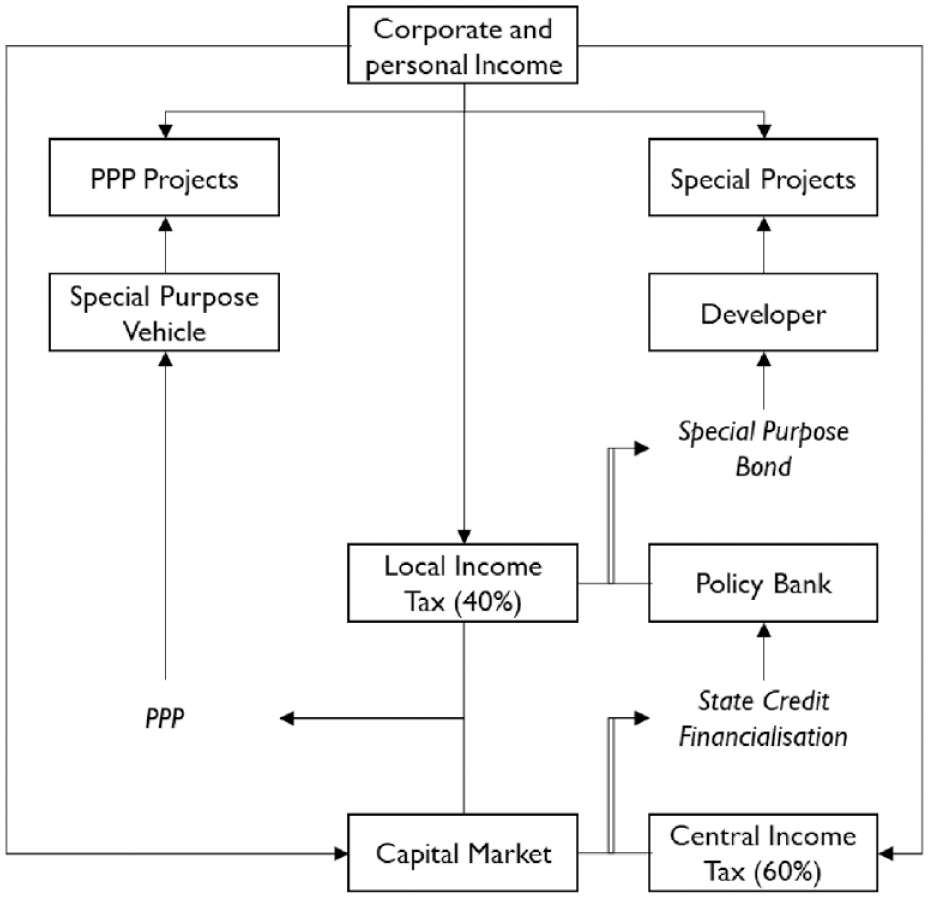
PPP aimed to create a new channel for the circulation of capital in the era of people-oriented urbanization, through special purpose vehicles (SPVs) responsible for bidding, designing, constructing, financing, and operating infrastructure projects (Figure 3). However, it rapidly revealed its limitations. By 2017, efforts to curb misuse of these partnerships by local governments led to a downturn in PPP projects. While the concept holds potential, its practical implementation remains a “cat-and-mouse” game between regulatory bodies and local authorities, who persist in borrowing through restricted channels. The transfer of regulatory oversight from the Ministry of Finance to the National Development and Reform Commission in 2023 reflects ongoing struggles to manage these partnerships effectively, even as they promise expanded participation by private and foreign capital (Zhang, 2024).
The intended circulation of capital in the people-centered urbanization.
The urban question: People or hukou?
Despite the successful settlement of 100 million people between 2014 and 2020, the gap between de jure and de facto urbanization rates has remained virtually unchanged. In 2012, this difference stood at 18.7%, and by 2020, it had only narrowed slightly to 18.5%. The National Urbanization Plan (NUP) aimed to reduce this gap by two percentage points, with an ultimate target of 15% by the end of 2020. However, these aspirations faltered. The urban resident population surged by 157 million, outpacing the 120 million who converted their rural hukou to urban status (Chan, 2023: 147).
This stagnation highlights the persistent barriers imposed by hukou policies, especially in large cities. Restrictive settlement criteria inhibit migrants’ access to full urban citizenship (Xie et al., 2021). These individuals struggle to obtain local hukou or meet the “settlement conditions,” which prioritize factors such as education and social security contributions over inherent rights as citizens. Even in cities like Shenzhen, where hukou policies are comparatively lenient, the high hurdles for local registration are often reserved for those with greater wealth or educational qualifications. Friedman (2018) thus contends that China’s largest cities employ a “just-in-time” strategy for urbanization, deploying labor as needed while maintaining strict controls to prevent waste and overpopulation.
On top of that, the gap between migrants’ desire to settle and their intention to transfer hukou underscores deeper socio-economic factors influencing urban integration beyond individual cost-benefit calculations (Li and Liu, 2020). Hukou transfer intentions often depend on factors such as marital status, housing affordability, and access to quality education (Wang et al., 2023). Hukou conversion alone does not guarantee access to sustainable urban livelihoods, rendering it insufficient to prevent continuous circular migration between rural and the urban areas (Chen and Fan, 2016). Furthermore, the push to eliminate the urban-rural hukou distinction is often driven more by municipal authorities seeking to acquire rural land for urban expansion than by genuine concern for migrants’ welfare (Andreas and Zhan, 2016). This focus means cities have little incentive to provide additional benefits for long-distance migrants, choosing instead to prioritize villagers on the urban periphery, who are frequently pressured to surrender their land to developers and fall into precarious employment situations post-resettlement (Zhan, 2017). Furthermore, China’s rapid population aging since 2014 (Zhang et al., 2016) has heightened the demand for social services and reduced the labor force, posing additional socio-economic challenges to urban integration efforts.
Combining these insights raises critical questions that often go unaddressed in discussions about “people-oriented urbanization”: What, then, defines a city and citizen in contemporary China? If hukou fails to emplace migrants into urban life, what does? The Chinese term “城市” (chengshi), which combines “city wall” and “market,” emphasizes architectural forms and economic activities, contrasting with rural areas. In English, “urban as a way of life” is often perceived as fashionable or superficial. However, homo urbanicus (Leung, 2014) challenges these interpretations by invoking Aristotle’s view of the city as a community for human habitation (i.e., civitas), irrespective of size, form, or economic model. Aristotle asserted that “the state [read: city] comes into existence for the sake of life and continues to exist for the sake of living well.” This perspective positions the city as a community centered on the well-being of its inhabitants.
Building a “people’s city” thus extends beyond merely undoing the harms caused by hukou policies. It demands a rethinking of the institutions and cultural norms that distort rational spatial interactions, preventing a balance between self-preservation and communal living (Leung, 2021). For instance, Teo’s (2024) study of Nantou village in Shenzhen offers a compelling example of how urban micro-regeneration can foster emplacement rather than displacement. Through state-sanctioned participation in the Shenzhen Urbanism/Architecture Biennale, traditionally marginalized groups—including villagers and migrant renters—have co-produced urban outcomes, redefining their relationships with the city and participating meaningfully in its evolution. Meanwhile, Li and He’s (2023) research on Beijing and Shanghai reveals a shift in priorities from economic growth to social development. They document the rise of long-term rental apartments (LTRs) that broaden access to affordable housing without the strict means-testing typical of earlier public housing initiatives. This shift marks a subtle but significant departure from past practices focused on maximizing investment returns, indicating that some cities are beginning to prioritize residents’ basic dwelling rights over profit.
These experimental approaches are promising but must be seen within the context of a broader systemic re-evaluation. For the past four decades, China’s urban policies have largely relied on population size-based management schemes, often framed by the concept of “big city malaise.” This term refers to the challenges associated with large cities, such as population surges, traffic congestion, housing shortages, environmental degradation, resource depletion, and high living costs (Xiao and Liu, 2018; Zhao and Zhou, 2002; Zhao et al., 2002). These concerns have long justified restrictive urban planning policies aimed at controlling city size. Yet technical debates about size-based management have neither reached consensus nor addressed these challenges from a people-centered perspective.
While size undoubtedly matters, the core issue is not merely about population control or land quotas—it is about finding a city size that balances efficiency with social harmony. A sustainable urban future must embody an approach that is truly “of the people, by the people, and for the people.” This means moving beyond the binary framework of hukou reform and embracing deeper transformations in urban governance and urban planning, where the focus shifts from exclusion and control to inclusion and mutual care.
Conclusion: Towards an equitable and efficient city
This article underscores the importance of linking state entrepreneurialism with homo urbanicus in China’s shift toward people-centered urbanization. By tracing urban reforms and connecting them to current development strategies, it offers new insights into China’s urbanization processes and their governance implications.
Though China is moving toward more inclusive and sustainable urban development, the path is neither smooth nor predictable. Scholars have examined these shifts from various perspectives: macroeconomic cycles (Yang and Wen, 2010), social transitions (Zhou et al., 2018), city size distribution (Chan, 2018), economic restructuring (Yeh and Chen, 2020; Yeh et al., 2006), and spatial planning rationale (Zhang et al., 2019). This study, however, adopts a dialectical lens, framing urbanization through the concept of scale—circling back to the core issue: the urban citizen.
Seeing the “urban question as a scale question,” China’s urban transformation emerges as an ongoing process of state rescaling. Each wave of reform reconfigures central-local relations to address crises in capital accumulation and state legitimacy. The outcomes of these rescaling efforts, though unforeseen, seem inevitable. None of the epoch-defining features—the rise of township and village enterprises (TVEs), the rapid financialization of land, the influx of migrant workers, or the tepid embrace of hukou conversion—were fully anticipated by policymakers (Zhou et al., 2018). At the local level, these changes reflect successive phases of state entrepreneurialism, from local state corporatism to municipal entrepreneurialism and public-private partnerships (Figure 1). These phases illustrate the state’s continual negotiation with market-driven reforms in labor, land, welfare, and government debt, generating cascading challenges that each wave of urbanism must confront. What begins as an innovation soon becomes routine (Peck, 2014), straining central-local relations and prompting new interventions. This cycle reveals that urban transformation is neither linear nor predictable.
The concept of homo urbanicus brings fresh clarity to these waves of urban change by shifting the focus from marketcraft and statecraft to citizenship and spatial interaction. It exposes the precarious journey from peasant to migrant to citizen (Figure 1), where urban rights are accumulated slowly and insecurely. More fundamentally, it challenges the assumption that urbanization is a stepwise procedure of migration, settlement, and hukou conversion. It questions whether hukou status should define citizenship, especially given recent setbacks in hukou-based citizenship reforms. Homo urbanicus pushes us to ask: How can China urbanize its economy, land, and people without forcing trade-offs between these elements? Reconciling these historical “incompossibilities” requires rethinking the foundations of urban governance. Rather than viewing city size solely through the lens of state or market priorities, people-centered urbanization must focus on fostering human-scale interactions that nurture both individual self-preservation and collective well-being. Leung’s (2014) insight that democracy flourishes in settlements of 200,000–300,000 people, with densities no greater than 10,000 people per square kilometer, offers a useful starting point.
At the heart of the dialogue between state entrepreneurialism and homo urbanicus lies the tension—and interdependence—between equality and efficiency. Homo urbanicus posits that true efficiency arises from self-preservation, while fairness is rooted in mutual preservation. These principles reflect a consensus on the material and spiritual dimensions of living with dignity, akin to natural law. This tension invites a reevaluation of the institutions and cultures that distort this human rationality, driving a wedge between individual and communal well-being. From a practical perspective, homo urbanicus advocates designing planning mechanisms that uncover the real spatial needs of individuals and groups, fostering an urban environment where differences coexist without sacrificing consensus (Leung, 2014, 2019). This approach offers an alternative to viewing urban governance solely through the lens of power struggles and economic imperatives (cf. Wang et al., 2024).
The expansion of state welfare and the growing range of choices available to rural-to-urban migrants suggest that equality and efficiency need not be mutually exclusive. However, state entrepreneurialism complicates the simplistic narrative that state welfare ensures equality while market freedom delivers efficiency. Instead, it shows that both welfare and freedom are products of the intricate interplay between statecraft and marketcraft (Wu, 2008, 2023).
As China charts its urban future, this study calls on scholars and policymakers to rethink how urban spaces are governed. The dialogue between state entrepreneurialism and homo urbanicus offers more than abstract theory—it points to real-world solutions for navigating the challenges ahead. Ultimately, the question of urbanization in China is not just about whether people can physically enter cities and obtain urban hukou, but whether they can live well within them. A just and sustainable city is not defined by its walls, markets, or size but by the quality of life it offers to all its inhabitants, regardless of where they come from.
Footnotes
Declaration of conflicting interests
The author(s) declared no potential conflicts of interest with respect to the research, authorship, and/or publication of this article.
Funding
This research builds on work undertaken during my PhD, supported by the SEED Postgraduate Studentship at the University of Manchester.
