



Abstract
This paper presents a comprehensive digital mapping of artists’ residential locations and social networks in Republican Shanghai, aiming to enhance our understanding of the role of spatial proximity in the development and expansion of artists’ networks, and, based on this, to reconceptualize the ‘art world.’ Our findings suggest that spatial proximity does not influence the development or maintenance of artists’ networks, which instead form a city-wide network of pipelines. However, the clustering of key nodes in primary art clusters indicates that spatial proximity is a necessary but insufficient condition for artists to expand their networks and establish themselves as leading figures. The paper further explores the dynamics of these primary art clusters, revealing mechanisms such as spatial-network synergies, the formation of intimate master-pupil relationships through co-residence, and group imaging and place branding centered around prominent artists.
Introduction
Over the past four decades, arts and culture have emerged as significant subjects in urban studies. This development is rooted in the ‘cultural turn’ in geography and urban planning during the late 1970s, the rise of the creative class and creative city discourses in the early 2000s (Charlse, 2000; Florida, 2002, 2005), and the enthusiasm for culture-led urban regeneration (Evans, 2002; McCarthy, 2006; Paddison and Miles, 2020) and the cultural and creative industries during the same period (Scott, 2000, 2004; Throsby, 2001). The growing interest in arts and culture within geography has, in turn, influenced its counterpart in the arts and humanities. In art history, for instance, habitation studies have gained increasing academic attention, focusing on artists’ involvement in the everyday activities of modern cities and their integration into the transformation of urban spaces, such as art studios. This focus prompts inquiries into the artistic zeitgeist within historical communities (Balducci and Jensen, 2014; Scott, 2016; Williams, 2019).
Similarly, urban scholars have contributed to shaping concepts within the arts and humanities (Guinard and Molina, 2018). One such concept is the ‘art world,’ which rhetorically combines the conceptually distinct entities of ‘art’ and ‘world.’ While the term ‘world’ implies a geographic scope or place, it actually refers to a socially defined domain of art production, consumption, and networking. Introduced by Danto (1964) and expanded by Becker (1984, 2023), the notion of the ‘art world’ emphasizes the significance of social connections in defining acceptable art and attaining ‘full membership’ through market integration. It underscores the interconnected system of entities and activities that influence the creation, distribution, and reception of art, highlighting the value of personal networks and creative communities within the cultural economy (e.g., Currid-Halkett, 2020; Hamilton, 2015).
Geographers, however, have sought to expand this concept by incorporating a spatial dimension. Through spatial correlation analyses, Currid and Williams (2010) demonstrate that events converge at specific nodes of the art world, exhibiting statistically significant clustering patterns at these locations. Additionally, scholarship has become increasingly specialized, with recent research advancing beyond the identification of influencing factors of art clusters to mapping these factors onto specific stages of the creative process (e.g., Granpayehvaghei and Bonakdar, 2022).
In line with this, our research examines the relationship between the spatial proximity of artists and their social network structure within the context of a creative city or art capital. While location choices reflect artists’ individual residential preferences (Markusen, 2006), our study investigates the broader geographic pattern of spatial agglomeration versus dispersion (Currid and Williams, 2010) and its association with artists’ social connections. Our objective is to identify the specific stages in the development of artists’ social networks and determine whether spatial factors influence these stages, and if so, what role they play. We address the following research questions: Is there a relationship between artists’ social networks and their residential locations? What is the significance of spatial proximity or clustering for artists’ social networks?
We used Republican-era Shanghai as a case study. During this period, Shanghai, a semi-colonial city, achieved a cultural zenith marked by significant accomplishments and continuous artistic production, blending traditional art with diverse and avant-garde experimentation (Bergère, 2009; Hay, 2001; Lee, 1999; Liang, 2010; Sullivan, 1996; Zheng, 2016). Recent studies have examined the spatial distribution of artists in specific districts through qualitative data analysis (Liang, 2010; Lin, 2018; Xu, 2015). Zheng et al. (2024a) highlight the social and historical context and factors influencing artists’ location choices and spatial distribution patterns. Zheng et al. (2024b) quantitatively examine 30 variables, including cultural, leisure, and entertainment facilities, art schools, cultural organizations, and art intermediaries, over 30 years, arguing that these factors influenced artists’ location choices. However, the relationship between artists’ social networks and their location choices remains unexplored.
Our research has three main objectives. First, we aim to determine the geographic scale of areas where social networks are concentrated. Second, we seek to identify the social network structure of Republican Shanghai’s art world by comparing the locations of key nodes in the social structure with those of spatially concentrated areas of artists’ residences. Third, we aim to understand the rationale behind the spatial-network dynamics identified in our second objective. Central to this research is a large-scale digital mapping and spatial analysis project of artists’ residential locations in Republican-era Shanghai, which represents a groundbreaking effort that fills gaps in Chinese art and urban history.
We argue that spatial proximity does not dictate the formation of artists’ social networks, which instead operate within a broader city-wide framework. However, spatial proximity remains a necessary but insufficient condition for artists to expand their networks and influence, and to establish themselves as influential figures or leaders in the field.
Expanding the concept of the ‘art world’ with a spatial dimension
Our conceptual framework incorporates insights from economic geography, art geography, and the creative economy/creative city literature. The economic dimension of the ‘art world’ facilitates the application of economic geography principles to better understand the spatial and social dynamics of art communities. On the other hand, given the human nature of art activities which are distinctive in many aspects than economic activities, we have also incorporated insights from art geography, and the creative economy/creative city literature, into the conceptual framework. Leveraging the concept of the ‘art world,’ we emphasize the significance of artists’ social networks and aim to expand this concept by incorporating the spatial dimension.
The concept of the ‘art world’
The concept of the art world was first introduced by Arthur Danto in response to negative attitudes toward emerging art forms in the 20th century (Danto, 1964). As a key figure, Becker (1984, 2023) defines the boundaries of acceptable art and grants ‘full membership’ to artists whose work integrates into the art world through market interactions. Howard Becker’s concept emphasizes the collaborative nature of artistic work, where individuals contribute to creating and sustaining art. This cooperation often becomes routine, forming patterns of collective activity that define an art world. Becker’s sociological approach highlights the complexity of these networks and their influence on the production and consumption of art.
Becker focuses on the interconnected system of entities and activities that shape the creation, distribution, and reception of art in cities. His inclusive approach spans all visual art forms and values the personal networks underlying creative communities, particularly in the context of the creative industry (e.g., Currid-Halkett, 2020; Hamilton, 2015). The art world framework captures the heterogeneous nature of art scenes, emphasizing the collaboration among artists in producing and presenting artworks (Becker, 2023). It examines the intricate connections between social dynamics and artistic practices, situating these within the cultural economy (Neate, 2012).
Overall, Becker (2023) defines an art world as a collaborative network where joint efforts lead to the creation of artworks. His conceptualization offers a nuanced understanding of the processes involved in producing and consuming art, surpassing the conventional focus on artists’ genius (Hamilton, 2015; Neate, 2012).
The space-social network dynamics: Implications from the economic geography
In economic geography, social networks are viewed as constellations of nodes at intersections of social linkages, defining communication pathways (Castells, 2004; Granovetter, 1973; Marsden and Campbell, 1984). These networks have a hierarchical structure, with nodes varying in participation and influence (Stanley and Faust, 1994; Symeon et al., 2013). Nodes with greater influence occupy central positions, acting as hubs (Martí-Costa and Pradel-Miquel, 2012). Some nodes bridge multiple communities, while others function as ‘outliers’ (Taylor, 2016). In the art world, high-weight nodes represent senior artists, mentors, or masters, who often attract visits from junior artists, thereby influencing their practices and even residential choices.
Cities, as focal points for cultural policies, concentrate networks conducive to creativity (Amin and Thrift, 1995; Fleming, 2004; Florida, 2002; Hall, 2000; Montgomery and Robinson, 1993). These urban centers attract creative individuals, influencing long-distance pipelines and short linkages (Preissl and Solimene, 2003), often extending across regions (Törnqvist, 1983).
Economic geography further explores the link between social networks and spatial clusters, highlighting how networks often lead to spatial clustering. Functional clusters, or hubs, are characterized by vibrant on-site or spatially evident social networks (Evans, 2004; Hall, 2000; Rosenfeld, 2004; Scott, 2004). Personal networks, built on mutual trust, contribute to social capital accumulation (Rantisi, 2002; Robert, 2005; Scott, 2004). Networks within clusters drive innovation by fostering shared information, opinions, and cultural sensibilities (Mommaas, 2009; Van Bon, 1999).
The relationship between social networks and the spatial clustering of artists can be mutually reinforcing. Networks provide support against career instability by creating circles of artists with shared lifestyles and career goals (Mommaas, 2004; Taylor, 2016). The convergence of networks within specific geographic areas enhances the group’s profile and strengthens collective competitiveness (Banks et al., 2000; Bilton, 1999). According to Porter (1998), physical spaces for face-to-face interactions are crucial for interpersonal communication and community connectedness. Meyners et al. (2017) argue that spatial proximity and homophily both drive social influence, with spatial proximity providing a key condition for mitigating differences.
Adapting spatial-network dynamics to the art world: Insights from the art geography and creative development literature
The art geography
Art geography offers a lens to understand the spatial dimensions of artistic production, consumption, and interpretation, bridging art and geography. Since the 19th century, it has involved mapping artworks’ locations and exploring the interplay between materials and culture in shaping the human environment (Cant and Morris, 2006; Miles, 2006). Kaufmann (2004), a pioneer in this field, emphasizes the spatial dimension in art. Scholars focus on how space, place, and environment influence human behavior and cultural practices. Art geography examines the contexts shaping artists, emphasizing human-environment relationships (Kester, 2005; Hawkins, 2010; Miles, 2006; Ren, 2017) and the creative process (Cant and Morris, 2006). This approach considers art as integral to everyday life (Miller, 2017) and highlights artist networks not just for connection but for expression (Morris, 2005). Dickens (2008) explores relationships across elite and institutional spaces, social interactions, and media environments. For instance, art galleries act as hubs, supporting interactions between networks and art practices (Neate, 2012), while historic artist districts have revitalized community images (Jackson, 2006; Lorente, 1995).
Art geography explores the spatial aspects of artistic activities, examining how geographic contexts influence artists. It offers insights into the interpersonal dynamics within the art community, shaped by geographic factors.
The creative development literature
The literature on creative economy, cities, and geography seeks to understand environments conducive to creativity, known as ‘creative clustering’ or ‘creative clusters’ (Comunian et al., 2010; Granpayehvaghei and Bonakdar, 2022; Granpayehvaghei et al., 2019). It posits that the locations of artists and their activities are determined by economic geographic principles rather than random chance (Mommaas, 2004; Rantisi et al., 2006). Cultural events are concentrated in specific urban areas, forming significant clusters (Currid and Williams, 2010). The creative economy network features value-added and spillover effects, with major hubs stimulating secondary cultural nodes (Currid and Williams, 2010; Liebowitz and Margolis, 1994; Storper and Venables, 2004).
The literature advances the understanding of how social networks and clusters interact in arts and creative industries, recognizing the complementary effects of density and networks (Storper and Venables, 2004). Geographic proximity facilitates idea circulation, feedback, cooperation, and management through informal meetings (Markusen, 2006). Recent research shows that closer proximity affects knowledge circulation indirectly via cognitive processes (Chumnangoon et al., 2023). Currid and Williams (2010) argue that artists’ spatial concentration is reinforced by a recursive mechanism, where cultural goods associated with specific places enhance their value. Cultural industries tend to locate events in the same nodes, creating homogeneous ‘event enclaves.’ The clustering of activities also attracts media attention, shaping desirable hubs and influencing city development, consumption patterns, and the fetishization of specific places.
These clusters are often characterized by a sense of ‘intimacy’ or ‘coziness’ (Hutton, 2006) and feature a friendly ‘urban village’ feel. Such communities are rich in social networks (Gordon and McCann, 2000; Mommaas, 2004), where networked actors collaborate on projects (Gordon and McCann, 2000). Artists’ social networks, including exchanges, collaborations, and sales, are pivotal in the art world (Jarynowski and Buda, 2013; Taylor, 2016). The atmosphere is often informal, bohemian, or somewhat run-down (Ho, 2009; Hutton, 2004; Lloyd, 2002). Wood and Dovey (2015) describe creative clusters as having synergies from a ‘mix of mixes’—a diverse morphology tied to various functions like production, exchange, and recreation, along with a socio-economic mix. The ‘buzz’ or ‘atmosphere’ results from the intense co-functioning of people, practices, identities, spaces, and built forms. Granpayehvaghei and Bonakdar (2022) introduce a framework combining soft cultural features and hard material attributes into three phases of creative activity—idea generation, production, and circulation/consumption—which interact across different levels, indicating that networks and technologies are foundational to creative cluster building.
Research methodology: Computer-facilitated digitally mapping and spatial-network analysis
Our research is based on a large-scale digital mapping project of artists in Republican Shanghai. We created three databases for this project in the first phase, defining artist as ‘a practitioner of visual art (e.g., painters, sculptors, and calligraphers) with public profiles.’ 1 To gather artists’ residential addresses and identify inter-artist social connections, we collected historical data from 156 biographies, 22 autobiographies, 9 Republican-period newspapers, 33 types of magazines, 652 academic books, 288 academic papers, 94 memories, and 57 volumes of archives housed in the Shanghai Archive House. From this information, we constructed a database of historical-locational data for 1,349 artists and constructed the second database that contains information on artists’ social contacts. We defined the term social contact as ‘persons within/related to the art field that had social ties to Shanghai artist(s).’ This trove of historical documents generates 1,373 pairwise social connections. Given the incompleteness of historical data, we built a third database of 45 artists whose yearly residential addresses were available.
To generate spatial data, we utilized the 1937 and 1947 editions of Zuixin Shanghai Jieshi Tu (‘The Latest Shanghai Neighborhood Map’) at a 1:20,000 scale 2 , chosen for their high resolution. Employing heads-up digitizing, we geo-registered our base maps with 50 control points each. The digitized 1937 map encompasses 1,087 streets, while the 1947 map includes 675 streets. Additionally, we digitized four maps representing various administrative units in the years 1908, 1910, 1926, 1928, and 1948. Using the first database, we created point data shapefiles by geolocating artists on the base maps. Lastly, the 1937 and 1947 editions of Hanghao Lutu Lu (‘Shanghai Commercial Guide’) mapped all residential buildings with street numbers, serving as a crucial reference for mapping artists’ residential locations.
For spatial analysis, we chose eight significant years to encapsulate historical transitions in Republican Shanghai, ranging from 1912 to 1948. The year 1920 follows the implementation of the national aesthetic education policy. Considered the zenith of Western-style painting, 1925 corresponds to the return of numerous Chinese art students from the West (Zheng, 2016). The establishment of the Jiang Jieshi administration, promoting distinct urban policies, occurred in 1928. In representing data availability for the 1930s, we selected 1933 and 1936 (pre-Sino–Japanese War). The year 1942 predates changes in the urban system and cultural policy under the Wang Jingwei administration.
We employed a comprehensive approach to map and categorize art clusters, utilizing four statistical methods. The K density estimation (or K function) was applied for spatial analysis, representing the standardized cumulative average number of data points within a specified distance for the typical point. District-based density of artists (grouped into sub-districts) and G statistics gauged the similarity between values of objects located in similar areas (i.e., ‘hot’ or ‘cold’ spots) from a spatial autocorrelation perspective. The vibrancy of social networks was assessed through quantitative and qualitative analyses of artists’ social contacts. The combination of these four dimensions was integrated into a cubic model for classifying the identified clusters (Zheng et al. 2022).
To assess the scale of dense areas within social networks, distinguishing between short linkages and long-distance pipelines in identified clusters, we conducted one Z test and two t-tests. The Z test was employed to compare the average geodesic distance of all pairwise social connections against a threshold based on one-tailed probabilities. The second and third t-tests were two-sample difference-of-means tests, comparing the mean geodesic distance of all pairwise social contacts in the clusters with that of all networks (year-specific).
The historical context: The transformative social network structure in Republican Shanghai’s art world
The vibrant art scene of Republican Shanghai was marked by an influx of talented artists and their accomplishments. This section examines the rise and fall of individual artists’ influence and the transformation of social network nodes, providing historical context for the spatial-social network interactions analyzed in the next section. Our discussion builds on Zheng et al. (2024a, 2014b) regarding contextual factors.
By computing the quantity of artists’ social contacts (Figure 1) (denoted as ‘number of contacts’ (NOC)), we listed artists in a descendent order according to NOC and classified the list into three tiers. The first tier comprises the top five artists with the largest number of social contacts. The second comprises the next 10. The third tier comprises the remaining artists. We then qualitatively analyzed their types and filtered the artists whose main social contacts were senior artists (as mentors). Artists of this type were junior artists who sought advice from the senior artists. Three cases fall into this category, including Zhu Wenyun (1895–1940), Guan Liang, and Qian Juntao. We designate ‘key social network nodes’ as the top five artists with the most social contacts (1st tier) and the subsequent 10 (2nd tier). These top artists represent core nodes, signifying high-weight membership. Thus, through quantifying artists’ social connections (Figure 1) 3 and analyzing their types (Zheng et al., 2022), we identify the prominent artists who maintained popularity throughout the Republican period and in each selected year.
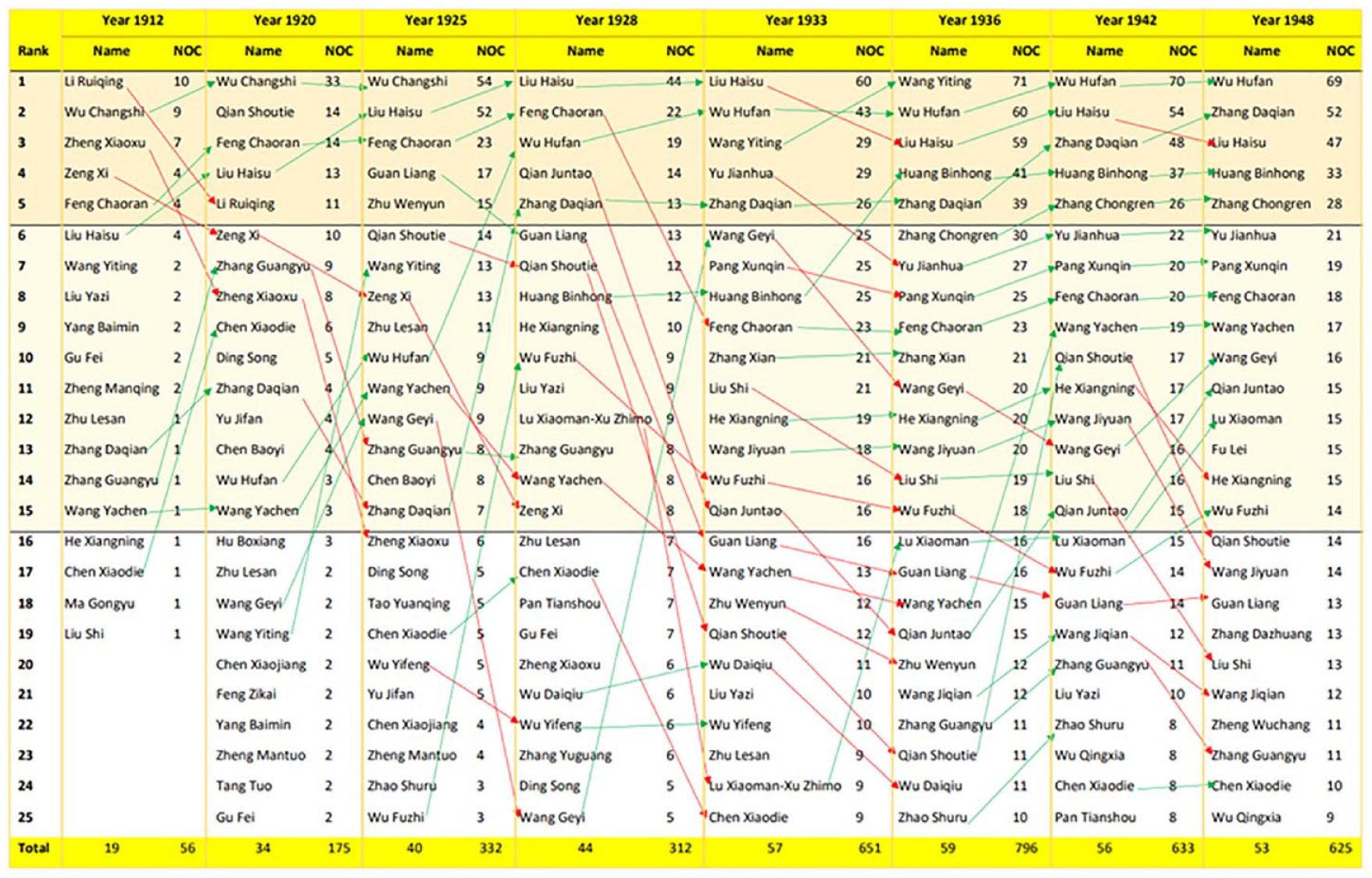
Tabulated social network analysis in eight selected years.
In the 1910s, Shanghai’s concessions experienced rapid economic expansion. Foreign businesses and banks fueled real estate and industrial growth, attracting immigrants and expanding the population from 75,000 in the late Qing period to 500,000 in the early Republican era (Wakeman, 1995). Initially dominated by former Qing officers like Li Ruiqing (1867–1920), who moved to Shanghai in 1911, the art scene shifted as the economy grew, giving rise to professional artists like Wu Changshi, Feng Chaoran (1882–1955), and Liu Haisu (1896–1994). By 1920, Wu Changshi emerged as the central node, with his connections accounting for 45.3% of the network (Zheng et al., 2024a), maintaining influence until his death in 1927.
During the 1920s, professional artists like Feng Chaoran and Wu Hufan rose in prominence, marking a decline in the influence of former Qing officers. Between 1927 and 1937, Shanghai experienced its peak prosperity (Bergère, 2009). Zheng et al. (2024a) suggest the thriving art scene was facilitated by the city’s fragmented governance, minimal government interference, modern facilities, and a sense of personal safety. The mid-1920s to mid-1930s saw significant shifts in the social network dynamics of Shanghai’s art world, with the rise of four prominent artists.
Wu Hufan (1894–1968) moved to Shanghai in 1924, quickly rising from 14th in 1920 to the top rank by 1942, maintaining this position until 1948. Zhang Daqian (1899–1983) relocated to Shanghai in 1919, significantly enhancing his reputation, reaching the 3rd position in 1942 and 2nd in 1948. Huang Binhong (1865–1955), after facing initial challenges, established himself in Shanghai by 1929, becoming a pivotal network node by the 1930s. By 1928, Liu Haisu was the most active artist, with the 1920s being the golden age of the Shanghai Art College under his leadership. However, political challenges led to the College’s temporary suspension in 1928, and Liu’s domestic popularity slightly declined, though he remained in the top three until 1948. Zhang Chongren (1907–1998), a sculptor trained in Europe, returned to Shanghai in 1936, establishing the first sculpture studio of its kind in the city. The social network structure saw minimal change in the 1940s (Figure 1). In contrast, former Qing officers like Li Ruiqing and Zeng Xi (1861–1930) saw significant declines in rank, with many passing away by the 1930s.
Spatial proximity and social networks of artists
This section highlights three key findings: First, artists in Shanghai formed social networks that extended city-wide and beyond, showing that spatial proximity isn’t essential for network formation. Second, spatial proximity is crucial for network expansion, significantly enhancing artists’ influence and reputation. Lastly, the study reveals how spatial proximity and social networks interact, with leading artists playing a pivotal role in shaping the artistic landscape and cluster image.
Scaling the dense area of social networks
This section examines whether spatial proximity influenced the formation of artists’ networks by determining if their connections were concentrated within specific small areas of the city (short linkages) or extended across the entire city (long-distance pipelines). These small areas refer to the art clusters identified in our research. To achieve this, we conducted statistical analyses on the geodesic distance of all pairwise social connections. Our findings reveal that the dense areas of artists’ networks covered at least half of the concessions, with long-distance pipelines dominating the network structure.
The average nearest neighbor distance test result ranges from 0.976 to 0.178 kilometers. We adopted 2.5 kilometers as the threshold of short linkages with sufficient tolerance of inter-cluster linkages, and compared it with the average geodesic distance of all the pairwise connections running a Z test through R.
Our finding 4 is that most networks were long-distance pipelines instead of short linkages. Two additional one-tailed t-tests show that this finding applies to the five prominent clusters and key network nodes. This means that the dense network area covered over half of the concessions. Long-distance pipelines were the primary type of social connections. Artists’ social networking activities took place on the city scale instead of districts. These findings are supported by our GIS mapping (Zheng et al., 2024a, 2024b), which compared the geographic scope of social networks and that of art clusters, high artist-density districts, and hot spots.
This shows that geographic proximity is not necessary for developing or maintaining inter-artist social networks. For example, Wu Changshi and Wang Yiting (1867–1938) maintained a close friendship and artistic collaboration despite living at opposite ends of the city—Wu in Zhabei (north of the International Settlement) and Wang in the Chinese walled city area. Artists’ social networks formed independently of where they lived. Zheng et al. (2004b) identified 30 factors influencing artists’ residential choices, suggesting that the overall urban environment in Shanghai, rather than social networks, shaped their location preferences.
The role of spatial proximity/clustering in establishing artistic influence
We find that as the influence of professional artists grew, key early social network nodes gradually converged into primary art clusters by 1925, a trend that persisted through the Republican era. All the leading artists with strong influence in the art circle lived in these clusters, indicating that spatial proximity played a role in establishing themselves as key influencers and leaders. These artists often chose to live near their peers. For instance, after Zeng Xi moved to Shanghai, he settled near the Tianhou Temple in 1918, and a year later, Li Ruiqing became his neighbor, as reported in the newspaper.
Li Ruiqing, a calligrapher, had originally resided in Qingyun Li, on Chongming Road. Seeking more convenient communication with Zeng Xi, he decided to relocate to Zeng’s neighborhood. This move brought them within close proximity, enabling daily chats and underscoring the depth and longevity of their friendship (Times, May 20, 1919, 5).
Artists’ location choices influenced their social network expansion. For example, Wu Changshi, residing in Zhabei, and Wang Yiting, living in the walled city, did not initially benefit from the art cluster’s influence until later, with Wu’s influence increasing after 1925 and Wang’s impact on the walled city persisting until his move to Hong Kong in 1937. The most enduring and influential art cluster emerged in the central-northern part of the French Concession in 1920 and became the leading art hub by 1925 (Table 1). Between 1928 and 1936, 62.8% of 45 tracked artists relocated at least once, with most moving within this cluster, highlighting its role as a concentration of key social network nodes. By 1936, 76.92% of key social network nodes, including prominent artists, were concentrated in this area.
A list of the 11 major art clusters.
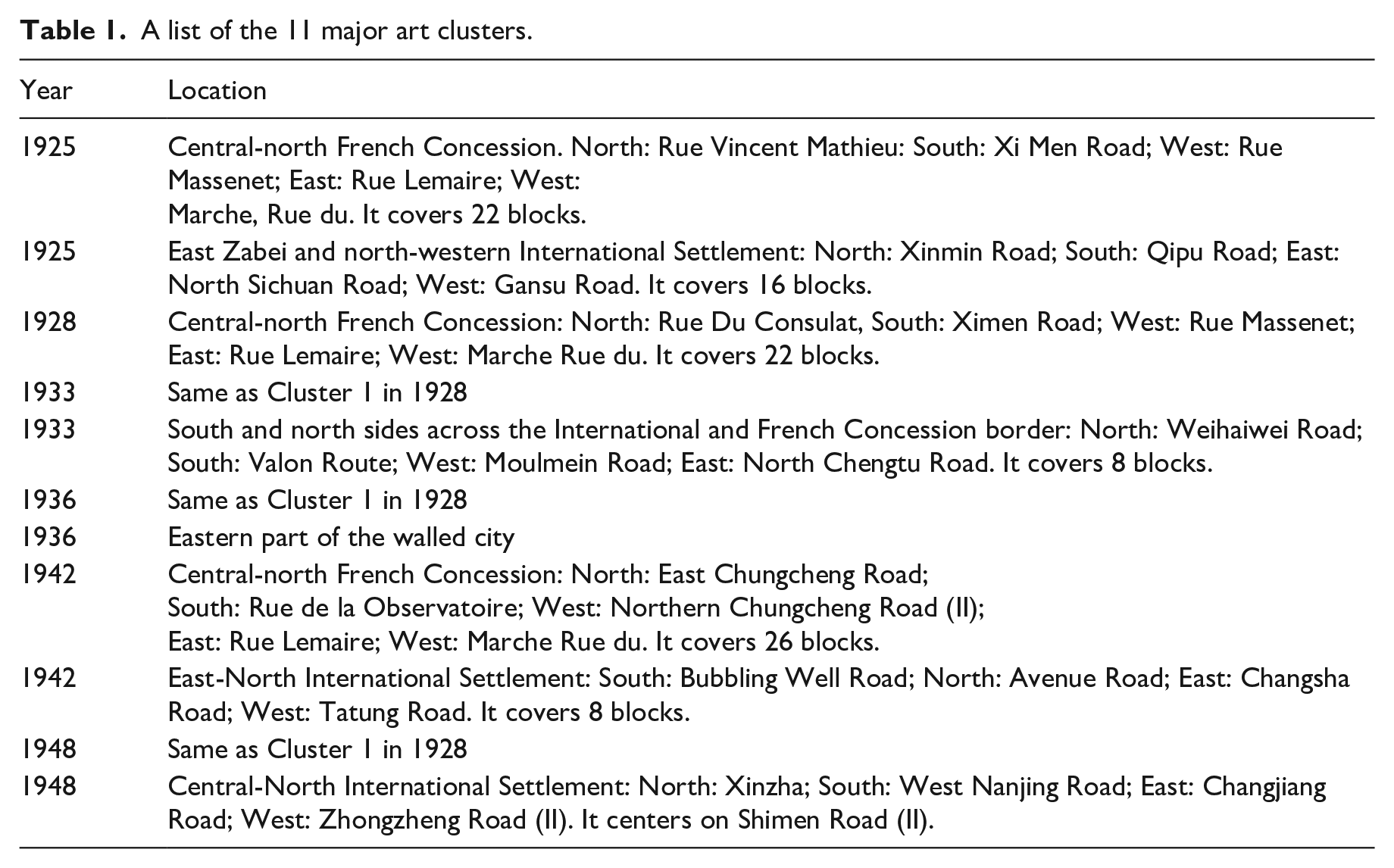
Artists such as Feng Chaoran, Wu Hufan, Zhang Daqian, Huang Binhong, Liu Haisu, and Zhang Chongren gained recognition after relocating to this district. They established sub-clusters or hubs around themselves, creating a dense network of artists and vibrant art activities. In the late 1920s, Zhang Shanzi, Zhang Daqian, Huang Binhong, and his student Gu Fei lived in a single building, No. 169 Xi Cheng Li, alongside prominent poet and painter Xie Yuchen. Feng Chaoran and Wu Hufan lived on the same lane, creating their own art hub, while Liu Haisu, president of the Shanghai Art College, attracted colleagues to reside near him on Route Lafayette. Zhang Chongren’s residence and studio formed a fourth art hub within this primary cluster, attracting a concentrated group of students and nurturing the first generation of Chinese sculptors.
While spatial proximity is necessary for artistic influence, it is not sufficient. Approximately 41.46% of identified clusters had high artist density but varied in social network vibrancy. Only 12.19% of clusters excelled across all dimensions and are termed ‘primary art clusters’ (Zheng et al., 2022). Clusters with high spatial concentration but low social vibrancy, called ‘locational clusters,’ likely represent areas with junior artists or new immigrants with limited social connections. This indicates that while spatial clustering is crucial, it alone does not ensure the expansion of social networks or significant social influence among artists.
Unpacking the mechanisms of primary art clusters
Our research reveals that primary art clusters are essential for artists to establish leading influence through three mechanisms: network-space interactions, strengthened ‘master-pupil’ ties via co-residence, and artist-centered place and collective imaging. While network-space interactions are broadly supported by existing literature, the latter two mechanisms are specific to the Chinese context.
Network-space interactions in art clusters
Our analysis of historical documents, in line with the literature on economic geography, art geography, and creative development, reveals the interactions between artists’ social networks and spatial clustering. These interactions significantly contribute to art production, illustrating how art clusters amplify the influence of prominent artists from an art production perspective.
First, artists’ spatial clustering was, in fact, influenced by their social networks. In the 1910s, artists relocated to Shanghai due to referrals or invitations from friends. Notable figures such as Wu Changshi, Zeng Xi, and Wu Daiqiu (1879–1949) made the move based on connections with artist friends (Jiang, 1990).
This finding applies to other years. Ding Fuzhi (1879–1949), a traditional Chinese-style painter who had moved from Jiangsu Road to Hongkou Qiujiang Road, extended an invitation to Tang Yun (1910–1993) to follow him and take up residence in his former house (Ding, 2006). Guan Liang (1900–1986), an artist trained in Japan, shared living quarters with his artistic friends in the Zhabei District, including Xu Dungu (1892-1983), a painter, and Xu Dishan (1893–1941), a Chinese literature professor. They also interacted with cultural luminaries such as Mao Dun (1896–1981), a renowned writer, Ye Shengtao (1894–1988), an educator, Zheng Zhenduo (1898–1958), and Feng Naichao (1901–1983) (Guan, 1984). A similar pattern was observed among Western-style painters, exemplified by the Storm Society, consisting of artists returning from Europe and Japan, who resided in close proximity to one another. Zhou Tai, the organizer and a returning artist from Japan, shared his residence with Pang Xunqin. 5
Second, while artists’ social networks played a significant role in shaping clusters, geographic proximity equally contributed to enhancing these social networks. Xu Muru (1904–1996) formed a connection with Wu Changshi, benefiting from spatial closeness. In 1915, as a primary school student living near Wu, Xu encountered an elderly gentleman in Taoist attire, lively and compassionate, strolling around with crossed arms behind his back. Later, Xu discovered that this man was the esteemed artist Wu Changshi and subsequently became his student (Xu, 1986). Gu Fei became a student of Huang Binhong also due to spatial proximity facilitated by the unique physical layout of the city. The Shikumen building neighborhood in Shanghai was densely designed, featuring narrow lanes. Gu, working as a tutor at a relative’s home, became acquainted with Huang Binhong’s niece residing in the building across the lane. This acquaintance introduced Gu to Huang (Gu, 1982). This instance exemplifies how a densely populated urban environment created opportunities for networking.
Social network and spatial proximity mutually strengthened, generating vibrant synergies and boosting art production.
Building close master-pupil ties through co-residence
The ‘master-pupil’ relationship accounts for over 50% of the social connections in primary art clusters. We find that the traditional Chinese art teaching style gave more emphasis to spatial intimacy when compared with economic and art geography theories. In Chinese traditionalism, the concept of ‘in-residence’ was significant in indicating the initiation of a formal ‘master-pupil’ relationship, often referred to as ‘dengtang rushi’ (accessing the hall and entering the room) (Zheng, 2016; Interview with Lu Yanshao’s student Wan Qingli in 2003). The Zhu brothers, Wenyun and Lesan, resided in Wu Changshi’s house as tutors. Zhu Lesan highly valued this experience, noting that before moving to Shanghai, he would walk eight to ten li to see Wu painting; the ‘in-residence’ experience significantly increased his access to Wu’s painting demonstrations (Liu, 2002). Co-residence helped to demystify the masters’ painting techniques. Masters like Feng Chaoran often painted after midnight, and only by living at his home could students observe him working, which was essential to their learning (Zheng and Feng, 2007). In the case of Huang Binhong, his student Dai Yunqi (1910–?) gained prominence in the art market and moved close to Huang to enhance his exposure to Huang’s instructions. An art advertisement published in the Shanghai Daily by Dai Yunqi reads: The painter Dai Yunqi specializes in landscape painting and has a penchant for travel. His works have reached new heights, displaying innovative features. Following his trip to Huang Mountain, he garnered an increasing number of customers. He has relocated to be in close proximity to Huang Binhong on Ximen Road. Address: No.54 Montmorand Rue Brenier de, Puqing Li, Shanghai (Wang, 2005: 325–236).
Synergies were commonplace in these neighborhoods, ranging from on-site art teaching to collaborative learning activities. Masters, such as Wu Changshi and Wu Hufan, enjoyed engaging in discussions and critiques of collected paintings when meeting with their students. Zhu Lesan, for instance, noted that Wu Changshi frequently recommended and discussed readings with him. Paintings adorned the walls, creating an environment where the master, his friends, and his students could engage in discussions—a seminar within a private circle. 6
As traditional Chinese painting theory emphasizes learning from past masters, a significant portion of art gatherings was dedicated to the study of ancient artworks through connoisseurship. 7 Masters who possessed a significant collection of antiques and were knowledgeable about connoisseurship became magnets. Liu Haisu (1896–1994) once visited Wu Changshi and presented him with a painting reportedly done by Guan Hong (907–960), a rare treasure, seeking Wu’s affirmation of its authenticity (Zhang, 2005). Zhang Daqian named his studio ‘Da Feng Tang’ (Gale Hall), signifying his precious art collection inherited from his ancestors. He took pride in his collection, which allowed him to absorb the quintessence from the works of past masters (Wang, 2014). Jiang Xiaojian (1894–1939) also amassed a large collection of antiques, converting half of his apartment into a storeroom filled with ceramics, paintings, calligraphy works, and 30 boxes of classical books; these were highly valued by his fellow artists and curio dealers (Liu, 2008). Wu Hufan owned the most substantial collection of antiques and artworks, which partially contributed to his rise.
Place-based group imaging spotlighting leading artists
Economic geography and creative literature suggest that junior artists co-locate to gain mutual support and create a collective image that enhances recognition (Markusen, 2006). However, in Republican Shanghai, leading artists developed their influence and formed distinct clusters through collaboration and communication with artists from other clusters. This process resulted in clusters that prominently featured these influential artists, contributing to their collective image.
Influenced by literati traditions, extensive collaboration among leading artists helped shape and brand their communities. For example, at Zhang Daqian’s residence, artists like Zhang Shanzi, Wang Shizi (1885–1950), Ma Mengrong (1892–1932), Xie Yuchen, Xiao Zhiquan (1865–1949), Fu Tienian (1886–1947), Chen Xiaodie (1897–1987), Yang Qingqin (1895–1957), and Qian Shoutie (1897–1967) created collaborative paintings, with Zhang hosting the event and preparing Sichuan cuisine. The gathering was a celebration of art and gastronomy (Wang, 2005). Anecdotes like this have been widely circulated in Shanghai.
Another notable collaborative initiative unfolded within Wu Hufan’s networks. Wu systematically named 24 architectural features of his residence, drawing inspiration from terms extracted from his antique collection. Engaging his artist friends, Wu orchestrated the creation of individual paintings for each labeled feature. Spanning from 1926 to 1950, this ambitious project culminated in the production of the album titled ‘Twenty-four Room Paintings’ (Interview with Xu Lantai, the stepson of Wu Hufan, 2001). In these cases, Zhang Daqian, Huang Binhong, and Wu Hufan were key figures in their respective clusters, and their activities significantly contributed to the collective image of their art hubs. This process resulted in clusters that prominently featured these influential artists, enhancing their collective image.
Also, the prevalence of long-distance pipelines signifies the presence of numerous inter-cluster connections. Wu Changshi maintained close ties with another influential core centered around Feng Chaoran and Wu Hufan. Feng Chaoran forged a friendship with Wu Changshi in the early 1910s and resided at Wu’s residence for a period. Upon Feng’s relocation to the Grosse Rue in the French Concession, he prominently displayed the couplet written by Wu Changshi, celebrating their enduring friendship (Zheng and Feng, 2007).
The extensive inter-cluster connections are evident in Wu Changshi’s relationships with the core group around Feng Chaoran and Wu Hufan. Feng, who had stayed with Wu, prominently displayed Wu’s couplet in his new residence. Additionally, leading artists such as Wang Yiting organized several Chinese painting associations, including Ti Jin Hui and Shanghai Shuhua Yanjiuhui (Chen and Li, 2007; Shen, 2008). The Xi Cheng Li group extended its influence to the Zhongguo Nüzi Shuhuahui, initiated by Gu Fei and Chen Xiaocui (Andrews and Shen, 1999).
Moreover, the primary art clusters maintained connections with various social and political elite circles. For instance, Wang Yiting was linked to Cai Yuanpei (1868–1940), the former head of the Cultural Ministry, Wu Tiecheng (1888–1953), the mayor of Shanghai, Li Yuying (1881–1973), a renowned educator and Head of the World Press, Qian Yongming (1885–1958), a famous banker, and numerous others (Shen Bao, December 21, 1936). Jiang Xiaojian (1894–1939), a sculptor, had extensive social connections with elites in social, political, and business circles, as well as cultural figures, leading to commissions for prominent urban sculpture projects (Liu, 2008).
Additionally, aligning with Currid and Williams’ (2010) concept of spillover effects, the Shanghai case shows how primary nodes influence secondary ones. After Wu Changshi’s death in 1927, his cluster dispersed, but a new cluster emerged around his followers in 1933 (Cluster 11, Figure 2(c)). Wang Geyi, a disciple of Wu, established a new network node in 1936 (Cluster 1, Figure 2(d)), demonstrating the ripple effect of influence from a previous core.
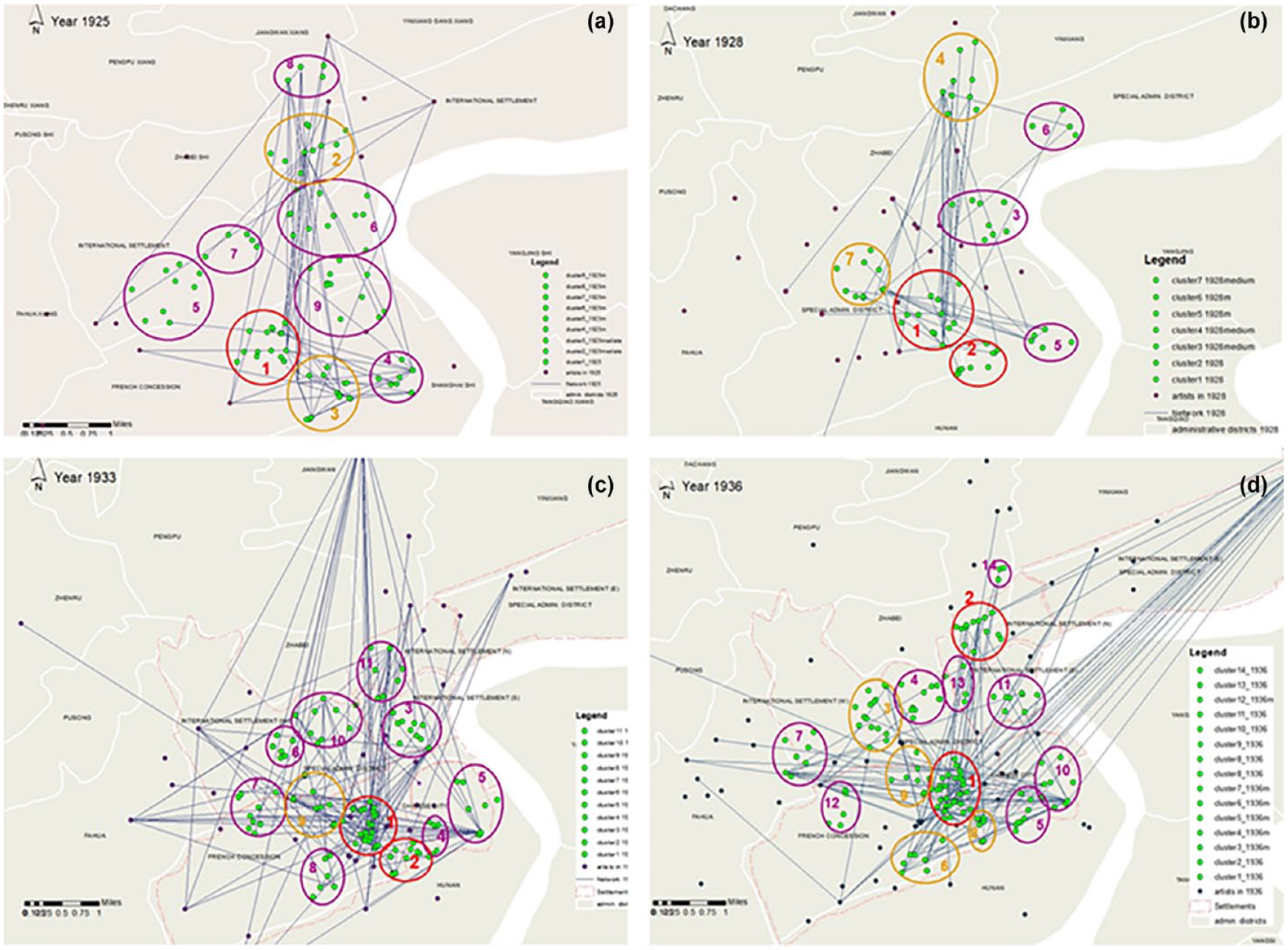
Spatial distribution of artists in (a) 1925; (b) 1928; (c) 1933; and (d) 1936.
Conclusion
This research, through meticulous mapping of the dynamic spatial distribution patterns of artists’ social networks, demonstrates that while spatial proximity is not necessary for artists to develop or maintain their social networks, it is a necessary yet insufficient condition for enhancing artists’ social influence and elevating them to leading positions in the art community. This finding aligns with the ongoing scholarly trend in social networks and geography, which acknowledges the conditional and limited impact of spatial proximity on social networks. This study advances this scholarly trend with breakthrough discoveries regarding the role of spatial proximity in various stages of space-social-network interactions within the art neighborhood, contributing to a nuanced understanding of how artists’ interactions intersect with their geographical context.
More importantly, informed by theoretical insights from economic geography, art geography, and creative development literature, this research contributes to unifying the theory-building processes across disciplines. It offers a fresh perspective on existing concepts in art research. The ‘art world’ is no longer solely a sociological concept of art but an integrated social-geographical concept. Specifically, within the Chinese context, the ‘art world’ can be reconceptualized as a hierarchically networked art capital city, characterized by key network nodes. These artists’ influences are deeply rooted in their residential neighborhoods, characterized by a high concentration of their followers, collaborators, and students with place-network synergies that boost art production, master-pupil ties through co-residence, and place branding centered around prominent artists.
Methodologically, our research is grounded in a comprehensive approach that combines large-scale digital mapping of artists and their social networks with rigorous statistical analyses, and qualitative analyses, establishing a robust foundation, and filling a gap in 20th-century Shanghai art research.
Overall, this research integrates art into the urban fabric, providing valuable insights into the processes of artists’ network formation and expansion that underpin Shanghai’s emergence as a prominent art capital. The revised concept of the ‘art world’ reshapes our understanding of an art capital or creative city, now characterized by dynamic social networks and network nodes within art clusters and hubs, which reflect varying levels of artistic influence and collective images centered around prominent artists.
Footnotes
Declaration of conflicting interests
The author(s) declared no potential conflicts of interest with respect to the research, authorship, and/or publication of this article.
Funding
The author(s) disclosed receipt of the following financial support for the research, authorship, and/or publication of this article: This research was funded by the Hong Kong Research Grant Council (CUHK 14621516).
