



Abstract
China’s environmental turn is diversifying the country’s urbanisation trajectories. Previously abstracted and exploited as a vast land reserve for urban expansion, the countryside of China now captures the imagination of a growing crowd of green-loving urbanites with its ecological and cultural resources, propelling a new, environmentalised form of urbanisation. In the Pearl River Delta, the development of rural greenways has driven this urbanisation, in which rural lives and landscapes have evolved in response to their encounters with urban users of the greenways. Based on the late John Friedmann’s multidimensional understanding of China’s urbanisation, this paper unpacks four aspects of changes brought about by greenway-driven urbanisation in the Pearl River Delta’s countryside since the 2010s, namely, economic diversification, institutional adaptation, physical reconfiguration, and sociocultural transformation. These changes underscore the need for research on China’s urban-rural relations to pay more attention to the growing centrality of the environment in the politics and practices of urbanisation.
Introduction
China is experiencing what Buttel (1992) labelled as a trend of ‘environmentalisation’, under which green concerns constitute an increasingly important driver of political decisions. Since the 1990s, the Chinese central government has made serious efforts to promote the centrality of the environment in policymaking, encapsulated by the vision to develop China as an ecological civilisation. Given this top-down pressure and popular demands for a better environment, local governments have rushed to incorporate environmental concerns into their governance agenda and launched a wide array of green projects.
Earlier studies have noted that this greening of China’s urban governance is marked by path dependence in the mode of urbanisation and its underpinning urban-rural relationship: rural areas have continued to be exploited for urban expansion, albeit under a different name of eco-city. However, as a wider body of work has reminded us, rural areas have, in some cases, been reimagined as critical sites to meet cities’ environmental demands: it is the green resources of rural areas which captivate the attention of urban interests (Jonas et al., 2011). It is then pertinent to ask whether and how the dynamics of China’s urbanisation has been diversified by the growing urban environmental demands, such that one may identify specific traits of an environmentalised urbanisation.
To address this question, we investigate the multifaceted sociospatial impacts brought by the development of greenways in the countryside of the Pearl River Delta (PRD) as part of the Pearl River Delta Greenway Project (PRDGP). Launched in 2010, the PRDGP is China’s first attempt to develop greenways, or linear green spaces, on a large scale. Apart from creating more green corridors for recreation in city centres, this project also involves developing – as the focus of our research – rural greenways with the aim of meeting urbanites’ growing demand for green respites with rural green spaces (Chung et al., 2018; Liu et al., 2019).
This article seeks to enrich our understanding of the diversifying urbanisation trajectories in China by investigating the impacts that the development of the PRDGP brings to the PRD’s countryside. In particular, we pay attention to how this greenway project enmeshes the search for fixes to urban economy-environment tensions with the recalibration of urban-rural relations. The findings we subsequently report are based on our research of the PRDGP since 2013 through three means. First, various policy and planning documents, media coverage, and academic publications on the project were reviewed. Second, visits to various sections of greenways were undertaken between 2015 and 2017 by the first author and in 2023 by both authors. Third, over 40 semi-structured interviews with government officials, local villagers, urban planners, and scholars were conducted. These endeavours allow us to gain insights into what kinds of rural transformation were envisioned by the masterminds of the PRDGP, how and why certain forms of transformation were initiated, appreciated, or resisted by specific groups, and rural residents’ perceptions of changes in different aspects of life brought by the development of greenways at their doorsteps.
Following this introduction, the next section offers a cursory review of the literature on urbanisation in China and beyond to draw more research attention to the extended moment and environmentalised forms of China’s urbanisation. The third section then presents an overview of the PRDGP, while the fourth section unpacks in detail how this project has catalysed environmentalised urbanisation in the PRD’s countryside in multiple sociospatial dimensions. The article concludes with a summary of our main findings.
Revisiting China’s urbanisation: Concentrated, extended, and environmentalised
China has experienced rapid and extensive urbanisation since its opening up and reform. For decades, observers of this trend have underscored the encroachment of urban development on rural areas so involved. This encroachment begins both from within rural China, as village collectives and individual villages ventured into light industries and the rental economy for industrialists and migrant workers (Xue and Wu, 2015), as well as from without it, as municipal leaders take advantage of the city-leading-county system to annex rural countries for additional space for urban development (Wu, 2015). A growing part of the countryside has been abstracted and exploited as a huge land reserve, with little respect for local ecologies.
Against this backdrop of rapid and extensive urban growth, Friedmann (2005: 36–38) proposed a five-dimensional construct of urbanisation to clarify the diverse ways through which rural China is subsumed to urban influences:
Administrative urbanisation, the administrative (re)designations of particular spaces and people as urban within the administrative hierarchy and the household registration system, respectively. The annexation of rural countries into cities is an example.
Economic urbanisation, indicated by a decline in the importance of the primary sector relative to secondary and tertiary sectors and a growth in the rural population receiving rental income derived from their collective or household properties.
Physical urbanisation, marked by rural areas acquiring an ‘urban look’ made up of multistorey residential buildings with modern sanitary facilities, factories, and paved streets, but also more air and water pollution.
Sociocultural urbanisation, as changes in people’s everyday routines and lifestyle choices. They may be brought about by social interactions between existing rural residents and newcomers working in the diversified rural economy, or by information and communication technologies spreading from cities.
Political urbanisation, the emergence of new power relations and governance structures as a result of the foregoing other aspects of urbanisation. Friedmann’s example of this aspect is the rise of local corporatism, under which strong rapport has developed between rural administrations and business elites in industrial development.
Friedmann (2005: xiv) developed his construct at a time when Chinese cities were sprawling out of control and rural communities were eagerly modelling against urban areas as a beacon of modernity (Zhu and Yang, 2016). It is, therefore, no surprise that many of his examples of urbanisation point to a tendency of increasing similarities between urban and rural areas. However, in their highly provocative ‘new epistemology of the urban’, Brenner and Schmid (2015) contended that urbanisation should not be considered synonymous with growing ‘cityness’, which only stands for its geographically ‘concentrated’ moment. Instead, urbanisation also has an ‘extended’ moment, denoted by the recasting of spaces beyond existing cities into the latter’s ‘operational landscapes’ (2015: 169), ‘where major socioeconomic, infrastructural and socio-metabolic metamorphoses have occurred precisely in support of, or as a consequence of, the everyday operations of growth imperatives of often-distant agglomerations’ (2015: 167). These spaces do not look like cities but take on whatever forms required to serve the functional needs of cities, such as extensive monoculture landscapes feeding the urban population, remote rivers dammed to generate hydropower for cities, or sinks of ‘the excesses and wastes of urbanisation’ (Swyngedouw, 2014: 24). So far, this extended moment of urbanisation has received much less research attention than its concentrated counterpart in urban China studies. Moreover, both moments should now be examined with respect to the growing stake of the environment in how urbanisation is conceived and practised in China, producing what we may refer to as environmentalised urbanisation.
China’s environmentalised urbanisation can be dated back to the 1990s, when the severe socioecological costs of the rapid and unruly expansion of cities rose to the top of the national agenda (Chang et al., 2016). In the ensuing years, the central government has removed much of municipal governments’ discretion over their land resources, imposed a growingly tightened annual quota on converting rural land into urban land, and mandated the redlining of ecologically sensitive areas for conservation, all feeding into the more recently articulated national priority of building China into an ecological civilisation (Chung et al., 2018; Jiang et al., 2019). In response to these requirements, municipal governments have launched a variety of projects to reconcile their growth objectives with environmental imperatives. Urban China researchers have drawn attention to one type of these projects, namely, eco-cities. Often in the form of new towns outside existing urban centres, eco-cities have been criticised as the Trojan horses of municipal governments to sustain their rural land grabbing in the name of trialling green urbanism (Caprotti, 2014; Chien and Woodworth, 2022; Xie et al., 2020). They exemplify a concentrated form of urbanisation with a green veneer, often only affordable to a small group of affluent homeowners (Caprotti, 2014).
Meanwhile, recent studies from a rural perspective have hinted at the unfurling of what we may call an extended form of environmentalised urbanisation in China due to another set of pressures for cities to be greener: urban dwellers’ demand for more contact with nature. In what Zhang et al. (2014: 5) labelled as an emerging process of ‘rural renaissance’, a growing rank of Chinese villages have attempted to resuscitate their economy not by mimicking the city; rather, they have sought to reinvigorate their distinctiveness as part of the countryside and champion their complementarity to urban living. Specifically, villages rearticulate their rich ecological endowments, such as farmland, ponds, and forests, as valuable resources for a new, environmentally more sustainable form of economic development centred upon nongjiale 1 and eco-tourism for urban visitors (Li et al., 2019; Zhang and Pan, 2022). This trend has been encouraged by the national campaign of building the ‘beautiful countryside’ and the discourse of ‘rural nostalgia’ (Shen and Shen, 2022). In this regard, Smith (2021: 7) argued China is experiencing ‘urbanization in a more diffuse sense’, under which villages are transformed into some kinds of ‘rural simulacra [. . .] which increasingly function as extensions of an urban way of life rather than as the sociospatial milieux that support villagers’ survival’.
The Pearl River Delta and its ‘way’ to ‘green’
The foregoing studies inspire us to reconsider the significance of China’s recent greenway boom through the lens of environmentalised urbanisation. Since 2010, governments across China have developed over 80,000 km of greenways (Office of the National Greening Committee, 2022), an assortment of linear landscape interventions for improving environmental quality and supporting outdoor recreation. For this article, we focus on the developments in the PRD, where greenways first took root in China before finding their way to the rest of the country. 2
Comprised of nine municipalities in the Guangdong province, the PRD is one of the regions where the clash of city-centred urbanisation and emerging environmental demands find their most intense expression. Each municipality in the PRD is composed of an urban centre and its rural (but increasingly urbanising) periphery. The region’s prosperity is inextricably intertwined with its land-centred urban development. Between the 1980s and early 2010s, the region experienced a fivefold jump in its aggregate extent of built-up areas from 1,570 km2 to 8,534 km2 (GDUPI, 2015). However, driven by the GDP growth imperative and intercity competition, the PRD municipalities tended to prioritise economic growth over environmental imperatives. As local land use planning often downplayed the need to provide and protect environmental amenities, many green spaces in both urban and rural areas were encroached on by real estate and industrial developments (Chung and Dai, 2023). This trend was much to the dismay of the PRD’s urban dwellers, whose demand for better environmental quality – premised on, among other things, greater access to green spaces – has grown with their increasing prosperity.
A group of green-minded planners in the PRD reckoned that some substantial interventions were necessary to improve access to green spaces for the region’s growing population. That intervention is the construction of a system of greenways, i.e. the PRDGP (Chung et al., 2018). Thanks to these planners’ endeavours, the project was formally launched in 2010 with staunch support from the Guangdong government as a political priority. Beginning with six regional greenways of 1,690 km, the nine PRD municipal governments have developed over 12,500 km of greenways in their territories (Liu et al., 2019).
The PRDGP is noteworthy for developing an extensive network of greenways across the PRD. Many studies have examined the project’s implementation in the PRD’s urban heartlands, where greenways take the form of narrow tree-lined sidewalks and bikeways that better serve as transport corridors than recreational ones (Liu et al., 2019; see also Liu et al., 2016). However, what should also be noted is that the PRD’s greenways span the urban-rural divide. Connected to their urban counterparts, greenways have also been developed in the PRD’s rural areas to physically open up and thus reframe their extensive agricultural and natural landscapes as green spaces for the pleasure of urban dwellers (Chung et al., 2018). As one of the masterminds of the PRDGP suggested, the vision of their project is to ‘let people follow greenways to escape from the urban concrete jungle and be embraced by the beauty of nature’, located in such rural sites as country parks and open fields (Ma and Cheng, 2013: 40).
To the Guangdong government, greenways may also serve as new ‘roads to riches’ of the PRD’s rural communities. In its plan to scale up the PRDGP to the rest of the province, announced in 2012, the Guangdong government advocated the development of ‘greenway tourism economic belts’ in rural areas, taking advantage of green-starved urban visitors of rural greenways as tourists with purchasing power: Through greenways, tourist spots, rural settlements and modern agricultural production bases are connected. . . Villagers along greenways should be guided to develop supporting services such as rural guesthouses, nongjiale and leisure farms. This is to drive the development of the leisure and tourism sector, promote peasants’ employment and entrepreneurship, and facilitate the circulation and valorisation of agricultural produce. (GDHURD, 2014: 339)
More recent incarnations of Guangdong’s greenway project continue this vision of tourism promotion. They include the development of heritage greenways under the name of South China Historical Trails, and the enhancement of waterfront greenways as ‘Ecological Belts’ which serve both conservation and recreational goals (Duan et al., 2022).
Given these visions, we argue that greenways in the PRD have been developed as drivers of an extended and environmentalised form of urbanisation. It is extended à la Brenner and Schmid (2015) for its focus on recasting rural areas as the recreational hinterland of urbanites, while it is environmentalised à la Buttel (1992) for its aim to address urban demand for green spaces.
Greenway-driven urbanisation in the Pearl River Delta
Although contemporary forms of China’s urbanisation may be different from what Friedmann (2005) charted, we contend that his multidimensional understanding of urbanisation facilitates a systematic analysis of what greenway-driven urbanisation in the PRD entails. Specifically, we argue that existing territorial institutions for administrative urbanisation, notably the city-leading-county arrangement, make it easier for greenways to be developed across urban and rural areas. Then, as greenways extend into the countryside, they have triggered urbanisation in the other four dimensions identified by Friedmann, namely, economic, political, physical, and sociocultural urbanisation.
Before moving on to examine each of them, we shall clarify that this paper is not written to claim that all these dimensions of urbanisation would be realised wherever rural greenways are developed or in the exact ways we describe below. Rather, we simply want to mobilise our necessarily circumscribed observations of a large-scale green infrastructure project (i.e. the PRDGP) to highlight the heterogeneity of China’s urbanisation trajectories beyond city-building and ecological devastations.
Economic urbanisation: Cashing in on urban visitors
Amidst the government publicity on greenways’ effectiveness in stimulating tourism, one of the immediate changes – or urbanising tendencies, given their roots in urban conditions – is the diversification of the rural economy. Along rural greenways, there have been attempts to profit from urbanites’ interest in rural scenery by offering an ‘ecologically more authentic’ (yuan shengtai) way of living. Instead of devoting themselves to primary agricultural production, some farms have expanded their functions to serve as spaces for leisure consumption.
A simple form of expansion involves opening up fields and orchards during harvest seasons for visitors to role-play as farmers to harvest fresh fruits and vegetables. Billboards are set up along greenways to attract attention from greenway users (Figure 1). As a farmer in this fruit-picking business suggested (Interview, August 2016), compared to selling their farm produce to urban retailers, this form of in-situ sales of farm produce can achieve a higher profit margin by saving intermediary costs involved in, for example, dispatching the produces. Sometimes, even the local government has facilitated such business diversification by altering its greenway plan. In Zhuhai, the local government diverted a strip of greenway by 20 m from a highway’s greenbelt to a path traversing a lychee orchard (Interview, Zhuhai forestry bureau, June 2016). Originally built for farmers’ everyday work, the path was repaved and incorporated into the greenway system to bring the flourishing lychee trees to the gaze of greenway users and help develop the orchard as a summertime nongjiale attraction featuring lychee picking.
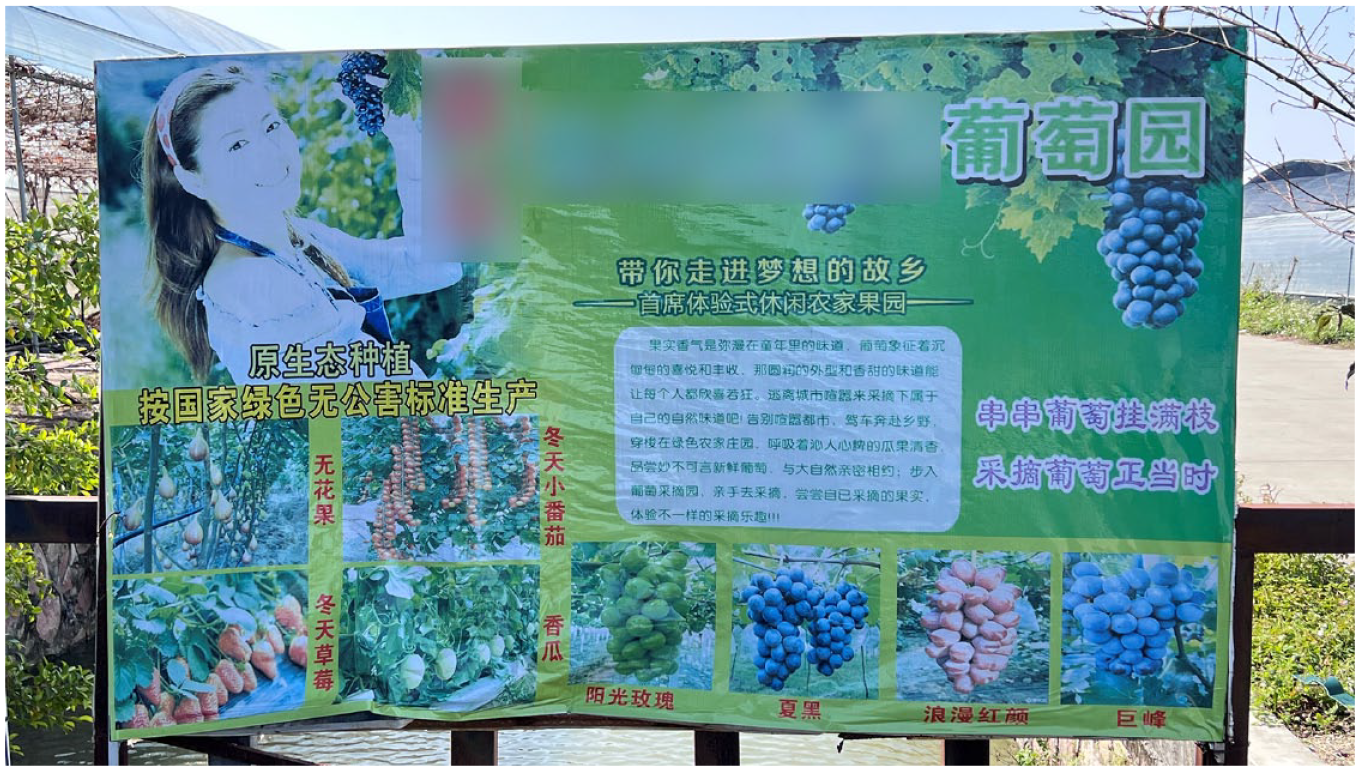
A billboard erected along a greenway to advertise fruit-picking opportunities.
Harvesting, however, is defined by seasonality. Farmers specialising in a particular crop usually do not have steady produce throughout the year to sustain a stable stream of visitors. Similarly, urban visitors seldom return to the same farm on a recurrent basis. Therefore, some farms have adapted their operations to develop their rendezvous with urban visitors into long-term business relations. For instance, cashing into those either keen on pursuing farming as a pastime away from urban distractions or caring especially about food safety, farmers set aside some lands for people to grow their own food. The significance of food safety is also highlighted by farms and other tourism destinations along the greenways, as they brand their food products as ‘green’ (lüse), ‘ecological’ (shengtai), ‘organic’ (youji), and ‘pollution-free’ (wu gonghai) to make their products stand out.
Farms have also sought to develop their edge by providing ‘value-added services’. Tenants who are swamped in urban hassles could pay farm operators to take care of their allotments and keep track of their crops through photographs taken by the farm. By the harvest season, they could also get the fruits picked and couriered to their homes. In this regard, while farmers attend to their daily work as usual, they have stepped one foot into the tertiary sector by commodifying daily agricultural efforts. In the words of a government official of Zengcheng, an outlying district of Guangzhou where the PRD’s first greenways were created, greenways turn ‘mountainous areas into scenic spots, agricultural products into tourism products, [and] farmers into tourism workers’ (Guo, 2014).
Apart from on-farm functional diversification, greenways have also triggered the development of off-farm businesses. Greenways constitute a welcoming addition to the suite of non-agricultural attractions on offer, such as ancient villages and unspoiled natural scenery. Although many greenways were planned as cycling paths, the expansion of public bicycle systems has been limited to the cities. This creates a niche market for village-based bicycle rental services (Liu et al., 2019). Another opportunity derives from accommodation. In some rural areas with rich tourism resources, people may not return home on the same day but would stay overnight as part of their rural holidaymaking pursuit. This has led to a mushrooming of homestays and guesthouses renovated from rural dwellings.
More ambitious tourism projects have been around, each of which brings together multiple leisure functions discussed so far and beyond on one site to create a one-stop destination for escaping the city. One of these developments is Oasis, a large-scale holiday village advertised to be a complement to – but increasingly detached from – the greenway system. Founded as a greenway service station in Creek Village, Oasis has gradually expanded into an all-embracing holiday village providing accommodation, restaurant, bicycle rental service, fruit-picking opportunities, and hot spring experiences. 3 In a trend that its employees described as ‘the guest becomes the host’ (fanke weizhu) (Interview, August 2017), Oasis has gained a reputation of its own and no longer needs the government’s publicity on the greenway system to sustain its visitors. Its promotional materials relegate the greenway from what it serves to one of the many features its visitors can enjoy.
Political urbanisation: New institutions for new businesses
Using the term ‘political urbanisation’, Friedmann (2005) underscored how urbanisation is a political process that entails and depends upon changes in power relations. In the PRD, these changes are embodied by new institutional arrangements developed with the rise of greenway tourism. Given the breadth of their operations and the depth of their resource requirements, comprehensive tourism developments like Oasis demand a complex range of institutional setups to keep them going. Oasis is located in Creek Village, whose landholding used to be highly fragmented. As one villager described, a plot of land could be as small as ‘just [the size of] of a tree, four metres times four metres’ (Creek Village documentary, 2016). To consolidate enough land for Oasis’s development, Creek Village’s collective established in 2010 a land-based shareholding company, which issued 500 shares to villagers for each mu of land they leased to the holiday village. With village officials taking the lead in investing in the project, many villagers who were initially suspicious of the project eventually exchanged their land for Oasis’s share. After land acquisition, Oasis was opened to the public in 2011. With an annual visit growing from 110,000 in 2011 to almost a million in 2015, Creek Village’s annual collective income rocketed from less than CNY 50,000 before 2010 to CNY 3.92 million in 2015 (Creek Village’s publicity material, n.d.). Optimistic of its business future, more villagers swapped for the project shares, and by the mid-2010s, over 90% of Creek Village’s natives were Oasis’s shareholders. The development of Oasis illustrates a phenomenon of corporatised upscaling of greenway tourism, under which a corporatised entity is established to take advantage of greenways for a spatially large and functionally diverse tourism business.
The centralisation of landholding in the hands of Oasis’s company has deterritorialised the land-linked economic interests of the shareholding villagers. Decoupled from the yields of their land parcel, these villagers’ income from land comes as a share of the aggregate yields of the pooled land resources (i.e. Oasis’s income) proportional to their land contribution. Members of Creek Village who do not rely on their land for a living, such as those who work away from the village or those who have become Oasis’s employees, welcome this new opportunity to make income on their land without farming it. However, for some other villagers, land remains their long-term source of subsistence, and they prefer retaining their landholding (Creek Village documentary, 2016). Villagers’ reluctance to sever ties with their land has resulted in a fragmented layout of Oasis: it is not an enclosed whole but a patchwork of sites connected by village roads and greenways.
Meanwhile, the maintenance of rural greenways after their creation warrants new institutions as well. In the PRD, these responsibilities are decentralised to governments at subdistrict and town levels. While some governments find it burdensome to groom the greenways and have outsourced their work to the private sector, others see a possibility to ‘make greenways feed on their own’ (yi lüdao yang lüdao) (GDHURD, 2014: 20). In the latter case, the governments enter into partnerships with private parties who can profit from greenways as a tourism product at the cost of taking over the responsibility of greenway maintenance. Such partnerships could be found in two subdistricts (jiedao) of Zengcheng. In Licheng subdistrict, the government granted the operation rights of its greenways and eight service stations to a local tourism agency for free (Guo, 2012). In turn, the tourism agency became responsible for the upkeep of the greenway system and was required to prioritise employing local people for its greenway business (Liu and Luo, 2014). Accordingly, the tourism agency franchised its service stations to villagers living along the greenway (Sun Yat-Sen University, n.d.: 39) and took a commission from these stations’ bicycle rental income to fund the greenway’s maintenance. In Xiaolou subdistrict, a private firm obtained a concession from the local government to operate four greenway service stations in its jurisdiction for 20 years. The firm was supposed to run the stations as a network so visitors could rent bicycles in one station and return them in another. The most widely promoted one among the four service stations, Jiang’ao station (to which we will later return), reached beyond a stop-by for free access to toilets but resembles Oasis’s ambition in developing agrotourism businesses.
Contrary to the initial optimism of greenway tourism shared by the local governments, their private partners and the villagers, both privately-run greenway networks had crumpled, as we revealed during our visit to Zengcheng in 2017. In Licheng, at least one of the greenway service stations was no longer affiliated with the government’s partner, despite bearing its name on the signboard. In Xiaolou, Jiang’ao station had also changed hands, while another station planned for local culture publicity discontinued its operation in 2015. Local villagers speculated that low patronage was the reason for the two companies to retreat from greenway tourism (Interview, August 2017). These changes in owners and operations were poorly publicised: old direction signs and notices for the abandoned service stations were not removed, nor have official websites of greenways been kept up-to-date about these changes. In this regard, the PRDGP appears to be an urbanisation driver that has lost its steam.
Physical urbanisation: Great for urban visitors, not the environment
The unfolding of the PRDGP confirms Smith’s (2021: 7) argument that villages in China have developed into ‘rural simulacra’ that perform as ‘touristic playscapes’ of ‘a rural aesthetic’. Both the top-down planning of greenways and the bottom-up initiatives to cash into their development have sought to reshape rural landscapes along with urbanites’ expectations of the rural environment.
Official plans of the PRDGP contain various recommendations on the landscape elements of greenways for the urban ‘tourist gaze’ (Urry, 1990). For instance, the initial plan for the PRD’s regional greenways stresses the need to plant well for the aesthetics of greenways. It urges local agencies of greenway development to ‘take full advantage of the ornamental values of plants, to create plant landscape rich in colours, layers, and space, thereby raising the pleasure to visit regional (provincial) greenways’ (GDHURD, 2014: 413). Moreover, the alignment of greenways has taken into account the possibility of articulating existing agricultural landscapes, often seen as a quintessential component of the countryside, as spectacles. In Zengcheng, one of the key attractions of its greenway network is Xiaolou’s ‘ten-thousand mu vegetation base’, an extended area earmarked for growing two of ‘Zengcheng’s ten treasures’ in agriculture, winter melon and late-flowering Chinese cabbage. The existing practice of crop rotation has ensured seasonal changes of scenery. Two crops of black-skinned winter melon are grown in spring and summer, during which bamboo frames are extensively erected in the field for vines to grow. This is followed by a crop of Chinese cabbage and potatoes in autumn. Whereas the flowering of Chinese cabbage is responsible for the golden field three months later in winter, the potatoes are harvested in the following spring.
Articulating these landscapes of awe is crucial to nongjiale businesses, as greenways’ boosting effect on their business is geographically much more uneven than what the governments depicted. As a planner suggested, the lack of ‘mountains and waters of significance’ (da shan da shui) could limit the capacity of local greenways to stimulate nongjiale development (Interview, Huizhou planning bureau, July 2016). Nongjiale, especially small-scale ones, often attract tourists by virtue of their proximity and connectivity to established tourist spots and landmarks. Therefore, some local governments have routed their greenways in particular ways to connect scattered attractions. However, if a nongjiale does not have such ‘famous neighbours’ to benefit from, it can only stand out with newly created spectacles. This is the case for Oasis, which maintains a visual feast of flowers to amaze its visitors. In our visit to the holiday village, snapdragon (Antirrhinum majus) in various colours were planted in a two-hectare field with a Dutch-inspired tower mill (Figure 2). The holiday village specially imported the soil in the field because of the difficulty of Creek Village’s infertile soil in supporting horticulture.
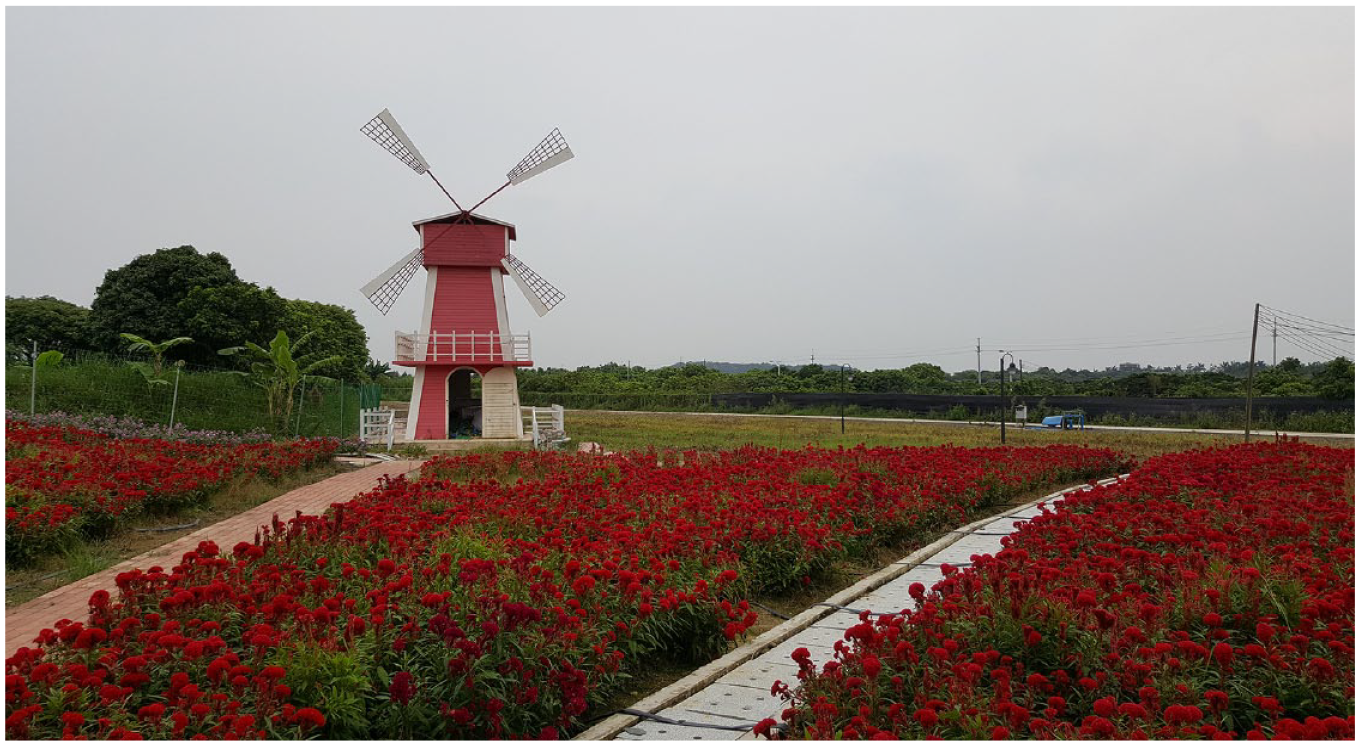
An extended flower field in Oasis.
Apart from these apparent changes to the rural landscape, physical urbanisation also takes the form of less conspicuous threats to the rural ecosystem. Compared with secondary industries, tourism is frequently categorised as an environmentally benign form of economic development, and so is its greenway-driven variant in the PRD. Nonetheless, as both the scope and scale of greenway tourism have expanded considerably from farm-based activities and household hospitality to corporatised operations of large-scale recreational destinations, the ensuing expansion in ecological footprint raises questions about whether greenway tourism does more good than harm to the rural environment. Here the case of Oasis is again relevant. Not far from Oasis’s main entrance sat a sign erected by the municipal government, warning that any illegal construction, modification, or expansion is prohibited within the water source protection zone and that any existing building should be demolished. However, part of Oasis, including its restaurant and a villa on the riverbank, was actually built within the protection zone. Although the municipal water resources bureau ordered Oasis to rectify the problem as early as 2012, it was not until August 2017 that the villa was demolished after a failed judicial review initiated by the collective of Creek Village of the order. Ironically, a site which brands itself as an excellent destination for pursuing health and nature is an ecological risk in the eyes of environmental regulators.
Our field evidence also suggests that it is hard to develop greenway tourism as an ecologically green economic sector because visitors are not ready to be so green. To attract visitors, farmers grew exotic produce such as grapes, strawberries, and dragon fruits organically. However, without artificial additives, grapes grown on the farm were smaller and sourer than usual. Although the grapes would sweeten as they ripen, their wrinkled appearance was uninviting to visitors. To recover the higher production cost due to organic farming practices, the farm charged visitors CNY 50 for every kilogram of grapes they picked, a price several times that of those sold by local retailers. Some visitors, therefore, complained that they were paying more to the farm for less. Responding to these complaints, a worker from Oasis bemoaned that ‘it is not that people cannot afford the price of organic produce, but they do not know what good value for money is’ (Interview, August 2017). Some visitors’ interest in organic food is grounded upon a paradox here: although customers pursue organic food, their expectation for food quality and appearance is locked in their consuming experiences of mainstream non-organic products. Before a critical mass of environmentally conscious visitors would emerge to keep the farm sustainable in both environmental and economic terms, Oasis maintained the grape farm as one of its attractions rather than a profitable agricultural business.
Sociocultural urbanisation: Be active, and be nostalgic
Last but not least, the arrival of greenways entails changes in the lives of rural residents. One aspect of change is people’s exercise habits. In both China and beyond, greenways have often been considered an effective physical intervention to encourage more physical activities and active travel (Liu et al., 2016; Zhang et al., 2020). Endorsing this idea, the PRDGP master plan remarked that its greenways ‘form a green open space network integrating ecological protection and leisure, to provide residents with spaces for outdoor activities’ (GDHURD, 2014: 254). This goal was not only meant for the urban dwellers but also for their rural counterparts who were relatively deprived of sports facilities. In their study of Liantang Village in Zengcheng, Liu et al. (2019: 88) reported that local greenways ‘strongly promoted outdoor leisure activities’ among villagers, many of whom did not pursue outdoor exercise before greenways were developed at their doorstep. Our visit to Liantang in January 2023 confirmed this finding: it was common to see both visitors and residents jogging and cycling along greenways around the village. However, on the same weekend, there was hardly any trace of outdoor exercise along Creek Village’s greenways. All that we could observe was a shabby bicycle shed located near Oasis’s main entrance, and some rusty bicycles lying at a corner of the lodging area. Visitors to the holiday village were mainly families who arrived by car or motorcycle. In this sense, greenways may facilitate but not assure active living in rural areas.
Another aspect of change is a resurgence of interest in heritage. Apart from being a reservoir of natural beauty, urban dwellers often imagine the countryside as sanctuaries of history vis-à-vis the volatility of cities. If the first wave of post-reform urbanisation was characterised by a strong urge to emulate the cities, greenway-led urbanisation in the PRD is instead marked by a renewed appreciation of the significance of the traditional aspects of the countryside, albeit sometimes with economic motivations. Villages along greenways have attempted a return to time-honoured rustic architecture compatible with urban dwellers’ preconceptions of an ‘authentic’ countryside. Many restaurants along greenways are emblematic of this cultural economy of nostalgia. Complementing the ‘rural family dishes’ (nongjia cai) they serve are a variety of symbolic references to local history in their physical design. As an illustration, a restaurant in Zengcheng erected a replica of the front façade of a traditional Chinese courtyard at the centre of its dining hall. Another restaurant in Zhuhai named their dining lounges as rooms for ‘Brigade Number X’ – a nod to the pre-reform organisation of rural areas into communes and production brigades.
Some large-scale visitor accommodations, such as the greenway service station in Jiang’ao, have also joined the rehistoricising trend. Though newly constructed in 2010, the service station features a traditional appearance which, according to its WeChat official account, ‘blends the delicacy of Jiangnan gardens and the gracefulness of northern courtyard house [siheyuan]’ (Jiang’ao Yizhan, 2017). This statement is intriguing: although both Jiangnan gardens and courtyard houses are well-known in Chinese architectural history, neither of them is native to the PRD. The lodging area consists of a set of side-gabled buildings distinguished by the classical combination of grey-tiled roofs and bright white walls (Figure 3). Various symbols of rurality and traditions can be found on the site, from calligraphies and flower paintings in the suites to lanterns, waterwheels, and artfully arranged stone clusters in the common area. However, contrary to these ostensibly rural attributes, the accommodation is furnished with an emphasis on modern comfort, scrapping all elements of the infrastructural backwardness of most rural villages in China. All suites are equipped with air conditioning, televisions, internet, and sanitary facilities. The Jiang’ao service station is, therefore, best understood as an urban-oriented social construction of rurality. It is less concerned about presenting the true colours of rurality to its urban customers than forging a landscape that is friendly and attractive to urban dwellers. It offers a sanitised form of rural experience, consuming its symbolic visual and gastronomical features but not its rustic, unmodernised qualities. In a carefully curated manner, rural ways of living that used to be deemed unenlightened are coming back into fashion and blooming into local distinctiveness.
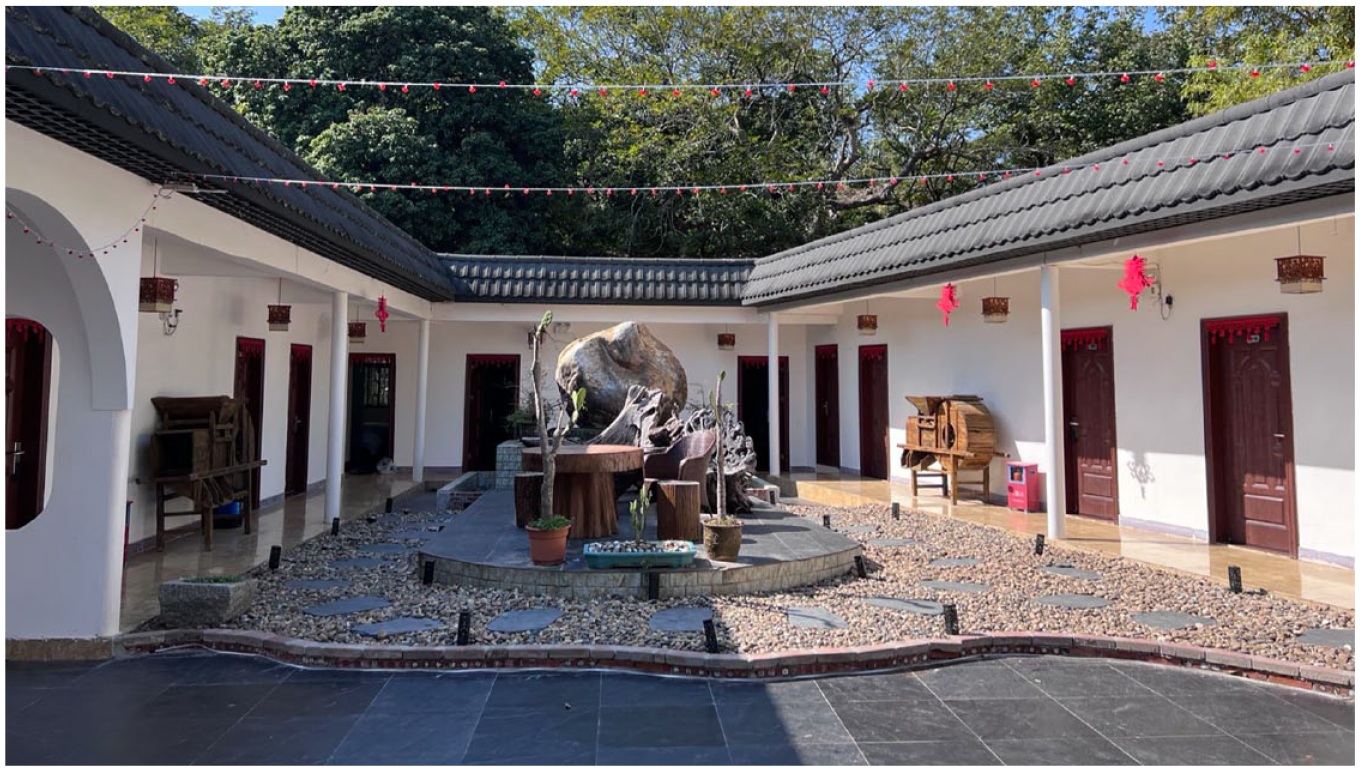
A greenway service station mimicking traditional Chinese architectural style.
Conclusion
Much has been written about how China’s urbanisation has become environmentalised, given the growing centrality of the environment as a politically, economically, and materially crucial driver of urbanisation. So far, research on this wave of environmentalised urbanisation has analytically privileged transformations within established urban cores and the emerging replications of cities in ostensibly eco-friendly forms. Much less attention has been paid to rural areas that have retained a rural look but indeed experienced significant transformations as they perform as the ‘constitutive outside’ (Vanolo, 2019) of urban areas, whose dwellers have a growing appetite for green spaces and outdoor recreation.
This article has, therefore, examined Chinese urbanisation ‘outside in’ by focusing on changes in the countryside brought about by its repositioning as an urban recreational hinterland in an environmentalised era. Specifically, we examine how this repositioning has unfolded in the PRD as a result of the development of rural greenways under the PRDGP and the responses of various rural stakeholders to this development.
Friedmann’s (2005) multidimensional framework of China’s urbanisation has facilitated us in teasing out the multidimensional implications of the PRDGP, initiated as a fix to urban green demands (Chung et al., 2018), on the PRD’s rural areas. In the administrative dimension, the PRDGP owes much to the prevailing city-centred territorial organisation, which facilitates the development of greenways across the urban-rural divide. In the economic dimension, the PRDGP stimulated rural tourism development by appealing to villagers to run new businesses targeting urban visitors looking for embodied engagement with rural, agrarian life. In the political dimension, new institutional arrangements were introduced in rural areas to maintain rural greenways and scale up rural tourism businesses. In the physical dimension, rural greenways have been routed and landscaped to entice urban visitors with iconographic biophysical elements, but the growing ecological footprint imposed upon the countryside by greenway tourism should not be neglected. In the sociocultural dimension, rural greenways have encouraged some villagers to exercise more, while the development of greenway tourism has rekindled villagers’ appreciation of traditional architectural design in the countryside.
To be sure, such greenway-driven, environmentalised urbanisation is a spatiotemporally uneven process. It gains little momentum in rural areas with limited natural endowments of tourism resources. It also depends on the willingness and capacities of village collectives and villagers to prioritise greenway tourism over other economic opportunities. The significance of greenways to the PRD’s rural development has waxed and waned under each incarnation of the greenway project. Some rural greenways and the hospitality businesses along them have remained popular over time, while others have been overgrown by weeds.
In calling for greater attention to environmentalised urbanisation, we do not suggest that the burly waves of ecological destruction caused by urban expansion have been arrested in China. Neither does our focus on extended urbanisation suggest the demise of its concentrated counterpart. Instead, by unpacking the changes that the PRDGP has sparked in the PRD’s rural areas, we simply want to show that urban environmental demands can stimulate urbanisation beyond the construction of greenwashed new towns, thereby adding ‘new narratives’ (Wu, 2020) to urban China studies. In our case, urbanisation finds new expressions as new forms of physical connections (e.g. greenways) and functional linkages (e.g. those based upon the demand and supply of outdoor recreation) between urban and rural areas. Rather than erasing the countryside, this process reinforces it as a biophysical and social environment of a particular kind, such that the rural remains significant to urban life in the PRD. 4 For a more nuanced understanding of China’s urbanisation, more research is warranted on the environment-development dialectic that animates urbanisation. It is by identifying and inspecting how environmental demands and development imperatives are entangled in specific ways that we can understand how the trend of environmentalisation has steered China’s urbanisation along particular trajectories.
Footnotes
Acknowledgements
We would like to thank the editor and reviewers for their generous and constructive feedback.
Declaration of conflicting interests
The author(s) declared no potential conflicts of interest with respect to the research, authorship, and/or publication of this article.
Funding
The author(s) disclosed receipt of the following financial support for the research, authorship, and/or publication of this article: The research reported in this paper was supported by the General Research Fund from the Research Grants Council, Hong Kong SAR (grant number 14602522 and 14617923).
