



Abstract
The urgency for China to attain carbon neutrality has driven the world’s largest carbon-emitting nation to seek more effective climate and energy policies. The adoption of smart grid (SG) technologies, aimed at enabling and accelerating the shift from fossil fuel-dependent energy systems to more sustainable ones, has garnered mounting policy interest in China. However, the full potential of SG development has yet to be realised amidst the ongoing electricity market reforms in the country. A key but largely unanswered question pertains to how and the extent to which the evolving dynamics between the government and the market have influenced SG advancements. This paper aims to develop and apply an integrated framework of policy mixes and functional dynamics for smart energy transitions, and apply it to reanalyse a case study of SG policy developments in China. Our study entails a synthesis of primary research findings, shedding light on how electricity market reforms create institutional contexts within which new government-market dynamics emerge and condition the progress of SGs in China. Our study reveals that the Chinese government has adopted a controlled dynamic approach to modulate the relationships between the government and the market within the power sector. This approach has both facilitated the creation of an enabling policy environment and imposed certain barriers to SG developments. The dominance of state-owned incumbents have on the one hand created state-driven market demand, reduction in technology costs and the influence of utility-led policy networks, but on the other hand, placing constraints on the growth of SG technologies. Our policy recommendations: China needs to formulate and implement SG policies which can effectively overcome key barriers which include under-developed regulatory frameworks, utilities’ disincentives to invest in renewable energy, and insufficiency in end-user engagements.
Introduction
Around the world, the growing urgency to achieve ambitious mid-century net-zero targets has led to increased policy focus on the importance of smart grid (SG) technologies. The widespread adoption of smart technologies, coupled with the utilisation of big data analytics, is playing an increasingly pivotal role in tackling some of the most pressing urban socio-environmental challenges. Specifically, the transformation of electricity systems is underway, driven by the integration of smart technologies. Leveraging sophisticated artificial intelligence and cloud technology, SG technologies encompass a broad spectrum of energy technologies. SG can facilitate the incorporation of renewable energy sources, enhance energy efficiency, introduce innovative price-based demand response programmes, improve control and automation, and elevate overall reliability of energy system (Levenda, 2020). SGs have therefore be regarded as an enabling technology of both supply-side and demand-side energy solutions (Hamidi et al., 2010; Parvin et al., 2022).
Worldwide, national and city governments have increasingly recognised that demand reduction is an important climate mitigation strategy to complement supply-side approaches, and SG is an enabling technology which can support the integration of supply-side and demand-side energy solutions. SG policies are thus not only to produce renewable energy but to tackle peak electricity demand and increasing the on-site self-consumption of electricity generated (Hossain et al., 2016; Tuballa and Abundo, 2016). Given the integral nature of SG technologies, this study focuses on the deployment of renewable energy and smart meter-enabled energy saving initiatives, to represent key supply-side and demand-side energy solutions respectively.
In recent years, many countries have elevated SG deployment to a major national economic and energy strategy. The US government launched “Building a Better Grid” initiative in 2022, which aims to upgrade power grids to achieve 100 percent clean energy. In the US, there were over 111 million advanced meters installed in 2021 (Statista, 2023b). In Europe, SG projects are identified as Projects of Common Interest (PCI) in European Union, and member states have committed to rolling out close to 200 million smart meters by 2020 (EC, 2023). In Asia, Japan and South Korea have also launched major SG initiatives (Mah, 2020; Mah et al., 2012).
In the global context of SG developments, China, as the world’s largest energy consumer and greenhouse gas emitter, has strong motivations to develop SGs. In 2020, President Xi Jinping announced the ambitious goal of achieving carbon peaking by 2030 and carbon neutrality by 2060 (CPCnews, 2020). The 14th Five-Year Plan on Modern Energy System published by the National Development and Reform Commission in 2022 have already included SGs as key components of the national energy plan (NDRC, 2022).
In recent years, China has made important progress in SGs. In 2020, the SG industry in China reached nearly 80 billion yuan in market value (Statista, 2023a), with the State Grid Corporation of China (SGCC) ranking 26th among 94 utilities across 39 countries/markets accordingly to a SG benchmarking index (SP Group, 2022). However, there exist three notable knowledge gaps. First, there has been limited progress in reducing electricity consumption and mainstreaming renewable energy, suggesting we have a limited understanding of SG policy effectiveness. Second, despite mounting interest in SG policies, there are few studies that provide insights with their implementation both theoretically and empirically. Third, amid ongoing electricity market reforms, the intricate dynamics between the government and the market, and their subsequent impacts on SG developments in China, have remained under-studied. There is a lack of an integrated framework that can capture and offer a good understanding of the complex interactions between the government and market.
This paper therefore aims to fill these knowledge gaps by bridging two major analytical perspectives related to the topic in question: The first is the policy mix perspective which sheds important lights on different types of policy instruments and their synergistic interactions at various administrative levels (from multi-national to national and to city and local levels), across different temporal scales and with different policy stakeholders (Rosenow et al., 2017). Another perspective is the functional dynamics of energy transitions which focuses on the essential functions of transitions processes that directly determine the development and diffusion of new energy technologies, including SGs (Bergek et al., 2008; Jacobsson and Bergek, 2011). We attempt to answer research questions as follows:
(1) To what extent have ongoing electricity market reforms in China affected the realisation of the full potential of SG development?
(2) What are the specific government-market dynamics that have emerged within the power sector in China regarding SG advancements, and how have these dynamics influenced the progress of SG technologies?
(3) What policy recommendations can be formulated to address the barriers hindering the growth of SG technologies in China?
The research is a case study of China. China presents a good case to examine government-market relationships. It is a country that has been going through an on-going electricity market reforms since 1980s. It thus allows us to examine the dynamics between the government and market, and policy issues associated with the developments of SGs. Empirical research on energy transitions in China can provide important reflection on existing theoretical perspectives on energy transitions which mostly originated in the West. Our research in China has also policy implications because our analysis can inform the further optimisation of the use of different policy instruments to foster SG developments. Policy learning can go beyond China to other major economies.
This paper proceeds as follows. We begin by discussing an integrated conceptual framework which draws together different perspectives on policy mixes and functional dynamics perspectives on energy transitions. Our integrated framework is then applied to examine the emerging government-market dynamics and the associated impacts on SG developments in China. We conclude by providing policy recommendations of which the Chinese policymakers may adopt in order to foster the further digitalisation of the power system.
Theoretical background
A growing body of the energy transitions literature shed lights on the critical roles of policy interventions in fostering technological innovation and multi-actor engagement in energy transitions processes (Li and Taeihagh, 2020; Lindberg et al., 2019; Long et al., 2022; Rind et al., 2023; Song et al., 2023). This study draws linkages between two major theoretical perspectives: the policy mix theory and the function dynamics perspectives, in order to offer a better understanding of how government-market relationships affect the formulation and implementation of SG policies in China.
SG policies from a policy mix perspectives
The policy mix literature from the established disciplines of public policies contributes to our understanding of SG policies from at least three important aspects, including policy contexts, types of policy instruments, and forms of policy mixes.
One theme of the policy mix literature focuses on the importance of policy context to the holistic instrument mixes for energy transitions. Studies, most notably by (Rosenow et al., 2017), considers that the wider policy context is essential for the need for comprehensive and well targeted instrument mixes to scale up energy transitions (Rosenow et al., 2017). Rosenow introduced two concepts, technological specificity and sector specificity, which distinguish two critical dimensions of low-carbon technology-related policy contexts. The concept of technological specificity emphasises that policies need to be responsive to the massive complexity of new SG technology (e.g., microgrid, energy storage, smart meter) and the massive technological costs associated with new low-carbon technologies. The concept of sector specificity, on the other hand, argues that energy transitions involve engagement with diversity of sectors, such as institution sector, industry sector and residential sector.
Another theme of the policy mix literature makes important distinction of four main types of policy instruments: command-and-control instruments, economic instruments, market-based instruments, and voluntary instruments. Empirical studies on SGs show that all these four types of policy instruments have been deployed to foster the development of SGs. In terms of
The third theme of the policy mix literature distinguishes five forms of policy mixes that have relevance to SG developments as outlined as follows: (i)
SG policies from a functional dynamics perspectives
Moving beyond the policy mix framework which is relatively static in nature, innovation system scholars introduced the functional dynamic approach to capture and conceptualise the dynamics of a number of key processes of system transformations, in order words, the key “functions” of energy system transitions. These functions are critical to the development and diffusion of new energy technologies. These functional frameworks have been applied various sub-fields of energy transitions, including SGs. Work on functional dynamics perspectives has conceptualised five key functions which include:
(1) Market formation: Governments can spur the formation of new markets to support transformative policy of SGs (Boon et al., 2022) through developing SG development roadmaps, setting clear policy objectives, providing pricing signals, and driving down costs by exercising bulk purchasing power (Bradshaw and de Martino Jannuzzi, 2019; ECLAC, 2021; Panori et al., 2022);
(2) Market regulation: Governments can establish market rules to regulate player behavior, attract new market entrants, and create standards for scaling up deployment of smart meter, for instance, at both city and regional scale.
(3) Managing public goods: Governments need to intervene when market failure jeopardises public goods such as energy security and decarbonisation (Hall and Foxon, 2014), reliability of energy systems (Kowli et al., 2010), standardization (Mah et al., 2017), R&D activities (Dantas et al., 2018), and information sharing (Helmholt and Broenink, 2011).
(4) Networking and resource mobilisation: Governments collaborate with network to share common interests to influence policy processes and outcomes (Li et al., 2019). Key networks include policy communities, professional networks, intergovernmental networks, producer networks, and issue networks (Mah et al., 2017).
(5) Policy learning: Governments and policy stakeholders need to engage in a policymaking process in which policy-makers interact through dialogues and deliberation in order to adjust goals, rules and policy instruments of a given policy (Boon and Bakker, 2016; Hall, 1993) . This engaging approach for policy-making is required to ensure policy legitimacy that are required to support wide-scale adoption of low-carbon energy technologies (Bergek et al., 2008; Chou et al., 2015).
The government-market dynamics and electricity market reforms
In addition to research focusing on functional dynamics perspectives, another emerging theme of energy transitions studies shed lights on the crucial roles of government and market (Akrofi and Antwi, 2020; Droste et al., 2016; He et al., 2021; Zhang and Andrews-Speed, 2020). The literature suggests that, on the one hand, governments, or public interventions, are required to overcome market failure and limits of market forces (Cui and Wei, 2017; De Almeida, 1998). On the other hand, market forces are perceived as the most cost-effective way to address energy problems.
Extending from these works, a sub-theme of the functional dynamics perspectives on energy transitions focuses on institutions. Some recent studies have found that electricity market reforms are critical government interventions that redefine the environment within which governments and market actors (including both incumbents and new market players, interact and influence energy transitions processes (Gao et al., 2018; Greenacre et al., 2012). These reforms play a crucial role in reshaping market rules, structures, and the dynamics between governments and markets. As early as in the 1980s, market-oriented reforms in the electricity industry had already become a global trend as a major approach to enhance competitiveness and improve efficiency. Over recent years, policy attention on electricity market liberalisation has intensified, particularly in the context of the global development of SGs. Electricity market reforms have been regarded as essential to drive systemic changes in the power sector which are needed to realise the full potential of demand-side and renewable developments that can be enabled by SGs (Cooke, 2011). A recurring theme in this literature advocates for a shift in government functions from direct administrative measures to government regulation in increasingly market-driven power sectors (Droste et al., 2016; Wu et al., 2021). How, then, should such co-evolution of the role of government and market occurs, and the impacts on established regime actors and emerging market actors (Martiskainen et al., 2021), remained relatively unexplored.
Studies on SGs in China
Whilst a large body of the studies on SG developments in China focuses on the technological and economic aspects of these energy technologies (Yüksel et al., 2014), a rapidly growing body of governance literature on SGs argues that if China were to fully utilise the potential that SGs may offer, many technological, economical, as well as institutional and policy challenges have to be overcome (Mah, 2016; Yuan and Zhang, 2014). Some studies have characterised the Chinese SG development as an incumbent-led model (Mah, 2016; Mah et al., 2017), or grid company-led approach (Yuan and Zhang, 2014), suggesting the dominance of incumbent utilities as a regime actor in driving the deployment of SG technologies in China without a strong presence of new market actors.
However, a growing number of studies have argued that smart energy transitions being driven by SG technological developments demands a rapid and profound transformation of the electricity sector in China (IEA, 2021a). SGs are transformational because they coordinate and orchestra the needs and capabilities of all generators, grid operators, end-users, and electricity market stakeholders (for instance, aggregators, new energy suppliers) in highly digitalised and integrated energy systems (IEA, 2023). This increasingly dynamic stakeholder landscape has heightened the tensions among stakeholders. How to address governance challenges as a result of changing government-market relationships are particularly important for Chinese policy-makers.
It is in this context that the market environment of China’s power sector has been largely reshaped by the ongoing electricity market reforms, which have been introduced since 1980s. Before the reforms, traditional energy systems in China were characterised by the centralised, coal-based power systems with the presence of a vertically state-owned monopolised power industry. To date, in the wake of a series of major changes which have been introduced into the power sector, which include primarily the separation of electricity grid and power generation, the liberalisation of the power generation segment, and the introduction of dynamic pricing policies, China’s power sector looks very differently.
There are two streams of research trying to estimate the effect of government-market dynamics under electricity market reform. The first strand of literature emphasises regulatory mechanisms from the government. The second strand focuses on the important role of market, including market pricing mechanism and market efficiency. By conducting two case studies that under electricity market experimentation, Yu (2020) evaluates how government and market complementarities can effectively play the role in China’s electricity market reform, and it also indicated incomplete regulation and political resistance are the major challenges for the market participants. However, how, and the extent to which, such changing government-market relationships have facilitated or limited the developments of SGs in China are however under-studied.
Towards an integrated framework
To address the knowledge gaps, we present the integrated functional dynamic framework that examine the government-market relationship in supporting smart energy transitions (Figure 1).
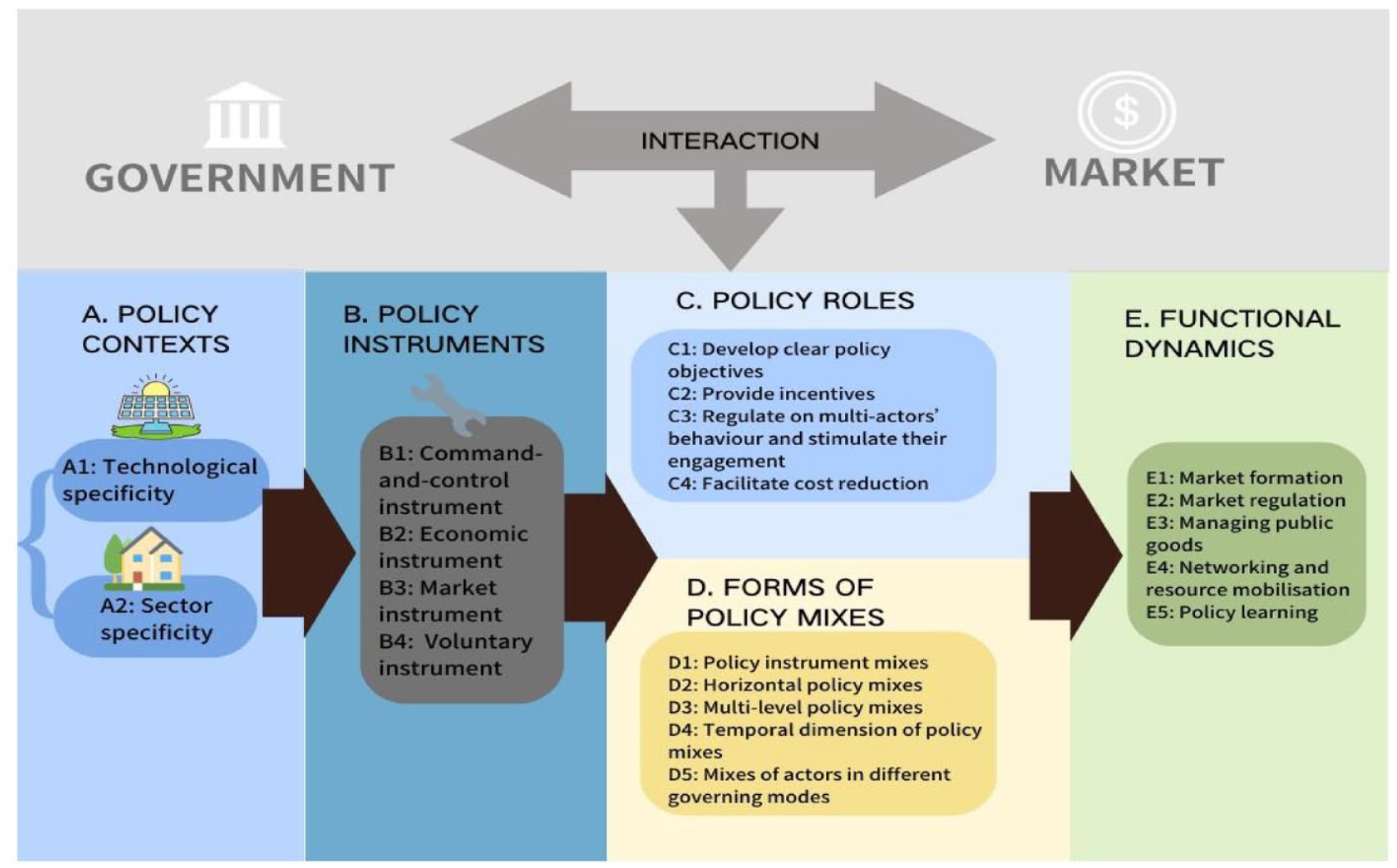
An integrated framework of policy mix and functional dynamics for smart energy transitions.
We adapted the integrated framework by (Mah et al., 2021) and further developed it in SG context. Our framework suggests that the government-market relationships in supporting smart energy transitions relates to five dimensions as follows: (1) policy contexts; (2) policy instruments; (3) policy roles; (4) forms of policy mixes; and (5) functional dynamics. Each concept is coded to facilitate a more systematic analysis (pls refer to a more detailed discussion in the methodology section). Our framework suggests the following propositions:
(1) Technological and Sectorial Influence: Policy contexts of SGs are significantly shaped by two factors: the technological specificity of the SG technologies [Code A1] and the sector specificity which is shaped by electricity market reforms and related sectors such as building and industry sectors [Code A2];
(2) Government Policy Roles: Governments play four essential roles of policies, which range from setting clear policy objectives to facilitating cost reductions [Codes: C1–C4], and deploy a diverse range of policy instruments (i.e., economic instrument, market instrument, command-and-control instrument, voluntary instrument) [Codes B1–B4]. These various instruments are integrated into various forms of policy mixes to foster the transitions to smart energy systems.
(3) Functional dynamics: The interactions of the government and market in the policymaking process within the policy contexts gives rise to five critical types of functional dynamics, which include market formation, market regulation, managing public goods, networking and resource mobilisation and policy learning [Codes E1–E5). These functional dynamics collectively influence the diffusion of SG technologies and, consequently, the overall performance of the SG-related innovation system.
Methodology
This study conducts a reanalysis of an empirical case study in China and develops an integrated conceptual framework to elucidate the intricate interplay between government and market dynamics within the context of smart energy transition. It synthesises findings from prior research and employs an integrated framework to enable robust analysis of empirical data. This methodological approach can support policy-relevant research through deeper exploitation of existing data resources, and have been increasingly adopted in energy transitions studies resulting in high-impact research (see, for instance, (Vigurs et al., 2021)).
We provided a systemic review of existing SG policies, major developments of the on-going electricity market reforms, and the impacts of the government-market dynamics on the developments of SG in China. Important empirical data collected from existing literature, official policy documents, reports and news were coded according to a coding system which is guided by our integrated framework.
Specifically, we have developed a coding system which is guided by our integrated framework for analysing data which was collected from existing literature and official policy documents, reports and news. Our framework, and the associated coding system, including five dimensions, and 20 sub-codes, (as presented in Figure 1). Our codes are linked to five key conceptual components of our integrating conceptual framework.
Our analysis focuses on how government adopted different types of policy instruments and employed policy mixes in an increasingly marketised environment, and the extent to which, and how the interactions between government and market drove or constrained the developments of SGs in China.
Case context
China’s energy basic
China’s economy is coal-dependent. Being the world’s largest developing country and the second-largest economy by GDP (World Bank, 2022), China is currently the largest energy consumers and greenhouse gas emitting country. In 2021, coal-fired power generation accounted for 55% of China’s total installed capacity (NBSC, 2021) (Table 1), and coal generated 67% of the country’s electricity (China Energy Portal, 2022) (Figure 2). While coal’s share has decreased from 72% in 2011, it remains the dominant energy source. However, non-hydro renewables, including solar and wind, have grown significantly from 4% in 2011 to 27% in 2021. Nuclear power increased modestly from 1% to 2%, while hydropower decreased from 22% to 16% during this period (NBSC, 2022).
Energy mix of China’s power sector (in terms of installed capacity) (2011-2021).(10,000 kW).
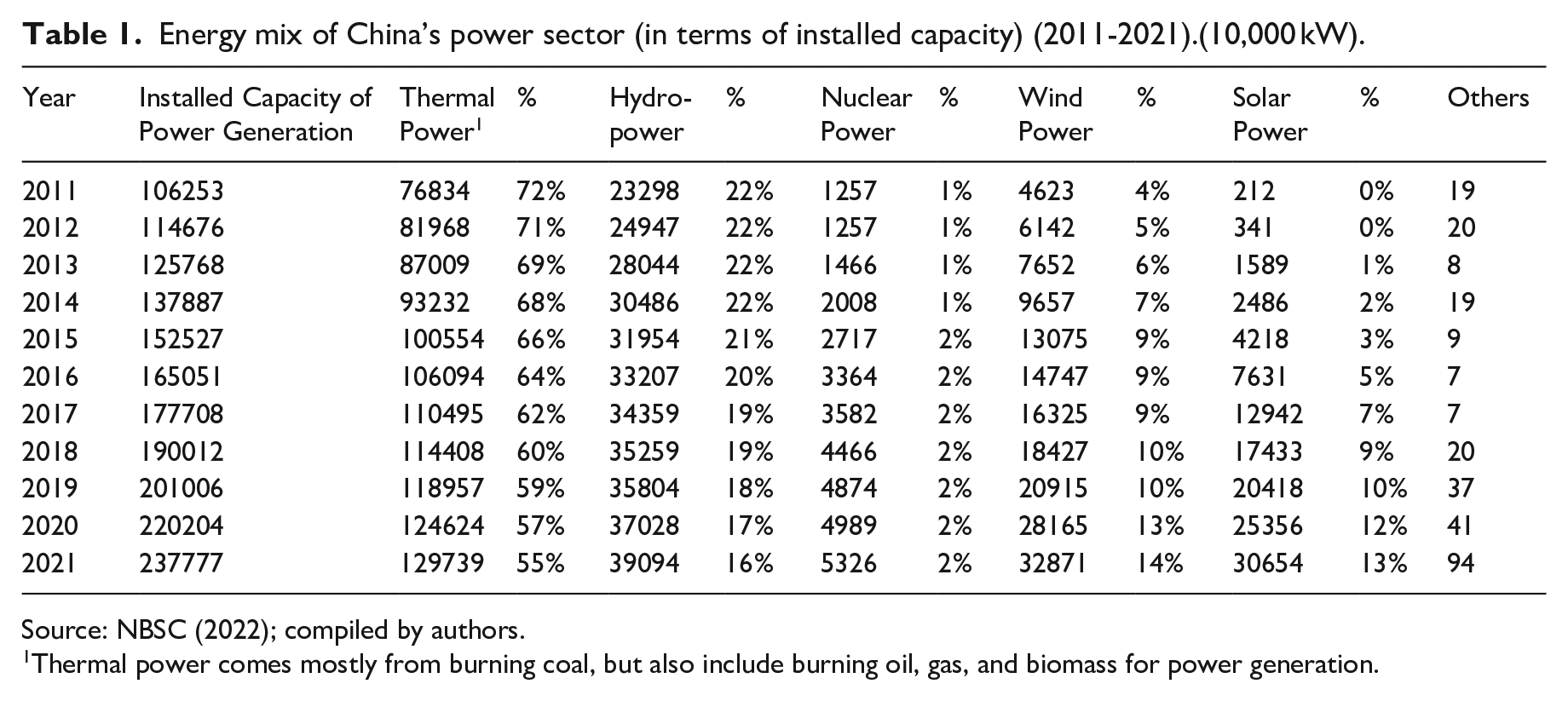
Source: NBSC (2022); compiled by authors.
Thermal power comes mostly from burning coal, but also include burning oil, gas, and biomass for power generation.
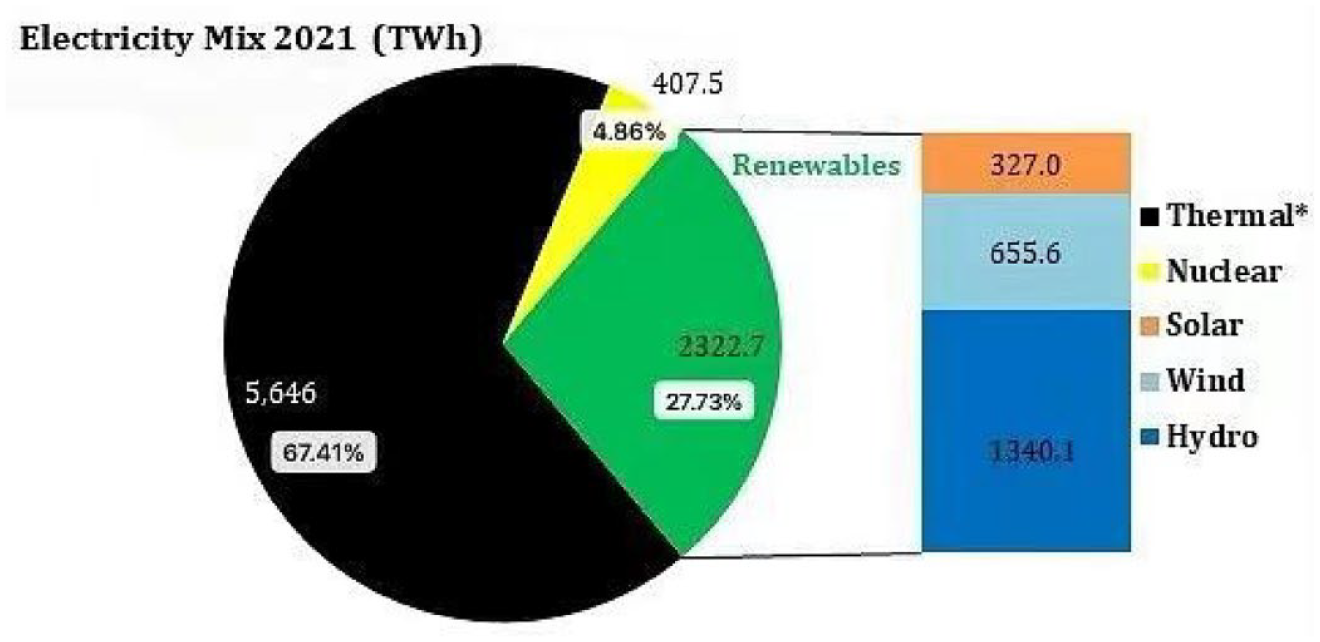
Electricity mix in China in 2021 (in terms of power generation (kWh)).
China’s coal-based energy system has had profound adverse effects on the economy, environment and society (Tai et al., 2020). These adverse impacts encompass climate impacts (Peng et al., 2018; Wang et al., 2021), concerns about energy security (Wang et al., 2020), cost-related issues (Zhou et al., 2022), and social instability (Shi et al., 2018). Against this national energy context that President Xi announced in 2020 a coal peaking target by 2030 and a carbon-neutral goal by 2060 (IEA, 2021a).
China’s ongoing electricity market reforms: five stages and the associated government-market relationships
As early as in the 1980s, market-oriented reforms in the electricity industry had already become a global trend as a major approach to enhancing competitiveness and improve efficiency of the power sectors (Byrne and Mun, 2003; Pollitt, 2012).
In China, electricity market reforms commenced in 1985, driven by three primary objectives: alleviating financial hardship of the power sector, attracting foreign investment, and fostering competition (Wang and Chen, 2012). Over these years, two major rounds of electricity market reforms were introduced in 2002 and 2015, significantly reshaping the power sector in terms of market structure, market players, and regulatory framework. Our review identifies five distinct phases of development within the power sector, each characterised by unique government-market dynamics, as outlined in Table 2.
Five stages of China’s electricity market reforms and features of government-market relationships.
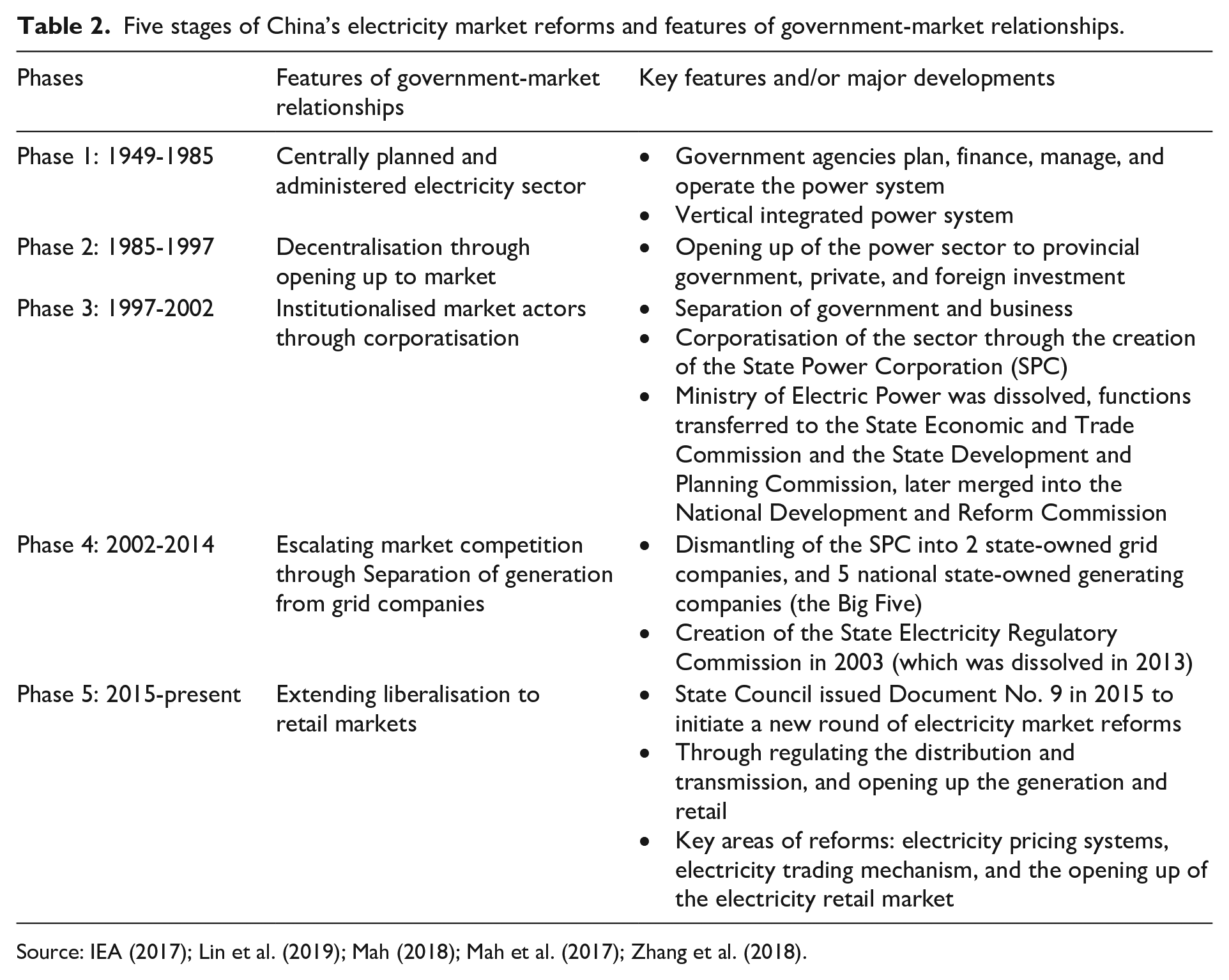
In
Despite the successful competition and efficiency improvements in power generation following the 2002 unbundling reform, state-owned grid companies had maintained a monopoly over electricity transmission, distribution, and sales (She et al., 2020). In
Major developments of SGs in China
China is a later-comer of SG developments when compared with its counterparts in the West. In contrast to other economies, China’s SG initiatives have largely focused on high-voltage transmission networks while the U.S. emphasising energy system resilience and the Japanese model is based on consumer participation enabled by smart technologies (Jensterle and Venjakob, 2019; Mah et al., 2017).
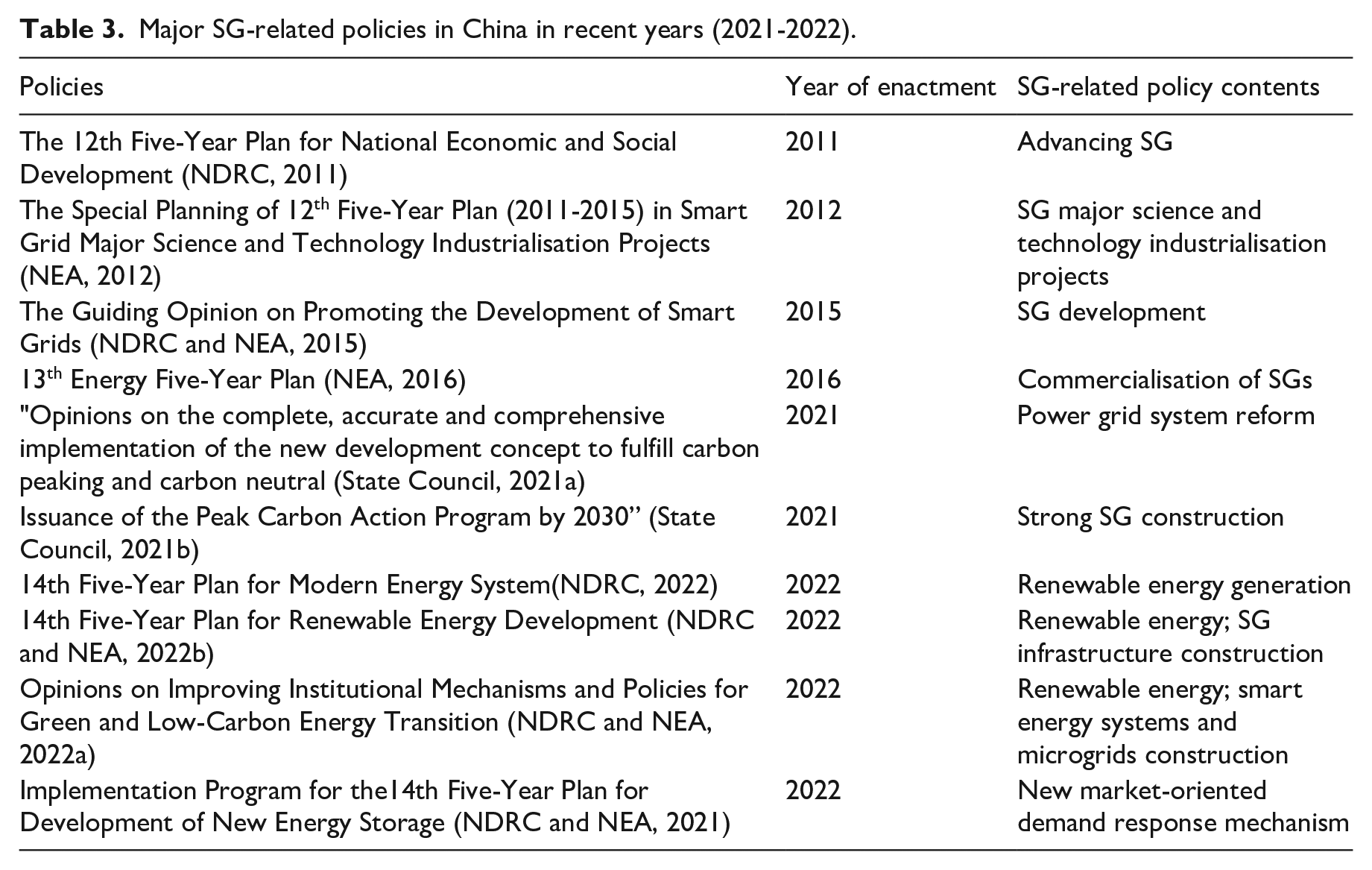
China’s SG development began with the SGCC’s 2009 announcement of a three-stage SG plan. Since then, major SG policies have been introduced by the Chinese national government (Table 3). Major progress has been made in these five areas:
(1)
(2)
(3)
(4)
(5)
Major SG-related policies in China in recent years (2021-2022).
Findings and discussions: Controlled dynamism in China’s smart energy transitions
Guided by our integrated framework, this study examines the development of SG policies in China, and we conceptualise China’s government-market relationships in the context of smart energy transitions as a controlled dynamic approach. This approach distinguishes certain key features of the government-market dynamics in China’s smart energy transitions: there existed a strong presence of the national government and SOEs while some extent of fragmentation (across sectors) and diversity (in the stakeholder landscape) in an increasingly marketised power sector was evident. The features and logics of this controlled dynamic approach, and an assessments of the emerging government-market relationships in fulfilling transition functions are discussed in more details as follows:
The features and logics of a controlled dynamic approach in a controlled dynamic setting
Informed by our integrated framework, we found that the technological and sector-specific factors amidst the on-going electricity market reforms in China have shaped the policy contexts of SGs within an increasingly dynamic stakeholder landscape [Codes: A1, A2]. It is important to note three observations:
Firstly, there existed a strong persisting presence of the national government and SOEs despite the electricity sector has been gradually opened up. Under China’s controlled dynamic approach of modulating the interactions of the government and the market within the power sector, our research found that the two grid companies were motivated by the combined effects of national policy low-carbon commitments, political obligations and economic incentives in an increasingly marketised power sector to mobilise resources to develop and implement plans to finance the deployment of SGs.
Previous studies have documented that because the electricity market has only been partially liberalised, the central government has retained a commanding position in the power sector through exercising ownership of the state-owned enterprises and through appointing and removing senior executives of state-owned enterprises (Chen, 2018).
The technological specificity of SG developments in China can explain the dominance of the government and SOEs [Code: A1]. SG technologies are complex and integral in nature. It entails an integration of a broad range of advanced technologies for transmission, distribution, storage, and retailing, which include smart metering, distributed system of power generation, energy storage systems, and home energy management systems. In response to these technological challenges, the Chinese government has emphasised the priorities of research and development of SG technologies in national strategic policies such as in The 12th Five-Year Plan (NDRC, 2011) and Opinions on Accelerating the Development of Energy Digitalization and Intelligence (NEA, 2023). Additionally, the complexity of SG technology is closely related to the high technology cost. Energy Foundation estimated that the amount of investment in national SG development can reached RMB 365.9 billion during the period of 2011–2030 (Energy Foundation, 2011). The high-cost nature of SG technologies also provided the two state-owned monopolised grid operators: the State Grid Corporation of China (SGCC) and China Southern Power Grid Co. Ltd. (CSG) an important role to play in this area of green investment. These two incumbents account for 83% and 17% of the national power consumption respectively, and have been pivotal in mobilising massive investments for grid enhancement and smart meter rollouts (Mah et al., 2017). SGCC and CSG have planned to contribute investments in power grid with a total of USD 442 billion over the period of 14th Five-Year Plan (2021–2025) (IEA, 2023). In 2022 alone, SGCC already invested over RMB500 billion ultra-high-voltage projects while the Chinese government played more roles on reducing technology costs through the large-scale deployment of SG technologies and achieved economies of scale (NEA and MIIT, 2022).
Additionally to the technological specificity, the sector specificity has given rise to a dynamic stakeholder landscape of SGs. Chinese policy instruments have covered a wide range of SG-related sector which include the industrial, residential and commercial sectors with the aim to enhance policy effectiveness through optimising the instrument mix in multi-sectoral policy settings [Codes: A2, D1 & D2]. It is however important to note that the policy attention given to different sectors was uneven and has been titled towards the industrial sector. The Guiding Opinion on Promoting the Development of Smart Grids (NDRC and NEA, 2015) set clear targets for increasing SG investments in industrial sector while giving insufficient attention to offering national policy support to engaging residential consumers.
Chinese provinces play a key role in the implementation of SG-related climate and energy policies at sub-national levels [Code: D3]. Under China’s “target responsibility system,” many of the central government’s key climate and energy targets are allocated to individual provinces, with provincial leaders responsible for fulfilling them. Each province has its own Leading Group on Climate Change, chaired by top provincial leaders (Sandalow et al., 2022).
Assessing the Achievements and Limitations of Government-Market Relationships in Fulfilling Transition Functions
Guided by our conceptual framework, our study has assessed the performance of China’s controlled dynamic approach in governing the government-market relationship. We found that China’s approach can perform critical functions which are required to support SG developments. However, some other functions haver remained under-performed as we discuss as follows:
Market Formation
The interplay between government and market in China’s power sector has provided critical conditions to support the market formation of SG technologies. Clear national visions and policy objectives have been delivered to policy stakeholders through the setting of the 2060 national net-carbon goal and the promulgation of the 14th Five-Year Plan on Modern Energy System (NDRC, 2022) [Code: E1].
It is evident that the government has deployed a mix of administrative measures and market forces to mobilise multi-sectoral policy stakeholders at national, provincial and city levels to deliver the vision and policy objectives. The Chinese government has recognised that the energy system requires not only the phasing out of fossil fuels and using more renewable energy on the supply side, but also behavioral changes regarding the individual energy consumption on the demand side. The introduction of the Renewable Portfolio Standards (which mandate state-owned grid companies a minimal purchase of renewable energy) (Hove, 2023) [Code: B1], the feed-in tariff policies [Code: B2], and the green electricity trading market [Code: B3] demonstrated the use of a mix of policy instruments. The introduction of demand-side pilots in Foshan and other Chinese cities, on the other hand, is a good example of city-level demand-side policy initiatives using market forces (Mah, 2016). These policies have created a conducive market environment for supporting SG technologies (Code: E1), through introducing these supply-side and demand-side initiatives across not only the power sector, but all electricity end-uses and subsectors including the building, transport, and had sectors (Sandalow et al., 2022; Hu et al., 2023a) [Codes: D2, D5].
These observed SG-related policies have, however, major limitations in introducing pricing signals. In general, the low electricity prices in China has failed to create strong market signals to motivate energy efficiency across all sub-sectors of electricity end-users (Mah, 2016). Although recent technological breakthroughs in SGs have led to greater interest in demand-side-management activities in the residential sector, Chinese householders had limited engagement in demand response programmes, and in generally did not respond actively to time-of-use dynamic pricing systems which are linked with the use of smart meters and visualisation of real-time electricity consumption data (Mah, 2018; Yang et al., 2018). The impacts of SG policies were therefore undermined. China underperformed its energy efficiency target in the 13th Five-year Plan (2016–2020), achieving a reduction of energy intensity during the 13th FYP at 13.2% - which was less than the initiate target of 15% (Sandalow et al., 2022) [Code: E1].
Market regulation
The ongoing electricity market reforms in China are expected to liberalise and regulate the power market in new ways in order to introduce market competition, economic incentives and pricing signals to scale up the deployment of renewable energy and demand-side measures.
It is important to note that, following the 2015 electricity market reforms, the Chinese government has made important progress in establishing and regulating its electricity markets. Power exchange centres have been set up in all provinces and autonomous regions to support electricity market transactions, encompassing not only traditional electricity but also renewable [. In 2022, China reached 20TWh of cumulative transactions volumes in green electricity trading market (GIZ, 2022). At provincial level, on the launch day of the electricity trading market in Guangdong [Code: D3], four renewable developers sold 10,480 MWh to seven retailers and power users through annual contracts [Code: D1], providing empirical evidence that new market actors have become more active in China’s increasingly dynamic stakeholder landscape [Code: D5]. Importantly, the Chinese government has played important roles in establishing new renewable trading rules that govern the operation of these new electricity trading platforms (Dong and Cao, 2021) [Code: E2].
Market regulation, however, appeared to remain one of the weakest functional areas in the current government-market relationships. Overseas experiences in, for example, Germany, Spain, and the US, have clearly shown that a variety of electricity markets (such as spot markets and cross-border electricity trading) can provide numerous options of energy supply to meet market demand, and thus enabling the mainstreaming of renewable energy (Szeberényi and Bakó, 2023; Zhang et al., 2018).
In contrast, there is a lack of a comprehensive regulatory framework for governing SG-related energy markets in China. To date, no single national legislative ordinance is dedicated to promoting SGs. Instead, the Chinese government has relied on a loose regulatory framework, primarily from the National Development and Reform Commission, to regulate SG developments. It is evident that regulating the SG industry through optimising government-market dynamics is challenging. The development of the renewable energy market is dominated by state-owned enterprises (SOEs). Retail competition involving renewable energy suppliers is lacking. A large-scale integration of renewable energy has remained a major challenge. Solar PV accounts for only 3% of domestic electricity generation, whereas countries like Italy, Germany, and Japan have higher percentages. Solar PV contributed to Italy, Germany, and Japan, solar PV contributed to 8%, 7.6% and 6.6.% of Italy’s, German, and Japan’s their national electricity generation respectively in 2021 (IEA, 2021b, 2021c).
Specifically, bottlenecks in transmission networks have been a major institutional constrain that hindered the major uptake of renewable energy. The partial electricity market reforms have not yet fully addressed curtailments of renewable energy. State-owned utilities, with their established positions, lack incentives to incorporate renewable energy which is intermittent in nature. This issue is compounded by a mismatch between transmission capacity and wind and solar farm outputs and a lack of energy storage systems (Luo et al., 2018). Large-scale wind curtailment first emerged in the late 2000s in the northwest regions in China, spreading nationwide in 2010. The total solar energy abandoned was 14.19TWh between 2013 and 2016, attributed to around 15% national average curtailment rate of solar PV during that period of time (Zhang et al., 2018). In recent years, even though curtailment has continued to improve due to the commissioning of additional interprovincial transmission capacity and improved market operations, wind and solar PV generation curtailment still reached approximately 15 TWh in 2020 (IEA, 2021d) [Code: E2].
The regulatory weakness has also hindered the effectiveness of SG policies in fostering consumer engagement. The electricity market reforms are expected to create new market conditions that enable competitive electricity prices, and more consumer choices – which are pre-requisite for the Chinese government to mobilise market forces and flexibility in engaging the public in demand response initiatives. However, following decades of reforms, retail market liberalisation and customer choices have remained limited in China’s power sector. Besides, demand response pilot city programmes were only launched in 10 cities as of 2019, most of these programmes were only applicable for industrial and business sector. The existence of limited customer engagement and the weak interactions between the two grid operators and residential end-users has constrained electricity consumers in participating actively in distributed energy markets and demand responses programmes (Liu et al., 2013; Mah, 2018).
Managing public goods
Many aspects of SG developments are public goods in nature which requires large amounts of investments with low return rates. Over these years, the Chinese government and two monopolised power grid companies have undertaken significant roles on accelerating SG development in China in terms of investments, R&D, diffusions, and international cooperations [Code: E3].
In terms of green investment, SGCC was the largest SG investor with its investment accounting for 99.2% of grid investment in China in 2021 (e.g., investments in the world’s first VSC-HVDC grid project in Zhangbei) (Sina Finance, 2021).
In relation to R&D, SGCC planned to increase R&D investments of RMB 58 billion from 2021 to 2025 to achieve breakthroughs in key technologies for new power systems. CSG, another state-owned grid company, has also undertaken major R&D projects such as a database power system (Sina Finance, 2021). Political obligations coupled with social responsibility appear to be the primary motivation to drive the two state-owned grid companies to develop SGs technologies. [Code: A1] The synthesis of data management, integration of renewable energy, resilience and repair (KPMG, 2023) has increased the complexity of SG development. SGCC and CSG believed that they had the responsibility to take the lead in developing SG technologies to avoid losing the global market competitiveness of the Chinese SG industries in this worldwide trend (Mah et al., 2017).
In addition, these SOEs also plays an active role in international cooperation on SGs. One notable examples is the UHVDC transmission lines which were built by SGCC in Brazil (KPMG, 2023).
Networking and resource mobilisation
It is evident that the Chinese government has been actively engaged with market actors within multi-types of policy networks in relation to SG development as follows [Code: E4].
(1)
(2)
(3)
(4)
There is however under-development and under-utilisation of policy networks in several important aspects. First, although industrial associations exist and have served as important intermediaries to transfer knowledge across the SG industry, many of them such as Beijing Electric Power Industry Association (2019), are managed and supervised by electricity authorities and have limited degree of independence and autonomy (Wang and Wang, 2018) [Code: E4].
SGCC and CSG have founded in-house research institutions (e.g., such as State Grid Energy Research Institute (SGERI) and CSG Electric Power Research Institute (CSG EPRI)) to provide standards, expertise, knowledge, and techniques to support SG development. However, the majority of databases from these research institutions do not open to the public, which limited the effects of knowledge sharing in research networks. [Code: E4].
Policy learning
Issue networks can play an important role in policy learning. Issue network in associated with SG developments in China involves with different industrial associations. For example, China Electricity Council (CEC). However, these kinds of government-affiliated industry association lack of independence and autonomy, and they are under the guidance and supervision of NEA. Another limitations of China’s issue network is that there are no national-scale SG industrial associations in China except the National Smart Grid Standardization Promotion Group (NSGSP) (NEA, 2011) established under the joint leadership of the NEA and the Standardization Administration of China (SAC) [Code: E5].
Another limitations of policy learning in China is the lack of an inclusive approach in SG policy developments. SG developments are a people-centered approach. Householders, or residential consumers of electricity, can be engaged in energy systems in various levels, from participating in demand-side energy solutions to investing in rooftop solar installations, and even stimulating market demand within regional renewable energy markets (Parag, 2015). However, realising the potential of consumer engagement necessitates significant departures from the traditional top-down and closed policy-making processes. Instead, it requires a shift towards a policy learning approach, through which end-users and other policy stakeholders collectively offer feedback and collaboratively adjust the goals, institutions, and policy instruments of SG policies (Lo, 2015; Mah, 2020).
Empirical studies on SG developments in China however have revealed that residential end-users exhibited a limited level of engagement in adopting energy saving practices in response to time-of-use pricing. Some studies found that consumers perceived little incentives to alter their daily energy practices because of the low electricity prices and a lack of clear differentiation between peak- and off-peak prices, there was little incentive for them to change the status quo in their daily energy practices. The Chinese government, on the other hand, was not active in making major adjustment in the electricity pricing reforms due to public opposition to tariff increase (Zhang and Qin, 2015).
Conclusions
This study developed an extended integrated framework of policy mix and functional dynamics for smart energy transitions to provide a systematic understanding of energy transitions, with a reference of an important sub-field of SG technologies in China. Our framework integrates policy mixes and functional dynamics perspectives, and guided us in our empirical analysis. It allowed us to provide a more holistic and critical analysis of SG development in China. Our analysis has illustrated that the on-going electricity market reforms have created institutional conditions (and the associated government-market dynamics) which have shaped and determined the developments of SG in China. We have advanced the theoretical developments of the energy transitions literature by conceptualising these Chinese features as a controlled dynamic approach.
In addition to theoretical contribution, this study has also made empirical contribution. In our methodology section, we explain that our reanalysis of an empirical case study through synthesising findings from prior research is guided by our conceptual framework. We also adopted a coding system to systematically map out the interactions of the government and the market. This systemic research approach enables us to conduct policy-relevant research through deeper exploitation of existing data resources. Our analysis is thus able to go beyond being desciptive. We are able to provide a much more in-depth discussion on how government adopted different types of policy instruments and employed policy mixes in an increasingly marketised environment, and the extent to which, and how the interactions between government and market can deliver critical functional dynamics that drove or constrained the developments of SGs in China. We found that changes to market rules, policy objectives and regulatory frameworks have contributed to the increasingly dynamic government-market relationships with more and more market actors interacting. However, there exist at least three significant functional weaknesses in China’s smart energy policies. These include the over-reliance on SOEs, ineffectiveness in engaging households in demand-side management, and the under-utilisation of an intelligent mix of policy instruments which are required to fully realised the potential benefits of SG.
Our findings have policy implications. We suggest that SG policies in China need to give sufficient attention to the limitations of the existing government-market relationships in fulfilling the key functions of market formation, market regulation, managing public goods, networking, and policy learning. As guided by our integrated framework, we recommend the Chinese government in assuming a more active role in optimising the policy mixes in order to improve the policy performance in delivering those “gap” functions. Our specific policy recommendations are as follows:
First, SG policies should better leverage the advantages of both the administrative policy measures and the market mechanisms to optimise the government-market relationships. Particular attention should be given to how to design and implement more effective market-based policy instruments in order to create sufficient market signals to mobilise residential end-users to take part in both supply-side and demand-side energy measures.
Secondly, the roles of the government in regulating different sub-types of energy markets, including green electricity markets, are critical and yet under-performed. SG technologies are highly integral in nature and yet there is a lack of a comprehensive regulatory framework for SGs in China. The Chinese government needs to introduce a national “smarter” regulatory framework which can foster cross-departmental policy coordination at the national level, as well as vertically across national, provincial, and city levels.
Thirdly, policy-making of SGs needs to adopt a more inclusive approach in order to encourage active engagement with the government, energy utilities, SMEs and other market actors, and endusers to gather feedback on policy-making matters.
This study applied the framework in the case study and illustrate the explanatory power of the framework. Future research directions can focus on conducting empirical research to collect primary data on explaining the policy impact of can be explained, and the scaling up mechanisms.
Footnotes
Declaration of conflicting interests
The author(s) declared no potential conflicts of interest with respect to the research, authorship, and/or publication of this article.
Funding
The author(s) received no financial support for the research, authorship, and/or publication of this article.