



Abstract
This paper examines the residential mobility of urban low-income residents in two Chinese cities using survey data. Contrary to previous studies, our results reveal a relatively low level of housing mobility among the urban poor. In exploring the determinants of low-income housing mobility, we employ both life-cycle and social-psychological theories, with particular attention to the role of place-based factors and their interactions with other variables. Our analysis uncovers a strong relationship between housing mobility and life-cycle variables, albeit with considerable heterogeneity among residents. Additionally, the lived experience of housing emerges as a significant predictor of mobility. Lastly, we find that the interplay of place and space exerts a profound and complex influence on this process, shaping moving intentions at various geographical scales and interacting with other factors to determine the housing mobility of urban low-income groups.
Introduction
The investigation of residential mobility has consistently been a central focus within urban and housing studies (Burrows, 1999; Clark and Huang, 2003; Clark et al., 1984; Cui et al., 2015; Heaton et al., 1979; Kendig, 1984; Rossi, 1955). It can be posited that the process of residential relocation in urban areas represents a fundamental factor influencing urban morphology and social ecology (Wolpert, 1966). Moreover, the mobility of individuals and households is essential for understanding urban development and dynamics (Li and Wu, 2004). Conversely, house acquisition, particularly family relocation, often constitutes a pivotal moment in an individual’s life, impacting their well-being, career progression, and domestic development (Clark et al., 1984). For the middle class and affluent populations, relocating often symbolizes an enhancement in housing and neighborhood conditions or a reunion with family and friends (Clark et al., 2006). However, for low-income groups, urban relocation may expose their vulnerability to health, employment, and housing challenges (Katz et al., 2001; van Westen, 1995). For these individuals or households, involuntary or frequent relocation may disrupt their established social and employment networks, potentially undermining the education and mental health of their children (Phinney, 2013). Nonetheless, if their residential mobility is too limited, it may indicate entrapment within a highly stratified and segregated housing market, hindering their ability to improve housing conditions within the city (Wu, 2010). Consequently, it is crucial to explore the nature and determinants of residential mobility among the urban poor to address their housing needs in cities.
Housing mobility can be conceptualized as a spatial equilibrium process, wherein a household adjusts its housing consumption—location, size, type, and tenure—in response to evolving circumstances throughout its housing career (Li and Wu, 2004: 1). A housing career is primarily characterized by the household’s major life-course events (Clark and Huang, 2003; Rossi, 1955). Nevertheless, scholars have yet to reach a consensus on the role of these life-course events, with conflicting perspectives in the literature regarding the effects of marriage (Green, 1997; Roisman and Botein, 1993), income (Abramsson et al., 2002; Kronenberg and Carree, 2010), and tenure (Clark et al., 1984; Li and Li, 2006) on residential mobility. Researchers have also investigated the psychological underpinnings of housing decision-making processes. Social psychologists view housing as a lived experience (Buttimer, 1980), with studies concentrating on cognitive assessments and affective attitudes of individual housing occupants concerning their housing conditions and neighborhood characteristics (Marans, 1976; Rent et al., 1978; Speare, 1974). This social-psychological perspective offers an approach to understanding the traits of different urban populations, such as the urban poor or upper class, at the same life-cycle stage.
Geographers have extensively examined the influence of place on housing mobility (Brown and Moore, 1970; Wolpert, 1966), with critical assessments of neighborhood effects on housing mobility (Coulton et al., 2012; de Souza Briggs, 1997). A consensus exists that neighborhood effects play a significant role in housing decision-making processes (Kling et al., 2007). However, housing relocation constitutes a multi-scalar spatial process that often surpasses the neighborhood scale. Geographical factors, such as urban morphology and spatial mismatches between work and home, are likely to substantially impact housing mobility at multiple scales. From a geographical perspective, both housing life-cycle and perceptive housing experiences are embedded in scalar places. Therefore, it is imperative to understand how housing experiences, life-course events, and cross-scale place-based variables interact to influence the housing mobility of the urban poor.
This paper explores housing mobility, specifically focusing on moving intentions among low-income urban residents, utilizing a dataset collected in Chengdu and Shanghai during the summer of 2015. The study examines how life-cycle factors, human capital, housing experiences, place-based factors, and their interactions collectively shape individual moving intentions. This analysis contributes to an expanding body of research investigating housing mobility for marginalized social groups in cities (Aliu, 2019; Basolo and Yerena, 2017; Galvez and Luna, 2014; Greenlee and Wilson, 2016; Li, 2010; Wu, 2010; Yang et al., 2021).
This article comprises six sections. Following this introduction, an in-depth literature review aims to establish a theoretical framework that guides empirical investigations. The third section details the data collection and methods employed in this study. The fourth section presents a descriptive analysis of the characteristics of survey respondents. Part five reports findings from regression modelling. The paper concludes with a discussion of the results in relation to existing literature and contemplates potential avenues for future research.
Life-cycle, lived experience and place: Theorizing housing moving intention
Numerous efforts have been made to theorize housing mobility and to unravel the underlying mechanisms that drive a family’s intentions to move (Burrows, 1999; Clark and Huang, 2003; Coulton et al., 2012; de Souza Briggs, 1997). Three distinct approaches can be identified in the literature. First, housing moving intention can be interpreted as the result of an equilibrium process within an individual’s “housing career,” with an emphasis on life-cycle-related factors (Clark and Huang, 2003; Kendig, 1984). Second, housing decisions can be viewed as part of lived experiences, exploring social-psychological factors associated with stress and satisfaction (Fang, 2006; Michelson et al., 1973). Finally, housing mobility research also examines the role of “place” in the relocation process, underscoring the importance of neighborhood formation and transformation.
Life-cycle and housing career
The life-cycle concept, introduced by Rossi (1955), defines housing mobility as “the process by which families adjust their housing to the needs generated by shifts in family composition that accompany life-cycle change.” Housing demand evolves as households age (Abramsson et al., 2002; Li and Li, 2006), and changes in household composition due to life events impact housing needs and consumption behavior, constituting one’s “housing career” (Clark and Dieleman, 1996).
Age and marital status serve as primary indicators of one’s stage in their housing career. The relationship between age and housing mobility intention is not linear, with a bell-shaped relationship widely accepted (Clark and Onaka, 1983; Huang et al., 2014). Studies on low-income residents’ housing mobility revealed a similar trend (Aliu, 2019; Basolo and Yerena, 2017). In China’s context, Zhang (2001) found that younger residents showed a higher propensity to move, especially those seeking employment or educational opportunities in urban areas. Marriage plays a crucial role in moving intention due to its effect on housing demand (Clark and Onaka, 1983; Speare and Goldscheider, 1987). For instance, newlyweds often seek to establish their households, leading to increased moving intentions (Wu and Gaubatz, 2020). Conversely, divorce can disrupt housing stability and prompt relocation, a phenomenon observed in numerous Chinese cities (Huang and Li, 2014). Basolo and Yerena (2017) found that the presence of a child and age significantly and negatively influenced the residential mobility of low-income, subsidized households, though the effects were not as strong as actual neighborhood quality and satisfaction.
The relationship between human capital and housing mobility intention has been frequently investigated in life-cycle research. The accumulation of financial capital, as measured by income, is considered a key enabling factor for improving housing quality (Saunders, 1978; Thornes, 1981). Extensive research on this topic suggests that housing mobility is high among extremely poor urban populations, primarily due to their unstable employment (de Souza Briggs, 1998; Skobba and Goetz, 2013). As income levels increase, housing mobility decreases and then rises again when income reaches a certain threshold, as the wealthy have the financial capacity to overcome housing affordability issues faced by the middle class (Kronenberg and Carree, 2010; Li and Li, 2006).
Two other human capital-related factors that have been widely discussed in the literature are: education and employment. Highly educated individuals are often more mobile due to their greater employability and the ability to secure better living conditions (Coulter et al., 2011). Low-income urban residents in China, who typically possess lower educational qualifications, face significant barriers to mobility. These individuals often lack the resources and social networks needed to access better housing (Huang and Tao, 2015). Employment status, another essential human capital factor, also affects mobility. Unemployment or job insecurity can increase the likelihood of moving as individuals seek better employment prospects, a trend observed in China’s rapidly urbanizing cities (Wu, 2004).
Clark and Huang (2003) noted that the transition from renting to owning is the most important milestone in the housing career. Homeownership often represents stability and economic security, and thus, homeowners are generally less likely to move (Clark et al., 1984; Li and Siu, 2001). It can be expected that homeowners have a higher psychological and financial attachment to their current dwelling. Several studies on low-income households made similar observations (Aliu, 2019; Crowley, 2003; Wu, 2012). However, for low-income urban residents in China, the transition from renting to owning is challenging due to high property prices and restrictive housing policies (Huang and Li, 2014). Furthermore, the hukou system often limits non-local residents’ access to homeownership, making them more prone to housing instability and higher mobility (Chan, 2010). Despite these barriers, the Chinese government has implemented affordable housing programs aimed at facilitating homeownership among low-income urban residents, which could potentially impact their moving intentions (Huang and Clark, 2002).
The literature reviewed above sheds light on the effects of life-cycle factors on housing mobility intention. To guide the empirical part of the study, the following hypothesis is proposed:
Hypothesis 1: Life-cycle variables significantly shape the likelihood of housing relocation among low-income urban residents. More specifically, younger, wealthier individuals and renters are more inclined to move than their counterparts.
Housing as lived experience
Critics of the life-cycle approach have questioned the arbitrary application of life-cycle concepts in housing mobility research (Fang, 2006). Researchers contend that interpreting residential mobility as the product of equilibrium processes of housing demand and consumption during different life-cycle stages is flawed (Blunt and Sheringham, 2019). An alternative to the life-cycle approach involves examining housing as a lived experience and exploring how this experience influences moving intentions. “Lived experience” is a concept that originated from phenomenology, a philosophical tradition focusing on individual subjective experiences and interpretations of the world (Husserl, 1970). In the context of housing studies, lived experience is about how people perceive, interpret, and respond to their housing situations and urban environments based on their personal experiences, feelings, and values (Seamon, 1979). As Rosenberg and Hovland (1960) suggested, “home” is not merely a physical shelter but a social-psychological construct with significant affective, cognitive, and behavioral implications. Residents’ moving intentions are shaped by their affective and cognitive responses to their residential conditions and surroundings. Thus, housing mobility intention can be investigated through the lens of housing preferences, (dis)satisfaction (Heaton et al., 1979), and the impact of community interaction and social integration (Coulton et al., 2012).
Originally, housing preference was a concept associated with life-cycle research, with the belief that changes in housing preferences—whether aesthetic, functional, or sentimental—would occur during life-cycle transitions. These changes would increase the likelihood of relocation. Miller (1977) discovered that shifting housing preferences among middle-aged and elderly groups represent the most significant non-economic factors contributing to urban-rural migration. For low-income residents in China, their preferences are often influenced by affordability, proximity to work, and access to amenities (Wang and Wang, 2020). Due to their economic constraints, there is often a considerable gap between their housing preferences and actual living conditions, contributing to dissatisfaction and increased moving intentions (Wang and Wang, 2020).
Housing satisfaction is another critical concept derived from housing preference research. The rationale is that when inhabitants are satisfied with their current housing, they are less likely to plan for relocation. In essence, residential satisfaction can be viewed as an endogenous variable affecting housing mobility (Marans, 1976; Speare, 1974). For urban low-income residents in China, housing satisfaction is often affected by factors like overcrowding, poor housing quality, and inadequate access to services (Day, 2013; Huang and Li, 2014). These unfavorable conditions can lead to heightened dissatisfaction and a strong desire for better housing, potentially spurring relocation (Aliu, 2019; Crowley, 2003; Kull and Coley, 2016).
An increasing body of literature emphasizes the importance of neighborhood characteristics in understanding moving intentions (Clark et al., 2006; Parkes and Kearns, 2003). Parkes and Kearns (2003) found that individuals who are dissatisfied with and disengaged from their neighborhood (e.g., poor neighborly relations, limited community participation) are more likely to plan a relocation than those who are content with and actively involved in their community. In Chinese cities, tight-knit neighborly relations, often facilitated by shared socioeconomic backgrounds and cultural norms, can foster a sense of community and deter relocation (Wu, 2004). However, for low-income residents in urban China, limited resources and institutional barriers often curtail their social engagement, potentially amplifying their moving intentions (Wang et al., 2019).
Social belonging and sense of pride are established indicators of one’s community attachment and neighborhood connection in housing relocation studies (Taylor, 2015; Zontini, 2015). Firey (1945) noted long ago that sentiment and symbolism are significant urban ecological variables. As a stronger sense of belonging typically indicates closer neighborhood ties, increased community involvement, and deeper emotional commitment, it is expected that the desire of low-income residents to leave their current residence may be diminished. For instance, when controlling for other socio-demographic factors, Zontini (2015) demonstrated that social belonging among Italian migrants in the United Kingdom is a significant predictor of the intention to relocate. Basolo and Yerena (2017) provided more precise measurements on this matter. Their study on low-income households receiving housing vouchers in Orange County revealed that a one-unit increase in perceived neighborhood quality significantly decreases the odds of moving by 2.6 percent. Nonetheless, for low-income urban residents in China, rapid urban transformation and neighborhood gentrification often disrupt their sense of belonging, creating a propensity to move in search of more stable and familiar environments (He and Wu, 2007).
In summary, the social-psychological approach offers valuable insights into how housing mobility decisions are influenced by individuals’ lived experiences. Consequently, a second working hypothesis is proposed to guide our empirical research:
Hypothesis 2: The cognitive assessment of housing conditions and the sense of belonging may be directly related to the intention to move. When the cognitive assessment of housing conditions or sense of belonging declines, a resident’s intention to move tends to increase.
The effect of place on housing mobility intentions
Both the classic life-cycle theory and the later life-course approach treat place as the spatial environment of the equilibrium process, within which place and space are expected to be completely exogenous and predominantly static (Kendig, 1984). More recently, ideas such as “place matters” (Dreier et al., 2001) have led to a rise in housing mobility literature emphasizing the causal power of place (Bruch and Mare, 2006; Coulton et al., 2012). Numerous studies have demonstrated the importance of place-based neighborhood characteristics, such as community reputation (Parkes and Kearns, 2003), neighborhood racial structure (South and Deane, 1993), neighborhood safety (Huang, 2005), and neighborhood poverty rate (Coulton et al., 2012), in influencing people’s housing mobility. These studies not only provide empirical evidence for the effect of community-level factors on housing mobility but also suggest an important theoretical corollary: urban residents’ intentions and decisions to move are influenced by neighborhood characteristics, and their relocations, in turn, shape the spatial characteristics of the communities they move into or out of.
One of the prominent examples of this mutual influence is the formation of residential segregation and its impact on housing mobility (Massey and Denton, 1988; Taeuber and Taeuber, 2008). The polarization of incomes closely relates to the fragmentation of urban living space, which has contributed to growing housing instability and vulnerability. This exacerbates the decline of communities, which in turn leads to the accumulation of poverty (Massey et al., 2000). This chain reaction has become a global concern. In the US, this is mostly manifested in patterns of racial relations (Taeuber and Taeuber, 2008); in Canada, Asian immigrants and indigenous communities often become the primary victims (Bauder and Sharpe, 2002); whereas in urban China, ghettoization is less of a concern. Communities are less likely to experience long-term decline due to the rapid pace of urban renewal, but this has been accompanied by authoritarian states and a rapid rate of residential displacement, putting at risk the livelihoods and property rights of low-income urban residents (Zhang et al., 2014; Zhu, 2007). In China, low-income households often concentrated in peripheral or substandard urban areas (Wang, 2011). This segregation limits their access to amenities and employment opportunities, which could heighten their intention to move. Furthermore, these marginalized communities often face stigmatization and social exclusion, further driving their desire for better living conditions elsewhere (Li and Liu, 2017). These studies significantly enhance our understanding of how the housing (dis)equilibrium process is shaped: it is not merely the mismatch of individual housing qualities but also the mismatch of location attributes and their perceptions as a whole that motivate people to relocate (Bruch and Mare, 2006; Clark and Ledwith, 2006).
Several critiques can be made regarding the studies surveyed in this review. First, they tend to narrow down “place” to “neighborhood effects” (Coulton et al., 2012; de Souza Briggs, 1997). One possible explanation is that the geographical scale of housing mobility research is mostly fixed: movement across neighborhoods within a city. Mobility below this scale is often not regarded as home moving, whereas mobility above this scale is typically the focus of migration studies. Consequently, housing mobility is presumed to be a community-scale spatial phenomenon. However, there is evidence that housing mobility in cities is also impacted by place-based variables operating at various scales.
Spatial mismatch and hukou are two prominent examples of multiscale factors influencing housing mobility intention. The spatial mismatch hypothesis (SMH) which posits that low-income individuals are often located far from job opportunities, can profoundly affect housing mobility (Kain, 1968). Urban China, characterized by rapid urbanization and job decentralization, has seen increased home-work separation, particularly for low-income residents (Zhao, 1999). These individuals often face long commutes, inadequate public transportation, and high transportation costs, contributing to their moving intentions (Wang, 2011). Moving closer to work areas becomes a strategy to reduce commuting time and costs and improve their quality of life. Horner and Mefford (2007) found a growing trend of home-work separation in China’s megacities (e.g., Beijing). They further indicated that this mismatch has fractured the original community structure, resulting in a phenomenon called “spatial fragmentation” (Liu et al., 2009).
The preceding discussion on home-work separation illustrates the impact of distance on residential mobility. Existing research on hukou status in China, on the other hand, indicates how institutional constructs influence housing mobility at a greater rural-urban scale. The system distinguishes between rural and urban hukou, with urban hukou holders enjoying better access to housing, education, and healthcare in cities (Chan, 2010). Having a local urban hukou status often entitles local residents to have many advantages when buying a home in cities; and in some cities, non-local-urban-hukou holders are downright banned to purchase a home. The consensus on the relations between hukou and housing mobility is that hukou has a significantly positive effect on homeownership (Huang and Clark, 2002; Li, 2003). Many low-income residents in Chinese cities are rural-to-urban migrants holding rural hukou, which limits their access to social services and decent housing in cities (Wang and Murie, 1999). This often forces them into a state of constant mobility as they seek better living conditions. According to Huang and Yi (2009), non-local hukou holders are more mobile in cities than their counterparts. Cui et al. (2015) demonstrated, however, that hukou has no substantial impact on the housing mobility of skilled workers in Nanjing.
In addition to the problem of scale, some studies adapted a preconceived “push and pull” analytical framework to examine place effects on housing mobility. Typically, they examined how various community characteristics (cognitive or physical) facilitate or restrict housing mobility. (Coulton et al., 2012; Kronenberg and Carree, 2010). This simplistic approach overlooks a crucial aspect: place functions as a medium, through which all human activities are carried out and interwoven with the environment. South and Deane (1993) examined the interaction of immigration status and community dissatisfaction and its correlation with housing mobility. They discovered that neighborhood dissatisfaction is a significant predictor of moving intentions for native-born Americans and UK immigrants, but it is insignificant for African immigrants. This evidence demonstrates how geographic differences ultimately affect moving intentions of different income groups by influencing their community perceptions.
To guide the empirical exploration of the role of place in shaping the housing mobility, a third working hypothesis is proposed:
Hypothesis 3: Place-based factors and their interaction with life-cycle and cognitive factors have an impact on housing mobility intentions. Longer commuting distance increases housing mobility, and non-locals will be more mobile than local residents.
Summary
The above review synthesizes the existing body of research on the housing moving intentions of urban low-income residents, particularly in China, with a focus on three interconnected factors: life-cycle, lived experience, and place.
The life-cycle approach in the literature illustrates how demographic factors, such as age, marital status, educational attainment, and housing tenure, significantly shape the likelihood of housing relocation. As residents progress through different stages of life, their housing needs, preferences, and financial resources evolve, influencing their moving intentions.
The lived experience perspective emphasizes the role of residents’ subjective perceptions and evaluations of their housing conditions and neighborhoods. It underscores the importance of housing satisfaction, community interactions, and social integration in shaping moving intentions. When there is a gap between residents’ housing preferences and actual living conditions, or when they feel socially excluded, their intention to move tends to increase.
The place-based perspective highlights how the physical and socio-spatial characteristics of neighborhoods, as well as institutional factors like the hukou system, affect housing mobility. Residential segregation, spatial mismatch, and low neighborhood satisfaction can all increase residents’ propensity to move.
This study integrates these three approaches to develop a comprehensive theoretical framework for understanding housing mobility. By considering both individual and contextual factors, three proposed hypotheses provide a more nuanced understanding of why and when urban low-income residents in China choose to move. We aim to contribute to the literature by offering a holistic, context-specific analysis of housing mobility, and by underscoring the multi-dimensional challenges faced by low-income urban residents in their housing journeys.
Methodology
Data collection
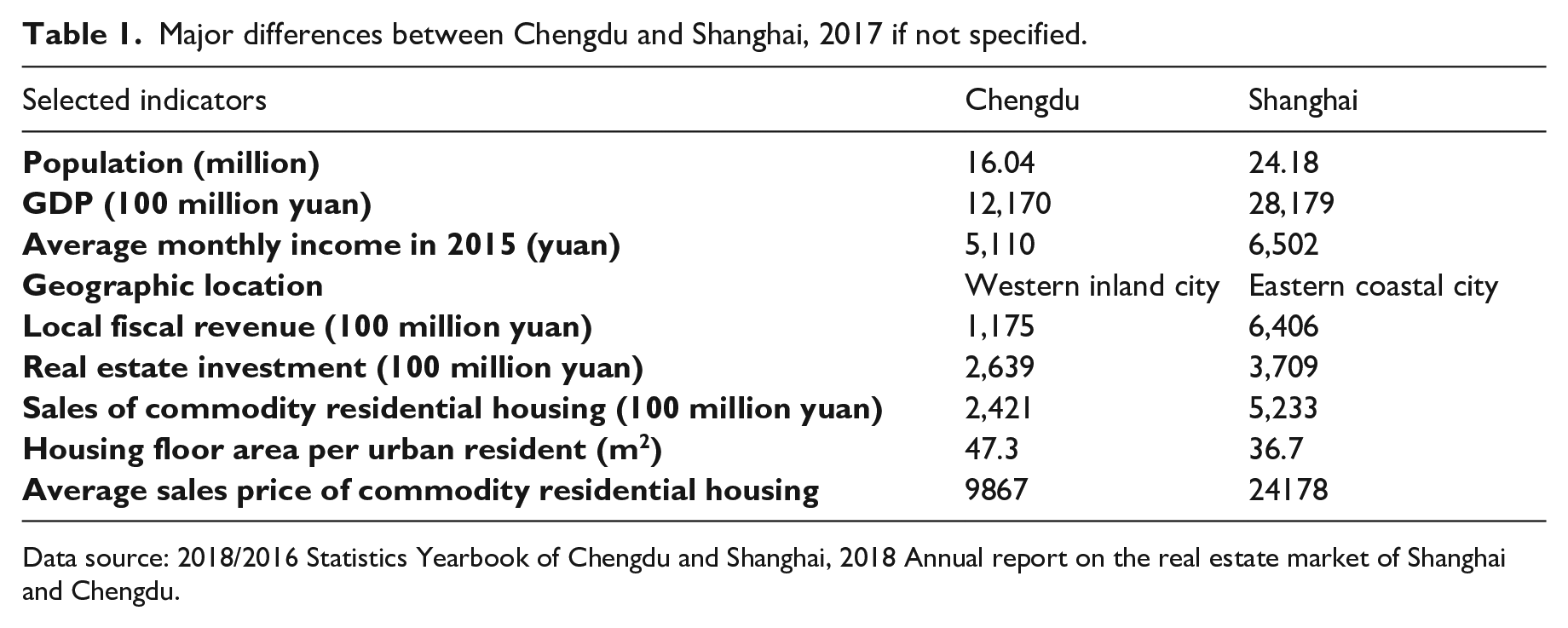
Chengdu and Shanghai were selected as the study areas for this project. Chengdu is the capital of Sichuan Province and one of the most important regional hubs in southwestern China, while Shanghai, one of four state-designated municipalities, is a national gateway and global metropolis (Table 1). While each of the two cities has distinct socioeconomic features, they were chosen to show the spatial variation in housing mobility of urban residents in China. In 2017, for example, Shanghai had 8.14 million more residents than Chengdu and its economy was almost twice as large. As for residential real estate, the market in Shanghai is also roughly twice the size of Chengdu, and the price per square meter of a new home is 14,311 yuan higher (approximately equivalent to C$2,000), while the average housing floor area in Chengdu is 10.6 square meters larger than in Shanghai (Table 1).
Major differences between Chengdu and Shanghai, 2017 if not specified.
Data source: 2018/2016 Statistics Yearbook of Chengdu and Shanghai, 2018 Annual report on the real estate market of Shanghai and Chengdu.
In the summer of 2015, a housing mobility questionnaire survey was administered in two cities, targeting residents aged 18–60 years with monthly incomes below the city-wide average. As detailed in Table 1, the average income for Chengdu and Shanghai was RMB 5,110 and RMB 6,502, respectively. During fieldwork, the primary screening criteria for selecting respondents were set at RMB 4,500 for Chengdu and RMB 6,000 for Shanghai to ensure that participants’ incomes were effectively below the city average and to enhance the success rate of intercept survey.
The survey employed a geographically stratified sampling technique to capture low-income residents from various areas within each city. Utilizing Shanghai as an exemplar, the sampling procedure was as follows: Firstly, ten districts were chosen to ensure geographical balance, comprising two districts within the city center (inner ring), four in suburban areas (between the inner and outer rings), and four in outer suburban regions (beyond the outer ring). Secondly, within each district, two neighborhoods were randomly identified as data points. Thirdly, at each data point, ten eligible respondents meeting the aforementioned criteria were surveyed.
In total, 420 completed interview questionnaires were collected. Following a meticulous evaluation and screening process, 41 questionnaires were excluded due to incomplete data or other data quality concerns. The final dataset included 379 valid responses, with 171 from Chengdu and 208 from Shanghai.
Research design
Both descriptive and quantitative modelling methods were employed to examine housing conditions and housing mobility of the urban low-income earners. In the descriptive analysis, we adopted the weight conversion approach to deal with ranking questions. In those questions, respondents were first asked to select the three best answers out of six to ten multiple answer choice, and then to rank these answers based on their preference and judgment. We converted those responses to codes reflecting the rankings assigned by the respondents. The final result is a weighted score for each response. The greater the value, the more important the response is to interviewed residents (Wang et al., 2009; Zhao, 2014).
To explore the major factors influencing the moving intentions of urban low-income residents, a binomial logit regression (BLR) model was estimated to test the hypotheses developed in the study. The binary dependent variable measures the moving intention (Yes = 1/No = 0) from the current dwelling of respondents. Noteworthy, the value 1 was assigned to respondents with short-term moving plans as well as long-term moving intentions, and the value 0 was assigned to respondents with no moving intentions. Four groups of independent variables are included in the regression model: life-cycle and human capital, housing and social experience, place-based factors and interactions. Table 2 presents variable information in detail. Binary logistic regression (BLR) explores how a change in the independent variables affects the likelihood of belonging in the “has moving plan” group relative to the “no moving intention” group. The function form of BLR model in this study can be written as:

where Pi denotes the probability of an observation falling in the “has moving plan” group. The parameter α0 is the model intercept, x1i denotes life-cycle and human capital variables, x2i denotes housing and social experience variables, x3i are place-based factors, x3xi denotes interactions between place-based factors and other variables, and εij represents a set of random errors.
Independent variables in BLR model.
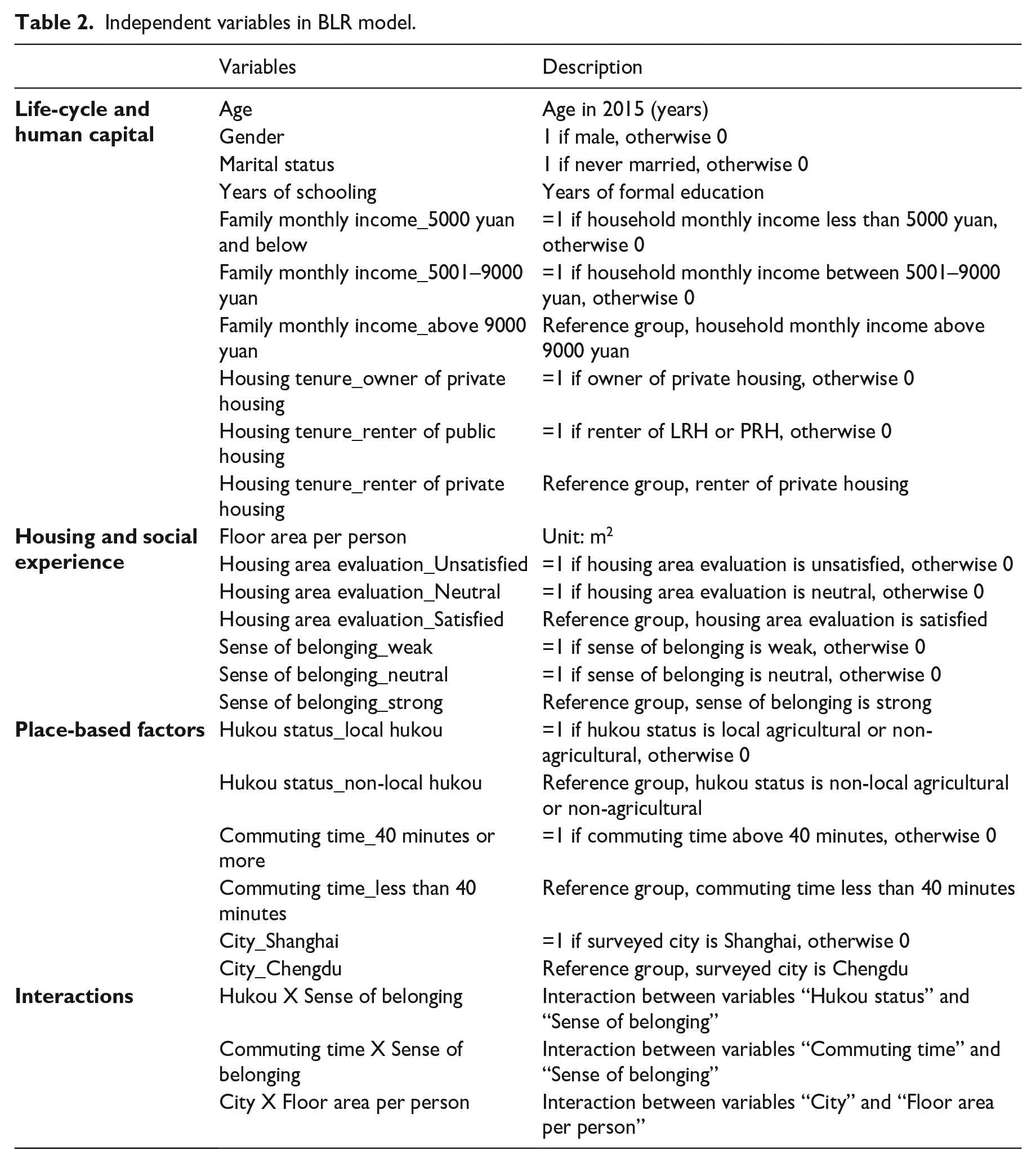
Notably, the selection of independent variables in this model was guided by a balance between theoretical inquiries and practical viability. In the “Life-cycle and human capital” category, Age, Gender, Marital Status, and Years of Schooling are standard variables for evaluating demographic and human capital characteristics. We selected the family income over the individual income because home moving is essentially part of family strategy. Three dummy variables were introduced to represent a person’s housing tenure status, a key juncture of their housing career. In the “Housing and social experience” category, a group of Sense of belonging variables were included to reflect their community experience. Respondents were asked to subjectively rate the adequacy of the following statement: “I feel like I belong in the community where I reside.” Floor area per capita and Housing area assessment variables were added to indicate the state of their actual housing condition and their perceptions of it. We also collected data on other aspects of their housing condition and their perceptions. However, these variables were not selected due to the lack of variations. It is evident from this survey that many housing features among low-income urban residents, like housing facilities and amenities, were mostly homogeneous at a low level with little variations. The per capita housing area is an exception. It varied greatly due to professional needs and family size. The same trend can be observed for their perceptions of the housing area. Thus, these two variables were eventually selected. In Placed-based factor category, we included three sets of variables to measure place effects at various spatial scales. Noteworthy, our primary criterion for selecting a place-based variable is whether it reflects any variations in the given geographic scale, rather than whether it represents the spatial characteristics of dwellings itself. Commuting time measures the distance between their residence and workplace, reflecting the place effect on a sub-city level. The inclusion of City variables follows the assumption that low-income residents from more developed urban regions may face greater housing stress and become more mobile. It represents the place effects at a city level. The income difference between two cities has also been controlled by this dummy variable. Hukou status is the third variable in this group. It is included to capture the effects of urban-rural dichotomy. As indicated in the section “The effect of place on housing mobility intentions”, this research treats “place” as both a direct influence on people’s desire to move and a medium with which other variables interact. Three interaction terms were included in the model to examine this complicated process. Each represents an interaction effect on one geographical scale identified in previous discussions.
Descriptive analysis
Socioeconomic profile and housing conditions for low-income urban residents
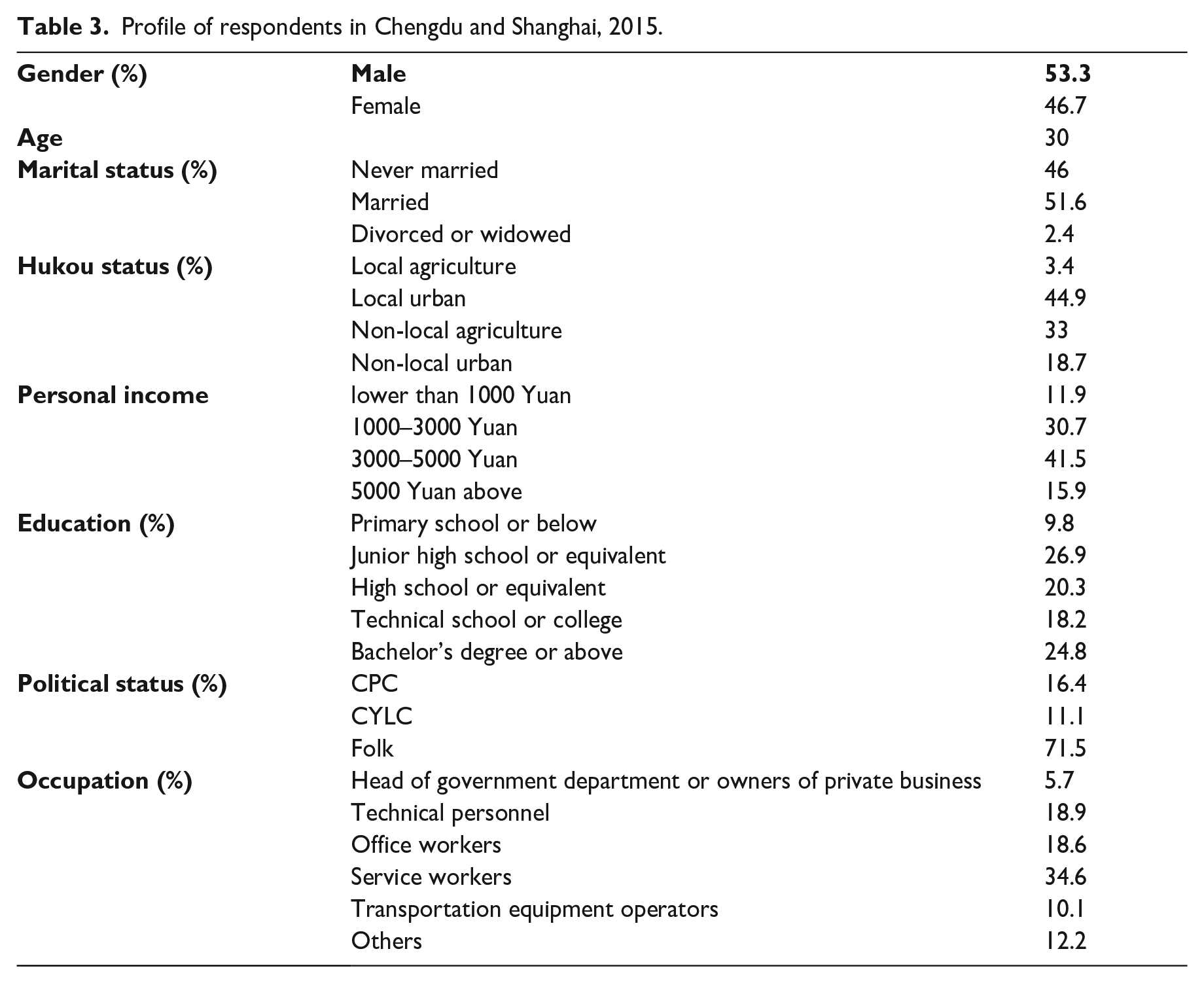
The major socioeconomic characteristics of the respondents are reported in Table 3. The gender ratio is close to 1:1, with slightly more males than females. The average age is 30. Half of the respondents are married. About 48 per cent of total respondents are local urbanites and 52 per cent of them are migrants. The large majority, 84 per cent, of our respondents have a monthly income lower than ¥5000. Twenty percent of the sample had higher education (university or above). The majority (71.5%) of respondents have no political affiliation (qunzhong). In terms of occupation, 37.5 per cent of respondents are technical personnel or office workers, and 34.6 per cent of them are service workers.
Profile of respondents in Chengdu and Shanghai, 2015.
As shown in Table 4, the average floor area per person for urban low-income residents in our survey is 28.1 m2. Eight housing facilities are recorded, including four basic facilities – separate kitchen, private toilet, private shower, and natural gas line – and four advanced facilities – air conditioning, internet access, cable television, and private balcony. The average facility index (FI) of homeowners is 0.78 (FI = 1 indicates that the housing unit possesses all eight facilities in our survey). Overall, the homes of responders were relatively well equipped and 57 per cent of respondents reported that their current dwelling is better than their last residence which also indicates that 43 per cent of them either failed or had no intention to improve their housing conditions by moving.
Housing profile of respondents in Chengdu and Shanghai, 2015 (all figures are averages).
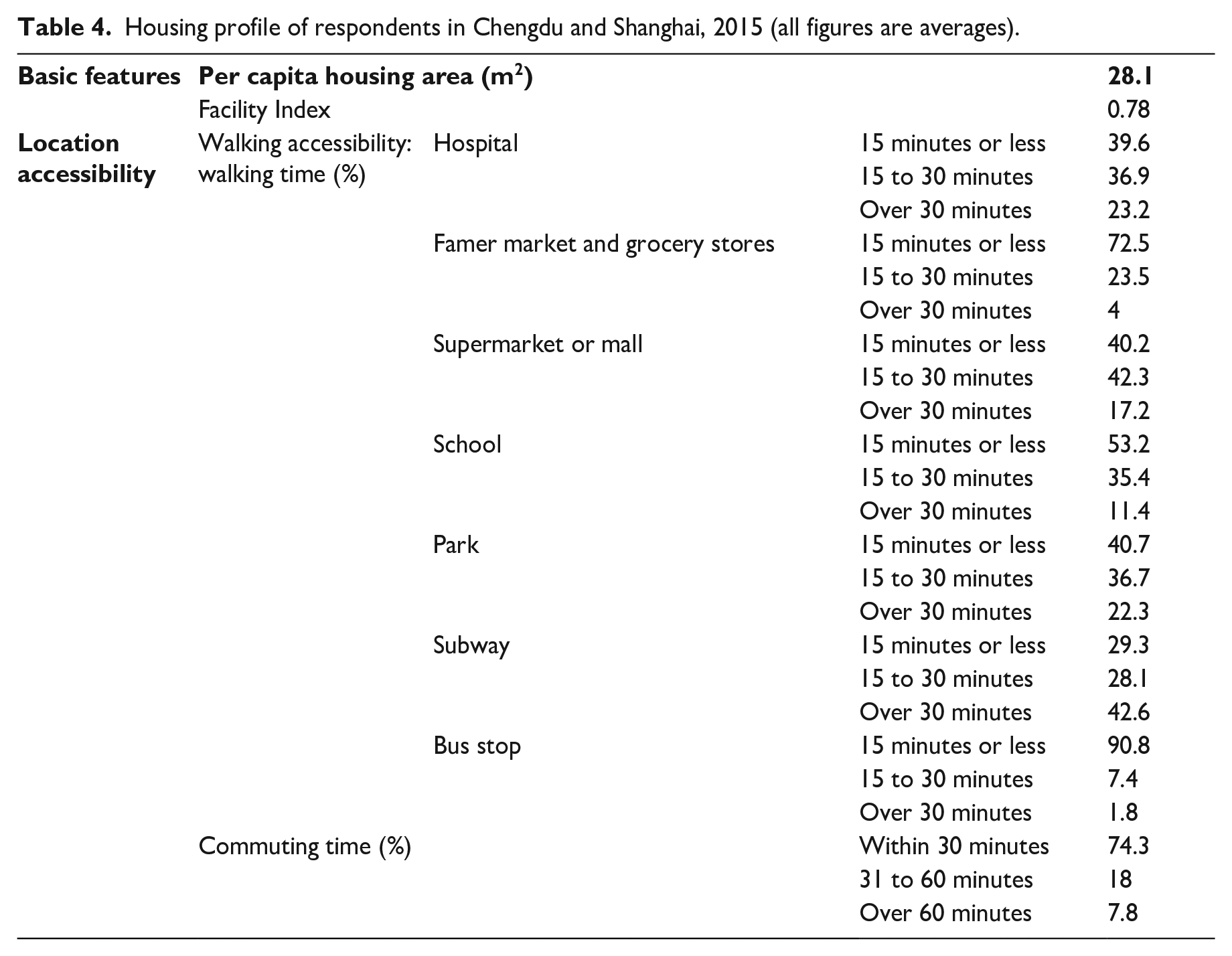
Some previous studies found that the urban poor tended to reside in dilapidated and isolated “urban villages,” often were alienated from modern urban facilities such as parks and malls, and suffered from excessive daily commute times (Wu, 2010; Yuan and Xu, 2008). In this project, we surveyed the walking times of low-income residents to different community amenities (Table 4). More than half of our respondents resided more than 15 minutes away by foot from the closest hospital, supermarket, shopping mall, park, or metro station, and around 20 per cent had a walking time of more than 30 minutes to reach these modern community facilities. However, even though low-income households were moderately distant from these modern amenities, there seems to be a localized workaround relying on community-based business clusters and public transit. More than 70 per cent of our residents have access to a farmer’s market or community grocery store within a 15-minute walk; and more than 90 per cent can reach a bus stop within a 15-minute walk. Recent research also indicated that low-income residents in China’s megacities were afflicted with extreme home-work separation, with excessive commuting time being one of the primary indicators (Liu et al., 2022). This project found little evidence to support this observation. More than 70 per cent of respondents report a commuting time of less than 30 minutes, and the proportion of respondents with severe home-job separation (greater than one hour of commuting) is only 7.8 per cent.
Housing decision and mobility
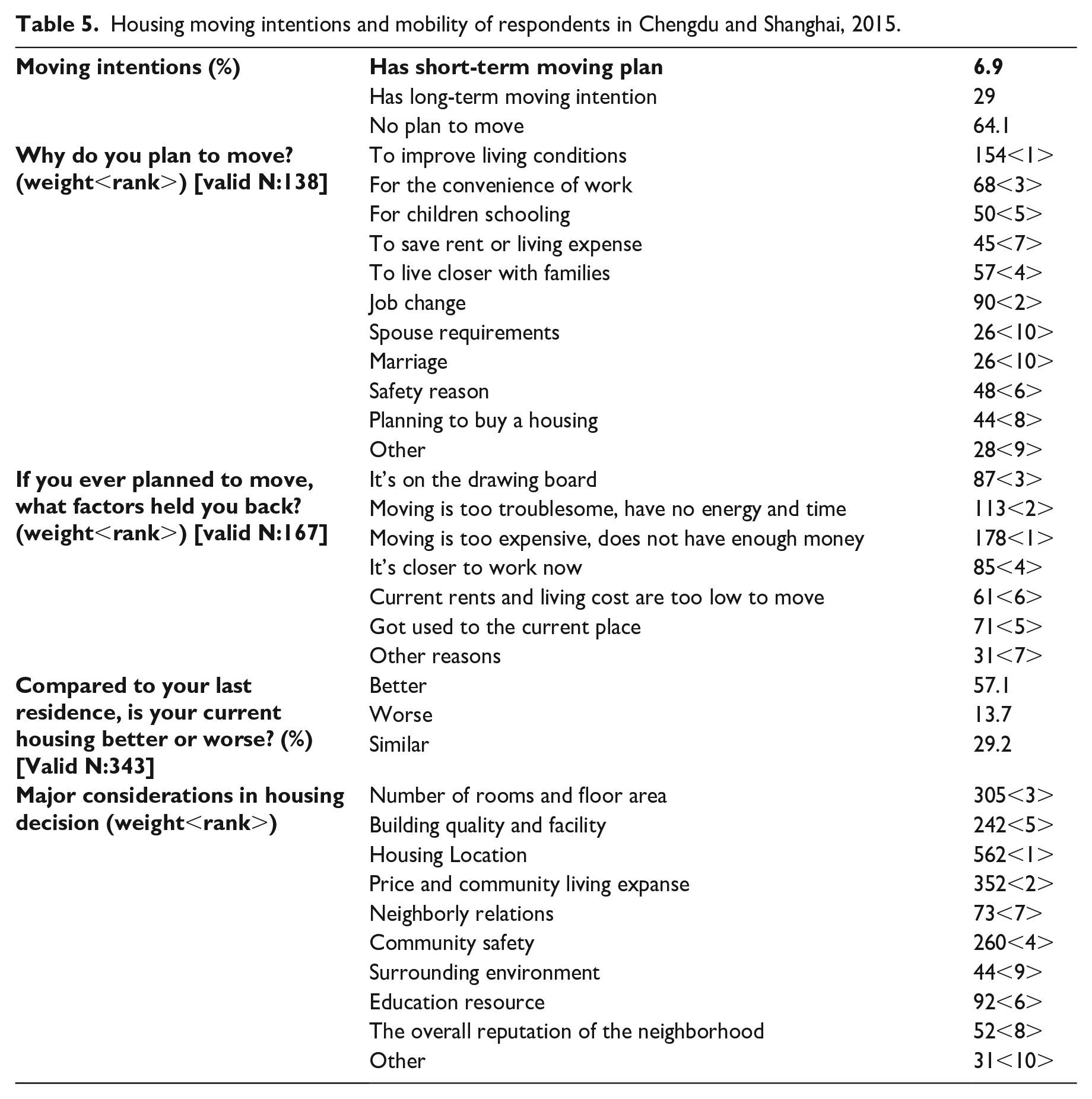
The respondents were asked “ Have you considered moving to another home (leaving your current residence permanently)?” Approximately 63 per cent of respondents had no intention of moving, while 30 per cent intended to move with no immediate plans (referred to in this paper as having long-term moving plan) and the other 7 per cent had made plans to relocate in the near future (referred to in this paper as having short-term moving plan). Numerous studies have indicated that urban low-income earners’ home relocation intentions are mostly influenced by restrictive factors (Cui et al., 2015; Li, 2010). Our study reveals a more complicated system in which external constraints (e.g., job change, urban gentrification) and family factors play an important role, but the desire for a “better life” still dominates their home moving intentions. The most common response to the question “why do you want to move?” is “to improve my living conditions.” The second and third most prevalent reasons are work-related: “job change” and “workplace proximity.” Family reunification and child education rank fourth and fifth, respectively.
To examine restrictions on housing mobility, we questioned respondents: “If you ever contemplated relocating, what considerations prevented you?” Among the responses, “Moving is too costly” and “I do not have enough money” ranked top. It was followed by “Moving is too difficult, I do not have the energy or time” and “My current residence is closer to my place of employment.” The finding suggested that economic, time, and energy constraints, as well as severe home-work separation, impede the moving intentions of low-income individuals.
Finally, we inquired about the primary concerns in respondents’ housing decision-making (Table 5). The three most essential factors, according to all respondents, were home location, price and community living expenses, and number of rooms and floor space. It seems that the location is the most important factor for both renters and homeowners, and that the proximity to the workplace is the deciding factor for low-income earners.
Housing moving intentions and mobility of respondents in Chengdu and Shanghai, 2015.
Logistic regression analysis
The logistic regression analysis employed moving intention as the binary dependent variable. There were four different model specifications. Model 1 included only the life-cycle and human capital variables. We added housing and social experience variables in Model 2, place-based variables in Model 3 and the interactions between places and other variables in Model 4. Table 6 reports the coefficient estimates and test statistics of the independent variables employed, as well as the overall test statistics. All models are statistically significant. From Model 1 to Model 4, the -2log likelihood gradually decreases, indicating decreasing model deviance and increasing estimation accuracy. The Nagelkerke’s R2 statistics show that the moving intentions of urban low-income residents are increasingly responsive as the experience and place-based factors are incorporated into the model as independent variables. Since Model 4 has the lowest -2 log likelihood and the highest Nagelkerke’s R2, it forms the basis of the discussion below.
Regression results.
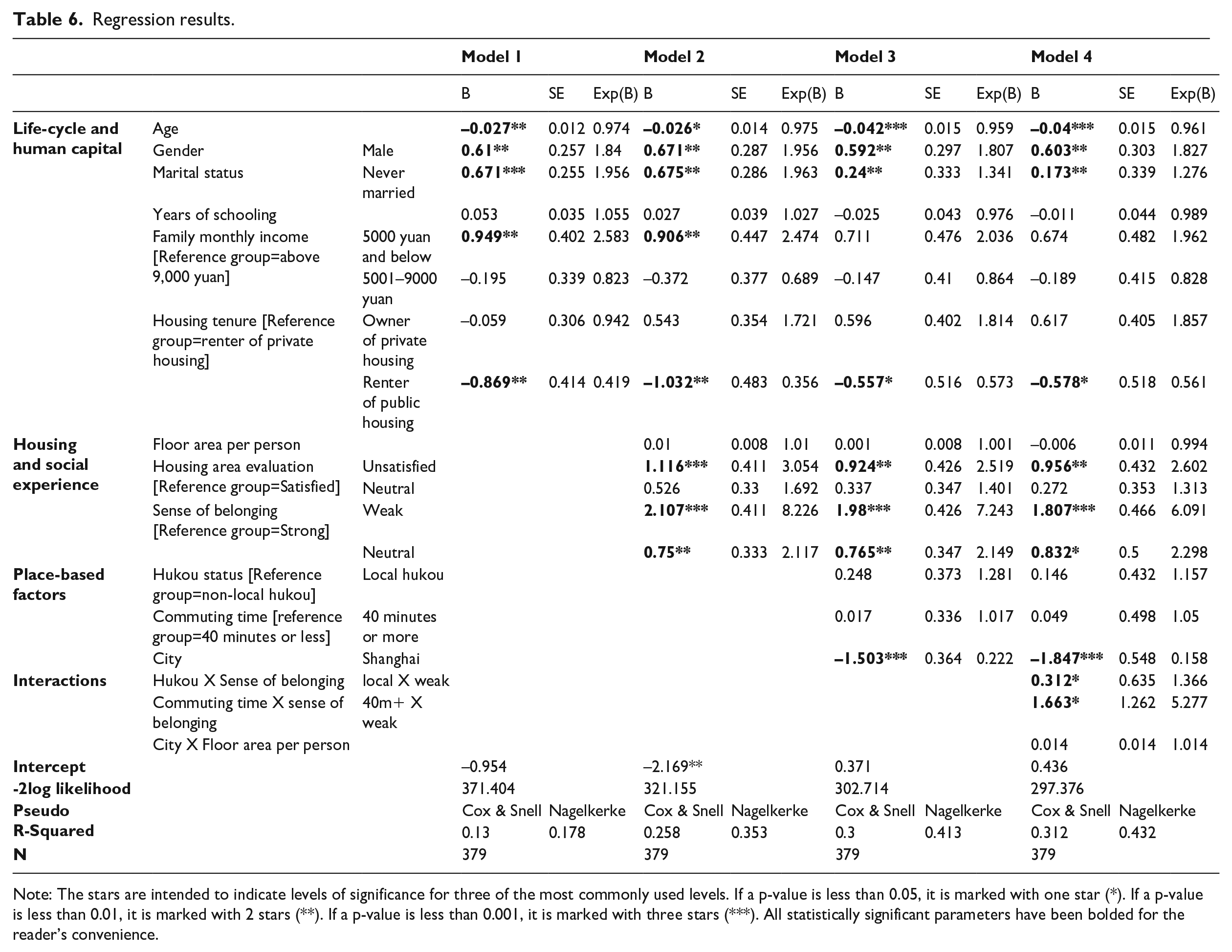
Note: The stars are intended to indicate levels of significance for three of the most commonly used levels. If a p-value is less than 0.05, it is marked with one star (*). If a p-value is less than 0.01, it is marked with 2 stars (**). If a p-value is less than 0.001, it is marked with three stars (***). All statistically significant parameters have been bolded for the reader’s convenience.
Life-cycle and human capital
Age and marital status have significant effects on moving intentions of urban low-income residents. As expected, age has a detrimental effect on moving intention. Each additional year of age decreases the likelihood that our respondents intend to move by 3.9 per cent. Marriage status also shows a significant effect on moving intentions. The results indicate that unmarried low-income residents are 27.6 per cent more likely to have moving intentions compared to married residents. This result implies that marriage as a major life-course event shows a great “anchor effect” that significantly reduces housing mobility intentions of low-income residents (Li and Li, 2006).
Switching housing status from rental to ownership has often been recognized as a milestone in one’s housing career and is expected to significantly reduce urban residents’ future housing mobility (Kendig, 1984; Roisman and Botein, 1993). In our model, however, the impacts of home ownership (as opposed to renting) on relocation intent are positive. The result indicates that low-income homeowners are more likely to form moving intentions than home renters. There are two probable causes for this seeming oddity. First, planning a relocation in a city is often perceived as a troublesome and time-consuming endeavor. Therefore, it often requires a relatively tranquil and stable environment, which home ownership is likely to provide. In other words, low-income renters may not have the “luxury” to plan for moving. Second, the moving intention is closely related to housing expectations (Heaton et al., 1979). Home renters tend to have much lower housing expectations than homeowners. These factors may explain why they are less enthusiastic about planning home moving in cities.
Existing research often ignore intra-group heterogeneity when analyzing the effect of home tenure on housing mobility, focusing instead on the owner-renter dichotomy. (Böheim and Taylor, 1999; Kendig, 1984). To address this, the variable “renters of public housing” was included as a binary variable in the model. Tenants of low-rental-housing (LRH) or public-rental-housing (PRH) are much more committed to their existing residence than renters of private housing. Public housing occupants are 43.9 per cent less likely to have intents to move than private housing tenants. The LRH and PRH application and approval processes are lengthy and complicated. Thus, it often requires a substantial commitment of time, effort, and sometimes, special contacts with housing authorities (guanxi). Therefore, it is not surprising that successful candidates for LRH and PRH are less likely to intend to leave their hard-earned houses.
The gender of the survey respondent reflects the impact of family factors and social norms on moving intentions. As expected, male residents have a stronger propensity to relocate, with an odds ratio of 1.827. There are two possible explanations for this gender difference. First, according to social psychology, women tend to be more conservative than males when making big life choices and are more inclined to maintain the status quo (Burke, 1996). Second, various research on social integration and place perception demonstrate that women are often responsible for domestic responsibilities, which frequently require participation in community-based activities. Therefore, compared to their male counterparts, they tend to be more deeply intertwined into the local community, which reduces their inclination to relocate (Zemore et al., 2012).
Conflicting views exist on whether education has positive or negative effects, and whether the effect is significant (Kronenberg and Carree, 2010, 2012). Our findings indicate that the education variable “years of schooling” is insignificant and unstable across all four models, suggesting that an increase in educational attainment would not significantly boost the prospective housing mobility of low-income urban residents.
The relationship between income level and housing mobility intention is often considered to be U-shaped. That is, both low-income and high-income groups are more likely to form moving intentions, with the middle class being the least mobile (Kronenberg and Carree, 2010; Li and Li, 2006). This research supports this view. It showed that compared to the higher-income group (monthly family income greater than 9,000 yuan), residents in the lower-income group (monthly family income less than 5,000 yuan) are 96.2 per cent more likely to move. Even though this variable is not significant in Model 4, it is significant in Models 1 and 2, and the signs remain unchanged across all four models. Compared to the higher-income group, middle-income respondents (monthly family income between 5,001 and 9,000 yuan) are 17.2 per cent less likely to move. This result indicates a U-shaped relationship between moving intention and income level. The middle-income group has the lowest probability of moving intention.
Housing and community perception
The first variable in this group, “floor area per person,” is a general measure of crowding, which is one of the key indicators of the housing quality. Surprisingly, there is no statistically significant correlation between the space of people’ existing dwelling and their inclination to move. Given their housing demands and budgetary constraints, it is possible that the occupants have already factored the low housing quality into their survival strategy in cities.
The actual housing conditions might have little impact, but their perceptions of housing was proven to have a considerable effect on moving intentions. Those who are dissatisfied with their existing dwelling space are 160 per cent more likely to have moving intent than those who are content (p < 0.001). This result indicates that the expectations and tolerance of low-income earners towards inferior housing conditions are by no means unconditional or absolute. They are constantly molded by their lived housing experiences.
To investigate the effect of social experience on moving intentions, two dummy variables measuring “sense of belonging” are included in the model. The reference group is those with a “strong sense of belonging.” The result confirms our hypothesis 2: social integration has a negative effect on moving intentions. Compared to the reference group, low-income residents with an extremely weak sense of belonging are six times more likely to have a moving plan. The odds ratio for the “neutral” groups is 2.3 (p < 0.01).
Place-based factors
To examine the effect of “place” on housing mobility, we include three variables in our model (Table 22). Among these three variables, only the “city” is statistically significant. The insignificant “hukou” variable indicates that, despite hukou status being widely recognized as an important factor in the housing purchase intentions of urban residents (Cui et al., 2015), its impact on moving intentions of urban low-income residents is much less apparent. Local identity (or lack thereof) no longer seems to play a decisive role in their moving decision-making process.
Based on previous research reporting the severity of home-work separation among China’s urban working-class, we expected “commuting time” to have a significant effect on respondents moving intentions. However, this variable is not significant in our model, which could be attributed to two plausible reasons. First, in our survey, 75 per cent of respondents reported that their commuting time is less than 30 minutes. Only 18 per cent of them spent 30 minutes to one hour on commuting, while only 7.8 per cent commuted for more than one hour. In the literature, the separation of workplace and residence is particularly prevalent among the urban wage-earning class who typically work in the crowded city center and live in remote peri-urban areas to save rent (Liu et al., 2009). In our study, half of the respondents worked in the service industry, implying that, unlike the middle-tier urban working-class, low-income residents in our study are more likely to work as community service providers. Thus, the separation of workplace and residence is much less severe. Second, as shown in previous research, urban low-income residents are more inclined to endure long commute times than middle- and upper-income groups (Kronenberg and Carree, 2010).
Although two of the three place-based variables are not statistically significant, their interactions with other variables show a sophisticated and nuanced effect on moving intentions. The interaction between hukou and sense of belonging variables is significant in the model. This implies that the impact of community belonging on moving intentions vary substantially between locals and non-locals. The inclination to relocate owing to a weak sense of belongingness is greater among local residents, i.e., the sense of belonging has a greater effect on urban local residents’ moving intentions. The interaction between commuting time and the sense of belonging is also statistically significant. This suggests that the social perception of the community differs based on the degree of home-work separation and ultimately influences the decision to relocate. Interaction between the city dummy variable and floor area per person (hereinafter referred to as ICF variable) is not significant in the model. However, the inclusion of the ICF variable has an intriguing effect on the “floor area per person” variable. In Models 2 and 3, excluding the ICF variable, “floor area per person” shows a positive effect on moving intentions, indicating that residents with a larger floor space per person are more inclined to move. This counterintuitive result contradicts the findings in the existing literature (Cui et al., 2015; Kronenberg and Carree, 2012). In Model 4, when the ICF variable is controlled, the symbol of the “floor area per person” coefficient becomes consistent with our theoretical predictions. A possible explanation for this result is that there was a noticeable difference in floor area per person between Chengdu and Shanghai (Table 1). Thus, when the ICF variable was excluded from the model, the variable “floor area per person” could not correctly predict the moving intention of low-income residents. This leads to the conclusion that a solid notion of the geography of housing markets might be indispensable to fully comprehend the relations between housing status and housing mobility intentions.
The preceding examination of place-based variables and their interactions with other variables indicates that the effect of “place” should not be limited to neighborhood scale in housing mobility research. Indeed, community-based factors played a key role in shaping their relocation intentions; however, accumulating evidence from this study demonstrates that spatial effects functioned at multiple scales, from the location of their homes to the cities in which they resided. The effect of “place” should not be treated as an external factor either. The intricacy of the place effects unveiled in this study presents a vivid image in which “place” acts as a medium. Not only does it provide space for economic and social activities, but its characteristics and structures sculpt these activities, and ultimately determine the ways people perceive and interact with the external world.
Conclusion and discussion
This article aims to enhance our understanding of the factors influencing housing relocation intentions among low-income urban residents in two major Chinese cities. Our sample revealed a low propensity to relocate, with less than 10% of respondents indicating an imminent intention to move, and only 30% reporting long-term plans to do so. Importantly, compared to actual relocation behavior, these intentions may underestimate the impact of unplanned moves and forced displacements, suggesting that the true rate of housing mobility could be higher.
Despite this, our study clearly demonstrates that a substantial portion of low-income residents, due to limited economic resources, remain in suboptimal and relatively isolated dwellings with limited access to modern urban facilities. Some existing literature attributes the housing difficulties faced by disadvantaged populations to a “lack of motivation” (Bolt and van Kempen, 2002; Murdie, 2003) and posits that “actively tolerating suboptimal housing” is a crucial aspect of their survival strategy in China’s megacities (Phinney, 2013).
While our study does not invalidate this argument—indeed, we found that a significant portion of the low-income group did lack motivation to move and some even expected and endured poor housing conditions for economic gains in cities—it does offer compelling evidence prompting us to reevaluate the extent of this narrative. Our findings indicate that an active desire for improved life quality remains the dominant factor in shaping relocation motivations. It seems that low-income earners may not be as passive and pessimistically pragmatic as previously portrayed in some studies.
However, it is also apparent that the prospect of enhancing living conditions through relocation remains unattainable for many. When asked about their most recent move, just over half of the respondents reported an improvement in housing quality, while the rest experienced no change or even a decline in housing and community conditions. Further research is needed to explore how urban low-income earners weigh their active pursuit of better life quality against the trade-offs they are willing to accept in order to survive within these rapidly gentrifying urban environments.
By testing the first hypothesis proposed under “Life-cycle, lived experience and place: Theorizing housing moving intention”, this study reaffirms the significant role of basic life-cycle transitions in shaping housing mobility intentions. Similar to middle and high-income urban populations (Clark and Huang, 2003; Kendig, 1984), both age and marriage substantially reduce urban low-income residents’ inclination to move. However, the low-income cohort exhibits distinct characteristics when considering educational attainment, a predictor found to be positively correlated with moving intentions in prior research (Kronenberg and Carree, 2010, 2012). This variable is not statistically significant in our study.
A plausible explanation for this discrepancy is that, for middle and high-income groups, higher education levels often lead to a broader range of job opportunities, thereby expanding skilled laborers’ potential housing options and increasing their housing mobility (Kronenberg and Carree, 2010). In contrast, for China’s low-income workers, severe labor market segregation may render their educational efforts and achievements fruitless (Yu et al., 2014), effectively severing the link between educational attainment and housing mobility.
Income level is another common predictor in housing mobility research. A widely recognized U-shaped relationship exists between labor market performance and housing mobility, with both low- and high-income cohorts exhibiting higher housing mobility than the middle-income group (Li and Li, 2006). Our study demonstrates that a similar trend can be observed even within low-income earners. The lowest income group in this study exhibits the strongest willingness to move, followed by the higher end, while the middle portion of the low-income group displays the lowest mobility intention.
Given that those in severe poverty are more likely to experience precarious employment and forcible displacement, their high level of housing mobility is unsurprising. However, it is perplexing that the higher-income group within our low-income sample is more inclined to move than the middle group. The typical explanation that the wealthy class possesses the economic means to overcome housing market affordability issues does not apply here, as our study exclusively surveyed low-income urban residents. One possible explanation is that, even among low-income individuals, as income increases, so does their desire to improve living conditions, potentially leading to a willingness to relocate despite institutional restrictions and affordability pressures.
We posit that further studies, particularly those distinguishing between forced relocation and active home moving, will enhance our understanding of the complex relationship between urban poverty, labor market performance, and moving intentions.
In the second hypothesis, we proposed that the cognitive assessment of housing conditions and the sense of belonging may be directly related to the intention to move. Our study confirms this assertion, as low-income residents’ perceptions of their current housing were found to be significant predictors of their moving intentions. Combined with the insignificance of the per capita housing area variable, this finding delivers a crucial message: predicting the moving intentions of low-income individuals based solely on their physical housing status may be insufficient and could even yield misleading results.
The empirical implications of this finding are also vital for understanding the processes that generate moving intentions among low-income residents. As discussed earlier, urban poor often incorporate poor housing conditions into their housing strategies, not just tolerating suboptimal housing conditions in cities, but utilizing them to their advantage in order to improve employment opportunities (Li et al., 2013). This observation could empirically explain the statistical insignificance of the “per capita housing area” variable. If low-income residents are mentally prepared and determined to adapt to harsh urban housing environments, it is reasonable to assume that their physical housing conditions would have minimal impact on their intentions to move. However, when changes in employment, familial, or financial status occur, their housing needs may also shift, and these changes are reflected in their subjective perception of current housing, which was found to be significantly linked to their moving intentions in this study.
Moreover, their social perceptions of living communities demonstrated even stronger effects. The “sense of belonging” emerged as the strongest factor significantly associated with moving intentions. In light of these results, we argue that future housing mobility research should place greater emphasis on the social-psychological needs and changes in individuals’ housing careers, particularly during life-course transitions. These variables may offer more comprehensive and accurate insights into the urban living experiences of low-income residents than their actual housing situation and neighborhood environment. Ultimately, this understanding will enable us to propose more effective and practical measures to improve their housing circumstances in cities.
The third hypothesis of this research explores the role of place-based factors and their interactions with other variables. Moving is fundamentally a spatial process, and the literature contains extensive discussions on how place-based factors influence moving intentions. This paper contributes to these discussions by providing new evidence that illuminates the less-explored interactions between “place” and other predictors of moving intention.
Our study reveals that proximity to the workplace is central to urban low-income residents’ housing decision-making. Their housing mobility is largely determined by their employment mobility within the city (Abramsson et al., 2002; Wu, 2010). Neighborhood effect is another well-studied place-based variable in housing mobility research (Coulton et al., 2012; de Souza Briggs, 1997). Our findings confirm that a sense of belonging, a key indicator of community engagement, profoundly influences the moving intentions of urban poor. More importantly, we examined place-based factors beyond the neighborhood scale, such as housing market discrepancies across cities, and found them to be significant factors in our models.
It is evident that, in addition to being influenced by location at the community level, the moving intentions of urban low-income groups are also strongly connected to city characteristics such as housing market structure and regulations. The tangible mechanisms of these metropolitan-scale effects and the potential impact of place-based factors on even larger spatial scales warrant investigation in future studies.
Furthermore, this research demonstrates that place acts as a medium by highlighting how place-based factors interact with other variables, ultimately shaping the moving intentions of low-income residents. These findings indicate that “place” should not be reduced to a fixed community-scale in housing mobility research, nor interpreted as an exogenous condition. “Place” represents a wide array of multi-scalar attributes, structures, and relations (e.g., home-work distance, city characteristics, migration patterns) that may interact with other factors. Home-making and residential mobility of urban residents involve a much broader and affective process than simply changing shelter from one neighborhood to another. Residents experience housing at both the domestic and community levels, forming and altering urban morphology through migration within cities; these constructed urban features, filtered through individual perceptions, shape their housing careers. Recognizing the “multi-scalar” and “mediated” aspects of place is essential for a comprehensive analysis of housing moving intentions. Future housing mobility studies should examine the impact of place-based factors at various geographical scales and combine them with broader socio-demographic and social-psychological processes.
In the face of urbanization and housing study, this research has provided a comprehensive view on the issue of residential mobility intentions among low-income residents in China’s urban context. It extends the current literature by recognizing and examining the nuanced interplay of life-cycle variables, lived experiences, and place-based factors. It advances our theoretical understanding by demonstrating how place acts as a medium that interacts with other variables. Our study paves the way for future research to expand on these interactions and their influence on housing mobility intentions. It calls for a more holistic approach in future research, considering both individual and contextual factors in understanding and addressing the housing challenges faced by urban low-income residents. It also provides an empirical base for policy-makers to design more effective housing policies that accommodate the complex realities and diverse needs of low-income urban residents. By doing so, we might move closer to the goal of more inclusive cities that offer improved quality of life for all their residents.
Footnotes
Declaration of conflicting interests
There are no confilicating interests to declare.
Funding
The author(s) disclosed receipt of the following financial support for the research and data collection of this article: This work was supported by the National Natural Science Foundation of China (NFSC# 41329001).