




Abstract
This article assesses the recent trend in cities across China toward building new towns, new areas, new districts, new cities and other urbanizing projects in suburban areas. We refer to these projects under the generic term “new city and new area” following the Mandarin usage (xincheng xinqu) (hereafter NCNA). Such projects are commonly on the fringes of urban centers, have significant area size, and are multifunctional in character. Hundreds of NCNA projects have been undertaken in recent years, reshaping metropolitan regions and altering the nature of China’s urbanization. Overall, the NCNA phenomenon emerges within China’s broader transition to a market economy amid the persistence of state land tenure, a Party-based personnel assessment system motivating intense careerism among urban officials, and the need for local administrations to push land development further into metropolitan peripheries to sustain local accumulation. The paper offers two urgent contributions to the existing literature. First, it discusses a panoramic assessment of the pervasive NCNA phenomenon and proposes a four-part typology of projects: (1) new Alpha-cities, (2) middle-class enclaves, (3) techno-poles, and (4) themed cities. Second, we provide an analysis of the underlying political-economic forces driving their development and highlight the variegated development trajectories of so-called modular urbanism in the current day.
Keywords
Introduction: From development zones to new cities and new areas
The pioneer of China’s new area (xinqu) 1 projects is Pudong New Area in Shanghai. Envisioned as the country’s leading financial and producer-services hub, China’s central leadership provided strong endorsements for the project, as well as financial and planning assistance (Olds, 1997). Beginning amid warehouses, factories, and fields Pudong has developed into a thriving multifunctional sub-city immediately adjacent to old Shanghai. Its cluster of high-design skyscrapers and the New Orient Tower across the Huangpu River from the Bund has become iconic.
While Pudong has been noted as a pivotal moment in China’s market transition and geopolitical ascendance, another crucial impact of its development was to furnish a politically sanctified template for city making projects around the country. Pudong supplied the basic contours for a modular type of new city development that could simultaneously spur local land development and redefine cities in the new millennium. Probably seeking to replicate Pudong by building a new city with central-government assistance, by 2006, Tianjin (Binhai), Zhengzhou (Zhengdong), and Shenyang (Shenbei) also established their own new cities that were formally accorded national-level new area status (guojiaji xinqu) (Yu et al., 2010). Their ascension in the bureaucratic ranking system signaled the replicability of the new area model of development and set in motion a process of mimicry across China, as cities sought to also establish large-scale multifunctional urban sub-centers or lobby for existing ones to gain national level status. Between 2010 and 2012, Chongqing (Liangjiang New Area), Zhejiang (Zhoushan Archipelago New Area), Gansu (Lanzhou New Area), and Guangzhou (Nansha Area) were granted national-level new city projects by the State Council, and since 2014, a further 13 national-level new-city projects were established, including the most essential one, Hebei Xiong’an New Area. 2 This latter project is conceived as a twin capital city to Beijing and, accordingly, has been the designated relocation site for central governmental offices and state educational and research institutions.
City administrations took up the modular form of new city growth with gusto, creating hundreds of large-scale multifunctional urban development projects in suburban areas. Some were established under the formal title of new towns (xin zheng), 3 while others are referred to as new area, university towns (daxue cheng), eco-cities (shengtai cheng), airport new cities/towns (konggang xincheng), and high-speed rail new cities/towns (gaotie xincheng) as well as a host of other formal appellations. According to one incomplete study (Feng et al., 2015), there are currently 3,174 projects categorized as “new areas” and “new towns” undertaken by urban administrations at the county level and up 4 (see the Table 1). Yet conclusive tallies are elusive given the spatial overlap of different projects (i.e., zones within zones, new towns within new districts, etc.), misreporting, and switches in the names and titles of projects.
NCNA projects by provinces in China.
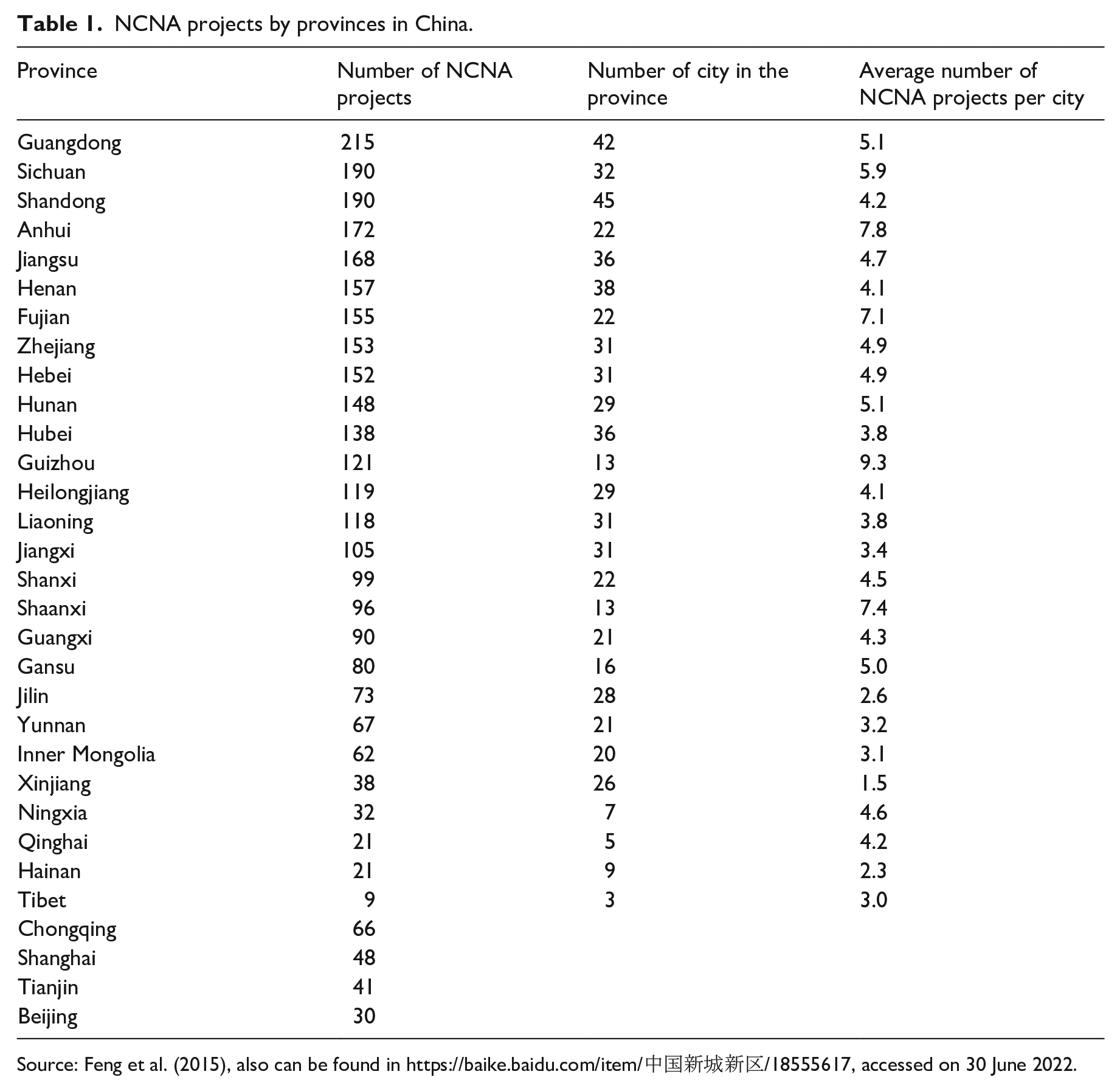
Source: Feng et al. (2015), also can be found in https://baike.baidu.com/item/中国新城新区/18555617, accessed on 30 June 2022.
A limited body of scholarly research has examined the planning and development of China’s suburban developments, including the formation of new cities over the past couple decades. This research has focused on the emergence of polycentric city-regional growth patterns (Feng et al., 2008, 2009; Wei, 2012; Wu and Phelps, 2008) and the formation of new residential settlements and industrial zones on the outskirts of major cities (Feng and Zhou, 2005; Shen and Wu, 2012; Wu, 2015). Recent work exploring China’s new towns by Oakes (2021) has sought to unpack both the political-economic and cultural aspects of these projects. While this literature has provided a wealth of insights, we are keen in this article to explore the emergence of different types of projects in a more panoramic fashion and to link these to the remarkable modularity of China’s contemporary new urbanizing projects. How might we identify and understand these projects? What has driven their emergence in suburban areas, and what are their current trajectories? How do these projects reflect changes in the nature and processes of suburban transformations in China?
In this article, we deploy the term “new cities and new areas” following the Mandarin usage (xincheng xinqu, or NCNA for short) as an inclusive term that captures the many different types of urban module-based suburban development projects undertaken in recent years by the central, provincial, and local governments under numerous formal titles. Our broad notion of NCNA projects in China is also intended to resolve categorization problems that arise given the variety of formal names applied and the frequent mismatch between formal names and ultimate functions of these spaces. For example, projects called new towns are sometimes designed around certain industries, while other projects given the title of economic and technology development zones may contain primarily residential and office space.
Our purpose in this paper is focused instead on illuminating the types of projects and underlying forces propelling their proliferation and expansion. Given the speed and scale of the NCNA phenomenon, we propose concepts of entrepreneurial and modular urbanism (discussed in detail in the next section) to illuminate how modularity in new-town projects fosters evolutionary and entrepreneurial changes in approaches to urban development. The current NCNA wave, we argue, signals a qualitative change in the zone-based modes of urban and suburban growth that have reshaped China’s metropolitan regions in recent decades. Through the 1980s and 1990s, scholars traced the suburban expansion of China’s city spaces through a proliferation of thousands of industrial zones (Cartier, 2001). While the spatial project-based mode of economic development still pertains, NCNAs instead reveal a broader range of functions and amenities within their planned area – often incorporating or adapting existing industrial parks and zones, while also making new ones – and aspire to hold significant resident populations, sometimes in the millions of people. Recent scholarship has argued that city administrations in recent years have shifted away from a singular focus on economic growth toward a greater emphasis on achieving societal stability, equitable growth, and environmental balance (Chung et. al, 2018; Wu et al., 2021; Zhang and Wu, 2021). While we do not assess the achievement of these new, non-economic priorities, it is worth noting that large-scale urban growth projects that previously served as a blunt instrument of economic growth may also serve to institute extra-economic goals on fresh turf. Eco-cities, for example, have been touted as testbeds for implementing a range of environmentally less damaging development techniques (see Caprotti, 2014).
The remainder of the paper contains three parts. First, we situate China’s new city phenomenon in literatures on suburbanization, new towns, and Chinese land development. Second, we examine four types of NCNA projects in detail: (1) new Alpha-cities, (2) middle-class enclaves, (3) techno-poles, and (4) themed cities. Third, we discuss the spatial and industrial aspects of new city growth. A conclusion summarizes the findings and suggests areas for urgent future research into this phenomenon. This article draws mainly upon secondary source materials complemented by semi-structured expert interviews and sites visits conducted in 14 cities in 2016 and 2017, as well as follow-up visits to sites in 2019. 5 The Covid-19 pandemic halted further site visits after 2019, and data for this period has been collected through online sources.
Chinese entrepreneurial and modular urbanism
As the Chinese NCNA phenomenon takes place mostly at the edge of an original city, we start our discussion from the concept of the edge city (Garreau, 1991). The notion of the edge city arose within debates about polycentric city-regions and was based mostly on North American experience. Variants of this concept have circulated over the decades, like “technoburb” (Fishman, 1987), “edgeless city” (Lang et al., 2009), and “post-suburbia” (Teaford, 2011; Wu and Phelps, 2008). Such terms are aimed at capturing what is regarded as a transition from residential suburbanization toward a dispersal of employment to the outer rings of cities and a diversification of land uses in suburban areas beginning in the 1970s. Emerging city-regions, these studies noted, were distinctive for their dispersal of city form and coalescence of industrial and commercial functions in suburban and peri-urban areas (Lee, 2007; Masotti and Hadden, 1973; Wheeler, 2008). 6 The edge city was identified as one formal expression of these broader suburbanizing trends.
In this paper, we use the term “NCNA” more loosely than Garreau’s concept of edge city, which laid out five narrow criteria in its definition. 7 We refer collectively to projects exhibiting the following traits: large, planned area size relative to the parent city, central planning, mixed land uses (residential, industrial, commercial, and civic functional segmentations), and location outside the urban core. Under our inclusive notion of the NCNA, the projects underway in China resonate with well-known planned peri-urban mega-projects like La Défense, on the edge of Paris’ core urban area, or London’s Canary Wharf, and Ilsan outside Seoul. Many of China’s NCNA also show similarities to 20-century new towns in Europe and North America. Wakeman has argued that the new towns of the twentieth century were “attempts to prefabricate, literally and figuratively, complete urban totalities” (Wakeman, 2016: 3). As we will see, at the level of the physical environment, NCNAs are also geared toward creating cities de novo.
However, unlike 20th-century new towns, which were advanced mostly within a milieu of modernist idealism, China’s NCNA projects are first and foremost urban growth projects geared toward local accumulation and were spurred in the first instance by land development. Aside from the rationalist functionalism that guides their planning, NCNA projects are not backed by any intellectual movement furnishing ideological ballast or overt political orientation. If Western mid-century new towns were implicitly – or sometimes explicitly – utopian, China’s NCNA projects more precisely exhibit the discovery of expedient and flexible development tactics characteristic of China’s neoliberal urbanism and land-centric growth machines (Wu and He, 2009).
Given the diversity of China’s NCNA projects, how are we to understand this phenomenon theoretically? We provide two perspectives: one is entrepreneurial, and the other is modular. For the entrepreneurial urbanism one, clearly, the NCNA projects resonates with studies on land development, land finance, and the designation of municipalities as the primary stewards of metropolitan regional growth strategy (Lin and Yi, 2011; Ma, 2005). Whereas Chinese cities were compact until the end of the twentieth century, economic reforms spurred rapid growth in the physical extent of cities. Local authority over fiscal matters has been decisively devolved to lower levels, along with greater responsibility for producing economic growth. Reforms have gradually introduced market forces across the economy, including in the crucial areas of land and housing. Local administrations have also been encouraged to draw inward investment and are granted broad leeway in formulating policies geared to that end. Urban land and housing reforms coupled with tax reforms have thus provided a powerful set of incentives for urban governments to promote urban development as a means of generating growth, attracting investment, and ensuring adequate fiscal revenue.
As land has become a vital source of municipal funds and development capital, cities have naturally sought to increase the amount of developable land at their disposal and to push growth into the urban fringes for that purpose. In gaining power over local fiscal affairs, city administrations have also become more entrepreneurial. The central tasks of urban administrations are to grow the local economy and actively promote the locality to boost investment. Driven by these impulses, suburban areas have been rapidly built up. According to a State Council study, urban built-up land has expanded at twice the rate of urban population, signaling a structural over-emphasis on urban expansion threatening the supply of arable land and undermining the stability of land and real estate markets (Lin, 2012a, cited in Sorace and Hurst, 2016). Under China’s entrepreneurial urbanism, growth-minded urban officials seek all manner of streamlined approaches to expand the spatial footprint of cities. NCNA projects figure as important spatial outcomes of this hyper-functionalist growth machine, as emerging coalitions comprised of state agencies and developers rush into new peri-urban land in pursuit of growth opportunities.
For the modular urbanism part, speed and scale became hallmarks of local-state economic development agendas in the 2000s. The qualitative difference in speed and scale between the West and China where urban growth is concerned are indexed that China’s usage of concrete between 2011 to 2013 as being greater than the total sum of concrete poured in the United States during the entire 20th century. 8 Urban expansion was partly turbo-charged by credit-driven stimulus measures introduced from 2008 onward with the intention of shielding China’s economy from the impacts of the global financial crisis. In addition, Chien and Woodworth (2018) theorize, speed and scale have become structural features of urban growth where officials must deliver enormous projects on astonishingly tight schedules set not by market demand but by relations among different scales and actors within the Party state. Within this so-called “speed machine,” the embrace of modular development projects like NCNA projects can facilitate local leaders in careerism for their rapid initiation, particularly in the context of cadres’ sense of urgency under party personnel review and growth targets in competition.
As modular approaches to urban growth, NCNA projects arise through centralized spatial planning at the municipal scale and include a standard assemblage of basic urban features with a limited set of alterations evident over time and in different settings (for discussion of modular urbanism within planning, see Friedmann, 1996). Modularity in China’s NCNA projects indicates a planning regime driven by a convergence of policy learning, formal mimicry, and the drive to territorialize municipal power in new states spaces (Chien, 2008; Wang, 2022; Wei, 2015). The modular aspect of NCNA planning schemes allows the generic new city to “travel” quickly and widely, finding rapid application in new sites with minimal adaptation to local conditions. As such, modularity enables and accelerates urbanization as a construction-oriented process, a growth process, and a territorial process.
Four spatial types of Chinese new cities and new areas
New Alpha-cities
A significant number of large NCNA projects advanced in recent years implicitly or explicitly seek to establish new downtowns with a large area designed to match or even supersede their parent cities in terms of economic prominence. Crucially, they are designed to symbolize a role as the regional Alpha-city, a position emphasized through contrast with the old, original city, its Beta twin. Not unlike Atkinson’s (2021) recent portrayal of London as the pre-eminent global Alpha-city by virtue of its concentrated financial and political power, the effort we see in China in creating NCNAs is to engineer similarly dominant hubs, albeit at regional scales. This intention is often declared in planning documents specifying the NCNA’s purpose as being a center for government, finance, culture, and leading industries. Some localities sought to emphasize this intention by moving the city halls and provincial administrative offices to NCNAs. By moving these core functions from the parent city to the new suburban one, officials send clear signals that the new site is the local government’s privileged space for future investment and growth. A particular benefit of the strategy to relocate essential urban amenities to the NCNA is to compel many residents of the original city to migrate to the new development project, thereby producing immediate demand for commercial real estate and igniting a rush of inward investment.
An example of the new Alpha-city phenomena is the Zhengdong New District (Wu, 2015; Xue et al., 2013; Yu et al., 2010). Originally planned as a small-scale development zone of roughly 6 square kilometers, the new concept of Zhengdong expanded the planned area to 33 square kilometers in its first phase and 150 square kilometers in its second phase, with a mix of residential, commercial, civic, educational, and technology development zones. Based on an urban planning scheme conceived by the Japanese urbanist Kisho Kurokawa, the Zhengdong New District boasts strong design features that would help to redefine the Zhengzhou-Zhengdong metropolitan agglomeration as the region’s leading hub city and would position Zhengdong as the dominant urban center within that new configuration.
An important element of the new Alpha-cities is the inclusion of one or more signature landmarks that affirm the symbolic prominence in the city-regional space. In the case of Zhengdong, Kurokawa’s eye-catching urban master plan was itself the city’s branding strategy, using the Japanese planner’s name and pioneering Metabolist design concepts to promote the new space (Lin, 2012b; Xue et al., 2011). In Kunming’s Chenggong New District (Yunnan), the inclusion of attractive government offices and cultural facilities similarly sought to define the new city. In other sites such as the Kangbashi New District (Inner Mongolia) in the prefecture-level municipality of Ordos we find a combination of eye-catching government buildings commissioned at great cost along with impressive corporate skyscrapers that produce a commercial and civic cluster intended to anchor the new city and generate a symbolic landscape announcing the new city’s dominant status (Woodworth, 2015).
Another well-known example for the new Alpha-city project type is Xiong’an New Area. In 2017, the drive to create new Alpha-cities was dramatically affirmed when the central government issued preliminary plans for the establishment of a national-level new district in central Hebei to serve as a secondary national capital city to Beijing. According to current plans, Xiong’an will become the relocation site for numerous central-government agencies, as well as research institutions and universities and a hub for the Beijing-Tianjin-Hebei mega-region. A prestige project of the central leadership, General Secretary Xi Jinping has called Xiong’an the “project of the millennium.”
In terms of projected populations, far more than simply being a base for certain industries, the new Alpha-cities are expected to host large populations – in some cases over 1 million people. It is conceivable that new Alpha-cities in close proximity to their parent cities will ultimately merge into more or less integrated bipolar urban spaces. In the event of such an outcome, China will in the future have a substantial number of twin city agglomerations anchoring sprawling urbanized mega-regions. Already, these outcomes can be seen in different projects: Tianjin Binhai New Area, for example, has been plagued for decades by slowness in development, whereas Shanghai’s Pudong New Area has thrived in the 2000s.
Middle-class enclaves
Strong demand for residential real estate in the 2000s helped to spur the development of new cities intended to function firstly as bedroom communities for upwardly mobile middle-class commuters as well as to lessen the crowding problems in major Chinese cities. Such master-planned communities, nevertheless, feature substantial amounts of floor space for office and retail development, indicating a range of functions beyond merely serving as a suburban residential enclave. Yet such spaces are typically marketed to the class of urban citizen seeking to escape crowded downtowns for more capacious and luxurious suburban homes. Planned residential populations for such projects typically range between several tens of thousands and half a million, with a general but inconsistent pattern of larger spaces occurring in cities higher up the territorial administrative system.
Shanghai’s “One City, Nine Towns (yicheng jiuzhen)” regional master plan, introduced in 2001, exemplifies this mode of development (Shen and Wu, 2012; Wu, 2015). In this case, the nine towns were planned as commercial retail, office, and residential centers located in a ring around the central city yet within the formal municipal boundaries. A unique feature of the Nine Towns initiative was that each town initially adopted an aesthetic program applied in a small tract in the central core of the planned community that borrowed from a foreign place. So-called Thames Town at the center of the Songjiang New Town, for example, features a core area built in the aesthetic style of an English town. The same broad concept to create multifunctional sub-centers was applied in the other new towns, though the plan to mimic foreign architectural styles was discarded outside Songjiang. While Shanghai’s nine new towns have seen varying levels of success in drawing residents and businesses, they signify a strategy to create new urban sub-centers with a focus on catering to middle-class homebuyers.
Since the initiation of Shanghai’s “One City, Nine Towns” plan, developments marketed to middle-class homebuyers and built under the title of new town have spread like wildfire across China. The city of Hangzhou, for instance, has announced plans to build 20 new towns surrounding the city; Guangzhou has 11 such projects in different phases of planning and construction; Xiamen has three.
In terms of functional zoning, middle-class enclaves are mixed-use urban centers with a balance of luxury residential, retail, and office space. As communities catering most directly to residents with private automobiles, such projects are implicitly designed for China’s wealthier urban citizens and expatriates with access to private cars and able to afford what are usually second homes in new towns. Hence, density in these middle-class enclaves is comparatively low and home prices comparatively high.
Techno-poles
As mentioned above, since the beginning of economic reforms, China’s economic development model has included thousands of industrial development zones. In the 2000s, the modular spatial development strategy of zones has evolved into the development of new cities. Many new cities have been initiated under the banner of high-tech industrial zones, economic and technology development zones, and industrial clusters; what we call techno-poles.
The recent push to develop techno-poles on the edge of the major cities reflects national economic development strategies calling for a transition away from manufacturing toward higher value-added service industries and information technology industries. Projects billed as science parks and research and development parks represent typical efforts in this direction. While cutting-edge industries serve as the centerpieces of such spaces, they also include substantial commercial and residential property development (Wu and Phelps, 2011).
The county-level city of Kunshan (Jiangsu) typifies this approach (Chien, 2008). Emerging in the 1990s as a low-cost base for industrial production on the outskirts of Shanghai, the city moved aggressively to establish itself as a favorable investment destination for information technology industries, mostly from Taiwan. The city’s technology zones have since evolved to become multifunctional intensely urbanized spaces. Eight new town projects were developed to foster the IT sector, to establish new business centers hosting the headquarters of certain Taiwanese companies, and to build new residential spaces catering to new migrants working in Kunshan and Shanghai. For example, Huaqiao New Town at the boundary between Kunshan and Shanghai is connected to Shanghai via subway and hosts a number of Taiwanese IT headquarters.
In recent years, another techno-pole model advanced in numerous cities is the so-called airport city, of which about 50 have been developed in recent years. Examples of such include Dongli Airport New Town (in Tianjin), Hefei Airport New Town (in Hubei), and Jinwan Airport New Town (in Hainan). The idea of the airport city was originally conceptualized to understand the role of airports as hubs supporting and spurring new economic activity and flows of people. Airports, according to Kasarda and Lindsay (2011), have become key transport nodes and significant generators of employment and economic growth. In China, the concept of the airport city model has been taken up as a new city template. The overarching purpose is to consolidate new industrial activities around the construction of vastly expanded airports and to include luxury residential and commercial developments as well. Recent new towns built along high-speed railway lines are another iteration of this type adapted to the new and expanding high-speed rail network (Feng, 2015, see Chapter 9). Airport and high-speed railway new towns are therefore embraced as potential growth poles that aim to cement the status of the parent city as an essential regional hub.
Themed cities
The fourth major element of China’s new city phenomenon is the development large-scale suburban projects around narrow themes suggesting singular industrial functions. In reality, themed new city projects are also conventionally multifunctional in that they include significant amounts of residential real estate as well as commercial retail and office property. A prominent example of this type of themed city is the eco-city (Caprotti et al., 2015; Chien, 2013; Rapoport, 2014). Such projects’ claims to environmentally friendly design are a prominent feature of their marketing and promotion, if not their reality. The Sino-Singapore Tianjin Eco City is the highest-profile eco-city project in China and it enjoys support from the central government. While critics have suggested the eco-city project falls short of many of its environmental goals, the eco-city model has unquestionably caught on as a promotional branding device, as over 200 projects can now be found throughout China under the label of eco-city (Chien, 2013a).
Other themed new cities are centered on major sports arenas as well as cultural centers and universities (Wang, 2022). In Nanjing, the Hexi New District, for example, was initiated in 2010 as the host site for the 2014 Youth Olympics. The stadium and sports complex built for the event in an area directly adjacent to the urban core became the central anchors for the new city. The creation of so-called “university towns” has emerged as yet another iteration of the themed new city phenomenon. As of 2014, more than 100 university town projects had been initiated by cities across China (Li et el., 2014). Xianlin University Town (Jiangsu), Guangzhou University Town (Guangdong), and Chenggong University Town (Yunnan) are typical examples. As Li et al. have argued (2014), despite their formal titles, university towns are speculative multifunctional planned communities with significant amounts of commercial property. By hitching commercial land development schemes to higher-education initiatives demanding expanded space, municipalities have seized upon university town projects as an expedient way to circumvent restrictive land-use quotas. Consequently, university towns are commercial in orientation and distinctly urban in their ultimate combination of diverse functions.
In sum, this four-part typology of China’s contemporary new cities provides a better understanding to comprehend the huge number and diversity of urbanizing projects shaping city-regional growth. This four-part typology further indicates the durability of the new city as a modular development strategy in China, one with roots in industrial new towns of the First Five Year Plan updated and adapted to reform-era market conditions. Yet this typology is also best seen as dynamic. Over the years and across different local administrations, projects change names, shift their core foci, and are absorbed into new projects, while others are abandoned or repurposed. As Cartier (2015) has noted, manipulations of administrative units, territorial boundaries, and project objectives are common throughout China when it serves the topmost objectives of achieving economic growth and consolidating political power.
The groupings we have proposed here provide a measure of clarity in terms of the forms that projects take, as well as the institutional and policy thrusts to which they respond. All NCNA projects involve mixtures of stakeholders including local governments, central governments, financial entities, and property developers and architects and planning consultancies. For example, local governments sometimes mobilize resources to relocate the headquarter offices of the local agencies to the new towns in order to imprint the image of Alpha-cities on the space, and also to announce to local stakeholders the government’s strong intentions to develop the site. Local governments also compete among each other for more preferential policies from specific ministries and departments at the central and provincial government levels in order to establish political backing and financial foundations for techno-poles and theme cities. Private developers and architects able to generate a signature design theme for high-end residential enclaves in new cities can also become key players alongside local governments in the creation of middle-class enclaves.
Spatial and institutional traits of Chinese modular urbanism
The emergence of master-planned NCNA projects no doubt responds to unique circumstances as well as to the specific institutional setting within which local-level city leaders operate. It is widely acknowledged that certain aspects of China’s Party-state system produce a remarkable bias toward land development, and this surely has a strong impact on the creation of NCNA projects. Research in this direction has highlighted key factors, specifically, the Party’s personnel management system, which places high priority on quantitative growth measures while also instilling uncertainty in officials’ tenure. Faced with extreme pressure to generate growth, city leaders (Party secretaries and mayors, chiefly) move quickly to begin large-scale land development projects as a careerist move. In addition, China’s fiscal system severely constrains cities’ ability to raise funds, thus generating a reliance on land development as an extra-budgetary source of revenue.
While these factors furnish the basic institutional pressures to explain much of China’s urban land development over recent decades, they are not the whole story. Examining NCNA projects, we see that further factors come into play favoring their creation. In this section, we identify three critical factors that help explain why modular NCNA projects have been a frequently employed tactic engaged by a variety of regimes to imprint some form of authority and control. From this perspective, certain similarities as well as differences of Chinese NCNA projects and Western new towns can be compared and discussed.
Newness: spatial projects to fix problems and crisis
As studies of the so-called new town movement have showed, new towns in Europe and North America arose in response to the insalubrious and chaotic conditions of the industrial city (Wakeman, 2016). New towns provided a means under an ethos of scientific progress and guided by the new profession of modern urban planning to escape the city and transcend its perceived planning failures, including pollution, congestion, weak infrastructure, and, not to be ignored, undesirable social mixing.
The perspective of fixing existing problems also can explain the formation of China’s new cities, which can be traced back to the 1950s as part of China’s initial socialist industrialization program, which featured 154 “key projects,” including the creation of industrial satellite cities (Wang, 2022). In the development of Luoyang’s industrial satellite town, for example, planners working with Soviet advisors converted large tracts of rural land to multifunctional developments clustered around dominant industrial enterprises (Li, 2019; Wang, 2022). These efforts established the modular “work unit” template that included work and leisure spaces in large walled communities. This approach sought to consolidate scarce resources and rationalize the spatial organization of industrial production, which to that point was scattered and fragmented. Hence, socialist-era new towns sought first and foremost to organize labor and focus capital on targeted industries in order to secure the growing scale of industrial output.
In the market reform era, starting with the original Special Economic Zones established between 1980 and 1984 and persisting to the present day, large zonal developments supplied delineated spaces to conduct limited experiments with market-oriented policy innovations and strategic industrial investments. More concretely, zones became laboratories for flexible wage labor, foreign investment, and business-friendly tax and regulatory reforms (Wang, 2022).
The marketized land-lease system, originally formulated in Shenzhen in the mid-1980s, exemplifies how new towns have served as testbeds to conduct experiments in market reform. The land lease system that required land users to purchase use rights to land for fixed periods created a market for urban land and fundamentally changed the state’s disposition toward urban land. By expanding the land-lease experiment to all cities in 1988 and formalizing it through an Amendment in the PRC Constitution, China’s current land system was born.
With the creation of the Pudong New Area in the 1990s, the Chinese new town achieved a new modular form and purpose (Olds, 1997). In terms of its form, the NCNA project exemplified by Pudong was cast as a full-fledged satellite city. In terms of its purpose, the NCNA project was intended to operate as a new state space facilitating China’s deepening global integration and connection. To this end, NCNA projects feature abundant space for producer-services as well as high-tech manufacturing. More crucial, however, was the designation of new zoned spaces in NCNA projects as target sites for policy innovations that might help spark new economic growth beyond traditional manufacturing and especially in IT sectors. More concretely, NCNA projects became “exceptional” spaces where city leaders experimented with such initiatives as tax abatements for target industries, extensive subsidies, and creation of free-trade zones.
Town-ness: territorial solution to embrace modernization and capitalism
In post-war Europe, new towns were built on the edges of cities starting in the 1950s in response to housing shortages. Under the dominant social democratic systems of the time in Europe, new towns were understood as technocratic solutions to the many problems raised by rapidly growing cities. As Wakeman’s study has noted (2016), the post-war new town model fused utopian idealism with scientific rationalism in service of broad social engineering objectives. The new town was widely viewed – and explicitly discussed – as ideal settings to deliver a proper balance of abundance and egalitarianism by design. Hence, new towns were modern spaces featuring innovations in social housing and collective welfare provision. The form of the city, at a reduced scale, was understood to be the desirably type of space for engineering desired social change.
China’s recent new city projects are likewise intent to create urban spatial form and in this fashion display a reification of the town or city as an ideal space of modern life. As noted earlier, zone projects begun in the 1980s and 1990s gradually took on comprehensive urbanizing functions. Municipal masterplans for virtually every major Chinese city, from the capital all the way down through the urban hierarchy, now include at least one scheme to build what Murray refers to as “city doubles” (2019): geographically separate master-planned cities designed to supplant the original city by providing controlled spaces for leapfrogging into a new era of advanced industry and abundant urban amenity.
While industry might have been said to build the city in former times, the build-it-and-they-will-come ethos prevalent among city officials since the 1990s has been translated into increasingly elaborate and decidedly urban plans intended to erect cities that can attract and build industry. As a sub-municipal spatial unit, therefore, the new town, in all its multiple iterations, leverages the local state’s control over land markets to produce an administrative entity – usually a county-level district (qu) – through which urban growth projects are organized and results are judged for the purposes of municipal leaders’ professional advancement. The new town-ness of China’s NCNA projects hence refers to their territorial and jurisdictional basis that specify their roles as local state-led projects of territorial rescaling and economic restructuring (Woodworth and Chien, 2021). NCNA projects also serve an important representational function by delivering updated built environments boasting declarative architectures and designs.
Municipalities have also built “characteristic towns” that claim to foster specific industries like finance or computer animation. At one level, such projects utilize a type of new town development as convenient ways to seize land for development over and above allotted quotas. University towns are another such mechanism of growth, tying land expansion to the central government’s policy priority to boost higher education. A similar pattern is evident in the rapid growth of eco-cities. Following the demonstration of the eco-city model in the Sino-Singapore Tianjin Eco-City, city after city broke ground on eco-cities (Chien, 2013a). Municipal governments forged global partnerships to help build new towns that would serve as demonstration sites for scaled-up application of “green” technologies. At another level, a common feature shared across these disparate project types is the specific modular approach centered on creating an urban space for development. The urge to create towns and cities, rather than merely industrial zones, speaks to the primacy of the city as an idealized – and deeply ideological (Oakes, 2019) – modern space.
Rank-ness: political strategy to explore/coordinate the subordinate
As the brainchildren of municipalities, NCNAs are creations of existing local governments and are therefore fitted into the existing territorial hierarchy. Naturally, as projects initiated by localities at one level of the territorial system, NCNAs are invariably given a territorial designation one step beneath that of the original city. Prefecture-level cities that establish NCNAs, for instance, have tended to utilize existing district-level territorial boundaries with discrete functional divisions carving up the district territory. This can offer two strengths. Firstly, land tracts administratively incorporated within urban districts, rather than as towns or townships, are legally classified as state-owned, which gives city governments much more power to develop the space and conduct land transactions. Secondly, as new towns are not independent municipal jurisdictions, but rather are governed as districts under the leadership of the city that initiated the project, an NCNA’s governing institutions are invariably placed beneath the municipality, which regards the new town as a pet project the success of which redounds to the benefit of its initiators.
County-level governments have also proved capable of using NCNA projects as ways to navigate the spatial administrative hierarchy for maximum benefit. As city-level development projects, NCNA development is overseen by ad hoc commissions headed, in most cases, by the vice mayor or vice Party secretary (or both), who guide the project in coordination with the existing district offices. Or leaders of NCNA projects are often assigned one or half-level rank higher than their counterparts in similarly designated jurisdictions (gaopei) (Chien, 2013b). In other words, leaders of an NCNA ranked at the county level will be assigned a vice-prefecture level bureaucratic status, one half-step higher than their jurisdictional designation. In this way, the NCNA obtains privileged political status and access to resources within China’s rigidly hierarchical administrative order where bureaucratic rank is closely followed.
In addition, local governments have also actively courted endorsements from the central government to have their NCNA projects listed as “national-level new areas,” thus conferring much higher rank status upon projects. National-level status is expected to bolster projects’ public profile and is a beacon for investors. National-level new areas are also afforded significant leeway to devise pro-growth tax and regulatory policies or to formulate other incentives to stimulate inward investment. However, most of NCNAs granted national level status have received little more than titles and formal high-level endorsements, with the exception of the central government’s own Xiong’an New Area project.
Concluding remarks
The objective of this paper has been to present the emergence of NCNA projects in China in recent years and to discuss the processes and implications of their development. In documenting China’s NCNA projects, we have noted that current projects represent an evolution in the scale and intensity of the country’s so-called “zone fever,” which characterized industrial park development in the 1980s and 1990s. Planned areas of several hundred square kilometers are commonplace in the NCNA projects, as are projected populations in the hundreds of thousands. The enormous long-term projections of spatial and demographic growth implicit in the plans for these projects raise the prospect of ongoing immense urban transformations in China. Yet such projections are largely aspirational, and might be better seen as geared toward bolstering the status of incipient projects in the near term as parts of bombastic marketing strategies. The planning process, as Wu (2015) argues, is growth-oriented and serves legitimating and promotional functions for local state-led spatial expansions and should not be mistaken as determinative statements of future outcomes.
Seen from this angle of entrepreneurial and modular urbanism, NCNA projects are a form of widespread territorial sprawl undertaken by municipalities for which land serves as an essential yet scarce resource. The establishment of new zones and cities is seen as a spatial module to propel city-regional economic growth and a temporal strategy to use one-time massive land acquisition for local regimes to rapidly register economic growth. Inter-city competition and bureaucratic incentives to foster local growth were underlying forces in the production of earlier industrial zones. Yet in the 2000s, priority is placed on the built environment as a realm of accumulation and speculation. Against this backdrop, NCNA projects have shown a tendency to become larger over time.
Over the past three decades, we observe a visible trend whereby NCNAs replicate a limited number of tested and approved templates for large-scale land development. Thus, while the newness of a NCNA is affirmed through the creation of urban spaces de novo, there is a striking mimicry across projects adhering to the types identified above. Such mimicry is more than an incidental feature of the wave of NCNA projects. Modularity satisfies key practical concerns of entrepreneurial local governments, namely the need to gain approval for new projects and roll them out as quickly as possible. Time-consuming efforts to craft new, tailored masterplans and detailed plans in consultation with residents and stakeholders introduce the risk that the rewards of development projects will not redound to the current administration. Projects that borrow liberally from existing schemes, by contrast, can accelerate the timetable for construction. Within this framework, familiar project types are both expedient in terms of delivery as well as being broadly legible as signs of effective economic development.
The current and future trajectories of NCNA projects are highly uneven and uncertain. There are signs that NCNA projects have become a fixture of central-government concerns around land preservation, property bubbles, land-related corruption, public debt build-up, and social stability. In addition, the National Development and Reform Commission promulgated new regulations in 2014 targeting projects formally labeled new areas (xinqu). The “Regulation on Review of Establishment of New Areas” (xinqu shezhi shencha banfa) and the “Regulation on Directions for Promoting High-intensity and Effective Land-Use Patterns” (tuijin tudi jieyue jiyue liyong de zhidao yijian) govern review and approval processes for new areas and are intended to enhance central oversight and control over the development of such projects. Thus, we note that a number of NCNA projects have been stalled or scaled back in recent years, as with the Yingdong New District (Liaoning) or Nandu New District (Guangdong), for example, both of which were significantly downscaled following controversies over their slow development.
However, we also notice that in a number of cases where development of NCNA projects has encountered slow growth, attempts have been made to spark growth by relocating government agencies and state-owned institutions. In addition, local governments have also sought out foreign capital and expertise to legitimate and sustain NCNA projects. Overseas collaborations facilitate projects by linking them with central-government technology transfer strategy and thus also help to speed up the relevant planning and approval processes. 9
A central contribution of this paper has been to highlight spatial planning and land development as driving forces of the entrepreneurial local state. The rollout of major NCNA plans is embraced as a way to gain approval for fresh land acquisitions and for cities to proclaim their development ambitions to investors and local residents. Additional work is needed, however, to assess the ways the NCNA projects affect population densities and economic activities across metropolitan areas. Initial impressions have suggested that much of the new construction in NCNA is geared toward speculative purchases of homes and other forms of property. Related to this is whether regional economies are spatially rebalanced as a result of new growth emerging in suburban areas? The roll-out of new urban built environments in suburban areas raises the prospect that significant land will, in effect, be wasted without the anticipated growth promised in planning documents. Further research will need to track these NCNA projects as they unfold, particularly in the context that real estate market challenge seems to face China since the outbreak of 2020 COVID crisis. 10
Footnotes
Acknowledgements
Author appreciate research grants sponsored by Ministry of Science and Technology, Taiwan as well as by Chiang Ching-Kuo Foundation for International Scholarly Exchange.
Declaration of conflicting interests
The author(s) declared no potential conflicts of interest with respect to the research, authorship, and/or publication of this article.
Funding
The author(s) disclosed receipt of the following financial support for the research, authorship, and/or publication of this article: Research for this paper was supported by a Chiang Ching-Kuo Foundation for International Scholarly Exchange Faculty Research Grant (Dr Chien and Dr Woodworth), a Regional Studies Association Early Career Grant (Dr Woodworth), and a research grant by Ministry of Science and Technology of Taiwan (Dr. Chien).