



Abstract
The context of urban development in China has undergone a remarkable transformation in the latest decade. In the course of this, the central government has gradually narrowed its early flexible policies and discretionary powers for local urban development, changing from the style featuring the growth-orientated values in the early phase to a new development concept of Urban Renewal Action highlighting plural values in the new era. Different from being promoted by the local-government-led growth coalition during the previous rapid development, Urban Renewal Action emphasizes the bottom-line constraints imposed by the central government, advocating an overall reconstruction in a combination of the renewal goals, the renewal mechanism, and the renewal objects. In this sense, urban renewal can no longer be explained only through the perspective of the growth coalition. This paper, through the re-interpretation of the urban renewal in the Southern Area of Nanjing (SAN), not only demonstrates the changes in the value context of China’s urban development in the past decade, but also proposes the development coalition, as a new approach, to decode the urban renewal governance transformation under the new development discourse in China. In the process, the central government promotes such transformation through policies and regulations while considering sustainable social development as the new goal of urban renewal locally. During this nationwide transformation, residents and intellectuals are functioning as new core members.
Introduction
Scholars introduced Molotch and Logan’s “Growth Coalition” theory or Stone’s “Urban Regime” theory to explain and analyze the driving force and the governance paradigm of different cities worldwide. The former theory believes that the local elites and the governments in the 1970s, around the eternal growth-oriented objective (Vogel and Swanson, 1989), constituted a coalition to seek profits by investing in land-based construction projects in U.S. cities. This coalition thus functioned as the growth engine of these cities (Logan and Molotch, 1987; Molotch, 1976). The latter theory, based on the “Growth Coalition,” constructed an analytical framework composed of four types of regime, each corresponding to a specific strategy, to gradually analyze the growth dynamics behind various U.S. cities, representing more pluralism research perspectives and localism outcomes (Stone, 1993, 1998).
Similarly, a high degree of consistency stood out in the study of the political language of multi-level governments and urban transformation in the 1990s in China by using the growth-oriented theoretical perspective, especially after the revision of the Land Administration Law in 1988, the reform of the central-local tax sharing system in 1994, and the reform of the housing system in 1998 (He and Wu, 2005; Shen and Wu, 2012; Sun et al., 2017; Zhang, 2002; Zhu, 1999). However, a brand-new national urban development strategy, Urban Renewal Action, was adopted by China’s latest 14th Five-Year Plan, with plural values, and is serving as a critical “gripper” that dismantles the original growth coalition formed in the city-building campaign during the rapid urban development and opening up a new era of departing from the growth-oriented urban development in China under the long-time stable and intense central-local relations (Du, 2019; Oi, 1995; Wu, 2016; Wu and Ma, 2006). Hence, if we still use the growth-oriented model to analyze the current governance behaviors and the interior relationship among the central government, local governments, enterprises, and residents engaged in China’s new urban renewal projects, the limitations or even inapplicability will pop up.
Drawing upon documentary analysis of national policies and almost a decade of continuous participation in the regeneration of SAN in Nanjing, this paper argues that urban development in China has been undergoing a remarkable transformation from growth-orientation to people-orientation. The development coalition rather than growth coalition, accompanied by increased participation of residents and intellectuals in urban renewal projects, is developing a new research perspective for understanding what is happening during the new round of urban renewal in China.
Great changes in China’s latest decade of urban development
Since the Reform and Opening up in the 1980s, the central government has considered local development as the primary carrier of the national economic transition, continuously adjusting the central-local power structure and the government-market-society interaction through policies (Miao and Phelps, 2021; Wu, 2019). And this process also represents the high degree of mutual adaptation of spatial policies and governance systems and its compatibility with industrialization and urbanization (Zhang et al., 2006). Since the convening of the 19th National Congress of the CPC to solve the contradiction of “the people’s ever-growing needs for a better life and unbalanced and insufficient development” (China Daily, 2017), the central government further has regulated the local development dynamics through structural policies from quantity-led to quality-led orientation, representing a shift from only pursuing economic growth to balancing plural development appeals.
Growth-oriented value: The main driving force of rapid urban development
“Considering economic construction at the core” is the long-term primary orientation of China’s urban development from the reform and opening up to the 2010s. The central government, through power regulation (Li, 2010), policy innovation (He and Wu, 2005), official promotion (Jiang et al., 2016; Shen and Wu, 2012; Sun and Huang, 2016), and other critical political means, created and maintained several growth-oriented discourses during the rapid urban development in China
Many scholars, on the premise of continuous observation of China’s coastal cities featuring advanced marketization, e.g., Shanghai, Shenzhen, and Guangzhou, etc., introduced the “growth coalition,” the “urban regime theory,” and the “urban entrepreneurialism” respectively into Chinese urban studies and analyzed their movement patterns during the rapid urban development. It has also been confirmed that the local growth coalition also existed widely during the rapid urban development in China (Yang and Chang, 2007), and revealed the practical evolution characteristics of the Western “growth coalition” in the centralized socialist China (Sun and Huang, 2016). China’s growth coalition, compared with that in Western countries, is dominated by local political elites (local governments) and jointly maintained by multi-level governments, although the components and targets of such coalition are the same. In the course of this, although the central government and its local agencies did not directly participate in the operation of the growth coalition (Zhang and Fang, 2004), they helped, regulated, and supervised its operation through political institutions (He and Wu, 2005; Wu, 2018; Zhang, 2002, 2014). As the local government was functioning as the core of the growth coalition (Du, 2019; Qian, 2007), it successively cooperated with foreign-funded enterprises (He and Wu, 2005; Wu and Ma, 2006), state-owned enterprises (Zhang and Fang, 2004), and private enterprises (Luo, 2010), to form various local growth coalitions and thus promote urbanization and industrialization (Sun et al., 2017).
Plural values: Urban policy shifts in the past decade
Many irrational “growth-oriented” movements have inherently broken related laws, bringing considerable threats to China’s urban and rural space, for example, the total arable land in China decreased by 123 million mu (1 mu equals about 1/15 hectare) between 1996 and 2006 (Du, 2019). Therefore, the central government has started to ameliorate these threats to public interests during the rapid urban development at the national level since the 18th National Congress of the CPC in 2013.
First of all, the central government redefined the major contradiction of the socio-economic development from expanding quantity to upgrading quality through the National Congress of the CPC (Wei, 2018). This new ideology has recently dominated a series of new strategic deployments arranged by the central government for urban development. Secondly, it readjusted the central-local relation from local autonomy (Gu et al., 2015; Wu, 2018, 2020) to nationwide co-ordination through the reconstruction of the urban and land planning and management system (Xinhua News Agency, 2018; NDRC, 2021). Therefore, a new power structure of central-local urban development highlighting clear land bases, coordinated land distribution, and administrative communication has been formed, entering a new era of coordination led by the central government. Finally, it re-organized the value system through new slogans within the socio-economic development discourse, so as to abandon the single-value system formed by the previous economic-growth-centered ideology and build a new value system in which plural subjects can coexist harmoniously. For instance, it advocates “an innovation-driven development” (Xinhua News Agency, 2015), “a beautiful China” (NDRC, 2016), “a service-oriented government able to satisfy the needs of people” (Xi, 2017: 35), “the lucid waters and lush mountains are invaluable assets” (Xinhua News Agency, 2017), “the people-centered urban development”(CGTN, 2019), “the cultural confidence” (Xi, 2022), etc.
Beyond growth: Decoding Urban Renewal Action under new development discourse
During the rapid urban development, all parts of the country had set up their own mechanisms for urban renewal because of urban entrepreneurialism (Miao and Phelps, 2019; Phelps and Miao, 2019; Wu, 2017, 2018), for instance, the foreign-invested style in Shanghai (He and Wu, 2005; Shih, 2010; Wang, 2009; Yang and Chang, 2007), collective financing style in Guangzhou (Li et al., 2014; Guo et al., 2018; Sun et al., 2017; Zhang, 2014), etc. There were no specific value recognition and judgment rules between localities, and the discretion of local governments took the dominance. Also, under the massive temptation of land finance, local governments often chose an incremental reconstruction approach for urban renewal because of higher efficiency, simple property rights, apparent spatial effects, and more benefits from comprehensive land management. As a result, most indigenous people would either be relocated or compensated to vacate space for commercialization and neofunctionalization (Shen and Wu, 2012), due to the absence of property owners or strict definitions of the owner’s scope of powers in the course.
However, new development slogans and new policies in the new era, such as “strict control of large-scale demolition,” “strict control of large-scale construction,” “strict control of large-scale relocation,” “retention and utilization of existing buildings,” “maintenance of the old city pattern scale,” and “continuation of urban characteristics”(MHURD, 2021) etc., have been put forward as the bottom-line thinking from the center to guide local urban renewal. The new development discourse constrains the core driving force of a Chinese-style growth coalition—land finance—and has weakened the dominant role of local governments in incremental development. It aims to integrate the built and natural environment with the property owners rather than potential consumers, so as to create a high-quality society with plural non-economic-only values. In this sense, residents will also change the historical inertia of weakness and become essential stakeholders in the renewal regarding vision, goal, interest composition and distribution, organizational structure, and policy innovations etc. This has profoundly affected urban development and local government governance. Therefore, it shows the limitations of the growth coalition theory in studying the practices under Urban Renewal Action.
This paper will deeply decode the de-growth-oriented urban renewal practices in China. Although the same phenomenon has been captured in the studies on the new trends of urban expansion driven by the liberal market economy (Alexander and Gleeson, 2019), such de-growth-oriented practices may be more significant and profound in China, with relatively balanced central-local interactions compared to those in the West (Phelps and Miao, 2019). Significantly, the new urban renewal practices studied in this paper go beyond the existing findings concerning urban governance studies in China. Despite superficial similarities with the pluralism urban regime theory, the Chinese situation fits neither due to the role of the state in urban development. New contributions and problematic barriers should be elaborated on and addressed in urban development governance to respond to and illustrate both evolutions of Western and Eastern conceptualization of the growth machine in the post-crisis era.
Material and methodology
Research site: Southern Area of Nanjing (SAN)
Nanjing, the capital city of Jiangsu Province, is located in the Yangtze River Delta on the eastern coast of China (Figure 1). With a 7,000-year history of civilization, it is listed among the first batches of famous historical and cultural cities in China. The SAN, located in the south of the Old City of Nanjing, has always been a gathering place for urban residents and businessmen with a profound folk and business culture, and is regarded as the birthplace of Nanjing’s urban development (Wu, 2008) (Figure 1).
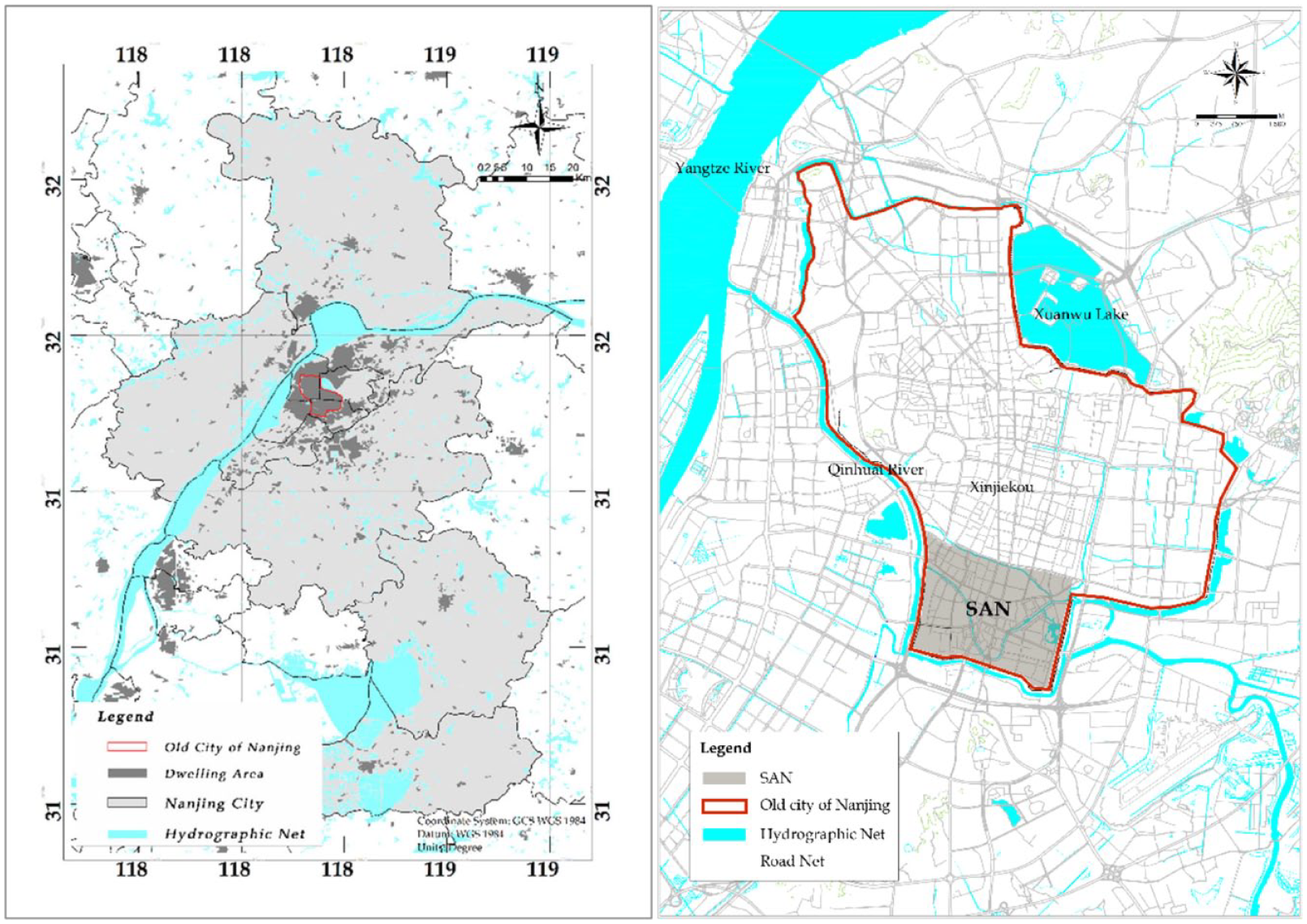
Location of Nanjing (left) and the SAN (right).
There are two main reasons for choosing SAN as the research site. First, Nanjing, located at the Yangtze River Delta, has more opportunities to balance the top-down and the bottom-up ideologies in terms of policy-making, planning implementation, and governance innovation when compared with the political and economic environment of the Beijing-Tianjin-Hebei Region (Jing-Jin-Ji) and the Pearl River Delta. Second, the renewal has been practiced at SAN since the commodification of urban land around the 1990s and still continues. It spans the period of rapid urbanization in China, which perfectly fits with the transformation of urban renewal and governance as studied in this paper.
Methodology
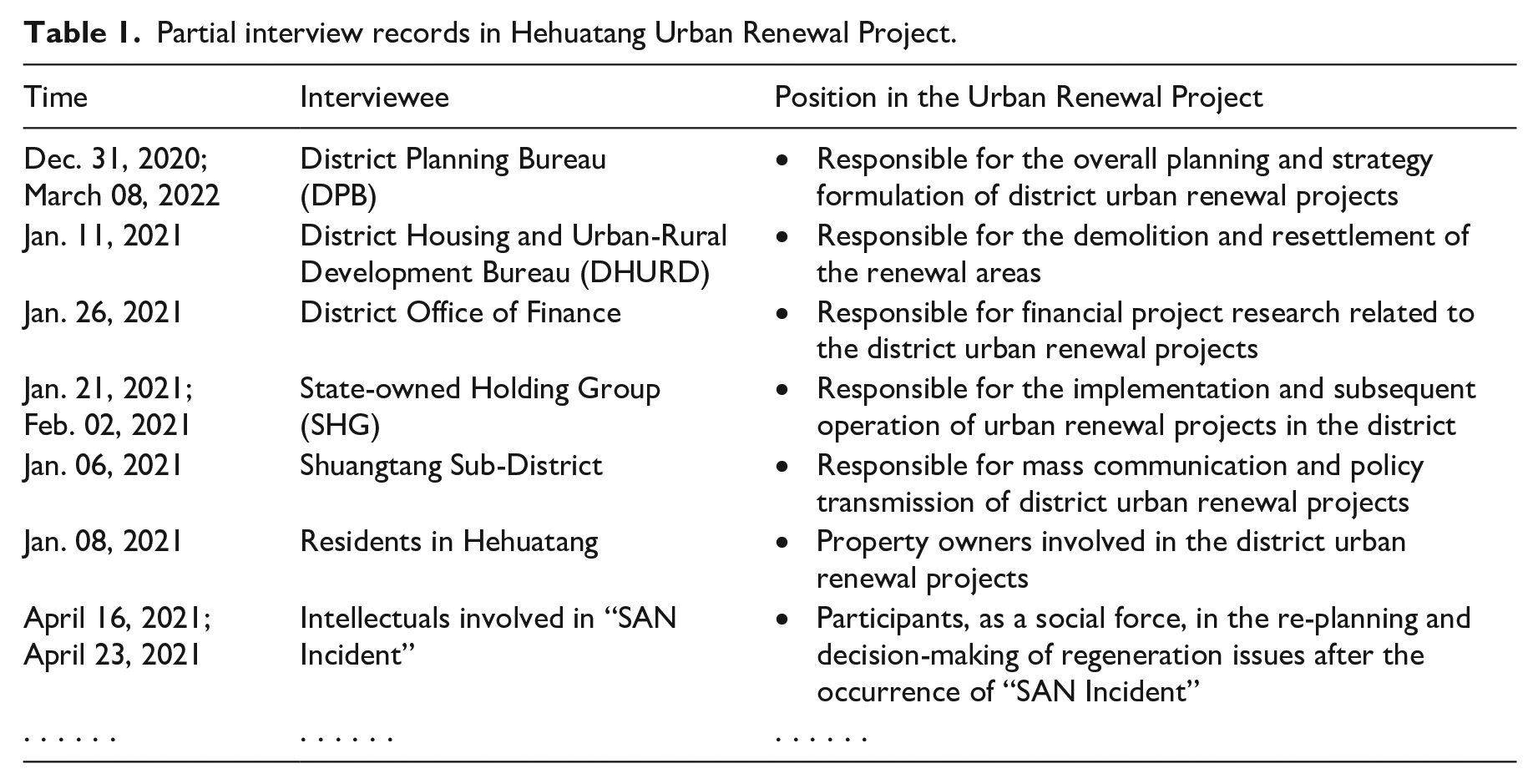
The study takes qualitative analysis as its primary method to analyze the transformation of urban renewal governance, including documentary analysis, nearly ten-year follow-up observations, and project-oriented semi-structured interviews etc. The well-known “SAN Incident” in the academic field of architecture and urban planning, which happened in 2006, was the first opportunity for authors to get contact with the regeneration issues at SAN. Afterwards, the authors collected research resources by participating in the renewal projects as scholars, specialists, and observers etc.
Table 1 shows partial interviews with essential authorities, developers, residents, and local intellectuals who have jointly participated in the renewal projects. As previous interviews took a long time, this study only lists partial interviews that the authors participated in during the ongoing Hehuatang project of SAN. The government authority takes a vital role in carrying on urban development projects regarding planning and implementation, which is mainly included in the interviews. The State-owned Holding Group is a brand-new developer responsible for almost every urban renewal project at SAN. In addition, the intellectuals mainly involved in the interviews have also been taken into account. Their most important role in the well-known “SAN Incident” has vastly changed the initial ideology and the mode of urban renewal at SAN.
Partial interview records in Hehuatang Urban Renewal Project.
Empirical analysis: The governance transformation during the renewal of SAN
According to the interviews, the renewal actions at SAN have generally experienced three phases: (1) from the early 1990s to 2005 (Phase I), when the policy of paid use of urban land was officially implemented in Nanjing city; (2) from 2006 to the early 2010s (Phase II), when the stagnation and reflection were forced by the intellectuals and the central government, taking the “SAN Incident” as a symbol; (3) from the early 2010s to the present (Phase III), which has been led by the concept of plural values and operated by the new form of urban development coalition.
Phase I: Growth coalition under urban entrepreneurialism
Urban reconstruction and landscape rebuilding
In 1992, the Nanjing Municipal Government (NMG) promulgated the Implementation Plan for Housing System Reform, which officially complimented the advent of commercial housing. Meanwhile, it proposed the urban reconstruction goal of “building 100 high-rise buildings in the main city” (DHURD, personal interview, Jan. 11, 2021) and the urban infrastructure renewal goal of “replacing dwellings with roads (yilu daifang), offsetting the construction cost of roads by the exchange value of dwellings (yifang bulu), reimbursing the construction cost of roads by the exchange value of lands (yidi bulu)” (Li, 2016: 38). To consistently revise and upgrade the marketization process of housing policies, the NMG successively issued the housing revolution in 1995 and 1998. In 2002, there were 956 high-rise buildings comprising more than eight stories in the old city, accounting for more than 80 percent of the total construction in across the city (DHURD, personal interview, January 11, 2021). Consequently, the government extended Zhongshannan Road located in the SAN and demolished the historic buildings on both sides of the Zhonghua gate, Mujiangying community (Figure 2), disrupting the traditional landscape of the SAN.
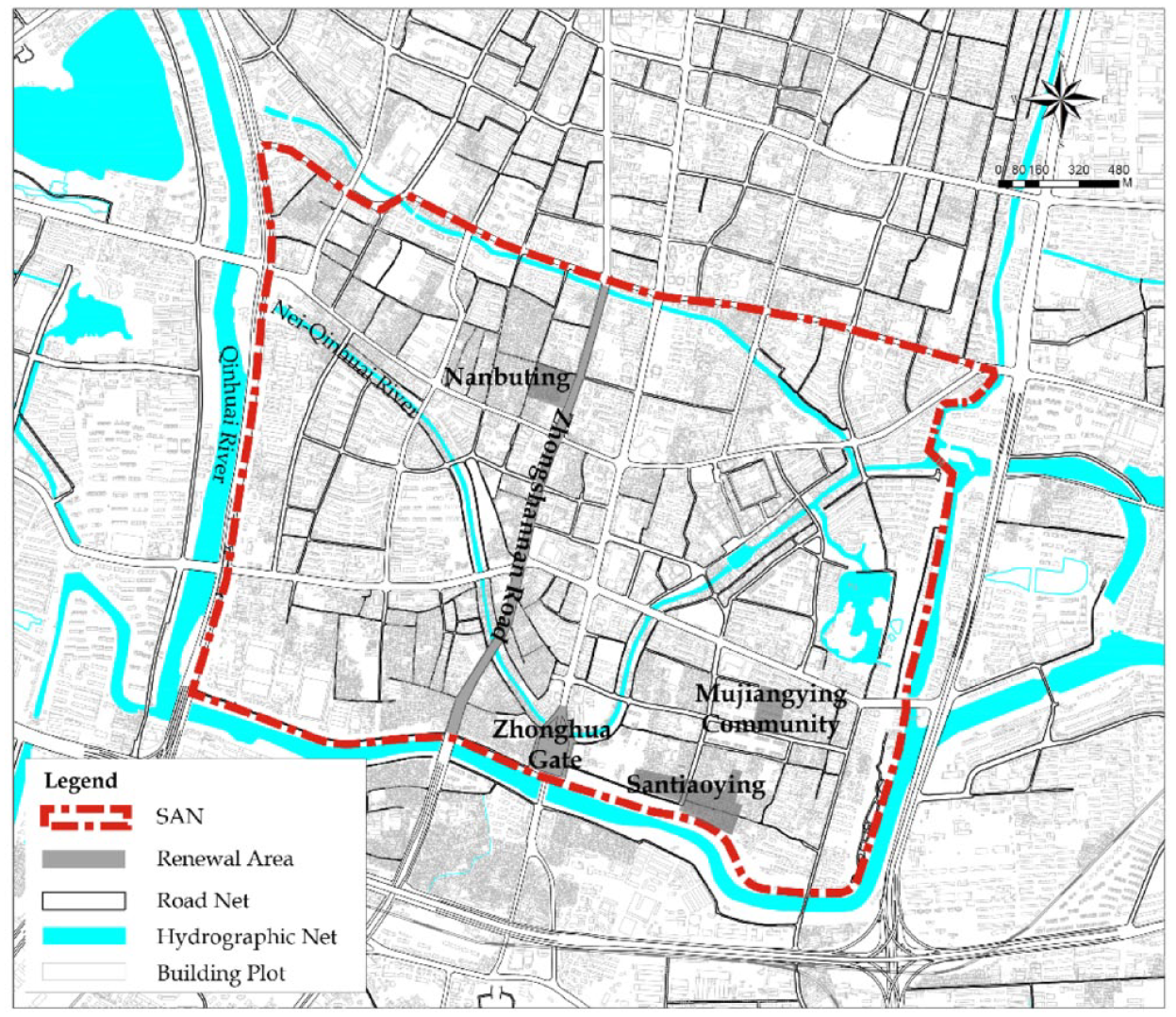
The emplacements of renewal projects (partial) in the SAN from early 1990–2005.
Entering the millennium, the rollout of the Implementation Opinions on Further Accelerating the Reform of the Economic System of the Urban Construction System by the NMG (2003) considerably dissolved the government’s monopoly in the urban development. Notably, the sole existing Santiaoying and Nanbuting historic blocks in the SAN were continuously under demolition as part of the reconstruction projects. Furthermore, the rezoning and commercialization of historical buildings were commended in the SAN, such as Santiaoying and Nanbuting (Figure 2), which was primarily influenced by the commercialization practices of Xintiandi, and Taipingqiao in Shanghai. Thereupon, the modern commercial squares driven by cultural operation further enhanced the spatial landscape of the central division in Nanjing.
Growth coalition, local government, and local government-owned developers
As presented in Figure 3, the local government and local government-owned developers have formed a growth coalition around both land operation and redevelopment during the large-scale demolition and construction works in SAN. This resulted in the dominance of local government over the growth coalition in the SAN.
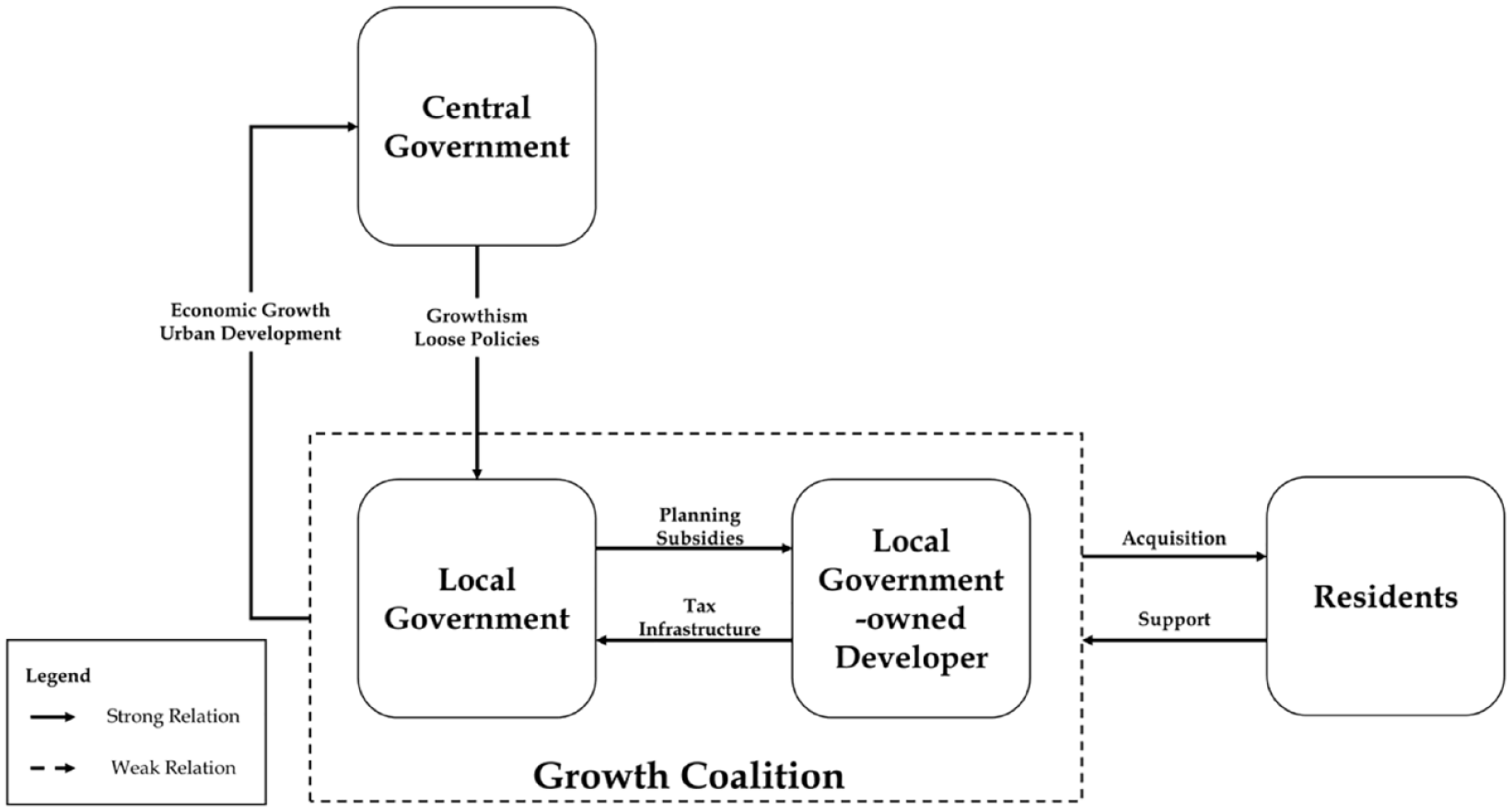
The operation approach of the growth coalition formed during the first phase of renewal projects in the SAN.
On the one hand, NMG has excellently guaranteed the legitimacy of the growth coalition in the renewal process by adopting adequate policies and regulations. For example, the triennial housing system reform from 1992 to 1998 emphasized the necessity of social capital in the urban reconstruction, which laid a foundation to forge a growth coalition. Likewise, the NMG (1994) promulgated and revised the Nanjing Urban Housing Demolition Management Measures and established a demolition management office in the Municipal Real Estate Administration in 1994. Specifically, the scope of initiating demolition was defined under the “needs for urban construction” (Article 8) and to formulate certain regulations centering on the conflicts resolution between the developers and the property owners. It was likely as “if an agreement cannot be reached through negotiation, it shall be adjudicated by the competent house demolition department that approves the demolition” (Article 14). Therefore, NMG has legalized the demolition and reconstruction through a combination of policies.
On the other hand, the NMG sponsored the urban replacement through SAN’s periodically released plans, which optimized the inclusive benefits of growth coalition, for example, the detailed development control plan of the Nanbuting District amended the categorization of land use to high value-added zones (He, 2012) in the course of compiling the Detailed Plan for the Protection and Renewal of Historical Features of Nanbuting District and the Nanjing Master Plan 2007–2020. Henceforth, this enabled the district government to explicitly supervise and implement the renewal movements in the SAN. To better advocate this, it has established various district-level real estate development enterprises and a double demolition headquarters (demolishing illegal buildings and dilapidated houses) (DHURB, personal interview, January 11, 2021). These mainly include the Nanjing Construction and Development Group Co., Ltd. (established in 1992) and Nanjing Baixia Dilapidated Old House Reconstruction and Development Co., Ltd. (established in 1993) especially in the SAN. To adequately proceed, they formed a system of mutual interests and profits exchange mechanisms with the local government. For example, 17% of the land transaction costs incurred on a renewal project will be subsidized by the government to local government-owned developers, in exchange for which the developers need to provide the acquired infrastructure on the subjected land plot (SHG, personal interview, January 21, 2021).
Phase II: Anti-growth coalition under activism
Destruction of the urban landscape and the SAN incident
In compliance with the growth coalition, the demolition-reconstruction of the SAN is in full swing. According to local statistics, 90% of Nanjing’s old city had been reconstructed by 2003 (Yao, 2015b). Specifically, five historic buildings in the SAN along the Qinhuai River including Yanliaofang, Diaoyutai, Chuanbanxiang, Shuangtangyuan, and Anpinjie, were listed in the district government’s “Old City Reconstruction” projects in 2006 (Figure 4). As expected, several intellectuals could not stand to witness the demise of the historical heritages. In August 2006, they teamed up with Wu Liangyong (academician of the Chinese Academy of Sciences), Xie Chensheng (drafter of the Law of the People’s Republic of China on the Protection of Cultural Relics), Hou Renzhi (academician of the Chinese Academy of Sciences), and other 13 well-known scholars to send an Urgent Appeal for Preserving Nanjing’s Historic Old Town to the central government for help (Li, 2016: 46). Later in October of the same year, the Premier Wen Jiabao released essential instructions to direct the Ministry of Construction, the State Administration of Cultural Heritage, and the Jiangsu Provincial Government to comprehensively investigate this incident. As a result, the Legislative Affairs Office was tasked to promptly draft and enforce the necessary regulations to conserve the historical and cultural cities (Intellectual who participated in “SAN Incident,” personal interview, April 16, 2021). Afterward, the local government embarked on to drafting work reports in collaboration with the central authorities in Beijing to prudently propose the new set of guidance in renewal actions of “overall protection (zhengti baohu), organic renewal (youji gengxin), government-led (zhengfu zhudao), and careful use of the market (shenyong shichang)” (Li et Liu, 2011: 70) in the SAN. Thereby, the local government devised the “tooth-filling” renewal method to substitute the semi-demolished historical and cultural blocks, which temporarily quelled the early SAN Incident.
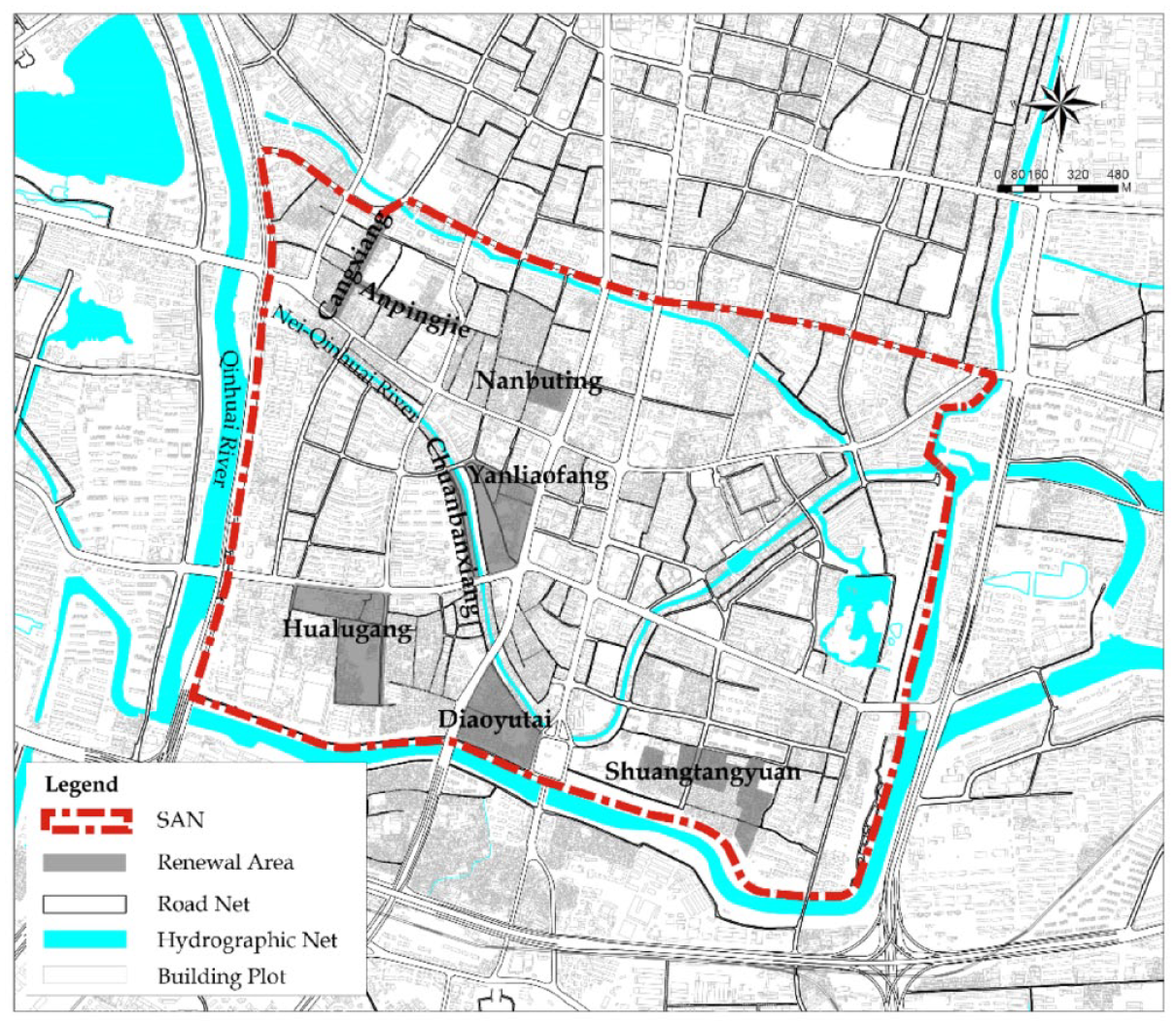
Locations of the renewal projects (partial) in the SAN from 2005 to 2010.
In 2008, the NMG launched a new large-scale renewal project for old lodgings. On that basis, the only lasting four historical sites in the SAN i.e., the Nanbuting, Shuangtangyuan, Hualugang, and Cangxiang, were once again enlisted under the scope of the renewal project (Figure 4), which once again attracted public consideration. In addition, a group of 29 Nanjing based researchers jointly submitted a letter to the State Council of the Central Government i.e., “Urgent Protection of Nanjing Historical and Cultural City” in April 2009. This was strived to signify that “Jinling Ancient City (Nanjing) only has less than 1 million square meters, which is less than 2% of the total area of the 50-square-kilometers old city” and “Jinling Ancient City (Nanjing) has reached the last phase of history” (Yao, 2015a: 148). About a month later, former Premier Wen Jiabao approved a novel decree to lead the MHURD, as well as the State Administration of Cultural Heritage to monitor the conservation of Nanjing’s historical and cultural assets and the reconstruction progress of old city (Intellectual who participated in “SAN Incident”, personal interview, April 16, 2021). Unsurprisingly, the demolition activities of the Nanbuting area were suspended after the third day of arrival of the central investigation team in Nanjing. Subsequently, the NMG adjusted the provisions on the renewal of the old city in the new Master Plan of Nanjing. The key proposed imperative was that the “historical and cultural blocks and districts should adopt a progressive organic renewal method, and no large-scale demolition or construction would be allowed” (Yao, 2010). In addition, the Nanjing University of Technology was commissioned to re-structure the architecture and cultural resources in Nanbuting. In a similar manner, another team from Tsinghua University was tasked to compile the Protection Plan and Urban Design of the Historic City in the SAN (2010 version). In accordance with the 1937 cadastral map and the 1951 boundary map, the technical planning team put forwarded the idea of “small-scale (xiaochidu),” “courtyard style (yuanluoshi),” and “full-spectrum style (quanpuxi)” for the renewal methods in the SAN. Eventually, this embedment of above-referenced scholars successfully satisfied the public and citizen representatives in delicately tackling the SAN incident.
Anti-growth coalition, central government, and local intellectuals
The SAN incident has demonstrated that this vigorous alliance of intellectuals and the public authorities interactively acted in a “bottom-up” way to safeguard the social justice and counter the profit-seeking comportment of technocratic government (Cook, 2018). In the meantime, it also proved the existence of an anti-growth coalition in the socialist China that can contend with the top-down growth coalition (Figure 5). This verified that the government’s earlier consensus on the urban renewal movements was reconstructed in a certain sense that was also influenced by the SAN’s discord.
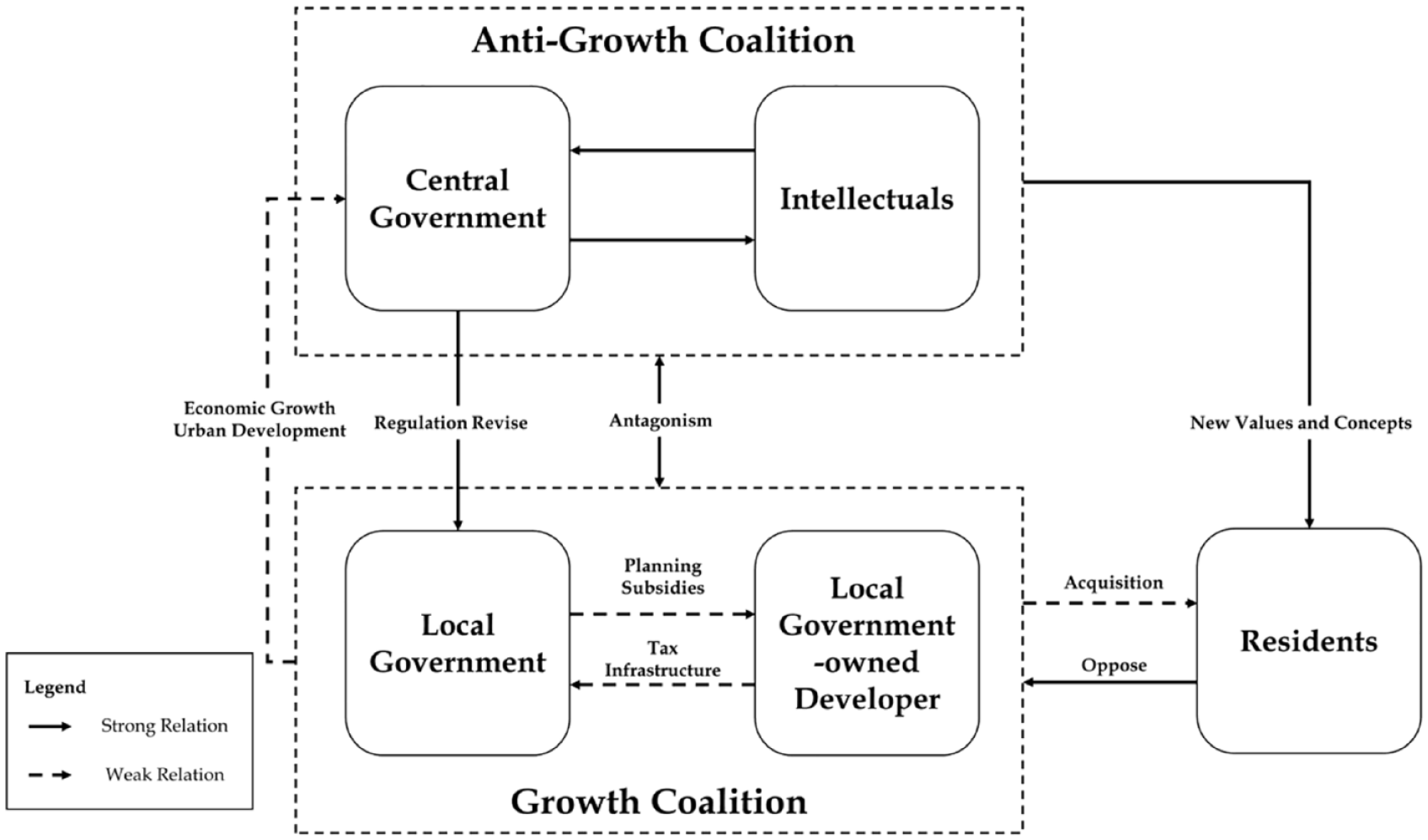
The operation approach of the anti-growth coalition and growth coalition formed in stage two of renewal projects in the SAN.
Opposite to the anti-growth coalition forged among the community residents, and the US executives (Molotch, 1976), SAN comprises urban intellectuals and the central government. It was obvious that these high-level intellectuals were not manifested from the residents or community’s particular interests, instead striving for city-wide protection, representing a more elite-oriented visionary movement. However, this high-level impedance of academic scholars represents one of the meaningful social forces in technocratic China. Similarly, as the central government is not a peculiar stakeholder in the local reconstruction projects, yet its engagement also constitutes an influential legitimacy under the constraints of China’s stern hierarchical governance and official promotion system. Consistently, the central government exercises the administrative power to leverage the local governments in transitioning the SAN’s overall renewal policy from supporting the participation of market capital to “use the market with caution (Li et Liu, 2011: 70).”
Under this general political transformation, in 2009, the Qinhuai District government established the state-controlled Nanjing Historic City Protection and Construction Group Co., Ltd. (Libao Group) to regulate the SAN’s renewal projects. Thereafter, the state-owned Assets Supervision and Administration Office of the Qinhuai District government further established the Nanjing Qinhuai State-Owned Holding Group (Guozi pintai). This assured the inclusive administration and ownership and all the local government-owned developers can participate in the renewal projects. It was observed that the district government upgraded the existing triple identity status by the social intellectuals such as colleges and design institutes to prepare renewal project plan at the project operation scales. However, it actually created a modern societal dilemmas such as the controversial outcomes of the tooth-filling method, the functional replacement, and the relocation of indigenous people, have been continuously discussed among the public (Li et Liu, 2011).
Phase III: Development coalition under pluralism
Gradual renewal process and dwellers’ willingness
It was believed that the SAN incident has put the overall process of the renewal movement in Nanjing on hold. Except for the remedial projects, no new large-scale renewal projects were initiated in the SAN between 2010 and 2015. For the meantime, Nanjing’s first Regulations on the Protection of Nanjing’s Famous Historical and Cultural City were implemented in 2012, which implied that SAN has formally instituted the legal process of protection and renewal. This aided in termination of the growth coalition-driven random demolition and reconstruction since 1990s. So after the approval of Preservation Planning and Urban Design of Historic Urban Area in the SAN and Qinhuai Area of Nanjing Old City Control Detailed Planning 2012–2020 further articulated the overall vision of landscape in Zhonghua Mendong and Menxi of the SAN as the exhibition of Nanjing traditional residential culture.
Following the SAN incident, the Dayoufang (Xiaoxihu) Historic Area in the SAN was planned as the first comprehensive renewal project in 2016 (Figure 6). A peculiar aspect of this project was the government’s cooperative attitude to fully respecting the residents’ willingness and has formed a specific implementation sequence of restoration-adaptation-reconstruction instead of directly no-different demolition. Through a one-year interview with 810 households at Xiaoxihu, 402 households decided to retain their original property rights, whereas 408 of them wished to exchange their existing land property rights or use rights by replacement. Appointed by the district government and based on the evident willingness, the Libao Group employed the architecture and planning design team of Southeast University to integrate the renewal plan for the Xiaoxihu historical block. The design team proposed a small-scale gradual renewal concept with the building sites as the renewal unit, offering the designers more flexibility to cope with the varying level of residents’ willingness, the design standards of residential communities, and the site protection requirements.
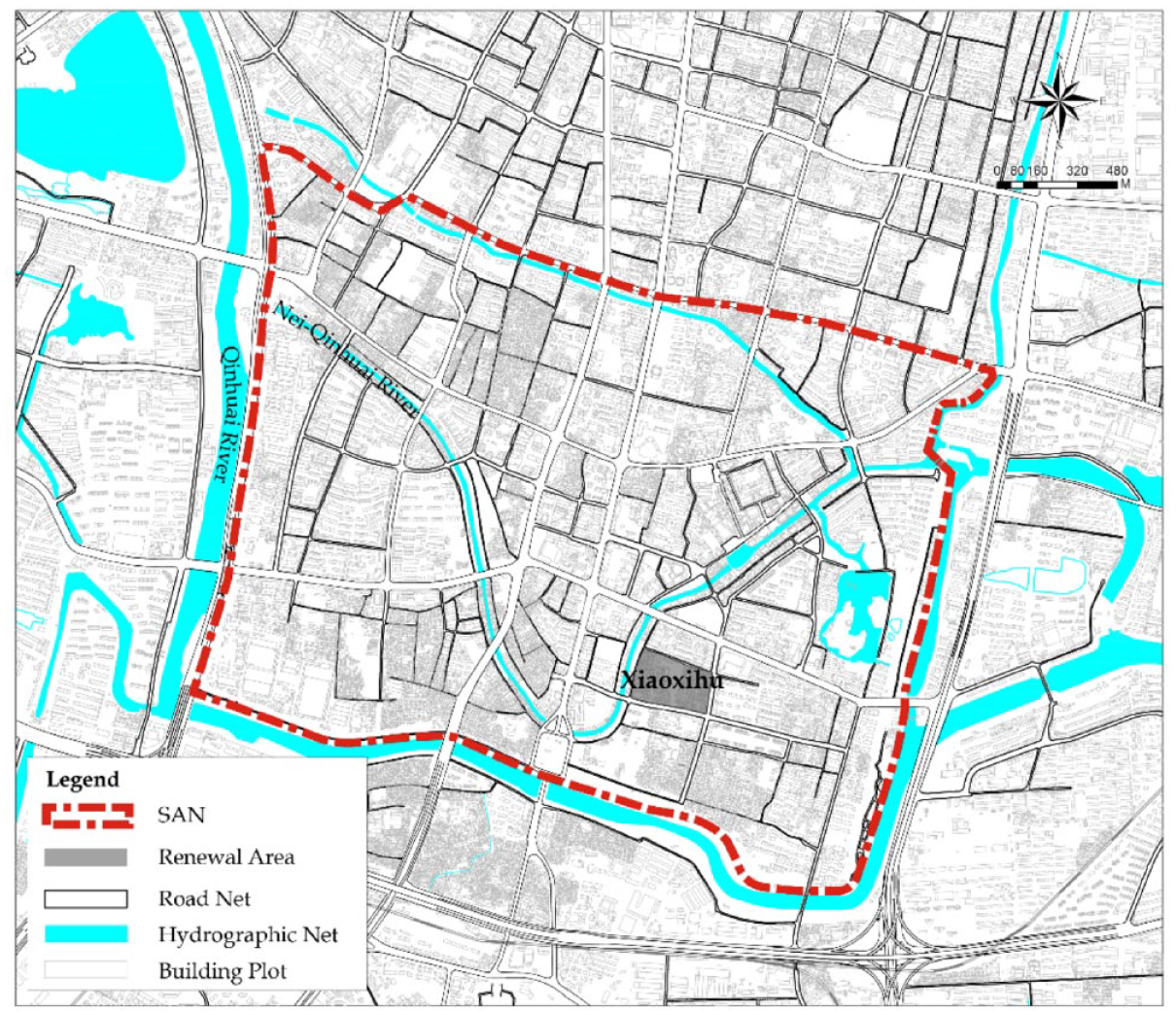
The locations of Xiaoxihu renewal project in the SAN.
First of all, the technocratic team further explored the renewal approach based on the integration of willingness and building conditions for the 402 households willing to keep their property rights. As a result of multiple negotiations with the residents until they signed the agreement, several unique renewal approaches were formulated (DPB, personal interview, December 31, 2020). For instance, one private dwelling on No. 35 Madao Street was initially owned by an elderly couple where the husband had passed away (Figure 7). Ideally, the wife required to inhabit in such an apartment consisting of inclusive facilities with promising living environment; however, she declined to abandon the property she had shared with her husband. Therefore, the renewal plan of this site was formed as a win-win plan, in which the government invested in a long-term lease of the property and repurposed it as a café without destroying the protected elements (Figure 7), while the older woman used the rent to re-lease an apartment.
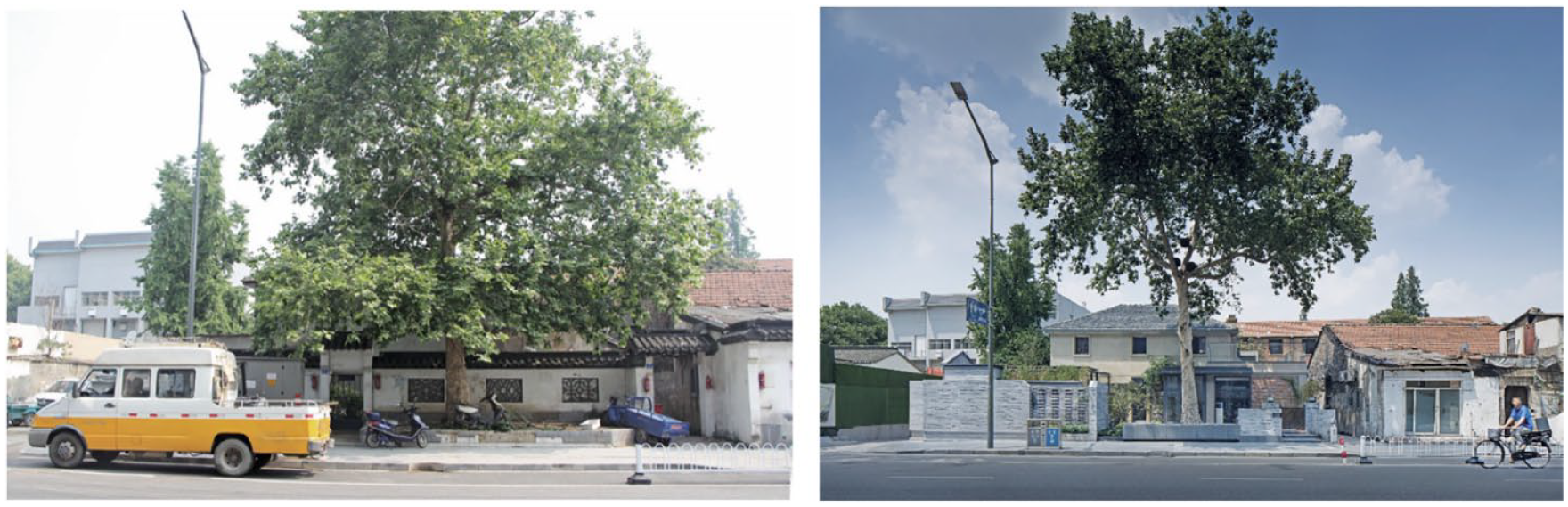
The comparison of the frontage on No. 35 Madao Street before (left) and after (right) the renewal.
Secondly, three resettlement strategies, i.e., translational (Pinyi Anzhi), nearby (Jiujin Anzhi), and new-town resettlement (Jiaoqu Anzhi), were formed for the remaining 408 households who opted to relocate. Importantly, the latter two approaches were comparable with the previous projects, while the “translational resettlement (Pinyi Anzhi)” was an innovation for the tenants with no property rights who yet wanted to stay and live in the existing blocks. To solve this challenge, the government purchased abandoned factories or buildings in the peripheries with careful decoration to start providing ready-to-move-in houses, and resettled such residents in accordance with the original living space (Figure 8). For the abandoned properties, the district government and design institutes would adaptively restore, reuse, or replace them in accordance with the protection requirements and the planning regulations. Lastly, the relocation released 48 building plots at Xiaoxihu (both preservation and demolition) that were designated to improve the quality of public space and revitalize traditional neighborhoods.
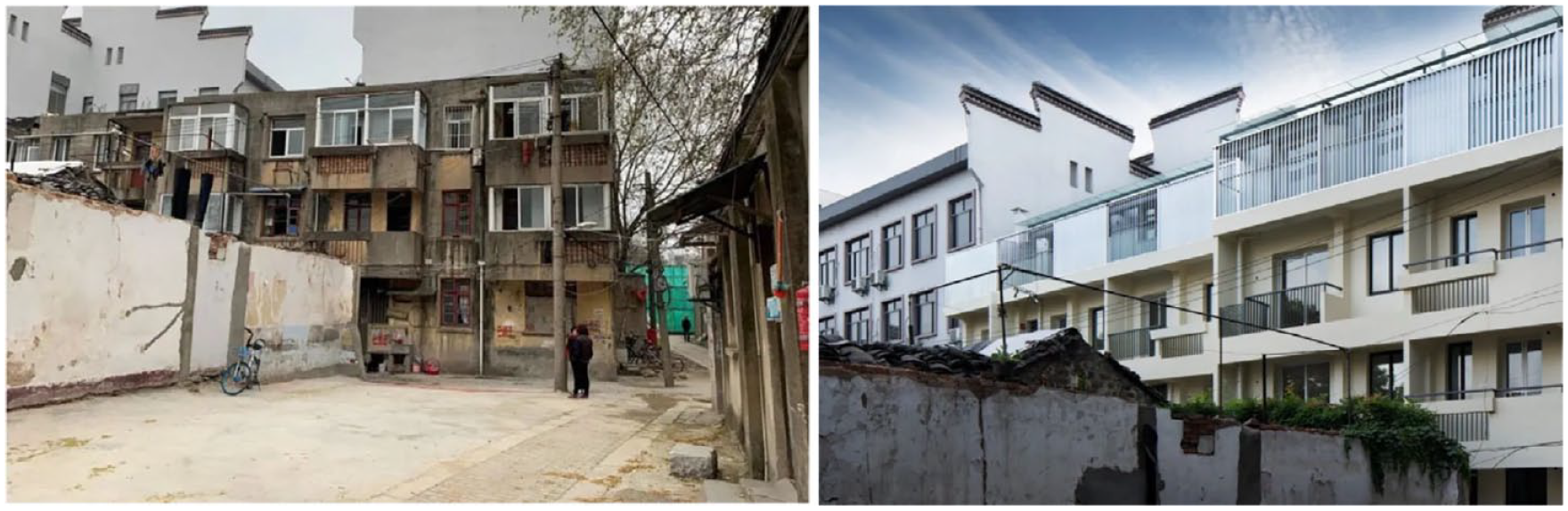
The comparison of the frontage of “translational resettlement” dwelling before (left) and after (right) the renewal operation.
Development coalition, local government, residents, intellectuals, and media
Obviously, the Xiaoxihu project in the SAN has fundamentally altered the urban renewal approach of “demolition and reconstruction” that was promoted by the previous growth coalition. This also demonstrated great respect for both the historical pattern and the residents’ willingness. Thus, this shift in the government’s attitude toward residents has triggered the re-organization of the core interests and stakeholders in the renewal process.
At present, the plural values rather than single economic values have become the core value-base of the renewal projects in the SAN. Unlike the interest structure formed by the dynamic land finance and land appreciation, the legalization of the protection of historical blocks makes it unattainable to collect the exchange value of historical blocks as before. This strongly advocates that the local government urgently requires the provision of a new renewal approach with more social satisfaction, especially after the SAN incident, which will aid in recovering its positive image under the central government’s supervision. Therefore, an interactive approach is necessitated where the total social forces can participate with the injected new value and willingness is formed in phase III of SAN renewal. At first, any new approach takes the residents’ willingness as the starting point. It is worth considering that the restoration results of half of the residents elicited that the revised approach acknowledges the space value of historical buildings and various social values. The current state of satisfaction bonded with the evolution of government behavior from administrative to service roles reflects that the local government and grassroots communities provide more diverse options for leaving or staying dwellers. Likewise, the multiple resident-centered policy innovation highlights the new value of “people-centered urban development” (CGTN, 2019). Furthermore, a large group of local intellectuals participated in the decision-making process of renewal schemes in terms of the historical preservation, adaptive reform, infrastructure promotion, and the spatial quality improvement. This implies that the engagement of these knowledgeable sectors augment the integrity of multiple values and the quality of spatial outcomes (Figure 9). In addition, the local media also embraced the initiative to engage the advertising support for the local government in the Xiaoxihu project after several positive follow-ups reported through the internet or novel media (Figure 9). Thus, it helped the local government in relieving the prior tense relationship with the public and multiple government divisions. Given the activism compromise in Phase II, the previous growth coalition on rebuilding the SAN has been replaced by a development coalition that is an active consortium of residents, intellectuals, media, and the local government with plural values (Figure 9).
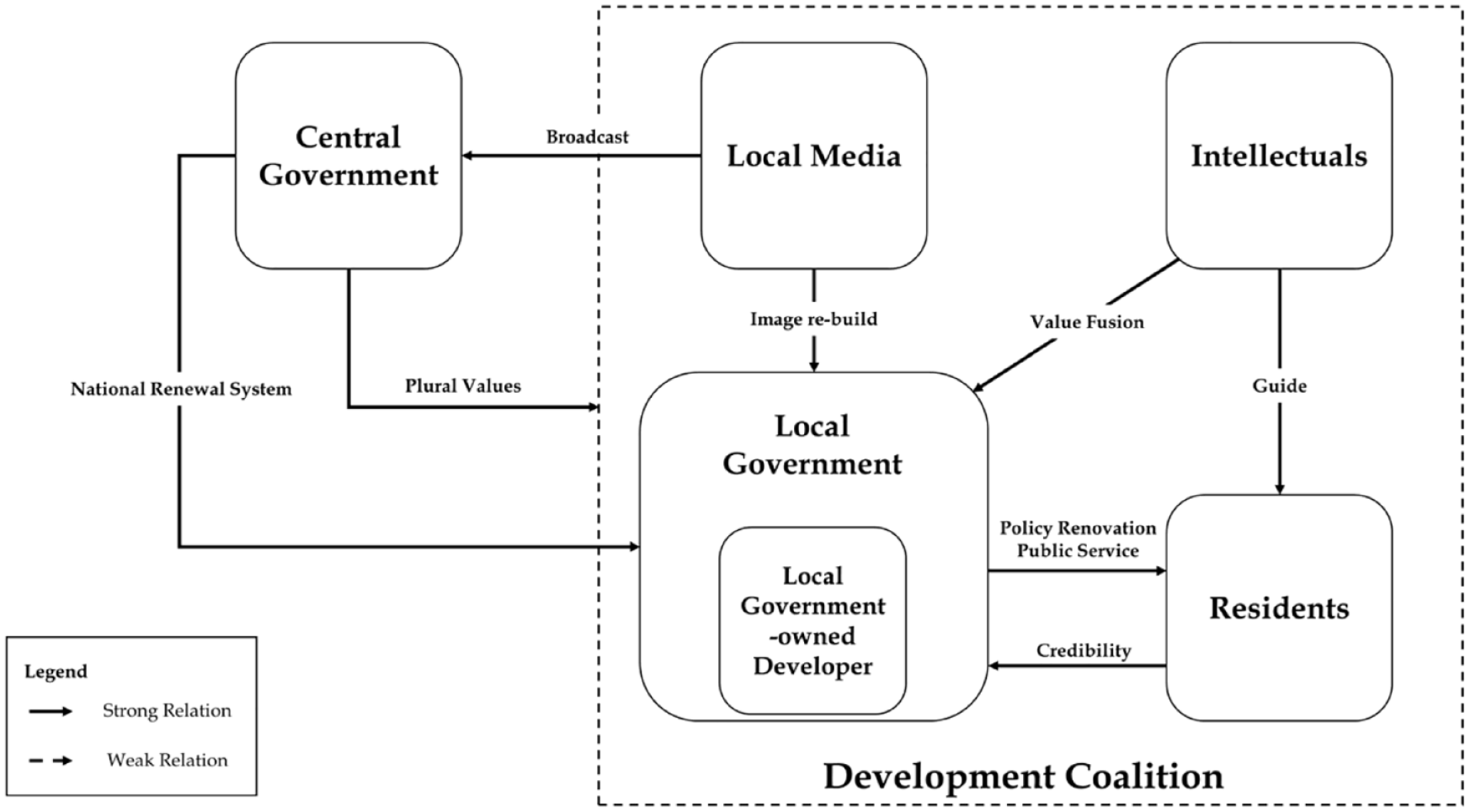
The operation approach of the development coalition formed in Phase III of renewal projects in the SAN.
Development coalition: A new perspective of studying urban renewal governance in China
Since the 18th National Congress of the CPC, China has implemented a series of political reforms to usher in a new paradigm of urban transformation from high-speed growth to high-quality development. Among them, the sustainable interplay between the central government’s policy supply and the local urban development practices have spurred the continuous innovation of the urban renewal approaches (Table 2). It was analyzed that the makeover of renewal approaches in the SAN during the past decade was witnessed when the local pro-growth coalition was not expectedly competent; the anti-growth coalition would temporarily penetrate in the development discourse to bargain for social justice. In the case of SAN, the local government systematically integrated the anti-growth coalition, which in turn shaped the new alliance of development coalition to influence the developmental processes and outcomes in the urban renewal movement.
The comparison of the growth coalition and the development coalition during the renewal phase of Chinese cities.
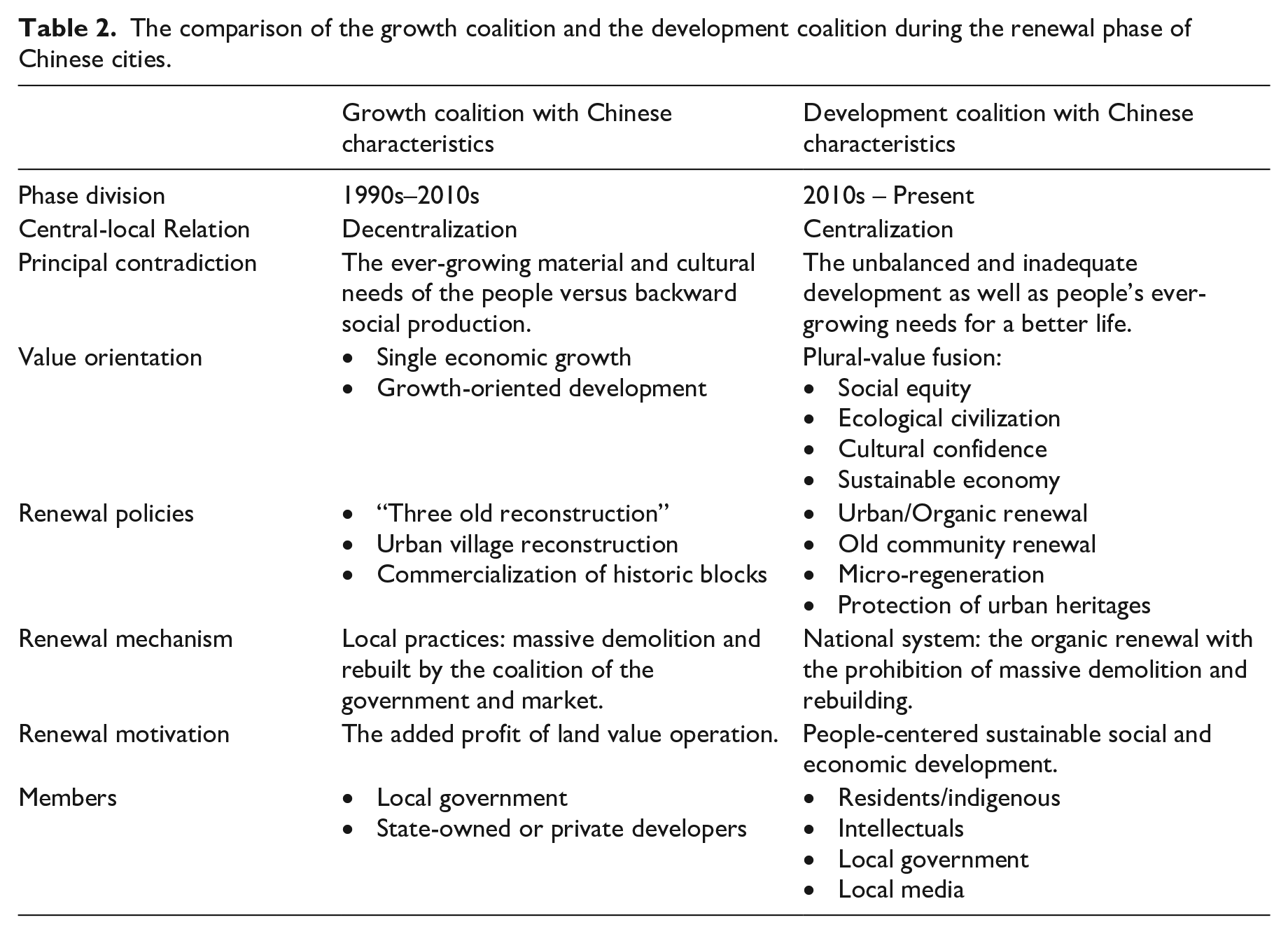
Transformation of local renewal behavior
By implementing the national strategy of “Urban Renewal Action,” a national urban renewal system that “prohibits large-scale demolition and construction” has been established to direct the transformation of local renewal behavior. Notably, the local government no longer implemented the top-down approach to design the specific renewal plan and redistribute construction elements; instead, it has transformed into a service-oriented government to guarantee the bottom-up participation. On the one hand, the local government has unified the previously scattered initial market renewal and development rights, enabling additional choices that can remarkably influence the policies to residents and intellectuals. On the other hand, it has thoroughly accommodated the wishes and choices of the residents in the renewal process by allocating more state budgets into relevant policy innovations. Therefore, the local governments no longer showcase the behavioral characteristics of a strong growth consciousness in the new development epoch.
Social development as the virtual goal of urban renewal
In previous urban renewal programs, the exchange value of the renewal land was the primary driving force to uphold the urban renewal movement and the establishment of coalitions. However, economic growth will no longer be the leading goal of urban renewal in the future with the advocacy of plural value by central government in the past decade. Having local government produce a renewal model that complies with the requirements of “The cities are built by the people and are for the people,” rather than just GDP increment, has become the key motivator for local government to unite residents, intellectuals and local media to form a new coalition. This mainly includes the safeguard and continuity of urban culture, nurturing a harmonious society, maintaining social equity, and improving spatial quality and supporting facilities.
Residents and intellectuals as core participants
As confirmed, the residents were often in a delicate situation and were mostly required to make choices under the previous growth-oriented initiatives. In response, the intellectuals were either marginalized by the growth coalition or formed an anti-growth coalition with residents to counter the greedy profit-seeking behavior of the growth coalition. In the past decade, however, the preservation of historical assets, social atmosphere, and the living scenario in the renewal process has gradually become a new focus in implementing the urban renewal action by the central and local governments. It has also been confirmed that the residents’ willingness is respected in the whole renewal process as never before. In contrast with the previous growth coalition, this new narrative empowers the local government to address the residents’ inclination as the starting point for local policy innovation and improvement. Given the current disposition, the role of intellectuals in urban renewal movements has progressively reformed from confrontation to activism. Therefore, both the residents and technical professionals have gradually earned a robust character in the emerging ideology of the urban renewal action plan, and even govern the reconstruction of local urban renewal governance and policy system to a certain extent.
Conclusion
The past decade has witnessed the urban development context with noteworthy revolution in China. It is believed that the rising plural-value concept profoundly affects the governance approaches of urban movements. The new national strategy of Urban Renewal Action has set a stage for urban development to transform from the incremental to built-up areas. In recent times, the previously constituted growth coalition by local governments and government-owned property developers in the past has rescaled. The government-owned real estate developers have reimbursed to the governmental service function, and the local governments are rapidly reverting to the public serving norms. In particular, the residents’ perspectives have shifted from an absolute liability in the past to the core elements of the critical issues. This transformation intensely marks the composition of interest relations, the operational structure of the project, the compendium of planning schemes, the orientation of policy innovation, and formed the development coalition by residents, intellectuals, local government, and local media.
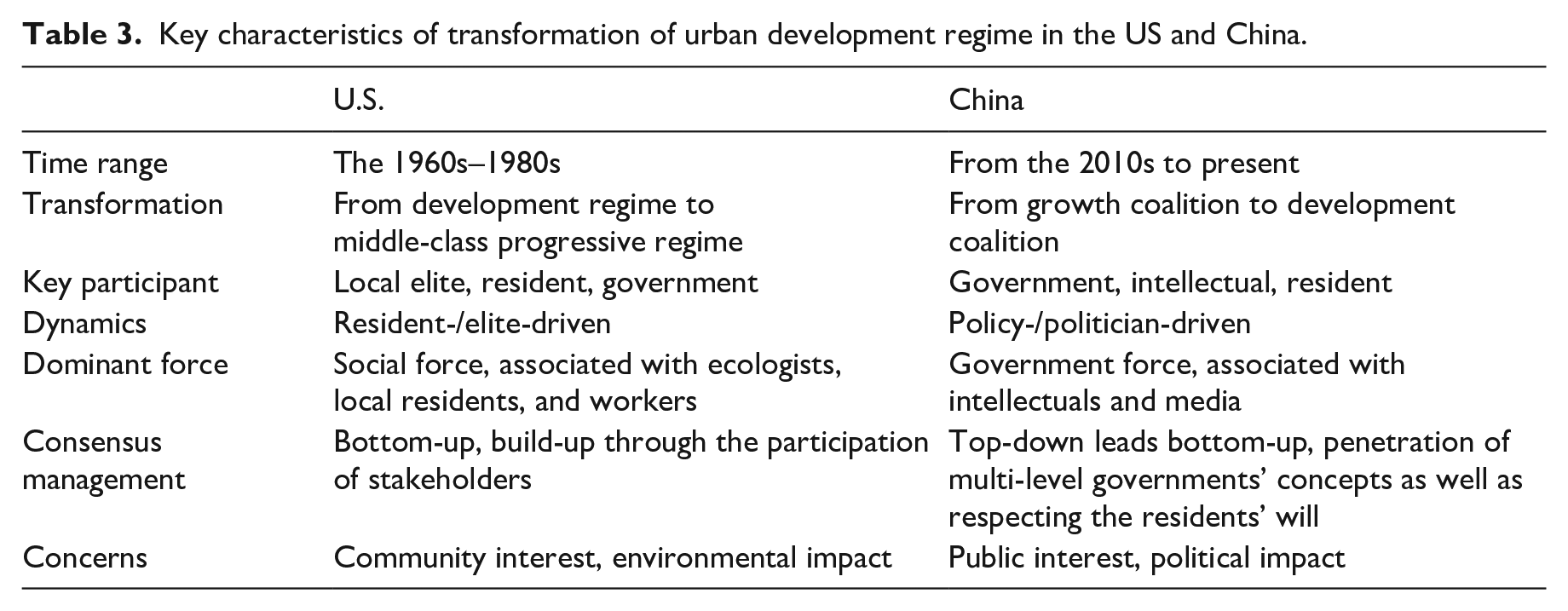
In conformity with the earlier researches, the transformation process of urban renewal governance from growth coalition to development coalition indirectly demonstrates the policy- or politician-driven urban development approach as a formidable Chinese characteristic (He and Wu, 2005; Zhai and Ng, 2013; Wu, 2018). Yet, it is dissimilar from the market- or capital-driven urban renewal in Western capitalist countries. Superficially, the transformation of China’s urban renewal governance follows a similar trajectory comparable to that observed by Stone (1993) in the US, namely, from a “development regime” to a “middle-class progressive regime”. However, they are radically divergent in terms of the dynamism, commanding drivers, consensus management, and the transformation predicaments (Table 3). With the recent 10-year transformation of urban renewal movements in China, this study reveals a decisive intervention of politicians and the policymakers in leading the fundamental transformation. Although it showcases the ever-growing respect for residents, the recent pluralism is embedded within the inflexible top-down pathway of the penetration of multi-level governments’ concepts into residents. This proves that the residents’ and intellectuals’ prompted development coalition in China still concerns the public interest rather than the community interest. In other words, it is still a government-led development model with powerful political mandates, however, temporarily contends less economic publicity within the development discourse.
Key characteristics of transformation of urban development regime in the US and China.
Moreover, it is worth pondering whether China’s rapid policy-oriented reforms at this phase have skillfully formed an urban renewal dynamic mechanism that is mutually supported by the development coalition? It can be strongly felt that this gigantic breakthrough in the SAN was enforced under the enormous pressure of the national political mandates. This was also agreed with Wu et al. (2021) that the task of urban redevelopment must be favored irrespective of whether it could generate economic returns particularly in China. Through interviews with local authorities and their developers, the authors also inferred that the local governments could endure additional transformation challenges and one indispensable aspect is the financial sustainability of the renewal project. Apart from the above, local government has unilaterally invested huge funds (DPB, personal interview, March 08, 2022). With the extreme shrinkage of land financing in the renewal domain and the withdrawal of social capital, the status quo has not formed a benevolent and complementary capital investment mechanism in the development coalition. The other is the concept of residents. Instead of social issues such as the environment, urban culture, and the historical features as described in the “middle-class progressive regime,” they still geared to obtain self-additional benefits. As such, it would not yield a community consensus on the development vision and aspirations to a large extent. Moreover, the innovation and smooth implementation of renewal policies also test the traditional Chinese government administration and management system. Thereupon, these emerging apprehensions should be explained in future urban renewal practice and academic research in China.
Footnotes
Declaration of conflicting interests
The author(s) declared no potential conflicts of interest with respect to the research, authorship, and/or publication of this article.
Funding
The author(s) disclosed receipt of the following financial support for the research, authorship, and/or publication of this article: Acknowledgment should be extended for the data support from “National Earth System Science Data Center, National Science & Technology Infrastructure of China. ( )”, for the information support from Nanjing Municipal Government and authorities, and for the funding from National Natural Science Foundation of China, Grant No. 52078245.