



Abstract
Urban transformation in China is witnessing a diversification of architectural designs and the more prominent roles played by architects. Notably, recent architectural practices in urban and regional China have increasingly emphasised the social functions and uses of architecture – architecture is mobilised by many architects and their clients to promote public goods, social improvement and extra-economic purposes. The dialectic between material and social transformations constitutes the focus of this paper. To reconceptualise architecture as an active social intervention, this paper first delineates a theoretical outline that starts from Henri Lefebvre’s thesis on the alienation of everyday life and proliferation of abstract space in modern cities. We then engage with the notion of concrete utopia that highlights alternative urban spaces produced by architectural works, which do not radically transcend the dominant capitalist system but intervene into the current conditions by enriching and improving them incrementally. To illustrate this perspective, this paper develops a preliminary reading of two empirical cases based on second-hand materials collected from public media and social media, namely the Aranya project in Changli County, Hebei Province and the renovation project of a traditional house in central Shanghai.
Keywords
Introduction
Over the past two decades, urban transformation in China has witnessed a diversification of architectural designs and the more prominent roles played by architects, who have engraved the built environment with their visions for a good society. Although this phenomenon is made possible by the loosened regulation and reduced standardisation of architectural design as a profession, it also epitomises the stronger connections between urban materiality and people’s pursuit of lifestyles, meanings and personhoods. The relationship between architecture and urban development is certainly a well-rehearsed topic in urban studies. In the context of Chinese and Asian urbanisms, scholars have analysed flagship buildings and skyscrapers as manifestations of neoliberal urban policies, global integration, national modernisation and state-endorsed accumulation strategies (McNeill, 2005, 2019; Ren, 2011), representative of which is Ong’s (2011) analysis of hyperbuilding as a key worlding strategy that expresses the contingent interplays among state power, a global culture of spectacle, and speculative capital.
Yet, the equivalence between architecture and dominant political economic relations is being questioned and destabilised in contemporary urban China. While the dominant political and economic interests are still served by the production of urban spectacles and hyperspaces (Ong, 2011), the landscape of architecture practices in China has also become more variegated and nuanced. In short, architects in China are paying more attention to the improvement of social wellbeing through buildings as material and social innovations, despite the fact that this is an uneven, slow and incremental process (Xue, 2006; Campanella, 2008). On the one hand, design is no longer confined to spectacular buildings and has increasingly engaged with everyday, small-scale projects. On the other hand, there has been a ramification of rationalities, logics and commitments among Chinese architects. Now, architecture is often mobilised by architects and their clients to promote public goods and extra-economic purposes. This is manifested, for example, in the incorporation of novel designs into public buildings such as libraries, art galleries, concert halls, museums and even community centres, 1 to enrich users’ aesthetic and bodily experiences; the building of primary and secondary schools with design features to make childhoods and adolescences more sociable, playful and enjoyable; and the wide use of architectural experiments in rural reconstruction and revitalisation initiatives to revive rural heritage and cultural identities (Lu and Qian, 2020). All these unfoldings imply that academic accounts about the relationships between architecture and urban and regional development in China need to be radically diversified and multiplied. The dialectic between material and social transformations will constitute the focus of this paper.
To address this inquiry, the objectives of this paper are twofold. At the theoretical level, it constructs an epistemological framework that conceptualises architecture as an active social intervention. We are interested in how architecture provokes positive social changes and acts as an intermediary between material conditions available in the present and visions about alternative futures and better lives. We start from Henri Lefebvre’s (1996, 2003) thesis on the modern capitalist city, which is centred on the alienation of everyday life and the proliferation of abstract space. We then engage with the recent utopian thinking in geography and urban studies, highlighting alternative spaces that do not radically transcend the dominant system but intervene into the current conditions by enriching and improving them incrementally. Architectures and the built environments are at the heart of the utopian impulses in the city. Conversing with geographies of architecture and the insights offered by Lefebvre (2002) and Bloch (1986), this paper outlines a perspective about the social use of architecture and employs the concept of concrete utopia to understand purposefully designed buildings that enable people to harness and reclaim everyday life vis-à-vis dominant conditions and forces (Lefebvre, 2002).
To further illustrate these theoretical claims, this paper proceeds to a preliminary reading of two empirical cases, based on second-hand materials collected from public media and social media. The first, named Aranya, is a complex of innovative architectural projects located in the Gold Coast, Changli County, Hebei Province. Affiliated to a real estate project, Aranya nonetheless moves beyond the rational provision of housing, as Lefebvre (1996) once criticised, and addresses a series of non-market concerns and rationalities that have been marginalised in modern market economy, including harmony with nature, sustainability, creativity, art and communal life. Without neglecting its symbiosis with profit-making activities and hence the serious limitations to its progressive possibilities, we nevertheless argue that it can, if only to a limited extent, recuperate the fullness of everyday life and contravene the degeneration and alienation of human experiences. The second case is located in the central city of Shanghai. In this project, the architect Shi Nanqiao renovated a dilapidated traditional house whose floor area was just 14 m2 and turned it into a cosy two-storey residence accommodating a family of five. The project has since gained fame after being reported by a popular TV programme called Dream Home (Mengxiang Gaizaojia). Residents in traditional neighbourhoods in urban China are often caught up in a limbo: they either put up with substandard residential conditions, or are slated for relocation to peripheral locations, forsaking accessibility and communal ties. This project, however, breaks away from this dilemma by negotiating a series of constraints to restore the dignity of urban living. As Lefebvre (1996) has famously argued, the politics of inhabitation is at the centre of urban politics, and it is most important to transform habitat, i.e., human settlements colonialised by economic utility and depleted of humanity, into spaces of poetic and authentic dwelling. We select these two cases not only because architects and architectural designs play an essential role in both but also because they partake of radically different scopes and purposes – while the first builds up the material fabrics of public social life, the second focuses on reconfiguring homely and domestic spaces. Together, they allude to an extensive range of socio-material systems centred around architectural experiments.
This paper contributes to urban China studies by arguing that the active engagements between humans and built environments provide a generative zone of progressive potentials. Built environments, apparently, occupy a central place in the research of Chinese cities, and an enormous scholarship has been dedicated to traditional neighbourhoods, gentrified urban districts, work unit compounds, gated communities, landscapes of corporate and commercial power, etc. Yet, built environments are usually analysed as the by-products of the dominant economic systems, or creations of the state-capital coalition, while few works have examined people’s experiences and practices of inhabiting their built environments, and the mutually constitutive relationships between human agency and the material agency of buildings. The series of works of Pow (2007, 2009, 2017) present notable exceptions, which argue that the aestheticisation of landscapes and the enactment of codes of civility in gated communities not only perform class prestige, but also provide moral discourses that justify the exclusion of “undesirable” bodies such as migrant workers. Building on these insights, this paper, however, takes a reversed direction, investigating the progressive social formations constituted by built environments. While architecture is embedded in and constrained by the prevalent economic, social and material conditions, they can nonetheless be used and appropriated – the two words alluding to Lefebvre’s (1996) emphasis on urban space as use value and a creative oeuvre – to advance purposes and agendas that dominant assumptions about the world tend to dismiss, or neglect at best, thus leading to the reinvention of the world itself, albeit in partial and incremental ways.
Urban alienation and architectural interventions
At the heart of Lefebvre’s social theories is his poignant critique of the alienation of everyday life in modernity. It is beyond the scope of this paper to reiterate this extensive body of works. Suffice it to say that for Lefebvre (1971), everyday life is reduced to a bureaucratic society of controlled consumption, because it is colonised and programmed by the capitalist system to perpetuate a close circuit of production-consumption-production, in tandem with scientism, positivism, functionalism and rationalism. Thus, people are compelled to self-regulation that reproduces the centrality of consumption and the impoverishment of everyday life. Alienation percolates into rubrics of everyday life because people are fundamentally estranged from their genuine humanity, social and bodily needs and communal relations (Butler, 2012; Elden, 2004a; Kipfer and Goonewardena, 2013).
Of particular relevance to the current study is the point that the alienation of everyday life is sustained by the production of specific spatial forms. As Lefebvre (1996) argues, the alienated social realm is expressed and shaped by the production of abstract space. Here, abstract space refers to social spaces that are divided and measured according to the logics of commodity and exchange, disconnected from natural and bodily rhythms, modelled according to instrumental purposes and ultimately divested of authentic, organic and lived forms of life (Lefebvre, 1996; Charnock and Ribera-Fumaz, 2011; Wilson, 2011, 2014). It is produced through the alliance of corporate interests and the state, the latter having become deeply imbricated in producing, maintaining and reproducing territorial conditions for the expansion of capital production (Qian and He, 2012). Together, they extend the control of the capitalist system “from the economic to the cultural and social spheres of our existence” (Elden, 2004a: 144). Reflecting on post-war urbanisms in the West, Lefebvre (1991; 1996) lamented the submission of space to technical rationality, bureaucratic planning, functional zoning and social control (Elden, 2004a; Stanek, 2011). For him, urban space is caught up in a fundamental contradiction: between the centralisation of power and the homogenisation of space based on technical rationality on the one hand, and on the other hand the fragmentation of social worlds and the banishment of disadvantaged groups to margins and peripheries (Butler, 2012; Elden, 2004a; Lefebvre, 2003).
Lefebvre (1996, 2014) used several pairs of opposite concepts to illustrate the dehumanising effects of abstract spaces, each illustrating his thesis from a different angle, but with significant overlaps among them: (1) use value vs. exchange value, in which the former emphasises the value of space to its actual users and inhabitants to fulfil a plurality of bodily and social needs, and the latter points to the conversion of space into faceless functional units and exchangeable commodities based on division and quantification; (2) oeuvre vs. product, in which the former suggests that the good city is a work of art and creativity, an embodiment of use value, based on specific people’s active inputs and contributions, while the latter refers to spaces that serve calculative rationality and the circulation of exchange value, contributing to exploitation and the deterioration of social relations; and finally (3) dwelling vs. habitat, in which the former implies a state of living in which bodies reclaim full control of corporeal and lived experiences, and can participate genuinely in social life and communities, and the latter refers to a pale material reality that is reduced, abstracted and concerned primarily with economic utility, based on the imposition of rational functionalism, aesthetic formalism and technical expertise (Elden, 2004a, 2004b; Butler, 2012).
Given the mutually reinforcing relationships between the alienation of everyday life and the abstraction of space, the need to contest the logic of habitat and rehabilitate poetic dwelling in the city becomes imperative. Over the recent years, there have been recurrent calls for reviving utopian thinking in urban studies, inspired principally by the encyclopaedia of hope proposed by Ernst Bloch (1986). It is crucial to note that the idea of utopia invoked here neither refers to hegemonic blueprints of society that follow a rigid teleology and turn out to be uniform and authoritarian, nor abstract and unrealistic visions that bypass the issue of feasibility. Rather, utopianism is anchored in our incessant hope for alternative places and practices, and better ways of living and being, that question and interrupt current social and spatial forms. In this conceptualisation, while an urban utopia expresses a state of excess, it is not transcendent but immanent to the lived experiences and material conditions in the present (Anderson, 2006; Coleman, 2005; Miles, 2007; Pinder, 2002, 2005; Pow, 2015). The present is not a closed totality but an open system that contains disruptive qualities and future-oriented latency. Utopia is hence analysed as a dialectic between realities, which are thoroughly embedded in capitalist conditions of producing space and exchange value, and a horizon of possibilities, potentials and excesses. This is because our material realities always-already have an unconcluded and experimental dimension, and thus anticipate new emergences (Anderson, 2006). Yet, there is no guarantee about the directions of becoming, and the tendencies for the new are perennially “suspended between better and worse” (Anderson, 2006: 701). Alternative spaces and places, therefore, are not projections of coherent visions, but require experimental approaches that follow the principle of knowing by praxis and trial, and acknowledge the indeterminacy or partiality of outcomes. Experimental practices as such, therefore, are discernible in a wide continuum of social practices that evaluate the world in relation to a not-yet (Anderson, 2006; Coleman, 2005, 2013).
Lefebvre himself recognises a dialectic between constriction and emancipation that coheres in modern everyday life. On the one hand, urbanisation inevitably brings people and objects into close contact, and the densities of social and material relations, or “centralities” in Lefebvre’s term, are likely to resurrect the residuum of human desires, subjectivities and relations that have not been subsumed by alienation and abstract space (Charnock and Ribera-Fumaz, 2011; Stanek, 2011). On the other hand, everyday life, albeit controlled and programmed, contains contradictions and cracks that de-naturalise the dominant system and lead to its reinvention (Coleman, 2005, 2013). For example, the French pavillon (the detached house) is a product of rational planning but can simultaneously be inhabited to negate the primacy of disciplined work and restore the unity between the artificial and the natural (Stanek, 2011). In this sense, everyday life, while being eroded and degenerated, contains simultaneously a critique of the fragmentation and atomisation of social life. It always anticipates a differential space that reunifies variegated needs and lived experiences in daily life and thus recuperates the use value of space (Butler, 2012; Lefebvre, 1996; Stanek, 2011, 2014).
Architecture and the built environment have long been utilised as an intervention into social processes. From Thomas Moore’s fiction of an ideal society for which the word “utopia” was invented, to Charles Fourier’s concept of phalanstery, Robert Owen’s experimental settlement, the garden city ideal of Ebenezer Howard, and finally the modernist urbanism of Le Corbusier and Congrès Internationaux d’Architecture Moderne (CIAM) (codified in the Athens Charter), urban planning and design have long contained a virtual and imaginative dimension aimed at reform and improvement. Although these initiatives were undergirded by laudable ideals such as collective living, gender equality and the collapsing of the producer/consumer divide, these goals were oftentimes advanced by prioritising rationalism and functional zoning, resulting in reduced richness of social and spatial fabrics and absolutist totalities with formal and stylistic rules. Other works expressed discomfort with the complicity between utopian projects and the imposition of reason, order, surveillance and control, which gave rise to elitist veneer rather than mass empowerment (Coleman, 2005; Datta, 2015; Miles, 2007; Pinder, 2002, 2005; Wilson and Bayón, 2018). While these lessons in history must be learned, it does not entail the dismissal of the point that architecture is part of the “continual elaboration and invention of social action” (Coleman, 2005: 5). In line with the open-ended concept of utopia outlined above, Coleman (2005: 107) underlines the political potentials of architecture as a situated and incremental practice that reaches a better future step by step, by building up deep attachment of human bodies to the milieus that they inhabit – it “engages existing conditions in order to surpass them”.
For Lefebvre, there are spaces of relative autonomy that temporarily “parenthesise” dominant relations and provide the material settings in which human life can flourish (Coleman, 2013). They are “concrete utopias” that are thoroughly grounded in what is operable and actionable in the present, namely capitalist economic relations (Lefebvre, 2003). A concrete utopia thinks beyond capitalist urbanism, but without being enervated by postmodern relativism negligent of existing relations underlying production and consumption. It serves progressive ends, not by stepping outside modernity altogether but by collecting alternative impulses and practices, including fragments of the past and the plural values and meanings in daily life. Thus, it avoids the pitfall of total utopianism and works creatively with provisionality and open-endedness (Coleman, 2013; Stanek, 2011, 2014).
In this view, there are latent potentials in the interstices of abstract spaces, and to discharge them, people must participate actively in the appropriation and creation of spaces, which turn them from soulless functional units to artful oeuvres (Lefebvre, 1996). The mission of space production is not to meet a planned set of needs and functions but enable a set of practices that link bodies and spaces in an open-ended field, so that the primacy of use value can be reinstituted (Stanek, 2011). In these processes, while state- and capital-centred planning is not toppled, spatial practices nonetheless plant seeds of hope that attest to people’s spontaneous agency.
The kind of utopian urbanism posited by Lefebvre is inherently experimental, constantly made anew though trial and test. This point is reprised, for example, in Lefebvre’s applauses for the Pessac neighbourhood in Bordeaux allowing residents to collectively contribute to the making of space through undertaking alternations from bottom up, for Fourier’s architectural vision that overcame functional separation and prioritised desires over economy, for Constant’s New Babylon concept in which spatiality was conceived of as a social situation fostering exploration, mass creativity and social interchange, and the renovation of Ivry-sur-Seine district in Paris that saw inhabitants ‘not as “users” (utilisateurs) but as interlocutors capable of experimenting, judging, critiquing’ (Stanek, 2014: xlv; also Stanek, 2011; Pinder, 2015).
In parallel, the emerging literature on the geographies of architecture has also provided ample testimonies for diverse engagements that traverse the social-material divide, which lead to the proliferation of the social functions and meanings of architecture. This rapidly growing field is underpinned by a series of theoretical advancements, three of which are drawn on in this paper. Firstly, in architecture animate and inanimate actors are entrained in socio-technical systems and networks, and the agency of one is co-produced and also constrained by the other. A building is thus a nexus of social and material relations, and the visions and rationales that it superimposes on people are subject to problematisation and destabilisation, in tandem with people’s ongoing inhabitation (Datta, 2008; Jacobs, 2006; Jacobs et al., 2007). Secondly, buildings are not static material manifestations of fixed cultures, meanings and identities, but unfolding “building events” in which diverse practices, experiences and relations culminate in meanings and identities that are constantly in flux (Datta, 2006; Jacobs, 2006; Kraftl, 2006, 2010a). Finally, architecture engineers and configures particular structures of feelings and affects, which re-steer everyday practices and the ways that people inhabit meaningful spaces (Adey, 2008; Kraftl and Adey, 2008). All these points hark back to the generative and transformative potentials of architecture, as we discussed earlier.
Indeed, the spatial agency played out by architecture in positive and progressive social changes is the lynchpin that brings together a growing collection of studies (Lorne, 2017). For example, architecture is closely entangled with pro-environment lifestyles, efforts at degrowth and the production of green and sustainable urbanism (Faulconbridge, 2013; Kraftl, 2010b; Olsen, 2021). Besides, Minuchin (2012) provides a parsing of Acosta’s proposal for a lineal city in the Spanish Block in Buenos Aires, Argentina. In this project, the architect rethought construction as a constituent of urban politics and attempted to estrange capitalist urbanism by creating a continuum between cities and nature, and by revitalising the communal and cooperative dimensions of housing. In addition, Kullman (2019) argues that the Ed Roberts Campus in Berkeley is designed in such a way that pre-existing conceptions and conditions of equality are constantly tested, questioned and revised to enrich equality and agency on the ground. There are also projects aimed at the preservation of identity, social mix, sustainable use of resources, and democratic participation in urban design (Ganjavie, 2015; Goodman, 2020). All these works, among numerous others, reaffirm the ability of architecture to work with the cracks and contradictions inherent in everyday life and urban spaces, so that people can critically and creatively engage with the present.
The Aranya
The name of the project, Aranya, is derived from Sanskrit, purporting feelings of tranquillity, remoteness and pristineness. Located on the Gold Coast of Changli County, Qinhuangdao City, Hebei Province, Aranya is a complex of public buildings affiliated to a real estate project. Back in 2013, the real estate project, due to its inaccessible location, enjoyed little popularity and incurred an enormous financial liability. In this context, another real estate developer, headed by the businessman Ma Yin, took over the project and decided to revitalise it by adding to it a cultural and spiritual façade. As Ma once commented in an interview, in a tone that strikingly echoed Lefebvre’s reprehension of habitat, housing is too often simplified into a functional need, while people’s emotional and spiritual needs are marginalised. 2 Locations, therefore, are evaluated by their distances from urban agglomerations and infrastructures. However, remote and reclusive locations obtain alternative values if they do not speak to rational planning, but to the spiritual domain of people. To activate the cultural value of a solitary seashore location, the developer has constructed and maintained a series of public buildings featuring innovative architectural designs, including libraries, arts centres, theatres, canteens, bookstores, etc., which are freely accessible to residents of the real estate compound and tourists coming for a homestay, and to a limited extent, short-term visitors. As Ma continued in the same interview, Aranya not only builds up material spaces but more importantly the prospects of good life, because it meets people’s needs at three levels simultaneously: the material, the emotional and the spiritual. The primary purpose served by the public buildings in Aranya is to foster engagements between human bodies and spaces and people’s active participation in playful and creative activities, thus contributing to ‘ongoing and continuous out of cultural products’. 3 Indeed, there are occasional mentions of a “middle-class utopia” in media discourses on the Aranya project. 4
Readers with a critical eye may question whether Aranya is an urban architectural project. While the Gold Coast is a remote peri-urban location, not characterised by compact land use and agglomerative economies, the project is nonetheless driven by urban capital and inhabited primarily by urban people who purchase second homes or come for homestay experiences. In line with the view of Brenner (2014), this project is part and parcel of the metabolic processes of capitalist urbanisation. More importantly, the project aims to address social malaises and feelings of alienation that are intrinsically “urban”, resulting from the dissolution of traditional communal relations and authentic rhythms of life in the midst of urban modernity. Overall, Aranya echoes Lefebvre’s (2003) thesis on the penetration of urban fabrics into non-urban and peripheral places, which significantly extends the boundaries of the urban society. As such, instead of denouncing the urbanness of Aranya, a more productive approach analyses it as part of urban cultural politics and urban utopianism, vis-à-vis the maelstrom of urbanisation and modernisation.
There are around 30 architectural projects in Aranya, and here we focus on four projects that have received widespread media exposure. The first, namely the Seashore Library, is a flagship project in the Aranya complex. Its architecture is underpinned by an attempt to restore the unity between human bodies and the nature, a theme that was repeatedly raised in Lefebvre’s works (Butler, 2012; Elden, 2004a). For example, the library is built mainly of concrete, and large proportions of the façades exhibit the texture of this material with little extra padding. This design feature creates some resemblance between the building and a rock on the seashore, and hence harmony with its exterior environment. Meanwhile, glass curtains and glass bricks are widely used, so that readers can have an open view of the sea from the indoor. Indeed, it is claimed that from every seat in the library, readers have access to a vista comprised of the sea, the beach and the fading horizon.
5
Furthermore, because glass bricks have coarse internal textures, they channel natural light into the library and concurrently amplify this effect with diffuse reflection, thus reducing the reliance on electric lights. Also, rooflights facing different directions are installed on the roofs. They project small light spots on the floor, and throughout different times of the day, the spots move slowly, reminding readers of the cyclical rhythms of nature. This experience further challenges and obscures the distinction between the artificial and the natural. As Dong Gong, architect of the library, commented in an interview: Reading represents a state of inner reflection. It is about building up a relationship with the author and reflect on the inner self of the reader. It is a moment of meditation. This relation is akin to the relations among the land, the sea, and the beach, and it is much more than a single house.
6
The second is a small-scale art museum called the Dune. It was commissioned by Aranya and has been managed by UCCA Centre for Contemporary Art, a leading independent art institute in China. Inspired by children who play with sand and build miniature structures, the tectonics of the museum is made up of a series of small, interconnected chambers shaped like caves, part of which are built underneath the sands, as if they were the creative works of children. In mimicking children’s miniatures, the project emphasises the harmonious relationships among the building, the beach and the sea, in which the artificial and the natural draw on each other to enrich their own meanings, mediated by human practices and creativities. Meanwhile, the cave is seen as a primitive form of human settlement. In appropriating this form, the project not only short-circuits the naturalised association between a concrete-and-steel structure and industrial civilisation, but also enable visitors and users to explore a liminal space that defies rational design and is open-ended and unconcluded in its spatial texture, which adds to the playfulness and what Lefebvre calls the jouissance of material engagements (Stanek, 2014). The architects even made efforts to blend the building into the energy cycles of the natural system, hence reducing its reliance on external sources of energy. For example, the structure is largely covered by vegetations and sands, which make up an insulation layer and reduce the need for air conditioning in Winter and Summer; rooflights facing different directions and of varied sizes supply the museum with plentiful natural lighting; and the use of a ground source heat pump keeps the indoor temperature at a constant level, through the exchange of thermal energy with the surrounding earth. 7
An important highlight of Aranya is the roles played by arts and performances in reconnecting people to nature, enriching the spiritual life of people, and nurturing communal relations. This is exemplified foremost by a gamut of exhibition and performing spaces in the project. For example, the philosophy underlying the Aranya Arts Centre emphasises that the rhythms of nature are regulated by the equilibrium between stability and fluidity. Hence, the exterior appearance of the centre is designed to resemble a huge monolith, signifying the timelessness of nature. In parallel, the interior is divided into a sequence of small cells displaying artworks, and the visitors can experience the fluidity of space by way of variations in spatial layouts and artworks. However, spiritual life is enriched not only through the appreciation of artworks but also direct participation in the production of oeuvres. For example, residents in Aranya are oftentimes invited to participate in performances staged in three different theatres, and it is estimated that so far more than 200 local residents have been involved in 30 performances. 8 Meanwhile, all of the arts centres and theatres assume the role of public spaces that facilitate mass participation and community building. Among the three theatres, the Beehive specialises in stage plays, and Theatre A can be used for theatre, concerts and exhibitions. Particularly noteworthy is the Dionysus Theatre, named after the ancient Greek god of wine. Apart from the name, which itself alludes to carnival and play, the theatre is built in the shape of a Roman amphitheatre and can be used as a public square for local residents during idle times. During a performance, the stage and the seating area are conveniently connected, and the roles of performers and spectators are often conflated with each other. This enhances the function of theatrical performances as occasions that foster social contact and communal relations.
The last project that intrigues us is an educational facility called Qixing Camp, operated by Qixing Education, an organisation specialising in the provision of extra-curricular activities to children and adolescents, such as summer schools. The most remarkable design feature of the camp is a gigantic ramp that starts from the side of the plot close to the sands, rises towards the rooftop of the structure, and winds down to the other side of the building. This is widely applauded as a brilliant design idea, because it avoids the rigid functional separation and the fragmentation of space. First, while used as a space for exercise, it simultaneously serves as a public space that meets children’s need for social interactions and plays. Second, it can be used for accommodating spectators when there are activities going in the sports field encircled by it. Finally, the ramp is supported by a row of concrete pillars and a concrete wall with wide openings, which make up a corridor connecting the building with the natural milieu 9 (Figure 1).
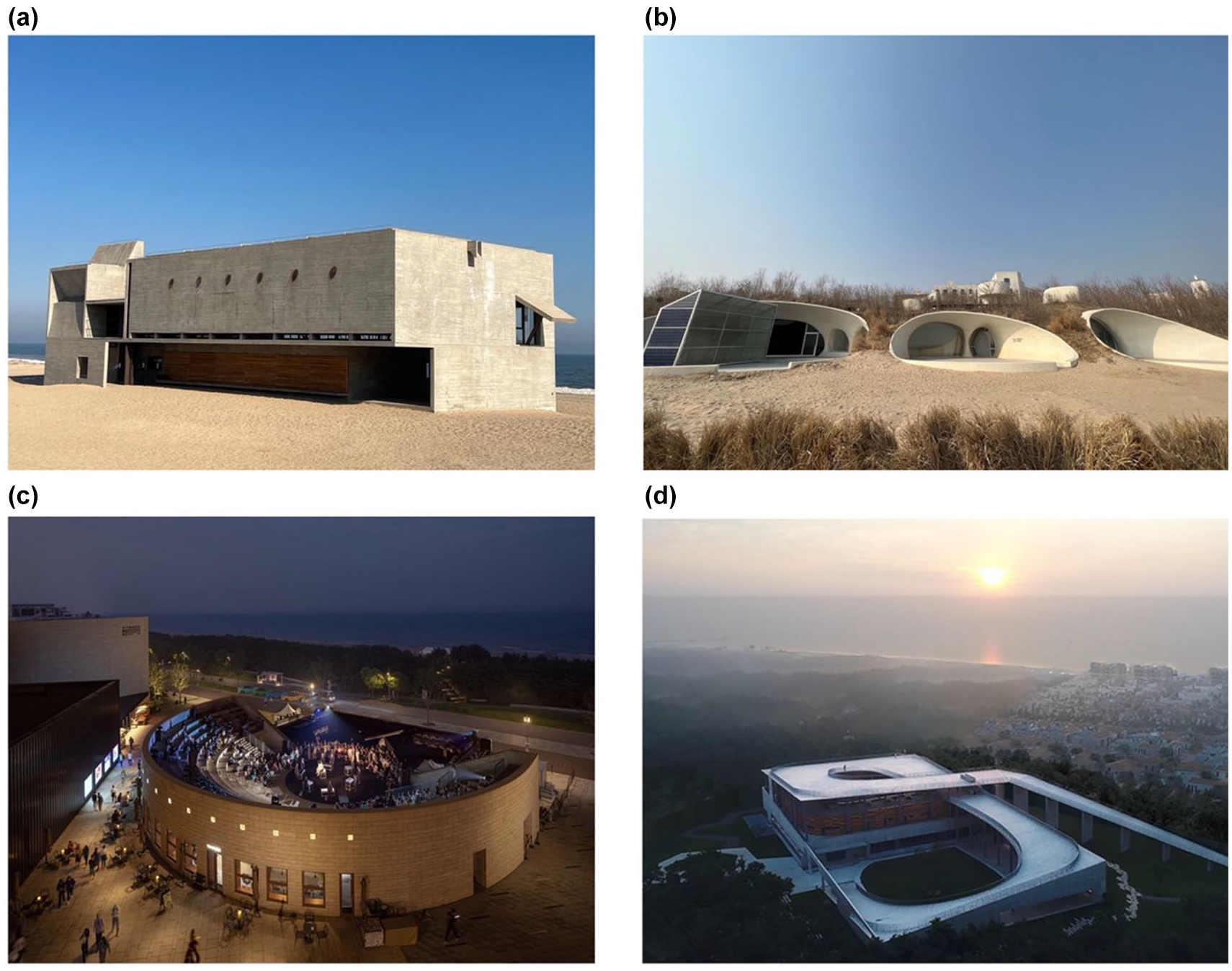
Major architectural projects in Aranya.
The Aranya project is intriguing because it invites us to deliberate on its progressive potentials juxtaposed with commercial discourses branding a tourist attraction, a theme-park-like place. As Coleman (2013) points out, for Lefebvre concrete utopias are “responsive and just social settings” (350) that emerge from the present but exceed its limits. This methodology avoids the entrapment in radical blueprints that ordinary people are not capable of delivering but draws on the “prodigious diversity of living” (Coleman, 2013: 354) and the open-endedness of everyday inhabitation of spaces to experiment with alternative ways of life. After all, Lefebvre believes that the downfall of the capitalist system is premised on the reinvention of everyday life. Thus, rather than adhering to the idea of class struggle, Lefebvre sees no problem in working with capital and market to unsettle them from within. Urban utopias, as a result, are necessarily partial and incomplete. This point encourages us to scrutinise the political limitations of the Aranya project without dismissing the potentiality of everyday practices as an open, creative system. While entrance to the public buildings is free of charge, they have not departed from the logic of aestheticisation for capital accumulation, for they are complicit with the exclusion of people other than middle-class and wealthy consumers. Aranya is by nature a commercial project, and most residents are second-home buyers from major cities located nearby, such as Beijing and Tianjin. Meanwhile, in order to maintain a high degree of consumer satisfaction in those carefully designed and branded spaces, residents and tourists staying overnight have privileged access, at the expense of short-term visitors, often from the local place of Changli or Qinhuangdao. In this sense, the project not only creates divides between different social classes but also separation between a middle-class enclave and its local contexts. It reinforces, rather than amend, the fragmentation of social fabrics, as opposed to Lefebvre’s advocacy for a reunified realm of everyday life. None of these, however, cloaks the fact the project does fulfil middle-class residents’ aspirations for nature and lived bodily rhythms. In the pragmatic view of Lefebvre, social spaces are always caught up in many competing directions of unfolding and becoming, and the majority of social experiments need to work with a series of contradictions.
Renovation of a traditional house
Architectural design is increasingly a social and cultural practice in urban China. On the one hand, architecture has become more attached to the individual authorships of architects, who see their works as projections of their visions about the good city and good society. On the other, instead of being driven by the mass needs defined by rational urban planning, architects are now more attentive to the situated needs of individual people and households, and many architectural works are customised to improve the living conditions of disadvantaged people by making the best of highly constrained conditions and resources. These trends are evinced by the popularity of several TV programmes themed on do-it-yourself building and design, such as Dream Home (Mengxiang Gaizaojia, Shanghai Dragon Television) and Dream House (Piaoliang de Fangzi, Zhejiang Television). The renovation project we discuss in this section was the theme of one episode of Dream Home in 2014, and since then received wide media exposure, among several other episodes featuring how on-site renovation work negotiated extremely cramped spaces and substandard infrastructures to create spaces of comfort and more importantly dignity for marginalised urban residents.
The family residence concerned by this renovation project was part of a traditional two-storey house located close to the City God Temple (chenghuangmiao), a renowned tourist spot in Shanghai. At the time that the client commissioned the project, the residence was owned and inhabited by a family of four surnamed Z, including the client’s grandmother, father, aunt and uncle-in-law (the latter two were the father’s sister and her husband). Meanwhile, because the house was located in a school catchment area, a great granddaughter in the extended family would soon join the existing four. The number of family members that the residence needed to accommodate contrasted starkly to the fact that it only occupied a small part of the second floor, with a floor area of just 14 m2 – the first floor was used by three shops facing the street, while the second floor was shared between the Z family and another family surnamed G. While the Z family carved out a small space on the first floor for kitchen and toilet (3 m2), another inbetween the first and second floors for storage (6 m2), and an attic as the bedroom for the father and the couple, 10 the living conditions were still extremely crowded, and the sharing of a bedroom among the father, his sister and her husband made it unlikely for the three to have any sense of privacy. 11 On top of this, the residence was inflicted by many other problems. First, the wooden structure had been riddled with worms, and the main pillars and beams had also been displaced from their original positions, leaving the whole house in an unstable state. Second, the use of space was not efficient – the space on the first floor was largely wasted, accommodating only a staircase; the kitchen and toilet were squeezed into the same space, causing issues of hygiene; and living spaces were blended with other functions such as storage, imposing limitations to the exercise of bodily functions and everyday needs. Finally, everyday life needed to negotiate a lot of difficulties and discomfort. For example, the staircase leading to the second floor was very steep, with a slope of 68 degrees, and each stair was only 15 to 18 centimetres wide, which was hardly adequate for a foot on it. In fact, the client’s grandfather passed away after he fell off the staircase. Also, the residence had poor natural lighting, and it was always quite dim and gloomy indoor. 12 In all, it seems reasonable to apply the Lefebvrian concept of abstract space to understand the production of this blighted residential space – on the one hand, the space certainly constricted the realisation of people’s lived experiences and needs; and on the other, the cul-de-sac faced by the Z family was overdetermined by a broader context of capitalist economy, because they could not afford commercial housing in a central city location, while a peri-urban location would entail forsaking social and cultural densities in the central city and falling victim to the centre-periphery divide condemned by Lefebvre (1996).
In line with Lefebvre’s view of concrete utopia based on experiment and trial that renders the familiar “unfamiliar” (Highmore, 2001), the architect entrusted with this work, Shi Nanqiao, worked with extreme constraints to explore a spatial formation that was not radically new but would nonetheless alter the socialisation of space and its associated social life. As Shi reflected about his philosophy, design for the disadvantaged is like a “competition with space”, and we must reclaim control of every square inch by carefully adjusting “every line, every ratio, and every scale” – in this sense, “space can be produced through human skills”. 13 In this project, this ethos about “small space but big work” was manifested in several important modifications to the residence. First, the project restored all major pillars and beams to the original positions and reinforced them with a steel frame, so as to maintain a basic level of safety. The walls were rendered with plaster that sealed moisture and further added to the strength of the structure. Also, the surfaces of the walls were padded with béton brut (raw concrete) to further insulate moisture. 14
Second, the use of space was optimised and made more efficient. For example, the first floor was initially comprised of a corridor and a staircase at the end of the corridor. Shi saw this as a wasteful use of space, and hence he relocated the staircase to the corridor. This significantly reduced the slope of the staircase, and also created a surplus space under the staircase that could be modified into a toilet, thus realising the separation between the toilet and the kitchen. The space between the first and second floors was modified into a bedroom for the client’s father, equipped with a foldable bed. This modification enabled the father and the aunt (with her husband) to have separate bedrooms and hence privacy; while not being used, the bed could be folded to facilitate air flow and ventilation. Meanwhile, a toilet was installed in a small redundant space close the stairs leading to the second floor and could be used conveniently by the grandmother. Moreover, the staircase leading to the attic was relocated so that the spatial layout of the attic could be redesigned. It was then re-divided into two bedrooms and a toilet, serving the aunt, her husband and the incoming great grandmother. 15
The final set of efforts made by Shi addressed issues of convenience and comfort, which might feel counterintuitive given extremely crowded space and restricted conditions. The dialectic between constraint and creativity was vividly played out, for example, in the ingenious idea of installing mirrors and glasses in the residence as an uncostly way to amplify natural lighting. Also, the architect designed every piece of furniture himself, tailored to the measure and scale of each room; even all the nonrectangular corners in the residence were modified into storage spaces to maximise the use of space. The exterior appearance of the traditional house was kept intact; for the interior decorations, they often imitated the colours of woods to reconnect the inhabitants to nature, and some furniture was processed to exude the feel of vintages and give the residents a sense of history and identity. Also, all stairs in the residence were made wider and hence less steep (Figure 2).
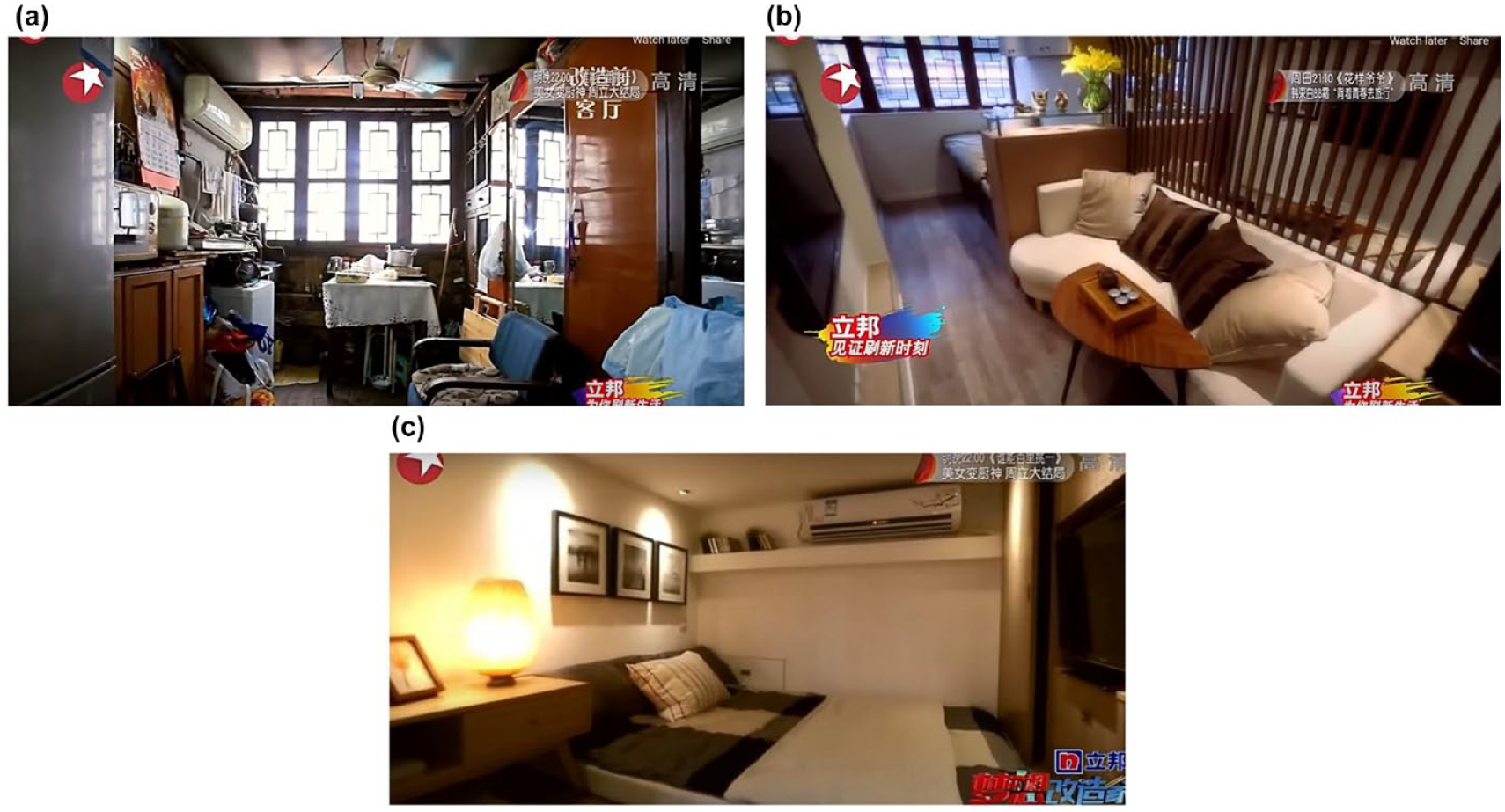
Comparison of the residence pre- and post-renovation.
A final point that is worth noting is that the reworking of material space may also invoke the reconstitution of social relations. The renovation work similarly epitomises the ambivalence of urban experiments. On the one hand, it enables the generation of commercial value for the TV programme. It also works with the dominant definition of property right, which was heavily criticised by Lefebvre (1971), and helps the G family to stabilise and boost the property value of the old house. On the other, however, it contributes to the improvement of family relations, neighbourly relations and even place belonging. The point is particularly pertinent in contexts of severely constrained conditions, in which spaces and resources are often closely shared among many disadvantaged people (Simone, 2018), and to reassemble materialities for the generation of new potentials and affordances depends on a spirit of collaboration from bottom up. For example, the renovation project, especially the reinforcement of the wooden structure, was initially opposed by the G family, which shared the house with the Z family, out of concern for safety. To convince and involve the G family, Shi offered to provide them with design service as well. Because the floor area for the G family was even smaller than that of the Z family, the former constructed a third floor on top of the second, which physically suppressed the attic built by the latter. As a result, the height of the attic was under 1.5 meters, and an adult could barely stand in it. After mutual negotiation, the G family agreed to increase the height of the third floor, leaving room for extra height for the attic, which was eventually realised through the renovation work. In return, the Z family conceded a small space for the G family to build a pipeline so that a flush toilet could be installed, which was lacking for the G family prior to the renovation. In sum, it was through negotiated materialities and also negotiated social relations that the renovation project finally came to fruition. 17
Conclusion
The purpose of this paper is to analyse architecture as a social innovation that exists in the interstices of alienated everyday life and abstracted social space. We highlight an epistemology of hope and positive change that concurrently emphasises its spatial and material dimensions. Hence, this paper understands architecture as a nexus of practices and relations that can be acted upon and experimented with in non-radical and incremental ways, thus foregrounding a conception of urban utopia that is more practical and grounded than those in classical and modernist thinking. Both the projects examined in this paper are illustrative of this theoretical perspective, for three reasons. First, they both address people’s everyday experiences and lived needs rather than radical but nebulous visions about social progress. Second, they do not break away with the capitalist economy but still rely on market circulations to access resources. Finally, however, they are aware and critical of the dehumanising and alienating effects of the dominant socioeconomic systems and engage with non-economic concerns and rationalities that have hitherto been marginalised and neglected.
For Lefebvre, to constantly enrich everyday life through a diversity of alternative meanings and values would eventually dilute the “hardcore” version of capitalist economy and lead to the reinvention of capitalism and our social life. Whether Lefebvre’s theoretical and political proposal has plausibility in the long term is a question that does not have a definite answer – small acts that address urban alienation may or may not lead to the downfall of the bastion of capitalist modernity. Still, an ethos of hope at least keeps us aware about the dialectic between seemingly static realities and a horizon of potentials and possibilities and motivates grassroots agency to make the most of present conditions, so that urban life is rendered more liveable and fulfilling (Anderson, 2006).
In concluding the paper, we acknowledge some limitations that this paper is subject to. First and foremost, this paper focuses predominantly on the discourses and visions of architects. Yet, how people’s everyday inhabitation of space reaffirms or contests these visions, and how everyday practices culminate in new debates and controversies around design, have not been adequately heeded. Precisely as Jacobs (2006) has pointed out, buildings are in fact “building events” in which relations and meanings are constantly renewed and renegotiated. Hence, the aftermath of accomplishing a building is in fact integral to social scientific understandings of architectural experiments, and the utopian dimensions need to be understood in more depth through ethnographic works. Second, this study has not touched upon the most disadvantaged strata in the Chinese society. Earlier, we critically reflected on Aranya as a middle-class enclave. But even in the case of the renovation project, the client was not dispossessed to bare life – after all, they were property owners of the residence and could afford the cost of renovation, which was about 240,000 Chinese RMB. Such association between architects and the specific class identities of clients further attests to the ambiguous place that architectural experiments occupy, between contestation to and co-optation by the dominant system. So far, we have little knowledge about architectural projects that serve the poor or the most disadvantaged in China, although beyond the Chinese context such engagements were evident in the Barefoot College in India and the community engagements pioneered by Karl Linn in the U.S. (Goodman, 2020; Miles, 2007). Finally, this paper has not probed into the relations between architectural innovations and state regulations that tend to impose uniform standards and criteria. Indeed, the Dream Home programme is occasionally beset by the problem of violating planning rules, and the Shanghai Municipal Government is already exploring the possibility of undertaking a massive urban regeneration project in the area to which the second case study belongs, though state projects do not necessarily eradicate grassroots spaces but may create new interstices for such innovations. Yet, there are also many Dream Home projects that have so far not been subject to state intervention. As to Aranya, while it showcases expanded room for the performativity of architectural design in China, avant-garde styles may disrupt spatial and visual orders in cities and arouse the state’s regulatory responses. These three shortfalls can be addressed only through nuanced empirical works in the future, for which we strongly appeal here.
Footnotes
Declaration of conflicting interests
The author(s) declared no potential conflicts of interest with respect to the research, authorship, and/or publication of this article.
Funding
The author(s) disclosed receipt of the following financial support for the research, authorship, and/or publication of this article: This research receives funding from the National Natural Science Foundation of China (Grant No. 41871124; 42071171) and The Hui Oi Chow Trust Fund at the University of Hong Kong. We are also grateful to Wang Zhikang for his research assistance.