



Abstract
Economic reform and housing commercialisation have fundamentally changed employer and employee relations and resulted in new patterns of urban governance in China. Consequently, recent research has focused on the emergence of new residential forms, their corresponding homeowners’ associations, neighbourhood committees and shequ governance structures – shedding light on state re-emergence at the grassroots level. However, an important omission in the literature is the changing roles played by the large number of existing work units within urban governance. This paper examines the new status of urban work units and assesses the changing nature of public institutions and their impact on socio-economic relations in communities – using a 70-year-old city hospital (shiye-danwei) as a case study. Key actor interviews and field observations reveal that these type of work units have created a framework of ‘one work unit, multiple systems’ – where mainstream employees not only enjoyed high pay, enhanced support and benefits at work, but also more opportunities to exercise influence in the neighbourhoods where they live. The case demonstrates that neighbourhoods and work units form two pillars within contemporary Chinese urban society in which shequ, resident associations and the work units all provide social and economic support and concurrently exercise social and political control.
Keywords
Introduction
After more than 40 years of reform and privatisation, fundamental changes have occurred between people-employer-government relations in Chinese cities (Cai and He, 2021; Tomba, 2014; Wu, 2018). Up until the early 1990s, the work units or the ‘danwei’ acted as the foundational building blocks in urban society, with cities effectively consisting of multiple work units that formed a kitchen tile like spatial layout (Bray, 2005; Chai, 2014). The work unit not only acted as a place of employment, but as a guarantor providing all possible residential, economic and social needs for its members. This provision was also coupled with control, as the work unit effectively acted as the state’s first point of contact in maintaining social order and governance (Lu and Perry, 1997). With the progress in economic reform, housing privatisation and market-driven transitions, many functions of the socialist danwei were gradually privatised, delegated and eroded (Ji, 1997; Gore, 2011; Wu, 2008). The focus of urban China literature therefore shifted towards the new urban forms that emerged over the years (Hsing, 2010), with particular interest in aspects of urban life that had been delegated from the work units (Gore, 2011) and the rise of neighbourhoods and civic organisation (Fu and Lin, 2014; Read, 2012; Tomba, 2014). More recently, researchers also began to pay more attention to the re-emergence of the state and its corresponding urban governance (Wu, 2018), questioning the streamlined western logics of privatisation (Wu and Zhang, 2022). As such, current literature has focused on the different patterns and configurations of neighbourhoods within the city, that have formed due to dynamic juxtapositions of grassroot neighbourhood organisations and state-led community associations (Cai and He, 2021; Lu et al., 2020; Tang, 2020).
Many of these recent studies tend to overlook the influence of work units, assuming the danwei arrangement as a declining structure. Recent observers have noted not only the work units survival, but that many are thriving and reproducing pre-reform socialist practices (Cliff, 2015; Francis, 1996; Keith et al., 2014; Kipnis, 2013). However, these studies are often based on profit driven enterprise work units (qiye-danwei) (Phelps et al., 2021). Public owned institutional units (shiye-danwei), such as government agencies, schools or hospitals, which are oriented towards service provision over profit production have faced far less erosion in comparison to enterprise work units – and have similarly drawn little literature attention. Their sustained relationship with the state after reform (Yang, 2004) and their continued presence in Chinese cities therefore have drawn our attention to what kind of influence they may still have on communities and individuals today.
Considering the continued presence of public institutional work units and their sustained elements of socialist danwei characteristics, this study aims to shed light on two related questions: How have the institutional work units changed and adapted under urban reform and transformation? And more so, how do these work units continue to exert their influence over urban and community governance today?
I address these questions by using one core case study – a central city hospital (from now referred as ZhongXin Hospital) located within an inland and under-researched medium-sized city in central-western China. 1 The empirical case study sections are based on analysis of documentary materials, on-site observation and stakeholder interviews. Documents consulted include papers and statistical reports produced by the hospital, which set the contextual details and official perspectives on various changes that occurred between 1951 and 2021. Stakeholder interviews (a total of 38 of them) were conducted with: doctors and nurses of various seniority, administrative personnel of different ranks, and temporary and outsourced workers. These interviews lasted between 30 minutes to 2 hours each. In addition, neighbouring work units and other hospitals within the province were visited to contextualize this case within the broader context of Chinese cities. 2
The next section reviews the literature on the changing nature of work units and the new patterns of urban governance. The subsequent sections will present a detailed report of ZhongXin Hospital in relation to institutional development, employment relations, welfare provisions, and housing and community support. Based on the discussion and analysis of this case, the last two sections will discuss the changing but enduring nature of the Chinese institutional work unit, their implications to contemporary grassroot urban governance, and potential theoretical contributions to urban China research.
Work unit reform and urban community governance
Prior to the reform era, urban governance in China was dominated by the work units. State-owned enterprises, government administrative bodies and public institutions acted as fundamental units of social organisation to which people in the city belonged. The ‘totality’ characteristics of the socialist danwei were reflected by the control over an urban employee’s life beyond work, as residential spaces were concurrently managed by work unit management; often being physically enclosed within the danwei’s grounds. Pre-reform literature therefore focused on the societal environment created by the totality of the work unit (Whyte and Parish, 1984) and its ‘organised dependency’ between workers and the danwei institution that forced the cultivation of personal ties with one’s superiors (Walder, 1986). This relationship was extended and solidified beyond just employment, as housing and provision of lifelong services were dependent on employee relations with the work unit (Lu, 1989). Social identity, mobility and the general life of an individual and their family was therefore fundamentally defined by ranks and relations within their work unit. Similarly, as work units themselves were not equal and diverse in their functionality and command over resources (Xie and Wu, 2008: 561), the quality of life for an individual in the Mao era city also corresponded to the social prestige and capabilities of one’s work unit in relation to the urban environment (Dutton, 1998: 214–15). As all work units belonged to the state, urban governance could be then interpreted as the state acting through the work units.
During the first stage of reforms in the 1980s, marketisation and privatisation began to erode the totality aspects of the work unit (Bray, 2005). The impacts on work units due to reform were, however, not uniform as privatisation was initially aimed towards enterprise units that focused on production and profit, rather than institutional (shiye-danwei) or administrative work units that instead provided services – such as health or education (Lu and Perry, 1997). Market-oriented reforms in the late 1990s focused on the reduction of unprofitable state enterprise work units (Lee, 1999) and consecutive reforms relating to housing commercialisation saw the curbing of the physical environment of the work unit and the direct relationship between employment and living space (Chai, 2014; Gore, 2011; Wang and Murie, 1996). In wider literature, this process, dubbed as ‘de-danweiisation’ (Ji, 1997), also saw the declining importance of work units in relation to urban governance and the direct management of their residential spaces (Wu, 2002). The work unit’s influence over the individual was weakened, as the definition of one’s social identity through the danwei was nullified by the market and perceived withdrawal of the state, via the work unit, from residential spaces (Bray, 2005).
Urban life in cities therefore fundamentally changed, and over the years, the work units have fallen from attention, as research rightly re-focused either on the multiple new neighbourhood forms that have emerged, typically middle-class and gated communities (Zhang, 2010), or the new market-oriented cultures that have emerged within work spaces (Gore, 2011). In particular, the re-emergence of the role of the state in these new spaces has drawn significant attention and reassessment of neoliberal assumptions regarding market forces over the neighbourhood and the Chinese city (Read, 2012). The emergence of shequ governance and other residential-oriented committees is often interpreted as the state’s attempt and desire in filling the governance gaps left by defunct work units (Fu and Lin, 2014; Tomba, 2014) – or as Wu describes it: ‘it is in the neighbourhood that the state’s authoritarian governance is achieved’ (Wu, 2018: 1180). However, as China’s reform has not been consistent both historically and geographically, neither has the state’s re-emergence within the neighbourhood. Varying degrees and types of housing commodification can yield different forms of neighbourhoods and as a result contrasting degrees of private and state influence within urban governance structures (Lu et al., 2020; Wang and Clarke, 2021).
The degree of state presence over a neighbourhood can drastically alter the kind of community engagement that is created and concurrently the resources and support it could obtain from district-level governments (Tang, 2020). In some areas neighbourhood community creation can be a state-led affair (Wang, 2022). Although, this is not always the case as the emergence of community-led grassroot neighbourhood organisations can often take precedence and lead over local government structures of the same level – revealing the uneven reach of the state (Cai and He, 2021). In all these interpretations however, the relationship between the state at the grassroots level is generally summarised as a dichotomy between the state and neighbourhood or community associations – the work unit being often overlooked.
Considering de-danweiisation was also an uneven process, and often focused on enterprise units that were failing to make a profit (Xie and Wu, 2008), it is possible to question the extent of influence the work unit might retain over grassroot communities via their employees. This is explicit when accounting for surviving enterprise units dubbed ‘neo-danwei’ and their revived socialist work unit practices of welfare provisions (Cliff, 2015). Concurrently, the same can be applied to the institutional work units, which were harder to privatise due to their function of non-profit service provision and therefore less likely to share the demised fate of unprofitable enterprise units (Yang, 2004). Consistently, National Bureau of Statistics (2017) data reveals that public institutional work unit employees have seen a consistent rate of growth from 34.2 million in 2006 to 44.2 million employees in 2016 and now account for over 25% of those employed in China. The sustained presence of the institutional work unit seemingly remains strong, and work units that were able to capitalise on their position often expanded their capabilities and offered their employees better provisions through the creation and increased distribution of housing aid, services and welfare (Wu, 2015). 3
For hospitals in particular, the Ministry of Finance’s promotion of greater self-sustainability saw many funding responsibilities transferred from the central to local governments (Tu, 2019). Later reductions in health care financing forced hospitals to ‘rely more on the sale of services in private markets to cover their expenses’ (Blumenthal and Hsiao, 2005: 1166). Such practices, which resulted in occasional profitability, directly translated to better provisions for work unit employees, the most explicit aid often coming in the form of housing support (predominantly the housing provident fund and assisted purchase) – a specific relationship between the work unit, residential space and its employee that is identifiable as a continued form of elicit housing governance (Zhang, 2002: 18).
Considering the above and that not all work units were completely dissolved, with some potentially even thriving, ZhongXin provides a classic case example of an institutional work unit that has experienced the range of China’s urban transformation. Therefore, we can consider: in what ways could employer-employee relationships mutate, and how can aspects of governance evolve and continue to expand today?
The case hospital
ZhongXin Hospital, located within a medium-sized city in western China, serves as a good example of an institutional work unit that has experienced the general trend of Chinese urban transformation. The city region where the hospital is located covers a central city (with three urban districts plus a high-tech development zone) and several counties, with a total population of 3.3 million in 2020 (ZhongXin City Databank, 2021). The core urban districts experienced extensive development throughout the last few decades, initially benefiting from central government policies in the 1960s which distributed key manufacturing industries to inland cities. In the 1970s and 1980s national planning policies encouraged the expansion of medium-sized cities and this city grew further and accepted several industrial projects of national importance. Due to the presence of these important state-owned enterprises and the associated growth of services, population in the central city tripled to 1.4 million since the 1990s (ZhongXin City Databank, 2021).
ZhongXin Hospital has mirrored the growth of its host city. Being set up in 1951 by the Ministry of Health to care for the wounded from the Korean War, it has grown into the main hospital in the city and has seen its workforce increased from about 200 to over 2400 employees today (ZhongXin, 2011). It is now the best state-owned health institution in the city, serving not only the urban residents within the central city but also the entire municipal administrative region. The hospital, with a total land area of 113,000 m2, was placed at the suburban areas of the then smaller city in the 1950s; it is now situated at a very important and convenient site in the inner-city area due to fast expansion of the built-up areas.
From a management standpoint, ZhongXin was decentralised to the provincial health department in 1954, then further down to local municipal administration in 1972. This initial hand-down to the local level was, however, largely symbolic, as it was still supervised closely and funded directly by the Ministry and provincial department until the reform era. De-danweiisation in the late-1980s and mid-1990s had limited effects on institutional work units, as they were often linked to specific government departments – hospitals being tied to the Ministry of Health (Burns and Huang, 2017). Nevertheless, marketisation policies between 1978 and 1999 saw the reduction of public health care spending by 50% (Blumenthal and Hsiao, 2005) and large hospitals like ZhongXin were reclassified to a partially-public-funded institutional unit (cha’e bokuan shiye-danwei). The push towards partial self-finance was accompanied by increased hospital autonomy in terms of management, finance, staffing and land use. This continued until 2009 when further decentralisation policy saw hospital finance being transferred directly to municipal health bureaus.
ZhongXin, with its increasing patient numbers and municipal support, was very successful in revenue generation, business expansion and large-scale redevelopments (Zhao 2017). The single-storey old medical and residential buildings, which marked the hospital’s appearance until the 1980s, were largely transformed into multi-storey tower block medical buildings and residential complexes by the 1990s and early 21st century (see Figures 1 and 2). Managers indicated that the main issue was no longer about funding, but a space limitation problem, as the expansion of the hospital is restricted by its original land and boundaries (current and retired human resource manager, April 2018).
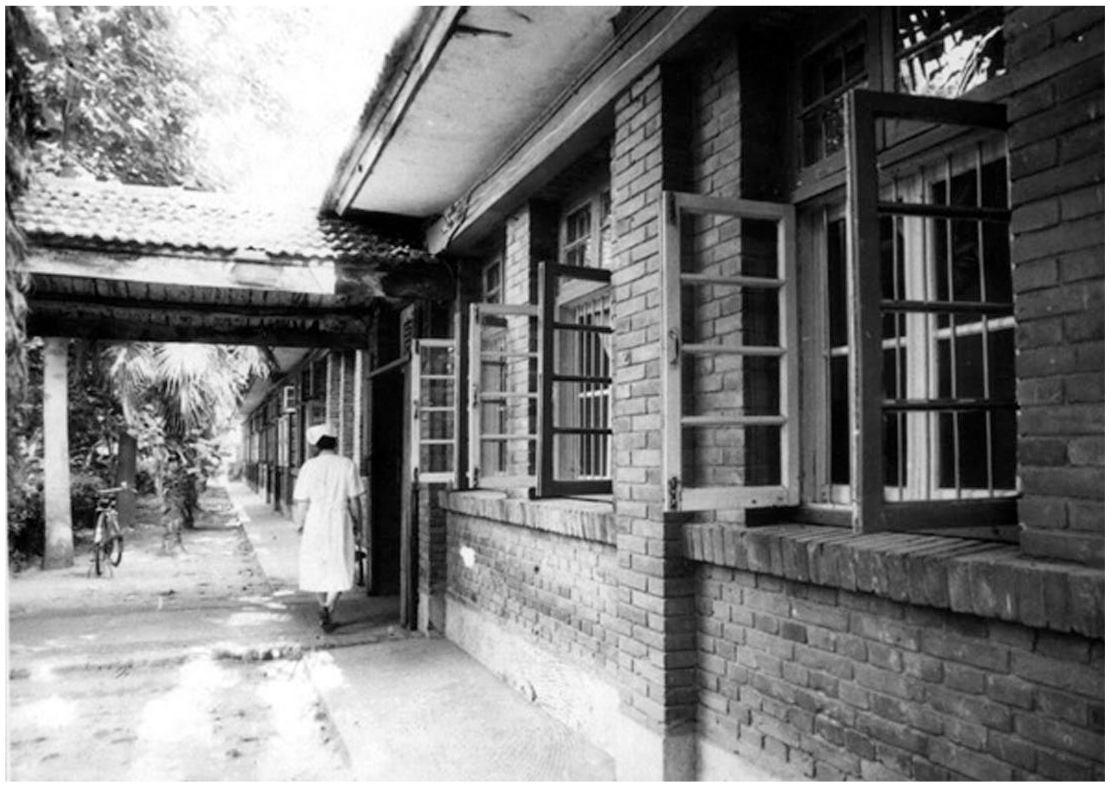
The main surgery building in the hospital until the 1980s.
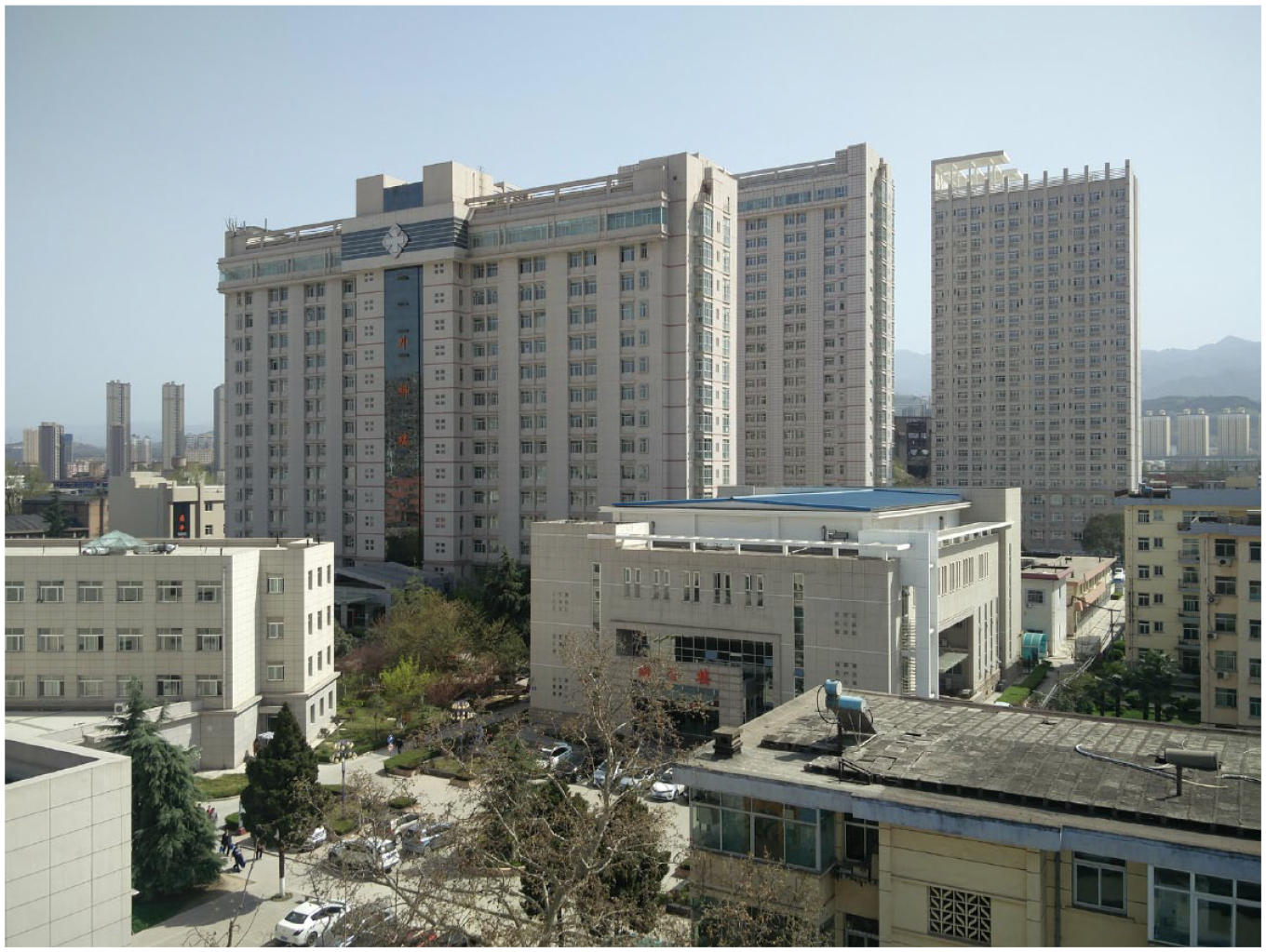
Modern multi-storey medical buildings in ZhongXin.
Employment relations
Early manager-employee relations in work units were described by Walder (1986) as organised dependency – where workers would be closely tied to their managers socially and politically. Through reform, the managers’ role changed gradually from one who could directly determine the employee’s social and political life to one who could only control the employee’s work life and associated finances. However, reform was gradual and according to employees, cultivating personal ties with managers remained important as one’s salary (such as bonus distribution) still depended on the chief’s discretion (retired doctor and current doctor, April 2018). Furthermore, well-run departments often had daily morning meetings, that, although they were meant for professional issues, often acted as a communal space to solve and mitigate inter-departmental employee grievances. In this context, department chiefs and chief nurses often proudly used the analogy of the department being a family – an anecdote reflected by pre-reform relations via all retired staff in interviews.
Job security
In the Mao and early reform era, everyone who worked in the work units were considered full and equal members and were guaranteed lifelong employment. The only technical division, in terms of employment status, was between whether employees were considered a cadre (ganbu) or a worker (gongren). In the hospital, cadres consisted of doctors, nurses, teachers, scientists and administrators, whereas workers included health aides, catering staff, and cleaners (ZhongXin 2010; 2011). At ZhongXin, reform saw cadre posts converted into permanent institutional work unit contracts (shiye hetong). By contrast, those with worker status were either converted to temporary contracts or allowed to take early retirement. The conversion from life-time employment to contract-based employment was, however, not a linear process, nor did it happen overnight. One manager, when asked about this reform, stated that, ‘. . . in reality, every year is like a reform year’ and that previous arrangements were never entirely removed – described as ‘old methods for old people, new methods for new people’ (laoren laobanfa xinren xinbanfa) (current and retired human resource manager, April 2018), the most crucial change being that newly hired workers were signed under a different (enterprise unit) temporary contract (qiye hetong) that carries less benefits and securities in comparison to the permanent institutional contract.
This staggered shift towards fixed contract employment has created a spectrum of differential treatment that depended on an employee’s relation to the hospital when they joined. For example, all employees, including lower-skilled health aides that were later converted to temporary contracts, who were employed prior to reforms in the 1990s were still entitled to the full pre-reform institutional (shiye-danwei) pension. However, by the mid-2000s, health aide recruitment became solely composed of outsourced labour and was no longer considered a work unit member. This arrangement was largely replicated for cleaners and catering staff, who saw limited access to both bonuses and welfare.
In February 2018, this process was extended to 70 newly hired nurses, who as cadres were traditionally treated similarly as doctors, but were all signed on via enterprise contracts. One manager pointed out that although these new enterprise contracts enabled nurses’ to be members of the work unit, it did not entitle them to permanent employment, meaning the hospital can choose to not renew and fire inefficient or problematic nurses (department chief doctor and human resources manager, April 2018). In theory the shift towards enterprise contracts offers more flexibility and mobility. However, this assumption also indicates the gradual erosion of junior and low-skilled staff’s job security and leads to serious inequalities among employees. However, the rigid nature of the permanent contract continues to parallel egalitarian structures as seen under danwei membership in the Mao era; the conversion of lower-tier occupations but also encroachment of more prestigious occupations from institutional to enterprise contracts resembles more of the changes that align with market transition.
Wage distribution
Although contract-type primarily defines how each employee is treated, one’s occupation and professional rank define how one is paid. Before the reform era, wages were a fixed sum that depended on an employee’s occupation and professional rank. During the early reform era, a fixed bonus pay (jiangli gongzi) was added on top of wages and distributed proportionally at the discretion of the departmental chief; this amount was often very small and did not exceed the regular pay. New wage systems in the hospital are now composed of two parts; the occupation-post pay (gangwei gongzi) and the performance pay (jixiao gongzi). The occupation-post pay parallels the former wage system as it was effectively calculated from a fixed hierarchical point-based system that only considered occupation and professional rank. Performance pay was introduced in 1985 to replace the previous fixed bonus with the rationale that those who worked harder and those with greater experience and responsibilities were entitled to a greater total wage. However, the complex calculation of performance pay can produce greater inequality among employees, as experience and responsibilities, perceived as the outcome of working hard, are often defined by rank seniority.
The amount of performance pay for each employee is determined by three factors: (a) total departmental income for distribution, (b) the number of employees who share this income controlled by the department and (c) an individual’s performance pay ranking based on occupational grade. In ‘wealthier’ departments, such as various surgical departments, the performance pay could be double or even triple the monthly occupation-post pay; a distribution scheme often also resulted in a greater gap for performance pay among employees; department chiefs could earn up to ten times the income of trainee nurses from just the performance pay. In contrast, less profitable departments saw reduced staff inequality (such as Traditional Chinese Medicine), as there were smaller performance pay allocations due to less departmental income. In this sense, the performance pay arrangement is significantly different from the previous fixed bonus pay system. When we consider salaries and bonuses between different contract types, the work unit has seemingly moved more towards that of inequality as defined by marketisation. However, as market transition has brought about new forms of employment relations and valuations, point system hierarchies and the need to curate employee-employer relations persist.
Welfare provision
Welfare provision had a direct impact on urban community governance as housing, health care, pensions and children’s education were explicitly provided for by the work unit before reform. In the 1990s, these welfare provisions were gradually shifted away from the work unit towards government organisations and state-owned insurance companies. In the current system, employment related welfare is collectively known as the ‘five insurances and one fund’ (wuxian yijin) and effectively represents monetised contributions via an employee’s insurance (Xie and Wu, 2008). The five insurances include: pension, medical insurance, unemployment insurance, work injury insurance and maternity insurance; the one fund refers to the housing provident fund – solely used for buying/renting/renovating housing. Before reform, the work unit would directly provide for most areas covered by the wuxian yijin – for example, there was no need for the housing provident fund, as housing was provided for and medical issues for employees and family members were directly treated by doctors in the hospital. The only welfare that was formally distributed prior to reform was the pension, but as employees lived within the compound after retirement, they were still effectively taken care of – beyond monthly pensions. One manager stated the emergence of wuxian yijin began to categorise and formalise the issue of welfare, plugging the social security hole left by work unit reform (retired human resources manager, April 2020).
Currently, work injury and maternity insurances are fully covered by the work unit, whereas the pension, medical insurance, unemployment insurance and the housing provident fund consist of mandatory contributions from the employee, work unit and the government. In ZhongXin, contributions were calculated percentages based on an employee’s total monthly pay. For the five insurances, this consisted of a total 8~10% self-contribution, a 10~15% contribution from the work unit and a further 5~10% contribution from the government. The housing provident fund itself consists of a separate 10~12% self-contribution with a further 20–25% contribution from the work unit. Percentage contributions from the work unit on insurances were also tied to occupation and increased with professional rank (ZhongXin, 2010). However, due to work unit contracts for permanent members largely being lifelong, and staff dismissals remaining rare; the hospital has not deducted nor contributed to the unemployment insurance of employees since the early 2000s. Similarly, although medical insurance is paid into one’s social security, hospital employees and their families were entitled to free medical diagnostics and mandatory yearly medical check-ups. Collectively this omits cumulative costs, and contributions made by employees effectively go directly into either one’s pension or housing fund.
Wuxian yijin represents the best possible set of benefits that employees can receive in the new system, but eligibility is restricted to those on an institutional unit permanent contract – differing from blanket coverage under Maoist-era work units. Those on institutional contracts are dual managed by the work unit and the local municipal human resource bureau, whereas enterprise unit fixed-term contracts are managed by the hospital. It is the association with the bureau, making them state/government employees, that entitles them to wuxian yijin. Those on enterprise contracts, considered temporary, are not entitled to the housing provident fund component (often the largest component), and have a lower employee contribution rate to their pension. This is particularly problematic for low-skilled/paid employees as these contributions form the most valuable aspects of work unit welfare in quantity and functional terms. For outsourced workers, the hospital does not contribute to their social security costs as this is considered the responsibility of the relevant labour agency.
Differentiations as dependent on when one joined the work unit are even more prevalent in terms of pension provision. Before reform, the hospital would directly take care of its retirees with the same benefits they had prior retirement. Pensions were calculated and distributed by the hospital, consisting of the reduced final wage adjusted by a percentage based on total years worked. In 2014, pension reforms meant that contributions would instead be paid into, managed by and then paid out by the municipal government via social security. However, pensions in ZhongXin, being an institutional work unit, are still managed and paid out by the danwei. One manager further explained that in 2018 ZhongXin Hospital was running a 2-year backlog of monthly pension payment calculations, and the pre-reform method (with fixed percentages) was still being used to distribute monthly pension payments to employees who retired prior to 2014 (retired human resources manager, April 2018).
The work unit, although no longer providing universal welfare services, has instead bolstered a specific permanent base (depending on occupation and when one joined), widening the inequalities between groups of employees through the provision of greater financial subsidies for some and the elimination of welfare for others. For the work unit elite financial benefits and division can be most visibly identifiable in terms of housing.
Housing and residence
Housing provision and residence management has a major influence over urban and community governance. In pre-reform Chinese cities, the relationship between housing and employment was one of the defining features of the totality of the work unit. The perceived dissolution of this relationship, with the commodification of work unit housing and creation of a housing market, was key within the academic narrative of de-danweiisation (Francis, 1996). However, as the institutional work unit remains strong and the administrative boundaries have remained the same, ZhongXin Hospital maintains a strong interest in managing and controlling its original housing stock (accounting for about 40% of land area) – making a direct contribution to local community governance. Furthermore, as the following discussion shows, new housing arrangements, such as hospital-assisted block purchasing, has effectively extended the institution’s influence into other neighbouring housing estates and local shequ business.
Before the 1990s, the hospital built simple single-storey rooms on its residential land and distributed them to their staff with a very low monthly rent. These buildings were expanded upon by occupiers in many ways over the years and the quality was very poor (Figure 3). By the 1990s and early 2000s, the hospital had organised the redevelopment of residential areas and built several multi-floor and different-sized flats. A sophisticated point system was used to distribute these houses and considered employment length, occupation, professional rank, marital status and number of children. Those ranked higher would receive priority choice on block location and which floor/apartment to live in.
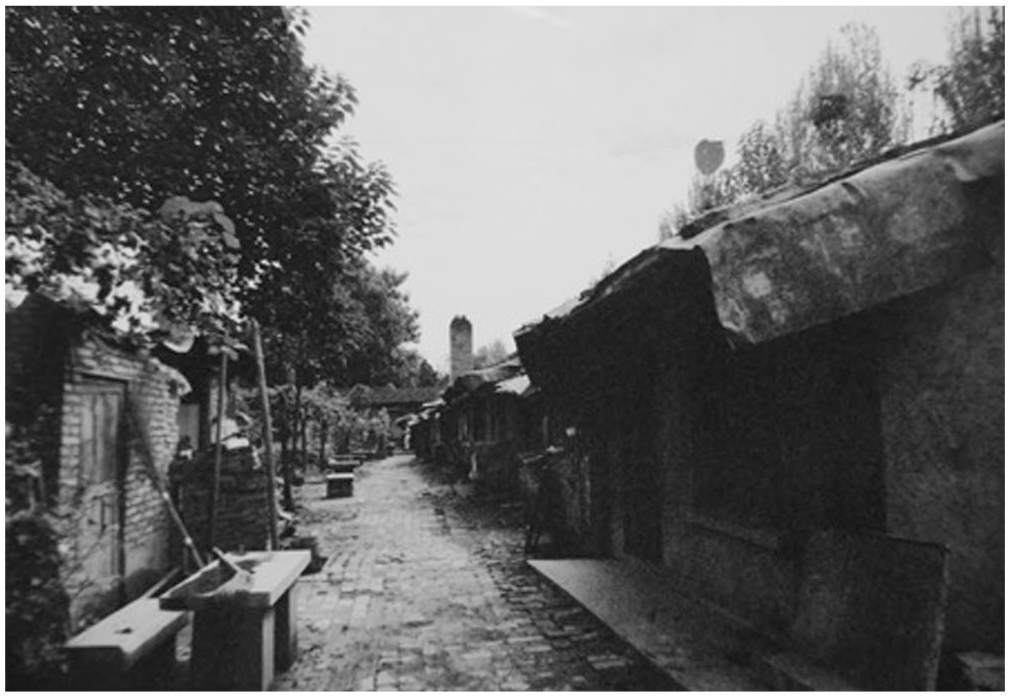
Housing and living conditions in the 1980s.
In 1998, national housing reform policies removed the work unit’s ability to distribute houses and allowed the privatisation of work unit housing (Man et al., 2011; Wu, 1996). In the same year, ZhongXin classified its residential properties as ‘reform housing’, a pseudo form of social housing, which allowed employees the opportunity to buy their allocated flats for a discounted price. As a result, most flats within the hospital have been sold to their occupiers, many of whom have since retired. Staff who joined the hospital recently would find limited, if any, housing on work unit ground.
Ever since reforms in the early-2000s, there has been a push towards standardising neighbourhood governance; transferring work unit housing management to the city government, who would then delegate these rights down to newly formed urban grassroot management organisations (shequ). However, city governments cannot seize housing land occupied by institutional units and must therefore depend on land to be voluntarily handed back by institutions. There has currently been no such voluntary move by ZhongXin. Regardless, the local government had still set up a shequ organisation that oversees residential areas in the district including the residential land owned by the hospital. This has resulted in a grey area in terms of residential administration. The residential committee (juweihui) within ZhongXin’s grounds pre-dates the formation of the shequ and its committee members are directly paid and considered official employees of the hospital – often composed of former medical staff who can no longer work directly in the hospital’s medical operations. Furthermore, as most who live in hospital grounds are current or retired employees, residents prefer the direct relation with the hospital and prevent any notion of disbanding the committee. The result is an awkward compromise and dual administration of the residential land between the hospital’s own residential committee and the local shequ – informally termed ‘joint management’ by the chair of the residential committee (interview with ZhongXin juweihui manager, April 2018). The continued direct connection between the hospital and its residential space results in the work unit as having predominant governance authority over the area and sustains an urban enclave that is practically autonomous from local government. However, the dual-management structure does restrict the work unit’s influence to managing and maintaining the residential area; specifically, it cannot re-develop old houses as this would require planning permission from the government – which would require ZhongXin to voluntarily hand over its land rights. The same manager stated that the hospital retains the rights to demolish old housing but is banned from building new housing stock under reforms in the 2000s. This has resulted in the unintentional preservation of some single-floored housing built in the 1970/1980s, and the ageing buildings constructed during the 1990s.
Although the work unit is no longer allowed to build new housing, they still provide important assistance for employees seeking properties on the market. With capital generated by the housing provident fund and increased salaries, most senior staff (who bought work unit property through housing reform) now live in neighbouring commercial estates (xiaoqu) that offer better-quality housing and living conditions. Some of them even own multiple properties, symbolising economic divisions as dependent on when housing was obtained and the concurrent ability to accumulate (see Gu et al., 2021). In 2007 and 2009, the hospital organised group-purchasing (tuangou) in neighbouring residential estates. The hospital had no direct economic involvement in the housing construction but negotiated with the property developer to assure several building blocks as exclusively for hospital employees only. The rights to buy these flats were then distributed internally among employees who required housing and allocated via the same point system criteria used prior to reform – ranking seniority and family sizes.
In the last decade, preference for such group-purchases have diminished as employees indicate the ease of buying properties individually. However, the non-monetary benefits of group-purchase, being the ability to live among colleagues, remains high as employees enjoy the community feel of living in proximity to each other (noted by both junior and senior doctors, 2018, 2021). Furthermore, many staff members highlighted the importance of convenience when living close to one’s work (various nurses, doctors and managers, April 2018). This was reflected by the fact that most employees lived within walking distance to the hospital. Ironically, although group-purchase practices no longer exist within hospital administration, most new-build properties surrounding the hospital are bought by hospital employees. In one new neighbouring high-rise estate under construction, over 80% of new sales were to the employees of ZhongXin (local real estate agent, April 2018). Despite the work unit no longer explicitly creating the conditions for the formation of an urban enclave of its employees (see Phelps et al., 2021), the economic and welfare provisions for its employees (tied with desires of convenience) have still resulted in the clustering and formation of work unit employee enclaves.
The direct connection between the work unit and employees, in the context of housing, remains strong. Newly obtained housing, although not in the work unit’s grounds, is still a sort of danwei housing and in many ways segregates non-work unit employees from the enclaves created by the danwei (see Gu et al., 2021; Phelps et al., 2021). Additionally, with permanent members being effectively categorised as state employees themselves, one interpretation can consider the presence of work unit employees as an extension of the danwei and in pseudo terms the state. This is more prevalent when we reconsider the political power the work unit may have in the context of the local government – such as in the case of ‘joint management’ and ‘dual administration’.
As ZhongXin Hospital shows, the work unit, although seeing growing restrictions in worker provisions, continues to exude characteristics that directly and indirectly help specific employees within society beyond generic wages. Many of the work unit’s benefits have undeniably changed, but in many ways, these methods are simply adaptations to the various dynamics that come with marketisation – all of which provides substantial advantages and benefits over those who are not directly associated with work units.
Discussion
This study aims to shed light on two related questions: How have the institutional work units in Chinese cities changed and adapted under urban reform and transformation? How do these work units continue to exert their influence over urban and community governance today? This section discusses the main findings. Firstly, the changing nature of work units can be summarised as continuation and change. Over the last four decades, despite various changes in relation to its management and funding, ZhongXin has exhibited continuation and has never faced any challenges which threatened its existence – like many other public institutional work units in the city and country (such as schools, colleges, large administrative and political institutions). On the contrary, as an important institutional work unit, ZhongXin has experienced large-scale expansion in terms of employment, services and physical existence (vertically) and continues to provide very comprehensive welfare services to its mainstream staff. In this sense, the work unit environment still facilitates the ‘organised dependency’ between workers and the work unit, nurturing ‘neo-traditionalism’ (Walder, 1986) and replicating Maoist work unit characteristics of all-encompassing benefits and dependence for employees (see Cliff, 2015; Kipnis, 2016).
The changes are represented by the gradual move away from relative egalitarian provisions, as the danwei develops towards more internal division, inequality and exclusion. The ZhongXin case demonstrates this predominantly through the elimination of relative equal pay and welfare provision between employees. The importance of salary and the ranging differentiations of pay (including hidden pay) have become more significant in the relationship between employee and employer – that are often defined by department and rank. The most striking change was the introduction of enterprise (fix term) contracts for low-skilled and lowly paid workers. Fixed contracts can be interpreted as facilitating employment mobility, yet they were deployed along the bolstering of salary and welfare provisions for retaining elite employees. In effect, successful work units continue to offer their core employees better and more comprehensive welfare provisions, through the creation and increased distribution of housing benefits and various insurance schemes. Yet, for the less skilled and manual workers who face exclusion in many services, work unit behaviour more resembles an employer found in a crude market economy. However, organised dependency still persists among temporary and enterprise (qiye) contract employees as relations are still required to be curated for maintaining a job. The process continues to evolve toward a more restricted mainstream staff circle, as newly hired nurses (traditionally permanent/shiye members of the work unit) are increasingly employed on enterprise contracts. What we see here is one work unit (danwei), two/multiple systems. Marketisation and adoption of contract-oriented employment exacerbated pre-existing inequalities, providing well-educated elites a comparatively better life than ever before while simultaneously marginalising those deemed of low skill.
It is evident that the relationship between the work unit and the mainstream employees have become more complex. Notably in the issue of housing, the shift from the danwei compound to commercial housing areas was often perceived as the severed link between housing and the work unit. Yet, the privatisation of initial work unit housing at discounted prices has ensured many senior and older employees (including those retired ones) with an important initial asset. The further introduction of the housing provident fund allowed many of them to accumulate and snowball further investments, and to become owners of multiple properties neighbouring the work unit. The complex relationship between the work unit and housing, although no longer as explicit, most certainly still exists and drives deeper both the dependent benefits and notion of inequality as induced by the work unit. This in effect has resulted in the expansion of the hospital’s influence far beyond its physical boundary and enabled the work unit to become a networked organisation with different arms reaching across many areas and neighbourhoods in the surrounding districts. Figure 4 shows this change, as the pre-reform work unit with its closed mosaic (kitchen tile) entity in the city transforms into a sprawling and open networked existence – exhibiting both change and continuity.
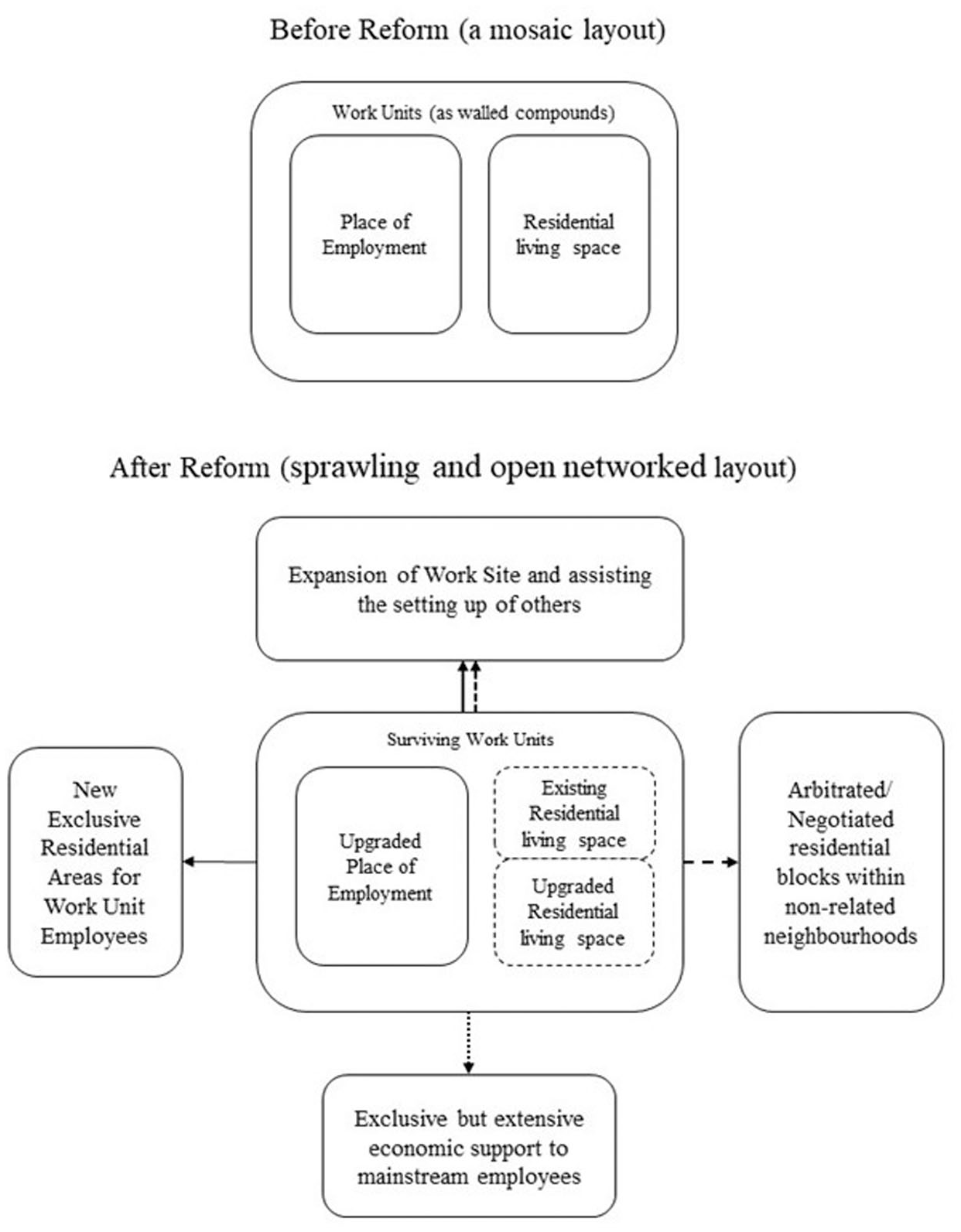
The changing nature of the work unit.
The sprawling and networked structure is more explicit when considering housing. ZhongXin has shown that when market logics are introduced within existing work unit spaces, employees will still buy houses near to their workplace. The sheer presence of current and former work unit employees in neighbouring residential areas can be inferred as a type of urban enclave and interpreted as an extension of the original work unit. Although institutional reforms allow for housing choice to become a factor, existing and strong cultural ties within the work unit will result in the clustering of employees’ homes. This expands on previous research that infers expansion and housing choice with the direct association of the work unit (Gu et al., 2021; Phelps et al., 2021). Such practices are more explicit when contrasting ZhongXin with the neighbouring steel pipe manufacturer work unit (a state-owned enterprise unit), which due to its profitability had explicitly expanded its own territory and contracted developers to build more housing stock beside its area of operation – for its own mainstream employees. In contrast, one similarly sized hospital visited in the provincial capital, with more resources, still distributes housing for senior staff and attracting talent. However, this is not to say that de-danweiisation is an irrelevant process, as to the south of ZhongXin remains a former coal power station which exhibits the process of an unsuccessful (deemed by one ZhongXin finance manager as unprofitable, April 2018) work unit. The power station itself was decommissioned in the early 2000s but the relevant work unit housing stock and its residents (largely composed of former employees) remained. Although there remains a residential committee, the lack of a work unit results in the area being directly managed by the same local shequ. However, resource shortages have similarly resulted in the indirect preservation of housing stock, paralleling old residential buildings in ZhongXin Hospital grounds.
These features of the public institutional work units have important implications for urban and neighbourhood governance. As highlighted in the literature, recent research finding shows that the emergence of shequ and other residential-oriented committees represents the state’s attempt and desire in filling the governance gaps left by defunct work units (Fu and Lin, 2014; Tomba, 2014). Researchers also paid particular attention to the various configurations and types of housing commodification that yield different forms of neighbourhoods and contrasting degrees of private and state influence within urban governance structures (Cai and He, 2021; Lu et al., 2020; Wang and Clarke, 2021).
As mentioned, these interpretations rightfully identify the new forms of dichotomy that exist between the state and grassroot neighbourhood associations. This case study of a public institutional work unit in general supports these arguments, but also leads to new insights over the specific ways the state can exercise its authority and control at the grassroots level. The main representatives of the state (shequ and jiedao) are not the exclusive actors in exerting power and control. Urban work units once played the foundational role in urban governance and in some areas today they still play an essential role, creating a three-way dynamic partnership of grassroot governance between the state – danwei – neighbourhood (shequ). In some neighbourhoods, the influence from the work unit is weaker and indirect, while in others it is much stronger, reflecting the uneven and different forms of grassroot governance structures. In this case study area, the legacy and continued influence of the work unit shapes the spatial layout and social structure of the city. The successful work units, which have been able to capitalise off the reform era via processes of marketisation and political links, dominate the selection and occupation of strategic land within the city. The private sector such as small businesses and politically weak actors fill the gaps left over by these powerful work units. In some cases, as with ZhongXin, the work unit can even act as the main arbitrator through private sector channels acquiring and supporting their employees in obtaining houses in strategic and convenient areas. For employees: rank, merit, favour and the dependence on when one has joined the work unit can define the degree/kind of benefits and assets that can be accumulated – for many, explicitly strengthening the relation between the work unit and its employee.
The influence of a strong work unit on the city can extend to other parts, as the social structures of the public institutional work unit can be replicated in the private sector. Specifically, ZhongXin Hospital was involved with the setting up of a new but private hospital at the other side of the city. ZhongXin’s support was not only limited to the provision of professional expertise but also the training and provision of management structures. Multiple recently retired employees of ZhongXin worked part-time in the private hospital and helped to set up the management structures largely replicating those of ZhongXin, the main difference being that as a private institution, the new hospital was disallowed from providing the same level of benefits and job security offered to those at ZhongXin as they could not provide institutional unit contracts. The private hospital was to some extent able to replicate the social hierarchies of ZhongXin but remains within the shadow of the work unit with its affiliation with the state and dominance in the city.
Conclusion
This research assesses the reform and adaptation of the work unit as a consistently important grassroot organisation in China. As the case study and discussion shows, the transformation toward a market economy has not led to a complete process of work unit dissolution – ‘de-danweiisation’. Institutional work units (shiye-danwei) continue to act as fundamental units of social organisation to which many in Chinese cities belong. Multiple key features of the early work unit identified by researchers such as Walder remain, and instead have been adjusted, trimmed and enhanced. The danwei persists in being a dominant factor of economic and social control, and although change has undoubtedly altered the classic framing of the work unit, the institution and its influence endures.
ZhongXin Hospital, as an institutional unit, has shown that work units are able to expand and thrive – bettering their own positions and that of their employees’ economic standing. The enduring influence of the work unit has further created inequalities that benefit its employees in drastic and unequal ways, continuing to define imbalances within Chinese cities (one work unit, multiple systems). It is when concentrating on the work unit as a framework of analysis that we are also able to see the important differences in institutional units and enterprise units within society in general – specifically the blurred concepts and divisions between them. It would be naïve to assume that there is one single linear model for institutional change, when there is much internal heterogeneity in China’s economy and society (Keith et al., 2014). The institutional work unit, both experiencing reform but also being comparatively more difficult to dismantle, therefore provides a comprehensive case that symbolises the work units’ nature as accounting for both continuity and change. Within the framework of a work unit lens, we are better able to understand Chinese cities in contemporary urban society.
As China moves towards constructing its own markets (Keith et al., 2014), the legacies of the totality work unit have diminished in some ways yet reinforced and mutated in others. The emergence of shequ governance can be interpreted as filling the spaces left by defunct work units (Tomba, 2014) and debates regarding the re-emergence of the state in neighbourhoods (Tang, 2020; Wu, 2018) – and the kind of urban governance this can create (Wang and Clarke, 2021). As the ZhongXin case demonstrates, the presence of the work unit as a grassroot form of governance persists, not only in its direct control of its original residential quarter, but also its strong influence in nearby commercial housing estates as a result of assisted block purchase of properties and other direct and indirect support for mainstream employees. Large and high-quality houses in well-designed new estates tend to be bought and occupied by the mainstream employees of various public institutional work units where the private business sector is weak. The low-paid workers such as junior nurses and cleaners can rarely be found in upper-class neighbourhoods and most of them need to rent in crowded accommodation in poor neighbourhoods like urban villages. In well-established neighbourhoods CCP members are required to dualistically report to both their respective work unit and neighbourhood (shequ). This research therefore ultimately builds on the dichotomies of state power in neighbourhoods and community building (Cai and He, 2021; Lu et al., 2020; Tang, 2020; Wang and Clarke, 2021). Furthering that today, shequ, neighbourhood associations and the work unit all provide social and economic support and concurrently exercise social and political control. Therefore, the neighbourhood and the work unit form the two dominant pillars of urban society. The changing nature of the work unit therefore still significantly shapes the prospects of many individuals throughout wider Chinese society and continues to play an important role in understanding Chinese cities and the grassroot socio-economic relations and political control they can harbour. As one retired human resources manager concluded within an interview, contemporary Chinese society, as it was in the Mao era, is still largely divided into those who belong to a work unit (insiders of the system) and those who do not (April 2018). Studies of Chinese grassroot governance should therefore not only focus on the new organisation of shequ and their associated neighbourhood organisations. As various institutional danwei still occupy large spaces in all cities, the work unit should still be examined closely as a key player in urban community governance today.
Footnotes
Acknowledgements
I would like to thank the editors and three anonymous reviewers who provided helpful comments and suggestions, as well as Rachel Murphy for her guidance throughout the research. In addition, my thanks to Michael Keith and Anna Lora-Wainwright for their comments on later revisions. I also thank all the interviewees who generously shared their time and insights.
Declaration of conflicting interests
The author declared no potential conflicts of interest with respect to the research, authorship, and/or publication of this article.
Funding
The fieldwork behind this article was partially funded by the Oxford Chinese Studies Centre Travel Grant and the Hertford College Graduate Travel Award for HT18.