



Abstract
Seasons are changing in the Anthropocene. Seasons serve as temporal frameworks for communities and societies to organize their livelihoods and activities around the expectation of recurrent environmental, social, and cultural events. In this article, we make an original case that the scale and rapidity of changes to our planet's biogeochemical cycles profoundly impact the sociopolitically interpreted (re)definitions of seasonal rhythms. We propose a conceptually novel typology for collating how new and evolving interactions between human and more-than-human environmental cycles are reflected in the seemingly simple—yet widely relatable—concept of “seasons.” We define emergent, extinct, arrhythmic (changes to timing), and syncopated (changes to intensity) seasons through our typology, to bring together disparate literature on evolving human–nature interactions, environmental knowledge production and deployment, local realities of environmental risk and disaster management, and the uneven spatiality of socioenvironmental feedback loops. Seasonality in the Anthropocene is political as it reflects a diversity of temporal ontologies and unveils unjust manifestations of the hegemony of standardized time and timescales, while the discursive construction of “seasonality” may be deployed for political and economic gains. We set an agenda for cross-geographical research that explores seasonality from place-based, multiscalar perspectives to unravel the complexities of seasonality in the Anthropocene.
Keywords
Introduction
The Anthropocene—marked by planetary-scale human impacts—remains a heavily contested geological concept. Although the Subcommission on Quaternary Stratigraphy recently rejected formal recognition of the Anthropocene as a geological epoch, many suggest that it should still be recognized as a geological “event” (Witze 2024). Regardless of ongoing deliberations, the term is culturally embedded to describe and conceptualize sudden or cumulative human-induced changes in environmental conditions (Crutzen 2002; Witze 2024).
Proponents of the term “Anthropocene” acknowledge that a minority of people have been responsible for the global changes that define the epoch (Crutzen 2002; Steffen et al. 2015). Yet, concerns over nomenclature persist, particularly the prefix “anthro-” and how it homegenizes humanity as a dominant force, disregarding social and political diversity and inequalities (Yusoff 2016). Likewise, the suffix “-cene” implies the integration of this epoch with conventional geological chronological frameworks that assume a continuous and linear progression of time. Collapsing the deep time of geology with culturally distinctive notions of human time potentially obscures complex and diverse interacting temporalities of ecological processes and human practices that shape and are shaped by the Earth (Yusoff 2016; Bensaude-Vincent 2022). The Anthropocene's associated “Great Acceleration” (Steffen et al. 2015) reflects a common perception of time as a measure of progress and development through trends in population, energy use, greenhouse gas emissions, and atmospheric temperature (Richardson et al. 2023). However, this perception neglects key elements of contemporary ecological crises resulting from clashing polychronic rhythms—“temporal mismatches”—within and between the biophysical environment and its cultures and societies. These mismatches occur when the pace (tempo) and intensity of human and more-than-human activities are “out-of-sync,” creating conflicts and uncertainties (Adam 2005; Bensaude-Vincent 2022).
Time may be considered a social construct (Berger and Luckmann 1966) whereby different societies and cultures create and maintain their own temporal frameworks and meanings, as seen in the representation of time in calendars, rituals, art, and narratives (Gell 1992). One such framework of time is Coordinated Universal Time (UTC), which has been ubiquitously adopted in a global societal response to technological advancements in communication and travel. This representation of time—as measured by standardized (but arbitrary) “seconds” within the International System of Units—contrasts with the rich variety of preglobalized concepts of “local” time based on culturally shared or unique inherent markers, such as those derived from the position of the sun or phases of the moon. In the rapidly changing environments associated with the Anthropocene, temporal perceptions of change are shaped by the social practices and institutions they are embedded in Pahl et al. (2014). Therefore, the communication, understanding, and shared experience of time with respect to environmental change—and how this gives rise to societal salience, cognitive biases, and (mis)judgments—is crucial for explaining mitigative or adaptive reactions (ibid.).
Scholars have advocated shifting from rigid “timescales” toward a more nuanced understanding of time as dynamic “timescapes” (Adam 1990, 2005; Bensaude-Vincent 2022). Timescales, offering uniform units and measures of time, serve as a cornerstone in the scientific understanding of planetary systems, enabling researchers to standardize observations and analyses, despite the complex temporal dynamics that may be unique to the processes of change across different systems. As an alternative approach, timescapes encompass spatially, socially, and culturally embedded perceptions of time, as shaped by social practices and processes. This paradigm shift highlights the complexity of interactions—both synchronous and asynchronous—among human and more-than-human elements, illuminating the multiplicity and heterogeneity of temporal experiences in the Anthropocene. Instead, timescapes emphasize the unique historical narratives and ethical implications of human existence (Yusoff 2016). In this context, we propose that the Anthropocene's manifestation through evolving timescapes affects the rhythms that underpin the organization of societies’ socioeconomic and cultural activities: our seasons.
Throughout history, communities and societies have defined seasons as distinct blocks of time. This practice establishes a temporal framework for organizing livelihoods and activities in anticipation of recurrent environmental, social, and cultural events (Krause 2013). Seasons have been celebrated through the arts and cultural festivities, often portrayed as a harmonious, perpetual ecological symphony. Traditional depictions present each season as playing its role in a seamless transition from one to the next (e.g., Shen Zhou's Flowers of the Four Seasons, ∼1460; Arcimbaldo's The Four Seasons, 1591; Vivaldi's The Four Seasons, 1725; the Noongar People's Six Seasons dot paintings). Concurrent with the standardization of time via UTC, seasonality has also been subjected to rigid definitions, such as the conventional “four seasons” in temperate regions (summer begins on 1 June), or the demarcation of tropical “wet” and “dry” seasons by Western meteorological institutions (e.g., Thailand's wet season is May to October according to the UK Met Office; 2023).
Scholars, particularly among anthropologists, have increasingly highlighted more diverse environmental epistemologies (Ingold and Kurttila 2000; Lefebvre 2004; Krause 2013). They contend that seasons have not always existed as fixed temporal blocks. Instead, seasons embody dynamic “rhythms” of life cycles that integrate economic and cultural practices with activities of other “more-than-human” entities, such as animal and plant phenology, weather patterns, ocean tides, and currents (Ingold and Kurttila 2000).
Indigenous seasons embody fluid experiences that are deeply rooted in multisensory connections with the environment, guiding navigation, coordination, and survival (Ingold and Kurttila 2000; Kalanda-Joshua et al. 2011; Enock 2013; Ryan 2013). Seasonal timescapes are not limited to local knowledge systems. Globalized economic seasons superimpose fixed meteorological seasons, such as the annual realignment of school holiday periods with warmer months, giving rise to the “tourist season” in the Mediterranean (Bimonte and Faralla 2016), followed by its counterpart “ruin season,” when resort towns empty in the colder months (Arboleda 2023). The “silly season” in the news media cycle might be considered a byproduct of holiday seasons, characterized by less serious news coverage that corresponds with the short supply of news sources during legislatory recesses (Fernández-Muñoz, Rubio-Moraga, and Álvarez-Rivas 2022; Lima, Teixeira, and Barbosa 2022). These diverse manifestations of seasons represent a continuous negotiation between rhythms of sociopolitical activities and perceptions of their underlying biophysical cycles. As such, we argue that seasons function both as conceptual and discursive frameworks within “timescapes” that give value to context-specific recurring environmental phenomena. This, in turn, may organize societal reactions and resource (re)distribution toward such phenomena (Bensaude-Vincent 2022).
Understanding evolving (re)definitions of seasons is crucial for conceptualizing human–environment interactions. As societies navigate the complexities of anthropogenically forged and altered seasons, their ability to adapt and respond to the changing world hinges upon their comprehension of seasonality (Endfield and Naylor 2015). Seasons denote collective perception and expectation of environmental “norms.” While societies in temperate geographies generally embrace the cycle of the “four seasons,” other parts of the world may only experience “winter” and “summer” or “wet” and “dry” seasons, with each bringing its own expected, yet variable patterns from year to year. For example, some summers are expected to be hotter with prolonged heatwaves, while others will not, yet the fluctuation of seasonal intensity does not change the rhythm of time passing, marked by the predictable cycles of sunlight or lunar phases. Seasons also evoke different meanings and experiences across places and cultures. Recollections of a Mediterranean winter, for instance, differ starkly from those of a Nordic winter. In Mauritius, the impact and response to tropical cyclones is conditioned by memories of the “cyclone season” that may have been forgotten and remembered (Walshe, Adamson, and Kelman 2020). The malleability of memory further emphasizes the subjective nature of seasonality. These experiences and memories of seasonal variability through both time and space set expectations of what is deemed “typical” or “standard,” thereby helping us make sense of environmental change, through perceptions of deviations from anticipated weather and broader environmental patterns (Hulme 2015).
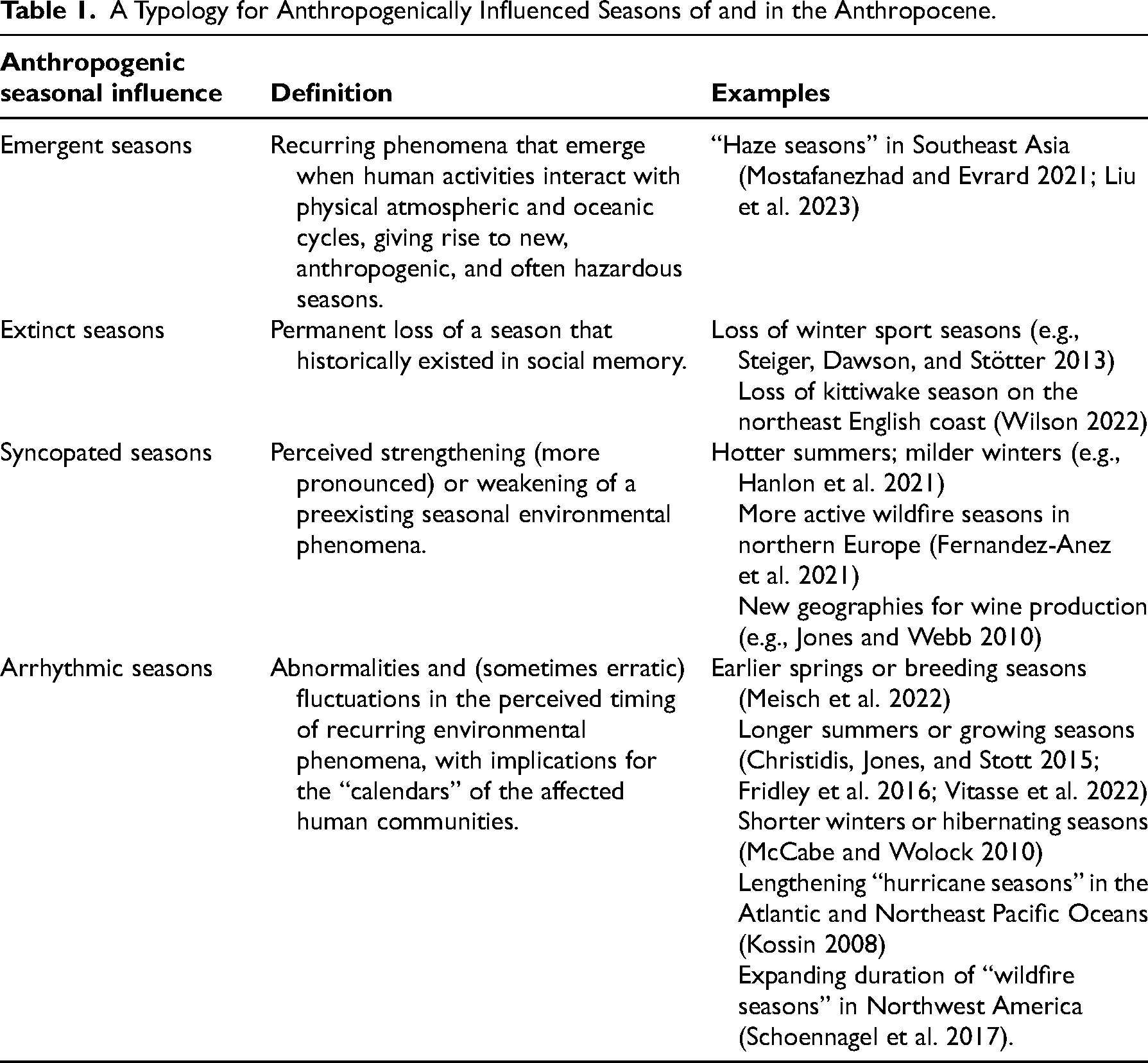
Through this agile framework of seasonality, societies recall collective, place-based, value-laden memories of the environment so that they may interpret connections with the past, navigate the present, and collectively mobilize for a future that demands preparedness and adaptability. Thus, seasons are spatiotemporal manifestations of socioenvironmental interactions. Below we propose a typology of seasons (Table 1) as distinctive timescapes through which environmental change in the Anthropocene is creating (“Seasons of the Anthropocene”) and disrupting or extinguishing (“Seasons in the Anthropocene”) environmental rhythms and their associated seasons. By proposing a typology, this article provides a holistic framework for integrating disparate fields of research—including human-more-than-human interactions, socioenvironmental feedback, local realities of environmental change, and political ecology—through a unified analytical lens.
A Typology for Anthropogenically Influenced Seasons of and in the Anthropocene.
Seasons of the Anthropocene
Seasons of the Anthropocene are novel, anthropogenic seasons. Human activities are profoundly impacting the atmosphere, hydrosphere, soils, and solid earth, intertwining with the physical cycles associated with atmosphere-ocean variability (Richardson et al. 2023). This entanglement of anthropogenic effects with more-than-human rhythms has led to the identification of what we call “Seasons of the Anthropocene.” Through the analysis of both historical and contemporary cases across various geographies, these “Seasons of the Anthropocene” are defined as recurrent phenomena stemming from the interaction between human actions and biophysical atmospheric, oceanic, and phenological cycles. These interactions result in the emergence of distinctive, often hazardous, anthropogenic seasons (Liu et al. 2023).
London's winter smogs, caused by burning sea coal, date back to the thirteenth century (Brimblecombe 1975). The term “pea soup,” used to describe the thick, opaque grey smog, was first recorded in 1820 (Sartain 1820). By the early twentieth century, Londoners and the media colloquially referred to these seasonal recurrences as “pea-soupers.” This included the “Great Smog” of 1952, which resulted in 12,000 deaths and served as a catalyst for the world's first air quality legislation—the UK's “Clean Air Act 1956” (Fouquet 2011). As perhaps one of the first “Seasons of the Anthropocene,” the anthropogenic factor was the widespread burning of coal for heating households and later for generating electricity. The peak in soot emissions from coal burning coincided with a decrease in the mixing layer height over the city (the volume of air in which pollution can disperse), due to a less turbulent atmosphere in the colder winter months (Barlow 2014). The legislation banning the burning of coal and closing inner-city power stations, such as the iconic Battersea Power Station and the Bankside Power Station (now the Tate Modern art gallery), demonstrates that societal recognition of emerging seasons can potentially lead to feedback that affects the phenomenon itself (Figure 1). In this case, mitigative action rendered the term “pea-souper” obsolete—a season of the Anthropocene confined to history.
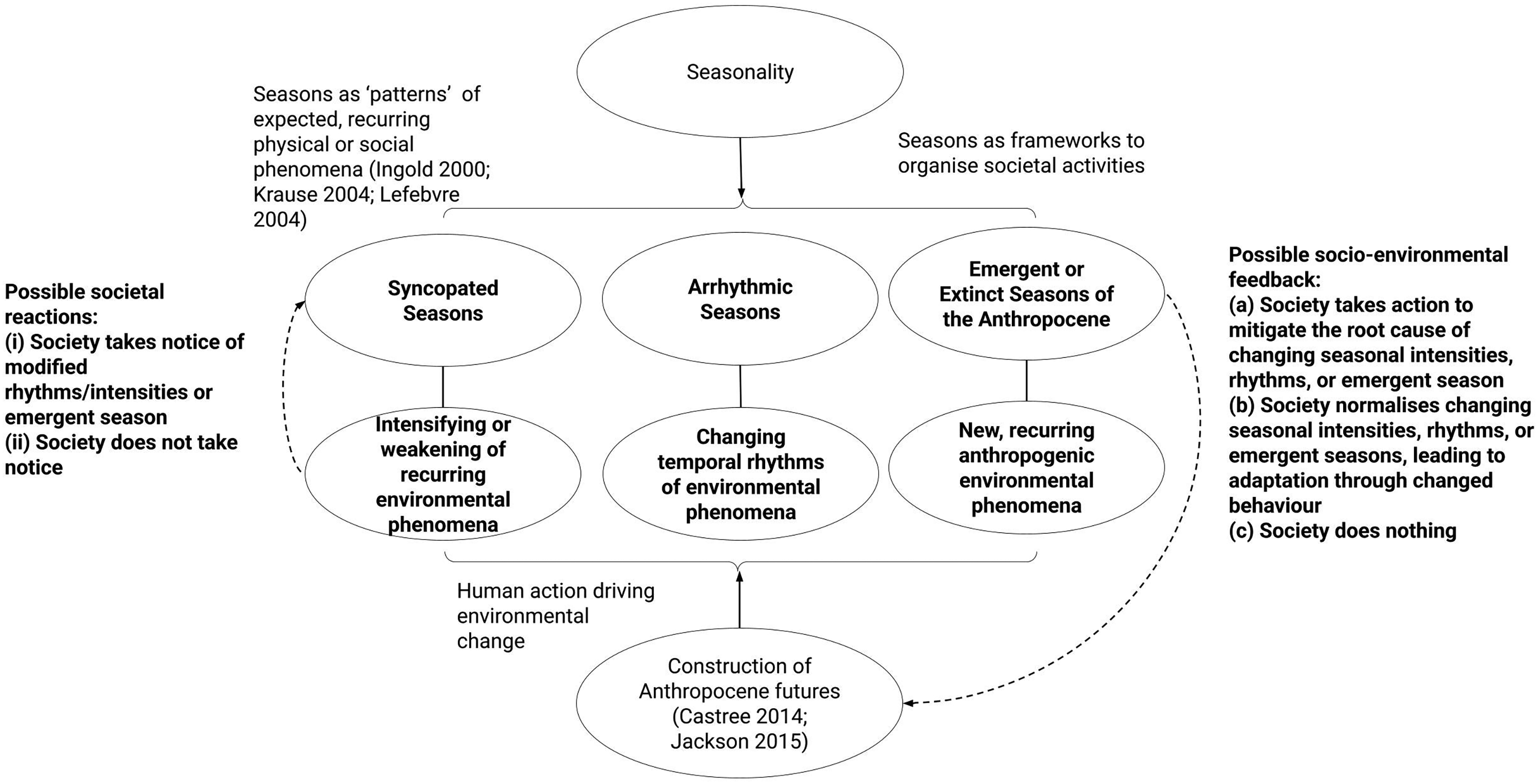
A Conceptual Framework for Seasonality in the Anthropocene and its Potential for Socioenvironmental Feedback.
Since the late 1970s, seasonal depletion of stratospheric ozone has recurred due to anthropogenic emissions of chlorofluorocarbons and bromine-containing halons (Schiermeier 2009). Under cold conditions unique to the Antarctic, these compounds undergo photochemical reactions that lead to the destruction of ozone when the sun rises after the polar winter, at the beginning of the Southern Hemisphere's springtime (September–November). Ozone is Earth's main defense against biologically harmful ultraviolet (UV) radiation from the sun. As such, the annual formation of the ozone hole increases UV exposure in the southernmost regions of the planet. The “ozone hole season” prompts media and public health organizations in the southerly regions of Australia, New Zealand, Argentina, and Peru to intensify their awareness campaigns on UV protection to reduce the risk of skin cancer (Sordo and Gutiérrez 2013; Cancer Council NSW 2016; Peterson et al. 2019; Australia Wide First Aid 2020; Sociedad Argentina de Dermatología 2022). This is an example of adaptive feedback to a season of the Anthropocene, while an ongoing multilateral environmental agreement, the Montreal Protocol, has had success at halting the expanse and severity of this annual phenomenon, with the slow recovery of Antarctic springtime stratospheric ozone concentrations (Young et al. 2021).
In the past two decades, distinctive tropospheric air pollution-related seasons have emerged. While the annual pollution events are recorded by environmental monitoring and satellite observations (e.g., Vetrita et al. 2021), they have also been recognized as “seasons” by the affected societies. This includes two distinctive seasons in Southeast Asia: one in the northern Mekong area between January and April (the “smoky season”), caused by the arrival of the dry season and grassland clearance and seasonal crop burning practices (Pardthaisong et al. 2018; Mostafanezhad and Evrard 2021), and another in the southern regions of Southeast Asia (the “haze season”) between June and October, caused by forest clearance and fires on drained tropical peatlands (Forsyth 2014). Similarly, in northern India, a “smog season” returns every winter, as the monsoon season ends and crop burning begins, often intensified locally by Diwali festive burning (Times of India 2022; Gautam et al. 2023). In Europe, Bergen in Norway (Wolf and Esau 2014) and the Po Valley in Italy (Copernicus 2022) experience recurrent “smog seasons” in autumn and winter. During the colder months, temperature inversions exacerbate the concentration of pollution from household solid fuel burning and industrial pollution. Zareba, Weglinska, and Danek (2024) find two distinct “air pollution seasons” in Krakow, Poland, according to their monitoring of particulate matter concentrations, due to fuel burning in colder months, and agricultural fires at the start of the growing season.
Looking beyond emergent atmospheric seasons of the Anthropocene, marine pollution seasons are also surfacing—quite literally—as observed on the beaches of Bali, Indonesia. Here, floating plastic waste, either washed off the land by heavy rainfall or dumped into the oceans, is blown by strong monsoonal winds onto the southern beaches of the island province from December to March. Heightened awareness of this predictable annual event, widely referred to as the “trash season” by locals and international media, has been detrimental to the reputation of Bali's communities and crucial tourism sector. This has led to a local government focus on clean-up operations, undertaken by hundreds of seasonal workers and volunteers. Concurrently, it has ignited interprovincial political disputes regarding the origins of the waste (The Guardian 2021; Sydney Morning Herald 2023).
Building on these examples, we propose criteria for identifying and defining emergent “Seasons of the Anthropocene” (Table 1). Human activities, such as forest clearance, agricultural burning, mining, domestic waste, and industrial pollution, combine with physical cycles, including seasonal pressure systems, wind patterns, and ocean currents, to create new environmental phenomena, often hazardous in nature. A season of the Anthropocene must be perceived by a social entity or collective as existing, referring to the emergent cyclical phenomenon as a “season.” These seasons may displace, shorten, or replace preexisting seasonal concepts, which we term “seasonal arrhythmia” or “season extinction,” respectively (see next sections and Figure 1).
Once an emergent season has been recognized by society, socioenvironmental feedback may drive mitigative responses that lead to changes in the timing and/or severity of the emergent season (e.g., the UK's “Clean Air Act” in response to “pea-soupers”) or adaptive actions (e.g., UV awareness campaigns in response to the “ozone hole season”; and Bali's clean-up preparedness during the “trash season”). There is a scarcity of research addressing whether societal responses (e.g., to adapt, mitigate, or do nothing) are impacted by novel seasonal constructs (i.e., the semantic construction of a new recurring phenomenon as a “season”). Only recently do we find a handful of studies that apply qualitative causal attribution approaches to this important question (Mostafanezhad and Evrard 2021; Liu et al. 2023).
Liu et al. (2023) explore the emergence of a “haze season” in equatorial Southeast Asia and its influence on societal responses to the problem. “Haze” (a regional term for smog) is caused by the widespread burning of tropical peatlands in regions of Malaysia and Indonesia and is now considered an annual event in equatorial Southeast Asia, impacting the health and livelihoods of millions. Affected societies have increasingly adopted the concept of “haze season” during the past three decades (ibid.), with widespread use of the term in news articles, social media (including memes), and public art. Analysis of news media found a significant distinction between articles written about “haze season” and those that refer to the haze problem alone. “Haze season” articles, particularly during the season (June–October), are associated with impacts and adaptive actions, including poor air quality, pollution standards, mask-wearing, staying indoors, and air filtration. Whereas articles that mention “haze,” without the seasonal construct, focus on causes of the haze crisis, such as peatland fires in Indonesia, oil palm plantations, deforestation, as well as the failures of geopolitical cooperation.
Framing seasonality with short-term measures that are repeated during annual crises may divert attention away from its root causes; the seasonal equivalent of well-documented crisis management strategies that downplay causal blame and stifle public debate (Masco 2017). Seasonal narratives associated with impacts and crises are not unique to the “haze season.” Through an ethnographic and historical political ecology approach, Mostafanezhad and Evrard (2021) establish a similar framing of northern Thailand's “smoky season,” which is increasingly being viewed as a crisis. The crisis narrative of the “smoky season” (and therefore, the response) differs, however, from that of the “haze season” to the south. While the “haze season” focuses on coping strategies, downplaying root causes, the “smoky season” is associated with more direct measures like fire bans, addressing immediate (local) causal factors, and serving to distract from more systemic forces that have facilitated the crisis.
We argue that emergent seasonalities play a pivotal role in societal responses to environmental change in the Anthropocene. Seasons of the Anthropocene develop through collective acknowledgment of new environmental phenomena and crises. Through this process, narratives emerge to frame societal perceptions and responses to these environmental crises. This raises important questions concerning how and why these seasonal narratives come to be, and the role of different societal actors (e.g., the media, public, governments) in shaping those narratives (see “The Politics of Seasonality in the Anthropocene” below).
Seasons in the Anthropocene
While we introduce “Seasons of the Anthropocene” as new, emergent phenomena, we propose “Seasons in the Anthropocene” as a related concept to describe how those preexisting concepts of “harmonious” seasonal patterns and intensities are discordantly shifting in response to human activities. In our typology (Table 1), we categorize changes to seasonal timing and intensity as “arrhythmic” and “syncopated” seasonality, respectively.
Shifting rhythms of seasonality are similar to arrhythmic beats. Arrhythmia, a term from cardiology, refers to heartbeat abnormalities. These arrhythmic seasons (Table 1), include changing timings of temperature fluctuations, such as earlier springs or breeding seasons (Meisch et al. 2022), longer summers or growing seasons (Christidis, Jones, and Stott 2015; Fridley et al. 2016; Vitasse et al. 2022), and shorter winters or hibernating seasons (McCabe and Wolock 2010). Phenologists have identified significant arrhythmic disruptions to the life-cycle patterns of flora and fauna, outlining the implications for the “out-of-sync” calendars of the human communities that are economically, socially, and culturally dependent on them (Bastian 2024). Arrhythmia is also associated with prolonged “hurricane seasons” in the Atlantic and North-East Pacific Oceans (Kossin 2008), as well as the expanding duration of “wildfire seasons” in northwest America (Schoennagel et al. 2017).
While “seasonal arrhythmia” describes the changing timing of recurring phenomena, anthropogenic environmental change also alters the intensity (or amplitude) of seasonal variability (Table 1). Using a musical metaphor, these changes in the amplitude of seasonal environmental phenomena are akin to syncopated rhythms in music. Syncopation in music is a cognitive mechanism that creates metrical tension, capturing listeners’ attention by introducing a new emphasis to beats or off-beats in a bar (Sioros et al. 2014). Like the metrical tension introduced by the emphasis of a previously silent beat in music, the prolonged, large scale, and intensive syncopation in environmental rhythms may draw societal attention to the impacts of seasonal phenomena that might have once gone unnoticed or were taken for granted. Examples of “seasonal syncopation” include hotter summers and milder winters in temperate climates (e.g., Kendon et al. 2022), while the increasing frequency and severity of extreme weather events such as wildfires (e.g., Buchholz et al. 2022) and flooding (Demski et al. 2017) are exposing more people to their impacts, leading to an expansion of the realms of “smoke seasons” and “flood seasons.”
As with emergent seasons of the Anthropocene, changes in seasonal timing and intensity may be recognized by society through noticeable adjustments to the collective acknowledgment and articulation of such changing patterns (left-hand side of Figure 1). This societal awareness of shifts in seasonal timing and/or intensity may lead to feedback on the phenomenon itself through changed attitudes toward mitigative or adaptive actions (right-hand side of Figure 1). Despite there being a plethora of research on shifts in seasonal timing associated with climate change (Nature Climate Change 2018), few have explored how perceptions of these changes influence support for mitigative action, such as greenhouse gas emissions reduction policies (Capstick 2012; Capstick et al. 2015). It is only in high-latitude regions (e.g., Siberia)—where seasonal shifts are most noticeable—that we find anthropological research into connections between perceptual awareness and a strengthened political engagement with mitigative response (Crate 2011).
There is a greater body of research on adaptive measures that have been taken in response to seasonal arrhythmia. This includes agricultural communities adjusting their planting, harvesting, and animal husbandry practices in response to new temperature patterns (Piao et al. 2019). Cereal farmers are changing their sowing times and selecting alternative cultivars (the type or variety of crop) in an adjustment to shifting phenological crop-growth duration (Fatima et al. 2020). Similarly, livestock farmers are changing the timing of management operations (e.g., grazing crop rotations, feeding, irrigation, application of pesticides) in response to changes in seasonal timing, while also diversifying their livestock to breeds that are best-suited to the changes in forage seasonality (Rojas-Downing et al. 2017). Wine producers are also adapting, with noticeable shifts in the timing of harvests, associated with the adoption of substitute grape varieties to maintain a regular sequence of ripening, flowering, maturity, and vinification, that is, so important for both wine quality and yield (Ashenfelter and Storchmann 2016). Societies in regions where wildfires have been historically hazardous are also recognizing seasonal timeshifts (usually a lengthening of the wildfire season). Changes to wildfire management strategies, such as conducting hazard-prevention (prescribed) burning earlier in the year, are the main adaptation response in these regions, in the anticipation of an earlier start, and a longer wildfire season (Lipsett-Moore, Wolff, and Game 2018).
For changes in seasonal intensity (syncopated seasons), societal responses and associated feedback diverge depending on the value society places upon the seasonal change. Some societies may capitalize on new opportunities that more pronounced seasons bring. For example, winemakers are exploring the plantation of new grape varieties in different geographies as an adaptation response to warmer summers (e.g., Galbreath 2011), with large French wine producers investing in the UK (to the north) in search of seasonal variability more akin to that experienced by the vineyards of northern France in the past (Kantchev 2013). Yet, hotter summers in Europe will also have negative health implications, especially for elderly populations (Arbuthnott and Hajat 2017; Ballester et al. 2023), epitomized by the thousands of excess deaths in the elderly during the 2003 heatwave in France (Vandentorren et al. 2006). Adaptive responses include the mobilization of urban resilience strategies addressing hotter summers (Kearl and Vogel 2023), and an increasing focus on the risks presented by more intense summer heatwaves by governmental civil contingency and public health institutions (e.g., Public Health England 2015).
Hotter and drier summers are also driving more intense wildfire seasons in temperate and high-latitude regions that had previously seldom experienced fire (Krawchuk et al. 2009; Fernandez-Anez et al. 2021). The amplification of US Pacific coast wildfires demonstrates how syncopated seasonalities set in motion new environmental policy approaches and perceptions. Increasing wildfire activity in the past three decades are expanding the spatial extent and severity of seasonal patterns of smoke pollution, impacting the health of millions (Buchholz et al. 2022). Part of the mitigative effort includes the reintroduction of Indigenous cultural burning in forested regions, which in turn enhances recognition of Indigenous environmental stewardship approaches and their importance for ecological and social restoration (Long, Lake, and Goode 2021). In the UK, the extreme winter storms of 2013/14 provide another example of how societal perceptions of the changing intensity of seasonal extreme weather may lead to an increased salience of climate change, support for mitigation policies, as well as changes to personal climate adaptation decisions (Demski et al. 2017).
Coexistence, interplay, and extinction of seasons
Emergent and shifting seasonalities do not happen in isolation but are nested within broader ecological and socioeconomic relationships. Anthropogenic environmental change often manifests in layered polyrhythmic cycles, and some of these shifting patterns may intersect to create amplified, compounded environmental changes (Chiaravalloti et al. 2021).
Interplay exists between changes to seasonal timing and intensity, as is evident in plant and animal phenology (Bastian 2024). Where once the timing of reproduction or dormancy of different species may have been sequential—distinctively spaced throughout a season—there are trends toward more synchronized or compressed ecosystem climaxes and dormancy phases in some places (e.g., in American semiarid grasslands; Tredennick et al. 2017). Other places may experience the reverse effect, with a shift from synchronized to staggered phenological stages (e.g., due to changes in the assemblage of alpine plant species; Alexander, Diez, and Levine 2015). Synchrony impacts ecosystem function through the buffering effect of diversity in the face of environmental change (Pires, Srivastava, and Farjalla 2018). If species are highly synchronous, then diversity may not provide much buffering effect, because the variability of the ecosystem function will be high regardless of the number of species. Synchrony is now considered to be more important than species richness for the stability of ecological communities undergoing climate and land-use change at a global scale (Valencia et al. 2020), with more- or less-coherent ecosystem productivity rhythms leading to marked changes in regional biogeochemical cycles (Seybold et al. 2022).
Over the past three decades, anthropogenic environmental change in northern Thailand presents a prime example of the coexistence and interaction of multiple seasonalities in the Anthropocene. Communities in the Mekong tributaries have thrived on the interconnected rhythms of human and more-than-human activities, sustained by alternating seasonal fishing and agricultural harvests for centuries. However, hydro-engineering projects upstream have disturbed these seasonal food provisioning traditions, leading to a decline in fishery yields and the degradation of agriculturally important floodplains (Friend et al. 2023). Concurrently, climate change is altering precipitation patterns, resulting in longer dry seasons and more intense rainfall during shorter rainy seasons (Friend and Thinphanga 2018). In this example, shifting seasonalities have become a prime influence on environmental governance. Policies that are designed to minimize the impact of seasonal variability on urban flood risk and water security, come at the expense of disruption to the seasonal traditions and livelihoods of the rural communities upstream (Cornford and Matthews 2007).
In a seemingly unrelated chain of events that further emphasizes the complex interplay of anthropogenically altered seasons, the introduction of industrial maize agriculture in northern Thailand has led to widespread land-use change and an expansion of seasonal agricultural burning. This intensification has prolonged the smoky season from a brief disruption early in the year to a recurring episode that spans January to May (Mostafanezhad and Evrard 2021), affecting public health and economic activities, particularly tourism. This sustained burning has increased the regional atmospheric loading of aerosols (e.g., black carbon) impacting cloud formation and resultant rainfall patterns, exacerbating uncertainty in reservoir water reserves. The intricate interconnectedness of these emergent, arrhythmic, and syncopated seasons in Thailand underscores the complexity of the challenges faced by the impacted communities and offers insights into how seasonality in the Anthropocene may unfold in other geographies.
While some seasonal shifts are expected to coexist and influence one another, other seasons are expected to become extinct (Table 1) due to increasing temperatures, shifting precipitation patterns, and/or pollution. The extinction of seasons impacts resource availability and associated economic activities. In some cases, the loss may trigger mourning and grief in communities (Carey 2007; Wilson 2022). Perhaps the most well-known example is Rachel Carson's account of the ecological impacts of the indiscriminate use of pesticides in Silent Spring (Carson 1962). More contemporary examples—associated with global warming—include glacier loss and reduced snow cover and the knock-on effect on downstream economic activities, including growing seasons in the agricultural sector (Milner et al. 2017) and winter sports seasons in the tourism sector (Steiger, Dawson, and Stötter 2013; Kaenzig, Rebetez, and Serquet 2016). Over time, as glaciers shrink and snow no longer settles, we will witness the extinction of certain societal seasons that rely on these biophysical resources.
Beyond changes to the physical environment, communities with place-based memories of phenological events may feel a sense of loss as the behaviors and migration patterns of animals adapt or vanish. An example includes the dismay of birdwatchers in the northeast of England who have noticed the disappearance of seasonal migratory birds, such as kittiwakes (Wilson 2022). As is the case for disasters associated with geohazards such as earthquakes, the losses that result from the extinction of seasons—“slow emergencies” of the Anthropocene (Dominey-Howes 2018)—cannot always be quantified in terms of mortality or economic costs. The impacts are often intangible, affecting the well-being of people and the more-than-human.
By reconciling the interconnectedness of environmental and social factors within the cyclical nature of change (O’Brien et al. 2023)—that is so evident in the examples discussed here—we argue that seasonal timescapes offer a lens through which a better comprehension of systems resilience and transformation may be achieved. This contributes to a more holistic and adaptable approach to addressing the challenges of the Anthropocene.
The politics of seasonality in the Anthropocene
Seasonality in the Anthropocene is political in three distinct, but interrelated ways. First, we argue for a conceptual shift to acknowledge seasons as “timescapes” that evolve continuously with asynchronous interactions between the biophysical environment, public discourse, policy-making, and resource allocation. This holistic approach challenges prevalent Western ontologies of environmental change that frame seasons through uniform, quantifiable “timescales” (e.g., seconds and UTC) according to corresponding temporal organizational instruments (e.g., clocks and the Gregorian calendar). Emergent and shifting seasonalities responding to anthropogenic climate change, pollution, and biodiversity degradation should be interpreted as manifestations of an increasingly discordant temporal mismatch between the relentless pace of planetary exploitation and the Earth's ecological cycles of regeneration (Bastian 2024). To navigate the vicissitudes and uncertainties characteristic of the Anthropocene, it is imperative to embrace this multifaceted, place-based, and relational notion of time to account for the polyrhythmic nature of those societal and biogeophysical interactions. This process is political because it returns voices to alternative ontologies that have been oppressed by (neo)colonization of environmental knowledge production pathways that underpin any subsequent environmental management regime.
Second, and related to the first point, seasonality draws attention to the temporal manifestations of anthropogenic environmental change. It highlights the political ecology of the hegemony of standardized time and timescales, which are readily associated with, but not entirely reducible to capitalisms, labor, and (neo-/post-) colonialism. This notion of time has gained purchase across the world (Ferguson, Green, and Swanson 2022), replacing and then controlling “local” conceptualizations and calculations of time. Like standardized time, “seasons of” and “seasons in” the Anthropocene also constitute a form of temporal control and imposition. Exploitation of Earth's resources, often driven by capitalist motives, composes new environmental rhythms that displace or replace deeply rooted local, Indigenous, and/or non-Western understandings of socioecological interactive cycles. At the same time, the affected communities are also subjected to the “downwind” or “downstream” impacts of the environmental degradation.
The evolving environmental management and policy landscape in Australia presents some examples of the environmental, social, and cultural benefits that result from a growing recognition of Indigenous knowledge of seasonality. The forests and savannas of Australia are managed, cultural landscapes that have coevolved with the sustainable, seasonally-sensitive human use of fire to manage an ecological balance for tens-of-thousands of years (Ritchie 2009). However, colonization devastated Australia's Indigenous population. Without their stewardship, new and more severe “fire regimes” in the late-dry season/summer emerged, often highly destructive to life and property (Russell-Smith et al. 2013). A surge in political activism and powerful Indigenous rights movements led to landmark Indigenous (“Aboriginal”) Land Rights legislation and the devolution of power to newly established Land Councils. This paved the way for environmental reforms that could realign land management driven by local knowledge sensitive to seasonality, while restoring carbon stock (Russell-Smith et al. 2013), biodiversity, and culture (Richards et al. 2012). This potential of embracing Indigenous times in environmental stewardship is emerging in other regions of the world (e.g., British Columbia, Canada; Nikolakis, Welham, and Greene 2022) where such practices were also abandoned or restricted.
The acceleration of recognition for Indigenous knowledge highlights a shift in valuing ecological practices amid environmental challenges. Indigenous calendars in Australia, which were once oral communications as part of Indigenous knowledge systems, are increasingly codified to preserve and broaden their recognition (McKemey et al. 2021). In New South Wales, a “fire and seasons calendar” is coproduced with Indigenous communities to more holistically integrate Indigenous knowledge with State environmental policies. While in Sydney, Indigenous Knowledge and Local Climate (IKALC) seasons have been leveraged to provide a detailed and more accurate characterization of annual air quality fluctuations (Beaupark et al. 2023). This growing adoption of Indigenous knowledge in environmental management, catalyzed not just by its intrinsic value and Indigenous rights but also by its economic and environmental utility, calls for environmental policies that are both mindful and transparent to the distribution of benefits and power to Indigenous peoples. Adopting a more inclusive and diverse societal framing of time and seasonality represents a reorientation in the production of environmental knowledge, and also advocates for the decolonization of ecological thought and environmental policy-making (Griffiths and Baker 2020; Kelz and Knappe 2021; Bensaude-Vincent 2022). Our conceptual reevaluation of seasonality in the Anthropocene highlights the intertwined nature of environmental change and sociopolitical structures. Through this situated, value-oriented, and relational perspective of seasonality, we shed light on the urgent need for integrating more complex ecological sensibilities into policy-making.
Third, we find that seasonality has been deployed as a discursive tool for structuring power relations within timescapes. In other words, collective understandings of seasons are invariably entrenched in socioeconomic, cultural, and political networks of power.
In Indonesia, Malaysia, and Singapore, a politically strategic framing of seasonality is used to shape the power dynamics between the public and the ruling elite. Varkkey et al. (2025) find that the term “haze season” has been used by a government–corporate oligarchy in an intentional effort to “normalize” the recurring air pollution crisis, thus absolving themselves from responsibilities. Government reports and (state-controlled) news media quotes from government officials and representatives from palm oil and paper pulp corporations (implicated in the environmental degradation that leads to fires and haze), overwhelmingly associate “haze season” with narratives of normalization. They discuss adaptation behaviors, as well as championing preparedness for the air pollution crisis, while any mention of the underlying root causes of the seasonal air pollution, and those responsible, is avoided (Liu et al. 2023).
Similarly, the annual recurrence of the “smoky season” in northern Thailand, caused by an intensification of stubble burning for industrial agriculture, has given rise to a new “chronopolitics” in northern Thailand (Mostafanezhad and Evrard 2021). The heightened awareness among communities of the “smoky season” has led to the construction of a socially defined seasonal crisis. In response, emergent official and public narratives have surfaced (Evrard and Mostafanezhad 2023), unveiling and consolidating deeper historical tensions within the region. Notably, these narratives (with a heavy emphasis on “season”) lay blame on the farmers, leading to punitive fire bans, while diverting attention from state-driven agroeconomic policies. This echoes a historical pattern of marginalization faced by impoverished agricultural communities and ethnic minorities, predominantly residing in the rural highlands (Cornford and Matthews 2007).
These examples suggest that the processes of identifying, articulating, and responding to changes in life cycles and patterns, indicative of “seasons of” and “seasons in” the Anthropocene are political. There are inherent, uneven power dynamics between governments, corporate actors, environmental civil society organizations, communities, and individual citizens in determining what environmental pattern change phenomena are worthy of social attention, and hence the subsequent direction of various “seasonality” discourses. These processes of semantic construction and amplification may be manipulated by institutional actors, typically through policy discourse and the press, while activist and community actors may resist through grassroots campaigns, alternative press, and social media (Varkkey et al. 2025). The construction of “seasonality” reflects the jostling of power and influence between environmental actors to explain and respond to shifting environmental patterns, the deliberation of societal matters of concern, and the associated (re)distribution of resources to support mitigative or adaptive (non)action to change, which invariably will shape what future environments and societies look like. As such, we argue for closer scrutiny of how seasonality narratives are constructed and how those narratives are manifested in environmental policy.
A research agenda for seasonality in the Anthropocene
We project that more seasons of the Anthropocene will emerge as anthropogenic environmental change intensifies throughout this century. As seasons change in the Anthropocene, a new relational, socially- and culturally-embedded ontology of the environment will gain prominence. The collective acknowledgment of and reaction to—or lack thereof—emerging, disappearing, and shifting seasons will shape how we understand and experience the environment. This, in turn, raises deeper questions about what the environment is, especially as it is continually shaped by anthropogenic activities and our responses to those changes. Although new rhythms of the environment can be detected through positivist scientific approaches, such as environmental monitoring or Earth Observation, the collective construction of environmental change patterns as “seasons” reveals deeper socioecological fabrics that explain contested interpretations and interactions with time and the physical environment, and subsequent debates over the causes and effects of environmental change.
Our typology (of emergent, syncopated, arrhythmic, and extinct seasons; Table 1) merely begins to explore the surface of a spatiotemporal landscape filled with new patterns and seasons—each bearing divergent socioecological implications—the full extent and intensity of which can be challenging to accurately predict. Peering into the future, for example, New York City may experience a new “smoke season” as a result of recurrent and increasingly severe forest fires in the northeast of the North American continent (The New York Times 2023). Syncopated seasons in the Anthropocene, such as the case of the inundation of Tuvalu by an ever-rising “King Tide” (Lin, Ho, and Cheng 2014), can pose matters of community survival. Furthermore, shifting and emergent seasonal patterns bear implications for public health. Examples include the physical health risks of seasonal exposure to severe air pollution. Mitigative solutions to avoid exposure to air pollution such as staying indoors can have mental health impacts too, as evidenced by parallel case studies of the mental health implications of staying indoors during dark, wet, cold winters (e.g., Bodden et al. 2022; Bodden, Lorimer, and Parr 2024). Therefore, it is crucial to effectively detect and assess the impacts of the social construction of seasons of and in the Anthropocene.
Understanding new seasonal concepts and narratives can help prepare societies for associated environmental hazards and minimize the potential negative consequences of normalization and desensitization, which we find to be increasingly prevalent in a growing body of literature that has considered the social construction of seasonality in the Anthropocene. The recognition of emergent cycles may determine societal priorities for mitigation and/or adaptation, as well as driving normalization and/or desensitization to environmental change (McNally 2018).
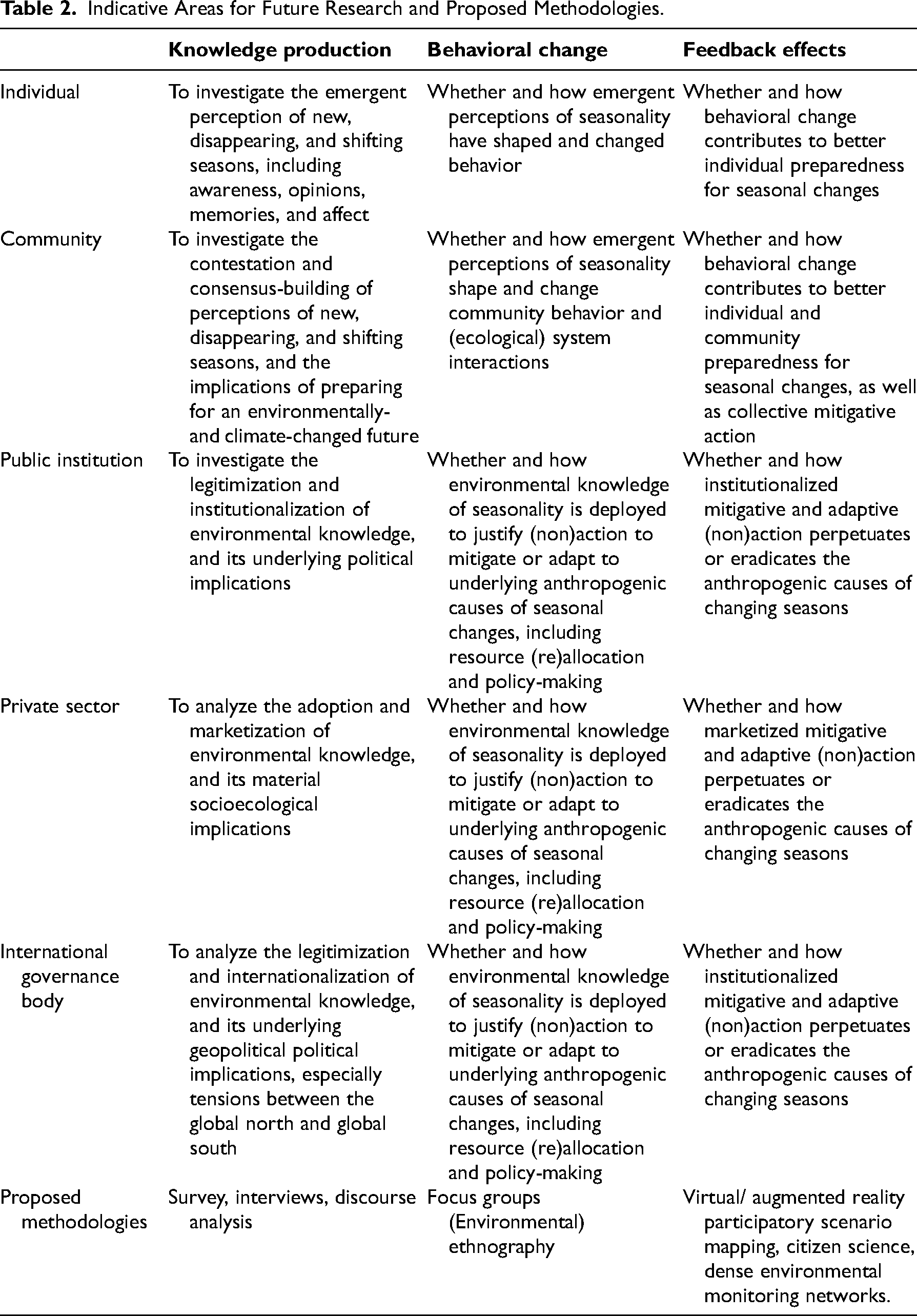
We propose a multiscalar, multiperspective approach to future research on the Anthropocene through the lens of seasonality, where anthropogenic environmental change and its diverse social impacts are experienced through changing patterns and rhythms of socioecological lives. This seasonality lens will unveil how individuals, communities, as well as public and private institutions (see top row of Table 2) contribute to constructing environmental futures, through environmental feedback effects driven by reconfigured perceptions and reactions to environmental rhythms. To examine the uneven temporal and sociomaterial impacts of the shifting understanding, categorization, and perception of environmental patterns (Colucci, Vecellio, and Allen 2023), we propose an interdisciplinary research agenda. Table 2 provides an indicative categorization of recommended research foci and methodologies for future research on seasons and the Anthropocene. This should delve into the key processes of “constructing” seasonality and its socioecological feedback, namely, whether and how shifting seasonalities foster environmental knowledge production, drive behavioral change, and/or create feedback loops that either enhance resilience or mitigate the root causes of change (see columns of Table 2). To this end, a broad set of methodological techniques drawn from environmental science, human geography, and environmental humanities, needs to be deployed to gain comprehensive, multiscalar, place-based insights into the construction of shifting seasonalities. This could include methods familiar to physical geographers, such as Earth Observation and environmental modeling, as well as methods with a stronger human geography and environmental social science leaning, such as media and social media analyses, surveys, interviews, and (environmental) ethnography (Lezak 2023). Moreover, to achieve equitable knowledge production outcomes, participatory approaches such as community-led scenario planning and participatory knowledge coproduction (Friend et al. 2023) may be deployed. In addition, more innovative methodologies could be employed. These include environmental art (Nurmis 2016) and the use of virtual reality to model and project future-centric environmental decision-making (Freeth and Drimie 2016; Scurati et al. 2021).
Indicative Areas for Future Research and Proposed Methodologies.
There remains a dearth of research on how societies and communities interact with shifting seasonalities in our rapidly changing world. Yet the examples we draw from in our typology highlight the applicability of our conceptual framework (Figure 1) to a range of environmental research disciplines. This includes, but is by no means limited to disaster and emergency risk management (Masco 2017; Dominey-Howes 2018); temporalities of environmental change (Bensaude-Vincent 2022); agricultural geography (Linderholm 2006); environmental health (Arbuthnott and Hajat 2017); tourism studies (Steiger, Dawson, and Stötter 2013); and decolonizing environmental and ecological science (Griffiths and Baker 2020). We suggest that seasonality, as a deceptively simple but highly relatable heuristic device, can act as a widely applicable framework for democratizing environmental change research, legitimizing and giving voice to the lived experience of shifting environmental patterns, and understanding the socioenvironmental feedbacks that may ensue.
Footnotes
Acknowledgments
The authors would like to acknowledge the following people for reviewing iterations of our manuscript at various stages of its development, and for their critical insights that influenced our conceptual framework and typology, as well as some of the examples we use to illustrate “Seasonality and the Anthropocene”: Dr Kevin Hicks; Dr Joshua Kirshner; Dr Christopher Lyons (University of York), Dr Kris Chan; Dr Kevin Lougheed (King's College London); Dr Julia Corwin (LSE); Dr Mark Griffiths (Newcastle University); Dr Patrick O’Reilly (Liverpool John Moores University); and Mr Martin Rowe. Seed funding for related research that influenced our decision to write this perspective was provided by the LSE Saw Swee Hock Southeast Asia Centre's Research Fund (2020/21).
Authors’ contribution
Smith conceived the idea of a perspective to focus on this topic. Subsequently, both authors (Smith & Liu) have contributed equally to the conceptual framework, the review of literature and related artifacts, and the writing of the manuscript. The authors would like to be considered as colead authors of this perspective.
Declaration of conflicting interests
The author(s) declared no potential conflicts of interest with respect to the research, authorship, and/or publication of this article.
Funding
The author(s) received no financial support for the research, authorship, and/or publication of this article.
