



Abstract
Energy communities can potentially advance just transitions towards low-carbon systems by devolving energy production and consumption to local scales. During vibrant debates on evolving energy geographies for more than a decade, human geographers have engaged with conceptualization and emergent models of energy communities in generative ways. We argue for a research agenda where these understandings of space, place and scale enhance research on energy communities. Three points hold particular importance and relevance for this agenda: (a) Pluralising understandings of energy communities, (b) Spatializing perspectives on the potential of energy communities to advance just transitions, and (c) Contextually situating technological-energy innovation strategies.
Introduction
The imperative to combat climate change through energy transitions has never been more pressing. With continued cost declines for renewable energy sources (Feldman et al. 2021) and storage technologies (Ziegler and Trancik 2021), there is an urgent need to embrace new models of energy production and consumption. Against this backdrop, an emergent concept is energy communities (ECs)—decentralized and small-scale energy production cooperations of an open and voluntary nature (Anfinson et al. 2023), where we also include demand-side energy flexibility solutions (Rydin and Turcu 2019; Barnes et al., 2022). These developments should be of core interest to energy geographies—a growing research field (Bridge et al. 2013; Calvert 2016; Bridge and Gailing 2020; Walker et al. 2021). Arguably, this interest has yet to translate into much human geographical research. Meeting the high ambitions for decentralized and renewable energy formulated in, for example, the European Union's “Fit for 55” package on reducing net greenhouse gas emissions by at least 55% by 2030, 1 will be challenging withoiut ECs, particularly cooperatives, in order to do so in ways that have widespread socioeconomic benefits. Human geographers can play a vital and immediate role in elucidating how the development of ECs can, and indeed must, progress to meet these critical climate goals.
In this article, we propose a research agenda on ECs where an understanding of space, place, and scale will enhance this emergent area of research. Like Hubbard (2005, 47), who writes that “the key question about space and place is not what they are, but what they do,” and Campbell (2018) who extends this sensibility to scale, we are careful not to champion a hegemonic discussion of each concept but rather to hold them tentatively and contingent on context of use. Thus, we treat space as absolute, relative and relational (Harvey 1973); place as spatiotemporal events (Massey 2005) a contextualized location imbued with relational meaning; and scale, following Herod (2010), as nested spatial spheres that stretch from the local to the global, yet are deeply interconnected and relationally constructed by social praxis.
We synthesize insights as a large collective of authors across geography and adjacent energy-related disciplines to argue that human geography should advance the energy geographies field by mobilizing its rich conceptual repertoire to expand our understanding of ECs. Such a move will bring geographical sensitivity to an arguably “singular, bounded and localized” academic discussion on ECs (Creamer et al. 2018, 2), albeit with several notable contributions over the years that we cite and build upon in the hope to systematize the values and concerns that they espouse in future EC research. Moreover, thorough engagement with ECs is likely to engender conceptual development within human geography (van Veelen et al. 2019). Thus, this paper develops a research agenda with the dual ambition of advancing human geography by revitalizing and revivifying core geographical concepts (i.e., place, space, scale) through engagement with ECs, and enriching discussions on ECs by conceptualizing the energy geographies of ECs.
ECs today are different from earlier energy-related communities (e.g., coal communities in the mid-twentieth century versus twenty-first century solar and wind communities). What they can do, how they are able to communicate and govern themselves, and the opportunities afforded for decentralization, have multiplied. This is largely due to technological innovation that enhances the scope for engaging in energy production and storage, allowing for greater participation in energy efficiency and flexibility. While new, potentially transitional energy infrastructures such as smart electric meters, cost-effective solar photovoltaics, and home battery storage have proliferated, such forms of energy system participation have remained relatively fringe phenomena and have been adopted primarily by upper-middle-class households (Rommel et al. 2018). ECs may help change this.
Despite ECs not currently being a major mode for organizing energy production and use, they play an increasingly substantial role across Europe; the European federation of citizen energy cooperatives (REScoop) states that 1.5 million citizens are members of such cooperatives (see https://www.rescoop.eu). Geographical literature has shown how diverse ECs are (Walker and Cass 2007), the range of motivations underpinning them (Bauwens, Gotchev, and Holstenkamp 2016), and the numerous forms of grassroots innovation that mobilize ECs and offer varying scope for diffusion of related social practices (Seyfang and Haxeltine 2012). ECs can harness energy flexibility (to continuously balance energy demand and supply, which is needed in all electricity systems) to both optimize the energy system and be economically attractive for EC members by, e.g., using smart devices to manage flexible electricity tariffs on smart grids, and limiting the need to invest in new electricity transmission and distribution infrastructure (Cunha et al. 2021). New ownership regimes and the democratization of electricity production can allow for new practices and relations with energy, creating space for discussions about sufficiency and market versus non-market supply (Braunholtz-Speight et al. 2021). Yet such new practices and relations are hardly a given. Indeed, there is structural resistance from incumbents (Strachan et al. 2015), the risk of reproducing social injustices (Tarhan 2022), and the need to work explicitly towards fair, inclusive, democratic and decolonial forms and governance of ECs (Mackenzie 2009; Simcock 2014; van Veelen 2018; Mazzone et al. 2023).
Why should ECs be of interest to human geographers? ECs can challenge an energy sector long characterized by top-down, industrial-scale, and spatially distanced energy production-consumption relationships. Similar trends are apparent in less electrified economies with more limited, uneven grid coverage, where there is scope to explore alternatives and complements such as mini-grids. Public and private utilities have tended to own territorial energy infrastructure to deliver centrally steered services to users defined as consumers. Critical social scientists have long noted that this centralized operational mode tends to constitute management and concentration of wealth, power, and resources in non-democratic ways (Burke and Stephens 2018) while strengthening lock-ins with detrimental socio-ecological effects (Avila 2018; Batel and Küpers 2023). As a discipline that is deeply concerned with people, place, and culture (Fouberg, Murphy, and de Blij 2015), as well as issues such as justice, power dynamics, and spatial disparities (Cumbers, Routledge, and Nativel 2008; Fuller and McCauley 2016; Yeung 2019; Przybylinski 2022), we hold that ECs are particularly relevant to human geography. By engaging with both the practical and conceptual aspects of ECs, human geographers can provide a deeper understanding of the evolving dynamics of ECs and contribute significantly to the development of more just and equitable ECs.
For human geographers, the complexity of spatial and social configurations in ECs that the aforementioned examples point to—and the identified lack of knowledge on impacts from, and the viability of, ECs (e.g., Bielig et al. 2022; Roberto et al. 2023)—warrant conceptual work that engages with core EC characteristics: local energy production, efficiency, storage, and demand flexibility. While geographical attention to renewable energy sources dates to the 1970s, with scholars such as Cook (1976) recognizing that alternative energy sources could require new geographical thinking, there has been a renaissance since the early 2010s (Zimmerer 2011; Bridge et al. 2013). Nevertheless, despite vibrant debates on energy geographies for more than a decade, we argue that human geographers, with their key insights on space, place and scale, can and should play an even bigger role in understanding and theorizing ECs.
Our article aims to remedy this. We bring research on energy geographies and ECs into conversation with human geography to enable greater theoretical development through cross-pollination. We make use of key geographical insights to start unpacking what a spatially informed perspective on ECs looks like. By applying the fundamental geographical concepts of space, place, and scale to the key characteristics of ECs, we point out three ways that human geography can and should contribute to EC research as well as to the development of ECs, namely by: (a) pluralizing understandings of ECs, (b) furthering the understanding of the potential of ECs to advance just transitions, and (c) situating technological-energy innovation strategies in this context.
We next conceptualize the energy geographies of ECs (Section Conceptualizing the energy geographies of energy communities), before applying three key human geography concepts to local energy production, efficiency, storage, and demand flexibility (Section Applying space, place, and scale to local energy production, storage, efficiency, and demand flexibility). We then elaborate on our agenda for human geography research on ECs and conclude with caveats for future research to consider (Section An agenda for human geographers to inform and enable energy communities for just low-carbon transitions).
Conceptualizing the energy geographies of energy communities
Despite the real-world plurality of ECs, much effort has been directed towards a common definition. While a narrower definition mobilizes a desirable orientation in national legislation (e.g., through the European Union's recast Renewable Energy Directive, also known as RED II, since 2018), this linear approach to a complex concept as an object of policy can be overly limiting. Using the broad definition provided in the previous section, we apply a wide understanding of ECs which, in their most archetypical form, feature renewable energy production and demand-side flexibility solutions that are spatially distributed, and organized in a cooperative manner where profit is typically not the main imperative. ECs may include technical objectives, such as neighborhood-scale energy production, and social objectives, such as using low-tech solutions to enhance the democratization of energy infrastructures.
What do ECs look like from a geographer's point of view? Geographers are acutely aware of the spatial implications of social phenomena and are well-placed to analyze and conceptualize the energy geographies of ECs with a variety of spatial concepts. In a foundational contribution to energy geography, Bridge and co-authors (2013) highlight location, landscape, territoriality, spatial differentiation, scaling, and spatial embeddedness. We find the concept of scale to be particularly relevant in the geographical study of ECs. In geographical analysis, scales are typically seen in relational terms, as interconnected and nested across spaces and levels (Silvester and Fisker 2023).
This differs from the “precision-nested scales” critiqued by Tsing (2012) who problematizes reductive understandings of scalability, as the scales cut across each other, embodying the messiness of actual nests where twigs intertwine across levels, as opposed to being stacked in a neatly layered hierarchy. Furthermore, we emphasize the need to critically engage with how scale is produced, interpreted, disputed, redefined, and restructured in society (Swyngedouw and Heynen, 2003; Rangan and Kull 2009). We thus acknowledge the “in-between-ness” and relationality of scale (Herod 2011) rather than conforming to spatial fetishism (Collinge 2005, 189). Unlike Marston et al. (2005) who argue for a flat ontology that dismisses the concept of scale entirely, we thus see value in the analytical mobilization of scale as a heuristic that can enable insight into the empirical messiness of ECs as phenomena, and enrich conceptual debates on the scale in geography that we lack space to unpack further within the present scope (but see Blakey (2021) for a nuanced discussion of the politics of these ontological debates centered on the scale).
The local aspect of ECs implies physical proximity in members’ locations and energy generation, within geographically circumscribed community membership (Devine-Wright 2019). Such definitions of “short-traveled” energy have important implications for energy distribution infrastructures, energy efficiency and justice, and relations to established energy geographies. Spatial bounding can follow the logics of territory (depending on distance) but also steering principles within or across a set of communities. These choices shape the form and depth of community building, where human geography offers an underutilized potential to understand.
Energy geography might highlight how localizing energy production close to energy demand centers can lead to hyper-local accelerated metabolisms (i.e., spatially clustered cycles of high energy supply and demand), while lowering the need to transmit energy across space. Co-locating energy production and consumption, while potentially attractive from a system’s efficiency perspective, layers atop already-existing infrastructures that connect places across space, namely electricity grids (Rommetveit, Ballo, and Sareen 2021). The supply-demand relationship of energy markets is technocratically embedded in national and international energy regulations that overwhelmingly favor incumbent actors and practices (Wittmayer et al. 2021). Thus, ECs unfold across nested scales of spatial deployment and valuation of distributed energy production. Considering nested scales can provide contextualization beyond existing conceptualizations of ECs that focus on them largely as discrete entities (cf., Petrovics et al. 2024).
Human geography could help bring the implications of this cross-scalar character to conceptualizations of ECs. Decentralized elements of energy systems imbricate with localized production yet carry different implications for system properties. The modular nature of some renewable energy technologies (e.g., solar panels, electric vehicles, rechargeable batteries) and other energy sources (e.g., biofuels, hydrogen, waste) further expands the scope for spatial flexibility in ECs. Localized electricity storage, with smart charging and spatial deployment of charging infrastructure, can change the rhythms of production-consumption relationships and their spatial distribution.
Human geographers can bring a place-based lens to how ECs are understood and implemented (cf., Lode et al. 2022). Since ECs constitute place-based interventions, sociocultural dynamics modulate their specific forms in place. Is there a culture of cooperativism and an appetite to democratize energy systems, a lack of interest, or highly protectionist incumbency? The latter leads to a risk of co-optation of broad EC definitions and stymieing of the possible public benefits from energy system reconfiguration (Newell and Johnstone 2018; Stirling 2019). To be enacted and widely reproduced, ECs must be socio-spatially adapted. Their situatedness conditions the potential for replication, or out-scaling (the replication of novel practices in similar systems, as opposed to upscaling) (Luederitz et al. 2017).
Emergent intermediaries—like CleanWatts and GreenVolt in Portugal (Scharnigg and Sareen 2023)—are adopting techno-economic models in the legislative space that has opened in several European Union member states, to rapidly enroll hundreds of households per EC in towns. This societal context differs significantly from the frontrunner “pilot” examples of ECs, primarily in large cities with heavy involvement of research and development actors. These potential differences between pilot projects and out-scaling constitute another important but subdued theme in EC scholarship (cf., Petrovics et al. 2024, Roberto et al. 2023), to which geographers are well positioned to contribute.
Geographers have pointed out the spatially embedded nature of innovations for low-carbon transitions (Bouzarovski and Haarstad 2019; Newell, Geels, and Sovacool 2022; Smith et al. 2023). Building on this for an understanding of ECs, we need to take seriously that interventions do not “come from nowhere” to become neatly embedded in any context. Place exerts its own influence on technological blueprints and abstract policy strategies. ECs mediate between local contexts and larger-scale energy system transformations. This is a challenging process since not all technically desirable configurations are socio-culturally feasible, and not all socio-culturally feasible technical configurations are desirable from an energy systems optimization perspective.
Furthermore, a scalar lens on ECs complicates romantic notions of the local, with concepts like energy democracy, local ideals of community, and expectations of localism and collaboration leading to greater cohesion and understanding (Walker and Devine-Wright 2008). They may also be involved in reinforcing the opposite: pro-incumbency bias, and the reproduction of large-scale system logics and related social inequality. The scalar lens brings a necessary dose of political economic realism into the scales of ECs. This will enable critical consideration of the emancipatory and scalability potential of ECs, which we suggest may largely be inversely related, but possible to move in positively reinforcing directions. Identifying these virtuous dynamics presents an exciting agenda human geographers should tackle.
Scalar characteristics of both local and virtual ECs—the latter a spatially-dispersed legal entity where multiple users virtually feed from a single energy source, such as a solar plant, enabled via digital trans-local accounting rather than a direct exchange of electricity—differ vastly from traditional, centralized energy systems, most fundamentally in size and production units. Thus, ECs in energy transitions may contribute to dissolving established core-periphery patterns at multiple scales (Gong et al. 2022). This can in turn localize governance, which requires national legal framework conditions alongside room for plural self-governance approaches to flourish. High local variation in ownership and organizational structures increases cross-scalar interactions, requiring more polycentric models of governance (Anfinson et al. 2023; Kumar and Aiken 2021). These also, in turn, rely on a background of assumptions and cultural expectations of what community does in different contexts. Local energy conflicts, for example relating to large-scale wind power sites, are likely to apply differently to ECs, given local ownership, participation in decision-making processes and utility rather than “external” ownership and top-down steering (Eikeland et al. 2023). Their energy justice implications have salutary potential for energy transitions (Fuller and McCauley 2016; Bouzarovski and Simcock 2017; Tornel 2023).
Other scalar characteristics and potentials hinge on technological development, notably storage. Energy flexibility can be aggregated (jointly optimized) in and from community-scale projects as a driver of change that links to wider energy geographies. Energy efficiency can likewise unfold under highly versatile scalar logic. For instance, small-scale can optimize or reduce efficiency; induce learning; impact economies of scale; undermine the cooperative underpinning of ECs; and enable defection from electric grids with local sufficiency and elements of degrowth—all varying based on contextualized implementation.
To better understand ECs, we need to apprehend the scale not only vertically, but also horizontally and relationally. A vertical understanding of scale means that we track the local, the regional, the national, and the global, and examine how certain local initiatives or phenomena can be “scaled up” to higher levels. Such a hierarchical scalar lens can show how ECs can be upscaled from “single” or “isolated” projects to transcend the local level (Aiken et al. 2022; Schmid and Aiken 2023). This perspective further points to trans-local implications of spatially complex transitions across various localities and scales. While upward scaling is desirable to many, and may be dependent on national-scale legal interactions, there is something about community that resolutely does not scale up (Aiken et al. 2022). This aspect has received considerable interest among poststructuralist and feminist geographers (Bell, Daggett, and Labuski 2020; Sovacool et al. 2023). Instead of “up-scaling,” they focus on the horizontal diffusion of novel practices among certain ECs that are spread across geographies globally. As a complement, horizontal integration may be provided through digital technology, such as blockchains, for the increased possibility of inter-community trading and thus increased independence from fossil fuels, but challenges exist, inter alia regarding trust-building across involved actors (Valdivia and Balcell 2022).
Given the above, how can we characterize the energy geographies of ECs? These geographies are not only constituted by interactions between local ECs and energy systems but are also shaped by the properties of larger-scale socio-cultural regimes and socio-spatial energy infrastructures. Co-constitutive dynamics result in clear challenges regarding the scope and potential of just low-carbon transitions through ECs. Any conceptualization of ECs must have enough stringent coherence to retain its core meaning across contextual variance, and it must be sufficiently pliable to take on board the adjustments necessary for sensemaking within context. By engaging in theoretical debates on ECs both within the subfield of energy geography and in the wider social science arena, human geographers can contribute a socio-spatial understanding of power relations in low-carbon energy transitions.
So far, we have offered a broad tour of potential avenues for human geography to unpack the nature of ECs in spatial, and particularly scalar, terms. In the following section, we offer a more targeted discussion of how concepts of space, place, and scale can be used to inform what we consider central criteria of these energy systems based on our collective overview of thematic scholarship on ECs—energy production, storage, efficiency, and demand flexibility—to concretely illustrate the difference that a spatial perspective makes.
Applying space, place, and scale to local energy production, storage, efficiency, and demand flexibility
The virtues of human geography for investigating the wider context of communities and different renewable energy aspects have already been demonstrated by studies that discuss the importance of physical landscape transformations with cultural evaluations of these material forms (Selman 2010; Bridge et al. 2013), place attachment and sense of place (Devine-Wright 2009; Devine-Wright and Howes 2010), and tensions between scales (Devine-Wright 2013; Mason and Milbourne 2014; see Graham and Rudolph 2014). Below, we present how geographical lenses can be applied to local energy production, efficiency, storage, and flexibility. Table 1 outlines how these four key aspects of ECs can be understood through geographical lenses, which the rest of the section unpacks.
Understanding core aspects of ECs using key concepts in human geography.
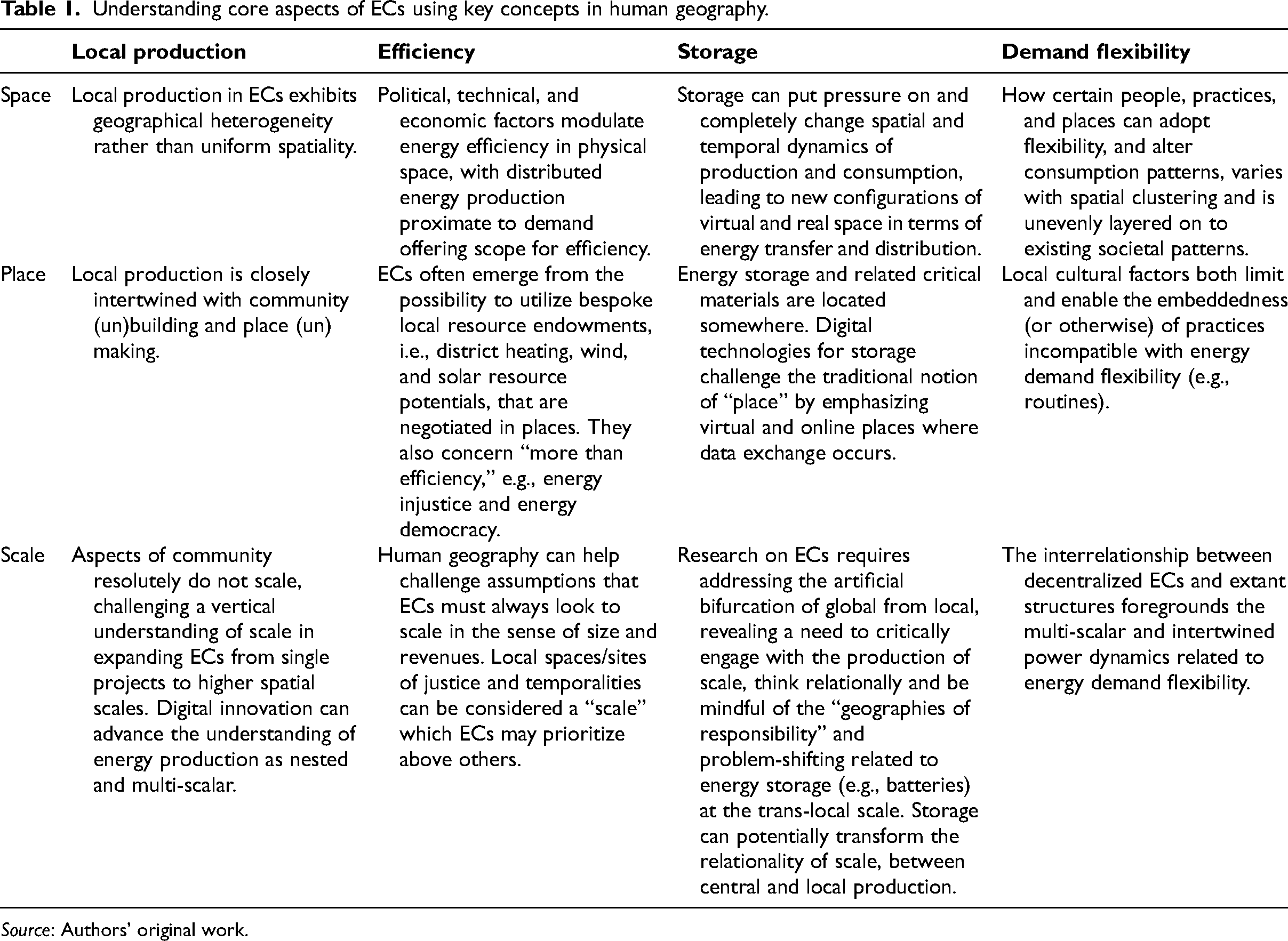
Source: Authors’ original work.
Geographies of production in energy communities
Understanding ECs as place-based opens opportunities to further contextualize against the dominant trend of decontextualization in EC studies, by employing historical (Lai 2022) and relational place-based (Lai 2019) perspectives regarding local production and efficiency. Place-based approaches gel easily with the local nature of energy production and efficiency. Local production does not necessarily equate to decentralized governance, nor does it necessarily demarcate a separation from national or global contexts: ECs can form part of global supply chains. Decentralization, however, is not an unconditional necessity that should always be worked towards (Walker et al. 2021). In contrast, part of the appeal of ECs lies in their very ability to generate diverse and place-specific engagement, anchored in the types of needs and issues that they prioritize and address as well as local interpretations of energy justice (LaBelle 2017; Devine-Wright 2019; Blasch et al. 2021).
At their core, energy transitions aim to replace fossil fuel energy sources with renewable ones. However, in the context of ECs, the substitution of fossil fuels is but one part of the transition: rather than substituting one energy source for another, an EC can engender a new set of social relations. For example, Braunholtz-Speight et al. (2021) note four central processes associated with community energy: decarbonization, digitalization, decentralization, and democratization. These processes indicate the complex landscape ECs inhabit: the shape of future energy geographies will be influenced by new and existing resource systems and infrastructures, future technological change, and socioeconomic and political processes (Zimmerer 2011). Echoing Hughes (1993), Huber (2015, 331) suggests that “the networks of electricity infrastructure are deeply implicated in the reproduction of political and economic power.” The shape of an EC will depend on the interrelations between—amongst other things—organizational forms, old and new technologies, spaces, and places. This points to a key insight: the local production of energy will also entail the production of new social relations.
A spatial lens on local production shows that ECs can be heterogeneous in their energy sources, geographical locations, and interaction with other ECs. Mengelkamp et al. (2018a) use the role of peer-to-peer networking as an example of how ECs can engage in production and consumption via microgrid energy markets and retain profits from trading energy within their communities based on smart contracts (Mengelkamp et al. 2018b; Sousa et al. 2019). A place-based lens helps illuminate how ECs and their relationships to local production take shape. Efficiencies gained from keeping things in the community (e.g., savings, governance and control) and incentivizing the development of community-owned initiatives can in turn support balancing the grid via local production and consumption management (Mengelkamp et al. 2018a). However, community attitudes to energy initiatives and projects are also closely related to residents’ place attachment and sense of place (Devine-Wright 2009; Devine-Wright and Howes 2010).
Geographies of efficiency in energy communities
Given that ECs represent decentralized and localized elements in an energy system, they also hold promise for different aspects of efficiency and legitimacy. Alongside the national context and cultural system ECs take place within (Lindberg et al. 2023), legal and economic framework conditions across scale and space shape ECs in significant ways, influencing their internal goals and governance structures (Aiken et al. 2022; Schmid and Aiken 2023). At a basic level, reducing the distance of electricity transmission can lead to more efficient systems, and is an argument for promoting ECs. While this potential would be enhanced by technological developments, particularly within storage, upscaled local electricity use itself offers significant efficiency gains.
Human geography offers important insights into aspects beyond energy system efficiency, particularly in terms of how the human-environment relationship is mediated by the relationship to energy (Calvert 2016). From a commodity-based and market-oriented relationship to energy, ECs may promote a communal view of and relationship to energy. By moving beyond the prevalent disconnected view of the energy market (Devine-Wright 2019), human geography can identify how ECs form around specific kinds of efficiency. This market-normative paradigm is a relatively recent cultural shift (Inderberg 2011), a shift that is currently being challenged through the partly analogous terms “citizen energy” and “energy democracy” (Szulecki 2018; Silvast and Valkenburg 2023). In this area, there is unrealized potential for human geography to offer insights into the governance of ECs, as well as on issues of legitimacy and energy transition (Anfinson et al. 2023).
New technologies that affect the geographical spread of ECs such as through digitalization can aid information monitoring and dissemination. A spatial perspective on the ECs that utilize these technologies allows for a better understanding of the political, technical, and economic limitations connected to physical space. Decentralized energy initiatives can impact regulatory market structures, and the input of energy flows derived from production needs to be carefully balanced and controlled, which digitalization can support through automation (Wu et al. 2022). ECs often emerge out of the possibility to utilize bespoke local resource endowments, such as district heating, wind, and solar resource potentials. A place-based lens can thus show the emergence of ECs from possibilities to efficiently utilizing and engaging the surrounding resources.
A geographical take on efficiency also allows for challenging the notion that ECs must always look to scale up, both in size and profit (Aiken et al. 2022; Schmid and Aiken 2023). Normative concerns such as justice, equality, and democratic control are often motivating forces behind the formation of ECs, which means that efficacy might be more important than traditional notions of scaling and efficiency (Valdivia and Balcell 2022), ECs might be more concerned with efficaciously promoting ideals such as economic equity or democratic participation. More careful attention to these normative concerns and their realization can also enable foregrounding of other important, yet nascent, discussions—such as on energy sufficiency, which concerns questions of limits and wellbeing (Burke 2020). Hence, it is important to consider how ECs are constituted around varying conceptions, which in turn are co-shaped with the space, place, and scale of ECs.
Geographies of storage in energy communities
For storage, human geography offers several key insights, particularly on electrochemical electricity storage and the development of battery technologies as well as the materials needed to produce them. A spatial lens on storage can contribute to a better understanding of the new configurations between virtual and real spaces in terms of energy transfer and distribution. New technologies can be used to facilitate more efficient energy use by providing both transparent and real-time data on energy consumption and production, leading to greater optimization, reduction in waste, and behavior orientated towards energy-saving (Baza et al. 2019), while related energy justice aspects such as inclusion also merit attention. A place-based lens can enhance the understanding of energy storage by tailoring insights into geographical, cultural, social, and economic contexts. Ultimately, energy storage and the related critical materials required need to be located somewhere. At the same time, the application of digital technologies enables the traditional notion of “place” to be challenged by virtual and online places where data exchange can occur, with Diener and Hagen (2022, 171) explaining the need for geographers to develop “a multi-dimensional consideration of place as integral to understanding place attachment (…) as an assemblage of materiality, performance, and narration.”
Finally, a scalar lens in human geography also questions the bifurcation of local and global in understanding the material flows related to energy storage and in particular batteries. Here, Massey's (2004) work on geographies of responsibility seems relevant. To respect cosmopolitan justice and not prioritize some dominant interests over the rights of marginalized others, we need to be able to view the globe as a single entity and to be mindful that energy transitions in one community (e.g., an EC in the global North) should not unfold at the expense of another (e.g., resource extractivism in the global South). In this sense, the discussion of problem shifting (van den Bergh et al. 2015) is particularly illuminating. Each individual EC must therefore consider its (inter)dependencies with other regions and/or communities pursuing energy transitions. Moreover, with ECs increasingly utilizing blockchains, their ability to engage the supra-local level is growing, with new storage technologies and solutions on the horizon. Hydrogen may offer a way to avoid negative trans-local effects, allowing ECs engaged predominantly in wind and solar to utilize electrolysis to facilitate their own green hydrogen production locally and also play a greater role in storage and balancing of energy demand and supply, in a low-carbon (albeit highly energy-intensive) way.
Geographies of demand flexibility in energy communities
Combined with solutions from the supply-side, flexibility of energy demand—or demand response—is one of the two demand-side shifts (together with demand reduction) that can help decarbonize energy systems (Barnes et al. 2022). Demand-side flexibility requires more effort (e.g., in terms of technologies and linking supply and demand) to be achieved in ECs than demand reduction (ibid, 9). Examples of local and flexible energy clusters have been present for several years, e.g., on islands and in industrial production contexts; however, they typically do not include a similarly diverse constellation of actors as in current ECs, and therefore the socio-technical gaps related to the governance of these energy systems require attention (Lowitzsch, Hoicka, and van Tulder 2020). This is significant since the integration of renewable energy sources requires context-specific solutions: “uneven distribution [of RE systems] will coincide with different populations, with a range of socioeconomic statuses, cultures, local politics and local economic development patterns in different ways” (Lowitzsch, Hoicka, and van Tulder 2020, 5).
Geographical lenses are important in understanding the complexity of flexibility in ECs. For instance, a spatial lens can help capture the unevenness between and within ECs with regard to their ability to adopt flexibility to alter consumption and production patterns. Utilizing digital tools such as peer-to-peer networks and smart contracts, ECs can sell surplus energy directly to neighboring communities without the need for a central intermediary (Antal et al. 2021; Chinnici et al. 2022; Wu et al. 2022). Flexibility can also be automated for demand response, autonomously adjusting energy usage based on pre-configured parameters for peak demand, availability, and price, with distributed and diversified energy resources being synergized through optimized solutions.
A place-based lens can help capture the local cultural, social, and institutional factors that enable and/or limit the embeddedness of practices that to some degree are incompatible with energy demand flexibility (Walker 2014). Place also takes on new meanings when the constraints of the physical world do not apply in the virtual world, with digitalization being able to open up new opportunities for ECs to participate in demand-side energy flexibility. A spatial lens on flexibility complements the emergent technological opportunities for energy storage, as a spatial understanding can capture the relationship between decentralized ECs and extant structures, offering enhanced explanations by drawing on the spatial dimensions of these power dynamics.
We have shown several ways that the human geography lenses of space, place, and scale can be applied to ECs in terms of local production, efficiency, storage, and demand flexibility. This demonstrates the multifaceted nature of ECs, and crucially, offers a novel glimpse of the potential for geographical insights to inform their development and impact on energy systems.
An agenda for human geographers to inform and enable energy communities for just low-carbon transitions
Finally, we will conclude the article by proposing what we see as headline issues in the development of a human geographical agenda on ECs. This ties together threads from above, where we illustrated the usefulness of spatial concepts for unpacking ECs and the broader energy systems that they form part of (Section Conceptualizing the energy geographies of energy communities). We have also honed in on some key elements of energy systems to show how a geographical perspective on ECs helps us understand them better (Section Applying space, place, and scale to local energy production, storage, efficiency, and demand flexibility).
So, given these wide conceptual possibilities, what should be the headline issues for the geography of ECs? Building on the insights from the conceptual application of space, place, and scale to local energy production, efficiency, storage, and demand flexibility, we will now delineate what using these geographical lenses can mean in terms of a concrete research agenda. Mobilizing concepts to inform and enable ECs for just low-carbon transitions requires specific kinds of foci in human geographical research. We suggest that the human geographical agenda on ECs should comprise three overarching directions for empirical research, which we now introduce in brief, before discussing each direction in more depth.
First, we suggest that human geographers can help pluralize and nuance the understandings of what ECs are. This offers scope for a deeper appreciation of the characteristics, identities, and dynamics of ECs. Second, we show how this deeper appreciation can give us a richer understanding of the potential of ECs to advance the energy transition. Here we point to processes of upscaling, out-scaling, realizing energy as a common good, and creating arenas for people to become invested in key areas of transition work done by ECs. Third, we show how a geographically informed perspective can help ground strategies for technological innovation in the energy sector, focusing on the values, needs, and aspirations of bottom-up communities rather than on top-down incumbent big-tech innovation. These three directions are intended to shape societal thinking on ECs to unlock their relational constitution; enhance recognition of their potential to advance the energy transition in significant, necessary, and specific ways; and contextually ground innovation to enable local agency and ownership. As our discussion illustrates, these are all areas that require significant empirical research.
Pluralizing understandings of energy communities
Existing concepts of ECs tend to rely on relatively bounded and territorial notions of community. Human geographers, with command over relational ideas of what constitutes community, can unpack and enrich these limited conceptualizations. A relational understanding of community suggests that what happens locally, or within a community, is deeply interconnected with actions and processes going on elsewhere (Herod 2011; Massey 2013). Communities are produced in a dynamic interchange of ideas, identities, and resources, rather than having a pre-given collective identity (Massey 2005). For instance, it is of significant analytical relevance if and how ECs exchange resources and innovations with other communities, and whether networks or movements of ECs emerge between seemingly discrete communities in different places. This has significant implications for their reach and effectiveness, or their ability to mobilize citizens for energy sustainability (Grandin and Haarstad 2021). Going beyond legalistic or territorial notions of community can help researchers appreciate these more diffuse, but nevertheless critical, aspects of what makes ECs possible and what empowers citizens through ECs.
A human geographical perspective can also help make visible the structures that divide, undermine, and temper ECs. ECs are always grounded somewhere and somehow, and the inevitable ties to institutional, legal, economic, and social contexts come with opportunities and constraints. Certain regions, like the Basque region of Spain, have historical experiences that can enable further community-building (Balbás Egea and Eguren Egiguren 2019). In contrast, until 2023 Norway had legislation that prohibited sharing electricity between households and therefore significantly constrained the EC development (Lindberg and Inderberg 2023). Emphasizing spatial divergence and difference is not simply about establishing the well-known fact that places are different. Rather, it allows for contextualizing of individual ECs and opens for drawing deeper insights into where such differences come from and what their effects are, in relation to uneven geographical development (Harvey 2005) expressed through patterns of energy production and demand and localized experiences of energy (in)justice Moreover, one can probe how difference and multiplicity can be generative of transformative change, by channeling the power of heterogeneity into diverse emergent pathways (Sarrica et al. 2016). Furthermore, how the agency can help overcome place-specific constraints merits attention (Bauwens, Gotchev, and Holstenkamp 2016). ECs are not determined by place-based conditions alone, since they are in dialogue with, and constituted by their relationships with multiple “elsewheres” (Robinson 2016).
Pluralizing understandings of ECs in this way is important because it opens our understanding of the multiple ways in which people come together in common projects around energy (Aiken 2016; Creamer et al. 2019). Much of the literature we cite shows evidence that such a shift is already underway in geographical scholarship (in part thanks to guidance by early community energy scholarship, e.g., Walker and Devine-Wright 2008), yet it requires some explicit systematization and orientation, which this agenda aims to contribute. Some communities may fit to specific legal definitions, but these are likely only the tip of the iceberg in terms of how energy concerns bring interests together, mobilize people, spark small and big actions, and help constitute energy as a common resource. Reminiscent of Gibson-Graham's (2006) iceberg illustration of the diversity of the economy, we argue that a similarly diverse understanding of ECs can make visible the multitude of common actions around the energy system. Above the surface, we find the ECs that fit the standard definitions and legal criteria, while below the surface, we find a diverse and multiple set of practices that make energy a community concern and stimulate common energy practices.
Spatializing perspectives on the potential of energy communities to advance just transitions
ECs are important for achieving high ambitions for decentralized and renewable energy in Europe and elsewhere. A nuanced appreciation of what constitutes ECs—looking at the iceberg from beneath the water's surface—can give us a richer understanding of the potential of ECs to advance the energy transition. To assess this potential, ECs should not be seen as interesting exclusively in terms of their measurable effect on the energy generated. In various ways, ECs can show that energy is a common good, and not just a commodity, and that it can be governed through active citizenship, not just passive consumption. The potential of ECs in the sustainable transition can be understood in terms of reframing the wider energy system, as well as the mobilization, experimentation, education, and learning that they generate across a range of scales.
A host of geographical perspectives shed light on how these sorts of practices have transformative potential. For example, research on experimentation illustrates how experiments break with established norms of top-down decision-making and produce new spaces for citizens to engage with and challenge existing policies (Evans, Karvonen, and Raven 2016). Seen as experiments, ECs may enable more democratic forms of energy governance that involve the bottom-up engagement of citizens and grassroots groups, with some potential to change the framing of energy in systemic terms (Bulkeley 2020). Alternatively, ECs may be seen as spaces for niche innovations, which may be scaled up to contest socio-technical regimes (Hansen and Coenen 2015) or mobilized for the politicization of these regimes (Bouzarovski and Haarstad 2019). The policy mobility literature illustrates how innovations from particular ECs may “travel” in networks and shape the trajectory of energy transitions across geographical contexts (Temenos and McCannet al. 2012).
These different geographical literatures frame the potential of ECs in slightly different ways. The key insight is that their innovations can affect broader complex spatial structures, and they can enhance alternative modes of governing, alternative visions, and alternative practices in concrete localized settings (Evans, Karvonen, and Raven 2016).
Several critical questions can be asked, of course, in the assessment of the potential of ECs in advancing the transition. Are the innovations they represent supporting a just transition, or are they merely connected to an instrumental view on community (Aiken et al. 2022; Schmid and Aiken 2023)? To what extent do they “stick”; in other words, do they create lasting systemic effects (Grandin and Sareen 2020)? Do ECs simply represent “organized irresponsibility” (Haderer 2023), in the sense that they allow governments to vacate their own responsibilities in transitioning to a sustainable energy system? What is the risk of incumbent co-optation of ECs, possibly undermining their potential for facilitating energy transition? Do ECs always advance energy justice, or are there also important ways in which they maintain inequalities?
Overall, addressing such questions not only provides a more comprehensive view of the potential of ECs to advance sustainable transitions—highlighting both the ways that they reframe energy and challenge incumbent structures and the potentially problematic aspects of relying on the voluntarism they may represent to achieve transitions—it can also contribute to more equitable and democratic EC building.
Contextually situating technological-energy innovation strategies
Finally, a geographical perspective can help “ground” strategies for technological innovation. Energy transitions seem to increasingly integrate digital technologies. There is anticipation that digitalizing energy systems will enable flexibility, allow the optimization of renewable energy resources, and stimulate a shift from consumers to prosumers (Rommetveit, Ballo, and Sareen 2021). ECs are situated at the center of these developments as representatives of the emerging decentralized, presuming, and flexible energy regime. The geographical hybridity in the morphology of ECs and how this relates to the clustering of socio-technical innovation is of interest in itself, notably for its inclusion or exclusion of the public (Walker and Cass 2007). Additionally, this reliance on technological innovation and digitalization opens new problems about the power of expertise, big technology providers, and techno-rational discourse on social change, or the broader societal ontology and effects of “cloud geographies” (Amoore 2018).
Geographical analyses can alternate between different scalar points of view, and often prioritize a bottom-up perspective. Transitions conceived in this way can take departure in the concerns of places, communities, and people, as starting points of strategies for shifts to energy sustainability. Among the available geographical literature one can turn to for inspiration here is the critical work on smartness and smart cities, where geographers have shown that the high-tech strategies of major corporate actors are poorly connected to the dynamics and needs of cities themselves (Karvonen, Cugurullo, and Caprotti 2018). However, digital tools can also enable acts of citizenship. To de Waal and Dignum (2017), civic organizations have already started to use digital technologies to mobilize around issues of collective interest, claiming their “right to the city.” This includes a range of collective activities that have become known under various categories, such as do-it-yourself citizenship, tactical urbanism, civic media, and citizen-centered smart cities. In short, human geographers should explore the potential to mobilize technology and data to strengthen community ownership of energy and its benefits, while also remaining aware that the implementation or reconfiguration of technologies can—and often does—change existing power relations or introduce new ones.
Still, we need to ask critical questions. Innovations are clearly not better or preferable just because they arise in the context of an EC. Moreover, the interests of ECs in advancing innovation may give them a competitive advantage over other communities and interests. There is clearly a danger of romanticizing community innovation and the policies that are developed to promote them (Hanke, Guyet, and Feenstra 2021). We need to look for ways in which a given EC innovation practice “looks beyond instrumental imperatives” and instead explores how to foster socio-political programs “that are more transformational than those currently prevailing in energy regimes” (Smith et al. 2016, 429). The key question is: innovation for what and for whom? Failing to reframe the dominant energy regime and the modes of accumulation it is based on, we risk the enrolment of ECs into a new “localized,” “experimental,” or “citizen-based” variety of the extant energy system, in which the main patterns of energy consumption, distribution, and profit accumulation remain in place (Bouzarovski 2022).
Final reflections
We conclude with two caveats for future research to consider. First, the evolution of ECs is conditioned by matters of space and place: many of the early ones have emerged thanks to the vehicle of white, male, middle-class engineers, who create specific kinds of ECs (Kumar and Aiken 2021). This relates to who has definitional power over what ECs are, which returns to our point about the need to pluralize. We are mindful that—despite our best efforts to feature a diverse, interdisciplinary team of authors—like any author collective we may still have biases and blind spots. Thus, we hope that future research will take the pluralization imperative of our agenda solemnly, and also applied to the agenda itself. ECs and their epistemological advancement within human geography pose pressing, resilient challenges and questions, such as those concerning “green” extractivism, or the case for energy sufficiency over efficiency, and absolute reduction (in throughput) over transition.
Second, we wish to explicitly raise reflection about the ways in which the reification of core geographic concepts (i.e., place, space, scale, which we have deployed heuristically above) might carry an instrumentalizing, even undermining effect on (and within) ECs. Hand in hand with this is the threat of revitalization and revivification of core geographical concepts (i.e., place, space, scale) through engagement with ECs, which flies in the face of extensive human geography debates about the good grounds to not unduly separate these out. We have aimed to be careful in our handling, and hope this call can inspire the emergent nature of human geography contributions on ECs to blossom further.
Footnotes
Acknowledgments
The authors are grateful to the Sustainability Transformation program area at the Faculty of Social Sciences, University of Stavanger, for making this collaboration possible. Sareen acknowledges the Horizon 2020 Sun4All project (grant 101032239) and the Horizon Europe (JPI Urban Europe DUT Call) and Research Council of Norway (grant 349994) ENERGY4ALL project, Inderberg acknowledges Research Council of Norway grants 726505 (SOLNOR) and 295704 (INCLUDE), and Sareen and Lindkvist acknowledge the Horizon Europe RESCHOOL project (grant 101096490) for funding their time.
Declaration of conflicting interests
The authors declared no potential conflicts of interest with respect to the research, authorship, and/or publication of this article.
Funding
The authors disclosed receipt of the following financial support for the research, authorship, and/or publication of this article. This work was supported by the HORIZON EUROPE Climate, Energy and Mobility, Norges Forskningsråd, Joint Programming Initiative Urban Europe, Horizon 2020 Framework Programme (grant number 101096490 RESCHOOL, 349994 ENERGY4ALL (DUT Call), 726505 SOLNOR, 295704 INCLUDE, 101032239 Sun4All).
