



Abstract
This paper combines assemblage theory, feminist ethics of care and decolonial theory to build on recent work in disaster studies that seeks to address the systematic and intersectional inequalities that underlie the emergence of disaster. We argue that Western logics of “risk” do not always have traction with communities, and so researchers must “stay with the trouble” in engaging with tensions between lifeworlds. We suggest that geographical imaginaries provide a means to analyze the diverse ways of being and knowing that are involved in this process.
Introduction
This paper builds on previous work that has argued in favor of a critical geography of disasters that pays renewed attention to the power dynamics, value systems, and relationships that lead to or suppress the emergence of disaster in a particular geographical setting (Angell 2014; Donovan 2017; Grove 2013; Groves 2017; McGowran and Donovan 2021). We use an assemblage framework and focus on the methodological challenges that it implies, arguing that research can put this into practice by rooting it more firmly in an “ethic of care” (Brannelly 2018; de La Bellacasa 2017; Hobart and Kneese 2020; Martin, Myers and Viseu 2015). This is an important problem in disaster studies, because labeling a group as “vulnerable” or “not resilient” can have significant consequences when governments actively use that labeling to disempower groups and effectively stymie justice (Andreucci and Zografos 2022; Bankoff 2001; Grove 2014; Maru et al. 2014). Furthermore, it is part of a wider set of discourses that emerge from a specifically Western mindset of categorization and quantification (Gaillard 2023; Porter 1996). Methodologically, we argue for an approach that we frame in the context of geographical imaginations—understanding the diverse, place-specific and value-ridden imaginaries of different groups (including scientists, disaster managers, and affected people) in disaster contexts, and how those imaginaries empower and are empowered by existing structural inequalities and dominant ontologies. This includes the Western imaginary of risk itself: many communities, especially in the Global South, do not think of their environment as “risky.”
We approach this argument through three concepts: desire, as it is described by Deleuze but then adapted by indigenous and feminist scholars; the ethic of care, which can enhance a feminist reading of Deleuze (Gilson 2011; Grosz 2018, 2008; Povinelli 2016; Sholtz 2022), and geographical imaginaries as a means of teasing out the interdependencies and affective complexities that are inherent in the production of “disasters-in-the-making.” We chart recent evolution in disaster scholarship that has sought to decolonize the discipline and argue that feminist and Deleuzian scholarship helps to bring together these advances theoretically. This paper will initially and briefly review the emergence of critical geographies of disaster in recent years, building on earlier work. We then adopt the geological imagery of Deleuze and Guattari to illustrate the ways in which geosocial strata are shaken and eviscerated in disasters. We bring together their conceptualization of desire with the feminist ethic of care and feminist and decolonial readings of Deleuze to emphasize the affective nature of disaster research and its subjects. We then argue that, methodologically, geographical imaginaries pose an appropriate approach to the study of the disaster assemblage, because they enable an awareness of the clash of lifeworlds that produce disaster. We particularly focus on the Western imaginary of “risk,” and the ways in which it has itself become a colonizing force—not only are disasters frequently colonial and revealing of colonial power relations (Atallah 2016; Bonilla 2020; García López 2020; Rivera 2022) but the apparatus that is used to conceptualize risk predisposes us to particular questions that may not reflect the concerns of communities in context. Gaillard (2021) argues for a local-focussed disaster research. This paper concurs with that and pays attention to the plural lifeworlds and imagined futures that are (often tacitly) in competition with each other in disaster contexts.
Background: critical geographies of disasters
Assemblage theory provides a useful way to conceptualize the emergence of disaster for several reasons—it encourages the combination of material and expressive components that arise in the socioenvironmental context (Briassoulis 2017; DeLanda 2006; Farías 2011); it accounts for the emergence of complex, nonlinear processes with plural endings; and it can incorporate “futures-in-the-making” (Adam 2005; Adam and Groves 2007) as an expressive component of an assemblage. McGowran and Donovan (2021) discuss “disasters-in-the-making” as a form of such a future: disasters emerge from particular sociomaterial and expressive assemblages in ways that may result from both planned and unplanned elements of naturecultures, strongly mediated by power dynamics and imbalances. The emergence of a disaster is likely exacerbated by an event—perhaps in combination with synchronous poor decisions or underresourcing—but it is also a form of slow violence: it derives from socioeconomic, cultural, and political conditions in complex dialogue with a dynamic physical environment (Atallah 2016; Bonilla 2020). Assemblage thinking differs from systems thinking, however (Farías 2017; Spies and Alff 2020): systems thinking is more readily quantitative and bounds its problems; assemblage is interested in entanglements and plurality of meaning, often seeking stories and narratives and enabling the incorporation of nuance (Deleuze and Guattari 1988).
Such approaches also engage with decolonial theory to understand the emergence of disasters: there is an increasing body of work that critiques the dominance of Western rationalism in disaster studies and international disaster paradigms (such as systemic risk) (Bonilla 2020; Gaillard 2021; García López 2020). The decolonial agenda has grown from regional discourses that make visible the ongoing (neo)colonial logics (obscured by modern capitalism and neoliberal governance) in postcolonial territories, seeking to deconstruct the “common sense” assumptions which allow them to persist (Mignolo and Walsh 2018; Quijano 2000; Said 1978; Siddiqi 2022). It is perhaps unsurprising that decolonial scholarship and disaster discourses have converged in their analysis of the underlying drivers of slow onset emergencies and the power dynamics which sustain inequalities, as disasters are felt disproportionately in the Global South (i.e., in “low income,” often postcolonial territories, see UNDRR and CRED, 2020, 20–22).
At the same time, the significance of other ways of knowing the environment and its materiality has been widely discussed (Armijos Burneo and Ramirez Loaiza 2021; Atallah 2016; Blaser 2014; Escobar 2015, 2014; Latulippe and Klenk 2020; Pardo et al. 2015; Wilkinson et al. 2020). Alongside this literature sits recent theoretical developments in political geology, including the politics of the earth itself (Grosz 2008; Povinelli 2016); the politics of the geological sciences (Bobbette and Donovan 2019); geosocial strata (Clark 2016; Clark and Yusoff 2017; Palsson and Swanson 2016; Yusoff 2013); and the Anthropocene (Chandler 2018; Clark 2014; Savransky 2012). These literatures are significant for disaster studies because they require that scholars engage with the materiality of relationships and entanglements in naturecultures and point toward the applicability of assemblage as a means of conceptualizing the intertwining of diverse processes, some of which are controlled by humanity and others less so (Adey, Anderson and Guerrero 2011; Anderson et al., 2020; Donovan 2017; Grove and Pugh 2015).
We acknowledge here that we are building on a field of knowledge that is largely Western in its origins (such as assemblage theory, which has its roots in the French philosophy of Gilles Deleuze and Felix Guattari—and also vulnerability theory). Maldonado-Torres (2020) makes the point that critique may be decolonial where it is “pluriversal, intercultural and transdisciplinary” (p. 170) and takes on the form also of self-criticism (which may also be collective in nature). He traces the history of “critique” in Europe and warns against the Eurocentric philosophical arrogance that leads to the political arrogance of colonial oppression, noting that “critique” emerges in other philosophies too. We seek to use these ideas, then, to unpick the complex historical trajectories of disasters-in-the-making, using them as a means of making-visible the geographically distinct but also networked power imbalances that enhance disasters. Initially, we use this literature and its imagery to draw out the geontology of disasters, building on the work of Povinelli (2016) and Yusoff (2019, 2023). We take the image of strata, deployed by Clark and Yusoff (2017), to illustrate the complex and historically contingent emergence of disaster risk from Western logics of taxonomy and calculation. We frame this around Maria Puig de la Bellacasa's “matters of care”: disasters are situated, contingent and fundamentally relational. They involve entangled naturecultures. We then explore geographical imaginaries as a methodological approach to lay bare the diverse imaginaries at work in the creation of disaster. “Imaginaries” have been referred to in Latin American decolonial literature, particularly around ideas of the coloniality of knowledge (e.g., Baquero et al., 2015; Gomez Moreno et al., 2015), where they serve as a useful means of unpicking the tensions and difference of diverse geopolitical viewpoints, among other things. Our focus in this paper is on theorizing the emergence of disaster and the ways in which we research it.
The stratigraphy of risk: a “matter of care”?
Thinking in the world involves acknowledging our own involvements in perpetuating dominant values, rather than retreating into the secure position of an enlightened outsider who knows better. (Puig de la Bellacasa, 2012, 197)
Work in disaster studies has often focused on categories—taxonomies that might explain vulnerability; logics of calculation that reduce “hazard” to a probability. It frequently imposes cartesian analytical frameworks that enable a particular kind of Western analysis, with predefined priorities. It imposes a framework onto a context from the outset. Thinking with care, though, involves flipping this around and considering, first, the priorities and lifeworlds of the marginalized. “Adequate care requires knowledge and curiosity regarding the needs of an ‘other’—human or not—and these become possible through relating, through refusing objectification.” (Puig de la Bellacasa 2011, 98)
The imposition of metrics and categorization—whether vulnerability, probability, or risk itself—presupposes a particular kind of existence and particular kinds of relationship. Typically, this is the state trying to impose control on an uncertain future—to assert its own power and preferred imagined futures (Hajer and Versteeg 2019). By contrast, Deleuzian feminists have argued in favor of orienting critique around care (Bignall 2008; Puig de La Bellacasa 2017; Grosz 2008). In this section, we elucidate links between Deleuze's work on desire—the force that produces the subject—and the feminist ethic of care.
Deleuzian assemblage thinking emphasizes the importance of desire (Deleuze and Guattari 1988): a virtual force that drives much of what “is” (Bignall 2008). Bignall likens Deleuzian desire to Foucault's theory of power: desire can be productive, rather than representing a lack. Desire becomes embodied and realizes assemblages, but whether or not new desires can transform existing assemblages depends on the nature of the assemblage itself. In writing about the “liberation of desire” to effect change, Deleuze emphasizes encounters between entities and the significance of having ideas in common—“common notions,” after Spinoza (Bignall 2008; Deleuze and Guattari 1983). Encounters can engender new desires and new knowledges: community experiences and affects are an important part of creating new configurations of assemblages—of capturing and mobilizing desire. Thus, while there are also commonalities between these approaches in their focus on relationships, complexity, and their attention to power dynamics, assemblage is also interested in the virtual—forces that influence both individually and collectively the choices and movements of entities within the assemblage. We suggest that this provides disaster research with an opportunity to engage carefully. “The question… lies in our receptivity to others, in what kinds of evidence we assemble and use—the voices to which we listen and the experiences we account for—and in how we craft our explanations.” Biehl and Locke (2010, 318)
The choices that are made by powerful actors in an assemblage are hugely significant and may define for a community what is regarded as a “desirable future”; hence, there are many attempts to ensure that planning processes, for example, are made more equitable (Bai et al. 2016; Rumbach 2017; Thomalla et al. 2018). Such choices, though, are underlain by values, desires, and interests (Jones et al. 2016; Rawluk, Ford and Williams 2018), and subject to the influence of complex histories and political economies, including the history of colonialism and the forces of globalization (Atallah 2016; Bonilla and LeBrón 2019; Kronmüller et al. 2017). Feminist readings of Deleuze thus emphasize desire as a means of understanding the configuration of the world through affect and the interdependency of entities. This aligns well with the interests of feminist scholarship in demonstrating the forces that lie behind the unfolding of events as not purely masculinized reason, but much more embedded, situated, and sensory (Bignall 2010; Gilson 2011; Haraway 1988; Sholtz 2022).
Stratigraphy is a useful metaphor here, and one that has been widely used in the political geology literature in displaying the ways in which historical processes, affects, and movements continue to influence a wide range of socioeconomic and (onto)political conditions (Clark 2016; Yusoff 2018, 2017). Strata are spatially specific, but they are also subject to forces and can be folded or altered (Groves 2017). There are diverse uses of this image in sociology, however—ranging from the specific and ultimately essentialist approach of Deleuze and Guattari (for whom strata—geological, biological or alloplastic—are, like assemblages, combinations of the material, and expressive in space) to the more common use of “social strata” to refer very basically to demographic groupings (Fordham et al. 2013). Yusoff (2017) develops the notion of “geosocial strata,” building on Deleuze and refocussing on geosocial relations, with an emphasis on the production of injustice through the use of the geological to enforce social distinctions. It is here that we conceptualize the “stratigraphy of risk” (Figure 1): risk, as conceptualized in modernist science, not only encapsulates both earthly and environmental forces alongside and intermingled with social forces but it also encapsulates values deeply embedded within that stratigraphy. While the physical strata studied by geologists encapsulates the temporal history of hazard events—and may be accompanied by archaeological evidence of their impacts—the social strata that operate alongside, between and within them are more complex and subject to a range of forces that emerge from different forms of geopower and with complex historical contexts. For example, social strata also inform who gets to study geology and for whom geological science is primarily produced; and geologies may enhance the machinations of colonial powers (Donovan 2021; Yusoff 2018, 2015). The modernist imaginary of “risk” emerges only because of the deeply stratified and value-laden modern capitalist state, and the forces of desire that underlie the emergence of disaster.
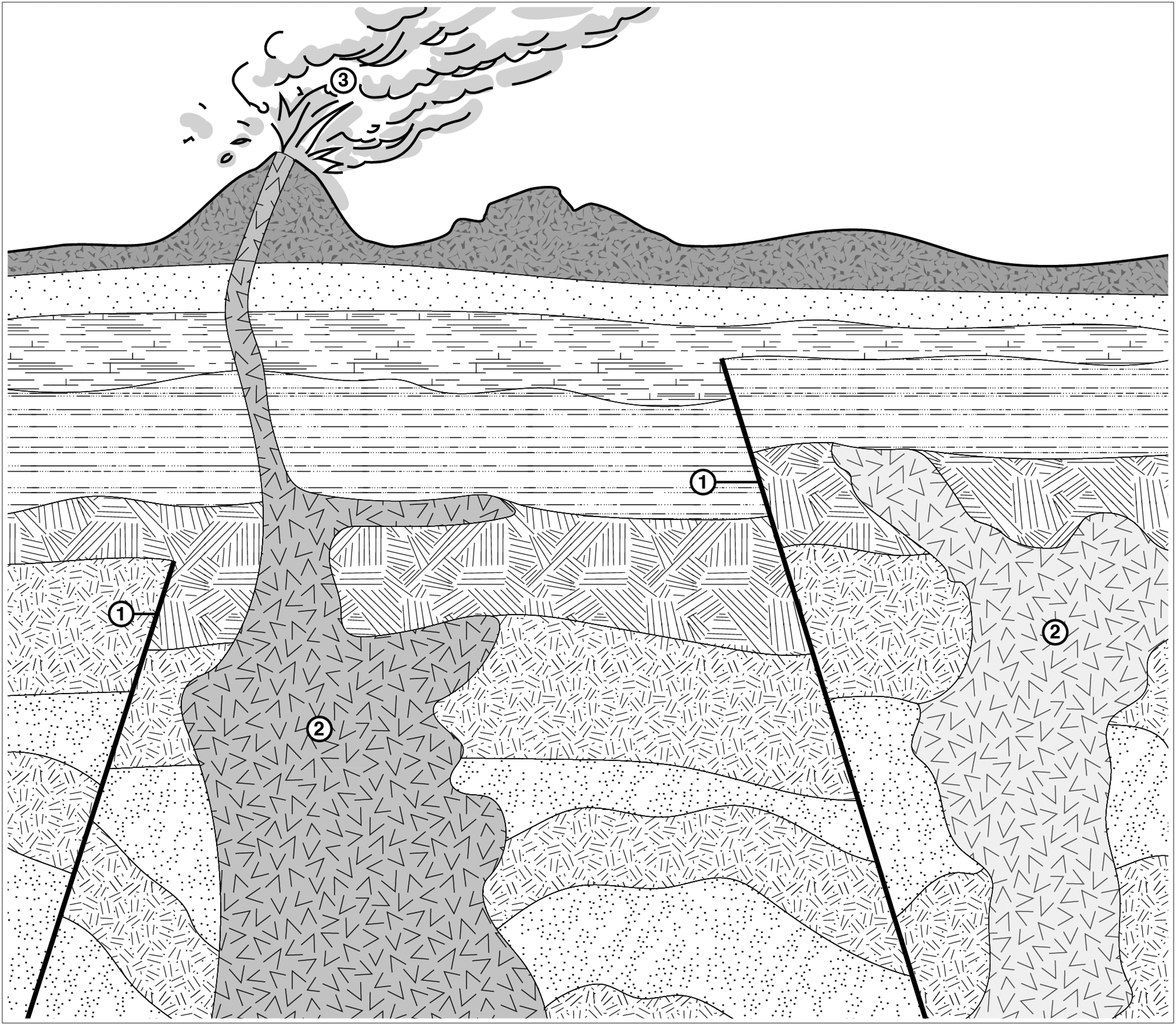
The stratigraphy of risk. This figure metaphorically shows sociogeological strata. The whole system is under pressure, which is not distributed evenly (power dynamics, intermingled with earth processes that may or may not be readily forecast by and for particular groups), and strata interact with each other. The system is subject to rupture (1) which results in changes as power structures evolve, elements interact, and societal fabric shifts. The system is also subject to rapid changes in the form of intrusions (2) which, depending on the forces at work, heat/interact with strata and may break through to the surface and cause dramatic changes to the social order (3). Values, like crustal fluids, permeate the strata. Figure drawn by C. Smith.
Knowledge production is underlain by values—both epistemic and non-epistemic (Dorato 2004; Douglas 2009, 2000). It is also inherently political (Hinchliffe 2001; Jasanoff 1996) and raises well-documented challenges for democratic governance in the “risk society” (Beck 1992; Brown 2009; Latour 2004). It involves the selection and navigation of affects—which may also be related to experiences of disasters in the past, to shared values and to relations with social and material worlds. As discussed above, geological and geographical institutions may have long histories of colonialism; and they function in the modern nation-state as neoliberal entities that are driven by market values (Millar and Mitchell 2017; Paudel and Le Billon 2020). In this context, the diverse values and lifeworlds of marginalized groups may be overlooked or even overridden by national and international priorities.
Simone Bignall writes, In the context of postcolonization, we might then ask: how can we act in order to shift the strata of national values and destabilize the colonial basis of a given society, without simply becoming included in the strata? (2008, 134)
This is a key question in disaster studies, and one where action research has struggled: perturbing the neoliberal state to take action to reduce vulnerability has proved challenging. One reason for this is the frequent absence of careful critique: stepping outside of the Western logic of risk and encountering and learning from other lifeworlds. Paying attention to the geosocial strata that have been emplaced in and still dominate the topography of such lifeworlds enables a decolonial analysis of the emergence of disasters.
Caring critique
The politics of knowledge cannot be disarticulated from a politics of care… By casting care and its problems aside we might not only lose what is generative in care—what care makes possible—we would also elide the ways that care works to animate and activate inquiry and analysis. To bypass, curtail, or overlook care would work to obscure further the moral and affective economies that shape researchers’ entanglements with the phenomena they describe. (Martin, Myers and Viseu 2015, 631)
Feminist geographers have applied ethics of care in their work extensively, seeking to pay attention to the significance of relationships, connectedness, and interdependency between humans, nonhumans, and more-than-humans (Aufseeser 2020; Puig de La Bellacasa 2017; Mason 2015; McEwan and Goodman 2010; Olson and Sayer 2009). Indeed, “thinking with care” has been advocated for as a way to direct attention to marginalized, hidden, and neglected entities and agencies, whereby care is demonstrated as “an active process of intervening in the count of whom and what is ratified as concerned” (Puig de la Bellacasa 2017, 52). In disaster research, this might entail a committed speculative sensitivity to discovering the traces of those (human, nonhuman, and more-than-human) less able to make their stakes in our research phenomena, or that are invisibly implicated in our processes. Values posited from ethics of care—including attentiveness, responsibility, trust, and solidarity—encourage scholars to stay with the complexities that arise in research (e.g., plural, possibly contradictory lived experiences) and the phenomena it studies (Brannelly 2018; Martin, Myers and Viseu 2015). Values from ethics of care also represent the kind of care that is connected to collective action and positive change (Hobart and Kneese 2020).
Assemblage-based approaches to disasters are well placed for such an approach. Puig de la Bellacasa (2011, 2017) took critical inspiration from Latour's (2004, 2014) reorientation of “matters of fact” to “matters of concern” and proposed “matters of care”: the affective entanglements within and between dynamic social, technical, and political assemblages. Such entanglements attend to marginalized, hidden, and neglected human, nonhuman, and more-than-human components. To do so, Puig de la Bellacasa (2017, 52) advocates “thinking with care” as “an active process of intervening in the count of whom and what is ratified as concerned.” Here, then, “care” entails a committed, speculative sensitivity to discovering traces of those less able to make their stakes in disaster risk management apparent—or to the assembling relations within disaster risk management that are invisibly implicated, including assumptions about what constitutes “risk.” It involves careful analysis of the geosocial strata.
In disaster studies, ethics of care have primarily been applied in literature about aid and the immediate care of disaster-affected people (Mena and Hilhorst 2022; Whittle et al. 2012), but are beginning to be used more broadly. For example, in their study of indigenous women in Colombia, Armijos Burneo, and Ramirez Loaiza propose:
un camino ético que se traza desde el cuidado entre los cuerpos como territorios y nuestros cuerpos como investigadoras, ubicados en el encuentro de la conversación; en este sentido, entendemos que este diálogo está atravesado por la figura de mutualidad, mutualidad de aprendizajes, historias y saberes, que terminan configurando espacios de cuidado del cuerpo-territorio. El cuidado, en este sentido, no solo se visibiliza desde un plano metodológico en términos de los vínculos tejidos entre co-investigadoras (investigadoras y participantes), también se retrata en el plano epistémico y ontológico de la forma como se habitan los territorios (2021, 20–21).
An ethic that is traced from the care between bodies-as-territories and our bodies as researchers, located in the encounter of conversation; in this sense, we understand that this dialogue is traversed by mutuality, mutuality of learning, histories, and knowledge, which ultimately configure spaces of care in the body-territory. Care, in this sense, is not only seen in a methodological sense in terms of the links between coresearchers (researchers and participants) but is also seen in an epistemological and ontological sense, in the way in which the territories are inhabited.
They argue that an ethic of care as decolonial practice involves not asking so much about integrating knowledges as about experiencing new ways of making knowledge. Indeed, Latin American studies of indigeneity make clear that the plural ways in which indigenous groups both live in and know their territories problematize Western separations of knowing and being, and of onto-epistemologies from territory (Armijos Burneo and Ramirez Loaiza 2021; De la Cadena 2010; Escobar 2001). Ethics of care scholarship also disrupts the norms and expectations of individualism, neoliberalization, and universalism, which see individuals as autonomous, independent, and self-responsible (Askew 2009; Clayton, Donovan and Merchant 2015; Cloke, May and Williams 2017). “Matters of care” involves “dissenting within” as a means of effecting meaningful and positive critique.
There is no one-good-care-fits-all approach to a critical geography of disasters; rather questions like “how to care” in the context of disaster become insistent but not straightforward (Puig de la Bellacasa 2011, 100). A critical geography of disasters requires an ethic of care that is attentive to value systems, inequalities, and intersectionalities, but that creates spaces for experimentation and speculation about other ways of being-knowing, recognizing that care looks different in different places (Raghuram 2016). It should seek to think-with and benefit the communities from which it is learning (Gaillard 2019) and enable productive discussions (“dissenting within”) around how Western logics of “risk,” “vulnerability,” and “hazard” interact with other ways of knowing the earth.
Imaginaries: making and unmaking the future
To develop these ideas further, we consider the concept of “imaginary,” which has been widely used in geography. One helpful definition of imaginaries is that they are “socially transmitted representational assemblages that interact with people's personal imaginings and that are used as meaning-making and world-shaping devices” (Salazar and Graburn 2014, 1). In geography, imaginaries have typically been understood spatially: “spatial imaginaries are stories and ways of talking about places and spaces that transcend language as embodied performances by people in the material world” (Watkins 2015, 509). Imaginaries are thus both expressive and material: they are beyond-representational because of the ways that they are territorialized in the world, and they are influenced themselves by affects as they are performed in the world and changed through embodiment. They interact with individual imaginations and influence them—and they can circulate through objects too—texts, images, artifacts, and strata for example. Imaginaries are multiscalar and encompass multiple themes (Watkins 2015); they also exist through time, with visions of histories and trajectories that are linked to places but highly variable between different groups and cultures. Finally, there is also a strong component of “othering” encased within the concept of “imaginary” (Sharp 2009), and this is where it links with other related ideas such as Said's “imagined geographies”: imaginaries may be imposed on places by external actors as well as held by multiple groups within a place (Gregory 2004, 1995; Said 2008). According to Howie and Lewis (2014, 132): “The idea of geographical ‘imaginaries’ is an attempt to capture not only that there are multiple geographical imaginations at large in the world, but that they do work in framing understandings of the world and in turn making our different worlds, and that particular imaginaries are wilfully put to work with political affect and effect.”
In this paper, we focus on the imaginaries of “risk” in specific places but also at multiple scales, and how those imaginaries—which typically originate in Western epistemology—interact with those of local peoples. Imaginaries often contain social anxieties with regard to the future (Gregory 1995, 456), and risk is a sociotechnical imaginary which uses ideas about the future to justify actions in the present—and one that takes many forms (Adams 1995; Beck 1992; Lupton 1999; Wisner, Gaillard and Kelman 2012). Particular imagined futures orientate the planning process, for example; these may come from scientific models, development decisions, or urban planning considerations. Imaginaries are not only made of (sometimes incomplete) knowledges but also interact with forms of knowledge production. “Imagination also operates at an intersubjective level, uniting members of a social community in shared perceptions of futures that should or should not be realised.” (Jasanoff 2015, 5).
This is consistent with geographical understandings of imagination too: the value attributed to place and community by different groups is mediated by imaginaries about what the world should be like—and thus imaginations both contribute to and are defined by power dynamics (Daniels 2011). 1 This requires geographers to pay attention to the diverse imaginaries exhibited by different groups of people: disasters emerge out of assemblages of decisions, ideas, physical processes, human–environment interactions, institutional geographies, affects, cultures, and historical patterns in particular places, often territorialized by the dominant political imaginaries (Angell 2014; Donovan 2017; Marks 2019; McGowran and Donovan 2021; Ranganathan 2015). It also emphasizes the importance of positionality in research, as emphasized in feminist approaches: researchers bring their own imaginaries into the field, impacted by their past experiences, scientific training, and expectations.
Imaginaries survive and travel through engagement with social dynamics and affects—including the histories and trajectories of particular places: geosocial strata. They may also be dictated by scientific and technological means, such as models and forecasts (Jasanoff and Kim 2015; Mathews and Barnes 2016)—and they are also implicated in the production of those objects. However, such imaginaries come into contact with other forms of imaginary in the public and institutional spheres. This can create significant tensions between visions of the future in particular places, which may ultimately increase the risk of disasters emerging. Similarly, other scientific interpretations of risk encounter are challenged by local, embedded imaginaries. Anticipation of the future is increasingly a part of governmentality, particularly in developed contexts but increasingly also in the Global South (Anderson 2010; Groves 2017). Risk may be a scientific imaginary; it can also become a technology of government (Amoore 2013; Strakosch 2012).
Imaginaries provide a potential way to think-with diverse groups of people about their perceptions of the world and how they might see it changing—and what forms of change they can or will accept. This can provide a useful tool in identifying not “the view from nowhere” (Shapin 1998) or even “the view from everywhere” (Borie et al. 2021), but focussing instead on “the view from within”: how do the shared attributes, experiences, and challenges of communities (including scientific ones) frame the ways that they think about their own stories in the face of disaster risk, and therefore the kinds of decisions they make or would like to make? Whose imaginaries dominate in the DRM assemblage? Methodologically, we follow Taylor (2004), in thinking of imaginaries as “…the ways people imagine their social existence, how they fit together with others, how things go on between them and their fellows, the expectations that are normally met, and the deeper normative notions and images that underlie these expectations” (Taylor 2004, 23)
For example, imaginaries of volcanoes may include stories based on past eruptive experiences, cultural beliefs, or scientific forecasts (Bankoff, Newhall and Schrikker 2021; Donovan 2022; Glynn and Cupples 2022; Walshe et al. 2023), and be a part of wider geographical imaginaries that help to forge identities in particular places. By focussing on imaginaries, researchers can engage critically with a range of different onto-epistemological worlds. Imaginaries incorporate and are underlain by values—including those aligned, or not, with dominant forces of politics and capitalism (Beckert 2016; Hajer and Versteeg 2019). They may also include epistemic values—preferences for particular forms of knowledge and knowledge-making over others. The scientists who work in contexts of disasters—and disaster researchers themselves—will hold particular sets of values and import imaginaries based on their own experiences and interests. Part of doing critical disaster research involves paying reflexive attention to those imaginaries and their values, alongside those of communities in situ—in effect, doing so carefully. Thus, grounding research in disaster imaginaries with “care” might assist scholars to ask questions of and unravel the often taken-for-granted structural processes and hegemonic discourses that interweave disaster risk.
Toward a critical geography of disasters
This paper has so far drawn on three theoretical concepts—Deleuzian desire in assemblage; the feminist ethic of care; and geographical imaginaries, using the metaphor of geosocial strata to think-with the earth in particular contexts. Its overall aim is in bringing these ideas together, drawing on the work of Maria Puig de la Bellacasa, Elizabeth Grosz, and Elisabeth Povinelli in its theory, and also building on the emergent decolonial literature on disasters. The materiality of disasters has received attention in the drive toward a critical geography that engages with disaster not through categorization or metrics but through an attention to the lived experiences and desired futures of people on the ground (Barbosa and Coates 2021; Bonilla 2020; Glynn and Cupples 2022; Rivera 2022; Sou 2022; Sou and Webber 2023). Assemblage enables us to sit with the tensions that arise in disasters between globalizing ideas and logics, such as humanitarian response, vulnerability assessments and probabilities, and the lived experiences of marginalized communities on the ground, whose lifeworlds may be completely detached from those wider logics. Such approaches force us to consider how and why we do research, and what the world-making effects of that research process may be: that is how we envision the operation of care in this context. Care involves care-full attention to the well-being of the world—human and nonhuman—and reflexive awareness of our own positionalities. It involves situated practice that pays attention to the interdependence between entities, including to affective entanglements. It is, fundamentally, political—because it involves a commitment to challenging inequalities and injustice. It also involves resisting dichotomous, categorizing readings of the world (Puig de La Bellacasa 2017; Grosz 2018; Povinelli 2016; Puig de la Bellacasa, 2012, 2011), but attends instead to the layers of injustice and violence that have produced the context for disaster to emerge.
Emerging work in disaster studies is increasingly sensitive to the historical injustices of colonialism. It is also conscious of complexity: traditional approaches, such as “pressure and release,” promote a linear framework that has shown itself powerful in some contexts—but has also been critiqued for its lack of attention to culture, for its deterministic language and for its simplicity, particularly in overlooking the complex interactions between humans and nonhumans among other things. It bears the hallmarks of its own sited production uncritically (Bankoff 2003, 2019; Malm, 2023; Turner et al., 2003). Recent work has therefore sought to enable a more comprehensive understanding of non-Western ontologies and diverge from the metrics and typologies that are inherent in traditional approaches—often highlighting similar results, but bringing to bear a more nuanced and complex understanding. For example, Bonilla (2020) unveils the “coloniality of disaster” in Puerto Rico, noting that disasters unveil the depth and pervasiveness of the colonial present—that vulnerability in this context was revealed in the waiting for assistance that never came. She writes that, …the search for a post-disaster future is thus about more than just repairing roofs and restoring streetlights. It is also a matter of attending to the deep inequities and long histories of dispossession that had already left certain populations disproportionately vulnerable to disaster (2020, 10).
She discusses in some detail the imagined repair of the island, which is not actualized because the powerful US “doesn’t care.” Instead, the lack of repair reveals the extent to which Puerto Rico is colonized: it reveals the layers of historical and present subjugation of the island.
We have used the image of stratigraphy to illustrate how risk is generated through temporal and spatial relations between elements of naturecultures and is arranged not only according to historical and colonial forcing but also through the values—the desires—that permeate the strata. Walshe et al. (2023) deploy imaginaries as an orienting concept in understanding the ways in which people around Lonquimay volcano in Chile conceptualize their life alongside the volcano. They describe the different imaginaries that different groups related, including differences between those who were from the Mapuche community, those dependent on tourism for their income and those for whom the area was long-term home but who had a modern, scientized view.
Other authors have used imaginaries as a means of analyzing environmental governance (Chhetri, Ghimire and Eisenhauer 2023), the socioecological futures of an urban river (Holifield and Schuelke 2015) and the ways in which geographical technologies are woven into tensions between settler colonialism and decolonial debates (Rivera 2023). Imaginaries may lead to deconstruction of existing assumptions, tacit knowledges, and ways of being and knowing, but in doing so, they reveal historical injustices between groups. Maria Puig de la Bellacasa, like Latour and Stengers on whom she draws extensively, is interested in critique as positive—as something that can help to make a better world. Thus, critiques of vulnerability or even of risk are not intended to replace or reject those imaginaries but to sit alongside them. Just as “attention to affect helps us bring into view the ways in which each element acts on the other, to be moved, and even transformed” (Latimer and Miele 2013, 23), so careful critique can enable renewed awareness of the interdependencies between beings that may be transformative of knowledge systems and their politics. We suggest that key features of a geographical imaginations approach to disasters might include attention to affects, to relationships-in-place, to thinking-with places and communities, to the diverse imaginaries of experts and communities, to the limits of metrics and the pervasive power that they exercise.
Geographical imaginations and disaster risk
The radical disaster studies agenda highlights the importance of positionality and humility on the part of researchers and the privileging of local epistemologies (Gaillard 2019, 2021; Goodall, Khalid and Del Pinto 2022). These emerging approaches are underlain by values that prioritize equity—flat ontologies and also the flat epistemologies that are essential for real transdisciplinarity (flat referring to the rejection of hierarchical distinctions between types of entities) (Donovan, Morin and Walshe 2023; Pardo et al. 2021). This in turn means making visible the assumptions, worldviews, power dynamics, and inequalities that have emerged historically in particular places and between them—and those embedded in the research process itself (Bull 1997; Latulippe and Klenk 2020; Meriläinen and Koro 2021; Rose 1997; Sillitoe 1998; Simandan 2019). The visualizing of “disasters-in-the-making” is a first step. Mitigating those disasters requires interventions that make visible the trajectories that lead to them—and the dominant imaginaries that are taking part in those trajectories. In many respects, this involves combining technology and science but doing so in a culturally, historically, and socially sensitive way that empowers communities and explicitly acknowledges and explores the diverse imaginaries that they contain. That is the approach that is discussed in this paper, and to which we refer, imperfectly, as a “geographical imaginations” approach.
Care forces us to engage with injustice (Lynch, Kalaitzake and Crean 2021). The geosocial stratification that drives the production of vulnerability is fundamentally unjust (Fordham et al. 2013) and requires attention to intersectionality and decolonization (Armijos Burneo and Ramirez Loaiza 2021; Gaillard 2021; Ryder 2017; Vickery, Jean and Hall 2023). Injustice may also emerge from the unequal power dynamics around knowledge (Allen 2007) and so is also a function of how disasters are managed, modeled, and mitigated in any society. Furthermore, injustice is multiscalar: it occurs not only within geographically bounded communities but also between them at national and international scales.
Disaster research must engage with the absence of justice—and the desire for it—carefully, giving attention to historically produced entities, relationships, positionalities, and imaginaries. It must be explicit about the pervading value systems in places, too: whose desires are being realized and at the expense of whom? What are the dominant imaginaries and how do they express these underlying value systems? Both of these questions inform an analysis of the emergence of disasters in specific contexts. Disaster risk ontologies and epistemologies have been the focus of a number of recent studies (Gaillard 2021; McGowran and Donovan 2021). The normative dimensions of risk, however, are much less studied (Roeser 2006). Nevertheless, moral geography has shown unequivocally the issues that arise from value judgments across a wide range of fields. We have refrained, in this paper, from referring to “disaster risk,” preferring to reduce this to “disaster” in a shift away from equations, likelihoods, and metrics.
Approaching disaster studies through geographical imaginaries begins with the community in question. It does not begin with “risk,” but rather recognizes that “risk” is one of many potential ways of viewing the world. It is in the divergences between the imaginaries of neoliberal governance, of globalization, of local communities and marginalized groups that there exists the possibility space for transformation in an assemblage (Puig de la Bellacasa 2012). In his 2007 essay, “On the coloniality of Being,” Maldonado Torres (Maldonado-Torres 2007) puts forward proposals for decolonial research that accepts concepts “as invitations to dialogue and not as impositions”: we suggest that Western logics—such as calculation, quantification and categorization—when used uncritically, shut down to the transmodernity that Maldonado Torres describes.
The multiscalar nature of environmental and social justice issues points toward the globalized elements of disaster risk that a systems approach seeks to capture, but critical approaches also recognize the coexistence of strongly geographical and expressive forces in the production of risk. Risk is not objective; it is embodied and experienced. Thus, understanding the experience of environmental hazards requires paying attention to the “minor” (Katz 2017, 1996; Temenos 2017): to those experiences that are rarely voiced and receive little attention, yet produce interstitial forms of knowledge. This parallels the arguments by those in disaster studies seeking a refocusing on the local, but it goes beyond the “local” to emphasize marginality and its emotions, affect, and relations: Working in a minor theoretical mode is to recognize that those subjectivities, spatialities, temporalities are embodied, situated, and fluid; their productions of knowledge inseparable from—if not completely absorbed in—the mess of everyday life. Minor theory is not a distinct body of theory, but rather a way of doing theory differently, of working inside out, of fugitive moves and emergent practices interstitial with “major” productions of knowledge. Katz (2017, 598).
The fact that such approaches are “interstitial” is important. The Western imaginaries of “risk” that dominate in disaster studies can produce useful critiques and insights, but they have to be reflexive about their origins and their assumptions.
The affective relations to which Deleuze calls our attention have often been ignored in disaster studies. Here, we draw on recent literature to suggest that critical geographies of disaster must think-with, and think carefully about, communities—and in doing so, must pay particular attention to other ways of being (Maldonado-Torres 2007). We argue that, methodologically, examining the diverse and sometimes overlapping geographical imaginaries of different groups may provide a means of understanding these issues that encompasses their ontological and epistemological politics and values. Disaster research across Human and Physical Geography has to engage with the power dynamics that operate at multiple scales but that are also place-specific. As we seek to understand more about the chains of disaster impacts and the systemic risks that are faced globally, we must not lose sight of the local and its complexity. Indeed there are significant risks in a systemic view: such a view can itself marginalize those who are not already in positions of power and, in some territories, risks further entrenching (neo)colonial logics. Systemic risk itself “risks” being a colonial logic. Imaginaries are, perhaps, one methodological approach that can help to make visible the complex dynamics of “risk,” threat, uncertainty—as it is experienced in particular places—and the imaginaries of the dominant political and scientific actors. By grounding these diverse and multiscalar imaginaries in feminist ethics of care, researchers may be able to decenter themselves and produce historically and geographically sensitive and useful narratives that contribute toward environmental justice and the reduction of disaster risk.
Footnotes
Declaration of Conflicting Interests
The author(s) declared no potential conflicts of interest with respect to the research, authorship, and/or publication of this article.
Funding
The author(s) disclosed receipt of the following financial support for the research, authorship, and/or publication of this article: This research was supported by H2020 European Research Grant "IMAGINE" (grant no. 804162).
