



Abstract
In this paper we present an overview of future-oriented research in sustainability science and place-based research and offer a tool for researchers and community partners to use to guide participatory scenario planning activities that result in actionable steps toward achieving sustainable futures. Within place-based community-engaged research projects, future-oriented methods, such as visioning and participatory scenario planning, have been increasingly utilized as an approach to integrate diverse voices and foster positive change. However, this emerging literature contains some overlapping concepts and approaches that require clarification before adoption. We review common definitions of scenarios, visions, and participatory scenario planning; benefits and challenges of conducting a participatory scenario planning process in place-based research; and three actionable frameworks (Three Horizons, Nature Futures Framework, Sustainable Futures Scenarios) that can inform participatory scenario planning. We then highlight gaps in the literature regarding how to conduct a participatory scenario planning process and introduce a tool named “Recipe for a Scenario” to guide the facilitation of scenarios workshops and co-create actionable pathways towards desirable futures. Our tool (and accompanying workbook that structures a scenarios workshop) supports cross-disciplinary community-engaged projects focused on bringing about positive change in a medium-term timeframe (approximately 20 years) to support more sustainable human-environment dynamics.
Introduction
Collaborative work between researchers and other stakeholders is an imperative for transformative change towards sustainability (Shrivastava et al. 2020). In this regard, community-engaged research projects are of special relevance since they involve a collaborative process of knowledge co-creation between researchers and stakeholders (often those with marginalized voices) to address practical problems (Doberneck, Glass and Schweitzer 2010). The use of future-oriented methodologies in community-engaged research projects fosters the capacity of stakeholders to anticipate and adapt to change, as well as to foster change towards desirable future states (Boyd et al. 2015; Iwaniec et al. 2020).
An array of scholarship and practice from multiple disciplines engages with the issue of exploring alternative futures; however, terminology is often used in inconsistent ways across the literature (see Cork et al. 2023 for a full, detailed review). In place-based research, key concepts commonly employed to engage with the future are visions, scenarios, and scenario planning. Although frequently utilized, researchers employ multiple definitions for these terms, particularly scenarios and scenario planning (Nalau and Cobb 2022; Ramirez et al. 2015). We conducted a critical review of the array of existing definitions of scenarios and scenario planning within sustainability science and place-based research with the purpose of describing a panorama of how scenarios work is operationalized. Then, we report on the described benefits and challenges of conducting a participatory scenario planning process. We focus our review on three common frameworks useful to inform participatory scenario planning from both theoretical and empirical perspectives: Three Horizons (Sharpe et al. 2016), Nature Futures Framework (Pereira et al. 2020), Sustainable Futures Scenario (Iwaniec et al. 2020). These frameworks were selected due to their interdisciplinary nature, explicit consideration for bringing about transformation towards positive futures, demonstrated success in empirical applications, and grounding on systems thinking. Finally, we review and summarize how these frameworks outline how a participatory scenario planning process can be structured.
As an outcome of our critical review, we identify a methodological gap — the lack of published tools to support the facilitation of scenarios workshops (Sharpe et al. 2016; Hichert et al. 2021). We highlight a few recently published notable exceptions where workshop processes, methods, guiding questions and activities have been detailed and outlined, such as Pereira et al. (2021), Pereira (2021), Mannetti et al. (2021), Lazurko and Keys (2022), Van Den Ende et al. (2021), Hichert, Biggs and Preiser (2019). The practicalities of how to implement scenario planning processes and workshops are essential to support their use by stakeholders yet remain underreported in the literature, hampering the potential for scenario planning to facilitate progress in research-based actions within a given system or place. Furthermore, many scenario processes are designed as multi-day events that require experts on multiple methods and professional facilitators. We argue that half or one day workshops can incorporate individual participants who might want to participate but cannot include this as part of their job, which is a necessary option for a more diverse and agile future practice (Lazurko and Keys 2022).
Addressing this gap facilitates progress in cross-disciplinary approaches to applied social sciences aimed at addressing current human-environmental challenges. Therefore, we developed a tool that includes facilitation guidelines, titled “Recipe for a Scenario”. This tool uses a cooking metaphor for facilitating conversations between researchers and diverse stakeholders that are structured, yet flexible, to co-create actionable pathways towards a desirable (i.e., sustainable and equitable) vision of the medium-term future (i.e., 20 years). We adopt a medium-term future perspective, since longer time horizons are appointed as more difficult to anticipate (Nalau and Cobb 2022), and medium-term goals set communities up for active negotiation of tensions and trade-offs of changes that are achievable, yet transformative (Voros 2003). Our tool is workshop-based and accompanied by a workbook that is the key supporting material to guide facilitation (Appendix 1). We present a comprehensive overview of the process including the recipe tool; the use of the workbook to facilitate scenarios workshops within community-engaged projects; data analysis; and communicating key findings to stakeholders. Further, we also reflect on the application of the tool in two different community-engaged research projects. Our review and tool are useful for ongoing community-engaged research, cross-disciplinary teams and practitioners seeking practical frameworks for moving from vision to actionable pathways in our efforts to build sustainable human-environment dynamics in an equitable way.
Method
According to Grant and Booth (2009), a critical review seeks to “take stock” of the available body of work, aiming to critically evaluate it and provide a way forward based on what is analyzed, which often results in the development of a new model or tool (e.g., Kulviwat, Guo and Engchanil 2004). We conducted a critical review to identify, synthetize, and analyze the literature published after the year 2000 on scenarios within sustainability science and place-based research. We recognize that literature on scenarios is plural and encompassing of multiple disciplines, theories, and practice (Cork et al. 2023). Due to the interdisciplinary nature of sustainability science and our focus on participatory processes, our review also intersected with other areas, including environmental geography, ecology, and anthropology. Therefore, we recognize and engage with literature from multiple areas, but focus on the field of sustainability science due to its normative orientation towards equitable, sustainable futures (Wiek and Lang 2016). We also aimed to identify frameworks to inform participatory scenario planning that 1) are interdisciplinary in nature, 2) explicitly give consideration for positive futures and transformation, 3) demonstrate successful application with communities, and 4) were grounded in systems thinking for both their development and application. Our critical review revealed three relatively recent, prominently used frameworks that met our evaluative criteria: Three Horizons, Nature Futures Framework, Sustainable Future Scenarios. The result of our review culminated in the development of a tool titled “Recipe for a Scenario” that contributes to the advancement of the empirical application of these frameworks.
Defining scenarios, visions and participatory scenario planning
Across disciplines, the term scenario is widely utilized with different meanings that emphasize distinct aspects of thinking about the future. For instance, some authors broadly define scenarios as alternative futures (Bishop, Hines and Collins 2007) or plausible descriptions of what the future might hold (Reed et al. 2013). Focusing on scenarios within the context of modeling, the Intergovernmental Science-Policy Platform on Biodiversity and Ecosystem Services (IPBES) define scenarios as a set of possible futures for different elements of a system (IPBES 2016). Scenarios can also be conceptualized as stories or narratives that explore and describe alternative futures (McKenzie et al. 2012; Bennett et al. 2016; Cork et al. 2023). In parallel, there are also definitions that emphasize the characteristics of scenarios. For instance, Oteros-Rozas et al. (2015) define scenarios as coherent, internally consistent, plausible descriptions of a potential future. Iwaniec et al. (2020) define scenarios as plausible, coherent narratives about the future for the production of anticipatory knowledge.
Beyond definitions, different typologies of scenarios have also been proposed. Börjeson et al. (2006) identifies three types of scenarios, based on the questions that guide scenario development: predictive scenarios; explorative scenarios; and normative scenarios. Voros (2003) proposes a “futures cone” that describes futures that are possible to be imagined; futures that are likely to happen, based on current knowledge and trends; and preferable futures, which focus on what is desired to happen based on held values. Building upon the typology of Voros (2003), Cork et al. (2023) propose an updated “futures cone” that include preposterous, possible, plausible, projected, probable and preferable futures. Drawing on a project's goals, the design of the scenario process, and the characteristics of scenarios, Van Notten et al. (2003) also offer different classification of scenarios, including descriptive, issue-based, normative scenarios, among other categories. IPBES (2016) classified scenarios as target-seeking, policy-screening, exploratory or retrospective policy evaluation. This broad array of existing definitions and typologies across disciplines indicates the wide scope of applications of the concept of scenarios.
According to Costanza (2003), to change how the world currently is and achieve a future that is desired, we must first envision the world we want. Within this context, the concepts of vision and visioning are often utilized alongside scenarios. A vision is defined as a desirable future state of a given system (Wiek and Iwaniec 2014). Although establishing a shared vision about a positive future is argued to be one of the first steps towards concretely achieving it (Meadows 1996; Costanza 2003; Van der Helm 2009), approaches that explicitly focus on desirable futures are still less adopted in scenarios literature, in comparison with explorative and predictive approaches (McPhearson, Iwaniec and Bai 2016; Nalau and Cobb 2022). In this regard, there has been a recent shift in the interdisciplinary literature on sustainability toward thinking about scenarios to explore desirable visions (Bennett et al. 2016; Bennett et al. 2021). By shifting the focus to positive futures, it is possible to explore radical alternatives and avoid the perceived inevitability that dystopian futures might generate (Iwaniec et al. 2020; Bennett et al. 2021). Although radical futures might seem less plausible, the elements to construct radical, positive, desirable futures will still be composed by the elements of our current reality (Bennett et al. 2016; Sharpe et al. 2016; Bennett et al. 2021). Therefore, a vision that describes a desirable future is a crucial step for the development of a scenario.
Scenario planning refers to a specific way to apply the concept of scenarios. According to Peterson, Cumming and Carpenter (2003), scenario planning is a systemic method for thinking creatively about possible complex futures. Given that the future holds many uncertainties, scenario planning focuses not on trying to predict what will happen, but rather on exploring a variety of futures and the possibilities they contain (Peterson, Cumming and Carpenter 2003). As Kahane (2012) adds, the planning in scenario planning is not merely about creating a plan and following it. Rather, it refers to creating a structured process of thinking about the future and then altering actions accordingly. Although some authors consider scenario development, scenario planning and scenario analysis as synonyms (e.g., Reed et al. 2013), we opt to consider scenario planning as a complete foresight investigation, in which the development of scenarios is a part (Bishop, Hines and Collins 2007). Therefore, scenario planning should integrate the development of a vision for the future, as well as the scenarios that include the associated steps on how to achieve it.
Participation can be defined as the active engagement of diverse stakeholders in a management or governance process, which contributes to supporting transparency, knowledge sharing, trust building, legitimacy of decisions, and empowerment of marginalized stakeholders (Reed 2008; Biggs, Schlüter and Schoon 2015). Oteros-Rozas et al. (2015) define participatory scenario planning as a process in which stakeholders engage in a highly collaborative process and develop a leadership role, frequently guided by researchers. The importance of including multiple values, perceptions, and opinions of stakeholders in scenario planning has been increasingly highlighted in recent scenarios literature (Lembi et al. 2020; Pereira et al. 2020; Harmáčková et al. 2021). Therefore, a participatory scenario planning process that is plural and focuses on positive futures can contribute to efforts that foster diversity, equity, and inclusion in a system.
Given the variety of definitions and applications of the concept of scenarios across the literature, in this paper we focus on how scenario planning can be used as a methodology to bring about positive change towards just and sustainable futures. While we draw from work that does not explicitly center on desirable futures, we focus on what can be learned to foster positive change. Therefore, we conceptualize scenarios as plausible and desirable descriptions of future trajectories of a system with specific, associated steps to achieve a desirable future that should be co-created with stakeholders and draw on evidence-based research. We recognize that understanding the plausibility and desirability of a scenario is a task that requires active discussion and negotiation across diverse stakeholders through the facilitation of participatory processes (Voros 2003; Iwaniec et al. 2020). In this sense, we conceptualize participatory scenario planning as an engaged, structured process that entails visioning and scenario development, with the ultimate goal of co-producing actionable pathways towards desired futures. Structured thinking about scenarios to achieve positive visions can be a useful tool for anticipating and preparing for a range of future events, and for actively shaping and building this future. For these reasons, participatory scenario planning stands to advance progress in interdisciplinary, place-based research as researchers and communities collaborate to build engaged, evidence-based responses to sustainability challenges.
Benefits and challenges of participatory scenario planning
Empirical studies have identified benefits and challenges for participatory scenario planning. A majority of studies focus on surveying participants of scenario processes to better understand impacts and outcomes (e.g., Schmitt Olabisi et al. 2016), while others have conducted literature reviews to investigate anticipated impact (e.g., Oteros-Rozas et al. 2015; Thorn et al. 2020).
Among the benefits of participatory scenario planning, a key aspect is how it contributes to foster participation of diverse stakeholders in community-engaged processes. Several studies report that scenario planning enhances stakeholder engagement, strengthens relationships and networking between participants, and increases the understanding of other perspectives (Schmitt Olabisi et al. 2010; Johnson et al. 2012; Oteros-Rozas et al. 2015; Waylen et al. 2015; Totin et al. 2018). Thus, participatory scenario planning can aid in building consensual management strategies and policies, contributing to collective decision-making (Palomo et al. 2011; Reed et al. 2013; Rutting et al. 2021). As a result, it can support equity, increase legitimacy in decision-making, integrate different types of knowledge, and enhance stakeholders’ capacity to engage with complex problems (Oteros-Rozas et al. 2015). When coupled with modelling techniques, it can be used to elicit drivers of changes and enrich the development of models (Schmitt Olabisi et al. 2016; Allington et al. 2018; Rutting et al. 2021). Finally, participatory scenario planning can foster transformative change through the creation of strategies to navigate crises and achieve desirable futures (Hebinck et al. 2018; Lazurko and Keys 2022).
Despite these successes, several studies highlight the challenges and limitations of participatory scenario planning. For instance, the transformative potential that scenario processes have is challenging to achieve and is sometimes not accessed (Totin et al. 2018), and not all scenario processes trigger systems thinking (Schmitt Olabisi et al. 2016). Moreover, participatory scenario planning requires careful consideration of values in balancing what is considered plausible and desirable by different stakeholders, produces impacts that are hard to monitor, and sometimes struggles to simultaneously address scientific goals and local needs (Voros 2003; Oteros-Rozas et al. 2015; Wiebe et al. 2018). There are also challenges in ensuring diversity in the group of participants in scenario planning, effective promotion and management of constructive conflict, the length of engagement, and ensuring time and resources for enhancing the quality of the process (Johnson et al. 2012; Rutting et al. 2021). Moreover, the tensions and trade-offs that emerge in the process require facilitation skills (Iwaniec et al. 2020; Harmáčková et al. 2021).
Despite the challenges, these studies all agree on how the process of participatory scenario planning is useful for building trust and connections among participants that reach beyond the benefits of the results. Hence, ensuring rich dialogues between diverse stakeholders in the context of scenario planning is key to improving decision-making towards desirable futures (Palomo et al. 2011; Rosa et al. 2017), and in some respects is more relevant than the development of scenarios themselves. However, a single scenario workshop is insufficient for achieving the transformative potential that it often aspires to (Nieto-Romero et al. 2016). Thus, it is important to emphasize that participatory scenario planning benefits from long-term processes that support coordination of stakeholders, dissemination of scenarios to broader community organizations, specificity in describing steps toward a shared vision of the future, and conversations about how to overcome barriers for collective action (Nieto-Romero et al. 2016).
Finally, the creation of communities of practice can facilitate the use of participatory scenario planning as a methodology to promote sustainable transformations, especially through the sharing of case studies, lessons, resources, and tools. Inspired by the necessity of a global collection of scenarios, the Biosphere Futures platform features a collection of place-based social-ecological scenarios (Kuiper et al. 2024; biospherefutures.net). Focusing on efforts in the present that can illustrate positive, radical futures, the Seeds of Good Anthropocenes database collects optimistic stories to foster inspiration for transformation (Bennett et al. 2016; Bennett et al. 2021; goodanthropocenes.net). Clearly this effort to collate and disseminate gray literature and applicable tools to a community of researchers and practitioners is an essential step to advancing participatory scenario planning as a strategic activity, overcoming the barrier of these tools existing only in peer-reviewed publications.
Frameworks that inform participatory scenario planning
Within scenarios literature, multiple frameworks conceptualize ways to think about the future. The results of our critical review reveal three dominant frameworks united in their interdisciplinary approach, explicit consideration for facilitating positive change, grounding in systems thinking, and their overarching goals of co-producing knowledge to inform actionable steps towards desirable futures. Thus, we focus our attention to deeper analysis of Three Horizons (Sharpe et al. 2016), Nature Futures Framework (Pereira et al. 2020), and Sustainable Future Scenarios (Iwaniec et al. 2020). These frameworks have gained popularity due to their generic character that allows application in different systems and locales. We present an overview of these three frameworks, highlight their strengths and empirical applications, and discuss guidelines they provide for operationalization. We highlight the intended uses, aims and any limitations to detail the contexts in which they can be useful.
Three horizons
Three Horizons emerged as a practitioner's tool aimed at providing a simple framework for working with complexity and engaging with the future (Sharpe et al. 2016). The framework is focused on the recognition of patterns in a given system to enable processes and practices that can bring about transformative change, although it does not pre-determine a temporal scale for such change (Hodgson and Sharpe 2007; Curry and Hodgson 2008; Sharpe 2014). It has a semi-exploratory character, meaning that while it enables the identification of different pathways towards a desired future, it does not aim to provide a single way and plan forward. The framework fosters reflection on the role of each participant in the transition, thus stimulating agency (Sharpe et al. 2016). It is graphically summarized by the changing prevalence of three different horizons over time (Figure 1). The first horizon (H1) describes business-as-usual – i.e., what is likely to happen if we extend the patterns of the present into the future. The third horizon (H3) represents transformative change. In H3, an alternate future has emerging patterns that grow from the fringes of the system and become the successor of H1. Hence, H3 is focused on seeing beyond current system structures, motivated by a positive vision. The second horizon (H2) is the turbulent domain of transition in which some innovations will facilitate transformative change towards H3, while others will fail or reinforce H1. While the framework makes a distinction between the three horizons, all of them can simultaneously coexist in the present.
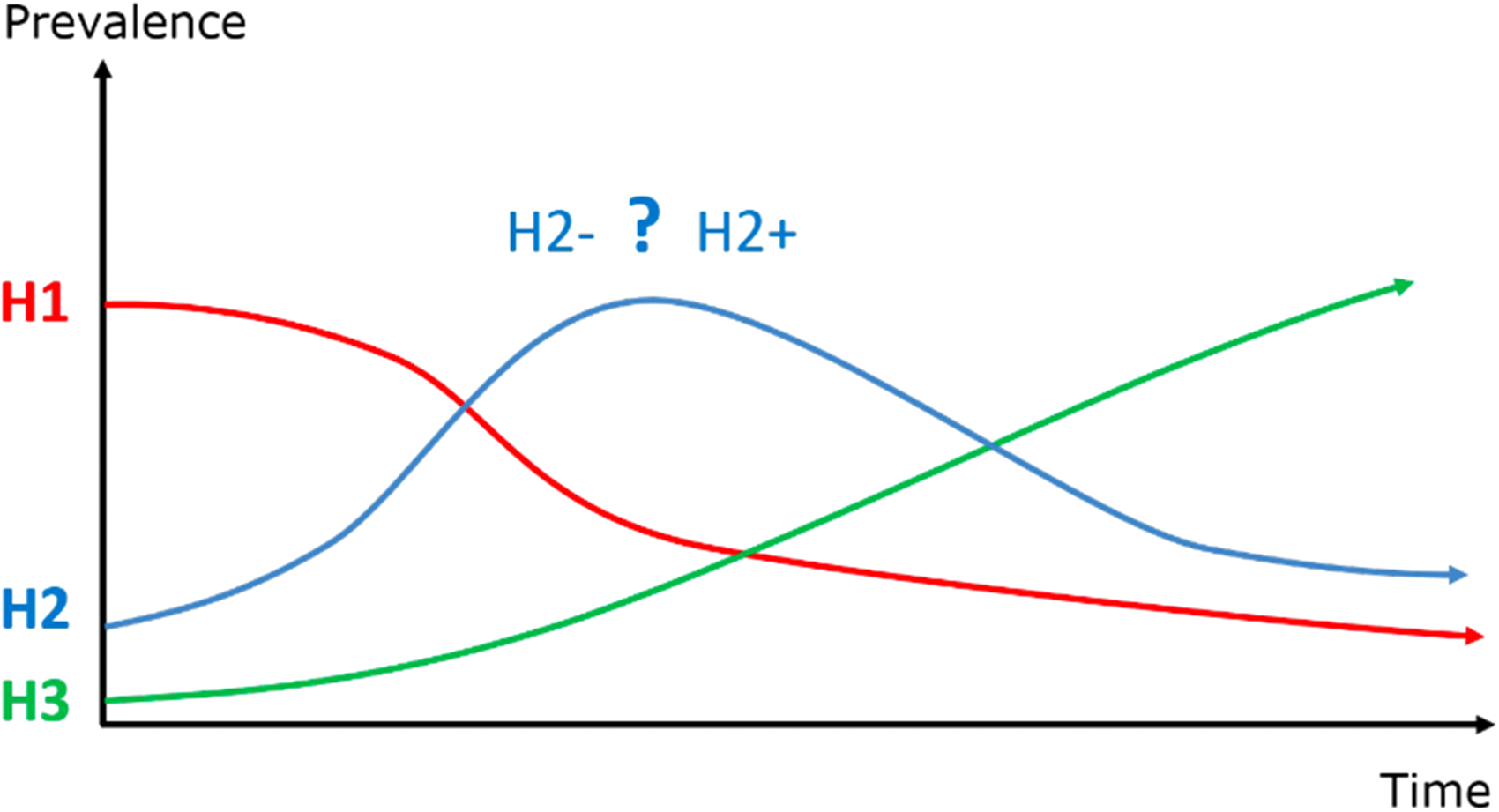
Three horizons framework as outlined by Sharpe et al. 2016. Prevalence refers to how dominant a pattern is, and the lines represent the three horizons (H1, H2, and H3). The first horizon (H1) describes business-as-usual, and the third horizon (H3) represents transformative change. The second horizon (H2) is the transition domain, in which innovations will either be absorbed back to business-as-usual (H2-) or will foster the emergence of transformative change (H2+). The question mark highlights the uncertainty in H2 (Source: Sharpe et al. 2016).
Broad steps for operationalizing Three Horizons include examining present concerns, the desired future, identifying present examples and innovations of alternative ways of doing things (“pockets of the future in the present”), and exploring what features of the present are essential to maintain in the future. Further steps in the application of this framework include distinguishing actions that lead to incremental or transformative change, exploring the management of transitions, and recognizing the power of different actors to influence change (Sharpe et al. 2016). However, specific materials or protocols are still lacking that inform how to apply the framework in workshop settings, with few exceptions that provide generic guidelines (e.g., Van Den Ende et al. 2021).
The generic character of the framework makes it useful for a broad array of problems. Early application included exploring new high school curriculums, funding for the arts, and climate change (Curry and Hodgson 2008). Due to its focus on recognizing systemic patterns with the goal of working towards transformative change, it is often of special interest to scholars studying human-environment systems. For instance, it has been utilized to envision future knowledge systems to support action towards sustainability (Fazey et al. 2020), co-design global scenarios to achieve the Sustainable Development Goals (Aguiar et al. 2020), co-creation of positive climate futures that could emerge after COVID19 (Lazurko and Keys 2022), and co-production of pathways towards desirable futures associated with storytelling and visual arts (Schaal et al. 2023). Three Horizons can also be incorporated into broader processes to facilitate specific activities (e.g., the Manoa Mashup Method as described by Pereira et al. (2018) and Hichert, Biggs and Preiser (2019)).
Nature futures framework
The Nature Futures Framework (NFF) is the result of an effort conducted by a group of biodiversity experts involved in the scenarios and models group within IPBES (PBL 2018; Pereira et al. 2020). The framework emerged as a response to global socio-environmental scenarios that lacked engagement of non-academic stakeholders in their considerations of achieving positive futures (Pereira et al. 2020). Hence, the NFF was developed as a strategy to enable the development of biodiversity-centered scenarios that can be applicable to multiple scales through a co-production process that embraces a plurality of views, although, again, does not pre-determine the timeline for futures.
The NFF is graphically represented as a triangle that maps preferences for the future of nature, building on a typology of values of nature that considers intrinsic, instrumental, and relational values (Figure 2) (Chan et al. 2016; Pascual et al. 2017; Chan, Gould and Pascual 2018). Nature for Nature represents the view in which nature is perceived as having value in and of itself (intrinsic values). Nature for Society represents nature as valued for the benefits and uses that people gain (instrumental values). Nature as Culture represents the perception of humans as an integral part of nature, thus valuing the relationship between people and nature and relationships between people that involve nature (relational values). Based on this gradient of possible nature values, scenarios can be assessed in terms of which values of nature are prioritized. It is relevant to stress that those values exist across a spectrum (Pereira et al. 2020; Mansur et al. 2022).
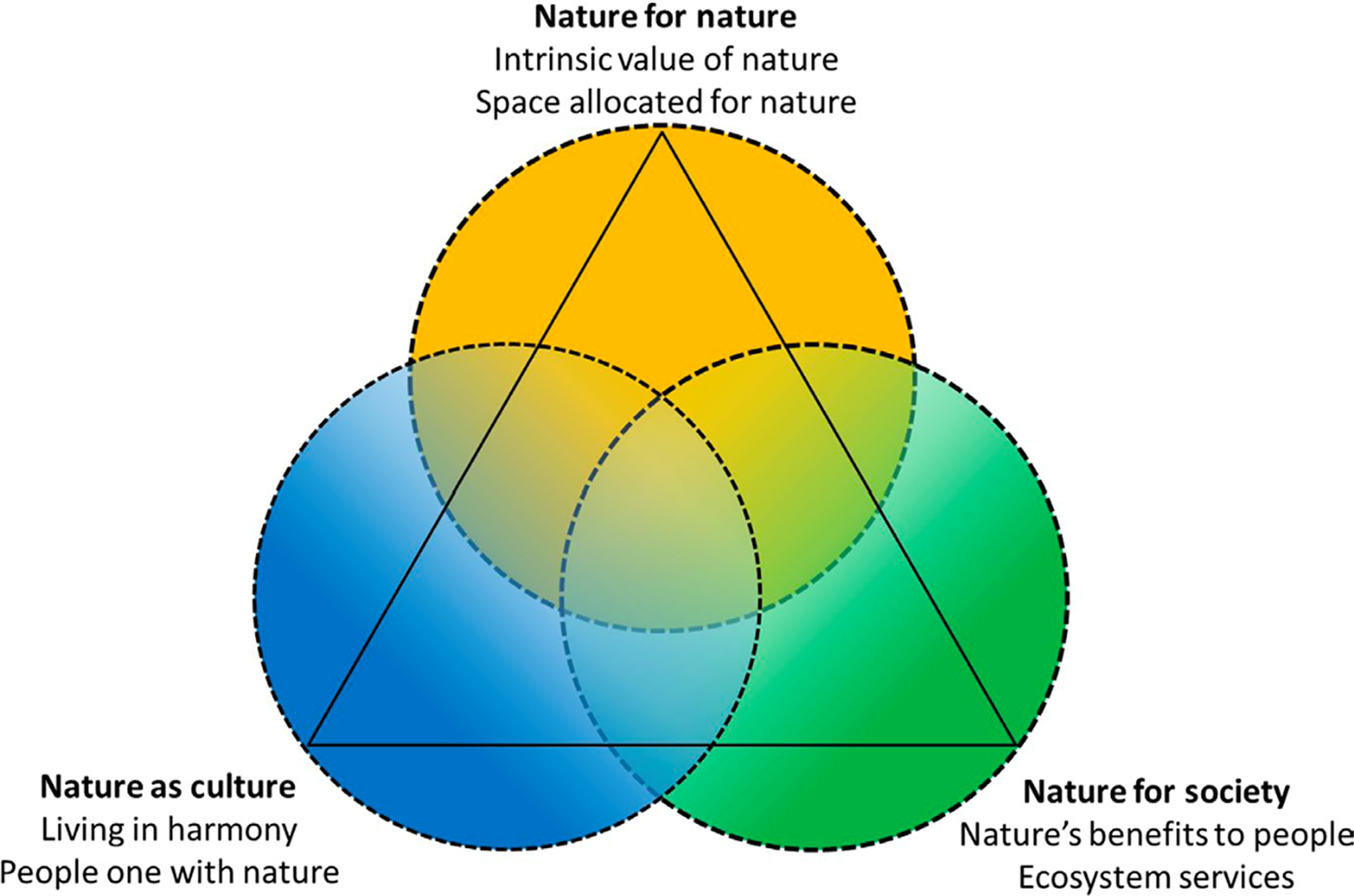
The nature futures framework is represented by Pereira et al. (2020) as a triangle that considers three different values regarding human-environment interactions. The color gradient highlights how some perspectives can fit into different into different values. The axis of each triangle presents the three values considered within the framework: Nature for Nature; Nature as Culture; Nature for Society. (Source: Pereira et al. 2020).
Nature Futures Framework is relatively new, and its operationalization is still in progress (Kuiper et al. 2022). Focusing on urban expansion in the Brazilian Atlantic Forest, Lembi et al. (2020) used the framework to evaluate trade-offs and synergies for biodiversity and ecosystem services that occurred based on which values are prioritized by urban planning. Mansur et al. (2022) further refined the application of the NFF to urban systems and present a four-step process to operationalize the framework. Kuiper et al. (2022) used the triangle that graphically represents NFF to discuss the plurality of values in human-environment relationships in a participatory visioning workshop. This study, specifically, presents an activity and set of guiding questions to operationalize the use of NFF in a workshop-setting. Other recent advancements on the applications of the NFF include its coupling with quantitative modelling of landscape scenarios (Haga et al. 2023) and methodological guidance to develop illustrative scenarios (Durán et al. 2023). Recent studies also indicate how the NFF can be applicable to contexts beyond scenarios, including the assessment of management strategies and policies (e.g., Palacios-Abrantes et al. 2022; Kim et al. 2023; Stronge et al. 2023).
Sustainable future scenarios
The Sustainable Future Scenarios (SFS) framework stands out for its explicit focus on scenarios for urban systems. Based on empirical work by researchers and practitioners in different cities across the Americas, the SFS framework offers a theoretical basis for the co-production of scenarios and pathways tied to interventions that foster positive transformation toward sustainability (Iwaniec et al. 2020; Iwaniec et al. 2021; Mannetti et al. 2021). Given that it has been developed with a focus on urban environments, SFS argues for the careful consideration of the different aspects that are critical for cities. Therefore, the SFS framework builds upon the notion of cities as social-ecological-technological systems with an ecological-biophysical domain, a social-economic domain, and a technological-infrastructural domain (McPhearson et al. 2022). The framework is long-term oriented, and it has been applied to time horizons that consider the year 2060 or 2080 (or 40–60 years in the future) for the realization of the scenario (Iwaniec et al. 2020; Mannetti et al. 2021).
Operationalization of the SFS framework is based on the co-production of three distinct types of scenarios that vary in plausibility and desirability: strategic, adaptive, and transformative scenarios (Figure 3). The strategic scenario is developed by researchers through the analysis of official governance documents to examine goals and strategies that municipal management already considers for a city's future. Adaptive and transformative scenarios are co-produced in scenarios workshops in a highly collaborative atmosphere. Adaptive scenarios are co-developed to creatively explore interventions to address specific challenges (e.g., a problem such as flooding). Transformative scenarios focus on exploring radical departures from current reality towards a desirable future. Negotiating what different stakeholders consider positive aspects of a desirable future is a key process of the SFS framework, requiring careful facilitation of scenarios workshops to incorporate various viewpoints and understandings of this shared future. The workshops have an iterative and reflexive nature and are crafted based on a process that can build anticipatory capacity and systems thinking among participants. After scenarios are developed, they can be evaluated and compared in terms of resilience, equity and sustainability using a qualitative tool (Berbés-Blázquez et al. 2021).
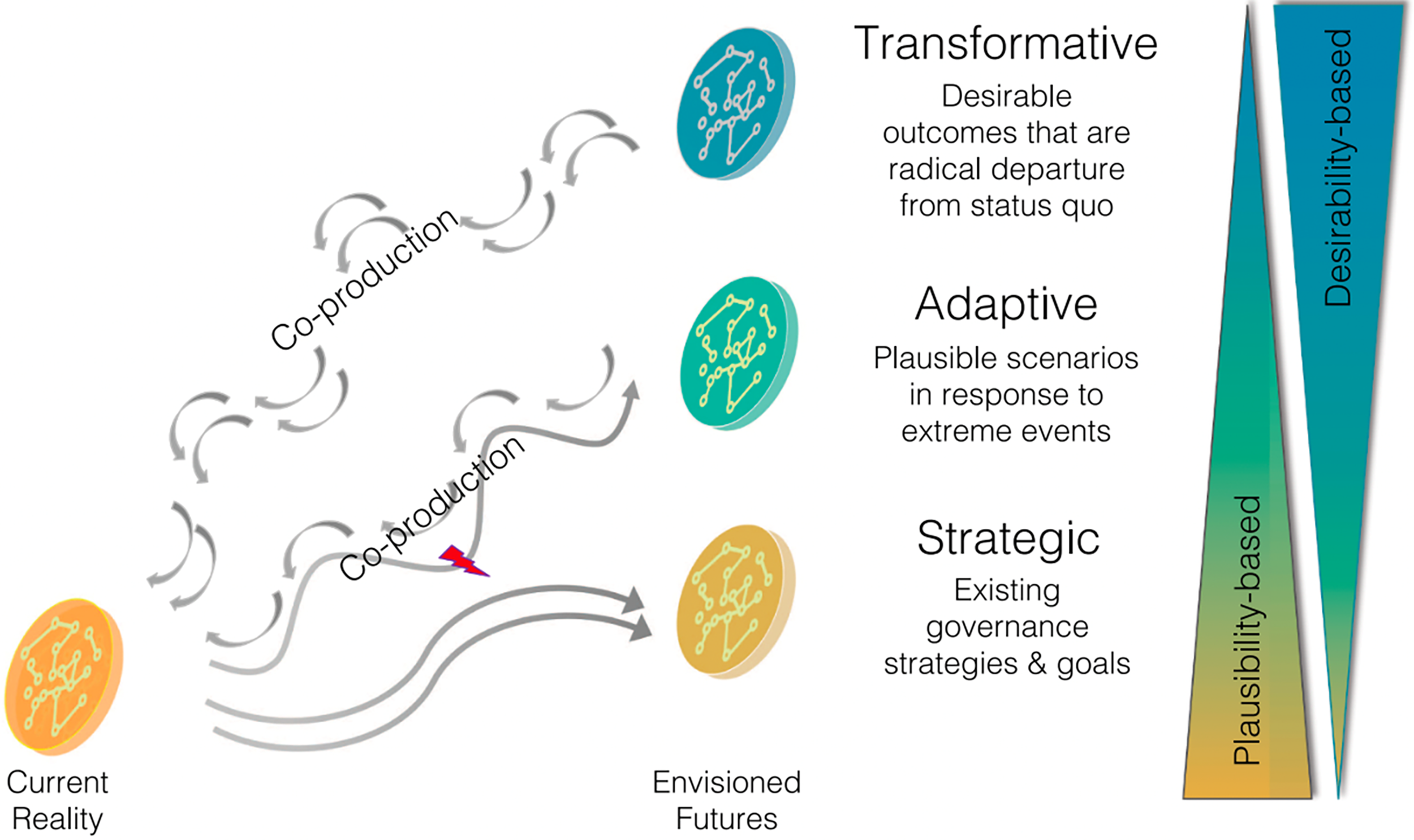
The sustainable futures scenarios framework by Iwaniec et al. (2020) compares different types of scenarios that vary in plausibility and desirability. Transformative and adaptive scenarios are co-produced with stakeholders in participatory workshops, whereas strategic scenarios are developed by the research team. The gray arrows represent the transition pathways from the present towards the futures. The red symbol indicates specific disturbances that the adaptive scenario should consider (e.g., extreme weather events). (Source: Iwaniec et al. 2020).
The Sustainable Future Scenarios framework proposes two-day participatory scenario workshops and indicates activities that can guide collaborative work. Mannetti et al. (2021) provide an overview of steps that can be conducted in pre- and post-workshop phases, as well as suggested activities to conduct during the workshops. Although a broad array of potential activities is suggested, specific guidelines or tools on how to easily operationalize this framework are lacking, with researchers instead providing generalized overviews on their application.
Moving forwards based on strengths and gaps of participatory scenario planning literature
That there are multiple frameworks to structure a participatory scenario planning process indicates how this approach is highly adaptable to fit the needs of future-oriented projects. While being generic is useful to enable customization, it can also pose a challenge—namely, only recently have researchers made available tools that can structure and aid in the facilitation of the process or application of the method (e.g., Mannetti et al. 2021 for the Sustainable Future Scenarios, Van Den Ende et al. 2021 for Three Horizons). The frameworks indicate the use of workshops as a method to foster participation and co-creation between stakeholders. However, guidelines for step-by-step design of the workshops and tools to aid in facilitation are not frequently observed, particularly in the three frameworks outlined above. Indeed, one of the key limitations for participatory scenario planning (and other participatory approaches) is the need for facilitation skills to guide dialogues between participants (Sharpe et al. 2016; Hichert et al. 2021). Furthermore, the frameworks either lack a specific timescale for application (Three Horizons, Nature Futures Framework), or focus on a longer time horizon like 40 or 60 years in the future (Sustainable Future Scenarios).
Thus, to address the gaps emerging from our critical review and in-depth analysis of these three frameworks, we present a participatory scenario planning process and a tool entitled “Recipe for a Scenario” to aid in facilitating participatory scenario planning workshops that focus on medium-term futures (20 years from the workshop date). To ensure accessibility of our proposed tool, we provide it in the form of an open-source workbook available with a creative commons license that can be customized, printed, and distributed to participants (Appendix 1). The “Recipe for a Scenario” is inspired by the three frameworks reviewed above, and as such is informed by systems thinking, interdisciplinarity, and consideration for positive future transformation. Specifically, we draw the following insights from each framework. From Three Horizons, we adopt its focus on the management of a transition, by exploring the concrete elements of the system that are necessary to bring about change towards a desirable future: consideration of geographic boundaries of the system of interest, which actions must come first for others to follow, which material and non-material resources are needed, and which stakeholders play a role in the transition process and how they can influence change. From Nature Futures Framework, we incorporate its value-based perspective by actively identifying values as community priorities, and considering which values are privileged by a desired future. Moreover, our tool incorporates the multiscale perspective of Nature Futures Framework, since it discusses the location of the scenario as one of its central features. Finally, from the Sustainable Futures Scenarios, we integrate insights on negotiating the tension between developing plausible actions that can yield transformative change.
Structure of a participatory scenario planning process and “recipe for a scenario” tool
As a participatory tool to facilitate scenario planning workshops in the context of community-engaged research, the application of the “Recipe for a Scenario” tool is embedded within a larger process. Our method emerged within the context of community-engaged research projects in which we worked in collaboration with community leaders working within urban food systems. We opted to utilize a cooking metaphor to make a clear connection between our academic research and the work that was being conducted by partners. In parallel, we also use a recipe metaphor to emphasize that a same set of given “ingredients” (i.e., the steps outlined in our workbook) can be mixed and matched in different ways to produce diverse “meals” (i.e., scenarios). While “recipe” may be seen as prescriptive, we build flexibility in our tool by allowing for participants to jump between the order of steps (“ingredients”) to develop (“cook”) their scenario, recognizing that there is room for creativity in the “cooking/research” process.
Figure 4 summarizes broad steps of our complete proposed, and tested, participatory scenario planning process. The key element and starting point of the community-engaged research project is building trusting relationships between researchers and stakeholders to enable a collaboration that is fruitful and respectful (Doberneck, Glass and Schweitzer 2010). Second, initial visioning activities are conducted to define desirable futures for the system (Wiek and Iwaniec 2014). Qualitative data from visioning activities is necessary so the research team, through thematic coding, can identify a set of values. Values are here defined as community priorities that describe the vision (building on Tadaki, Sinner and Chan 2017). Based on this first round of data analysis, a vision is developed either by the researchers, or collectively in a community-engaged process, and subsequently validated by stakeholders. Building upon the initial set of values and vision, we move forward to scenario development through a participatory workshop that uses the “Recipe for a Scenario” tool to co-create actionable pathways towards the vision. After scenario development, we draw on any previous qualitative and quantitative data for further analysis by the research team to supplement the actionable steps outlined in the scenario workshop (“supplementing and resource sharing”). Finally, a new set of interactions between research team and stakeholders validates the findings to ensure they are representative of workshop discussions, accurately reflect participant's views, and will ultimately be useful to the community.
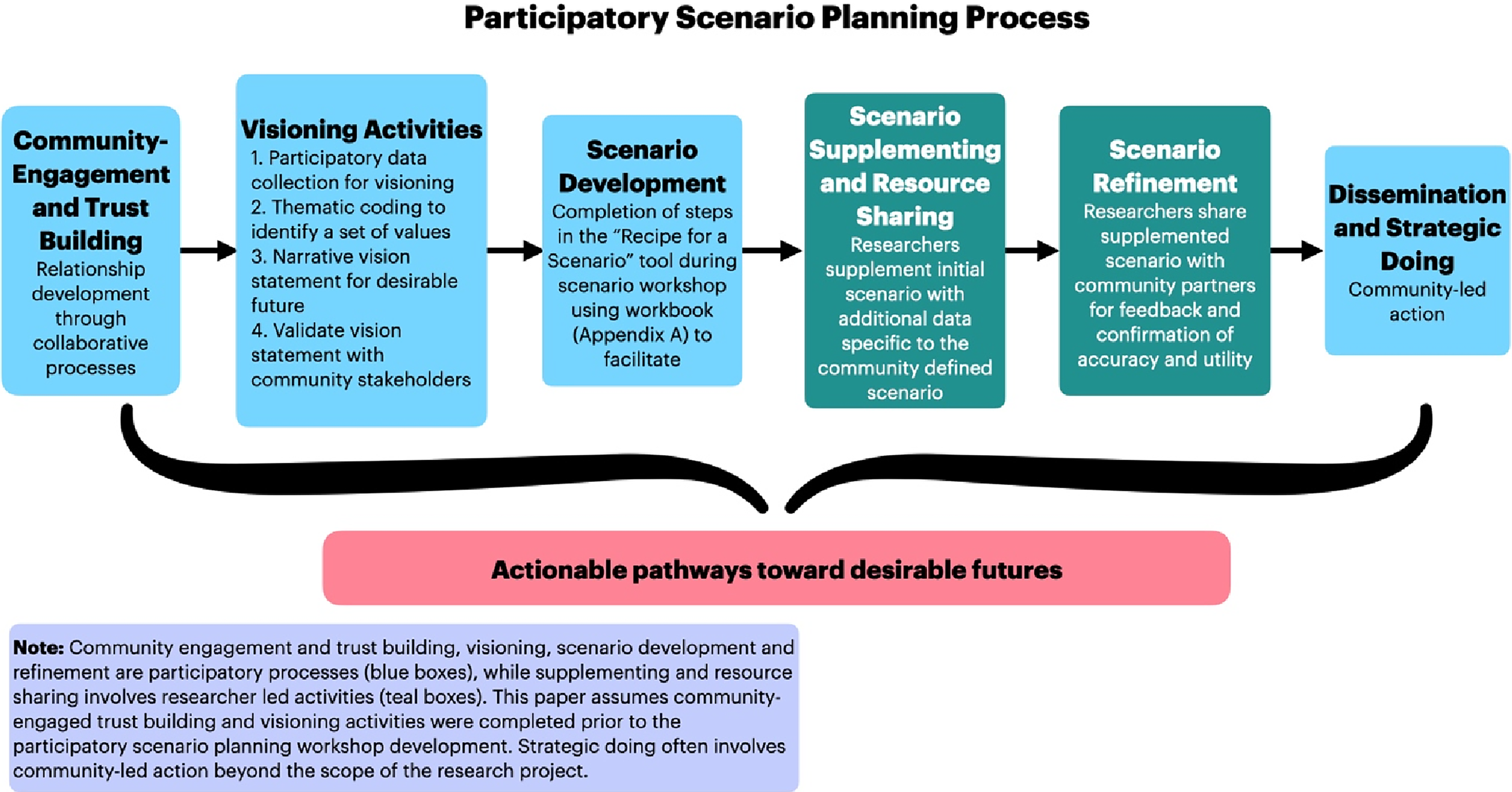
Description of the process of a community-engaged research project that includes participatory scenario planning. We frame participatory scenario planning as a future-oriented investigation that includes building trust and partnerships with community partners, a visioning activity to identify values and features of a positive future, a scenario development workshop that co-creates actionable pathways towards the vision using the “Recipe for a Scenario tool”, scenario supplementing and resource sharing to refine and supplement scenarios with other sources of available data, and dissemination and strategic doing to ensure continuity with community goals. As an iterative process, the participatory scenario planning process requires multiple rounds of interactions with stakeholders and of data analysis and validation.
Community engagement and trust building
The active involvement of community partners in a research project that aims at co-creating knowledge to address sustainability challenges is beneficial to improve legitimacy and applicability of findings, thus contributing to improved decision-making (Biggs, Schlüter and Schoon 2015). Moreover, collaboration between researchers and other stakeholders reframes the relationship between citizens and experts as a mutual learning experience that both improves academic theory, as well as empowers and encourages stakeholders to be a part of solutions (Bridger et al. 2019). In this approach, we stress the role of the research team as facilitators of spaces and dialogues in which trust can be built for open debates on the analysis of problems and development of solutions (Bridger et al. 2019). Although community engagement is conceptualized differently with a wide variety and degrees of engagement across different disciplines (Doberneck, Glass and Schweitzer 2010), we emphasize the necessity of clarifying the degree of collaboration between researchers and stakeholders in each of the different steps of a project (Doberneck and Dann 2019). For our proposed participatory scenario planning process, we recommend open communication processes throughout to encourage a level of collaboration that is best suited to the specific partnership.
Visioning activities
A key step for our participatory scenario planning process is visioning. The co-creation of a desirable vision that is shared between stakeholders is essential to creating a vision statement that is the foundation for the scenario workshop. Prior community-engaged research or strategic planning to identify the vision is necessary before the scenarios workshop activities can commence. Considering who participates in the visioning activities is relevant, because the vision reflects perceptions and worldviews of those involved. Ensuring a diversity of perspectives within the community, being attentive to power dynamics, and validating findings with other community members is important in generating a vision and ultimately a set of scenarios that are inclusive and attractive to a variety of stakeholders (Nalau and Cobb 2022). Diverse methods are available for visioning activities. For example, the Manoa Mashup Method for workshop-based activities that aim at generating visions of just and sustainable futures that are hopeful, inspiring, and positive (Pereira et al. 2018; Hichert, Biggs and Preiser 2019). The Manoa Mashup is an adaptation of the Manoa Method (Schultz 2015), and it has been successfully applied and refined in different contexts and geographical regions (e.g., Hamann et al. 2020; Rana et al. 2020; Raudsepp-Hearne et al. 2020). Our approach is specifically inspired by Belisle-Toler, Hodbod and Wentworth (2021). Although applied to the particularities of food systems research, Belisle-Toler, Hodbod and Wentworth (2021) provides a blueprint on how to conceptualize a system and its components, as well as guiding questions and a protocol to explore desired features for the future and identify values. Further, the authors also report on a way to rank the values collected using Q-methodology (Belisle-Toler and Hodbod 2019). This mixed-methods approach enables the exploration of correlations between types of stakeholders and values they possess. It is also relevant to consider the availability of time and other resources when choosing a method. For instance, the Manoa Mashup Method is proposed as a 3-day workshop activity; Belisle-Toler, Hodbod and Wentworth (2021) suggests several 1-h workshops with diverse stakeholders complemented by a ranking activity utilizing Q-methodology; and Lazurko and Keys (2022) proposes a single 3-h workshop complemented by surveys. Whatever method for gathering visions is employed, a final, community-validated statement that references the current system and describes a desirable future is necessary preparation for the scenario workshop.
Scenario development: application of the “Recipe for a Scenario” tool
Outline of the “recipe for a scenario” tool. Each step represents relevant components of a given system (ingredients) that will need to be described in the process of developing (cooking) a scenario. While this order is recommended as a place to start, participants will likely find they will need to jump around this list as discussions prompt further ideas (particularly after step 4). The application of this tool is presented in the form of a workbook (Appendix 1).
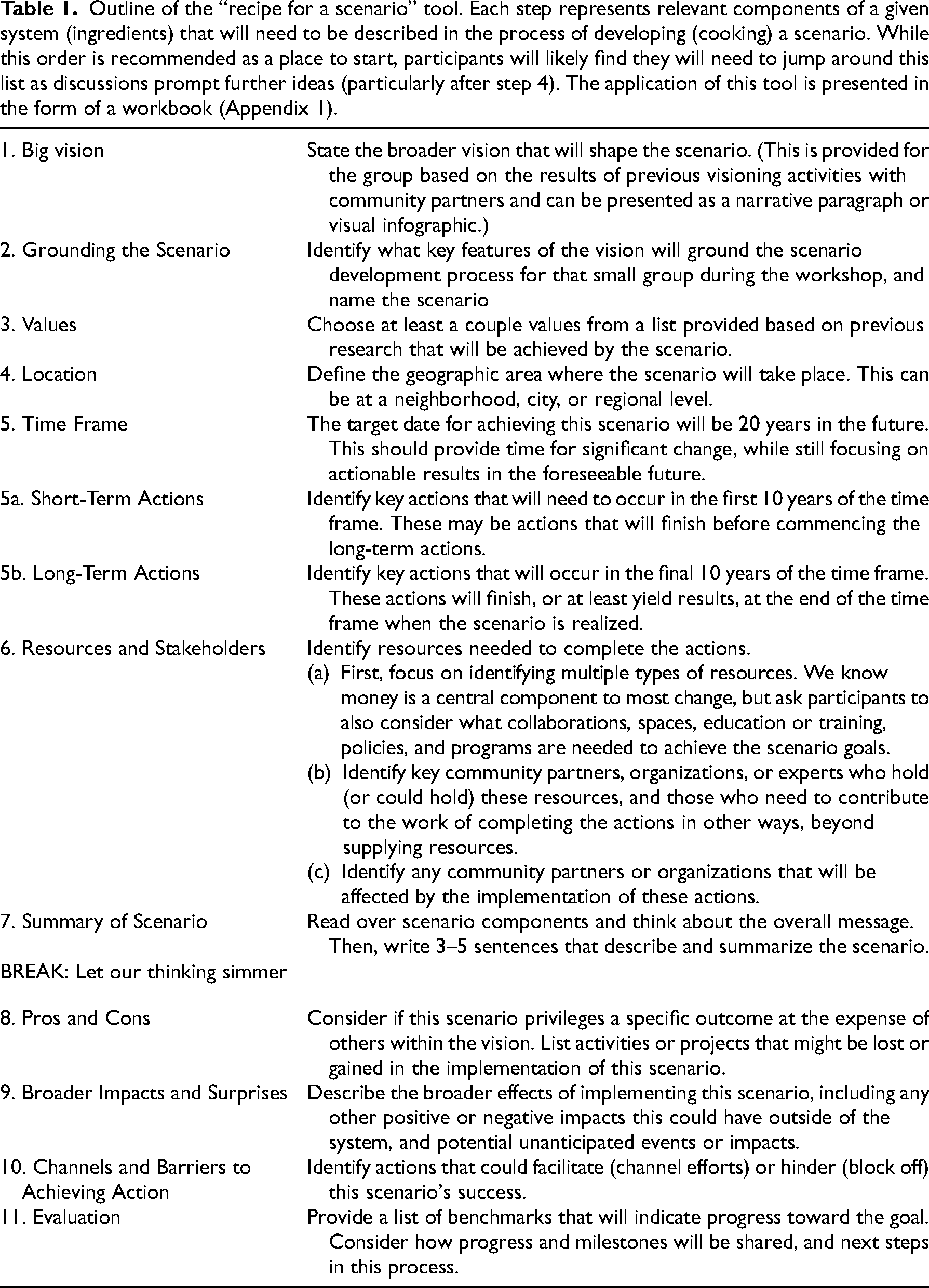
We recommend the use of the tool in a workshop setting to enable the development and/or strengthening of relationships between participants, as well as data collection. Specifically, we suggest the full application of the tool in a 4–6-h period that includes a maximum of 40 participants who primarily work in small groups of 5–10. Depending on the group size, this results in multiple scenarios generated by the end of the workshop. Each small group is guided by a facilitator and note-taker. Our research demonstrates that the use of this tool produces actionable scenarios that can support a community-led strategy on how to move forward to achieve the desirable future (Lembi et al. 2023; Wentworth et al. 2023).
Scenario supplementing and resource sharing
After the scenario workshop, the research team conducts a careful analysis of the workshop data using a mixed-methods approach. First, notes and transcripts, if available, are analyzed using a thematic coding process (Miles, Huberman and Saldaña 2014). The steps of the workbook are used to structure the codebook for thematic coding, allowing for the coding of data using the different ingredients of the scenario recipe as the main codes. In many cases of community-engaged research projects, data from other sources and previous work, such as literature reviews, participant observation, interviews, and modelling activities can be used to supplement the scenario that was developed. This process details how a preferred future can be reached, supplementing ideas generated in the workshop with further data, so that robust, evidence-based scenario products can be used to inform actions, decisions, policies, and resources that are needed to achieve a specific scenario.
Scenario refinement
Scenario refinement is built on another round of feedback from community partners. Detailed scenarios that incorporate the results of the supplementing and resource sharing step are shared with stakeholders, which should include scenario workshop participants, and can also include additional stakeholders identified in the scenario, or those integral to the implementation of the scenario. Through this process the research team gathers feedback to ensure the scenarios are reflective of the workshop discussions, reflect the views and needs of diverse community members, and ultimately have utility for the community.
Dissemination and strategic doing
The final step in the process is transparent and collaborative dissemination so that scenarios are available to community and policy leaders to help shape a positive future. The work of implementing change, particularly over the course of a 20-year time horizon, is beyond the scope of most research projects. However, dissemination of co-created scenarios can serve as a relevant source of information to inform action-oriented planning in the present that can lead to positive change in the future. Doing so can connect outcomes from scenarios workshops to policy and governance, thus bridging the gap between research on scenarios and action (Vervoort and Gupta 2018). This is aligned with the perspective of anticipatory governance, which is defined as a mode of governance that seeks to shift decision-making towards longer-term vision of policies that recognize social and environmental uncertainty (Boyd et al. 2015; Vervoort and Gupta 2018). Hence, supporting community-engaged processes and the translation of research into action requires active work to ensure the results are accessible to a variety of stakeholders so they can implement evidence-based activities to achieve the desired future. While the actual work of implementing the scenarios is stakeholder-led, and stakeholders could be working at local, regional, state, or national levels, it is imperative that the resulting scenarios are shared by researchers in accessible language to a wide audience, as a key part of translating evidence-based research into practice. Workshop participants and key community leaders are best suited to lead dissemination and ensure the final scenarios are presented in an accessible manner and to the appropriate audiences. Within our community-engaged research experiences, we used reports, community events, and interactive websites to communicate findings from a scenarios workshop (e.g., FLPP 2023; Lembi et al. 2023; Wentworth et al. 2023). However, videos, presentations, and other forms of creative and artistic work can be useful to initiate and foster dialogues and sharing of findings (Hichert et al. 2021; Schaal et al. 2023).
Empirical applications of the “recipe for a scenario” tool
The development and refinement of the “Recipe for a Scenario” tool and its associated workbook is a result of two distinct empirical applications with diverse stakeholders. First, drawing on previous research with urban agriculture stakeholders in Lansing, Michigan, United States and the second drawing on a multi-year project in partnership with the Community Foundation of Greater Flint in Flint, Michigan, United States. For each project, previous efforts of establishing partnerships and building trust between researchers and stakeholders were fundamental to guiding research efforts and enabling buy-in and recruitment of key organizations to participate in activities such as workshops (as outlined in the first step of Figure 1). After facilitating scenarios workshops, co-authors of the paper had debriefing sessions to collectively reflect on the process and discuss feedback obtained from community partners who participated in the workshop, which informed our reflection on the empirical application of the tool.
In the first project, previous work had been conducted to explore values that describe a desirable vision for the future or urban agriculture in the city of Lansing; a resilience assessment that developed a timeline with key events that shaped the system, including the effects of the COVID-19; a study on inclusion of refugees and immigrants in urban gardens (Hodbod et al. 2019; Piso et al. 2019; Kirby et al. 2020; Goralnik et al. 2022; Hodbod et al. 2024). Regarding the second project in Flint, previous research identified shared values for the future of the food system (Belisle-Toler, Hodbod and Wentworth 2021); a resilience assessment that depicted shocks, responses and cross-scale interactions influencing the urban food system (Hodbod and Wentworth 2021; Wentworth, Hodbod and Gerard 2022a); strategies to navigate community-engaged research (Schmitt Olabisi et al. 2022; Wentworth et al. 2024); and a series of leverage points (as per Meadows 1999), or points of intervention within the system where relatively small interventions yield systemic change (FLPP 2023). Building upon these previous efforts and partnerships, we applied the “Recipe for a Scenario” tool and workbook to present key findings from previous research and then build actionable pathways towards a desirable future in 20 years (2042).
In the application of this tool, beginning with a shared vision for the future and values are essential components to be previously co-developed. However, the ways these are incorporated into the application of the tool can vary based on community needs. For example, in Lansing, the vision of a desirable future was presented in a narrative format that described a story of a positive future for the system that had been previously co-written with the community (Wentworth, Lembi and Hodbod 2022b). In Flint, the vision of a desirable future was presented in the format of four different infographics co-created with community partners to depict the results of the research project, describing the current system, the desirable future, as well as a few examples of leverage points for positive change (Wentworth, Lembi and Hodbod 2022c). Therefore, the first step in using the workbook, presenting a vision of a desirable future, should be tailored to the results of prior research and community needs.
Further, the list of ingredients participants had available to them was also context dependent. In Lansing, participants could draw from the vision and values, whereas in Flint they also had access to a list of leverage points to build their scenario because the leverage points were a primary outcome of the research. Therefore, while the vision and values are essential to the implementation of the tool, how these are presented, and if there are additional components or ‘ingredients’ available to participants is dependent on community needs and previous research. Customization and adaptation of the “Recipe for a Scenario” tool and its associated workbook illustrate how we remained faithful to the workbook structure, while also incorporating flexibility based on previous research and the needs of the community partners. Thus, the workbook is a structured, yet flexible tool, since the list of ingredients can be tailored to fit previous research efforts and community needs.
In Appendix 1, we provide a generic version of the workbook that can be edited to meet different projects and community goals. For examples of final versions of the workbook that were empirically tested, see Wentworth, Lembi and Hodbod (2022b) and Wentworth, Lembi and Hodbod (2022c). While we encourage adapting the ingredients and resources available to participants as they create scenarios, our empirical application of the tool demonstrated the usefulness of the proposed workshop activities, particularly steps four through eleven (see Table 1) create the essential framework for building actionable pathways towards more equitable, just and sustainable futures.
Building connections across diverse stakeholders to co-produce scenarios is key to ensuring workshop outcomes are useful to building workable solutions to complex problems (West, Van Kerkhoff and Wagenaar 2019; Schaal et al. 2023). In parallel, the presence of diverse voices in scenarios workshops can help avoid ‘group think’ or domination of viewpoints (Nalau and Cobb 2022; Cork et al. 2023). From our application of the tool, we found most success when participants from different sectors come together during the development of scenarios. Aligned with previous literature, we observed that inviting government leaders, policymakers, grantors, community activists, non-profit service providers and interested members of the community helps bring diverse ideas. In parallel, the presence of both policymakers and community leaders can foster shared buy-in to initiate change. Connecting scenarios to decision-making is a key challenge, so applicability can increase with participation of champions in the community who are interested in supporting implementation (Cork et al. 2023). In this regard, we argue that the “Recipe for a Scenario” tool can facilitate scenarios workshops to co-produce actionable knowledge that can inform transformation processes led by change agents (Cork et al. 2023; Schaal et al. 2023).
During scenarios workshops, we found stakeholders worked through the tool by jumping around from step to step based on their conversations and different areas of expertise. This supports our structure and need for an overview page to help participants think creatively about the scenarios and process. Being able to reference the overall structure, while moving back and forth between sections as the scenario is developed illustrates that our workbook tool is useful to guiding participants through a structured process, while maintaining flexibility for participants creativity and revision.
Finally, we argue that our tool can serve a role in fostering transformation. By connecting the present to actionable pathways towards sustainable futures, scenario processes can contribute to transformative change (Cork et al. 2023). Specifically, Hebinck et al. (2018) highlights three roles future-oriented processes can serve: enabling pre-conceptualizations of change; creating spaces to build new connections between different stakeholders; and co-creating strategies that have higher chances of being concretely implemented. Transversal to these themes is the necessity of structured spaces in which people can gather and work together to co-create actionable knowledge and discuss how transformation can be concretely achieved. The application of the “Recipe for a Scenario” tool can contribute to the facilitation of structured workshops in which diverse stakeholders can gather to discuss ideas and plans to achieve a desirable future. Therefore, tools that aid in the design, planning and facilitation of scenarios workshops may assist in tapping into the transformative potential that future-oriented methodologies seek to have. We acknowledge that transformations are complex, but also recognize that our workbook tool can be a helpful component in the process of navigating change. Finally, our tool is aligned with the perspective of a more agile futures practice that is less time- and resource-intensive for both researchers and stakeholders (Lazurko and Keys 2022).
Conclusions
In this paper, we carried out a critical review on literature from sustainability science and place-based research to outline the state of knowledge in scenario process development. The review focused on definitions for scenarios, visions, and scenario planning; benefits and challenges of participatory scenario planning in placed-based research; and descriptions of three dominant frameworks (Three Horizons, Nature Futures Framework, Sustainable Future Scenarios). We demonstrate that participatory scenario planning stands to advance progress in interdisciplinary research that is focused on achieving more equitable and sustainable human-environment dynamics as it supports community-engaged, evidence-based responses to social and environmental change. Our review provides an entry-point to engage with future-oriented concepts and methods in place-based research.
Across disciplines, there are numerous concepts and fields of knowledge which engage with the future, stemming from multiple epistemologies and ontologies (see review by Muiderman et al. 2020). The complex nature of current social and ecological challenges highlights the necessity of collaboration between researchers and stakeholders to co-create knowledge to support decision-making for a sustainable future. Within community-engaged research projects, future-oriented methods, such as visioning and participatory scenario planning, have been increasingly utilized as an approach to foster positive change, yet explicit tools for operationalizing that change are rare (with few exceptions, see Mannetti et al. 2021; Pereira et al. 2021 and Van Den Ende et al. 2021).
Given the lack of actionable, medium-term description of how to implement scenarios research, we created a tool, “Recipe for a Scenario”, to aid in the facilitation of scenario planning workshops. This participatory tool is implemented in a workshop process to generate actionable pathways towards sustainable futures with a midterm (∼20 year) time horizon. We share the corresponding workbook we use to guide the facilitation process (see Appendix 1).
We contribute to the growing body of literature that engages with the future to mobilize actors and shape governance in the present (Boyd et al. 2015; Muiderman et al. 2020; Vervoort and Gupta 2018). We corroborate the notion that future studies are “futureless;” for, the relevance of discussing the future is to act upon it in the present (Anderson 2010; Sardar 2010). Through this critical review and the resulting “Recipe for Scenario” tool, we offer a concrete contribution for those are seeking ways to design and conduct participatory processes that result in the co-production of actionable knowledge and plans to bring about a desired future.
Supplemental Material
sj-pdf-1-peg-10.1177_27539687241253616 - Supplemental material for Recipe for a scenario: Moving from vision to actionable pathways towards sustainable futures
Supplemental material, sj-pdf-1-peg-10.1177_27539687241253616 for Recipe for a scenario: Moving from vision to actionable pathways towards sustainable futures by Rafael Lembi, Chelsea Wentworth and Jennifer Hodbod in Progress in Environmental Geography
Footnotes
Declaration of conflicting interests
The authors declared no potential conflicts of interest with respect to the research, authorship, and/or publication of this article.
Funding
The authors disclosed receipt of the following financial support for the research, authorship, and/or publication of this article: This work was supported by the Foundation for Food and Agriculture Research, Fulbright Association, (grant number FFAR Grant Number: 560827, Fulbright Brazil-CAPES Fellowship (08/2020)).

Supplemental Material
Supplemental material for this article is available online.
Appendix 1.
The “Recipe for Scenario” is accompanied by a workbook to guide the facilitation process of scenarios workshops. We present a generic version of the workbook designed to be adapted and used by a range of researchers and community partners (licensed under CC BY-NC-SA 4.0). We encourage editing and adapting a generic version that is available via the following link: https://tinyurl.com/scenarioworkbook. Requests for a generic version can also be made directly to the first author of the manuscript. Versions of the workbook tailored to community stakeholders and specific research projects are also available online (See Wentworth, Lembi, and Hodbod 2022b; and Wentworth, Lembi, and Hodbod 2022c)
References
Supplementary Material
Please find the following supplemental material available below.
For Open Access articles published under a Creative Commons License, all supplemental material carries the same license as the article it is associated with.
For non-Open Access articles published, all supplemental material carries a non-exclusive license, and permission requests for re-use of supplemental material or any part of supplemental material shall be sent directly to the copyright owner as specified in the copyright notice associated with the article.
