



Abstract
This article assays geographical research into nuclear cultures, and cognate conversations in atomic heritage, toxic waste studies, and memory and landscape studies, as one way to develop the notion of nuclear memory. In doing so, we survey how geographers and social scientists have sought to think and communicate memory of nuclear things through three specific modes: the archival, the aesthetic, and the speculative. Our central argument is that nuclear memory provides a theoretical orientation for geographers to engage with alternative possibilities for thinking nuclear waste futures besides anthropocentric notions of common sense.
“A place we must remember to forget.” (Madsen 2010)
Introduction
Over the course of the past four decades or so, the problem of how to communicate memory of nuclear things has been a source of intrigue in the social sciences. Engagements with nuclear semiotics (Sebeok 1984), atomic heritage (Storm, Andersson and Rindzevičiūtė 2019), nuclear waste futures (Joyce 2020), nuclear art (Volkmar 2022) and cultures (Carpenter 2016), future consciousness (Högberg et al. 2017), toxic waste studies (Kaur 2021), memory studies (Freeman 2016), nuclear landscapes (Pitkanen and Farish 2018), and decolonial approaches to nuclearity (Hecht 2014) directly and indirectly approach the problem of how to think the enduring materialities of nuclear things into the future given the danger these materials can pose to organic life over thousands of years. Part of the reason for this intrigue, perhaps, is the sense that the imperceptible qualities of nuclear materials might offer fresh perspectives on environmental problems (Bickerstaff 2022; Klaubert 2021) – especially through deep time perspectives (Bjornerud 2018; Gordon 2021; Ialenti 2020), speculative forms of experience (Engelmann 2022; Keating 2022a), and alternative ontologies of environmental envelopment (Morton 2013; Povinelli 2021). In the case of nuclear waste, transferring knowledge and information about these materials into the future requires alternative techniques of thought capable of thinking with the 100,000 year time horizon that spent nuclear fuel is deemed dangerous to organic life 1 – a time horizon wherein contemporary language systems are ineffectual, and where the existence of the ‘human’ is in doubt.
Yet problems occur when nuclear waste futures are predicated too strongly on the contemporary human subject and its anticipation of the future. The central problem here is that approaches to communicating memory of nuclear things often remain wedded to representational systems of language, art, semiotics, and subjectivity that presume too much about what it will be deemed valuable and what kind of subject will be communicated with in the future. Joyce (2020) explores something of this problem in The Future of Nuclear Waste through a critical archaeology of ‘common-sense’ notions characterising nuclear landscape marker projects in the US. As Joyce (2020, 231) notes, rather than “suggesting how we can convey a perfect message from our present/ past to a future/present” what is instead needed are different sensibilities that allow “a way to imagine a future of contending common senses”. In this paper, we develop how geographers might contribute to this sensibility as something involving the production of alternative modes of expression that do not map onto common sense derived from contemporary anthropocentric and Western regimes of meaning-making and knowledge production (Burdon 2022; Povinelli 2021) – alternatives that would be capable of countering a recent tendency to conceptualise post-human futures using contemporary values inherent to a Western human ‘us’ (Weisman 2008; Zalasiewicz 2009).
Our aim, therefore, is to develop the relationship between recent research in environmental geography engaging with nuclear things (Alexis-Martin et al. 2021; Alexis-Martin and Davies 2017), and the problem of how to communicate memory about nuclear materials whose effects often exceed the perceptive and epistemic frames of the human (Madsen 2010). In doing so, we assay recent advancements in nuclear cultures research and suggest avenues for future work in geography. To date, relatively little has been said about how geographical concepts help advance and respond to the problem of communicating memory of nuclear waste materials into the future (though see Dawney, Harris and Sørensen 2017; Doel 2019; Engelmann 2022; Keating 2022a; Storm 2019). This relative lack of geographical engagement is perhaps surprising because engagements with nuclear waste futures (Brylska 2020; Harrison 2016; Joyce 2020; Masco 2021) invoke questions of landscape and heritage process, non-human materiality and agency, world-making, as well as affective and non-representational modes of expression that have become key geographical concerns. Our contention is that geographical research into this problem might be fruitfully developed through the notion of ‘nuclear memory’.
By nuclear memory we refer to a recent penchant for developing techniques and approaches for transferring knowledge and information about nuclear matter into the future. Of course, the notion of nuclear memory is not limited to nuclear waste repositories nor questions of radioactive waste. As Pitkanen and Farish (2018) argue through the notion of nuclear landscapes, memory and futurity also directly concern ongoing forms of colonialism enacted by various nuclear industries and weapons testing events – processes involving the differing effects of the capitalist military industrial complex in dispossessing indigenous land rights in places ranging between the Arctic and South Pacific. In this paper, we take on a specific emphasis by paying close, albeit not exclusive, attention to how the materialities of nuclear waste shape how geographers conceptualise earth futures. We focus especially on nuclear waste materials at a time when environmental politics is fast changing – particularly given recent decisions in parts of northern Europe and North America to build so-called ‘permanent’ or ‘final’ geological repositories for nuclear waste; 2 the construction of new nuclear energy reactors in parts of Europe, China, India, and South Korea; as well as a sense of mounting support for nuclear energy production as a key contributor to climate change adaption practices (Knapp and Pevec 2018). Positioning nuclear memory as a research orientation rather than a new concept, we develop the idea that geographers can contribute much to analysing these changing nuclear waste futures – especially through conceptual research into new materialist and non-human agencies, future thinking, landscape and heritage studies, and speculative geographies that provide different ways of imagining and valuing ‘nature’ besides anthropocentric logics (cf. Braun 2006; Debaise 2022; Soper 2009).
In conversation with these lines of geographic enquiry, our key argument is to say that communicating memory of nuclear waste repositories requires techniques of thought that imagine the future openly in terms of a multiplicity of possible contingent scenarios. To make this argument we assay research into nuclear memory through three distinct modes – the archival, the aesthetic, and the speculative. In developing these three modes of nuclear memory, we are not attempting to draw any strict distinction between these approaches: as Patchett (2022, 247) notes, archival research is at once speculative and aesthetic insofar as it is concerned with “pluralizing rather than pinning down” the way geographers account for the lifeworlds of non-human things. Recognising the differences inherent to these approaches, we suggest why each mode of nuclear memory present overlapping, yet notable, ways of thinking nuclear memory precisely because they each attempt to re-imagine nuclear waste futures in ways that resist certain conventions of the present. By re-imagining conventional thinking archival, aesthetic, and speculative modes of nuclear memory are noteworthy, we contend, because they provide organising criteria for analysing different imaginaries of distant nuclear waste futures – imaginaries that have political importance as an abstraction for anticipatory governance in nuclear waste producing nations (see Masco 2021, 327–332).
Advancing nuclear memory as a question of communicating the enduring materialities of nuclear things into the future, we resist the urge to think nuclear waste futures in terms of anticipatable scenarios, and instead call for attention to the indefinite and indeterminate elements of speculative future thinking that stubbornly resist present day calculative logics. As the paper develops, speculation resists thinking the future in terms of probabilistic and anticipatable scenarios (Savransky, Wilkie and Rosengarten 2017) insofar as it refers to an enquiry into how conceptual abstractions can pluralise, rather than pin down, how a subject comes to categorise experience and its sense of the future
3
(Savransky 2021; Debaise 2017). In developing this line of thinking through nuclear memory, we follow Wikander who notes that: “[s]uch an exercise must perforce be extremely speculative…if we are to deposit nuclear waste and let it lie for tens of thousands of years, we must speculate. Indeed, the entire enterprise is one based on speculation.” (Wikander 2015b, 8)
Thinking nuclear memory for nuclear waste futures
Memory is a concept that has been recently advanced by geographical scholars in diverse ways. As Jones and Garde-Hansen (2012, 10) note, geographers have sought to articulate with greater nuance and complexity the “entanglement of past/present spatial relations”, particularly in understanding memory as something “bound up with place, space, the body, practice and materiality”. Significant is the way this recent geographical research into memory stages a direct problematisation both of dominant understandings of a subject perceiving the past, present, and future through the unfolding of chronological time, and the conventions of locating certain kinds of memory within objects according to the logics of Euclidean space. For this paper's focus on developing the concept of nuclear memory, three tendencies of geographical engagements with memory become notable.
First, a number of scholars have highlighted the role of landscape in the production and stabilisation of memory (Holdsworth 2022; Legg 2007; Maus 2015; McEwen et al. 2017; Storm 2021). For example, emphasis has been placed on the relationship between landscape and collective memory of identity belonging to territory and nationality (Paasi 2020; Tolia-Kelly 2016; Wylie 2007). Also engaging with the relation between memory and landscape, but in conversation with historical-cultural geographies, della Dora (2013, 696) focuses on ancient Roman and Byzantine understandings of memory as “an embodied practice depending on mental and corporeal attitudes but also one heavily grounded in and interacting with landscape's matter, colours, forms, and with their specificities”. Second, there has also been particular emphasis on non-representational and affective approaches (DeSilvey 2012; Drozdzewski 2018; Jones 2015; Sumartojo 2021). Engagements with affective registers of experience not only affirm an expanded conceptual repertoire accounting for the (re)production and circulation of memory, but also draw attention to certain geographies of negativity such as the way memory can fall apart, be marked by an affective sense of absence, or encounters certain bodily limits (Bissell et al. 2021). Third, and relatedly, there has been a focus on non-human materiality in processes of memory and memorialisation (Fox and Alldred 2019; Ginn 2016; Greenhough 2019; Muzaini 2015). Drawing on accounts of those living through the Second World War in Malaysia, Muzaini (2015, 110) develops how memories can emerge involuntarily and unwilled by a subject through the “agency of non-humans, material surroundings and psychosomatic reflexes”. Reflecting on Haraway's situated knowledges, Greenhough (2019, 164) likewise highlights the ethico-political materialities of memory expressed as a “commitment to sharing stories” that itself “brings with it a different set of political obligations”.
In this paper, we advance geographical engagements with memory in another direction by focusing its reconfiguration through nuclear things. Of course, this is not to say that the geographic relationship between memory and the nuclear has not already been explored (Freeman 2016). Maus (2015, 221) explores this relationship through the materialities and landscapes of Cold War nuclear bunkers – sites that enact “practices of localised memory” emerging from material structures that express the legacies of time-passed. Likewise, Davies (2013, 127) develops something of nuclear memory via interview and photographic methods engaging with those working in the Chernobyl exclusion zone in highlighting the strange similarly between ‘memory’ and the ‘nuclear’ that are both “simultaneously vivid and intangible”, and express something of the “unseen and lived reality of everyday life”. Focussing on Sellafield in the UK, Bickerstaff (2022, 967) articulates a sense of the intangible by calling for ethnographic writings that “work through these drawn-out timescapes, the invisibilities and affects of slow violence” of nuclear industries (see also Kalshoven 2022). Intersecting questions of the intangible and difficult-to-detect aspects of memory production, Voyles’ (2015, 202) research into the enduring colonial politics of uranium mining in Navajo land in the United States bears witness to the way “competing and echoing histories of violence, as well as about histories of the complex personhood of community life” take shape in relation to nuclear industries and the dispossession of land.
Different from geographical research emphasising the embodied constitution of memory (Drozdzewski 2021), something of the intangible is also present within Engelmann's (2022, 154) concept of “elemental memory” referring to an element's affective “capacity to auto-relate, self-organise and thus remember their origins”. Drawing on Erich Berger and Mari Keto's Inheritance Project, staging the inter-generational care of jewellery containing mined thorianite and uraninite, elemental memory articulates how certain nuclear materials can enact an “encounter between humans and the deep-time memories (auto-relations) of rock and mineral” (Engelmann 2022, 170). As elemental, memory is not conceived through the conscious subject but through a subtle non-human capacity for memory as auto-affectivity. Whilst inspired by elemental memory for theorising the capacity of nuclear materials to engage in auto-relations of memory communication, we want to caution against a focus on elemental origins and on locating memory in individuated things. One of the reasons for this caution in our development of nuclear memory is to avoid the idea that memory would be intrinsic and carried by an element, and as well as the sense that every element has an origin that can be remembered rather than expressing a sequence of continuously forming and reforming elemental processes that resist any resolution into a given ‘origin’.
Differently, in developing nuclear memory we take our cue from ontogenetic theories of time: in Matter and Memory Bergson (1991) critiques the idea that memory is something defined by a sense of material origin or preserved within individuated structures (the brain, an object, etc.). For Bergson, the problem with defining memory in terms of origins is that this manoeuvre neglects the specific power of memory to affect a subject ‘unsummoned’ from the whole of time without any obvious embodied or individuated structure – what Bergson refers to as ‘pure memory’. Bergson illustrates this problematisation of memory through déjà vu understood as an illusionary experience of having already lived through a present moment. Responding to the connected problems of mechanistic and finalist theories of time and ontogenesis (Williams 2022, 489), for Bergson (2002) déjà vu reflects the autonomous capacity for memory to arrive unsummoned from the whole of time – what Deleuze (1988) terms the “virtual” coexistence of the pure past. As Ansell-Pearson (2018, 76) summarises, an ontogenetic approach to memory thus begins with the contention that “memory is not in the brain but rather ‘in’ time, but time is not a thing, it is duration hence nothing can be ‘in’ anything”. As an outcome of duration and ontogenesis, Bergson's theorisation of memory thus serves as a reminder of the problem of linking memory too closely to a question of origins, which risks fixating on the false problem of explaining how memory is preserved within particular things rather than articulating how memory can become communicated from a non-individuated psycho-social empirical field – what he refers to as a ‘pure’ past.
For our focus on nuclear memory, this ontogenetic approach is significant because it attends to how acts of remembering are always subject to numerous historical accidents and events with the power to alter, or even entirely invert, messages communicated about nuclear things (Poirot-Delpech and Raineau 2016; Van Wyck 2004; Wikander 2015a; Arnold 2016). How, then, to theorise the relationship between nuclear matter and memory given this irreducible status of memory to a given ‘thing’? What becomes of memory if it is also something displaced and remade through the ungraspable time horizons of radioactive decay? What does it take to communicate nuclear memory into a future where no human is said to exist, and no language systems are viable for memory communication? In the remainder of this paper, we address some of the problems implied with these questions through three distinct modes.
Archival
First is the archival. The genesis of industrial nuclear waste in the twentieth century has led to international research into the role of textual and historical archives as a way of ensuring certain legacies of nuclear waste materials are communicated into the future. From time capsules, to durable paper vaults, stone inscription, and digital archives, attention to textual and historical archives have often focused on the need to combine technical detail about the formation of nuclear waste with a wider focus on how archiving produces certain politics of knowledge and processes of categorisation (Kalmbach 2017; Lyons and Holtorf 2020; Penrose, Harrison and Breithoff 2020). Recognising this politics, research into nuclear archives and memory communication have also sought to apprehend something of the spatial and temporal scale of impact the nuclear has on the earth. Perhaps most directly, questions of spatial and temporal scale have been engaged through geographical and historical research accounting for past nuclear disasters – a focus that, as Kalmbach (2017, 61) explains, has “emphasised the duration of the aftermath of disasters and the important role that narratives and memory play in how a disaster is understood”. Referring especially to twentieth century nuclear weapons testing in Utah USA, Davis (1993) engages with this approach to nuclear archiving through the 1980’s photography of Carole Gallagher. Examining the construction of US “national sacrifice zones” consisting of massive regions of land – including Kazakh, Paiute, Shoshone homelands – Davis considers how these archives account for the production of particular kinds of subjects. These subjects, so-called Downwinders, refer predominantly to lower income Americans who, for decades, have fought for government help in treating the cancerous waste legacies of nuclear weapons testing events. As Davis (1993, 12) writes: “Most of the urban Midwest and Northeast, moreover, was downwind of the 1950’s atmospheric tests, and storm fronts frequently dumped carcinogenic, radio-isotope ‘hot spots’ as far east as New York City”.
Developing a similar line of thought, research within atomic heritage has recently contributed ways to apprehend the nuclear as a contested techno-political process of categorisation (Ialenti 2022; Rindzevičiūtė, 2019; Storm et al. 2019). One implication of this focus on the techno-political has been renewed attention to the political effects of radioactive things – especially in relation to nuclear colonialism. Hecht's (2014) Being Nuclear is notable in advancing how the categorisation of radioactive matter as ‘nuclear’ – its nuclearity – is always contingent upon a particular spatio-temporal milieu. Focussing especially on archival sources relating to nuclear industries operating in Africa, Hecht (2014, 210) demonstrates how this contingency has profound effects on the lives of those working in uranium mines – spaces that are often not officially deemed a risk to human health due to processes of categorisation enacted by racist colonial states in cahoots with mining industries (see also Voyles 2015). Elsewhere, Davis (2007) focuses on the processes of archival erasure enacted by the US military in Bikini Atoll following the 1946 nuclear weapons testing – erasures that are achieved through the removal nuclear testing signs and other archives understood as part of a wider effort to re-construct the island as a pristine wilderness. Another example, although one that has received modest attention in geography (Cederlöf 2021; Röver 2021) is the effect of nuclear contamination on Sámi people and lands. The need to understand the archival and memory qualities of these lands is important not least because: “[b]etween 1960 and 1991, the former Soviet Union…dumped radioactive waste in the Kara and Barents Seas. These dumped wastes were both liquid and solid, the latter including reactor compartments and entire submarines” (Soininen and Mussalo-Rauhamaa 2021, 1–2).
In accounting for an ongoing sense of contamination, clearly nuclear archives and processes of atomic heritage are not limited to landscapes or textual things. Geographers have also developed the scale of the body as a particular form of nuclear archive. On the one hand, this includes the organismic body – such as through how notions of exposure or fall-out develop the way human and animal bodies incorporate radioactive particles and become carriers of traces from nuclear activities (DeSilvey 2017). Indeed, the record of the bodily archive sometimes stands in conflict with records of corporate or institutional document archives, particularly in detailing nuclear activities’ potential consequences for human health (Silver 1996; Trundle 2011). Directly considering some of these bodily consequences, Davis and Hayes-Conroy (2018, 727) refer to a specific “micro-scale spatiality” as one way to understand how the risk of bodily exposure to nuclear materials is encountered differently by, for example, children playing in the contaminated landscape of the Fukushima prefecture and older residents whose mobilities tend to be quite different. Such a focus on the micro-scale changes to bodies encountering nuclear waste also connects to Masco's (2006: 293) “theory of mutation” of the environmental legacies of the Manhattan Project, in which biosocial transformations over time become possible to categorise and assess. It also recalls Krupar's (2013, 154) examination of illness associated with radioactive waste exposure as itself “a kind of material-environmental memory” of note for accounting the legacies of nuclear industry on the lives of former nuclear workers.
On the other hand, the scale of the body also includes non-human materials that act as direct and indirect modes of archival nuclear memory communication, particularly through notions of ruin and ruination (Dawney 2020). In Manual for Survival Brown (2019) engages with non-human bodies as archives for nuclear memory both by accounting the illegal sale of radioactive blueberries from the Chernobyl exclusion zone into European markets (see also Tsing et al. 2020), and through a sense of time standing still in the Chernobyl contaminated Red Forest that resists conventional temporal durations of decay (Brown 2019, 125–129). The archival role of non-human bodies also appears in critical calls for durable nuclear waste archives for deep time periods with international co-operation and alignment. Echoing proposals for preserving memory of nuclear waste repositories over deep time scales (OECD/NEA 2019), so-called ‘shadow libraries’ were built in the US during the Cold War in an ambition to protect key documents to help the nation to function in the event of nuclear war, including through the vaulting, dispersal and duplication of documents related to cultural heritage (Spencer 2014).
Linking to the role of non-human bodies in processes of nuclear archiving, there has been growing emphasis on thinking archival forms of nuclear memory as something directly concerning practices of ‘future thinking’ (Brylska 2020). For Holtorf and Högberg (2020), archiving of this sort requires an attention to the ways the future is open to unpredictable forms of change and transformation. For nuclear archives to reliably be communicated into the distant future, they argue for an approach to nuclear heritage process where archival sites are kept “alive” by “inviting future generations to interpret and use these sites in their own way” (Holtorf and Högberg 2020, 155). This approach to keeping archives alive is part of a wider call for future oriented heritage practices and forms of “future consciousness” (Högberg et al. 2017) capable of thinking the future as something other than an extrapolation of the present. Yet, one of the difficulties with the task of keeping nuclear archives ‘alive’ is that these approaches tend to assume, albeit implicitly, that there is a given subject of the future who has some knowable capacity for reading or sensing its environment. Be this through the perceptive syntheses of the human body, or through some anticipated capacity of non-human aesthesis, it is difficult to imagine a living archive without positing the idea that in the future there will be something resembling a sensing body capable of making an archive intelligible in a way that approximates the human's current relationship to archives. Similarly problematic, as Holtorf and Högberg (2020) recognise, is the tendency to assume that our current ways of valuing nuclear waste as a ‘problem’ to be safely managed will necessarily apply to a future reader of an archive. How, then, to write an archive without assuming too much about the future reader, their capacities for sense and perception, and their ways of valuing nuclear waste either as a problem, commodity, or as something else?
One response to the problems with deep future archiving is to emphasise more explicitly the role of gaps, incapacities, and instabilities of archival memory processes as something inherent to future thinking. As Kasperski (2019) argues, processes of archiving are clearly not only about selecting what should be preserved, as much as it is about apprehending what will be demolished and destroyed. Wikander (2015b, 18) captures something of this destructive character of nuclear waste archiving in arguing for “the necessity of linguistic redundancy – the need for preserving texts in many different languages and media – as there is no way to predict the socio-political changes that influence the use of one particular language instead of another in the future”. In part, this line of thinking emphasises the need to understand the materialities of archives themselves as unreliable carriers of memory. If, for Derrida (1996, 85–91), archiving itself is something bound to the question of anarchiving and a nostalgic Freudian desire for an authentic sense of origin, one might also reflect on the tensions and incommensurability of archival modes of nuclear memory: how to fathom an archive of nuclear waste repositories when no human archive has lasted close to this period of time? This is what DeSilvey (2007, 878) refers to as those “uneasy speculations” produced in considering all manner of things that remain valuable despite not neatly fitting inside of the category of an ‘archive’. Following DeSilvey (2017, 29), one response is to approach nuclear objects as processual events wherein “materiality is not a static field of reference that awaits inscription from an active mind but is itself constitutive of … human selfhood, as distributed through intimate relations with other entities – plants, stones, dust”. Echoing what Harrison (2015, 27) has termed “connectivity ontologies”, as well as Sjöholm's (2018) focus on the ephemeral archive of the sketchbook, DeSilvey (2017, 13) points out that “what may appear as erasure on one register may be generative of new information on another” and, therefore, she suggests there is a potential to “uncouple memory work from material stability” (p.15).
Aesthetic
The second mode of nuclear memory – the aesthetic – offers something distinct precisely because communicating memory about nuclear things is clearly not restricted to material processes of categorisation, but includes various creative practices that also offer ways to imagine and communicate memory across time. Aesthetics can be apprehended affectively as something sentient to the “distribution of the sensible” concerning future possibilities for subjectivity through differences in sense and sensation (Rancière 2010) – or what Millner (2021, 393) terms “the conditions under which something new may present itself to the senses”. As a question of nuclear memory, aesthetics feature as one way to understand how artistic and creative productions of sense and affect provide opportunities to communicate memory differently in time.
Two key moments characterise aesthetics modes of nuclear memory. First includes initiatives spearheaded in the 1980’s and 1990’s in the USA for the then-planned Yucca Mountain nuclear waste repository and Waste Isolation Pilot Plant in New Mexico, respectively. Prominent at this time was the role of landscape markers including Spike Field (Brill and Abidi 1991) – an artistic concept for a landscape containing rock spikes, hieroglyphs, and pictorial messages designed to endure on the surface above geological nuclear waste repositories into the distant future. As van Wyck (2004, 66) examines, the designers of Spike Field aimed to create “mimetic signs that look dangerous” in order to produce “an inhospitable environment for certain activities”. As a mode of aesthetic nuclear memory, what is noteworthy about this example is the way it draws on certain affective tendencies of matter to instil atmospheres of inhospitality and fear – affects aimed at not the human subjective today, but of any subject whatsoever in the future (Bains 2002; Keating 2022a). As Dawney et al. (2017, 114) notes, such “affective engagements open up new (speculative) possibilities for exploring the shared spaces occupied by humans in the present and future”.
And yet, the use of landscape art and markers as forms of nuclear memory are not without their problems, as Jensen (1993, 23) reflects, given that “messages from such markers may pose interpretation problems as we have today for messages left by earlier societies such as rune inscriptions”. For Jensen, landscape markers are limited because they rely both on the quality of translation and a willing subject that is able to follow a message as intended – a scenario that becomes especially unlikely over 100,000 year timeframes. Instead Jensen, and other nuclear memory practitioners in the 1990’s, advocated active forgetting. The motivation of active forgetting is a sense that it would be safer and more feasible for societies to plan to forget the existence of buried nuclear waste materials in order to prevent purposeful human intrusion in the future – such as from those looking to extract potentially valuable metal resources used to contain the radioactive waste underground. Discussing the differences between markers, on the one hand, and ‘traces’, on the other hand, related to nuclear activities in Australia, the US, Finland, and Sweden, Sörlin and Bandolin (2007) suggest that while markers attempt to convey a specific meaning that may be easily lost over time, a ‘trace’ is more persistent referring to the capacity of environments to convey a multiplicity of meanings that necessarily change and resist any sense of epistemic fixity. Referencing plans for a permanent Swedish geological repository, they propose using the rock blasted in underground tunnels to lay the foundation of nuclear monuments producing traces. In this example, as the physical characteristics of the monument changes through time the specific character of the rock will continue to carry traces of a message into the future. The amount of rock used in a monument would point to an underground void of a certain size, and the minerality of the rock offers possibilities to trace the region of the earth's bedrock from which it was extracted.
However, recognising the limits to markers is not to dismiss aesthetic signs tout court, nor to say aesthetic modes of nuclear memory are restricted to questions of landscape markers – as evidenced by the second key moment of aesthetic nuclear memory: the rise of nuclear cultures research in the 2000’s and 2010’s (Carpenter 2016). Madsen's (2010) film Into Eternity has gained a certain prominence in nuclear cultures research in geography by inspiring aesthetic engagements with time scales of radioactive decay. As Madsen (2010) explores with a focus on Finland's permanent geological repositories for nuclear waste, communicating memory of radioactive matter invites aesthetic approaches that confront both existential and practical questions of what it means to manage distant nuclear waste futures where contemporary representational systems are ineffective. Recalling the way that nuclear waste management companies have posited art and aesthetics to produce ‘eternal’ warning signs – including, for example, Munch's The Scream – the film considers how artworks might speak across a 100,000-year time frame. In doing so, it poses the question: how precisely are societies in the future to ‘remember to forget’ the existence of nuclear waste repositories? Thinking with this sense of eternity and impossibility of active-forgetting in the context of the 2011 Fukushima nuclear waste spill, Doel engages with the aesthetics of photography (2019) in expressing the aporia produced in living-on with body-bagged earth that resist human attempts at containment. Likewise, Volkmar (2022, 161) argues that aesthetic practices with nuclear materials offer no ready-made solutions to the aporetic and existential problems of waste storage but, on the contrary, suggest alternative registers of experience that “encourage viewer-participants to resist the temptation to seek out those answers that promise closure”.
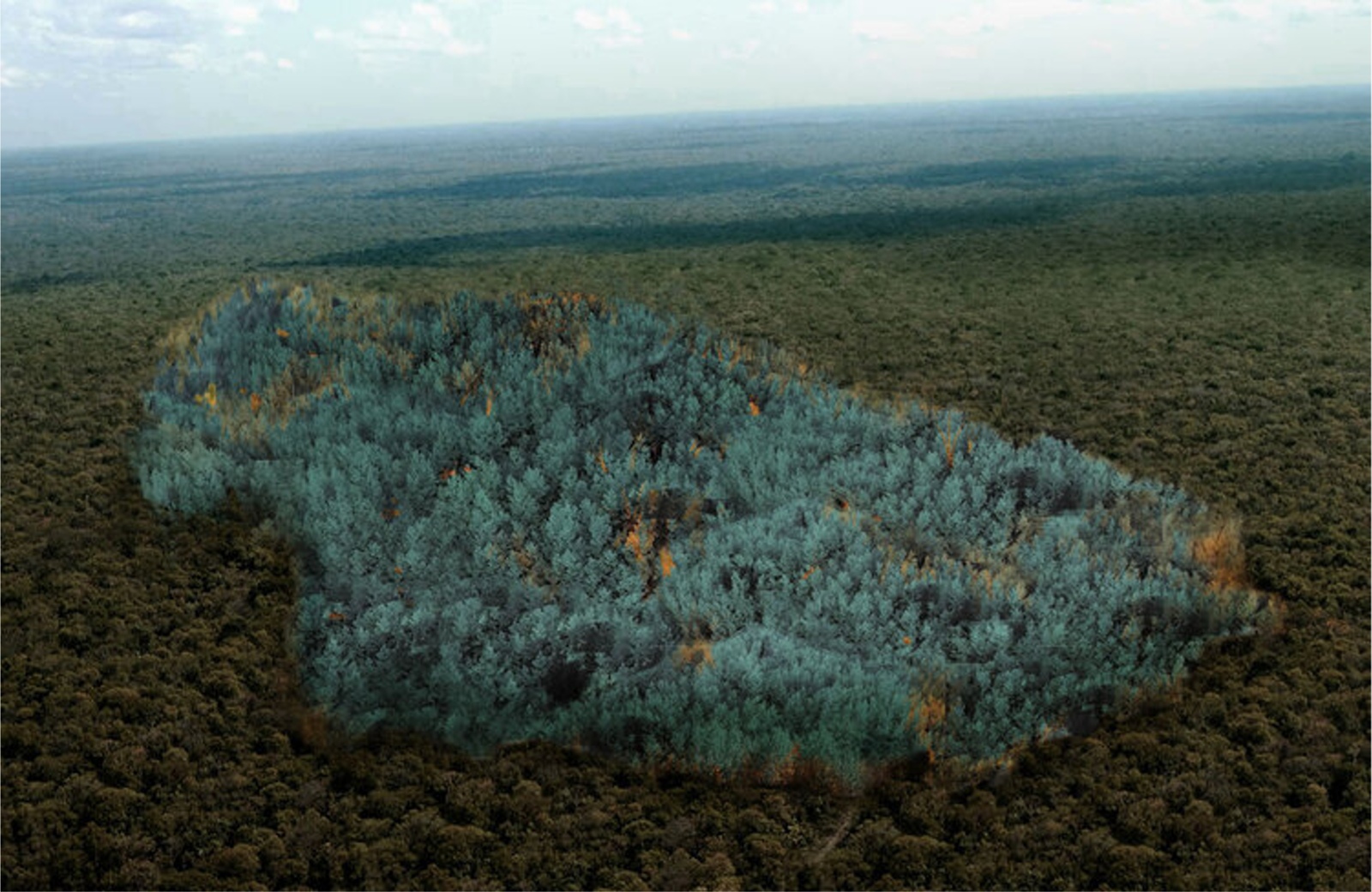
The development of alternative aesthetic registers can also be discerned with the French National Radioactive Waste Management Agency (Andra) and their commissioned artwork The Blue Zone (Figure 1) – a concept by Stéfane Perraud and Aram Kebabdjian that proposes a genetically modified blue forest as a source of permanent memorialisation for a nuclear waste repository lying beneath. Different to landscape markers, which tend to include various forms of written messages, the Blue Zone instead relies on organic bodies as a sole mediator of nuclear memory that offers a more open ambiguous aesthetic message. As the creators note, rather than trying to create a future-proof mode of communication, instead the artwork's intervention is pitched more widely in staging something of tragedy of the will to protect the future from C20–21st nuclear waste: “a forest grows and tells over and over again, each passing year, both the hope and despair of this humanity” (Perraud and Kebabdjian, n.d.).
The Blue Zone by Stéfane Perraud and Aram Kebabdijan (2015).
If C20th landscape markers focus on communicating a specific message or mood into the future, then C21st attention to land art utilises aesthetic modes of nuclear memory to evoke a far more open and uncertain mode of communication. In doing so, such work clearly makes no guarantees about its efficacy for communicating over thousands of years. As Joyce notes: “Land artists have left a rich legacy of installations and commentaries, including comments on archaeological sites. These highlight contingency and the openness of such works to divergent interpretations and unpredictable material evolution, offering an alternative common sense countering the desire for predictability that underlies the proposal adopted for markers.” (Joyce 2020, 12)
One enduring challenge, however, is the way land art often remains wedded, albeit subtly, to the existence of contemporary aesthetic conventions of form and genre. That is, there is nothing to say that a subject in the future would necessarily experience a sense of unease and estrangement through land art that utilises contemporary aesthetics conventions of, for example, a blue forest as something that should invoke a sense of the unusual. In other words, this is to consider how, if at all, the aesthetics of nuclear memory might come to express a specific sense or affect to any future subject whatsoever.
The third mode of nuclear memory we want to draw attention to is the speculative. Unlike archives and aesthetics, recent conceptual engagements with speculative thinking concern the production of manners of thinking and communicating that aim to pluralise what counts as experience in order to expand the possibilities for future action (Debaise 2017; Puig de La Bellacasa 2017; Savransky 2021; Stengers 2008; Williams and Keating 2022). Following Debaise (2017), speculation refers to a specific approach to the production of alternative abstractions capable of remaking the possibilities for thought and experience. Central to this notion of speculation is this sense that the possibilities for experience directly concern the circulation of abstractions at any given time (Debaise and Keating 2021) – where abstractions describe, amongst other things, concepts and modes of evaluation that condition how a subject experiences a sense of past, present, and future. Far from suggesting that thought might escape abstractions, speculative thinking of this kind begins with the premise that we have no choice but to think with abstractions, and that there is a politics to producing alternative abstractions for remaking how the human comes to make sense of and categorise events of experience (Debaise and Keating 2021). Linking to critical futures studies that interrogate the way “cultural texts not only represent the future, but also actively shape it by opening up or closing down imaginative possibilities” (Godhe and Goode 2018, 151), the speculative would be an attempt to think – if not ‘capture’ or ‘know’ – the arrival of the future from an indiscernible element that remains in excess of human meaning-making.
Put in terms of nuclear memory, the speculative takes on a certain import, we contend, insofar as it highlights the need to disturb the knowledge parameters conditioning how a subject imagines different scenarios of nuclear waste futures. As Stengers (2008, 53) explains, as a question of remaking knowledge the speculative is something that acts as a “lure for new possibilities that add to the interest of a situation and transform the way it is addressed”, and thus concerns “the sense of a possible that has already begun to materialise, even if it has no other power for the moment than that of marginally disturbing the acquired evidence” (Stengers 2006, 14–15). By disturbing the limits of the evidential, speculative approaches thus serve as one way to approach Joyce's (2020) concern around how contemporary knowledge regimes edify certain kinds of common sense thinking about the future. Put in these terms, something of the speculative is discernible, for example, in geographical research into the elemental powers of nuclear matter (Engelmann 2022), as well as work concerning the intangible afterlives of atmospheric radiation (Eriksen and Turnbull 2022). An explicit engagement with speculative forms of nuclear memory has also recently been proposed by Thibault (2022), who uses artificial intelligence generated images of nuclear waste markers and signs as a speculative semiotic approach to communicating memory of nuclear waste sites thousands of years into future.
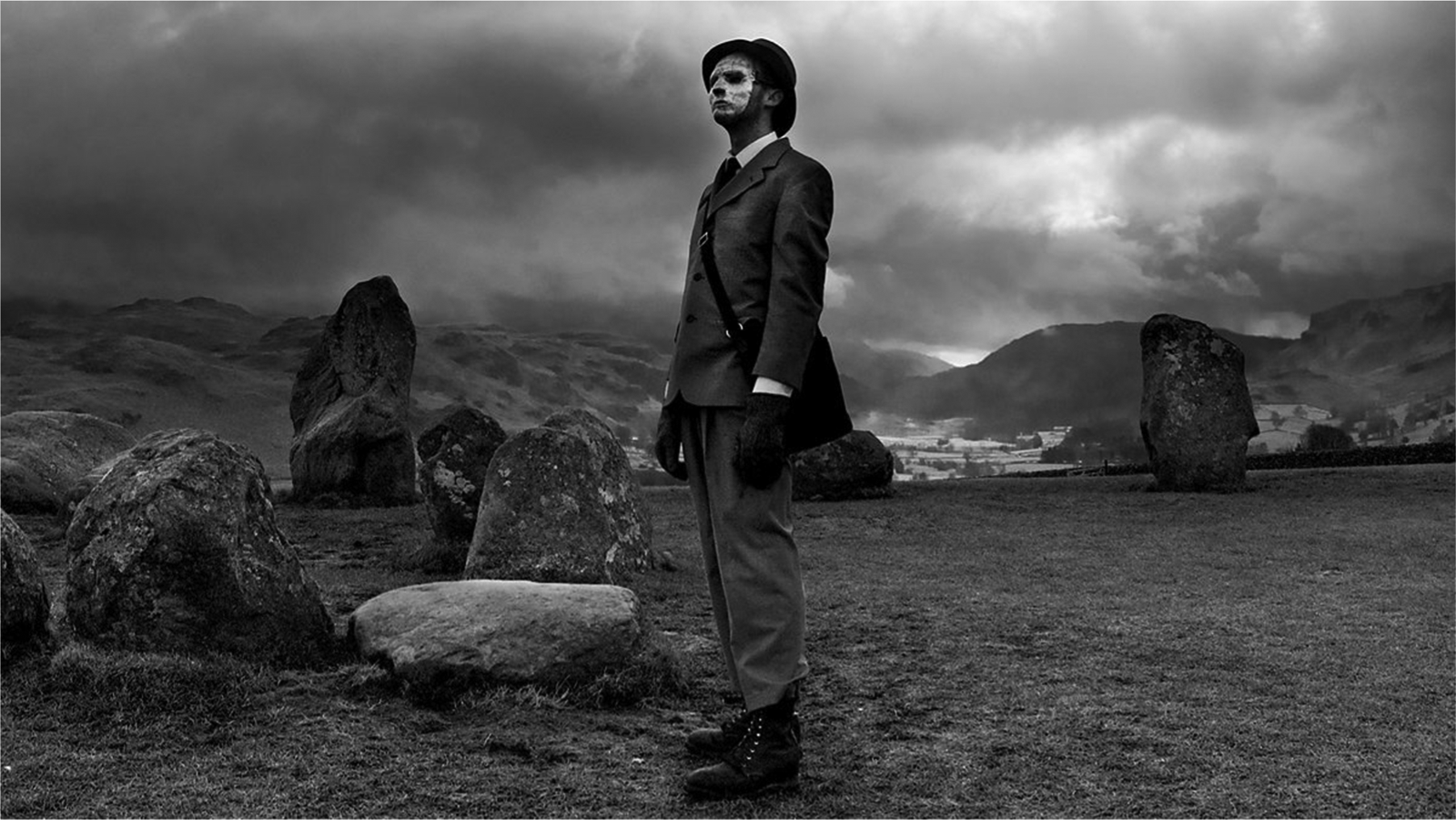
To consider speculative modes of nuclear memory a little further, one can turn to the way previous nuclear waste memory programmes have incorporated speculative thinking of a sort – albeit usually without explicit recognition. In a nuclear waste context, speculative modes of memory communication can be detected with the growth of nuclear semiotics in 1980’s. Most prominent, perhaps, is the Atomic Priesthood – a theoretical proposal developed, amongst others, by semiotician Thomas Sebeok and recently reexplored by Robert Williams and Bryan McGovern Wilson (2013) in Cumbrian Alchemy (Figure 2). Reacting to the sense that existing methods for communicating nuclear memory of geological repositories rely too heavily on conventional image and semiotic modes of communication, the Atomic Priesthood instead emphasises how the production of rituals might become a central method of communication over thousand-year time horizons. For Sebeok (1984, 24), the atomic priests would not be a supernatural clairvoyant being, but consist of “a commission of knowledgeable physicists, experts in radiation sickness, anthropologists, linguists, psychologists, semioticians” whose function is not only to pass on expertise but also, and perhaps most importantly, to ensure the survival of a message between generations (also Sörlin and Bandolin 2007). As Sebeok (1984, 27) acknowledges, such a vision of nuclear memory communication relies on a degree of violence for its success, including the “veiled threat that to ignore the mandate would be tantamount to inviting some sort of supernatural retribution”. As ritualistic – and potentially violent – form of nuclear memory communication, the Atomic Priesthood attends less to the ideal of precision and technical accuracy of an archival message, and much more to the transmission and reproduction of a ceremonial practice that is open to future evolution. As Sebeok (1984, 28) explains, the ritual carried by the priesthood is envisaged as a “judicious mixture of verbal and averbal components, preferably containing a mixture of iconic, indexical, and symbolic elements”. As with mythological stories relying on oral traditions that are subject to reinterpretation and change over thousands of years (Nunn 2018), speculative practices like the Atomic Priesthood prioritise the need for openness and transformation of ideas as a central condition for ensuring memory is preserved.
‘Cumbrian Alchemy’ photograph part of an Atomic Priesthood project by Bryan McGovern Wilson & Robert Williams (2012–2018).
However, the Atomic Priesthood is hardly the first initiative to employ averbal and mystical forms of communication within the context of nuclear waste. As Anshelm (2010) notes in the Swedish context, myths and mysticism have been present in nuclear waste discourse since the 1950’s and are often evinced as part of the ‘civilising’ promise of nuclear energy societies. Forms of mysticism are also present within popular accounts of nuclear memory communication – including genetically engineered glow-in-the-dark ray cats (Bastide and Fabbri 2015) – where emphasis is placed on generating a certain intrigue and playfulness about nuclear memory practices rather than trying to guarantee the preservation of a specific message through time. As with Thibault's (2022) discussion of the ray cat images created through artificial intelligence systems, there is a speculative dimension to mystical forms of communication specifically in the way these forms make no claims to create a ‘practical’ or ‘truthful’ vision of the future, but a rather pursue an explicitly playful storying of what could happen by “opening a window on a possible future” (p.6).
Yet the idea of deploying mystical forms of communication like the Atomic Priesthood within nuclear memory practices is also clearly not without its problems (Lapidos 2009). As Wikander (2015a, 116–117) explains, it is difficult to argue that rituals such as those proposed by Sebeok could be “deliberately fabricated” given that “[f]ew scholars of religion today would subscribe to the notion that religious rituals are always or even mainly meant to facilitate remembering of narrative material”. Acknowledging that practices like the Atomic Priesthood may merely be taken as whimsical attempts to reimagine nuclear safety communication methods that lack practical planning and scientific expertise, nonetheless what we want to draw attention to here is the idea that such practices offer an invitation to imagine alternative nuclear waste futures that, perhaps, unsettle conventional distinctions between the theoretical and practical, or the scientific and the ritualistic. As an imaginative exercise in rethinking our ways of valuing earthly things, or what Debaise (2022) refers to through the writing of William James as an exercise in producing “partial stories”, such practices may offer ways to communicate nuclear memory differently through time due not only to their emphasis on storytelling as a form intergenerational communication, but also in their capacity to be open to contingency and future transformation. The speculative, in this manner, gestures towards the unthinkable and incalculable qualities of the future besides anticipatable scenarios and pre-given value systems (Savransky et al. 2017). Different from the more representational mode of speculative image generation developed by Thibault (2022), this is to think of the speculative as a response to what Deleuze (1988, 62) refers to, via Bergson, as the problem of “dominant recollections” of memory that trap thinking within closed loops of redundant hierarchies and false problems. Speculation, as a mode of nuclear memory, would be about remaining open to different futures that remain unknowable and uncertain, and thus fall outside of these dominant reflections – including futures with the potential to become violent or unappealing. The speculative mode of nuclear memory thus highlights the task of retaining the contingencies and emergent possibilities implicit within different imaginaries of nuclear waste futures. What remains speculative in the Atomic Priesthood concept, therefore, is the way this concept does not prescribe to a defined model of how memory communication should work, but a far more open ‘living’ ritual – a ritual that remains open to different possible future becomings even at the risk of taking on currently undesirable tendencies.
Across the archival, the aesthetic, and the speculative we have developed some avenues for research into nuclear memory – a focus we see as important, not least, because there is seemingly little agreement between nuclear waste producing nations about how best to communicate memory of nuclear waste burial sites into the distant future. What we see as remarkable about this research orientation is how it addresses to an impossible yet intractable aporetic problem: on the one hand, the seemingly ungraspable task of communicating over 100,000 years and, on the other hand, the drawn-out decay of radioactive matter demanding environmental management spanning thousands of years. Returning to Wikander (2015b), we see nuclear memory as a theoretical orientation that responds to the speculative demand of nuclear waste: of articulating other notions of the future that are inflected with contingencies rather than a pursuit of certainties – a task that at once also problematises the status quo suggesting the future is something we might be able to access and render open to probabilistic calculation.
Clearly, however, there are certain dangers in such an endeavour, including how nuclear memory communication often invokes profound acts of hubris in suggesting that the human subject today would be able to communicate across incalculable limits of time (Barad 2017). Another danger, no doubt, is that working with nuclear waste sites and topics “is likely to earn researchers a fixed label that conflates advocacy and scholarship” (Pitkanen and Farish 2018, 873). Recognising the risk that our attention to permanent geological repositories for nuclear waste could be understood on some level as a tacit agreement with these management approaches, the ambition in doing so is to imagine how the articulation of alternative nuclear waste futures through nuclear memory research might respond to the violence of the nuclear present. Nuclear memory, as a theoretical orientation, is proposed as something capable of transforming what Masco (2021, 7) terms “a violent technopolitical order that could always have been, or could still be, otherwise”. Implied by this technopolitical order is an understanding that toxic waste exposure is an outcome of specific racialised (Liboiron, Tironi and Calvillo 2018) and gendered (Rentetzi 2022) politics – the consequences of which are often only partially understood in the present. In thinking with this politics, we conclude by highlighting some of the transformative possibilities of nuclear memory as a theoretical orientation, which we see as fruitful for advancing geographical research into nuclear things in three important ways.
First is that nuclear memory demands attention to alternative onto-epistemologies of time and temporality. Key here is the possibility to explore alternative ontologies of time beside chronological time (Bastian 2019; Glowczewski 2016; Kasperski and Storm 2020), including through recent research into geo-ontologies (Joyce 2020; Povinelli 2021; Yusoff 2013) and conceptualisations of the mnemo-technical capacities of the earth (Szerszynski 2019). This focus on alternative onto-epistemologies of time sometimes suggests a certain existential thrill associated with accessing deep temporal horizons – especially where the enduring materialities of nuclear waste are seen to offer fresh perspectives on durations of time besides the human condition (Gordon 2021; Ialenti 2020). However, we want to caution against this zealousness, and instead call for the production of situated knowledges that avoid the trappings of aspiring towards any privileged access to deep time horizons via nuclear things. This call for situated knowledge concerns, as Ruddick (2020, 516) pursues, the need to “inhabit a present which is at the same time intimately attentive to the connections between the immediacy of our actions and the rhythms of deep time, the connection between duration, durée and deep time”. Rather than encourage a heady-dive into deep time realities, maintaining attention the immediacy of actions in the present might involve turning to nuclear things – and indeed other indefinitely toxic waste materials like mercury, arsenic, or so-called ‘forever chemicals’ like per- and polyfluoroalkyl substances – to rethink the immediate speculative and material politics of the here and now (Barry 2013; Sandlos and Keeling 2016). In environmental geography, one promising area for future research into the relationship between deep time and nuclear waste politics includes the field of ecosemiotics (Maran 2020), wherein there is already an understanding of how futures emerge in non-chronological time from a present “nonsymbolic semiotic world in which such a future is nested” (Kohn 2013, 206). Another area, and intersecting research into ecosemiotics, includes how conceptual engagements with asignifying semiotics (Keating 2022b; Williams and Burdon 2022) might present alternative modes of memory communication besides linguistic and subject-centred regimes of meaning-making.
Second includes the critical problem of understanding who the subject of nuclear memory is; that is, what subject(s) – human and non-human – will bear responsibility for managing and caring for nuclear memory communication practices into the future (Brylska 2020; Kasperski and Storm 2020; Storm 2019)? We see this problem as demanding investigation into how communicating memory along 100,000 year time horizons is legitimised at an institutional level. For instance, further research is needed to understand precisely why the idea of societies actively forgetting about nuclear waste burial sites is today no longer considered viable in nuclear waste management, and why the notion of ‘rolling stewardship’ (Edwards and Del Tredici 2013) has gained a certain prominence in some nuclear waste producing nations as a way to continually manage the process of communicating nuclear memory over decades, rather than millennia (see Poirot-Delpech and Raineau 2016). Another area worthy of geographical research includes the role of stories in transforming how a subject imagines and evaluates nuclear waste futures (Whittaker 2009). Stories warrant further attention not for their functional efficacy, or in being stable and reliable forms of memory communication, but because they have an existential capacity to disrupt a subject's sense of, and continuity within, the immediacy of the present (Proust 2003). Here, environmental geographies might consider the way stories can communicate nuclear memory through theatre performance staging colonial critique (Gilbert 2013), or through the capacity of oral traditions of storytelling (Nunn 2018) that can enact longue durée modes of nuclear memory communication over thousand-year time scales. Stories are promising for nuclear memory research because they have a certain speculative capacity in remaining open to being rewritten and transformed by subsequent generations: stories can be defined in ways that offer situated and partial knowledges of the earth here and now (Debaise 2022), rather than as something aspiring to communicate a universal message across millennia based on the significations of the present (cf. Sagan 1978).
Third, and finally, are the critical questions raised by nuclear memory as a theoretical orientation for environmental geographies, namely: what are the conditions that allow nuclear waste and deep time concepts to gain a certain intrigue today? Key lines of enquiry here include genealogical research into the emergence of nuclear future thinking in the social sciences, as well as investigations into the conditions making communication over post-human timescales interesting to a certain kind of subject. This genealogical research might consider, for instance, how nuclear memory communication itself echoes a tendency towards hubristic thinking within the Anthropocene (Grove 2021). Along with these critical lines of enquiry, there is also a need to better understand the tragedy of burying nuclear waste underground over thousand-year time periods; what kind of failure of thinking is this? Tracing the emergence of this failure of thought is at once to open a space for thinking differently: namely, an appraisal of the specific form of care incited by nuclear memory towards the earth and its radioactive environments enduring beyond the lifetime of the human. What are the conditions of emergence for this collective gesture of care for an earth existing at a time after the human species, and what else might this gesture make possible?
Footnotes
Declaration of conflicting interests
The author(s) declared no potential conflicts of interest with respect to the research, authorship, and/or publication of this article.
Funding
The authors disclosed receipt of the following financial support for the research, authorship, and/or publication of this article. This work was supported by Svensk Kärnbränslehantering Aktiebolag (no.24992).

