




Abstract
Loss and damage is the “third pillar” of international climate governance alongside mitigation and adaptation. When mitigation and adaptation fail, losses and damages occur. Scholars have been reacting to international political discourse centred around governing actual or potential severe losses and damages from climate change. Large gaps exist in relation to understanding the underlying power dimensions, rationalities, knowledges, and technologies of loss and damage governance and science. We draw from a Foucauldian-inspired governmentality framework to argue there is an emerging governmentality of loss and damage. We find, among other things, that root causes of loss and damage are being obscured, Western knowledge and technocratic interventions are centred, and there are colonial presupposed subjectivities of Global South victims of climate change, which are being contested by people bearing the brunt of the climate crisis. We propose future directions for critical research on climate change loss and damage.
Introduction
Loss and Damage is both a political object (henceforth L&D) and a scientific concept (henceforth loss and damage; Boyd et al. 2021). Perspectives of what L&D is vary (Boyd et al. 2017), but scientifically losses and damages are suggested to occur when mitigation and adaptation fail to prevent deleterious attributable climate change impacts (McNamara and Jackson 2019; van der Geest and Warner 2015). The UNFCCC (2013, 1) Warsaw International Mechanism on Loss and Damage (WIM) seeks to “address loss and damage associated with impacts of climate change, including extreme events and slow onset events, in developing countries that are particularly vulnerable to the adverse effects of climate change”. Despite being enshrined in the Paris Agreement as Article 8 (UNFCCC 2015), L&D discourse remains marginal to mitigation and adaptation, with many actors framing it as an adaptation and risk management problem (Mechler and Schinko 2016). Hossain, Huq and Khan (2021) wrote of the “intractability of loss and damage issues” in the climate regime, highlighting, for example, conflicts between Annex 1 and non-Annex 1 1 countries over liability, compensation, and finance.
Research on L&D governance at the international level dominates the literature (Calliari 2018; Calliari, Serdeczny and Vanhala 2020; McNamara and Jackson 2019). However, Calliari and Vanhala (2022) suggest we may be on the cusp of a “national turn” in L&D research (Pill 2021; Thomas and Benjamin 2018a, 2018b; Thomas et al. 2020; Vanhala, Robertson and Calliari 2021; Wewerinke-Singh and Salili 2020). Mitigation and adaptation (the first two pillars of climate governance) have received much critical multi-scale attention in the literature (Eriksen, Nightingale and Eakin 2015; Grove 2014; Sovacool 2021; Stoddard et al. 2021). We argue that both the science of tangible and intangible losses and damages as well as L&D policy mechanisms (the “third pillar” of climate governance) necessitates similar treatment. Indeed, there has been limited engagement with underlying power dimensions, rationalities, subjectivities, knowledges and technologies of L&D and the science of loss and damage at all scales. Those studies that have sought to dig beneath the veneer of L&D have provided significant insights. For example, Vanhala, Robertson and Calliari (2021) unpacked the knowledge politics of L&D in Antigua and Barbuda, finding disparate understandings of what L&D is, a lack of usable data, and a form of epistemic violence when concepts and theories are introduced from the international level without consideration of local contexts. Boda et al. (2021) suggest that actors’ implicit assumptions of sustainable development dictates how L&D is conceptualised, studied, framed and governed. Boda and colleagues’ contribution was a first step towards exposing implicit assumptions and rationalities. Building from these, and other critical contributions (Ciplet 2017; Perry 2021; Roberts and Pelling 2020), we draw from Foucault's (1991) concept of governmentality and ask: is there a governmentality of L&D? We will review existing L&D literature in addition to wider research that we believe can help identify an emerging governmentality of L&D.
In line with Foucault's (1991) initial theorisation of governmentality, we suggest that the governing of L&D does not irradiate from a single centre of power, but it is diffused in myriads of modalities of knowing and acting on the localised harm linked to the physical impacts of climatic changes. Such modalities have historical genealogies, the study of which sheds light on the parties involved in the proliferation and establishment of specific techniques and knowledges to manage this particular aspect of social life. A governmentality approach allows for an understanding of how knowledges and practices produced in the scientific and policy arenas to deal with climate impacts are shaped by concerns with regulating populations’ conducts and with making L&D governable. It thus opens up an appreciation of the selective legitimation of which rationalities count and of how they are made legitimate. This approach clarifies the multiple genealogies of L&D, spurring many questions.
Climate governmentality research has illuminated the underlying rationalities and technologies of government in adaptation and mitigation policy and interventions at various scales (De Roeck 2019; Lövbrand et al. 2013; Mills-Novoa et al. 2020; Oels 2005). Lövbrand et al. (2013, 34) observed that: Students of climate governmentality typically draw attention to the how of climate governance; how the climate is conceptualized and construed as a domain of government; how climate governance is accomplished in practical and technical terms; and how agent categories and subjectivities are constituted through the practices of climate government.
Drawing from Dean's (2009) analytics of government framework, De Roeck (2019) analysed the adaptation governmentalities of the EU Global Climate Change Alliance initiative, finding that real power is wrought, transformational potential is marginalised, and responsibility for risk is placed on recipients. Based on its proven utility, we will employ Dean's (2009) analytics of government framework. Dean (2009) emphasises four key aspects of governmentality (adapted by Oels 2005): fields of visibility, forms of knowledge, technical aspects, and formation of identities. By examining these four aspects, we find a complex web of competing governmentalities from different actors in the L&D arena. Disproportionate vulnerability and unequal capacity are acknowledged, but there is reluctance to treat the underlying drivers of vulnerability and the losses and damages that they lead to. Security and stability concerns are implicit in hegemonic L&D governmentality, where a future-oriented risk framing and proposed treatments through established risk-management infrastructures (e.g., humanitarian systems) prevail. Those subjects of L&D governance, typically countries and communities of the Global South, are showing resistance to being objectified as inherently vulnerable, whilst many Northern states are unwilling to acknowledge their own, not insignificant, vulnerabilities. These among other findings will be introduced and analysed.
We begin by first introducing and developing the concepts of governmentality and climate governmentality. Next, we show how climate change L&D was constituted as a governance object and its evolution is partly driven by what we call the scientisation of L&D. We then employ Dean's (2009) analytics of government framework to unearth multiple L&D governmentalities. We conclude by summarising our key findings and proposing ways forward.
From Foucault to climate governmentality
Foucault, power and governmentality
Foucault sought to understand forms of power in Western nations, from its genealogical manifestation to the political rationalities influencing government and subjectivities (Dean 2009; Walters and Haahr 2005). Beginning with an analysis of sovereign power, Foucault identified the sovereigns’ “right to take life and let live” (1990, 136), later Foucault (1982, 2008) developed the concept of biopower (i.e., techniques for subjugation and control of whole populations based on biological knowledge from the late 1800s) and analysed neoliberal power. Foucault (1982, 220–221) identified a shift from governing territory to “the complex of men and things”, leading to new conceptions of population as a manageable productive resource by governments through “the conduct of conduct” that shape, guide and affect persons (see also Gordon 1991).
Foucault (1991, 108) suggested governmentality is: [T]he ensemble formed by the institutions, procedures, analyses, and reflections, the calculations and tactics that allow the exercise of this very specific albeit complex form of power, which has as its target population, as its principal form of knowledge political economy, and as its technical means, apparatuses of security.
The concept of governmentality is therefore tied to the management of populations through political economy and it gives space to consensus, coercion, and the complicity of subjects, which are seen as instrumental in power relations (Foucault 1982). Within liberal governmentality, various overlapping forms of power coexist, with the triangle of sovereign, disciplinary, and governmental management suggesting key techniques in ruling (Death 2013). Foucault's approach emphasised the importance of history in analyses of governance, which aligns with, and has been utilised by, other perspectives such as political economy, critical theory and postcolonial approaches (Death 2013; Valdivia 2015). Encompassing many disparate disciplines, a central concern has been illuminating how power radiates through governments, institutions, ideas, knowledges, procedures, and technologies at various scales from the local to the global (Death 2013).
Climate governmentalities
Climate governmentality is a growing field (Death 2013; Lövbrand et al. 2013; Low and Boettcher 2020; Oels 2005, 2013). From the analysis of the international climate regime centred on the UNFCCC (Low and Boettcher 2020), to detailed ethnographies of mitigation and adaptation programmes and strategies (Mills-Novoa et al. 2020), scholars have shown, beyond narrower aims (e.g., reducing emission, reducing risk), how subjectivities are targeted by those that wield “power that conducts” (Foucault 1991). Yet, as emphasised by Foucault's (1991) concept of “counter-conduct”, subjects frequently resist imposed rationalities and desired transformations by those wielding power, whether this power emanates from development agencies, national governments, or humanitarian actors (Mills-Novoa et al. 2020). Climate governmentality, although it lacks an agreed definition, seeks to expose and critique the way power is distilled and operationalised by those governing the climate (Lövbrand et al. 2013).
Taking a macro perspective, Oels’ (2013) suggested a shift in international climate governmentality from probability and a future-risk temporality towards contingency plans for actually occurring harms, whereby a prior focus on mitigation broadened to include adaptation. Moreover, Oels’ (2013) and others (Maertens 2021; Methmann and Rothe 2012) argue that there has been a move towards “the climatization of security”. Security is a central aim of any governmentality and climate governmentality is no different. Indeed, the acknowledged goal of powerful global actors (e.g., nation-states, international finance) is to ensure stability and security so that the market can operate despite threats such as climate change (Newell 2010). The UNFCCC and many nation-states continue to use a risk framing for climate change, but one that emphasises neoliberal resilience, which is conceptualised as being able to quickly recover from extreme events and exploit novel opportunities.
As climate change is a planetary-scale common goods problem that will affect all nation-states, albeit not equally, typical North-South developmentalist paradigms, deeply rooted in colonial and neocolonial governmentality, have been called into question (Horner 2020). Horner (2020) suggests that an emerging transition from international development towards global development (i.e., every country is a developing country) is especially evident in the SDGs (UN 2015), with its focus on planetary boundaries as well as typical development indicators. This problematises certain aspects of hegemonic climate governmentality. For example, whilst the most vulnerable are affected the most, all nations need to transition away from fossil fuels, reduce vulnerability, arrest biodiversity decline, among other political-economic transformations. Furthermore, as demonstrated by Eriksen and colleagues (Eriksen and Simon 2017; Eriksen et al. 2020) through their work analysing the Affluence-Vulnerability Interface, wealthy nations can be highly vulnerable to climatic hazards. Recent disasters in the Global North, such as heatwaves and fires in British Columbia in 2021, have demonstrated this fact conclusively. Yet, traditional North-South international development mentalities remain prevalent, and this, as we will show, is evident in emerging L&D governmentality.
Most agree that advanced liberal governmentality prevails (De Roeck 2019; Lövbrand et al. 2013). Governments and corporations frame their climate response as an opportunity to expand markets, make profit, and, ultimately, reproduce capitalism itself. Like international development more broadly (Mawdsley 2018), climate change mitigation and adaptation are increasingly being financialised and subsumed into existing, or seeking to create new, market relations globally (Ciplet and Roberts 2017; De Roeck 2019; Mills-Novoa et al. 2020; Oels 2005). Yet, it is important to recognise that there is a mosaic of climate governmentalities (Death, Stripple and Bulkeley 2013). Foucault (2008, 313) mentioned different governmentalities can “overlap, lean on each other, challenge each other, and struggle with each other”. We find many academics, NGOs, activists, and some states, draw from a governmentality of morality or justice, which can be traced to how climate change was first framed during its emergence as a governance object (Oels 2013) and the older environmental justice movement (Mohai, Pellow and Timmons Roberts 2009; Schlosberg and Collins 2014). Although neoliberal governmentality undergirds climate governance (Ciplet and Roberts 2017), there are multiple governmentalities present. Llaque and Barletti (2021, 3) suggest “no governmentality is a finished product as it is constantly being challenged by both powerful actors and historically underrepresented communities”.
The emergence and scientisation of loss and damage
The emergence of loss and damage
L&D, as a political object, emerged before the shift towards adaptation governmentalities, being first elevated by the Alliance of Small Island States (AOSIS) in the early 1990s (INC 1991). AOSIS recognised that climate change posed existential risks to their territories and hence sought resources from wealthy nations in the form of an insurance pool (Roberts and Huq 2015). Yet, the scientific concept of loss and damage followed the progression of mitigation-adaptation-loss and damage (IPCC 2022). Here we provide an overview of how L&D was constituted as a governance object (see Allan 2017; Demeritt 2001; Hart and Victor 1993; Hulme 2011, for how climate change itself became a governance object).
The international climate regime constituted mitigation as the object of climate governance (Beck and Oomen 2021; Oels 2005; Swyngedouw 2010). Mitigation was framed as being a matter of transforming energy systems and transportation primarily, and, to lesser degrees, reducing deforestation and greening agricultural practices (Savacool 2021). Multiplication of renewable energy, carbon accounting and trading, offsets, and carbon capture and storage initiatives have emerged as key features in recent years (Stoddard et al. 2021). Nationally Determined Contributions (NDCs) remain the vehicle for the reduction of emissions, informed by the Common but Differentiated Responsibility and Respective Capabilities (CBDR-RC) clause that has framed the UNFCCC process since its inception (UNFCCC 1992). Despite the focus on mitigation, the Great Recession in 2008 and the COVID-19-linked recession in 2020/21, emissions continue to increase (Ritchie and Roser 2020; Stoddard et al. 2021). This failure to rapidly mitigate emissions forms the first part of the equation that increases losses and damages globally.
Oels (2013, 23) draws attention to the shift in climate governmentality from a focus on future harms to occurring impacts that require adaptation in the early 2000s, with far more visibility in IPCC (2001). Despite many influential papers published in the 1990s and 2000s on the need for processual, human-centred adaptation targeting societal root causes of vulnerability (Ford and Smit 2004), a sectoral (e.g., agriculture, infrastructure) and linear understanding of impacts and “command and control” interventions are characteristic of dominant Climate Change Adaptation (CCA; O’Brien et al. 2007). An immense literature on CCA exists today. Berrang-Ford et al. (2021) undertook a systematic review and found limited evidence of adaptation's role in vulnerability reduction. Some have criticised adaptation for negatively impacting vulnerability (i.e., maladaptation) and preserving the status quo despite the discourse of transformation becoming more visible (Eriksen et al. 2021). Adaptation governmentalities remain overwhelmingly neoliberal and technocratic (De Roeck 2019; Eriksen et al. 2021; Grove 2014). The failure of adaptation forms the second part of the loss and damage equation.
L&D began as a political project that sought to emphasise unequal contributions to emissions and disproportionate vulnerability, resulting in a call for a redistribution of material resources, typically framed as compensation, for unavoidable climate-driven harms (Hossain, Huq and Khan 2021; McNamara 2014; Roberts and Huq 2015). Whilst the language of justice and fairness was made visible, L&D was constituted primarily as an economic object conceptually tied to an “insurance pool” for more at-risk nations (Mayer 2014). The establishment of the WIM in 2013 marked the official debut of L&D in the UNFCCC negotiations and despite its mandate to address loss and damage, remained largely stuck at the stage of knowledge enhancement and technical discussions. With the persistent desire for compensation, governance actors and scholars framed L&D in legal language and concepts, with tort-like claims being most visible, but these have been ultimately unsuccessful due to challenges of proving causation and a general reluctance by powerful states to address their historical responsibilities and persistent trade, debt, and other dependencies between states (Cameron and Weyman 2021; Millar, Gascoigne and Caldwell 2013; Robinson and Carlson 2021). Many actors remain uncertain of how to operationalise L&D, especially at the national level, or even its actual utility for the reduction of climate change harms (Calliari and Vanhala 2022). Yet, L&D is Article 8 of the Paris Agreement (2015). Seven years after Paris, to many observers’ surprise, 2 COP27 saw agreement to operationalise the Santiago Network and establish (in the future) an L&D funding mechanism, although its details are scarce (UNFCCC 2022a). Indeed, as we will now show, it is becoming harder for L&D detractors (i.e., Annex-1 nations) to wilfully ignore or obscure scientific evidence and conceptual developments.
The scientisation of loss and damage
The discourse of L&D has been significantly influenced by the increasing social and political power of climate science and emphasis on measuring losses and damages (Boyd et al. 2021). We refer to this process as the scientisation of L&D. Specifically, we argue L&D is increasingly informed by the growing scientific evidence base for occurring and expected losses and damages from climate change. The IPCC (2021, 2022) suggests it is “unequivocal” that humans are causing climate change and that losses and damages are happening now. The IPCC (2022) defined losses and damages as “adverse observed impacts and/or projected risks and can be economic and/or non-economic”. L&D was initially quite easy to dismiss as pessimistic when mitigation was within the realms of possibility and adaptation was not yet considered inadequate relative to climate impacts. Yet with each IPCC iteration, the dire predictions of the past have been proven correct if not conservative (IPCC 2021, 2022). Armed with this scientific evidence, particularly at-risk countries, such as Small Island Developing States (SIDS) and other Least Developed Countries (LDCs), along with NGOs and social movements, argue losses and damages are happening now and will continue to escalate (Boyd et al. 2021). Today, when an island is threatened by encroaching seas or extreme weather affects a settlement, the language of loss and damage is being articulated. Although L&D emerged from international climate politics, perceived scientific progression fuels the normative and political calls from a wide range of actors for addressing losses and damages.
The advancement of probabilistic Extreme Event Attribution (EEA) (IPCC 2021; Otto 2017; Swain et al. 2020; Van Oldenborgh et al. 2021) has strengthened claims for incurred losses and damages from climate extremes (IPCC 2022). Notoriously difficult to model and observe, climate scientists now demonstrated we can, with some confidence, disentangle climate change signatures in extreme events such as heatwaves, floods, and droughts (Van Oldenborgh et al. 2021). This, however, is a more contentious area of L&D and the literature has only begun to explore the ethical and political implications of EEA (Jézéquel, Yiou and Vanderlinden 2019; Lusk 2017; Olsson et al. 2022). There are significant risks with linking L&D to EEA, such as requiring attribution evidence as a prerequisite for finance or compensation for climate change-related losses. We note in particular the lack of observational data from the Global South needed to perform and verify the statistical analysis (Otto 2017; Van Oldenborgh et al. 2021) and the inherent complexities of disentangling attribution of harm to climate change from multiple structural drivers of vulnerability (Raju, Boyd and Otto 2022). Regardless of scholarly debates, nation states and societal actors, especially social movements advocating for action (especially finance) on L&D, have found further political licence in this scientific development.
Lastly, Annex-1 countries historically tried to place L&D under adaptation in the UNFCCC process (Roberts and Huq 2015). Partly in response to this, and to develop a new science of loss and damage, scholars began to further conceptualise limits to adaptation, upon which the scientific definition of loss and damage is based (IPCC 2022; McNamara and Jackson 2019; Mechler et al. 2020). The social adaptation literature mostly spoke of constraints as opposed to limits, as there was a belief that humans are almost infinitely adaptive (Adger 2003). Adaptation limits can be natural or social and comprise hard and soft limits (Thomas et al. 2021). The IPCC (2022, Ch.1, 62) suggests: “Soft adaptation limits occur when options may exist but are currently not available to avoid intolerable risks through adaptive actions and hard adaptation limits occur when no adaptive actions are possible to avoid intolerable risks”. Thomas et al. (2021) reviewed the international literature and found one-quarter of the 1600 reviewed articles identified hard limits to adaptation. L&D emerged in relation to residual risks and potentially unavoidable climate change impacts; and with the scientific evidence of hard and soft limits to adaptation, losses and damages are conceptually easier to distinguish and hence become more politically actionable going forward.
Loss and damage and the analytics of government
We now turn to Dean's (2009) analytics of government framework to identify an emergent L&D governmentality. Dean sought to understand how governmental objects were constituted, maintained and transformed over time through analysis of “regimes of practice”. Dean (2009) suggested that the regimes of practice could be identified through analysis of the fields of visibility, technologies, specific rationalities and the formation of identities. We draw from Oels’ (2005) adapted framework and follow De Roeck (2019) in analysing the fields of visibility, knowledge and technologies, and the formation of identities. This leads us to the following specific questions for understanding L&D governmentality: What is made visible and obscured? Which forms of thought arise from and inform the activity of governing? Through what instruments, procedures, and technologies is governance achieved? What forms of self are presupposed and created by governance? By answering these questions, we will be able to answer our original question: is there a governmentality of L&D?
The three subsections that follow do not exhaustively go through every possible example. We instead demonstrate the value of an analytics of government approach. Additionally, whilst many of the critiques we introduce may seem to undermine aspects of L&D and the science of loss and damage, we believe it is necessary to constructively critique these fields to ensure justice for those who have been made vulnerable to climate change through the historical construction of vulnerability.
Fields of visibility
Climate change is foregrounded as the causal agent of loss and damage in many texts (UNFCCC 2013, 2015) especially in the press (e.g., NYT 2021). How could there be loss and damage without climate change? Whilst climate signatures are visible in certain climatic hazards (Swain et al. 2020; Van Oldenborgh et al. 2021), an explosion of claims has emerged with or without attribution evidence (Lusk 2017; Sandstrom and Juhola 2016; UN 2021). Climate change is an important risk factor, through changing and intensifying hazards, but it is frequently being framed as the cause of disasters (Kashwan and Ribot 2021; Ribot, Faye and Turner 2020; Sandstrom and Juhola 2016; Savelli et al. 2021). Droughts, fires, cyclones, and floods, for example, are now considered “climate disasters” (Lyster 2015; NYT 2021), or in the case of Madagascar's recent drought the first “climate change famine” 3 (UN 2021). Disasters, which are historically and socio-politically produced (e.g., de Waal 1997; Drèze and Sen 1991; Oliver-Smith et al. 2017), are now framed as the result of climate change.
Whilst most North and many South governments are uneasy about the implications of EEA, scientists and civil society are being reinvigorated by the opportunities presented. Attribution, whether through fractional attributable methods (Van Oldenborgh et al. 2021), or otherwise (Hulme 2014), in theory, allows the attribution of blame onto greenhouse gas emissions and emitters and hence a narrower form of causality for climate-driven harms. EEA is concerned only with the probability of the hazard itself and this can, perhaps unwittingly, obscure vulnerability and its societal drivers including colonialism, class and race, extractive capitalism, land-use change, developing-country debt, austerity, population growth (i.e., more exposed people and assets), and governmental decisions and (in)actions (Kashwan and Ribot 2021; O’Keefe, Westgate and Wisner 1976; Savelli et al. 2021; Sealey-Huggins 2017). Moreover, severe data limitations (currently underappreciated in the literature) in most developing countries foster a geographical bias in the use of probabilistic EEA (Otto 2017; Scown et al. 2022). Ultimately, this fails to illuminate the historical, political-economic, and ecological processes and factors that led to the kinds of socio-ecological relations that (re)produce vulnerability (Andreucci and Zografos 2022; Jackson 2021; Ribot 2014; Rivera 2020; Sultana 2022; Tuana 2019).
For example, Rivera (2020) explored disaster colonialism in Puerto Rico and the Caribbean and argues racialised violence and dispossession, even through disaster responses, reproduces coloniality and vulnerability throughout marginalised communities. Social movements, particularly peasant and Indigenous led, have consistently called attention to the colonial and neocolonial roots of vulnerability such as dispossession, depeasantisation, proletarianisation, and categorising subjects into hierarchies based on race or other attributes (Borras et al. 2012; Löf 2013; Perry 2021; Sealey-Huggins 2018). These historical factors, among others, create the socio-ecological conditions that climate change, as a risk amplifier, interacts with, leading to losses and damages (Raju, Boyd and Otto 2022; Roberts and Pelling 2020; Wrathall et al. 2015). Although these are examples from the South, it is important to recognise that disasters remain driven by similar processes, factors and actors in the North. For example, rising inequalities, expansion of the rural-urban interface, and increasingly high-risk development and land use change are creating vulnerability globally (e.g., UNDRR 2022).
Developing countries and, in particular, SIDS and LDCs, are overwhelmingly framed as being disproportionately vulnerable to losses and damages in the climate regime.
4
However, not all SIDS – or the communities within them – are equally vulnerable (e.g., Campbell and Barnett 2010), nor are they always the most vulnerable to loss and damage. AOSIS has drawn from the vision of sinking islands that permeates the public imaginary of climate change and has been extremely effective in advocating for finance and technical assistance, which has culminated in the monumental outcome on finance at COP27. This particular imaginary leads, however, to other marginalised groups being obscured in L&D (McNamara and Jackson 2019). For example, landlocked nations throughout Africa and Eurasia can be extremely vulnerable to climate change yet they are rarely centred. Perhaps more contentiously, vulnerability in affluent states, too, is obscured in the imaginary of L&D as a SIDS and LDC concern. As Eriksen et al. (2017, 2020) demonstrate through their analysis of the Affluence-Vulnerability Interface, developed countries can be highly vulnerable to environmental hazards and change. L&D governmentality typically neglects this reality. When reviewing the literature on environmental migration, for instance, Piguet, Kaenzig and Guélat (2018, 372) state: The case of Europe is striking: Only a handful of case studies were identified there, indicating that privileged countries consider themselves immune to mass displacements. The same argument, put differently, can explain this attitude: Instead of encouraging more research, development can give certain countries a Promethean illusion of immunity.
This finding fits comfortably with advanced liberal governmentality insofar as Northern governments perceive L&D as primarily a problem in the South. As recent environmental disasters indicate (e.g., 2021 Western Europe flooding), this is, and has always been, untrue. Yet, the historical appropriation of resources from the South and the systems of power that maintain this wealth does provide higher resilience to absorb shocks and stressors. Still, vulnerability is evident and unequally distributed within all development contexts (IPCC 2022; UNDRR 2022), and this obscuration must not prevent critical researchers turning their attention to the (re)production of vulnerability in wealthy countries.
The illumination of slow-onset events and processes, such as coastal inundation/erosion, desertification, and salinisation (IPCC 2021; van der Geest and Van den Berg 2021), as causes of displacement (Desai et al. 2021) obscures constraints on human mobility and other drivers of migration. Humans have always moved and still do, whether in response to historical sea-level changes, land degradation, conflicts, or greater opportunities (e.g., Nunn and Campbell 2020). Yet, Westphalia conceptions of sovereignty, with arbitrary borders and other technologies of government (e.g., colonial-encouraged sedentarisation, census, infrastructure development) have significantly reconfigured mobilities (de Waal 1997; Ford et al. 2013). Climate-related mobility is now framed by the governmentality of security, fuelled by assumptions about the relationship between climate change and migration (Bettini 2013, 2014; Boas et al. 2019; Farbotko and Lazrus 2012; Kashwan and Ribot 2021; Ribot, Faye and Turner 2020). Whilst sea-level rise and the increasing frequency and intensity of extreme events are, and will increasingly be, playing a role in certain migration (McMichael et al. 2020; Wrathall et al. 2019), causality is more complicated. It is essentially the interplay between push and pull factors related to perceived social and economic constraints and opportunities (Boas et al. 2019). Most migration remains rural to urban, with many migrants ending up living in precarity and highly-exposed informal settlements (Douglas and Ann Miller 2018).
Ribot, Faye and Turner (2020, 49), drawing on a case study of so-called climate migrants from the Tambacounda region of Senegal write, “the multiple causes for their often ill-fated departures are rendered invisible and thus politically nonactionable”. The authors specify: “Young farmers are fleeing neither a changing climate nor mere long-standing poverty; they are fleeing new levels of economic exposure, uncertainty, powerlessness, and declining social reciprocities” (Ribot, Faye and Turner 2020, 55). L&D governance, whilst making slow-onset events and processes visible (McNamara and Jackson 2019), obscures the complexity of (im)mobilities (Ayeb-Karlsson 2021; Ayeb-Karlsson et al. 2019; Boas et al. 2019; Kashwan and Ribot 2021; McMichael et al. 2021; Vinke et al. 2020). These observations, of course, do not negate the very real role of climate change in (im)mobilities (McMichael et al. 2020), but do challenge the dominant, depoliticised narrative regarding presumed cause and effect and hence responsibilities.
Finance for L&D, though bitterly contested, is highly visible within the UNFCCC process and outside (Gewirtzman et al. 2018; Mechler and Deubell 2021; Pill 2022; Roberts et al. 2017). Developing countries have repeatedly called for solidarity-based finance to address losses and damages (Hossain, Huq and Khan 2021). However, Gewirtzman et al. (2018, 1078) observed: Gradually and over time, solidarity-based proposals, including public sector interventions, taxation and transfers from developed nations to vulnerable countries, have been downplayed, whilst private sector insurance-type interventions have been given a central role.
Private-sector financialisation, which is antithetical to the polluter-pays principle, conforms with neoliberal governmentalities underpinning climate governance (Lövbrand, Stripple and Bulkeley 2013; Oels 2005). At COP26 a proposed Glasgow Loss and Damage Facility was forwarded by vulnerable countries but was formally dismissed by many Annex-1 Parties, with Australia and the United States singled out in particular by some observers (Reuters 2021). 5 Proponents are now seeking private sector and voluntary funding by Parties, with Scottish First Minister Nicola Sturgeon symbolically pledging 2 million pounds towards a loss and damage fund (Washington Post 2021). Since then, a series of countries have pledged small amounts of money (e.g., Denmark, Ireland, New Zealand, Germany, etc.). Despite these gestures, Perry (2021) observes: “Financial repair and a broader reparatory framework is not currently on the agenda to address climate crisis that perennially affect racialised communities in the Global South.” Private and voluntary finance has been made visible, while international solidarity finance has been obscured. Although an L&D fund has been established at COP27, there is currently no designated money, no requirement to pay, or any mention of liability in the decision (UNFCCC 2022c). Adding to the difficulties associated with reliance on private financial mechanisms like insurance is that these also obscure non-economic loss and damage (NELD), which cannot meaningfully be monetised. More fundamentally, though, as the Cochabamba Peoples Agreement (2010, 3) states in relation to harms caused by Western capitalist development and climate change: “The focus must not be only on financial compensation, but also on restorative justice, understood as the restitution of integrity to our Mother Earth and all its beings”. Many actors demand far more than merely financial compensation for climate change and development-induced losses and damages, and this is missing from L&D governance discourses.
EEA is increasingly visible and is being tied, at least conceptually, to the growing climate litigation movement (Burger et al. 2020; Otto et al. 2022). EEA could become a driver of litigation by providing the evidentiary base for causation claims and by shifting understanding of what weather is foreseeable, with implications for the duties of governments and private parties (Marjanac and Patton 2018; Stuart-Smith et al. 2021). The IPCC WGIII (2022) has acknowledged that the upward trend in climate lawsuits “can affect the outcome and ambition of climate governance” (Chapter 13) and some research explored how legal avenues may advance the UNFCCC negotiations on loss and damage, also through EEA evidence (Toussaint 2021). However, as we demonstrated above, an overt reliance on EEA risks obscuring the societal root causes of losses and damages and constrain the available evidence, due to data limitations (currently underappreciated in the literature) for most developing countries.
To conclude, we draw brief attention to further examples of visibility and obscuration in L&D governance (all examples discussed can be seen in Table 1). First, comprehensive risk management (CRM) is highly visible and pushed by wealthy nations, but this comes at the expense of developing countries’ desire for compensation (Mechler and Deubelli 2021) or reparations (Perry 2021). Second, whilst economic losses and damages remain visible, increasingly non-economic losses are being highlighted (Pearson, Jackson and McNamara 2021; Tschakert et al. 2019). This reorientation is positive, but we warn against the potential for actors to downplay the importance of economic losses and the dangers (political, ethical) of universalising Local and Indigenous people (who are often targeted in NELD studies) as being outside of the global economy (see Radcliffe 2019). Moreover, Pill (2021) found that in Dominica and Barbuda residents didn’t distinguish between economic and non-economic losses and damage. Third, the focus on NELD is still very anthropocentric and continues to obscure the losses being incurred by the more-than-human world (IPBES 2019). Although ecosystem services and biodiversity are established categories of NELD (Boyd et al. 2021), they are still framed in relation to human use values as opposed to intrinsically valuable themselves. Finally, a dominant focus on UNFCCC negotiations at the global level (with Member States as the main actors) continues to obscure alternative spaces of governance, the role of politics at subnational levels, and associated power asymmetries. These examples, among others, suggest continued critical research is required to show what is being obscured by L&D governmentalities.
Examples of illumination and obscuration in L&D governance.
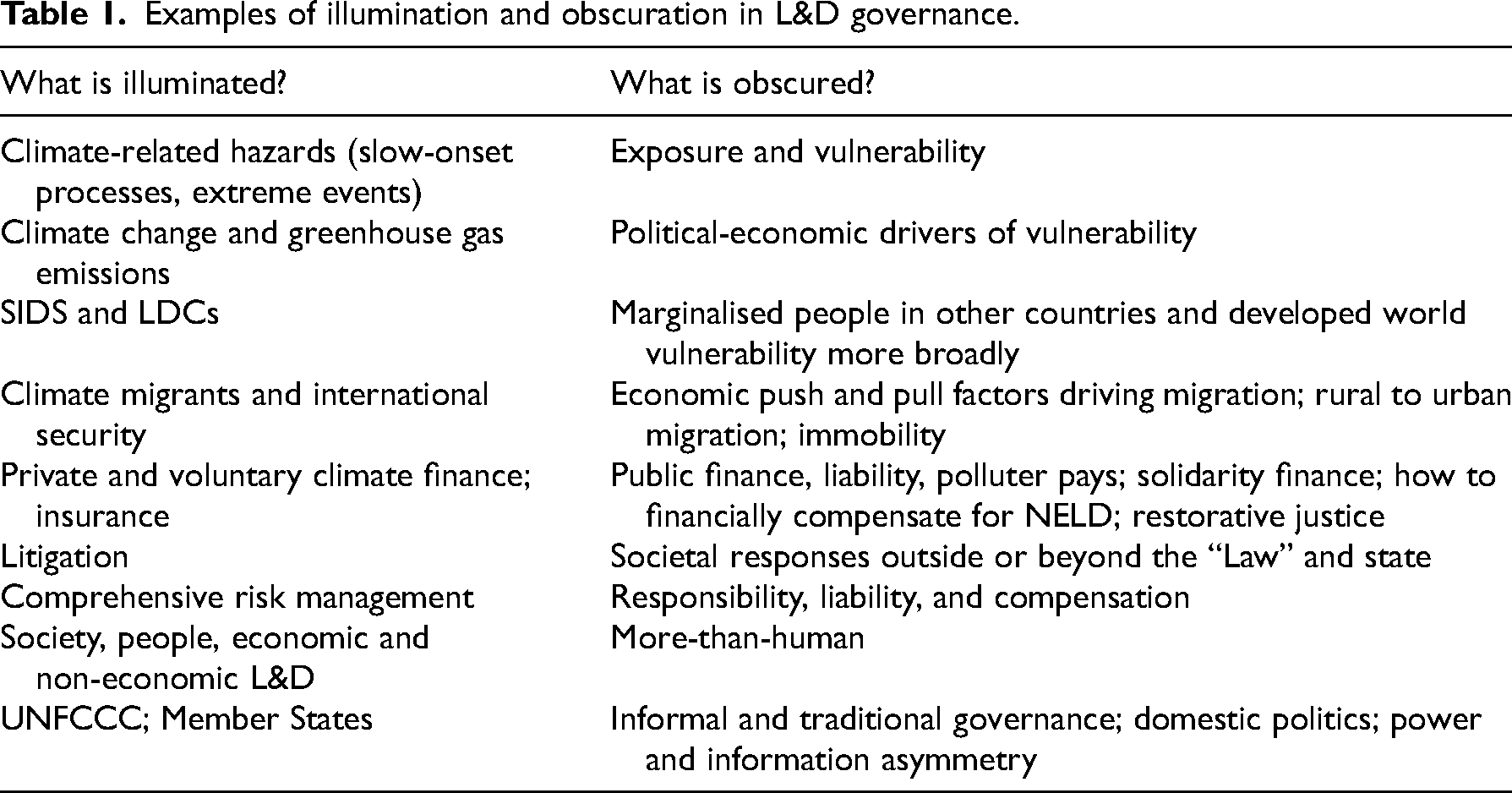
Examples of illumination and obscuration in L&D governance.
We now turn to understanding the forms of thought that arise from and inform the activity of governing and how this knowledge is made “practical and technical” (Dean 2009) through various instruments, procedures and technologies in L&D governance.
Much alike the early framing of climate change as a future threat (Oels 2005), loss and damage is often formally framed as a future threat to wealthy nations and links with an identified pattern of reflexive biopolitics in advanced liberal societies (Cavanagh 2018; Collier and Lakhoff 2015). Despite the actually occurring climate-driven impacts in all parts of the world (IPCC 2021), and many nation-states blaming climate change when a major disaster strikes to deflect attention from political-economic root causes (Raju, Boyd and Otto 2022), this framing persists. Yet, loss and damage discourse emerged from those countries experiencing existential threats to their territory (Ciplet 2017; Roberts and Huq 2015) and many have noted that the climate crisis has been occurring for decades in particularly vulnerable (by way of multi-causal analysis) regions and countries (Hossain, Huq and Khan 2021). This knowledge and direct experiences of disproportionate vulnerability and unequal contribution to emissions were foregrounded in political and legal language. However, nation-states that have disproportionately benefited from fossil fuels will not accept liability for emissions (or historical contribution to creating precarity around the world) because they expect, rightly, an endless list of litigation (Hossain, Huq and Khan 2021). This has been a redline for historical polluters. Therefore, the way that L&D is discussed by the climate regime is technical and devoid of moral and litigious language (Ciplet 2017; Cox and Cox 2020).
The illumination of scientific and technocratic management solutions, with distinct neoliberal rationalities, and the obscuring of different ontologies and epistemologies is, we suggest, a tool of emerging L&D governmentality (see Ciplet 2017). Nightingale et al. (2020) argue that climate research and policy is at an impasse due to its emphasis on producing ever more precise knowledge of risks and the desire to implement incremental “technical fixes” that end up sustaining the status quo. L&D governance is caught within this broader rationality, with the WIM more focused on “enhancing knowledge” of loss and damage despite the urgent need to holistically address root causes (Roberts and Pelling 2020). The Santiago Network under the authority of the WIM is mandated to “catalyse the technical assistance of relevant organizations, bodies, networks and experts” (UNFCCC 2022b). L&D governance has been reduced to, at best, CRM, social protection, and other forms of technical assistance. Ultimately, this is the domain of international development and humanitarian experts and their, often, universal “Northern” knowledge claims (e.g., Carpi 2021; Hilhorst and Jansen 2010). Despite the deflection by wealthy Parties of L&D to existing humanitarian systems, many have been scaling back their international development funding over recent years (e.g., UKGov 2021). This can be interpreted as being a way to appear to do something, whereas the actual effect is to block progress on meaningfully addressing L&D now and into the future.
Humanitarian systems have been much critiqued over the years for their colonial roots and tendency for reactive instead of anticipatory approaches, which can reinforce and exacerbate underlying vulnerability to environmental hazards and change (Jackson 2020; Rivera 2020). We find that the most visible and, perhaps, digestible approach to avert, minimise, and address losses and damages is the vague concept of CRM (Mechler and Duebelli 2021; Schinko and Mechler 2017). The intellectual and political lineage can be easily tied to responsive disaster management systems which, like adaptation as well, treat visible symptoms of climate change and obscure root causes, such as those discussed in the previous section. Significant funding has already been made available in the form of climate adaptation funding in many regions labelled as vulnerable, but there remains limited evidence of effectiveness and it is mired by evidence of elite capture, capitalist developmentalism, and outright misuse (Marquardt, Delina and Smits 2021; Work et al. 2019).
Andreucci and Zografos (2022) show that through the biopolitics of climate change: (Mis)representations of “undeveloped” or “developing” countries or regions as realms of deficient populations and mismanaged resources have since been a cornerstone of development practice; and, we argue, the same logic of othering and improvement traverses contemporary interventions in the name of climate change adaptation and mitigation.
We suggest their analysis can be extended onto the realm of L&D. When considering the society-ending potential of climate change and the economic rationalities inherent in climate governmentalities, the logic of necropolitics (Mbembe 2019) will play out on the world scale, with some regions likely to be saved whilst others will be sacrificed. The counter-hegemonic narrative from social movements and some developing countries indicates they are at least tacitly aware of this (Climate Action Network et al. 2021). And yet, L&D governmentality would prefer to obscure this and focus instead on incremental “technical fixes” towards “resilience”.
Formation of identities
The effect of CCA governmentality on subject formation has been explored to some extent (De Roeck 2019; Keskitalo, Juhola and Westerhoff 2012; Manuel-Navarrete and Pelling 2015; Mills-Novoa et al. 2020) but not so for L&D. In emerging L&D governmentality, despite the hyper visibility of advanced liberal institutions’ presupposed subjectivities and desired transformations, there is no universal subject of a passive victim of loss and damage.
Climate science is criticised for being shaped by a coloniality of knowledge that was preceded by periods of epistemic violence linked to colonialism (Burman 2017; Sultana 2022). This dismissal or, as is increasingly common, appropriation (Chandler and Reid 2020; Todd 2016) of others’ thinking, are both forms of colonisation and shape the perception that people have about others. L&D and the science of loss and damage is embedded within this reproduction of epistemic violence in knowledge production and policy prescriptions.
As mentioned previously, SIDS are hyper-visible in L&D discourse (Ourbak and Magnan 2018; Thomas and Benjamin 2018a). More broadly, SIDS are qualified as the “canaries in the climate change coal mine”, “the barometers of international environmental policies”, or the “hot spots of climate change” (Hanna and McIver 2014; Klöck and Nunn 2019). SIDS are categorised as units of observation of the evolution of climate change and an experimentation of technical adaptation and mitigation strategies. SIDS are imbued with passivity, even if Barnett (2020) suggests their ability to adapt to socio-political and environmental stressors is starting to be recognised. Indeed, AOSIS has been credited for constituting L&D as a political object and massively influencing the discourse of climate governance (Roberts and Huq 2015). Yet, a framing that loss is inevitable in these territories, although true enough, leads to a conclusion that external aid, or charity, is needed. For Barnett (2020) this obscures climate change drivers and maintains the “marginal” position of these islands in the climate regime.
Connected to the climate determinism that permeates climate science and policy (Hulme 2011; Swyngedouw 2010; Whyte 2016), in emerging L&D governmentality there are vulnerable countries and subjects that will increasingly experience losses and damages (UNFCCC 2015). A universal subject affected by losses and damages is typically an Islander or pastoralist being forced away from their homeland (Hanna and McIver 2014; Kashwan and Ribot 2021). This discourse affects the subjectivities of actors, from grassroots social movements to international organisation bureaucrats and nation-state leaders. In neoliberal logic, vulnerability is typically tied to weak markets and a lack of clearly defined property rights, thus economic development is needed to create resilient nation-states and subjects. Elites in these countries with “weak markets” internalise this rationality and international economic organisations, such as the World Bank and IMF, seek to transform societies into an image of core liberal democracies. Joseph (2009, 427) writes: [P]articular bureaucrats, officials and policy makers who populate these [international] institutions are themselves subjects whose understanding has been constructed within a particular epistemic field which makes them see the world in a particular way even if this is wholly inappropriate to problem solving in less developed countries.
This has been recognised as a long-standing problem in development, disaster risk reduction (DRR), and CCA (Pottier 1996), in which contextual factors are ignored or underappreciated in “recipient” societies thereby leading to poor outcomes of interventions (Eriksen et al. 2021). Politically, however, these misunderstandings make more sense, especially when we consider that the dominant rationality is neoliberal. Climate change loss and damage is, potentially, another way to create desired transformations in subjectivities, in both governors and governed, which is justified by temporalities inherent in climate crisis framing.
In sharp contrast to this meta-narrative of universal Southern victims of loss and damage, One recent Pacific Climate Warriors campaign phrase is “We’re not drowning, we’re fighting” (350, Pacific 2021). Cullors and Nguvu (2017, no pagination) show Black Lives Matter UK frame climate change similarly, stating: “The inequalities that turn an extreme weather event into a disaster or human catastrophe mirror the inequalities that cause the disproportionate loss of Black and poor life globally – and the exact systems that Black Lives Matter fights against”. These are useful encapsulations of, in the words of Foucault, counter-conduct and refusal to be objectified by others. Yet, some vulnerable-country governments and INGOs appear to employ a passive victim framing for political purposes such as bargaining chips in negotiations for finance or for their own reproduction (Chakraborty and Sherpa 2021).
Franz Fanon argued colonial subjects needed to form new subjectivities through revolutionary struggle or else continue to be defined through the eyes of their colonisers. Fanon (2001) cuts to the core of the issue, of which L&D today is another expression, writing: “What matters today, the issue which blocks the horizon, is the need for a redistribution of wealth. Humanity will have to address this question, no matter how devastating the consequences may be”. This reparational focus, termed compensation in counter-hegemonic L&D governmentality (Ciplet 2017), is intimately connected to subjectivities of resistance, politico-historical liability, and the desire for self-determination (Perry 2021; Sultana 2022). This contrasts with the Northern-dominated L&D governmentality, which is focused on technical assistance or more limited, and often concessional, North-South climate finance. However, it is a truism that in international politics weaker states and actors cannot always say what they really mean. For some, climate change may be perceived as an avenue to address historical and contemporary harms linked to colonialism and capitalism, and there is much anticolonial writing to suggest this is true (Ajl 2021; Sealey-Huggins 2017; Sultana 2022). However, those governors and elites who benefit from the current geopolitical systems of rule, downplay this association, implicated as they are, but nonetheless see climate change as an opportunity to further their political and material interests. For example, Chakraborty and Sherpa (2021, 49) quote a senior scientist from the National Mission on Himalayan Studies: The mountains are always neglected. We are the last to get roads and electricity and our problems are always ignored in New Delhi's halls of power. But now with climate change, the whole world's focus is on us. We need to seize this opportunity…
Climate change, as an issue of concern for Northern populations and Southern elites, attracts attention to vulnerable rural areas, which is an opportunity for redistribution as much as it is a risk.
Concluding thoughts and ways forward
We have argued that there is an emerging governmentality of L&D, one that, due to the wide range of actors and the complex interplay between science and governance, is difficult to pin down. Nonetheless, by employing an adapted analytics of government framework, we have demonstrated that there are identifiable rationalities that inform the science of loss and damage and governance of L&D. We suggest the obscuration of historical and socio-political root causes of loss and damage by both North and South actors, the technocratic and Western scientific knowledge claims, which disavows other knowledges/interpretations, and the presupposed subjectivities of “victims” of climate change, goes some way to unearthing underlying governmentalities of L&D. Through institutions, technologies, procedures, reflections, and calculations a particularly narrow kind of L&D object has emerged and been sustained despite many criticisms and competing “counter hegemonic” framings over the last 20 years.
Unable to systematically go through all attributes of this emerging governmentality, we have laid the initial tentative foundation of an empirical research programme. As L&D research only really began in response to the establishment of the WIM in 2013 and it has overwhelmingly focused on international politics (Calliari and Vanhala, 2022), there are many potentially fruitful directions for research. We suggest three potential ways forward for environmental geographers and cognate scholars.
First, there is a need to continue the “national turn” in L&D research. Through empirical work with governmental and non-governmental stakeholders (e.g., Calliari and Vanhala 2022; Pill 2021, 2022; Wewerinke-Singh and Salili 2020) we can better understand how international discourses and policy processes are being perceived and translated on the ground. From this we can map actors’ particular framings of loss and damage and the techniques, calculations, and technologies of L&D governance beyond the confines of global institutions (e.g., the WIM and Santiago Network). This research must be informed by current debates in environmental geography especially relating to decolonisation and subaltern critiques of hegemonic climate institutions, knowledge claims, and capitalism.
Second, we propose more critical research on the role of science and the potential benefits and concerns with what we have termed the scientisation of L&D. With the increasing acceptance of climate change science and the unique normative and emerging political role of EEA in loss and damage science, difficult questions must be asked and answered. The IPCC (2022) WG2 “Impacts, Adaptation and Vulnerability” emphasised the losses and damages that are already occurring and are expected to worsen due to increasingly apparent limits to adaptation in natural and social systems. They made such claims by drawing on relatively epistemologically-plural literature from physical and social science, humanities, and Indigenous Studies. Nonetheless, narrower climate science, in particular modelling and probabilistic EEA, is increasingly informing loss and damage discourse, and critical environmental geographers are well placed to ensure that a diversity of scientific, political, and ontological and epistemological perspective of climate change loss and damage are included into the future. There must be a greater emphasis on the political dimensions of science and its development and use to ensure social movement, activists, and civil society can seek justice for losses and damages.
Third, as introduced in section 4.1 and increasingly in the broader climate change literature (Raju et al. 2022; Ribot 2014), root causes of vulnerability to climate change are being obscured, whether intentionally or unintentionally. Loss and damage scholars and actors must reflect on the way they are reproducing various scientific and governmental discourses that reduce the social, political, economic, and environmental processes and factors that create vulnerability to climate change being the cause of losses and damages. EEA definitely has a role to play in showing the contribution that anthropogenic climate change has in any given extreme and when it does not (Van Oldenborgh et al. 2021), but even here reflection is needed in the communication of such results to potentially less-informed stakeholders and the general public (Raju et al. 2022). 6 Research that unpacks the calculations and, ultimately, the rationale for overly emphasising the role of climate change in loss and damage, which we have suggested detracts attention from governmental decisions and (in)actions, colonialism and extractive capitalism, is crucial for our goal of steering L&D away from the technocratic and neoliberal governmentalities so ubiquitous in mitigation and adaptation.
As the climate crisis intensifies and more people and institutions are accepting this reality, the political object of L&D will continue to grow in visibility, both socially and politically. These three proposed research directions are not exhaustive and merely indicate paths forward based on our governmentality analysis and long-term engagement with the field. With the L&D literature mostly reacting to the UNFCCC process, there are many further empirical and theoretical gaps that call for greater attention by environmental geographers. To avoid the same fate of mitigation and adaptation, which have been captured by dominant neoliberal climate governmentality, the emerging loss and damage governmentality, with its obscuration, colonial knowledge claims, and presupposed subjectivities, can be confronted and shifted. Loss and damage is fundamentally about addressing colonial-capital-climate harms to the human and more-than-human world. The truly radical potential of L&D is implicit but must be developed further and made explicit. Within the denuded landscape of climate governance, fresh shoots of climate justice are visible and we, as academics, must play our role to ensure that they can survive, grow, and flourish.
Footnotes
Declaration of conflicting interests
The authors declared no potential conflicts of interest with respect to the research, authorship, and/or publication of this article.
Funding
The authors disclosed receipt of the following financial support for the research, authorship, and/or publication of this article. This work was supported by the Svenska Forskningsrådet Formas (grant number FR-2018/0010).
