



Abstract
Digital technologies increasingly mediate relations between humans and nonhumans in a range of contexts including environmental governance, surveillance, and entertainment. Combining approaches from more-than-human and digital geographies, we proffer ‘digital ecologies’ as an analytical framework for examining digitally-mediated human–nonhuman entanglement. We identify entanglement as a compelling basis from which to articulate and critique digitally-mediated relations in diverse situated contexts. Three questions guide this approach: What digital technologies and infrastructures give rise to digital entanglement, and with what material consequences? What is at stake socially, politically, and economically when encounters with nonhumans are digitised? And how are digital technologies enrolled in programmes of environmental governance? We develop our digital ecologies framework across three core conceptual themes of wider interest to environmental geographers: (i) materialities, considering the infrastructures which enable digitally-mediated more-than-human connections and their socioenvironmental impacts; (ii) encounters, examining the political economic consequences and convivial potentials of digitising contact zones; (iii) governance, questioning how digital technologies produce novel forms of more-than-human governance. We affirm that digital mediations of more-than-human worlds can potentially cultivate environmentally progressive communities, convivial human–nonhuman encounters, and just forms of environmental governance, and as such note the urgency of these conversations.
Keywords
Introduction
Digital technologies increasingly mediate human–nonhuman relations in diverse settings including environmental governance, surveillance, and entertainment. Digitisation produces unique understandings of, and modes of access to, more-than-human worlds, and fundamentally reshapes conservation, environmentalism, and ecological politics (Jørgensen 2014). Early critics argued that these intensified human-technology relationships both produced and reflected public ecological disengagement (e.g., Balmford and Cowling 2006; Louv 2005; Kareiva 2008). Digitisation, they argued, was driving humanity's ‘extinction of experience’ (Pyle 1993) and fuelling ‘nature deficit disorder’ (Louv 2005). In response, ‘reconnecting’ with nature beyond the on-screen encounter emerged as “the mantra for addressing humanity's severance from the natural world” (Zylstra et al. 2014, 120). More recently, however, researchers and policymakers are increasingly embracing the optimistic idea that digital technologies can provide new forms of nature reconciliation. Such technofix solutionism is pervasive in discourses concerning all sorts of nature recovery programmes (see Fletcher 2017). In both of these ideological frames, the impacts of digitisation remain under-studied in conceptual and empirical terms (see Kuntsman and Rattle 2019).
In this paper, we present ‘digital ecologies’ as an analytical framework for researching digitised human-nonhuman relations which favours situated understandings of digitisation as a material, affective, and plural process. We feel this intervention is timely and of growing importance given the ubiquitous nature of digitisation in everyday life (Ash et al. 2018; Leszczynski 2020). We resist the false binary between connection/disconnection underpinning forms of eco-scepticism towards digital media (see Leszczynski 2015; McLean 2017; 2020) and the technofix prometheanism behind ‘digital solutionism’ (Kuntsman and Rattle 2019). Instead, following Taffel (2019), we employ the term digital entanglement. For Taffel (2019, 2), entanglement “refuses subject/object, nature/culture and representation/reality dualisms,” whilst emphasising the inseparability of the material and experiential qualities of digital mediation. This position provides a useful basis from which to develop a holistic approach attentive to energy, matter, information, data, code, and attention (Taffel 2019). For us, entanglement highlights the potentials afforded by digital mediation and technologies, which do not inherently disengage nor reconnect humans to nature. Rather, they foster the potential for both, depending on socioeconomic, ecological, cultural, historical, and geographical context (Altrudi 2021). They inaugurate new relationships that cannot be easily judged as harmful nor as a one-way ticket to a fantasised convivial techno-utopian future.
We begin by situating our interventions at the confluence of more-than-human and digital geographies, political ecology, and media studies in Section 2, developing a shared lexicon that seeks to bridge these subdisciplines. In doing so, we advance digital ecologies as an analytical framework and field of research covering the diverse range of approaches within this space (see Verma 2021). 1 Then, to help understand the nuances of digital entanglement, we develop our analytical framework across three key themes of long-standing interest to environmental geographers: materialities, encounters, and governance. This structure reflects key domains in which digitisation alters human–nonhuman relations, and offers a robust approach for examining the nature, ethics, and politics of digital entanglements: what they are, where they are, and why and to whom they matter.
Section 3—materialities—develops two arguments. First, digital mediation must be understood ontologically as a material process. This is crucial to conceptualising digital entanglement and attending to the political economies implicated in producing, enacting, and sustaining digital mediation. Second, we examine the environmental harms and socioeconomic inequalities implicated in digitisation, which are often obscured by digital systems and ‘solutionism’, but illuminated through attention to digital materialities (e.g., Crawford and Joler 2018; Kuntsman and Rattle 2019). In section 4, we examine the affects, spatialities, and mediations associated with more-than-human digital encounters. Following McLean (2020), we conceptualise digital encounters as ‘more-than-real’ rather than impoverished approximations of the ‘real world’. Jettisoning ‘real’/’virtual’ distinctions, we focus on the specific spatialities in which digital encounters occur, examining the affects and affordances of technological interfaces, and the environmental subjectivities inaugurated both through and beyond ‘the screen’. Drawing from political ecology, we discuss how digital encounters are valued and commodified—producing ‘digital encounter value’ in settings including wildlife livestreaming and videogames—and point to the implications this has for contemporary forms of environmentalism. Remaining critical of commodified digital encounters, we note that digital encounters can, under certain circumstances, produce meaningful modes of care and concern outside capitalist relations, and encourage researchers to produce situated accounts of digital encounters across contexts. Finally, Section 5 brings the material and experiential aspects of digital entanglement together to examine novel forms of environmental governance inaugurated by the proliferating use of digital technologies. We explore how digital entanglement fosters uneven exercises of power, domination, and control, and ask how these technologies are themselves governed.
What material, social, and political economic relations are enabled, reinforced, or foreclosed through the digital mediation of more-than-human worlds? Our three thematic sections speak directly to this question, which helps to guide research into diverse instances of digital entanglement. Materialities places digitisation in an assemblage of material entities and relations, and foreground the socioecological injustices that underpin it. Encounters examines the experiential qualities and ways of being inaugurated by digital entanglement, and the political economies implicated in such encounters. Governance highlights how practices of digitising more-than-human worlds carries bio- and geo-political consequences. Thus, we propose digital ecologies as an analytical framework for elucidating instances of digital entanglement, foregrounding the interconnected potentials, politics, and responsibilities associated with the digitisation of more-than-human worlds.
A shared lexicon for digital ecologies
We begin by defining key terms—digital/digitisation and ecology—to establish a shared lexicon for digital ecologies, before intellectually situating our intervention in relation to a genealogy of related work. While work in more-than-human geography (Whatmore 2002; 2006) has explored the role of digital mediation in human-nonhuman relations (e.g., Blue 2016; Davies 2000; 2005; Nelson 2017; Ritts and Bakker 2021; Stinson 2017; Verma 2016; Verma et al. 2016; von Essen et al. 2021), there remains relatively sparse engagement between the disciplinary traditions of more-than-human and digital geographies (although see Dwyer 2021; McLean 2020; Nelson et al. 2022; Nost and Goldstein 2021; Prebble et al. 2021; Travis et al. 2023). As Leszczynski (2019, 21) notes, scant attention has been paid “to how nature as an assemblage of both human and non-human organic life intersects with or fits into what is often presented as a triad of technology-society-space relations.” As such, digitisation is under-examined and under-theorised in more-than-human geography, while digital geographies could benefit from fuller conceptualisations of nonhuman agency and materiality as offered by more-than-human geographers. By conversing these geographical subdisciplines (alongside adjacent work in political ecology and media studies), this paper thus offers an analytical framework for future interdisciplinary research.
For Ash et al. (2018, 25), geography's ‘digital turn' signals “a demonstrably marked turn to the digital as both object and subject of geographical inquiry,” and the ways in which “the digital has pervasively inflected geographic thought, scholarship, and practice” (see also Ash et al. 2019). Despite this digital turn, the continued definitional ambiguity of ‘the digital’ is well documented (Berry 2014; Duggan 2017; Kitchin and Dodge 2011; Jeanneret 2000). Miller and Horst (2012, 3) define the digital as “all that which can be ultimately reduced to binary code, but which produces a further proliferation of particularity and difference.” Digitisation converts the messy worlds of ‘organic signals’ into ‘digits’: the zeros and ones constituting binary code (Fish 2019; Lunenfeld 1999). As such, new media theorists suggest digitisation can be considered a contemporary form of inscribing, writing, and representing the world (Jeanneret 2000; 2013; 2019). This work attends to digital technologies as cultural ‘objects’ as well as analysing media content itself, exemplifying the heterogeneity of digitisation (Bolter and Grusin 1998; Jeanneret 2008; 2014 Jeanneret and Souchier 1999; 2005; Kittler 1986; Manovich 2001; Souchier 1996; Stiegler 1998). In this vein, Ash et al. (2019, 4) warn against singular ‘monolithic’ depictions of ‘the digital’, instead invoking ‘digital’ in multiple ways to conceptualise the interconnected things produced through digital modes and mechanisms. In relation to the nonhuman world, these multiple processes of digitisation work, in turn, to produce a multiplicity of natures (Nelson et al. 2022). Digitisation thus shapes human–nature relations in multiple ways, enabling and foreclosing connections across more-than-human assemblages, events, and processes (Leszczynski 2015; Grusin 2015).
We turn next to the theoretical lens of ecology, which draws attention to how the process of digitisation is always underpinned by material relationships and infrastructures, despite these relations often being obscured. As such, ecology reminds us to examine “the materials that media are made of” (Cubitt 2016, 11). Ecology is conventionally understood as the biological study of interactions between living organisms and their environments. Promisingly, the term has also been adopted and reworked in the social sciences and humanities, notably by STS scholar and philosopher of science Isabelle Stengers (1997; 2005; 2010), precisely because of its focus on relations, assemblages, practices, and connections between more-than-human actants (Hörl and Burton 2017; Latour 2004; Latour et al. 2018; Tsing 2015). Inspired by Stengers, scholars have explored ecological frameworks for elucidating the relations between matter, bodies, and environments (Barad 2007; Bennett 2009; Braun and Whatmore 2010; Barua 2014; Lemke 2021)—key themes running throughout this paper. Digital geographers have likewise deployed an ecological lens to study the agencies of cybernetic matter such as algorithms, data, and malware (Amoore 2020; Dwyer 2019; 2021; Lupton 2016), and ecological metaphors are commonly deployed in organisational theory (Raptis et al. 2014), making ecologies a fruitful framing for interrogating the diversity of social and material relations that comprise digital entanglement.
While its use as a generic descriptor of systems has been common since the 1970s, ‘ecology’ also references the critical tradition of political ecology; a field of study examining how environmental conflicts and change are suffused with political, economic, and social power relations (Harvey 1996; Robbins 2020; Sultana 2020). More recently, scholars have begun to define ‘digital political ecologies’ (Tait and Nelson 2021), drawing on work in ‘feminist digital geographies’ (Elwood and Leszczynski 2018; Leszczynski 2018; Brooke 2021), ‘feminist political ecology’ (Harcourt and Nelson 2008; Sundberg 2017), and ‘digital conservation’ (Nelson 2017) to understand how political, economic, and social power dynamics play out and transform when environmental conflicts take place online or are digitally mediated (Tait and Nelson 2022; Nelson et al. 2022). Nelson and colleagues (2022, 4) call this body of work ‘Feminist Digital Natures’ and emphasise the importance of “power, embodiment, social difference, and emotions” in shaping how digital entanglement is differentially experienced, accessed, and governed. Their approach involves “understanding exactly who creates and uses digital technologies” and “how they are used or affectively engaged with” (Nelson et al. 2022, 4). Drawing inspiration from such work, digital ecologies research should not only offer critique of digital entanglement, but work towards just more-than-human worlds by seeking to create “possibilities of a liberatory digital politics for re-making our technologies and ourselves as digital subjects” (Elwood and Leszczynski 2018, 640).
Within geography and cognate disciplines, several terms have emerged to describe specific empirical or conceptual domains dealing with the digitisation of more-than-human worlds. Verma (2021) recently outlined some of the most prominent terms in this growing lexicon, which inform the genealogy outlined in Table 1.
Selected research strands informing digital ecologies as an analytical framework, following the initial provocation of Verma (2021).
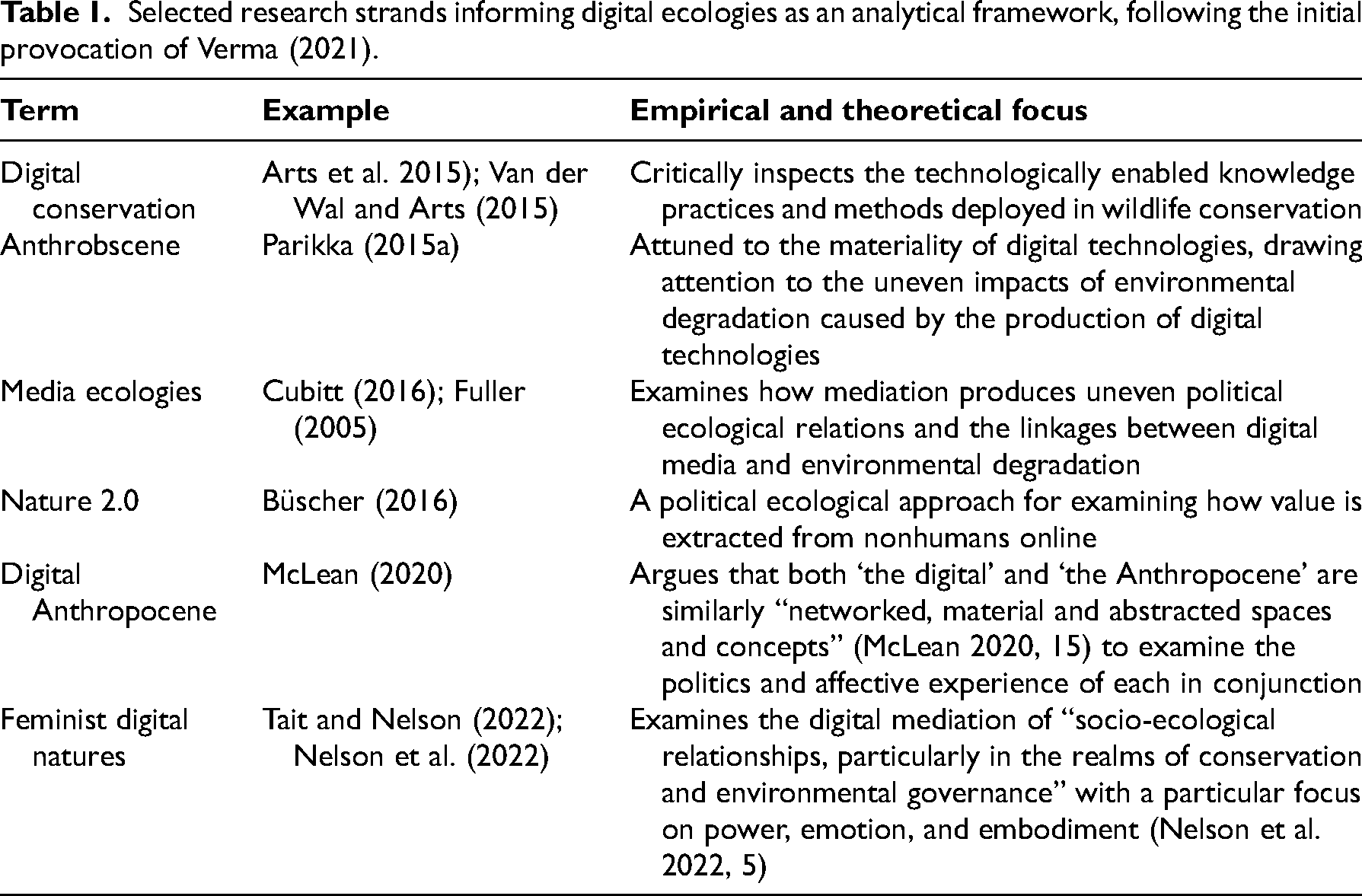
Encapsulating the bodies of work outlined above, ‘digital ecologies’ simultaneously invokes the (often harmful) material relations that underpin digitisation, the uneven geographies forged by digitised encounters, and the forms of environmental governance shaped by digitisation. Importantly, it is able to account for the multiplicity of digitisation as a process and the subsequent multiplicity of technology-society-environment relations constituting digital entanglement. It thus offers an apt analytical framework for interrogating emergent and interrelated digitised more-than-human worlds across geographical contexts.
Materialities of digitisation
Materiality is a foundational concern of more-than-human geography, highlighting the diversity of nonhuman actants implicated in the co-fabrication of social, political, and economic worlds (Whatmore 2006). This diversity is frequently obscured by the seemingly immaterial character of digitised worlds. Thus, within our digital ecologies analytical framework, we begin with materialities of digitisation to draw attention to the materials, devices, and infrastructures that are fundamental to the digitisation process. We turn first to the diversity of devices that digitise animals’ lifeworlds.
Digitisation takes many forms and occurs via a plethora of devices across many geographical contexts. For instance, the use of digital monitoring technologies in ecological research has burgeoned since the mid-twentieth century, such that wildlife is now ‘wired’ (Benson 2010) with a continually advancing array of available loggers and sensors (Holton et al. 2021). Examples now include miniature tags for bees (Barlow et al. 2019), software that translates environmental data from a single tree into social media posts, 2 and radar sensors attached to albatrosses to police illegal fishing vessels (Weimerskirch et al. 2020). Certain devices generate ecological data on biotic and abiotic environments, from oceanic conditions to environmental radiation levels, facilitating the gathering of previously inaccessible data and the enrolment of nonhumans themselves as sensors and sentinels of environmental conditions (Gabrys 2018; Keck and Lakoff 2013). Digitised nonhumans, therefore, are now situated within wider digital milieus, presenting novel research opportunities for ecologists. For instance, in the Chornobyl Exclusion Zone in Ukraine, ecologists have used specially designed GPS-collars fitted with dosimeters to simultaneously understand the radiation exposure of wolves and their spatial range (Hinton et al., 2019).
Nevertheless, digital entanglement is always multiple, and partial: not everything can be neatly digitised, nor is digitisation a uniform process. Matter is inherently lost in the digitisation process, meaning digitised worlds are altered versions of the realities they portend to represent. In one sense, digitised worlds are reduced versions of the worlds they represent—usually, you cannot smell a digitised flower. But this argument is a red herring: rather than impoverished copies, digitisation produces difference and novel spatial constructions with their own sets of affects and affordances that cannot be equated with the ‘real thing’ (Kitchin and Dodge 2011; Kinsley 2014; Stinson 2017). Indeed, digitisation produces and shapes material worlds; it does not merely represent them. This is well exemplified by the case of ‘smart forests’, or other so-called ‘smart’ environments (see Moss et al. 2021). Once digitised by an array of technologies—including terraforming drones, sensors, AI, and robots (Gabrys 2020)—forests are remediated and circulated through devices which “co-constitute and mobilise forests as distributed sites that travel across platforms, data sets, observation technologies and participatory apps” (Gabrys 2021, 2). These processes allow different groups to then intervene in material forest processes in divergent ways, transforming forests and forest governance (Gabrys 2020; 2021; Gray 2020). Digitised worlds are thus: (a) mutable, translating between physical and cybernetic forms; (b) multimedial, materialising across a range of geographical and technological contexts; and (c) massive, existing in great number and frequency (see Rose 2016).
For Adams (2020, 18), digital devices give nonhumans “a second life lived through the continuous unspooling of location data” moving “in server farms and temporary storage in its transmission from animal to satellite and down again.” In an era of extinction, some digital animals may outlast their corporeal counterparts. Nevertheless, the infrastructures underpinning digital mediation are themselves subject to the process of decay and require ongoing replacement (Taffel, 2022). Given this, it is concerning that institutional environmental regulations continue to overlook the impacts of these energy-intensive, maintenance-requiring digital infrastructures (McLean et al. 2022). As Kuntsman and Rattle (2019) note, ‘digital solutionism’ continues apace with little concern for digitisation's deleterious impacts. Without systematically accounting for the materialities of digital devices, the promise of digital technologies for environmentally-positive futures is debatable (Kuntsman and Rattle 2019). Thus, we turn next to the material ecologies of media themselves—both active and obsolete—littered around the world (Gabrys, 2011).
In contrast to common imaginaries of digital worlds as immaterial ‘clouds’ (see Monserrate 2022), media ecology theorists stress that environments do not simply surround media but run through and enable them (Kember and Zylinska 2012; Parikka 2015a; 2015b; Pickren; 2014; 2016). 3 Indeed, a long tradition in media theory—which culminated in the ‘infrastructural turn’ around the turn of the millennium (Bowker and Star 2000; Edwards et al. 2009; Star 1999; Star and Ruhleder 1996)—examines the infrastructures underpinning digital mediation. This research foregrounds the materiality of data centres (Bratton 2016; Hogan 2018; Holt and Vonderau 2015; Parks and Starosielski 2015), undersea cables (Starosielski, 2015), and cloud infrastructures (Peters 2015; Amoore 2020) amongst other things, and their role in geopolitical and environmental inequalities (Franklin 2021). It is not only digital hardware that causes socioenvironmental damage, though; software, too, can be more or less energy efficient (Taffel 2019). For instance, each Google search emits 0.2 g of CO2 (Cubitt 2016).
Like with other commodities, the production of digital technologies deepens the socioeconomic inequalities associated with resource extraction, commodification, and waste disposal (Taffel 2012; 2019; 2022). For example, in the Katanga Copperbelt, Democratic Republic of Congo, where more than half of the world's cobalt is mined, workers are exposed to poor working conditions, unjust wages, and environmental toxins through mining a mineral essential to lithium-ion batteries now found in mobile phones and other digital devices worldwide (Tsurukawa et al. 2011; Nkulu et al. 2018). Cubitt (2016) outlines how 70% of all mined uranium—often used to generate the electricity which powers digital devices—comes from Indigenous territories and is often acquired through exploitative neo-colonial practices. For example, the Australian government breached international human rights laws while extracting uranium from Indigenous lands. Examples such as this abound, and the relationship between digital media and capital is at the root of this exploitation (Cubitt 2016). Digital materialities extend beyond metals and minerals, too, contributing to the production of plastic, radioactive waste, and other forms of pollution (Taffel 2016; 2021).
The technoscientific ability to understand earth systems is dependent upon the extraction of the very same earthly materials under examination. The observed materials are themselves integral to the building of digital sensing devices. Parikka's (2012) neologism ‘medianatures’ captures this ironic interdependence. Elsewhere, Parikka (2015a) highlights the long-lasting material remnants of digital devices, raising awareness of the extractive processes implicated in their production and their toxic lives and afterlives (see Palmer 2021), which form technological debris scattered globally. What ends up as a toxic contaminant in one place begins as a rare earth mineral elsewhere, briefly animating a technological device in the interim. Gabrys (2011) similarly highlights the ubiquitous and long-lasting toxic rubbish by-produced through digitisation. Understanding digital technologies through this material lens thus involves widening the ontology of ‘digital technologies’ to include vast material infrastructures produced through exploitative extractive economies. Akin to follow-the-thing methodologies (Cook et al. 2004), tracing the lives of digital devices from production to disposal reveals the inherent materiality of digitisation (see Palmer 2021).
In addition to labour exploitation in the extractive industries underpinning digital technologies, labour is also exploited through digital platforms (Terranova 2000; Marres 2017). This is prominent in the context of crowdsourcing for environmental projects (Woodcock et al. 2017) where volunteers’ time, skill, knowledge, and energy become digitally obfuscated (Dagiral and Peerbave 2012; Scholz 2015). This becomes particularly problematic when enterprises are heralded as democratising science, but in reality, engage volunteers as ‘cogs in a machine’ to execute pre-set tasks under disciplined supervision (Benson 2017; Woodcock et al. 2017). Increasing smartphone use and internet accessibility blurs distinctions between producers and consumers of nature content online. But while Büscher (2016) laments the rise of so-called ‘prosumers’ under platform capitalism, others note the ‘democratising’ impact digital technologies can have (Silk et al. 2021). We return to this in more depth in the next section.
Foregrounding the materials and infrastructures underpinning digital entanglement shows how digital media themselves fundamentally affect the environments, interactions, and bodies of the nonhumans they were invented to observe. Epistemic practices involving digital technologies are thus tightly entangled with their subjects of study. A focus on materiality connects sparse spatiotemporalities to illuminate the mineral lives of digital media before their use, the extractive labour politics that bring them into being, and their environmentally deleterious afterlives perpetuated when rendered obsolete by capitalist economies (Gabrys 2011; Taffel 2022). Bringing attention to digitisation as a material process also draws together disparate material relations often obscured by popular notions of ‘the cloud’ that are culturally tacked onto digitality. Materiality thus offers digital ecologies a lens to consider new digital spatialities, subjects, beings, relations, and politics. In addition, it gestures to how digital media are rooted in relations of extractive and colonial capitalism and, in doing so, points to possibilities for conceiving of alternative digital subjectivities and politics (see Elwood and Leszczynski 2018). Having examined the material basis of digital entanglement, we turn our attention in the next section to its experiential aspects and the political economies invoked via more-than-human digital encounters.
Digital encounters
An encounter takes place when two or more different entities come into contact, thus reconfiguring identities, space, and political economies (Barua 2015; Wilson 2017). More-than-human encounters occur within ‘contact zones’ which unsettle borders between humans and nonhumans (Haraway 2008). In this context, digital entanglement involves mediated encounters in which ecologies are experienced and made sense of. So, what happens when contact zones are digitally mediated? How does digitisation transform encounters with the nonhuman world? And what is at stake politically and ethically when species (sort of) meet digitally?
Digitisation allows humans to amplify and alter “possibilities of perceiving, feeling, knowing and acting” (Carbone 2019, 97-98). Furthermore, it ‘reorients’ senses and bodies to different environments, opening up new spaces of political opportunity (Nelson et al. 2022). We identify two ontological shifts inaugurated by digital encounters. First, digitisation enables new ways of encountering nonhumans that were (and are) encountered without digital mediation. These are encounters that took place before digitisation but which are now mediated by it. Second, entirely novel encounters are facilitated by digitisation, involving aspects of nature inaccessible to encounter without the use of digital technologies. This section explores how digitisation transforms encounters and mobilises them to generate value, foster conviviality, and facilitate novel insights into the nonhuman world. We begin by interrogating where digital encounters take place.
Digital encounters—from entertainment to scientific research—most often take place via screens, where digitised nonhumans are commonly encountered as audio-visual renderings. This involves both high-definition imagery and sound, or rudimentary abstractions like GIS dots-on-the-map. Given visual bias, screens have become the most dominant technology for mediating ecologies and are “a central component of an increasingly digital world” (Silk et al. 2021, 1130). They tend to produce encounters imbued with a fundamental ‘flatness’ (Yang 2021) and ‘partiality’ (Haraway 1988). For this reason, screen-based encounters are often considered disembodied versions of corporeal encounters. But while digital encounters may involve fewer sensual elements of the nonhuman world, they are not disembodied: screens produce “a world for the viewer,” generating “affects [which] resonate to form a territory for the body” (Ash 2009, 2116). Screens thus create novel socialities and spatialities (Boellstorff 2020). For Ash (2009), their ability to forge connections between bodies and environments even renders screens ‘ecological’.
Digital encounters are intensely affective. As a result, they are often put to work for political, social, and economic ends, both conservative and progressive; coercive and empowering (Chasseray-Peraldi 2020; Dyer-Witheford and de Peuter 2009). For example, Berland (2019) directly links colonial menageries and digitised animals, noting that both were/are enrolled to facilitate the commodification of nature in exploitative ways. Here, digitised animals are used as charismatic entertainers to generate profit for corporations, resembling the objectification of animals in colonial menageries to symbolise status, wealth, and power. Contrastingly, Hawkins and Silver (2017) examine how Inuit activists have used digital media and social media platforms to challenge colonial views of their hunting practices as cruel, a sentiment perpetuated by uninvolved celebrities and animal rights organisations online. Digital technologies, including hegemonic tools like those used for surveillance, can thus be (and often are) subverted towards progressive ends (e.g., Engelmann et al. 2022). This exemplifies how “digital technologies can open up new possibilities of multi-species relating through embodied, affective, emotional interactions, and reciprocity” (Nelson et al. 2022, 5). As these examples show, the political potential of digital encounters is highly contingent, making it imperative to examine the specific uses of digital technologies in situated practices to understand the pros and cons they engender, and for whom.
Despite the potential for digital encounters to be either progressive or conservative, much scholarship regarding digital human-nature encounters remains rooted in critical discourses concerning commodification and surveillance. This literature holds that digital encounters “stimulate and complicate the commodification of biodiversity,” allowing new forms of nature commodification to take place (Büscher 2016, 726). Büscher (2016, 726) suggests these spectacular forms of commodification produce ‘Nature 2.0’; a reimagining of “ideas, ideals and experiences of (‘pristine’) nature” (see also Mitman 1999). Digital encounters with Nature 2.0 involve the production of digital encounter value (see Turnbull et al. 2020). ‘Encounter value’ is produced when species meet. It is considered the third form of capitalist value alongside ‘use value’ and ‘exchange value’ as theorised by Marx (Haraway 2008; Barua 2016). Digital encounter value is thus generated through digitally mediated encounters when human and nonhuman bodies are not necessarily proximate in time and space, fundamentally altering the nature of how value is produced by involving a range of distributed human, nonhuman, and technological agencies (see Oliver 2021). This value production “often occurs through spectacle, celebrity, and popular media-based content encouraged in many digital spaces” (Nelson et al. 2022, 5). ‘Lively capital’ (Barua 2016) is thus produced at and circulates between, a wider range of sites in the age of digital entanglement, the nuances of which should be explored in future research.
On social media, digital encounters most commonly occur with familiar species, involving spectacular, stereotypical, and repetitive representations (Igoe 2010; Somerville et al. 2021). The ‘Instagrammable outdoors’ reoccurs as users adhere to pre-set cultural scripts in the pursuit of likes and shares (Arts et al. 2021). Charismatic animals can even attain celebrity status in digital form (Barua 2020; Dale Joshua et al. 2016; Despret 2016), while smaller-bodied taxa, are often excluded from online digital encounters (Silk et al. 2021), creating skewed understandings of ‘pristine’ nature among broad publics (Büscher 2016). Digital encounter value is thus associated with ‘spectacular accumulation’ (Barua 2017; see also Goodman et al. 2016), which generates profit by stripping individual nonhumans from their ecologies to render them marketable.
However, not all digital encounters render nonhumans spectacular through ecological and historical decontextualisation. Digital technologies offer real-time, widespread access to the daily lives of nonhumans globally (Kamphof 2011; 2013; Loomis et al. 2018), where we see promise for convivial practice. Turnbull et al. (2020) examine popular livestreamed animal encounters during COVID-19 lockdowns, where organisations actively situated nonhumans in ecological contexts to produce digital encounter value. One example involved ‘virtually petting’ free-roaming dogs in the Chornobyl Exclusion Zone, where online tourists learnt of the dogs’ life histories. In 2021, Cambridge University Botanic Garden livestreamed the rare blooming of the moonflower (Selenicereus wittii)—accompanied by public dialogues regarding the species’ natural history. Encounters livestreamed 24-hours-a-day, like peregrine falcon ‘nestcams’ (Searle et al. 2022), allow for recurring encounters (Kamphof 2011), where affective bonds between human viewers and individual animals can be forged. Livestreamed encounters often cut against spectacular accumulation, broadcasting a range of species doing ‘boring’ everyday things, which appeal to those in search of calming slowness (see Peplin 2016). Digitisation thus fosters the potential for less-exploitative, consciously situated, and more convivial human-nonhuman relations.
The real-time insights gleaned by livestreaming technologies also allow for significant scientific insights to be made into a range of species’ biologies and ecologies globally. Emerging digital technologies have the capacity to produce on-screen encounters with otherwise un-encounterable aspects of nonhuman life. Through a case study of peregrine falcon ‘nestcams’, Searle et al. (2022) detail how digital encounters allowed for previously unachievable observations that generated insights fundamentally reshaping understandings of peregrine ethology (see also Kettel et al. 2016). Similarly, Crickette Sanz and colleagues have used digital camera traps to observe wild chimpanzees without relying on human habituation to study their behaviour ‘in the wild’ (Musgrave et al. 2016). Novel ecological insights can thus be facilitated with little intervention into the lives of at-risk species through digital encounters.
But while digital encounters bring distant wildlife into homes and laboratories around the world, this can have negative consequences, especially in conservation contexts where ‘less interventionist’ technologies like camera traps and drones are used (Rovero and Zimmerman 2016; Sandbrook et al. 2018; Wich and Koh 2018). As Kiggell (2021) notes, the increased use of digital remote sensing technologies among ecologists means that less time is spent in the field interacting with implicated communities, which generates impoverished understandings of complex nonhuman lives, including the ways in which they relate to humans (Collard 2018; Parks 2019). Digital encounters can displace decision-making away from local communities and their situated knowledges, which in turn reinforces colonial knowledge production practices that plague the history of global conservation (Adams 2019; Kiggel 2021). The very notions of ‘the field’, fieldwork, and field encounters are thus reconstituted via digital technologies (Benson 2016), and new questions are raised concerning the ethics of access to traditional ‘fieldwork’ and the forms of enquiry necessary for producing knowledge about the world (Guasco 2022). Nevertheless, digital encounters—like all encounters—always offer partial perspectives. When inaugurated for resarch purposees, digital encounters must thus be situated in broader socioecological contexts, and often supplemented with other forms of enquiry.
While the spatiotemporal displacements caused by digitisation can imply immateriality, digital encounters always remain rooted in physical encounters and material relations (see Chasseray-Peraldi 2020; 2022; Fish 2020; Hoelzl and Marie 2022; Pink 2011). The very presence of digital devices and infrastructures in certain places can thus have detrimental effects on local communities, some of whom oppose and resist their deployment. We return to the implications of this for environmental governance in the next section.
Digital encounters, moreover, are commonly non-reciprocal and the intimacies they inaugurate can be problematic (Marres 2017; see also Koch and Miles 2021). Concerns are raised that one-sided encounters breach the privacy of nonhuman animals (Collard 2016; Mills 2010), as well as people (Sandbrook et al. 2018). The infringement of nonhuman privacy is only beginning to be problematised (Paci et al. 2022). Digital technologies now capture animals in their most vulnerable states—such as nesting, giving birth, mating—which they go to great lengths to conceal in the wild. An additional issue with this involves putting endangered animals at increased risk of undesirable in-person encounters, or even poaching, by people who determine their whereabouts online (Silk et al. 2021). This unidirectional relation, though, is not always the case. Joanne Tate (2021), for instance, notes how, during COVID-19 lockdowns, an aquarium in Tokyo encouraged the public to video call its resident garden eels as a means of engaging, helping, and caring for them. The zoo believed the eels’ health and sociability would be improved through these digital encounters. Contrary to the risks of poaching just identified, civilians have also become watchdogs of the security and well-being of wild animals on livestreams, alerting authorities to risks of poaching or urging intervention in the case of harm (Pschera 2016; Searle et al. 2022). Digital encounters thus take a range of both care-full and harmful forms.
Beyond digital encounters with actual wildlife, encounters with entirely novel natures are facilitated by digital technologies. Such encounters often take place in videogames, virtual or augmented realities (Nelson et al. 2022; Tyler 2022; Wallin 2022), and imagined or designed worlds. While at first glance this may seem ecologically irrelevant, there are now approximately 2.7 billion gamers worldwide, and a variety of videogames engage themes relating to ecology, making them important contact zones between humans and avatars of the nonhuman world (Chang 2019; Dorward et al. 2017; Fisher et al. 2021). For many, such encounters are a primary site where nature is made sense of. Certain videogames are explicitly concerned with conservation issues (Sandbrook et al. 2015), species loss and extinction (Büscher 2016), and animal management (Burroughs 2014). Some, like WilderQuest, even have the explicit remit of combating ‘nature deficit disorder’ in children (Louv 2005; Fletcher 2017). Crowley et al. (2021) suggest certain action-adventure games should be taken seriously as conservation education tools by highlighting the ability to play as ‘naturalists’ completing storylines in ‘eco-friendly’ ways.
But ‘eco-friendly’ videogames often sidestep issues relating to power over natural resources which are, in fact, drivers of the biodiversity crisis (Fletcher 2017). Indeed, commercial videogames continue to exhibit forms of ‘Casual Empire’ by depoliticising and reframing colonial encounters as ‘adventure’ (Harrer 2018). Scepticism towards these games is compounded by the fact that digital encounters can be manipulated, misleading viewers with fabricated versions of nature (Louson 2021; Silk et al. 2021). Furthermore, apps geared towards nature engagement often demonstrate a preoccupation with self-monitoring and competition—i.e., gamification (Arts et al. 2021). Even accredited scientific initiatives which log species data, like ‘Artdatabanken’ in Sweden, are now pressured to satisfy citizen scientists’ competitive urges (Peterson et al. 2021). Indeed, developers often operate with the primary purpose of enhancing user-experience rather than facilitating convivial more-than-human relations. However, emerging research in digital ecologies is beginning to show that focusing solely on in-game, in-app, or on-screen encounters is an ineffective approach. Indeed, digital encounters—gaming or otherwise—regularly incite action beyond the screen, such as seeking out a physical encounter with a bird from user coordinates logged in a database (see Turnbull et al. 2022; Von Essen et al. 2021).
Technological improvements in miniaturisation also allow unfamiliar aspects of nature to be depicted (Verma et al. 2016; Silk et al. 2021). At the genomic scale, for instance, emerging digital technologies are allowing scientists to encounter what was previously speculated to be ‘biological dark matter’ (Marcy et al. 2007). For instance, Meta AI (previously Facebook) recently predicted the existence of 600 million microbial protein structures through machine learning (Callaway 2022). Microbial ecologies are thus made knowable and visible through screen-based encounters and digital mediation and speculation (Almeida et al. 2021; Lapidus and Korobeynikov 2021). Such interventions involve the production of novel digital realities in which nonhuman life can be governed at the molecular scale. These instances reflect a broader display of biopower in which nonhuman life is quantified, valued, and commodified through the digitisation of genomic information (Lonkila and Kaljonen 2018). Digital technologies not only engender novel governance techniques but render new aspects of the nonhuman worlds governable, which we turn our attention to in the next section.
Digital environmental governance
Digitisation generates opportunities for understanding pasts, governing presents, and forecasting futures (Kitchin 2015; Amoore 2020), and participates in a culture of control and prediction. Digitisation also reshapes the governance of technologies themselves. Mark Bevir's (2013, 1) definition of governance—“all processes of governing” regardless of by whom and for which purpose—reflects the conceptual plasticity of governance, providing suitably broad scope for this paper. In this section, we outline the role of digital technologies in the uneven exercise of power, considering how technologies transform environmental governance. This has diverse implications for both nonhumans and humans, stemming from the ways digital technologies and the data they produce can redistribute expertise and authority to novel actors (Mattern 2017).
Environmental governance and conservation policies increasingly rely on data from monitoring devices such as biologgers and camera traps, and the models used to analyse, visualise, and conduct predictions based on this data (Benson 2010; Collard 2018; Hussey et al. 2015; Kays et al. 2015). As Grusin (2015, 147) suggests, “data are now gathered on almost everything humans and nonhumans do,” with proponents of data-driven governance seeking “a world in which all humans and nonhumans are networked and mediated.” Governance thus relies on the proliferation of digital technologies to satiate its appetite for evermore data to facilitate ‘smart’ or ‘precise’ governance interventions. Such interventions are often championed for their capacity to operate in real-time (Bakker and Ritts 2018; Bakker 2022), such that governance can function in response to the world rather than pre-empting it (Chandler 2018). Real-time governance is generally supported by scientists, publics, and an expanding analytics industry championing rapid registration of and response to worldly processes (Beer 2017).
Digital technologies thus facilitate a plethora of instantaneous interventions into diverse ecologies. For instance, they are implicated in ‘precision farming’, which entails unprecedented surveillance of—and intervention into—biological processes via automated monitoring and response (Pylianidis et al. 2021). Devices like mooON —a ‘fitbit for cows’ (Sharma 2019)—are used to monitor bovine physiology, optimising practices such as artificial insemination and preventative healthcare (Stellapps 2021). Moreover, entire agricultural systems are now represented as ‘digital twins’—simulated models that reflect real-time changes in the system. The company ‘Growing Underground’, for instance, has developed a digital twin of its vertical farming operation designed to “monitor, learn, feedback and forecast information that will make the real-life twin work better” (Walsh 2021, np; see also Jans-Singh et al. 2020). Through these systems, environmental variables can be sensed and modified, and efficiency and productivity maximised (Gabrys 2014; Green and Chandler 2014; Rose and Chilvers 2018; Wolfert et al. 2017).
Digitally-enabled surveillance now applies to wildlife, agricultural, and laboratory animals, as well as entities like rivers (Duncan and Levidis 2020), oceans (Braverman and Johnson 2020; Drakopoulos et al. 2022), and atmospheres (Gabrys 2016). Such surveillance often entails the enrolment of digital technologies into coercive forms of biopolitics. Yet, just as digital encounters are not necessarily spectacular, digital technologies are not always involved in hegemonic biopolitical governance. A phenomenon akin to ‘the Foucault effect’ (Nustad and Swanson 2021) prevails in critical scholarship, denoting a tendency to label all uses of digital technologies to govern as oppressive biopolitical techniques. While digital technologies are often used in surveillance contexts, they can also generate other, potentially positive, possibilities. Whitney (2014), for instance, regards the bird's-eye view offered by geolocating tags not as a manifestation of the ‘god trick’ (Haraway 1988), but as a form of situated knowledge allowing access to an animal's environment. Real-time monitoring, in particular, has consequences beyond hegemonic governance and can enable more convivial more-than-human relations to emerge (von Essen et al. 2021). ‘Nestcams’, for instance, allow publics to report wildlife crime and accidents, like when fledglings fall from nests (see Chambers 2007; Searle et al. 2022), whilst the Deepwater Horizon ‘spillcam’, arranged by popular public demand, acted as a livestreaming witness to environmental catastrophe and allowed scientists to contest BP's impact estimates (Jue 2020).
Digital technologies, moreover, often enrol nonhumans as actors or labourers in the governance process. The potential for ecologies themselves to guide governance via networks of sensors is expressed by Lenton and Latour's (2018) conceptualisation of ‘Gaia 2.0’: a self-regulating and self-aware Earth system. In Gaia 2.0, organism-sensor assemblages connected to the ‘Internet of Animals’ (Curry 2018; Max-Planck-Gesellschaft 2021) conduct ecological monitoring and shape governance. This includes far-ranging examples such as ‘albatross cops’ (Stokstad 2021), ‘elephant seal oceanographers’ (Forssman 2017), and 'poacher-detecting herbivores' (de Knegt et al. 2021). These nonhumans are rendered infrastructural and contribute actively to desired systemic properties such as biodiversity and flood resilience (Barua 2021; Braun 2014; Manaugh 2015; Wakefield and Braun 2019). Dynamic ocean management systems which monitor ecological conditions and the movement of protected species to inform marine management decisions in real-time offer one example of this already in operation (Bakker 2022; Maxwell et al. 2015; Ritts 2017; Ritts and Simpson 2022).
Whilst we see potential in digital technologies for enhancing environmental governance in progressive ways, a suite of unresolved issues remain. First, monitoring technologies can negatively affect the animals being monitored, either via the research process itself (e.g., the effects of tagging an animal) or by creating new avenues for policing, exclusion, and exploitation (Phillips et al. 2003; Sandbrook et al. 2018; Wilson et al. 2019). This applies to the humans caught in an animal's orbit, too, where breaches in privacy are enabled when technologies collect private data or imagery without consent, like camera trap imagery (Sandbrook et al. 2018). As digital methods proliferate, de-contextualisation becomes more of an acute issue. This is most evident in conservation planning's reliance on digitally-simulated animal movement. The ‘minimal animal’ (Benson 2016) in these simulations is divorced from observations of actual living animals (Bergman 2005). As Kumar et al. (2021) note, models for predicting wildlife movement produce ‘minimal ecologies’ in which broader ecological relations are obscured (see also Kumar et al. 2022). These practices have been critiqued for deepening conservation's biopolitical tendencies towards forms of population management neglectful of individual animals’ experiences (see Srinivasan 2014; Braverman 2015; Kumar et al. 2022), and digital technologies still require ‘ground-truthing’ to ensure equitable and responsible conservation outcomes.
Second, digital technologies may even be designed to kill, as with autonomous vehicles that automatically detect and kill starfish which damage the Great Barrier Reef (Dayoub et al. 2015; Dauvergne 2020). These activities are often performed by wildlife managers—as with the culling of tracked wolves who regularly predate cattle (Marris 2017), and the elimination of potential predators of endangered species (see Reinert 2013). Whilst “killing for conservation” (Duffy 2000) and the “entanglement of harm and care” in conservation practice (Srinivasan 2014, 501) have long been prominent features of the field, the efficiency and non-reflexivity with which this can be achieved using digital technologies, and the lack of common governing principles, requires critical scrutiny in future research.
Third, in relation to the above examples concerning sentinel animals, there remains a risk that wildlife is valued solely in terms of its “sensory-driven utility” (Barua, 2021, 69); that is, objectified as data producers. This is likely in a context where data is highly valued and can thus be sold to private companies, insurance agencies, and more. Such animals are not only enrolled as environmental sensors, but also into processes of capital accumulation. Such concerns extend to contexts where nonhumans are put to work under the framework of ‘ecosystem services’ and ‘natural capital’ (Helm 2016). Varied digital technologies—from drones measuring organic carbon (Stanley 2022) to blockchain technologies used to trade environmental goods as exchangeable tokens (Stuit et al. 2022)—further translate organic processes into value-able, marketable entities. Digital technologies, in this way, help to “make nature exponentially more available to the uses of capital and empire” (Lehman 2020, 165), enabling processes of valuation that political ecologists have critiqued for objectifying, commodifying, and de-contextualising nature, while failing to deliver equitable outcomes (Apostolopoulou and Adams 2017; Büscher and Fletcher 2015; Smith 2007).
Fourth, as noted by Bakker and Ritts (2018), real-time environmental governance does not necessarily guarantee ecological wellbeing and may favour certain actors over others. The risk is that governing could be reduced to the real-time regulation of the neoliberal status quo, leaving major (infra)structural issues unaddressed (Chandler and Pugh 2021). Indeed, whilst digital governance tools are often celebrated for addressing issues spanning poverty, food security, and biodiversity loss, they also raise important concerns around data sovereignty, digital divisions and dispossessions, and the actors involved in decision-making (Adams 2019; Bakker and Ritts 2018). Equally, critical scrutiny of the shifting sites and forms of expertise and decision-making—particularly towards those who design technologies and analyse and communicate data—is necessary (Nost and Goldstein 2021; Goldstein and Nost 2022; Nadim 2021; Turnhout et al. 2014). As knowledge production and the operation of power increasingly occur algorithmically, governance can itself be conceived of as a fundamentally more-than-human achievement—distributed across human actors, sensors, data infrastructures, and algorithms (Machen and Nost 2021; Amoore 2020). Digital technologies might even entail notable reductions of human agency in environmental governance through reliance on artificial intelligence (Fish 2020; see also Drakopulos et al. 2022). And yet, digital technologies are often embedded with (and perpetuate) the biases and exclusionary practices of the human groups from which they emerge (Graham and Dittus 2022; Silk et al. 2021), raising pressing questions regarding who gains and who loses amidst digital entanglement.
In response to the aforementioned issues, digital technologies themselves require robust governance frameworks to ensure their more equitable use. However, efforts to responsibly govern the use of new technologies are often outpaced by their deployment and development (di Minin et al. 2021; Sandbrook et al. 2021). For example, intentional or accidental collection of data on people via conservation monitoring technologies has generated growing concern (Sandbrook et al. 2021). Camera traps, for example, generate ‘human bycatch’ (unintentional images of humans), with no common framework for the handling of these data (Sandbrook et al. 2018). Similar issues have been identified for drones (Sandbrook 2015) and for the use of social media data in ecological research to inform decision-making (di Minin et al. 2021). Data collected for biosecurity monitoring has also been exploited for financial gain when sold to third parties (Corcoran and Hamilton 2021). Amongst other risks, this can entrench a mode of militarised and coercive conservation through the vehicle of surveillance, or ‘conservation by fear’ (Adams 2017; 2018; see also Duffy 2000; Humle et al. 2014; Sandbrook et al. 2021; Simlai and Sandbrook 2021). In addition, without adequate governance frameworks, openly accessible animal location data “can help people locate, disturb, capture, harm or kill tagged animals,” with some hunters tracking data for these purposes (Cooke et al. 2017, 1205). Attending to novel modes of digital entanglement in environmental governance ultimately requires tracing how digital technologies intersect with, exacerbate, or lessen pre-existing inequalities and affect “ongoing decolonial struggles across the uneven landscapes of the postcolonial world” (Faxon and Kintzi 2022, np; see also Indigenous Geotags 2018).
The use of digital technologies to generate data also poses several problems. Rooted in ongoing use as a “technique of colonial power” (Hunt and Stevenson 2016, 372), the production of environmental data is integral to exclusionary processes that construct ecologies as profitable resources (see Murray Li 2014). Digital technologies can deepen existing inequalities in knowledge production and decision-making (Adams 2018; Bakker and Ritts 2018), widening the ‘digital divide’ or exacerbating harms to the ‘digitally dispossessed’ (Franklin 2021). Traditional ways of knowing ecologies, such as those embedded in Indigenous cosmologies, risk being erased or replaced as a result of remote, standardised ways of extracting data (see Belcourt 2015; TallBear 2013; Todd 2016; Watts 2013). Indeed, following Faxon and Kintzi (2022, np), future work in digital ecologies should look to provincialise “smart projects within situated histories” and to ground “smart development within existing struggles over land, labour, and livelihoods.”
The concept of environmental data justice offers a powerful lens to challenge the extractive logic of environmental policies and produce fair and participatory data practices (Walker et al. 2018; Vera et al. 2019). Examples include community-based counter-mapping initiatives that use drones and aerial imagery to illuminate land grabbing and resource extraction within Indigenous territories (Radjawali and Pye 2017), and strengthen the claims of Indigenous groups "regarding specific environmental liabilities and justice issues” (Paneque-Gálvez et al. 2017, 86). Equally, organisations like the Arctic Eider Society (2021) and the Digital Indigenous Democracy platform are combining Indigenous epistemologies with earth observation, sensing, and communication technologies to promote community building and Indigenous participation in environmental governance (Young 2021). These initiatives show that digital technologies can enable progressive politics by demonstrating how, reconfigured, digital environmental governance can advance self-determination and environmental justice.
Digital ecologies: an analytical framework
We began this paper by diagnosing digital entanglement as a condition of the contemporary socioecological era. But on its own, this ambivalent diagnosis does nothing to engender a particular set of responsibilities or to advance an ethical framework fit for living well together in digitally mediated more-than-human worlds. Neither does it give researchers the toolkit with which they can understand the nuances and multiplicity of digital entanglement in specific empirical contexts. Thus, we propose digital ecologies as an analytical framework for examining what comes after digital entanglement (see Giraud 2019). This provocation prompts us to acknowledge the complexities and messiness of entangled digital relations that condition more-than-human everyday life, and “to explore the possibilities for action amid and despite this complexity” (Giraud 2019, 2). Digital ecologies align approaches from more-than-human geography, digital geography, political ecology, and media studies, developing three key themes to guide future research in this emerging field: materialities, encounters, and governance. Our tripartite structure elucidates what digital entanglement entails; where it takes place and within what political economies; and who and what assemblages are implicated in the emerging forms of digital environmental governance it engenders. In conclusion, we reflect on the consequences of this approach and identify avenues for future research.
A focus on the materialities of digital entanglement highlights the implications of digital technologies and practices in economies of extraction, often involving exploitative labour relations and destructive environmental practices. Indeed, the digital technologies used to understand the effects of climate change and to study the ecological effects of mining rare earth minerals are somewhat ironically built using these very same minerals and are powered by the fossil fuels that are driving climate change (Allard and Monnin 2022). From this position, how is it possible—ethically and politically—to find hope for digital conviviality? What is clear amidst this complexity is that these are ‘compromised times’ where notions of ‘purity’ must be abandoned (Shotwell 2016). Nevertheless, it is possible to counter concepts that problematically obscure the materiality of digital mediation via metaphors such as ‘the cloud’. For instance, Dustin Edwards (2020, 59) develops a creative approach—‘storying digital damage’—for raising awareness of these obscured digital materialities without completely disregarding the benefits they engender. An example of one such interruptive narrative is Phone Story, a videogame played on mobile phones involving “a series of events that highlight ecological impacts associated with mobile phones,” before the player is told: “Don't pretend you are not complicit” (Taffel 2019, 202). What is at stake, then, is understanding how digital technologies can “go beyond just raising awareness,” and instead empower users to take action (Taffel 2019, 204).
Digital entanglement is not only material, but also experiential. Most humans now sense and make sense of the nonhuman world via a degree of digital mediation. Digital devices facilitate more-than-human encounters from research to entertainment, and newly-designed technologies continually emerge, opening up evermore modes of relation. As a result, experiences of digital entanglement are plural and diverse. We showed that digital encounters engender embodied and affective relations with nonhumans previously encountered without digitisation, as well as entirely novel natures made encounterable by digital technologies. These encounters should be taken seriously to understand how nature comes to be known by vast swathes of people in the contemporary era. Much existing research on digital entanglement focuses on social media, remaining rooted in representation and critical analytic lenses of surveillance and commodification which, we argue, do not capture the diverse affects involved in digital encounters. Much can be learned here from digital geographers who have developed methods for studying geographies produced through, produced by, and of the digital (Ash et al. 2018). Despite digital divides and their implicated power relations, fieldwork in postcolonial and Global South contexts is particularly important to counteract the “problematic filtering that occurs through the technological gaze” (, 324). Indeed, digitisation of environments and species is not an evenly distributed process, and attending to its plurality is essential for understanding its potentials.
Questions remain as to how to bring together the material and experiential aspects of digital entanglement into cogent analyses. While we begin the conversation here, closer engagement between geography and new media studies will offer fruitful avenues for thinking materialities and encounters—or infrastructure and experience—together. Taffel's (2019) work, which draws on Félix Guattari's entangled ecologies of mind, society, and environment offers a fruitful place to start. Taffel (2019) argues for a relational approach to scale that acknowledges how Guattari's ‘three ecologies’ are now always implicated in processes of digital mediation. Indeed, for Taffel (2019), it is impossible to understand the agencies of content, software, and hardware in isolation from one another.
Importantly, digital entanglement produces forms of biopower that enrol individual nonhumans and ecologies into environmental governance in novel ways. We draw attention to such instances in elaborating our analytical framework to consider how best to govern these emerging technologies which inaugurate a host of underexplored ethical challenges concerning human and nonhuman life. A focus on governance thus enriches concerns with materiality and encounter, where thinking across spatial and temporal scales is paramount, from materials to individuals to species to experience. Regarding the modalities of biopower made possible by digital entanglement, digitisation presents opportunities for activists, researchers, designers, artists, and others seeking to refashion how environmental governance takes place and subvert technocratic hegemony. Whilst digital technologies remain rooted in systems of extractive capitalism that entrench socioecological inequalities, they are not, however, bound to them: they present opportunities, not a silver bullet (Taffel 2019; Wagner et al. 2022). Digital ecologies present an analytical framework to examine and highlight subversive and novel modes of digital environmental governance.
Throughout this paper, we do not paint a purely affirmative or negative critique of digital entanglement: the same technologies which enable ethically questionable practices of digital capture, monitoring, control, and commodification incubate potentials for producing convivial futures. What matters, then, is how digital ecologies are mobilised in search of progressive ethics and political potential. As ethics are always situated and emergent (see Gerlach 2020), geographers should pay close attention to ecologists, policymakers, and other practitioners experimenting with digital technologies to determine the responsibilities and obligations they inaugurate (see Stengers 2010). Looking towards an ethical framework for digital ecologies, we pose the following question to researchers and practitioners: given the potential for digital technologies to exacerbate societal inequalities, how can they be deployed or reoriented towards politically and ecologically just futures?
In closing, we see opportunities for future work to explore how geographers can deploy digital methods themselves, developing digital ecologies in practice—meaning methods appropriate for studying digital human-nonhuman relations, as well as methods that themselves involve digital devices and practices. Such experiments with modes of representation and participation will creatively cross disciplinary boundaries. Inspiration can be gleaned from scholars like Clara Mancini, who designs digital technologies for and with nonhumans to support multispecies cohabitation, collaboration, and participation (Mancini et al. 2017; North and Mancini 2016), and Jennifer Gabrys, whose Citizen Sense project designs air monitoring devices with citizens to democratise environmental action (Gabrys 2017; see also Urzedo et al. 2022). Digital technologies beyond the usual sensors, camera traps, and drones, as well as non-screen-based devices, also deserve closer empirical inspection. Virtual and augmented realities, in particular, are exciting fields for geographers interested in digital ecological world-making and digital environmental politics. Speculative art and design, moreover, are challenging the boundaries between digital life and organic life beyond the figure of the cyborg evoked by Haraway (1985), offering thought-provoking insights for digital ecologies research. Anicka Yi's ‘In Love With The World’ (2021), for instance, asks what it would feel like to share the world with machines that could live in the wild and evolve on their own, 4 while Karolina Uskakovych's (2020) ‘Encyclopedia of Consequences’ places mutants generated by artificial intelligence into actual landscapes to provoke questions concerning the fusion of biology and digital technologies. 5 Such projects implore researchers to examine in greater empirical and conceptual specificity the intimacies and affects that emerge during the digitisation of human-nonhuman relationships and to elucidate the positive, negative, and ambivalent aspects of digitally mediatd more-than-human worlds.
The analytical framework we outline in this paper regarding materialities, encounters, and governance serves as a guide for future research in the emerging field of digital ecologies. What, then, comes after digital entanglement?
Footnotes
Acknowledgements
The authors would like to thank Bill Adams, Jamie Lorimer, Hannah Fair, and Matt McMullen for providing insightful comments on an earlier version of this paper. Eva Giraud's guidance, support, and reading suggestions throughout the writing process have also strengthened this work immeasurably. We would also like to thank audiences at the 2021 RGS-IBG Digital Geographies Symposium and the More-Than-Human Research Group at the University of Oxford where these ideas were first presented. We are grateful to three anonymous reviewers and our editor Becky Mansfield whose kind comments helped us to draw out the conceptual contribution of this paper.
Declaration of conflicting interests
The author(s) declared no potential conflicts of interest with respect to the research, authorship, and/or publication of this article.
Funding
The author(s) disclosed receipt of the following financial support for the research, authorship, and/or publication of this article: During the preparation of this manuscript, the Digital Ecologies research group received funding from King's College (Cambridge), the Vital Geographies research group at the Department of Geography (Cambridge), the University of Bonn, the German Research Foundation (project number 446600467), the European Research Council (grant number 949577), the Olso School of Environmental Humanities, and the Technological Life research cluster at the School of Geography and the Environment (Oxford) to host events in which the ideas in this paper were formed.
