



Abstract
Forests are increasingly central to policies and initiatives to address global environmental change. Digital technologies have become crucial components of these projects as the tools and systems that would monitor and manage forests for storing carbon, preserving biodiversity, and providing ecosystem services. Historically, technologies have been instrumental in forming forests as spaces of conservation, extraction, and inhabitation. Digital technologies build on previous techniques of forest management, which have been shaped by colonial governance, expert science, and economic growth. However, digital technologies for achieving environmental initiatives can also extend, transform, and disrupt these sedimented practices. This article asks how the convergence of forests and digital technologies gives rise to different socio-technical formations and modalities of “political forests.” Through an analysis of five digital operations, including 1) observation, 2) datafication, 3) participation, 4) automation, and 5) regulation and transformation, we investigate how the co-constitution of forests, technologies, subjects, and social life creates distinct materializations of politics–and cosmopolitics. By building on and expanding the concept of cosmopolitics, we query how the political is designated through digital forest projects and how it might be reworked to generate less extractive environmental practices and relations while contributing to more just and pluralistic forest worlds.
Introduction
Forests are increasingly at the center of policies and initiatives to address and mitigate environmental change. From proposals to restore 350 million hectares of degraded lands during the UN decade on ecosystem restoration (IPCC, 2019; UN, 2019), to agreements to stop illegal deforestation by 2030 as part of the Glasgow Declaration on Forests (COP26, 2021), forests feature as environments that would repair an overheated planet. While forest preservation and development are not new to environmental change agendas (e.g., Kyoto Protocol), there are a growing number of forest schemes that attempt to galvanize public support, motivate climate and biodiversity policy, and present viable strategies for mitigating environmental destruction (Chazdon 2016, 538-40). At the same time, digital technologies together with data-oriented policies are spurring a transformation in forests by observing, managing and augmenting these environments. Whether surveying patterns of deforestation and reforestation, automating wildfire detection, or facilitating participation, digital devices and networks are generating expanded practices for monitoring and governing forests (Gabrys 2020; Goldstein and Faxon 2020; Howson et al. 2019; Vurdubakis and Rajão 2020). In the context of ongoing and accelerating environmental devastation, digital technologies have become a central component of efforts to restore, rewild and rewire the planet (Cuff et al. 2008; Galle et al. 2019; Nitoslawski et al. 2019, 2021).
This article examines the convergence of forests and digital technologies as they assemble into smart forests. By smart forests, we refer to the numerous digital technologies and infrastructures that are now monitoring, networking, managing, and remaking forests as they attempt to observe environmental change, optimize forests for resource management, and intervene in sites of forest loss. While digital technologies in the form of remote sensing could be relatively removed from forests, other devices such as sensors are placed in situ to study forest environments. Whether proximate or distant, digital technologies can generate distinct ways of tuning in to environments, valuing distinct forest features, and informing decisions and practices about how to manage and govern forests. Together, these technologies contribute to distinct political and material conditions that are the focus of this review.
While extensive research documents the political contours of forest ecologies (Forsyth 2020; Lukas and Peluso 2019), the actual technologies and socio-technical formations of forest governance are less well studied. To undertake this review, we ask: How does the co-constitution of forests and digital technologies create distinct formations of political forests? What are the varying social-political consequences of these smart forest environments in locations around the world? And if digital technologies potentially contribute to less equitable forest relations, then how is it possible to challenge such inequities by mobilizing a cosmopolitical approach to forests that works toward more pluralistic engagements? This set of inquiries is in dialogue with ongoing research on political forests (Devine and Baca 2020; Peluso and Vandergeest 2001, 2010, 2020; Tsing 2005; Vandergeest and Peluso 2015), and with research on the digital governance of environmental change (Adams 2019; Bakker and Ritts 2018; Büscher 2016; Gabrys 2016). In this sense, we draw on fields that span human and environmental geography, political ecology, science and technology studies (STS), and digital media.
Our review method involved using Scopus to undertake keyword searches of key literatures in three fields specifically: geography, STS, and computer science. We set Scopus search parameters to title and abstract, including publications between 1999–2021, and then sifted through results, setting further parameters for field or journal if the search exceeded 150 results per query. Search terms included the five key digital operations discussed in this text, as well as the terms in Appendix 1. For each of the five digital operation areas, this process produced approximately 100 results that were selected for closer inspection. Smart forest developments are taking place in locations worldwide, and we included results from geographic locations across the Global North and South, and throughout rural and urban locations.
In the next section, we discuss how digital technologies co-constitute forests as political entities. We examine what counts as political while attending to the socio-technical formations of forest worlds, and propose a shift from the political to the cosmopolitical forest to more fully account for the transformations of digital technologies and forest worlds. Section three analyzes five digital forest operations in detail to show how digital technologies can mobilize and foreclose political engagements, actors and possibilities. The concluding section considers how cosmopolitical engagements with digital forests can expand the political by enabling more pluralistic and just socio-technical formations and forest inhabitations.
From political to cosmopolitical forests
Forests are not self-evident entities. As Peluso and Vandergeest (2001) argue in their assessment of political forests, “we need to ‘de-forest’ our minds to recognize the contours of what political forests (and political Customary Rights) have caused history to forget” (766). These authors develop a key inquiry into the political formation of forests as administrative entities, where their conversion into state ownership through territorialization processes generates political entities. By attending to the formation of forests as administrative objects, often in the service of colonial rule, they show how forest management operates “as a technology of state power” (762). Here, forest management is an extension of states, which carve up land, apportion rights, form collectives and subjects, and legitimate some knowledge practices and not others. The call to ‘"de-forest’ our minds” involves attending to governance processes that constitute forests, rather than taking forests as given. Devine and Baca (2020) similarly suggest that the political forest is a way to “denaturalise forests, refiguring them as political-ecological entities, shaped through a combination of colonial discourses, territorial governance strategies, and the rise of scientific forestry” (912). In this reading, the political forest has never been natural.
While Peluso and Vandergeest's original argument focused on how forests become legible as political entities through an analysis of state mechanisms, subsequent research has multiplied the trajectories whereby political forests materialize across state or extra-state human actors. Scholars have analyzed the decentralization of state power, whether through community forestry or global market influences, which has led to further transformations in forest governance (Agrawal et al. 2008; Ribot et al. 2006; Tacconi 2007). Indeed, Peluso and Vandergeest (2020) extend their 2001 argument to engage with the extra-state operations and relations by which forests are constituted where they identify a “fourth” moment of the green neoliberal formation of forests (following territorial colonialism, development-oriented forestry, and armed insurgencies). Building on Peluso and Vandergeest, Devine and Baca (2020) especially draw attention to how political forests materialize through the stratagems of green neoliberalism (cf. Goldman 2005; Marijnen and Verweijen 2018). In this fourth moment, digital technologies also generate distinct political forests (Goldstein 2019).
If forests are not self-evident entities, however, so too are politics not self-evident. This updating and reworking of the political forest gives pause to consider what politics are at play here. The political within political forests typically designates a set of actors, institutions, systems and practices that operate within a more singular ontology of neoliberal power and influence (Lukas and Peluso 2019). In this formulation, technologies–digital, analogue, and governmental–can be analyzed as tools that materialize techniques of power (Peluso and Vandergeest 2001, 2020). In many cases, digital technologies build on previous techniques and infrastructures of forest management (Agrawal 2005; Sivaramakrishnan 1999). Colonial projects of expansion and nation building, as well as preservation initiatives of delineating and protecting lands, have become possible through distinct technologies of measurement, classification, and calculation. Practices of designating and accounting for territory as resource continue to inform the present-day identification of forests as carbon stores or biodiversity reserves (Ehrenstein and Muniesa 2013; Nel 2017; Nost 2015). Digital technologies can reinforce the singularity of the political by maintaining a separation with nature in the attempt to establish environmental facts, govern land uses, preserve and conserve spaces, and manage and extract resources. Digital technologies thus fix objects of observation and concern to reinforce political conditions rather than question how earth practices and relations have sedimented into destructive arrangements that often continue to contribute to runaway environmental change.
Yet digital technologies also have political effects that exceed a singular designation of forests or power, while being drawn into political situations in different ways, whether through the variable status of forests as carbon stores or the inclusion of Indigenous cosmologies in land-use decisions. We therefore attend to the pluralities of politics, forests, and socio-technical worlds that could be activated through or foreclosed by smart forest developments. To make this move, we consider how to generate a cosmopolitical approach to digital-political forests, where forests are not only constituted through diverse human actors and institutions, but also through pluralistic worlds and multiple entities–including technologies and organisms–that influence politics and ways of living in and with forests. There are many uses of cosmopolitics as a concept. For the purposes of this review, we engage primarily with Stengers (2005, 2011 [1997]) and de la Cadena (2010), along with Indigenous cosmologies, to consider how cosmopolitics challenges the separation of science and politics, nature and humans, and in so doing proposes an expanded approach to who or what can enter into or contribute to political scenes. If political forests show how forests have never been natural, then cosmopolitics welcomes forests, multiple entities and relations as political participants that differently and multiply constitute forests (Tsing 2015). Indeed, many Indigenous cosmologies and forest practices incorporate more-than-human entities–including fires and floods, birds and fishes, ancestors and spirits, axes and computers–as contributors to governance, relationality and self-determination (Coombes et al. 2012; Kuyakanon et al. 2022; Norgaard 2014). Even more than simply expanding the political to a broader array of entities, a cosmopolitical approach activates different environmental and political relations and subjects that multiply ways of knowing, inhabiting and cultivating forests (cf. de Sousa Santos 2018).
In this more cosmopolitical approach to digital-political forests, technologies are not only the tools that would apply political agendas, but even more are formative of different and diverging social-technical worlds, whether through pattern detection set to capture distinct acoustic signatures of biodiversity, sensing technologies to produce inventories and carbon storage estimates of woodlands, or counter-actions to map contested territories and prevent resource extraction (Gaveau et al. 2017). Digital-political forests could be analyzed within the usual singular register of what counts as political. But this would be to miss exactly how digital technologies compose, constitute and activate forests according to particular designations of politics, science, environment, and action. Politics, in other words, is not simply done to forests and forest entities by state and extra-state actors, but even more materializes through the pluralistic co-constitution of forests, forest dwellers, stories, cosmologies, remote activists, technologies, users, governments, industry and a changing planet.
Digital operations: constituting and processing smart forests
Turning to consider the digital technologies and practices that have become central to forest governance, we identify five digital operations–including observation, datafication, participation, automation and optimization, and regulation and transformation–that provide different entry points for analyzing digital-political forests (Figure 1). We focus on digital technologies ranging from remote sensing to sensor networks, drones, Lidar, machine learning, and participatory platforms, which are central to forest research, conservation and extraction. We suggest in the following analysis that digital technologies have become key components of environmental governance that co-constitute political forests as territories, processes, and resources; as well as create possibilities for resistance, plurality, and alternative forms of organizing. For example, tropical forests become zones of carbon offsetting for wealthy countries, where carbon storage becomes a way of valuing forests in ways that can contrast with local livelihoods. These practices can lead to the “simplification” of forests that Scott identifies (1998), which digital technologies can further exacerbate by scaling and speeding up forest transformations. In this sense, we consider how digital technologies are as likely to lead to new forms of control and resource use (Amoore 2016; Machen and Nost 2021), as they are to generate expanded forms of participation and enhanced understandings of environmental change (Elwood and Leszczynski 2013).
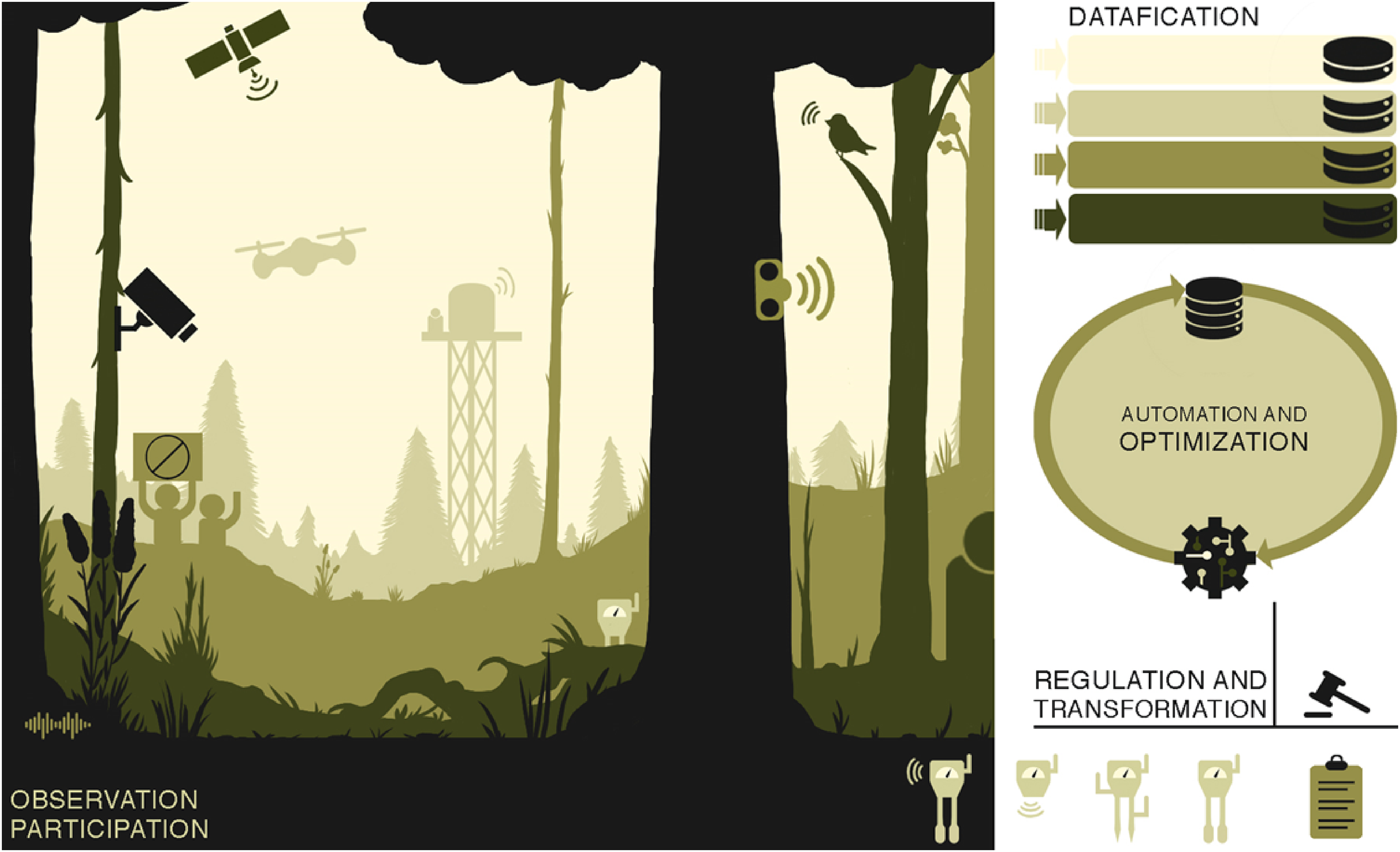
A visual rendering of the five digital operations under review. Observational technologies such as sensing practices set political worlds in motion through viewing, documenting, and analysing forest environments in distinct and often singular ways. Datafication processes parse different aspects of forest ecologies that produce computable and comparable datasets. Participatory approaches raise questions of who participates and who can resist digital technologies in forests. Techniques for automation and optimization reveal critical concerns about technocratic innovations and the marketization of forest ecologies. Lastly, digital infrastructures co-constitute the politics of regulation and transformation in which forests are reworked as policy objectives and zones of protection or ecosystem services.
Observation
On 23 July 1972, the satellite that would come to be known as Landsat was launched as part of the Earth Resources Technology Satellite (ERTS) programme. Fast-forward fifty years, and observational technologies are now central to monitoring and tackling the global environmental crisis, including within forests. Earth observation practices and technologies continue to change in scope and extent (Grainger 2017). From sensors and cameras on balloons (Wang et al. 2020), to airplanes (Schleper 2021), satellites (Kramer, 2008), and drones (Getzin et al. 2012), technologies of observation that are standard tools for military operations and humanitarian intervention are now pervasive in environmental analysis (Benson 2010). A range of state and civil society actors, including governments, academic researchers, militaries, and private organizations, monitor and manage environments with these devices. The political forests that materialize here are often aligned with the creation of economic value, management of carbon levels, and designation of conservation areas designated in response to international and national policies rather than local priorities. How would more pluralistic observation practices remake trajectories of forest action? Here, we consider the cosmopolitical transformations that such a query could activate.
Observational technologies have ontological and epistemological consequences that set political worlds in motion. Technologies of observation, from monitoring and surveillance to pattern detection, have in some cases transformed observation into practices of “remote seeing” (Shim 2014; cf. Dodge and Perkinsda 2009). Satellite observation has become more accessible through tools like Google Earth, which makes aerial views of often-remote forest regions more accessible while shaping public imagination (Purdy 2010; cf. Helmreich 2011). Such observational technologies generate distinct ways of constituting environmental information and imagination (Jasanoff and Martello 2004). Whether viewing environments from afar, fixing them into governable units of analysis, or collecting image-based evidence for policy measures (Bennett et al. 2022), digital technologies and practices constitute and sustain forests as particular kinds of governable entities.
Deforestation monitoring is a key area where observational technologies create more singular political forests focused on trees loss or gain. Forests are now monitored through global satellites at fine-grain resolution that reveal changes in near real-time. Multispectral sensors on satellites have been particularly designed for the analysis and monitoring of forests and natural resources across the globe (Boyd and Danson 2005). Data derived from remotely sensed spectral signatures can be further fused with geographic information systems to produce statistics on rates of deforestation (Achard et al. 2002, Hansen et al. 2013), inventories of forest type (White et al. 2016; McRoberts and Tomppo 2007), and information on the biophysical and biochemical properties of forests (Houborg, 2015; Im and Jensen 2008). Remote sensing and multispectral digital imaging are significant observational tools for monitoring these events. Global forest assessments such as that of the United Nations Food and Agriculture Organization (FAO 2020) employed earth-observing satellites to measure the extent of forest cover at a range of spatial and temporal scales.
These remote-sensing and aligned digital observational practices constitute forests as political entities by mobilizing technical variables that define what counts as a forest (Chazdon et al. 2016). In these digital-political operations, forests are characterized through minimum morphological characteristics and differentiation from other land uses (FAO 2020). They are not defined as cosmologies, relations, or ways of life. The ongoing observation and designation of morphological features influence how forests–and deforestation–circulate within spaces of international and domestic governance, where remote sensing is required to measure, report and validate the outcomes of forest interventions on the ground. For instance, the Warsaw Framework for REDD + requires scientific evidence for measuring, reporting, and verifying carbon emissions from deforestation and land degradation so that developing countries can access corresponding results-based payments (UNFCC n.d.). These digital-observational technologies remotely constitute and govern forests as spaces of environmental protection as designated through international and domestic policy. And yet, forests are also observation spaces for traditional landholders and agro-ecologists, hunters and subsistence dwellers (Robbins 2003). However, these observational practices often do not register in the usual configuration of political forests. Such approaches raise the question of how pluralistic observation practices could contribute to more cosmopolitical approaches to forests, not only as morphologies or entities that absorb carbon or maintain tree stock but also as social, cultural, and reciprocal relations and cosmologies of flourishing with the land (cf. de la Cadena 2010).
Observational technologies and data also inform supply-chain interventions, where the provenance and movements of commodities, as well as activities at farms and warehouses, are documented through geospatial data, which in turn informs the designation of products as not contributing to deforestation (Global Forest Watch n.d.b). However, such observation technologies have varying degrees of risks and uncertainties. Satellites and other tools can produce expert-driven but limited knowledge through powerful visual media such as maps. Yet the versions of forests that these tools mobilize can be very different from the lived experiences of forest inhabitants. Remote observation tools can produce hegemonic views of what forests are and how they should be identified and valued, while making invisible alternative understandings of forest processes (Goldstein 2019). Pluralistic forest experiences and processes, however, could be crucial for rethinking forest relations beyond an extractive calculus and toward other epistemic and ontological registers that materialize most clearly within cosmopolitical engagements with that which does not fit within a more streamlined set of observation and management practices.
Observational technologies such as Lidar also co-constitute forests as sites of carbon storage through new techniques for assessing forest biomass (Asner et al. 2012). Airborne Lidar systems transported on both satellites and drones or UAVs (Unmanned Aerial Vehicles) are now gathering unprecedented data on forest structure and extent. For instance, the US National Aeronautics and Space Administration (NASA) recently launched the Global Ecosystem Dynamics Investigation (GEDI) sensor to provide Lidar data on tropical and temperate forests. Unlike other satellite sensors, Lidar systems can scan through the forest canopy (Pourshamsi et al. 2021) to determine vegetation structure (Ni-Meister et al. 2010), map understory growth (Venier et al. 2019), and measure forest biomass (Dubayah et al. 2010). Some researchers suggest these techniques have ushered in a new era of 3D ecosystem observation (Neuenschwander and Pitts 2019). Lidar surveys are expected to monitor forest carbon data at high accuracy for informing international policies such as REDD + programs and to boost the carbon market. In Brazil, conservation funds have invested more than $15 million USD to produce high-resolution carbon maps of the Brazilian Amazon using Lidar and remote sensing, and to inform the national REDD + strategy (MMA 2017). Yet similar to the observation of forests through remote-sensing tools, the criteria for what counts as a forest, as well as details about structure, carbon capacity, and biodiversity, are ways of digitally constituting political forests as forests, which in turn can have implications for governance across situated and planetary responses to environmental change. These same definitions could align more or less readily with how human and more-than-human forest dwellers engage with the land, where an international or domestic policy designation of a forest could spur land-use practices that destroy rather than enhance forest inhabitations.
Drones have also significantly contributed to observational forest technologies. These low-cost aircraft platforms can monitor environmental variables, while contributing to digital experiments in forests. Equipped with sensors, drones flying at low altitudes can produce finer resolution spatial data that can expand ecological and environmental observations (Adams 2019). Diverse users can also use drones to undertake a range of forest monitoring activities (Zhang et al. 2016), from biodiversity monitoring and conservation (Koh and Wich 2012), to forest-fire detection (Sudhakar et al. 2020), precision forestry (Banu et al. 2016), measurements of above-ground carbon stocks, together with counter-mapping and monitoring of deforestation and community forests (Paneque-Gálvez et al. 2017; Radjawali et al. 2017). Communities might use drones to generate evidence of deforestation because these observation practices are ones that register as legitimate within spaces of environmental governance. Here, observation counter-actions attempt to enter into a singular realm of politics to make space for more cosmopolitical forest encounters that would not register as relevant within environmental governance (cf. Peluso 1995). If an “earth being” such as a forest mountain or river god does not register as significant within established political spaces (cf. de la Cadena 2010), then communities might turn to digital technologies to make their voices heard, however imperfect this socio-technical arrangement might be.
However, it is necessary to analyze how specific practices of observation change the social and political dynamics within forests. While the social and political implications of drones and other tools of observation have been well documented in conservation research (Sandbrook 2015; Shreshta and Lapeyre 2018), rapid advancements in observational technologies often outpace institutional frameworks for their regulation (Adams 2019; Sarkar and Chapman 2021). Developments in observational technologies often correspond with the militarization of conservation, which can have severe consequences for local communities while impacting the long-term viability of conservation actions (Duffy et al. 2019; Simlai and Sandbrook 2021). In some cases, communities might refuse to map or make visible their territories to evade detection, avoid revealing locations of forest resources, or sidestep problems of enforcement or illegality (Asiyanbi et al. 2019). Observational technologies can thus be detrimental to local livelihoods (Schleper 2021) because they prioritize some forest worlds and knowledges over others. A cosmopolitical approach to forests asks what other ways of observing, sensing, and monitoring forests could be generated through digitally informed forest governance to enable more pluralistic forest worlds. Such an approach works toward observation practices that accommodate multiple and cosmopolitical experiences of inhabitation, rather than a more singular register of control and territorialization (cf. Scott 1998). It also considers how observational practices of forest dwellers that often do not register as legitimate within forest science and governance can contribute to different ways of seeing and knowing forests, whether through grounded or remote experience.
Datafication
Processes of observation involve not just multiple forms of sensing and documenting forests, but also ongoing processes of datafication. Different aspects of forest ecologies are rendered into datasets, from ecological assessments to forest narratives (Goodman et al. 2016). Bowker (2000) interrogates efforts to understand biodiversity through large datasets, where only a “thin slice of species and environments” (2000: 645) can be assembled in data form, in comparison to the rich and heterogeneous worlds under study. Twenty years later, Bowker's text remains salient for assessing digital forest governance, since biodiversity science remains a “data-intense science” (2000: 1) that identifies entities and relations, while generating datafied representations, assessments, and techno-scientific insights across environmental inquiry and practice (Dempsey 2016; Devictor and Bensaude 2016). Yet how do these data practices contribute to the socio-technical formation of some political forests while reducing or omitting other non-computable forest experiences? The singularity and simplification of data practices, in other words, could reduce possibilities for more pluralistic and cosmopolitical engagements with forest worlds, even as they attempt to document and act on environmental change within the usual contexts of science, policy and markets.
Forests are increasingly explored, expanded, and located within data-oriented digital procedures. One useful starting point for tracking the emergence of digital forests is Cuff et al. (2008) discussion of “embedded networked sensing” at the James Reserve, a forested space managed by the University of California. Here, the authors identify a new moment of forest datafication. “In the last five years,” they write, “we have seen a shift in the emphasis of sensing research, with greater importance being placed on data, data processing, and mathematical and statistical models for environmental phenomena” (2008, 26). Then as now, volumes of forest data are produced “quickly” and “with no uniform format” (Zou et al. 2019: 46622; cf. Walford 2015).
Under the sway of the digital, environmental science, research, and policy have changed their methods and objects of study toward more data-intensive and data-extensive practices and outcomes (Edwards 2010). Indeed, data is seen to be the necessary precondition for understanding and acting on environmental change. Data practices actively constitute their objects of concern–and trajectories of action–often in ways that can reinforce rather than transform environmental injustices. For example, data on carbon can be prioritized over data on forest livelihoods. Species counts could be valued over data on sites of cultural significance. The political crux of datafication appears less about incompletely catalogued data, however, than the underlying sameness that subtends it: a techno-colonial conversion of forest differences into data resources that are more universally comparable and exchangeable. A cosmopolitical approach suggests less that a more universal and comprehensive engagement with datafication should occur and instead points to the specific social, political and economic stakes that influence datafication, which often work toward a singular register of how to value forests.
Datafication not only creates data through the study of forest ecologies, it also enables new associative links across forest ecosystems (Zou et al. 2019). As Nadim suggests, “the datafication of nature makes present conventionally dissociated contexts” (2021: 62). Data infrastructures allow multi-lateral and cross-scalar decision-making to emerge throughout datafied forests. According to its architects, The Amazon Tall Tower Observatory (ATTO) aims to “continuously record meteorological, chemical and biological data, such as the concentration of greenhouse gases” (n.d.). Because biodiversity loss and ecosystem change do not occur on a global scale but rather within smaller spatial units (Beck et al. 2017), questions arise regarding the location of these infrastructures, and the environments they would observe and connect. The “becoming environmental of computation” (Gabrys 2016) has political implications across sites, relations, and communities, where only some environments will be readily available to datafication, while others might not receive the material investment needed for data infrastructures. At the same time, this raises the question of what other data infrastructures are already in place for documenting and comparing forest environments, but which do not register as legitimate within spaces of “expert” forest science.
Data generated through ever more sophisticated forms of radar technologies (Zou et al. 2019), portable acoustics (Wrege et al. 2017), drones (Sandbrook 2015), and app-based cameras (Hyyppä et al. 2017) are used to characterize forest biodiversity, whether in timber stands, temperate rainforests or urban parks. These processes often take place within big data narratives that position the accumulation of data as generative of new frontiers, insights and actions (Lippert 2016; Thatcher et al. 2016). Such data practices align with governmental organizations, such as the European Environment Agency Biodiversity Data Centre, which prescribes procedures to describe, format, submit, and exchange data in particular ways that often align with national and international environmental governance objectives. Tree-stem measurements, images of foliage and canopy structure, and acoustic signals, can index ecosystem variances to ecological processes. Through the digital logics of datafication, these biodiversity indicators influence decision-making while often being constituted as resources for green capitalism (Dempsey 2016; Nost 2015). The broad institutional uptake of ecosystem services exemplifies how datafication can provide evidence to support responses to biodiversity loss, while furthering colonial forest governance (Sullivan 2013). The designation of biodiversity through datafication can reinforce unequal knowledge practices, where prevailing determinations of forest health, integrity, and productivity are to be evaluated and settled often in the interest of forests as resources (Dempsey 2016; Salk et al. 2020). A more cosmopolitical approach to datafication could suspend the extraction of value from forests, considering instead what other relations and livelihoods are left out of datafication processes, how they could generate different epistemic and ontological insights and data practices, and what other forest worlds could be taken into account when expressing environmental change as data.
Datafication's relationship to forest governance is important to grasp if we are to engage the contemporary contours of neo-colonial forest practices (Büscher 2020; Levenda and Mahmoudi 2019). ‘Indigenous data sovereignty’ movements reveal growing resistance to the surveillant, extractive, and identity-profiling procedures that routinely attend datafication, even as communities seek to manage biodiversity loss and other environmental degradations in their territories via digital technologies (Rainie et al. 2019; cf. Raval 2019; cf. Couldry and Meijas 2019). Within universities and NGOs, calls to engage with environmental data justice propose practices of transforming the collection, sharing, and use of data to respect the values and needs of diverse alliances of scientists, practitioners, and land stewards (Goldstein and Nost 2022; Longdon 2020; Sandbrook et al. 2021). New and experimental citizen sciences, involving a range of participants and entities, are also emerging as processes that work toward data justice in the context of datafication (Connors et al. 2012; Gabrys 2021; Loukissas 2016). Cosmopolitical thinking and doing raise the question of how datafication can support an “ecology of knowledges” (de Sousa Santos 2007) across Indigenous, critical, scientific, and participatory ways of knowing and being.
Participation
Digital infrastructures and devices can not only change how forest data is sensed and classified, but also transform possibilities for participation. Forest-based initiatives using mobile technologies, online platforms, Geographical Information Systems (GIS), and citizen data can differently constitute political forests by expanding the actors, networks, and practices of forest engagement. Two persistent challenges arise here. The first involves the question of who participates, and who is affected by, digital participation. Many digital technologies assume a universal user, along with prescribed trajectories of action. But digital participation–including within forest environments–involves diverse and complex contributors and contributions. The second challenge pertains to how or whether more cosmopolitical engagements can be generated through participatory digital technologies, such that dominant engagements with environments might be resisted or transformed to realize more just and pluralistic forest worlds.
In what could largely be regarded as an attempt to democratize forest governance and knowledge production, local forest communities have become involved in decision-making processes regarding the management of local forests, mapping of resources, negotiation of territories, or undertaking services for global restoration initiatives. Digital technologies can facilitate such participatory initiatives through engagements that ask people to contribute data such as documenting the location of forest activities on digital maps (Brown and Reed 2009), logging environmental changes (Pratihast et al. 2014), using mobile devices as sensors (Hill et al. 2018), reporting illegal forest activity with apps like Forest Watcher (Global Forest Watch, n.d.a), or identifying species with apps such as iNaturalist (n.d.). On the one hand, these projects add different voices to how forests are observed and imagined. On the other hand, such projects often reinforce, rather than disrupt, existing power dynamics by organizing participation in ways that reinforce the status quo (Radil and Anderson 2019). The challenge of asking “who participates” is then a cosmopolitical one of ensuring that actors who tend to already have a voice are not the primary or only digital participants. This is especially the case when such efforts do not directly confront the production of environmental injustices, but rather continue to reproduce entrenched power dynamics (Turnhout et al. 2020).
For example, one case study collecting citizen data on urban tree coverage in Philadelphia, U.S., showed that neighborhoods with a higher percentage of white residents also had higher data coverage, raising questions about whose geographies are engaged with through these initiatives and for what purposes (Foster and Dunham 2015). Such data can be partial and unrepresentative when translated into policy decisions about forests. Here, urban forests are sites of cosmopolitical considerations as much as rural forests. Resonating in a different way with the above discussion on “observation,” the forests that “count” here are the product of selective participatory efforts by often-privileged actors who can contribute to preserving and increasing property values, in contrast to less privileged urban areas. Digital technology can further complicate environmental participation when taking into account who designs these technologies, who performs precarious labor by using them to gather information and report events, and who benefits from this labor through policy changes or the (re)making of forests. Digital participation, in other words, often requires extractive infrastructures and practices that can do as much harm as good to forests and broader environments. The use of participatory digital technologies in forest environments then requires critical reflections on the structures that can (dis)empower a broad range of participants who can be differentially affected by such activities.
The question of who participates and who is affected by digital technologies can be by considering how forest technologies enable the resistance or transformation of dominant political structures. In research on smart cities and digital citizenship, Datta (2018) describes such resistance as a “breach” that challenges the power encoded in digital spaces, while enacting other forms of “smartness” that are not authorized. Examples of such forms of resistance in relation to forests include technologies that have initially been employed to centralize green economies and generate consensus among forest stakeholders, but at the same time have enabled local communities to contest one-sided spatial knowledge, highlight existing conflicts over land tenure, shape the production of forest negotiations, and even refuse to use these technologies where they could jeopardize forest livelihoods and inhabitations (Astuti and McGregor 2015). In this way, the originally planned program of use for digital technologies opens into other unanticipated forms of engagement that can challenge the initial scope of participation. This is a further example of forest politics that is neither singular nor self evident, and which requires a broader array of cosmopolitical engagements to slow down politics as usual and generate different political exchanges.
While participatory digital technologies can produce alliances between powerful actors and align citizens with state interests, local communities also organize and develop tactics to protect forests in ways that can diverge from dominant approaches to environmental governance (Forsyth 2020). Participatory networks in forest restoration such as the Xingu Seed Network in Brazil are working together with Indigenous and traditional communities to build resilience and identify alternative engagements beyond the state and outside Eurocentric approaches to forest restoration technologies (Urzedo et al. 2020). A further example in the Ekuri forest in Nigeria shows how local resistance to neoliberal conservation addresses the failing promises of REDD + initiatives and community technologies through online campaign platforms (Rainforest Rescue n.d.), which create repertoires for the struggle against dominant forms of environmental protection and governance (Asiyanbi et al. 2019). When used for resistance, participatory digital technologies can at times both affect and empower local communities in protecting their environments. The politics of participation might ordinarily focus on community engagement through monitoring and feedback to central and international policies and initiatives. But multiple other forest politics materialize through participatory practices that bring seeds, plants, soil, trees, cultivation, stories, land stewards, and other-than-expert environmental knowledge into cosmopolitical conversation.
Besides resistance tactics by local communities, alternative propositions for (re)makings of forests can be generated through digital engagements. In this sense, participation is a digital operation taken up and influenced by multiple actors and entities, where grassroots organizers deploy participatory technologies while state and extra-state actors interrupt standard participatory practices. In resisting the use of forest technologies to create profit or become legible within power structures, do-it-yourself (DIY) and hacker communities develop and share open-source software and tools that support data gathering and forest interventions. The Forest Guardian tutorial, for example, helps people create solar-run devices to detect illegal logging in forests (Mallick 2021). Such open-source remote-sensing tools avoid the need for controlled licensing and acquisition of data owned by global companies (Bhunia, Shit and Sengupta 2021). Other online platforms are broadening participation in (re)making forests by creating blockchain transactions or virtual tokens of forest entities to bypass centralized economies, which can have more or less generative effects (Howson et al. 2019; Lally 2019). Such platforms mobilize people around the world to participate in forest conservation and restoration, possibly without ever setting foot in the affected forest sites. These digital initiatives construct forests as political spaces that are often far removed from actual forests, but which remote activists and NGOs contribute to identifying and protecting (Gabrys 2021). Resistance through digital technologies can be a form of refusal and a proposal for living otherwise.
A final cosmopolitical understanding of participation in forest sites draws attention to the more-than-human entities that assemble through forest negotiations and events (Biemann 2015). These entities involve the technologies that participate in forming new political constellations in forests, and the multispecies forest communities that interrupt technological proposals by refusing to participate in human political institutions (Pritchard 2013). It is important to note here that Indigenous communities have long included more-than-human entities in environmental cosmologies and continue to emphasize the importance of a more reciprocal relationship with the land (Kimmerer 2013; Kohn 2013; Latulippe and Klenk 2020). Such projects acknowledge how humans are merely one participant among many other entities that constitute forests as political spaces. Moreover, traditional Indigenous technologies for working within forests (Levis et al. 2018) pose questions for how to decolonize and Indigenize digital technologies toward more pluralistic epistemologies and ontologies (cf. Amrute and Murillo 2020; Mohamed et al. 2020; Pritchard 2018). The values and goals of forest management can be very different across locations depending upon whether carbon targets or forest spirits primarily influence land-use decisions. Such projects acknowledge how humans are merely one participant among many other entities that constitute forests as political spaces. The point here is not to valorize Indigenous forest management over other forest practices, but instead to indicate how multiple forest worlds materialize and need to be accounted for when investigating the emergence of digital-political forests. A cosmopolitical approach attends to these multiple forests without attempting to flatten them into one realm of best practices or digital interventions for forest management.
Automation and optimization
While multiple forms of digital participation are now a feature of forest platforms and devices, an extensive set of infrastructures are developing to automate and optimize forest management and governance, whether in relation to local forestry objectives or planetary carbon targets. Participatory forest politics can be analyzed alongside automated formations of politics that often reinforce and optimize, rather than transform, forest governance and decision-making. Automation covers a wide range of streamlined, speedier, and cost-effective procedures meant to decrease dependency on human labor (Arts et al. 2015; Venturini et al. 2014). Wireless sensor networks, machine learning, airborne and terrestrial UAVs (or eco-robots) are now widely used to quantify and analyze forest ecology dynamics while responding to environmental risks and uncertain futures (Adams 2018). Automation and optimization rely on the continuous search for “efficiency”. Here, efficient forests can be understood as those that would grow quickly and homogeneously, store significant amounts of carbon and contribute to timber harvests, and not require extensive management while contributing to monetized ecosystem services. Moreover, automation techniques have recently grown in popularity as a way to digitalize environmental data collection, processing, and validation, and to inform forest conservation practices and policies (Roberge et al. 2020). Yet, how do such developments toward efficient forests devalue diverse forest environments and entities that are not readily made efficient or computable?
Automation and optimization technologies often coordinate forests as components within multiscalar global conservation networks. When implemented in forests and governance systems, automation techniques can reveal critical concerns about agency and authority, since distinct types of knowledge production and the marketization of the environment can be coded into the digital logics of automation systems. In other words, forests can be valued as carbon stores that offset the consumption of wealthy nations, and less as cosmopolitical worlds that make a plurality of contributions to forest dwellers’ ways of life. Indigenous peoples, local communities, and smallholders have historically managed forests at the local level by influencing, resisting, and transforming technocratic and top-down external interventions (Agrawal et al. 1997; Larson and Soto 2008). However, the emerging and expanding knowledge-power nexus that automation and optimization technologies put in place can reinforce and even exacerbate socio-environmental inequalities relating to the access and control of forest resources across scales. Plurality often does not readily contribute to efficiency, which often streamlines and reduces the complexity of forest worlds.
Over the last three decades, precision approaches to environmental management have involved automating land practices to maximize productivity and reduce costs in different industries and supply chains (Pierce and Nowak 1999; Wolfert et al. 2017). Precision techniques seek “a way to apply the right treatment in the right place at the right time” (Gebbers and Adamchuk 2010, 828). The transformation of environmental management through targeted and optimized tools and practices emphasizes site-specific measures to improve economic and environmental outcomes (Srinivasan 2006). Such digital techniques–often adapted from precision agriculture (Bronson and Knezevic 2016)–have transformed the forestry industry since the 2000s, where they have automated resource planning, forest management, and harvesting operations (Šumarstvo 2010; Wolfert et al. 2017). More recently, precision techniques have also influenced environmental governance systems by optimizing the practices and resources required to design, implement and monitor forest conservation initiatives in different locations worldwide (Joppa 2015). Advocates for automating and optimizing conservation and restoration methods emphasize the ability of digital tools to tackle complex environmental challenges while creating co-benefits at multiple scales (Castro et al. 2021). Forests become political through automated digital management processes that designate them as productive resources to be made even more productive. Politics here, however, is focused on streamlined and resourceful forests. A cosmopolitical approach to digital forests suggests that not all forest relations can be readily automated or optimized, and this might even lead to the refusal of precision techniques.
In a related way, Microsoft has invested $165 million USD over the last five years in social impact programs by encouraging technological development, including actions for monitoring, modeling, and managing climate and biodiversity (Microsoft, n.d.). In this context, information, finance, and infrastructure are centralized in specialized centers, hubs, labs, and big tech settings are overseen by state-corporate experts (Adams 2018; cf. Matthews 2011), while forests are designated as the resources that would deliver ecosystem services, and be managed and optimized to best fulfill these functions. Such technological systems can be crucial for sensing forest conditions. At the same time, they point to the role of typically “big tech” companies, together with select experts and state agencies, in designing and implementing what are often market-based solutions for tackling multifaceted socio-ecological problems (Lave 2015; Newell et al. 2012; Pattberg 2010). The efficiency of forests is often oriented toward and underwritten by company objectives to extract profits from forests. The formation of such political forests inevitably minimizes and devalues some forest worlds in the process of maximizing and valuing others. Although automation methods are often celebrated as groundbreaking innovations, critics show how these interventions contribute to economic logics of productivity and labor automation (Miles 2019). Asymmetric power dynamics are often deeply embedded in automation development, such as machine learning, which shapes knowledge practices aligned with emerging markets for forest conservation and restoration. The drive to automate forest environments is more than an advancement of conservation techniques. Instead, it can legitimize scientific and commercial discourses and practices that align with state and corporate interests, and implement a digitalized global environmental agenda that can be at odds with complex forest livelihoods (Karlsson et al. 2018). The digitalization of forest governance can then reflect and amplify power asymmetries and contestations through distinct political formations of forests, forest dwellers, forest institutions, and technologies.
Wildfire detection is one final area where automation and optimization technologies have developed apace, especially for sensing, reporting, forecasting, and acting on fire events (Goh 2020). Forest fires, for instance, not only can be exacerbated by environmental conditions or local land-use practices but also by multilevel political processes (Harwell 2000; Mistry et al. 2019). The recent dismantling of the Brazilian environmental agenda by the Bolsonaro government coincided with large-scale forest fire events in the Amazon, but also transferred official fire monitoring responsibilities to the Ministry of Agriculture. This has in turn led to much less advanced data being used to detect and predict forest fire events (Ennes 2021). This critical situation highlights how technological expertise can legitimate a particular political agenda for forest management. At the same time, community groups have responded to these authoritarian interventions by enhancing local institutions and protecting community territories (Dennis et al. 2005; Gibson et al. 2000). In the Brazilian Amazon, Indigenous organizations and researchers have developed a digital platform to align climate risk monitoring with territorial information collected and uploaded by Indigenous peoples through a smartphone app to report several local events, such as forest fires, which in turn can refine climate models and improve law enforcement (SOMAI, n.d.). Here, cosmopolitical forests materialize across digital infrastructures and power dynamics, as well as through local struggles and technological innovations that challenge the dominant narratives of automation and optimization.
Regulation and transformation
As automation and optimization, along with the other digital operations discussed demonstrate, the combined effect of the digitalization is to generate distinct forms of forest governance that in turn transform forest environments. In many ways, digital technologies are transforming forests toward particular regulatory objectives that attempt to address climate change and biodiversity conservation. These technologies are oriented toward forms of detection and prediction, which document where forest changes are taking place while anticipating the impact of these changes. In other words, digital technologies not only make it possible to automatically collect data more efficiently, but they also assist in data production to detect and predict future environmental conditions and events (Thayyil 2018). But how do detection and prediction constitute forest features for monitoring and change? Such a query points to the importance of a cosmopolitical approach to digital-political forests, which would work toward more pluralistic engagements with forest worlds and the technologies that would document and ultimately transform them.
One of the key ways that such detection and prediction of changing forests takes place is through artificial intelligence (AI), which is a further extension of the logics of automation and optimization. Machine learning systems, a subset of AI, describe the processes of developing linkages within extensive training datasets (Huntingford et al. 2019). Many forest platforms, including Global Forest Watch and related initiatives such as Land and Carbon Lab, rely on AI and machine learning to process satellite imagery, compose near real-time renderings of changing land use, and trigger alerts while informing policy. Although machine learning is expected to provide reliable information, emerging debates point out numerous risks driven by automatic analysis and response (Enni and Herrie 2021). For example, automated data processing often requires big datasets extracted and analyzed by experts to identify patterns of interest and transform them into a model for training algorithms (Huntingford et al. 2019). Within data mining processes, particular data and datasets are targeted and cleaned by excluding noisy or irrelevant observations (Rich and Gureckis 2019). As a result, algorithms require processes of selection that are embedded in biases and political contexts that reflect specific sociocultural values and principles, which can in turn inform the prediction of events (Dignum 2018; Pasquale 2020). Lack of accountability and insufficient transparency in machine learning approaches can result in limited operations that amplify errors and exacerbate social inequality (Caplan et al. 2018). Yet they can also clean away the “noise” of other forest worlds and relations that are crucial to forest dwellers in a multiple locations.
These algorithmic approaches have now been applied to numerous forest issues to make complex political decisions from domestic regulations to international agreements (Venturini et al. 2014). By predicting upcoming forest events, computational algorithms are expected to inform policymakers of the best technical ways to plan and prioritize resource allocation for land-use planning and biodiversity conservation (Arts et al. 2015). Through a collaboration between an environmental NGO and Microsoft, the Previsia AI platform predicts land clearing trajectories in the Brazilian Amazon to inform the specific locations where governmental agencies must centralize efforts to stop illegal deforestation (Previsia, n.d.). In the Democratic Republic of Congo, an algorithmic model developed by the World Resources Institute (WRI) anticipates deforestation trajectories that inform governments on how best to implement the national REDD + program, including the selection of priority areas to restore 8 million hectares of degraded lands (Goldman et al. 2017). However, decision-making processes could defer to computational processes that obscure the values and beneficiaries of these techniques. They can also exclude other situated forest dwellers from contributing to land-use planning, as they could be more or less well situated to contribute to or work within such algorithmic practices.
As discussed earlier in this article, wireless sensor networks in forests typically consist of small and low-cost sensor nodes and networks that allow for the collection, processing, and communication of diverse physical, chemical, biological, and environmental data (Alkhatib 2014). Data from these devices are often integrated into a cloud platform to process, visualize, and store data. This overall configuration of sensors, networks, data, and processing has been characterized as the “Internet of Trees,” in a play on the Internet of Things that can be found in many other smart environments. These near real-time datasets can be analyzed automatically through machine-learning algorithms to identify and warn of environmental risks without manual or human operations (Thayyil 2018). Algorithms are also aligned with wireless sensor networks to develop sophisticated models to detect and predict environmental events over temporal and spatial scales (Abid 2021; Torresan et al. 2021). These different sensing practices co-constitute forests and technologies, and create particular ways of valuing and tuning in to forest environments (Gabrys 2016). In turn, such practices inform regulatory processes in feedback loops that constitute forests as particular zones of protection or “services,” which further transform forests toward and through particular policy objectives. Yet sensors could emphasize distinct forest processes while overlooking others. Many people and entities are differently sensing and experiencing their environments, and in turn valuing and contributing to environmental relations (Spencer et al. 2019). Rather than imagining these practices as further data to add to ever-more compfrehensive models of forest environments, these engagements demonstrate the need for cosmopolitical engagements that would examine how sensing practices reflect and support distinct forest worlds.
In order to strengthen the social and environmental benefits of AI and digital technologies more broadly, researchers have highlighted the emergent necessity for refining the quality of quantitative datasets, including through empirical evidence (Cowls et al. 2021), adopting qualitative methods (Marda and Narayan 2021), and adding multidisciplinary perspectives (Miriyev and Kovač 2020). Beyond fixing knowledge gaps, scholars also question how autonomous decision-making processes require ethical considerations to ensure trust and understanding of cultural values and human rights (Dignum 2018). These digital transformations require working toward more pluralistic and cosmopolitical engagements with AI to challenge conventional ideas of digital development. By recognizing and including different worldviews and positing alternative relationships within nature, plural knowledge practices can remake how technologies are used to sense environments in diverse ways (de Sousa Santos 2018), and co-create alternative forest governance systems to deal with ongoing environmental challenges.
Conclusion
Digital forest technologies rework the political in political forests (Peluso and Vandergeest 2001). They are key components of forest governance in a time of global environmental change, which is now thoroughly informed by digital logics, practices, evidence, intervention, and management. We have attended to these transformations of forests under the sway of the digital. Such devices can map on to existing and sedimented state, scientific, and colonial practices of designating and managing forests. Yet they also co-constitute different political forests by identifying and monitoring carbon stores for offsetting, biodiversity treserves for staving off extinction, and commodity chains for making forests productive. A forest is designated and becomes a carbon source or sink, an erosion buffer, or a resource hotspot in relation to the variables that digital technologies would observe and act upon, for the further purposes of informing environmental governance. These are delineations and operations undertaken and facilitated through digital technologies, which can even transform what a forest is or could be. For this reason, the digitalization of forests requires questioning the political in political forests to work toward more pluralistic and cosmopolitical forest engagements.
As we have suggested here, there are varying and multiple social-political consequences of these digitalized forest environments around the world. These devices and systems can amplify existing environmental injustices and create new ones. They can be used primarily by expert and privileged actors to further entrench power inequalities. Yet it can also be possible to challenge the dominant digital logics that are now being implemented in political forests around the world by engaging with the multiplicity of forest worlds with which forest dwellers are in relation. Forests–and politics–are not singular environments or relations. Attending to the plurality of forests, forest worlds, and forest dwellers requires engaging with the actors, builders, purveyors, and users of these systems and devices to consider who is affected, who gains, who is dispossessed, and what worlds matter. In this sense, a cosmopolitical approach to forests also requires considering the environmental knowledge practices and relations that digital technologies recognize, legitimate, and reproduce. In pluralizing and reworking digital-political forests in this way, Indigenous and traditional communities, more-than-humans and technologies, ancestors and future generations could become recognized and supported as contributors to the critical work of imagining, cultivating, and caring for forests in a time of planetary change.
Footnotes
Declaration of conflicting interests
The author(s) declared no potential conflicts of interest with respect to the research, authorship, and/or publication of this article.
Funding
The author(s) disclosed receipt of the following financial support for the research, authorship, and/or publication of this article: This work was supported by the H2020 European Research Council, (grant number 866006).

Appendix 1
List of keywords used when searching for publications, projects, and policies related to digital forests.