



Abstract
In an attempt to break with both the hegemonic and cooptive nature of modernity, we set out to provide a provocative reflection on the teaching of indigenous peoples. The message of this conceptual contribution is simple: To have a future, we need to quickly learn, but also unlearn. The ‘we’ here refers first and foremost to polluter elites in the so-called Global North as well as those in the Global South who have greater access to resources and emit more carbon. The process will need to entail, learning from and with those whose lives are more aligned with the more-than-human world; and unlearn behaviours and practices that brought us to where we are: A situation where we experience the unprecedented loss of species, extractive practices depleting the natural environment, a societal meaning crisis despite being hyper-connected and yet disconnected simultaneously. What seems necessary is no less than a rapid decolonisation of harmful, unsustainable thinking and a fundamental breaking of our unsustainable lifestyles and the behaviours and practices underpinning them to move towards a caring, resonant and sustainable way of being.
Keywords
Introduction
With the dawn of modernity in the 17th century and the rapid industrialisation process, we started engaging in acts of ongoing self-destruction. Indeed, driven by the unsustainable extraction and overconsumption of resources, we are increasingly pushing beyond the planet's carrying capacities (Steffen et al., 2015). As of today, the most notable ‘improvements’ in carbon budgets in the Global North have emerged through efficiency gains and the offshoring of heavy industries to poorer countries (Hickel, 2020). Changes to green consumerism on an individual and household level where consumers switch from one ‘bad’ product to a ‘better’ product have not added to the significant progress needed that would allow us – all of us – to stay within planetary boundaries. As the UK's former top science advisor David MacKay (2008: 115) reminds us: ‘If everyone does a little, we’ll achieve only a little.’
Here, the way wealthy nations and their citizens consume provides a particular pertinent example, demonstrating the interconnections between ecological and socio-cultural systems. Not only shows it a trend towards ever greater and faster consumption of resources 1 , but also demonstrates the often one-sided, both unequal and unjust effects consumption has on some and not others (e.g., Milanovic, 2011). Indeed, the consumption of products and services is grounded in globalised extractive practices where wealthy, powerful actors extract (socio-ecological) value in one place to generate economic value elsewhere.
In our work, we situate consumption as a process that propagates ecological and cultural imbalances, thus pointing toward a different way of understanding sustainability and enacting practices that are based on relationships, context, and ancient knowledge. In so doing, we set out to address the question: How can Indigenous perspectives provide actionable insights for unlearning unsustainable (consumption) behaviours and fostering ecological and social harmony? This question anchors our exploration of the instrumentalisation of place-based knowledge and its implications for sustainability.
In our exploration, we draw on the Amazon as one of the most important regions for analysing the relationships between sustainability, consumption, and culture. Amazonian tribes have not only demonstrated for millennia that it is possible to tread lightly on our planet but are also increasingly opening up trading relationships that go beyond the Amazon in an attempt to enable sustainability-based value creation (e.g., Dias et al., 2025), potentially giving way to new processes that can either coopt sustainable attempts or drive greater awareness and behaviour change across (previously) extractive actors.
Moreover, the lived experiences contribute to this research of one of the authors, who is an Indigenous woman from the Baixo Tapajós. This region is highly connected with the socio-ecological system of the Amazon. Besides being a storehouse of the world's biodiversity, the Amazon is a critical contact zone where the external extractivist forces meet indigenous and local knowledge systems. Our work explores how place-based, indigenous knowledge systems, which continue to be eroded and deployed within and through global consumption dynamics, can provide crucial insights to people in wealthier countries about how to tread lightly on our planet.
While we will discuss the numerous ills that modernity brought with it, in our contribution, we utilise the case of consumption at times to illustrate our points. As discussed before, this seems most relevant since it provides a stark juxtaposition to Amazonian indigenous praxis and perspectives. Indigenous praxis usually represents contrasting values and approaches to resource use, sustainability, and community. That is, while indigenous practices are typically rooted in sustainability, respect for the environment, and community wellbeing (see, e.g., Albert and Kopenawa, 2022: 147; Viveiros de Castro, 2018), capitalist consumption, a key tenet of modernity's ills, is driven by profit, often resulting in resource exploitation and unsustainable practices (Albert and Kopenawa, 2022: 156). Indeed, across so-called developed and increasingly developing countries, intense, often unsustainable levels of consumption provide a major example of what is wrong and what needs urgent change.
However, that something is wrong about how we consume, should be no news. Fromm (1956: 134) already argued decades ago in his book The Sane Society that ‘[w]e consume, as we produce, without any concrete relatedness to the objects with which we deal; We live in a world of things, and our only connection with them is that we know how to manipulate or to consume them’. Building on this, businesses have started to co-opt nearly everything for commercial ends; from language to whole belief systems, concepts and practices as in the case of mindfulness and even sacred spiritual rituals (Elf and Isham, forthcoming; Elf et al., 2023), often blatantly ignoring the responsibilities they carry (Werner et al., 2024). Similarly, Byung-Chul Han (2024: 53), stresses that ‘[t]he lack of being causes an excess of production’.
In a different but related realm, Krenak (2022: 90) suggests that ‘[t]he 21st century [is] the century of neoliberalism, whose invention has only served to equip bodies and construct servitude’. Similarly again, Jose Mujica, former president of Uruguay, noted that ‘we are replacing the idea of citizen with the experience of consumer, and thus the world is now inhabited by customers – some of them preferential’ (cited in Krenak, 2022: 53).
In our work, we set out to offer a contribution by reflecting, asking questions at times, and circumscribing solutions. The scale of the crisis means, however, that we are unable to provide (easy) answers. This is partly, because they may not be discoverable and partly because answers are best co-created and implemented together. At best, we circumscribe alternatives that might allow us to manoeuvre out of the mess. Some of these alternatives already exist but too often remain on the margins.
In the process, we draw on the work of seminal Western thinkers and, in particular, the deep knowledge of povos originários (original peoples known as indigenous people) and those closely working with them. Here, we mostly use insights and knowledge from the Amazon since the Latin American and especially the Brazilian context is the one we are most familiar with. By doing so, we certainly do not wish to evoke the sensation that we dismiss the rich insights and existing literature from other traditions across the Global South and the tropics as well as other indigenous traditions (e.g., Kimmerer, 2020; Masolo, 2010; Weber, 2018: 71).
Some of the insights are more uncomfortable than others. Some hopefully give way to wider processes of reflexive conscientização (conscientisation) (Freire, 1970) that eventually (but urgently) need to lead to wider changes that transform so-called developed societies and behaviours. By nature, our attempt is imperfect and we invite others to build on, challenge and extend our reflections in a ‘sym-poietic’ (i.e., ‘making with’) manner as suggested by Donna Haraway (2016). Overall, it is a call to ‘stay with the trouble’ (ibid), to find answers together, and, eventually, to quickly move from musing to acting.
Following the introduction, we will briefly describe the mess we got ourselves into and the ills of modernity. Here, we focus particularly on the role of consumption. We then take perspective before we explore ways to move from musing to theorising, and finish by offering some concluding remarks.
The mess we got ourselves into
Our enormously productive economy … demands that we make consumption our way of life, that we convert the buying and use of goods into rituals, that we seek our spiritual satisfaction, our ego satisfaction, in consumption …. We need things consumed, burned up, worn out, replaced, and discarded at an ever-increasing rate. (Lebow, 1955: 7)
Alarmingly, some of the existing solutions have been coopted by powerful actors. For instance, the growth of monoculture tree plantations especially in the Global South shows that there is a paradox when it comes to the green economy discourses being adopted by the said actors. Though situated as potential solutions combating the climate breakdown, these plantations are better described as ‘green deserts’ that aim to maximise profits of forestry companies, according to Böhm (2024). Supported by state subsidies and international agreements as part of neo-extractivist approaches, these monoculture landscapes neglect ecological and ethical considerations, thus leading to the infiltration of non-indigenous plant species such as eucalyptus and pine, which, in turn, often result in compounding issues of water scarcity and the active threatening of local food security and livelihood of sidelined, indigenous populations including the Mapuche in Chile (Böhm, 2024).
This points to another issue; while the unsustainability of our socio-economic systems concerns all of us, it is not experienced equally. Even though most unsustainable practices are caused by consumers situated in the Global North, they affect people as well as flora and fauna in places that have – historically speaking – contributed much less to looming climate breakdown (Hickel, 2020). Here again, the case of Amazon communities offers a pertinent case, illustrating the far-reaching impacts on the ecological systems and people's livelihood in often remote areas. The broader point is supported by recent empirical evidence. For instance, the discourse surrounding Sustainable Development Goal 17 highlights the challenges of aligning global partnerships with local realities, particularly in the tropics. Stanberry and Balda (2023) argue that while SDG 17 – partnership for the goals – aims to strengthen the means of implementation, its broad and often ambiguous framework can perpetuate systemic inequalities if not critically examined. Their research reveals how governance mechanisms frequently privilege Northern agendas over the voices of the most vulnerable. This dynamic, rooted in a history of hierarchical partnerships, underscores the importance of ecological reflexivity – an approach that fosters inclusivity and accountability in addressing sustainability challenges. The tension between global objectives and localised needs calls for sustainable, egalitarian partnerships that transcend transactional relationships, embracing instead a transformative ethos rooted in equity and contextual understanding.
Moreover, people of colour and various minority ethnic groups around the globe are most affected by the rise in the planet's temperature caused by increased consumption, environmental degradation, deforestation and resource overconsumption (International Rescue Committee, 2023). These disparities in which non-White populations have suffered more acutely from the consequences of climate change are part and parcel of extractive practices that fuel modernity, illustrating what has been called ‘environmental racism’ (Ergene et al., 2024) and ‘carbon colonialism’ (Parsons, 2023).
Ironically (and sadly), populations in remote places who live in unison with their natural environment causing little or no harm to the planet, are those that are too often dehumanised, and their rich knowledge, cultures and lifestyles are marginalised. Drawing attention to the injustice of this marginalisation and devaluation, Krenak (2022) refers to these (including his very own) groups as ‘subhumanities’.
These deeply unjust and unsustainable structural factors raise the question of whether, despite the massive potential for change, such changes are possible in our kind of consumption society (Jackson, 2017: 102). There is no doubt that it is past-due for polluter elites to step back and give support to poorer countries and minority ethnic groups to achieve the minimum social foundation (see e.g., Raworth, 2022), and to deal with the unequal consequences of the climate breakdown.
But, are so-called ‘developed’ countries in the Global North prepared to make substantial lifestyle changes to drastically reduce carbon emissions while supporting countries and regions which, perhaps, need necessarily to increase their carbon emissions? And, why is it that we celebrate and constantly nurture modernity's ills while knowing that we perhaps need to ‘hospice modernity’ to free us from its ills (Machado de Oliveira, 2021)?
Indeed, in a hyper-connected world, which increasingly understands the implications of extractive practices and climate change, one might think that we have a plan. But, do we?
For instance, the support of ecomodernist leadership by countries such as Singapore also reveals a major weakness of green growth models in dealing with climate crises (e.g. Maher et al., 2024). According to Maher et al. (2024), these approaches are characterised by anthropocentric and instrumental approaches to nature, which effectively translate environmental issues as technical risks that markets and finance can manage. It is, therefore, a seductive logic given its economic rationality, as it only serves to entrench the hierarchy in which nature remains subordinated to human demands and financial goals. The Singaporean case demonstrates how ecomodernism as a governance approach uses environmental decline as a resource to promote market-based approaches to cement instead of undermining the systems that cause ecological damage. This and other paradigms counter the attempts towards achieving sustainability by embracing more holistic and contextual environmental approaches.
Hence, maybe we enslaved ourselves in the Aristotelean sense, where we are so very disconnected from others (including the more-than-human world) assuming fewer and fewer responsibilities towards others and the wider polis (Weber, 2018: 83).
Ills of modernity: On consumption and disconnection
Today, human mentality conditioned by modernity and neoliberalism, which evolved within this context (Harvey, 2007), is seemingly based on the capture, consumption and appropriation, which reproduces a colonial logic of domination. Consumption reproduces this desire for omnipotence and subjugation of nature and other human beings. Our self-inflated moral imperative to guide a wayward Earth or heal our sick planet is evidence of our immense capacity for delusion – and equally an urgent call for unlearning of our current, often unsustainable practices (cf. Freire, 1970). Unsustainable consumption practices grounded in Global North exceptionalism paired with an obsession with modernising and instrumental efficiency thus present deep-rooted structural and perhaps even cognitive challenges. As the great systems thinkers, Meadows et al. (2004: 127) observed, we are ‘[t]rying to fill real but non-material needs – for identity, community, self-esteem, challenge, love, joy – with material things is to set up an unquenchable appetite for false solutions to never-satisfied longings’.
Of course, we do not pretend that the picture is entirely bleak, and we have witnessed some improvements in recent years. For instance, over 500 policy instruments related to sustainable consumption and production reported by 63 countries between 2019 and 2023 were introduced and the number of companies publishing sustainability reports tripled since 2016 (UN, 2024). However, despite the efforts to enhance sustainable consumption and sustainable behaviours more broadly, advances have been inadequate. A symptom and simultaneous driving force, the metrics for domestic material consumption increased from 2015 to 2022 by 5.8%, the material footprint rose by 6.8%, and e-waste generation rose by 21% (UN, 2024). Reading these figures and trends, one is reminded of Eliane Brum's (2021: 45) words: ‘We are an unsustainable civilisation. We are unsustainable. How are we ever going to produce anything in equilibrium?’ In a similar vein, Mark Fisher (2012) reflected that it might be easier to imagine the end of the world than the end of capitalism.
What this comes down to in its last analysis is a profound disconnection with the world; a disconnection from others (e.g. Putnam, 1995) and from the more-than-human world (Bridle, 2022). Indeed, one might argue that the resulting lack of resonance in and with the world makes the world fall silent (Rosa, 2019), inducing a state of alienation that is increasingly becoming the norm or modus operandi of modernity. Take cities as an example. Modern cities limit rituals as a means to celebrate life (cf. Byung-Chul Han, 2020; see also Rufino, 2021: 12, 16) while, paradoxically, creating monotonous rhythms in service of capital (Lefebvre, 1992). The result is a growing alienation-as-world-relationships (Rosa, 2019); a ‘mimetic resistance’, to borrow Marc Augé's (1989) term. These are further perpetuated through manufactured needs in the form of new gadgets and stuff to nurture what Rosa (2019: 22; 404f.) calls ‘dynamic stabilisation’, a concept that describes our economies’ need to constantly accelerate 2 in an attempt to avoid crises. This, in turn, fuels materialism (Isham et al., 2022) and unsustainable consumption. However, with increasing impacts in the Global North, a rethink might emerge. As Kopenawa and Alpert (2015: 11) reflect: ‘After the ecology stories emerged in cities, our [indigenous’] words about the forest could be heard for the first time’.
Taking perspective: From modernity's ills of disconnection and alienation to resonance and indigenous ideas of buen vivir
Perspectivism calls for an active engagement with unlearning, challenging conventional, dominant Western ideas about nature, culture, and the relationship between humans and other beings (Rufino, 2021: 25). Viveiros de Castro (2018: 2), for example, challenges Western ontologies and epistemologies, which he posits as the source and origin of all colonialism. Indeed, instead of embracing different perspectives, colonialism enforces values and worldviews as well as practices. From commercial trade practices to more individualistic values and cultures that underpin today's neo-liberal forms of capitalism (e.g. Harvey, 1991; Marcuse, 1964).
This is not to say that there no attempts to break with the ills of modernity and its impact on people and planet. Indeed, pursuits to sketch out more sustainable alternatives have been suggested across Western countries. So, too, have researchers explored and circumscribed what it could mean to create an economy of wellbeing (Diener and Seligman, 2004), to abandon our growth-driven economic activities (Jackson, 2017) and to pursue low-carbon good lives (e.g. Isham et al., 2024). These do not attempt us to ‘go back to caves’ 3 . Instead, one might understand them as attempts to (re)align our lifestyles in such a way that they become more both liveable and sustainable; ways to improve sustainable wellbeing.
As a result, indigenous perspectives and concepts like buen vivir (Acosta, 2016, 2019) have enjoyed greater attention in recent years. Buen vivir (Good Living) is based on a community life linked to the territory with the establishment of horizontal relationships between humans and non-humans, between nature and spirituality, between the individual and the collective. Bem Vivir, or Sumak Kawsay is a way of life of Andean indigenous populations in Abya Ayala. ‘Sumak’ means beautiful and ‘Kawsay’ means life in Quechua (Acosta, 2016). In other words, there is a need to cultivate a good life connected with nature in a system of care for nature and others (i.e. ‘caring-with’; see, e.g., Puig de la Bellacasa, 2017). This way of life aims to bring aspects of reciprocity to the fore and represents a significant difference to the consumerist way of life based on appropriation, ownership and accumulation, which define modern understandings of what it means to succeed and to live well.
Support for this proposition comes also from Banerjee and Arjalies (2021: 10) who note that indigenous worldviews may provide a ‘deeper and more intimate way of knowing that is different from the knowledge produced in a laboratory’. Indeed, original people from across the world can make deep contributions to the debate, both about the polis and about the ideas of nature – urihi a – ecology and culture (Krenak, 2022: 89) that require holistic approaches. So far, however, Western attempts arguably (and perhaps necessarily 4 ) exclude the phenomenological value and richness – including the spiritual, animated nature of their practices – that comes through experiencing different ways of being (e.g. Bridle, 2022).
Here, an emerging body of literature has framed indigenous practices and concepts such as buen vivir as an opportunity to inform Western both practices and thinking. Notably, although these works reveal how Indigenous worldviews are based on the principles of ecological sustainability (Jessen et al., 2022), they rarely explain the political and cultural aspects of such practices. For example, most of the discourse focuses on conservation without noticing the structures that pose a threat to Indigenous people's self-determination (Garcia-Arias and Cuestas-Caza, 2024). In addition, there is a lack of discussion on how such practices are counter-hegemonic to the dominant economic paradigms insofar as they subvert the anthropocentric and extractivist logics that prioritise the accumulation of wealth by emphasising the wellbeing of people's relationships (cf. Jimenez et al., 2022). In this manner, an improved understanding of buen vivir as a decolonial – as well as sustainable consumption – framework (Jimenez et al., 2022) can counteract current discourses (Garcia-Arias and Cuestas-Caza, 2024) and inform wider attempts to become more sustainable. In this way, this approach recognises sustainability as a moral and collective project and includes other Indigenous approaches to offer a radical and liberatory framework.
So, where does that leave us? Eliane Brum's 2021 profoundly insightful book Banzeiro Òkòtó features two words that perhaps could not better describe the current crossroad humanity faces; taken from two cultural and linguistic traditions, banzeiro is what some indigenous peoples from the Amazon call the place where the river turns into a fearsome vortex, and òkòtó is the Yoruba word for a shell that spirals outward into infinity. Note that we deliberately refer to ‘humanity’ and not, for instance, ‘the planet’. Besides humanity's immense impact on the Earth as captured by terms such as the ‘Anthropocene’ (Crutzen, 2006), the planet will continue to exist for more than 7 billion years.
To understand how different indigenous perspectives are to modernity's dominant approach, one might just take the following example: For forestpeople ‘to be poor’ means to have no choice (cf. Mont et al., forthcoming). In contrast, to being rich means and ‘not needing money’ (Brum, 2021: 86). The ecosystem provides everything to not only live but to flourish. Snyder (1990: 22, as cited in Weber, 2024: 115) therefore suggests that ‘wild’ peoples are actually those that show ‘manners, and regard’ when it comes to other actors of their ecosystem. Evidence supports this. Historically, indigenous peoples have protected the biodiversity of their territories (e.g. Fernandez-Llamarzares et al., 2021). Regions with a presence of indigenous peoples have more significant biodiversity conservation (Levis et al., 2024). These ethnic groups have ancestral knowledge of caring for nature and a deep relationship with the land that nurtures them and which they nurture (e.g. Minoia and Castro-Sotomayor, 2024; Minoia et al, 2024).
Reciprocity, connection and belonging
Indigenous peoples’ ‘being “of the forest” has nothing to do with property, but with belonging’ (Brum, 2021: 91). In other words, to live well, we need to belong (see also Ryan and Deci, 2017 for extensive support from psychological research). In a similar vein, organisational scholars Banerjee and Arjalies (2021) concur that life is sustained by the very nature of our relationships with the planet. For instance, the acephalous societal settings (Weber, 2024: 17) allow members to recognise themselves as part of an intricate web of relations and exchange with all other beings (Brum, 2021: 102). That is, there are no hierarchies between human beings, animals, plants and enchanted spiritual beings. These beings are the reciprocal guardians of nature and protectors of indigenous peoples. Likewise, indigenous peoples look after and care for – and care with – these enchanted spiritual beings as a way of conserving territories. In their worldviews, there is a fundamental need to link with ancestry and spirituality for the integral protection of ecosystems and the generation of more life. In this view, ‘worthy is what creates more life’ (Weber, 2018: 31). Life and flourishing is only possible through reciprocity (Kimmerer, 2020: 15); reciprocity with the natural environment and more-than-human world that bounds us to and moves our understanding towards one of ‘commons’ and experiences and praxis towards ‘commoning’ (e.g. Bollier and Helfrich, 2019). Indeed, to understand nature (including society) as a commons is, eventually, a new way to understand ourselves (Weber, 2018: 81). A world of reciprocal Nicht-Trennung, Selbstsein-in-Verbindung 5 (Weber, 2018: 82).
However, this reciprocity stands yet again in fundamental contrast to modern consumption behaviours and conditional gift-giving practices (Mauss, 1925/2000), which are (too) often driven by utilitarian motivations. Here, Kimmerer (2020: 152f.) argues that by using materials as if they were a gift, and returning that gift through worthy use, we can find balance and generate unconditional reciprocity (see also Weber, 2024: 11; 82f.).
While, as previously argued, modernity silences our world relations, indigenous worldviews ‘are fundamentally animated and spiritual, immersed in a life force that transcends time, humans and nonhumans’ (Banerjee and Arjalies, 2021; see also Weber, 2024). Indigenous cosmologies have an intrinsic ancestral connection with nature. In this way, they don’t only feel but are part of the ecosystems in an integrated and horizontal way. Their thinking, as suggested by Andreas Weber (2024: 59), ‘is not bound to having a spirit, but to have a reciprocal relationship’. The resulting inner dimension is grounded in and flourishes through reciprocity. Summarising the thinking and perspective but also tools, Weber proposed the term and concept indigenialität – a German word that brings together the words indigenous and genius. For Weber (2024), indigenialität means ‘seeing yourself as an active part of a meaningful whole and acting in such a way that your own quality of life increases that of this whole’ (Weber, 2024: 11, our translation). It is a call to rediscover us; our nature-being (Weber, 2024: 31).
From musing and theorising towards acting
Having witnessed the atrocities that are committed on a daily basis to indigenous people and their land, Eliane Brum, a Brazilian journalist from the south of the country, aims to ‘unwhiten herself’ (Brum, 2021: 43), that is, to unlearn; to decolonise the mind and actively embrace indigenous knowledge and perspectives (Rufino, 2021: 5; Weber, 2024: 31). She argues that ‘sustainable development’ is mostly ‘a term used by those who deem it possible to climb out of the abyss without relinquishing the capitalist system that threw us into it …. A palatable discourse that allows everything to proceed as is’ (ibid, 44). The increasingly hegemonic sustainability discourse (Wissman et al., 2024) is both upheld and nurtured by those who have devoured Earth.
Move away from burning down our own home 6
Plant biologist and author Robin Wall Kimmerer (2020: 259) reminds us that ‘a place becomes a home when it sustains you, when it feeds you in body as well as spirit’. She urges us to remember that, ‘truly sustainable, is what creates more life’ (ibid), and is what ‘enlivens’ (Weber, 2018: 31). In this context, to accelerate the speed of change towards practices of ‘enlivenment’, it seems unavoidable that we need to decolonise our practices and, more widely, our mindset. A mindset that acknowledges and actively goes against the historical exaltation of the Global North and its baggage; the felt superiority and entitlement, which seemingly naturalises unsustainable lifestyles based on violence in the form of resource extractions in remote places and under often precarious conditions. A mindset that, instead, cultivates an understanding of ‘response-ability’ (Haraway, 2016: 34) when implementing solutions and new practices together while breaking down barriers and differences that currently stand in the way. It is that mindset that might move us from musing and theorising towards acting.
The Amazon is one of the best places through which to examine the relationships and the delicate balance between environmentalism and indigenous cultures. The vast array (see also Figure 1) is one of the most biodiverse areas on the planet, and plays a pivotal role in the global climate. Forest people, the Indigenous and the traditional communities of the Amazon, have lived in harmony with the forest and more-than-human beings for millennia, offering deep insights into ways of interacting with the environment that is entirely different from the extractivist approaches. For instance, the Yanomami people's techniques of planting crops in small, temporary clearings allow the forest to regenerate, ensuring long-term productivity without depleting resources (Tomioka Nilsson and Fearnside, 2011). These practices challenge the Western model of large-scale deforestation and extractive industries by emphasising stewardship, balance, and the intrinsic value of the forest, challenging consumption and production logics inherent in the Global North understanding of modernity. Instead, it champions practices that are in harmony with natural cycles and processes (not a fearsome vortex!) that can and will need to inform new but old worlds.
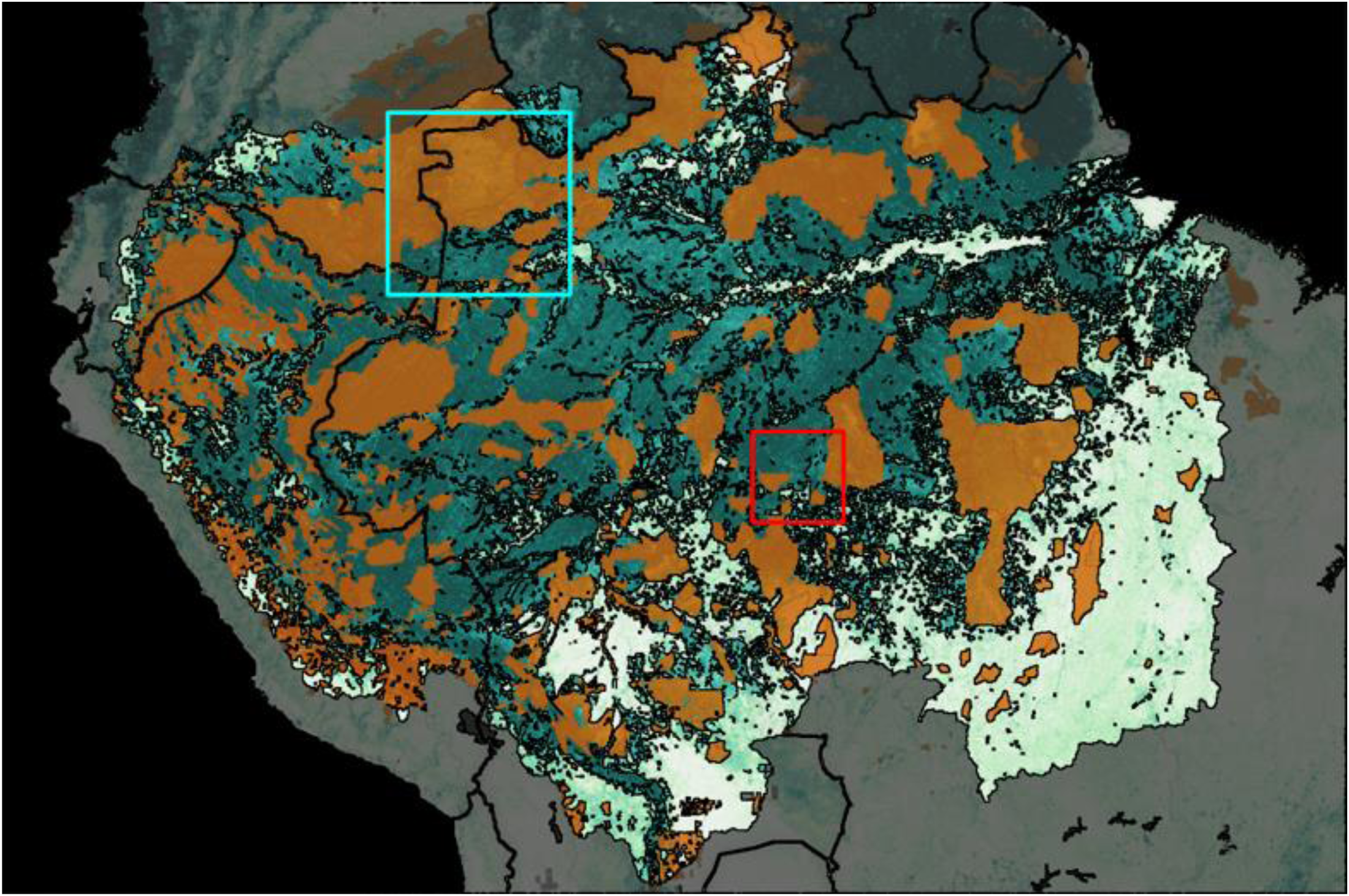
Indigenous Territories and Forest Conservation in the Amazon Basin. Original source by NASA (2023) with demarcations of Yanomami region in cyan and the Kumaruara region in red.
Will this be easy and are forestpeople willing to engage with us in ‘making-with’ practices?
Forestpeople – those who live in the forest and the forest lives within them – practice every day what Viveiros de Castro calls rexisistência, that is, ‘resistance for existence’ (Viveiros de Castro, 2018: 236). From Davi Kopenawa, Ailton Krenak, to Nobel Peace Prize nominee Raoni Metuktire in Brazil alone, hundreds of indigenous people are putting their lives on the line. However, consider a case in point: as a result of years of natural habitat degeneration and the proactive demolishing of their land, the Yanomami in Brazil refer to white people as ‘commodities people’ or ‘forest eaters’ (Brum, 2021: 10). Moreover, the word for the white, non-original peoples is napě, which corresponds to the word for ‘enemy’. This is just one example of many that indicate why it should not surprise us that winning back the trust of the forestpeople and persuading them that we are serious about sustainable change will not be easy. It will require substantial efforts of ‘making-with’ and learning from ‘subhumanities’ (Krenak, 2022).
Changing our vocabulary, changing our priorities?
As a first, immediate step, Brum (2021: 91) argues that we need to modify our language and with it the structure of thought. It is not necessarily a shift from one language to another, or a shift from one perspective to another. Echoing the sentiment of Eduardo Viveiro de Castro's perspectivism, she argues that ‘[t]o honour the world, we need all languages’ (Brum, 2021: 27). Here, Brum (2021: 44) makes an interesting suggestion: We need to ‘amazonise’ ouselves. For Eliane Brum, to amazonise means to engage in a perspective and action that goes beyond the forest. Amazonising stresses the need to decolonise our thinking and provides a counterpoint to Global North techno-optimism. It is a ‘return to being, and to being a part – rather than being apart’ (ibid: 44). Brum (2021) points out the need of re-placing the Amazon and other enclaves of nature at the geopolitical centres of the human world on the planet. To amazonise is both an active and a reflective verb that demands a shifting of geopolitical centres and also a transformation in the very structure of thought.
Notably, and again highlighting the importance and power of language, this vocabulary stands in contrast to even sympathetic concepts such as Kenneth Boulding's (1966) ‘spaceship earth’ analogy. While bringing the discourse of sustainability to the ‘West’, Boulding's Hollywood analogies of cowboys and astronauts demonstrates yet again a stark Western centricity, which in its ultimate analysis ‘subjugates the planet as Other’ (Brum, 2021: 187). Hence, adapting and applying a new vocabulary might allow us to focus our attention, nurture reciprocity and support our attempts to act.
Eventually, it might even help us to unmute our modern world relations. For instance, German sociologist Hartmut Rosa (2015, 2019) convincingly argues that we need to (re)build resonance with the world (i.e., resonance-as-world-relation). According to Rosa (2015), to achieve this we need to deaccelerate our lives, and make space for thought and connection; to contemplate and reflect. It entails raising consciousness to and with others in order to break with modernity's alienating ills and create resonant spaced which give way to engaging with others and their perspectives.
In a Global North context, citizen assemblies have shown promising results (see, e.g., Cherry et al., 2021) offering opportunities to reclaim collective power to address key socio-ecological issues while raising consciousness through perspective-taking. Similar experiments to bring different people and different perspectives together are needed. In time, perhaps we might even engage in experiments that can find ways that make us understand consumption practices as caring practice. Not caring for the consumer but for and with people and planet. Caring for what provides us with life (e.g., healthy soil), and for those that work the land. It might provide opportunities of ‘encountering the other’, that is, again, those that produce and provide. To make it meaningful, it requires a connection and a deep contemplation about what it means to receive (and to give), which, similar to indigenous practices, involves a practice of care that enlivens.
In stark contrast to consumer capitalism, which prioritises unchecked resource extraction and perpetual growth, Amazonian indigenous praxis offers a model of life rooted in reciprocity and balance with the more-than-human world. For Amazonian indigenous communities, such as the Kumaruara and Yanomami, the forest is not a mere resource but a living entity to whom respect and care are owed. The Kumaruara from the Tapajós region in Para, Brazil, like many others in the Amazon, operate within a framework where the forest's health is integral to their own wellbeing; this relationship is not transactional but interdependent. Where consumer capitalism feeds on the insatiable desire for more, the Kumaruara view abundance not as the accumulation of goods but as a state of harmony and sufficiency sustained through ecological stewardship and collective care. By integrating practices like controlled foraging, rituals that honour the spirits of the land, and rotational farming that preserves soil health, they avoid depleting resources, thereby sustaining a viable ecosystem for future generations.
Our argument here is aimed at those who, steeped in the tenets of neoliberal capitalism, may view sustainability through the lens of productivity metrics and market-driven solutions. Yet, such perspectives often bypass the foundational understanding that Amazonian indigenous praxis embodies: The interrelation between all living beings. Unlike the neoliberal paradigm that commodifies nature, Amazonian cultures engage in practices of ‘commoning’ (see also Bollier and Helfrich, 2019) – creating a shared space where the forest, animals, and rivers are treated as co-inhabitants. This is evident in the rituals of, for instance, the Yanomami, who, in their interactions with the forest, acknowledge it as both provider and kin. Their practices reflect a worldview where nature's gifts are met with acts of reciprocity, such as offerings or refraining from overextraction, aligning human activities with the forest's natural cycles rather than imposing external demands upon it.
Moreover, while neoliberalism promotes individual ownership and accumulation as markers of success, Amazonian communities emphasise a collective ethos. Among the Ashaninka, an indigenous group of people who live in the Amazon rainforests of Peru and Brazil, for example, knowledge and resources are communally shared, with each individual contributing to and drawing from the collective wellbeing. This way of life, grounded in an intricate web of social and ecological relationships, not only sustains the community but also counters the alienation and hyper-individualism endemic to capitalist societies. Where modernity's capitalist frameworks create isolation through consumer identities, the Ashaninka foster a sense of belonging and purpose through practices like communal harvests, storytelling, and rituals that strengthen communal bonds and a shared identity rooted in the land.
In suggesting that we look toward Amazonian indigenous knowledge, we are not advocating for a simplistic adoption of their ways of living per se, but are rather urging a re-evaluation of how we conceptualise our relationship to the Earth. Amazonian praxis challenges us to move away from a consumer model of extraction and excess and to reframe sustainability as a reciprocal act that respects the Earth's limits. It is a call to learn from, not colonise, their wisdom – an invitation to engage in practices that honour mutual flourishing. Such an approach, rooted in interdependence rather than domination, offers a critical perspective on how we might dismantle the capitalist fixation on endless consumption and instead nurture practices that cultivate life in its fullest sense.
Paying attention to indigenous teaching acknowledges that economically powerful countries have something to learn from cultural ontologies and epistemologies other than their own. Instead of enacting an inside-out xenophobia that converts indigenous, or ‘original’ peoples into native foreigners (Brum, 2021: 183), we need to embrace their knowledge.
Concluding remarks: Towards ancestral futures
We are (almost) all complicit in the wicked situation we find ourselves in. This holds especially true for people from the Global North and other polluter elites, including those in the Global South. As Kimmerer (2020: 307) argues, ‘we've allowed the “market” to define what we value so that the redefined common good seems to depend on profligate lifestyles that enrich the sellers while impoverishing the soul and the earth.’ Despite a growing awareness of the consequences of unsustainable practices, we remain trapped in counterproductive habits, reinforcing cycles of consumption and environmental degradation. Our relationship to the Earth and the more-than-human world has become increasingly muted (Rosa, 2019), yet Indigenous teachings offer a pathway to unlearning these destructive patterns.
In a world marked by overconsumption and climate breakdown, Indigenous worldviews provide not only wisdom but also actionable frameworks for sustainability. Amazonian Indigenous praxis presents an alternative to the dominant extractivist logic by emphasising reciprocity, balance, and interdependence with the natural world. This challenges mainstream sustainability discourse, which too often relies on market-based solutions that fail to address root causes. As Latour (2012: 452) suggests, ‘a progressive return to ancient cosmologies and their concerns’ is not unfounded but rather an urgent necessity. The preparation and action required must focus on finding, accepting, and fulfilling our place in this world in unison with others – just as Indigenous peoples and more-than-humans have done for centuries.
However, meaningful change is unlikely to be led by policymakers alone, as governance measures continue to lag behind the pace of environmental decline. Instead, it will likely emerge from a groundswell of bottom-up, grassroots participatory initiatives that connect people and more-than-humans in a shared effort to create sustainable futures. By shifting our understanding of sustainability from an economic metric to a moral and collective responsibility, we can establish a more reliable foundation for action – one that transcends fleeting consumerist distractions and instead fosters long-term ecological resilience.
This study highlights the importance of incorporating (vs appropriating!) land and place-based knowledge systems into the global sustainability agenda, that is, knowledge that requires an engagement with the pedagogies created by that place; the experiences, problems, languages and histories these communities rely upon to construct a narrative of collective identity (Johnson, 2012). Theoretically, it challenges hegemonic discourse by offering Indigenous perspectives that prioritise harmony over exploitation, relationality over resource extraction, and community well-being over individual accumulation. From a practical standpoint, it underscores the necessity of including forest peoples in environmental governance and climate adaptation efforts. Without their leadership, sustainability policies risk remaining extractive, perpetuating the very inequalities they aim to resolve. Indeed, Approaches and frameworks that fail to acknowledge the deeply situated, land and place-based knowledge that defines indigenous worldviews risk instrumentalising indigeneity as a means to alleviate environmental and social issues created by modernity. This form of governance, although couched in the language of inclusion, can perpetuate structures of domination by casting indigeneity in a role that supports global governance rather than community self-determination. Thus, as we draw upon indigenous knowledge, we must be vigilant in ensuring our engagement does not replicate these extractive tendencies, instead fostering genuine co-creation and reciprocity.
In striving to avoid the romanticisation of Indigenous approaches, we acknowledge the warnings of Chandler and Reid (2019, 2020), who caution against the re-colonisation of Indigenous knowledge by Western governance frameworks. In their work, they challenge the speculative application of Indigeneity as a conceptual tool, arguing that such an approach risks appropriating and reifying Indigenous knowledge rather than engaging with its material and political struggles (ibid). They caution that framing Indigeneity as a speculative alternative to modernity, rather than as a lived reality shaped by colonial legacies and contemporary struggles, can lead to its instrumentalisation by privileged, for instance, academic and governmental imaginaries. Their argument suggests that instead of treating Indigeneity as a theoretical horizon, a more situated engagement is necessary – one that recognises the political agency of Indigenous communities rather than just their ontological difference. Chandler and Reid's (2020) distinction between modernity and Indigenous practices, does not merely propose an epistemological shift but demands a reconfiguration of political relations, underscoring the urgency of addressing colonial continuities and avoiding the romanticised abstraction of Indigenous worldviews as a resource for Western theoretical innovation.
While not central to our argument, we agree that efforts to ‘become Indigenous’ in response to the Anthropocene, risk appropriating Indigenous wisdom while failing to uphold Indigenous autonomy and sovereignty. Moreover, their critique is relevant; especially since we emphasise the need to ‘unlearn’ unsustainable behaviours and the importance of local, place-based approaches that put people and the respective environment first. In this sense, we concur that if sustainable initiatives are to be truly transformative, they must be based on genuine co-creation and reciprocity, not the instrumentalisation or cooptation of Indigenous practices to sustain the very systems that have caused the crisis.
Here, policymakers, for example, must recognise that sustainability cannot be achieved through tokenistic inclusion or market-driven conservation alone. Therefore, policies must be just, community-led, and contextually grounded, integrating land and place-based and, where possible, Indigenous knowledge not as an accessory but as a central pillar of decision-making. This means moving beyond Western-centric definitions of progress and embracing Indigenous frameworks, such as buen vivir, that advocate for co-existence rather than domination. The integration of local and global approaches, blending seminal Western and Indigenous insights, offers a crucial step toward redefining sustainability as a process that engages diverse stakeholders meaningfully.
Ultimately, sustainability requires disconnecting from what disconnects us – unlearning behaviours that push us beyond planetary boundaries and away from one another and the more-than-human world. This process will not be easy, as modernity's structures impose hegemonic dynamics that sustain consumer capitalism at the expense of ecological and social health (Machado de Oliveira, 2021). Yet, as Arendt (2005: 189) reminds us, ‘Loving the world means finding the courage to protect it.’ By centring the Amazon and other ecological enclaves in global politics, we might begin to amazonise ourselves – shifting our structures of thought, as Brum (2021: 329) suggests, and embracing what Bollier and Helfrich (2019) call ‘OntoShift’: a transformation in our fundamental ways of being.
The challenge is great, but so is the opportunity. Local impact, global thinking, is what is desperately required; a mindset that is so apparent in the careful treading of peoples yet so absent in consumer cultures. And, why not try? What do we have to lose?
As an apocryphal quote often attributed to Ilya Prigogine states: ‘When a complex system is far from equilibrium, small islands of coherence in a sea of chaos have the capacity to shift the entire system to a higher order’. We now must recognise and cherish the margins as what they are: Centres of resistance against all forms of death and for the creation of possible lives (Brum, 2021: 330). By doing so, we can create desirable futures – together.
Indigenous stewardship, and reciprocal economies of care – And where better to begin than with those who have long practiced what it means to walk lightly on the Earth? If we are to move toward what Krenak (2022) calls futuro ancestral, we must listen, learn and unlearn, and act – not as passive observers, but as active participants in the regeneration of our world.
Footnotes
Declaration of conflicting interests
The authors declared no potential conflicts of interest with respect to the research, authorship, and/or publication of this article.
Funding
The authors received no financial support for the research, authorship, and/or publication of this article.
