




Abstract
This study examines the effect of victimization and religious affiliation on support for a policy banning the open grazing of livestock in the northern Nigerian state of Kaduna. This policy, which aims to reduce the incidence of conflicts between nomadic herders and sedentary farmers, has been implemented to varying degrees in some states across Nigeria. Kaduna is a suitable case study for investigating these relationships because, despite having the third-highest incidence of farmer–herder conflicts out of Nigeria’s 36 states, the state government has not implemented an open grazing ban policy there. The regression results show that victimization by herders increases the likelihood of supporting the policy. On average, Muslims are more supportive of the policy than Christians. The higher support among Muslims is quite surprising because most of the respondents who have been victimized by herders are Christians. Muslims might be more supportive of an open grazing ban policy due to a contagion effect: the common religion of Islam that they share with nomadic herders could lead to the attribution of blame for farmer–herder conflicts to Muslims, making them more eager to see an end to the conflict. This eagerness might be what leads to increased support for an open grazing ban policy.
JEL Codes: D74, N57, Z12
Keywords
1. Introduction
Violent clashes between nomadic herders and sedentary farmers over land and water resources have exacerbated ethnic and religious polarization in Nigeria (Ejiofor, 2023; Griswold, 2018; Onwuzuruigbo, 2023; Tuki, 2024c). Even before these conflicts turned violent around 2009, Nigeria was already ethnically and religiously divided (Coleman, 1958, p. 351; Laitin, 1982; Obilom & Thacher, 2008; Ukiwo, 2003). Although these conflicts are spread across Nigeria’s 36 states, they are concentrated in the country’s Middlebelt Region (especially in the southern part of Kaduna State and the states of Benue and Plateau), where the resident population is predominantly Christian. 1 The conflict is often viewed through a religious lens because nomadic herders belong to the Fulani ethnic group and are Muslims (Christian Association of Nigeria, 2018; Parsons, 2023). Moreover, religious affiliation in Nigeria has been found to shape how individuals experience farmer–herder conflicts and the interpretations they ascribe to these experiences (Higazi, 2016; Schaub, 2014; Tuki, 2024c).
To address farmer–herder conflicts, the Nigerian federal government proposed a Grazing Reserve Bill in 2016, which sought to establish grazing reserves in all of Nigeria’s 36 states; in these reserves, nomadic Fulani herders would reside with their livestock. The bill, which was eventually abandoned, was vehemently opposed by the state governors in the Middlebelt and Southern Regions. Similar policies—like the establishment of cattle colonies, Rural Grazing Areas (RUGA), and the National Livestock Transformation Plan—have also been met with stiff resistance in these Regions (Babajide, 2023; Ejiofor, 2023; Ele, 2020; Nnodim & Alagbe, 2021; Olumba, 2022). These proposals, though well intentioned, have failed because they are perceived as land-grabbing attempts by the Nigerian government in favor of the Fulani and as a move toward ethnic domination and the Islamization of Nigeria (Chukwuma, 2020; Ejiofor, 2022, 2023; Ele, 2020; Nwankwo, 2016, 2024a; Onwuzuruigbo, 2023; Tauna, 2019). The skepticism toward these policies was exacerbated by the fact that the Nigerian President at that time, Muhammadu Buhari, was a Muslim and belonged to the Fulani ethnic group. 2 In fact, Onwuzuruigbo (2023, p. 15) asserted that “Fulani pastoralists are tacitly supported by the Fulani-dominated federal government.”Ejiofor (2023, p. 13) has highlighted the close association between land and ethnic identity in Nigeria: “Ethnic groups in Nigeria prefer to engage in unending conflicts than lose ancestral lands tied to their ethnic and cultural identities.”
In response to these “bad” policies, some state governors in the Middlebelt and Southern Regions passed legislation banning the open grazing of livestock. The state of Benue, which has the second highest incidence of farmer–herder conflicts, was the first to pass such a law in 2017 (Godwin, 2017; Kwaja & Ademola-Adelehen, 2017). 3 The law criminalizes the free movement of livestock, mandates the adoption of ranching methods, and imposes penalties for infractions (Balarabe, 2021). Different requirements apply to indigenous peoples and non-indigenous peoples for the establishment of a ranch in Benue. To lease land for ranching purposes, non-indigenous peoples must gain approval from the landowner, the landowner’s family and kindred head, community leaders, the chairman of the local government area (LGA) (i.e., municipality) where the land is located, and the state governor. Only when these authorities grant approval can a non-indigenous person set up a ranch. The lease, which cannot exceed 1 year, is subject to renewal. These requirements do not apply to the indigenous peoples of Benue state (Balarabe, 2021; Kwaja & Ademola-Adelehen, 2017; Onwuzuruigbo, 2023). Commenting on the discriminatory nature of the open grazing ban legislation, Onwuzuruigbo (2023, p. 365) observed: “It would appear that the hidden intention of the Benue State anti-grazing law is to remind the Fulani of their status as non-indigenes.”
Given that the law only applies to nomadic Fulani herders, coupled with the fact that they already constitute a minority in Nigeria’s Middlebelt and the Southern regions, they perceive the law as discriminatory and as a violation of their right to free movement within Nigeria. This right is enshrined in Nigeria’s 1999 constitution. Balarabe (2021) faulted the open grazing ban policy because it portrayed nomadic herding merely as an occupation and completely ignored the fact that the centuries-long practice is an integral part of Fulani culture and identity. Conversely, the Benue state government contends that the open grazing ban policy only restricts the movement of livestock, not people (Abah, 2017). The government also argues that the open grazing ban policy is a necessary intervention to reduce farmer–herder conflicts, protect the lives and property of the population, and encourage the adoption of modern ranching methods among herders (Mac-Leva & Emmanuel, 2020; Odunsi, 2021; Silas, 2017, 2021; Ugwu, 2022). Besides the State of Benue, some other states in Southern Nigeria like Ondo, Oyo, Delta, and Anambra among others have also passed open grazing ban legislations; although enforcement appears to be a challenge (Adedipe et al., 2022; Adegun, 2021; Olafusi, 2021).
But what are the attitudes of ordinary Nigerians toward an open grazing ban policy? Do religious patterns underlie these attitudes? How does the concrete experience of violence (i.e., victimization) influence support for an open grazing ban policy? Relying on novel survey data collected from the northern Nigerian state of Kaduna as part of the Transnational Perspectives on Migration and Integration (TRANSMIT) research project, as well as the theory of intergroup relations, this study seeks to answer these questions. 4 Kaduna is a suitable case study for investigating these relationships because, despite having the third-highest incidence of farmer–herder conflicts out of Nigeria’s 36 states, such a law has not been passed there by the state government. Furthermore, mirroring Nigeria, Kaduna’s population is almost evenly split between Christians and Muslims, with the latter group being slightly more numerous. The predominantly Muslim northern part of Kaduna was under emirate rule during the precolonial period (i.e., the Zaria Emirate). Conversely, the Southern part of Kaduna which has a predominantly Christian population, though subject to slave raids, was an indigenous territory that was never captured by Muslim jihadists. Kaduna has a history of religiously motivated conflicts between Christians and Muslims (Angerbrandt, 2011, 2018; Scacco & Warren, 2021).
Although some studies have examined the effect of the open grazing ban legislation on farmer–herder conflicts in Nigeria, they mostly employ qualitative methods and rely on secondary information (e.g., Balarabe, 2021; Ejiofor, 2022, 2023; Nwankwo, 2024a, 2024b; Onwuzuruigbo, 2023; Vanger & Nwosu, 2020). The originality of this study lies in the novel large-N survey data employed in the analysis, the quantification of support for an open grazing ban policy, and the use of econometric techniques. Moreover, unlike previous quantitative studies on conflict in Nigeria that use data from the Armed Conflict Location and Events Database (ACLED) (Raleigh et al., 2010) to construct a measure of conflict exposure (e.g., George et al., 2022; Odozi & Oyelere, 2019; Tuki, 2023b), this study focuses primarily on the concrete experience of violence (i.e., victimization) by the respondents and their family members. I only use the conflict exposure variable derived from ACLED as a control variable. Besides examining the heterogeneous effects of victimization on support for an open grazing ban policy among members of Nigeria’s two major religious groups (i.e., Christians and Muslims), I also examine how support for an open grazing ban policy varies among respondents depending on who the perpetrator of violence is (e.g., herders, robbers/bandits, and religious extremists).
This study finds that general victimization—that is, irrespective of the perpetrator—has no effect on support for an open grazing ban policy in Kaduna. The null effect persists even when I disaggregate the data based on religious affiliation and estimate models using the Christian and Muslim subsamples of respondents. This might be because an open grazing ban policy is related to a specific kind of violence—that is, that involving nomadic herders. However, when I focus specifically on victimization by herders, I find that it has a robust positive effect on support for an open grazing ban policy. The regression results also show that Muslim affiliation is positively correlated with support for an open grazing ban policy. This suggests that, on average (i.e., irrespective of victimization status), Muslims are more supportive of an open grazing ban policy than Christians. This might be due to a contagion effect: Blame for farmer–herder conflicts might be partly attributed to the larger Muslim population due to their shared religion of Islam with nomadic herders. The conflation of both groups might pressure Muslims to dissociate themselves from nomadic herders and make them more eager to see an end to farmer–herder conflicts. This eagerness might be what translates into increased support for an open grazing ban policy.
The rest of this study is organized as follows: Section 2 discusses some theoretical considerations and states the hypotheses. Section 3 describes the sampling strategy, operationalizes the variables used to estimate the regression model, and specifies the model’s general form. Section 4 presents and discusses the regression results, while Section 5 summarizes the paper and concludes.
2. Theoretical considerations
2.1. Violence and support for an open grazing ban policy
There is a robust literature showing that violent conflicts negatively impact human well-being. In a study conducted in Ghana, Otu et al. (2024) found that farmer–herder conflicts caused a decline in farmers’ agricultural output and a reduction in pastoralists’ herd sizes. Analyzing survey data from war-torn Tigray in Ethiopia, Weldegiargis et al. (2023) found that three-fourths of households were food insecure; they had resorted to eating smaller meal portions, had eaten food they did not want to eat, and, in some instances, had gone without food. They pointed out that the armed conflict had caused food insecurity by destroying food systems, disrupting access to markets, increasing food prices, and reducing farming populations. Béné et al. (2024) conducted a study in Burkina Faso, finding that armed conflict had led to a contraction in local food traders’ activities by about 50% and negatively impacted the local food system. Some studies have focused specifically on the Nigerian case: Using the General Household Survey (GHS) data for Nigeria, Odozi and Oyelere (2021) found that exposure to violent conflicts led to a decline in the number of hours that households devote to agriculture. The negative effect was particularly strong among household heads. They pointed out that this could lead to a reduction in agricultural output and income, especially when these hours were not diverted to non-farm productive activities. Likewise, George et al. (2020) utilized the GHS survey data to show that exposure to violent attacks perpetrated by the radical Islamist group Boko Haram prompted households to depend on less preferred foods, limit the variety of foods eaten, and reduce the portion size of meals consumed. Nnaji et al. (2022) conducted a study among rural households in Nigeria and found that both the incidence and intensity of farmer–herder conflicts increased the risk of food insecurity.
Violent conflicts have also been found to cause psychological distress. For instance, Thabet et al. (2013) conducted a study among 374 Palestinian adults aged 22–64 years who had been exposed to war trauma. Death anxiety was pronounced among the respondents, and 66% of them had been diagnosed with PTSD. War exposure has also been found to cause PTSD among Palestinian children and adolescents residing in the Gaza Strip (El-Khodary & Samara, 2018; Manzanero et al., 2021; Thabet et al., 2011) and among nursing staff working there (Shamia et al., 2015). In a study conducted in the war-affected districts of Northern Ethiopia, Tadese et al. (2022) found that 75% of the population reported experiencing stress. Some studies have focused specifically on the Nigerian case. Analyzing survey data collected from northeastern Nigeria, Ajefu and Sonne (2022) found a positive correlation between exposure to Boko Haram attacks and depressive symptoms among household heads. Their regression model also showed that food insecurity, unemployment, illness, and injury were pathways through which violence led to depression. Tuki (2024b) conducted a study in the northern Nigerian state of Kaduna and found that exposure to violent conflicts increased individuals’ likelihood of having a negative economic outlook. He observed that this was due to the disruption of socioeconomic activities and the psychological distress caused by conflict, both of which can reduce people’s optimism about the future.
In a state like Kaduna, where most households rely on crop agriculture for their sustenance (Kaduna State Bureau of Statistics, 2016), individuals who have been victimized by herders might be more eager to see some concrete policy action from the government geared toward resolving farmer–herder conflicts. Such policies could include an open grazing ban. The discussion so far leads to the first hypothesis that this study seeks to test:
2.2. Religion and support for an open grazing ban policy
According to DiDonato et al. (2011, p. 66), ingroup favoritism is “the perception of ingroups as having more desirable attributes than outgroups.” Ingroup members usually have similar characteristics, which may be phenotypical (e.g., race) or cultural (e.g., language and religion). Recognizing the difficulty in defining an ingroup, Allport (1954, p. 31) observed: “Perhaps the best that can be done is to say that members of an in-group all use the term we with the same essential significance.” He also noted that even though the existence of an ingroup logically implied the existence of an outgroup, ingroup membership did not necessarily imply hostility or negative attitudes toward outgroup members. Brewer (1999, p. 30) concurred with Allport: “Indeed, ingroup love can be compatible with a range of attitudes toward corresponding outgroups, including mild positivity, indifference, disdain, or hatred.” However, she also pointed out that ingroup favoritism could serve as a platform for outgroup hate, especially when one group perceives the other as a threat: “Whether actual or imagined, the perception that an outgroup constitutes a threat to ingroup interests or survival creates a circumstance in which identification and interdependence with the ingroup is directly associated with fear and hostility toward the threatening outgroup and vice versa” (Brewer, 1999, pp. 435–436).
Some studies have shown that people are generally inclined to treat members of their religious group preferentially. For example, in an experimental study conducted among undergraduate Jewish–Israeli students, Halabi et al. (2015, p. 104) found that “participants attributed less blame and recommended less severe punishment for an ingroup [a Jew] than an outgroup member [an Arab] for the same event.” In another experimental study conducted in the United States, Hawkins and Nosek (2012) found that Christian participants contributed more money to religious charities than to non-religious ones. Analyzing data from the 2018 American General Social Survey, Speed and Brewster (2021) found that Christians exhibited a high level of ingroup favoritism and showed dislike for atheists. By contrast, atheists gave Christians similar favorability ratings as they rated their fellow atheist ingroup members. Galen et al. (2011) conducted a study in which they found that individuals who were high in religious fundamentalism rated religious individuals more favorably than those who were non-religious, leading them to conclude that, “Those who are high on religious fundamentalism prefer to affiliate with the target more when he is religious, whereas those low on fundamentalism do not show a religious social preference” (Galen et al., 2011, p. 2137). Evidence of favoritism toward religious ingroup members has also been found among Baptists, Catholics, Methodists, and Jews in the United States (Dunkel & Dutton, 2016), among Protestants in Ireland (Cairns et al., 2006), and among Muslims in China (Xia et al., 2021).
In the state of Kaduna, ingroup favoritism is particularly salient in the political domain, as individuals tend to vote based on their ethnoreligious affiliation and not on the capability of political candidates (Human Rights Watch, 2011; Ostien, 2012). This could be tied to Brewer’s observation that “When groups are political entities, however, these processes [i.e., intergroup conflicts] may be exacerbated through deliberate manipulation by group leaders in the interests of mobilizing collective action to secure or maintain political power” (Brewer, 1999, p. 437). For instance, in 2023, a video of Kaduna’s former governor, Nasir El-Rufai, emerged. In the video, he openly admitted that he had given preferential treatment to districts with mainly Muslim populations in the allocation of resources because they had voted for him during the elections, unlike the districts with predominantly Christian populations. Besides mentioning that religion was an important factor for him when making employment decisions, he boasted that he had ensured that only Muslims occupied key positions in his government, such as the deputy governor, minister of finance, secretary to the state government, and chief of staff. His remarks sparked outrage among Christians in the state, and reignited concerns about Muslim dominance in the political sphere (ACN International, 2023; Sahara TV, 2023; Shiklam, 2023).
Given this background, the Muslim population and nomadic Fulani herders are widely perceived as members of the same ingroup due to their shared religion of Islam. Nigerian herders have generally been critical of an open grazing ban policy, referring to it as discriminatory (Balarabe, 2021; Okon, 2021; Oyewale, 2020). The predominance of Muslims in Kaduna State politics may partly explain why the government has not proposed an open grazing ban policy, despite the high incidence of farmer–herder conflicts in the state. If cultural similarity does indeed lead to ingroup favoritism, then Muslims might, in solidarity with nomadic herders, oppose the implementation of an open grazing ban policy. Another reason why Muslims might be less supportive of an open grazing ban policy (or why Christians might be more supportive of the policy than Muslims) is that the conflicts are concentrated in Southern Kaduna, where the population is predominantly Christian (see Figures 2 and 3). This is congruent with the argument advanced by Tuki (2023a) that farmer–herder conflicts are more likely to occur in municipalities with predominantly Christian populations than in those where Muslims are predominant. He pointed out that this was because the common religion of Islam, which is shared by the nomadic herders and the Muslim sedentary population made it easier for both parties to peacefully resolve disputes over land and water resources. For instance, they could appeal to a religious authority that they both respected—for example, an imam. By contrast, disputes over resources between nomadic herders and the Christian sedentary population were likely to turn violent due to the religious differences between the two parties. The concentration of conflicts in Christian territory might make Christians more eager to see some concrete policy action from the government geared towards ending farmer–herder conflicts, leading to increased support for an open grazing ban policy. This leads to the second hypothesis that this study seeks to test:
However, the reverse is also possible—that is, Muslims may be more supportive of an open grazing ban policy than Christians. There is a body of literature highlighting the tendency among ingroup members to attribute the objectionable qualities of a few deviant outgroup members to the entire outgroup. This could be tied to the concept of scapegoating, which Stephan (1983, p. 42) defined as “a process by which other individuals or groups are held to be the cause of one’s own problems.” According to Allport (1943, p. 11), scapegoating is “a phenomenon wherein some of the aggressive energies of a person or group are focused upon another individual, group, or object; the amount of aggression and blame being either partly or wholly unwarranted.” He noted that scapegoating emanates from “the exaggerated expression of common prejudices, occurring in times of abnormal social tension and personal frustration” (Allport, 1943, pp. 6–7). A point worth emphasizing is that scapegoating is likely to occur in times of war and conflict, when fears, anxieties, guilt, and deprivation are prevalent (Allport, 1943, pp. 15–17).
Several studies have provided empirical support for scapegoating. Baysu and Duman (2016, p. 46) conducted a study among Turks and Kurds in Turkey and Belgium, in which they found that “Ingroup identity predicts placing more responsibility on outgroups, which is then used to legitimize negative intergroup attitudes.” Moreover, their results showed that blame attribution to outgroup members reduced the likelihood of intergroup forgiveness. They also found that a superordinate identity reduces both ingroup favoritism and outgroup blame, and increases intergroup forgiveness. In an experimental study conducted among ethnic Slovaks, Bauer et al. (2023, p. 1628) found that “when wrongdoers harm the victim, the destructive behavior towards the scapegoat doubles when the scapegoat is from the Roma minority than when the scapegoat is from the majority group.”
Nwankwo (2024a) carried out a qualitative study in Nigeria’s Benue valley which revealed that Christian farmers often integrate the land-grab discourse around farmer–herder conflicts with the Islamization discourse emanating from past religious crises. As a result, Christian farmers interpret farmer–herder conflicts as attempts by Muslims to assert control over lands owned by Christians, and to convert the local Christian communities to Islam. Likewise, Tuki (2024c) conducted a study in Nigeria and found that exposure to violent conflicts makes Christians unwilling to have Muslims as neighbors. Among Muslims, however, exposure to violent conflicts had no effect on their willingness to have Christians as neighbors. He argued that this was because the major conflicts that have ravaged Nigeria during the past decade have involved the radical Islamist group Boko Haram and Muslim nomadic Fulani herders. The common religion of Islam shared by these groups and the Muslim population, makes it difficult for Muslims to establish ingroup-outgroup distinctions. Among Christians, however, ingroup-outgroup distinctions can easily be established because of the religious difference between the conflict actors. He conducted another study in the northern Nigerian State of Kaduna, where he found that exposure to conflicts involving nomadic Fulani herders not only led to distrust in members of the Fulani ethnic group but also in the larger Muslim population (Tuki, 2023b). He pointed out that this was due to a contagion effect in which members of the Fulani ethnic group were conflated with the larger Muslim population because of their shared religion of Islam.
Although all ethnoreligious groups in Kaduna share the superordinate identity of being Nigerians, this might not necessarily soften the attitudes of Christians and Muslims toward each other because each group tends to identify more strongly with their religion than with their nationality. The TRANSMIT survey conducted in Kaduna in 2021 included a question asking respondents to choose which aspect of their identity was most important to them—that is, their ethnicity, religion, or nationality. 74% chose their religion, 5% chose their ethnicity, 16% said all identities were equally important, while only 4% chose their nationality. 5 The high level of religious identification among the population engenders entitativity—that is, the perception of a social unit as a group—leading to a scenario where conflicts between individuals, say a Christian and Muslim, escalate to the group level due to the religious affiliations of the individuals (Higazi, 2008; Opeloye, 1998; Suberu, 2013; Tuki, 2023b). 6 Furthermore, the population in Kaduna, especially Christians, view farmer–herder conflicts as being religiously motivated. The TRANSMIT survey showed that 34% of the population in Kaduna agree that farmer–herder conflicts are caused by religion. When I disaggregate the data based on religious affiliation, the results show that 52% of Christians hold this view, which translates to one in two Christians. By contrast, only 17% of the Muslims agree that the conflicts are religiously motivated.
The tendency to associate nomadic herders with the larger Muslim population—due to the shared religion of Islam—might also imply the attribution of some blame to Muslims for farmer–herder conflicts. Allport (1954, p. 26) observed that “It is convenient to believe, if one can, that all of one category is good, all of the other evil.” The attribution of blame to Muslims might make them more eager to see an end to farmer–herder conflicts, prompting them to support an open grazing ban policy. Muslims might also support the policy as a means to dissociate themselves from nomadic herders, who are generally perceived to have a high predisposition toward violence (Balarabe, 2021; Chiluwa & Chiluwa, 2022; Eke, 2020). 7 Looking from another perspective, Christians might be less supportive of an open gazing ban policy than Muslims because they do not have much confidence in the government, which is dominated by Muslims. Qualitative studies conducted in Kaduna show that some individuals believe the state government has failed to tackle farmer–herder conflicts because they are concentrated in the southern part of the state, where the population is predominantly Christian (Saidu et al., 2023). Given this background, Christians might see an open grazing ban policy as a farce—that is, as a policy that might be enshrined in the law but is not enforced. Such perceptions could make Christians hesitant to support an open grazing ban policy. The discussion so far leads to a variant of the second hypothesis:
3. Data and methodology
3.1. Sampling strategy
This study relies on novel survey data collected in the northern Nigerian state of Kaduna in 2021 as part of the Transnational Perspectives on Migration and Integration (TRANSMIT) research project. 8 A total of 1,353 respondents were interviewed. Clustered random sampling was used to select the interview locations. Data were collected from all 23 local government areas (LGAs) (i.e., municipalities) in Kaduna except for four of them (i.e., Giwa, Birnin Gwari, Kauru, and Zangon Kataf). These LGAs were excluded from the sampling frame because it was unsafe for enumerators to conduct interviews there due to the high risk of kidnapping and intercommunal violence. Section B in the appendix discusses the sampling strategy in detail. The variables used to estimate the regression models are discussed in the next section, while Table A1 in the appendix reports the summary statistics for these variables.
3.2. Operationalization of the variables
3.2.1. Dependent variable
Open grazing ban
This measures the degree to which respondents believe an open grazing ban policy would reduce the incidence of farmer–herder conflicts. It was derived from the question, “Some state governors have proposed a ban on the open grazing of cattle and the adoption of modern ranching methods to address the clashes between farmers and herders. Do you think this policy would be effective in reducing these clashes?” The responses were measured on a scale with five ordinal categories ranging from, “0 = strongly disagree” to “4 = strongly agree.”
The question on the open grazing ban policy was preceded by one where respondents were asked whether they were aware of the conflicts between nomadic herders and sedentary farmers. Of the 1,298 respondents who were asked this question, 326 said they were unaware of the conflict. This reduced the sample size by 25%. Given the high incidence of farmer–herder conflicts in Kaduna, coupled with the topic’s prominence in public discourse, it is likely that those respondents who claimed to be unaware of the conflict gave that response because they did not want to discuss the topic. Farmer–herder conflicts are a sensitive issue in Kaduna, especially because of the religious dimension along which they play out. Of the 232 respondents who said they were unaware of the conflict, 71% were Muslims and 28% were Christians. When compared to the total number of respondents, 32% of Muslims and 17% of Christians claimed they were unaware of the conflict. Moreover, the 326 respondents who said they were unaware of the conflict were distributed between men and women in a ratio of 70:30. This suggests that women are more willing to talk about the conflict than men.
Figure 1 shows that support for an open grazing ban policy in Kaduna is quite high. 69% of the respondents either “strongly agree” or “somewhat agree” that the policy would be effective in reducing the incidence of farmer–herder conflicts. Disaggregating the data based on religious affiliation shows that Muslims are more supportive of the policy than Christians: 75% of Muslims either “strongly agree” or “somewhat agree” that the policy would reduce farmer–herder conflicts, while 63% of Christians hold this view.
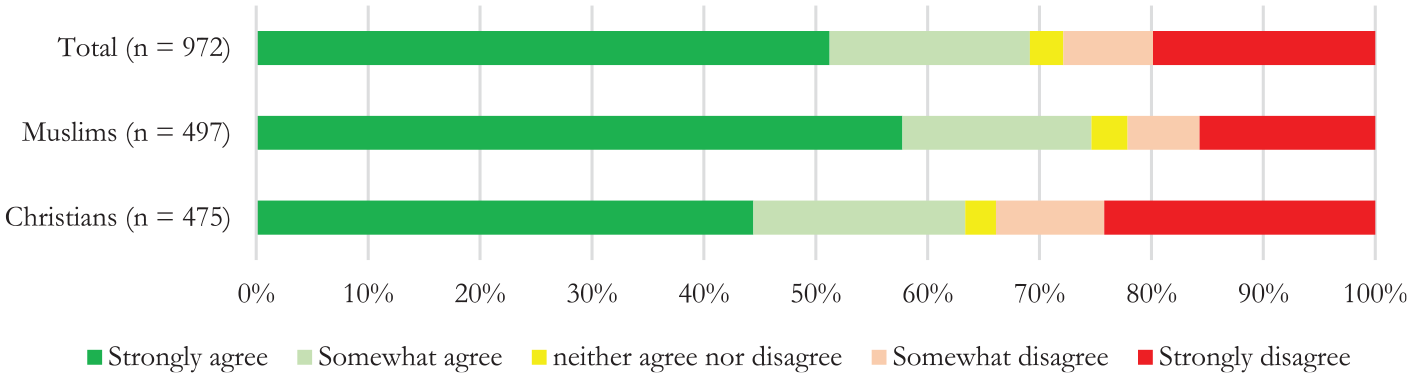
Support for an open grazing ban policy in Kaduna State.
3.2.2. Explanatory variables
Victimization (all)
This is a dummy variable that takes the value of 1 if a respondent reported that he or she, or a family member, had experienced some form of violence during the last decade (i.e., irrespective of the perpetrator) and 0 otherwise. It was derived from the question, “During the last 10 years (2011–2021), have you or your close family members been affected by violence? By ‘affected,’ I mean (a) you or your close family were threatened by violence, (b) you or one of your close family members was injured or killed, or (c) your home or property was destroyed by an attacker.” The responses were measured on a binary scale: “1 = yes” and “0 = no.” 232 respondents reported that they had been victimized, which is equivalent to 18% of the total respondents. In other words, one in five households in Kaduna was directly affected by violence between 2011 and 2021.
The respondents were then asked to identify the perpetrators of the violent incidents that had affected them. They were allowed to specify more than one perpetrator. As shown in Table 1, religious extremists were reported as the main perpetrators of violence. This is not surprising because Kaduna is polarized along religious lines and has a history of violent conflicts between Christians and Muslims (Angerbrandt, 2011, 2018; Scacco & Warren, 2021). The TRANSMIT data show that the population in Kaduna is almost evenly divided between Christians and Muslims, in a ratio of 44:56%, respectively. Some studies have found that polarization peaks in a society when the population is evenly split between two cultural groups, which, in turn, increases the risk of conflict (Montalvo & Reynal-Querol, 2003, 2005). Nomadic herders were the second most reported perpetrators of violence, while robbers/bandits ranked third. I developed dummy variables for each of the three main perpetrators of violence. For example, in the case of herders, the variable takes a value of 1 if the respondent or a family member has been victimized by herders and 0 otherwise. The reference category thus consists of respondents who were not victimized, plus those who were victimized by other perpetrators besides herders.
Distribution of victimized respondents based on religious affiliation and perpetrators.
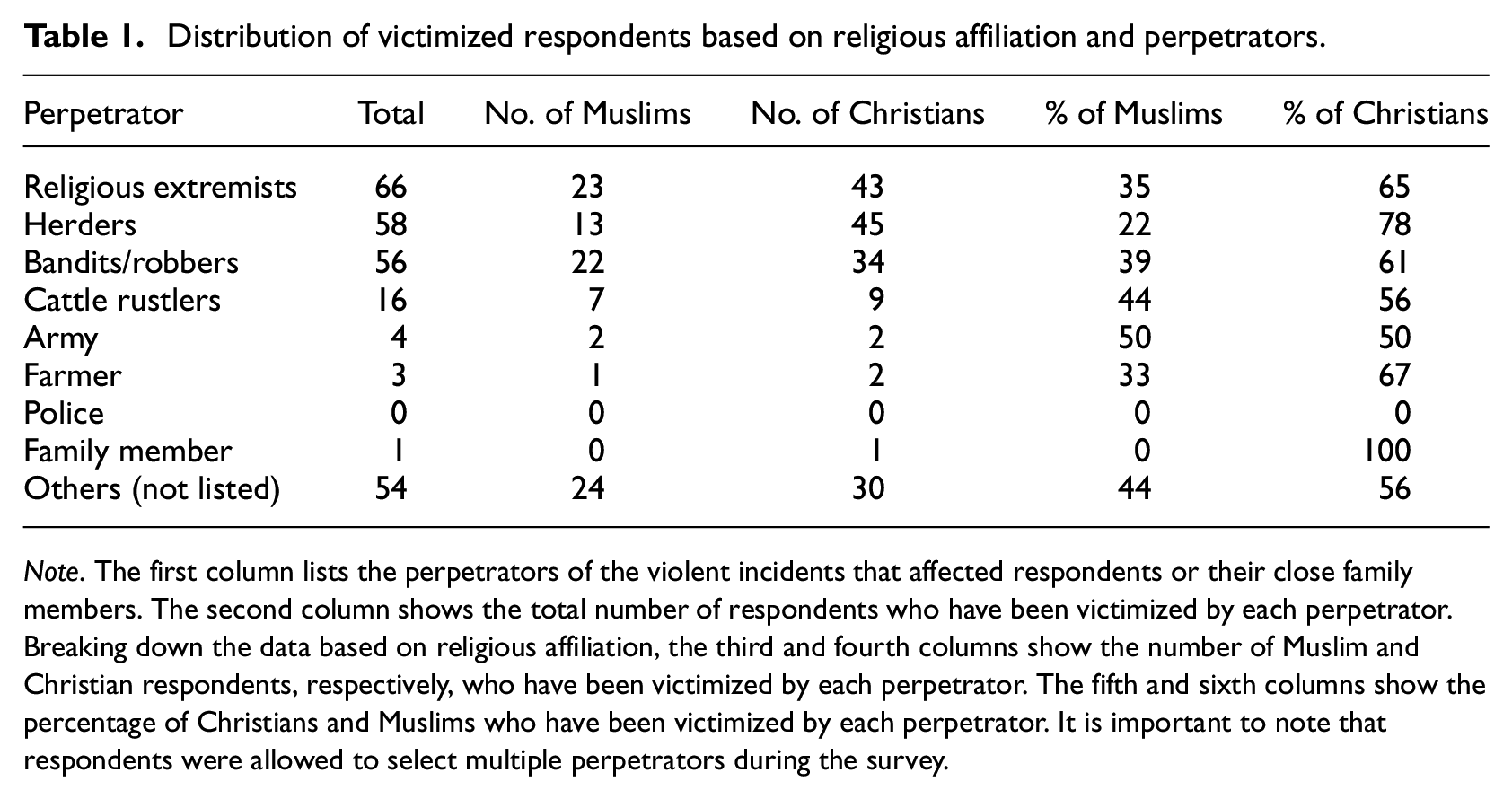
Note. The first column lists the perpetrators of the violent incidents that affected respondents or their close family members. The second column shows the total number of respondents who have been victimized by each perpetrator. Breaking down the data based on religious affiliation, the third and fourth columns show the number of Muslim and Christian respondents, respectively, who have been victimized by each perpetrator. The fifth and sixth columns show the percentage of Christians and Muslims who have been victimized by each perpetrator. It is important to note that respondents were allowed to select multiple perpetrators during the survey.
A closer examination of the data reveals a religious pattern: More Christians report being victimized than Muslims. Of the 232 respondents who had been victimized (i.e., irrespective of the perpetrator), 64% were Christians, while 36% were Muslims. Examining the religious distribution of victims based on the perpetrators of violence reveals that more Christians than Muslims reported being victimized in most categories. Specifically, 78% of those victimized by herders were Christians, while 22% were Muslims. The predominance of Christians among those victimized by herders might be due to the concentration of farmer–herder conflicts in the southern part of Kaduna, where the population is predominantly Christian.
To check whether this is indeed the case, I used data from the ACLED project (Raleigh et al., 2010) to visualize the spatial distribution of both the incidence of conflicts involving herders and the intensity of these conflicts in terms of the associated fatalities. I identified all conflict incidents in Kaduna where at least one of the actors was a “pastoralist” or belonged to the “Fulani” ethnic group. The two terms are identical in the ACLED dataset because actors defined as pastoralists are often referred to as “Fulani.” 9 This operationalization is possible because the ACLED dataset provides information about both the occupation of the conflict actors and their ethnicities. A point worth highlighting is that this operationalization captures not only incidents where herders were the perpetrators but also those where they were the victims. Although the ACLED dataset, like most conflict datasets, is imperfect due to its heavy reliance on news sources, it is still very useful in illustrating conflict patterns because of its disaggregated nature and the fact that it is updated in real time.
Figure 2 shows that conflicts involving Fulani herders are indeed concentrated in the southern part of Kaduna State, where the population is predominantly Christian, especially in the LGAs that are contiguous to the state of Plateau. 10 Figure 3 shows that the fatalities associated with these conflicts are also concentrated in the southern part of the state. This pattern might be driven by the religious difference between Muslim herders and the predominantly Christian resident population, which makes it difficult for trust to be established between both parties, thereby increasing the likelihood of disputes over land and water resources turning violent. One could argue that the number of Muslims who reported in the survey that they had been victimized by herders may be underestimated because most of the respondents who claimed to be unaware of farmer–herder conflicts were Muslims. However, in addition to the general trend indicating that farmer–herder conflicts are concentrated in the predominantly Christian southern region, it can also be argued that the exclusion of Zangon-Kataf from the sampling frame might have resulted in an underestimation of the number of Christians who had been victimized. 11 As shown in Figures 3 and 4, Zangon-Kataf, which has a predominantly Christian population, has both the highest incidence of conflict and the highest number of fatalities out of the 23 LGAs in the state. 12 It is also worth noting that Kagarko, Jema’a, Sanga, Kaura, and Kajuru, which are also in the southern part of Kaduna and have witnessed high levels of violence, also have predominantly Christian populations. Most of the LGAs with a low incidence of violence and fatalities (e.g., Kudan, Makarfi, Ikara, Zaria, and Kubau) have predominantly Muslim populations. Furthermore, a closer examination of the survey data shows that six respondents who had earlier reported that they had been victimized by herders in an earlier question had later said that they were unaware of farmer–herder conflicts. Four of them were Christians and the remaining two were Muslims.
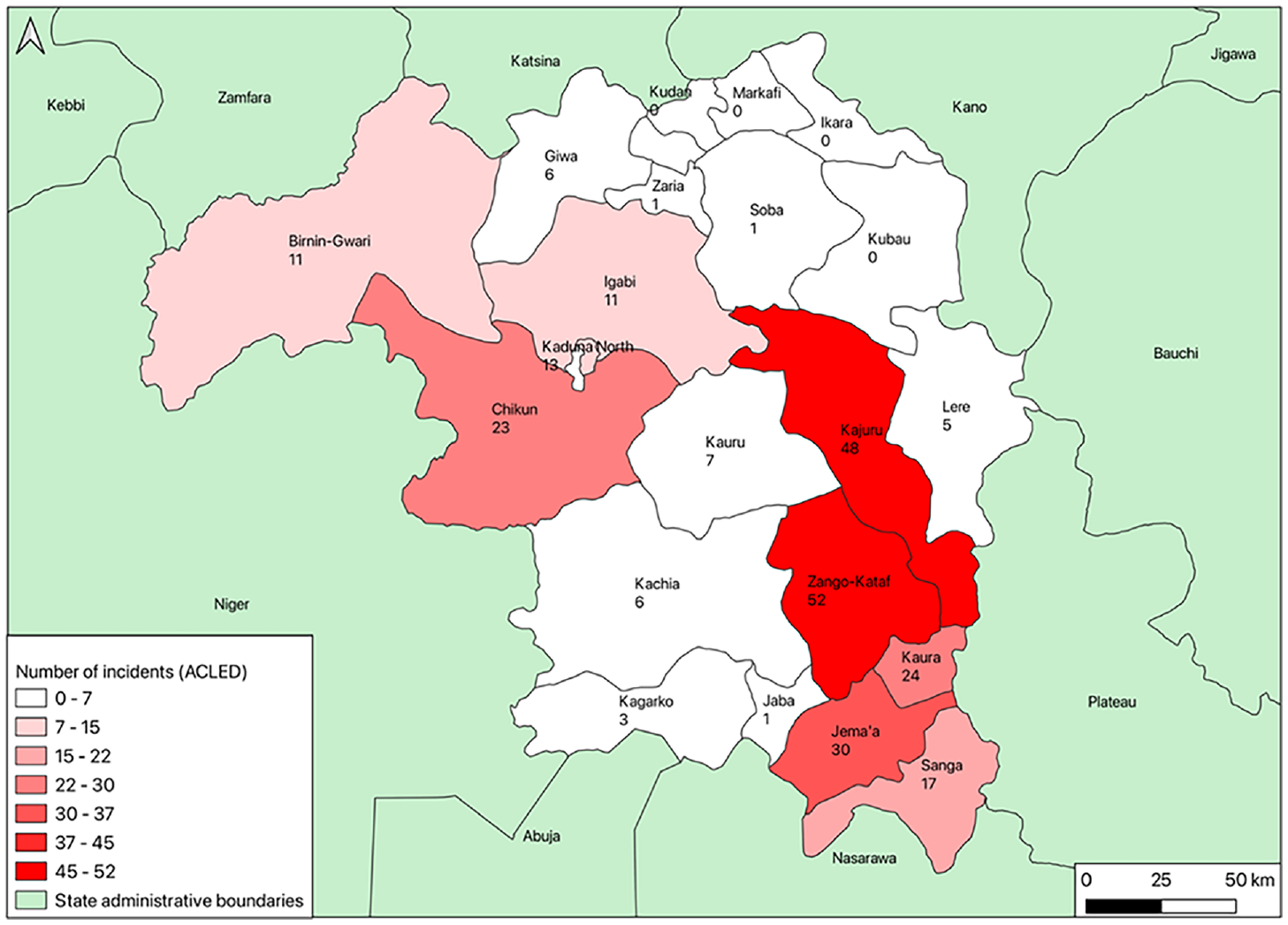
Distribution of conflict incidents involving nomadic Fulani herders in Kaduna State (1997–2021).
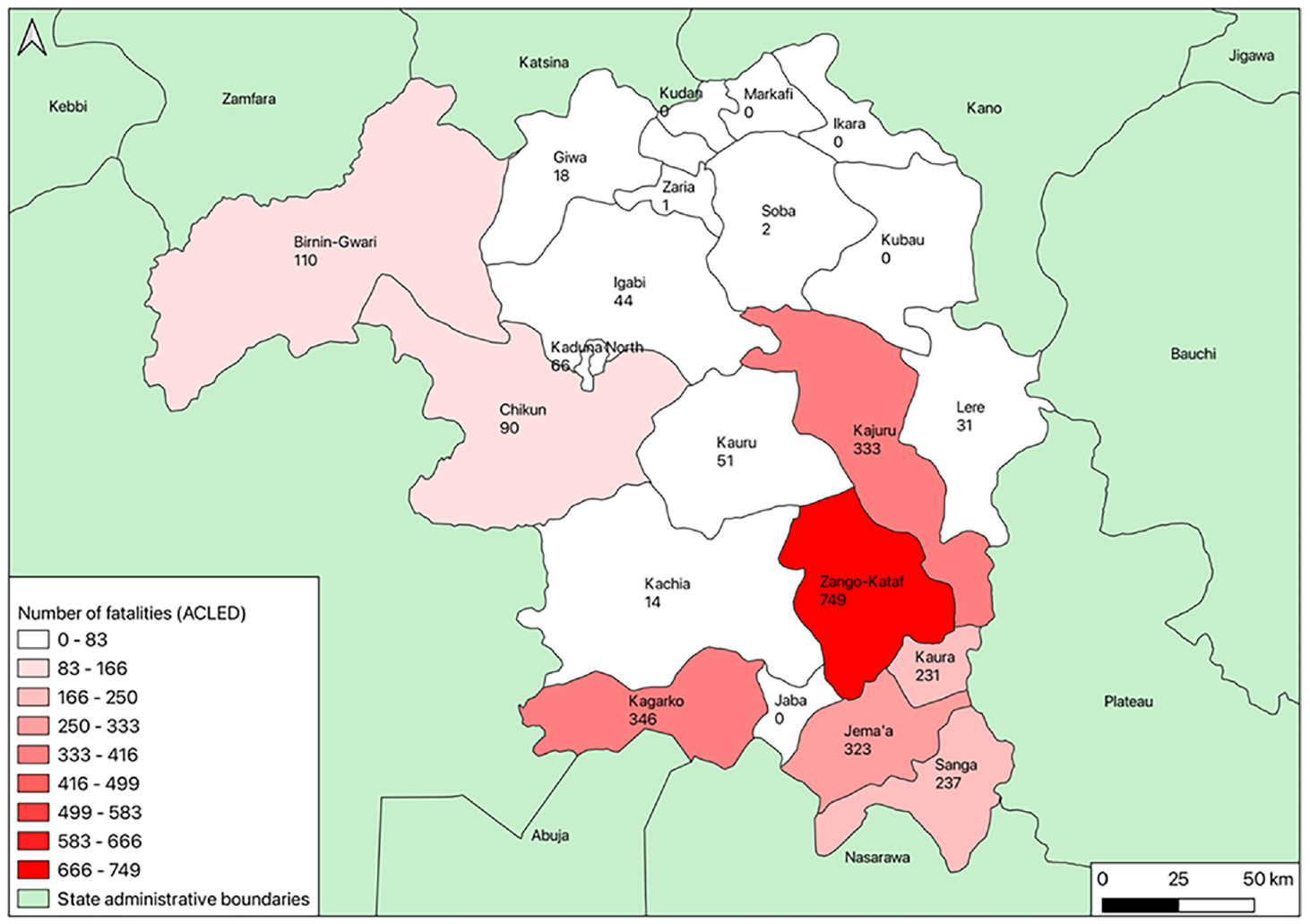
Distribution of fatalities from conflict incidents involving nomadic Fulani herders in Kaduna State (1997–2021).
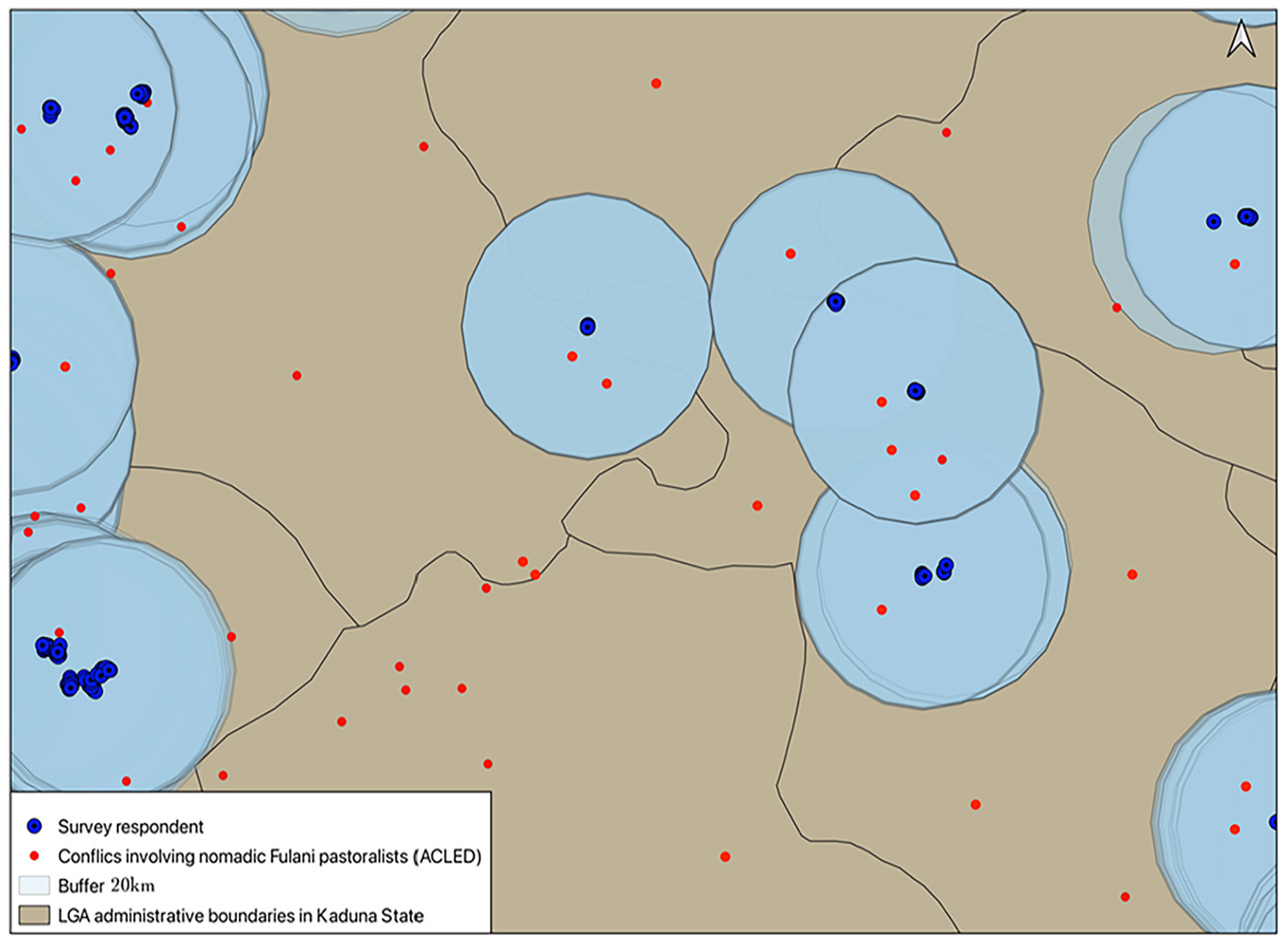
Measuring exposure to conflicts involving nomadic Fulani herders.
The violence during farmer–herder conflicts often occurs indiscriminately. A salient feature of these conflicts in Kaduna is their tendency to escalate from individual disputes to communal violence, often involving reprisals. For example, a conflict might begin with cattle straying into farmlands and destroying crops, leading to a violent dispute between an individual farmer and herder. This initial clash can result in the injury or death of one party and may also involve the killing of livestock. Such incidents lead to grievances among members of the associated ethnic and religious groups, especially when Christian farmers clash with nomadic herders, which can escalate the conflict to the communal level. During reprisals, communities are often attacked by gunmen based on their ethnoreligious identities, and people killed indiscriminately, regardless of their involvement in the initial conflict. The casualties from these attacks often include children (Abubakar, 2020; Al Jazeera, 2023; Amnesty International, 2018; Human Rights Watch, 2018; Oduah, 2016).
Muslim affiliation
This is a dummy variable that takes the value of 1 if a respondent is Muslim, and 0 if they are Christian. All the respondents were either Muslims or Christians.
3.2.3. Control variables
Conflict exposure
This measures the total number of conflict incidents that occurred from 1997 to 2020 within a 20 km buffer around the respondents’ dwellings (see Figure 4). I considered only incidents where at least one of the conflict actors was a “pastoralist” or belonged to the “Fulani” ethnic group. I was able to identify both the occupation and ethnicity of the conflict actors because the ACLED dataset provides this information. A point worth emphasizing is that this operationalization captures incidents where nomadic herders were either the perpetrators or the victims.
I was able to draw buffers around the geolocations of the respondents using QGIS software because both the TRANSMIT and ACLED datasets are georeferenced. I considered conflicts within the buffer starting from 1997 because the ACLED dataset is available from that year. Although the ACLED data are updated in real time, I excluded all incidents that occurred after 2020. This adjustment mitigates the potential problem of reverse causation since the dependent variable is measured in 2021. I considered all conflicts within the buffer from 1997 to 2020 because I am particularly interested in the cumulative effect of conflict. Some studies have shown that memories of past conflicts tend to persist and shape perceptions in the present (e.g., Hong & Kang, 2017; Tuki, 2024a). I included conflict exposure as a control variable in the regression model because it could confound the relationship between victimization and support for an open grazing ban policy: exposure to conflict might increase the likelihood of individuals being victimized. 13 Also, Individuals who are exposed to violence might be more supportive of an open grazing ban policy—in the hope that this would end farmer–herder conflicts. 88% of the respondents had at least one conflict incident within the 20 km buffer around their dwellings, and 45% of them had at least 14 incidents.
Demographic attributes
This includes the age, gender, and marital status of the respondents. Gender takes the value of 1 if a respondent is female and 0 if male. Marital status takes the value of 1 if a respondent is married or has ever been married, and 0 otherwise. Age is measured in years.
3.3. Analytical technique
To examine the effect of victimization and religious affiliation on support for an open grazing ban policy, I consider a model of the following general form:

where
4. Results and discussion
4.1. General victimization (i.e., irrespective of perpetrator)
Table 2 reports the results of regression models examining the effect of victimization and religious affiliation on support for an open grazing ban policy. Models 1 to 5 are based on the full sample covering the population in Kaduna, while Models 6 and 7 focus on the Muslim and Christian subsample of respondents, respectively. In Model 1, where only victimization was considered, it was statistically insignificant. This suggests that general victimization has no effect on support for an open grazing ban policy. This might be because the population in Kaduna distinguishes between the perpetrators of violence, coupled with the fact that an open grazing ban policy is tailored specifically to address conflicts involving nomadic herders. In Model 2, where only Muslim affiliation was considered, it was statistically significant at the 5% level and carried a positive sign, suggesting that Muslims are on average more supportive of an open grazing ban policy than Christians. This result, which is consistent with Hypothesis 2b, is independent of the respondents’ victimization status. The higher support for the policy among Muslims might be due to a contagion effect: Muslims might be conflated with nomadic herders because of the religion of Islam they share, leading to the attribution of some blame for farmer–herder conflicts to Muslims. Blaming Muslims for the conflicts might make them more eager to see some concrete policy action from the government to address the conflict, resulting in greater support for an open grazing ban policy. 14 The increased support for the policy might also be driven by Muslims’ desire to dissociate themselves from nomadic herders, who are often perceived as having a high predisposition toward violence (Eke, 2020). Looking from another perspective, Christians might be less supportive of an open grazing ban policy than Muslims because they do not believe in the government’s ability to effectively and impartially implement such a policy. This skepticism arises from the perception that the government, dominated by Muslims, may be preferential toward nomadic herders. In Model 3, where the two explanatory variables were included in the same model, the results were consistent with those in the baseline models. When control variables (Model 4) and fixed effects for the respondents’ ethnic groups and the LGAs where they resided (Model 5) were included in the model, the main results remained unchanged. Among the control variables, only age was statistically significant. Its negative sign indicates that people are less likely to support an open grazing ban policy as they get older.
Ordered logit models regressing support for an open grazing ban policy on victimization.
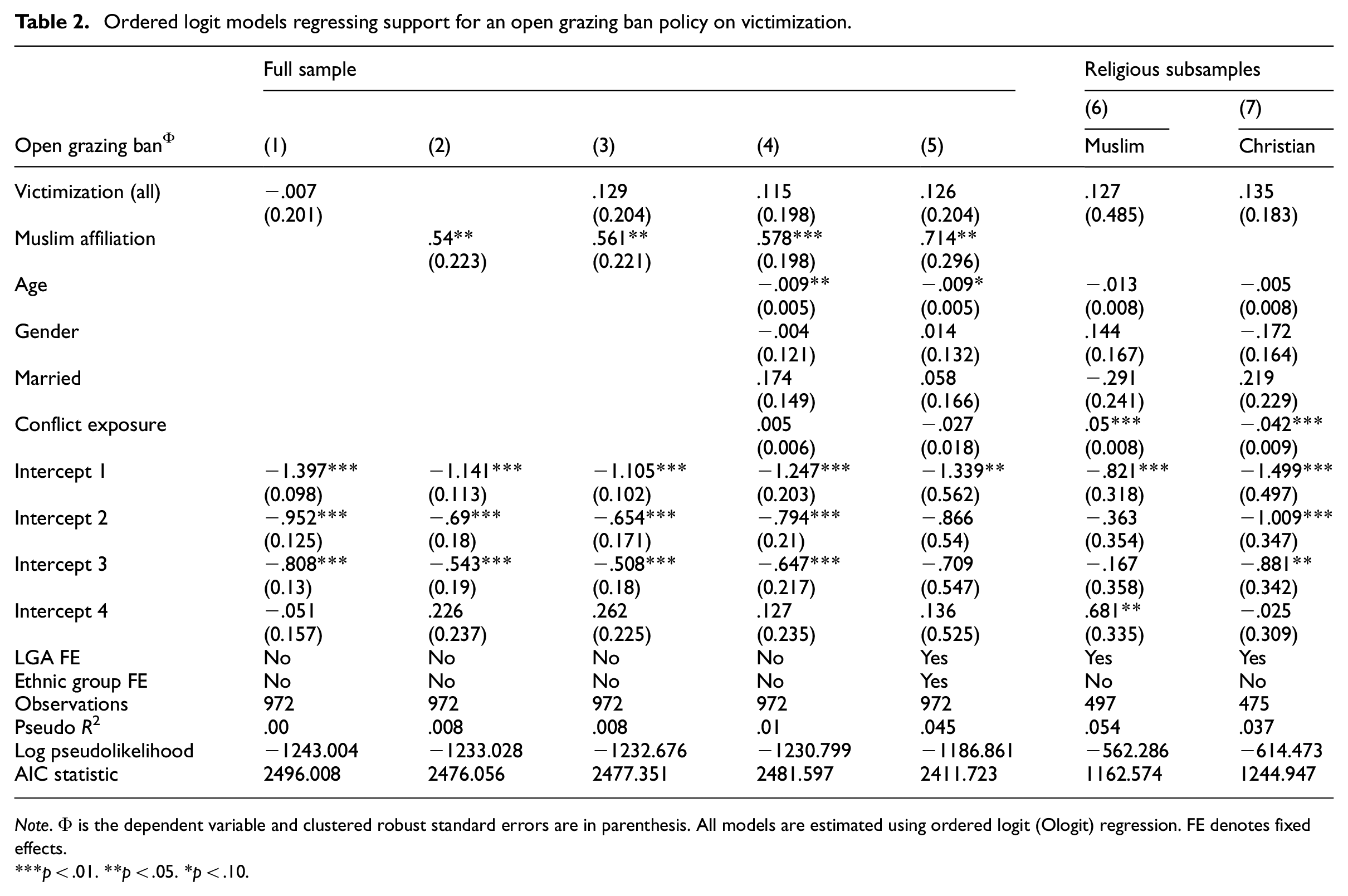
Note. Φ is the dependent variable and clustered robust standard errors are in parenthesis. All models are estimated using ordered logit (Ologit) regression. FE denotes fixed effects.
p < .01. **p < .05. *p < .10.
To check whether heterogeneous patterns underlie the effect of victimization on support for an open grazing ban policy, I disaggregated the data based on religious affiliation and estimated models using the Muslim and Christian subsamples of respondents. As shown in Models 6 and 7, victimization had no effect on support for an open grazing ban policy among both Muslims and Christians. This lends some support to my earlier argument regarding the tendency among the population to distinguish between the perpetrators of violence, coupled with the fact that the open grazing ban policy is specifically associated with violence involving nomadic herders. Among the control variables, only conflict exposure was statistically significant. Its positive sign in Model 6 suggests that among Muslims, exposure to conflicts involving Fulani herders increases the likelihood of supporting an open grazing ban policy. This might be because Muslims who are exposed to conflict trust the state’s institutions and believe that an open grazing ban policy would mitigate farmer–herder conflicts. Among Christians, however, conflict exposure had a negative effect on support for an open grazing ban policy (Model 7). This might be because Christians who are exposed to farmer–herder conflicts have low institutional trust and, hence do not see an open grazing ban policy as an effective tool to address farmer–herder conflicts. Moreover, given the dominance of Muslims in the political sphere, Christians might be skeptical regarding the effective and impartial implementation of an open grazing ban policy, even if such a law were passed.
The TRANSMIT survey had a question where respondents were asked the following: “How effective do you think the Nigerian government has been in its effort to address the conflict between farmers and herders?” The responses were measured on a scale with five ordinal categories ranging from “very effective” to “very ineffective.” 52% of the population in Kaduna chose either the “very effective” or “somewhat effective” response categories. Disaggregating the data based on religious affiliation revealed a pattern: Muslims assessed the government’s handling of farmer–herder conflicts more favorably than Christians. 67% of Muslims chose either the “very effective” or “somewhat effective” response categories. The estimate for Christians was only 36%. 15
4.2. Perpetrator-specific victimization
4.2.1. Herders
It is possible that the null effect of victimization on support for an open grazing ban policy reported in Table 2 was because all the perpetrators of violence were merged into a single category. Support for an open grazing ban policy might vary depending on who the perpetrator of violence is. This prompted me to disaggregate the victimization variable, focusing on the three main perpetrators of violence: herders, religious extremists, and bandits/robbers (see Table 1). I began by estimating models where I focused specifically on herders. Table 3 reports the results. In Model 1, where only victimization by herders was considered, it carried a positive sign and was statistically significant at the 5% level. This is consistent with Hypothesis 1, which states that among the population in Kaduna, victimization by herders increases the likelihood of supporting an open grazing ban policy. This might be because individuals who have been victimized by herders are more eager to see some concrete policy action from the government aimed at resolving farmer–herder conflicts, even if this involves the implementation of an open grazing ban policy. In Model 2, where Muslim affiliation was included in the model, victimization by herders maintained its positive sign and its significance level rose to 1%. Models 3 and 4 show that the main results are robust to the inclusion of control variables and fixed effects for respondents’ ethnic groups and the LGAs where they reside.
Ordered logit models regressing support for an open grazing ban policy on victimization by herders.
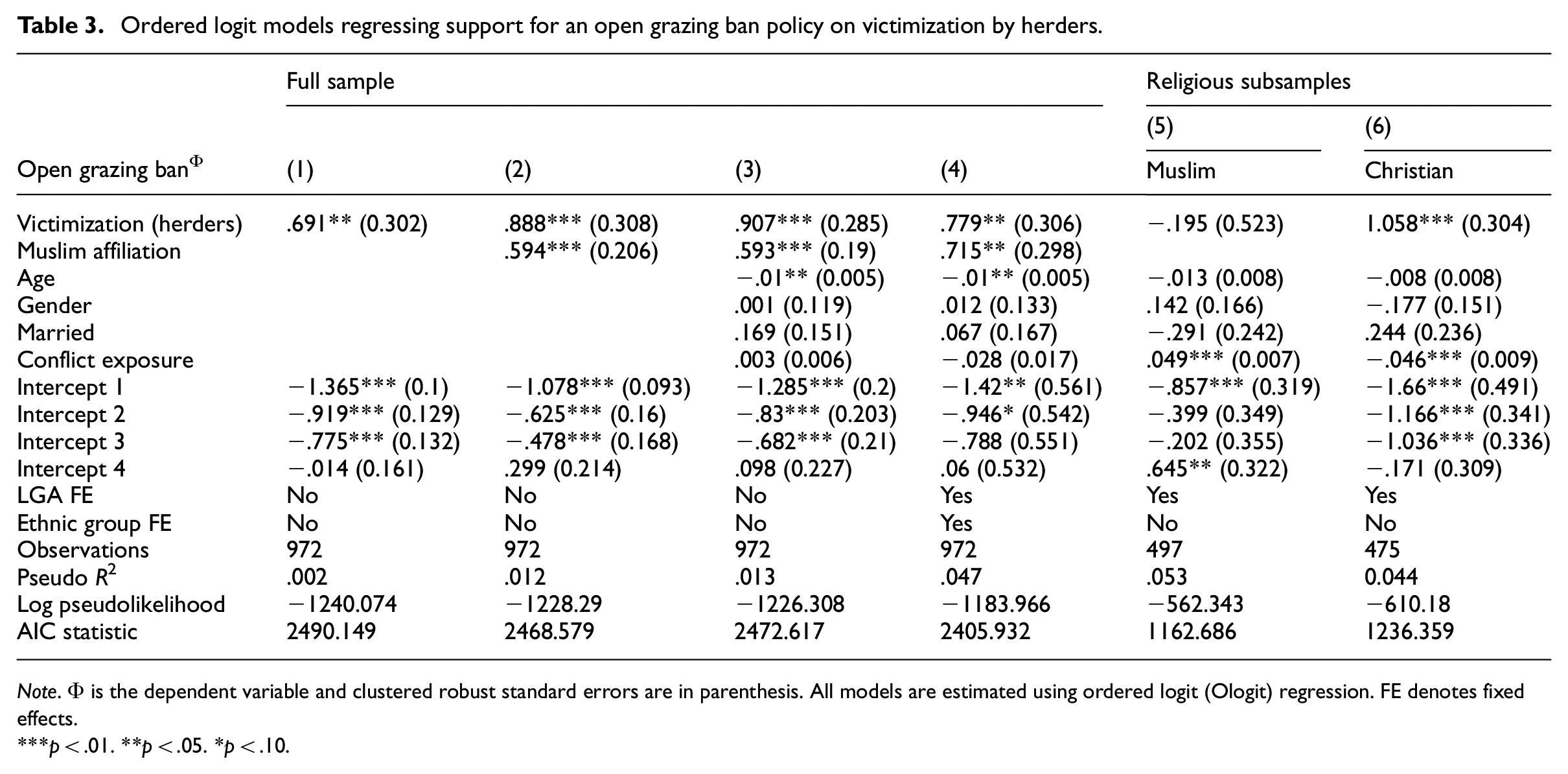
Note. Φ is the dependent variable and clustered robust standard errors are in parenthesis. All models are estimated using ordered logit (Ologit) regression. FE denotes fixed effects.
p < .01. **p < .05. *p < .10.
To check for heterogeneous effects based on religious affiliation, I estimated Models 5 and 6 using the Muslim and Christian subsamples of respondents, respectively. Among Muslims, victimization by herders had no effect on support for an open grazing ban policy, while it had a positive effect among Christians. The positive effect found among Christians is consistent with Hypothesis 1, while the null effect found among Muslims is not, which makes it quite surprising. This indicates that religious affiliation influences how individuals respond when victimized by herders. Put differently, Muslims and Christians do not respond in the same way when victimized by herders. This might have something to do with the religious affiliation of the perpetrators and is an area that requires further research. 16
It is imperative to point out that Christians and Muslims respond differently to victimization by herders and exposure to conflicts involving herders. While exposure to conflicts involving herders reduces the likelihood of Christians supporting an open grazing ban policy, victimization by herders has the opposite effect. Among Muslims, however, exposure to conflicts involving herders increases the likelihood of supporting an open grazing ban policy, while victimization by herders has no effect on support for the policy. This variation might be because victimization and conflict exposure do not measure the same thing. While victimization indicates the concrete experience of violence by respondents or their close family members, conflict exposure does not necessarily imply victimization. It is possible for individuals living in conflict zones to devise coping strategies that enable them to carry on with their “normal” lives despite the prevalence of violence.
To illustrate the size of the effects reported in Table 3, I plotted the predicted probabilities. A cursory look at the four panels in Figure 5 shows that the effect of religious affiliation and victimization by herders is largest on the extreme response categories of the dependent variable—that is, “strongly agree” and “strongly disagree.” Panel A shows that, compared to Christians, Muslims are 16 percentage points more likely to choose the “strongly agree” response when asked about the potential for an open grazing ban policy to reduce the incidence of farmer–herder conflicts. By contrast, Muslim affiliation reduces the probability of choosing the “strongly disagree” response category by 10%. Panel B shows that, among the population in Kaduna, individuals who have been victimized by herders are 18 percentage points more likely to choose the “strongly agree” response category when asked about the potential for an open grazing ban policy to reduce the incidence of farmer–herder conflicts. By contrast, victimization by herders reduces the probability of choosing the “strongly disagree” response category by 11%. Suffice it to add that the reference category here consists of individuals who have not been victimized, plus those who have been victimized by other perpetrators besides herders. As shown in Panel C, where all the whiskers cross the horizontal line at zero, victimization by herders has no effect on support for an open grazing ban policy among Muslims. Panel D shows that among Christians, victimization by herders increases the probability of choosing the “strongly agree” response category by 24% when asked about the potential for an open grazing ban policy to reduce the incidence of famer–herder conflicts. Conversely, victimization by herders reduces the probability of choosing the “strongly disagree” response category by 18%.
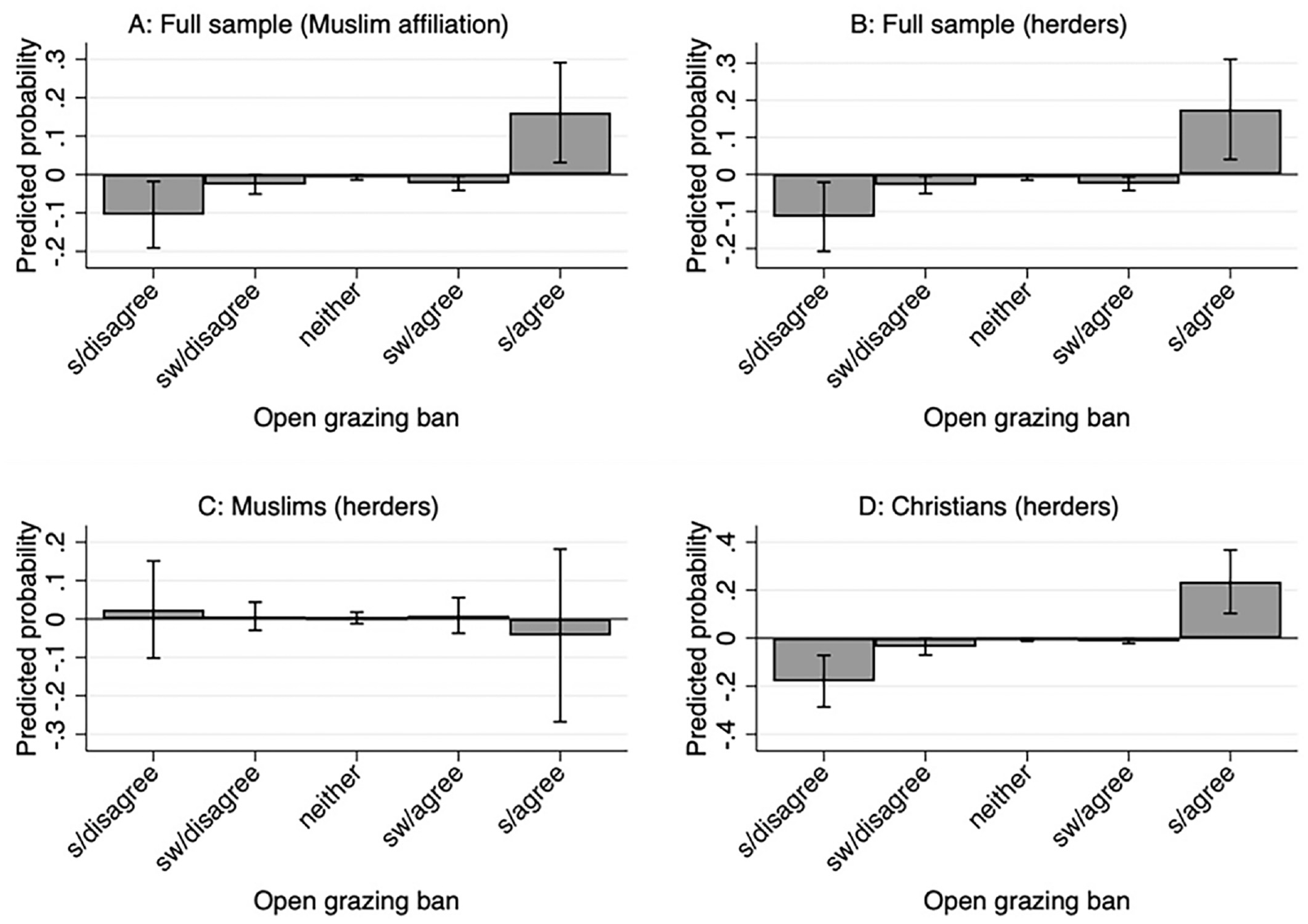
Average marginal effects of religion and victimization by herders on support for an open grazing ban policy.
4.2.2. Religious extremists and bandits
Table 4 reports the results of regression models examining the effect of victimization by the other two main perpetrators of violence (i.e., religious extremists and bandits/robbers) on support for an open grazing ban policy. Models 1 to 3 focus on victimization by religious extremists. In Model 1, which is based on the full sample where victimization by religious extremists was considered alongside the control variables and fixed effects for the respondents’ ethnic groups and the LGAs where they reside, victimization by religious extremists had no statistically significant effect on support for an open grazing ban policy. It remained insignificant even when the data were disaggregated based on religious affiliation and models estimated using the Muslim and Christian subsamples of respondents (Models 2 and 3).
Ordered logit models regressing support for an open grazing ban policy on victimization by religious extremists and bandits/robbers.
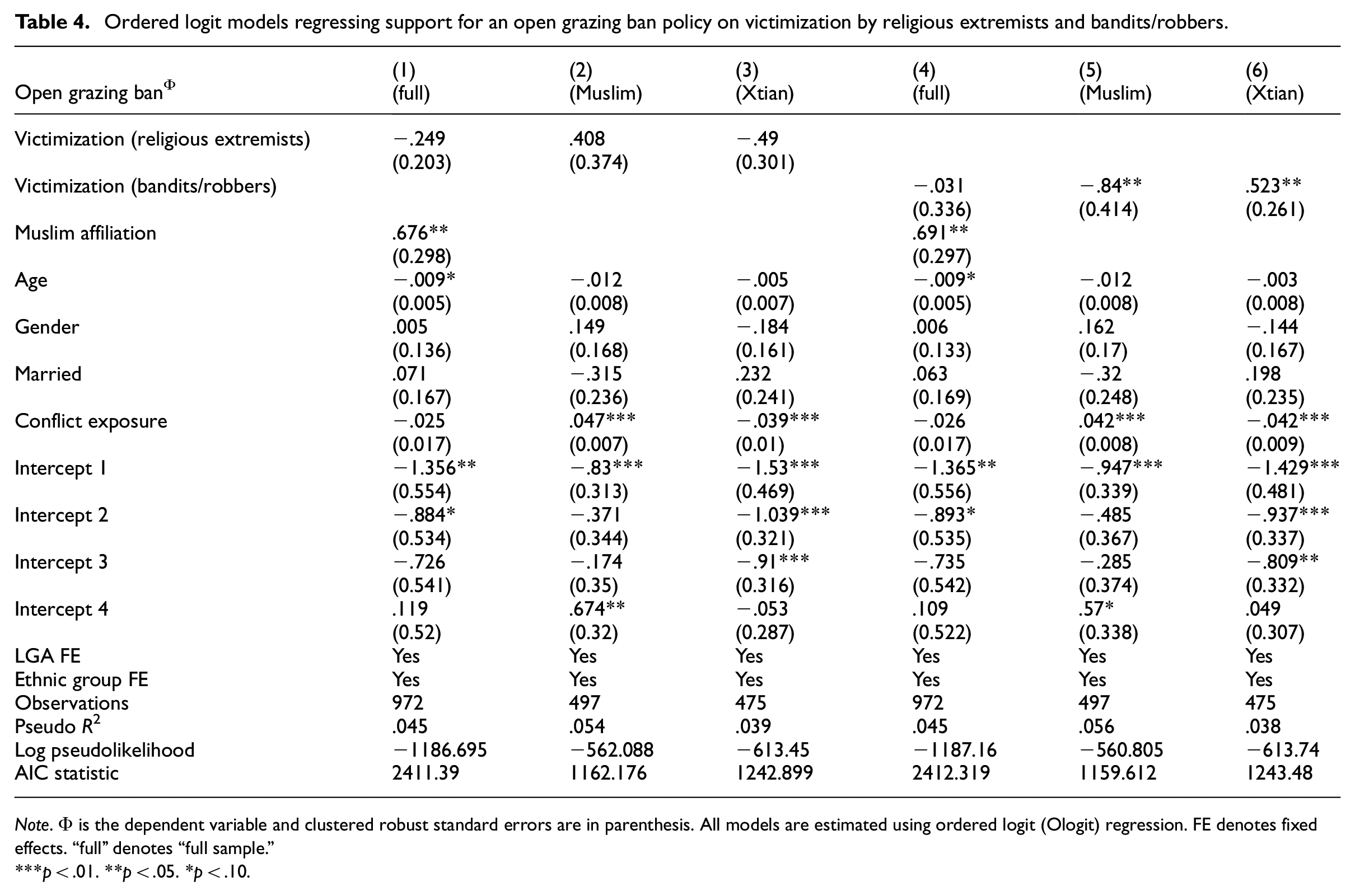
Note. Φ is the dependent variable and clustered robust standard errors are in parenthesis. All models are estimated using ordered logit (Ologit) regression. FE denotes fixed effects. “full” denotes “full sample.”
p < .01. **p < .05. *p < .10.
Models 4 to 6 focus on victimization by bandits/robbers. In Model 4, which is also based on the full sample and includes control variables and the relevant fixed effects, victimization by bandits/robbers was statistically insignificant. However, when the data were disaggregated based on religious affiliation, some patterns emerged: As shown in Model 5, which is based on the Muslim subsample of respondents, victimization by bandits/robbers carried a negative sign and was significant at the 5% level. This indicates that Muslims who have been victimized by bandits/robbers are less likely to support an open grazing ban policy. By contrast, as shown in Model 6, which is based on the Christian subsample of respondents, victimization by bandits/robbers carried a positive sign and was significant at the 5% level, indicating that Christians who have been victimized by bandits/robbers are likely to support an open grazing ban policy.
To illustrate the effect sizes, I plotted the predicted probabilities for Models 5 and 6 in Table 4 (see Figure 6). As shown in panel A, among Muslims, victimization by bandits/robbers reduces the probability of choosing the “strongly agree” response category by 18% when asked about the potential for an open grazing ban policy to reduce the incidence of farmer–herder conflicts. By contrast, it increases the probability of choosing the “strongly disagree” response category by 10%. Panel B shows that among Christians, victimization by bandits/robbers increases the probability of choosing the “strongly agree” response category by 12% and reduces the probability of choosing the “strongly disagree” response category by 9%.
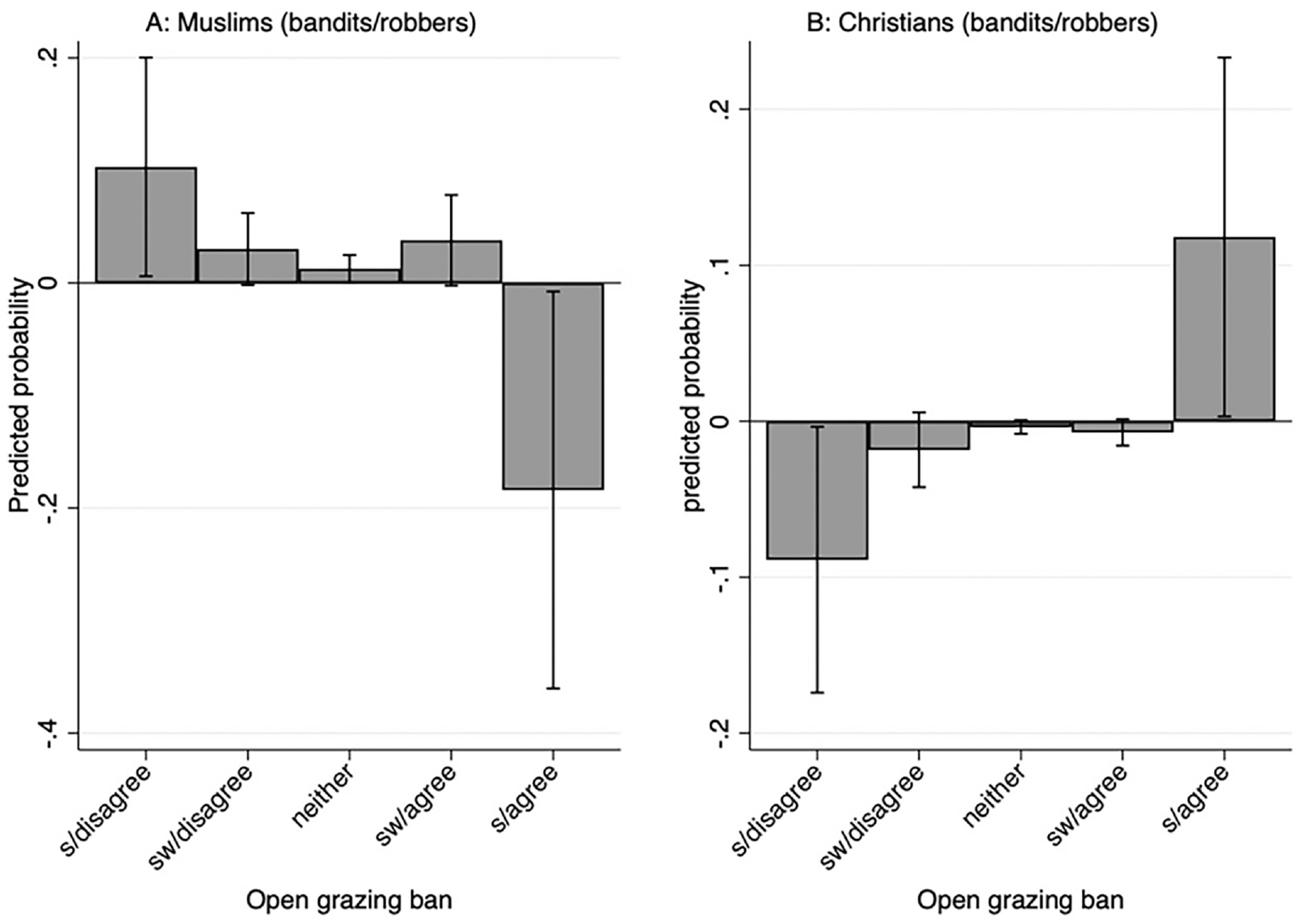
Average marginal effects of victimization by bandits/robbers on support for an open grazing ban policy.
A poignant question one might ask is, why does the effect of victimization by bandits/robbers differ between Muslims and Christians? To answer this question, it is imperative to first identify who the bandits/robbers are and the areas where they operate. Over the last 5 years, Nigeria’s Northwest geopolitical zone (which includes the state of Kaduna) has witnessed a significant rise in banditry and ransom-driven abductions. Members of the Fulani ethnic group are overrepresented among the bandit groups operating in the region. Ejiofor (2021, p. 88) observes that “the term ‘armed bandit’ in the northwest zone is, in local parlance, shorthand for nomadic pastoralists of Fulani extraction who have taken to criminality in the absence of economic opportunities beyond cattle herding.” In fact, armed banditry claimed more lives than the radical Islamist group Boko Haram in 2019, prompting the Nigerian government to proscribe them as terrorist organizations (Mac-Leva & Ibrahim, 2019; Ochojila, 2022). Given this background, the lower support for an open grazing ban policy among Muslims who have been victimized by bandits/robbers might be because they think the policy would threaten the livelihood of nomadic herders and lead to increased grievances, pushing more of them into banditry as a means of survival. The support for an open grazing ban policy among Christians who have been victimized by bandits/robbers might be because they make no distinction between bandits and nomadic herders, who share the same religion and ethnicity. This might prompt them to believe that the same policy—an open grazing ban—would curtail the violence perpetrated by both herders and bandits/robbers. While these explanations are plausible, I am unable to test them empirically using the TRANSMIT dataset because the survey instrument does not have a specific question focusing on people’s perceptions of the association between banditry and nomadic herding. This is an area that requires further research.
5. Conclusion
This study examined the effect of victimization and religious affiliation on support for a policy banning the open grazing of livestock in the northern Nigerian state of Kaduna. Kaduna is a suitable case study for investigating these relationships because, despite having the third-highest incidence of farmer–herder conflicts out of Nigeria’s 36 states, the state government has not implemented an open grazing ban policy there. The regression results showed that the effect of victimization on support for an open grazing ban policy depends on who is perpetrating the violence. General victimization (i.e., irrespective of the perpetrator) had no effect on support for an open grazing ban policy, but victimization by herders did have a positive effect. The positive effect was particularly strong among Christians. The regression results also showed that Muslims were, on average, more supportive of an open grazing ban policy than Christians. This might be due to a contagion effect, which leads to the conflation of nomadic herders with Muslims—due to the common religion of Islam they share. This results in the attribution of blame for farmer–herder conflicts to Muslims, making them more eager to see some concrete policy action from the government to address the conflicts. This eagerness might be what translates into higher support for an open grazing ban policy. Support for the policy among Muslims might also be driven by their desire to dissociate themselves from nomadic herders, who are generally perceived as having a high disposition toward violence (Eke, 2020).
Taken together, the results of this study indicate that religious affiliation influences how individuals respond to violence. It also highlights the need for policymakers to consider religion while developing policies to mitigate farmer–herder conflicts. Failure to do so might rather lead to an escalation of violence. A case in point is the Rural Grazing Area (RUGA) policy, which sought to establish grazing reserves in all of Nigeria’s 36 states where herders were to stay with their livestock. Though well intentioned, the policy was vehemently opposed by Southern Nigerian states and states in the Middlebelt region with predominately Christian populations. These peoples saw the policy as an attempt by the Muslim-dominated government to give their ancestral lands to nomadic Fulani herders who are considered settlers and non-indigenous peoples. By contrast, the policy met no opposition in Northern Nigerian states with predominantly Muslim populations. Although religion is contentious in Nigeria, scholars need to consider it in the analysis of land use conflicts, as this enables a holistic understanding of the problem.
Footnotes
Appendix
Acknowledgements
I thank Hussaini Kwari, two anonymous reviewers, and the editor for their helpful comments. Thanks to Roisin Cronin for editorial assistance.
Funding
The author disclosed receipt of the following financial support for the research, authorship, and/or publication of this article: Financial support from the German Federal Ministry for Family Affairs, Senior Citizens, Women and Youth (BMFSFJ) is gratefully acknowledged.
Ethical approval
Ethical approval was obtained from the WZB Berlin Social Science Center Ethics Review Committee (Application No.: 2020/3/101) and the National Health Research Ethics Committee of Nigeria (NHREC) before the survey in Nigeria was conducted.
