




Abstract
Sand is mined illegally in numerous countries globally—with devastating consequences for the environment and the people living in the sand mining areas. In our contribution, we highlight the conflict potential of illegal sand mining. We collected data from different online sources and found that between 1990 and 2021, (a) sand has been mined illegally in 35 African countries and (b) 21 of them saw nonviolent conflicts, such as complaints, threats, or peaceful protest, while six of them, namely Algeria, Ghana, Kenya, Morocco, Nigeria, and The Gambia, saw violent conflicts, such as targeted killings, violent and deadly protest, or violent clashes. Our data indicate that violent conflict was by far the most escalated in Kenya, in particular, in Makueni County. We argue that an overview of the prevalence of illegal sand mining and an awareness of its link to nonviolent and in particular violent conflicts is crucial, considering the ever-growing demand for sand. Taking sand governance seriously now can prevent not only environmental damage but also ensure that sand does not become a resource that is linked to violence more broadly than it already is. It has the potential to prevent conflicts.
1. Introduction
Headlines like “The Coming Sand Wars” (Beiser, 2019 in Foreign Policy), “The Deadly Global War for Sand (Beiser, 2015 in Wired), or “Kenya’s Sand Wars” (Constable, 2017 in Al Jazeera) point toward the conflict potential of sand. In this study, we seek to provide an overview of illegal sand mining activities in Africa and point out in which African countries illegal sand mining is linked to nonviolent and violent conflict. We focus on Africa because most intrastate conflicts occur in Africa (Davies et al., 2022, p. 596), while of the rebel groups that use natural resources to fund their rebellion, it is the rebel groups located in Africa that use the greatest breadth of activities—extortion, theft, smuggling, and booty futures—in their funding strategies (Walsh et al., 2018, p. 703). 1
Our article provides novel information about a resource that has thus far been neglected in the context of natural resource conflicts: sand. Information on where conflicts around illegal sand mining take place provides a basis for systematic theory-driven analysis that can shed light on the conflict dynamics at play in the context of illegal sand mining, which is crucial for identifying strategies for conflict prevention. To our knowledge, our contribution is the first to provide an overview of illegal sand mining and its relation to conflict in Africa from a peace and conflict studies perspective. Research from this perspective on illegal sand mining can be linked up with different research streams in environmental peace and conflict research (as discussed by Ide et al., 2023). Further analysis can account for dynamics at play in the context of the local resource curse, for example, when people mobilize (Sexton, 2020), or corruption levels in mining areas (e.g., Knutsen Kotsadam et al., 2017). Meanwhile, sand is incrementally linked to water, as it stores the latter. With increasing occurrences of droughts in several regions (IPCC, 2023, p. 7), sand thus is a resource that is not only in high demand for construction but also crucial for holding water (Constable, 2017 in Al Jazeera). Illegal sand mining conflicts are hence of relevance in the climate–conflict nexus. Considering that sand could become a resource to fund rebellion more broadly than it already does, just like for example opium, timber, or tea (for an overview of resources funding rebellion, see Walsh et al., 2018), learning more about illegal sand mining conflicts is vital not only for understanding how it affects the local population and the conditions under which it leads to violent conflict but also regarding the question how conflict parties, especially nonstate actors, fund their activities. In this context, accounting for the cooperation between nonstate actors in their illicit activities might be worthwhile paying attention to, considering that rebel groups cooperate with poachers in the context of ivory poaching, for example, to generate income (Haass, 2020). Besides, addressing the larger dynamics at play in illegal sand mining might provide interesting insights into the management of common pool resources (i.e., Ostrom, 1990), organized crime, and the political economy of illegally obtained resources finding their way into the market.
We argue that establishing a link between sand and conflict at a point in time where sand is not yet high on the agenda of policymakers regarding its conflict potential is crucial. Sand is the world’s second-most extracted and traded natural resource after water (Msuya, 2019), with an ever-growing demand and price (Bikkina & Shravya, 2017). Its conflict potential is possibly increasing, as resources that provide higher revenues are more likely to lead to conflict (Berman et al., 2017). Learning more about cases that have already seen illegal sand mining conflicts can be an important step when seeking to prevent others. After all, “[a]s the demand for sand continues to grow around the world, the body count seems certain to rise with it” (Beiser, 2017).
We proceed by briefly providing information on sand and sand mining. What follows is an overview of the data we have collected. We describe in which African country’s sand was mined illegally between 1990 and 2021 and where nonviolent and violent conflicts occurred in this context. We provide brief insights into the dynamics at play in cases that have seen violent conflicts in the context of illegal sand mining. Our contribution closes by pointing out avenues for further research and policy recommendations.
2. Sand and sand mining
Our life heavily depends on sand—a resource that is becoming scarce, as our sand consumption outpaces the world’s capacity for renewal (Beiser, 2018, pp. 5–7, 30–31). Not only does sand form part of the ground that we walk on and the soil in which plants root but it also stores water and substantially contributes to providing key ingredients to our survival on the Blue Planet. It is also an important part of cement and numerous other products, such as glass or pharmaceuticals (Bendixen et al., 2021). In fact, “[t]oday the construction industry consumes some $130 billion worth of sand each year” (Beiser 2018, p. 2).
Sand corns are “loose grains of any hard material with a diameter between 2 and 0.0625 millimeters” (Beiser, 2018, p. 6). Stones, seashells, corals, volcanic lava, or quartz can become sand if shaped by wind or water, which takes approximately 200 million years. Different types of sand exist and are used for construction, varying in hardness, roundness, angularity, or color. Together with gravel, sand is often referred to as aggregate in the context of construction. Desert sand, shaped by wind, is not suitable for construction, as it is too round and does not provide a basis for stable construction (Beiser, 2018, pp. 8–10).
Sand is traded locally, nationally, and internationally. As sand is becoming scarcer, it is increasingly becoming a global commodity (Beiser, 2018, p. 240). It can be mined with elaborate machinery or simply by hand. In numerous countries globally, people of different ages and genders, including pregnant women and children, mine sand from rivers, the sea, backyards, or fields. They are locals to the sand mining area, come from other regions of the country, or cross borders to mine sand. Sand is mined with shovels, people use their bare hands to mine sand or dive into rivers or the sea to collect it in baskets. At the other end of the spectrum, people mine sand with, for example, excavators or ships that pump sand from the ground of the sea.
Sand is mined legally and illegally. While legal sand mining requires government licenses (Bikkina & Shravya, 2017, p. 109), controlling sand mining is difficult because sand is a common pool resource (Torres et al., 2017, p. 970). With sand prices increasing and sand being easy to mine, the illegal sand mining business has flourished. Sand is mined illegally and controlled by local mafias in at least 70 countries around the world (Marschke et al., 2020), for example in India, Malaysia, Indonesia, China, Sri Lanka, Algeria, Morocco, Kenya, or Uganda (Beiser, 2017 in The Guardian; Daghar, 2020; Kusum & Navaratnem, 2008; Zeisl, 2019).
Sand mining has several consequences. On the ecological level, beaches or islands disappear, coral reefs or mangrove forests are damaged, and fish populations are threatened or changed, while riverbed sand mining, in combination with climate change, leads to rises in the sea level and has contributed to the loss of thousands of rice farms in the Mekong Delta for instance (Beiser, 2018, pp. 14–15, 18). It affects the infrastructure and can damage bridges, gas pipelines, or water and electricity grids (Beiser, 2018). On the social level, child labor is often named (Daghar, 2022a), school dropouts are an issue (Sumani, 2019, p. 48), 2 while prostitution (Akabzaa, 2020) and substance abuse can increase in sand mining areas (Nthambi & Orodho, 2015; Shaji & Anilkuar, 2014). Sand mining can also destroy livelihoods and force people to leave their homes (Beiser, 2018, p. 15; Lamb et al., 2019). People sometimes drown in holes dug by sand miners (Sumani, 2019, p. 46). Moreover, both violent and nonviolent conflicts can occur in the context of illegal sand mining, especially among miners, citizens, and the government (Atejioye & Odeyemi, 2018; Zhu, 2020). 3 It is these conflicts the remainder of this article focuses on.
3. Data collection on illegal sand mining and conflicts
To assess where sand is mined illegally in Africa, we created a dataset that indicates whether (a) sand is mined illegally for every African country and (b) conflicts occur in this context between 1990 and (including) 2021. Our data collection focuses on illegal sand mining, although legal sand mining can also lead to conflict. We consider sand mining illegal when it is unlicensed, following the notion by Bikkina and Shravya (2017, p. 109) that legal sand mining requires government licenses. 4
We define a conflict to be an expressed incompatibility of interests, ideas, or values between at least two actors (Berghof Foundation, 2022). We consider conflicts to be violent conflict if one actor attacks another, or if both attack each other, physically, where the physical harm of the other is intended or—if not intended—accepted as a consequence of the action (for a discussion of the term “violence,” see Bonacker and Imbusch (2010, pp. 81–102)). We consider conflicts to be nonviolent conflicts if they are short of physical harm.
Our data collection is based on an online search. We included newspaper articles, reports, and videos. 5 A challenge with this material is that reporting can be biased regarding the portrayal of an event as well as the selection of what is reported (Weidmann, 2016, p. 207). Hence, cases in which illegal sand mining occurs might have gone unnoticed because the source did not report on the illegality of sand mining. It might also lead to the inclusion of cases that describe legal sand mining events, which are reported as illegal incorrectly. We tried to reduce the risk of including cases incorrectly by searching for as much information on respective events as possible. 6 Moreover, sources might report incidents in favor of the government. While it was possible to triangulate information using different online sources for some events, especially those of violent conflict, it was not possible for all events.
We searched in English and ended our search when we found no additional information on conflicts in the context of illegal sand mining for the respective country. 7 For selected countries in which the first language is not English, and for which the search in English did not provide conclusive insights, we conducted an online search in French, Portuguese, or Arabic. We did not add data from sources published in other languages, for example, Swahili or Somali, although an extension of the search to other languages might have resulted in additional insights. Further research needs to include sources published in other languages than the ones we focused on to ensure that an exhaustive picture is painted. If events went unnoticed because of our focus on sources published in English, French, Portuguese, and Arabic only, we assume these to be illegal sand mining sites around which—if at all—nonviolent conflict occurred. We expect violent conflicts to be picked up more broadly, and hence reported in the sources we consulted. In fact, despite the potential biases that media reports might have, they “have become the most important data source for larger data collections on political violence” (Weidmann, 2016, p. 207).
To identify sources that provide information on illegal sand mining activities in different African countries, we used the search words “illegal sand mining” or “illegal sand harvesting,” adding the respective country name to the search. This way, we determined whether illegal sand mining activities occurred in the respective countries and time frame. Our more detailed focus lies on conflict. Hence, we added the search terms “violence,” “protest,” “conflict,” or “complaints” to further iterations of our search.
We created a new observation for every source that describes a new event. To ensure that events do not enter into the data with several observations, we coded the first source we found on the event. For events for which we found sources that provide additional information, we added the information to the observation from the additional source(s). To ensure that all sources we draw information from are referenced, we have two source variables: one for the main source we are drawing information from and one for the additional sources that refer to the event and provide further information. Most sources describe one particular event, which we then code. Some sources describe more than one event and do not allow a clear differentiation between the events that are reported. If this is the case, and we did not find additional sources that describe the single events referred to, a source that describes more than one event is entered as the main source into the data. While most observations in our final data therefore portray single events, not all observations do. Our final dataset contains 133 observations.
Our dataset indicates the country name, the Correlates of War (COW) country code, and the COW country abbreviation. 8 For every African country, it indicates whether illegal sand mining occurred in the time frame we focused on. We do not report all instances of illegal sand mining however. If we do not find information on the conflict in this context, we provide but a snapshot of the fact that illegal sand mining has taken place in a particular country. 9 For the countries for which we found evidence of conflict in the context of illegal sand mining, we provide a comprehensive picture. For these countries, we continued our search until we found no additional information on illegal sand mining and conflict and coded whether the conflict was violent or nonviolent.
To provide more detail about the conflict that occurred, we coded subcategories to the variables violent and nonviolent conflict. These variables are not mutually exclusive. Regarding violent conflict, we noted down whether targeted killings, violent clashes, violent protests, or deadly protests occurred. We also noted down who was engaged in the conflict: sand miners and the police or other state officials, sand miners and the population or journalists, different sand mining groups, or the police and the population. Regarding nonviolent conflict, we indicated whether complaints or threats were made, or whether peaceful protest (i.e., sit-ins or demonstrations) took place. For two cases, it was unclear what type of conflict had occurred, which we noted down in a separate variable (intensity unclear). The variables that provide subcategories for violent and nonviolent conflict can help scholars identify cases of, for example, protest only and make the variance in conflicts collected in the data more transparent.
We also provide the link to the news source and a comment, which adds information to the already coded notions that might be of relevance for researchers focusing on illegal sand mining and conflict. Here, we also indicate whether uncertainty regarding the illegality of sand mining remains. We provide information on the location of illegal sand mining as pointed out in the source we consulted, for example, a river name, a district name, a city name, or a village name, and the time frame in which sand was mined illegally if reported in the source. We also included a variable that holds the publication date of the source. For most sources, the date of the publications is a good estimate for the time of the actual conflict event since the reported events have usually occurred during the prior days. In some cases, the publications reported on events that lay further in the past. If we noticed something of importance regarding the date, that is, a difference of more than a few days between the date of publication and the conflict event, we commented on it.
Overall, our data can provide an overview of where in Africa sand has been mined illegally between 1990 and 2021. It can answer the question of whether nonviolent or violent conflicts occurred in this context, what kind of conflict occurred, and who was engaged in the conflict.
4. Illegal sand mining and conflicts in Africa—Empirical insights
Table 1 lists the 35 countries for which we found information that sand was mined illegally between 1990 and 2021. 10 The table indicates whether nonviolent or violent conflict occurred in the context of illegal sand mining and specifies what kind of nonviolent or violent conflict was reported. Of the 35 countries in which sand was mined illegally, our data collection indicates that 21 have seen nonviolent conflict; six have also seen violent conflict, namely Algeria, Ghana, Kenya, Morocco, Nigeria, and The Gambia.
Overview of countries in which sand was mined illegally and the type of conflict that occurred in its context.
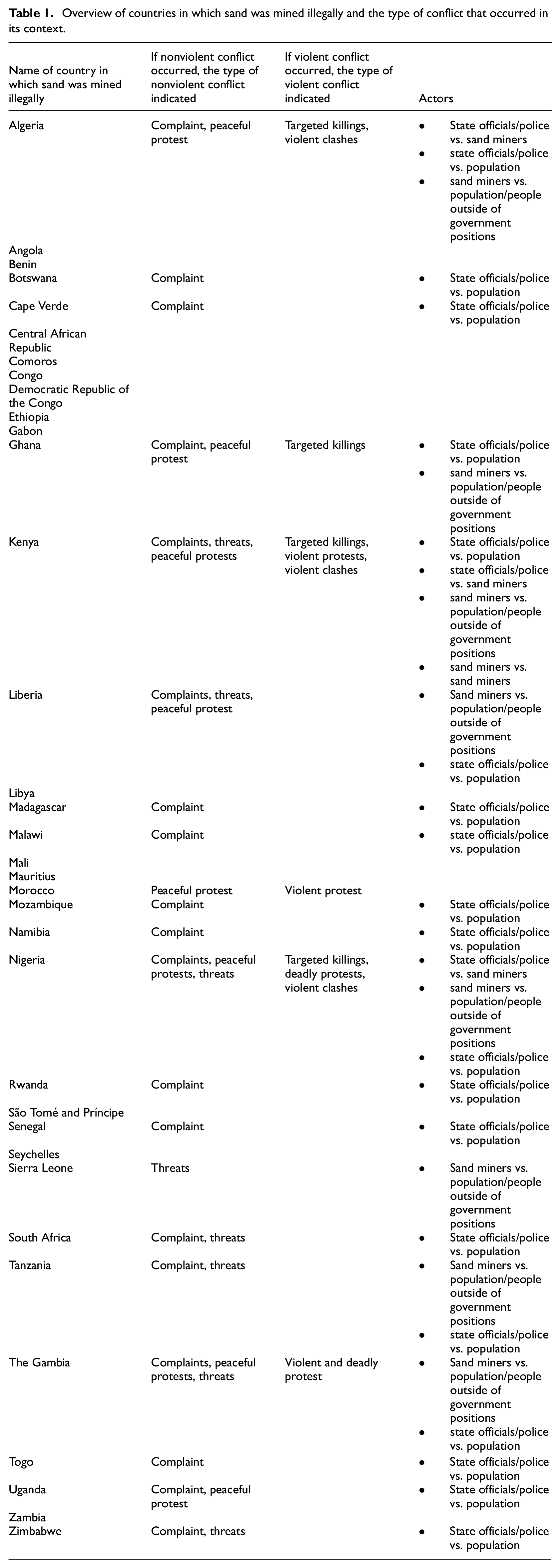
Table 2 provides an overview of the number of times the different types of conflict occurred, according to the information we have collected. The most common form of nonviolent conflict is issued complaints. We noted complaints for 19 of the 21 in which sand was mined illegally and recorded 35 accounts of complaints. Over time, complaints became more common, with 9 of the 35 complaints recorded in 2021. We noted 12 accounts of peaceful protest. They took place in eight different countries and occurred in 2017, 2019, and 2020. Threats were issued in eight countries. The most common form of violent conflict is violent clashes. They occurred in three countries, namely, Algeria (2013), Kenya (2011, 2014, 2015, and 2016), and Nigeria (2017, 2019, 2020, and 2021). Violent protests, targeted killings, and deadly protests occurred least often.
Type of conflict, number of instances, and country names, in which different conflict types occurred.
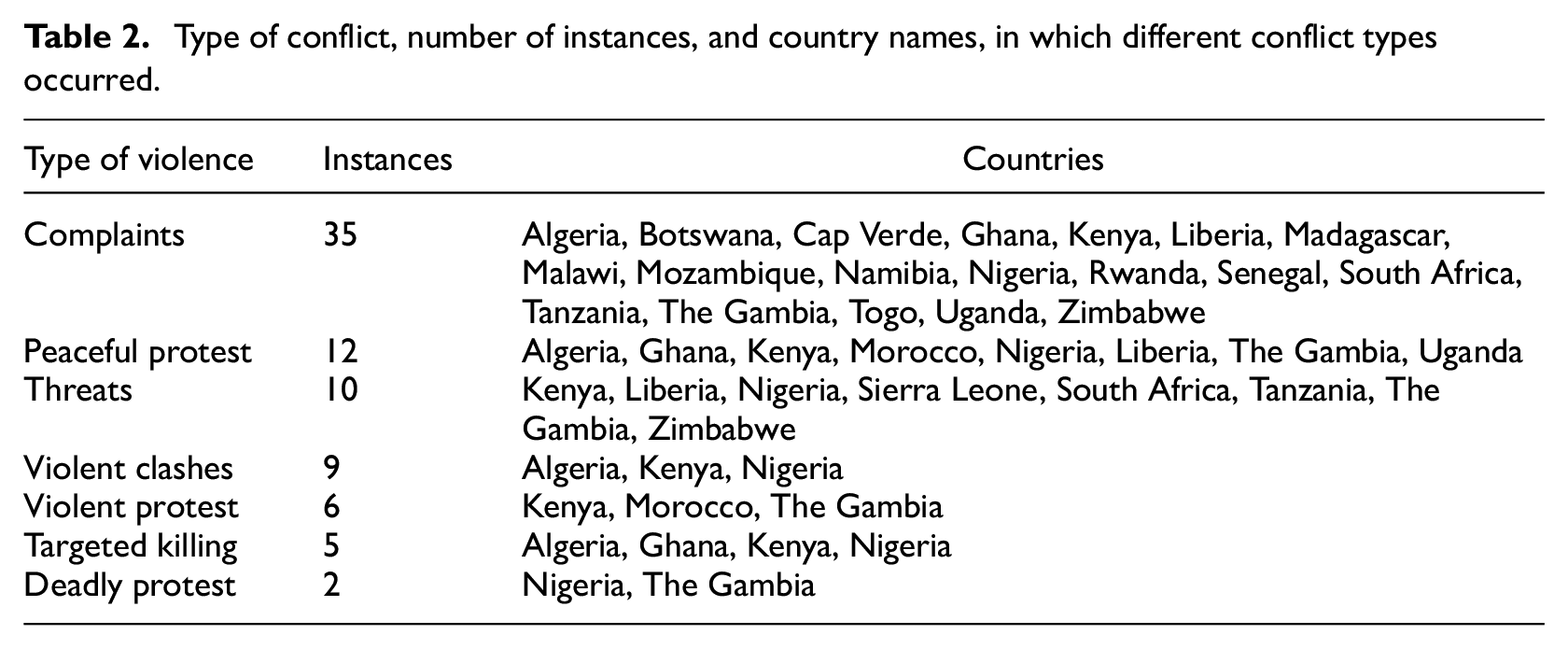
Figure 1 provides an overview of the occurrence of illegal sand mining conflicts over time. The yellow bar indicates how many nonviolent and violent conflicts have occurred in a particular year according to our data, while the brown bar provides information about the number of nonviolent conflicts. The gray bar points out how many violent conflicts occurred in a particular year. It becomes apparent that, according to our data, illegal sand mining conflicts have increased over time. Interestingly, the occurrence of illegal sand mining conflicts has become a phenomenon that can be observed in every year since 2013. A huge gap can be noted for the years 2003 until 2010. For these years, we did not find information on illegal sand mining conflicts. Between 2013 and 2021, the number of conflicts has mostly remained constant or increased and only decreased twice (in 2016 and 2018). In sum, Figure 1 underlines that nonviolent conflict is much more common in the context of illegal sand mining than violent conflict. At the same time, it shows that violent conflicts occurred in all years in which nonviolent conflicts occurred.
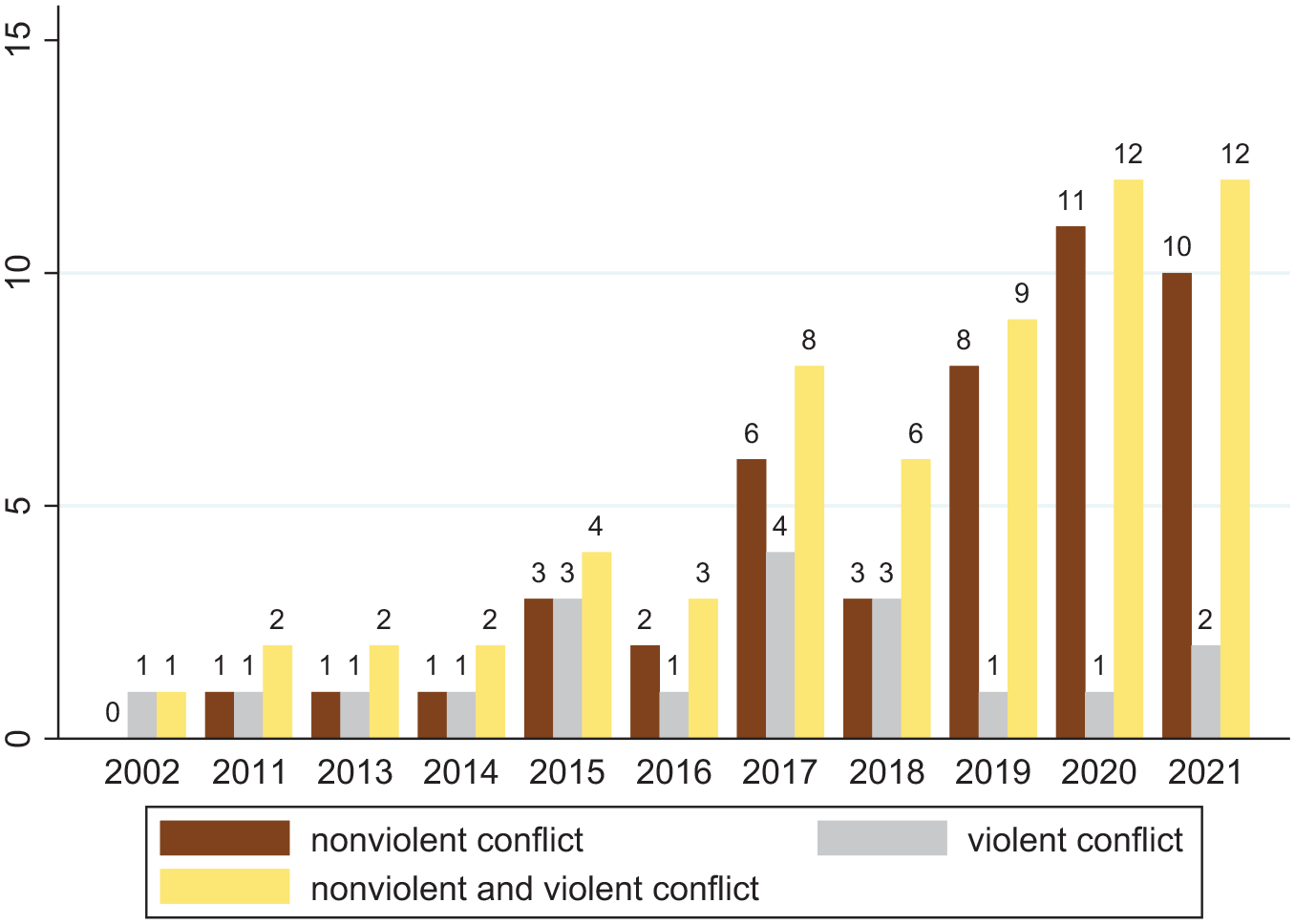
Occurrence of conflicts over illegal sand mining over time.
Figure 2 focuses on the six countries that have seen violent conflicts. It shows how many nonviolent (dark blue) and violent (light blue) conflicts we recorded for these countries. It becomes apparent that Kenya and The Gambia have seen the most violent conflict events. As discussed in footnote 7, Kenya saw a lot more conflicts than the ones displayed in Figure 1. Although the number of sand-related conflicts might seem small, we argue that it is important to learn about possible patterns of conflict escalation in this context because, as pointed out above, “[a]s the demand for sand continues to grow around the world, the body count seems certain to rise with it” (Beiser 2017). Meanwhile, the media might not have picked up on all nonviolent conflicts. Thus, the number of nonviolent conflicts displayed in Figure 1 might be higher.
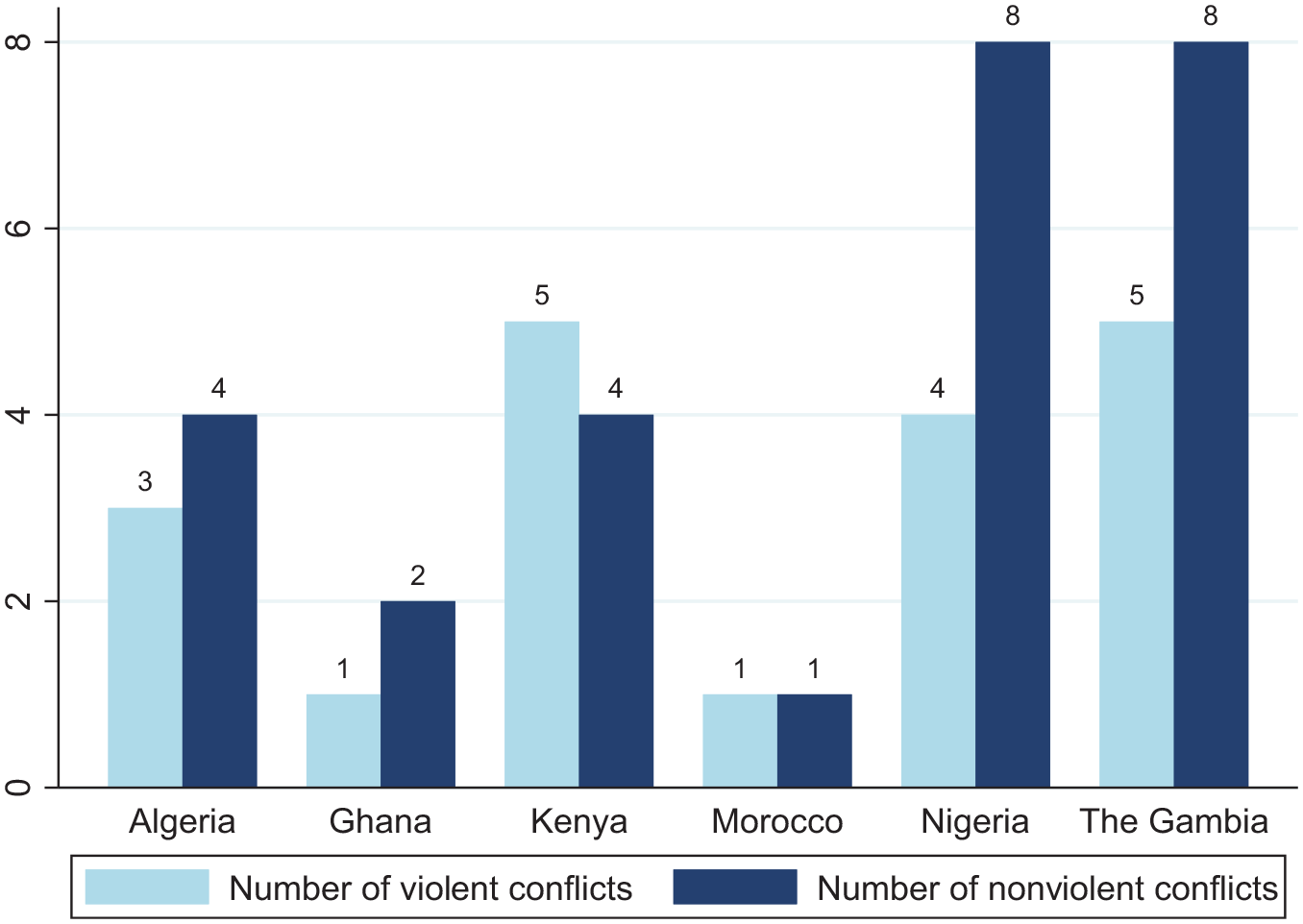
A number of nonviolent and violent conflicts in the countries that have seen violent conflict.
Seeking to learn more about possible patterns of conflict escalation, it becomes apparent that six of the eight countries that have seen peaceful protests have also seen violent conflict according to our data. In other words, in all countries in which violent conflict occurred, peaceful protest also occurred. The same cannot be ascertained for threats issued by the sand miners. Although sand miners have threatened individuals in three countries in which violent conflict occurred, violent conflict did not occur in the four other countries, for which we recorded threats. Meanwhile, targeted killings occurred in four countries. Three of them also saw violent clashes. While the former finding might suggest that a certain level of organization is more likely to lead to conflict escalation, the latter suggests that a certain penchant for violence might lead to clashes. To truly identify the patterns of escalation in illegal sand mining conflicts, more in-depth analysis is necessary. 11
When accounting for the actors engaged in conflicts around illegal sand mining, it becomes apparent that both state-based conflicts—conflicts including the state—and nonstate conflicts—conflicts in which the state is not engaged—took place. These conflicts occurred within states, thus, not across state borders, although sand miners might come from other regions or countries than the one in which sand is being mined illegally.
When seeking to identify patterns concerning these actors, it becomes clear that state-based conflict is of relevance in the category of nonviolent conflict regarding complaints: It is usually the local population complaining about the consequences of illegal sand mining to state institutions. Most protest events are also state-based conflicts. Here, the local population protests against illegal sand mining. If these protests turn violent, it is police officials using violence against protesters and/or vice versa. We can also observe state-based conflict in the categories of targeted killings and violent clashes. All targeted killings that fall into the category of state-based conflicts were conducted by sand miners. Their targets—at times—were government officials or police officers standing up against illegal sand mining. We also noted instances of violent clashes between the police and sand miners. 12
Nonstate conflicts are conflicts that take place between illegal sand miners and the population or other people who do not hold official government positions, such as journalists. All threats and targeted killings we coded were issued or conducted by illegal sand miners—mostly against people who are part of the local population, who stood up to the sand miners. 13 We also noted down protests and reports on clashes between the local population and sand miners, where for example, the local population tried to prevent sand mining by going to the sand mining sites. Finally, violent clashes between different illegal sand mining groups also occurred. They fought over control of the sand mining sites.
This section provided an overview of illegal sand mining conflicts—both nonviolent and violent. It became apparent that the sources we consulted point toward illegal sand mining in 35 African countries, of which 21 saw nonviolent and six violent conflicts. Both state-based and nonstate conflicts occurred between the following conflict actors: state officials/police versus population, state officials/police versus sand miners, sand miners versus population/people outside of government positions, and sand miners versus sand miners. In the following section, we elaborate on the cases that have seen violent conflict.
5. Illegal sand mining and violent conflicts in Africa—Brief case insights
To provide a clearer understanding of the conflicts that can occur in the context of illegal sand mining, we provide brief insights into the conflicts that turned violent in the context of illegal sand mining: Algeria, Ghana, The Gambia, Kenya, Morocco, and Nigeria.
In Algeria, several violent clashes occurred between armed groups engaged in illegal sand mining and the police or citizens. For example, in the mid-1990s, the terrorist group GSPC (Salafist Group for Preaching and Combat) used sand to finance its activities and committed targeted killings of the police and local citizens (Le Soir D’Algerie, 2021). In 2002, targeted killings of three police officers who actively opposed sand mining occurred, while there is evidence of cooperation between people working in the security sector and the terrorists who fund their activities through sand mining. It is stated that armed groups protect illegal sand miners, as sand mining is the main source of funding terrorism (L’Expression, 2002; Le Matin D’Algerie, 2018). In Algeria, illegal sand mining continues until today. Repeatedly discussed in the sources is the fact that it is organized by mafias (e.g., Algérie 360, 2019; Le Matin D’Algerie, 2018). The information on illegal sand mining and violence we collected for Algeria suggests that sand is a natural resource that is used systematically for funding violence.
In The Gambia, in November 2015, villagers who protested against illegal sand mining were violently repressed (Environmental Justice Atlas, 2018). At least 45 people were arrested (Amnesty International, 2015); of the people brought in front of the court, several showed marks of severe torture (The Fatu Network, 2015). In May 2018, people who protested against illegal sand mining clashed with the Police Intervention Unit (PIU), a paramilitary police force. The PIU fired teargas and rubber bullets, while villagers threw stones at vehicles and burned them (Human Rights Watch, 2018; Touray, 2018). In June 2018, two people were killed and at least six were injured by the PIU at demonstrations against a sand mining site (Human Rights Watch, 2018). In the Gambia, the key conflict line seems to run between the local population and the police; protests were organized and repeatedly turned violent.
In Ghana, a man was shot by people who had invaded his property to mine sand illegally in April 2017; he had objected to them mining sand on his land. His death was followed by demonstrations against illegal sand mining, with protesters highlighting that illegal sand mining leads to land destruction, pollution, and diminished rivers (GhanaWeb, 2017). After the death of the man who was shot by illegal sand miners, no more violent acts seem to have occurred in the context of illegal sand mining in Ghana. However, this case shows that sand mining poses a security threat as it becomes apparent how quickly illegal sand miners can resort to violence if they perceive their source of income to be threatened or inaccessible.
Our data suggest that Kenya is the African country that has seen the most intense conflicts in the context of illegal sand mining. 14 Often, illegal sand mining is run by violent sand mining cartels (Daghar, 2022b) or mafias (Beiser, 2017). Sources point to the occurrence of violent conflicts in different parts of Kenya. Makueni County seems to have been most affected by sand violence, especially between 2015 and 2017 (Muthomi et al., 2015, p. 29). Between 2015 and 2016 alone, six people were killed and numerous others injured (Maundu, 2016). The violence occurred among different illegal sand mining groups fighting over the question of who is allowed to mine sand at a particular place. Violence, including targeted killings of illegal sand miners and torching of trucks ferrying sand, was also perpetrated by civilians who organized to fight illegal sand miners, while illegal sand miners committed targeted killings of people who loudly stood up against them (Constable, 2017; Maundu, 2015). When violent clashes occurred, people mostly used bows and arrows, machetes, or Molotov cocktails as weapons.
In Kenya, corruption is generally a huge problem—Kenya is among the 60 most corrupt countries in the world, according to Transparency International (2023). In the context of illegal sand mining, both the police and politicians have been accused of being involved in the illegal sand mining business. Hence, sources report that the local population that fights illegal sand mining does not only attack illegal sand miners but also police officers as they consider police officers to be part of the people engaged in illegal sand mining (Beiser, 2017; Daghar, 2022b).
People suffer from a range of consequences caused by illegal sand mining in Kenya. Prominently discussed are water scarcity and a drastic deterioration of security (Constable, 2017). To combat illegal sand mining, Makueni County has established an institution focusing solely on the governance of sand: The Makueni County Sand Conservation and Utilization Authority. This is the first institution that solely focuses on managing sand in Africa. After the establishment of the Sand Conservation and Utilization Authority and its enforcing regulations systematically, efforts to create awareness about the consequences of illegal sand mining, and the building of sand dams, violence, and the number of illegal sand mining sites reduced. Sand is still mined illegally in different parts of Kenya, however (Obi, 2018).
In Nigeria, cultists financed themselves with illegal sand mining and “harm[ed] others in the community” (Oyewole, 2019). In 2016, sand miners also forced the local population out of areas in which they would like to mine, with threats, and burning houses, leading to the deaths of a pregnant woman and her child (Adebayo, 2017). Similar to the description for Ghana, the case of Nigeria suggests that being in the way of illegal sand miners can bear a substantial security threat, while cultists financing themselves with illegal sand mining underlines the fact that criminal groups have already started using sand for their endeavors. The extent of violence perpetrated by cultists in Nigeria seems to be lower than that perpetrated by armed groups in Algeria though.
In Morocco, the “illegal sand mining business is run by a syndicate second in size only to Morocco’s drug mafia” (Abderrahmane, 2021). In fact, “Morocco has emerged as one of the world’s hot spots for illegal sand extraction” (Zeisl, 2019). Although illegal sand mining occurs on a large scale and is organized, very few accounts of violence can be found. Conflicts occurred, however, when sand was to be mined from a mountain of high historical and cultural value. The local population protested against it, to which the local police responded violently and made several arrests (Environmental Justice Atlas, 2017). 15
The six cases point toward some worrisome patterns concerning violent conflict: (a) illegal sand miners do not refrain from using violence—and organize to use violence—to protect their business; (b) some organized groups use illegal sand mining to finance their violent activities (e.g., cultists in Nigeria and armed groups in Algeria); and (c) the local population organizes to protect their land and resources against illegal sand miners—at times by violent means. (d) Mostly, the perpetrators and victims of violent fighting are young men, although people of all genders, and also children engage in illegal sand mining. In Kenya, increases in rape cases in illegal sand mining areas are reported (Ombuor, 2015), which adds another dimension of violence to the ones we have focused on in our research.
6. Discussion and conclusion
Sand is mined illegally in numerous countries globally with a myriad of consequences. Keeping in mind that many different natural resources, such as opium, timber, or tea (for an overview of resources funding rebellion, see Walsh et al., 2018) play a role in the context of conflict, we wondered whether and how sand is linked to nonviolent and violent conflict. To address this question, we collected information to ascertain where in Africa sand has been mined illegally between 1990 and 2021. Our research showed that illegal sand mining sites existed in 35 African countries in the named time frame. We then addressed the question of conflict in the context of illegal sand mining and found that nonviolent conflict occurred in 21 of the 35 countries in which sand was mined illegally, while violent conflict occurred in six countries, namely Algeria, Ghana, Kenya, Morocco, Nigeria, and The Gambia—all of which also saw nonviolent conflict. The case of Kenya, in particular Makueni County, underlines that taking sand governance seriously can abate problems caused by unmanaged sand mining. Makueni Country established the Sand Conservation and Utilization Authority, which implements regulations on sand mining and coordinates sand management activities among others (Makueni Country Sand Conservation and Utilization Authority, 2023). After having put sand governance more prominently on the agenda, illegal sand mining—and with it, conflicts around it—drastically reduced in Makueni County. Other regions and countries can learn from this example.
Extant work also discusses different other factors for ending illegal sand mining. A key aspect is public awareness. Calling the public’s attention to the devastating consequences of illegal sand mining can enforce action being taken by the responsible authorities (Filho et al., 2021; Koehnken, 2018; Peduzzi, 2014). Arifin and Handayani (2022) demonstrate how mass media coverage brought a halt to illegal sand mining activities in the Brantas River Basin, Indonesia. Closely linked to the need for public awareness is the necessity to educate (inter-) national and local communities about the consequences of sand mining (Filho et al., 2021). Regarding the governance level, clear and coherent legislation needs to be designed and implemented to determine under which circumstances (if at all) sand can be mined. Legal and policy action taken should be informed by in-depth scientific research, (environmental) assessments, and monitoring, and needs to be open for adaptation (Chevallier, 2014; Filho et al., 2021). Effective legislation and monitoring must also be installed on the international level (Filho et al., 2021; Peduzzi, 2014). Furthermore, ensuring legal enforcement is of great importance (Chevallier, 2014; Filho et al., 2021). Sustainable substitute materials for sand must be introduced to reduce the dependency on the (finite) resource (Chevallier, 2014; Filho et al., 2021; Peduzzi, 2014). Meanwhile, insights from the management of other common pool resources (i.e., Ostrom, 1990) might be crucial indicators for successful sand governance.
Linking up illegal sand mining with conflict also has implications for research. It calls a natural resource on the plan that thus far has been neglected in systematic research on cooperation, conflict, and violence, and suggests that linking different resources and their scarcity in systematic analysis, such as sand and water, can be worthwhile. Accounting for sand and its link to water suggests an increased impact of climate variability on the population in and around sand mining areas due to sand that has been mined. At the same time, further research needs to complete the picture of where in the world sand is mined illegally and where conflicts occur in this context. Learning more about the structural conditions for conflict onset and termination as well as for cooperation in the context of sand mining would be necessary to establish mechanisms of conflict prevention.
Broadening the view to research on other natural resource conflicts, similarities, and differences become apparent. For example, Sexton (2020) points out that people mobilize in particular when the consequences of mining become apparent. 16 By contrast, high-quality governance can reduce the likelihood of conflict erupting. 17 Our data and case insights suggest a similar pattern for the eruption and management of illegal sand mining conflicts. Knutsen et al. (2017) argue that while mines are often located in less corrupt areas, the opening of mines increases corruption levels: the local population holds more money and thereby can pay bribes more often and at a higher level. Thus, especially bribery in the police increases. Their results suggest a “local political ‘resource curse’” (Knutsen et al., 2017, p. 321). While we cannot ascertain whether corruption levels increase, case insights certainly support the notion that police bribery is not a rarity in the context of illegal sand mining. However, contrary to Krauser (2020), who finds that mining sites are free of violence, “but imperiled at the perimeter” (Krauser, 2020, p. 1968), illegal sand mining sites are often where violence occurs. Eck (2014) argues that in competing jurisdictions around land in countries, in which different identity groups are living, communal conflict can arise due to insecurity about which legal system prevails. This does not seem to be a major issue in the context of illegal sand mining. Further research on illegal sand mining conflicts needs to systematically establish whether similar trends in conflict escalation and management to other resources can be identified.
Overall, illegal sand mining has an important impact on peace and security. We noted both state-based and nonstate conflicts with different levels of organization to them—ranging from threats and targeted killings to organized protests or violent clashes between sand miners or between sand miners and the local population or the police. While the population living in sand mining areas might stand up against illegal sand miners due to, for example, water scarcity induced by sand mining, those engaged in illegal sand mining might also fight each other over the control of the sand. People might organize to protest illegal sand mining, demanding action from the government. The underlying tensions and explicit expressions of violence, next to the environmental consequences of illegal sand mining, can have a substantial impact on the security of the population living in the sand mining areas. Besides, the population living in sand mining areas faces an increased vulnerability to natural disasters as floods after heavy rains, or water scarcity after drought can become more common. A loss of biodiversity and infrastructural damages often also come along with excessive sand mining (Filho et al., 2021; Koehnken, 2018). 18 Meanwhile, the revenues from illegal sand mining can be used to finance different endeavors, among others, organized violence, which was the case in Algeria and Nigeria. This bears the threat of more than local conflict. The impact illegal sand mining has on peace and security needs to be accounted for by policymakers.
Footnotes
Acknowledgements
We are grateful for the helpful feedback we have received from the anonymous reviewers, Margit Bussmann, Belén González, Julia Hagen, Tobias Ide, Anja Jetschke, Ole Kelm, Burcu Ucaray-Mangitli, and Adam Scharpf. We thank Omar Kassar Abo Alkhair, Emilie Brietzel, and Hanaa Ebrahem for their valuable research assistance and are thankful for the support we have received from the Equal Opportunities Commission at the Social Science Faculty of the University of Göttingen.
Funding
The author(s) received no financial support for the research, authorship, and/or publication of this article.

Data availability
The data is avaiable as complimentary material to this article.