



Abstract
This article examines how digital fundraising reconfigures cultural entrepreneurship among DIY musicians. Through interviews with Dutch DIY musicians who have successfully used crowdfunding and representatives from two platforms, we demonstrate how crowdfunding enables musicians to mobilize Bourdieu's alternative forms of capital and convert them into economic capital. While social capital remains a key driver of economic capital in crowdfunding, our study highlights how fan communities, rather than peers, now provide the favors that support music production. Crowdfunding campaigns not only generate buzz but also serve as a reputation qualifier for programmers and funders, converting symbolic capital (recognition) into future economic returns. The involvement of backers, sometimes as cocreators, reinforces this process by signaling market demand. However, we also identify the hidden costs of building a fanbase, where sustained engagement can lead to the forgoing of economic capital.
Introduction
Why someone succeeds or fails in the arts remains something of an enigma. What is clear is that talent alone is not enough, nor is entrepreneurial agility (Everts et al., 2022; Hoffmann et al., 2021; Kackovic et al., 2020). Moreover, “making it” can mean different things to different people; for many, earning a living from their art is already a form of success (Abbing, 2002; Udo et al., 2025).
In a seminal 2012 article, Michael Scott, drawing on Bourdieu (1986, 1993, 1997), describes the process of capital mobilization and conversion among cultural entrepreneurs, focusing on music producers. Scott (2012) outlines how an economy of favors among peers promises deferred rewards (Throsby, 2001) and how “buzz” leads to recognition by cultural intermediaries. Within this dynamic, insider networks play a critical role in career development within the music industry, as they do in other arts sectors (Braden and Teekens, 2019; Fraiberger et al., 2018).
With the rise of digital technologies, there was a moment of optimism: perhaps lower entry barriers would democratize cultural production and consumption (Anderson, 2006) and alleviate the precarious working conditions of creatives by enabling more direct and diversified income streams (Ross, 2009). Yet this hope was premature. The dominant players in the cultural industries, still shaped by oligopolistic market structures, adapted quickly, maintaining control over market mechanisms through new business models and their usage of big data, curated playlists, and algorithms (Frenneaux, 2023; Hodgson, 2021). While entry barriers may have lowered, the gatekeeping walls in many ways appear higher than ever in what is sometimes seen as an oversaturated market (Everts et al., 2022; Haynes and Marshall, 2018a; Klein et al., 2017; Shapiro and Varian, 1999). At the same time, digitalization and the internet have created new financing opportunities for creatives (Dalla Chiesa and Rykkja, 2026; Loots et al., 2022). Crowdfunding, or project-based funding sourced from the public via digital platforms, offers one potential alternative for independent or “do-it-yourself” (DIY) musicians who seek genuine artist–fan interactions, fundamental in the contemporary music economy (Guerra, 2021; Oliver, 2024).
This article aims to analyze how crowdfunding reshapes processes of capital mobilization and conversion among DIY musicians in the Dutch music industry by asking: How do capital mobilization and conversion processes currently operate for musicians, now that crowdfunding is among the available tools? and, What is the role of favors and buzz in this digitalized DIY economy? Using Scott's (2012) analytical lens, this exploratory study draws on interviews with Dutch independent musicians who have successfully engaged with crowdfunding platforms, as well as representatives from two platforms. While prior literature has established the importance of social capital in crowdfunding, particularly its ability to generate economic capital (Cai et al., 2021; Shneor et al., 2024) with its related thick and thin social ties (Dalla Chiesa and Dekker, 2021), our aim is to provide a fresh perspective by revisiting these processes as processes of capital mobilization and conversion (Bourdieu, 1997; Scott, 2012).
This article first outlines the theory of capital mobilization and conversion, then examines how digitalization and crowdfunding have reshaped the music industry. After describing the data and methods, it analyzes how DIY musicians use crowdfunding strategically and discusses how these insights refine existing theory, concluding with implications for future research.
Literature review
DIY musicians’ capital mobilization and conversion
Scott (2012) provides a detailed account of how Bourdieu's (1986, 1993, 1997) forms of capital are mobilized in the context of music production. He describes cultural entrepreneurs as a youthful group pursuing artistic ambitions while often holding multiple jobs. These entrepreneurs frequently operate from positions of limited economic means, under precarious conditions; they are, as Ellmeier (2003) puts it, “sans capital.” To build their careers and strengthen their positions within the field, cultural entrepreneurs mobilize and convert various forms of capital: social, cultural, and symbolic (Bourdieu, 1986, 1997; Pret et al., 2016; Venema and Wijngaarden, 2024).
In the music field, social capital refers to the networks and connections that grant access to shared group resources. DIY musicians who can draw on their social networks may benefit from collaborations that support the development of their careers and projects. However, social capital often proves valuable only when accompanied by cultural capital, or inherited cultural experience (Bourdieu, 1986, 1997). Within a music scene, cultural capital encompasses knowledge of genre conventions and trends, as well as musical skills and expertise (Scott, 2012). For instance, the cultural capital of jazz musicians includes the ability to perform a repertoire of jazz standards, whereas for a black metal band, it may involve adherence to genre-specific lyrical themes, body art, and naming conventions. This “objectified” cultural capital is expressed through prior achievements, such as self-released recordings (Scott, 2012). Formal education contributes to cultural capital by developing practical know-how for navigating the field, representing its institutionalized form and shaping an individual's habitus (Bourdieu, 1997; Schediwy et al., 2018; Scott, 2012).
Symbolic capital refers to an individual's accumulated prestige, reputation, and recognition (Bourdieu, 1991; Pret et al., 2016). According to Scott (2012), music producers may acquire symbolic capital through awards, chart rankings, record sales, media reviews, competitions, successful tours, endorsements from prominent artists and performances at prestigious venues. Despite ongoing transformations in the music industry, key indicators of reputation have remained consistent over time (Everts et al., 2022).
Social, cultural, and symbolic capital possess a “use value.” In music, this use value is found in its capacity to evoke emotional responses or to support the construction of personal or collective identities (Scott, 2012; Skeggs, 2004). In addition, these “alternative forms of capital” have exchange value, derived from music's commodified form and people's willingness to engage in economic transactions for music products. Since DIY musicians often begin their careers from economically constrained positions, they depend heavily on the mobilization and conversion of these capitals, drawing on both their use and exchange value. One key mechanism through which this occurs is the exchange of “favors” (Scott, 2012). Musicians, engineers, and producers frequently collaborate out of a shared passion for the craft, optimism about a new artist's potential, or loyalty to peers within the scene, all motivations rooted in use value that can, over time, translate into exchange value.
Another essential element in the mobilization and conversion of capital is the generation of “buzz.” In a crowded and competitive music industry, DIY musicians must cultivate buzz, defined as “the infectious power of rumours and recommendations circulating through dense cultural intermediary networks” (Scott, 2012: 244). By generating buzz, DIY musicians attempt to position themselves as “subjects of value” in the eyes of intermediaries, such as managers, record labels, publishers, booking agencies, journalists, and funding bodies, who have the power to facilitate their access to broader markets (Skeggs, 2004).
Technological developments in music recording, distribution, and promotion
Digitalization has driven significant technological developments in music recording, distribution, and promotion. In the predigital era, music recording was heavily dependent on record labels operating within an oligopolistic market structure (Peterson and Berger, 1975). Recording was costly and required access to professional studios, specialized equipment, and the expertise of studio technicians, record producers, and mastering engineers. Record labels expanded through vertical integration, gaining control over multiple layers of the music production process (Peterson and Berger, 1975). Ambitious musicians needed to be discovered by these labels, which functioned as key gatekeepers. During this time, acts such as The Buzzcocks bypassed these structures by self-releasing their debut EP and promoting it through self-made magazines sold in small retail outlets, thereby laying the groundwork for future DIY artists (Frenneaux, 2023). Today, digitalization provides DIY musicians with both the know-how and the tools to record music from home at a minimal cost. Digital audio workstations such as GarageBand, Ableton Live, and Cubase offer a wide range of features, enabling artists to mix, master, compress, sample, and sequence music independently (Prior, 2010). Artists such as mxmtoon and Billie Eilish have helped popularize the “bedroom pop” aesthetic, launching successful careers from home-recorded music (Barna and McLaughlin, 2024).
Second, alongside recording, music distribution has also undergone a radical transformation. In the predigital era, recorded music was primarily distributed through physical formats such as LPs, CDs, and cassettes. Between 1985 and 2000, the music industry experienced a “golden age,” with global sales quadrupling from $10 billion to $40 billion (Sanghera, 2002). Major labels saw consistent growth in CD sales during this period (Leyshon et al., 2005). However, with the advent of digitalization and the internet, the industry's business model began to shift. In the 1990s, the MP3 format made downloading music simple and widespread (Sterne, 2012), followed by the emergence of peer-to-peer file-sharing platforms such as Napster. This era introduced the threat of internet piracy, as unauthorized copies of copyrighted music circulated rapidly (Hesmondhalgh, 2021; Leyshon et al., 2005). The disruptive impact of the internet on traditional distribution structures forced the music industry to adapt. A key turning point came with the rise of on-demand streaming platforms like Spotify in the late 2000s, which introduced a business model that compensates both musicians and labels. Unlike the “record shop model,” music is now distributed partly “for free,” resembling the predigital radio era, while platforms generate revenue through advertising and subscription-based premium services (Hesmondhalgh and Meier, 2018). The shift from music as a physical product to a digital good, reproducible at near-zero marginal cost, has significantly lowered production expenses and has reduced barriers to entry (Waldfogel, 2017). Recent industry data show that global recorded music revenues reached $29.6 billion in 2024, marking a tenth consecutive year of growth, with streaming revenues exceeding $20 billion (IFPI, 2025). This expansion, however, has not translated into improved income conditions for independent musicians. The digitally accessible music landscape has also led to oversupply pressures (Caves, 2000) and information overload (Shapiro and Varian, 1999), intensifying competition among musicians for listeners’ attention. In response, streaming platforms have assumed a gatekeeping role through their recommendation algorithms and curated playlists, increasingly shaping the success of songs and consumer tastes (Bonini and Gandini, 2019). This influence has prompted some producers to tailor their music specifically for these platforms, resulting in what has been called “Spotify-friendly” music (Hodgson, 2021).
Third, online and digital technologies have also transformed promotion opportunities. In the past, record labels invested heavily in promotion through mechanisms such as payola, paying radio, or television stations to play their artists’ music. Today, a strong social media presence has become essential for musicians (Klein et al., 2017). Some artists, such as YouTubers who initially gained attention through song parodies, have transitioned into mainstream pop stars, supplementing their income with merchandise sales and sponsorship deals. Although social media can help maintain a fanbase, musicians still depend on more traditional audience engagement and often view digital platforms ambivalently, recognizing both their promotional benefits and structural limitations (Haynes and Marshall, 2018b; Hesmondhalgh and Valdovinos Kaye, 2025; Klein et al., 2017). Overall, digitalization has expanded possibilities for DIY musicians in recording, distribution, and promotion, allowing them to bypass traditional gatekeepers. Yet record labels still act as quality signals and help reduce audience search costs, so they are far from obsolete.
Crowdfunding as an online funding method for musicians
Digitalization has also opened new funding opportunities for musicians. A well-known example is Radiohead's release of their album In Rainbows as a free digital download, accompanied by an optional donation link and a deluxe edition. The band generated substantial revenue directly from fans through digital and physical sales (Tschmuck, 2016). For a time, touring artists saw their income from ticket and merchandise sales become more lucrative than revenue from recorded music (Tschmuck, 2016). Touring, however, mainly benefits high-demand musicians, while for others it can exacerbate precariousness and strain well-being, due to increased (post-COVID) costs and foregone earnings (Zendel, 2021). While streaming has become the dominant way audiences access music, it generates relatively limited income for musicians, especially those with smaller audiences (Aguilar and Waldfogel, 2018). Evidence suggests recorded music earnings still have not returned to predigital levels, with revenues for featured artists and studio producers falling 41% in real terms between 2000 and 2019 (Hesmondhalgh et al., 2021). As a result, less mainstream and independent artists are compelled to seek alternative income streams.
Crowdfunding, introduced about two decades ago by musicians, has opened new opportunities for creators to reach audiences. Crowdfunding can serve as a means of generating economic capital with relatively low transaction costs, while also allowing creatives to test market interest and increase their visibility (Handke and Dalla Chiesa, 2022). As a demand-driven model, crowdfunding suits project-based initiatives and provides a flexible alternative to traditional subsidies, with simpler requirements (Dalla Chiesa, 2022; Loots et al., 2025). Crowdfunding has been described as a relatively low-risk environment for both creators and backers: on two-sided market platforms, creators can delay production until a minimum level of demand is confirmed, while backers commit funds only if a campaign meets its target (Handke and Dalla Chiesa, 2022). However, this holds true primarily for All-or-Nothing (AON) campaigns, in which contributions are refunded if the funding goal is not reached. In contrast, Keep-it-All (KIA) campaigns allow the campaigner to retain any funds raised, regardless of whether the initial target is met. Creatives generally prefer AON models due to lower assurance risk: if a campaign fails, backers are refunded, unlike in KIA models. Although musician-specific evidence is limited, studies show AON can have higher success rates due to costly commitment signals (Cumming et al., 2020). Musicians should still try to engage as many potential backers as possible.
Different forms of crowdfunding coexist, with DIY musicians mostly using reward-based, donation-based, and subscription-based models. Reward-based crowdfunding is most prevalent in the cultural sectors. Rewards make backers early customers who receive early access to the cultural product at a low price (Mollick, 2014). These rewards are usually low marginal cost, making them suitable for musicians (Handke and Dalla Chiesa, 2022), though special donors may receive unique perks like personalized videos or living room concerts. Donation-based crowdfunding entails single donations without rewards in return. Subscription-based crowdfunding occurs on platforms such as Patreon, where campaigns have no end goal or end date and can continue indefinitely (Regner, 2021). This model helps creators connect directly with audiences and encourages regular content production to maintain fan subscriptions. Independent musicians can gain temporary cash flow, but career sustainability depends on maintaining enough patrons and attracting additional income, such as ads or platform-based revenue (e.g. on Twitch or YouTube).
Recently, public authorities have begun supporting crowdfunding through matching funds, thereby legitimizing the model from a policy perspective (Dalla Chiesa et al., 2025; Loots et al., 2024). The Dutch platform Voordekunst, for example, enables public–private partnerships through online match funding with local foundations, municipalities, and regional governments supporting campaigns aligned with their thematic interests (Dalla Chiesa et al., 2026). Similar mechanisms exist in countries such as Canada, Brazil, and the UK, and are likely to become more prominent as cultural budgets decline (Dalla Chiesa and Rykkja, 2026).
Success in crowdfunding depends mainly on campaign quality and credibility signals, including budget, visuals, media, language, and reward tiers (Mollick, 2014). Professional presentation signals a strong work ethic and increases success likelihood. However, social capital plays a key role in crowdfunding. Campaigners’ networks help attract early support, as contributions from family and friends signal commitment. Colombo et al. (2015) argue that “internal social capital,” which is support from the platform community, is especially important, as early donations based on reciprocity norms improve success more than external social networks. Previous research suggests that DIY musicians have approached crowdfunding cautiously and perceived limited benefits from platforms’ fandom effects, with word of mouth and close contacts remaining central to backer support (Dalla Chiesa, 2022).
Data collection and analysis
This study employed a qualitative approach based on semistructured interviews to explore how crowdfunding platforms influence capital mobilization and conversion among DIY musicians in the Netherlands. A purposive sampling strategy was used to identify ten DIY musicians who had run successful campaigns on reward-, donation-, and/or subscription-based platforms (Bryman, 2016). Selection was based on three criteria: participants (1) successfully completed a crowdfunding campaign, defined as reaching the funding goal for reward- and donation-based campaigns, or earning at least $750 per month for subscription-based campaigns; (2) were based in the Netherlands; and (3) were not affiliated with a record label during the campaign. Additionally, two professionals working for crowdfunding platforms were interviewed.
Table 1 provides an overview of participants. All interviewees gave informed consent, and names and identifying details have been anonymized using pseudonyms to protect confidentiality. Seven DIY musicians conducted reward-based crowdfunding campaigns via Kickstarter, Indiegogo, or Voordekunst; one used a donation-based campaign through GoFundMe; and two ran long-term, subscription-based campaigns on Patreon. One expert represented the Dutch reward-based platform Voordekunst, while the other represented the UK-based mixed-model platform RocketfuelHQ, which combines donation-, reward-, and subscription-based crowdfunding. The British interviewee is treated as an insightful outlier perspective (Aguinis et al., 2013), as it contributes to covering the full spectrum of crowdfunding types. Interviewees varied in age, career stage, genre, and crowdfunding motivations (recordings, tours, and education), with campaigns differing in size and scope, providing a broad view of practices.
List of interviewees.
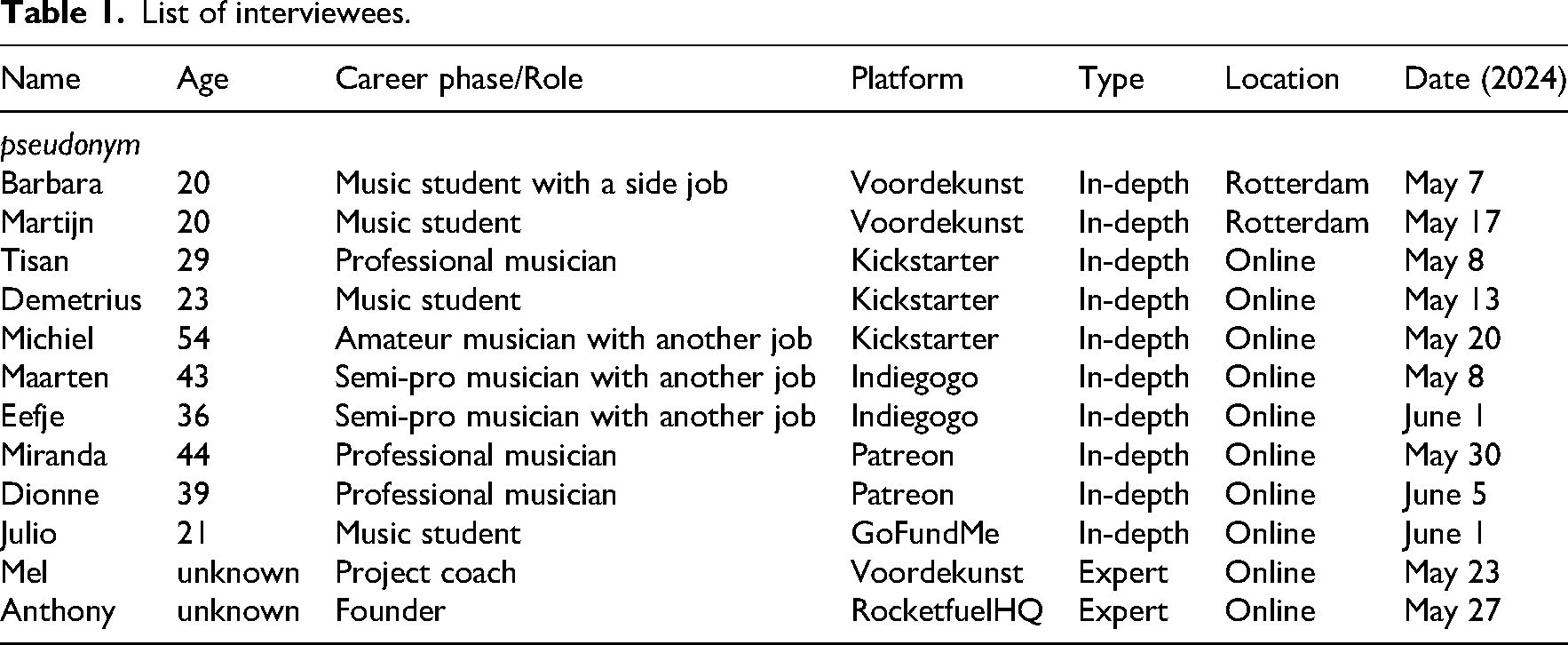
The interviews, lasting between 30 and 75 minutes, were conducted in May and June 2024. They addressed themes such as motivations for crowdfunding, factors contributing to campaign success, the role of cultural intermediaries, and the impact of social media on crowdfunding strategies. Questions were designed to align with Scott's (2012) theory of capital mobilization and conversion, while also allowing space for participants to introduce additional relevant concepts.
Interviews were transcribed and thematically analyzed in ATLAS.ti using an abductive approach, moving between Scott's (2012) framework and emerging themes. The first author conducted the initial coding, identifying key concepts and recurring themes; the second author joined in later rounds to refine these into broader categories such as motivations, cultural intermediaries, and the effects of digital platforms on capital conversion.
Findings
How DIY musicians strategize crowdfunding
Musicians typically use reward-based and donation-based crowdfunding to finance various aspects of cultural production, including studio costs, mastering, mixing, promotion, artist fees, artwork, and distribution. These models generally generate direct support for a specific cultural project. Rewards often take the form of presales, though more creative incentives occur. Importantly, musicians do not perceive offering rewards as a burdensome obligation. In reward-based crowdfunding, they appear to feel empowered by the transactional nature of the process, as offering rewards reflects a form of reciprocity between artists and their supporters. Donation-based crowdfunding does not require rewards, making it useful when time or resources are limited. One musician used it to fund his education as a non-EU citizen; though uncomfortable, he saw it as necessary. It is generally viewed as a way to raise emergency funds. One respondent critically noted: “Donation-based crowdfunding is more suited for people who need surgery; it doesn’t really work for the creative industry.” On subscription-based platforms such as Patreon and RocketfuelHQ, musicians can use accumulated funds flexibly. Regular monthly contributions provide greater autonomy in planning and investment decisions. For example, a singer in two established metal bands relies on subscription-based crowdfunding to “always have the money to jump into the studio whenever needed, without having to meticulously plan everything in advance.”
Platform choice also depends on reach and language. Indiegogo and Kickstarter suit musicians or genres with international appeal and global fanbases, while smaller local platforms better reach regional audiences and may offer additional campaign support. In addition to crowdfunding models and platform reach, a third consideration is choosing between AON and KIA models. One participant preferred AON for EP funding to ensure refunds if the goal was not met, while another chose KIA to finance album artwork, promotion, and distribution, where any funds raised could support these ancillary activities.
Perceived success in crowdfunding
The Dutch crowdfunding platform's project manager explains that campaigns require a realistic fundraising goal, with approximately 80% of contributions typically coming from the creator's personal network, which must be mobilized before the campaign launch. To reach family, friends, and fans, musicians leverage social media and adopt a personalized communication style, carefully planning how and when to engage their audience. For example, Demetrius relied on friends with marketing expertise and observed that his campaign introduced new listeners to his music, turning them into fans who later attended his performances. Similarly, Tisan, a jazz/funk pianist and singer adept at working with algorithms, strategically targeted areas such as his birthplace in India, and Los Angeles and New York, where his genre is appreciated. He observed a noticeable impact on the donations to his Kickstarter campaign.
Respondents highlight how symbolic capital gained through previous accomplishments contributes to crowdfunding success. Tisan explains: “Right before the campaign, I performed at several major festivals, including North Sea Jazz. Mentioning this in a campaign signals to potential backers, especially those unfamiliar with your work, that you are credible.” Eefje, a member of a trip-rock band, adds: “Our guitarist was in a well-known band in the 1990s, and I play in another group with a substantial fanbase. The combination of our existing fanbases and past successes played the most significant role in our crowdfunding success.” Similarly, Demetrius secured collaboration with a renowned American jazz saxophonist for his album, which likely served as a quality mark. These are clear examples of the symbiotic relationship between cultural, social, and symbolic capital. Two campaigns on Voordekunst benefited from match funding from regional public funds. As Mel from Voordekunst, explains: “We have match funding partners who actively fund our crowdfunding projects. These are municipalities, provinces, and private and public funds. We, as project supervisors, try to match creators with these funds.” This institutional support serves as a quality signal in itself.
Five out of the eight musicians who conducted reward-based or donation-based campaigns express interest in future subscription-based crowdfunding. They emphasize the importance of having a fanbase and speculate how subscription-based and hybrid platforms, such as Patreon and RocketfuelHQ, link funding to fandom, often directly tied to an artist's live performances. These platforms enable musicians to provide continuous feedback and rewards to their supporters. Dionne elaborates: “You need to keep your audience engaged. Think of it as running a business; if you are inconsistent, your backers won’t know what to expect from their subscriptions.” Anthony distinguishes between different types of fans and their engagement: “Some fans are value-seekers who focus on getting a product at a good price, while others want to make a meaningful impact. They may not be interested in contributing $50 but would rather invest $5000.” While some backers seek recognition through exclusive or personalized rewards, such as credits in an album leaflet, others prefer to donate anonymously. Anthony underscores the importance of catering to all supporter types, stating: “If you focus all your energy on just one potential backer type, you risk missing out on 80% of your audience.”
Altruism and patronage are vital to crowdfunding success across platforms. Mel explains: “People like to be personally involved. Because of their donations, the production of a project is possible. For that reason, backers feel like they are part of the production process.” Many backers have long followed musicians’ projects. Beyond choosing higher-tier rewards for their quality, supporters often contribute primarily to the artist's financial support. Additionally, backers show goodwill by sharing campaigns online and boosting visibility, and as such, attracting extra donations.
Capital mobilization and conversion in crowdfunding
Musicians leverage their human capital to create music, which they aim to eventually convert into economic capital through creating demand for their music. Crowdfunding platforms support this process by cultivating social capital and fostering dedicated fanbases. Two musicians using donation-based platforms noted that these platforms help deepen relationships with their supporters. In this way, crowdfunding becomes fanfunding. This leveraging of social capital into economic capital is well recognized by platform owners. For example, Anthony, founder of RocketfuelHQ, stresses the importance of community building: “Most crowdfunding campaigns are “hit and run”—once they reach their goal, they shut down. Our aim is to transform the crowd into a community. RocketfuelHQ is the marketplace where these communities engage and support artists.” Similarly, Voordekunst encourages campaigners to engage backers directly by sharing behind-the-scenes videos and previews from the creative process. According to Mel, this generates excitement for the final release even before the campaign ends.
Human capital and social capital interact in at least two additional ways. First, designing a series of rewards mobilizes human capital and can generate social capital by expanding or strengthening a fanbase. In addition to presales, most respondents offered exclusive rewards such as personalized thank-you videos, signed CDs, naming opportunities in album liner notes, and even private concerts. Creating original and compelling rewards requires not only musical skills but also creativity and entrepreneurial thinking. Second, fans’ human capital can also be activated. Artists on platforms like Patreon share unreleased demos and ask for honest feedback. A participant explains: “I share songs before their release date, and my fans are always honest with their opinions. It also really helps build excitement for what's to come.” Another participant used a reward-based platform to give backers a direct role in production, aiming to cocreate his debut EP and strengthen ties with supporters. Whereas the ultimate goal of crowdfunding is to generate economic capital, musicians “are not just trying to attain economic capital through crowdfunding; they are also positioning themselves as artists and putting their music on the map,” which equals developing symbolic capital.
Crowdfunding can assure economic capital from sources other than crowds as well. Whereas three of the eight musicians considered applying for grants to support their projects, they saw crowdfunding as less time-consuming than obtaining grants. Barbara explains: “Besides crowdfunding, I also explored subsidies, but the application process was lengthy, and I ultimately did not receive one. That's why I decided to pursue crowdfunding instead.” A successful crowdfunding campaign not only raises capital but can also increase the likelihood of securing future public funding. As Eefje confirms, “Our successful Indiegogo campaign served as a quality stamp when we applied for grants at Cultuurfonds and Sena, demonstrating demand for a second album.” The reverse sequence can also occur: progressive jazz drummer Demetrius first secured a subsidy from Gave, which he then used to promote his Kickstarter campaign via social media ads.
Crowdfunding can secure not only direct financial support but also postponed economic capital by increasing visibility and drawing attention from professionals. The buzz generated by a campaign can influence cultural intermediaries such as venue and festival programmers. As Mel notes, “A successful crowdfunding campaign acts as a stamp of approval for bookers at venues and festivals.” Interestingly, all musicians agree that attracting record label attention is not a priority. Still, they recognize that a reputable label can be beneficial, as its financial resources help artists reach wider audiences, and labels maintain a dominant role on Spotify, reflected in the prevalence of signed artists on curated playlists. Several respondents highlight how the role of labels has evolved. Maarten, whose band was previously signed before turning to crowdfunding as an independent group, explains: “Labels have changed since the 2010s. They used to provide upfront funding for studio recording. Now, labels are only interested if you already have a finished album.” This shift led Maarten's band to record and release their album independently, raising the funds needed through crowdfunding. As such, musicians see crowdfunding as a substitute for labels’ (previous) financial investments in production. Eefje states “We weren’t signed to a label during our crowdfunding campaign, and we still aren’t. We don’t see it as essential. We financed the album ourselves, so what more could a label offer?” She adds that by securing economic capital independently, the band maintains full creative control and retains ownership of their copyrights.
While crowdfunding is primarily intended to raise money, building social capital in the form of a fanbase can come at a cost, particularly in reward-based campaigns, which may create financial setbacks that musicians did not anticipate. For example, one musician shared how their band was unprepared for many international backers, resulting in “spending most of our crowdfunding money on postage costs.” Another musician underestimated the time needed to sign and send CDs. Musicians on subscription platforms such as Patreon and RocketfuelHQ regularly produce exclusive content for their most dedicated fans. This resembles how platforms like OnlyFans allow creators to engage subscribers continuously, providing regular content in exchange for ongoing financial support. One musician dedicates Monday mornings to sharing voice memos about her weekend and upcoming plans: “I keep it personal, telling them about going to the dentist and how I’m not looking forward to it. I also ask what they’re not looking forward to this week.” She notes that this content is easy to create and popular with fans. However, such “musicianfluencing” comes with the opportunity cost of time that might otherwise be used to work and generate economic capital. Moreover, the pressure to constantly produce may reduce quality, risking the loss of symbolic capital.
The roles of buzz and favors in crowdfunding
Crowdfunding generates buzz, but not exactly as Scott (2012) described. Some platforms enable musicians to keep backers updated and actively involved by sharing regular teasers of the final product. This fosters buzz, as Anthony explains: “Through crowdfunding campaigns with constant updates, you build momentum.” Strong supporters can amplify this buzz. For instance, respondents note that rewards such as being named in an album's liner notes increase backers’ personal involvement, which they often proudly share on social media. In reward-based crowdfunding, reaching the financial goal can also create buzz if musicians use the milestone effectively or if the platform promotes it through its communication channels. However, from a peer-to-peer perspective, crowdfunding buzz may not always be desirable, as some musicians object to it for its perceived commercial nature.
Similarly, Scott's (2012) concept of favor mainly applies to peer-to-peer contexts, whereas crowdfunding shifts the balance of favor toward the relationship between musicians, who work to sustain their community, and fans, who reciprocate by donating. The economic capital gained through crowdfunding may partly replace peer favors. For some respondents, costs that would have been covered as favors, such as studio rent, mastering, mixing, and artwork, are now partially or fully funded through crowdfunding. This reduces peer-to-peer favors, as Miranda explains: “Patreon gives me the money to make good music in the studio and pay the musicians well.” Nevertheless, many artists acknowledge that, despite crowdfunding, much of the production still depends on favors. A musician notes, “My friends, who also study at my school, play on my EP for low remuneration. If this project succeeds, I will bring them along. They also receive royalties for their contributions.” Thus, postponed rewards remain part of capital mobilization and conversion processes.
Discussion
We extend Scott's (2012) theorization of how DIY music producers, often starting with limited economic capital, mobilize and convert different forms of capital in the context of lower entry barriers, protective oligopolistic market strategies (Shapiro and Varian, 1999; Waldfogel, 2017), and new funding opportunities enabled by digitalization (Loots et al., 2022). Our findings illustrate how crowdfunding allows DIY musicians to mobilize Bourdieu's alternative forms of capital—social, cultural, and symbolic—and convert them into economic capital, with social capital playing a central role. Musicians strategically use different crowdfunding models to finance cultural production, with platform and model choices shaped by the intended use of funds and audience scope. Reward-based campaigns typically support specific projects, with rewards seen as reciprocal rather than burdensome, while donation-based models are often reserved for urgent needs, and subscription-based platforms provide financial autonomy through steady income. Crowdfunding literature emphasizes the importance of friends, family, and social media connections (“external social capital”) for campaign success (Colombo et al., 2015; Mollick, 2014), a point confirmed by our interviewees. However, what Colombo et al. (2015) term “internal social capital,” or support from fellow campaigners on platforms, appeared less significant in our data. Instead, social capital emerges primarily as a quantitative resource in the form of a fanbase mobilized through crowdfunding platforms. Our study also reveals the hidden costs of building social capital, suggesting that the opportunity costs of sustained engagement represent economic capital foregone. Despite technologies that connect artists directly with audiences, musicians continue to value endorsements from industry insiders, seeing them as symbols of success and a romanticized route to recognition (Everts et al., 2022). Recognition gained through concerts or festivals (symbolic capital) tends to boost both the number and size of crowdfunding donations (economic capital), while crowdfunding simultaneously provides funds to record and produce an album, effectively substituting for, or circumventing, previous financial investments from record labels.
The contemporary music production context revisits two key mechanisms identified by Scott (2012) in cultural entrepreneurs’ career development: buzz and favors. First, in Scott's framework, buzz primarily served to attract the attention of cultural intermediaries; today, it is embedded in the crowdfunding campaign itself. A successful campaign generates positive attention, functioning as a quality signal to festival organizers, bookers, and funding bodies by demonstrating market demand. Crowdfunding also produces prerelease anticipation: as backers contribute financially and participate as cocreators, their online enthusiasm amplifies buzz for the project before its release, highlighting a more participatory and audience-driven form of visibility than Scott originally described. Second, while Scott (2012) argued that DIY musicians rely on favors from other cultural entrepreneurs to mobilize and convert Bourdieu's alternative forms of capital, our findings show that crowdfunding provides DIY musicians with financial means to (partially) cover production costs, suggesting that those favors from peers are no longer needed. Yet, musicians often still perform on crowdfunded albums at a good-friend discount, reflecting the exchange value of these favors, as described by Skeggs (2004), with expectations of royalties and future opportunities. Crowdfunding seems to introduce a new way of generating favors, this time from the crowd. Our respondents consider rewards secondary, with many donors contributing primarily driven by a sense of “warm glow” (Andreoni, 1990). Many backers choose higher reward tiers out of goodwill, consistent with Hu et al.'s (2015) theory that price discrimination is a key factor in crowdfunding success. Goodwill can thus be understood as a new form of favor. Figure 1 illustrates how the mobilization and conversion of capital shape cultural entrepreneurs’ career trajectories and financial sustainability through crowdfunding.
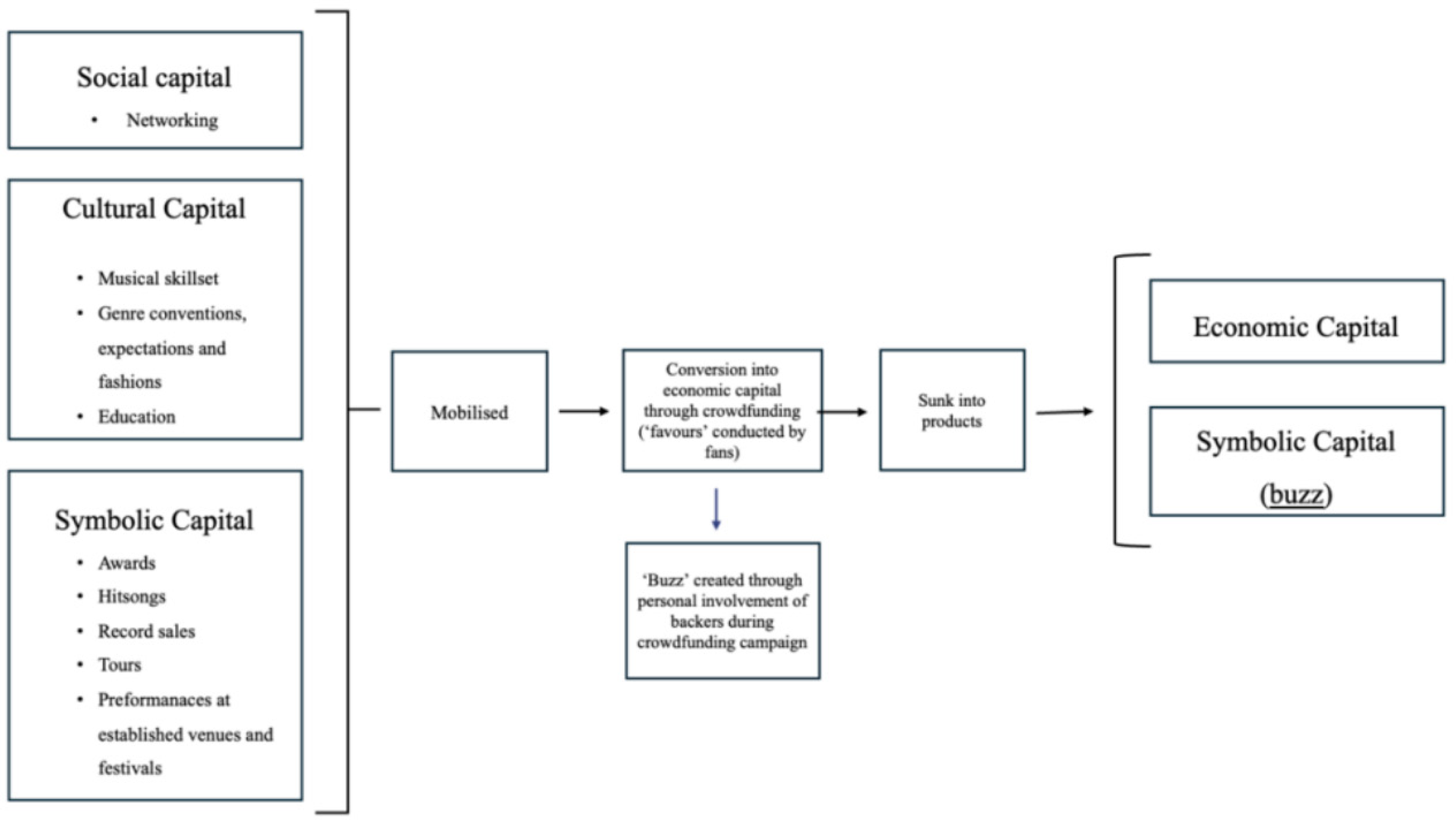
Visualization of Scott's (2012) theory on capital mobilization and conversion, including crowdfunding mechanisms.
Contributions and implications
We make two contributions to the literature. First, we show how Bourdieu's alternative capitals are mobilized and converted through crowdfunding driven by fans’ favoring, extending Scott's (2012) theory of capital mobilization and conversion to the digital age. Updates shared with backers generate buzz, which is amplified by their sense of cocreation. Economic capital from successful campaigns finances production and can later be converted into additional economic and symbolic capital when the product is released.
Second, we extend the crowdfunding literature, which has mostly focused on explaining financial outcomes as a result of various entrepreneur-related and campaign-related variables (Mollick, 2014; Shneor and Vik, 2020). Our qualitative exploration shows crowdfunding as key to capital mobilization and conversion: crowdfunding relies on signals that activate social capital, where the quantity of contributions fosters economic capital (Colombo et al., 2015). Conversely, crowdfunding itself acts as a signal, enabling DIY musicians to leverage this symbolic capital as a form of validation. This validation, in turn, may attract more and larger donations and garner the attention of intermediaries and funders within the music industry.
Our study offers valuable insights for DIY artists. While Scott (2012) highlighted the importance of peers in the creation process, our findings, alongside the crowdfunding literature, emphasize the critical role of actively building and maintaining social capital through backers, supporters, and patrons through time. For DIY musicians, our findings suggest approaching crowdfunding as a relational and strategic practice rather than solely a financial tool. Musicians benefit from investing in long-term audience relationships and the gradual accumulation of social and symbolic capital through creating “buzz.” Particularly subscription-based crowdfunding, often in conjunction with social media presence (Hesmondhalgh and Valdovinos Kaye, 2025; Klein et al., 2017), can support sustained engagement with fans and enable incremental resource mobilization (“favors”). In the absence of label-based upfront investment, crowdfunding allows musicians to build fan-based endorsement, which can subsequently be converted into economic capital to support cultural production. Yet artists venturing into digital fundraising must tread carefully: maintaining a fanbase comes with hidden costs that can significantly reduce the economic capital they aim to generate.
Conclusion and limitations
This interview-based study set out to examine how crowdfunding reshapes processes of capital mobilization and conversion among DIY musicians in the Dutch music industry, and what the role of favors and buzz is in this digitalized DIY economy. Three main conclusions emerge. First, crowdfunding enables DIY musicians in the Netherlands to initiate processes of capital mobilization and conversion, generating economic capital for their entrepreneurial activities. Although peer-to-peer favors persist, crowdfunders often use economic capital to fund music production, shifting the source of support from peers to fans. Backers frequently choose higher reward tiers out of goodwill or to support the artist's cultural endeavors.
Second, successful campaigns not only generate buzz but also serve as a stamp of approval for festival organizers, bookers, and funders. This suggests that crowdfunding is more than a mechanism for converting social capital into economic capital; it functions as a reputation qualifier, turning symbolic capital (recognition) into potential future economic returns. The active involvement of backers, sometimes as cocreators, reinforces this process, as their financial contributions and enthusiasm signal market demand.
Third, our study highlights the hidden costs of building a fanbase, with sustained engagement resulting in foregone economic capital. This shows that crowdfunding functions as both an enabling and a demanding entrepreneurial tool for DIY musicians.
Our study has limitations, primarily its reliance on self-reported data from a small number of platform managers of only two platforms, and musicians in the rock, jazz, and metal scenes. Literature on other genre contexts, such as hip hop, suggests that platformization may shape musicians’ entrepreneurial processes in genre-specific ways (Barna, 2025), indicating that crowdfunding dynamics may likewise differ across musical genres. The focus was on crowdfunding success, rather than on failure or average outcomes, and we did not assess the relative contribution of crowdfunding to musicians’ financial viability and other success factors (Udo et al., 2025), nor its longer-term implications for precarious labor conditions in the music sector (Ross, 2009). Although crowdfunding expands access between niche producers and consumers, sociodemographic and geographic concentration, along with revenue accumulation among superstars, continue to shape consumption patterns similarly to traditional music markets (Noonan, 2026). Future research could examine whether and how crowdfunding meaningfully alleviates income insecurity among musicians or instead reproduces existing structural vulnerabilities, in relation to other forms of platformization in creative industries (Hesmondhalgh and Valdovinos Kaye, 2025). Lastly, the proposed model and mechanisms can be further tested to quantify capital transformation, which may be better approached through statistical techniques we have not employed in this study.
Footnotes

Ethical approval and informed consent statements
The article resulted from a master's thesis; informed consent for publication was provided by the participants, verbally, according to the master thesis standards of the university in 2024.
Funding
The authors received no financial support for the research, authorship, and/or publication of this article.
Declaration of conflicting interests
The authors declared no potential conflicts of interest with respect to the research, authorship, and/or publication of this article.