



Abstract
This article argues that DIY musical instrument innovation and live-looping in Mozambique functions as a decolonial practice, asserting what I term sonic sovereignty. Drawing on remix theory, African temporality, and Playability Theory, it examines the transformation of traditional instruments—specifically the MidiMbira and the Kankumbwe—through digital performance. A 2024 live-looping set is analyzed in which archival footage was modularized into audiovisual stems, controlled via tactile interfaces, and layered with improvisation. Methodologically, the article combines practice-based research with ethnographic engagement and remix aesthetics. The RIY3 (Remix/Recycle/Re-signify It Yourself) framework conceptualizes DIY as a culturally embedded, recursive logic that prioritizes continuity over novelty. In contrast to Global North framings of DIY as leisure-based resistance—rooted in voluntary disengagement and creative subcultures—Mozambican DIY emerges from constraint and cultural inheritance. It is not merely reactive, but a situated form of creative agency forged through necessity, collaboration, and historical continuity.
Introduction: Temporal loops, sonic sovereignty, and DIY intentions
Standing on stage at KISMIF 2024, the instrument in my hands—the MidiMbira—felt both ancient and alien. Beneath my thumbs were the steel tines of a traditional Mozambican mbira, physically vibrating with centuries of cultural memory. Yet, hidden inside the wooden body were piezoelectric sensors and an Arduino brain, translating every pluck into digital data. As I triggered the first loop, a ghostly video projection of an afro-skiffle band appeared behind me, their sound now flowing through my custom-built interface. In that moment, the performance was not just about triggering samples; it was a negotiation between the sasa (the living now) and the zamani (the deep past).
This article explores that negotiation. It examines how “making-do”—the creative repurposing of available materials—manifests not just as a survival strategy, but as a form of sonic sovereignty. Unlike the leisure-based DIY cultures often described in the Global North, where building a synthesizer might be a hobbyist’s rebellion, DIY innovation in Mozambique emerges from a different lineage. It is a situated form of creative agency forged through necessity, collaboration, and historical continuity. By analyzing the MidiMbira in a live-looping performance, I argue that digital musical instruments (DMIs) do more than modernize tradition; they remix it, allowing us to “perform the archive” rather than just observe it.
Here, “MidiMbira” refers to an mbira-inspired acoustic interface that translates lamella playing gestures into midi (musical instrument digital interface (MIDI) control data, allowing traditional performance techniques to navigate and trigger digital processes in real time. In the performance, it functions less as an abstract controller and more as a continuity device, where mbira hand-technique becomes the physical logic through which digital looping is organized.
By repositioning DIY through the lens of “making-do,” this paper is grounded in Mozambican musical practices. It challenges Global North-centric narratives by framing DIY as cultural resilience, innovation, and technological agency. The case studies of the MidiMbira and Kankumbwe reveal DIY instrument-making as materially grounded and epistemologically rich. RIY3 (remix/recycle/re-signify it yourself) illuminates how remix, recycling, and re-signification operate in artistic processes. Playability Theory extends this by showing how embodied interaction drives expressive innovation in digitally mediated contexts, as seen in the KISMIF 2024 performance. This redefinition of DIY—through practice and performance—calls for a decolonial view of musical and technological creativity, recognizing Global South sites as loci of innovation and knowledge. For many Mozambican artists and artisans, DIY functions as indigenous futurism, where “making-do” becomes tradition renewed.
The live performance itself was loosely structured, acknowledging that improvisation requires constraints. At its core, it was a radically DIY system where the base-set was a provocation rather than a fixed score. The looping architecture operated in a permanently negotiable state, allowing continued navigation backward and forward, guided by improvisational responsiveness. Instability was a deliberate RIY3-informed feature. 1 Here, the performance particularly activates the RIY3 questions of recombining and recontextualizing, as archival video, live loops, and tactile gestures are reorganized into a single, improvisatory instrumentarium.
Rather than faithfully rendering traditional music, the performance embraced Navas’ (2018) “originality of copies,” deliberately de-authoring archival Mozambican material into a contemporary techno-cultural interface. The result was a hybridized Deleuzian “event” (Deleuze, 1987), where expressive forms emerge through difference, variation, and recombination.
This was DIY in the fullest sense—not only because the tools were built and mapped by the author, but because the method embodied a do-it-yourself epistemology. It was a lived act of RIY3: remix, recycle, and re-signify it yourself. In these use-cases, as Barthes (1977) notes, authorship dissolves among memory, machine, and moment.
To describe this mode of practice, I use RIY3 as both an analytical framework and a methodological lens. RIY3 names a reflective “making-do” logic in which materials, gestures, memories, and technologies are continuously reworked rather than replaced (Figure 1).
As Mbiti (1971) affirmed, in traditional African ontologies, time moves from the Sasa (the now) toward the Zamani (accumulated past). “Actual time,” in this framework, is defined by what has been experienced or is in the process of being realized. That which lies too far ahead is not yet time—it is “no-time” or “potential time” (Mbiti, 1971 in Zwaan, 2022). Thus, time becomes an experiential extension of the present moment into memory and potentiality, a concept the performance took literally. It reanimated archival footage not as documentation, but as performance material, looped and re-performed into the now. 2 The layering of live improvisation onto historical sonic traces was a recursive act of making time—of crafting Sasa from Zamani, of placing the past in feedback with the present through a self-built musical setup (Figure 2).
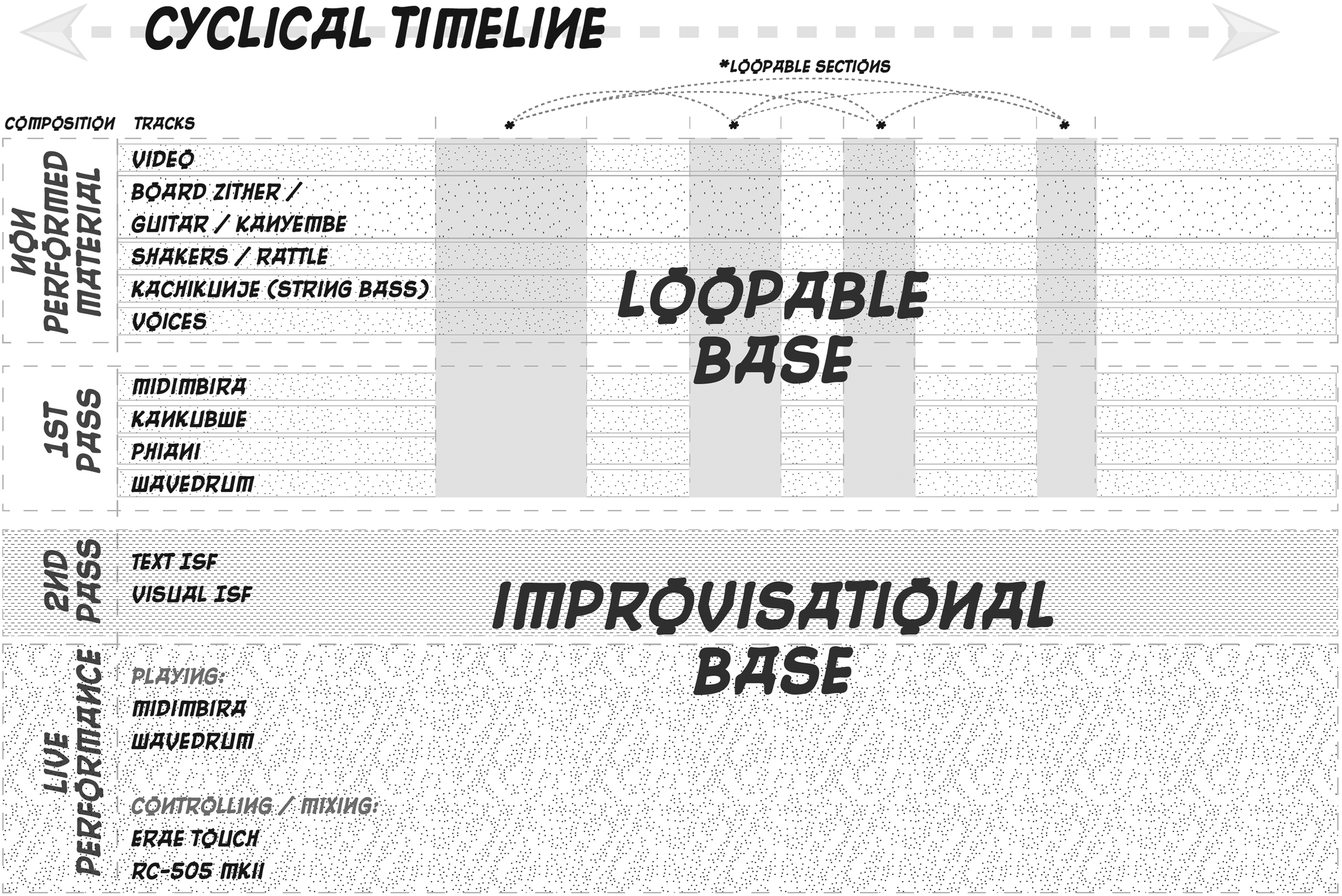
Live Performance structure—from pre-production to performance (author, 2025; CC BY 4.0).
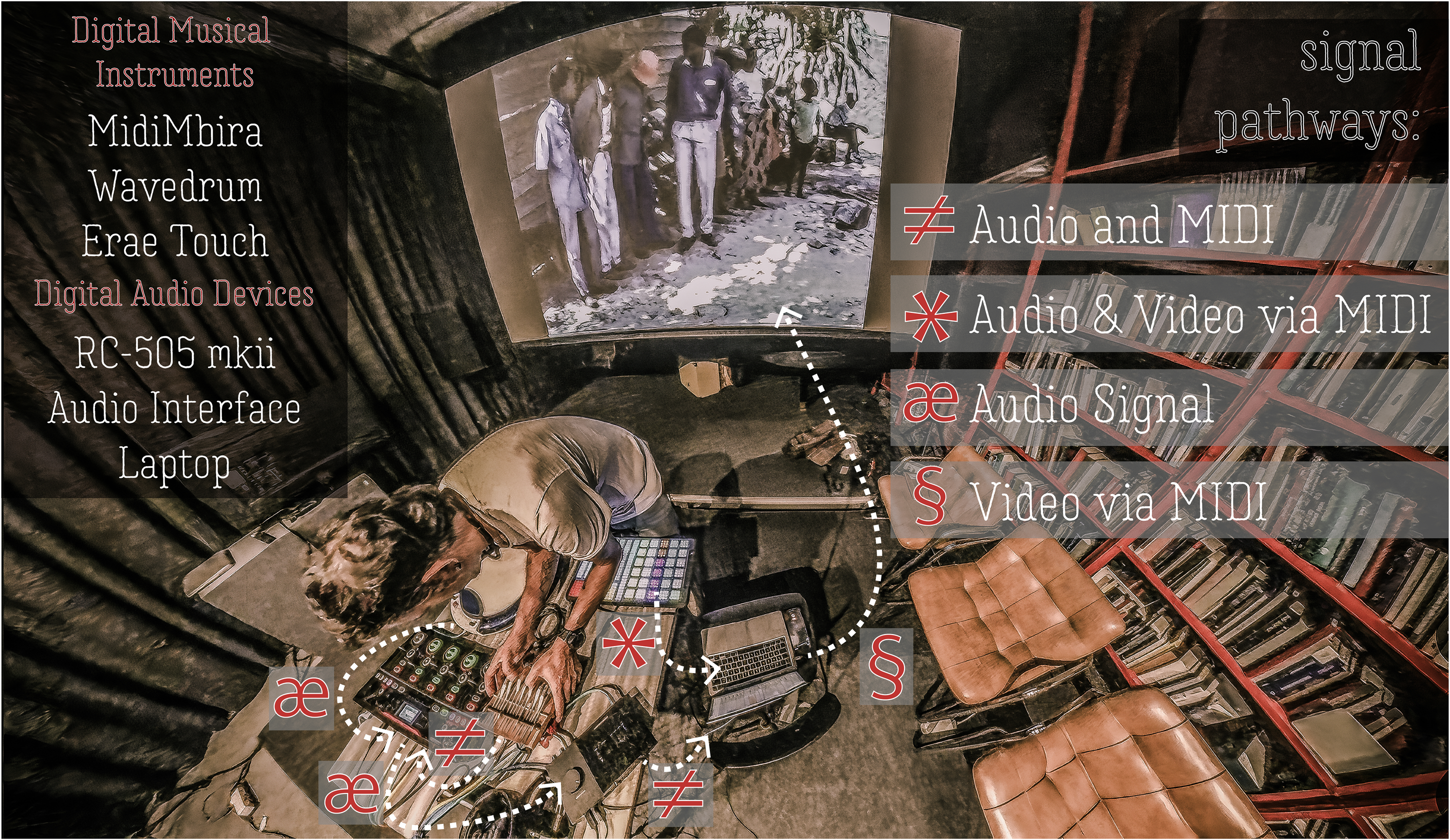
DMIs, Devices and signal pathways for the KISMIF performance setup (author, 2025; CC BY 4.0).
In this way, playability—as theorized in Playability Theory—became central to the set. The way loops responded to gesture, how tactile controllers extended the expressive capacity of traditional instruments, how mapped effects opened up new modes of articulation: these were not just affordances, they were forms of playability remixed. Instruments and interfaces were mutable agents transformed through the RIY3 framework using logics of transposition and transduction (Pirrò, 2018).
The stage hosted a hybrid set functioning as a DIY temporal machine: an instrumentarium, a reflexive rig, a cultural reimagining. As Simondon (1958 [2005]) might argue, transduction occurred epistemologically as much as technically, creating meaning through hands-on engagement with sonic history. Remix philosophy became tactile: “copying from copies” (Navas, 2018) as inquiry and inheritance. Tradition living not in stasis but in a state of transfluence (Bispo, 2023). 3
My contribution to KISMIF proposed DIY as more than a production strategy—a temporal and philosophical stance folding memory, improvisation, and technology into recursive cultural reflection.
The inspiration for the improvised Musician/DJ/VJ/Dub mixer performance at KISMIF 2024 came in 2023 while reading Andrew Tracey's “Music in Mozambique: Structure and Function” (1983). A few years earlier, I’d been digitizing and cataloguing late-’80s fieldwork video by Professor João Soeiro de Carvalho for the project “Timbila, Makwayela and Marrabenta: one century of musical representation of Mozambique.” After obtaining his permission to remix the footage, I saved it within my chaotic digital “clutter-hub,” anticipating future improvisational insights.
Autoethnographic Note: Loops of Time and Archival Dreamtimes
Later, I encountered Josephine Zwaan's thesis (2022), arguing that Western perspectives on circularity in digital audio software are constrained by linear values. She reframes circularity through African philosophy, particularly John S. Mbiti's concept of the African time cycle, offering a holistic understanding of music and temporality. One key insight is that circularity is “an experiential and fundamentally dynamic phenomenon” (Zwaan, 2022), echoing Mbiti's assertion that time is “a composition of events that have occurred, are taking place now, and are immediately to occur” (Mbiti, 1971).
Mbiti clarified that actual time is circular, encompassing present and past, moving “backward” rather than forward (Mbiti, 1971). It struck a note with Tracey's observation about Mozambican music:
“It starts at a certain point, goes through a number of ideas, and keeps returning to the same point all over again. This fact becomes an inter-cultural breaking point: the African cycle is intensely frustrating to Westerners, although to Africans it is one of the firm bases on which all expression is built. Western music is linear or straight-line; African music is cyclical. One merely has to accept this, and get rid of the reactions which frustration may cause (such as calling the music boring or primitive) by means of refocusing one's attention onto those things which are important in African music” (Tracey, 1983).
The performance idea crystallized: live-loops could enact past-present circularity. Presumably one could fold archival footage—originally from Mozambique—into real-time looping cycles (“pockets” of no-time/potential time) navigating through them using a DAW and a Boss RC-505 mkII loopstation. In live performance, past and present could then resonate with and fold into each other. After pitching my performance to KISMIF's theme, DIY Cultures, Democracy and Creative Participation, it was accepted, leading subsequently to this paper.
DIY culture in historical perspective: From fixing things to remixing worlds
The term DIY initially referred to domestic repair and home improvement in the early twentieth century (Gelber, 1997; Bell, 2017). Its meaning expanded to include grassroots responses to institutional structures and cultural norms (Woods, 2017), symbolizing subcultural identity, independent innovation, and community-driven artistic practice (Grimme et al., 2014).
In African contexts—particularly where access to manufactured goods is constrained—DIY has long been vital for musical knowledge transmission (Quigley and Smith, 2021). Instrument-making exemplifies ingenuity, ecological adaptation, and the preservation of sonic aesthetics and cultural identity (Agawu, 2016; Webb et al., 2018; Georgiev and Nanjappan, 2023). In resource-scarce contexts, “making-do” is essential, as makers adapt available materials, reflecting skilled engagement with local ecologies, preserving acoustic specificities tied to culture and necessity (Devlin, 2017). Adaptation of traditional instruments in urban centers reveals a dynamic interplay of tradition, innovation, and cultural critique (Hector, 2018).
George McKay (1998) described DIY culture as operating within an “economy of means,” emphasizing resourcefulness shaped by material constraint (Jawad and Xambó, 2024). This paper extends McKay's perspective beyond the Global North. In Mozambique, DIY practices exemplify culturally embedded resourcefulness, simultaneously preserving and reimagining musical heritage. These acts are economical and epistemological (Smith and Gillett, 2015).
Decolonizing DIY: Challenging the global north narrative
In Euro-American literature, DIY is often linked to punk's ethos of self-production and anti-mainstream independence (Guerra and Quintela, 2014, 2021). Fanzines, posters, and indie labels embodied the “anyone can do it” spirit (Guerra and Straw, 2017; Guerra, 2018). Western DIY also appears in “maker” and “hacker” cultures, which emphasize creating, repairing, and sharing knowledge (Kuznetsov and Paulos, 2010). Here, “making” is ethically valued over “consuming” (Richards, 2013; Guerra and Quintela, 2021), reflecting both individual expression and community bonding (Bennett, 2018). DIY is frequently tied to radical political praxis and countercultural lifestyles (Gray et al., 2021). Yet the narrative remains Western-centric, focusing on contexts with greater manufacturing and publishing output (Verbuč, 2017), often obscuring DIY practices in the Global South and Africa (Olazabal et al., 2021).
Although autonomy and ingenuity may be universal, Western-centric views often misinterpret or ignore non-Western practices (Fulco and Tatarević, 2024). This imbalance renders Global South and African practices either invisible or misunderstood (Matich et al., 2023), as many acts of “making” or “fixing” don’t align with Western frameworks. As Golpushnezhad (2018) shows in her study of Iranian underground rap, lacking a formal mainstream industry shifts the meaning of DIY. Marginalizing Southern epistemologies excludes much African and Global South creativity from academic definitions, even though they reflect DIY's core principles (Olazabal et al., 2021).
This approach aligns with recent scholarship that reframes artistic research in the Global South. As noted in Music as Decolonial Practice (Cohon et al., 2023), musical praxis effectively challenges hegemonic epistemologies when it actively engages with local materialities. Similarly, Doherty's work in Arts Research Africa (2020) highlights how practice-based research can dismantle colonial hierarchies of knowledge. In the context of the MidiMbira, the act of soldering, coding, and composing is not merely technical; it is a decolonial assertion of the right to define one's own technological future.
Recognizing the limits of Global North narratives enables a more inclusive understanding of DIY—one that values creativity and resourcefulness under economic precarity (Xiao and Donaghey, 2022). “Making-do” should be seen as an endogenous innovation, emphasizing adaptability and ingenuity (Waal and Smal, 2024). This shifts DIY from leisure-based counterculture to a practice rooted in survival, resilience, and cultural continuity (Dutta and Pal, 2010).
Making-do: Improvisation, resourcefulness, and situated innovation
In Africa, there is a long history of local production and innovation, often driven by necessity and the creative use of available resources (Agawu, 2016). However, such practices are rarely acknowledged within Western academic frameworks of DIY. The “making-do” mentality—solving problems with what is at hand—is a vital cultural trait in many African communities, though often unrecognized in dominant scholarly narratives. ‘Making-do’ is a fundamental human practice that predates the Western concept of DIY. It reflects human ingenuity in overcoming challenges through creativity and adaptation. This is especially evident in contexts where scarcity drives innovation (Bennett and Guerra, 2018). In African histories, ‘making-do’ appears in constructing homes and tools with local materials, and in crafting musical instruments from natural or recycled objects. Such resourcefulness remains vital, rooted in deep knowledge of local material ecologies. ‘Making-do’ as a broader human practice—especially in African contexts—emphasizes resourcefulness, creativity, and adaptation as responses to need and cultural expression. Recognizing these practices beyond Western contexts is essential for a fuller understanding of human creativity. While both Western and African forms may fall under ‘DIY’, their motivations differ. In Africa, DIY often emerges from material scarcity and cultural continuity, unlike Eurocentric versions rooted in leisure or personal expression. This distinction reveals a framework of endogenous innovation shaped by economic and cultural realities. Lowndes (2016) identifies DIY as “subjugated knowledge,” historically sidelined by dominant narratives. This paper aims to extend this by showing how African ‘making-do’ practices reclaim and validate such knowledges, asserting cultural sovereignty against epistemological dominance.
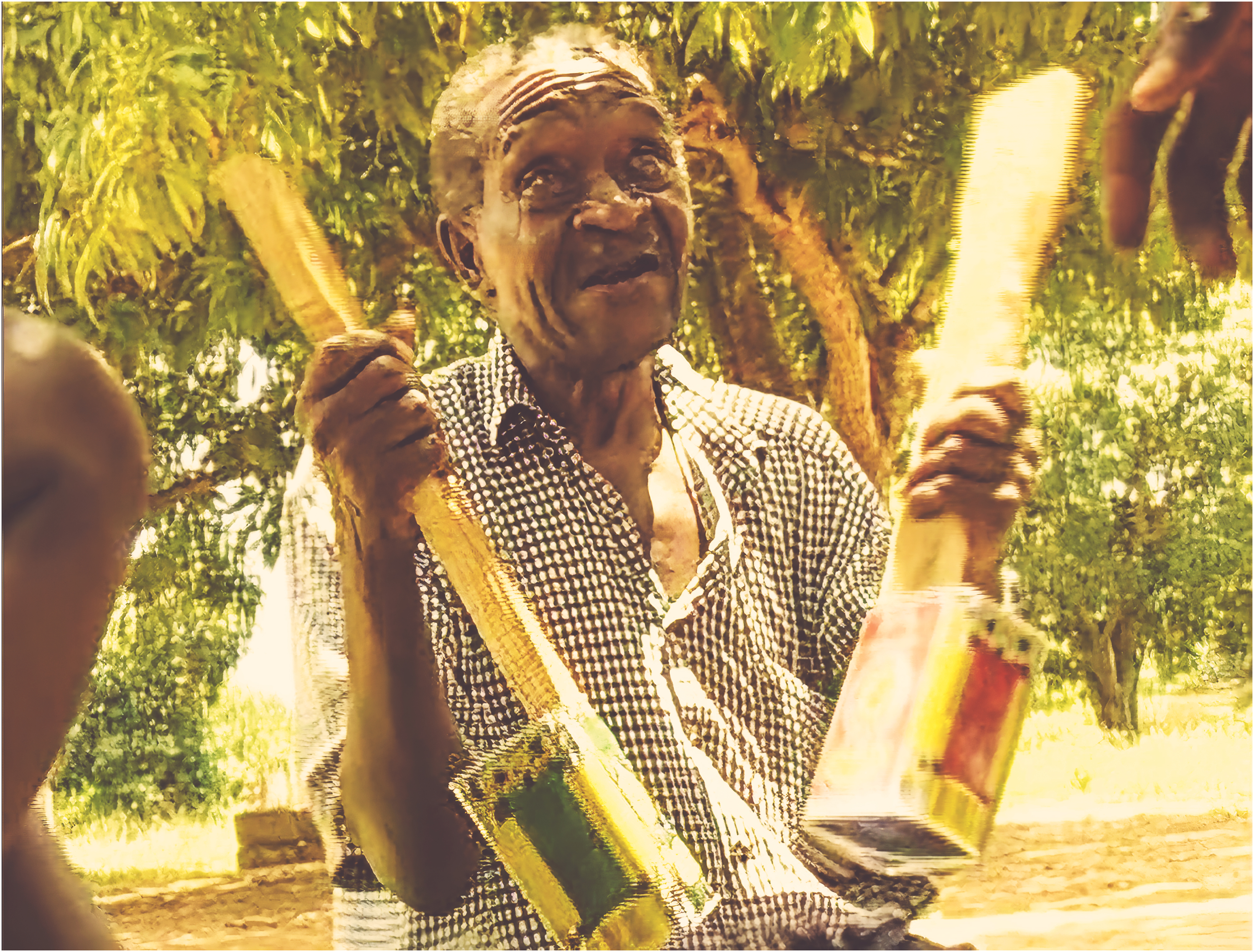
Still from “Tin Can Guitars” (1:42), by Karen Boswall (2013), YouTube. Dilon Djinji tells his granchildren about his experiences building DIY guitars as a child.
Therefore the concept of “making-do” positions DIY within a broader, culturally situated practice of everyday creativity. To ground this conceptual shift concretely, it is helpful to focus specifically on the creation of traditional musical instruments. In Mozambique, DIY instrument-building is not simply a response to limited resources; it is a sophisticated technological practice of “making-do” that is deeply intertwined with local musical culture, knowledge systems, and material ecology. Understanding this practice demands a broader definition of technology, one that includes not only high-end machinery but also localized expertise, material awareness, and the capacity to meet human needs with ingenuity and care. As we transition to examine specific case studies—the MidiMbira and the Kankumbwe—we further explore how these principles manifest in instrument-making practices that remix past and present through the aesthetics of “making-do.”
Mozambican musical technologies: DIY instrument-making as situated knowledge
In resource-limited contexts, several perspectives inform DIY musical instrument creation: the nature of technology, contextual relevance, the interplay of culture and technique, and the use of available materials. “Technology” extends beyond complex machinery or mass production—it includes techniques, skills, and the purposeful use of local resources (Olsen et al., 2012). Thus, DIY instrument-making, even with basic materials, is a legitimate technological practice rooted in ingenuity.
Performing DIY exemplifies “technological relativity”—a processual, embodied activity shaped by cultural dimensions such as skills, norms, and historical experience. Many technological advances arise from practical needs and creative use of available resources (Layton, 1974). In resource-scarce settings, limited access to manufactured instruments inspires communities to repurpose materials for musical expression.
In DIY instrument-making, functionality is inseparable from intentionality. Even when materials are humble—scraps, wires, cans, wood—the crafted object becomes a realized sonic function shaped by purpose. This aligns with Kroes and Meijers’ (2006) notion of the “dual nature” of technological artifacts: both material and defined by human goals. Here, design is less schematic and more about assembling a “use plan”—a bricolage logic. But the relationship between maker, player, and object goes beyond utility. Drawing from Ihde (1975, 1979, 1983, 1991), 5 Nonaka et al. (1996), 6 Sternberg and Horvath (1999), 7 and Merleau-Ponty et al. (2013) 8 we can understand the interaction with these instruments as a form of embodied innovation: an imaginative, situated response that draws on memory, gesture, and adaptation. Beyond function or even embodiment, there's an ontological dimension. In Heelan's terms (1989), the sonic world crafted through these DIY practices is a form of “technological carpentry”—a reshaping of local acoustic reality. The act of building and the act of sounding contribute jointly to a shared sonic culture, in which technological improvisation is not just practical, but a way of knowing and world-making.
The DIY ethos in this context is rooted in necessity and resourcefulness. In economically constrained societies, building instruments from recycled materials arises more from need than choice (Yende et al. Mugovhani, 2023). This reflects resilience in the face of limitation (McKay, 1998) and resonates with African societies’ responses to historical and contemporary challenges (Atkinson, 2021). It exemplifies a broader DIY principle: creating with an economy of means, shaped by an aesthetic of necessity (Lowndes, 2016).
In many African societies, music is integral to cultural identity, and the ability to build instruments from salvaged materials sustains musical traditions despite limited access to commercial instruments (Agawu, 2016). This prioritizes cultural well-being and shows that expression persists despite economic hardship. Rather than relying on purchasing power, these practices emphasize social and individual meaning. Such acts of “instrument-making-by-making-do” reflect endogenous innovation: locally grounded creativity that fuses technical skill with cultural intent. This form of DIY is not only materially inventive but intellectually and spiritually embedded in context. It supports broader efforts to decolonize economic thinking by valuing indigenous knowledge and resisting Western replication. Instrument creation thus becomes a political act—one that envisions “Afrotopia,” rooted in self-determined futures and cultural sovereignty (Sarr, 2020).
Kofi Agawu (2016) emphasizes the profound relationship between musical practices and African cultural identity. Building on Agawu, my study explicitly connects DIY instrument-making in Mozambique with culturally-situated technology, suggesting that DIY musical practices sustain and reinvent musical identities, emphasizing that these processes represent culturally rooted. Considering DIY as a philosophy of “making-do” allows us to understand DIY musical instrument creation in resource-scarce environments not as a lack of technology, but as a specific form of technological practice deeply rooted in local culture, driven by necessity and resourcefulness, and characterized by the creative adaptation of available materials to fulfil a desired function. The principles discussed in the context of broader technology and its philosophy, such as context sensitivity, the nature of artifacts, and embodied knowledge, all find resonance in the specific creative practice of “making-do.”
The MidiMbira and Kankumbwe, examined through collaborative ethnography in Mozambique, offer distinct but related models of DIY instrument-making that challenge the binary between tradition and innovation. Here, “collaborative ethnography” refers to research in which collaborators are not treated as informants but as co-shapers of questions, materials, instruments, and interpretive outcomes. The MidiMbira emerged from iterative design blending traditional Mbira aesthetics with contemporary MIDI controller logic. Its hybrid construction—combining traditional materials and microcontrollers—enables real-time control over sound, visuals, and looping, exemplifying expanded playability (Tanaka, 2000). Crucially, it resists Eurocentric controller paradigms by grounding its interface in Mozambican performance epistemologies. This aligns with DMI design approaches that reject the dominance of Western, academic, and predominantly white spaces often associated with DMI research, by engaging indigenous communities and diversifying cultural contexts (Tragtenberg et al., 2024).
Read through the RIY3 lens, the MidiMbira foregrounds recycling and re-signification: recycled bicycle spokes become lamellas, while mbira performance gestures are re-signified as digital control data that reroute archival sound and image.
Remix and resonance: DIY instrumental innovation in Mozambique—MidiMbira and Kankumbwe
Augmenting acoustic instruments with digital technology is a well-established research area that expands performance possibilities and explores hybrid instrument potential (Bachmann et al., 2003; Impett, 1994; Mäki-Patola et al., 2006; McPherson and Kim, 2010). The MidiMbira embodies RIY3 processes—especially Recycling and Re-signification. Built with Mozambican artist May Mbira, it converts traditional tactile gestures into digital control signals. Its lamellas, made from repurposed bicycle spokes and scrap metal, reflect a recycling ethos. Meanwhile, its transformation of the Mbira into a MIDI instrument re-signifies cultural heritage, enabling ancestral sonic practices to engage contemporary digital tools (Figure 4). 9
In contrast, the traditional Kankumbwe (Figure 5)—a lesser-known musical bow from Tete Province—is being reimagined by Maneto Tenfula, a master instrument maker and musician. Rather than framing it through loss or salvage, our collaboration affirms its dynamic evolution within local musical ecosystems, reinforcing its relevance and case for heritagization. Maneto's adaptations include adding guitar tuning pegs for pitch stability and crafting a two-string variant (Figure 6). These changes mark continuity, not rupture—actualizing the instrument within shifting musical and material contexts (Kubik, 2010; Agawu, 2014). Our documentation foregrounds localized ingenuity and sonic experimentation within DIY praxis.
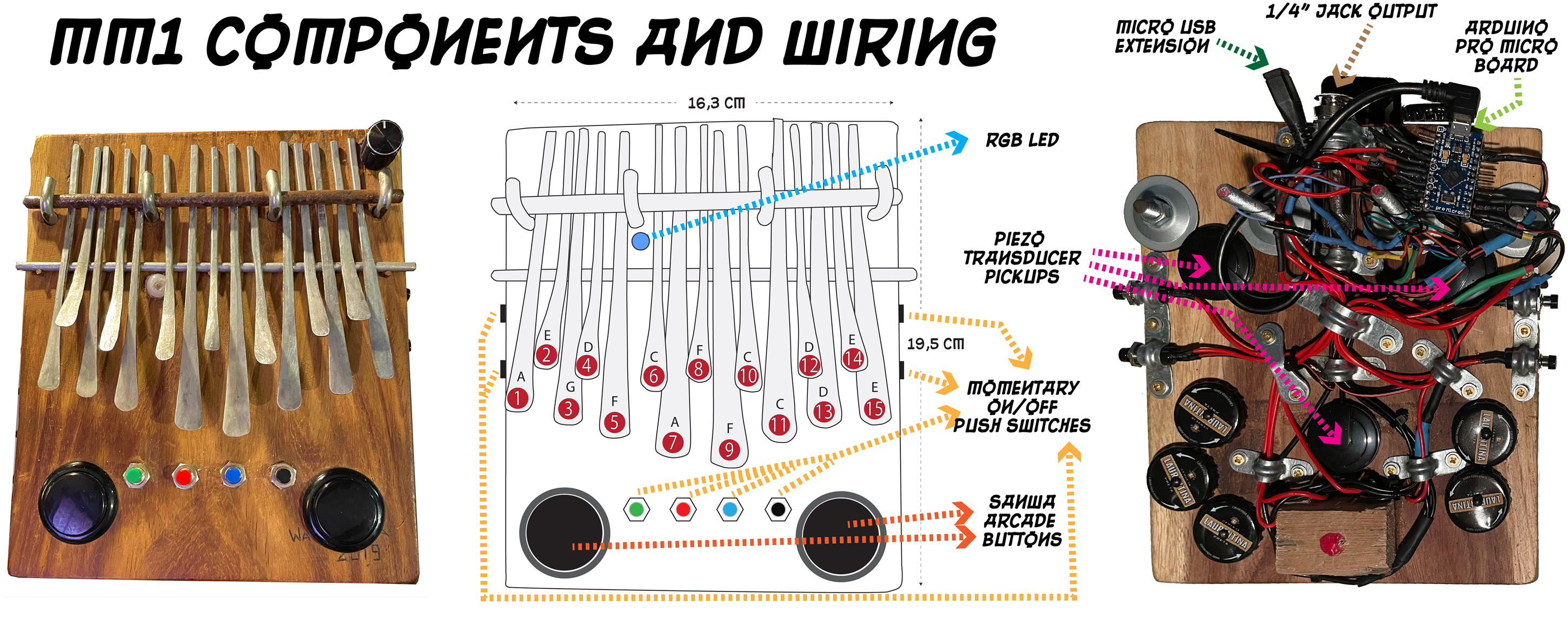
MidiMbira model MM1 (author, 2025; CC BY 4.0).

Author's illustration of the Kankubwe (Makubwa), reproduced from Margot Dias (1986), instrumentos Musicais de Moçambique.
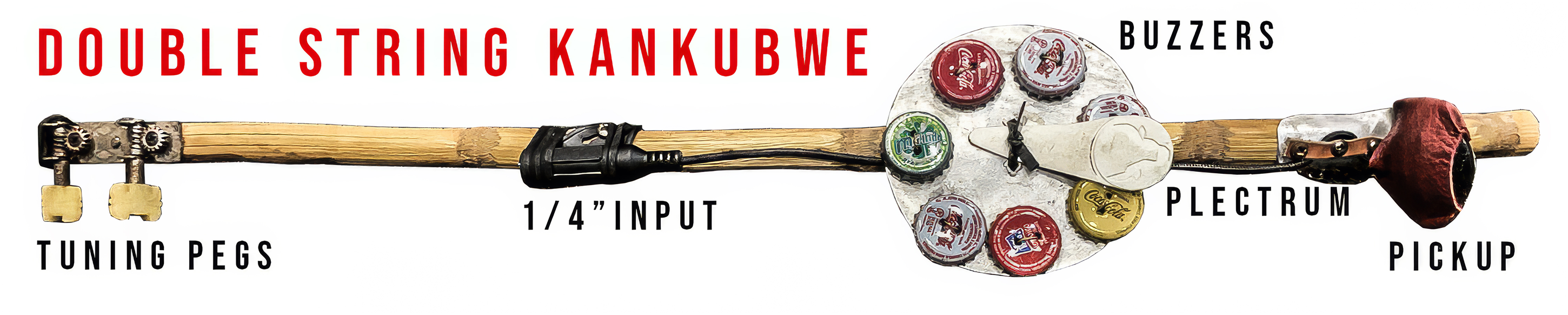
Maneto Carmo Tenfula's double-stringed Kankubwe (author, 2025; CC BY 4.0).
Maneto Tenfula's approach illustrates the RIY3 notions of Remaking and Recontextualizing. Adding guitar pegs remakes the instrument, improving pitch stability. Crafting a two-string version (Figure 6) recontextualizes traditional musical structures—not as static preservation but as adaptive, living practice. These innovations show how the Kankumbwe evolves with changing demands and conditions, embodying the “making-do” aesthetics of practical creativity and situated improvisation.
Maneto's adaptations make explicit the RIY3 operations of remaking and recontextualizing: guitar tuning pegs remake the Kankumbwe's material configuration, while the two-string variant recontextualizes its role within contemporary musical ecologies.
Together, these case studies show that DIY in Mozambican music emphasizes situated co-creation over individualism. They reveal a remix logic rooted in material precarity, ancestral memory, and adaptive improvisation. From the digitized hybridity of the MidiMbira to the evolving acoustic expressivity of the Kankumbwe, these instruments embody a dialogic relation between past and future—offering a model of innovation that is ecological, relational, and deeply local (Ingold, 2013; Eisentraut, 2012).
The practical narratives of MidiMbira and Kankumbwe instruments clearly reveal DIY as a process of remixing cultural materials, techniques, and technologies. Such remix practices invite deeper theoretical exploration through the RIY3 framework, which explicitly articulates the creative acts of recycling, remaking, recombining, and re-signifying cultural artifacts.
RIY3 as method: Remix, recycle, and re-signify as creative praxis
In artistic creation, creativity emerges from dynamic interplays of memory, experience, and cultural artifacts. The RIY3 typology seeks to illuminate this intricate process.
Theoretical foundations of RIY3
The RIY3 framework (Figure 7) emerged from reflective analysis of compositional processes. Inspired by Irvine's (2014) Dialogic Engine of Culture, 10 and interviews with artist-producers, it offers a structured tool for creators and researchers to examine the nuanced interactions in artistic production. It emphasizes how creativity draws from remixing knowledge, influence, and lived experience.
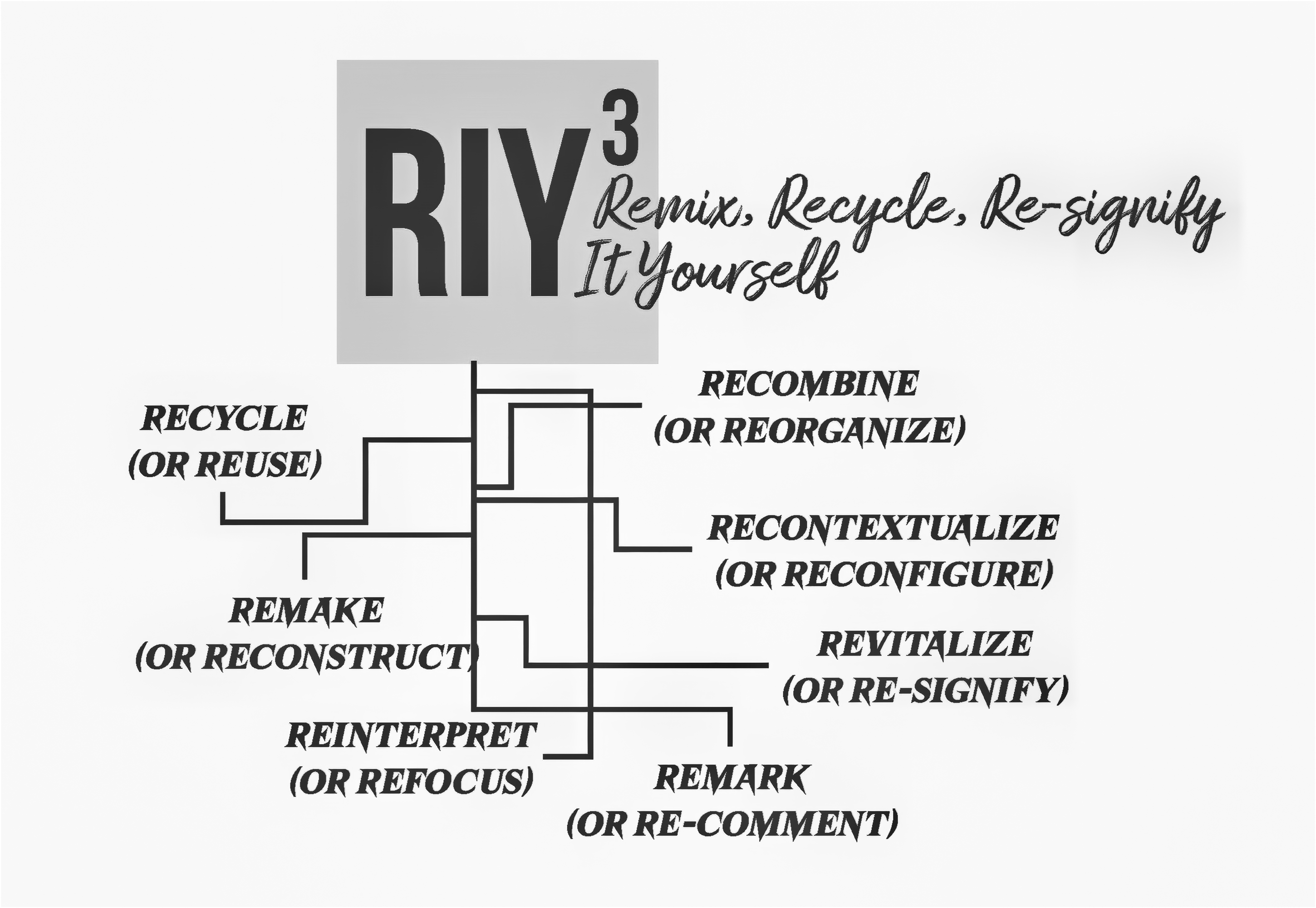
The dialogic engine of composition (author, 2025; CC BY 4.0).
Remix as a fundamental creative operation
RIY3 centers on the idea that remixing is foundational to artistic innovation. Remix challenges isolated authorship and originality, aligning with “remixology”—an intertextual practice where creators act as curators or DJs, reworking existing material (Gunkel, 2016). Deleuze similarly frames remix as creative variation through repetition, not mere reproduction.
RIY3 uses reflective questions to explore how creators consciously and unconsciously recycle, remake, recombine, recontextualize, reinterpret, revitalize, and remark on existing materials. This holistic method foregrounds intentionality and serendipity, revealing how creativity balances deliberate and intuitive processes.
Recycling: Valuing existing materials
Recycling in RIY3 highlights how artists draw from a vast pool of existing materials—ideas, motifs, and techniques rooted in cultural history. It challenges the hierarchy that privileges originality over derivation, reframing recycling as a vital creative act of reconfiguration (Navas, 2018). This view aligns with Emerson and Gunkel, who argue that all creation weaves “old and new” in continuous dialogue between past and present (Gunkel, 2016).
Re-signifying: Active meaning-making
Re-signification in RIY3 foregrounds the artist's role in giving new meaning to recycled material. It aligns with transposition—the shifting of content or form across contexts to alter meaning (Braidotti, 2018 [2006]). Through re-signification, familiar elements are transformed into innovative reinterpretations. Deleuze's concept of the “event” resonates here: novelty arises from subtle variations that create new relationships among existing elements, echoing RIY3's logic (Williams, 2003).
The seven reflective questions of RIY3
The following seven questions operate as a loose analytical scaffold for the discussion that follows, guiding how materials, gestures, instruments, and temporalities are examined. RIY3 articulates its conceptual framework through reflective questions that reveal layers of intentionality, spontaneity, and unconscious remixing:
Recycle (or Reuse): Is material reused from external sources like audio samples? Why? Remake (or Reconstruct): Does the work reproduce prior content, like re-recording a known bassline? Recombine (or Reorganize): Is a single source reorganized or spliced in classic remix fashion? Recontextualize (or Reconfigure): Are diverse materials combined into a unified composition? Reinterpret (or Refocus): Does the piece alter or obscure the original material's identity? Revitalize (or Re-signify): Are meanings reshaped to produce new affect or dissonance? Remark (or Re-comment): Does the material critique or comment on its context?
Notably, RIY3 also validates creative uncertainty. “I don’t know” is a legitimate response, acknowledging how intuition and unconscious processes often guide artistic decisions. In what follows, these seven RIY3 questions do not remain merely conceptual; they provide a structural lens for the analysis, guiding how I describe DIY instrument-building and performance in Mozambique.
Playing the remix: Embodied creativity and instrumental innovation in music performance
Applying RIY3 to musical performance opens new analytical pathways, especially alongside Playability Theory and transposition. Playability Theory examines how musicians interact with instruments, shaped by personal and collective musical histories. In RIY3 terms, playability is inherently remix-based—performers continually rework past experiences, styles, and embodied memories into unique performances. Transposition shows how musicians shift and transform musical ideas across instruments, contexts, or cultures—altering both form and content. This act of re-signification positions performers as transposers and interpreters, remixing technique, culture, and aesthetics into new expressions.
The critical examination of originality in musical performance through the prism of RIY3 challenges traditional distinctions between original works and derivative performances. Recognizing that each performance is a unique remix—drawing on interpretations, adaptations, and the performer's individual history—RIY3 reframes musical originality as a dynamic continuum rather than a binary construct.
RIY3 as praxis: Creativity and cultural re-signification
As an analytical and creative framework, RIY3 highlights the complex interplay of memory, influence, and innovation that defines contemporary artistic practices. By framing creativity as remix-based, it invites creators and researchers to recognize remix as an embodied cultural process. Playability Theory extends RIY3 into the experiential domain of musical and DIY creativity.
Playability theory: Embodied interaction and expressive possibility
Though often loosely defined, playability is central in today's digitally interconnected music world. Playability Theory (Figure 8) explores musician–instrument interaction amid evolving technologies (Feenberg, 1991, 2004; Ihde, 1991). Playability includes gesture, intention, imagination, feedback, expressive exchange, and prioritizes embodied expression over efficiency (Heelan, 1989; Hacking, 1983; Ihde, 1991; Kroes and Meijers, 2006). Both a novice and a virtuoso engage with playability—albeit differently.
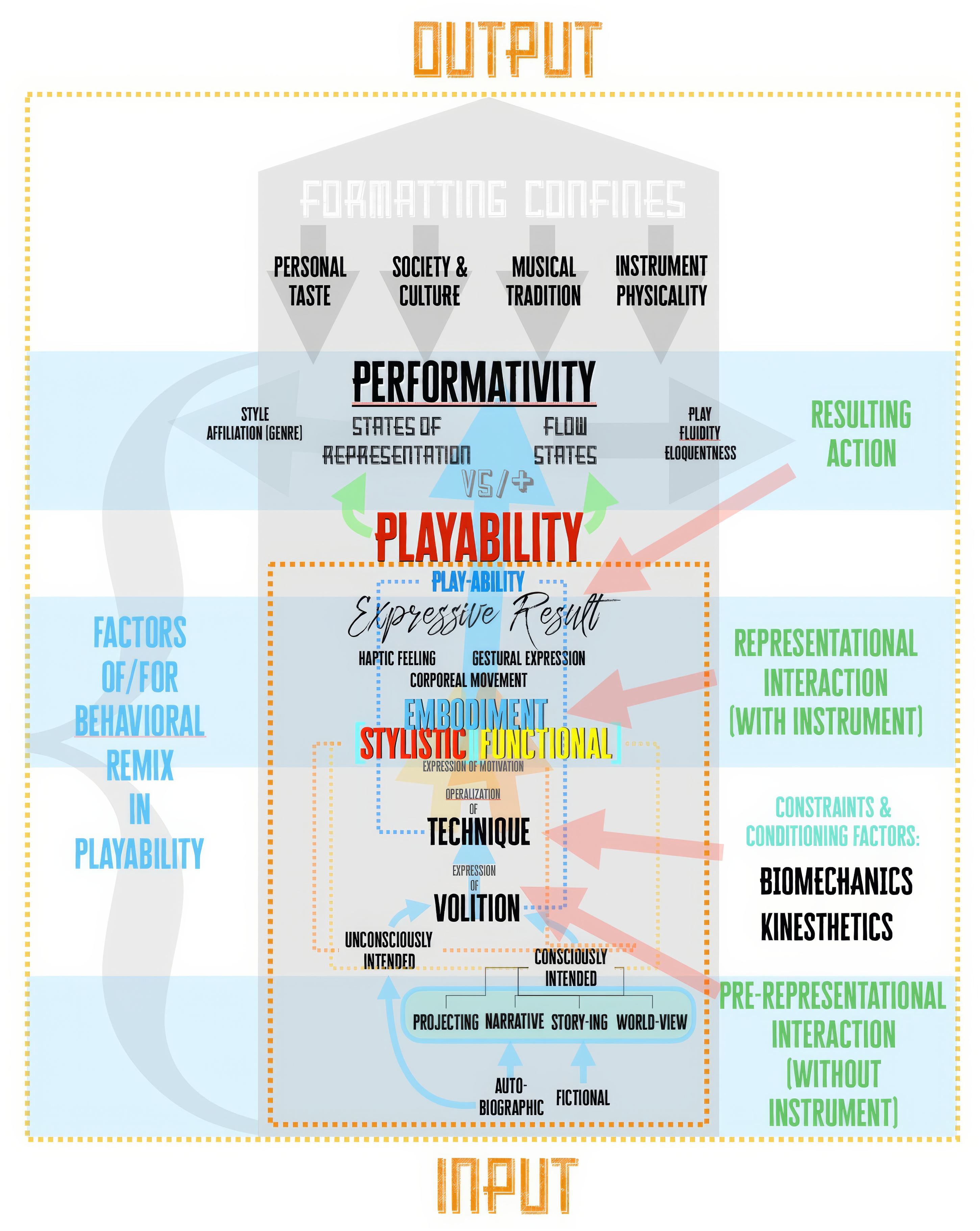
Full model of playability theory (author, 2025; CC BY 4.0).
Digital tools have reshaped traditional musical interaction. Whereas instruments once imposed expressive limits (Ihde, 1991), MIDI technologies decouple sound from physical constraints, allowing musicians to remix playability. This aligns with views of technology as open to reinterpretation and shaped by users (Pinch & Bijker, 1987; Verbeek, 2005). Controllerism—using MIDI controllers like pads and sliders—exemplifies this, enabling artists to build bespoke interfaces and redefine performance. These digital tools transform musician-instrument dynamics and expand expressivity (Ihde, 1991; Verbeek, 2005).
Playability Theory draws from play theory, flow theory, embodied music cognition, and human-instrument interaction, incorporating philosophical ideas from Plato (Hunnicutt, 1990), Kant (Matherne, 2014), and Schiller (Hein, 1968). Schiller's “play impulse” bridges sensation and reason, while Kant explores imagination and understanding. Flow theory (Csikszentmihalyi, 1975, 1990) describes the immersive focus of ideal performance. In Playability Theory, flow represents optimal musician–instrument interaction: emotionally aligned, highly focused, and embodied. As mediating agents, instruments shape music through bodily interpretation and cultural context (Leman, 2007; Keller and Janata, 2009). Recognizing music as both physical and experiential allows neuroscience, psychology, and musicology to clarify how technology affects musical experience.
Bodies in sound: Embodied cognition and human-instrument interaction
Embodied music cognition complements flow theory by focusing on physical interaction in musical environments. It emphasizes kinesthetic engagement—awareness and feedback between musician, instrument, and sound—highlighting active, embodied participation over passive listening (Leman and Maes, 2015; Kim, 2020; Howlin et al., 2022; Ow et al., 2023). Human-instrument interaction (HII), adapted from human-computer interaction (HCI), applies user-centered design to optimize cognitive, physical, and emotional engagement with musical interfaces, enhancing expression and intuitive play (Wöllner and Williamon, 2007; Pfordresher, 2012).
Playability theory further identifies “formatting confines,” external factors that shape musical interaction. These include personal taste (Fuentes-Sánchez et al., 2021), societal and cultural norms (Tepper and Hargittai, 2009), musical traditions (Vella and Mills, 2016), and the physical nature of instruments themselves. These forces operate hierarchically, gradually narrowing the creative possibilities available to musicians (Mawang et al., 2018). The theory introduces the concept of “pre-representational interaction” (PRI)—the initial mental formulation of musical intention, combining autobiographical and imaginative elements to form an “expression of volition” (EOV). This intention meets constraints—biomechanics (physical movement) and kinesthetics (feedback)—that shape expression. Upon actual instrumental engagement—termed “representational interaction”—the musician's initial intention translates into “expression of motivation,” manifesting through functional techniques (specific sounds) and stylistic gestures (expressive performance). These interactions yield two outcomes: representativity (referencing musical archetypes) and spontaneous improvisational flow.
Playability archetypes emerge as standardized, recognizable interactions between musicians and instruments, while individual subjective experiences of playability remain unique and non-standardizable. Moreover, historical and cross-cultural examples demonstrate how musicians have long remixed playabilities organically, as observed in East African lamellophone adaptations, Angolan Indanga bow techniques, Zimbabwean Chimurenga Guitar styles, and West African Juju music.
Playability Theory reframes musical interaction as a dynamic interplay of body, culture, and interface—clarifying how musicians adapt within evolving technological contexts. As traditional and digital boundaries blur, it invites ongoing inquiry into how technology reshapes music-making.
Looping backwards: Remixing time, memory, and DIY practice
RIY3 and Playability Theory offer complementary lenses to understand the remix logic within DIY/making-do. RIY3 highlights how musicians remix, recycle, and re-signify internal and external resources. Playability Theory complements this by focusing on embodied innovation—how DIY musicians physically remix instrumental playabilities into new hybrid forms. Together, both theories highlight how DIY creativity and practice are rooted in embodied reflection and hands-on transformation.
RIY3 and Playability Theory illuminate how they manifest in live performance. The ethno-digital looping set serves as a culmination—where theory and practice converge to exemplify DIY's temporal, technological, and cultural dynamism. This practice reveals how looping can embody African temporalities and generate performative knowledge through sonic layering and recursion (Figure 9).
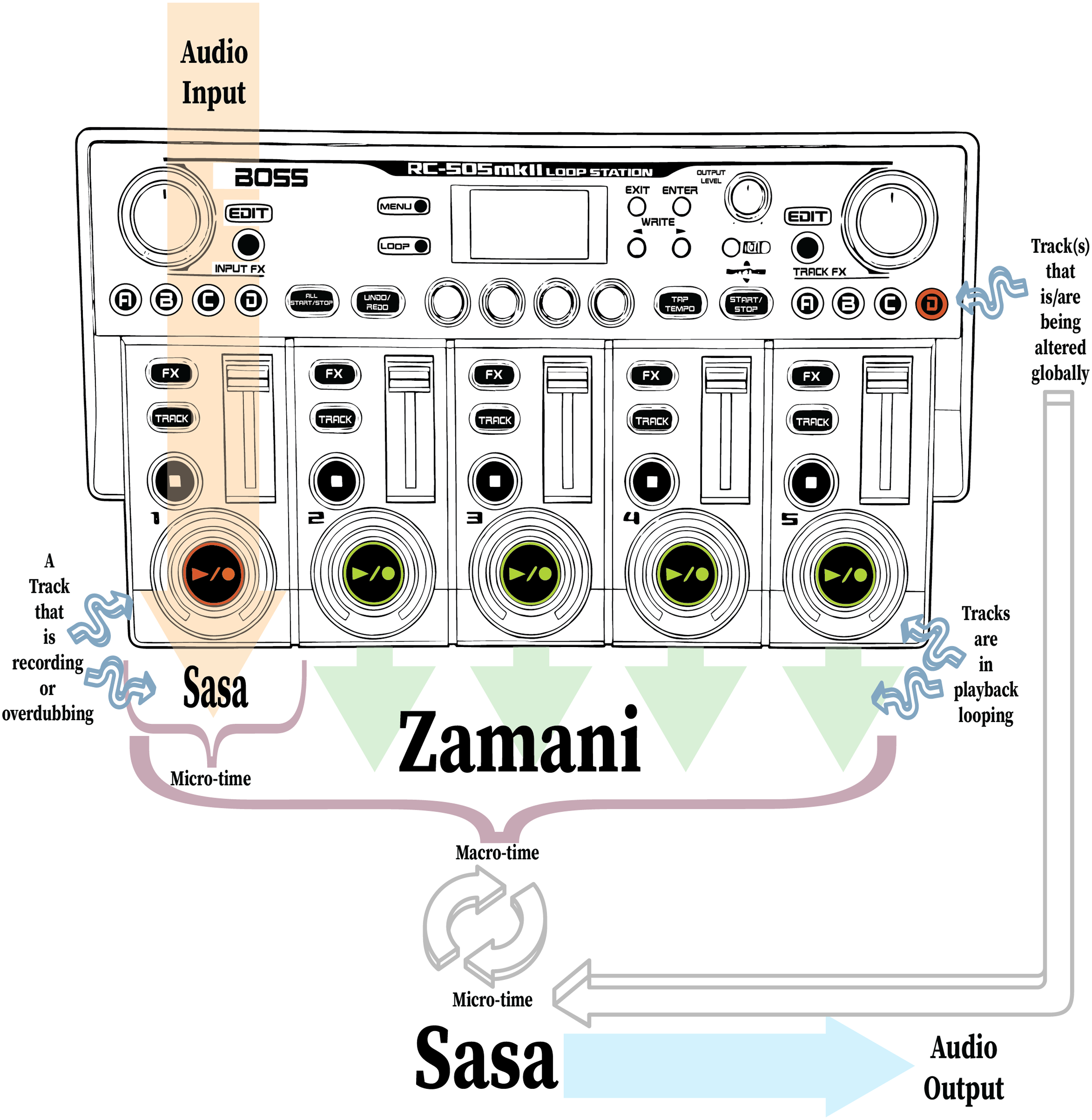
Mapping Sasa, Zamani, micro-time and macro-time on the Boss RC-505 mkII loopstation (author, 2025; CC BY 4.0).
Sonic Sasa, looped Zamani: Ethno-digital performance as temporal research
Following Mbiti's (1971) model of African time—where Sasa (lived present) precedes Zamani (mythic ancestral time)—looping performances enact recursive temporality. Sasa is a dense field of “actual time”: what is happening, has just happened, or will imminently happen. It is micro-temporal and embodied. Zamani is macro-temporal—an archive of accumulated past. In this worldview, time flows backward, not forward. Future events become real only once experienced. Live-looping mirrors this: sonic material is captured (Sasa), layered, and folded into loops (Zamani). The performance uses a DAW, Boss RC-505 mkII, and recycled audi-visual samples drawn from Mozambican field recordings. Each loop is a gesture toward ancestral inscription. This insight frames the article's broader argument. The looping architecture itself can be read as an RIY3 process, continually recycling and recombining sonic fragments while re-signifying archival recordings as live, situated research material.
Conclusion: Reclaiming sonic sovereignty through DIY futurisms
Ultimately, the MidiMbira project suggests that the future of organology in the Global South lies not in the uncritical adoption of Western music technology, but in the “hacking” of it to serve local ontologies. Across the examples discussed in this text, the RIY3 questions shift from an abstract typology to a structuring method, making visible how recycling, remaking, recombining, and re-signifying underpin Mozambican DIY as a decolonial practice of making-do. Future research might further investigate how other traditional instruments can be similarly “versioned” without losing their organological soul. How might the Xitende or Timbila be reimagined through similar DIY interfaces? Furthermore, as AI tools for audio separation become more accessible, ethical questions regarding the “mining” of archival recordings for remixing must be central to the debate. This project offers one model: a recursive, respectful loop where the technology serves the tradition, ensuring that the zamani continues to speak clearly in the sasa.
Footnotes
Acknowledgments
The author gratefully acknowledges the invaluable collaboration of May Mbira and Maneto Carmo Tenfula, whose creative insight and musical expertise were central to the development of this work. Sincere thanks are also extended to Professor João Soeiro de Carvalho for his continued guidance, critical support, and encouragement throughout the research process.

Consent to participate
All named collaborators contributed knowingly to the research as co-creators and are acknowledged with their explicit consent.
Consent for publication
The named collaborators (May Mbira and Maneto Carmo Tenfula) have given their informed consent to be publicly acknowledged and cited in this article. The video still of the late Mozambican artist Dilon Djinji is used with respect and in recognition of his public cultural legacy.
Funding
The authors disclosed receipt of the following financial support for the research, authorship, and/or publication of this article: This research was supported by the Fundação para a Ciência e Tecnologia (FCT), through a PhD studentship awarded to the author under grant number 77915DFA.
Declaration of Conflicting Interest
The authors declare no potential conflicts of interest concerning the research, authorship, and/or publication of this article.
Data availability
Data sharing is not applicable as no datasets were generated or analyzed during this study.
Supplemental material
Supplemental material for this article is available online.