




Abstract
This article explores the existence of an alternative artistic sub-field in contemporary Portugal, grounded in the DIY ethos. Drawing on Bourdieu's theory of artistic fields, it argues that DIY is central to the emergence and consolidation of artistic manifestations within this sub-field. Our approach incorporates insights from the cultural turn and post-subcultural theory, with particular attention to DIY cultures. Those initiatives, while facing commodification and institutionalization, also face structural precarity in the Portuguese cultural sector, exacerbated by the COVID-19 pandemic. Through qualitative methods – interviews and content analysis – the study identifies DIY as a practice of resistance and adaptability. Despite tensions and pressures, DIY remains an essential dimension of these artistic initiatives, playing a crucial role in underpinning the alternative tendency of this sub-field, as well as its cultural and sociological relevance in contemporary Portugal.
Introduction
The study on which this article is based, ARTOPIA: Paths, intersections, and circumstances of urban artistic manifestations of alternative character in contemporary Portugal (hereafter ARTOPIA), 1 revealed that the DIY dimension is essential to demonstrating the existence and characterization of a differentiated artistic sub-field (Bourdieu, 1996) in contemporary Portugal (Guerra, 2010). DIY is fundamental to explaining the origin of the artistic initiatives that comprise this sub-field, as well as the paths of resistance, overcoming and consolidation, considering the structural instability that characterizes the present day cultural sector, particularly in Portugal (Bennett and Guerra, 2019; Green et al., 2023; Guerra, 2018a, 2022).
Our research focused on a set of artistic manifestations characterized by the intersection of arts, disciplines, and knowledge – expressly multidisciplinary and transdisciplinary. We sought to demarcate a sub-field within the field of the arts that is characterized by diversity, hybridity, morphological complexity, and confluence in the form of scenes (Bennett & Guerra, 2019; Bennett and Peterson, 2004; Straw, 1991). It has become clear that we are dealing with a sub-field whose logics/dynamics of emergence, implementation, and consolidation of the manifestations/initiatives that comprise it are interwoven with the structuring and transversal processes of commodification, institutionalization, and massification (Januário, 2019, 2022; Januário and Guerra, 2023), which stand in considerable tension with the founding principles of these manifestations, which are based on alternative, disruptive, DIY, independent, informal, or underground logics and practices (Guerra, 2018b, 2018c; Jürgens, 2016). However, the predisposition of these artistic manifestations towards artistic emergence, experimentalism, and eclecticism, as well as the pressures arising from the constraints they face, preserve some of those assumptions. These include the DIY ethos and principles (Beck, 2002; Bennett and Guerra, 2019; Nesbitt, 2007) that are the subject of this article.
The inherent nature of DIY is not only revealed, as mentioned, in the emergence – in some cases in a context of crisis – of the artistic initiatives studied, which we believe make up a demarcated artistic sub-field with an alternative slant to the prevailing canons and orthodoxies (Bourdieu, 1996); it is also represented as an important factor regardless of the consolidation processes that may affect these initiatives. DIY is particularly evident in the dynamics of response to the vicissitudes, contingencies, and constraints (Green et al. 2023; Guerra, 2022) with which they are confronted, either in the short term or structurally – in other words, in the dynamics of resistance, sometimes in the face of moments of crisis, sometimes as a confrontation with the immanence of underlying structural challenges seen in the artistic-cultural sector of contemporary society, particularly in Portugal (Januário, 2020, 2022).
This article highlights and reflects on the logics and dynamics of DIY principles/ethos that we see in urban artistic manifestations/initiatives present in contemporary Portuguese urban contexts. This takes the form of a qualitative methodology, based on content analysis of interviews with a group of internal agents/actors involved in the case studies – a mixed-methods research model (Bryman, 2012), centrally operationalized in a multiple case study (Yin, 2018) inspired by the extended case study method (Burawoy, 2000, 2009). These interviews constituted the empirical object of this article, along with an exploratory documentary analysis of the social media of some of the manifestations and artists of the first empirical set, during the COVID-19 pandemic. 2
It should be noted that the culture and arts sector suffered greatly during the pandemic because of the total suspension of its activities (Guerra et al., 2021; Januário, 2020). Not only were spaces for continuous activity closed, but shows, festivals, exhibitions, and a wide range of other initiatives were also cancelled. As demonstrated starkly by the pandemic, the precariousness of the sector has the potential, at least in Portugal, to take on a structural character that will be difficult to reverse (Guerra, 2018a, 2022).
We have therefore organized this article into several key sections, which we will outline briefly. First, we provide an account of the context in which what we assume to be an artistic sub-field emerged in contemporary Portugal. Second, we explore how DIY has been interpreted in relation to artistic alternatives and disruption. This sets the scene for the next section, which seeks to point out the evidence of DIY as an ethos inherent in the logics of emergence of the manifestations/initiatives that form a distinctive artistic sub-field and to highlight the extent to which, despite the tensions it encounters when confronted with processes of fading, DIY stands out as an essential dimension of resistance and resilience in the face of crises and constraints. Finally, we make some brief remarks about the sub-field we are trying to discern and the relevance of DIY in its sociological distinctiveness.
The emergence of an alternative artistic sub-field in contemporary post-dictatorship Portugal
An examination of Portugal shows that modernity did not just arrive late to the country but, because of that delay, also came already revised and reconsidered. In other words, if in the 1970s Portuguese society revealed itself as not particularly modern (Guerra, 2020), stagnated in a conservative and imperialist vision due to the dictatorship that had been in force for over 40 years, in the following decade – a time of democratic consolidation – the country plunged into late modernity, simultaneously demonstrating the traces of globality characteristic of western contemporaneity and the risks pointed out by a reflexive modernity or post-modernity. Dividing these ‘two times’ over the last 100 years of the country, we have the Portuguese democratic revolution of 25 April 1974. On one side is a period marked by a dictatorial regime – known as Estado Novo – and on the other side is a democratic period of openness, development, and rapid modernization.
For 41 years (between 1933 and 1974), an authoritarian, conservative, autocratic, corporativist, and colonialist regime prevailed, translated into restrictions on freedoms, censorship, and the annihilation of any political opposition, as well as a significantly suspicious paternalism of external ideas and trends (Guerra, 2018b). Until the mid-1960s, Portugal was a markedly rural country, poorly educated and socially and culturally closed. It was in this decade that important changes – economic, social, and cultural – would contribute to the democratic and social transition of the country (Guerra, 2018b). These transformations, although gradual and unequal – since they were socially demarcated and localized (mostly to Lisbon) – had repercussions for culture and artistic activities. The social and cultural reconfiguration of Portugal towards a process of massification (Loff, 2014) – manifestly felt at the level of schooling – explains the changes in cultural practices that started to become evident (Guerra, 2018b). An increase in the number of libraries and the frequency of theatre and cinema offerings are examples, alongside the growing importance of the media, due to the evolution of the print run of newspapers and the relevance of TV in daily life, in the formation of tastes and the dissemination of other forms of culture (Guerra, 2018b). The reconversion of cultural and social practices emerged as an ‘opening of horizons’, of reflection and resistance, alongside the military mobilization that, the meantime, occurred as a form of protest against a regime that stubbornly maintained the colonies in Africa at the cost of the lives of thousands of young military personnel, culminating in democratic revolution in April 1974.
In the 1970s, Portuguese art and culture established transversality, multidisciplinarity, and the confluence of various activities and expressions (Guerra, 2018b). Simultaneously, the revolutionary aura – manifested in the intention of a new social project – offered the potential for concrete artistic interventions (intervention art). This was a fruitful period for collective conciliation (Jürgens, 2016; Guerra, 2018b), bringing artists closer to the population; it was a time of intervention and ‘culturalization’ of the population. The social changes generated by the political transformation resulted in aesthetic effects that marked the subsequent decades.
In fact, in cultural and social terms, the end of the 1980s in Portugal – particularly in Lisbon and Porto – mark a period of deep transformation. As a sign of late modernity, time accelerated noticeably in Portugal. Alongside democratization, social and cultural practices intensified, revealing irreversible processes of customs liberalization, festivalization, and artistic cosmopolitanism (Costa, 2002; Fortuna and Leite, 2009; Silva et al., 2013). Within this cultural turn (Chaney, 1994; de la Fuente, 2019), artistic manifestations were embodying new forms of creation, mediation, reception, and conventions and canonizations (Belfiore, 2018). In such manifestations, the symbolic force of cultural authority enabled the rise of new art worlds (Crane, 1992) though the inversion of traditional class, community, and culture forms.
In the 1980s, several autonomous artistic practices outside the commercial gallery system emerged, including art interventions in public spaces, performative dynamics and the emergence of photography as counter-narrative (Jürgens, 2016). It the 1990s, numerous informal, artist-led initiatives emerged, producing significant qualitative changes in the Portuguese cultural field. This pluralization transformed underground practices into an ‘alternative mainstream’.
Informality became a defining feature of these new processes. Amid the gallery system crises and institutional disinterest in young artists, collective dynamics emerged that endured, shaping the independent artistic sector into the next decade. Their longevity and influence pointed towards the delimitation of an artistic sub-field (Januário, 2022). The 1990s was a decade when a critical art that disturbed the consensus embodied a strong political message about and for the world (Conde, 2010).
The ‘culturalization’ of society, initiated in Portugal in the 1980s, became inescapably evident in the first two decades of the new millennium. Culture, now recognized as a sector, gained centrality through the growing professionalization of the cultural and creative sector. Alternative artistic initiatives persisted despite today's hybridism, global massification of artistic production and consumption, of the incessant merchandizing that tends to subsume art and culture under the creative industries. These dynamics are further shaped by the institutionalization (recognition and legitimization) of artistic practices (Januário, 2022).
Portugal's historical distinctiveness lies not so much in the artistic trends – since it shares artistic and cultural phenomena with the Global North (Jürgens, 2016) – but rather in the compact timeframe in which events occurred. Portugal's modernization was delayed due to the socio-political circumstances portrayed, but when it came it was swift and compact. For this reason, our attempt to define a specific artistic sub-field – which operates as an alternative – within Portuguese contemporaneity proves to be complex.
Contributing to this complexity are elements of structurality that are recognizable in Portugal's artistic and cultural sector. Despite the growing importance of the cultural sector in the country, reflected in the strategies for valuing and developing its territories (Silva et al., 2015), these have been particularly evident in the most recent socioeconomic crisis resulting from the COVID-19 pandemic.
The artistic and cultural field was one of the first to experience the impacts of the pandemic and its collateral effects. The suspension of activities – cancellation of shows and exhibitions, closure of cultural and artistic venues – has significantly revealed how perilous it is to carry out activities in the sector, which is characterized not only by widespread precarious working conditions, but also by the intermittent systematic political solutions (or a lack of them) and a certain persistence in not regarding art and culture as essential social values (Januário, 2020). Several studies have shown the omnipresence of precarious labour in the careers of professionals in the Portuguese music scene (Bennett and Guerra, 2019; Green et al., 2023; Guerra, 2018a, 2018b, 2022). The COVID-19 pandemic forcefully exposed the conditions of instability inherent in the individualization and neoliberalization of the contemporary socioeconomic model, highlighting Bauman's (2013) doubts about the supposed freedom and self-realization of artistic careers in liquid modernity. It also shines a light on McRobbie's (2003, 2016) deconstruction of the ‘creative entrepreneur’ narrative, which promotes autonomy and self-sufficiency while discarding the role of the state, absolving it of the social protection of individuals. This reveals the DIY neoliberal ethos in all its contradictions, particularly in the cultural economy (McRobbie, 2003). In fact, the objective conditions of art and culture professionals in Portugal point to the maintenance of precarious labour relations, despite the political measures aimed at the sector. The Professional Statute for Cultural Workers, which came into force in Portugal in 2022, does not seem to have been imposed as a means of tackling the structural precariousness and individualization of work in the sector, according to various cultural associations and representatives of professionals and artists.
Paradoxically, the disruption to cultural production caused by the pandemic would not only expose the fragility and fragmentation of these models but would also reaffirm the social value of artistic work (Green et al., 2023; Guerra 2022; Januário, 2020). The paradox behind this discussion involves highlighting elements that allow us to understand how DIY logics operate in the demarcation of an artistic sub-field, which we think of as an alternative slant, while overcoming and resisting the inherent constraints and the faltering structurality of the artistic-cultural field to which it belongs.
The alternative at the limits of the paradox of existence
The assumption of the existence of an alternative-leaning artistic sub-field in contemporary Portugal requires us to engage with the conceptualization of that qualifying epithet. The concept of ‘alternative’ emerges as the possibility of framing the arts – especially the plastic/visual arts, those of exhibition – beyond what is considered canonical and orthodox. The alternative challenges the established systems of creation and mediation, both market-driven (such as galleries) and institutional (linked to official cultural validation (Melo, 2012). On the other hand, we can understand these processes and practices as a space that tends to be distinct from what is considered massified and distinctive to the mainstream in terms of reception. In art, the notion of alternative has an emergent social-historical context, and it refers to a particularly distinctive social action.
The named alternative art is associated with actions that began in the 1960s and 1970s in the United States. These emerged as criticisms of the institutionalized art system and materialized in collective structures/spaces of artistic production, mediation and reception that changed practices, theories, modes of production and forms of making inscribed in the existing definitions of creative production and circulation and installation of artistic works (Jürgens, 2016: 177). We are therefore faced with what Bourdieu (1996) terms heterodoxies in the field of art, expressed through symbolic struggles of the field, since what is questioned is the established power held by the market of art and institutions. The emerging heterodoxies, in the referenced context, revealed themselves against a hegemonic system (orthodoxy) that was censorious, exclusionary, and capitalized in that it held control of the arts system (Jürgens, 2016). Such actions were in opposition to the museum (power), the gallery (commercial), and the consolidation of cultural industries (marketing). These alternative structures were closely aligned with the broader social movements of defending civil rights that marked the 1960s, particularly in New York. The social and political struggles are also part of the artistic field, especially regarding the social and political role of the artists themselves (Wallis, 2002: 164–65).
We can therefore say that these practices had repercussions within the artistic field, in two ways. On the one hand, the socio-political dimension manifests itself in the fight against the commodification of the art field, personified by the gallery system (exhibition for sale and Marchand system) – that is, against profit and anti-commercial (Ault, 2002: 170–71). On the other hand, we are facing a counter-institutional movement opposed to museums and institutions. It should be noted that, in that context, the most varied demonstrations and movements and activist tendencies contributed to the formation of a social space of informal and of self-employment artists’ projects that were ‘counter-institutional, of an anarchic nature and based on DIY ethics’ (Jürgens, 2016: 195). This character of ‘doing by yourself’ and the marginality of the system have been the substance of movements and dynamics in other contexts. Nesbitt (2007), for example, points out that there was a tendency in Britain in the 1980s and 1990s to create what he calls alternative spaces, coming from groups of people (artists) who promoted exhibitions. These were self-promotion activities, since the galleries were closed to the artists involved in these initiatives. These informal and DIY initiatives were significantly challenging to the (art) establishment. In Portugal, as we have seen, this type of initiative gained momentum in the 1990s.
In addition to the DIY ethos, other concepts and dimensions are associated with the notion of alternative; among these, there is a significant correlation and even circularity, as we shall see. One of them is artistic independence. As Bourdieu (1996) argues, the emergence of the modern artistic field is grounded in the principle of independence, expressed through practices and exhibitions that have broken with institutional aesthetic canon (orthodoxies). The independence materialized not only in artistic practices but also in the exhibition, in a form of self-management. It transformed the broader field of art, including processes of mediation and reception (Jürgens, 2016). Independence is therefore associated with rupture, an exercise of freedom, and the affirmation of autonomy.
Like independence, autonomy requires the demarcation and detachment of the artist and their creation from institutional constraints. Artistic autonomy finds its essence in the subversion and questioning of the processes and mechanisms of recognition and institutionalization, and the practices and roles of the agents that integrate the art system (Jürgens, 2016). We also found a correlation between alternative, independent and autonomous space and artistic freedom, emergence, and experimentalism. Such fruitful space for innovation, and even the artistic vanguard (Crane, 1987), is therefore fundamental to the transformation and evolution of art. These emerging artistic practices, in the context of the emergence of the alternative phenomenon, contributed to redefining the concept of art, models and forms of exhibition, democratizing the artistic system and expanding possibilities by leveraging spaces for the confluence of artists from different artistic disciplines, in a way that was both multidisciplinarity and interdisciplinarity (Jürgens, 2016).
One consequence of the artistic alternative is based on what today is inseparable from artistic creation: the confluence that characterizes contemporary art, manifested in eclecticism, transdisciplinarity, pluralism, and relativism (Melo, 2016). The interpretation of these dynamics in a confluence perspective is based on the assumptions of an ‘ideal of freedom tending to be total’ (28) and on the metamorphosis resulting from the dialogical between ‘being inside’ and ‘being outside’ (Zolberg, 2015) or underground. In fact, we think the parallelism between alternative and underground is obvious. An approach to the origins of this concept – which is rooted in approaches to subcultures and youth cultures – shows us that the underground is a set of styles, expressions and movements that are outside the standard, commercial, and mass media circuits (Guerra, 2010; Guerra and Straw, 2017). Alternative artistic practices – from creation to exhibition – are totally carried out by the artists themselves, who create the conditions for exhibiting and disseminating their creations. Characterized by self-management and informality, these practices are DIY (Jürgens, 2016). As Beck (2002) points out, the projects designated as alternative in the United States in the 1960s were based on collective and shared dynamics of self-sufficiency. This DIY ethos remains in many of the artistic initiatives, usually those of young artists (Nesbitt, 2007). Associated with resistance to traditional forms of music and cultural production, DIY has become synonymous with a broader lifestyle policy ethos that unites people in networks of alternative and translocal cultural production – and this is particularly visible in cities (Bennett & Guerra, 2019).
Informality is another relevant characteristic of the alternative. This informality does not fail to revalue the transgressive brand associated with the alternative phenomenon and its relevance is greater in a context of crisis in the Portuguese gallery system; there is a lack of interest in the institutional circuit for young artists. In turn, in a context of accentuation of the characteristics of late modernity, it is remarkable to be faced with eminently collective dynamics that have persisted, creating spaces and initiatives that still mark the independent artistic sector. It should also be noted that, when expressed in the artist's self-management and improvization practices, informality evidences the DIY ethic to frame initiatives with a significant degree of inventiveness, improvization, and creative flexibility.
On how we came to know: Some methodological notes
The research that supports this article is based on a multiple, intensive case study (Yin, 2018), inspired by the extended case study methodology (Burawoy, 2000, 2009) and implemented through qualitative methods, such as interviews, document analysis, and an ethnographic approach – namely observation.
Dispersed across the national territory, the cases being studied, marked by their multidisciplinary and transdisciplinary artistic nature, take various forms. They include festivals and permanent spaces, such as cultural artistic associations (Figure 1 shows the spatial distribution of the case studies across the national territory). Our aim was to understand the emergence of these manifestations, along with their consolidation, their strategies and dynamics, their audiences, and the actors/agents that gravitate to them. Our priority was to analyse the field through the perspectives and social representations of those actors/agents – both those involved in the events and those who, in some way, are active in the artistic field, such as artists and others including academics, critics, curators, journalists, and local government agents 3
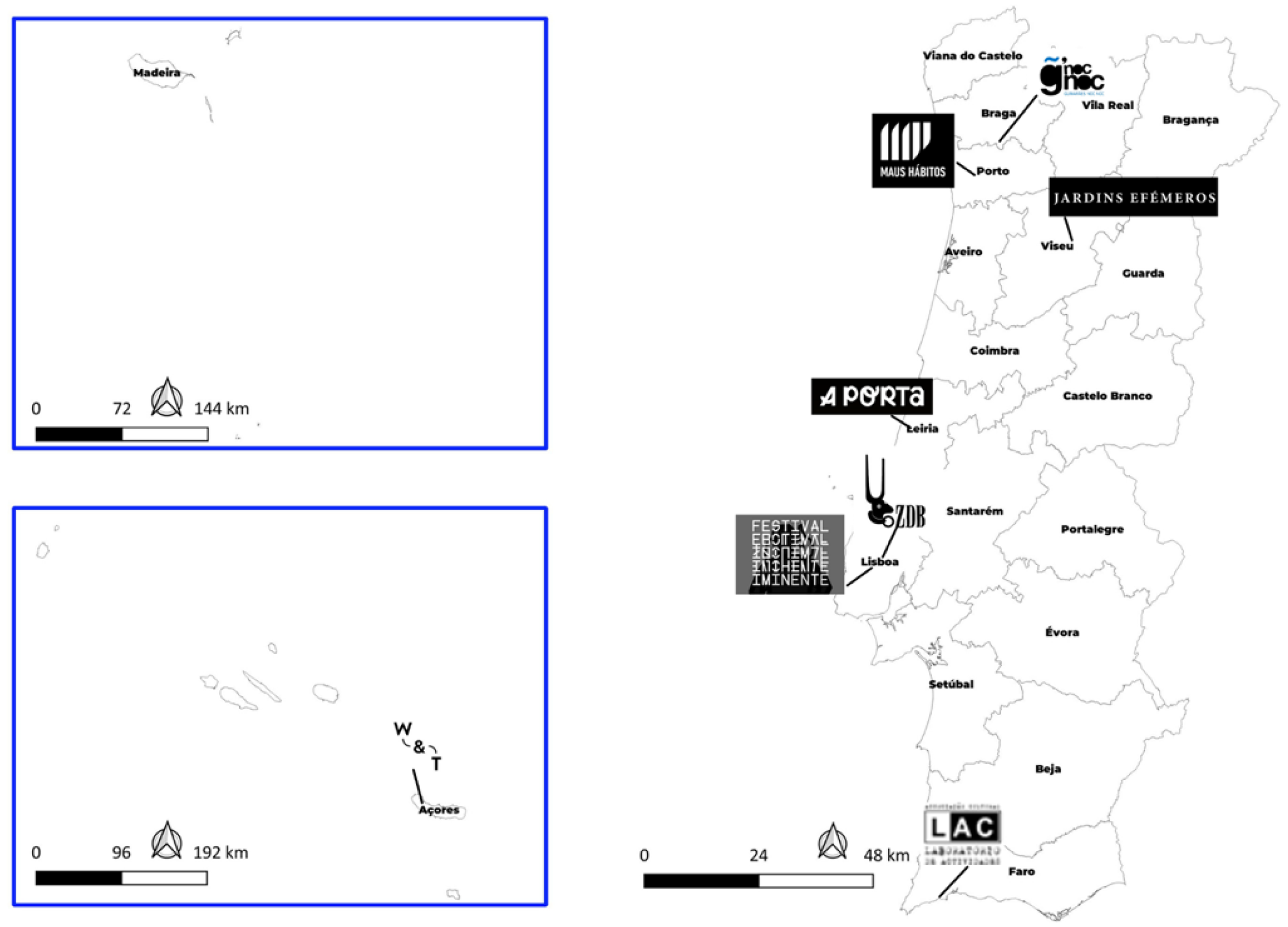
Distribution of the artistic manifestations under study by territory. 8
In this article, our discussion is based on the social representations of the interviewed actors/agents. We therefore chose to adopt a qualitative methodology, based on a set of in-depth interviews with 21 case study agents, six field agents, and seven artists together with subsequent content analysis. From the social representations of this group of actors, the meaning and significance are reconstructed to gain insight into the reality under investigation.
The empirical focus of the research was the analysis of the content disseminated by some of the initiatives under study, 4 as shared via social media during the first general pandemic lockdown in Portugal, between March and May 2020. This more systematic monitoring of the actions of the initiatives under study resulted in an initial essay on the activities promoted during the period in question, in which the initiative's resilience and adaptability became evident (Januário, 2020).
DIY: An ethos of emergence, existence, fragility, and survival
We started from the premise of the existence of an alternative artistic sub-field in which a set of contemporary artistic manifestations is visible, which simply do not belong either to the dynamics of the market (galleries) or to institutional dynamics (instances of cultural consecration) (Melo, 2012). The exploratory approach of a multiple and multifaceted object of study taken as a social space focused on the concepts of alternative, informal, independent, DIY, and underground experimentalism. This is the focus of our critical inquiry. Is it possible to witness the alternative phenomenon today? Is it legitimate to define an alternative artistic sub-field in the current context? There are no straightforward answers. In fact, historical evolution has shown that the alternative phenomenon was, in a way, time-specific (Jürgens, 2016), and has certainly become eroded over time. While the phenomenon was clearly rooted in the 1960s and 1970s (and, in Portugal, in the 1990s), it must be acknowledged that the spaces that merged then – and survive today – have often faced the very processes of commodification and institutionalization they once resisted. In fact, many of the alternative and independent initiatives that emerged in those decades – and even in later decades, as in the case of Portugal – have survived by making concessions to market and institutional logics. The alternative movement or phenomenon of the 1960s and 1970s diminishes as the initiatives disappear or become institutionalized, commercialized and/or hybridized, and are absorbed into mass consumption (Boltanski and Chiappello, 2005). Approaching the mainstream, some become reliant on audience recognition, drawing closer to the mainstream in the process. Moreover, the fluidity and hybridism of contemporaneity, together with the culturalization and festivalization of life (Bennett et al., 2014) that mark our present day, challenge the boundaries of what can be considered alternative. The question that remains is whether our intention to delimit an alternative artistic sub-field remains a valid or feasible endeavour.
We argue that the enduring presence of the DIY dimension in these initiatives is a defining characteristic. It underscores their specificity and their potential to constitute a distinct artistic sub-field (Januário, 2022). This argument will be further elaborated in the following discussion.
As stated previously (Januário, 2019, 2022), we can easily discern that an artistic sub-field can be delimited through the intention to challenge a certain institutionalized normative validity (need for independence from the established system), to create new modes (materialized in spaces and structures) of production and circulation of artistic works, where other possibilities are expressed on the basis of non-formal, self-management dynamics and open to experimentalism (informality). At the heart of this informality lies the DIY principle, which is fundamental both to the emergence of new artistic practices and to the interdisciplinary nature that defines many alternative art spaces (Jürgens, 2016; Guerra, 2021). Some of our interviewees reinforced this point: I think that [DIY] is an excellent expression, probably what motivated people, because … I think people realized that they have the power to intervene … [Artistic facilitator] This space and many of these spaces are born out of the need for artists to self-organise, and this one is obvious. I even think that [this institution], in terms of the history of self-organised spaces for artists, of workshops organised by artists, is one of the first spaces even at a national level … [Artistic facilitator] I think it is very important the opportunity that they give to artists to show their work … many times if it wasn’t for these kinds of entities, they wouldn’t be able to show their work … I think that these spaces are fundamental to have a great variety of discourse and to show younger or more emerging artists. [Journalist]
Notably, the emergence of a significant number of these initiatives, anchored in DIY logic, is not only a form of cultural insurgency, but also a response to recurring structural crisis that tends to accentuate the precariousness and fragility of areas such as culture and art: With the crisis … I mean, in 2008 the economic crisis begins, doesn't it? Then the arts, as always, suffered the most … Portugal has never had much support for the arts … I think people have realised that they have the power to intervene, I don’t know what discourses have taken place in Portuguese society, I don’t know if it was a reaction to right-wing governments that perhaps … cut back on areas, the public and the arts, that the Portuguese have realised are important and have reacted to this … [Artistic facilitator] I think … always thinking of our ideals … and it is a bit like that, DIY, the punk question … this is super connected to punk, for me this is super connected to punk … and brings that component that to me excites in all these projects you were talking about, I think they all have this scene … I’m not saying it from the point of view of what we think is punk, but from that perspective it is! … It's not a luxury … It's not a luxury, it's resisting! [Artistic facilitator]
A central element of the DIY ethos and praxis, particularly within the current socioeconomic and political framework, is the principle of sharing. In the case of music, for example, it is common for practitioners to share essential resources to musical production – such as stage infrastructure, sound and image equipment, and editing tools (Guerra, 2018a). This act of sharing is not driven primarily by necessity, but rather by an ethical commitment to accessibility and collective enjoyment. As Chrysagis (2020) observes, DIY can be understood as a modus operandi that enables individuals to attain the intrinsic value of a practice while simultaneously reshaping the mechanisms through which value is produced across different spheres. Most individuals engaged in DIY music activities combine intrinsic values with at least some form of extrinsic valuation: aesthetic and social enjoyment, as well as personal fulfilment, intersect with the provision of the material and symbolic resources necessary for sustaining the practice, its dissemination, and even social and artistic validation (Januário, 2022).
Indeed, it is possible to observe how social actors have seen creative/artistic practices – particularly in music (Green et al., 2023; Guerra, 2022) – as possible occupations and as a means of coping, especially with exclusion. This became particularly evident during the COVID-19 pandemic. Immediately following the decree issued by the Portuguese government in mid-March 2020, three of the artistic initiatives under study responded to the resulting suspension of activities by adapting to the available means and resources, turning to digital tools not only for dissemination but also for creation (Januário, 2020).
At the time, we had the opportunity to observe the online edition of the Iminente Festival–Emergency Edition, 5 which brought together a range of artists from the fields of music and visual arts for one day in April 2020. Maus Hábitos, 6 a permanent venue, recreated its usual program under the banner of #Hábitos de Quarentena [Quarantine habits], a series of podcasts that sustained its regular features, including parties, mixtapes, DJ sets, and clubbing. Its motto was: ‘If you can’t go to Maus Hábitos, Maus Hábitos will come to your house.’ LAC 7 also launched a 2-day multidisciplinary streaming initiative entitled LAC–Closed Day. This title served as a counterpoint to its annual initiative LAC–Open Day, which typically aims to openly and intensively promote its activities to the local community. Over the course of 2-day event, several artistic interventions were carried out, including the dissemination of images, pre-recorded videos and live-streamed content by several artists (Januário, 2020). We argue that these events, promoted by artistic initiatives situated within the sub-field we have sought to delineate, once again attest to their ability to face adversity. This, in turn, reveals a marked inclination towards voluntarism and reinvention, fundamental dimensions of their continued existence.
Making alternatives possible
The attempt to demonstrate the existence of a distinctive artistic sub-field with an alternative orientation in contemporary Portugal has proved to be far from straightforward. This is largely due to broader societal trends, notably the processes of institutionalization (Januário, 2022) and commodification (Boltanski and Chiapello, 2005; Thornton, 1995), as well as the relativization of the DIY ethos. These dynamics are not exclusive to the art and culture sector but reflect broader transformations in contemporary societies. As already mentioned, it is impossible to ignore the ways in which art and culture have been shaped and instrumentalized – a trend that prioritizes economic value over symbolic meaning and demonstrates that capitalist logics are increasingly shaping the processes of creation, mediation, and reception (Boltanski and Chiapello, 2005; Thornton, 1995). The penetration of the logic of management and specialization, clearly visible across society at large, also finds expression in artistic manifestations, particularly in relation to their viability (the continuity of their existence) and credibility. Nevertheless, and despite the relativization of the DIY ethos, of the notion of the ‘alternative’, and of informality itself, the relevance of these initiatives/manifestations – particularly in relation to artistic emergence, experimentation, and resistance – remains significant.
The persistence of a certain degree of organizational informality helps to sustain DIY logics, expressed primarily through informal management structures born of limited financial means and chronic resource scarcity. This context not only implies resistance but also calls for a kind of pragmatic creativity to devise solutions and ensure the realization of activities. These logics help to explain, at least in part, the continuity of the initiatives studied over time and how they persist despite structural underfunding and limited resources. On the other hand, the DIY logic and dynamics are also the basis for the fact that, as spaces for artistic mediation, the initiatives studied are potentially initiatives for artistic emergence. This emergence is evident in the fact that it is often the artists themselves who, through DIY approaches, create the necessary conditions to promote their work. Furthermore, it has become clear that these artistic initiatives respond to moments of pronounced crisis through a particular DIY ethos. The ways in which the three cases analysed in this article – Festival Iminente, Maus Hábitos and LAC – responded to the constraints imposed by the pandemic are exemplary in this regard.
Footnotes

Funding
The authors disclosed receipt of the following financial support for the research, authorship, and/or publication of this article: The publication was supported by FCT – Foundation for Science and Technology, within the scope of UIDB/00727/2020.
Declaration of conflicting interests
The author declared no potential conflicts of interest with respect to the research, authorship, and/or publication of this article.