



Abstract
This article scrutinises an endeavour staging together hardware prototyping, co-design and exhibition-of/performance-with DIY artefacts. Inhibition pivots on a neural network controlled headset capable of electroencephalography and algorithmic audio composition. This technology is detailed and the particular ways in which it affords a multi-faceted doing-it-with-others are elaborated upon. Technological and artistic implications are discussed vis-à-vis: holistic frameworks for co-production/education; multi-modal affect; participatory/relational art; Dewean pragmatism; and the practice and culture of ‘open-sourcing’. It is shown that the values that are more often than not associated with art making fail do justice the ramifications of such an endeavour and that the latter cannot be thought of through an hylomorphic lenses. A different vector of values is demanded that rather concerns playful techno-scientific experimentation, ‘commonism’ and socio-material enactment. On this continuum, the author suggests neo-constructivism, democracy and post-selfhood as the lenses to think about Inhibition.
Introduction
The question of a unified holistic framework for simultaneous artistic production, presentation and education has been both topical and pending in a number of diverse contexts, and will be further discussed in the next section. This article scrutinises a relevant project that stages together instrument making, techno-scientific research, creative experimentation, artistic performance, co-design, improvisation, workshopping and exhibition of DIY artefacts. This venture – namely, Inhibition, revolves around an ANN (artificial neural network) controlled headset that is capable of EEG (electroencephalography) and algorithmic audio composition. This prototype technology provides a context for DIWO (doing it with others) involving extended workshopping and several opportunities for the participation of the general public. Inhibition has been premiered at the Hybrids media art exhibition, curated by Ars Electronica, and hosted in Athens GR between November 2016 and January 2017. Subsequent workshops, performances, lectures and exhibitions have taken place in Berlin DE (twice), Sophia BU, and Limassol CY.
Before detailing the project, it is worth delineating what is at stake. This endeavour should be thought of vis-à-vis the following research subquestions:
Frameworks to co-produce, share know-how, practice creativity, and learn holistically employing advanced technology; Staging of art in ways that transcend the traditional paradigms of performance, installation, or exposition; reconfigure relational aesthetics so as to take into account techno-scientific tenets; Artistic practice as an open-ended research laboratory; artistic research as the artistic outcome proper (and not as the means to some eventual artistic result); Blurring the boundaries between production, presentation, and education; renegotiate the roles of artists and audiences; Demystification and democratisation of the techno-artistic process; establishment of democratic environments to co-create, co-research and co-learn; Explore paradigms of cybernetic ‘post-selfhood’ (to be explained later on)
This article intends to provide an empirical account of how to tackle the above in a real-life context as well as to discuss implications thereof.
Having introduced the project and what is at stake, a Background section follows with the state of the art. The section afterwards elaborates on the technology the project pivots on and the one after that outlines its staging and the ways in which it facilitates audience participation and DIWO. A Discussion section follows examining the project through the lenses of neo-constructivism, Dewean pragmatism, and cybernetic emergence. The Conclusion section revisits the research subquestions above and offers some final remarks. Then, comments on Future Research are given. Two appendixes are also included, providing technical details and mathematical descriptions of key components.
Background
Scholarship offers several accounts of projects that concern the unification of art making and exhibition/performance with hardware prototyping, education, and/or technological experimentation. Albeit sharing common grounds, those approaches differ significantly in the extent to which they only involve experts (or broader audiences), produce new technology (or not), and attain educational prospects (or not). In LLEAPP series of collaborative workshops (Green, 2014) or in Media Mess(e) (n.a., 2022), to give a couple of examples, artistic research and technological experimentation are concretely exposed as activities with inherent artistic value. In those two cases, however, only experts engage in techno-artistic experimentation so that any relevance to Inhibition is merely epiphenomenal.
Broadly considering the eclectic tradition of participatory arts, audiences are involved in artistic contexts in all sorts of different manners. In his seminal work, Bourriaud (2020) coins ‘relational aesthetics’ as an umbrella term for several different kinds of practices that pivot on social contexts and very often involving the general public. Bourriaud furthers an understanding of the artist as a catalytic presence that facilitates, or that co-creates, artistic value alongside an actively concerned audience. Still, relational art largely concerns apparatuses to either use audiences for artistic purposes or to create phenomenological experiences for audiences and artists to share. Unlike other participatory approaches, it is not interested in joint research or education.
Other scholars give accounts of participatory music making pivoting on workshopping and involving situated local audiences and the general public (Jo et al., 2013; Richards, 2013). Participants of varying backgrounds and skills actively engage in the artistic process, building themselves the instruments they are about to subsequently use in order to perform with one another. In such cases, artistic value lies not so much in the eventual production, or listening, of a piece of music but rather in the entire workshop experience. The latter is not to be thought as a compositional means to the former but as the artwork proper with inherent aesthetic value of its own. Patel and Richards detail several similar approaches in which making, studio recording, and live electronics converge to an ongoing hybrid activity that ascribes to a ‘DIY Nomad’ ethos – that is, one concerning workshopping on the move and with the “creative licence to use limited skills to define the scope of their work” (Patel and Richards, 2020).
Other endeavours aspire to bootstrap micro-communities around some technology. For instance, Fukuda et al. support the instrument they have invented by means of commissions, workshops, mentorships and long-term technical support (Fukuda et al., 2021). Setting up communities around an apparatus is, of course, nothing exceptional; in a market economy companies actively support groups of users and fora concerning their hardware or software products. However, such communities are far from being democratic since – as a rule of thumb – the technical know-how is disclosed and the rights to repair, customise, or specialise are largely just in the hands of a commercial company. That said, community driven making/doing is intrinsic to many aspects of contemporary techno-scientific culture such as fablabs, hackerspaces, hackathons, experimental non-monetary micro-economies, guerrilla gardening and other DIY activities (Caldwell and Foth, 2014; Travlou, 2014). While trending paradigms of the sort only epiphenomenally, if at all, address artistic concerns (they are not meant to be art in the first place) they, nevertheless aid in making known a paradigm for the general public to engage with culture that is very different to how it has been traditionally exhibited in museums and galleries. A direct consequence of this is that nowadays media art festivals and biennials routinely include DIY/DIWO workshops and similar activities in their program.
On the same continuum, the so-called maker/hacker and FLOSS (Free/Libre Open Source Software) movements are of particular interest in that they have pretty much become ideologies one may choose to align with. While there are many different ways to interpret and adopt the former, they all revolve around two foci (Feller, 2005):
sharing (that is ‘opening’) prototype technology is a good thing to do; (consequently) collaboration, co-learning, and peer production is to be celebrated and endorsed.
In reality, both maker/hacker and FLOSS relate to a broader ‘commonism’ movement that calls for the public ownership of cultural content and natural resources alike (Bollier, 2014). Such an understanding of ownership resonates socialist/leftist political theories and occasionally results in a rather speculative/utopian way of thinking. That said, open-sourcing is a reality; it is already widely spread across peers, academia, small companies, and even big enterprises (e.g. Google). In this vein, the so-called ‘open innovation’ model has emerged, pivoting on less secrecy in business and encouraging the sharing of ideas, data, and artefacts (Saebi and Foss, 2015).
While approaches such as those of Richards and Patel certainly share common grounds with FLOSS/open-sourcing, the latter do not simply suggest an immediate DIWO and a sharing of technical resources; they additionally demand that care is given to ensure that it is easy/possible to bootstrap longer-term (micro-)communities around some project or its transfiguration into another. At the very least, this involves sharing detailed technical handouts through some dedicated online platform for co-development and version control. More involved cases also incorporate fora, dedicated websites, physical meetings, thematic conferences, management committees, and so on. A very common practice in FLOSS is that of the ‘fork’; that is, to copy the entire code base of a project in order to initiate an independent development vein that may lead to some other distinct project. This is very different to practices such as Fukuda et al., in that the latter concern communities exploring the use or the appropriation of some technology while the former is more about actively developing it and very often pushing it to entirely new directions.
Open-sourcing is very often in sharp contrast with artistic practice, too; in that the former puts emphasis on sharing and community work while the latter appears still largely governed by (post-)romantic values (talent, genius, originality, expression, exceptional craftsmanship) that have somehow survived both modernism and post-modernism. Indeed, many artists would feel uncomfortable to openly share their techniques or to abandon authorship altogether. There are important exceptions, of course, but the sheer majority of professional artists would not embrace plagiarism or anonymity as valid artistic values. (It is maybe worth noting that this has not always been the case historically; consider, e.g., Byzantine religious art). Plagiarism, anonymity, and non-attribution are not unknown to open-source and maker/hacker culture, however; as a matter of fact, there do exist dedicated licenses to distribute creative work explicitly allowing, if not encouraging, the former 1 .
On a different continuum, holistic and situated hands-on education has a long history along different vectors. Dewean pragmatism advocates learning as a necessarily hands-on, social, and interactive process (Dewey, 1997). This is fundamentally discrepant with the traditional view of pedagogy as the lossless transmission of authorised knowledge across different generations. It, instead, suggests that education is all about DIWO, with an additional emphasis on democratic structures, on the flow of which art, creativity, and education emerge as a unified activity (Ingold, 2017). Similar views have been (more or less independently) expressed, and put to action, by others throughout the 20th century. E.g., with Escuela Moderna founded by Catalan anarchist Francisco Ferrer i Guàrdia in 1901 in Barcelona and, later on, by his acolytes in New York (Avrich, 2014), or with the so-called ‘Reggio Emilia’ approach for early childhood education in post-WWII Italy (Hewett, 2001). Maybe most importantly, the trending application of the so-called ‘4E Cognition’ in education calls for learning environments that afford embodied, embedded, enacted, and extended doing; a recent special issue of the Constructivist Foundations journal is entirely dedicated to such applications (Videla and Veloz, 2023).
All the above converge in the need for an environment affording enactive learning; Dewey, Ferrer i Guàrdia, and Reggio Emilia, further suggest that this environment needs be democratic, non-competitive, and promoting sharing, collaboration, and trans-generational DIWO. While such ideas belong to the first half of the 20th century they are no less valid today. As a matter of fact contemporary scholars occasionally return to Dewean pragmatism with vivid excitement acknowledging its relevance to contemporary learning sciences (Ingold, 2017). A subtle, but important for this article, difference, between such a lense and our time is that today we have a much deeper appreciation for the significance of our material surroundings. Frameworks such as ANT (Actor-Network-Theory) (Latour, 2007) or MET (Material Engagement Theory) (Malafouris, 2013) celebrate things, tools, and (techno-artistic) practice as actors that are equally (if not more) important to humans in bringing forth sense-making. In light of this, for contemporary DIWO practice objects, materials, technologies, and things of all sorts are no less important than human peers. We can then think in terms of democracies, not of people, but of people, things, and technologies alike. Such an understanding perturbs the way Inhibition is structured.
Under these premises, this endeavour draws upon, or relates with, a broad array of subareas in art, technology, social sciences, philosophy, education, and economy and attempts to tackle related concerns in an empirical fashion and through the development and public staging of new technology. Inhibition aligns with 4E Cognition, is deeply inspired by the democratic values of Dewey and i Guàrdia, draws extensively on workshopping tactics introduced in projects such as those of Richards and Patel, and follows performance paradigms such as those that appear in the case of LLEAPP or Media Mess(e). It also owes a lot to open-sourcing/commoning paradigms – especially regarding the particular ways in which the featured technology is staged for local and remote audiences to survey, use, and build upon. Accordingly, Inhibition relies a lot on an interplay between bespoke technology and the public staging thereof. The next two sections examine these two vectors in detail.
Prototype
Making a headset capable of real-time EEG, sound synthesis and Machine Learning is a rather involved affair. Literature, of course, is abundant in resources on BCIs (brain computer interfaces) and – to a much lesser extent – EEG-driven audio synthesis; still the idiosyncrasies of this project make existent resources not particularly helpful. The prototype headset is not just an instrument for the author to use, but also a basis for DIWO so that, overall, it needs to:
afford customisation be battery operated (for safety) have excellent EEG sensing performance in the 1–20 Hz frequency range have high noise and electrical hum rejection be moderately low cost be modular and extensible be relatively easy to make by non-experts be lightweight and relatively comfortable to wear (it shouldn’t put audiences off using it)
The remaining subsections describe the technology developed to those ends.
Circuity
Figure 1 demonstrates the eventual electronics schematic. This is a compromise circuit built after careful consideration of several technical resources, namely Benning et al. (2003), Moyes and Jiang (2012), n.a. (n.a.), as well as trial and error. The proposed circuit comprises an amplification stage, a DRL (driven right leg) circuit, a hi-pass filtering/amplification stage, two low-pass filters, a floating ground power supply, analogue-to-digital conversion and some auxiliary utilities (an audio ON/OFF switch, an ON/OFF switch with flashing LED, volume control, etc.). It acts as a front-end to a single board computer – namely, C.H.I.P., also known as the 9$ computer at the time of prototyping. Out of the numerous available options C.H.I.P. was deemed an excellent choice since it was very cheap, lightweight, with very low power consumption, and also featuring a DAC (digital to analogue converter), a step-up power converter, and an embedded battery charger. 2
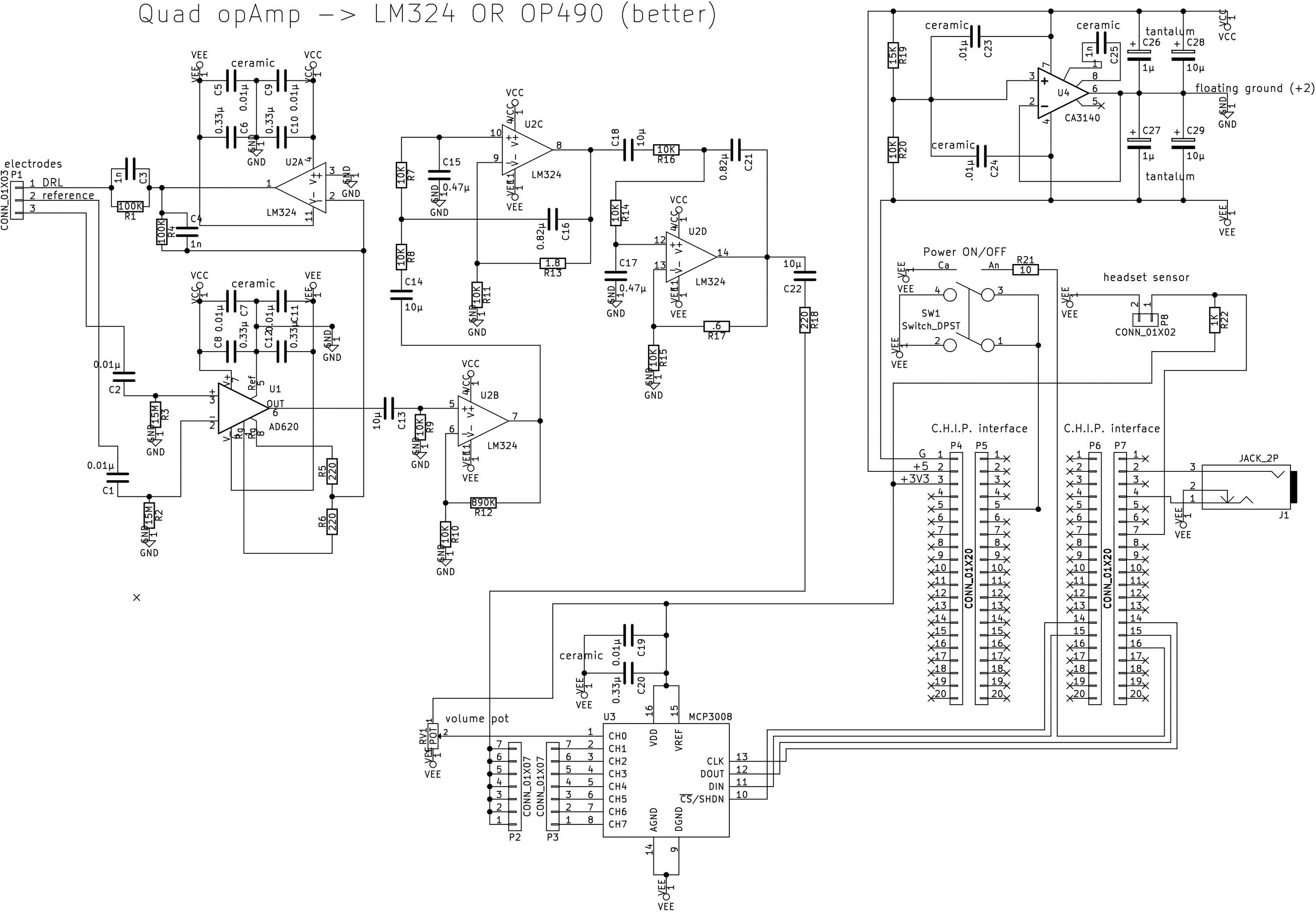
Electronic schematics.
An overview of how the EEG signal is processed is given in this section; more technical details are given in the first appendix. The detected signal first goes through the passive hi-pass filters formed by
The DRL and the filters are implemented in a quad op-amp that could be either the high-precision and low-noise (but also much more expensive) OP490 or the standard LM324 (that is typically used in workshops). When fitted with a standard 3.7 V lithium battery C.H.I.P. will deliver 5 V clean (since it is from the battery) and regulated electrical power to the circuit. A floating ground is then created employing a buffered voltage divider and a few capacitors in parallel for stability. According to their datasheets, both OP490 and LM324 swing up to approximately 1.4 V below the positive rail and up to approximately 500 mV above the negative one, so that with the ground floating at 2 V is should be possible to achieve a maximum
PCB
Figure 2 illustrates both layers of the PCB for Inhibition and Figure 3 an assembled and soldered prototype. (A couple of pins are cut and bridged so as to cater for some errors in the design.) The pins on the bottom right corner are where the C.H.I.P. is attached. The PCB is designed to be stackable so that up to seven different layers can be used with the same C.H.I.P. and the same ADC (MCP3008 features eight channels but one is used to digitise the signal from the volume control potentiometer). Channel selection is via a jumper. To use more than one PCB one needs to use spacers, as shown in Figure 4, and some bridging pins. The DRL and the reference electrode are common so that only one additional electrode needs be added per layer. The floating ground circuit can be omitted from all extra layers since the rails are also shared.
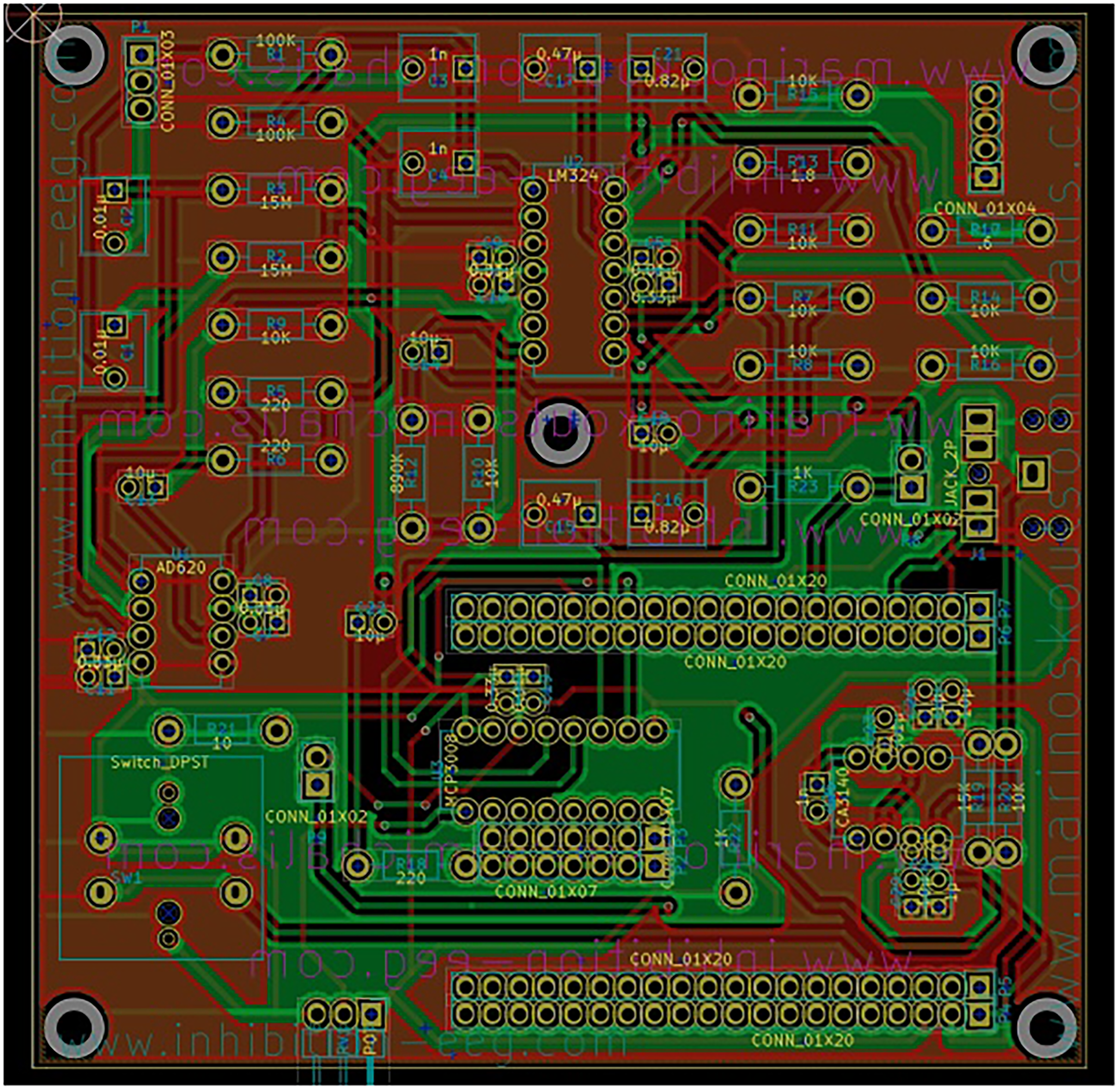
PCB, both layers shown.
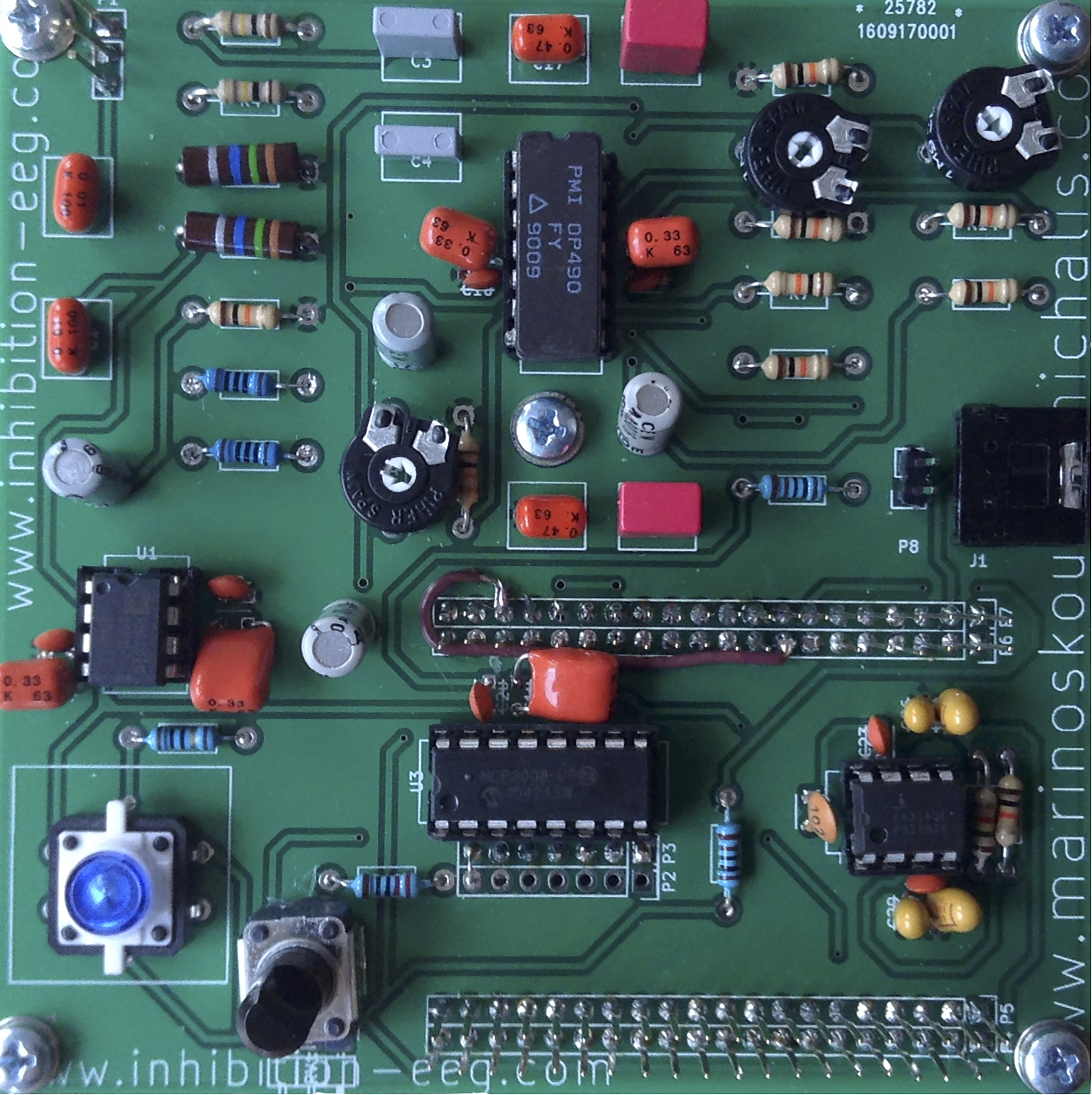
PCB, assembled and soldered.
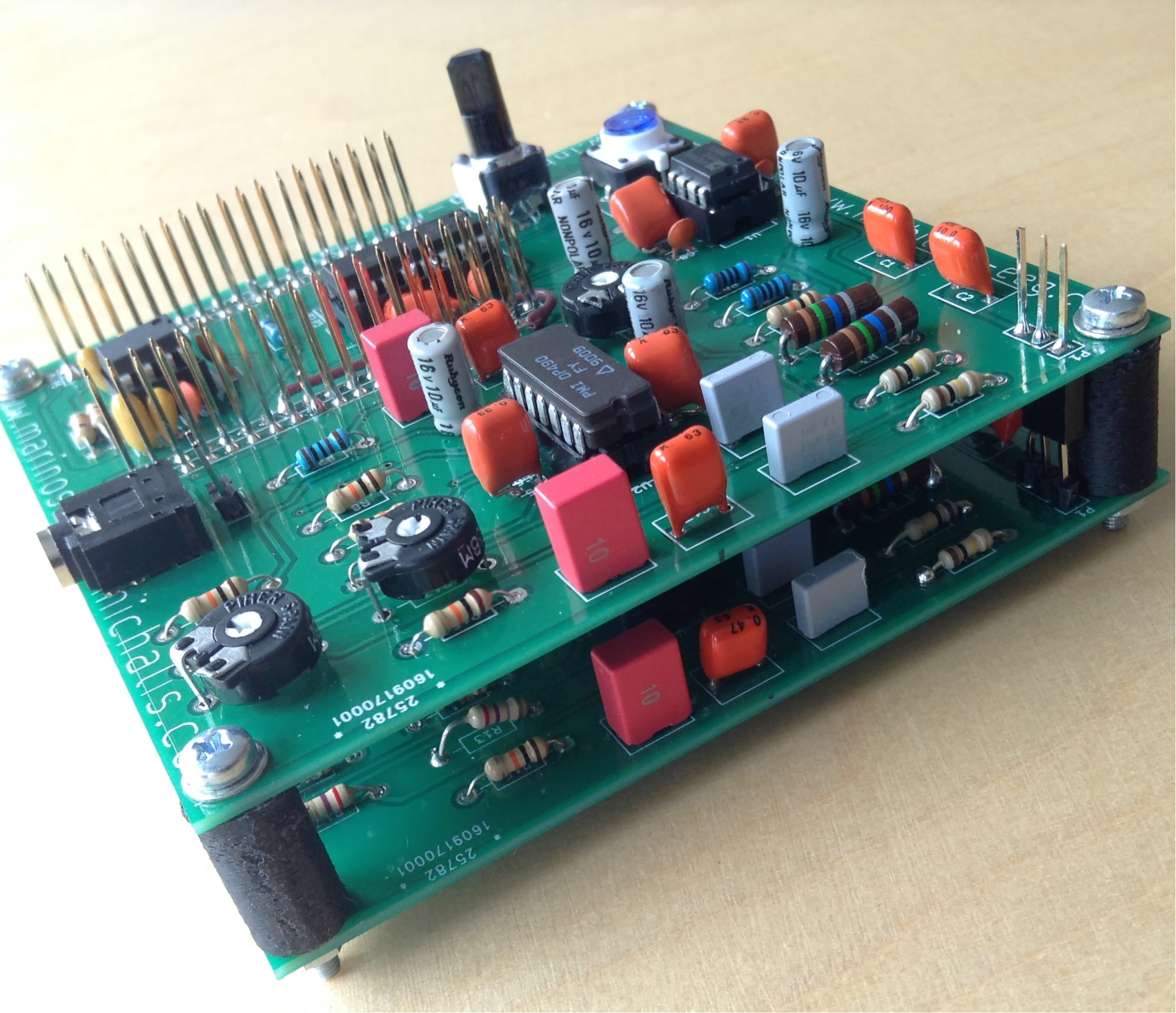
Two stacked PCBs, side view.
Electrodes
The electrodes are a very important elements insofar as overall performance is concerned. The electrical impedance of the skin may vary dramatically from an individual to another, and in any case a good and relatively ‘matched’ coupling is necessary so as to deliver a healthy signal at the AD620. There are three main approaches when it comes to electrodes for EEG. ‘Wet’ ones employ some gel electrolyte to achieve quality coupling with the skin while ‘dry’ ones feature small spikes that lightly pierce through the skin to lower its impedance. Finally, there are some ‘active’ designs with impedance matching and amplification circuity right onto the electrode. (More kinds of coupling are encountered in clinical settings – e.g. ‘needle’ electrodes that pierce deep inside the brain (after having opened the skull, of course) but these are obviously not adequate for a DIWO techno-artistic project.) The provided circuity is compatible with both dry and wet electrodes. Given a good electrolyte wet ones seem to give better results and are more comfortable to wear. Still, in a DIWO context it is important to keep both options open as to afford different use scenario (e.g. designs having the electrode pierce through hair).
Software
The software developed for the project comprises a number of distinct modules the most important of which appear in Figure 5. The Synthesis engine, coded in SuperCollider, is the main module. Every few seconds it asks a utility module (coded in C++) to retrieve a few seconds long chunk of multichannel EEG activity and to store it locally; this is subsequently analysed via FEUtil – a machine listening feature extraction tool developed by the author as part of the So.D.A. project (Valle et al., 2014). FEUtil produces a vector of features that is dynamically mapped onto the synthesis parameters. Sound synthesis is then controlled by both the detected features and the specific mapping schema in effect. Note that the latter is not necessarily linear nor one-to-one.
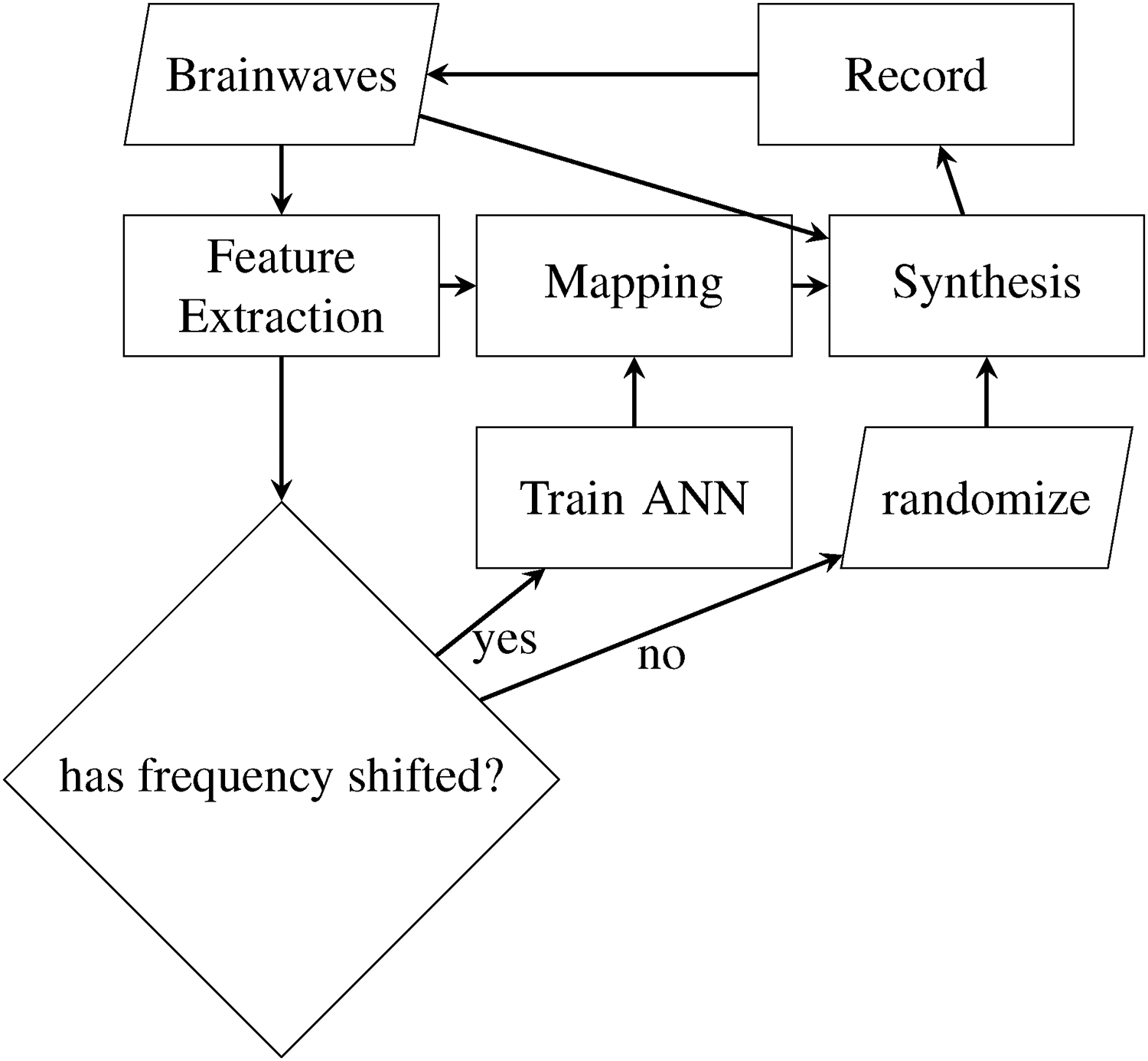
Modules pipeline.
Synergistically, the above provide a basic infrastructure to facilitate all sorts of projects pivoting on live EEG analysis and/or interaction. They allow the programmer to access several channels of raw EEG data, to extract some features of interest out of them, and to even perform complex sound synthesis (employing SuperCollider). The author’s prototype only explores one of the many possible applications; one that revolves around a very simple idea: to always inhibit the concentration of a human subject. In this context, the single most important feature to be extracted is the fundamental frequency of bio-electric oscillations. The prototype algorithm attempts to somehow alter it through sound. At first, the synthesis parameters are randomised. If after a few seconds some notable change (greater than 0.6 Hz) is detected, the mappings in effect are deemed effective for this particular brain. Accordingly, a machine learning utility (also coded in C++) – a shortcut ANN (Artificial Neural Network) with five layers – is trained on the existent mapping so that the next configuration will only slightly deviate from the former as the ANN seeks to further optimise its weights. If, however, the detected change is less than 0.6 Hz an altogether different (random) mapping is employed. This procedure is further elaborated upon in the next subsection.
Composition
A brief overview of the audio synthesis algorithm is given in this subsection; for a much more detailed technical account refer to the second appendix. The compositional schema at play is based on two working hypotheses: that a subject’s concentration can be indeed affected via sound, and that a rather simple machine learning pipeline has the capacity to optimise such a system vis-á-vis the real-time reactions of the subject’s brain. It should be underscored that in a DIWO context lots of other compositional ideas are worth exploring, the author’s being a rather niche one. It should be also noted that there are, of course, numerous assumptions in the above hypotheses and most importantly in the way they back up implementation; most notably that a subject’s concentration relates to the fundamental frequency of their brain’s bio-electric oscillations and that it is indeed possible to alter the latter employing sound synthesis. While both assumptions are certainly plausible, it is well beyond the scope of this article to delve deeper into such affairs. Inhibition is envisioned as a platform to facilitate playful experimentation and research with exactly those kind of questions and this is very well reflected in the idea of an apparatus that attempts to destabilise concentration through sound – whether this is indeed possible or not.
The system comprises two distinct audio generators – a wavetable-lookup oscillator and a sinewave oscillator, respectivelly – both of which are modulated by other control signals so as to achieve a numbers of effects (e.g. panning, vibrato, tremolo, frequency shifting, and other) at varying modulation rates. Given a detected fundamental frequency in the EEG signal, a ‘target pitch’ is chosen – that is, another frequency (that is close to the former fundamental) towards which a shift is desired. At irregular time intervals the synthesis engine employs either of the two generators to produce a number of simultaneous tones in various frequency registers that either oscillate at a harmonic of the target pitch or produce interference beats at the same rate. Interference beats are produced when two oscillations have slightly different frequencies; this is perceived by human listeners as a periodic variation in volume at a rate equal to the difference of the two frequencies.
Similar ‘interference’ schemata are in effect with the rest of the synthesis parameters so that the resulting composition is characterised by (more or less synchronous) periodic oscillations at a rate governed by the target pitch (or some harmonic thereof) that govern stereophonic positioning, amplitude, fundamental frequency, timbral morphing, vibrato, and other qualities. It is hypothesised that should a human subject be exposed to such oscillating patterns suggesting a certain target pitch that is different to the fundamental frequency of their brain’s bio-electrical oscillations, the latter would be eventually affected (and possibly even synchronised with the former).
To sum up, when some substantial change over the fundamental frequency of a subject’s brainwaves is detected the ANN is trained to learn the synthesis parameters that have caused this to happen; a new target pitch is then selected so as to attempt another shift. If no substantial change is detected after a while, a new random configuration is tried out. This process goes on indefinitely, with the apparatus ‘learning’ (in theory, at least) the ways a particular brain responds to the generated audio and so as to continuously self-optimise. That explained, the audio composition is not entirely controlled by this process. In order to avoid repetition and so as to sustain a contingent composition that offers variation to a listener, subtle divergent behaviour is hard-coded employing standard stochastic music synthesis techniques so that the resulting audio is contingent at all times.
Headset
Figure 6 3 demonstrates one of the two prototypes created by the author (in collaboration with a professional designer). A pair of headphones and several 3D-printed plastic parts are used so as to keep two PCBs in place on the top of the head. Tire-ups are employed to keep the battery in place. Articulated supports hold the electrodes so that it is easy to have good skin contact in differently sized foreheads. Finally, just below the PCBs a small piece of leather hides a momentary lapse button that will turn the headset ON whenever someone wears it. Headphone based designs – albeit rather simpler and only featuring one PCB – are typically offered to workshop participants as ready-made solutions and so as to allow them to focus on other aspects (e.g. synthesis or electronics). On several occasions, notwithstanding, other designs have been tried out; e.g. employing ready-made helmets, belt clip-ons or straps to hang on one’s neck.
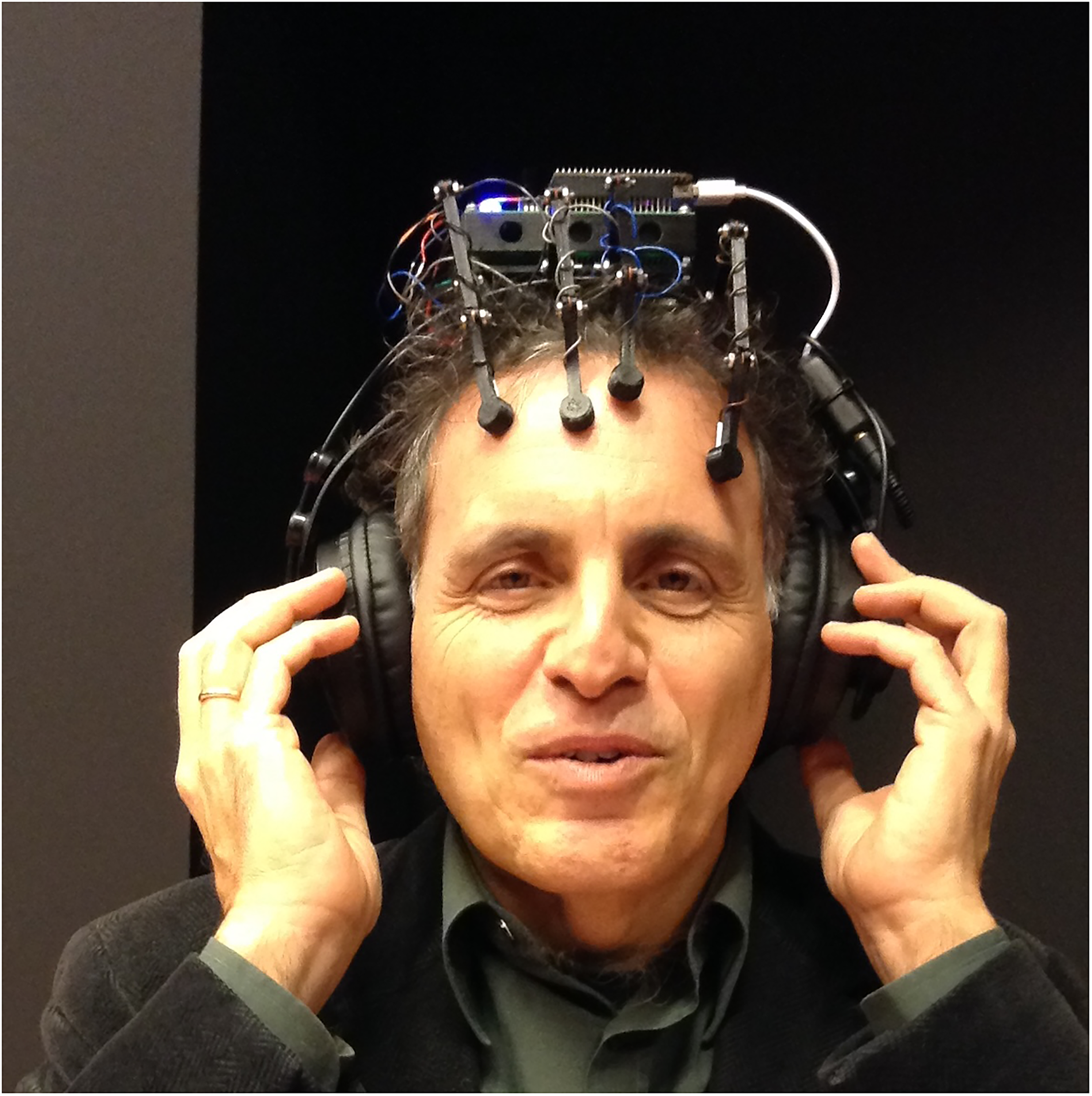
Prototype headset; photo by the author.
Doing it with others
Having elaborated on the technology developed for inhibition, in this section the DIWO specifics of the endeavour are scrutinised in some depth.
Workshop
As already discussed, the prototype technology is designed from the ground up to facilitate extensive workshopping. It relies on parts that can be easily (and affordably) acquired or fabricated digitally, a circuit board with ample space between components (so that it can be easily soldered by amateurs), an open-source (very cheap) single-board computer, and a code base that only makes use of open-source libraries and frameworks. The result is a rather affordable, relatively easy to produce, and safe to use device that, at the very same time, suggests itself for extensive customisation. To this end, the author has also catered for alternative components and strategies that either make the headset faster and easier to implement or that favour customisation in some particular respect. In this way, the fabrication of individuated apparatuses is both afforded and encouraged and pertains to many different design aspects.
The electronics can be easily customised to produce simpler (e.g. with just one layer) or more sophisticated (e.g. with several layers, optimised filter characteristics and/or electromagnetic shielding) implementations. It is trivial to embed the PCB in all sorts of wearable objects and paraphernalia. Then, given that the utility to capture the EEG signal is rather low-level and fast (being coded in C++), the headset can be interfaced with software of all sorts, in any language, and for different purposes. The author has also made available a simpler version of his prototype SuperCollider code that can be used as a starting point for other compositional endeavours since, in reality, most workshop participants are not particularly interested in inhibiting concentration in the way described above.
Hitherto five different Inhibition workshops have taken place in different countries across Europe, lasting from a few months with weekly meetings to just a few consecutive days. More than 30 individuals have taken part in those workshops and several bespoke headsets have been produced individually or in groups – Figures 7 and 8 illustrate two such examples.
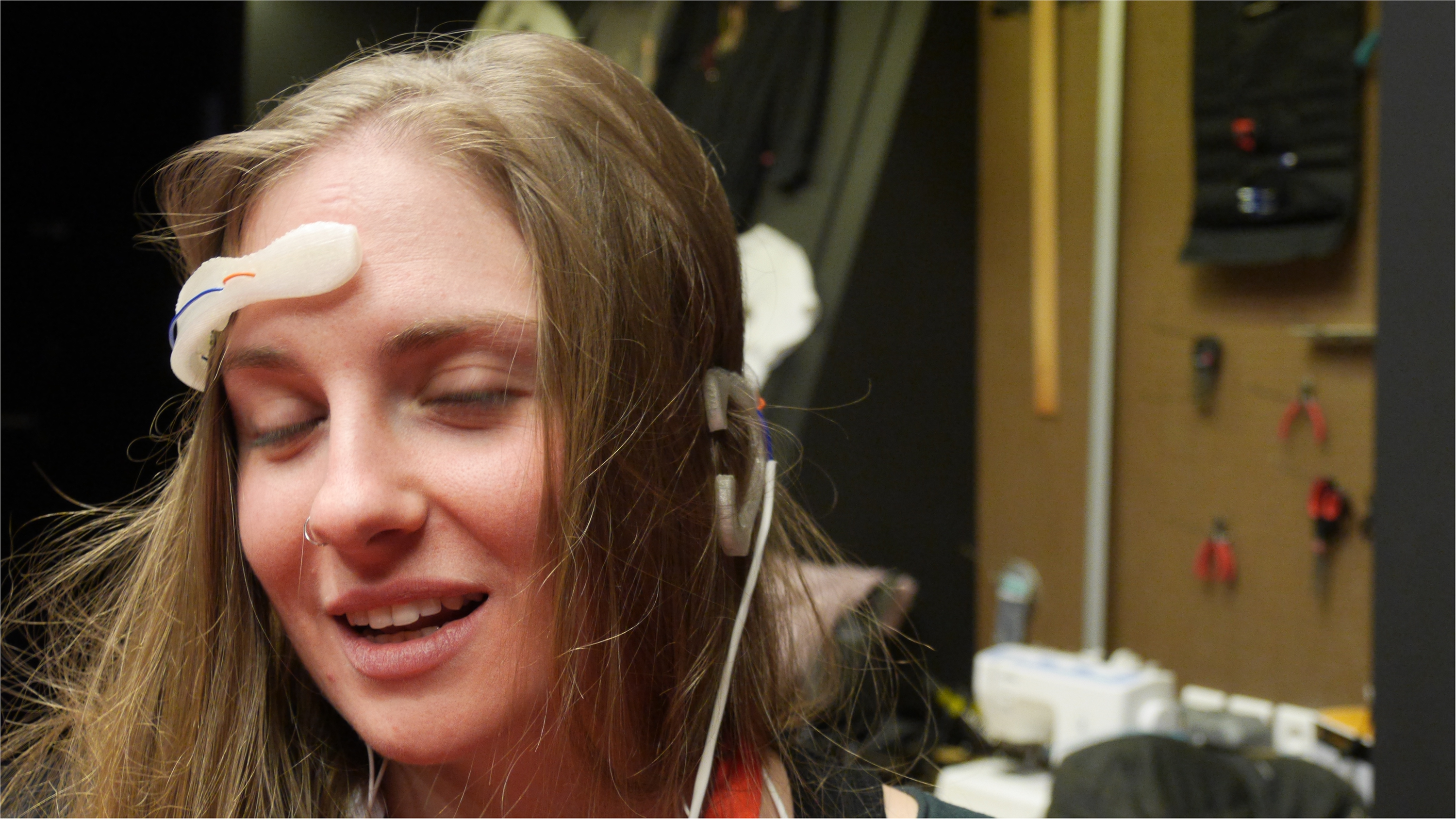
Workshop participant bespoke; photo by P. Goubouros.
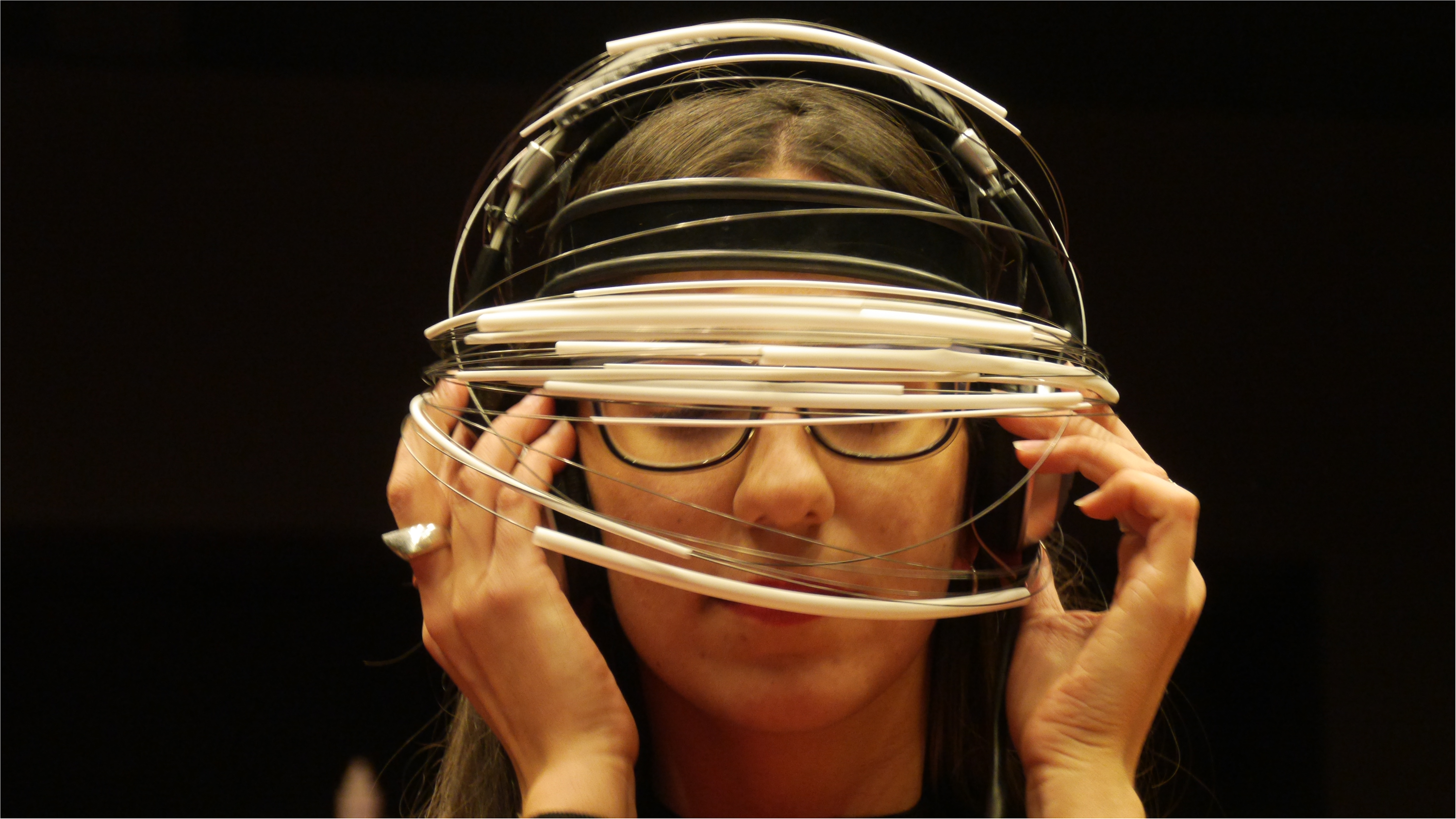
Workshop participant bespoke headset; photo by P. Goubouros.
Exhibition
A typical Inhibition exhibition comprises the author’s prototype, a selection of bespoke headsets by workshop participants, a video presentation of the history of the endeavour in a loop, and an exposition of various materials and artefacts that are reminiscent of the technology developed for the project and of the prototyping process – see Figures 9 to 11. The ‘memory’ of any past workshops is left to reverberate the exhibition space; that is, material remnants that are evocative of the workshop experience are left in place for audiences to survey. Visitors are also invited to use the author’s prototype in an interactive fashion and so as to listen to an ever-evolving individuated sound composition synthesised in real time with respect to their neurophysical activity. The video, the headsets showcase, and the drifting material ‘memories’ of past workshops aid expose technological research and DIWO as a fundamental aspect of the art being exhibited.
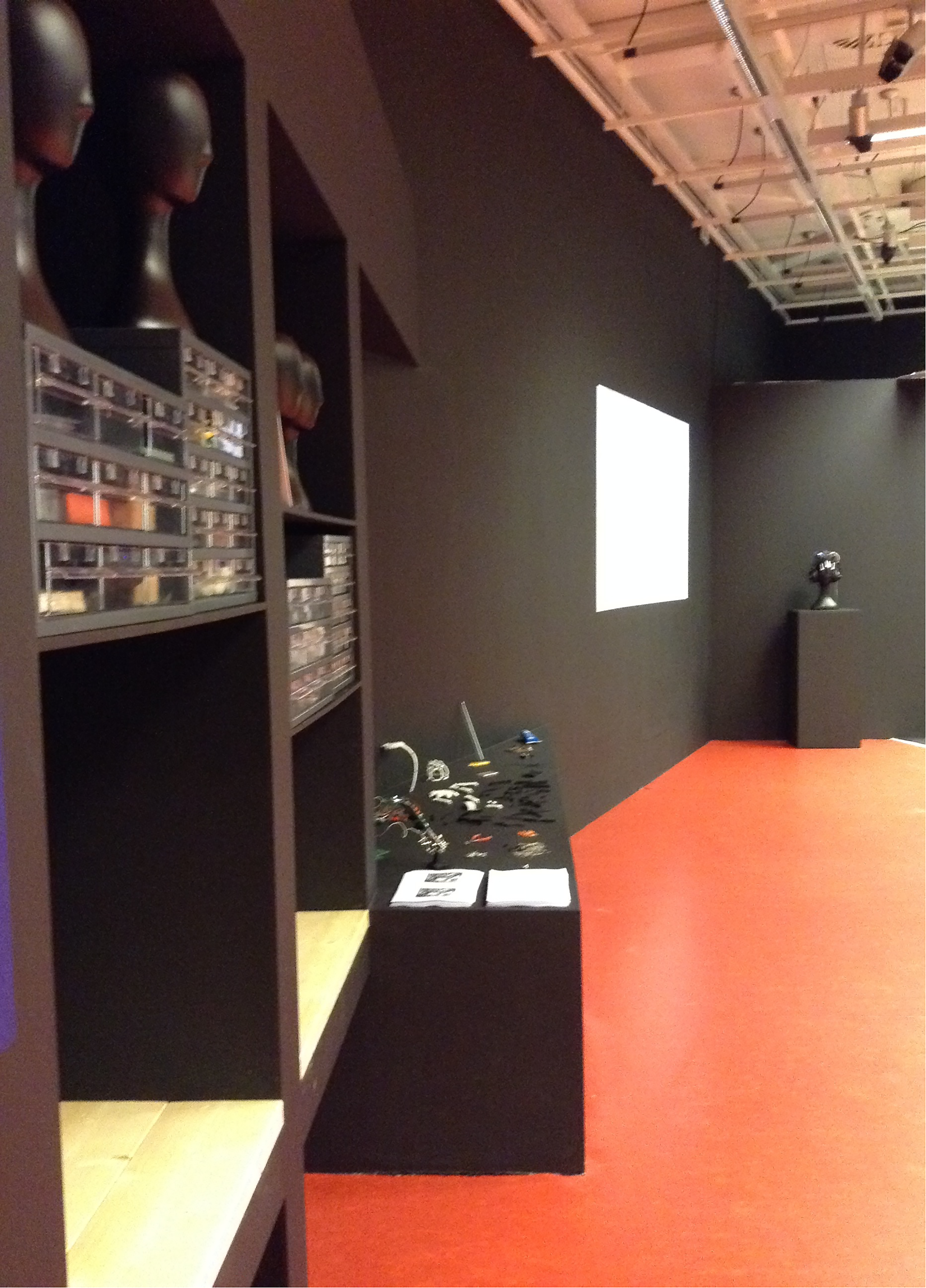
Exhibition view; photo by the author.
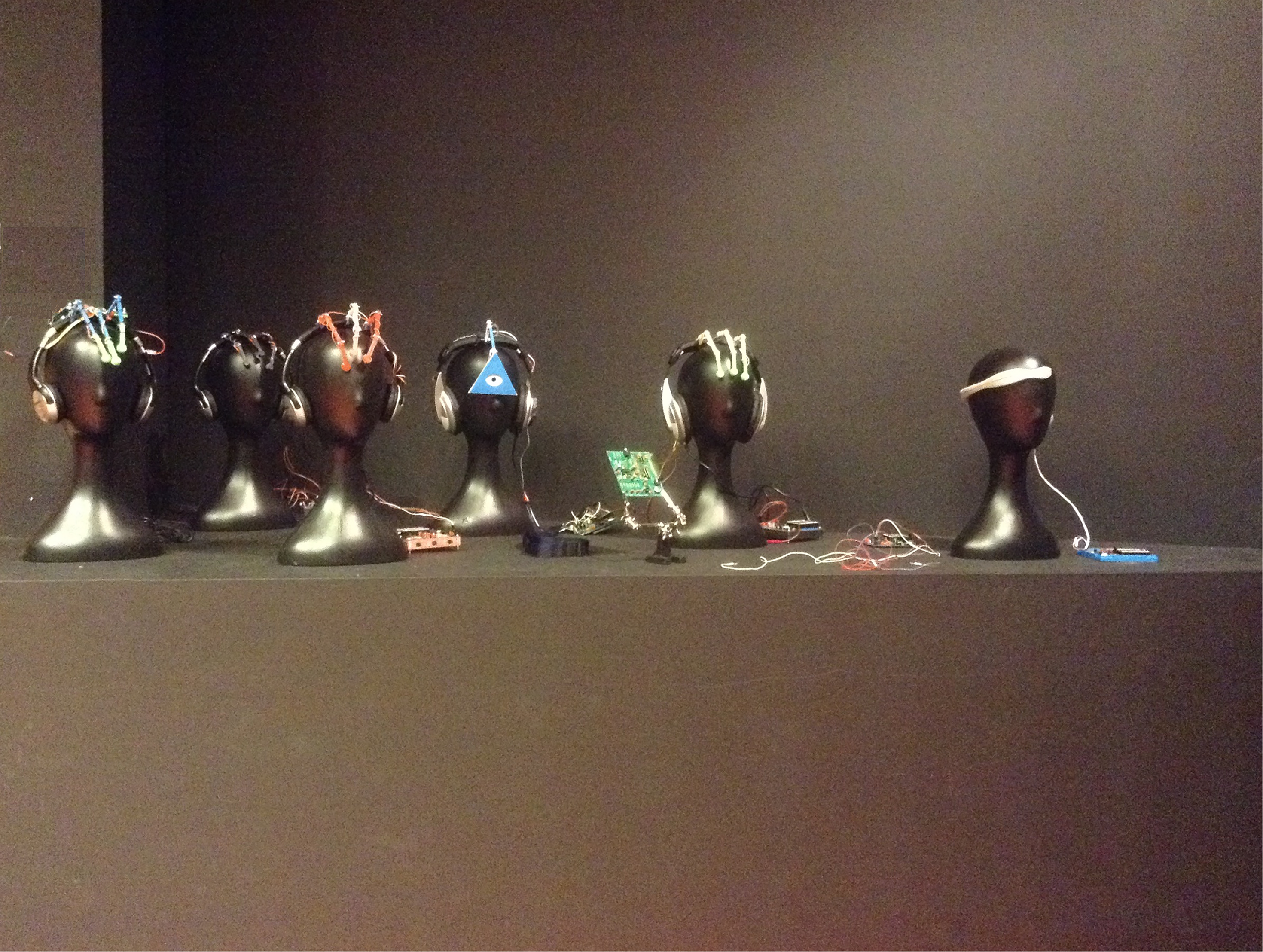
Exhibition detail; photo by the author.
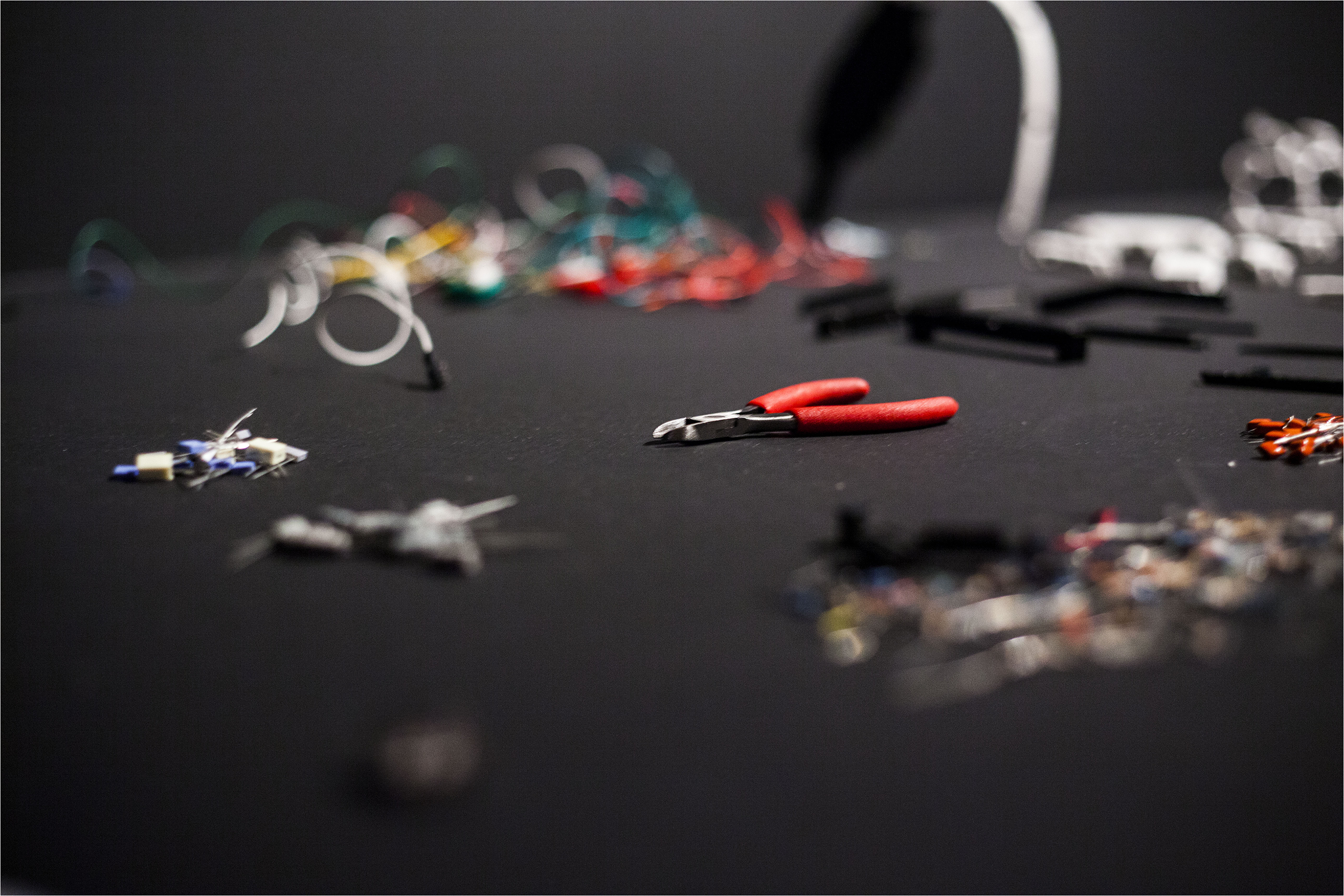
Exhibition detail; photo by T. Ziaragka.
Performance
On several occasions the author has performed electronic music for a live audience wearing the headset and having the generated audio also sent to a loudspeaker system for public reproduction. Such events typically conclude with the author inviting members from the audience to take his place and to perform on his behalf. More than just a theatrical gesture, such an act exposes the headset as the means to an entire array of contingent compositions vis-á-vis the neurophysical reactions of some particular listener. On a few other occasions impromptu ‘EEG ensembles’ are formed where workshop participants put their bespoke headsets on and perform collectively. This leads to improvisations that are much more complex, dense, and organic than what an individual with one headset alone can do.
Community
In tandem with FLOSS and maker/hacker culture, Inhibition seeks to bootstrap a community around the prototype technology developed. Accordingly, all the material base of the endeavour – that is, schematics, 3D-printable and CNC-producible models for parts, technical handouts, and the C++/SuperCollider code are all made publicly available online both at Github 4 and in a dedicated website 5 . The latter also features detailed information on the project and aspires to become a meeting place for makers, artists, scientists, hackers and creative technologists that are interested in BCI research. Individuals can use the provided forum to socialise with one another, to contribute technical material of their own, or to upload images/video displaying their own creative outcomes. Initially, this community has been rather active with individuals contributing some of their own designs and implementations; but soon after the author stopped facilitating face to face workshops it declined into a rather dormant state; it seems that situated workshopping is necessary to sustain an active community in this case.
Discussion
The above account suggests an organic ecosystem wherein materials, technologies, and social dynamics are inextricably interwoven. Such a condition no longer echoes those values that are most often than not associated with artistic practice: e.g. originality, artistic genius/talent, or excellence of the finished artefact so that neither structuralist, expressivist, modernist nor post-modernist lenses would do justice to the aesthetic implications brought forth. Maybe more importantly, hylomorphic schemata fall short since Inhibition does not encourage the production of some given artefact but rather intends to initiate and to sustain open-ended research in different directions (Koutsomichalis, 2018). Inhibition then necessitates a different vector of aesthetic values that rather draws on playful techno-scientific experimentation, design research, ‘commonism’/open-sourcing, and enactment. The author suggests that the project is seen through the lenses of (neo-)constructivism, democracy and post-selfhood.
Early 20th century Russian Constructivism understood the art object as the result of laboratory experimentation with materials and technologies and, thus, proclaimed an artistic practice that acquires value in extensive research and on top of a non-hylomorphic understanding (Gough, 2005). Such a take foregrounds research and process and is strikingly similar to several contemporary art/technology and art/science endeavours, as e.g. accounted for in Salter (2015). Inhibition certainly aligns with such a way of thinking and is very much structured accordingly. Indeed, the logic of a laboratory/workshop driven thinking is apparent throughout this endeavour.
At the same time, the particular ways in which Inhibition opens up technological resources to the public is meant to echo democratic values. The project has been conceived and implemented from the ground up so as to facilitate the sharing and the demystification of the technological know-how acquired by the author. More importantly, it takes community building seriously so that the knowledge that has surfaced is further enriched and further promulgated. As already discussed, this is supported with lectures and workshops as well as through the opening up of all code, design blueprints, and schematics. In a fashion that is reminiscent of Dewey’s stance towards education, the general public is invited to actively engage, co-create, co-perform and co-exhibit with the author. As noted in the Background, however, a strictly Dewean perspective does not underscore the importance of the material/technological layer that, since ANT, we know is almost paramount.
We can speak, then, of a shared socio-material space – a ‘micro-democracy’ of (more-than-) humans that, in a neo-constructivist manner, affords the production of bespoke artefacts, their exhibition, and the training of audiences. Process is celebrated and peer production is concretely advertised as equally – if not more – important than the artist’s own work, while at the very same the material basis of the overall venture is acknowledged as equally significant though the omnipresent exhibition thereof. Accordingly, knowledge sharing, co-production, experimentation and the presence of a hybrid socio-material environment that affords and that actively fuels the former all acquire artistic value. Reciprocally, Inhibition acquires artistic significance not in terms of some artefact nor its performance potential, but because of the overall democratic and creative ethos towards techno-scientific experimentation that the project adopts and stages.
Under these premises, any artistic value in Inhibition cannot be solely attributed to the author but, rather, belongs to the entire DIWO ecosystem that affords the production of all the exhibited artefacts, the resulting performances, and the ongoing community building. This also relates to the proposed notion of ‘post-selfhood’ that is claimed to manifest here in two different respects:
The coupling of an individual brain to a device meant to alter its bio-electric activity – thus, bringing forth an emergent (non-consciouss) cognitive assemblage Surrendering individuality and own intentionality to the emergent cybernetic properties of a much broader socio-material assemblage
The above may sound – and to some extent are indeed – both abstract and hard to support with evidence. Notwithstanding this, cybernetics, cognitive studies and critical post-humanism offer well laid out frameworks that aid contextualise and elaborate on both.
A contemporary view of the mind is not longer that of an intracranial computational machine but, instead, that of an emergent process that also comprises an environment, a soma, affect, emotions, feelings and more. MET calls for a radical re-conceptualisation of mind and material culture according to which the latter substantiates its meaning enactively so that it is even possible to “to think through things, in action, without the need of mental representation” (Malafouris, 2013, p. 58). MET suggests that the mind does not pre-exist its interaction with the material world but is in fact produced by the latter. In a not so different vein, Hayles talks of ‘cognitive assemblages’; that is, symbiotic hybrid entities that interpenetrate each other’s actions, so that cognition is always already distributed throughout an assemblage that may comprise either or both biological and technological elements (Hayles, 2017).
Drawing upon such trains of thought, it is easy to see that with the prototype headset on, a subject becomes immediately entangled to a non-conscious cognitive assemblage. That is to say, that some sort of hybrid (non-conscious) meta-mind surfaces the intersection of cerebral processes and technology designed so as to affect them. With this technology as a point of departure and in the manners discussed in the previous section, Inhibition seeks to also macroscopically establish and sustain an ecosystem that facilitates socio-material enactment. While there are numerous different ways to engage with this technology, an explicit call to make, share, play, socialise, think through things and tools, and let go in some temporary ad hoc symbiotic hybrid mind – of the kind accounted for by Hayles – is always there. Can such a condition be thought of in terms of post-selfhood?
According to the biological theory of autopoiesis, selfhood arises from intrinsic processes that are recursive and self-producing (Varela et al., 1981). That is to say, that selfhood’s primary function is to sustain itself. It has been later suggested that social systems also exhibit autopoietic behaviour and, thus, have capacities akin to intentionality and sense-making that can be dramatically different to those of their constituent (human) parts (Luhman, 2008). A DIWO ecosystem of the sort described here can be, of course, thought of in exactly such terms. Inhibition can be said to produce itself on top of processes that refer back to its very own technological and methodological bearings. Moreover, it does ‘behave’ in ways that cannot be fully understood or predicted by any of the human actors that comprise it – the author included. It resolves in artefacts and ad hoc preformative events that, albeit loosely planned, cannot be entirely predicted or controlled. What is eventually produced is not the work of some particular individual but the collective work of a micro-democracy of (more-than-) humans.
Conclusions
Let us now return to the subquestions stated in the first section. Also considering the state of the art, Inhibition easily surfaces as a conscious and integrated case of a holistic and unified paradigm to co-produce, share, exhibit creativity, and learn empirically. At the very same time, this multi-modal way to present techno-artistic research to the general public – involving inter alia lectures, performances, ensembles, workshops, etc. – is shown to relate with an ethos that shares little grounds (if at all) to the values often echoed in modernist and post-modernist art traditions, relational aesthetics, collective improvisation, and (probably to a lesser extent) DIY/DIWO music making. Instead, Inhibition is heretofore shown to draw from FLOSS and hacker culture, Dewean pragmatism, and technological experimentation. Accordingly, Inhibition is shown to be much more relevant to the following vectors:
Neo-Constructivism, in that it celebrates open-ended technological experimentation not as the means to art but as the very art to be presented; Democracy of (more-than-)humans, in that it seeks the establishment of communities and ecosystems that afford co-production, co-exhibition, co-learning and the active engagement of individuals with one another as well as with all sorts of materials, tools, technologies and ways of working; Post-Selfhood, in that it fumbles about with the possibility of hybrid (non-conscious) cybernetic assemblages at two different levels – that of an individual human with a headset on and that of a distributed sociomaterial ecosystem.
Accordingly, the role of the artist and that of their audience are renegotiated. The artist is no longer an individual who advertises their technical/aesthetic excellence and presents their work in front of a largely passive audience (as is often the case with other kinds of art), nor is it someone who abandons craftsmanship altogether so as to afford a space of shared common experience with the general public (as is generally the case with relational aesthetics). Instead, artists, local and remote audiences, and a very important technological substrate interact with one another (having varying degrees of involvement) so as to sustain a more, or less, autopoietic system. As shown, this condition is fundamentally discrepant with a hylonoetic understanding of agency and creativity. Inhibition does not seek the production of some specific something, but rather seeks to allow creativity and technical expertise to be lived through first person experience. This can be also thought of as a way to practice democracy through socio-material enactment.
Future work
The prototype technology developed for this project suggests itself for experimentation in subareas such as neurofeedback and BCI. The author would be very interested to collaborate with other experts so as to explore potential clinical applications (e.g. inhibiting some undesired bio-electrical pattern on its outset) but there are no concrete plans in this direction. Affairs of DIWO and the question of a unified holistic framework for simultaneous artistic production, presentation and education are actively researched by the author in the context of the Machines of Sentient Resonance project. In this case, groups of undergraduate students and workshop participants are given AI-generated imagery of non-existent machines and are asked to fabricate them as well as to come up with more or less (or not at all) fictional uses of them in workshops facilitated by the author or in the classroom. Machines of Sentient Resonance builds on the body of work presented here and also adds important elements of design fiction, post-optimality in design, and ‘speculative fabulation’.
Footnotes
Declaration of conflicting interests
The author declared no potential conflicts of interest with respect to the research, authorship, and/or publication of this article.
Funding
Inhibition has been commissioned by Ars Electronica Export and the Onassis Cultural Foundation for the Hybrids group exhibition. This article is the result of further research and reflection realised in the context of the EPISTEAM project that has received funding from the European Union’s Horizon 2020 research and innovation programme under the Marie Skłodowska-Curie grant agreement No 101129655.
