



Abstract
This article offers a critical provocation and reconceptualisation of the DIY/punk nexus, both to challenge the standard critical narrative of punk as originary DIY culture and to liberate the broader practice of DIY from the limits of punk. It critically traces the development of the discourse of DIY both in original British punk c. 1976–1984 and in what has become punk studies, mapping the development of the scholarly orthodoxy. It then challenges the latter via an interrogation of aspects of punk that have been repeatedly presented in the scholarship as evidence of its DIY-ness: punk mediation, instrumentation, and participation. These three then constitute a context for the central and more detailed critical exploration of the most widely accepted DIY/punk practice, the independent or self-produced record, which is also read as ‘non-DIY.’ The article concludes by widening the critical gaze via a call for DIY to undergo a process of depunking.
At that time [1976] we didn’t think we’d get a record deal, so we came up with the idea of making our own. It seems obvious now, but the thought that we could phone a record plant and get them to make some was an amazing feeling.
Steve Diggle, guitarist with Buzzcocks, on Spiral Scratch EP (quoted in Chilton, 2022: np)
… the notion of DIY culture has developed from a punk-focused ethos of resistance to the mainstream music industry into a more widely endorsed aesthetic underpinning a broad sphere of alternative cultural production. (Bennett and Guerra, 2018: 7)
Was DIY (Do It Yourself) culture ‘punk-focused’, or did it become so as punk developed its own discourse and (partial) history? Is it primarily ‘music’– or even ‘aesthetically’– or ‘culturally’ centred (see Fox, 2014 for a historical perspective on DIY technological developments that does not even mention any of these)? To what extent did DIY punk possess an ‘alternative’ positionality? And, fundamentally, was punk even DIY? In this article, I offer a set of critical readings to unpick the assumptions or accretions of the DIY/punk nexus. 1 It opens with a section critically tracing the development of the discourse of DIY in both early British punk and what has become punk studies. This includes identifying competing terms to DIY used in the early scene. In its challenge to the scholarly orthodoxy, the central section interrogates key aspects of punk that are regularly and repeatedly presented as evidence of its DIY-ness. The aspects identified and discussed first for their non-DIY rather than, as critically conventional, DIY evidentiality are punk mediation, instrumentation, and participation. These three then constitute a context and a base for a more detailed critical interrogation of arguably the most widely accepted DIY/punk practice, the independent or self-produced record, which is also here read as non-DIY. The article concludes by widening the critical gaze via a call for DIY to undergo a critical process of depunking. In its problematisation and reconceptualisation of the DIY/punk nexus, this article presents material that I hope will and think should form part of the agenda for future research on DIY appearing in this new journal. 2
Tracing the development of DIY discourse in early British punk, and in punk studies
Although I myself was a punk, an anarchist, a free festival attendee, a squatter, and a musician in the late 1970s and 1980s in the UK – cultural and political/social terrains in which aspects of DIY praxis could be assumed central –, it was not really until the early 1990s that I began to come across the term being used regularly by the people in a countercultural scene or movement as a mode of self-identification. By that time (McKay, 1996, 1998) I witnessed, respected, and helped minorly to document how this (often but not always) new generation was embracing new music, media, environmental and animal rights activism, and alternative living and gathering, in an ambitious strategy of righteous positionality. In the introduction to a 1998 collection of chapters written by DIY activists and cultural workers about their activities I noted how challenging and inspiring they were: ‘the explosion of positive energy around what I found was being called DiY was a keen rejoinder to the cynical narratives maybe activists of my [then ageing punk] generation had offered about the depoliticised nature of Thatcher's Children’ (McKay, 1998: 3). I opened that book, DiY Culture: Party & Protest in Nineties Britain, with a set of five epigraphs, one on each decade from the 1950s to the 1990s, in part as a ‘neat (too neat) … cartography of DiY Culture in Britain since the Second World War’ (1998: 1–2), but also to make explicit the argument that DIY needed historicising, and was historicisable. Punk rock was the focus of merely one of those epigraphs, and arguably not really DIY's high point in the view of the book.
For there was not that much use of the term DIY during punk's early or high years, which we can think of as 1976–1984. Caroline Coon's 1976 review in the British music weekly Melody Maker of an early punk festival at the 100 Club in London is one relatively rare example of its use at the time. According to Jon Savage (1992: 230), this is when ‘Coon uttered for the first time the incantation: “Do it Yourself”.’ As Coon wrote of the event: The creative buzz, the feel that something is ‘happening,’ is infectious. There is a continual stream of criticism and rude abuse poured over each other's favourite enterprises, but having and giving back that kind of attention is part of the fun. “Do It Yourself” could be the motto down at the 100 Club. Everyone wants to get in on the act. Everyone can. (Coon, 1976: 24)
Similarly Sex Pistols manager Malcolm McLaren's description of the cultural purpose and significance of the band's first single, ‘Anarchy in the UK’, in the same year uses the term: the song is ‘a statement of self-rule, of ultimate independence, of do-it-yourself’ (quoted in Marcus, 1989: 9; see also Triggs, 2006: 70). The music journalist Graham Lock uses the term in a 1978 New Musical Express interview with one of the main but minor independent British bands to champion self-production: ‘The Desperate Bicycles have a refreshingly left-field attitude to the music business – and, one suspects, some influence in encouraging others to follow their DIY example’ (Lock, 1978). Such quotations, which I acknowledge do constitute a use of DIY during punk's early period in Britain and are significant for that – are not actually however indicative of the embryonic discourse's dissemination and recognition. Indeed, as we see here with Coon, and alongside McLaren, they are often the primary cited journalistic evidence in scholarly and popular writing alike when charting the early DIY/punk nexus. Despite the fact that each of these instances is more than simply the use of a descriptor – DIY is presented as a ‘motto’ and a ‘statement’, an ‘example’ ‘to follow’ – Coon's and McClaren's inventiveness or ambition did not really catch on: if DIY was important, even central, to punk, it was not that often called DIY. 3 There is a discursive and critical gap: DIY was relatively rarely used as a term in itself by anyone in the original punk scene; DIY is almost invariably used as a total descriptor of the ethos, spirit or aesthetic of that scene by everyone since, or, perhaps more accurately, by almost everyone today. This should matter within punk (studies), yes, but also and more importantly in other fields where DIY as practice or theory resonates, such as music, media or cultural studies, or sociology, and it must be an issue for a new academic journal that includes the actual term ‘DIY’ in its very title.
Pete Dale has pointed out the extent to which punk is over-fetishised as the groundspring of DIY. In a familiar narrative, the development of what he conflatingly calls ‘the DIY indie scene’ (Dale, 2008: 173) begins with self-released records in the UK such as Buzzcocks’ Spiral Scratch EP (1977), while a few years earlier in the US acts such as Television, Patti Smith and the Flaming Groovies had all released their first or early singles on small new independent labels (Dale, 2008: 174–175), as indeed had Australian punk band the Saints with ‘I’m stranded’ on their own label Fatal Records in 1976. I do not dispute that this would become a significant and productive trend: Gronow and Saunio's discography of punk up to 1982 identifies 16,000 releases from 3000 independent labels, primarily but not exclusively in the USA and the UK (1998: 163). The laying bare of the process of production in a demystifying and self-referential gesture of the British acts does extend the practice in an important way, but this was very rare, even within punk's new(ish) field of grassroots cultural production of self-released 7″ singles. Only a handful or two such releases include the discourse of DIY. Thus we find such laying bare most clearly in the cover art for the records of a small number of acts such as the Desperate Bicycles, TV Personalities, Scritti Politti, and the Door and the Window, which, as we will see further below, included detail of how each record was made, and a breakdown of costs for key elements of the final product (such as recording studio, mastering, pressing, and sleeves). Occasionally this minor meta-discourse of DIY praxis was extended: at least one of these acts (Scritti Politti) also produced a booklet one could mail order about how to make your own record (Bestley, 2018: 13); another (the Desperate Bicycles) propagandised further by singing about the process of making their own record in the lyrics of one of the recorded songs.
More broadly, the call to musical demystification and participation claimed in DIY punk media and music is exemplified in a small number of key instances which are commonly, even repeatedly, cited. (Does citational repetition, as with Coon and McLaren above also, signal evidential poverty?) Here are two, each frankly originally quite obscure 4 – but, let us acknowledge, supremely attitudinal and inspiring – now, by virtue of scholarly and public repetition, arguably foundational. First, the opening issue of a fanzine called Sideburns from 1976 to 1977 contained a hand-drawn graphic featuring a set of guitar-playing symbols with scrawled text: ‘THIS IS A CHORD, THIS IS ANOther, This is A THIRD – NOW FORM A BAND’ (typography original). Many or even most of us might never have seen a copy of the actual fanzine, but came across the image first in Jon Savage's England's Dreaming, where it is described thus: ‘Brilliant!’ (1992: 281). Second, the Desperate Bicycles again, from the chorus of one of their two self-released singles from 1977, ‘The medium was tedium’: ‘It was easy, it was cheap, go and do it’ (The Desperate Bicycles, 1977; emphasis added). Significantly, each of these is, to the reader or listener, an instruction, not a statement. Each presents in imperative mode. The song chorus was, in fact, a refrain, since the Bicycles – ‘DIY's most fervent evangelists,’ according to Simon Reynolds (2005: 97) – had already sung those very words on their previous DIY single, ‘Handlebars’. 5
As would be expected, in the early scene the discourse around the new (I want to keep writing ‘-ish’ here) phenomenon of punk offered or coined a variety of terms to describe its practice, and to bolster its sense of innovation or novelty. That is to say, terms other than DIY were used as descriptors in the developing punk discourse. Music of the transition from early-1970s pub rock to mid/late-1970s punk was sometimes identified as ‘Street Rock’ (Birch, 2003: 247; Savage, 1992: 151). Another such was ‘dole queue rock’ (‘the dole’ is unemployment benefit; see Worley, 2017: 95–100), to signal the perspective of punk as working class, as authentic, and as a product of (unemployment-induced) boredom. Even though, as Matt Worley shows, this one was quickly jettisoned – slightly surprisingly in my view – intriguingly its resonance was not entirely lost: decades later ‘dolewave’ would be a term for one DIY punk offshoot in the Australian underground scene (Threadgold, 2017: 157). For some early punks, the idea of Xerox culture was vital, and not only within the paper media of fanzine production: this referenced the relatively new accessibility of print technology via the office photocopier. DIY champions the Desperate Bicycles sang of how ‘xerox music's here at last’ (1977). Indeed for Jon Savage, in a 1978 in-depth feature, with interviews, a survey and fanzine reviews, for the readers of Sounds, one of the three national music weeklies, punk and in particular its proliferation of fanzines were transforming Britain into ‘the Xerox nation’ (Savage, 1978: 17). A bold claim, though the strength of the argument is somewhat undermined by the fact that it was being made precisely not in a fanzine, but in the kind of commercial and professional music press output that fanzines were supposed to be writing against. Adam and the Antz pushed the idea further in their 1979 song ‘Zerox’ – the Xerox punk nation meeting the Blank Generation (xerox/zero) – and branded their UK tour that year as the ‘Zerox Tour’ (see Triggs, 2006: 75–76). Within a few years, the early punk scholarship was employing and attempting to concretise the term, as with Dave Laing’s writing of ‘“Xerox” record labels’ and ‘“Xerox” records’ (1985: 17–18). Pete Dale confirms that technology was the driver for both the practice and the discourse of ‘so-called Xerox music’ (emphasis added), ‘because basic multi-track recording equipment was being mass-produced as never before, and because Xerox copiers enable fanzine writers to easily produce discourse about the recordings produced’ (2008: 175). 6 Yet, while Xerox – photocopying – arguably suggested a challenge to ideas of copyright, possibly to notions of ownership and access too, it was also duplicatory, offering not just sameness, but the guarantee of sameness, while, as Russ Bestley notes, ‘even the production of fanzines and flyers required access to often elusive technical processes’ (Bestley, 2018: 8). The Xerox machine was generally located in that least punk of everyday spaces, the office, where one might have to work one's dread daily drudge prior to night-time excitements. It's true that offices could have their benefits, especially in a small anarcho-economy: Teal Triggs found that numerous fanzine ‘producers obtained free copies by using copiers found in their workplace or through friends’ jobs,’ for instance, from Sniffin’ Glue onwards (2006: 72). Pushing another early competitor term, Russ Bestley identifies the ‘helpful’ title of a 1979 Scritti Politti song (with impeccable DIY credentials: it features on their DIY 7″ 2nd Peel Session EP) ‘Messthetics’ as ‘a term that was to become synonymous with the more genuinely do-it-yourself and avant-garde fringes of independent post-punk music’ (2018: 13). This feels like an overstatement: while a US punk-oriented Fugazi offshoot band and an unrelated compilation/playlist series championing obscure DIY records has each used ‘Messthetics’ in their name, for example, such modest achievements – even as neat tributes and historical nods – do not carry sufficient weight to justify a claim that messthetics is now ‘synonymous’ with DIY.
As a punk term then, nothing has stuck quite like DIY – alongside, possibly, boredom, anarchy, pogoing, it seems core corpus. Yet as originary discourse, it was arguably little more important than, say, street or dole queue rock, xerox music, or even messthetics. This point matters when we make claims for punk as the distillation of DIY. There is a great deal of use of the term DIY in punk history as it developed and in what has become punk studies. In work on grassroots or underground music more generally, or on the ideas and practices of DIY more generally, it is also commonplace to cite the two – DIY and punk – together. It is, or rather has across the decades become, a standard academic narrative that punk was an inspiring and even originary popular moment of DIY practice, especially but not only in its production of fanzines and its independently released records. So, with reference to what he identifies in his still outstanding early study as two key areas of activity, punk fanzines and self- or locally released records, Dave Laing in 1985's One Chord Wonders defines ‘punk difference’ as ‘“Do it Yourself”’ (1985: 14). In another classic foundational text, England's Dreaming from 1992, Jon Savage writes of the punk rock ‘incantation: “Do it Yourself”’ (1992: 230). Teal Triggs's study of the aesthetics of punk fanzines writes throughout of the ‘“do-it-yourself” punk ethos’ from its beginnings in mid-1970s Britain on (Triggs, 2006: 75). In discussing independent record labels and releases, Pete Dale writes of ‘the DIY spirit of 77″’, although this is actually slightly qualified—less ‘the “year zero” it was once claimed to be’ (who by is not cited) and more ‘a building up of certain trends’ (Dale, 2008: 175). Matt Worley repeats Laing in pinpointing ‘the DIY ethos embodied in [punk's] independent labels and fanzines’ (2017: 21). Steven Threadgold's 2017 study of contemporary DIY music in Australia places it in the context of ‘DIY and punk-influenced activities’, arguing that ‘DIY is an important concept in music scenes across the world[,] … following the post-punk scenes in the early 1980s’ (2017: 157, 160). The second epigraph of the article currently being read, is from the work of the co-founders of the influential international DIY academic network KISMIF (the name captures its punky origins: ‘Keep It Simple, Make It Fast’), who happen also to be founding co-editors of this new journal in the field, confirms the relationship. The argument repeats, across the decades, as the scholarship begins to shape the field into punk studies; there are many more sources which do the same. Thus, effectively: punk is DIY, and DIY is punk. It is critical orthodoxy.
My aim is to question that.
Challenging the DIY/punk nexus
Thus far I have argued that the DIY/punk nexus is largely a given, rather than a proven. Academic scholarship, including – even, especially – punk studies, has rewritten punk as DIY and has defined DIY as originating in punk. I am left wondering whether this constitutes a double error, or, if not an error, at least largely unproblematised twin assumptions. For it is important to acknowledge that there have been some recent efforts in discrete fields to revise our understanding of and reliance on the originary narrative. This includes by teasing out instances where early punk was shaped by professionalism rather than amateurism, or by direct connections rather than breaks with existing musical or commercial practice. Research has tended to focus on the detail and nuance of a specific issue as a case study, with its critical implications for the broader issue of DIY underexamined or ignored. We can see such efforts in aesthetic and sonic realms. Aesthetically, Russ Bestley and Paul Burgess have examined the development of punk design, which is occasionally widened to questions of commercial and DIY practice in that field. [W]hen it came to punk ‘products’ – records, clothing, promotional material – the more traditional business-led operations of branding, marketing, professional design and copyright held sway. Punk clothes … display[ed] a tension between the punk high fashion of Vivienne Westwood … and the charity shop adaptations and home-made, do-it-yourself outfits of many early fans. (Bestley and Burgess, 2018: 318)
The ‘tension’ identified here between punk's high-end Westwood design and ‘home-made, do-it-yourself outfits’ is a symptom of the discursive and practical lacuna within DIY that begins to qualify its presence and question its centrality. The authors also suggest such questioning of punk DIY should take place not only in the context of style or clothing, but across punk more generally. If I can push their argument further than perhaps they do, in fields of activity such as promotion, design, and the cultural-legal question of copyright, punk embraced standard practice – ‘traditional business-led’ practice – and not DIY. Bestley's tentative critical positionality on the subject is also evident in another article published in a 2018 special issue of the journal Punk and Post-Punk Studies on the theme of DIY. As articulated in its introduction (called an ‘editorial’, thus here a statement on the position of knowledge and presumably journal policy) the aim of the special issue is ‘to question some accepted tropes’ of DIY while noting ‘[o]f course’ that ‘the DIY maxim is central to a wide range of punk and post-punk activity’ (Bestley and Dale, 2018: 3; emphases added). Effectively the journal introduction seems to dilute any critical interrogation of DIY that might follow in the special issue down to settle instead on some pretty low-level challenges. Again focused on aesthetics, Bestley's own article says that it aims to ‘problematize the relationship between an outspoken do-it-yourself ideology within the early punk scene and the restrictions afforded by production processes in the design and manufacture of physical artefacts’, in particular record sleeves (Bestley, 2018: 8). I have already questioned whether there even was an ‘outspoken DIY ideology’ in early punk. But Bestley's critical positionality attenuates. There is, he writes, ‘something of a conundrum’: While the demystification of the process of production can be seen as spreading the word and embodying a punk DIY ideology, it can be argued that in some ways these examples do little more than pay lip service to the notion of ‘doing-it-yourself’. (Bestley, 2018: 22; emphases added)
Nonetheless, he concludes with a reconfirmation of ‘the pioneering spirit of the early DIY punk artists’ (p. 22). A more incisive interrogation of punk DIY is undertaken by Samantha Bennett, though still focusing on one discrete area. Sonically, she has explored the people, technologies, and spaces responsible for creating and capturing the classic sounds of early punk. In scholarly discourse and cultural commentary, the depiction of the site of punk recording as a small, DIY, dingy, perhaps basement studio with barely operational equipment is, at best, a flawed representation and, at worst, mythology … Some of the most significant punk recordings were made at prominent workplaces with strong ties to the rock canon. Not only that, much subcultural music is often recorded in facilities associated with mainstream pop and rock record production, and the acoustic qualities of the recording space, technologies, and recordists thus imbue similar sonic aesthetics. (Bennett, 2020: 8, 10)
Bennett's sharp eye or ear here tells us that, ‘at worst’, the DIY/punk nexus as presented in both academic and popular writing is a ‘myth’.
If we say – punk paraphrase imminent – HERE'S THREE LETTERS, D, I, Y, NOW CHANGE THE WORLD – I think firstly that that is an important and worthwhile instruction, gesture or practice, and I think secondly that then we need carefully to consider those letters, the etymology, history, use, and trajectory of the precise phrase and the development of the discourse, especially because of its importance and worthwhile nature. (Otherwise, if the foundations are flawed, the edifice may shake or crumble.) Punk studies and punk rock are not the same thing, although we could all benefit from more bass-smashing scholarly writing (referencing here the iconic and iconoclastic cover of the Clash's 1979 album, London Calling). I have shown the (relatively minimal) extent to which other scholars have questioned the DIY/punk nexus. But we should ask in extended scholarship whether DIY was punk's periphery, rather than the centre. In fact, let us go further: was punk even – ever – DIY? I want to consider the degree to which core activities of punk were precisely not DIY, in sections that follow headed ‘Non-DIY 1’ and ‘Non-DIY 2’. To be clear: here I am mostly focused on the high years of punk's innovation (c. 1976–1984), in a British context, rather than other chronological or national moments or movements, and rather than the discursive ways in which punk has been retrospectively constructed in the decades since. To explore the punk side of this question of DIY-ness, in the wider-ranging section Non-DIY 1 I contextualise by introducing and challenging an important set of critical assumptions from across punk studies. These are the mediation of punk and the importance of its spread of corporate media rather than DIY fanzines, the non-DIY meanings of punk instrumentation, and the limited extent of its participatory nature. In my article's central contribution, I then employ a more focused critical gaze in section Non-DIY 2, to interrogate in detail arguably the great tenet of the DIY/punk faith: making one's own records.
Non-DIY 1: Mediation, instrumentation, and participation in the early UK punk context
First, is mediation. While punk DIY fanzines began to appear locally, as it was happening punk was championed and attacked across the UK in the national weekly music press – especially Melody Maker, New Musical Express (NME from 1978), and Sounds – which were established pre-punk publications (founded in 1926, 1952, and 1970, respectively) produced by commercial print media companies. At one stage Melody Maker and NME were both owned by IPC Magazines Ltd, then ‘the largest consumer magazine publisher in Europe’, with a roster that included Country Life, Horse and Hounds, and Woman's Weekly (IPC Company History). On account of ‘its massive size and bureaucracy’ IPC was known as Britain's ‘Ministry of Magazines’ (Quinn, 2020) – hardly a profile suggesting grassroots production or orientation, but rather media acquisition and agglomeration. Called ‘the inkies’ (reading left its mark) the three key examples of the music press cited combined two important roles, ‘play[ing] a major part in the process of selling music as an economic commodity, while at the same time investing it with cultural significance’ (Shuker, 2012: 151). With features like weekly sales charts and prominent advertising from major labels, they were ‘closely tied into the record industry’, and indeed even ‘a service industry’ for it (Shuker, 2012: 152, 160). Writing in 1983, that is, kind of during punk, Simon Frith noted that the record industry and the music press were intertwined: ‘record company press departments recruit from the music papers, music papers employ ex-publicists; it is not even unusual for writers to do both jobs simultaneously’ (quoted in Shuker, 2012: 157). While, as we have seen, the rise of fanzines is repeatedly presented in punk studies as core punk DIY in media form, in fact, subcultures such as punk and their spread were mass-mediated phenomena reliant on the significantly scaled readerships and economies of the music weeklies as well as the news dailies. With regard to the latter, Dick Hebidge writes of how punk in 1977 ‘provided the tabloids with a fund of predictably sensational copy and the quality press with a welcome catalogue of beautifully broken codes’ (Hebdige, 1979: 26). In turn, punk was demonised and popularised alike via such mainstream reporting. Of course, such ‘complex and varied’ mass media representation of a youth subculture is not unique to punk: as Sarah Thornton has pointed out, rave culture in the 1990s underwent a similar twin media process of demonisation and popularisation. ‘How else’, she asks, ‘might youthful leisure be turned into revolt, lifestyle into social upheaval, difference into defiance?’ (Thornton, 1995: 6). But rave was not claiming quite the originary DIY capital that punk was, or is. Elsewhere in media, it is rarely noted or commented on that punk had no pirate radio scene – even though it was preceded and followed by countercultural or subcultural musics (of the 1960s and 1980s/1990s) in which pirate radio was an important transmitter of sonic innovation. The major radio influence on British punk was DJ John Peel, who broadcast his influential radio show, which regularly featured specially recorded sessions by bands done in BBC studios, on the BBC, the publicly funded national broadcaster. Peel converted to the punk scene and sought to do the same to his listeners with two ‘Punk Specials’ programmes on his late-night BBC Radio 1 national show in December 1976 and August 1977 (see Cavanagh, 2015), and he remains widely recognised and praised for his pivotal role in supporting punk and other new musics years after his death. But the fact is again, this important punk media is not DIY in any way whatsoever. Indeed, quite the opposite: Radio 1 was originally established by the BBC, which held a broadcasting monopoly on British airwaves, in 1967 – the same year as the government passed the Marine Broadcasting (Offences) Act targeting the pirates – as part of the process of closing down the 1960s pirate radio movement (Peters, 2018: 96). A media practice further from DIY is difficult to envisage.
Secondly, the vast majority of punk bands used absolutely conventional manufactured instrumentation, whether bought, borrowed, or stolen – their guitars, basses, drums, and mics were not made by them. Even when they stole it – à la Sex Pistols, from David Bowie, Rod Stewart (Savage, 1992: 75) or the Rolling Stones (Laing, 1985: 14) – their equipment was the same as earlier rock bands, literally in these instances. Others specifically chose their brands of instruments for their historic resonance, that is, with the express purpose of displaying their connection with, rather than the distance from, earlier music. We can think here perhaps of the Jam's use of Rickenbacker guitars and basses, and guitarist Paul Weller's use of a Vox AC30 combo amp, as a knowing (visual and sonic) stylistic reference to 1960s mod and beat culture (see Alcantara, 2006; The Jam, n.d.). It is difficult to locate examples of punk musicians making or significantly modifying their own instruments, a practice which of course we do see in popular music more broadly – including in forms of rock music which might make little claim to DIY-ness. To focus only on the common instrument of the guitar, examples from Bo Diddley to Les Paul to Eddie van Halen have all been involved in at least the design of one-off custom-built instruments for their own playing, while, arguably more radically, players such as Brian May of Queen, or Wild Willy Barrett, each manufactured and plays a homemade guitar, though May's ‘Red Special’ is designed to a significantly higher spec than Barrett's wooden plank (Byrne, 2007; May and Bradley, 2014). Punk has no such tradition. Further, moving beyond rock, avant-garde and experimental music practices opened up more creative, contumacious cultural space than punk ever managed or was interested in. Writing of more recent electronic experimental music and sound, John Richards has argued that [a] new DIY community in music emerged in the late 1990s … [in which] hacking, circuit bending, open-source hardware and software, and the appropriation of found objects for sound-making coalesced to create a new paradigm that ran alongside digital technology and communications. (Richards, 2013: 274)
Richards extends his reading with the claim that such electronic music hacking goes ‘beyond DIY’: ‘[w]ith the creation and re-creation of [what he calls “Dirty Electronics”] instruments, a DIY approach questions the instrumental tradition’ (Richards, 2013: 278; emphases added). The entire instrumental tradition of music – whether string quartet or classic rock band – is one that punk, with its conventional rock line-up, is clearly part of rather than separate from. Richards develops the implications of what he views as an altogether more powerful claim and radical practice of DIY by electronic hacker instrument makers and players than anything that a guitar-based form such as punk rock, for all its DIY rhetoric, could either produce or imagine. A DIY approach has enabled musicians and performers to create their own sound devices and consequently change the relationship between musician and instrument … Where building and making are part of the creative process, it follows that the concept of musical instrument [itself] is not fixed and is always evolving. (Richards, 2013: 277).
Thirdly, punk is regarded and often celebrated as a participatory culture, seen by Naomi Griffin in a live music context in the notable ‘interaction of the crowd with each other as well as with the bands playing [which] blurs the boundaries between those “on stage” and those in the “audience”.’ In Griffin's view this creates ‘an altered power dynamic to that which you may expect at non-DIY shows’ (2012: 71). Pete Dale seems to push this even further, arguing that punk's ‘special contribution to the history of popular music … is that it encouraged maximal participation’ (Dale, 2008: 176; emphasis added). Really, though? More than folk music, say, where anyone attending a local folk club could join the circle and offer a song? Or more than carnival, a free annual public street music and dance event characterised by a joyful blurring of the distinction between participant and observer? Claims of punk's ‘specialness’ demand more careful elucidation and justification. On the other hand, Ellis Jones points to ‘DIY [punk]'s substantial differences to other amateur musics which seem more clearly to have a participatory character’. He uses the example of the ‘politicized’ ‘street choir’ movement in Britain to reflect critically on DIY punk's profound limitations, arguing that, while DIY is purportedly deeply interested in increasing participation, and minimizing artist-audience distinctions, it is notable that it very rarely takes an approach which thoroughly emphasizes participation over and above adherence to the forms and units of popular music. (Jones, 2021: 62)
Punk was not a particularly participatory (live) music, as has been recognised by Bestley and Burgess: while punk claimed to be a project of ‘participation and the levelling of hierarchies between performer and audience, … in practice such hierarchies were harder to budge’ (2018: 318). Setting aside perhaps events such as the legendary (which may mean misrepresented) Sex Pistols Manchester gigs at the Lesser Free Trade Hall in the summer of 1976, in which many of the young Mancunians and Salfordians present would go on to carve notable musical careers (see Morley, 2011), the live music space of a punk club or gig was a largely conventionally organised one, with a small number of producers in a designated elevated space (bands on stage), being watched by paying consumers (the crowd). This would have been entirely recogniseable to fans of the very rock music punk claimed to be setting up in opposition to. Indeed, the main club of my formative punk years in the city of Norwich in the later 1970s, called People's, hosted punk disco and ticketed live band nights twice weekly, while different musical and subcultural tastes were catered for on other nights. People's remains a powerful experiential and musical memory for me, as well as for other members of that early local punk scene, even decades later, but I would not describe it as DIY, nor as markedly participatory. (Yes, local punk bands featured, but local bands played in the folk clubs or rock pubs around the city, too – this was not ‘special’ to punk.) Rather it was a traditionally spatially organised and commercially motivated music venue. After a brief flowering, People's closed down and reopened soon after as a new live music club, now called the Boogie House. Both the venue's name and the headline bands it now booked may have been less interesting (IMHO), but the space itself, its design, its degree of openness, and levels of creative participation, were much the same.
Non-DIY 2: The music industry and the manufacture of records
Having presented a wider context by looking at non-DIY issues within the fields of punk mediation, instrumentation, and participation, I turn now to my primary case study to develop my argument in greater depth. Most successful punk bands signed to major existing record labels and sat comfortably, or antagonistically, alongside rosters of other contracted rock and pop acts (for an indicative list see Laing, 1985: 32). There were six international ‘majors’ in the UK when punk started, which together controlled over 65% of the market. These ‘majors’ were vertically integrated: not only did they originate recordings by signing artists and putting them into the studio, they also manufactured discs and tapes and then distributed them to the shops. Each controlled three of the four main aspects of the record business, while [one,] EMI[,] had a stake in the fourth – retailing – through its chain of HMV record shops. (Laing, 1985: 1)
From the Sex Pistols careering in 1976–1977 through EMI Records then A&M and only finally Virgin, or the Clash/Crass divide, for example, narratives around bands’ record contracts were very important to punks at the time.
7
Mark Perry, producer of the innovative punk fanzine Sniffin’ Glue, as well as leader of the band Alternative TV, recalled his emotional and critical view of the moment one of Britain's leading punk bands, the Clash, signed to the major label CBS. I remember being upset … I knew that bands didn’t need CBS. There were enough small record shops coming up [that could sell the new independent records] … It was a blow that they got signed; the music business hadn’t really changed, but if a band as big as them had done that [stayed independent] then it might have been a lot different. (quoted in Savage, 1992: 304).
CBS's Managing Director at the time, Maurice Oberstein, explained: ‘record companies are in business to make money … I wasn’t interested in looking at the Clash as a social phenomenon: we were just making records’ (quoted in Savage, 1992: 304).
The question of ‘just making records’ is pivotal here.
8
We should revisit one of the epigraphs to this article, in which a Buzzcocks member moves from describing the early punk thrill of ‘the idea of making our own’ record to, in the very next sentence, the reality of what that meant in practice: ‘we could phone a record plant and get them to make some’. In that gap, between the idea and the telephone order, lies the death of DIY. Or, less dramatically, the gap marks DIY's rhetorical and practical limits in punk, which are signalled at its very moment of birth. It is an obvious point to make but record pressing was a fundamental element of the music industry then. Surprisingly the processes and material products are not that widely researched: ‘while commonsense tells us that the “music industry” is in the business of making records, we [as music scholars] rarely think about what those recordings are made of’ (Devine, 2015: 367) – or where and how and by whom, and what those facts might mean for our socio-cultural interpretations. Even in its early stages of development as a mass communications medium, recorded music was heavily reliant on pressing factories (once the various competing technological innovations to disseminate the new forms of sound recording had settled on a consistent approach and a common technology, the phonograph disc or gramophone record). According to Pekka Gronow, by the First World War, while ‘the record industry had … conquered most of the globe’, local production and consumption (often reliant on imports) were patchy because ‘recording and pressing technology was rare outside the main industrialised countries’ (Gronow, 1983: 59). Keith Negus argues that the choice of the disc as preferred technology of sound reproduction in the first place – over in particular its key competitor of the cylinder – was in part because the disc was better suited to the capitalist system of production and distribution because it was harder to make pirate copies and, hence, the companies were able to control its manufacture more easily. Unlike cylinders, discs could not be manufactured anywhere, but required organised pressing plants. (1992: 22)
The disc was always about industry control of the process and associated profits.
Despite this, for a decade or two, one particular kind of disc, the independently released vinyl single, was the fetishized product of any local punk band, and a marker of ambition, achievement, autonomy, and identity: Ellis Jones has described how punk viewed ‘the seven-inch single as a life-changing phenomenon’ (2021: 64). Pete Dale asks why it should have been thought so important to do it, since he baldly observes that ‘the release of a DIY 7″ [single] is a rather pointless exercise: … Why do “it”? Particularly if “anyone can do it,” as many in punk have been quick to argue: why bother, then?’ (Dale, 2008: 176, 188). Jones also questions the motivation for releasing records, for it is ‘highly notable that DIY practitioners, historically, [have] been so willing to replicate the forms and structures of an industry which they position themselves in opposition to’ (2021: 62). These are each reasonable starting points for critiques of the rhetoric and practice of releasing singles in DIY punk. But mine is a more fundamental observation, based on the economics of the industry. No punk band ever made its own singles – sleeves, yes – but the key commodity of the 7″ record was always manufactured by a vinyl record-pressing factory for a commercial fee. Drawing on Bestley, 2018, my own archive, and cross-referencing with various online databases, I have identified and present in Table 1 a set of primary examples of DIY record-making from the early punk scene in Britain, those which include details of ‘how to’ and/or ‘how much’ on their sleeves. This very small number of singles from a handful of bands, we can think, represents peak DIY in terms of punk-era record singles production. But how DIY, in fact, were they?
Total record production costs and pressing information, from eight key DIY releases, 1977–1979.
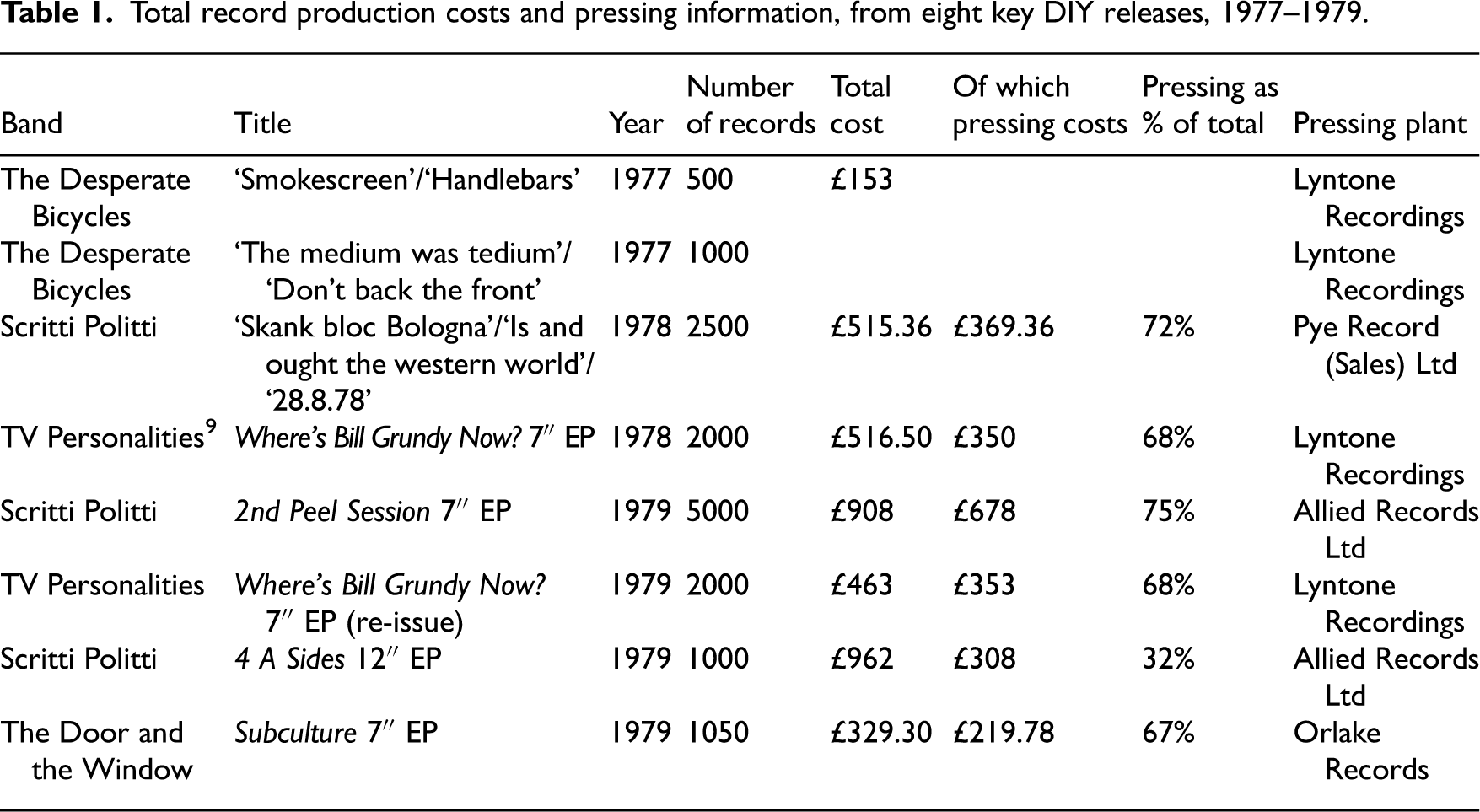
My point of interest here is around pressing (the manufacturing act of turning a blob of plastic into a microgrooved record), both company and cost. Each company employed has been identified either via the simple fact of it being named as part of the record cover information about manufacture, or via the record's unique matrix code scratched on the vinyl at the point of production. As Table 1 shows, the cost of pressing – material and process – was almost invariably the single largest point of expense, and by some margin: between two-thirds and three-quarters of the total cost of most of these singles went straight to a well-established commercial factory. (The outlier with lower percentage pressing costs, Scritti's 4 A Sides 12″, was a step up in ambition for the band: it was recorded over at least two days in two different studios, and sold in a two-colour professionally printed cardboard sleeve. The latter alone cost £240 per 1000.) Can we really say that these classic singles – which conceptually constitute peak punk DIY – are anything of the sort?
Tracing the business history of some of these record manufacturing companies, and their commercial operation, offers a further critical frame when evaluating the DIY-ness of these punk singles. Allied Records Ltd (1955–1986), in Ladbroke Grove, London, used by Scritti Politti, was established ‘originally to press and distribute a catalogue of nursery rhymes and bedtime stories. Later the company acquired the catalogue of … the leading American manufacturer of budget line classical music …, and by the late 1950s Allied had grown into a successful manufacturer and direct-to-consumer distributor’ via mail order (Discogs Allied). Lyntone Recordings Ltd (1957–1991), north London, favoured by the Desperate Bicycles and TV Personalities, originated ‘to manufacture special records for industrial advertising and promotion’, including picture discs and flexi-discs. In its early years it was incorporated into the leading British film and entertainment conglomeration the Rank Organisation, as an element of Rank Audio Plastics Ltd. By 1970 Lyntone moved into the pressing of vinyl records, often for promotional purposes; a 1979 single, George Chandler's ‘The best dreams’, was produced exclusively for giveaway by Burnley Building Society (with lyrics by Salman Rushdie) (Discogs Lyntone; Seventies Sevens). Orlake (1964–1999), based in Dagenham, Essex, used by The Door and the Window, ‘operated a state-of-the-art plant with 16 Toolex Alpha automatic and 24 Toolex Alpha semi-automatic presses at its peak producing one million records per month … These … included picture discs, shaped discs, … and coloured vinyl’ novelty records (Discogs Orlake). We can see from this that even the newest, shortest-lived, radical, and most propagandistic DIY records and labels (those in Table 1) are entirely reliant on manufacturing companies which are quite long-established (then 15–25 years), work with a wide variety of industries, from music and entertainment to advertising and banking, and are capable of operating at very large scale. Simon Reynolds boldly describes the Desperate Bicycles project as constituting ‘the overthrow of the establishment music industry because it was the people seizing the means of (record) production’ (2005: 97), but such claims are extremely wide of the mark, are even ludicrous, when we consider this much-overlooked aspect of ‘the establishment music industry’.
One further point: while the evidence so far would suggest that record manufacturing companies were willing and happy to work with any partner that was commercially viable, for a pressing run of one million or one thousand, in fact, the kinds of issues of taste and outrage that punk was so good at provoking were raised in this context too. The power the manufacturing side of the music industry could flex was evident on various occasions during early punk. For instance, workers at EMI's production factory in Hayes, London, threatened industrial action and refused to sleeve the planned EMI release of the Sex Pistols’ ‘Anarchy in the UK’ in 1976 (Savage, 1992: 364). The leading anarcho-punk band Crass's first release, 1978's The Feeding of the Five Thousand, opened with two minutes of silence entitled ‘The sound of free speech’. This replaced the track ‘Asylum’, which, as the sleeve notes explained over a black block of redacted lyrics, ‘has been erased because of the refusal of any company to press the record if it was left intact. We apologise’ (Crass, 1978). Such instances lay bare the cultural limits of commercial pressing and manufacturing companies, whether around questions of taste or politics, as well as further confirm, if it were needed, precisely those companies’ non-radical nature. There is no DIY in punk record-making, whether in commercial, independent, or even anarchist-led modes of operation.
Conclusion: Depunking DIY
National mediation, traditional instrumentation, lack of participation, major labels, and commercial pressing – I have shown important ways in which none of this activity was DIY. Yet all of it was vital for the development of punk. So, if punk – the punk I am looking at, the early British variety – was not really, possibly was not even, DIY, why does everyone keep saying it was? Perhaps it makes punk more enduring and influential, which matters if one is a celebrant-scholar. Yet punk's legacy is captured at punk's start: Johnny Rotten, in early 1976, photographed in a straitjacket. Thus: enough about punk, for rewriting punk (studies) has implications for our understanding of DIY, too. In an attitudinal and critical act of debunking that I am going to term depunking, I want to think about what the sidelining of punk from DIY might mean not for parochial little punk but for the altogether larger field of DIY. If DIY pushes away the thin frisson of outrage or rebel (‘rebel’!) energy punk may still (claim to) hold, what does that mean for DIY, beyond perhaps a soundtrack with a wider sonic palette – which may be worth it alone? For some or many there are less palatable aspects of punk – one could consider here features such as spitting, swearing, a criminal aesthetic, banal music banalised, narcotic excess references, confrontation, aggression and violence, or a regular celebration of blank waste in life. The wonderful experimental singer, community musician, and political radical Maggie Nicols has spoken of how she experienced the political and cultural limitations of the DIY/punk nexus in the 1970s and 1980s in contrasting political (communist and anarchist) and musical (free improvisation and punk) contexts: The W[orkers’] R[evolutionary] P[arty] for all its organisation and hierarchy I found to be much more open than the anarchist movement I had some involvement with later. You might think there would be strong links between anarchism and free improvisation, but some of them were actually pretty conservative: if it wasn’t some sort of thrashy punk music they weren’t interested, didn’t want to listen. (quoted in McKay, 2005: 225)
To liberate DIY from the straitjacket of punk, from what Mark E. Smith was already, in 1979, calling ‘the seventy-seven shit pile’ (The Fall, 1980), allows it, DIY, to become much more of an adhocism (Jencks and Silver, 1973) or adhockery (McKay, 2005: 326 n.1), a cultural practice of endless creative (re)invention folded into different ways of life and ethical living, where there is space for the sober, the uncool, the quietly spoken, the expert even (must we all play badly?). John Richards writes of an ‘alternative approach’ to DIY as exemplified by him in admittedly, yes, ‘punk rock’, but also and equally in ‘knitting clubs or ham radio societies’ (2013: 274). This seems to me a more generous and generative iteration of DIY. In implicit inclusion and embrace it signals an ambition of scope and potential for DIY, as well as, for example, opening up critical space for greater consideration of common methodologies across different cultural practices, of a wider range of historical contexts, or of questions of gender or technology, say. For the sonically minded there is the suggestion in Richards's iteration of DIY of a significant change of texture or volume as we hear, instead of punk noise, the click of knitting needles, or of the Morse code of the amateur radio enthusiast.
DIY needs depunking. DIY deserves more than punk. My hope is that this new journal will widen the field of reference and understanding, culturally, socially, and theoretically, and keep widening it. To contribute to that process by interrogating the DIY/punk nexus has been one of my aims in this article.
Footnotes
Acknowledgements
I owe thanks to Profs John Street and Matt Worley, each of whom helped me in my efforts to sharpen the arguments here. Also thanks to the editors of this journal, for the invitation to write in the first place, as well as for their patience and support, and to Rich Cross, for sharing his knowledge. I am grateful too for the invitation to discuss a draft of this work at the Punk Scholars Network conference at Middlesex University in December 2022, in particular to organiser Dr Mike Dines, and to those present for their helpful comments. Finally, thank you for their time and thoughts to the three anonymous peer reviewers. Flaws in fact or argument remain my responsibility.
Declaration of conflicting interests
The author(s) declared no potential conflicts of interest with respect to the research, authorship, and/or publication of this article.
Funding
The author(s) received no financial support for the research, authorship, and/or publication of this article.