




Abstract
This paper examines the use of Artificial Intelligence (AI) to generate a speech for the CEO of a hypothetical publicly traded coal mining company, intended to be delivered at that company’s annual general meeting. Using ChatGPT, we prompt this Large Language Model (LLM) to generate the CEO’s speech. We then analyze the speech using close reading, highlighting important language features, critical ethical considerations, and broader implications of AI-driven speechwriting for corporate leadership. By exploring four language features of the speech (metaphor, semantic tone, pronoun use, and readability) we find that the language pattern of the ChatGPT speech closely mirrors that of a speech prepared by an authentic human leader, inasmuch as it was customized to the controversial topic, the audience and setting, and possessed many “human-like” linguistic features. We highlight ethical concerns about the role of AI in leadership discourse and demonstrate the potential of AI to disembody executive authority. If AI’s contribution to speechwriting is not acknowledged transparently, CEO communication risks becoming a leadership charade. Any decision to use AI as a speechwriter should be reached after weighing the efficiency and convenience of doing so, against the potential erosion of authenticity in leadership communication.
Artificial Intelligence (AI) has rapidly emerged as a transformative force in global business, generating both enthusiasm and apprehension among corporate leaders. In his 2024 annual report letter, Jensen Huang, CEO and founder of AI powerhouse NVIDIA Corporation, noted excitedly that the advent of Large Language Models (LLMs) such as ChatGPT 1 had ushered in an era where “computers can now generate information based on human prompts … [and have] learned to understand human language, prior knowledge, and even some common sense from massive amounts of text” (NVIDIA 2024 Annual Report, s201.q4cdn.com/141608511/files/doc_financials/2024/ar/NVIDIA-2024-Annual-Report.pdf). Despite Huang’s upbeat view, excitement for AI applications such as ChatGPT has been tempered by widespread fears and cautions. One major fear is that ChatGPT and similar platforms such as Copilot, DeepSeek, and Grok 3 will draw upon “deepfakes … to create convincing, but false information that can distort reality, undermine public trust, and … cause widespread panic and fear in a worst-case scenario” (Peters, 2023).
In this paper, we draw attention to the application of AI to a common and important task undertaken by corporate leaders: writing a CEO’s speech. Specifically, we assess the possibility that ChatGPT can be used beneficially to fulfil a common communications obligation of a CEO—preparing a speech the CEO is to present at a company’s Annual General Meeting [AGM]. While AI LLM platforms such as ChatGPT present efficiency advantages, the role of AI technology in leadership communication remains contentious. Leading corporate communicators, such as David Murray, executive director of the Professional Speechwriters’ Association, argue that relying on AI for speechwriting risks undermining authenticity. Murray (2023) asserts that “having a machine write a first draft is not a shortcut, it’s a short circuit.” Thereby, he emphasizes the importance of a CEO’s direct engagement in the speechwriting process. In the field of education, the use of ChatGPT has sparked concerns that the automation involved will diminish genuine discourse (Ranade & Eyman, 2024, p. 1). A more sanguine view of ChatGPT is that it is not “inherently deceitful,” particularly if “consistent and shared guidelines” are used “to ensure its ethical and effective application” (Saccenti et al., 2024, p. 415).
We focus specifically on leadership communication. Our dual intent is first, to deepen understanding of AI’s impact on CEO speechwriting; and second, to highlight how AI influences the perception and enactment of corporate leadership. We do not address AI’s broader security risks, trustworthiness, or system vulnerabilities (Habbal et al., 2024). Instead, our analysis centers on a hypothetical scenario in which the LLM ChatGPT “drafts” a CEO’s speech for a coal mining company’s AGM. We explore key language features of the speech, ethical dilemmas arising from the process involved, and delve into the consequences of AI-generated speeches in leadership settings.
CEOs depend on communication in a wide variety of formal and informal settings. They use a broad array of media to convey their messages, ranging from a CEO’s personal Twitter (now “X”) account (Craig & Amernic, 2020) to a CEO’s annual letter to shareholders (Amernic et al., 2010), and to speeches, including those presented at a company’s AGM (Amernic & Craig, 2017). The various communications of a CEO, including those produced by an AI platform such as ChatGPT, possess important ethical implications (Amernic & Craig, 2006, 2013). A pertinent question arising from using an AI platform to write a speech is “who” or “what” is enacting leadership?
We use the term “disembody,” in the context of leadership, to mean the separation of the leader’s personal involvement, authenticity, and direct engagement from the leadership role they are expected to embody. If AI-generated content replaces a CEO’s input to a speech, the leadership message risks losing a human touch and becoming detached. Thus, CEOs can disembody their leadership by relying excessively, and in an unacknowledged way, on AI-generated communication. If they do so, their leadership may seem distant, impersonal, or performative and lack the depth that comes from their personal experience, conviction, and interaction with topics and audiences.
This paper analyzes whether AI disembodies leadership. The lens used is a hypothetical situation in which ChatGPT is assigned the task of writing a speech to be presented by the CEO of a company in a controversial industry (coal mining) to the company’s AGM. We highlight important language features of the ChatGPT-generated speech, discuss some critical ethical issues, and explore the potential implications that speeches written by AI can have in enacting corporate leadership.
The present study is important for at least four reasons. First, because it explores the intersection of AI LLMs (such as ChatGPT), leadership, and communication, and draws on this to highlight implications for corporate governance, ethics, and public trust. Second, the study helps to critically assess the impact that AI technologies can have on authenticity, strategic messaging, and perceptions of leaders. Third, the study enhances understanding of the advantages and limitations of AI-assisted speechwriting, including by highlighting the need for transparency and accountability in corporate leadership. Fourth, the study contributes to broader discussions about the evolving nature of leadership in the Digital Age.
We begin by highlighting features of the high-profile leadership setting (a company’s AGM) in which the speech generated by ChatGPT is scheduled for presentation. We then outline the four language features used to analyze the speech (metaphor, semantic tone, pronoun use, and readability), before discussing some ethical issues that arise from using AI to write a CEO’s speech. We describe the research method adopted, including the process used to generate, review, criticize and validate the speech. We then present results, engage in discussion and offer conclusions.
Analytical Framework and Literature Review
AGM Setting
The AGM is widely regarded as “…one of the cornerstones of corporate governance…” and a “powerful setting for accountability” (Catasús & Johed, 2007, pp. 168, 173). The CEO’s speech to an AGM is a defining moment of the CEO’s leadership because it offers an opportunity for stakeholders to “construct meaning by identifying, labeling, and organizing phenomena (such as events and ideas), including strategies and performance measures” (Amernic & Craig, 2017, p. 67). Given that “the CEO’s job is inherently one of communication” (Porter & Nohria, 2010, p. 464), the CEO’s speech is an essential part of enacting leadership. In the setting proposed here (an AGM of a publicly listed and traded coal mining company), the speech’s focus “on the subject of ethics and leadership in the coal mining industry” (see below) would have made it a highly anticipated and high-profile event.
Four Language Features
We examine the following four language features in the ChatGPT-generated speech.
Metaphor
Metaphors have been studied extensively across a variety of disciplines as a means of revealing insights into “leaders’ thinking and … the basis of their actions” (Oberlechner & Mayer-Schönberger, 2003). Close reading for metaphors can be highly beneficial in providing “rich understandings of the intentions of those who generate [them], and [of their] likely impact on the cognitive processes of the message recipients” (Amernic et al., 2007, p. 1843). Furthermore, analysis of the influence of a single metaphor can be amplified by “surrounding nonmetaphorical language,” thereby reinforcing its conceptual reach (Gibbs, 2015, p. 173). The analysis we conduct considers whether any single metaphor in the ChatGPT speech contributes to “a larger metaphorical structuring.” 2
Semantic Tone
DICTION text analysis software 3 has been used extensively in many disciplines to ascertain the semantic tone of a text. 4 Its five master variables (ACTIVITY, OPTIMISM, CERTAINTY, REALISM, and COMMONALITY) provide a broad indication of the pervading semantic tone (Hart, 2001). DICTION has been used to assess the tone of speeches given by business leaders: for example, of the 332,847 words in the corpus of 125 publicly available speeches given by Lord John Browne, long-serving CEO of BP, between 1997 and 2007 (Craig & Amernic, 2014).
The present study uses DICTION to help determine whether the ChatGPT speech differed in semantic tone from a corpus of similar communications by business leaders. To make this comparison, DICTION’s Corporate Financial Reports [CFR] dictionary was chosen as a comparative yardstick (DICTION Help Manual, 2013). The CFR dictionary comprised language used in 48 annual financial reports of a variety of Fortune 500 companies. Given the inherent limitations of computer-assisted text analysis, we interpret DICTION’s results with caution, mindful that close phraseological analyses may be required to find the subtle nuances of messages (Murphy, 2013, p. 56).
Pronouns
CEOs play a pivotal role in shaping organizational identity and cohesion. They “enhance organizational performance by … cultivating a sense of shared collective identity (‘us’) with those they lead” (Fladerer et al., 2021, p. 299). Accordingly, CEOs can be expected to project and enhance a sense of collective identity in the speech to an AGM “through the use of we-referencing (as opposed to I-referencing) language” (Fladerer et al., p. 299). Our analysis of pronoun use (“I” and “we”) provides insight into whether the CEO attributes success to individual effort or acknowledges it as a collective achievement. 5
Readability
A well-crafted speech presented by a CEO to an AGM should be sensitive to the reading and listening abilities of those likely to read, or listen to, the speech. Two widely adopted measures of readability that we calculate are the Flesch Reading Ease score and Flesch-Kincaid Grade Level score, explained below.
The Flesch Reading Ease gives a text a score between 1 and 100, with 100 being the highest readability score. Scoring between 70 and 80 is equivalent to school grade level 8. This means text should be fairly easy for the average adult to read… The Flesch Kincaid Grade Level is a widely used readability formula which assesses the approximate reading grade level of a text… If a text has a Flesch Kincaid level of 8, this means the reader needs a grade 8 level of reading or above to understand it. (https://readable.com/readability/flesch-reading-ease-flesch-kincaid-grade-level/)
By applying these measures, we evaluate whether the ChatGPT-generated speech aligns with the expected readability standards of the audience at an AGM.
Ethical Issues Posed by Use of AI to Enact Leadership
Human Leadership
AI offers vast possibilities for supporting leadership. AI is capable of fostering “an imaginative and action-oriented process that drives movement from what is to what could be” (Beghetto, 2023, p. 324). Leaders and their followers should recognize AI’s ability to “expand and contract the possible” (de Saint Laurent, 2024, p. 7) and acknowledge its potential benefits and limitations. However, because leadership is a fundamentally human endeavor (Alvesson & Einola, 2019), and AI LLM technologies such as ChatGPT can aid leadership practices, their use must not undermine or override human authority and responsibility. Ethical leadership requires AI to be used as a supportive tool rather than a substitute for genuine executive presence. For AI-driven speechwriting to align with ethical leadership principles, human leaders must engage meaningfully with the technology and not delegate core leadership functions to AI (Crawford et al., 2023).
Ghostwriting
CEOs have long engaged human speechwriters as ghostwriters, with varying degrees of involvement. Many CEOs who view speeches and other means of communication to be a serious part of their leadership often interact strongly with ghostwriters. For instance, Jack Welch, the former widely admired CEO of General Electric (1981–2000), had a well-documented collaborative long-term relationship with his speechwriter, Bill Lane (Lane, 2007).
If CEOs employ ChatGPT to write a speech, in full or in part, a critical question is: “Can ChatGPT’s role as a speechwriter be managed so that apparent benefits outweigh the costs involved?” In considering this question, it is pertinent to reflect on some important aspects of the interface between ChatGPT, CEOs and speechwriters, highlighted by Murray (2023): The extent to which ChatGPT will be used in corporate communication has less to do with the sophistication of the technology and more to do with the true motivations of corporate leaders–and their real attitudes toward human communication. … there are two kinds of leaders in the world: Those who see communication as a potential strategic differentiator, and those who see it as obligatory window-dressing… But there are lots and lots of the latter …[who]… don’t provide the facetime and candor a speechwriter would need to authentically and meaningfully connect the CEO’s life story and personal outlook with their professional drive and the corporate mission. Some leaders don’t work with the speechwriter to co-create a compelling, constructive, and coherent communication narrative. They don’t drive that speechwriter to think rigorously about which audiences they should be reaching through speeches and myriad other leadership communication opportunities–and to what strategic end.
As Murray suggests, AI-driven ghostwriting presents many formidable challenges. For example, speechwriting platforms (such as ChatGPT) must “master the skills of impersonating viewpoint, style and even personality” (Shenk, 1988, p. 377), while demonstrating “a thorough awareness of language, audience, and context” (Ramadan & Yousif, 2021, p. 1). Unlike humans, AI is limited in its capacity to infuse speeches with cultural references, humor, and creative flair.
Despite these challenges, AI-generated speeches offer several benefits. AI LLM platforms such as ChatGPT can analyze enormous datasets, personalize outputs for certain audiences, generate speeches much faster and with higher accuracy, cater better to the cultural and psychographic background of audiences, “refine grammar accuracy, writing style, and linguistic richness,” “excel in customization based on data analysis,” adapt to audience feedback in real-time, and continuously learn from data and previous history (Ramadan & Yousif, 2021, p. 2). Additionally, and in comparison to traditional speechwriting, AI-generated speeches often maintain a uniform tone and are more cost-effective.
However, the underlying data relied upon by AI-generated speeches can be biased and lack diversity. Such speeches can be impersonal and overly “polished.” They may display feigned, rather than genuine, authenticity; and they may lack emotional nuance, cultural references, and relatable “human touches,” such as anecdotes and humor. A critical concern is whether true accountability is being exercised by a CEO (Shenk, 1988, p. 8). An AI-generated speech can raise concerns about the deceitfulness of its use as a ghostwriter. Who is the “real” author? There should be clear recognition that ghost-writing, including by ChatGPT, sunders “the act of delivering the message from the process of conceiving it” (Jamieson, 1988, p. 204).
Some support for the ethicality of using ChatGPT as a ghostwriter is provided by the long-time acceptance by the public that many politicians and business leaders routinely use ghostwriters (Riley & Brown, 1996, p. 713). The underlying pragmatics for using AI as a speechwriter seem sound: leaders (such as politicians and CEOs) lack the time and energy to “understand all the issues and ideas they are dealing with” (Einhorn, 1991, p. 125). Furthermore, if ChatGPT is engaged sensibly, it will not be solely responsible for the speech. Rather, responsibility should be a collective one and involve strong inputs from the CEO.
In response to the general question “Does it matter whether some form of AI writes a speech?,”Riley and Brown (1996, p. 714) cite Einhorn (1991, pp. 130–131) to argue tellingly that “When the primary concern is the influence of the speech given by the speaker who represents the institution, it doesn’t really matter who did the writing.”
Diminishing the CEO’s Knowing by Thinking and Writing
In crafting a good speech, writing becomes a process of learning. Anderson (2023, p. 10), for example, acknowledges that she is involved in a “… process of writing to learn” and confesses that her process of writing to learn “would minimally be different or perhaps less available had my writing process begun with ChatGPT.” She argues that … the technology of writing (being forced into assembling my thoughts into paragraphs that organize the relationships between my ideas and those of other thinkers) have informed my perspectives … however, the lack of transparency about sources and references in ChatGPT compositions, at a minimum, makes those conversations more difficult (p. 10).
When a CEO delegates the core leadership task of speechwriting to AI, the CEO forgoes the benefit of thinking about the task reflectively and in real time: that is, “knowing by thinking and writing.” The CEO is relieved of drafting (and rewriting) the speech. While CEOs often rely on human assistants to help craft their speeches, engaging ChatGPT to write a speech seems fraught because of the possibility that the CEO will not be involved substantively in constructing the speech. Although ChatGPT could serve an ancillary role, as a useful prompting tool, no words generated by ChatGPT should appear in the final speech unless they are clearly identified. Contributions by ChatGPT should not replace the CEOs intellectual engagement in the crafting of a speech.
Legal Liability
Significant legal liability issues can arise from a CEO’s use of AI as a speechwriter. These concerns extend beyond instances of deliberate human misuse to encompass unintended consequences, such as the risk of libelous or otherwise legally actionable communication (Volokh, 2023, p. 554). Several key questions merit consideration:
What legal repercussions may arise if shareholders assert that they bought, sold, or retained shares based on allegedly inaccurate information in the CEO’s LLM speech?
Could the Securities and Exchange Commission (or an equivalent stock market regulator) determine that the company engaged in inaccurate disclosure, including the omission of critical information?
Would the company have grounds to sue the CEO if its board of directors mistakenly assumed that the speech had been drafted solely by the CEO and human collaborators, rather than incorporating AI-generated content?
Context and Morality
The environmental impact of coal mining is frequently mentioned as an existential concern. A key ethical question emerging from the use of AI-generated content for the CEO’s speech in the hypothetical case we propose is whether—and how—to disclose the effects of the company’s coal mining operations on communities, the natural environment, and global warming. From a moral standpoint, an AI-generated speech might reasonably be expected to emphasize these matters, given the widely accepted perspective that coal mining endangers communities, threatens water sources, and undermines the long-term sustainability of farmland, rangelands, and wildlife habitats (Sierra Club, n.d.).
Such critical and multifaceted concerns warrant explicit acknowledgment by the CEO in an address at an AGM. However, as we outline below, beyond generalized statements about “prioritizing safety,” the AI-generated speech analyzed later remains conspicuously silent on these issues.
Research Method
On July 17, 2023 we issued the following prompt to ChatGPT (version 3.5): Assume you are the CEO of a publicly traded coal mining company. Write a 500-word speech to be delivered at the company’s annual general meeting on the subject of ethics and leadership in the coal mining industry.
This request exemplifies “prompt engineering”—the process of “creating input statements (prompts) for [a] generative AI model” (Knoth et al., 2024, p. 1). The precision and clarity of our prompt was intentional, to optimize “…the effectiveness of the interaction” (Knoth et al., 2024, p. 1) and to help ensure relevant responses were obtained. No multiple iterations of prompt testing were necessary.
Furthermore, our approach incorporates “role-prompting” or giving the AI model a “specific role to play, such as a helpful assistant or a knowledgeable expert” (Chen et al., 2024). In this case, the prompt directs the LLM to assume the role of a CEO delivering an AGM speech within the coal mining industry. The prompt aligns with four desirable criteria: it is a one-shot prompt with no prompt modification; it assigns a specific role (CEO); it contextually defines a role (CEO of a publicly traded coal mining company); and it addresses a distinct topic (ethics and leadership in the coal mining industry).
In an AGM, a CEO has a legal and moral obligation to demonstrate broad public accountability. This is particularly the case in industries (such as coal mining) that are scrutinized for their environmental impact and ethical behavior. This context underscores their importance, transparency and corporate responsibility.
The CEO’s speech is generated using the ChatGPT3.5 LLM that is available on the website https://chat.openai.com/auth/login. The speech is reproduced in Supplemental Appendix 1, with line numbering added for ease of referencing. The speech was analyzed, in large part, by using the close reading method, with particular attention given to four language features: metaphor, semantic tone, pronoun use, and readability (all discussed earlier). Evaluating these features offers the potential to yield revealing insights into the speech’s human-like qualities, soundness and coherence.
The close reading method involves slowing down the pace of reading to facilitate scrutiny of the text. Close reading involves activities such as “… re-reading sentences and paragraphs, exploring the sequence and frequency [of word use] … investigat[ing] the meaning of individual words, look[ing] for apt and inapt juxtapositions, seek[ing] insights to authorial intent … [and] identify[ing] critical silences …” (Craig & Amernic, 2021, p. 6). Although the close reading method can provide many beneficial insights, its conclusions are contestable and should be viewed with caution because the text being analyzed usually fosters “a ‘plurality of plausible explanations’ (Ron, 2008) for the matters being considered” (Craig & Amernic, 2021, p. 6).
To assess the semantic tone of the speech we used DICTION text analysis software (Hart, 2001). To assess readability, we used the Flesch Reading Ease score and the Flesch-Kincaid Grade Level score.
Analysis
Language Considerations
Metaphor
The core metaphor underlying the ChatGPT-generated speech was: OUR COMPANY IS A MORAL BEING.
This is evident in the sentence: “Moreover, as a responsible corporate citizen, we must take proactive steps to minimize our environmental footprint” (lines 18–19). It is evident too at numerous other places in the speech: for example, “…strive to be good corporate neighbors…” (lines 23 and 24); and “…the path ahead for our coal mining company will be guided by a strong moral compass and a commitment to ethical leadership” (lines 40–41). These examples project OUR COMPANY as a moral and sentient entity that is taking proactive steps, striving to be a good neighbor, following a purposeful path, adhering to a strong moral compass, and upholding ethical commitments. Since only sentient beings can be “moral,” the underlying metaphor reinforces the human-like qualities embedded in the speech. 6
Semantic Tone
DICTION-based analysis of the ChatGPT-generated speech reveals significantly elevated scores for the two master variables, OPTIMISM and REALISM, both exceeding the expected range of the CFR norm (see Table 1).
DICTION analysis of the semantic tone of the ChatGPT speech.
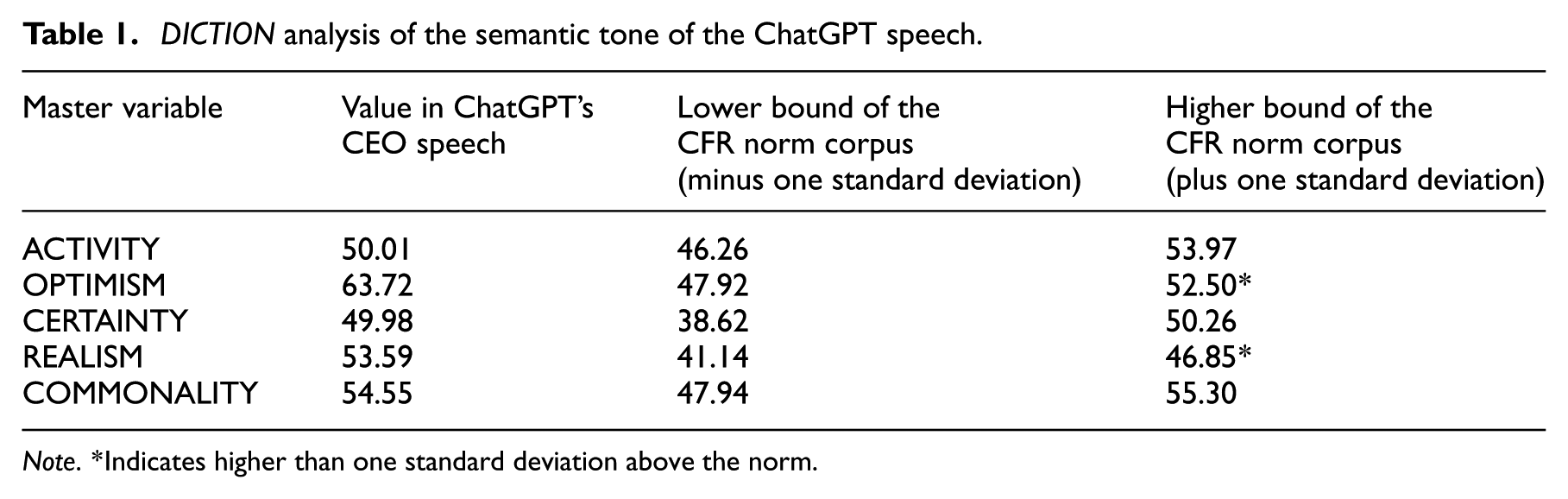
Note. *Indicates higher than one standard deviation above the norm.
This pattern seems likely to be common in a speech intended to be delivered by the CEO of a coal mining company at the company’s AGM. The elevated OPTIMISM score reflects enthusiasm and positivity, while the REALISM score signals a focus on “tangible, immediate, recognizable matters that affect people’s everyday lives” (Hart, 2001). This balance between forward-looking confidence and grounded practicality is characteristic of language used by authentic human leaders.
Regarding DICTION’s 31 word list dictionaries, the ChatGPT speech scored much higher than CFR norms only for PRAISE (“Affirmations of some person, group, or abstract entity”), INSPIRATION (“Abstract virtues deserving of universal respect”), HUMAN INTEREST (“…concentrating on people and their activities [to give] discourse a life-like quality”), and RAPPORT (“…attitudinal similarities among groups of people”). These are desirable semantic features in a speech by the CEO of a company operating in an environmentally sensitive industry. Notably, the speech remained within the normal range for 22 of DICTION’s 31-word list dictionaries, indicating that it does not rely on extraordinary words or language patterns. Thus, generally, the semantic tone was consistent with what a typical coal mining CEO might be expected to say when delivering such a speech. In key areas of PRAISE, INSPIRATION, HUMAN INTEREST, and RAPPORT, the high range DICTION scores suggest the speech had been custom-tailored, rhetorically, to suit the controversial topic, the audience, and the AGM setting.
Pronoun Use
The frequency of the four personal pronouns “I,” “we,” “our,” and “us” in the ChatGPT speech was as follows:
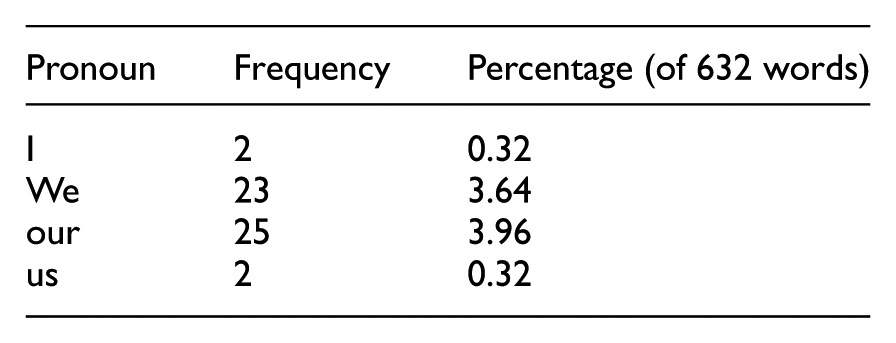
The predominant use of collective pronouns suggests an intentional rhetorical strategy. “I” appears only two times, both in line 2 (see Supplemental Appendix 1). This merely positions the (hypothetical) speaker as CEO of the company and as being “honored” to speak. In contrast, the collective pronouns “we,” “our” and “us” appear 50 times, reinforcing a sense of unity and shared responsibility.
Thus, in lines 6 to 9, the following uses of “our,” “us,” and “we” occur (with bolding applied): Let me begin by acknowledging that
In this extract, the use of personal pronouns is rhetorically subtle. In the opening sentence, the (hypothetical) CEO is “acknowledging” an unpleasant fact. But “acknowledging” is softer than “admitting” or “confessing.” The word “faced” positions “
Furthermore, consider the following example of the use of the collective pronouns “our,” “us” and “we” between lines 28 and 35 (with bolding applied).
As leaders in the coal mining industry, In line with
These statements present a strong ethos of corporate responsibility, yet ambiguity remains regarding the precise agency involved. It is unclear whether the pronouns used refer to the company, the CEO, or other members of the company’s top management team. Such rhetorical ambiguity clouds agency and responsibility and suggests that the vague positioning of “we,” as “leaders in the coal mining industry,” is an exercise of virtue-signaling—something common among the CEOs of major coal mining companies.
Readability
Although our request to ChatGPT was to “Write a 500-word speech,” the speech delivered comprised 632 words. The readability profile is shown in Table 2.
Readability profile of the ChatGPT speech.

The Flesch Reading Ease score (27.6) and the Flesch-Kincaid Grade Level score (14.0) indicate the speech is suited to audience members who have at least a college (university) education. Such an audience readability profile for the ChatGPT speech seems merited in view of evidence that the expected audience (principally shareholders) are likely to have a higher level of educational attainment than the general population. 7
Validation
The underlying databases relied upon by any AI speechwriting platform are enhanced over time and vary between platforms. Because the ChatGPT speech we analyzed above was generated on July 17, 2023, we investigated whether there was a maturation effect or any bias in its underlying LLM. Thus, we used the same prompt on January 17, 2025, to generate a speech using Microsoft Copilot (2025; this is reproduced in Supplemental Appendix 2).
8
To help assess whether there had been any maturation effect or bias, we compared the ChatGPT and Copilot speeches in terms of their themes, tone and rhetorical devices, using a close reading approach supplemented by the results from the following request to Copilot: Compare the speeches generated by ChatGPT and Copilot, highlighting similarities and dissimilarities in terms of themes, tone and rhetorical devices.
Thus, our comparison involved our (human) assessment, assisted by a LLM.
“Reality” and Humanness
Using the same approach (close reading supplemented by AI), we then checked the level of “reality” in the two AI-generated speeches. Did they accord, closely or otherwise, with an actual “live,” “real” speech delivered to the AGM of a coal mining company, by a CEO? We selected at random the speech given by Paul Flynn, CEO of Whitehaven Coal (reproduced in Supplemental Appendix 3) to the company’s AGM on October 30, 2024. Whitehaven Coal is one of Australia’s leading coal companies, producing about 25 million tons of coal annually, and exporting metallurgical and thermal coal to many markets in Asia (Whitehaven Coal Annual Report, 2024 https://whitehavencoal.com.au/publication/annual-report-2024/). Using the same method (Copilot and close reading), we compared the speeches generated by ChatGPT and Copilot with the “real” AGM speech given by the CEO of Whitehaven. Finally, we asked Copilot to respond to the following prompt: What characteristics of a human writer are missing from the ChatGPT and Copilot speeches?
Comparative results identified by Copilot for the three dimensions of “themes,” “tone,” and “rhetorical devices,” for each of ChatGPT, Copilot, and the “real” speech, are reported in Supplemental Appendix 4. The major difference between the two AI-generated speeches and the “real” speech, as assessed by our close reading assisted by Copilot, lies in their focus and approach to key ideas. While ChatGPT and Copilot emphasized values and ideals, the “real” CEO’s speech prioritized tangible achievements and highlighted concrete achievements and strategic planning.
The AI-generated speeches tended to highlight “broad principles and ethical frameworks, such as sustainability, innovation, and community engagement” and this was intended to “inspire trust and optimism through high-level concepts.” By contrast, the “real” CEO speech was “heavily focused on practical and measurable business strategies, such as financial metrics, market dynamics, and operational excellence, providing a tangible and data-driven narrative that highlights growth, resilience, and adaptability.”
Copilot concluded that AI has an undeniable strength in processing large datasets, ensuring coherence, and delivering polished drafts—perfect for covering the technical and strategic aspects of such a speech. However, the deeper human element, like evoking emotions, weaving in personal anecdotes, or responding to the specific nuances of the audience, is where a human writer often shines.
Ultimately, a decision to use AI as a speechwriter often hinges on weighing the efficiency of AI-generated speechwriting against the authenticity and emotional resonance of speeches crafted by human writers.
Discussion and Conclusions
A CEO’s speech in the high-profile leadership setting of a company’s AGM is a pivotal mechanism for enacting corporate leadership. While a CEO might consult with speechwriters and advisors in crafting such a speech, and may, at times, engage deeply with them, any reliance on AI-generated content, whether partial or complete, must be acknowledged fully and transparently.
Determining whether it is ethically appropriate to assign corporate leadership duties (such as writing a CEO’s speech) to AI platforms like ChatGPT or Copilot, cannot be answered by a simple “yes” or “no.” The decision carries profound leadership implications. As Murray (2023) argues, the extent to which AI should be integrated into corporate communications generally should have “less to do with the sophistication of the technology and more to do with the true motivations of corporate leaders – and their real attitudes toward human communication.” Importantly, a speech generated (even in part) by AI, without substantive cognitive engagement by the CEO, risks disembodying a CEO’s leadership, potentially rendering the speech a charade or performative act, rather than a genuine expression of corporate vision and leadership through communication.
The rise of AI generally, and the introduction of ChatGPT in late 2022 (and the proliferation of similar LLM’s since then) represents a “significant technological change.” This is something that prominent educator, media theorist and cultural critic, Postman (1992, p. 23) observed “…generates total change…” Within this evolving landscape, employing AI to craft speeches for a CEO may be seen as part of a large transformation in corporate communication. The shift raises critical questions such as: “What defines corporate CEO leadership?” and “Who is truly exercising corporate leadership in AI-assisted communication?” “What is the CEO’s responsibility for substantive cognitive engagement in learning and reflecting as the speech is crafted?”
The human quest to craft an important communication such as a speech to an AGM, is an integral aspect of leadership—and one that becomes even more salient when the company the CEO leads is in a contentious or widely vilified industry, such as coal mining. Delegating speechwriting to AI can disembody or erode a CEO’s personal involvement and leadership, even if the final speech appears to be polished and human-like in tone. A balanced practical approach would be for AI to provide the initial framework, perhaps stimulate ideas, and the human CEO then refine this by adding strategic and operational insights, and some personal embellishments. Indeed, the initial “ideas” generated by the LLM may need radical alteration as the CEO engages in substantive cognitive reflection on the topic at hand.
Despite indications that the LLM-generated speech analyzed in this study is seemingly human and authentic, nonetheless it remains a chimera of CEO leadership. Effective leadership requires direct engagement between the leader and the speechwriting process. Such an interplay can be labor-intensive, yet invaluable. Without this engagement, the resulting speech risks becoming a hollow vessel rather than a meaningful leadership statement. Two ensuing implications of any lack of engagement are that the CEO forfeits an opportunity for personal learning and development; and the speech’s “human-like” qualities may prove deceptively persuasive and mask the lack of genuine leadership involvement.
Supplemental Material
sj-docx-1-pst-10.1177_27538699251374119 – Supplemental material for Disembodying CEO leadership through AI-assisted speechwriting
Supplemental material, sj-docx-1-pst-10.1177_27538699251374119 for Disembodying CEO leadership through AI-assisted speechwriting by Joel Amernic and Russell Craig in Possibility Studies & Society
Footnotes
Declaration of Conflicting Interests
The authors declared no potential conflicts of interest with respect to the research, authorship, and/or publication of this article.
Funding
The authors received no financial support for the research, authorship, and/or publication of this article.

Supplemental Material
Supplemental material for this article is available online.
Notes
References
Supplementary Material
Please find the following supplemental material available below.
For Open Access articles published under a Creative Commons License, all supplemental material carries the same license as the article it is associated with.
For non-Open Access articles published, all supplemental material carries a non-exclusive license, and permission requests for re-use of supplemental material or any part of supplemental material shall be sent directly to the copyright owner as specified in the copyright notice associated with the article.
