




Abstract
This article introduces the Tetractys of Philosophical Health, a structured visual exercise inspired by the Pythagorean tetractys that facilitates alignment between an individual’s cosmological worldview, sense of purpose, and practical engagement with the world. This heuristic exercise is methodologically grounded through multi-layered convergent indications from cognitive load theory, affective neuroscience, neuroplasticity research, ancient wisdom traditions, and sustained philosophical counselling practice. Employed as a core component within the SMILE_PH method (Sense-Making Interviews Looking at Elements of Philosophical Health), the exercise serves as both exploratory tool and intervention, bridging abstract philosophical reflection and concrete action while training compossibility thinking—the capacity to create mutually reinforcing relationships between different dimensions of possibility. The article presents this four-layer theoretical foundation, describes implementations within philosophical counselling sessions with case examples, and discusses theoretical and practical implications for educational, organizational, and personal development contexts. The Tetractys, a tested innovation presented here for the first time in print, contributes to philosophical practice and possibility studies by offering a consolidating—compossibilizing—approach that helps individuals create integration between personal cosmology, cognitive coherence and practical mission while developing systemic thinking.
Keywords
Introduction
The relationship between abstract philosophical perspectives and concrete lived experience represents a perennial project in philosophical practice. How can individuals connect their understanding of the universe and worldview with their daily activities and life choices while ensuring these connections are both personally healthy and collectively eudynamic, conducive to good systemic possibilities? This article introduces the Tetractys of Philosophical Health, a structured visual and conceptual exercise designed by philosophical practitioner Dr Luis de Miranda that helps address this challenge by supporting individuals in creating coherence between their cosmological worldview, sense of purpose, and practical engagement with the world, while developing “compossibility thinking,” the capacity to create mutually reinforcing—rather than contradictory—relationships between different levels of experience and reality.
The Tetractys of Philosophical Health guides individuals to articulate their worldview through ten carefully chosen words arranged in a triangular formation. Participants are asked, in philosophical dialogue with the counsellor, to identify a single word that captures their individual understanding of the fundamental cosmic principle, followed by two words describing how this ultimate principle manifests in earthly becoming, then three words expressing their personal higher purpose, and, at the base of the equilateral triangle, four words outlining their practical manifestations and personal roles in daily life. This 1–2–3–4 progression creates a visual map that flows from personal cosmology to practical engagement, enabling persons to reflect upon the connections between their deepest convictions and everyday actions. The resulting personal Tetractys serves both as a heuristic tool for identifying areas of philosophical incoherence and as an intervention that trains what we term “compossibility thinking,” the capacity to ensure that different dimensions of life can coexist harmoniously and dynamically—become possible together—while contributing to collective flourishing.
Philosophical counselling has emerged as a discipline that applies philosophical inquiry to personal challenges and existential questions (de Miranda, 2024; Lahav & da Venza Tillmanns, 1995; Marinoff, 2002). Within this field, many rely on the sole power of unstructured yet reflexive dialogue. Nevertheless, a few semi-structured methods have been developed to help individuals reflect on their lives philosophically and develop greater coherence in their thinking and action. The Tetractys exercise, as part of Sense-Making Interviews Looking at Elements of Philosophical Health, a.k.a. the SMILE_PH method (de Miranda, 2023), offers a structured approach to this process that is partly grounded in convergent knowledge from multiple disciplines. The Philosophical Tetractys has been applied initially by Luis de Miranda and subsequently by other certified SMILE_PH practitioners in philosophical counselling sessions with very promising feedback.
This article describes the implementation of the exercise within philosophical counselling, provides case examples of its application demonstrating compossibility principles, and discusses its theoretical and practical implications for possibility studies and, more broadly, for a practice of the possible and the compossible. The article also examines the multi-layered theoretical and scientific arguments that support the design of the Philosophical Tetractys, drawing on cognitive science, affective neuroscience, neuroplasticity research, ancient Pythagorean philosophy, and contemporary approaches to philosophical health.
The Tetractys of Philosophical Health: Structure and Implementation
Structure of the Exercise
The Tetractys of Philosophical Health (Figure 1) adapts the Pythagorean tetractys into an architecture that connects cosmological principles to earthly action through four hierarchically organized levels. The exercise consists of a triangular arrangement of ten points organized in four rows (hereinbelow A, B, C, D), each with a specific focus:
A. Cosmic principle (1 point/1 word): The top point represents the person’s understanding of the fundamental nature of reality or the cosmos, the highest organizing principle that gives meaning to universal existence. This might be understood as the creative force, consciousness, love, evolution, beauty, expansion, or any other ultimate principle that the person recognizes, decides or believes is foundational after pondering over it, ideally in dialogue with a philosophical counsellor.
B. Earthly becoming (2 points/2 words): The second row represents for the person doing the exercise the essential nature of becoming or development on our planet Earth, how the cosmic principle manifests in the terrestrial realm in a teleological or developmental manner. This bridges the gap between ultimate reality and earthly processes.
C. Personal higher purpose (3 points/3 words): The third row represents the individual’s grander purpose and how the participant specifically embodies or serves the principles identified in the higher rows. This universalizable purpose represents the person’s unique contribution to get all living beings closer to paradise on earth, and it should be compatible with the aforementioned cosmic principle through earthly becoming.
D. Practical mission (4 points/4 words): The bottom row represents the person’s concrete activities, roles, styles, places or practices—the embodied, practical ways one fulfills one’s higher purpose in everyday life. These are the specific actions, strategies, or areas of focus through which purpose manifests.
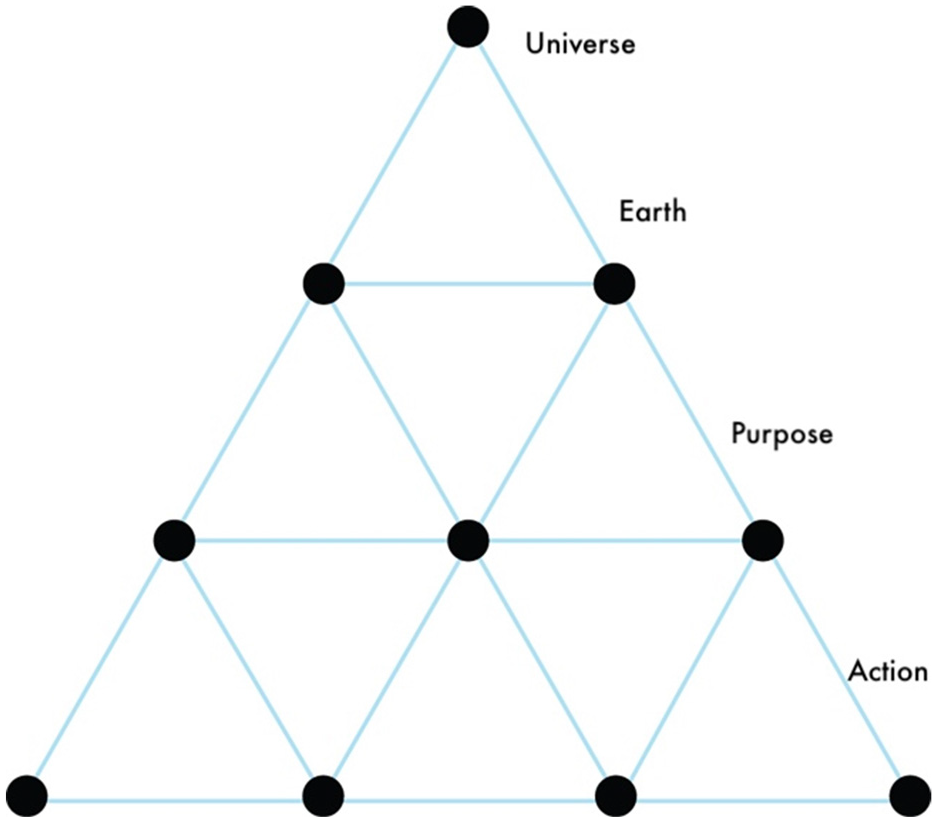
The Philosophical Tetractys.
For each point, the person proposes and eventually selects words, concepts, ideas or prepositions that help capture their perspective on the essence of each level in the Tetractys. The result—which can be fine-tuned through time—is a visual representation, and potentially an incantational formula, for how their cosmic understanding flows through increasingly concrete levels to inform and anchor their practical engagement with the world. The person is also free, if pertinent, to rotate the equilateral triangle, without moving the words, such that personal engagement appears on top for pragmatic reasons.
Methodological Guidelines: Flexibility with Coherence
Participants, in dialogue with their philosophical counsellor, have complete freedom in choosing individual words or phrases at any level of the Tetractys. However, the exercise privileges narrative and philosophical coherence. Research demonstrates that coherent self-narratives require thematic unity and causal connections between elements, with studies showing that individuals who can construct more coherent accounts of their experience report higher levels of wellbeing and lower levels of psychological distress (Adler et al., 2016; Waters & Fivush, 2015).
Narrative identity research shows that coherent personal narratives are linked to positive developmental outcomes across the lifespan, including better memory, deeper self-understanding, more effective communication, and stronger identity (Reese et al., 2011). Coherence in personal narratives is believed to require three essential dimensions: context (providing adequate orienting information), chronology (maintaining clear sequencing and causal connections), and theme (maintaining focus while developing meaningful interpretations; Vanden Poel, L. & Hermans, D., 2019). In short, individuals with more coherent existential narratives report fewer psychological difficulties and greater life satisfaction. The commonsensical fact that the Philosophical Tetractys exercise should prioritize coherence over arbitrary word choice is in counselling practice intuitively understood by persons concerned with their philosophical health.
To complete rows 2 to 4 of the triangle, one may ask if short phrases are preferable than successive keywords. There is no strict rule here, but simply a recommendation in the spirit of philosophical health. For instance, while a participant might choose “Transform, Innovate, Lead, Teach” as four distinct words at the practical level of the triangle, at the level of the higher purpose the philosophical counsellor might encourage to favor a three-word phrase, for instance (real-life examples among many others) an option like “Harmony for All” or “We Are Equal”—as opposed to three complex concepts such as for example “Liberty, Equality, Fraternity.” Indeed, a higher purpose composed of potentially competing ideas might be in practice, at least for most people, too difficult to balance and contrary to the ideas of conceptual prioritization and integrity that are constituent of philosophical health (de Miranda, 2024). An elegant economy and minimalism in the multiplication of concepts might better serve the integrity and coherence function by expressing a clear purpose with epistemic humility. This does not fully disqualify a choice of 3 conceptual words at the level of higher purpose, which could be seen as an internal compossibility challenge or an optimized equilibrium. For instance, Liberty-Equality-Fraternity could be perceived as a eudynamic unity or interconnected triad in need of mutual adjustment. Meaningful purpose might emerge from the integration of relatedness, inherently relational concepts thus expressing the interactive nature of purpose in eudaimonic wellbeing (Ryan & Deci, 2000, 2001).
The coherence check involves asking: Does the Tetractys tell a coherent story from cosmic to practical? Can you trace clear thematic, organic or causal connections between levels? Does it reflect content that may support philosophical wellbeing? Does the participant deeply believe in all this? This guidance provides grounding for word choice without imposing rigid restrictions.
Implementation in Counselling Sessions
The Philosophical Tetractys exercise is typically introduced between the sixth and seventh sessions of the SMILE_PH method (which contains eight sessions of 45 min each: introduction, bodily sense, sense of self, sense of belonging, sense of the possible, sense of purpose, philosophical sense, and conclusion). The exercise can be given and explained in the last 15 min of the session on sense of purpose and to help the counsellee prepare their philosophical sense session, which deals with worldview, cosmology and manifested philosophical health via the discussion around the more or less completed Tetractys exercise. This timing allows the exercise to serve as a bridge, helping to connect the person’s emerging sense of higher purpose with their broader philosophical perspective while providing a structured architecture for integration. Using the Tetractys along with the SMILE_PH method is not compulsory but simply advised.
The counsellor introduces the exercise by briefly explaining its structure, foundations, and purpose, emphasizing that it serves to create coherence between abstract philosophical principles and concrete lived experience while training compossibility thinking, which cultivates structural compatibility between ideas, concepts, behavior as well as balance between personal interests, earthly belonging, enactive work, and social embedding. The person is then guided through the process of completing each level of the Tetractys:
A. Cosmic principle: The counsellor may ask, “What single word would you use to describe the fundamental nature of the cosmos, the core orientation of the universe? What is the universe ultimately about according to you?” This requires the person to explore and distill their cosmological understanding to its essence, drawing on their deepest philosophical intuitions.
B. Earthly becoming: The counsellor may ask, “What two words would you use to describe how your cosmic principle manifests in the becoming and development of earthly beings? What is ultimately going on Earth?” This helps connect abstract cosmology to terrestrial processes, requiring the person to think about how ultimate reality expresses itself in our planet conceived as a whole.
C. Personal higher purpose: The counsellor may ask, “What three words capture your higher or highest purpose? How would you or do you help humanity and the world to get closer to paradise on earth, focusing on what you highly value?” This connects cosmic and earthly principles to personal meaning and deep orientation, requiring integration of individual fulfillment with collective contribution. A higher purpose should be thought as a collective good, not just a selfish outcome.
D. Practical mission: The counsellor may ask, “What four words describe your chosen practices and embodied actions in life and in society—your activities, roles, strategies, expertise, or the specific ways or spaces in which you embody or plan to actualize your purpose?” This grounds purpose in concrete action while maintaining connection to the higher levels.
Once completed, and during the next session on the philosophical sense, the counsellor and person continue their dialogue about the ongoing Tetractys, exploring the compossibility between levels and identifying any tensions or inconsistencies. This process often leads to refinements as the person works to create greater alignment between their understanding of reality and their everyday actions. The counsellor and the counsellee pay particular attention to whether the different levels coexist harmoniously and dynamically. The concept of compossibility derives from Leibniz’s philosophy and will be further explained in a subsequent section of the present article.
As mentioned above, the Philosophical Tetractys exercise is not presented as final or fixed but as a working document that can evolve as the person’s understanding and experience of the world develops. Individuals revisit and refine their Tetractys over time, using it as a tool for ongoing philosophical reflection and life navigation. Regular rehearsal, social experimentation, and reflection on the chosen words operates through multiple established mental mechanisms that create a reinforcing cycle of integration. Neuroplasticity research suggests that repeated engagement with meaningful concepts strengthens neural pathways. Simultaneously, this practice may function as cognitive priming, directing selective attention toward information and experiences that align with the practiced—a process that mobilizes what philosophers call epistemic virtues (honesty, curiosity, intellectual focus, deep orientation, open-mindedness), and may or may not share mechanisms with what psychologists recognize as confirmation bias (Bargh & Chartrand, 1999; Nickerson, 1998). The Tetractys rehearsal or daily inner hypotheses or incantations also strengthens what Gollwitzer (1999) terms “implementation intentions,” the mental linking of abstract goals to specific contextual cues, making individuals more likely to recognize and act upon opportunities that serve their stated purpose. This combination of neural reinforcement, attentional focusing, and enhanced goal-action linkage may create what appears to be meaningful coincidence or “synchronicity” but might simply be the predictable result of a mind increasingly organized around coherent principles and more sensitized to relevant possibilities and compossibilities. The subjective experience of enhanced meaning and apparent external validation—or conversely, the lack thereof—reflects the more or less successful alignment of internal cognitive processes with environmental opportunities, demonstrating the practical impact of philosophical coherence upon domains like personhood, earthly belonging, professional spheres and societal embeddings.
Theoretical and Cognitive Foundations: A Multi-Layered Validation
The four layers below provide empirical or theoretical validation of the pertinence of the Philosophical Tetractys exercise from independent discourses: the Tetractys structure aligns with cognitive processing capabilities, activates fundamental motivational systems, enables neuroplastic transformation through meaningful language, and builds upon historical frameworks for wisdom transmission.
Cognitive Load Theory and Hierarchical Information Processing
The Tetractys structure aligns with principles from cognitive load theory, which establishes fundamental limitations and capabilities of human information processing. George Miller’s research on memory span suggested constraints on how much information people can generally process in terms of memorable units. The Tetractys addresses this limitation through its hierarchical structure, where ten words are organized in ascending groups (1–2–3–4), bringing meaningful chunks within manageable memory constraints and cognitive capacity (Miller, 1956). This structured approach makes the exercise more cognitively manageable than processing ten unrelated items.
Moreover, because the personal Tetractys consists of highly meaningful and personally relevant content rather than random or mundane information, individuals can be trusted to retain 10 words in regular memory without too much effort. Research on the “self-reference effect” demonstrates that information processed in relation to the self is significantly better remembered than arbitrary content, as it engages deeper elaborative processing and connects to existing autobiographical knowledge structures (Rogers et al., 1977; Symons & Johnson, 1997).
Research on chunking reveals that meaningfully hierachized structures are easier to process than less meaningful (Chase & Simon, 1973). The 1–2–3–4 triangular progression creates natural cognitive chunking that reduces unnecessary mental effort while supporting the deep processing necessary for meaningful learning (Sweller, 1988). Sweller’s cognitive load theory identifies three types of mental effort in learning: intrinsic load (the natural difficulty of the material itself), extraneous load (unnecessary confusion caused by poor presentation), and germane load (the productive mental work of understanding and connecting ideas). The Philosophical Tetractys structure optimizes this cognitive architecture by providing manageable intrinsic cognitive load through its limited scope of ten words, minimizing extraneous cognitive load through its familiar shape, and enabling adequate time for germane cognitive load through its dialogical and reflective integration requirement.
Furthermore, research on hierarchical goal structures in psychology demonstrates that individuals naturally organize their motivations and intentions in hierarchical patterns, with abstract values at higher levels and concrete actions at lower levels (Carver & Scheier, 1998). The Tetractys aligns with this natural cognitive architecture, making it intuitively accessible while scientifically grounded. Philosophical health is about learning to deeply prioritize and better distinguish what is important existentially from what is contingent; the triangle is a familiar shape that represents this hierarchization. One may speak of a personalized “sacred ruling,” which is the Ancient Greek etymology of the word hierarchy.
The SEEKING System and Motivational Architecture
Contemporary affective neuroscience provides crucial validation for the Tetractys approach through research on what Jaak Panksepp identified as the SEEKING system, the core subcortical emotional system that energizes and directs exploratory behavior, curiosity, and goal-directed action (Panksepp, 1998). This SEEKING system, operating through dopaminergic pathways, represents what Panksepp called the “granddaddy” of all emotional systems, underlying motivation itself.
Convergent research across multiple disciplines validates this SEEKING-centered understanding of human motivation. Kent Berridge and Terry Robinson’s incentive salience theory distinguishes between “wanting” (dopamine-driven, SEEKING-like exploration) and “liking” (opioid-based pleasure), demonstrating that sustainable motivation depends more on the exploratory “wanting” system than on passive satisfaction (Berridge & Robinson, 2003). This research suggests that philosophical counselling using the Tetractys activates the more fundamental motivational system that drives sustained engagement with sense-making processes.
Loewenstein’s (1994) information-gap theory of curiosity shows that curiosity emerges as a response to perceived knowledge gaps, validating the insight that our core pre-philosophical drive operates as “a goad without a goal.” The Tetractys provides a structured approach to epistemic exploration that activates this fundamental curiosity drive while giving it a direction. Friston’s (2010) free energy principle demonstrates that organisms minimize prediction error through active exploration, aligning with the cognitive expression of SEEKING behavior.
This neurobiological grounding demonstrates that philosophical counselling using the Tetractys is not merely intellectual exercise but activation of fundamental motivational systems essential for mental flourishing and sustained engagement with meaningful activity. Experimental work still needs to be systematically conducted to validate these claims more directly.
Neuroplasticity and Language-Mediated Brain Change
Research on neuroplasticity reveals the Tetractys’ potential for lasting mental transformation through language-mediated brain change. Neuroscientist Andrew Newberg and communications expert Mark Robert Waldman suggest that focused word repetition, especially when practiced regularly, may influence physiological markers that regulate physical and emotional stress, and that exercising cognitive practices can support neural pathway modification through neuroplastic processes (Newberg & Waldman, 2012).
Studies on repetitive practices demonstrate that sustained engagement with meaningful cognitive and verbal exercises strengthens associated neural networks through activity-dependent plasticity. Neuroimaging studies of cognitive training reveal structural brain changes including increased white matter integrity and gray matter density in areas corresponding to practiced skills (Draganski et al., 2004; Woollett & Maguire, 2011). Research on language processing shows that repeated engagement with meaningful verbal patterns strengthens neural pathways through neuroplasticity mechanisms, with studies demonstrating enhanced brain connectivity and structural changes in language-related regions (Mechelli et al., 2004; Zatorre et al., 2012). Convergent findings across meditation, cognitive training, and language research provide robust evidence that repetitive engagement with personally meaningful content—such as the Tetractys keywords—can influence brain structure and function. Research on chanting and mantras also found that repetitive meaningful language can decrease stress, anxiety and depressive symptoms, as well as increase positive mood, feelings of relaxation and focused attention through measurable changes in brain activity (Perry et al., 2016).
The brain’s fundamental preference for repetition and pattern recognition means that what you repeat tends to become what you believe and repeated affirmations shape inner dialogue through the strengthening of specific neural networks (Cozolino, 2014). This neuroplasticity research provides scientific grounding for traditional practices involving repeated meaningful phrases or concepts. The Tetractys practice of articulating, refining, and internally rehearsing one’s ten words creates neuroplastic changes that train the brain toward philosophical coherence.
This neuroplasticity dimension helps explain the transformative potential reported by the counsellees and provides foundation for the exercise’s effectiveness as an intervention rather than merely a diagnostic tool. However, these experimental indications are indirect and need to be confirmed in the future by direct studies.
Historical Precedent and Ancient Wisdom Integration
The historical Pythagorean tetractys, of which we know little and yet spans over two millennia of philosophical tradition, provides symbolic validation for a 10-point triangular structure. Ancient sources reveal it was so revered that Pythagoreans swore by it, with their famous oath referring to it as containing the fount and root of eternal nature (Fideler, 1987). This wasn’t experienced as superstition but as sophisticated understanding of mathematical, musical, and cosmological principles. For Pythagoreans, this geometric form represented the organization of space, the harmonic ratios in music, and the structure of the cosmos itself.
In Pythagorean numerology, the number 10 (the sum of 1+2+3+4) represented perfection and the universe, while the individual rows reflected fundamental cosmic principles: as far as we know, the monad (1) represented the divine source; the dyad (2) represented the material world’s fundamental polarities; the triad (3) represented harmony and integration; and the tetrad (4) represented manifestation and earthly existence (Fideler, 1987; Guthrie, 1987).
The number ten represented unity of the highest order called “The Dekad,” suggesting that ten elements and their 1–2–3–4 progression create completeness rather than arbitrary collection (Ferguson, 2008). The progression was understood as representing increasing manifestation from unity to multiplicity, from the most abstract divine principle to the most concrete earthly manifestation. However, rather than claiming here that the Tetractys represents a sacred universal truth, we prefer to write that this historical inspiration serves as homage to a philosophical tradition that considered the pursuit of philosophical health in alignment with holistic principles to be philosophy’s true mission.
Philosophical Health and the SMILE_PH Method
The concept of philosophical health has gained increasing attention in recent years as philosophers and practitioners explore the role of philosophical reflection in human flourishing (de Miranda, 2024; Tukiainen, 2011). Philosophical health can be understood as a state of coherence between one’s worldview, values, purpose, and actions—a state that facilitates meaningful engagement with existence while contributing to collective eudynamia—a dynamic system of good and healthy relationship with the possible and the compossible.
It is worth remembering here that the SMILE_PH method (Sense-Making Interviews Looking at Elements of Philosophical Health) provides a semi-structured approach to philosophical counselling that explores six key elements of human experience:
A. Bodily sense: How the person experiences and relates to their physical embodiment.
B. Sense of self: How the person conceptualizes and experiences their identity.
C. Sense of belonging: How the person relates to others or embedding realities and finds community or communion.
D. Sense of the possible: How the person perceives opportunities and senses potentialities.
E. Sense of purpose: How the person orients themselves toward meaningful and universalizable goals.
F. Philosophical sense: How the person critically understands the ultimate nature of reality and existence, as well as the interconnectedness of phenomena.
Through dialogue sessions addressing each of these elements, the SMILE_PH method helps individuals develop greater coherence in their philosophical outlook and lived experience (de Miranda, 2023). The Philosophical Tetractys exercise serves as a culminating component of this method, helping to integrate insights from all elements into a coherent whole while training “compossibility thinking,” the capacity to ensure that different aspects of one’s life philosophy and practice can coexist harmoniously. This exercise should ideally be given in the second part of session E, and/or as a bridge between session E and F.
Necessity of Alignment Between Cosmology, Purpose, and Practice
Philosophical health requires a certain degree of dynamic harmony between one’s understanding of the world (cosmology), one’s purpose within it, and one’s practical engagement with it. Without this alignment, individuals may experience what existentialists have described as inauthenticity (Heidegger, 1962) or bad faith (Sartre, 1956), a disconnection between one’s values, experiences and actions that can lead to existential distress, decreased motivation, and psychological fragmentation.
The philosophical tradition has long recognized this need for coherence. Aristotle’s concept of eudaimonia requires that one’s actions align with virtue and purpose in an integrated manner (Aristotle, 2009). Similarly, Stoic philosophy emphasizes living in accordance with nature and reason, creating balance between one’s understanding of the cosmos and one’s conduct (Epictetus, 2008). These ancient insights find validation in contemporary research on narrative identity and psychological wellbeing. Research demonstrates that narrative coherence, the ability to construct coherent accounts of personal experience, is strongly associated with psychological wellbeing, identity formation, and resilience (Reese et al., 2011; Waters & Fivush, 2015).
The Philosophical Tetractys exercise provides a structured visual representation that facilitates this connection, helping individuals create a coherent and conceptualized narrative that spans from their cosmic hypotheses to their everyday engagement with the world. Unlike approaches that focus on single events or isolated experiences, the Tetractys provides an integrative framework that supports development of what we might term “philosophical narrative identity,” a life story explicitly grounded in theoretical understanding while manifested through coherent practical engagement.
Case Examples: Compossibility Thinking in SMILE_PH Sessions
The following case examples illustrate how the Philosophical Tetractys exercise has been applied in SMILE_PH counselling sessions and how it facilitates compossibility thinking, the capacity to create mutually reinforcing relationships between different levels of experience. To protect confidentiality, these cases are a compound of various real cases, and they do not refer to a single person.
Case 1: Marcus—Environmental Scientist
Marcus, a 42-year-old environmental scientist, sought philosophical counselling to address a growing sense of disconnection between his professional work and his deeper values. Through the SMILE_PH sessions, he articulated a strong sense of purpose related to environmental stewardship but struggled to connect this to his daily work, which often involved compromise with industrial interests.
Marcus’s Tetractys, after discussion with the counsellor and subsequent edits revealed the following:
Cosmic principle: Creation.
Earthly becoming: Adaptive intercreation.
Personal purpose: Harmony for all.
Practical mission: Research, orchestrate, educate, protect.
Compossibility Analysis
The Tetractys exercise helped Marcus recognize that his choices demonstrated sophisticated compossibility thinking rather than contradiction. “Creation” as cosmic principle enabled “Adaptive Intercreation” as earthly manifestation, a recognition that creative forces work through interconnected, adaptive systems rather than isolated entities. His purpose of “Harmony for All” emerged from this understanding, representing not harmony through separation or opposition, but harmony through adaptive integration and mutual support. The concept of harmony, which originated as a musical metaphor beloved by the Pythagoreans, remains today commonly associated with the purpose of creation.
The Tetractys exercise helped Marcus identify a tension between his cosmic understanding of creation as partly adaptive and the oppositional stance he had been taking toward industry. While his purpose of “harmony” aligned with his understanding of adaptive intercreation, he realized that harmony could be dynamic, evolving in time, and that effective “Education” and “Orchestration” required engaging and composing with, rather than opposing, industrial partners. This insight led to a shift in perspective, from seeing his work with industry as compromise to viewing it as a necessary aspect of cocreating balance within interconnected systems.
Marcus later reported that this shift allowed him to approach his work with renewed purpose and reduced internal conflict, as he could now see how his practical mission aligned with his cosmic understanding of reality. The compossibility framework helped him understand that sustainable environmental protection required working within existing systems while gradually transforming them, rather than opposing them from the outside. Interestingly, this reinforced his idealism while helping him overcome rigid perfectionism.
Case 2: Sophia—Marketing Executive
Sophia, a 31-year-old marketing executive, sought philosophical counselling to address a persistent feeling of meaninglessness despite career success. Through the SMILE_PH sessions, she had explored her sense of purpose but struggled to articulate a coherent worldview that could give meaning to her everyday activities.
Sophia’s Tetractys ultimately revealed the following:
Cosmic principle: Beauty.
Earthly becoming: Creative expression
Personal purpose: Illuminate to inspire.
Practical mission: Design, share, lead, transform.
Compossibility Analysis
The exercise revealed to Sophia that her understanding of the cosmos centered on beauty as a fundamental principle, with creative expression as its earthly manifestation. This created a compossible foundation where her higher purpose, “Illuminate to Inspire,” flowed naturally from beauty seeking to express itself through creative manifestation. Her practical mission elements became internally compossible: she could design beautiful yet meaningful communications, share them to illuminate beauty for others, lead teams in beauty-centered approaches, and transform organizations toward greater aesthetic coherence, which she equated with moral grace.
This insight helped her recognize that her marketing work could be meaningful when viewed as an opportunity to illuminate beauty and inspire connection through creative expression. The Tetractys framework revealed that marketing, properly understood, could serve beauty by helping people recognize and connect with what is intrinsically rather than superficially beautiful, rather than merely promoting consumption.
However, the exercise also revealed a compossibility tension between her current role, which primarily promoted consumer products of moderate aesthetic and social value, and her purpose of illumination and inspiration. The Tetractys suggested that sustainable wellbeing required practical mission activities that more directly served her cosmic-earthly-purpose triad. This led Sophia to explore how she might transform her professional practice to better align with her purpose, eventually leading to a career shift toward marketing for an art organization involved in educational initiatives.
The compossibility framework helped Sophia understand that career change wasn’t about rejecting her previous experience or skills, but about finding contexts where her cosmic and moral understanding of beauty could more fully manifest through her practical activities while contributing to collective flourishing rather than mere consumption. Sophia also later communicated that she saw her personal philosophical Tetractys as still evolving and that her plan was to revise it in dialogue with the philosophical counsellor once every 3 years.
Case 3: James—Retiring Physician
James, a 58-year-old retiring physician, sought philosophical counselling to help navigate his transition from a demanding medical career to retirement. He expressed concern about losing his sense of purpose and identity with the end of his professional practice.
James’s Tetractys revealed the following:
Cosmic principle: Compassion.
Earthly becoming: Healing power.
Personal purpose: Serve to relieve.
Practical mission: Listen, guide, support, write.
Compossibility Analysis
The exercise helped James recognize that while his specific role as a physician was ending, his deeper Tetractys remained completely compossible and transferable to new contexts. “Compassion” as cosmic principle could continue manifesting through “Healing Power” that extended far beyond medical intervention. His purpose to “Serve to Relieve” didn’t require medical credentials or institutional authority; it could be fulfilled through any activities that genuinely helped alleviate suffering or distress and promote wellbeing.
The “Write” element in his practical mission was particularly significant, representing an aspiration he had long held but never pursued—writing about his medical experiences to guide both patients and younger physicians. The compossibility framework revealed that writing could serve his cosmic principle of compassion by extending healing power beyond his direct patient interactions and continuing his educational mission beyond retirement.
The Tetractys showed that “Listen,” “Guide,” and “Support” were transferable skills that could continue through mentorship, volunteer work, community involvement, and written contributions to medical education. These activities remained fully compossible with his cosmic understanding and purpose while contributing to collective wellbeing in new ways.
James later reported that the Tetractys exercise helped him see retirement not as an end to his purpose but as a transition to new forms of embodying the same fundamental values of compassion and healing service that had motivated him. The compossibility framework provided both continuity and flexibility for this major life transition, demonstrating the existential benefits of philosophical thinking.
Discussion: Theoretical and Practical Implications
The Tetractys as Compossibility Training
The Tetractys of Philosophical Health functions partly as training in compossibility thinking, the philosophical practice of ensuring that multiple possibilities can coexist harmoniously while mutually reinforcing each other. Drawing from Leibniz’s original concept but expanding it for contemporary application, compossibility in philosophical health involves both internal coherence and external harmonization with broader living and social systems (Adams, 1994).
Leibniz’s (1714/1989) compossibility, an idea he evoked for instance in his Monadology, referred to the principle that a possible world consists of a set of possibilities that are more or less mutually compatible rather than absolutely contradictory. In our adaptation, each level of the Tetractys must become compossible with the others: the earthly becoming must be compatible with the cosmic principle, the personal purpose must flow coherently from both cosmic and earthly understanding, and the practical mission must genuinely serve the purpose while remaining feasible within earthly constraints and logic.
This vertical compossibility check ensures internal consistency, but the framework also encourages consideration of external compossibility. The Tetractys thus serves not merely as personal development tool but as training for the kind of thinking needed to address complex social and ecological or cogenerative challenges that require integration of multiple perspectives and possibilities. In an era requiring planetary thinking and unprecedented cooperation to address global challenges, the capacity for compossibility thinking becomes essential for both individual flourishing and collective survival. Personhood, earthly becoming, work as worldmaking, and social belongings are four aspects of our embodied, extended, enactive and embedded cognition that we need to learn to harmonize.
Philosophical Coherence and Vertical Integration
The Tetractys has several theoretical implications for understanding the relationship between abstract philosophical principles and concrete lived experience. First, the exercise suggests that philosophical coherence requires integration across levels or domains of abstraction. A person’s understanding of cosmic principles should inform their understanding of earthly becoming, which in turn should inform their sense of purpose and ultimately practical stance. Frankl (1963) insisted on the existential nature of the human need for meaning, connecting everyday activities to larger purposes and holistic understanding.
This integration process reflects themes found in humanistic psychology, including what Maslow (1971) described as self-actualization, the realization of one’s potential for authentic self-expression. Research demonstrates that meaning-making and value-based living correlate strongly with psychological wellbeing and life satisfaction (Peterson and Seligman, 2004). The Tetractys provides a structured method for monitoring this integration systematically.
Second, the structure of the Tetractys, with its increasing or decreasing number of words at each level, reflects the natural expansion that occurs as realities move from conceptual to multiple, and vice versa. The Tetractys structure acknowledges both the unity of philosophical understanding and the plurality of its practical expressions, reflecting what complexity theorists call “holarchical organization” (Koestler, 1967), systems organized as nested hierarchies where each level is both a complete unit and a component of larger systems.
Third, the Tetractys highlights the bidirectional nature of philosophical reflection. While cosmic principles inform practical mission, the experience of engaging in practical activities also informs and refines understanding of universal principles. This suggests a hermeneutic circle (Gadamer, 2004) in which understanding develops through continuous movement between abstract principles and concrete experience. This process resembles what Schön (1983) identified as “reflection-in-action,” the dynamic interplay between theory and practice that characterizes expert performance across domains.
Research in experiential learning theory (Kolb, 1984) validates this bidirectional process, showing that meaningful learning requires continuous cycling between abstract conceptualization and concrete experience. The Philosophical Tetractys formalizes this cycle within the domain of philosophical development, providing what Mezirow (1991) calls a “transformative learning” framework that can lead to fundamental shifts in worldview.
Finally, the Tetractys provides a visual metaphor of what might be called “philosophical integrity,” the alignment of one’s understanding, purpose, and action, with its triangular solid unshakable base combined with ascending aspiration. Moreover, the triangular shape is not static but dynamic, as it can be rotated in three different orders of the same words, generating ongoing reflection and adjustment as understanding evolves and circumstances change, reflecting what Dweck (2006) calls a “growth mindset” applied to philosophical development.
Identity and Meaning-Making Integration
The Tetractys of Philosophical Health, as an existential exercise, facilitates what narrative identity theorists call “thematic coherence,” the ability to derive a general theme or principle about the self through clear cause-and-effect relationships between events and their effect on the narrator’s sense of self (Habermas & Bluck, 2000). This process reflects what Taylor (1989) called “strong evaluation,” our capacity to make judgments about what is worthy or valuable based on deeper commitments that give life direction and meaning, despite urges to behave differently.
By connecting universal principles to practical activities through a coherent narrative structure, individuals develop stronger sense of meaning and purpose. Research by Martela and Steger (2016) demonstrates that such meaning-making processes contribute to what they term “tripartite meaning”—coherence (comprehensibility), purpose (goal-directedness), and significance (sense of life’s worth). The Tetractys addresses all three dimensions simultaneously.
Unlike approaches to meaning-making that focus on single events or isolated experiences, the Tetractys provides an integrative framework spanning from ultimate philosophical commitments to immediate practical choices. This comprehensive scope supports the hypothesis of a philosophical narrative identity, a life story explicitly grounded in theory while manifested through coherent practical engagement. This resonates with what MacIntyre (1984) called “narrative unity of life” and what Kegan (1994) described as the “self-authoring mind,” the capacity to create coherent meaning systems that guide action across diverse contexts.
Research in post-traumatic growth (Tedeschi & Calhoun, 2004) shows that individuals who can reconstruct coherent narratives following major life challenges or existential wounds often experience enhanced psychological development and increased sense of meaning. The Tetractys provides a proactive framework for such narrative construction, potentially building resilience by anticipation, before challenges arise, while supporting ongoing meaning-making throughout the lifespan.
Institutional Applications
In educational settings, the Tetractys can serve as a tool for helping students connect abstract philosophical concepts to their own lived experience and aspirations. By articulating how philosophical principles might inform their purpose and actions, students can develop a more engaged and personally meaningful relationship with philosophical and existential inquiry. When students construct their own Tetractys, they engage in a reflective process through which abstract principles become foundations for situated, meaningful decisions, as well as for the development of character composure, the ability to maintain emotional stability and intellectual control, especially under pressure or in stressful situations. This practice may mitigate what Freire (1970) condemned as the disconnection between academic knowledge and lived experience, and fosters what Nussbaum (1997) described as the capacity to consider the complexities of real lives through philosophical and ethical lenses.
Additionally, the compossibility framework teaches students to think systemically about their intellectual commitments, developing “complex thinking” (Morin, 2001), an ability to consider interconnections and avoid reductive approaches to understanding. Rather than treating philosophical positions as isolated beliefs, students learn to consider how different philosophical commitments interact and whether they create coherent, sustainable worldviews that can contribute to collective flourishing. A workshop in which participants would describe their Tetractys and compare it to the Tetractyses of the other participants would be a useful exercise in open-mindedness and mutual understanding.
In organizational contexts, the Tetractys can also help align individual purposes with organizational mission and values while addressing what organizational psychologists call the “values-action gap” or the difference between what people say they believe (“espoused theory”) and how they actually behave (“theory-in-use”) (Argyris & Schön, 1978). By exploring how their personal Tetractys relates to the organization’s higher principles and long-term goals, if any, individuals might find greater meaning and coherence in their professional roles while contributing more effectively to organizational success. This approach supports what Kahn (1990) identified as “personal engagement” at work, the psychological presence that leads to higher performance and satisfaction. Research in organizational behavior demonstrates that meaning at work significantly predicts employee engagement, retention, and performance (Martela & Pessi, 2018; Rosso et al., 2010).
For personal growth, the Tetractys offers a structured approach to creating coherence between one’s worldview and life choices, supporting what Jung (1969) and others called “individuation,” the process of integrating different aspects of personality into a coherent whole. Regular reflection on, inner repetition and fine-tuning of one’s Tetractys can support ongoing development and integration, helping individuals make choices that align with their deepest values and understanding while contributing to collective wellbeing. Research on life transitions suggests that individuals who maintain coherent sense-making frameworks during change may experience less distress and greater post-transition adaptation, as indicated by transition frameworks that emphasize the importance of meaning-making processes (Bridges, 2004; Schlossberg, 1981). By maintaining focus on the cosmic-earthly-purpose-action Tetractys, individuals can navigate change while preserving core identity and direction. This process reflects what Frankl (1963) famously observed in extreme circumstances—that individuals who maintain connection to transcendent meaning and purpose demonstrate remarkable resilience and capacity for growth.
Last but not least, turning the triangle on itself without changing the order of the words might reveal a different perspective on the same structure of values, for instance less contemplative and more pragmatic if one turns the triangle such that the upper word is a personal or societal role. This flexibility allows for different emphases while maintaining the same underlying compossible structure, reflecting what gestalt psychologists call “figure-ground relationships” (Köhler, 1947) where the same elements can be organized in different meaningful patterns.
The Tetractys and the Praxis of the Possible
The Tetractys of Philosophical Health actively engages with a praxis of the possible, by serving as a bridge between our philosophical understanding and our earthly actions, providing a structured pathway to translate our sense of the possible into tangible possibilities and compossibilities in the world.
The Tetractys as a Tool for Eudynamic Exploration
A philosophically healthy sense of the possible represents “a good sense of potential” or eudynamia, a term derived from two Ancient Greek words: “eu,” meaning good or well, and “dynamis,” meaning potential, possibility or empowerment (de Miranda, 2024). The Tetractys exercise encourages this eudynamic capacity by guiding individuals to articulate not only what they believe is possible in an hypothetical sense but also how these possibilities might manifest in their lived experience and echo across domains. As individuals move through the Tetractys—from cosmic principle to earthly becoming, personal purpose, and practical mission—they are essentially tracing the journey of possibility into actuality, of potential into manifestation.
Perhaps the most significant contribution of the Tetractys exercise to philosophical health and possibility studies is its emphasis on compossibility, the harmonious integration of multiple potentials within a coherent whole. The Tetractys embodies this principle by requiring individuals to consider how their cosmic understandings, personal purposes, and practical actions can coexist and mutually reinforce, rather than negate, one another. The visual structure of the exercise, an equilateral shape that remains identical when rotated, is itself a reminder of the need for coherence.
When a counsellee struggles to find words for a certain level that align with the levels above, this signals an opportunity for philosophical exploration and spiritual, conceputal or ethical growth. Such moments of perceived incoherence or tension towards coherence become productive sites for dialogue, as the philosopher and counsellee together examine the potential contradictions and seek resolutions that enhance rather than diminish the person’s sense of the possible and the compossible.
From Individual Possibility to Collective Compossibility
The Tetractys exercise, while centred on personal philosophical health, also opens pathways to considering one’s place within the broader network of collective possibility in society. As participants articulate their practical mission at the base of the Tetractys, they inevitably confront questions about how their actions will interact with the actions and purposes of others.
This confrontation echoes the challenge of our era: the new compossibility mindset advocated by the philosophical health paradigm involves dealing with each part of our world (in particular person, earth, work, and society) with a holistic lens, by maintaining an overview focus and developing long-term intelligence. The Tetractys facilitates this mindset by encouraging individuals to situate their personal possibilities within a framework that remains mindful of the possibilities of others. For instance, a counsellee who identifies “Creation” as their cosmic principle, “Adaptive Intercreation” as their earthly becoming, “Harmony for All” as their higher purpose, and “Research, Orchestrate, Educate, Protect” as their practical mission (as in the aforementioned case of Marcus) is explicitly engaging with compossibility: the emphasis on “intercreation,” “harmony,” and “orchestration” signals an awareness that one’s own creative possibilities must be realized in concert with, rather than at the expense of, the creative possibilities of others.
The Tetractys as Crealectic Intelligence in Action
The Tetractys exercise exemplifies “crealectic intelligence,” an enactive mode of thinking that engages with the world as both potential, real and compossible (de Miranda, 2021). Unlike purely analytic approaches that dissect reality into components or purely dialectical approaches that focus on oppositions and contradictions, crealectic thinking aims to synthesize and harmonize without simplifying or rigidifying the possible. By engaging with the Tetractys, individuals practice this crealectic intelligence for themselves, learning to see connections rather than divisions, possibilities rather than limitations, compossibilities rather than antitheses. The exercise trains the mind to think in terms of wholes rather than parts, to consider how seemingly disparate elements can be integrated into a coherent, creative and meaningful life philosophy.
Conclusion: The Tetractys as Philosophical Praxis
The Tetractys of Philosophical Health is not only a counselling tool or a conceptual framework but a form of philosophical praxis, an active engagement with the art of making possibilities compossible. As participants work through the exercise, they become action-philosophers, embodying the core understanding that philosophical health is not a state, but a process, a journey in which theory becomes practice, and practice becomes theory.
Through this process, individuals cultivate a good balance between personal sense of the possible and an eye for compossibility in whole systems or ecosystems. They learn to navigate the creative tension between individual aspiration and collective harmonization, between cosmic ideals and earthly realities, abstract possibilities and concrete manifestations. The Philosophical Tetractys helps individuals become conscious agents in the asymptotic creation of the best of possible worlds, beginning with their own lives but extending outward to embrace the broader compossibility of all beings. Philosophical health explores our possible contributions to the collective and reflective eudynamia of life on Earth.
Limitations and Future Research
While the Tetractys of Philosophical Health has shown effectual and very encouraging results in philosophical practice, it is a very recent tool and several areas for future research should be acknowledged.
First, the effectiveness of the exercise may vary within different cultural or educational backgrounds, and psychological types. Further research could explore what kind of persons respond better to this exercise. We can note here, for instance, that a pilot of SMILE_PH intervention has been conducted with 8 students and 2 staff members of the Stockholm School of Economics between February and April 2025, under the guidance of Luis de Miranda, during which a vast majority of participants completed their Tetractys exercise with enthusiasm and later reported satisfaction, confirming the broad applicability observed in similar interventions between January and August 2025.
Second, the long-term impact of the exercise remains to be systematically studied. While multiple real-life examples shared by certified SMILE_PH practitioners suggest that the tetractys can facilitate meaningful insights and changes, longitudinal research is required to assess its lasting effects on philosophical coherence, psychological wellbeing, and quality of life for example. Such studies may employ standardized measures of meaning in life, purpose, identity coherence, or psychological flourishing to assess outcomes quantitatively. Or they will also use the Philosophical Health Compass (PHC), a 48-stances questionnaire specifically designed to evaluate a person’s philosophical wellbeing (de Miranda et al., 2025).
Third, the neurobiological mechanisms underlying aspects of the tetractys’ effectiveness warrant further investigation using methods from affective neuroscience and cognitive psychology for instance. Studies could examine how engagement with the exercise affects neural networks associated with meaning-making, identity formation, and executive function, but also how emotions may be related with purpose in learning (Immordino-Yang & Damasio, 2007). Studies using fMRI or EEG could investigate whether Tetractys work and keyword repetition activates the brain’s default mode network differently than other cognitive activities.
Planetary civilization
The Tetractys of Philosophical Health offers a structured approach to connecting abstract philosophical principles with concrete lived experience while training individuals in compossibility thinking, a form of cognition that we claimed in this article is essential for both personal flourishing and collective harmonization. As a component of the SMILE_PH method, the tetractys may help individuals see how their sense of purpose fits within a larger cosmological or ideological framework and informs their practical engagement with the world. Nevertheless, the SMILE_PH method is conversational, semi-structured rather than rigidly structured, and more often than not, the dialogue is not based on specific exercises, but on exploratory sense-making around six existential elements: bodily sense, sense of self, sense of belonging, sense of the possible, sense of purpose, and philosophical sense.
As areas for future research in philosophical health abound, the Tetractys represents a contribution to the growing fields of philosophical practice and possibility studies in society. By providing a visual structure that connects cosmological concepts to concrete actions or social roles, the Tetractys of Philosophical Health supports what might be considered the fundamental aim of philosophical health: not merely to understand the world, but to live in accordance with that understanding while contributing to the creation of more wise, grateful, and eudynamic communities.
In an era requiring unprecedented cooperation to address global challenges, tools that develop holistic thinking are needed for both personal resilience and collective survival, thus contributing to the compossibilizing work of creating what has never yet existed on Earth: a human and more-than-human planetary civilization.
Footnotes
Acknowledgements
I would like to express my gratitude to the persons who participated in philosophical counselling sessions using the SMILE_PH method in general and the Tetractys exercise in particular.
Author’s Note
Marie Sklodowska-Curie Fellow at the University of Turku; Associated Researcher at the Center for Research Ethics and Bioethics, University of Uppsala, Sweden; and Affiliated Researcher at the Center for Wellbeing, Welfare and Happiness, Stockholm School of Economics, Sweden.
Declaration of Conflicting Interests
The author declared no potential conflicts of interest with respect to the research, authorship, and/or publication of this article.
Funding
The author disclosed receipt of the following financial support for the research, authorship, and/or publication of this article: This project has received funding from the European Union’s Horizon Europe research and innovation programme under the Marie Skłodowska-Curie Actions Grant Agreement No. 101081293.
Ethical Approval
No ethical approval is requested as no real human case is cited in the article, and the cases are reimagined.

Data Availability Statement
No data is connected to this article.