



Abstract
For a set of 10 conditions (e.g. homosexuality, obesity, drug addiction), we explored associations between moral judgments, agency evaluations, and perceptions that a condition is a mental illness. In a preregistered study (n = 1,249 U.S. adults), we found that perceptions of lower agency were associated with decreased moral wrongness judgments, as well as increased perceptions of mental illness, yet perceived moral wrongness was the most robust predictor of perceived mental illness. In other words, although perceived mental illness was associated with evaluations that tend to be morally exonerating (such as less control and greater difficulty changing), we observed positive associations between wrongness judgments and perceived mental illness. We also found that—at least within our set of conditions—political conservatives tended to evaluate conditions as more controllable, more morally wrong, and more of a mental illness, yet on the whole, ideology was not a reliable predictor of perceived mental illness. Instead, liberals and conservatives with similar wrongness evaluations tended to similarly ascribe mental illness. These findings raise questions about potential causal relationships between mental illness perceptions and moral evaluations and the possibility that perceived moral wrongness might sometimes contribute to perceptions that a condition ought to be considered a mental illness.
For centuries, philosophers, neuroscientists, psychologists, and legal scholars alike have debated the nature of human agency and moral responsibility, and many vital questions of contemporary social, cultural, and political concern are inherently tied to perceptions of agency. The present work asks how moral wrongness judgments and perceptions of human agency relate to attributions of mental illness. The fourth edition of the Diagnostic and Statistical Manual of Mental Disorders (DSM-IV; American Psychiatric Association, 1994) mentions “an important loss of freedom” as a characteristic feature of mental disorder. Insofar as a lack of freedom and diminished agency reduce moral responsibility (e.g. Shariff et al., 2014), perceived mental illness should then be associated with reduced moral judgment. Indeed, legal courts across the world have varied forms of the “insanity defense,” which treats mental dysfunction as an exonerating factor. There are, however, reasons to expect the opposite pattern: that perceived mental illness and perceived moral wrongness might be positively related. For example, behaviors considered immoral often involve norm violations (Monroe & Ysidron, 2021), and norm-violating behavior may be considered indicative of mental illness. Similarly, people might assume most individuals want to behave morally, and so failures to do so may seem indicative of mental illness. Still a different reason might be that perceptions that a behavior or trait is immoral might motivate individuals to stigmatize the condition as a mental illness (see, e.g. Clark et al., 2015; Haidt, 2001; Kunda, 1990).
The present paper reports one study exploring the associations between agency judgments, moral responsibility judgments, and perceptions of mental illness across a set of 10 conditions. This study aims to test the two competing hypotheses raised above: moral judgment might be positively—or negatively—related to perceptions of mental illness for various conditions. In additional exploratory analyses, we investigate the role of political ideology in this relationship. Given ongoing political conflicts surrounding what constitutes a mental illness (e.g. Suhay & Jayaratne, 2013) and which human behaviors warrant moral opprobrium (Everett et al., 2021), ideology may predict different construals of mental illness and judgments of morality.
The contentious definition of mental illness
To understand the relationship between perceptions of mental illness and moral judgment, it is critical to explore the notion of mental illness itself. Long after the term “mental illness” became common in the field of psychiatry, the phenomenon still lacked a clear definition (Scott, 1958). Texts such as the DSM-II (American Psychiatric Association, 1968), which altogether lacked any attempt at defining this term, were argued to be compilations of conditions treated by physicians (Klein, 1978), hence founded in medical practice rather than clear criteria.
Beyond exposure to psychiatric treatment, a common feature in conceptualizations of mental illness was the idea of maladjustment: a lack of adherence to social norms (Scott, 1958). People possess a set of intuitive expectations about normal mental function and behavior—perceptions that are highly shaped by cultural knowledge and moral norms (Boyer, 2011). Deviations from these expectations are flagged and categorized as potential signs of mental dysfunction. For instance, if transgender identity or having certain fetishes opposes cultural and moral norms, these conditions are more likely to be pathologized than culturally widespread manifestations of gender and sexuality. These intuitions about mental dysfunction are reflected in the field of psychiatry. For example, the DSM-II (American Psychiatric Association, 1968) included homosexuality as a mental illness, which was removed from following editions with a shift in the sociocultural landscape.
However, the role of norm-deviating behavior in diagnoses of mental illness is unclear. In its definition of mental disorder, the DSM-IV (American Psychiatric Association, 1994) clarifies that “neither deviant behavior…, nor conflicts that are primarily between the individual and society are mental disorders unless the deviance or conflict is a symptom of dysfunction in the individual.” This assertion was likely a response to rising critique of mainstream psychiatry since the 1960s (Bolton, 2013). For instance, Szasz (1960) argued that mental illness was a “myth,” a term imposed upon social deviance in order to pathologize it. He argued that “the notion of mental symptom is therefore inextricably tied to the social (including ethical) context in which it is made.” Insofar as perceived mental dysfunction is characterized as a disease, he declared the concept of mental illness as both unnecessary and misleading.
The contentious notion of “mental illness” reveals the possibility that this term—whether used colloquially or even professionally—is grounded in moral concerns regarding behaviors that deviate from social norms, suggesting that perceived wrongness could be associated with higher perceptions of mental illness. However, a positive association between moral wrongness and perceived mental illness might seem puzzling if mental illness is assumed to involve a loss in freedom. Indeed, many philosophers and laypeople share the intuition that various forms of agency, such free choice, control, intentionality, and the ability to do otherwise, are prerequisites for moral responsibility.
Agency, moral judgment, and mental illness
Kant argued that a person’s behavior can only be morally judged insofar as they had control over it—that is, if they made an intentional choice between multiple possibilities for action (e.g. Kant, 1781/2005, 1785/1998). Research shows that this idea matches everyday intuitions: people are more inclined to blame those who cause harm intentionally (e.g. Cushman, 2008; Malle et al., 2014; Malle & Knobe, 1997; Schein & Gray, 2018). Similarly, the more controllable someone perceives a condition such as obesity to be, the more blame they place on obese people—a pattern also seen for schizophrenia and homosexuality (Chandrashekar, 2020; Haider-Markel & Joslyn, 2008). More generally, those who believe more in free will or hold less mechanistic views of human behavior also tend to be more punitive (Shariff et al., 2014). Findings such as these suggest that various agency and control-related characteristics—such as an actor’s intention, whether an actor could have possibly avoided the outcome, and the role of situational factors in influencing an outcome—predict the extent to which a behavior is morally judged, or considered immoral.
The critical role of perceived agency in moral judgment is exemplified by the legal system, which has a long history of placing value upon the intention behind a crime. “Mens rea” (Latin for “guilty mind”) is usually a necessary component in the conviction of a crime (Sayre, 1932). Accordingly, lack of mental awareness or choice is often treated as an exonerating factor, and this provision is reflected in the “insanity defense,” used by defendants suffering from severe mental illness at the time of their actions (Goldstein, 1967), because of the association between mental illness and lower perceived control (Meynen, 2010). The insanity defense, which proclaims individuals as “not guilty by reason of insanity,” rests on the argument that mental illness reduces accountability, and it is featured to varying degrees in legal systems across the world today (Simon & Ahn-Redding, 2006).
However, the relationship between mental illness and moral responsibility is not straightforward. Despite the provision of the insanity defense, this defense is rarely used, and rarely successful (Schmalleger, 2001). For instance, in the landmark 2006 Clark v. Arizona case in the US, an adolescent was convicted for murder despite suffering from schizophrenia, and despite the defense that he did not have control over his behavior (Appelbaum, 2006). Mental disorders remain morally contentious not only in such legal situations, but also in society more generally, where they face a strong stigma (e.g. Byrne, 2000; Corrigan & Wassel, 2008; Fink, 1992). Research shows that although biological and genetic explanations for mental illnesses reduce perceived agency and accountability, they are simultaneously accompanied with reduced feelings of empathy toward individuals with mental illnesses (Lebowitz & Ahn, 2014; Lebowitz & Appelbaum, 2017). The relationship between perceptions of mental illness, control, and morality hence remains unclear.
Ideological differences in perceptions of responsibility
Attribution of and belief in control-related constructs can vary situationally. For example, previous research has found that when people wish to punish others or justify moral condemnation, they attribute more intentionality, controllability, capacity to choose freely, and free will to others (e.g. Alicke, 1992; Clark, Bauman, et al., 2017; Clark et al., 2014, 2021; Knobe, 2003). Such judgments also differ systematically on the dimension of political ideology. Studies have shown that people who support a conservative ideology tend to believe in free will more than people who support a liberal ideology (Carey & Paulhus, 2013; Paulhus & Carey, 2011). This difference is reflected in attribution styles; whereas conservatives often attribute social problems to internal personal factors (reflecting a focus on personal agency), political liberals are likelier to attribute the same problems to unjust external social circumstances (Cozzarelli et al., 2001; Furnham, 1982; Kluegel & Smith, 1986; Skitka et al., 2002).
One proposed reason for group differences in free will belief is that conservatives tend to moralize a broader array of scenarios in general, which motivates them to justify these moral judgments with a belief in personal control. Indeed, conservatives tend to view various behaviors as more morally wrong as well as more controllable, relative to political liberals (Everett et al., 2021). However, studies show that when stronger desires to blame were elicited among liberals, they ascribed more freedom and control than conservatives (Everett et al., 2021). Moreover, the extent to which liberals and conservatives attribute personal responsibility (such as their level of endorsement of genetic explanations for behavior) relates to their respective policy positions toward various behaviors (Suhay & Jayaratne, 2013). Thus, political differences in perceptions of agency may be partially morally motivated, rather than purely reflecting consistent ideological differences in the perceived causes of human behavior. In our study, we hence explored the role of political ideology in predicting moral judgment, perceptions of agency, and mental illness, across different conditions.
The present research
The present work is a descriptive and exploratory investigation testing the links between perceptions of human agency, moral evaluations, and construals of particular conditions as mental illnesses. Given known differences in control-type ascriptions and moral evaluations between political liberals and conservatives, we also investigated political differences in these relationships.
We presented participants with a wide range of traits, conditions, and identities that may be seen by some as deviating from contemporary Western norms or ideals, in order to test potential within- and between-condition variations in perceptions and judgments. For the rest of this paper, we will refer to this range of traits, conditions, and identities as “conditions” presented to the participants. We included five conditions that are formally classified as mental disorders (depression, psychopathy, pedophilia, drug addiction, and schizophrenia), three conditions that deviate from traditional cultural norms of gender and sexuality (homosexuality, transgenderism, and having a fetish), one disease that is often stigmatized (obesity), and a widely morally condemned trait (being racist).
These particular conditions were selected because they represent a diverse set of conditions that may be viewed differently along the relevant dimensions (agency, moral wrongness, and mental illness) by each evaluator and between multiple evaluators. Moreover, many of these conditions are perceived differently by conservatives and liberals, such as homosexuality and drug addiction. Accordingly, political ideology could impact the extent to which a particular condition was viewed as a deviation from the cultural norm.
Method
Open science statement
This study was preregistered: https://aspredicted.org/gr55v.pdf. Data are available here: https://osf.io/yr6qu/. Verbatim study materials are available in the Supplemental Material. Methods were followed exactly as described in the preregistration. As stated in the preregistration, all analyses were exploratory. We deviated from the preregistration in one way: we did not impute missing data because imputation made the analyses more complicated than we had anticipated. Instead, we allowed it to remain missing.
Participants
In an online study, we recruited 1,250 participants from Amazon Mechanical Turk and 1,273 provided at least some data (Mage= 38.02, SD = 12.38; 603 male, 641 female, 5 other, 24 not reported; Mconservatism = 3.55, SD = 1.79 [excluding “Other” and “Don’t know/not political” ideology]).
Procedure
Participants were told they would be responding to questions about several people with different types of conditions and were randomly assigned to respond to four different conditions from a set of 10. These conditions included someone who (1) was a pedophile (n = 482), (2) was addicted to illegal drugs (n = 482), (3) was a psychopath (n = 483), (4) was gay (n = 483), (5) had a fetish (n = 359), (6) was racist (n = 486), (7) was transgender (n = 512), (8) was obese (n = 639), (9) was depressed (n = 481), and (10) had schizophrenia (n = 481). All provided ns correspond to the number of participants who responded to questions about each condition. Each condition was accompanied by a very short description in case participants were not familiar with the condition (e.g. pedophile was accompanied by the description “someone who feels sexually attracted to young children”).
For each condition, participants responded to nine questions. Five questions regarded judgments related to agency and controllability, including (1) how difficult it would be to change the person, (2) whether this person would like to change, (3) the extent to which their condition is caused by their genes, (4) how much control this person has over their condition, and (5) how much internal distress this person experiences as a result of their condition. Two questions were related to moral assessments, including (1) how wrong it is for them to have their condition, and (2) the extent to which they should be punished more or less severely because of their condition. And one question probed perceptions of mental illness: whether this person should be considered mentally ill. These questions were all answered on relevant 7-point scales. Participants also reported the percentage of people they thought had each condition on a sliding scale from 0 to 100%.
Participants also completed some demographic items including their age, gender, and political ideology on a 7-point scale from Very liberal to Very conservative with two additional response options Don’t know/not political or Other. These last two categories were excluded for all analyses including ideology.
Results
Descriptives and correlations
Descriptive statistics for all evaluations of all conditions are available in Table S1. Figure S1 presents all correlations across conditions, and Figure 1 below presents all correlations collapsed across conditions in order to highlight the most consistent patterns. Here, we only interpret correlations that reach a minimum threshold of |r| ≥ .10. In line with previous research, the less that people perceived conditions as controllable (i.e. lower perceived control, greater desire to change, and more genetic causation), the less they perceived it as morally wrong, and the less they found it deserving of punishment. Similarly, when people believed that conditions caused more internal distress, they judged them as less immoral, and meriting lower punishment. The more a condition was perceived as morally wrong, the more it was considered deserving of punishment.
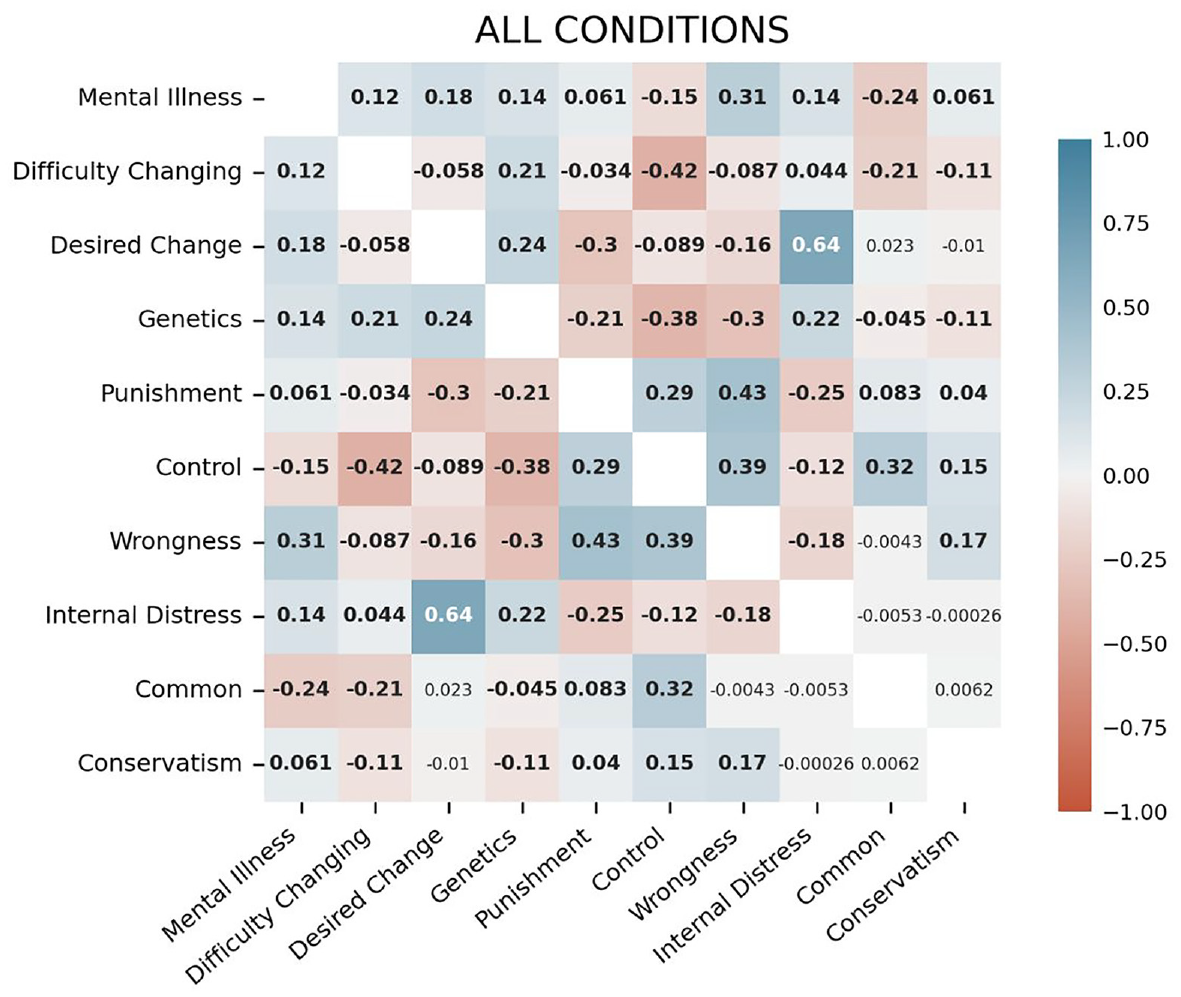
Correlations collapsed across all conditions.
Although perceived mental illness was associated with greater difficulty changing, stronger desire to change, more genetic causation, lower control, and higher internal distress, its strongest association was with higher perceived wrongness. In other words, perceived mental illness was associated with control-type evaluations that were linked to lower perceptions of moral wrongness, yet we observed positive associations between moral wrongness and perceived mental illness. When analyzed within each condition independently, these positive relationships between perceived moral wrongness and perceived mental illness were observed for having a fetish, being gay, obesity, pedophilia, psychopathy, and being transgender (see Figure S1).
Predictors of perceived mental illness
We next analyzed all potential predictors of perceived mental illness in linear regressions for each condition. Controlling for all other evaluation variables, higher perceived moral wrongness continued to predict higher perceived mental illness for 7 of 10 conditions (see Table S2) and was the single strongest predictor for five conditions—being gay, psychopathy, having a fetish, being transgender, and obesity.
Higher perceived internal distress also predicted higher perceived mental illness for 7 of 10 conditions, however it was the strongest predictor only for pedophilia and depression. All other predictors of mental illness were significant in five or fewer cases (and sometimes in inconsistent directions; see Table S2). Overall, then, perceived moral wrongness appeared to be the most robust predictor of perceived mental illness across conditions.
Ideological differences (and similarities)
Figure 2 and Table S3 display differences (and similarities) between liberals’ (those who selected 1–3 on the ideology scale, n = 615) and conservatives’ (those who selected 5–7 on the ideology scale, n = 371) evaluations (with centrists, those who selected “4” [n = 238] excluded, although see Figures 1 and S1 for correlations with continuous ideology). We interpret differences that reach a minimum threshold of |Cohen’s d| ≥ .2.
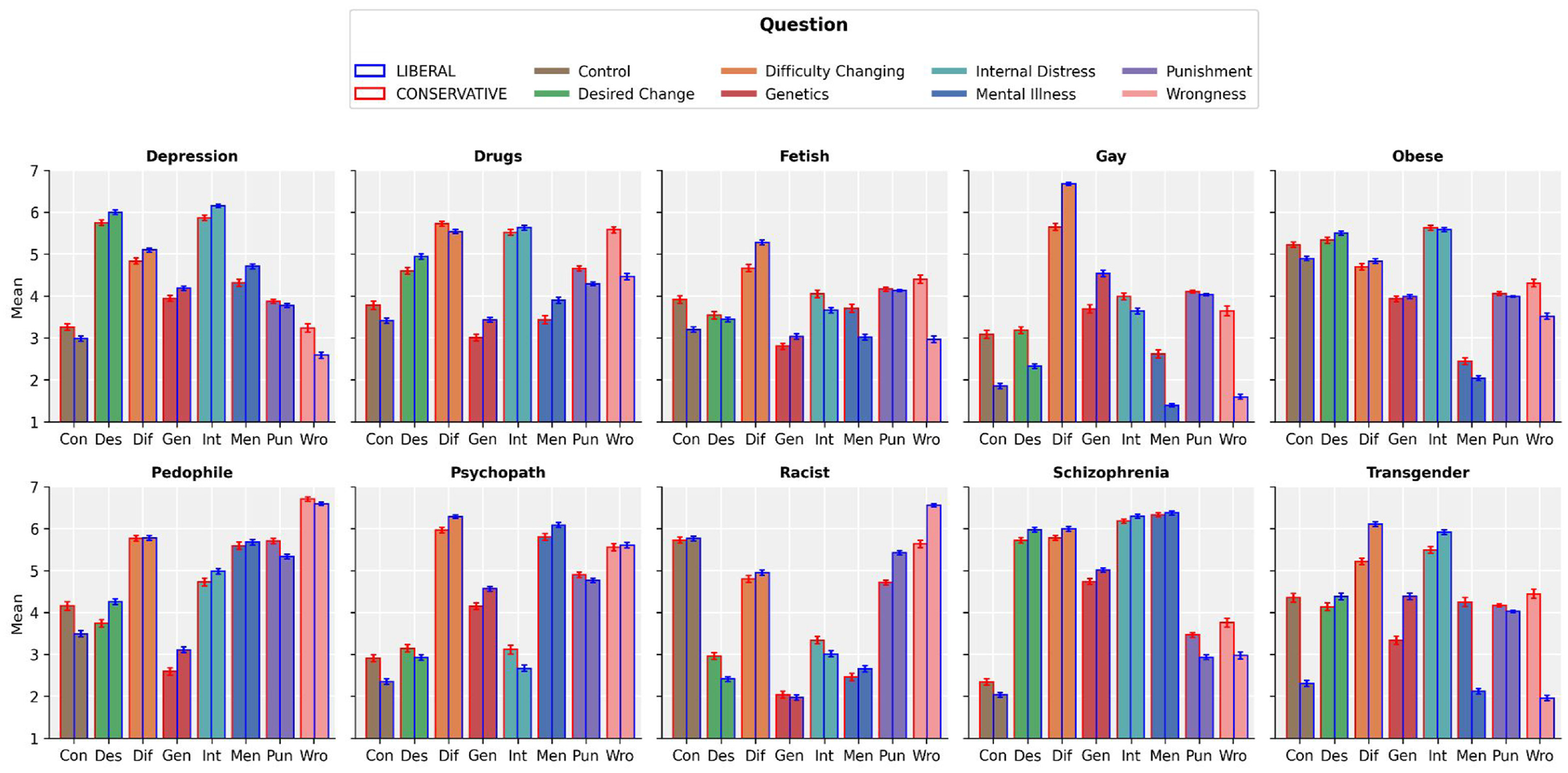
Average participant responses for each question split by political views.
Compared to liberals, conservatives viewed obesity, having a fetish, being gay, and being transgender as more of a mental illness, whereas compared to conservatives, liberals viewed depression and drug addiction as more of a mental illness. On average, conservatives tended to view most conditions as more wrong, including having a fetish, being gay, obesity, depression, drug addiction, having schizophrenia, and being transgender. There were no differences in perceived wrongness for pedophilia and psychopathy, and liberals viewed being racist as more wrong than conservatives.
Differences in endorsement of punishment were less consistent, but still, conservatives viewed drug addiction, pedophilia, schizophrenia, and being transgender as more deserving of punishment. The only condition for which liberals endorsed stronger punishment was being racist, which liberals saw as similarly wrong and deserving of punishment as pedophilia.
In general, conservatives tended to view people as having more control. This pattern was observed for having a fetish, being gay, obesity, pedophilia, psychopathy, schizophrenia, and being transgender (but not for having depression, drug addiction, or being racist). For no conditions did liberals view people as having more control.
Many of the observed differences across conditions were small. The largest differences were observed for being gay or transgender, which displayed very similar patterns: conservatives saw both conditions as more controllable, less difficult to change, less genetically caused, more wrong, and more of a mental illness. Overall, these findings appear consistent with previous work suggesting that ideological differences in blameworthiness correspond with ideological differences in perceptions of freedom and controllability (Everett et al., 2021).
Interactions between ideology and perceived wrongness
The differences between liberals and conservatives in perceptions of wrongness and perceptions of mental illness for various conditions prompted us to test the effect of interactions between political ideology and perceived wrongness on perceived mental illness. Higher perceived wrongness continued to be the largest predictor of higher perceived mental illness for pedophilia, psychopathy, being gay, having a fetish, being transgender, and obesity, with medium to large effects, semipartial rs = .24 to .57 (see Table S4).
More leftwing ideology predicted higher perceived mental illness only for drug addiction and depression, and more rightwing ideology predicted higher perceived mental illness only for being transgender, but these were small effects, semipartial rs = −.14 to .14. Significant interactions between ideology and wrongness were found only for psychopathy, being racist, and depression, but all with small effects, semipartial rs = .11 to .17.
As can be seen in Figure 3, with few exceptions, the relationships between perceived wrongness and perceived mental illness look quite similar for liberals and conservatives. Both liberals and conservatives who view pedophilia, psychopathy, being gay, having a fetish, being transgender, and obesity as more wrong also view these conditions as more of a mental illness, yet liberals and conservatives at different points along the “wrongness” continuum differ very little from one another in perceptions of mental illness. For one striking example, liberals and conservatives who view being transgender as more morally wrong are very similarly more likely to view being transgender as a mental illness, and liberals and conservatives who do not view transgenderism as morally wrong very similarly do not view it as a mental illness. In contrast, liberals differ substantially from other liberals and conservatives differ substantially from other conservatives when their perceptions of the moral wrongness of transgenderism differ. Here, it seems moral evaluations are a much better predictor than ideology of whether conditions are perceived as mental illnesses. This pattern is also reflected in the correlational matrix in Figure 1. Across conditions, ideology had almost no relationship with perceptions of a mental illness, whereas perceived moral wrongness had the strongest relationship.
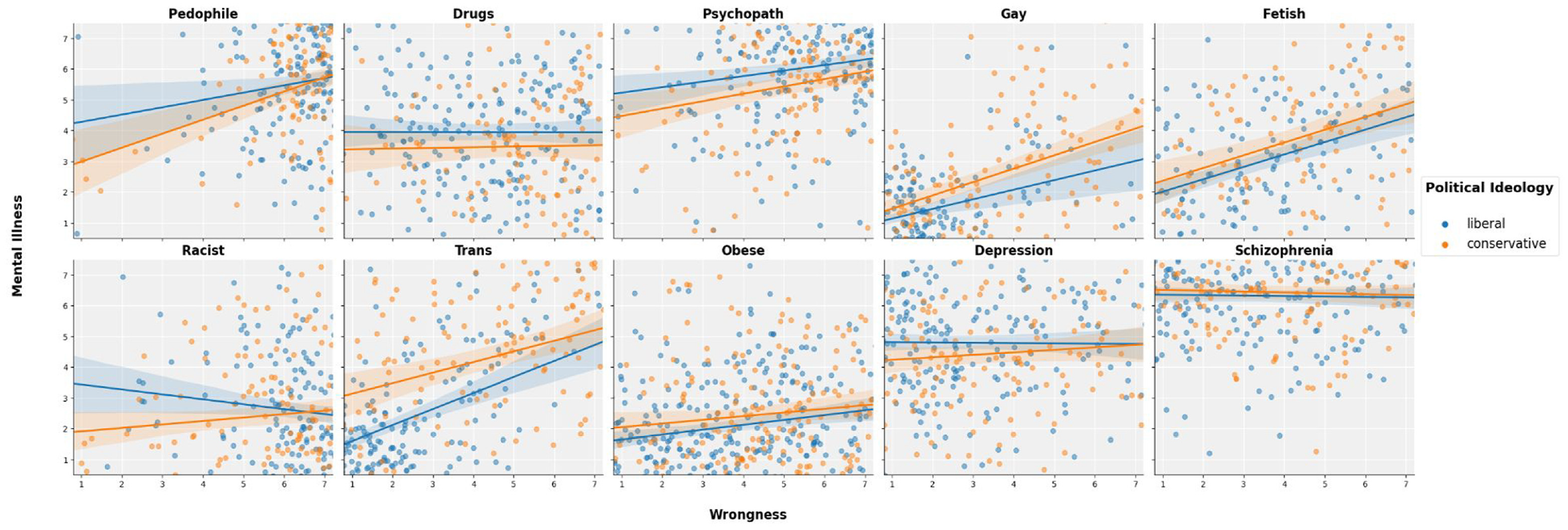
Associations between perceived moral wrongness and perceived mental illness for liberals and conservatives across all 10 conditions.
Discussion
Being able to control one’s choices and outcomes in the face of multiple possibilities is fundamental to our understanding of moral responsibility (e.g. Clark et al., 2023). Our data are consistent with this idea—when people considered a condition less controllable and more difficult to change, they morally judged the condition less harshly. Participants who viewed a condition as more of a mental disorder also tended to find the condition more difficult to change and less controllable, two evaluations that tended to be morally exonerating. Yet despite these associations, perceptions of mental illness were linked with harsher moral judgment. Indeed, across a range of conditions, perceived moral wrongness was generally the strongest predictor of attributions of mental illness.
The consistency and strength of the relationship between perceptions of mental illness and moral judgment suggest the possibility of a causal link between the two. Although the present findings cannot indicate whether such a causal relationship exists, nor the order or underlying reasons for any potential causal relationship, they do raise a number of possibilities worthy of exploration in future work. Perceptions that particular behaviors, outcomes, or conditions are immoral may drive ascriptions of mental illness as a means of pathologizing morally objectionable traits and identities (Szasz, 1960). Along similar lines, perceptions of immorality may drive ascriptions of mental illness via motivated cognition processes (e.g. Haidt, 2001; Kunda, 1990). Consistent with past research indicating that desires to justify punishment influence causal attributions (e.g. Alicke, 1992; Clark, Baumeister, & Ditto, 2017; Clark et al., 2021; Knobe, 2003; Vonasch et al., 2017), when people wish to punish a condition, they may seek to stigmatize the condition as a mental illness as means of making it seem more deviant and in need of correction. There are also other possibilities. Among norm-violating behavior, immoral behavior might be viewed as particularly deviant—it is not merely uncommon, but uncommon along an important sociomoral dimension that average people should be particularly disinclined to violate (see, e.g. Boyer, 2011). From this perspective, immoral behavior may seem indicative of mental dysfunction simply because average people would generally avoid behaving in ways that others would judge as immoral. Theories of person-centered morality (Uhlmann et al., 2015), which highlight the importance of making accurate characterological assessments, might offer a fourth explanation. Regardless of whether mental illness ought to be exonerating from a normative perspective, to the extent that those suffering from mental illness are perceived as incapable of controlling their own behavior, these individuals may be seen as unpredictable and risky social partners. Ascriptions of mental illness themselves may be a kind of (negative) moral characterological judgment that indicate a person is to be avoided. From this perspective, one might expect precisely the type of positive association between mental illness ascriptions and judgments of moral wrongness. Of course, these possible explanations are not mutually exclusive, and future research could further clarify why we observed the positive association between perceived mental illness and judgments of moral wrongness.
Future research should also seek to explore whether our findings are limited to trait-level evaluations. Our study focused exclusively on “conditions”—overall identities, orientations, and dispositions—rather than on specific behaviors, which may elicit different evaluations of personal agency. For instance, if during a particular event, an individual is perceived as mentally ill and hence lacking agency, their behavior may not face harsh moral judgment (as reflected in the legal “insanity defense”). In this case, perceived mental illness could be exonerating. On the other hand, if an overall “condition” is viewed as immoral, deviant, beyond the control of the individual, and in need of societal intervention, people may perceive that condition as a mental illness that is deserving of moral condemnation. In this case, perceived mental illness could be incriminating, consistent with our findings.
We further investigated the role of political ideology in the relationship between these constructs. Replicating previous results, our data suggest that conservatives have a higher overall tendency to moralize than liberals, and that conservatives tend to ascribe more personal control in general. Crucially, despite showing that perceptions of mental illness differed by ideology, our findings indicate that political leaning is nevertheless not a strong predictor of perceived mental dysfunction, relative to moral judgment. For instance, liberals and conservatives who considered obesity as similarly morally wrong also similarly construed it as a mental illness, suggesting that a person’s moral judgments are a better indicator of their beliefs regarding which conditions ought to be considered mental illnesses than their ideology. Future research should seek to explore these patterns outside of the United States to test if these patterns generalize to other contexts.
The strong link found between perceptions of mental illness and immorality has far-reaching implications. In courtrooms of law across the world, impaired mental functioning (and an associated lack of agency) can be used as a defense for one’s actions. Yet our research indicates that despite being linked with greater difficulty changing, more genetic causation, and less control, perceiving a condition as a mental illness is associated with harsher moral condemnation, possibly implying that mental illness is incriminating, not exonerating.
Altogether, our research suggests a striking mismatch between human intuitions that link agency with greater moral culpability, mental illness with a lack of agency, and yet mental illness with greater culpability. Understanding these perceptions will only become more critical as research continues to discover potential links between genetic factors, external environmental factors, and criminal behavior (Appelbaum, 2005; Belsky et al., 2009). We hope our findings will inspire this much needed research.
Supplemental Material
sj-docx-1-pst-10.1177_27538699241240611 – Supplemental material for Perceived mental illness is associated with judgments of less agency, yet more moral wrongness
Supplemental material, sj-docx-1-pst-10.1177_27538699241240611 for Perceived mental illness is associated with judgments of less agency, yet more moral wrongness by Charul Maheshka, Meriel Doyle, Brett Mercier, Azim Shariff and Cory J. Clark in Possibility Studies & Society
Footnotes
Declaration of conflicting interests
The author(s) declared no potential conflicts of interest with respect to the research, authorship, and/or publication of this article.
Funding
The author(s) received no financial support for the research, authorship, and/or publication of this article.
Supplemental material
Supplemental material for this article is available online.
References
Supplementary Material
Please find the following supplemental material available below.
For Open Access articles published under a Creative Commons License, all supplemental material carries the same license as the article it is associated with.
For non-Open Access articles published, all supplemental material carries a non-exclusive license, and permission requests for re-use of supplemental material or any part of supplemental material shall be sent directly to the copyright owner as specified in the copyright notice associated with the article.
