



Abstract
Hypothetical thinking is an extraordinary human ability that allows people to think beyond the facts of a situation to imagine alternative possibilities. I first consider how people understand factual conditionals, such as, ‘if there was an apple in the fruit bowl there was a banana’, then how they understand counterfactual conditionals, such as, ‘if Pearl had studied harder she would have passed the exam’, and then how they understand counterpossible conditionals, that is, conditionals about impossibilities, such as, ‘if people were made of steel they would not bruise easily’. I discuss the theory that people understand conditionals by envisaging models of possibilities, and consider experimental evidence that corroborates its predictions for factual, counterfactual, and impossible conditionals.
Hypothetical thinking is an extraordinary human ability that allows people to think beyond the facts of a situation to imagine alternative possibilities. An account of how people think about possibilities is fundamental to understanding the human mind. It requires a theory of how people think about what is, what could be, and what could not be. The study of possibilities reveals the profound ways in which human thinking is affected by awareness of imagined alternatives to reality. I focus on conditional reasoning as an illustration of the range of modal cognition. In the first section, I consider how people understand factual conditionals, such as, ‘if there was an apple in the fruit bowl there was a banana’, by envisaging models of possibilities. In the second section I discuss how people understand counterfactual conditionals, such as, ‘if Pearl had studied harder she would have passed the exam’, by envisaging dual possibilities corresponding to the conjecture and the presupposed facts. Many intriguing experimental discoveries have been made about how people think about conditionals (for a review, see Nickerson, 2015), and counterfactuals (for a review, see Byrne, 2016). They have been studied extensively in philosophy (e.g. Adams, 1975; Lewis, 1973; Stalnaker, 1968), and psychology (e.g., Evans & Over, 2004; Johnson-Laird & Byrne, 2002; Oaksford & Chater, 2007). In the third section I outline how people keep track of the epistemic status of real and counterfactual possibilities in the absence of ‘source cues’ for reality monitoring. In the final section, I sketch how people understand counterpossible conditionals, that is, conditionals about impossibilities, such as, ‘if people were made of steel they would not bruise easily’, which has received far less attention in psychology or philosophy. I argue that the ability to imagine not only what is the case, but also what could have been the case, and what could not have been the case, underlies human rationality.
Conditionals and possibilities
When people understand a conditional, such as, ‘if there was an apple in the fruit bowl there was a banana’ they mentally represent how the world would be if the assertion were true (Johnson-Laird & Byrne, 2002; Khemlani et al., 2018). They construct small scale models to simulate the description, envisaging not only what is mentioned, the apple and the banana, but also other possibilities that are consistent with the conditional. Their models are iconic, dynamic simulations of the imagined possibility, which can be captured in the following diagram:
apple banana no-apple no-banana
The diagram reflects that it is possible that there is an apple and a banana, and it is possible that there is no apple and no banana. Depending on the interpretation a person reaches of the conditional, their models may also include the possibility that there is no apple but there is a banana,
apple banana no-apple no-banana no-apple banana
People interpret conditionals in many different ways – and their understanding of them does not correspond to the truth-functional material implication of propositional logic (Johnson-Laird & Byrne, 2002).
People do not tend to think about the possibility that is ruled out as false by the conditional, that it is impossible that there is an apple and no banana in the fruit bowl. Moreover, because of the limitations of working memory, their initial mental models tend to be parsimonious, and they make explicit just a single model,
apple banana . . .
The ellipsis in the diagram indicates that there are other possibilities, which have not yet been thought about. In some cases when people learn further information, such as ‘there is an apple in the fruit bowl’, they can update their models, to identify that one of the possibilities now corresponds to a fact, and they can make a modus ponens inference, ‘there is a banana’. In other cases, they may learn further information, such as, ‘there is no banana’, that instead requires them to flesh out their initial models to be more explicit. They must mentally represent the possibility in which there is no apple and no banana, to make the modus tollens inference, ‘there is no apple’. As a result of these extra demands, people make fewer modus tollens inferences than modus ponens ones (see Nickerson, 2015). Hence the possibilities that people can think about most readily guide their inferences. The ability to imagine alternative possibilities, including counterexamples to putative conclusions, underlies the ability to establish whether a conclusion necessarily follows from premises (Johnson-Laird & Byrne, 2002). The human imagination of possibilities is thus central to rational thought.
There is as yet no consensus in psychology about how people understand and reason from conditionals. Some theorists argue that people think, not about possibilities, but about probabilities (e.g., Evans & Over, 2004; Oaksford & Chater, 2007). They compare the probability that there is a banana given there is an apple, P(B | A), to the probability that there is no banana given there is an apple, P(not-B| A), and they do not think about the situations in which there is no apple (e.g. Evans et al., 2003). Many experimental studies test the conflicting predictions of the different theories. For example, one way in which the two theories differ in their proposals about how people understand ‘if there was an apple in the fruit bowl there was a banana’ is in whether people ever think about the possibility ‘there was no apple and there was a banana’. The model theory proposes that people may flesh out their models to think about this possibility on some interpretations of the conditional, whereas the probabilist theory implies they do not think about it in their comparison of P(B | A) and P(not-B | A). In one series of experiments, people read various brief stories, say, about someone going to the grocers, and they heard a conditional during the story, such as ‘if there were apples there were bananas’. The length of time they spent reading a subsequent conjunction, such as, ‘there were apples and there were bananas’ was measured. The idea behind such studies is that the time people take to read a sentence provides a clue about whether they have already thought about the possibility it expresses. The results showed that participants were ‘primed’ by the conditional to read very quickly some conjunctions, including, ‘there were no apples and there were bananas’. The finding corroborates the model theory’s proposal that they have thought about this possibility when they understood the earlier conditional, and it goes against the probabilist proposal that they think only about the cases in which there are apples in their calculation of the probability of bananas or no bananas in that context (Espino et al., 2009). Possibilities appear to be foundational in human cognition, rather than probabilities (Byrne & Johnson-Laird, 2020).
Counterfactuals and possibilities
People often imagine how things could have turned out differently, particularly after bad outcomes, for example, after a car accident, a person may think, ‘if only Ruby hadn’t been distracted by her ‘phone, the accident wouldn’t have happened’ (e.g, Kahneman & Tversky, 1982). Such counterfactual thoughts often help people to work out the causes of outcomes (e.g., Spellman & Mandel, 1999; Frosch & Byrne, 2012). Their counterfactual thoughts about the past can be helpful in learning how to prevent bad outcomes in the future (Dixon & Byrne, 2011; Ferrante et al., 2013; Roese & Epstude, 2017).
When people understand a counterfactual conditional such as, ‘if Pearl had studied harder she would have passed the exam’, they envisage several possibilities from the outset (Byrne & Tasso, 1999; Fillenbaum, 1974). They think not only about the conjecture, Pearl studied hard and passed the exam, but they also recover the known or presupposed facts, Pearl did not study hard and did not pass the exam,
studied passed counterfactual conjecture not studied not passed presupposed facts
To fully understand a counterfactual conditional, people must not only engage in the flight of fancy required to entertain the imagined alternative to reality conjectured by the conditional, but they must also remain anchored in actual reality, they must recover the known or presumed facts against which to compare the imagined alternative. A core difference between a factual and a counterfactual conditional is that people keep in mind just a single possibility from the outset for the factual conditional whereas they think about several possibilities from the outset for a counterfactual. Hence a counterfactual can seem to mean something very different from a corresponding factual conditional (Byrne & Johnson-Laird, 2020).
One illustration of the evidence that people consider several possibilities when they understand a counterfactual, comes from eye tracking experiments (Ferguson & Sanford, 2008; Nieuwland & Martin, 2012; Orenes et al., 2022). For example, in one set of studies, participants listened to brief stories over headphones while head-mounted cameras recorded what their eyes looked at in a visual display on a computer screen. The idea behind such studies is that where people look provides a clue about what they are thinking about. Participants heard different sorts of stories, for example, one was about a person buying some fruit, and the story included a conditional, ‘If there are oranges, there are pears’. The images displayed on the screen included an image of an orange and a pear, an image of an apple and a strawberry, and images of these fruit with strike-throughs, for example,
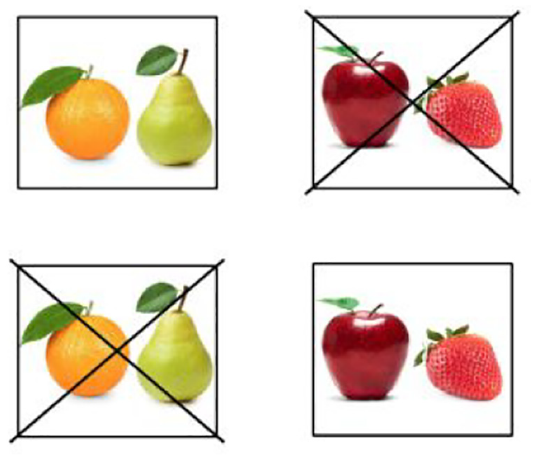
When participants heard the factual conditional, they tended to look at the image of the orange and the pear, during the ensuing few seconds. The experiment also included stories that included instead a counterfactual, ‘if there had been oranges, there would have been pears’. When participants heard the counterfactual, they tended to look at the image of the orange and the pear at the outset, but very rapidly, in a matter of a few 100 ms, they also began to look at the image of the orange and the pear with the strike-through, and thereafter during the period of measurement of a few seconds, they tended to look at both of these images (Orenes et al., 2019). The results support the idea that participants tend to think about two possibilities when they understand a counterfactual, but only one possibility at the outset when they understand a conditional. The consequences of envisaging more possibilities at the outset for a counterfactual than a factual conditional endure for more than a few seconds. For example, people make more modus tollens inferences from counterfactual conditionals compared to factual conditionals, because they have mentally represented two possibilities from the outset for the counterfactual (Byrne & Tasso, 1999).
The epistemic status of real and counterfactual possibilities
People must keep track of the epistemic status of dual possibilities when they understand a counterfactual conditional, one possibility as imagined and corresponding to a counterfactual conjecture, and the other as real and corresponding to the known or presupposed facts (Byrne, 2005). It is crucial for people to be able to distinguish facts from possibilities, and possibilities from impossibilities. Most of what is known about how people monitor what is real and what is imagined relies on the study of remembered events. People rely on many heuristic processes to engage in ‘reality monitoring’ – tracking what really happened in the external world to distinguish it from what happened only in the imagination (Garrison et al., 2017; Simons et al., 2017). They try to infer the source of their memories – the outside world or their internal thoughts – by relying on various clues. They consider contextual information about spatial or temporal details, for example, I know I went swimming this morning because I remember cycling to the sea and it was just before lunch. They rely on sensory information such as colour or pitch, for example, I remember the sea was a deep green, I recall the swishing sound of the waves, or the emotional quality of the memory, for example, I felt invigorated afterwards, and even their own awareness of their internal reasoning, for example, I found it difficult to decide whether to swim because there were jellyfish. They infer that their memory of an event is the memory of an external perception rather than a memory of internal imagination because of ‘source cues’, clues such as vividness and the availability of other details associated with the memory.
Yet people also need to distinguish reality from alternative possibilities in real time, when they engage in conversation with others or when they read what others have written, for example, when a speaker invites a listener to entertain a conjecture, or imagine a fictional world. When a speaker says, ‘if my bike had had a puncture, I would have had to stay at home instead of going swimming’, a listener can imagine the conjecture, a punctured bike and the speaker at home, and they can also recover the presupposed facts, a bike with intact tyres and the speaker going swimming. But the listener needs some means to distinguish what actually happened from what is the imagined possibility, the alternative to the facts of what happened. When a listener thinks back over the conversation, how can they distinguish which of their thoughts corresponds to what actually happened to the speaker, and which of them is an imagined possibility? There are few ‘source cues’ available from such conversational exchanges. Little is known about how people keep track of what is real from what is imagined during the immediate moment-to-moment understanding of what someone else is saying to us. One suggestion is that models of possibilities can be annotated by some sort of symbolic mental footnote to indicate their epistemic status (Johnson-Laird & Byrne, 2002),
puncture no swim counterfactual conjecture no puncture swim presupposed facts
One way to test whether people keep track of the epistemic status of models of possibilities is to examine whether people maintain access to both possibilities for a counterfactual, or whether in some circumstances they can dispense with access to one possibility and prioritise access to the other one. To fully understand an imagined alternative to reality, they must compare it to the presumed reality, but keeping multiple possibilities in mind is burdensome for working memory. A recent series of experiments examined whether during the course of hearing about an event, people continued to maintain access to both of the dual possibilities, the conjecture and the presumed facts, or whether they began to prioritise access to one possibility over the other, as they updated their understanding with further information (Espino & Byrne, 2021). When people were ‘primed’ to anticipate that a story would continue to be about the presupposed facts, they read a target description about the facts very quickly, more quickly than one about the imagined situation. The result indicates that they tended to prioritise access to their simulation of the real situation. As soon as they anticipated the story would continue about the presumed reality, they began to dispense with the imagined alternative and prioritise access to their representation of reality. In contrast, when they were primed to anticipate that a story would continue to be about the imagined alternative to reality, they read a target description about the facts and one about the imagined situation equally quickly. The result indicates that they tended to maintain access to their simulation of both the real situation and the imagined one (Espino & Byrne, 2021). Hence, markers of reality and imagined possibilities are fundamental to the fabric of mental representations, as people need to be able to distinguish their models of different sorts of possibilities.
Impossibilities
People can also think about hypothetical impossibilities, such as ‘if people were made of steel, they would not bruise easily’. Conditionals about impossibilities can seem very different from counterfactuals about matters that once were possible but are so no longer. In everyday life, ordinary reasoners rarely construct ‘miracle world’ conditionals, such as ‘if there hadn’t been gravity the airplane wouldn’t have crashed’ compared to the frequency with which they construct ‘close’ counterfactuals, such as ‘if there hadn’t been a bird strike the airplane wouldn’t have crashed’ (e.g. De Brigard et al., 2013; Kahneman & Tversky, 1982; Markman et al., 2008; Roese & Epstude, 2017).
A counterfactual’s meaning can be assessed by creating an alternative to reality, just like reality in every way, except that, for example, there is an apple in the fruit bowl. But the meaning of a conditional with an impossible conjecture, a ‘counterpossible’, may pose problems for a logic based on constructing a ‘possible world’ (e.g. Lewis, 1973; Stalnaker, 1968; see Williamson, 2018). Nonetheless, some impossible conditionals, for example, ‘if people were made of steel, they would not bruise easily’ seem true, whereas other impossible conditionals, for example, ‘if people were made of steel, they would bruise easily’ do not seem true. Since both conjectures are impossible, people cannot be made of steel, why does one seem true, and the other, not? The answer may be that people rely on their knowledge about the real world to attempt to construct a consistent simulation of an impossible conjecture and its suggested outcome, as if it were a real possibility (Byrne, 2023). The first conditional seems true because a salient property of steel is that it is hard, and hard substances do not bruise, so people can readily simulate steel-people who do not bruise. The second conditional seems false because people cannot construct a consistent simulation given their real-world knowledge. Hence, people may think about impossibilities just as they do possibilities, by attempting to construct a consistent simulation of the impossible conjecture with its suggested outcome, informed by their knowledge of the real world.
Strikingly, some impossible conditionals, for example, ‘if Plato were identical to Timaeus, he would not have a small nose’, seem true with either outcome, such as, ‘if Plato were identical to Timaeus, he would have a small nose’. Knowledge of the real world does not eliminate either outcome as a possibility, because the sizes of Plato’s or Timaeus’s noses are unknown. People can simulate a Timaeus-like Plato with a big nose, and equally, a Timaeus-like Plato with a small nose. Both outcomes seem true because people can construct a consistent simulation of either one of them. There is as yet no consensus on whether all impossible conditionals should be considered true with both outcomes, that is, logically vacuous (e.g., Williamson, 2018), or whether some are true with only one outcome, and accordingly, helpful in, say, scientific theorising (e.g., Berto et al., 2018; Brogaard & Salerno, 2013; Wilson, 2018). However, experimental evidence indicates that people tend to judge some impossible conditionals, such as the steel-people one, as true for only one outcome (Byrne, 2023). Nonetheless, they are capable of judging other impossible conditionals, such as the Plato’s nose one, as true with either outcome. The result goes against the idea that people judge impossible conditionals as true with only one outcome because they succumb to a cognitive bias based on calculating conditional probability, which prevents them from recognising that impossible conditionals can be true with both outcomes (cf. Williamson, 2018). It suggests that whether an impossible conditional is considered true or not depends on its simulation consistent with knowledge of the real world. There is relatively little known about how people imagine impossibilities, and why they do so, and further research on imagined impossibilities is a promising future direction.
Conclusions
People possess the remarkable capacity to think not only about facts in the past, present or future, but also to imagine possibilities and impossibilities. Their understanding and reasoning with conditionals provides an illustration of such modal cognition. They understand factual conditionals, such as ‘if there was an apple in the fruit bowl there was a banana’, by envisaging models of possibilities, and their ability to make rational inferences depends on their ability to imagine alternative possibilities, including counterexamples to putative conclusions. They understand counterfactual conditionals, such as ‘if Pearl had studied harder she would have passed the exam’, by envisaging dual possibilities corresponding to the conjecture and the presupposed facts, and they keep track of the epistemic status of real and counterfactual possibilities. They also understand conditionals about impossibilities, such as ‘if people were made of steel they would not bruise easily’, by relying on their knowledge about the real world to construct a consistent simulation of the impossible conjecture and its outcome, as if it were a real possibility. The focus of the study of possibility on how people think about what could be, and what could not be, as well as what is, reveals the profound ways in which human thinking is affected by awareness of possibilities. One challenge for studies of possibility in the future includes consideration of how constraints on our imagination of what could and could not be, may impose limits on our ability to make rational judgements about what is.
Footnotes
Declaration of conflicting interests
The author declared no potential conflicts of interest with respect to the research, authorship, and/or publication of this article.
Funding
The author received no financial support for the research, authorship, and/or publication of this article.
