




Abstract
Preparing paramedic students for demanding and unpredictable care contexts requires the development of competencies such as emotional intelligence and compassion, particularly in relation to emotional regulation, interpersonal interactions, and decision-making. This descriptive correlational study aimed to examine the relationship between emotional intelligence and compassion among paramedic students, explore the associations between the subdimensions of emotional intelligence and compassion, and determine which emotional intelligence dimensions explain variance in compassion levels. The study included 113 paramedic students. Data were collected using a Personal Information Form, the Trait Emotional Intelligence Questionnaire-Short Form (TEIQue-SF), and the Compassion Scale (CS). Descriptive statistics and simple and multiple linear regression analyses were performed. The results showed that paramedic students demonstrated a high level of compassion (102.12 ± 10.00). Emotional intelligence was significantly associated with compassion and its subdimensions (p < 0.001), explaining a substantial proportion of the variance. These findings indicate that emotional intelligence is a relevant psychological characteristic associated with compassion among paramedic students. From an educational perspective, the observed associations suggest that emotional intelligence training may emerge as an important focus to bolster compassionate capacities among paramedic students. Further research could examine its relevance for curriculum design.
Keywords
Introduction
A paramedic is a healthcare professional who delivers, most commonly, paramedicine services across prehospital, community and other healthcare settings. Paramedics assess and interpret patients’ clinical condition through a comprehensive assessment that includes physiological, psychological and contextual factors, including vital signs as key indicators of clinical condition, and initiate appropriate interventions using approved medications, medical devices and clinical judgment to support patient stabilization and safe transfer to healthcare facilities.1–3 Their role extends beyond technical interventions to include rapid clinical decision-making, coordination with multidisciplinary teams and adaptive care in unpredictable and high-pressure environments. Beyond technical competence, paramedics are also required to regulate their own emotional responses while responding to the distress, fear and uncertainty experienced by patients and their families. 3
Emotions play a central role in shaping individuals’ perceptions, judgments and behaviours, particularly in high-stress clinical environments such as prehospital emergency care. Emotional awareness enables healthcare professionals to respond appropriately to complex and emotionally charged situations. In paramedicine, where unpredictable conditions, limited resources and exposure to trauma are common, effective emotional regulation is especially critical.1–6
Emotional intelligence refers to the ability to recognize, understand and manage one's own emotions as well as those of others, and to use this emotional information to guide thinking and behavior. 3 Individuals with higher emotional intelligence are better able to cope with stress, regulate impulses and mood, demonstrate compassion and maintain motivation and hope in challenging circumstances.5–9 These competencies are particularly relevant for paramedics, whose roles require not only rapid decision-making but also the ability to manage emotions effectively and demonstrate interpersonal sensitivity in crises.6–9
Compassion, defined as a humane sensitivity to the suffering of others accompanied by a motivation to alleviate that suffering, is a fundamental component of ethical and patient-centred care.5–9 In paramedic practice, compassion supports humane interactions during moments of acute vulnerability, even when clinical decisions must be made rapidly. However, the manifestation of compassion in paramedicine may differ from that in hospital-based professions, given the unique environmental, temporal and emotional demands of prehospital care.6,8
Emotional intelligence is closely related to compassion and may facilitate compassionate responses. It is widely recognized as an important emotional foundation of compassionate care.5,8–13 Through compassion, individuals become more attuned to the needs and emotional states of others, enabling more sensitive and supportive responses.
While emotional intelligence and compassion have been extensively examined in nursing, medicine and social work, these constructs have often been studied in parallel rather than through a clearly articulated theoretical relationship. Therefore, caution is required when extrapolating these findings to paramedicine, as paramedics operate within distinct clinical, organizational and situational contexts.9–15
Nevertheless, emotional intelligence and compassion appear to play important and complementary roles in guiding paramedics' clinical judgment, communication, psychological support, and emotional awareness.7–11
In this context, emotional intelligence may be considered a contributing factor in the development and expression of compassion, as the ability to recognize, understand and regulate emotions can facilitate compassionate responses in clinical practice.
Evaluating and strengthening emotional intelligence and compassion during paramedic education may contribute to both professional development and the quality of emergency healthcare services.7–9 Paramedic students must acquire not only technical skills but also the capacity to maintain emotional balance, uphold professional values and deliver compassionate care in unpredictable and high-pressure environments.16,17 However, in many paramedic education programs, emotional intelligence and compassion are not addressed through structured or explicitly defined curricular components, but are instead assumed to develop implicitly through clinical exposure and professional socialization. Accordingly, the present study does not evaluate the impact of formal training, but rather examines existing emotional intelligence and compassion levels within the current educational context.7–17
Although numerous studies have examined emotional intelligence and compassion among nurses and physicians, there remains a notable gap in the literature concerning paramedics, who often serve as the first point of contact in emergency healthcare.1–14 The limited evidence regarding how emotional intelligence relates to compassion within paramedicine highlights the need for profession-specific research grounded in paramedic education rather than inference from other health professions.5–12
Accordingly, the present study aimed to examine the relationship between emotional intelligence and compassion levels among paramedic students, explore the associations between the subdimensions of emotional intelligence and compassion, and determine which emotional intelligence dimensions explain variance in compassion levels within this student population. By explicitly defining these aims, the study seeks to contribute empirical evidence specific to paramedic education without inferring causal effects or presuming the presence or effectiveness of structured emotional intelligence training.
Methods
Study design
This study was designed as a descriptive and correlational investigation to examine the relationship between emotional intelligence characteristics and compassion levels among paramedic students. The study population consisted of 122 paramedic students enrolled at the Niğde Zübeyde Hanım Vocational School of Health Services during the 2021–2022 academic year, and the data were collected between 10 May and 30 June 2022. Given the relatively small and accessible population, a full enumeration sampling strategy was adopted.
Students who declined to participate (n = 5), who were absent during the data collection period (n = 2), or submitted incomplete or incorrectly completed questionnaires (n = 2) were excluded. As a result, data were obtained from 113 students, corresponding to 92.6% of the target population.
At the time of data collection, paramedic students reported that the current undergraduate paramedic curriculum did not include any formal or structured training specifically targeting emotional intelligence, emotional regulation or compassion. No dedicated courses or systematic educational content addressing these competencies were offered within the curriculum. Therefore, students’ emotional intelligence and compassion levels reflected individual characteristics rather than the influence of formal curricular training.
Data collection instruments
The Personal Information Form was developed based on the relevant literature3,5,7 and expert consultation to describe the sample and to examine potential associations between sociodemographic variables and the main study variables. Although a formal pilot test was not conducted, the items were reviewed for clarity and face validity by academics experienced in paramedic education prior to data collection. The form included eight questions related to paramedic students’ age, gender, and reasons for choosing the paramedic profession.
The TEIQue-SF was developed by Petrides and Furnham and consists of 20 items. 18 It was selected to assess paramedic students’ global emotional intelligence as an independent variable in the present study. The Turkish validity and reliability study was conducted by Deniz et al. 5 The TEIQue-SF has been psychometrically validated in undergraduate students. 5 The scale uses a seven-point Likert format ranging from 1 (strongly disagree) to 7 (strongly agree), with higher scores indicating higher emotional intelligence. The possible total score range of the TEIQue-SF is 20–140. In our study, the internal consistency of the scale was acceptable, with a Cronbach's alpha coefficient of 0.80.
CS was developed by Pommier and consists of 24 items. 19 The Turkish validity and reliability study was conducted by Akdeniz and Deniz. 20 A total of 949 undergraduate students participated in the validity and reliability study. The scale comprises six subdimensions: kindness, indifference, common humanity, separation, mindfulness and disengagement, and is scored on a five-point Likert scale ranging from 1 (never) to 5 (always). CS was used as the dependent variable to measure the level of compassion among paramedic students. The possible total score range of the CS is 24–120. Higher scores indicate higher levels of compassion. In our study, the Cronbach's alpha coefficient was 0.83, indicating good internal reliability.
Data collection procedure
Data were collected using a structured self-report survey administered under standardized conditions. The purpose of the study was explained to all paramedic students, and verbal informed consent was obtained prior to participation. All data were collected using self-report questionnaires administered by the researchers under standardized conditions.
Data analysis
Statistical analyses were conducted to examine the relationship between emotional intelligence and compassion levels among paramedic students. Data were analyzed using IBM SPSS Statistics version 24.0. Descriptive statistics (frequency, percentage, mean and standard deviation) were calculated to summarize paramedic students’ sociodemographic characteristics and scale scores.
Prior to inferential analyses, the distributional properties of the scale scores were examined. Normality of continuous variables was assessed using the Shapiro–Wilk test, which is recommended for small to moderate sample sizes and provides robust sensitivity in detecting deviations from normality. In addition, skewness and kurtosis values were inspected to further evaluate distributional assumptions.
The results indicated that the scale scores demonstrated approximately normal distributions, supporting the use of parametric statistical methods. Accordingly, the assumptions of linear regression, including normality of residuals, linearity, homoscedasticity and absence of multicollinearity, were evaluated and met.
To examine the predictive effect of emotional intelligence on compassion, simple and multiple linear regression analyses were performed. Given that the outcome variable was continuous and met the assumptions required for linear regression, data transformation or alternative regression models were not deemed necessary.
Cronbach's alpha coefficients were calculated to assess the internal consistency of the measurement tools. A p-value of less than 0.05 was considered statistically significant.
Ethical considerations
The study was conducted after obtaining approval from the Nigde Omer Halisdemir University Ethics Committee (Meeting Date: 28 April 2022, Decision No: 2022/05-22) and institutional permission from the relevant vocational school. Participation was voluntary, and all students were informed about the purpose and procedures of the study prior to providing informed consent. Participant anonymity was ensured by collecting data without any personally identifiable information. Questionnaires were completed voluntarily and anonymously, and no identifying codes were used. All collected data were stored in password-protected electronic files accessible only to the researchers and were used solely for research purposes.
Results
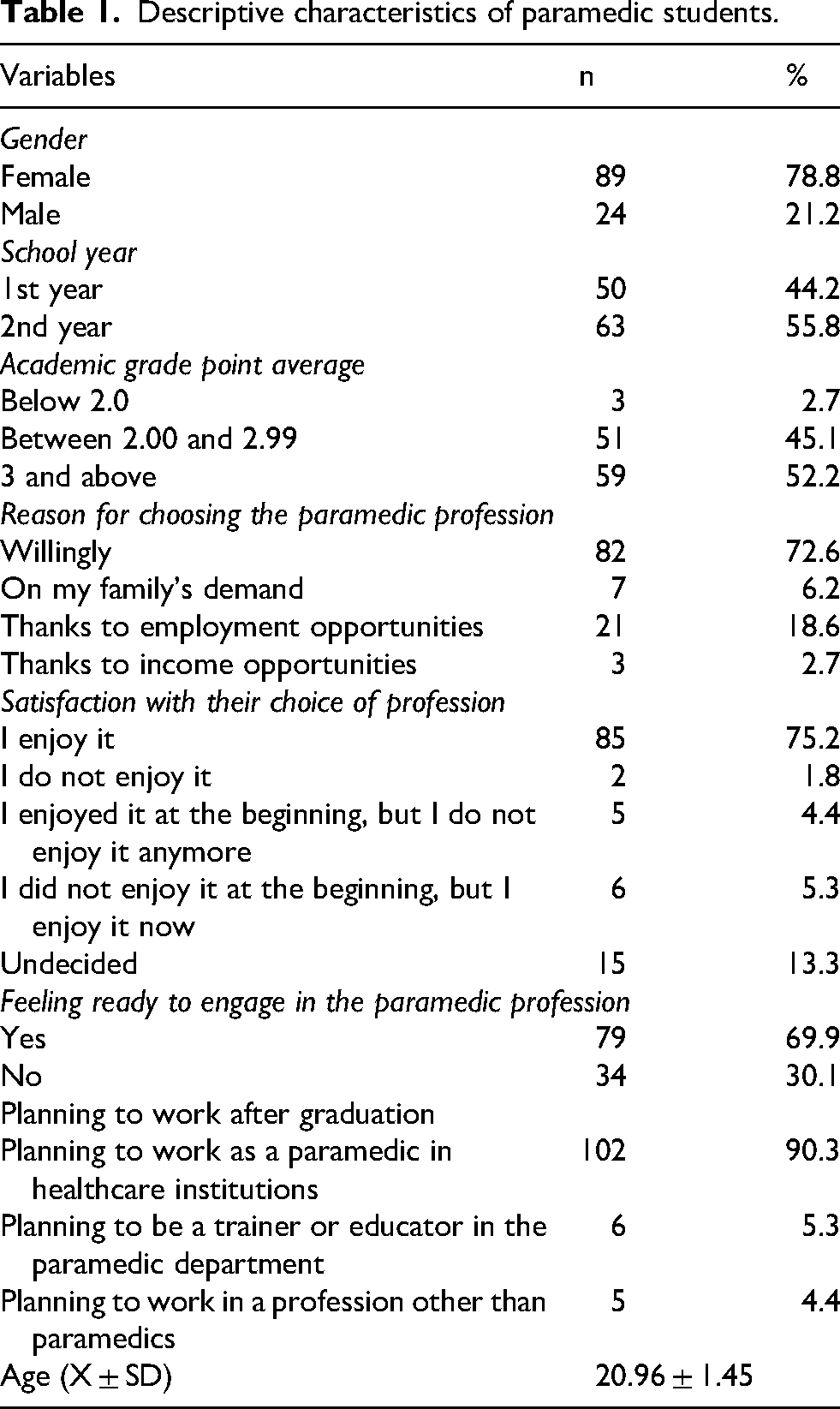
The results are based on data obtained from 113 paramedic students (n = 113). The mean age of the paramedic students was 20.96 ± 1.45 years. Of the students, 78.8% were female and 55.8% were second-year students. In terms of academic performance, 52.2% had a grade point average of 3.00 or higher.
Regarding professional orientation, 72.6% of the students reported that they had willingly chosen the paramedic program, 75.2% stated that they enjoyed studying paramedics and 69.9% felt ready to practice the profession. Additionally, 90.3% indicated that they intended to work as paramedics in healthcare institutions after graduation (Table 1).
Descriptive characteristics of paramedic students.
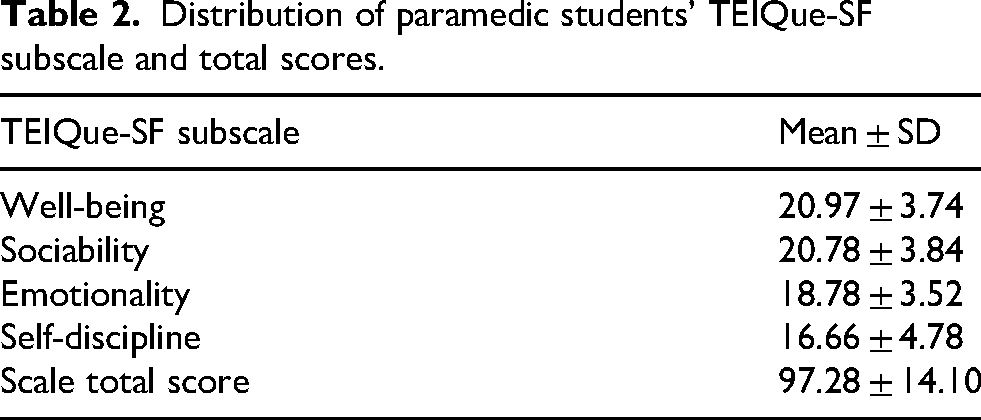
The mean total score on the TEIQue-SF was 97.28 ± 14.10. Among the TEIQue-SF subscales, the lowest mean score was observed for self-discipline (16.66 ± 4.78), whereas the highest mean score was found for well-being (20.97 ± 3.74) (Table 2). These values indicate moderate to high levels of emotional intelligence among the paramedic students (Table 2).
Distribution of paramedic students’ TEIQue-SF subscale and total scores.
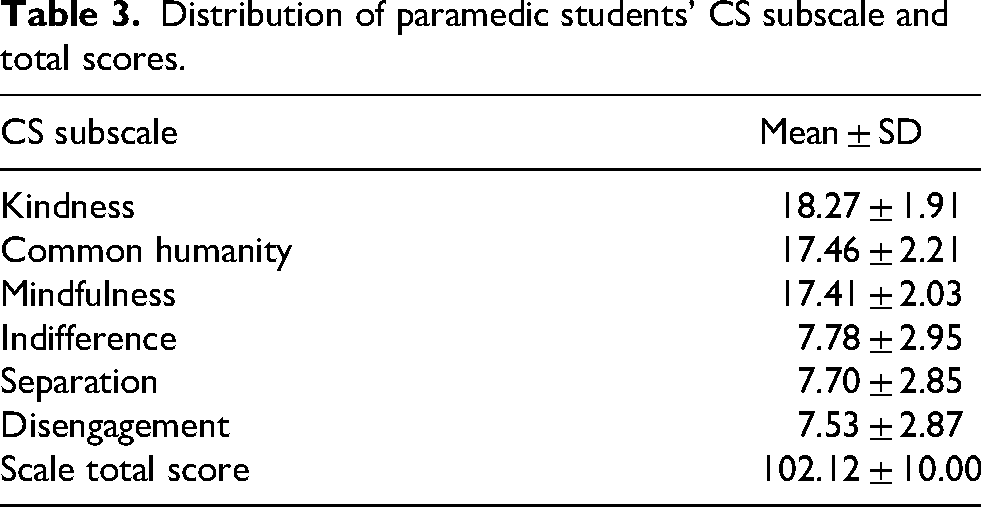
The mean total score on the CS was 102.12 ± 10.00, suggesting a high level of compassion when considering the possible score range of the scale (Table 3). Among the compassion subdimensions, students obtained the lowest mean score on disengagement and the highest mean score on kindness.
Distribution of paramedic students’ CS subscale and total scores.
Higher emotional intelligence scores were also inversely associated with lower levels of the compassion subscales of indifference, separation and disengagement.
Regression analyses were conducted to address the primary objective of the study, namely, to determine the effect of emotional intelligence on compassion levels among paramedic students. Emotional intelligence was found to significantly predict compassion (p < 0.001), and the regression model was statistically significant (F = 116.732, p < 0.001) (Table 4). The standardized beta coefficient for emotional intelligence was 0.716, indicating that higher emotional intelligence was associated with higher levels of compassion. The TEIQue-SF total score explained 51.3% of the variance in compassion levels among students (R2 = 0.513).
Regression analysis results on the effects of TEIQue-SF and subscales on CS.
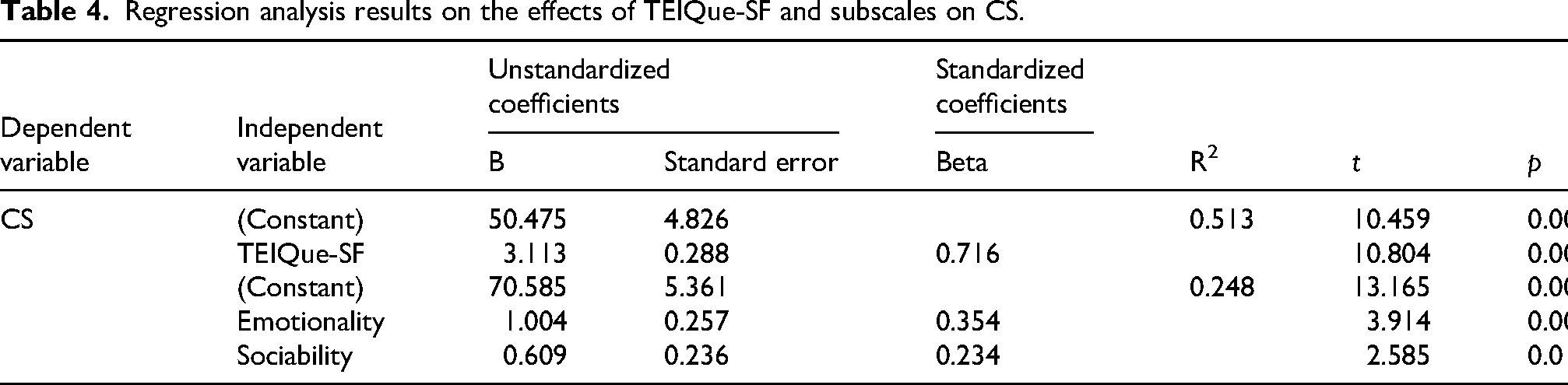
In a subsequent analysis examining the predictive role of emotional intelligence subdimensions, the model was also statistically significant (F = 9.404, p < 0.001). Emotionality (β = 0.354) and sociability (β = 0.234) together explained 24.8% of the variance in compassion levels (R2 = 0.248) (Table 4).
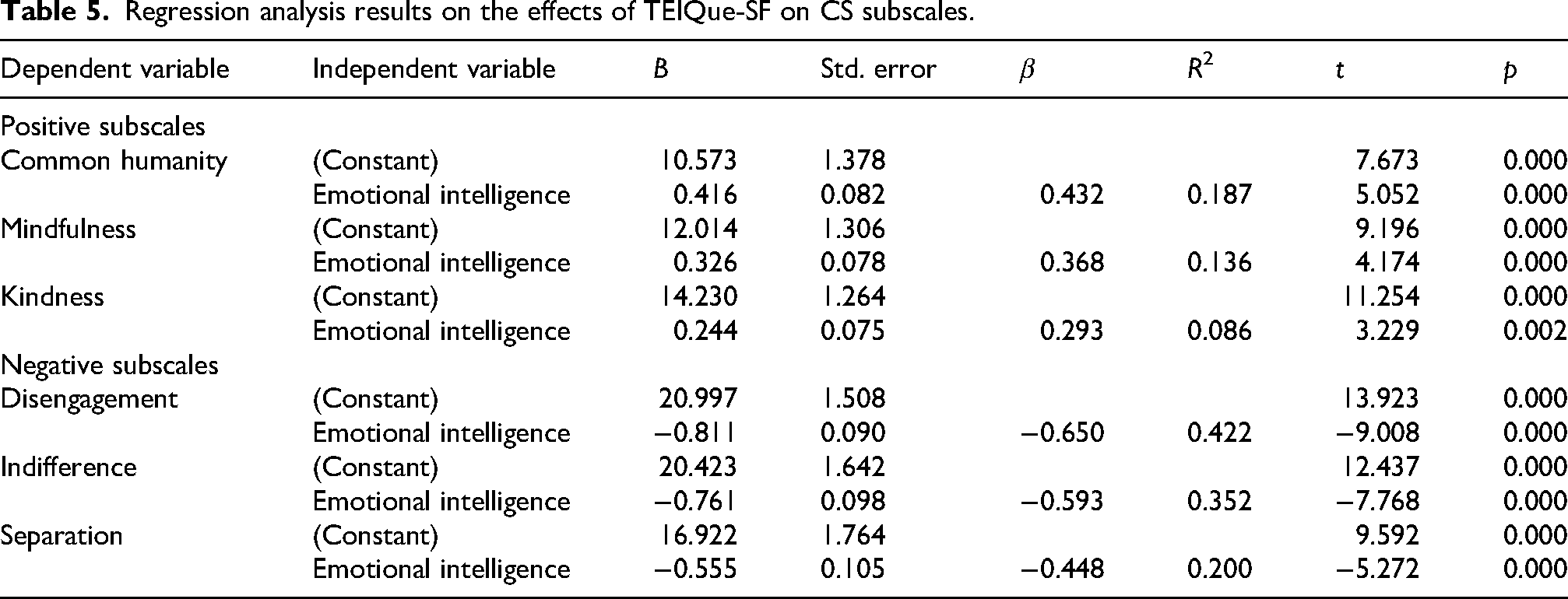
Further regression analyses demonstrated that emotional intelligence significantly predicted all subdimensions of compassion (p < 0.001), and all corresponding models were statistically significant (Table 4). Higher emotional intelligence scores were associated with increased kindness (β = 0.293), common humanity (β = 0.432), and mindfulness (β = 0.368), while lower levels of indifference (β = −0.593), separation (β = −0.448), and disengagement (β = −0.650) were observed.
These findings indicate that emotional intelligence plays a substantial role in explaining both overall compassion and its specific dimensions among paramedic students (Table 5).
Regression analysis results on the effects of TEIQue-SF on CS subscales.
Discussion
The primary objective of this study was to examine the relationship between emotional intelligence and compassion levels among paramedic students, a group that has received limited attention in the existing literature. The findings demonstrated that emotional intelligence significantly explained compassion and its subdimensions, indicating that higher emotional intelligence is associated with higher compassion among paramedic students. By directly addressing this relationship, the study responds to the identified research gap concerning the unknown relationship between emotional intelligence and compassion within paramedic education. Compassion plays a central role in patient healthcare professional interactions and is associated with increased patient satisfaction and improved health outcomes.21–23 While much of the existing evidence regarding compassion and emotional intelligence is derived from nursing and medicine, the present study extends these findings to paramedic students, acknowledging the distinct nature of paramedicine. Unlike hospital-based professions, paramedics are often exposed to unpredictable, high-pressure and emotionally intense environments, which may increase the relevance of emotional awareness and compassionate engagement.
The results showed that paramedic students’ emotional intelligence characteristics explained 51.3% of the variance in compassion levels. This finding suggests that emotional intelligence may be associated with compassionate attitudes during professional training. However, when emotional intelligence was examined at the subdimension level, emotionality and sociability explained a smaller proportion of the variance in compassion. This indicates that specific emotional competencies may play a more prominent role in the development of compassion among students.
Similar findings have been reported in previous studies conducted with nurses and nursing students. Beauvais et al. (2018) 16 found that nurses with higher emotional intelligence levels demonstrated higher compassion toward patients. Kim et al. 24 suggested that compassion may be related to higher well-being and lower burnout among nurses, although the cross-sectional design limits causal interpretation. Although these studies were conducted in different professional contexts, they support the notion that emotional intelligence contributes to compassionate attitudes and emotional well-being in healthcare providers. Given the demanding and high-risk conditions under which paramedics operate, initiatives aimed at enhancing emotional intelligence and compassion may be associated with improved emotional well-being and potentially lower levels of emotional exhaustion and burnout. 24 However, existing evidence primarily suggests associative relationships, and further longitudinal and interventional studies are needed to clarify the extent of these effects.
The present study further demonstrated that emotional intelligence significantly explained all subdimensions of compassion. Higher emotional intelligence was associated with increased kindness, common humanity and mindfulness, and with decreased indifference, separation and disengagement. Compassion involves the capacity to emotionally perceive another person's suffering and the motivation to alleviate that suffering. Emotional intelligence, through its association with emotional awareness and regulation, may be related to higher levels of these compassion subdimensions and improved interpersonal interactions.17,20–27
Previous studies have consistently reported associations between emotional intelligence and behaviors that promote positive interpersonal relationships and the well-being of others.24,26 In addition, several studies have identified a positive relationship between emotional intelligence and compassion.17,20–27 Hajibabaee et al. 27 found a strong positive relationship between emotional intelligence and compassion among nursing students, suggesting that emotionally intelligent individuals are better able to communicate effectively and manage emotions in clinical settings. The findings of the present study are consistent with these results and support those reported by Perez-Fuentes et al. 17
Educational interventions have been shown to enhance emotional intelligence in healthcare students. Goudarzian et al. 28 demonstrated that emotional intelligence levels increased among nursing students following a structured educational program focusing on compassion and emotional intelligence. Although the present study did not include an intervention component, the findings suggest that similar educational approaches may be beneficial in paramedic education.
Importantly, as this study was conducted with paramedic students rather than practicing paramedics, the findings should be interpreted in the context of professional preparation rather than clinical performance. Nevertheless, the results highlight the potential value of incorporating emotional intelligence-focused training into paramedic curricula to support the development of compassionate, emotionally competent future paramedics.
Limitations
This study has several limitations that should be considered when interpreting the findings. The cross-sectional and correlational design precludes any causal inferences regarding the relationship between emotional intelligence and compassion; therefore, the results reflect associations rather than directional or causal effects. In addition, the sample consisted of paramedic students from a single vocational school, which may limit the generalizability of the findings to other educational settings or regions. Although basic demographic variables such as age and gender were reported, other potentially relevant characteristics, such as prior clinical experience, socioeconomic background, or exposure to emotionally demanding events, were not assessed. Moreover, while age and gender were described, the study did not examine whether emotional intelligence or compassion levels varied across these variables; exploring such differences could provide valuable insights into potential developmental or demographic influences.
Another limitation concerns the timing of data collection, which took place in 2022 and may raise questions regarding temporal relevance. However, emotional intelligence and compassion are relatively stable constructs that are not expected to change substantially over short periods, and no major curricular or structural changes related to these competencies in paramedic education occurred during this time. Finally, all data were collected using self-report instruments, which may be subject to response bias and social desirability effects. Future research using longitudinal designs, multi-centre samples, and mixed-method approaches would help to address these limitations and provide a more comprehensive understanding of the relationship between emotional intelligence and compassion among paramedic students.
Conclusion
This study demonstrated that emotional intelligence is significantly associated with compassion levels among paramedic students. The findings indicate that higher emotional intelligence corresponds to higher compassion within this student population. Given that the participants were paramedic students, the results should be interpreted within the context of professional preparation rather than clinical practice. While the students exhibited relatively high levels of emotional intelligence and compassion, the observed relationship between these constructs suggests that emotional competencies may be an important psychological characteristic during paramedic training.
Although the present study did not evaluate educational interventions, the findings highlight emotional intelligence as a relevant attribute linked to compassion among paramedic students. From an educational perspective, this association may inform future research exploring whether and how emotional intelligence can be supported or sustained throughout paramedic education and early professional practice. Overall, the study contributes profession-specific evidence by clarifying the relationship between emotional intelligence and compassion among paramedic students and may serve as a foundation for further empirical research focusing on emotional competencies during training.
Footnotes
Acknowledgement
We would like to thank all paramedic students involved in the study.

Ethical approval
The study was started after an ethics committee approval was obtained from the Niğde Ömer Halisdemir University Ethics Committee (Meeting Date: 28 April 2022, Decision No: 2022/05-22), and an institutional permission was granted from the institution where the study was conducted. The purpose of the study was explained to the paramedic students who agreed to participate in the study, and their informed consent was obtained.
Author contributions
Kezban Koraş Sözen (KKS) and Tuğba Aydemir (TA) contributed to the conception and design of this study; KKS and TA collected the data of the study; TA performed the statistical analysis of the manuscript; KKS and TA critically reviewed the manuscript and supervised the whole study process. All authors read and approved the final manuscript.
Funding
The authors received no financial support for the research, authorship, and/or publication of this article.
Declaration of conflicting interests
The authors declared no potential conflicts of interest with respect to the research, authorship, and/or publication of this article.
Data availability statement
The datasets generated during and/or analysed during the current study are not publicly available due to the protection of personal data of participants, but are available from the corresponding author on reasonable request.