




Abstract
Attrition and certification failure remain persistent challenges in paramedic education, reducing workforce readiness and straining training programs. Despite widespread use of selective admissions criteria, little empirical evidence exists regarding the predictive validity of selective admissions examinations in paramedicine. The aim of this study is to evaluate whether preadmission academic performance and scores on the Fisdap Paramedic Entrance Exam predict successful program completion and first-attempt certification. A repeated cross-sectional study was conducted using records from one paramedic program (N = 109). Program completion was defined as on-time graduation with first-attempt success on the NREMT examination. Three logistic regression models were tested: academic predictors, Fisdap entrance exam subscales, and a combined model. Model performance was evaluated using likelihood-ratio chi-square tests, Nagelkerke R2, and AUC. Both the academic model (R2 = 0.15; AUC = 0.69, 95% CI [0.57–0.81]; LR χ2(4) = 11.19, p = 0.025) and the Fisdap model (R2 = 0.28; AUC = 0.77, 95% CI [0.68–0.87]; LR χ2(3) = 21.59, p < 0.001) were statistically significant. Institutional grade point average (GPA) and anatomy grade positively predicted completion in the academic model, while only the reading subscale was a significant positive predictor in the Fisdap model. In the combined model (R2 = 0.26; AUC = 0.77, 95% CI [0.68–0.86]; LR χ2(2) = 19.79, p < 0.001), the Fisdap composite score remained a significant positive predictor, whereas the GPA did not. The combined model demonstrated a sensitivity of 0.81 and a specificity of 0.43. Entrance exam performance, particularly reading comprehension, demonstrated moderate predictive validity beyond prior academic achievement and showed stronger associations with program completion than did institutional GPA. These findings support using cognitive entrance exam data to assess readiness and complement holistic admissions processes in paramedic education. Multi-site studies are needed to confirm generalizability and refine evidence-based selection and support practices.
Keywords
Introduction
Attrition remains a persistent concern in paramedic education. National estimates from the United States suggest that roughly one-quarter to one-third of students enrolled in a paramedic program do not complete the program,1,2 and of those who do graduate, an additional 11–18% do not obtain initial certification on the National Registry of Emergency Medical Technicians (NREMT) paramedic certification examination. 2 This represents a substantial loss of workforce potential during the educational pipeline, with consequences for both program resources and the broader emergency medical services (EMS) labor market. Although this study uses US data, the problem of paramedic attrition and workforce loss is internationally recognized, with similar pressures reported across Australia, Canada, and the United Kingdom. 3
In response to concerns about attrition and first-time certification pass rates, program directors and accrediting bodies have considered the role of admissions practices in identifying students most likely to succeed. While selective admissions requirements such as prior EMS experience or oral interviews are commonly employed, empirical evidence on their predictive validity remains limited. The Committee on Accreditation of Educational Programs for the EMS Professions (CoAEMSP) and NREMT highlighted admissions practices as an area of potential leverage for improving retention and certification outcomes. 4 However, the independent predictive value of specific preadmission measures, particularly standardized entrance exams, has not been rigorously tested within paramedic education.
Much of the available literature on predictors of paramedic student success is outdated, only tangentially relevant, or examines paramedic students outside of the United States. Early studies examined factors such as program accreditation status 5 or instructor qualifications, high school class rank, and student demographic characteristics including age, race, and sex. 6 A 2006 study of prehospital care students at an Australian university found that students with higher university admission exam scores or previous health-related experiences were more likely to pass their first year, 7 while a 2011 Australian study found scores on university admission exam and mature student entry were associated with greater success in paramedic students’ first year bioscience. 8
While informative, these studies did not directly evaluate standardized paramedic entrance exam scores. Recent research in the United States surveyed 645 program directors (288 responded) and provided descriptive insight into admissions practices. 9 Among those who responded, 185 programs reported selective admissions. The most frequent selection processes included oral interviews (n = 115), standardized academic test scores (n = 111), and prior EMS experience (n = 101); only 31 programs reported requiring an entrance exam. Although the author examined instructor-to-student ratio, prior academic experience, and selective admissions as correlates of retention in paramedic programs, the study's analytic approach was limited to nonparametric median tests, preventing conclusions about predictive validity. There are a few extant research abstracts examining the relationship between paramedic program entrance exams and paramedic student outcomes.10–15 These abstracts provide support for a positive association between entrance exam scores and paramedic student success; however, few peer-reviewed studies have established the predictive validity of these instruments. More recent reporting suggests that cognitive entry requirements may be more widely used in US paramedic programs than earlier survey data indicated, underscoring the importance of empirically evaluating how such criteria relate to meaningful educational outcomes. 16
By contrast, research in other health professions has demonstrated the utility of objective cognitive measures in admissions. Nursing programs widely employ instruments such as the Health Education Systems, Inc. Admission Assessment (HESI A2), Test of Essential Academic Skills (TEAS), or Kaplan Nursing School Admission Test, many of which have been repeatedly validated as predictors of academic performance and licensure success.17–22 Nursing programs have also examined other cognitive indicators, such as grade point average (GPA), as correlates of successful program and licensure completion.23–26
In medicine, the Medical College Admission Test (MCAT) remains a nearly universal prerequisite and has demonstrated moderate predictive validity for medical school performance and licensing examination outcomes. A recent systematic review and meta-analysis 27 reported consistent, though bounded, associations between MCAT scores and United States Medical Licensing Examination performance, alongside substantial heterogeneity and methodological limitations. Together, these findings illustrate that standardized cognitive admission measures can provide meaningful, though incomplete, information about subsequent academic success.
Similar patterns have been reported in other healthcare education contexts, including pharmaceutical studies, respiratory therapy, and radiography programs, where entrance exam performance has been associated with outcomes such as reduced attrition, successful program completion, or attainment of certification or licensure,18,28,29 though effect sizes and evidentiary strength vary.
Nursing literature has also distinguished between “rational” selection models, in which admissions committees rely on subjective evaluations, and “statistical” models, in which empirically validated predictors such as GPA and standardized test scores drive decisions. 30 Evidence consistently suggests that statistical models outperform rational approaches in forecasting student success. 31 Without evaluative validation efforts in paramedic education, programs may be over-reliant on subjective judgment despite the known inconsistency and bias of unaided human decision-making. 32
Entry requirements and paramedic program outcomes
Some evidence suggests that minimum entry requirements may influence certification outcomes in paramedic education. Mougey et al. 33 speculated that inadequate admissions standards contribute to reduced NREMT pass rates, and data shared by CoAEMSP and NREMT in a conference presentation 34 have shown that programs without selective admissions experience higher attrition. Yet these claims have not been substantiated by predictive modeling of standardized measures such as entrance exam scores or GPA.
Study purpose and research questions
Taken together, the literature underscores a clear gap. Although attrition and certification failure remain pressing issues, and while other health professions have established predictive value for standardized entrance exams, there is little recent empirical evidence about the role of such exams in paramedic education. The present study addresses this gap by evaluating whether the cognitive admissions criteria of (a) entrance exam scores on the Fisdap Paramedic Entrance Exam, a commercially available paramedic program entrance exam, and (b) preadmission academic performance predict timely program completion and first-attempt success on the NREMT paramedic certification examination. Specifically, the current research aims to answer the following research questions:
To what extent does prior academic performance (grades in prerequisite courses and preadmission institutional GPA) predict student success in a paramedic program? To what extent do scores on the anatomy & physiology, math, and/or reading subscales of the Fisdap Paramedic Entrance Exam predict student success in a paramedic program? In a combined model, to what extent does a Fisdap composite score and/or preadmission institutional GPA predict student success in a paramedic program?
Methods
Design and participants
This study used a repeated cross-sectional design to examine predictors of paramedic program completion. De-identified data were obtained from a single paramedic program in the Midwestern United States. The study site was a community college-based paramedic program operating within the decentralized US paramedic education system, in which program structure and admissions practices can vary substantially across institutions and states. 3 The program uses selective admissions criteria, including minimum academic thresholds and a standardized cognitive assessment, to establish baseline readiness for entry. Applicants are scored using these criteria, but admissions primarily function as a threshold process, with ranking applied only when applicant volume exceeds available capacity. As is common in US paramedic education, cohort size and applicant volume fluctuated across years, and detailed applicant-to-admission ratios were not consistently available for analysis. This admissions context reflects the locally governed nature of paramedic programs in the United States.
The dataset included records from all students enrolled in the paramedic program between 2019 and 2024, representing multiple entry cohorts over this five-year period and yielding a total sample of 109 students. Data were extracted retrospectively from administrative records following program completion and certification outcomes. Cases with incomplete data for the variables of interest were excluded listwise. Additionally, two students without available anatomy grades and four without physiology grades were excluded from the academic predictors model; these omissions reflected unavailable transcript data rather than outcome-related missingness. Final analytic sample sizes varied slightly by model (range: 93–109) due to available Fisdap or academic data. To protect anonymity, only aggregate demographic data were reported.
Theoretical framework
The Geometric Model of Student Persistence and Achievement 35 provides a useful framework for interpreting these findings. The model conceptualizes student retention as the interaction of academic, environmental, and social-psychological factors. In practice, admissions committees primarily have access only to cognitive and academic indicators, whereas environmental and psychosocial variables typically emerge later and are more difficult to quantify during admissions decision-making.
Accordingly, this study focused on academic preparedness indicators (institutional GPA and prerequisite coursework) and cognitive readiness indicators (entrance exam subscales) as the variables most relevant to evidence-informed admissions decisions in paramedic education. Environmental and social-psychological factors were recognized as important influences on completion but were beyond the scope of this study.
Measures
Program completion (outcome variable)
Program completion was coded dichotomously (1 = successful, 0 = unsuccessful). A student was classified as successful if they (a) completed the program on time by passing each course on the first attempt and (b) passed the NREMT exam on the first attempt.
Academic predictors
Four academic variables were extracted from institutional transcripts: cumulative institutional GPA and final grades in anatomy, physiology, and EMS essentials. Institutional GPA reflected all coursework completed prior to entry into the paramedic program and was recorded on a 4.0 scale. Although institutional GPA was not used as a formal admissions criterion at the study site, it was included as an exploratory predictor to evaluate whether broader academic performance contributed incremental information beyond prerequisite coursework.
Anatomy and physiology were introductory, college-level human anatomy and human physiology courses completed prior to program entry. These courses were transferable and were not required to be taken at the admitting institution. Minimum grades in anatomy, physiology, and EMS essentials (C or higher) were required for admission, and letter grades were converted to a numeric scale (A = 4, B = 3, C = 2) for analysis.
EMS essentials is a program-specific preparatory course completed prior to entry into the paramedic program. The course is designed to orient students to foundational EMS concepts, operational expectations, and preparatory material relevant to paramedic training. Although EMS essentials is not a standardized international course, it functions at the study institution as an admissions prerequisite intended to establish baseline readiness. It was included in the present analysis because it represents a formal component of the program's admissions process and may capture early indicators of academic engagement or preparedness relevant to subsequent program completion.
Entrance exam predictors
Cognitive aptitude was measured using scores from the Fisdap Paramedic Entrance Exam, a commercially available assessment used by some US paramedic education programs as part of admissions or pre-matriculation screening. Beyond admissions testing, Fisdap functions as a centralized educational platform that supports cognitive assessment, skills tracking, and clinical and field internship documentation across the duration of paramedic training. While neither CoAEMSP nor NREMT mandates the use of a specific entrance examination, programs may elect to use commercially available tools such as Fisdap to support local admissions decisions and to maintain continuity between pre-admission assessment and ongoing academic and clinical performance monitoring. In the present study, the Fisdap Paramedic Entrance Exam was selected because it was the standardized cognitive admissions instrument in routine use at the study institution during the study period.
The Fisdap Paramedic Entrance Exam includes four subscales—anatomy & physiology, math, reading, and EMT. To remain aligned with the theoretical framework of this study, the EMT subscale was excluded from all analyses to focus on general cognitive predictors of program success rather than on prior EMS training. Each subscale is scored on a 0–100 scale. The exam's internal structure has been examined in Fisdap's technical analyses, which demonstrated unidimensionality for the anatomy, physiology, and reading subscales and a weaker fit for the math subscale. 36
Fisdap does not report a composite entrance exam score. For exploratory purposes, the present study constructed an author-derived composite Fisdap score by calculating the mean of the three included subscales. The composite score was used solely in the combined model to evaluate whether aggregated entrance exam performance on general cognitive scales demonstrated incremental predictive validity beyond institutional GPA.
Data preparation
Missing data patterns were examined by constructing binary indicators of data availability (available vs missing) for Fisdap entrance exam scores and EMS essentials grades. Chi-square tests were used to evaluate associations between data availability and program completion status. Results were nonsignificant (all p > 0.30), indicating that missingness was not related to completion outcome. Missing cases were thus deleted listwise for the relevant analyses. 37 Continuous predictors were screened for range accuracy and outliers before analysis.
Statistical analysis
Three binary logistic regression models were conducted:
Academic model: Institutional GPA and anatomy, physiology, and EMS essentials grades as predictors. Entrance exam model: Fisdap anatomy & physiology, math, and reading subscale scores as predictors. Combined model: Institutional GPA and Fisdap composite score to evaluate incremental predictive validity of the entrance exam beyond prior academic performance.
Statistical analyses were performed in JASP (Version 0.95.4). Model significance was tested with likelihood-ratio chi-square statistics. Goodness-of-fit was examined using Nagelkerke R2 and classification accuracy, and model discrimination was assessed using the area under the ROC curve (AUC). Confidence intervals for AUC were computed using R (Version 4.5.1). Statistical significance was set at α = 0.05 (two-tailed). This study is reported in accordance with the STROBE cohort checklist. 38
Ethics
The study was approved by the institutional review board at the author's institution, which granted a waiver of informed consent for the use of de-identified archival student records.
Results
Descriptive statistics
The dataset included 109 students who were enrolled between 2019 and 2024. Enrollment per cohort ranged from 14 to 24 students (see Table 1). The overall sample was 47.7% male (n = 52) and 52.3% female (n = 57). Sex and cohort information were used for descriptive purposes only and were excluded from regression analyses to maintain anonymity and to avoid unstable subgroup estimates.
Enrollment by cohort year.
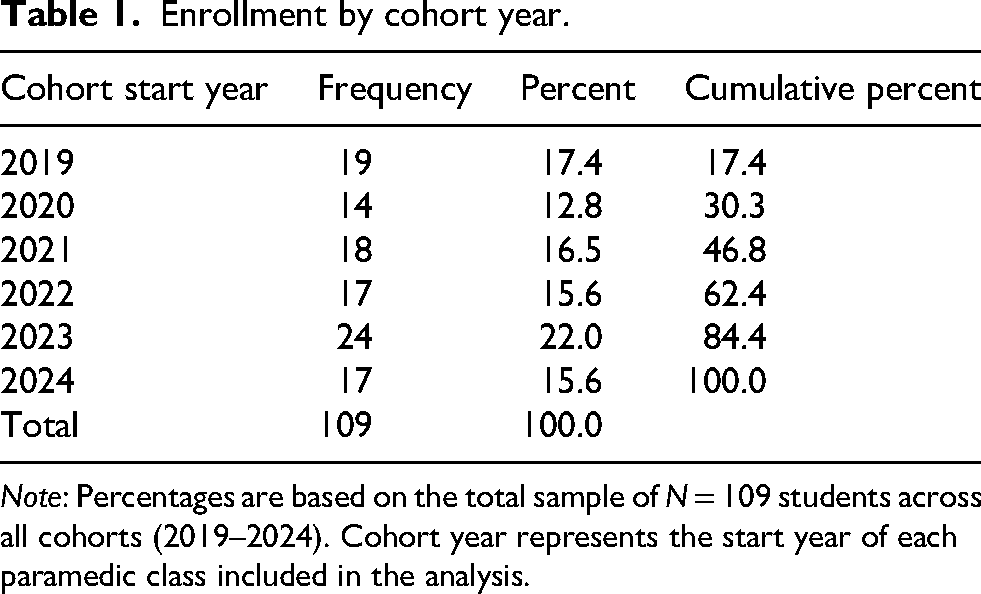
Note: Percentages are based on the total sample of N = 109 students across all cohorts (2019–2024). Cohort year represents the start year of each paramedic class included in the analysis.
Mean institutional GPA prior to program entry was 3.29 (SD = 0.55). The mean Fisdap composite score, calculated as the mean of the three subscales, was 81.46 (SD = 4.24), with subscale means ranging from 79.77 to 83.34. Average prerequisite course grades were 3.40 on a 4-point scale.
Preliminary analyses and assumption checks
All assumptions for binary logistic regression were evaluated and met. The outcome variable was dichotomous, cases were independent, and the ratio of cases to predictors exceeded a recommended minimum of 10 events per predictor except for the Academic Predictors model, which had about eight events per predictor, suggesting cautious interpretation of individual course predictors. However, such minor deviations may be considered acceptable when model fit is adequate. 39
Descriptive statistics for all predictor variables are presented in Table 2. Among academic predictors, preliminary correlations among institutional GPA and grades in anatomy, physiology, and EMS essentials ranged from r = 0.36 to 0.75 (all p < 0.001), consistent with shared measurement of academic preparedness.
Descriptive statistics for continuous variables.
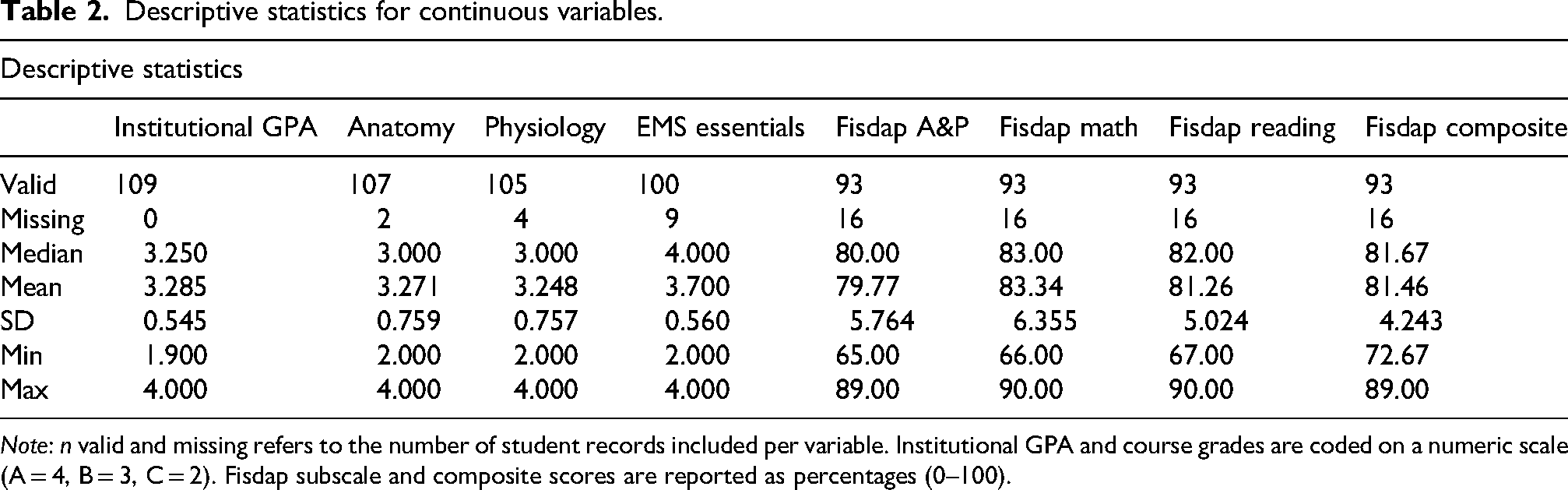
Note: n valid and missing refers to the number of student records included per variable. Institutional GPA and course grades are coded on a numeric scale (A = 4, B = 3, C = 2). Fisdap subscale and composite scores are reported as percentages (0–100).
Bivariate correlations among the Fisdap reading, math, and anatomy & physiology subscales ranged from r = 0.28 to 0.37 (all p < 0.01), indicating moderate associations and confirming that the subscales assess related but distinct cognitive domains. Each subscale was also significantly correlated with program completion (r = 0.29–0.40, all p < 0.01). No outliers or evidence of complete separation were observed. Cronbach's α was calculated to estimate reliability across subscales, yielding a modest coefficient (α = 0.59, 95% CI [0.44, 0.73]). Because item-level data were not available, this estimate reflects internal consistency at the subscale level rather than reliability of individual exam items and is reported descriptively.
Academic predictors
For the academic predictors model, cases with incomplete data for anatomy, physiology, or EMS essentials grades were excluded via listwise deletion, yielding an analytic sample of n = 95. Missing grades primarily reflected unavailable pre-program academic records during early program implementation.
A binary logistic regression evaluated whether academic variables predicted program completion. The overall model was statistically significant, χ2(4) = 11.19, p = 0.025, explaining 15.3% of the variance in completion (Nagelkerke R2 = .15) and correctly classifying 67.4% of cases. Two predictors were significant: anatomy grade (p = 0.018, OR = 0.37, 95% CI [0.16–0.85]) and institutional GPA (p = 0.029, OR = 5.28, 95% CI [1.19–23.42]). Physiology and EMS essentials grades were nonsignificant after controlling for the other academic variables. Model discrimination was acceptable (AUC = 0.69, 95% CI [0.57–0.81]). At a probability threshold of 0.50, the academic model demonstrated a sensitivity of 0.87 and a specificity of 0.30 (Table 3).
Model 1: academic model.
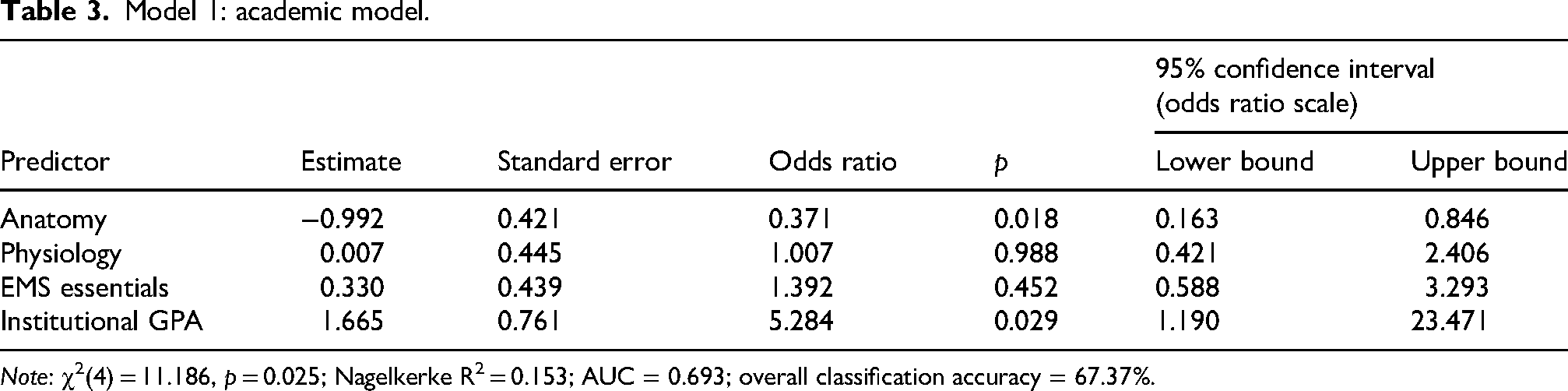
Note: χ2(4) = 11.186, p = 0.025; Nagelkerke R2 = 0.153; AUC = 0.693; overall classification accuracy = 67.37%.
Fisdap subscales
For the entrance exam model, cases without available Fisdap entrance exam records were excluded via listwise deletion, yielding an analytic sample of n = 93. The reduced sample size reflected missing vendor records, which occurred for a subset of students during data extraction.
A logistic regression tested whether Fisdap subscale scores predicted program completion. The overall model was significant, χ2(3) = 21.59, p < 0.001, explaining 28.2% of the variance in completion status (Nagelkerke R2 = 0.28) and correctly classifying 69.9% of cases. Among subscales, only reading was significant (p = 0.007, OR = 1.16, 95% CI [1.04, 1.29]), indicating that higher reading scores were associated with greater odds of completion. Math and anatomy & physiology subscales were nonsignificant after controlling for reading. Model discrimination was acceptable (AUC = 0.77; 95% CI [0.68–0.87]), indicating that predicted probabilities correctly distinguished completers from non-completers about 77% of the time. At a probability threshold of 0.50, the entrance exam model demonstrated a sensitivity of 0.83 and a specificity of 0.49 (Table 4).
Model 2: entrance exam model.
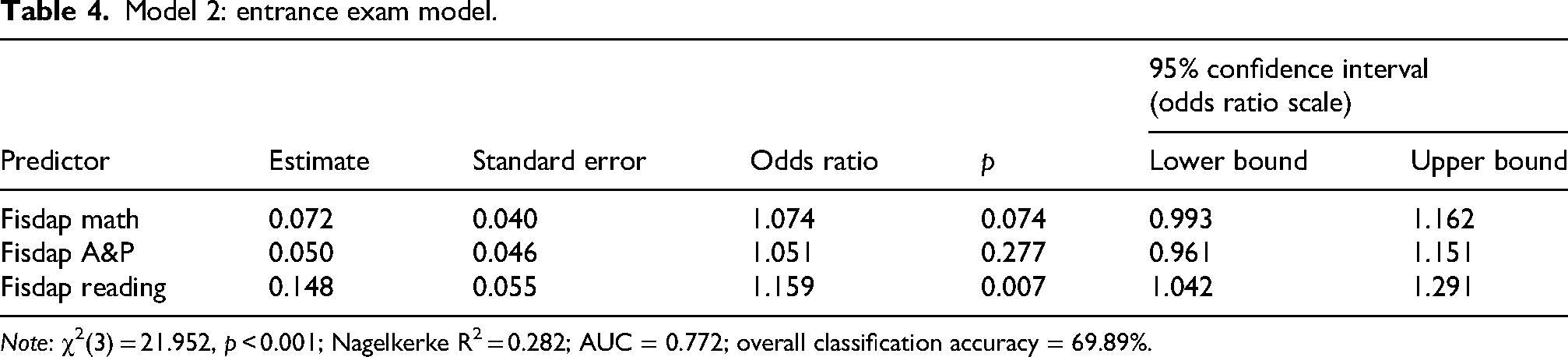
Note: χ2(3) = 21.952, p < 0.001; Nagelkerke R2 = 0.282; AUC = 0.772; overall classification accuracy = 69.89%.
Combined model
A combined logistic regression including both institutional GPA and Fisdap composite score significantly predicted program completion, χ2(2, n = 93) = 19.79, p < 0.001, explaining 26.1% of the variance (Nagelkerke R2 = 0.26) and correctly classifying 66.7% of cases. Within the model, only the Fisdap composite was significant (p < 0.001, OR = 1.29, 95% CI [1.13–1.46]), indicating that higher Fisdap performance was associated with greater odds of program completion. Institutional GPA was a nonsignificant predictor (p = 0.96). Model discrimination remained acceptable (AUC = 0.77; 95% CI [0.68–0.86]). At a probability threshold of 0.50, the combined model demonstrated a sensitivity of 0.81 and a specificity of 0.43 (Table 5).
Model 3: combined model.
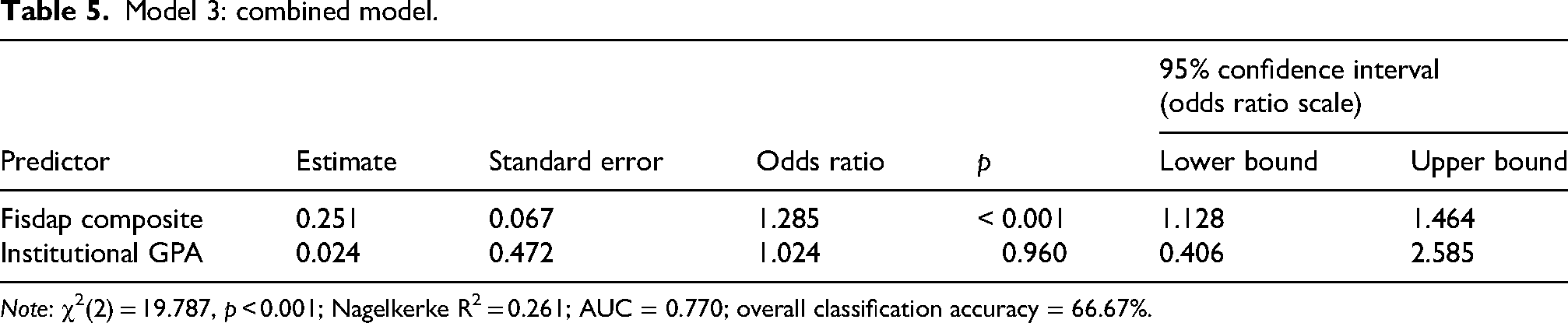
Note: χ2(2) = 19.787, p < 0.001; Nagelkerke R2 = 0.261; AUC = 0.770; overall classification accuracy = 66.67%.
Discussion
When Fisdap subscales were analyzed, the model was significant, but only the reading subscale contributed uniquely. For each one-point increase in reading score, the odds of completing the program increased by about 16%. The math and anatomy & physiology subscales were not significant predictors. These results suggest that performance on a reading assessment may be a meaningful contributor to evidence-based program admission criteria.
In the academic model, institutional GPA showed a strong positive association with completion (OR ≈ 5.3). For each one-point increase in institutional GPA, the odds of completing the program increased by more than five times. Anatomy grade also entered as significant with an odds ratio < 1; given the moderate correlations among academic indicators, this likely reflects a suppression effect from shared variance with GPA rather than a true negative relationship. The slightly lower events per predictor may also have contributed to this effect. The results of this analysis suggest that institutional GPA may be a meaningful contributor to program admission criteria.
In the combined model, the Fisdap composite remained significant while GPA did not, indicating incremental predictive validity for the entrance exam and explaining roughly one-quarter of the variance in completion. Each one-point increase in the Fisdap composite score increased the odds of completing the program by about 29%. Institutional GPA, however, did not contribute uniquely once Fisdap performance was considered. The results of this analysis suggest that scores on an entrance exam may capture aspects of readiness not reflected in institutional GPA alone when used as a part of program admission criteria.
The overall pattern suggests that entrance exam performance captures readiness factors that extend beyond prior academic achievement as reflected in GPA. Whereas GPA represents sustained classroom performance across diverse subjects, Fisdap subscales may index domain-specific cognitive abilities—reading comprehension, applied science reasoning, and quantitative processing—that more directly align with paramedic program demands. The results provide preliminary evidence of incremental predictive validity for the Fisdap Paramedic Entrance Exam: it predicts program completion even after accounting for students’ overall academic record.
Practically, these findings support the judicious use of standardized entrance assessments as one component of a multifactorial admissions process. However, GPA and course grades should not be dismissed; rather, they may serve as complementary indicators of persistence and study discipline, while entrance exams provide a snapshot of cognitive readiness. Replication with larger and multi-site samples will be needed to confirm whether this pattern generalized across programs and exam versions.
Although this study was conducted within a US paramedic education context, its implications extend beyond a single national system. In health professions education broadly, educators must make admissions and support decisions under conditions of constrained training capacity and variable student preparedness. The present findings suggest that early, standardized cognitive indicators may provide information about educational persistence not fully captured by prior coursework alone. For an international audience, the relevance of this study lies not in the adoption of a particular entrance examination, but in the broader principle of empirically evaluating admissions criteria against meaningful program outcomes.
This study contributes to early empirical evidence regarding the extent to which paramedic program admission criteria such as scores on an entrance exam and academic performance are associated with successful program completion as defined by on-time graduation with first-attempt NREMT paramedic certification success. Other available research from abstracts published in the Prehospital Care Research Forum has also found a positive association between entrance exam scores (Fisdap and HOBET) and successful program outcomes.11,15 However, there remains a severe lack of empirical evidence to inform the use of cognitive factors such as prior academic performance and entrance exam performance to inform paramedic program admissions criteria.
These findings have practical implications for paramedic program admissions and early student support. The significant association between entrance exam reading scores and program completion suggests that general verbal reasoning and comprehension skills may play a foundational role in students’ ability to navigate complex medical material, written protocols, and case documentation. Programs that use cognitive entrance exams may wish to emphasize reading and information-processing domains when interpreting results, while recognizing that no single subscale should serve as a sole admission gatekeeper. Instead, entrance exam data could be used formatively to identify applicants who might benefit from early literacy or study-strategy support, rather than punitively as exclusion criteria. At a broader level, the results reinforce the value of ongoing validation studies to ensure that selection tools in EMS education predict meaningful outcomes and promote equitable access to the profession. Ultimately, these findings may help to ameliorate the workforce shortage in EMS by providing a first step toward defining empirically supported selective admission criteria which may help to reduce paramedic program attrition and increase NREMT paramedic certification examination success rates.
Limitations
This single-site study limits generalizability; institutional grading standards, pedagogy, and student demographics may differ elsewhere. Although missing data were minimal and not associated with program completion, listwise deletion reduced the sample size and may have modestly affected statistical power. The entrance-exam data were collected over multiple cohort years, and minor variations in exam administration or preparatory curriculum cannot be entirely ruled out.
Several academic predictors were measured on restricted ordinal scales. Final grades in anatomy, physiology, and EMS essentials were coded on a limited range (2–4), reflecting program admission requirements that mandate a minimum grade for entry. As a result, variability in these predictors was constrained, with standard deviations less than one, which may have reduced statistical power to detect associations. Thus, nonsignificant or unstable effects for individual course grades should be interpreted cautiously, as they may reflect measurement limitations rather than absence of predictive relevance.
Notably, the study period overlapped with the COVID-19 pandemic, during which there were significant shifts in educational practices. Because the analyses relied on retrospective administrative data, program-level indicators of pandemic-related disruption (e.g. shifts to remote instruction, altered clinical requirements, or cohort-specific stressors) were not available and therefore could not be modeled directly. Consequently, the reported associations reflect aggregate predictive relationships across cohorts and should be interpreted with appropriate contextual caution.
Logistic regression models identify associations rather than casual relationships; while the Fisdap composite score was associated with program completion, it should not be interpreted as a causal determinant of student success. Important noncognitive factors (e.g. psychosocial supports, work hours, financial stress) were not measured and may influence outcomes. This study does not evaluate the fairness, demographic bias, or access implications of entrance examinations, which require separate analysis.
To date, little peer-reviewed research has examined the psychometric properties of the Fisdap Paramedic Entrance Exam. Few published studies have reported reliability or validity evidence for this instrument. Accordingly, the present findings should be interpreted as preliminary evidence of predictive validity rather than as a comprehensive evaluation of the exam's measurement quality. Additional studies examining internal structure, fairness, and reliability across diverse samples are needed to further establish the exam's psychometric characteristics.
Conclusions
This study aimed to answer three research questions. Regarding the first research question of prior academic performance, the study found that prior academic performance, particularly institutional GPA, was a significant, moderate predictor of student success in a paramedic program. For the second research question, Fisdap Paramedic Entrance Exam subscale scores, particularly in reading, were a significant and moderate predictor of student success in a paramedic program. For the third research question, Fisdap composite scores were significant and moderate predictors of paramedic student success while institutional GPA did not contribute to the regression model.
This single-site study provides preliminary evidence that performance on the Fisdap Paramedic Entrance Exam, particularly the reading subscale, is associated with successful completion of a paramedic education program as defined by timely program completion and first-attempt NREMT paramedic certification examination pass. While prior academic indicators such as institutional GPA showed some predictive value, entrance exam performance demonstrated stronger and more consistent relationships with completion outcomes. Together, these findings support evidence-informed use of entrance-exam data to understand cognitive readiness, complementing (not replacing) holistic admissions processes for paramedic education, with potential downstream implications for workforce sustainability. This serves as a foundation step for future research to replicate these analyses with larger, multi-site samples and across additional entrance exam instruments to confirm generalizability and refine evidence-based selection and support practices in EMS education.
Footnotes

Ethical considerations
This study was approved by the Institutional Review Board at Ozarks Technical Community College.
Consent to participate
The Institutional Review Board approved a waiver of informed consent due to the use of de-identified retrospective data.
Author contribution(s)
Funding
The author received no financial support for the research, authorship, and/or publication of this article.
Declaration of conflicting interests
The author declared no potential conflicts of interest with respect to the research, authorship, and/or publication of this article.
Data availability statement
The datasets generated and analyzed during the current study are not publicly available due to institutional and ethical restrictions related to the use of de-identified educational records under FERPA and the conditions of Institutional Review Board approval. Aggregate data are included in the manuscript. Further information may be requested from the corresponding author, subject to institutional approval.